Each year, ~1000 infants in the United States of America are born with hypoplastic left heart syndrome.Reference Hoffman and Kaplan 1 , Reference Reller, Strickland, Riehle-Colarusso, Mahle and Correa 2 Hypoplastic left heart syndrome is one of the most severe cardiac defects amenable to surgical palliation, and accounts for up to 25% of neonatal deaths associated with cardiac disease.Reference Grossfeld 3 Infants with hypoplastic left heart syndrome often experience profound feeding difficulties, which contribute significantly to growth failure, morbidity, and mortality.Reference Davis, Davis and Cotman 4 – Reference Skinner, Halstead, Rubinstein, Atz, Andrews and Bradley 7 The phenomenon of feeding difficulties in this population is not well understood, however, and no research has examined the physiological and behavioural responses of these infants to different oral feeding methods.
Feeding is a physiologically expensive event requiring coordination of sucking and swallowing with respiration to achieve nutritional intake while maintaining adequate oxygenation. When infants experience difficulty with bottle feeding, one of the most commonly used strategies involves changing the type of bottle nipple, and thus the rate of milk flow. Altering the rate of milk flow has been shown to affect the physiological state during feeding in healthy, term infantsReference Al-Sayed, Schrank and Thach 8 and infants born prematurely,Reference Kao, Lin and Chang 9 , Reference Mathew 10 but it remains unknown how infants with hypoplastic left heart syndrome respond to different flow rates.
In healthy infants, increased milk flow results in increased rate of consumption at the expense of decreasing ventilation.Reference Al-Sayed, Schrank and Thach 8 During swallowing, the airway must close to prevent aspiration of fluid. As flow rate increases and swallowing necessarily increases, the duration of airway closure also increases.Reference Al-Sayed, Schrank and Thach 8 The healthy infant with normal cardiorespiratory functioning is able to quickly recover from this decrease in ventilation by increasing respiratory rate and tidal volume to maintain adequate oxygenation.Reference Mathew 11 The healthy, full-term infant is also capable of self-regulating the rate of milk flow during bottle feeding by altering sucking rateReference Schrank, Al-Sayed, Beahm and Thach 12 and pressure,Reference Colley and Creamer 13 , Reference Mathew, Belan and Thoppil 14 allowing the infant to regulate the effect of flow on ventilation.
Premature infants who have compromised respiratory function and immature neurological and respiratory systems have been found to have limited ability to self-regulate milk flow during bottle feeding and limited capacity to recover from the reduction in ventilation.Reference Mathew 10 Slowing the rate of milk flow during bottle feeding has been found to reduce ventilatory compromise in preterm infants.Reference Kao, Lin and Chang 9 , Reference Mathew 10 It is theorised that reducing the rate of milk flow delays swallowing until a critical volume of milk accumulates, therefore reducing the number of swallows and the time the airway is closed to ventilation.Reference Al-Sayed, Schrank and Thach 8 , Reference Lau and Schanler 15
Infants with hypoplastic left heart syndrome after stage 1 palliation are extremely fragile. They have decreased oxygenation at rest as a result of mixing of oxygenated and deoxygenated blood in a common atrium. They also frequently experience decreased cardiac output due to a single functioning ventricle and tachypnoea as a result of increased pulmonary blood flow through the artificial systemic–pulmonary artery shunt.Reference Pearl, Nelson, Schwartz and Manning 16 , Reference Tweddell, Hoffman and Fedderly 17 A further decline in oxygenation as a result of disruption of ventilation during swallowing, however minor, may cause considerable physiological distress, and given their poor cardiac output and tachypnoea their ability to recover is likely limited.
Slowing the rate of milk flow may enable the infant with hypoplastic left heart syndrome to better maintain baseline ventilation requirements. In addition, infants with hypoplastic left heart syndrome are at risk for aspiration as a result of vocal cord injuryReference Sachdeva, Hussain and Moss 18 and swallowing dysfunction.Reference Skinner, Halstead, Rubinstein, Atz, Andrews and Bradley 7 Slowing the transit time of the bolus to the pharynx may allow the infant more time to coordinate a safe swallow and better protect the airway.Reference Goldfield, Smith, Buonomo, Perez and Larson 19 The effects of variations in milk flow on infants with hypoplastic left heart syndrome remain unknown. The purpose of this study was to examine the physiological state changes such as heart rate, oxygen saturation, and respiratory rate and behavioural indicators of distress such as coughing, gagging, behavioural disorganisation, and disengagement that occur during feeding and in the recovery period after feeding when an infant with hypoplastic left heart syndrome is fed with either a slow-flow or a standard-flow nipple.
Theoretical framework
Polyvagal TheoryReference Porges 20 was used to conceptualise the physiological and behavioural responses of an infant to stress during feeding. Polyvagal Theory explains that during times of low stress, the nucleus ambiguous pathway of the vagus predominates and allows for social communication by providing tone to the muscles of the face, head, and ears.Reference Porges 20 Input from the nucleus ambiguous also supports feeding by coordinating sucking, swallowing, and breathing and preserves metabolic resources for growth by maintaining a low heart rate.Reference Porges 21 Simultaneously, limited input from the dorsal motor nucleus pathway of the vagus aids digestion and absorption of nutrients from the gastrointestinal tract.Reference Porges 22
In response to stressful situations, there is a hierarchical activation of the two stress response systems. Initially, the sympathetic nervous system mobilises resources to meet physiological demands, resulting in increased heart rate, decreased heart rate variability, release of stress hormones, release of cytokines, and diversion of blood away from the gastrointestinal tract to more vital organs such as the heart, brain, and lungs. If the sympathetic nervous system response is not able to meet the demands of the situation, the dorsal motor nucleus is activated to conserve resources, resulting in disengagement, behavioural distress, hypotonia, apnoea, and bradycardia.Reference Porges 23 This theoretical framework was used to identify outcome variables as behavioural and physiological indicators of stress related to feeding.
Materials and methods
This was a single-case experimental design study where a single infant with hypoplastic left heart syndrome was studied while being fed under two flow conditions: slow-flow and standard-flow. The infant was studied for three feedings, which allowed for replication of one of the conditions. Institutional Review Board approval was obtained before the study was initiated.
Sample and setting
This study was conducted at a Pediatric Quaternary-Care Center in the north-eastern United States of America. Inclusion criteria were as follows: infants born full-term, that is ⩾37 weeks of gestation, with hypoplastic left heart syndrome and should have survived stage 1 palliation. Infants were excluded if they were not orally feeding, if they had another major congenital anomaly that interfered with their ability to feed orally, for example cleft palate, or if they did not have a parent over 18 years of age to consent for participation.
Flow conditions
Variability in milk flow within and among bottle nipples has been documented.Reference Mathew 24 – Reference Pados, Park, Thoyre, Estrem and Nix 26 Dr. Brown’s (Handi-Craft Co., St. Louis, Missouri, United States of America) nipples were used because they were found to have the most consistency in flow rates between nipples of the same type.Reference Pados, Park, Thoyre, Estrem and Nix 26 The Dr. Brown’s Preemie nipple was used for the slow-flow condition because this was the slowest Dr. Brown’s nipple available at the time. Dr. Brown’s Level 2 was chosen for the standard-flow condition because it was comparable in flow rate with the Enfamil Slow-Flow (Mead Johnson & Co., Glenview, Illinois, United States of America),Reference Pados, Park, Thoyre, Estrem and Nix 26 which was typically used for feeding infants with hypoplastic left heart syndrome in the unit where the study was conducted. It should be noted that the flow rate of the “standard-flow” nipple used in this study was slower than many standard-flow nipples used for feeding infants in the hospital.Reference Pados, Park, Thoyre, Estrem and Nix 26
Study feeding protocol
Feeders for the study feedings were guided to swaddle the infant and hold the infant in a supported, flexed position, facing the feeder, and at a 45° angle. Feeders were asked to minimise stimulation and movement of the infant’s body during feeding, and avoid manipulation of the nipple to encourage sucking. The infant was to be monitored during feeding and given a break if he or she displayed signs of physiologic distress including tachycardia (heart rate >200 beats per minute (bpm)), bradycardia (heart rate<80 bpm), or a decrease in oxygen saturation >10% below baseline. Feeding was reinitiated only when the infant was physiologically stable and displayed readiness cues. Study feedings were initiated in accordance with unit standards and infant readiness and were limited to 30 minutes. The feeder was blinded to the flow rate of each study feeding.
Variables and measures
Infant characteristics, feeding description data, behavioural outcomes, including feeder actions and infant behaviours, and physiological outcomes were collected.
Infant characteristics
Descriptive data were collected on the infant to describe the pregnancy, birth history, and medical course, including primary and secondary diagnoses, surgical history, respiratory support requirements, echocardiogram results, laboratory work, and medications received. Data on the infant’s feeding experience since birth were also collected, including type of feeding (bottle or breast), type and caloric density of milk, amount consumed orally, amount of milk administered via feeding tube, type of feeding tube, prescribed type and amount of milk, and any feeding complications.
Feeding description
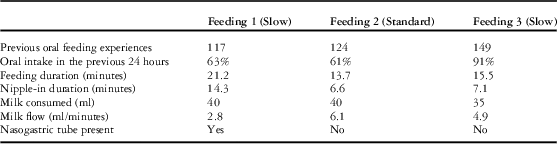
Data were collected to describe the three study feedings in terms of total feeding duration, nipple-in duration, and milk flow achieved (millilitres/minute). Definitions of these variables are provided in Table 1. The presence of a nasogastric tube and the type of milk offered were recorded.
Feeding experience and description.

Feeding duration=time from first nipple-in to last nipple-out; milk flow=milk consumed/nipple-in duration; nipple-in duration=time the nipple was in the infant’s mouth
Skimmed breast milk 30 calories/ounce offered for all study feedings. Oral intake in the previous 24 hours=percentage of prescribed nutrition consumed orally in the previous 24 hours
Behavioural outcomes
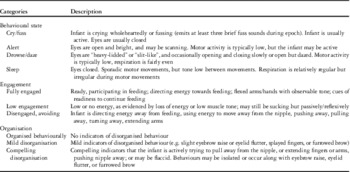
Starting ~30 minutes before the study feeding and continuing throughout the feeding period, a single video camera was used to capture a close-up angle of the infant’s face and upper trunk. An observational coding scheme (Table 2) was used to code the videos using the observational coding programme – the Observer XT 11 (Noldus Information Technology Inc., Asheville, North Carolina, United States of America). Coders were trained until they achieved ⩾80% reliability using the κ-statistic.
Coding scheme descriptions of behavioural state, engagement, and organisation.

The behavioural states are a simplified version of sleep–wake states as defined by Holditch-DavisReference Holditch-Davis 27
Feeder actions
Actions of the feeder were evaluated during feeding to confirm that the feedings were performed in a similar way. Study feedings were video-taped and coded continuously to identify the frequency, that is number of events, of stimulating the infant to suck, decreasing milk flow, and repositioning during the nipple-in period. The duration (in seconds) of burping and pacifier use was coded for the entire feeding period. At the end of the observation, the predominant positioning of the infant’s arms and shoulders, containment of the limbs in the swaddle, trunk positioning, angle of the trunk, alignment of head, and anterior/posterior neck alignment were noted.
Infant behaviour
Of the 30-minute observation period before feeding, 6 minutes were selected to represent baseline where the infant was quietly resting with minimal movement. The baseline period was coded for activity level (continuous coding; no movement or movement) and four behavioural states (interval coding every 10 seconds). The percentage of time with no movement and the percentage of time in each behavioural state were calculated. During feeding, videos were coded continuously for infant distress behaviours, including coughing (number of events and duration in seconds) and gagging (number of events and duration in seconds) infant engagement (proportion of feeding in each level of engagement) and behavioural organisation (proportion of feeding in each level of organisation).
Physiological outcomes
Physiological variables included heart rate, oxygen saturation, and respiratory rate. Physiological data were analysed during the 6-minute baseline period, throughout the feeding period, and for 30 minutes after feeding. The recovery period was defined as starting at the time the infant was settled into her bed after feeding and caregiving activities were completed and continuing for 30 minutes. All physiological data were collected at a sampling rate of 1000 samples/second, digitised using the BioNex Bio-Potential Amplifier (MindWare Technology, Gahanna, Ohio, United States of America), converted to an analogue waveform, and stored using the BioLab Data Acquisition Software (MindWare Technology).
Heart rate
Heart rate data were collected by a three-lead electrocardiogram, imported into MindWare HRV 3.0.20 (MindWare Technology), and R peaks were marked by the program. The investigator confirmed each R peak of the QRS complex and cleaned the data of artefact. The cleaned data were used to calculate indices of heart rate, including mean, minimum, maximum, and coefficient of variation, which was calculated as standard deviation divided by the mean, for every 1 minute during the baseline and feeding periods and for every 2 minutes during recovery. A change from baseline score was calculated for feeding as the mean heart rate during the entire feeding period minus the mean heart rate during the baseline period. A change from baseline score was also calculated for the recovery period. In addition, the number of bradycardic events, defined as a heart rate <100 bpm,Reference Dawson, Myers and Moorhead 28 were calculated.
Oxygen saturation
Oxygen saturation was determined using the Radical-7 Pulse Co-Oximeter (Masimo Corporation, Irvine, California, United States of America) with an averaging window set at two samples per second. This co-oximeter is reported to provide oxygen saturation data with an accuracy of ±2% in the event of low perfusion, which is critical for the population of infants with hypoplastic left heart syndrome who frequently experience poor perfusion. 29 The data were cleaned of artefact by the investigator and the mean, minimum, maximum, standard deviation, and coefficient of variation of oxygen saturation were calculated for every 1 minute during baseline and feeding and for every 2 minutes during recovery. A change from baseline score was calculated for feeding as the mean oxygen saturation for the entire feeding period minus the mean oxygen saturation during baseline. Change from baseline oxygen saturation was calculated for the recovery period as well.
Mean oxygen saturation during all three baseline periods was calculated to create categories of fluctuations in oxygen saturation data that represent an increase in oxygen saturation 5–10% above baseline, increase in oxygen saturation >10% above baseline, a decrease in oxygen saturation 5–10% below baseline, and a decrease in oxygen saturation >10% below baseline. The frequency oxygen saturation events within each of these categories was calculated. The percentage of the feeding within each category was also calculated.
Respiratory rate
Respiratory rate was collected using the Ambu® Sleepmate RIPmate™ Inductance Belts system (Ambu Inc., Glen Burnie, Madison, United States of America), which uses inductance plethysmography to measure movement of the thoracic cavity related to respiratory effort. AcqKnowledge software (BIOPAC Systems Inc., Goleta, California, United States of America) was used to mark the peak, or the point of maximal chest circumference, during each breath. In order for chest movement to be considered a breath, that is a respiratory peak, it had to be associated with a voltage change of at least 20% of the mean voltage change during a baseline period of stable, regular breathing.Reference Bamford, Taciak and Gewolb 30 Respiratory rate was calculated as breaths/minute. The mean, minimum, and maximum respiratory rates were calculated for every 1 minute during the baseline period, during each nipple-in period of the feeding, and every 2 minutes during recovery. Data during nipple-out periods were not included in the analysis because of increased artefact related to burping and other movement of the infant. Change from baseline respiratory rate was calculated during feeding as well as during recovery. In addition, frequency of respiratory pauses, defined as >3 seconds between consecutive respiratory peaks,Reference Nixon, Charbonneau, Kermack, Brouillette and McFarland 31 was calculated; 3 seconds was used because this indicates a pause in respiration longer than what is typically associated with swallowing.Reference Nixon, Charbonneau, Kermack, Brouillette and McFarland 31
Statistical analysis
The analysis of this single-case experimental study occurred in two phases. In Phase 1, the outcome variables were described per feeding using descriptive and graphical analyses, which are accepted methods for single-subject experimental data.Reference Tervo, Estrem, Bryson-Brockmann and Symons 32 , Reference Kratochwill, Hitchcock and Horner 33 Mean values for measures during the baseline, feeding, and recovery periods were tabled. Repeated-measures physiological data were graphed to illustrate change over time. A quadratic regression line was fit for each set of physiological data to evaluate the shape, that is direction of change, and steepness, that is slope, of change over time.
In Phase 2, the repeated-measures physiological data were analysed in SAS 9.3 (SAS Institute Inc., Cary, North Carolina, United States of America) using linear mixed modelling to evaluate the effect of flow condition on each physiological outcome. For this analysis, data were grouped by flow condition. Correlations between measurements within the same feeding and within the same flow condition were taken into account. Baseline values of the outcome variable being tested were controlled as covariates in the model. For the purposes of hypothesis generation for a larger study of the effect of flow rate on infants with hypoplastic left heart syndrome, statistical significance was defined as α<0.1 and a trend towards statistical significance was defined as α<0.2.
Results
Infant characteristics and case history
Baby G was a full-term (39 3/7 weeks of gestation) female born to a 30-year-old primagravida. The pregnancy was complicated by a prenatal diagnosis of hypoplastic left heart syndrome. At 21 weeks, a fetal surgical intervention was performed with balloon dilation of the aortic valve. The post-surgical course was uncomplicated. At birth, Baby G’s growth was appropriate for gestational age. She did not require resuscitation at birth. Her Apgar scores were 8 at 1 minute and 9 at 5 minutes.
An echocardiogram after delivery confirmed hypoplastic left heart syndrome with aortic stenosis. Shortly after birth, balloon dilation of the aortic valve was repeated and a stent was placed across the atrial septum under fluoroscopy. Despite the efforts to dilate the aortic valve and support growth of the left ventricle, her cardiac function remained poor, and on day of life 10 the infant underwent a stage 1 Sano Damus–Kaye–Stansel procedure. Her procedure was altered from the typical Norwood procedure in the hope that her left ventricle would continue to grow eventually to form a two-ventricle heart. An illustration of her post-surgical cardiac anatomy is provided (Supplementary Fig 1).
She did not experience any major complications during the procedure. Sternal closure was delayed per standard care at this institution because of typical swelling of the intrathoracic structures. She was extubated on day of life 24 to continuous positive airway pressure. On day of life 25, she was transitioned to nasal cannula and then transitioned to room air on day of life 27. Her course was complicated by postoperative chylothorax, hypothyroid, gastrooesophageal reflux, and neonatal abstinence syndrome following prolonged perioperative narcotic exposure.
Oral feeding was initiated on day of life 26 while on nasal cannula, and for the first 10 days of oral feeding she took 0–15 ml by mouth per feeding. On day of life 38, the infant was evaluated by the feeding team; they noted that the infant did not readily open her mouth for the feeding, showed no rooting response, used a munching motion when the nipple was placed on the hard palate, had pooling in the oral cavity, and gagged three times, but did not show overt signs or symptoms of aspiration. She continued to be offered oral feedings. Study feeding 1 occurred on day of life 41 after the infant was consistently taking ⩾20 ml/feeding for 2 days. Study feeding 2 occurred on day of life 42, and study feeding 3 occurred on day of life 46. Feeding experience data at the time of each study feeding are presented in Table 1. All her oral feeding experiences were with bottle feeding. Between study feeding 2 and study feeding 3, the infant had a gastrostomy tube surgically placed. The infant was reintubated for surgery and was not given fluids enterally for 24 hours.
At the time of the study feedings, the infant was regularly receiving the following medications: captopril for afterload reduction, lasix for diuresis, levothyroxine for the treatment of hypothyroidism, omeprazole for the treatment of gastrooesophageal reflux, aspirin for anticoagulation, simethicone for the treatment of gastrointestinal discomfort, and acetaminophen as needed for pain management. She had received her last dose of a methadone taper for treatment of neonatal abstinence syndrome on day of life 39. In the evening of day of life 41, ~12 hours after study feeding 1 and 12 hours before study feeding 2, her Cardiac Children’s Hospital Early Warning ScoreReference McLellan and Connor 34 was rated as 3, indicating the need for escalation of care and more frequent assessment, and she was given a rescue dose of methadone. Otherwise, in the 24 hours before and after each study feeding, her Cardiac Children’s Hospital Early Warning Score was rated 0–1 by the infant’s nurse, indicating appropriate behaviour and cardiorespiratory parameters. Laboratory values for electrolytes, haematology, thyroid function, and venous blood gas were acceptable for her cardiac status at the time of the study.
Feeding description
The infant was randomised to the following order of flow conditions – feeding 1, slow-flow; feeding 2, standard-flow; and feeding 3, slow-flow. The flow conditions are referred to as Slow and Standard. The nipple-in duration of feeding 1 (Slow) was nearly twice as long as feedings 2 (Standard) or 3 (Slow); however, the infant consumed approximately the same amount of milk during all three feedings. As a result, the milk flow rate for feeding 1 (Slow) was slower compared with feedings 2 (Standard) or 3 (Slow). A nasogastric tube was present for feeding 1 (Slow), but during feeding 2 (Standard) it had been removed to trial her ability to meet nutritional requirements by oral intake only. At the time of feeding 3 (Slow), she had a gastrostomy tube in place, and therefore no longer required a nasogastric tube. Breast milk 30 calories/ounce that had been skimmed of long-chain fatty acids and replaced with medium-chain triglycerides was offered for all study feedings due to her history of chylothorax.Reference Chan and Lechtenberg 35
Behavioural outcomes
Feeder actions
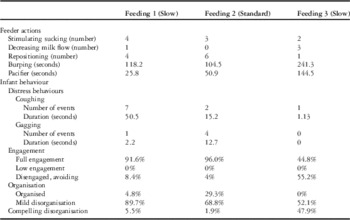
Feedings 1 (Slow) and 2 (Standard) were performed by the same speech-language pathologist and member of the feeding team. Feeding 3 (Slow) was performed by the infant’s mother, who had been present at the infant’s bedside throughout her hospitalisation and had fed her more often than anyone else. All three feedings were performed with the infant in the supine position at ~45° angle. The infant was swaddled with the shoulders and arms supported throughout feedings 1 (Slow) and 2 (Standard). During feeding 3 (Slow), the infant was more loosely swaddled, and over the course of the feeding the swaddle became less supportive. Throughout all three feedings, her head was in a midline, neutral position that was appropriate for feeding. During feeding 3 (Slow), the feeder spent more time burping the infant and provided the infant with a pacifier for a longer period of time than during either feeding 1 (Slow) or 2 (Standard) (Table 3). Otherwise, the number of events of stimulating the infant to suck, decreasing milk flow, and repositioning were similar between the feedings.
Behavioural outcomes.

The feeder action variables stimulating sucking, decreasing milk flow, and repositioning as well as the infant engagement and organisation variables were calculated only during the nipple-in period. Burping duration, pacifier duration, and infant distress behaviours were evaluated during the entire feeding period, including time when the nipple was not in the infant’s mouth
Infant behaviour
During the 6-minute baseline period before feeding 1 (Slow), the infant was asleep 100% of the time and had no movement 97.3% of the time. During the baseline period before feeding 2 (Standard), the infant was asleep 100% of the time and had no movement 75.9% of the time. In the baseline period before feeding 3 (Slow), the infant was asleep 50% of the time, was alert for 3%, and in a drowsy daze 47% of the time; she had no movement 71.5% of the time.
Baby G had seven coughing events during feeding 1 (Slow), with a total duration of coughing of 50.5 seconds, compared with two coughing events during feeding 2 (Standard; duration 15.2 seconds), and one very brief event (1.13 seconds) during feeding 3 (Slow). She gagged more during feeding 2 (Standard; four events; duration 12.7 seconds) compared with one event of gagging (2.2 seconds) during feeding 1 (Slow) and none during feeding 3 (Slow).
In terms of her engagement in the feeding, she was most fully engaged during feeding 2 (Standard) (96%). During feeding 1 (Slow), she was fully engaged for 91.6% of the nipple-in time. She was the least fully engaged during feeding 3 (Slow; 44.8%). In all three feedings, she was either fully engaged or disengaged; there was no low engagement in any of the feedings. During feeding 3 (Slow), she was disengaged and avoided feeding during 55.2% of the nipple-in time.
Behavioural organisation during nipple-in periods followed a similar pattern as engagement. During feeding 2 (Standard), she was fully organised for 29.3% of the feeding time, whereas she was only fully organised for 4.8% of the time during feeding 1 (Slow). She was never fully organised during feeding 3 (Slow). She showed signs of compelling disorganisation during nearly half (47.9%) of feeding 3 (Slow), while only 5.5% of feeding 1 (Slow) and 1.9% of feeding 2 (Standard).
Physiological outcomes
Heart rate
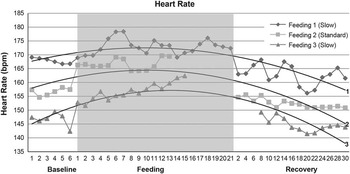
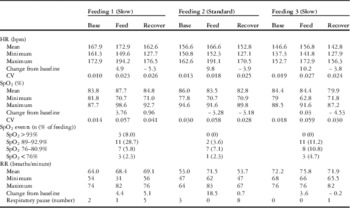
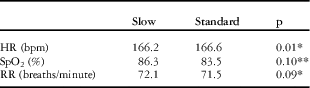
Mean heart rate increased from baseline to feeding during all three feedings times and then decreased to below baseline values during all recovery periods (Table 4). During feedings 2 (Standard) and 3 (Slow), mean heart rate increased similarly from baseline to feeding (10.2 versus 9.8 bpm, respectively). Mean heart rate increased the least during feeding 1 (Slow; 4.9 bpm). In Figure 1, heart rate was plotted over time for baseline, feeding, and recovery. A quadratic regression line fit to the data revealed that heart rate increased from baseline to feeding and decreased during recovery. The infant did not experience bradycardia during any of the analysed periods, but did have transient elevations in heart rate above 190 bpm during both feedings 1 (Slow; maximum heart rate 194.2 bpm) and 2 (Standard; maximum heart rate 191.1 bpm).The coefficient of variation increased from baseline to feeding during all feedings as well, indicating greater variation in heart rate during feeding. The coefficients of variation of heart rate remained elevated above baseline during the recovery periods of all three feedings and were similar in value. In the Phase 2 analysis, the mean heart rate during feeding was significantly higher during standard-flow feeding than during slow-flow feeding (F1,46=6.71, p=0.01) (Table 5), when baseline heart rate was taken into consideration.
Heart rate (beats per minute (bpm)) plotted every 1 minute during baseline (6 minutes) and feeding (indicated in grey) and every 2 minutes during recovery (30 minutes). Quadratic regression equations – feeding 1 (Slow): y=−0.02x2+0.70x+167.01 (R2=0.60); feeding 2 (Standard): y=−0.03xReference Reller, Strickland, Riehle-Colarusso, Mahle and Correa 2 +0.92x+157.07 (R2=0.71); feeding 3 (Slow): y=−0.04xReference Reller, Strickland, Riehle-Colarusso, Mahle and Correa 2 +1.41x+143.67 (R2=0.75).

Physiologic outcomes.

Base=baseline; bpm=beats per minute; CV=coefficient of variation (SD/mean); Feed=feeding; HR=heart rate; Recover=recovery; SpO2=oxygen saturation given in percentage
Mean values for HR were calculated as a true mean of the entire baseline, feeding, and recovery periods. SpO2 events are given in number of events and percentage of the feeding. Two events had to be separated by at least 5 seconds of data within the range of ±5% (81–88.9%) to be considered separate. The most extreme value for SpO2 during the event was used for calculating the number of events. Respiratory pause was defined as ⩾3 seconds between breaths
Physiological changes during feeding by flow condition.

bpm=Beats per minute; HR=heart rate; RR=respiratory rate; SpO2=oxygen saturation
Linear mixed modelling was used to analyse the physiological variables during feeding, covaried on baseline values. Results were grouped by flow condition (slow versus standard)
*p<0.1, **p<0.2
Oxygen saturation
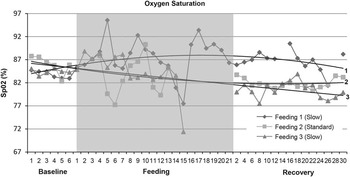
Mean oxygen saturation during feeding was the highest during feeding 1 (Slow; 87.7%) compared with feeding 2 (Standard; 83.5%) and feeding 3 (Slow; 84.4%). During feeding 1 (Slow), the oxygen saturation increased from baseline by 3.76%, whereas during feeding 2 (Standard) oxygen saturation decreased by 3.28%, and it remained essentially unchanged during feeding 3 (Slow; 0.03%). Minimum oxygen saturation was the same (70.7%) for both feedings 1 (Slow) and 2 (Standard), whereas oxygen saturation dropped to a minimum of 62.8% during feeding 3 (Slow). Maximum oxygen saturation was higher during feeding 1 (Slow; 98.6%) compared with feedings 2 (Standard) and 3 (Slow) (91.6% for both). The coefficient of variation of oxygen saturation was similar across all feedings, but in all cases it increased from baseline to feeding and decreased during recovery. Mean oxygen saturation was plotted over time in Figure 2; a quadratic regression line fit to the data revealed that for feeding 1 (Slow) oxygen saturation increased from baseline to feeding and decreased during recovery, and for feeding 2 (Standard) oxygen saturation decreased from baseline to feeding and increased during recovery. The regression line for feeding 3 (Slow) was nearly flat as it decreased slightly from baseline to feeding and then continued to decrease during recovery.
Oxygen saturation (SpO2) plotted every 1 minute during baseline (6 minutes) and feeding (in grey) and every 2 minutes during recovery (30 minutes). Quadratic regression equations: feeding 1 (Slow): y=−0.01xReference Reller, Strickland, Riehle-Colarusso, Mahle and Correa 2 +0.38x+83.61 (R2=0.11); feeding 2 (Standard): y=0.004xReference Reller, Strickland, Riehle-Colarusso, Mahle and Correa 2 +0.30x+86.94 (R2=0.28); feeding 3 (Slow): y=0.0003xReference Reller, Strickland, Riehle-Colarusso, Mahle and Correa 2 –0.18x+86.38 (R2=0.40).

The grand mean for baseline oxygen saturation for all feedings was calculated to be 84.7% (range from 83.8 to 86%), with 81–88.9% being equivalent to ±5% of baseline. During feeding 1 (Slow), the infant had three events with the oxygen saturation rising >10% above baseline (i.e. >93%), which accounted for 8% of the feeding period. There were desaturation events >10% below baseline (<76%) in all feedings, accounting for 2.3% of each feeding 1 (Slow) and 2 (Standard) and 4.7% of feeding 3 (Slow). In Phase 2, the linear mixed modelling analysis revealed a trend towards a significant effect of flow on oxygen saturation (F1,43=2.87, p=0.10), with the oxygen saturation being higher during slow-flow feedings after controlling for baseline oxygen saturation.
Respiratory rate
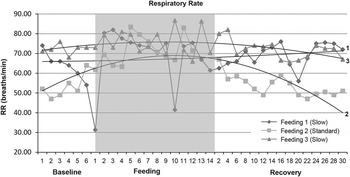
Mean respiratory rate was high during all three feedings, ranging from 68.4 breaths/minute during feeding 1 (Slow) to 75.8 breaths/minute during feeding 3 (Slow). The infant increased her respiratory rate during feeding compared with baseline for all three feedings. The change from baseline to feeding was greatest for feeding 2 (Standard; 18.5 breaths/minute) and similar for feedings 1 (Slow; 4.4 breaths/minute) and 3 (Slow; 3.6 breaths/minute). The mean respiratory rate returned to near or below baseline during the recovery periods of feedings 2 (Standard) and 3 (Slow), but remained elevated above baseline during the recovery period after feeding 1 (Slow). In Figure 3, the mean respiratory rate was plotted over time, which revealed a nearly flat regression line for feeding 1 (Slow) with a slightly positive slope, although there was considerable variation in the mean respiratory rate values at each time point. The infant had one respiratory pause during the first nipple-in episode of feeding 1 (Slow), where mean respiratory rate for this episode was 31 breaths/minute. Otherwise, she did not have any respiratory pauses during feeding. Consistent with the greatest changes in mean respiratory rate during feeding 2 (Standard), the regression line for feeding 2 had the steepest curve and increased from baseline to feeding and then decreased during recovery. The regression line for feeding 3 (Slow) also revealed an increase from baseline to feeding and a decrease during recovery, but was less steep compared with feeding 2.
Respiratory rate (RR) (breaths/minute) plotted every 1 minute during baseline (6 minutes) and nipple-in periods of feeding (in grey) and every 2 minutes during recovery (30 minutes). Quadratic regression equations – feeding 1 (Slow): y=0.004xReference Reller, Strickland, Riehle-Colarusso, Mahle and Correa 2 +0.03x+65.89 (R2=0.03); feeding 2 (Standard): y=−0.08xReference Reller, Strickland, Riehle-Colarusso, Mahle and Correa 2 +2.55x+48.61 (R2=0.57); feeding 3 (Slow): y=−0.02xReference Reller, Strickland, Riehle-Colarusso, Mahle and Correa 2 +0.63x+71.08 (R2=0.19).

Although respiratory pauses were rare during feeding, this infant did have two respiratory pauses during the baseline period before feeding 1 (Slow) and three pauses during the baseline period before feeding 2 (Standard). She had no respiratory pauses before feeding 3 (Slow). The frequency of respiratory pauses during the baseline period of feeding 2 (Standard) may explain the relatively low mean respiratory rate of 53 breaths/minute, and the resultant large increase from baseline to feeding. During the 30-minute recovery period, she had five respiratory pauses after feeding 1 (Slow), eight after feeding 2 (Standard), and only one after feeding 3 (Slow). In the Phase 2 analysis, linear mixed modelling revealed that there was a statistically significant effect of flow condition on respiratory rate during feeding (F1,37=3.11, p=0.09); she had a higher respiratory rate during slow-flow feeding than during standard-flow feeding, after controlling for baseline respiratory rate.
Discussion
The medical course of this infant with hypoplastic left heart syndrome was not atypical for infants with similar cardiac disease, and her responses to feeding were similar to what is often seen clinically. Feeding was a challenging event for this infant and was associated with adverse events such as coughing and gagging and evidence of physiological expense and behavioural disorganisation, regardless of whether she was fed with a slow-flow or standard-flow nipple. There is evidence throughout the literature that infants with hypoplastic left heart syndrome have difficulty feeding,Reference Davis, Davis and Cotman 4 , Reference Jadcherla, Vijayapal and Leuthner 6 but this is the first study that we know of that has looked closely at the physiological and behavioural changes that occur as an infant with hypoplastic left heart syndrome faces the challenge of oral feeding.
Comparing the feeding sessions with one another, the feeders’ actions were not considerably different. During feeding 3 (Slow), the infant’s mother offered her a pacifier and burped her more often than during feedings 1 (Slow) and 2 (Standard). It is speculated that this was done in an attempt to help the infant organise her behaviour for the feeding. The behavioural outcomes of feeding 3 (Slow) show that the infant was never fully organised. Between feedings 2 (Standard) and 3 (Slow), the infant was reintubated for the placement of a gastrostomy tube and feeding 3 was particularly difficult for her. Her behavioural state before feeding 3 (Slow) was also different with her being asleep only 50% of the time, compared with 100% during both baseline periods before feedings 1 (Slow) and 2 (Standard). This change in behavioural state during rest may be indicative of pain related to her abdominal incision at the site of her gastrostomy tube. When a pacifier was offered, she was able to calm down and appeared ready for feeding, but as soon as flow started when the bottle nipple was placed in her mouth she would become disorganised again.
The behavioural outcomes provided important information about this infant’s response to feeding. Feeding was behaviourally distressing for Baby G. She coughed with concerning frequency during feeding 1 (seven events accounting for 50.5 seconds), despite the use of a slow-flow nipple. Given her surgical history, she is at high risk for aspiration due to vocal cord and/or swallowing dysfunction.Reference Skinner, Halstead, Rubinstein, Atz, Andrews and Bradley 7 , Reference Sachdeva, Hussain and Moss 18 , Reference Carpes, Kozak and Leblanc 36 The feeding team evaluation before the study did not find evidence of aspiration; however, she had not had an evaluation of her vocal cord movement or a swallow study under fluoroscopy to evaluate the safety of her swallow during feeding. A difference between feeding 1 (Slow) and the other two study feedings was the presence of a nasogastric tube during feeding, which may, theoretically, alter the anatomy during swallowing and increase the risk of aspiration. This may have contributed to the increased coughing seen during feeding 1 (Slow). Clinicians need to be vigilant in assessing evidence of aspiration events, which have the potential to not only be life-threatening in these very high-risk infants but also be experienced negatively by the infant, which has ramifications for future engagement in oral feeding.
Baby G had four gagging episodes during feeding 2 (Standard), which was also concerning. The gag reflex is a protective mechanism to prevent aspiration and choking, and occurs when food or fluid remain in the posterior oropharynx after swallowing.Reference Morris and Klein 37 The higher flow rate of the standard-flow condition may have resulted in pooling of milk in the posterior oropharynx, especially if she was having difficulty swallowing completely, which initiated the gag reflex. Aside from being an indication that this infant was at high risk for aspiration, gagging is a negative experience during feeding.Reference Byars, Burklow, Ferguson, O’Flaherty, Santoro and Kaul 38 This infant had multiple factors that put her at risk for aversion to oral feeding, including prolonged intubation, multiple intubations, gastrooesophageal reflux, prolonged nasogastric tube use, and prolonged period without oral feeding.Reference Einarson and Arthur 5 , Reference Dodrill, McMahon, Ward, Weir, Donovan and Riddle 39 – Reference Jadcherla, Wang, Vijayapal and Leuthner 41 Infants with hypoplastic left heart syndrome are frequently found to experience long-term feeding difficulty,Reference Hill, Silverman and Noel 42 , Reference Maurer, Latal, Geissmann, Knirsch, Bauersfeld and Balmer 43 and negative experiences such as gagging during feeding should be actively avoided to prevent the development of long-term feeding disorders.
As discussed previously, feeding 3 (Slow) was particularly difficult for this infant and she displayed indicators of disengagement, avoiding feeding and compelling disorganisation during a significant proportion of this feeding, despite being slow-flow. This study feeding occurred about 48 hours after placement of the gastrostomy tube, which required a reintubation. A number of factors associated with the procedure, including an additional negative oral experience, pain at the incision site, and swelling of the pharyngeal structures, may have contributed to the difficulty that she experienced during feeding 3. Feedings 1 (Slow) and 2 (Standard) were relatively similar with regards to her level of engagement in feeding and, although she was organised more during feeding 2 than feeding 1 (29.3 versus 4.8%), she was compellingly disorganised during very little of either of those two feeding sessions.
Physiologically, feeding was a challenge for this infant and, consistent with Polyvagal Theory,Reference Porges 20 her sympathetic nervous system response to this challenge was to increase heart rate in order to meet the physiological demands. Normal heart rate range for young infants is considered to be from 110 to 150 bpm,Reference Park 44 and her heart rate at baseline was at the high end to above normal (range from 137.3 to 172.9 bpm). Her heart rate increased during feeding to 141.8–194.2 bpm. In this case, an increase in heart rate much above baseline was potentially problematic because when the heart rate rises above ~180 bpm, ventricular filling time and end-diastolic volume are diminished and myocardial oxygen consumption increases.Reference Gupta and Sinha 45 As myocardial perfusion occurs during the diastolic phase, increases in heart rate above 180 bpm have the potential to cause cardiac ischaemia and ventricular dysfunction.Reference Gupta and Sinha 45 In an infant recovering from open-heart surgery and with pre-existing diminished ventricular function, cardiac protection is critical. The results of the heart rate data suggest that feeding 1 (Slow) allowed this infant to maintain her heart rate closest to baseline, and the linear mixed modelling analysis also revealed that slow-flow feeding allowed this infant to maintain significantly lower heart rate than standard-flow feeding, indicating that slow-flow feeding may have been less physiologically taxing.
The results of the respiratory indices were less clearly supportive of either flow condition. The unique cardiac physiology of infants after stage 1 palliation for hypoplastic left heart syndrome requires a careful balance of pulmonary-to-systemic blood flow ratio. In this infant, as the right ventricle was essentially providing blood flow to both the pulmonary and systemic circulations, the vascular resistance in each of these systems helped determine the ratio of blood that flowed in either direction. Management of infants after stage 1 palliation aims to maintain a pulmonary-to-systemic blood flow ratio of 1, which is generally achieved with a systemic arterial oxygen saturation of ~75–80%.Reference Photiadis, Sinzobahamvya and Fink 46
Oxygen saturation as measured in this study is a measure of arterial oxygen saturation. During baseline, this infant’s mean oxygen saturation was 83.8–86%, which was already higher than the target range.Reference Photiadis, Sinzobahamvya and Fink 46 Given the fragile balance of pulmonary-to-systemic blood flow ratio, the goal for oxygen saturation during feeding should be to remain as close to baseline as possible. Oxygen saturation outside of the range of 75–90% is considered concerning in this population.Reference Feinstein, Benson and Dubin 47 These infants are already hypoxic and further significant decreases in oxygenation are potentially detrimental to systemic and coronary perfusion. Similarly, increases in oxygen saturation above 90% are also problematic, as they suggest preferential shunting of blood to the pulmonary circulation, which may result in excessive pulmonary blood flow and reduced systemic perfusion. In addition to the obvious issues with reduced systemic perfusion and/or oxygen delivery, such as perfusion of the brain and heart, adequate perfusion and oxygen delivery to the gastrointestinal tract is critical for utilisation of nutrients ingested during feeding.
Given the constraints of the physiology in this patient, the linear mixed modelling results of the analysis of oxygen saturation, indicating a trend towards higher oxygen saturation during slow-flow feedings, were not necessarily better. During feeding 1 (Slow), the infant had frequent increases in oxygen saturation >5% above baseline – >89%. This was surprising given the number and duration of coughing events. Coughing can be a sign of aspiration, which is typically associated with decreases in oxygen saturation. In this infant, coughing events resulted in a rise in oxygen saturation. The mechanism behind this is unclear. It may be that the infant had small residual pleural effusions and coughing resulted as lung volume increased, and therefore a temporary fall in pulmonary vascular resistance, resulting in increased oxygen saturation.Reference Gabrielli, Layon, Yu, Civetta, Taylor and Kirby 48 During feeding 3 (Slow), the infant only had one brief coughing event, but still had several increases in oxygen saturation >5% above baseline. The maximum oxygen saturation during feeding 3 (Slow), however, was 91.6% compared with 98.6% in feeding 1 (Slow). During feeding 2 (Standard), the infant had rare events above 89% or below 76%.
The results of respiratory rate during feeding also suggested that both feeding conditions caused significant physiological distress. The linear mixed modelling analysis revealed that respiratory rate was significantly higher during slow-flow feedings (72.1 versus 71.5 breaths/minute); however, the change from baseline to feeding was greatest for feeding 2 (Standard) (18.5 breaths/minute). Normal respiratory rate for infants is considered to be ~24–50 breaths/minute.Reference Bardella 49 On the one hand, as Baby G’s respiratory rate was above normal, the higher respiratory rate during slow-flow feeding could be interpreted as being an indicator of this feeding condition being more physiologically demanding and requiring the infant to therefore increase respiratory rate accordingly. On the other hand, this could be interpreted as being supportive of physiological stability because the infant is able to breathe during feeding. Some medically fragile infants are unable to coordinate breathing with sucking and swallowing during feeding and experience a decrease in respiratory rate.Reference Mathew 10
This infant’s mean respiratory rate across all three feedings was ~72 breaths/minute, which is equivalent to one breath every 0.83 seconds. In normal infants, swallowing behaviour is dominant to respiration in order to protect the airway from aspiration, and respiration is paused for about 0.5–1.5 seconds during swallowing.Reference Barlow 50 At 72 breaths/minute, it is very difficult, if not impossible, to fit a safe swallow in between breaths. As she was hypoxic at rest, she may have been less able to tolerate a decrease in respiration during feeding than infants who are normally oxygenated at the start of feeding. Respiratory rate does not give any indication of how safely the infant is breathing during feeding and it may have been that her need to breathe was so great that she did so during feeding despite the risk for aspiration. The coordination of sucking, swallowing, and breathing is controlled by a complex system of interacting nervous system networks that are dependent on sensory experiences to facilitate pattern development.Reference Barlow 50 Given that this infant was intubated for the first 24 days of life, she had been deprived of early oral sensory input that would have supported development of safe patterns of swallowing and breathing.
Limitations
There were certain limitations to the respiration data and these results should be interpreted with caution. Respiratory rate was evaluated by chest movement using respiratory inductance plethysmography. Although a minimum change in chest movement was used to identify a respiratory cycle, this method did not identify a change in tidal volume. There may have been considerable alterations in minute ventilation due to interrupted or shallow breaths during feeding that were not identified. The reliability of respiratory inductance plethysmography for measuring chest wall movements in infants after a median sternotomy, who have the potential for increased pliability of the chest wall, may warrant further investigation.
Another limitation of the study was the time between study feedings, particularly between feedings 2 and 3. The effect of maturation and history could have been limited by performing all three study feedings in 1 day, but the research team and clinical staff were concerned that this would unnecessarily stress an already vulnerable baby. As a result of performing the study on 3 different days, two feeders were necessary. The feeders were trained to perform the feeding in a similar manner, and feeder actions were evaluated to ensure feedings were performed in a similar way. This was a highly complex study to perform with a vulnerable population in a busy clinical setting, and these factors necessarily constrained the research process. As a single-case experiment, there are natural limitations to the study data, but this design allowed for close evaluation of this infant’s response to the different feeding conditions while considering the variable context of each feeding.
Conclusion and future directions
This was a single-subject experiment and the results cannot be assumed to reflect the feeding responses of all infants with hypoplastic left heart syndrome; however, this study provides data that reflect what many clinicians have long observed – infants with hypoplastic left heart syndrome can experience significant distress during feeding. This is the first extensive examination of the physiological and behavioural responses of an infant with hypoplastic left heart syndrome to the challenge of oral feeding. Despite the use of a very slow-flow nipple (Dr. Brown’s Preemie) for the slow-flow feeding condition, this infant experienced significant distress. Feeding interventions aimed at reducing physiological and behavioural stress, preserving metabolic resources, and encouraging positive oral experiences are needed to support infants with hypoplastic left heart syndrome, especially during the tumultuous time between stages 1 and 2 of palliative procedures. Feeding has been identified by parents of infants with CHD to be a source of stress.Reference Medoff-Cooper, Naim, Torowicz and Mott 51 , Reference Svavarsdottir and McCubbin 52 Emphasis should be placed on identifying feeding strategies that are simple, easily implemented by parents, and will reduce, not increase, parenting stress.
The results of this study suggest that future studies should consider testing an even slower-flow nipple combined with additional supportive feeding interventions, such as a semi-elevated side-lying position and/or a co-regulated feeding approach. A semi-elevated side-lying position has been found to support physiological stability in infants born premature by slowing the movement of the bolus to the back of the oral cavity and reducing the work of breathing.Reference Park, Thoyre, Knafl, Hodges and Nix 53 In the population of infants with hypoplastic left heart syndrome, a right side-lying position with the left vocal cord positioned upwards may be supportive for these same reasons as well as minimising the risk of aspiration resulting from any malfunction of the left vocal cord; positioning the functioning right vocal cord down utilises it for primary protection of the airway. A co-regulated feeding approach involves close evaluation and regulation by the feeder of sucking, swallowing, and breathing behaviour,Reference Thoyre, Holditch-Davis, Schwartz, Melendez Roman and Nix 54 which may be particularly important for infants with hypoplastic left heart syndrome who have been deprived of early oral feeding experiences for central pattern generation.Reference Barlow 50 Finally, research on breastfeeding in this population is also needed. Although there is evidence that breastfeeding may reduce the stress of feeding in preterm infantsReference Chen, Wang, Chang and Chi 55 , Reference Meier 56 and infants with other types of CHD,Reference Marino, O’Brien and LoRe 57 clinicians continue to express concern about allowing infants with hypoplastic left heart syndrome to be breastfed. Research needs to evaluate whether these concerns are valid for this population.
Acknowledgements
The first author acknowledges the Boston Children’s Hospital Feeding and Swallowing Program and The University of North Carolina at Chapel Hill, School of Nursing, Biobehavioral Laboratory for their contributions and support of this study.
Financial Support
This study was supported by a Sigma Theta Tau International Honor Society of Nursing Alpha Alpha Chapter Research Award (B. F. P., 2014), Linda Waring Matthews Research Fund Scholarship (B. F. P., 2012 and 2014), James and Patricia Leak Fund for Nursing Research (B. F. P., 2013), and was supported by the National Institute of Nursing Research of the National Institutes of Health (B. F. P., grant number F31NR011262).
Conflicts of Interest
None.
Ethical Standards
The authors assert that all procedures contributing to this work comply with the ethical standards of the relevant national guidelines on human experimentation (US Department of Health & Human Services, Office for Human Research Protections) and with the Helsinki Declaration of 1975, as revised in 2008, and has been approved by the institutional committees (The University of North Carolina at Chapel Hill and Boston Children’s Hospital).
Supplementary Material
For supplementary material referred to in this article, please visit http://dx.doi.org/10.1017/S1047951116000251