

I
What kind of monetary institutions do countries need to become proper states? In today's circumstances, creating a national currency and establishing a central bank (entrusted with managing this currency) would be seen as minimum requirements; this is the case even when the newly created national currency is pegged from day one of statehood to another currency (e.g. Bosnia-Hercegovina and Kosovo to the Deutschmark/Euro since 1995 and 1999, respectively). This pattern has been followed since the interwar period, when the newly independent countries of Central and Eastern Europe established themselves politically, economically and administratively on the territories wrenched from Austria–Hungary and Tsarist Russia; a two-step procedure followed by countries in the post-World War II wave of decolonisation and again by the transition economies in the 1990s. Yet in a longer historical perspective, few monetary institutions were indispensable to statehood. Banks of note issue – the forerunners of today's central banks – date back only to the seventeenth century (Sweden's Riksbank: 1668; Bank of England: 1694), and unified coinage was absent for centuries in the ‘old’ European state with roots in the Middle Ages (England, France, Portugal, Spain, Denmark and Sweden). In all these cases, a national currency and a bank of note issue were late additions to an already well-established statehood, and the early modern ‘bureaucratic revolution’ had evolved around other administrative and economic issues.
This brief analysis suggests that monetary institutions vital for statehood changed over time. The Balkan countries, which will constitute the focus of this article, allow us to study this question for a particularly interesting period, i.e. the late nineteenth century, which saw modern economic growth and industrialisation spreading beyond North-Western Europe and the emergence of a global economy epitomised by the gold standard. While the global trend at the time (a period often referred to in political history as the Age of High Imperialism) was towards incorporation of non-European political entities into (West) European colonial empires, the South-East European countriesFootnote 1 (SEE) obtained political independence from an Ottoman Empire in (relative) economic decline and had to ask themselves all the questions at the heart of this article: do we need national coinage and a bank of note issue, or can we break with the Ottoman Empire politically but still rely on its monetary system? Is a bank of note issue necessary for or, at least, conducive to issuing government bonds? Last but not least, was gold standard membership part and parcel of a modern monetary system or a separate objective of economic policy?
In the following, I will describe and analyse monetary reform in four Balkan countries between 1815 and 1910. By the early twentieth century, Greece (1832), Romania (1878), Serbia (1878) and Bulgaria (1908) had all been recognised internationally as sovereign states, but this ‘seal of approval’ was preceded by a slow process of transition from being part of the Ottoman Empire to autonomy within it. Serbia, the first country to achieve some form of autonomy in 1815, for instance, had to wait another 63 years to achieve full-fledged political independence at the Congress of Berlin (1878). The interval between autonomy and independence was shorter in the other three cases, but still more than a decade in each of them. The Greek revolution started in 1821, Romania received autonomy from the Ottoman Porte in 1859 and Bulgaria was released into independence in all but name in 1878. Only in the Greek case were there prolonged military hostilities (Greek War of Independence, 1821–8). In each case, it was the earlier date which created the political space for economic policy, including monetary reform; this date therefore forms the starting point of my analysis. The study ends in 1910, when Greece adopted the gold standard, following earlier such moves by Romania (1890), Bulgaria (1906) and Serbia (1909).
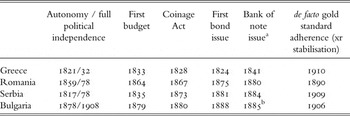
What were the important monetary reforms enacted in SEE between 1815 and 1910? While the exact chronology differs between countries, the sequence of events followed a standard pattern (Table 1): countries first passed a national budget, which reflected a practical need (autonomy came with obligations) but also expressed further political ambitions (independence). This was followed within a relatively short time period by a Coinage Act (which allowed the budget to be expressed in the national currency). The third step probably comes as a surprise: even before obtaining political independence or establishing a bank of note issue, the Balkan countries opened up to foreign bond markets, reflecting the sizeable investment needs (in particular for railways) in the presence of scarce domestic savings. Only then, as a fourth and penultimate step, was a bank of note issue founded, giving rise to a monetary policy proper. Ironically, the foundation of a bank of note issue hindered rather than helped countries take the fifth and final step in the process of monetary reform, i.e. joining the gold standard: in opening the door to seigniorage revenue on an unprecedented scale (through forced central bank loans), the exchange rate depreciated significantly, and it subsequently took approximately two decades of monetary stabilisation and fiscal consolidation between the foundation of a bank of note issue and eventual gold standard adherence.
Timeline for four South-East European countries, 1815–1910

Sources: Feis (1930), Lampe and Jackson (Reference Lampe and Jackson1982), Mazower (Reference Mazower2001), South-Eastern European Monetary and Economic Statistics from the Nineteenth Century to World War II (2014), Morys (Reference Morys2015), Sundhausen (Reference Sundhausen1989).
a Names were as follows: National Bank of Greece, National Bank of Romania, Privileged National Bank of the Kingdom of Serbia and Bulgarian National Bank.
b The Bulgarian National Bank was founded in 1879 but obtained the note-issuing privilege only in 1885.
II
The first step towards a modern monetary system consisted of passing a unified budget at the national level. This move might not appear a major event and arguably does not constitute a ‘monetary reform’ in the narrow sense of the word; yet such an approach would grossly underestimate the importance of the event. Two obstacles needed to be overcome, one ‘external’ and the other ‘internal’. ‘Externally’, a national budget raised the question to what extent it was compatible with autonomy short of political independence; a consideration which weighed more heavily in the early nineteenth century (Serbia) than at later stages when the Ottoman Empire had become used to seeing autonomy as a first step towards eventual political independence. Yet the real resistance to a national budget was typically internal: in introducing transparency and some element of accountability, a national budget was often resisted by the leaders of the military rebellion (and hence the first political leaders) who preferred to run the new states as their own fiefdom. The cases of Serbia and Greece illustrate this tension very well. Count Milos Obrenovic (1780–1860), the Serbian warlord turned political leader after the successful Second Serbian Uprising (1815), strongly resisted the participation of other warlords in ‘his’ government; it took 20 years for him to be overthrown and a constitution to be imposed upon his successor which entailed, among other things, the provision of an annual budget (Sundhausen Reference Sundhausen1989, p. 445). Similarly, the early Greek state did not have anything resembling a national budget; political, economic and military power was in the hands of various Greek clans. The first national budget of 1833 emerged in response to the 1832 treaty, when England, France, Russia and Bavaria demanded the development of the new Greek state along European lines in exchange for recognising its independence from the Ottoman Empire. As the century went on, the interval between autonomy and first national budget shortened, but only in the case of Bulgaria do we see the modern pattern where a national budget is passed immediately after securing the political room for manoeuvre to do so.
III
In what currency would the national budget be passed? In the absence of a national currency, Serbia, Romania and Bulgaria all expressed their annual budgets initially in terms of foreign currency (the French franc in all cases); only Greece had already created its own currency (the drachma) by the time it passed its first budget, owing to shortage of coin for everyday transactions during the Greek War of Independence (1821–8).
Such an approach would seem strange for the twentieth century, but quite natural in a nineteenth-century context characterised by foreign coin circulation. The Balkan Peninsula at the time was not only a colourful mixture of peoples but also of coins. Circulation of foreign coins was not unusual in the nineteenth century, but it was more widespread in the Balkans than anywhere else in Europe (Einaudi Reference Einaudi2007). One of the few good sources to gauge the extent of foreign coin circulation is the exchange-rate lists of the Principality of Serbia (i.e. the nascent Serbian state between 1815 and 1878). In an attempt to regulate (and limit) foreign coin circulation, Serbia issued lists of Austrian, English, French, German, Greek and Ottoman coins in which taxes could be paid. While Turkish coins became less important over time, the coin circulation of western provenance increased. But even as late as 1866 the Serbian authorities gave the choice between no less than 47 different types of coin, suggesting that many more were circulating at the time (Gnjatovic Reference Gnjatovic, Avramov and Pamuk2006, p. 47). The evidence available for the early years of Romania points to the same conclusion (Lampe and Jackson Reference Lampe and Jackson1982, p. 205).
This system worked sufficiently well for many years; or at least not badly enough to confront the two main obstacles to national coinage: would the Ottoman Empire object to coinage within territories of which it continued to be the sovereign? Moreover, how costly would national coinage be? The first issue weighed heavily on the autonomous Balkan countries. While foreign coin circulation was widespread, the only imperial mint was in Constantinople/Istanbul. Consequently, Serbia postponed the question for decades and waited for more populous and economically more powerful Romania to take a lead. Romania was hesitant as well and preferred a consensual solution, asking the Sublime Porte to add a clause to its approval of the 1866 Romanian constitution which would allow for the creation of a national currency (Lampe and Jackson Reference Lampe and Jackson1982, p. 205). Only once the Ottoman Empire had granted this concession and a Romanian precedent had been set, did Serbia follow suit and pass its own coinage legislation in 1873, more than half a century after obtaining autonomy. As with other reforms, events in Bulgaria moved more quickly, yet followed the same order: autonomy in 1878 (Congress of Berlin), a first national budget expressed in French franc (1879) and a Coinage Act in 1880.
In this endeavour to establish a national coinage system, all countries turned to the Latin Monetary Union (LMU). No region of the world welcomed LMU coinage principles as enthusiastically as South-East Europe (Einaudi Reference Einaudi2007; Morys Reference Morys2014), even though the 1865 LMU agreement explicitly invited all countries to adopt its rules (article 12). The French coinage system was not only ‘rational’ and ‘modern’ in the sense that it was based on the metric system (as opposed to the English coinage system which was based on the 1824 Imperial System of Weights and Measures, its only serious rival), but it was also the most widely used one in Europe. The omnipresence of French coins in mid-nineteenth-century Europe is well documented (Helfferich Reference Helfferich1898), and their wide diffusion compared to English coins is easily explained. In the 1860s, the four LMU countries (France, Italy, Belgium and Switzerland) combined had a population more than twice as large as the UK and a combined GDP that was 40 per cent higher than British GDP (Maddison Reference Maddison2003). The German coinage system was not yet a rival, as the German states, at the time, were themselves engaged in serious discussions on how to unify coinage within the German confederation. Both factors combined explain why in 1867, at the First International Monetary Conference, held in Paris, countries from all over the world agreed that the French coinage system be universally adopted (Reti Reference Reti1998).
Other reasons made the LMU coinage system attractive to SEE in particular. First, it offered universal appeal but allowed for country-specific idiosyncrasies. The newly independent Balkan countries were allowed to label their currency as they wished (Bulgaria: lev; Greece: drachma; Romania: leu; Serbia: dinar) and to have the royal effigy on the front of the coin. While this was theoretically possible under any coinage system, this option had already been pursued by Belgium, Italy and Switzerland in the case of the LMU, making it tempting for the SEE countries to follow suit. Second, Bulgaria, Greece, Romania and Serbia all envisaged minting abroad as a cost-saving measure, creating an additional incentive to adopt the highly standardised and reputable LMU coinage system. Third, as France at the time was the most important creditor for European destinations, better access to the French capital market also militated in favour of adopting the French coinage system.
The most intriguing aspect of the choice in favour of the LMU coinage system is probably its timing, in particular as far as late-coming Serbia (December 1873) and Bulgaria (1880) are concerned. Understanding their motivations is important in assessing what exactly the adoption of LMU coinage principles meant. Both countries passed bimetallic legislation at a time when the LMU countries themselves – beginning with France and Belgium in September 1873 (Flandreau Reference Flandreau1996; Morys Reference Morys2012) – had already started moving from ‘pure’ bimetallism to ‘limping’ bimetallism (limitation and eventual suspension of free silver coinage). What was the appeal of bimetallism when the countries sponsoring the system were turning away from it and embracing the gold standard instead?
In the case of Serbia, it is plausible to argue that the country adopted a wait-and-see approach given that the LMU countries themselves moved at different speed (and with different conviction) to the gold standard in the period from 1873 to 1878.Footnote 2 In the case of Bulgaria, the situation was different. The emergence of the classical gold standard was completed by early 1879, as evidenced by the unsuccessful 1878 International Monetary Conference (which had aimed at restoring bimetallism through an internationally binding agreement), the subsequent decision of the LMU countries to suspend free coinage on private account (November 1878) and the US return to specie convertibility in gold alone (January 1879). When Bulgaria passed its Coinage Act in May 1880, the gold–silver ratio on bullion markets stood at 18.09:1 (Warren and Pearson Reference Warren and Pearson1933), making bimetallism unviable. What then explains passing legislation that, on the face of it, is ostensibly bimetallic?
While the LMU countries and the SEE countries shared the same analysis of the post-1873 monetary system – that is, it was no longer possible to maintain gold and silver in circulation under ‘pure’ bimetallism – they came to a different conclusion. The LMU countries switched to limping bimetallism, effectively joining the gold standard. Given their economic maturity and sound finances, this was a sensible decision. By contrast, the SEE countries faced an altogether different situation. They were economically backward and had poor public finances, rendering immediate gold standard adherence (de facto or de jure) almost impossible. Yet they had high aspirations for their economic development, including the long-term vision of exchange-rate stabilisation. In this dilemma between what was feasible in the short run and what was desirable in the long run, bimetallic coinage legislation offered to have it both ways. It allowed the minting of silver coin; some of which could be used as backing for future banknotes, thereby laying the foundation for a modern monetary system. At the same time, bimetallic coinage legislation also allowed for gold coinage, opening the door for a future transition to the gold standard.
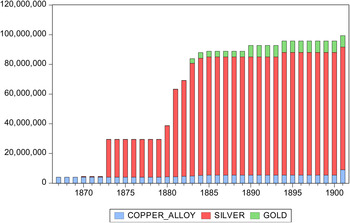
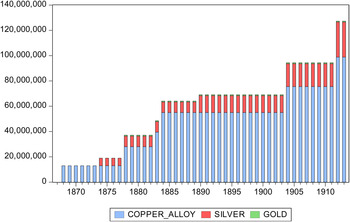
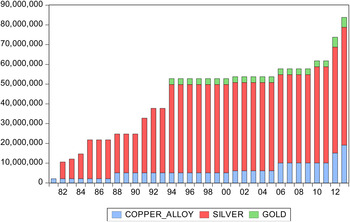
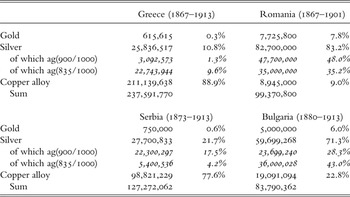
The interpretation of the coinage legislation advanced above – a long-term vision combined with a realistic approach as to what can be realised short term – can be supported by data on national coinage which are preserved for Romania, Serbia and Bulgaria (see Figures 1–3).Footnote 3 In all three cases, gold coinage remained in very small proportions (see Table 2; Romania: 7.8%; Serbia: 0.6%; Bulgaria: 6.0%) and came only years after passing the Coinage Act (Romania: 1867 vs 1883; Serbia: 1873 vs 1878; Bulgaria: 1880 vs 1894). In the case of Serbia – which had weaker budgets than the other two (Morys Reference Morys2015) – not even silver was minted in sizeable amounts (21.7%), and the burden of coinage fell on copper (77.6%). Low-denomination copper coins were commonplace in the nineteenth century; in LMU countries, such coins were even a necessity, as the smallest silver coin (0.20 franc = 20 centimes) weighed only 1 gram. Yet the extent of reliance on copper was unusual; it even meant that copper was used for denominations reserved for silver under LMU rules (in particular the 20 centime coin, one of the most widely used coins at the time, as its value amounted to approximately 10 per cent of a day labourer's wage for a full working day).
Romanian mintage according to metal, 1867–1901 (nominal value in Romanian leu = French franc)

Serbian mintage according to metal, 1873–1913 (nominal value in Serbian dinar = French franc)

Bulgarian mintage according to metal, 1880–1913 (nominal value in Bulgarian lev = French franc)

Total mintage in four South-East European countries according to metal, 1867–1913, in domestic currency (= French franc)

Sources: Own calculations based on Leconte (Reference Leconte1994) for Greece and Serbia, Bulgarian National Bank (2009) for Bulgaria and Romanian Statistical Yearbook (various issues) for Romania.
IV
Similar to the passing of a national budget, the first international bond issue does not constitute a monetary reform sensu stricto; it was a treasury operation which, interestingly, preceded the existence of a proper monetary authority in the form of a bank of note issue. Yet it was a crucial step towards developing a modern monetary system in that it contributed to both the foundation of such a bank as well as a stock exchange located in the capital city.
The early issuance of a first bond is explained by a combination of push factors and pull factors. The young Balkan countries operated on a third of Western European per capita income levels (Morys Reference Morys, Avramov and Pamuk2006), but faced high expenditure in the absence of any meaningful capacity to collect revenue. A government and administrative structure needed to be built completely from scratch but this was expensive, not least in relative terms due to the small population size (below 2 million in all cases except Romania). Military expenditure was high given lingering border conflicts and the irredentist political agenda. In such difficult circumstances, seigniorage revenue through coinage was a first attempt to close a weak budget, and the early coinage experience described above has been analysed econometrically in this light (Morys Reference Morys2015). Yet financial needs were simply too high and after eight years of first coinage (incidentally the same interval throughout), Romania, Serbia and Bulgaria launched a first bond denominated in foreign currency and issued abroad.
Why were Britain, France, Germany and, to a lesser extent, other West European countries such eager buyers of SEE government debt? Economic and commercial motivations certainly played a role – especially in the case of Romania, which offered great economic promise due to good agricultural conditions on the Danubian plains – but the detailed account of Feis (Reference Feis1930, ch. 12) suggests that political and diplomatic considerations played an outsized role in comparison to the rest of Europe. The specific circumstances of the first loan demonstrate well the overall pattern. In the Greek case, the first loan of 1824/5 was a war loan by Britain and France in support of the Greek revolution (Lazaretou Reference Lazaretou2014, p. 102). In the cases of Serbia and Bulgaria, the first bond issue aimed at securing the funds for the completion of the Vienna–Istanbul rail link (Orient Express) on their respective territories; construction of these rail links was an international obligation which both countries had entered into at the Congress of Berlin (1878) in exchange for obtaining political independence (Feis Reference Feis1930, pp. 262–3; Lampe and Jackson Reference Lampe and Jackson1982, pp. 208–9). Only in the Romanian case was the first bond issue motivated primarily on economic grounds, that is to build rail links to Austria–Hungary to transport wheat, the country's main export commodity, to West European markets (Lampe and Jackson Reference Lampe and Jackson1982, pp. 209–10).
The sense of urgency on the part of the borrowers as well as the lenders also explains why a bank of note issue – which in the case of many other countries was given the task of administering such bond issues – was not seen as a precondition for a first loan. Rather, with regard to Romania and Serbia at any rate, the reverse seems to have been the case: the ability to ‘dump’ unsold government bond issues on the national bank appears to have been a key motivation in its foundation only years after the first bond issue (Stoenescu et al. Reference Stoenescu, Aloman, Blejan and Costache2011, p. 186; Hinic et al. Reference Hinic, Durdevic and Sojic2014, p. 342). Not only did the bank of note issue become quickly involved in ‘buying’ and administering the national debt, but stock exchanges emerged domestically as a trading platform for it. This process was quickest in Romania (foundation of the Bucharest stock exchange in 1882), where (different from the other countries) a wealthy aristocracy existed which quickly repatriated a certain amount of foreign-issued Romanian government debt and traded it locally. The same forces operated more slowly in the other three countries, but in all cases the foundation of a national stock exchange seems to reflect the trading of government debt rather than of industrial stocks (Battilossi and Morys Reference Battilossi and Morys2011).
V
In contrast with common practice since the interwar period, the establishment of a monetary authority occurred only with a considerable interval between political autonomy and a Coinage Act in all four cases. Even in the case of Bulgaria, where events moved fastest given its late-coming status, seven years passed between (effective) political independence (1878) and a bank with note-issuing privilege (1885).Footnote 4 Were banks of note issue not crucial to a modern monetary system and statehood under nineteenth-century conditions?
On one level, banks of note issue were not necessary for the monetary systems of the young Balkan countries. National coinage was in sufficient supply, gradually replacing foreign coinage through a combination of changing moneyholder preferences and actual demonetisations of foreign coins. Foreign bank notes had never played any meaningful role in the Balkans (and hence there was no need to replace them with domestic ones), and the bank note experiments of the late Ottoman Empire had all failed and created suspicion rather than interest in this new means of payment (Lampe and Jackson Reference Lampe and Jackson1982, p. 203). As demonstrated in the previous section, government bonds had been placed abroad in all cases without a national bank, suggesting that international capital markets did not see a bank of note issue as a precondition for the much needed international lending.
Yet there was a growing realisation that such a bank would be helpful in various ways. First, it could promote financial development in general. In all four cases, there were no commercial banks prior to the establishment of a bank of note issue (Morys Reference Morys2014, p. 41); loans existed through moneylenders, but were confined to small sums and subject to interest rates over and above 10 per cent (Sojic and Djurdjevic Reference Sojic, Djurdjevic, Avramov and Pamuk2006, p. 143). Second, while international lending was forthcoming without such an institution, relying exclusively on such loans to cover the chronically weak budgets was risky; a national bank would help as a government banker in difficult times. Last but not least, the political symbolism of a national bank was important: while political autonomy was not seen as enough to establish such an institution, political independence not only provided the legal basis but also made it politically expedient to found such a bank.
With the exception of Greece's earlier political developments, only the Congress of Berlin (1878) therefore provided the natural starting point for Serbia, Romania and Bulgaria to establish a bank of note issue. But even then it took several years – and various failed attempts in all countries (Lampe and Jackson Reference Lampe and Jackson1982, pp. 203–8) – to found such an institution. The process was lengthy and arduous, as two questions needed to be settled first. First, who would provide the capital for the bank? Second, what level of influence would be granted in return?
The ownership structure showed considerable variety among the four banks. The Bulgarian National Bank was completely state-owned, whereas the National Bank of Serbia was completely in private hands, with the National Bank of Greece and the National Bank of Romania falling in the middle. Ownership structure could also change over time. The National Bank of Greece and the National Bank of Romania, for instance, were initially partly state-owned (20% and 33%, respectively), but this share was later reduced to zero (Conant Reference Conant1902, p. 280; Lampe and Jackson Reference Lampe and Jackson1982, pp. 204, 206, 217). The main tension was not over public versus private ownership: it was well understood that the government would retain considerable influence also over a privately owned bank. The big issue was the extent of foreign involvement: while it was desirable to muster capital quickly given the scarcity of domestic saving, all four countries eventually decided against foreign participation which they saw as incompatible with the political independence achieved only recently.
Ownership structure does not necessarily reveal a great deal about the level of influence the government enjoyed; it is well known that nineteenth-century governments had their own ways of asserting influence over privately owned banks of note issue, either formally (government representatives on the board and, in particular, the right to appoint the governor) or informally in a myriad of ways. Crucially, the note issue privilege was granted by the government only on a temporary basis, which meant that the renewal of the charter (or even threatening with non-renewal years ahead) provided considerable opportunities for government influence over banks. The history of the four SEE banks demonstrates nicely that formal criteria do not do justice to the complexities of the relationship between government and national bank (Conant Reference Conant1902, pp. 277–81, 283–4; Lévy Reference Lévy1911, pp. 198–228, 502–9). On a formal level, the National Bank of Greece and the National Bank of Serbia enjoyed the strongest protection against government interference: shareholders elected all board members (including the governor), and the note-issuing privilege was granted routinely for 20 years or more; both banks only had to accept a royal commissioner tasked with a loosely specified ‘general oversight’. The National Bank of Romania and the Bulgarian National Bank appear less independent in comparison: the Bulgarian National Bank was a full-fledged state bank, and in the case of Romania governors were appointed by the government.
Yet applying economic criteria leads to the opposite conclusion. Arguably, the best way of evaluating the level of influence is by assessing the amount of government debt held by the bank of note issue. Banks were generally hostile to such debt monetisation, and they only accepted it if they had to. In the Serbian and Greek cases, government debt as percentage of total assets peaked in the 1890s at 33 and 55 per cent, respectively (Lampe and Jackson Reference Lampe and Jackson1982, p. 214; Lazaretou Reference Lazaretou2014, time series gr4g); by contrast, the Bulgarian National Bank did not hold any government debt until 1898 and thereafter only of modest proportions. In the Romanian case, the position of the national bank vis-à-vis the government even improved over time in this regard. Initially, the National Bank of Romania had acted as government banker, but was able to free itself from further government borrowing in 1900 (an achievement which coincided with the government's decision to withdraw its capital from the bank). In the following decade, government debt as a share of the bank's assets was very small. The degree to which the National Bank of Serbia and the National Bank of Greece became subservient to the treasury can also be inferred from another piece of evidence: reducing the banks’ role as a government banker was a crucial objective of the international financial supervision arrangements which Serbia and Greece entered into in 1895 and 1898, respectively (Morys Reference Morys2015; Tuncer Reference Tuncer2015).
VI
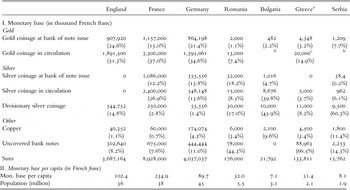
The foundation of national banks turned out to be a mixed blessing. While it enabled the circulation of bank notes and allowed for the provision of credit – including long-term credit for agricultural, commercial and industrial purposes (Morys Reference Morys2014, p. 41) – it undermined another monetary reform objective, namely joining the gold standard. The national banks had not been primarily founded with a view towards debt monetisation; yet once established, the SEE governments closed weak budgets by forced loans. I mentioned above that the ambitious gold standard legislation had in practice been followed by the mintage of silver and copper; this practice was now ‘refined’, with bank notes (issued against government debt of questionable quality and liquidity) taking the role of token coins: the bank of note issue quickly became the main vehicle of debt monetisation by the treasury (Morys Reference Morys2015). As a result, gold developed a premium against silver, copper and, later, bank notes: the fiat standard was born which lasted until the early twentieth century. To substantiate this point, I calculate the various components of the monetary base for SEE and compare them to Haupt's estimates for England, France and Germany (Table 3).
Composition of monetary base: Western Europe versus South-East Europe, 1885

Sources: Haupt (Reference Haupt1886), complemented for Bulgaria by Bulgarian National Bank (2009) and Dimitrova and Ivanov (Reference Dimitrova and Ivanov2014), for Serbia by Gnjatovic (Reference Gnjatovic, Avramov and Pamuk2006) and Hinic et al. (Reference Hinic, Durdevic and Sojic2014) and for Greece by private correspondance with Sofia Lazaretou.
a Greek data refer to December 1886.
b Any values can only be approximate estimates; see discussion in the main text.
c Value constitutes an upper-bound estimate. Haupt's estimate is for September 1885, the last month of a short spell of convertibility in Greece which only lasted from January to September 1885 (Lazaretou 2005). We recalculate Haupt's estimate for December 1886 based on two assumptions: first, all the metallic stock at the National Bank of Greece was in gold; second, the gold coinage in circulation remained unchanged compared to September 1885. The first assumption is based on the good advice of Sofia Lazaretou; the second assumption is not plausible (given the balance-of-payments deficit at the time which resulted in cours forcé) but serves well the purpose of establishing an upper bound.
The sum is identical to the modern concept of ‘monetary base’: coins and notes in circulation.Footnote 5 Subcomponents are constructed in an instructive way. Haupt lists gold and silver coinage at the central bank (which is not monetary base), but subtracts these values from ‘bank notes in circulation’ to arrive at a position labelled ‘uncovered bank notes’. The basic message is this: residents in the core countries experienced the gold standard by being exposed to gold coin on a daily basis; by contrast, transactions in SEE were carried out in silver, copper and paper currency. In England, France and Germany, gold as a percentage of the monetary base exceeded 50 per cent. Even gold in circulation accounted for more than a third of total circulation in all three countries. Conversely, the amount of uncovered bank notes was small. The composition of the SEE monetary bases could not be more different. Gold remained below 10 per cent and circulation was dominated either by silver (Bulgaria, Serbia) or by bank notes (Greece, Romania). The fiscal needs of the young Balkan countries had made an illusion out of the gold standard legislation passed between 1867 and 1880. Silver, copper and bank notes dominated circulation and traded at a heavy discount against the little gold left in the country.
As the origin of the problem was fiscal, the envisaged exchange-rate stabilisation could only be achieved by fiscal consolidation. Romania was the only country in which domestic reforms alone paved the way for gold standard membership in 1890 (Stoenescu et al. Reference Stoenescu, Aloman, Blejan and Costache2011, pp. 184–92). In the other three countries, the situation had to get worse before it could improve. In the absence of domestic reform and with foreign funds flowing in easily, it was only a matter of time for debt levels to grow out of all proportion. Greece and Serbia had accumulated debt-to-GDP ratios of 176 and 138 per cent in 1893 and 1895, respectively, the year of their default. For a variety of political and economic reasons (and in the Greek case only after a five-year period), both countries wished to move from unilateral default to a debt restructuring, and consented to financial supervision by their main lenders in 1898 and 1895, respectively. The quid pro quo was similar for Bulgaria, although the country did not default but entered financial supervision ‘voluntarily’ in 1902 to obtain another loan. It was only under this new institutional setting that the three countries started to run positive budgets which allowed the withdrawal of currency in circulation. The exchange-rate appreciated and further debt monetisations were no longer necessary. In this environment, Bulgaria, the ‘mildest’ of the three cases, was able to shadow gold in 1906, followed by Serbia in 1909 and Greece in 1910 (based on remaining within a +/–2.0% band vis-à-vis de jure gold standard countries; see Morys Reference Morys2014, p. 46). The SEE countries had finally implemented their gold standard legislation from four decades earlier.
VII
What kind of monetary institutions are needed to become a proper state? I have provided an answer to this question for the four SEE countries which became autonomous within and, later, independent from the Ottoman Empire during the nineteenth century: Serbia, Greece, Romania and Bulgaria. As most of the political and economic dynamism was concentrated in the second half of the nineteenth century, their experiences give us good insight into what monetary institutions were needed at a time of a globalising world economy epitomised by the gold standard.
I identified five steps which were taken in the same chronological order by the four countries. Following political autonomy, they first passed a national budget; a process which could take up to two decades and reflected the gradual metamorphosis of clan-based societies into modern states structured around a centralised bureaucracy and a political process mediated by government and parliament. A system of national coinage came only as a second step (again with considerable delay in some cases), to be followed by a first government bond issue targeting West European capital markets. Only then came the foundation of a national bank as a proper monetary authority; a step which today would be taken immediately upon independence. The century of monetary reform in SEE ended with all four countries eventually adopting the gold standard at the turn of the century.
I explained how the five reform steps were interrelated and how they built on each other, and also pointed out that only two of them were ‘monetary reforms’ in the narrow sense of the word: a unified coinage and the establishment of a bank of note issue. Why did these two reforms come so late? We could also turn the question around and ask from an eighteenth-century perspective: why pass such reforms at all? The answer is that the Balkan countries emerged in the nineteenth century and hence show a pattern of institutional development between the two concepts of monetary reform implicitly articulated in the two questions. Foreign coin circulation was widespread in nineteenth-century Europe, including in the economically more advanced West European countries. The Latin Monetary Union of 1865, for instance, owes its very existence to the French, Italian, Belgian and Swiss desire to maintain the benefits of long-established foreign coin circulation under new circumstances (in the event, price changes between gold and silver on international bullion markets). Consequently, the Balkan countries initially did not see a need for unified, national coinage and postponed the costly reform. The late emergence of a national bank can be rationalised on similar grounds: there were no immediate benefits to having such an institution (even international capital markets could be accessed without one), but raising the necessary capital domestically was difficult. Consequently, reform efforts stalled until it became clear that such an institution would be helpful in managing the national debt as well as supporting the financial development of the domestic economy more broadly speaking.