INTRODUCTION
Over the last several decades, the focus on cognitive impairment in multiple sclerosis (MS) has grown exponentially (Chiaravalloti & DeLuca, Reference Chiaravalloti and DeLuca2008). This increase in attention on cognition has shed light on patient reports of poor memory abilities, with objective memory deficits observed in 40–65% of patients in MS (e.g., Chiaravalloti & DeLuca, Reference Chiaravalloti and DeLuca2008; Rao et al., Reference Rao, Grafman, DiGuilio, Mittenberg, Bernardin, Leo and Univerzagt1993). While the majority of inquiry into learning and memory impairment in MS has been centered on episodic, specifically retrospective memory (i.e., recalling previously learned information), few studies have explored the prevalence and nature of prospective memory (PM) difficulties in persons with MS (Dagenais et al., Reference Dagenais, Rouleau, Tremblay, Demers, Roger, Jobin and Duquette2015; Miller, Basso, Candilis, Combs, & Woods, Reference Miller, Basso, Candilis, Combs and Woods2014; Rouleau et al., Reference Rouleau, Dagenais, Tremblay, Demers, Roger, Jobin and Duquette2018). PM refers to the ability to remember to perform an intention at a specific point in the future (i.e., “remembering to remember”). Typical PM tasks require one to: (1) formulate an intention, (2) encode the intended action with the appropriate cue for execution, (3) maintain the cue-intention pairing over a delay, (4) retrieve the intention from retrospective memory upon detection of the appropriate cue, and (5) successfully execute the intended action (McDaniel & Einstein, Reference McDaniel and Einstein2000). In other words, PM tasks require both retrospective memory and self-initiated retrieval for overall success because in addition to remembering the task, one must remember the appropriate context in which the task must be performed (e.g., buy milk when you pass the grocery store; McDaniel & Einstein, Reference McDaniel and Einstein2000). Across aging and clinical populations (e.g., Parkinson’s disease, HIV), poor PM abilities are associated with poorer everyday functioning (Hering, Kliegel, Rendell, Craik & Rose, Reference Hering, Kliegel, Rendell, Craik and Rose2018; Pirogovsky, Woods, Filoteo, & Gilbert, Reference Pirogovsky, Woods, Filoteo and Gilbert2012; Woods et al., Reference Woods, Iudicello, Moran, Carey, Dawson and Grant2008; respectively). In MS, Honan and colleagues (Reference Honan, Brown and Batchelor2015) found that self-reported PM deficits were associated with an increased likelihood of unemployment.
Among the small yet growing literature on PM in MS, a common finding has emerged across all studies, that PM tasks with high strategic demands (i.e., require more effortful and executive-level processing) are relatively more impaired than those with low strategic demands (see Rouleau et al., Reference Rouleau, Dagenais, Tremblay, Demers, Roger, Jobin and Duquette2018 for review; Dagenais et al., Reference Dagenais, Rouleau, Tremblay, Demers, Roger, Jobin and Duquette2016). According to McDaniel and Einstein’s Multiprocess Theory of PM (McDaniel & Einstein, Reference McDaniel and Einstein2000), time-based PM (Time-PM) tasks generally require greater strategic resources largely due to the need for monitoring time before performing the delayed intention (e.g., remembering to call your friend in 2 hr). On the other hand, event-based PM (Event-PM) tasks require fewer strategic resources because they are tied to a specific cue in the environment (e.g., remembering to mail a letter when you drive by the post office). Thus, event-based tasks lend themselves to spontaneous retrieval when one encounters that cue and require less effort for the individual to retrieve. In time-based tasks, however, the passage of time needs to be periodically monitored without external cueing for successful completion of the PM task, oftentimes resulting in a more difficult task. Indeed, Time-PM tasks are often more sensitive to cognitive dysfunction in clinical populations (Raskin, Reference Raskin2009). To date, only one study has directly examined and compared Time-PM with Event-PM tasks in persons with MS, which showed that individuals with MS performed worse on Time-PM tasks compared to Event-PM tasks, particularly for time-based intentions over sustained delay periods (Miller et al., Reference Miller, Basso, Candilis, Combs and Woods2014). Despite the growth of this line of inquiry into PM in MS, both the underlying cognitive mechanisms of Time-PM impairment and the relationship of PM to everyday life performance have yet to be explored in MS.
One important facet of Time-PM that is largely unexplored in MS and in general is the length of time between forming the PM intention and the appropriate time/place to perform the intended action (e.g., intending to call your friend in 2 min or 2 hr). Clinical populations that exhibit deficits in executive functions (i.e., strategic processes) have more difficulty performing PM tasks when the delay period in-between intention and cue is longer (e.g., HIV infection; Morgan, Weber, Rooney, Grant, & Woods, Reference Morgan, Weber, Rooney, Grant and Woods2012). Therefore, one of the goals of this study was to examine whether impaired executive functions would be associated with Time-PM impairments, particularly those with longer delays between cue and intention formation.
The present study seeks to (1) examine whether participants with MS would perform worse than HC on Time-PM tasks compared to Event-PM tasks, (2) examine whether longer delays on PM would result in poorer performance relative to short delay PM tasks, (3) examine the neuropsychological correlates of PM performance, and (4) examine the relationship between the PM and a measure of everyday functioning. The study hypotheses were that (1) the MS group would perform worse than HC on PM tasks in general, but relatively worse on time-based PM tasks compared to event-based tasks; (2) the MS group would perform worse than HC on long delay Time-PM tasks; (3) executive functions will be positively associated with Time-PM performance but not with Event-PM performance; and (4) PM performance will be associated with performance of tasks assessing everyday functioning.
METHODS
Participants
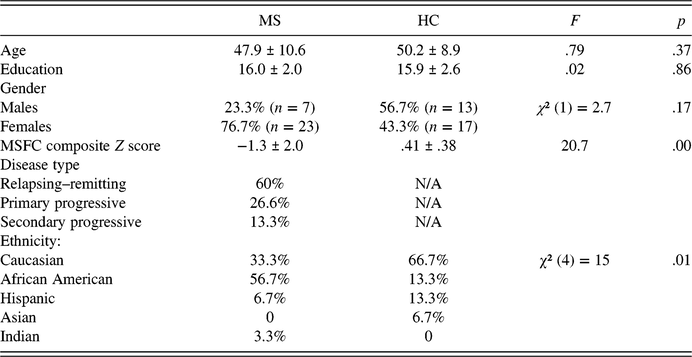
Participants consisted of 30 persons with clinically definite MS (Polman et al., Reference Polman, Reingold, Banwell, Clanet, Cohen, Filippi and Wolinsky2011) and 30 healthy controls (HCs). Demographic characteristics are described in Table 1. Participants were all between the ages of 28 and 65, had no reported history of alcohol or drug abuse and/or psychiatric illnesses, were free from any history of neurological injuries or illnesses (aside from MS), and English was their primary language. Groups were matched on age, sex, and education level. All MS participants were at least 1 month post-exacerbation and were free of corticosteroid use. MS participants were recruited from study advertisements and through local support groups, as well as from the participant recruitment database at the Kessler Foundation. HC were recruited from study advertisements and through word of mouth. Potential participants completed a telephone screen and were then considered for enrollment based on the inclusion/exclusion criteria discussed above.
Demographic characteristics of the study sample

N/A, not applicable.
Note. Values are mean ± SD or as otherwise indicated.
Upon initial telephone contact, potential participants were screened according to the inclusion/exclusion criteria discussed above. Before study enrollment, all participants signed an informed consent form approved by the Institutional Review Board. Upon meeting inclusion criteria, participants were scheduled for an interview and testing. Participants completed various neuropsychological tests to assess PM and related cognitive functions.
PM Assessment
Memory for Intentions Screening Test
(MIST; Raskin, Reference Raskin2009; Raskin, Buckheit, & Sherrod, Reference Raskin, Buckheit and Sherrod2010). The MIST is a 30-min test, in which participants engage in a word search puzzle as the ongoing task while performing other tasks simultaneously. The MIST is comprised of four trials with event-based (EB) cues (e.g., “When I hand you a postcard, self-address it.”) and four trials with time-based (TB) cues (e.g., “In 15 minutes, tell me it is time to take a break.”), with each item scored from 0 to 2 points based on correctness of the cue and response components; thus, the separate event-based and time-based scales have scores ranging from 0 to 8. The MIST allows for separate scoring of time-based trials (8 points possible), event-based trials (8 points possible), 2-min delay periods (8 points possible), 15-min delay periods (8 points possible), verbal response trials (8 points possible), and action response trials (8 points possible), which are summed for a total of 48 possible points; higher MIST totals indicate better performance. Prior studies support the reliability and validity (see Raskin, Reference Raskin2009 for review; Woods, Moran, Dawson, Carey, & Grant, Reference Woods, Moran, Dawson, Carey and Grant2008) of the MIST to assess PM as a unitary construct separate from retrospective memory and executive functions (Gupta, Woods, Weber, Dawson, & Grant, Reference Gupta, Woods, Weber, Dawson and Grant2010). The following variables were examined: (1) summary score; (2) time-based scale; and (3) event-based scale. Given our interest in delay length, we also examined the MIST Time-PM and Event-PM scales by delay interval, such that we obtained a 2-min Time-PM scale, 2-min Event-PM scale, 15-min Time-PM scale, and a 15-min Event-PM scale (each with four points possible).
Neuropsychological Assessment
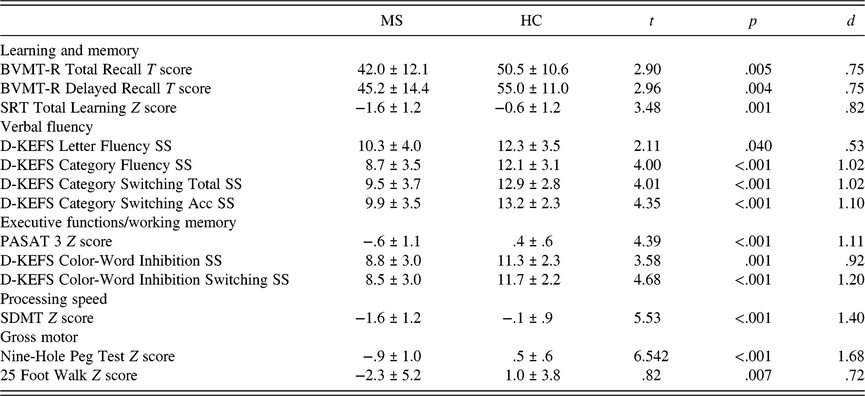
All participants completed a battery of neuropsychological tests that included measures known to be sensitive to MS-related cognitive impairment as well as constructs important for PM performance (MS-Cog, Erlanger et al., Reference Erlanger, Kaushik, Caruso, Benedict, Foley, Wilken and DeLuca2014). This included measures of learning and memory [i.e., Selective Reminding Test (SRT) (Buschke, Reference Buschke1973); Brief Visuospatial Memory Test (BVMT) (Benedict, Reference Benedict1997)], information processing speed [i.e., Symbol Digit Modalities Test (SDMT) (Smith, Reference Smith2002), Delis–Kaplan Executive Function System (D-KEFS, (Delis, Kaplan, & Kramer, Reference Delis, Kaplan and Kramer2001)) Color-Word Interference], verbal fluency (D-KEFS Letter, Category, and Category Switching Fluency), executive functions/working memory [D-KEFS Color-Word Interference and Interference Switching, Paced Auditory Serial Addition Test (PASAT, (Diehr, Heaton, Miller, & Grant, Reference Diehr, Heaton, Miller and Grant1998))], and motor functioning [9-Hole Peg Test, Multiple Sclerosis Functional Composite (MSFC) 25 foot walk (Fischer, Rudick, Cutter, & Reingold, Reference Fischer, Rudick, Cutter and Reingold1999)]. Demographically corrected scores were used for each test; neuropsychological performance characteristics of each sample may be found in Table 2. Within each cognitive domain (see Tables 2 and 3), test scores were converted to population-based Z scores and averaged to comprise domain composite scores.
Cognitive characteristics of the study sample (Mean ± SD)

Everyday Functioning Assessment
Actual Reality™ (AR) (Goverover & Deluca, Reference Goverover and DeLuca2018; Goverover, O’Brien, Moore, & DeLuca, Reference Goverover, O’Brien, Moore and DeLuca2010) is a performance-based functional test that consists of using a website to accomplish a task. Everyday life activities are assessed using the Internet to assess three functional tasks of (1) purchasing cookies for a birthday present; (2) flight tickets to go to Orlando FL, and (3) purchase pizza for a party. Prior to providing instructions on how to complete the AR tasks, participants are provided with a basic computer tutorial, paper, pen, calendar, and credit card in a wallet to use for payment. During each task performance, no actual purchases are made. Each task is comprised of 32 steps involving critical actions required to finish the task, such as selecting and clicking certain Internet icons when necessary (e.g., selecting appropriate cookies, selecting price, filling in information such as name, address, and payment method). Each AR task yields four variables: AR – Total Number of Errors: Total number of errors regardless of type. Each error received 1 point and, thus, the score could range from 0 (no errors were made) to 32 (error was made in each step of the task). AR – Sum of Errors: if an error is made but corrected following self-correction/self-questioning (score = 1), if an error is made and the participant does not receive a cue, and did not correct him/herself (score = 2), if an error was made and was corrected after a cue (score = 3). If the error is made but is not corrected after a cue (score = 4). Lower scores indicated greater independence in the performance of the task (i.e., needed fewer cues to perform the steps accurately). AR – Cognitive Capacities Score (AR-Cog) refers to the observable cognitive capacities required to complete the AR tasks (e.g., initiation, organization, notice, and respond). The response choices for each cognitive capacity are scored as follows: competent (0), inefficient (1), or severe deficit (2). Time to complete the task, AR-time, was the fourth measure which is comprised of the time it took a participant to complete each task. Thus, each task has four scores associated with it, and performance for each subscale was averaged across the three tasks. AR has been demonstrated to be a reliable and valid indicator of everyday functioning across persons with TBI and MS (Goverover & DeLuca, Reference Goverover and DeLuca2015, Reference Goverover and DeLuca2018; Goverover et al., Reference Goverover, O’Brien, Moore and DeLuca2010).
Data Analysis
To examine group differences between HC and MS on time- and event-based PM tasks, a 2 [within-subjects: PM cue type (Time-PM and Event-PM MIST subscales)] × 2 [between-subjects: group (MS and HC)] repeated-measures ANOVA was conducted. To examine the impact of delay length on PM, a 2 [within-subjects: delay length (2 and 15 min MIST subscales)] × 2 [between-subjects: group (MS and HC)] repeated-measures ANOVA was conducted; note that these latter analyses were conducted separately for Time-PM trials and Event-PM trials. Significant or trend-level interaction terms were explored using independent-samples t tests within MIST scales, with Hedge’s g calculated to estimate pairwise effect sizes akin to traditional Cohen’s d descriptor ranges (i.e., small = .2, medium = .5, large = .8). Spearman’s ρ correlations were used to examine the relationships between cognitive domain composite Z scores and MIST performance, as well as between AR subscores and MIST performance. Spearman’s ρ correlations were used for this analysis because MIST scales were non-normally distributed. Lastly, we ran a series of linear regressions with each AR variable as a dependent variable, and with MIST Time-PM score and each cognitive domain Z score as predictor variables.
RESULTS
Time-Versus Event-Based PM Cues
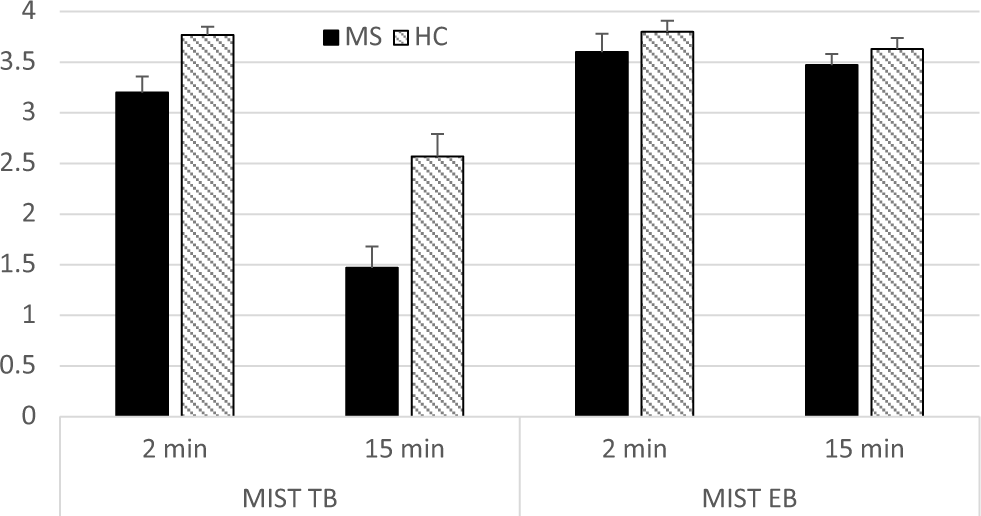
A significant interaction between cue type and group was observed [F(1,58) = 14.257; p < .001; partial η 2 = .197], such that the MS group performed significantly worse on the Time-PM subscale of the MIST relative to the HC group (Hedge’s g =1.03; p < .001) but not on the Event-PM subscale (Hedge’s g = .30; p = .265; see Figure 1). Additionally, the MS group performed significantly worse on the MIST subscales overall compared to HC [group main effect: F(1,58) = 14.274; p < .001; partial η 2 = .197] and both groups performed worse on the Time-PM subscale relative to the Event-PM MIST subscale [PM cue type main effect: F(1,58) = 98.458; p < .001; partial η 2 = .629].
MIST TB and EB subscale mean (and standard errors) scores by clinical group.

Time-Based PM: Short Versus Long Cue-Intention Delay
With regard to Time-PM delay length, results indicated a trend-level interaction between delay length and group [F(1,58) = 3.146; p = .08; partial η 2 = .05]. Follow-up comparisons to the interaction indicated that both groups tended to perform worse on 15-min delay trials relative to 2-min delay trials (MS: Hedge’s g=1.67, p < .001; HC: Hedge’s g = 1.32, p < .001), although a greater effect size between delay lengths was observed in the MS sample (effect size difference between MS and HC = .34; see Figure 2). Overall, the MS group performed worse on the time-based MIST subscales across delay lengths [F(1,58)=17.857; p < .001; partial η 2 = .235] and both groups were more likely to perform worse on the 15-min delay time-based trials relative to the 2-min delay time-based trials [F(1,58)=95.159; p < .001; partial η 2 = .621].
MIST Time-PM and Event-PM subscale mean (with standard errors) scores by clinical group and cue-intention delay length.

Event-Based PM: Short Versus Long Cue-Intention Delay
With regard to delay length in the Event-PM, neither of the main effects (group: [F(1,58) = 1.008; p = 1.740; partial η 2 = .029]; delay length: [F(1,58) = 1.460; p = .232; partial η 2 = .025]) nor the interaction between group and length of delay intervals [F(1,58) = .018; p = .894; partial η 2 = .000] was statistically significant (see Figure 2).
Correlations Between Time-PM and Cognitive Domains
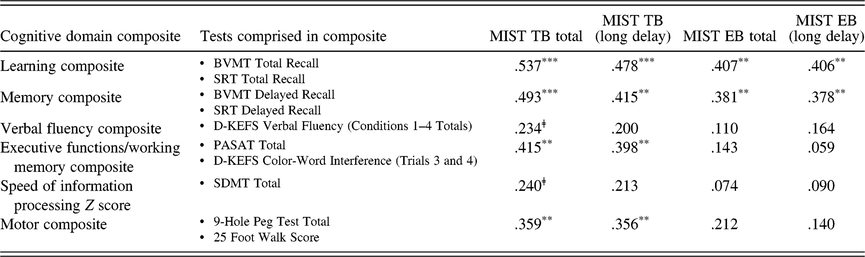
Bivariate correlations (Table 3) within the entire sample revealed significant positive relationships between the MIST Time-PM score and the Learning composite (ρ = .54; p < .001), Memory composite Z score (ρ = .49; p < .001), Executive Functions/Working Memory composite (ρ = .41; p = .001), and Motor composite (ρ=.36; p = .005). Both the Fluency composite (ρ = .23; p = .072) and Information Processing Speed composite (ρ = .24; p = .065) trended toward statistical significance (ps < .10). A similar pattern of findings was noted using MIST Time-PM 15-min scores (Learning composite: ρ= .478, p < .001; Memory composite: ρ = .415, p = .001; Executive Functions/Working Memory composite: ρ = .398, p = .002; Motor composite: ρ = .356, p = .005; all other ps > .10).
Spearman’s ρ correlation values between MIST subscales and cognitive domain Z scores by cue and delay length

*p < .05, **p < .01, ***p < .001.ǂ p < .10.
Correlations Between Event-PM and Cognitive Domains
With regard to Event-PM, significant positive correlations were observed between the MIST Event-PM scale and Learning composite (ρ = .407; p = .001) and Memory composite (ρ = .381; p = .003). Correlations with all other cognitive composites did not reach statistical significance (ps > .10). A similar pattern of findings was observed using the MIST Event-PM 15-min delay scores (Learning composite: ρ = .406, p = .001; Memory composite: ρ = .378, p = .003; all other ps > .10).
Relationship Between MIST and AR
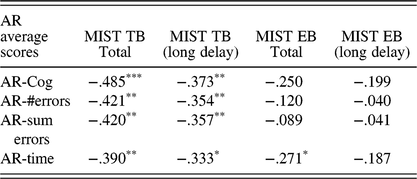
As shown in Table 4, the MIST Time-PM scales were significantly negatively correlated with all composite subscores of AR (AR-Cog, AR-#errors, AR-sum errors, AR-Time), with Spearman’s ρ values ranging from −.333 to −.485 (ps < .013). The total MIST Event-PM subscale was only significantly correlated with AR Time to Completion (ρ = −.271; p = .043). The 15-min Event-PM delay subscale was not significantly correlated with any subscore of AR. A series of linear regressions demonstrated that MIST Time-PM scale independently and robustly predicted each AR variable, even when accounting for all cognitive domain Z scores (AR-Cog: p = .002, partial η 2 = .164; AR-#errors: p = .005, partial η 2 = .143; AR-sum errors: p = .020, partial η 2 = .100; AR-Time: p = .047, partial η 2 = .078).
Spearman’s ρ correlations between MIST subscales and Actual Reality™ (AR) scores

*p < 0.05; **p < 0.01; ***p < 0.001.
DISCUSSION
The present study demonstrated that the MS group had significantly more difficulty with remembering to perform intended tasks compared with a HC group, specifically when the PM cue is based on the passage of time (i.e., Time-PM), rather than dependent on a physical cueing event to occur (i.e., Event-PM). Thus, the study hypothesis was confirmed, and the current results extend previous studies findings with regard to PM impairments in people with MS (Dagenais et al., Reference Dagenais, Rouleau, Tremblay, Demers, Roger, Jobin and Duquette2016; Miller et al., Reference Miller, Basso, Candilis, Combs and Woods2014; Rouleau et al., Reference Rouleau, Dagenais, Tremblay, Demers, Roger, Jobin and Duquette2018). This finding is important because PM tasks are ubiquitous across multiple spheres of everyday life and are associated with independent daily functioning across clinical populations. In this study, participants with MS demonstrated greater Time-PM impairments compared with Event-PM impairments. While not universally of increased difficulty, time-based PM tasks often have greater strategic demands compared to most event-based PM tasks, but this discrepancy varies based on the specific assessment (McDaniel & Einstein, Reference McDaniel and Einstein2007). For the MIST in particular, the strategic demands are relatively lessened for event-based tasks due to the semantic relatedness between the cue (e.g., postcard) and intention (e.g., self-address). Across clinical samples, time-based PM is often more sensitive to cognitive impairment, particularly white matter and frontal lobe damage, but findings vary by pathology (Raskin, Reference Raskin2009). Failing to remember intended tasks at specific times can affect every aspect of a person’s life, from employment (e.g., attend a meeting at 11 AM) to health behaviors (e.g., take medication as scheduled) to daily functioning in the home (e.g., pick up a child at school at 3:15 PM) (Rouleau et al., Reference Rouleau, Dagenais, Tremblay, Demers, Roger, Jobin and Duquette2018).
The second goal of this study was to examine whether longer delays on PM would result in poorer performance relative to shorter delay PM tasks. As hypothesized, the results of the current study confirmed that tasks assigned for completion with longer delays are more susceptible to impairments in persons with MS. Indeed, the ecological relevance of longer delays between PM cue and intention in Time-PM has been demonstrated in a number of studies. For example, longer Time-PM delays predict ADL decline in healthy aging (Tierney, Bucks, Weinborn, Hodgson, & Woods, Reference Tierney, Bucks, Weinborn, Hodgson and Woods2016) and everyday functioning in cognitively impaired adults with HIV (Morgan et al., Reference Morgan, Weber, Rooney, Grant and Woods2012). Additionally, persons with HIV who showed treatment non-adherence had worse performance on the 15-min, but not 2-min delay PM MIST subscales (Poquette et al., 2013).
The third aim of the study was to examine the association of memory and executive functions to PM. The results of the current study add to the growing evidence of PM impairment in MS, which is consistent with the complaints reported by patients. Furthermore, the results of this study are novel in that they demonstrate that Time-PM deficits in MS are associated with executive functioning, rather than with only episodic (retrospective) memory. These findings are consistent with the hypothesis proposed by some authors and the Multiprocess Theory’s view (McDaniel & Einstein, Reference McDaniel and Einstein2000) that PM deficits in MS cannot be attributed to episodic memory impairments only (Bruce, Hancock, Arnett, & Lynch, Reference Bruce, Hancock, Arnett and Lynch2010; Dagenais et al., Reference Dagenais, Rouleau, Tremblay, Demers, Roger, Jobin and Duquette2016), but they also provide a potential explanation for such deficits—that is, a deficit in executive functioning (Dagenais et al., Reference Dagenais, Rouleau, Tremblay, Demers, Roger, Jobin and Duquette2016). Although approximately 23–30% of persons diagnosed with MS may present with executive functioning impairments (Goverover, Chiaravalloti, & Deluca, Reference Goverover, Chiaravalloti and Deluca2013), these results suggest that they may still contribute to impairment in more integrated cognitive functions that are relevant to everyday functioning. Additionally, while not directly implicated in Time-PM processes, the motor composite score was significantly correlated with Time-PM performance. Motor abilities are one of the most affected domains in MS populations and are commonly used as a proxy of overall disease severity (e.g., 25 foot walk and 9-hole peg) (Cutter et al., Reference Cutter, Baier, Rudick, Cookfair, Fischer, Petkau and Willoughby1999; Fischer et al., Reference Fischer, Rudick, Cutter and Reingold1999; Hohol, Orav, & Weiner, Reference Hohol, Orav and Weiner1995). As such, it may be that these findings may indicate a relationship between disease severity and PM.
Lastly, our fourth aim was to examine the relationship between PM and a performance-based task of everyday functioning as to demonstrate ecological validity of the MIST in MS. As hypothesized, the time-based subscales of the MIST were significantly associated with numerous outcomes measures of AR, including overall performance, errors, and time to completion. Moreover, these relationships were statistically significant above and beyond all other cognitive domains, and were characterized by at least medium-to-large effect sizes. To our knowledge, this is the first study to directly examine the relationship of the MIST to everyday functioning in MS. Findings from this aim are consistent with previous studies that have investigated associations between the MIST and various aspects of everyday functioning (e.g., IADL dependence: Pirogovsky et al., Reference Pirogovsky, Woods, Filoteo and Gilbert2012, Hering et al., Reference Hering, Kliegel, Rendell, Craik and Rose2018; employment: Burton, Vella, & Twamley, in press; medication adherence: Woods et al., Reference Woods, Dawson, Weber, Gibson, Grant and Atkinson2009) across a variety of neurological and psychiatric disorders (i.e., Parkinson’s disease, severe mental illness, and HIV infection, respectively). Of note, only the Time-PM subscales of the MIST (not Event-PM) were significantly correlated with AR subscores. Previous studies have demonstrated the relative ecological validity of MIST Time-PM compared to Event-PM (e.g., Woods et al., Reference Woods, Dawson, Weber, Gibson, Grant and Atkinson2009, Pirogovsky et al., Reference Pirogovsky, Woods, Filoteo and Gilbert2012; cf. Woods et al., 2009), particularly on performance-based everyday functioning tasks (e.g., medication adherence monitoring, financial management tasks) compared to self-report indices. It is important to note that AR performance is associated with executive functions (Goverover et al., Reference Goverover, O’Brien, Moore and DeLuca2010), and thus, it does make sense that Time-PM, which is significantly associated with executive functions, would also be associated with performance of AR.
The findings regarding the relationship between Time-PM and cognitive functions of memory and executive functions, and with functional performance have implications for cognitive rehabilitation. Specifically, these findings underscore how improving learning and memory abilities may help ameliorate Time-PM deficits, potentially by strengthening the PM intention at the acquisition phase to allow it to persist over a longer delay (e.g., via implementation intentions). Additionally, findings suggest that addressing impaired executive functions may improve Time-PM performance by supporting strategic aspects of the task. As has been explored in other clinical populations (see Fish, Wilson, & Manly, Reference Fish, Wilson and Manly2010 for a review), rehabilitation efforts may include trainings to encourage monitoring (e.g., Goal Management Training; Levine et al., Reference Levine, Robertson, Clare, Carter, Hong, Wilson and Stuss2000; e.g., Levaux et al., Reference Levaux, Larøi, Malmedier, Offerlin-Meyer, Danion and Van der Linden2012, see Fish, Wilson, & Manly, Reference Fish, Wilson and Manly2010) or changing the TB nature of the task to EB (e.g., NeuroPage alarms: Wilson et al., Reference Wilson1997). Most importantly, these study findings suggest that such treatment may also be associated with everyday life performance.
The present study is not without limitations. First, the study sample size was relatively small, which precluded use of more robust statistical analyses. Specifically, we combined the clinical and healthy samples for the purposes of examining the relationship between PM and cognitive/functional measures with sufficient power and range variability, and so these analyses represent more of a global association between the constructs. A larger MS sample would have allowed for a more focused examination of relationship to individual cognitive domains within the MS sample alone. Additionally, our MS sample may not be fully representative of the MS population in the USA, as we enrolled a relatively high proportion of non-Caucasian and Primary Progressive MS participants. Second, one of the strengths of this study is the concurrent assessment of Time-PM and Event-PM using a well-validated measure of PM (i.e., MIST). Despite the benefits of using a comprehensive PM assessment, the use of overlapping PM trials in the MIST present additional challenges to analysis and interpretation. Specifically, although the MIST has a combination of Time-PM/Event-PM and long-delay/short-delay trials, these trials are not necessarily interspersed evenly throughout the test as to control for effects of cognitive load (see Marsh, Hicks, & Cook, Reference Marsh, Hicks and Cook2005; Logie, Maylor, Della Sala, & Smith, Reference Logie, Maylor, Della Sala and Smith2004). In other words, some trials (particularly long-delay) may need to be carried out while numerous other PM intentions are being simultaneously maintained online, thereby absorbing cognitive resources not related to that specific PM trial. Indeed, research has demonstrated that Time-PM is especially sensitive to increased cognitive load (e.g., Khan, Sharma, & Dixit, Reference Khan, Sharma and Dixit2008). Therefore, our results may be influenced by test design rather than exclusively MS-related cognitive impairment. Future studies should replicate these MIST-based findings using independent measures of Time-PM and Event-PM as to take issues of task interference into account. Lastly, although this study explored cognitive mechanisms underlying Time-PM task performance, there may be other factors (specifically related to time, e.g., time production, time estimation, time monitoring) that we did not take into account during data collection. As such, future studies should aim to directly test the time-related mechanisms of Time-PM impairment in MS, particularly over long delays, using a comprehensive battery of PM-based constructs (e.g., Mioni et al., Reference Mioni and Stablum2014; Raskin , Williams, & Aiken, Reference Raskin, Williams and Aiken2018) to more effectively target Time-PM impairment in MS.
Overall, these results suggest that Time-PM is disproportionately impaired relative to Event-PM in MS, and that these effects are exacerbated by longer delays. Because Time-PM tasks are common in everyday life, the present findings support the use of tailored methods to improve Time-PM functioning, which may yield important strides in maintaining functional independence through MS disease progression.
ACKNOWLEDGEMENTS
The primary study (“The use of Actual Reality™ to measure everyday life functional activity in MS”) was funded by an Investigator Initiated Grant/Trial Award from Biogen (US-MG-13-10511; YG, JD); this secondary study did not receive direct funding from Biogen. There are no other conflicts of interest to report for the authors (EW, NDC, JD, YG).
CONFLICT OF INTEREST
The authors report no current or potential conflicts of interest.