Introduction
In May 2010 a Conservative and Liberal Democrat Coalition Government was elected in the United Kingdom. It immediately started to plan a programme of wide-ranging cuts in public spending to tackle the effects on the economy of the 2008 financial crisis. The new Chancellor of the Exchequer, in his Comprehensive Spending Review for the period up to 2014, announced average cuts of 19 per cent in government department budgets and a reduction in the amount of money that local authorities would receive from central government in April 2011 of 7.1 per cent (HM Treasury Reference Treasury2010). In turn, charities would face nearly £3 billion in cuts between 2011 and 2015 (Cabinet Office 2010). In an attempt to mitigate the effects of cuts in spending, the government set up a transition fund of £100 million to help third-sector organisations with the costs of reconfiguration to meet new challenges and develop existing or new services, while £370 million was made available to build third-sector capacity (HM Treasury Reference Treasury2010). The outgoing New Labour Government had, during its term of office, created the ‘Futurebuilders’ fund with £215 million to help third-sector organisations to bid for public funding, a ‘Communitybuilders’ fund providing £70 million to help small community-based organisations, and a ‘Social Enterprise Investment’ fund with £100 million to help organisations deliver health and social care services. In addition, the ‘ChangeUp’ programme provided £150 million to support organisations providing capacity-building services to the third sector at national and local levels.
In the face of severe economic problems, the new Coalition Government decided to retain the New Labour government's emphasis on active ageing, as reiterated in the Giving White Paper published in May 2011 (Cabinet Office 2011). According to the World Health Organization, ‘Active ageing is the process of optimizing opportunities for health, participation and security in order to enhance quality of life as people age’ (Edward Reference Edward2002, 12). The New Labour Government's Opportunity Age policy suggested active ageing was about creating a ‘Society where later life is as active and fulfilling as the earlier years, with older people participating in their families and communities’ (Department for Work and Pensions (DWP) 2005, 30). At the same time, many older people have said that active ageing is about having access to suitable housing, leisure opportunities and social activities, as well as maintaining physical health and mental functioning (Bowling Reference Bowling2008). It is pertinent to reflect on the turndown in the economy that has occurred since 2008 when considering the longer-term sustainability of different government initiatives designed to promote active ageing and capacity building in organisations that support the involvement of older people in activities designed to empower them and improve their quality of life.
This paper examines how capacity-building partnerships between English local authorities and third-sector organisations worked to deliver the New Labour Government-inspired LinkAge Plus (LAP) pilots that were set up in eight areas in England and ran from 2006 to 2008. The aim was to find better ways to co-ordinate and manage the design and provision of services to meet the needs of older people aged 50 and over. At the same time, there was an emphasis on shifting from a ‘needs-led’ to a more ‘citizen-centred’ approach by developing services with, rather than just for, older people. An Opportunity Age policy had been developed that sets out a view of older people as active citizens, working or volunteering and engaging in lifelong learning (DWP 2005). Subsequently, a strategy was devised to bring national government departments, local authorities and other relevant organisations together in order to:
• Identify and tackle issues which limit older people's ability to get the most out of life, including rooting out age discrimination.
• Ensure that older people can be actively engaged locally in influencing decisions which affect their lives, such as planning and public transport.
• Ensure that older people have access to opportunities locally such as learning, leisure and volunteering.
• Promote healthy living at all ages (DWP 2005, xvi).
The pilots were required to embrace six LAP core principles, including the following three statements that are especially relevant to the themes of capacity building, partnership working, and developing or improving services for older people:
• Engage and consult: older people should be involved in how information about relevant services is provided; they are involved in the design and development of those services and their opinions on the quality of service delivery are obtained.
• Ensure that services promote independence, wellbeing and active ageing: services should focus on early intervention and a preventative approach which goes beyond traditional health and social care functions; encouraging respect and social inclusion for older people as citizens should be a primary consideration.
• Maximise opportunities for efficiency and capacity building: efficiencies in the provision and delivery of services should be sought through joint working with partner organisations and improving outputs and outcomes through capacity building.Footnote 1
This paper explores the extent to which different LAP pilot projects were effective in promoting these core principles. It starts by putting these projects in the context of the then Labour Government's policy to build local partnership capacity. It then goes on to examine how this policy was intended to empower older people to become active citizens, getting involved in the development or improvement of services. Theory on collaboration is used to explain the different approaches taken by the eight pilot projects. The methodology section describes how a meta-evaluation was undertaken of national and local reports on the performance of pilot projects. Concluding comments draw together views on the extent to which government objectives concerning older people's welfare and quality of life were achieved. In particular, the creation of effective and sustainable capacity-building partnerships at the local level is considered together with the implications for policy makers.
New Labour and capacity building
In 2003 the New Labour Government reaffirmed its views on capacity building between public and voluntary organisations as being about having ‘The right organisation, systems, partnerships, people and processes to deliver against a particular agenda or plan’ (Office of the Deputy Prime Minister 2003, 8). Initial programmes to build capacity in both local government and third-sector organisations were targeted at internal organisational and workforce performance (Department for Communities and Local Government (DCLG) 2008). In 2006, the Office for the Third Sector was set up to support the activities of third-sector organisations that included voluntary or community groups, social enterprises, charities, co-operatives and mutuals.
However, the government recognised that strengthening the internal capacity of organisations was not sufficient to ensure that local authorities and third-sector organisations would be able to work together effectively to deal with complex social problems that required collective action at the local level. For example, Healy (Reference Healy1998) had differentiated between communities that are well connected, good at getting access to needed funds and supported by influential people, and communities that are fragmented and not well connected and therefore less likely to be supported by influential people and able to get access to needed funds. Meanwhile, Putnam's (Reference Putnam2000) concept of social capital showed how communities with extensive networks and relations with a range of organisations and individuals stand a better chance of obtaining the resources needed to make their neighbourhood a good place to live. In 2004 the government-sponsored Civil Renewal Unit launched the Firm Foundations initiative (Civil Renewal Unit 2004) that set out a framework for capacity building at the local level that would help to address the problem of fragmented and poorly connected communities. There was an emphasis on finding ways to build the types of social capital that would mean more communities were able to get access to the resources they needed to deal with problems at the local level. The importance of social capital was reaffirmed in the 2008 White Paper Communities in Control: Real People, Real Power, that proclaimed ‘Strong social networks, good community spirit and a local sense of belonging and place, are foundations for confident and healthy communities’ (DCLG 2008, 21).
Diamond and Liddle (Reference Diamond and Liddle2005) describe ten dimensions needed to assure community capacity: leadership, values, understanding community history, sense of community, community power, citizen participation, skills, networks, resources and critical reflection. But the tension and conflict that can arise within the process of community capacity building show how it is itself a contested process. For example, Diamond (Reference Diamond2008) has argued that bringing together community groups and outside experts with a limited understanding of local issues can be problematic if the procedure is not well thought through. There are also concerns about whether different stakeholders are able to understand each other's perspectives and work together to achieve mutually desired goals (DCLG 2008; Hudson and Hardy Reference Hudson, Hardy and Glendinning2002; Willis Reference Willis, Rigg and Richards2006). Meanwhile, there is the ‘Expertise that citizens and service users have to contribute to the formulation of policy and the design and delivery of services’ (Barnes et al. Reference Barnes, Skelcher, Beirens, Dalziel, Jeffares and Wilson2008, 2) through, for example, participation in relevant partnerships at the local level. The White Paper Communities in Control: Real People, Real Power (DCLG 2008) and the White Paper Our Health, Our Care, Our Say: A New Direction for Community Services (Department of Health 2006) both emphasised the importance of a shift in culture and resources to ensure greater involvement of a range of people in the design, commissioning and evaluation of services that are delivered in a joined up way by partnership organisations. This policy shift was also enshrined in the Public Service Agreements (PSAs) that set out key outcomes for the government in its Comprehensive Spending Review for the period 2008–2011. However, the extent to which community capacity building has enabled citizens to use their skills and experiences to engage effectively with other stakeholders as opposed to merely lending legitimacy to their actions is open to challenge (King and Cruickshank Reference King and Cruickshank2010).
Capacity building and older people
The government wanted local capacity building to promote the principles and aspirations outlined in its strategy document Opportunity Age (DWP 2005), which set out plans for meeting the challenges of ageing in the 21st century. Meanwhile, PSA 17, Tackle Poverty and Promote Greater Independence and Wellbeing in Later Life (HM Treasury Reference Treasury2007), reiterated a priority to making a contribution to society, in particular through material wellbeing, good health, satisfaction with home and neighbourhood, and the ability to maintain independent living. The DWP, working closely with the DCLG and Department of Health to implement PSA 17, viewed older people as the co-producers of a range of services alongside public, private and third-sector organisations. It was felt that older people's active engagement in capacity building and the development of policy would be a more effective way of developing or improving services to meet their needs and promote wellbeing. However, few local authorities were well prepared to deal with the challenges created by an increased number of older people (Audit Commission 2008). Ensuring active citizenship would require a radical shift to age-proof mainstream services such as employment, education, transport and leisure by better understanding, engaging and mobilising communities and older people.
Partnerships, collaboration and capacity building
Theory on partnerships and collaboration underpinned the theoretical framework that was constructed to interrogate LAP pilot evaluation reports for the purposes of the study reported in this paper. The intention was to assess how capacity building through collaborative working might help to empower older people by involving them in decisions about the services needed to meet their needs, while also enabling them to live independently as active citizens for as long as possible. The form that partnerships or collaborations take can range from, ‘wide networks through loose alliances and tight federations to the creation of novel organizational entities’ (Cropper Reference Cropper and Huxham1996, 82). They often stem from interdependencies that exist between autonomous organisations (Gray Reference Gray1985; Logsdon Reference Logsdon1991). More specifically, voluntary and community organisations often work together to represent the views of marginalised or excluded groups in different debates and decision-making processes (Durose and Lowndes Reference Durose and Lowndes2010; Lowndes and Sullivan Reference Lowndes and Sullivan2004). Different organisations can come together to develop shared structures, rules and norms for decision-making and action (Wood and Gray Reference Wood and Gray1991) and obtain more control over the environment within which they are located and operate (Astley Reference Astley1984). Partner organisations can gain a better understanding of each other's views on relevant issues, learn from one another and search for solutions to problems that extend beyond their own limited vision of what might be possible (Gray and Wood Reference Gray and Wood1991; Sowa Reference Sowa2009). In turn, partner organisations can agree shared priorities for action to deal with problems and manage conflict over policies or resources (Fredericksen Reference Fredericksen1996) and achieve more by collaborating or working together than they can working alone (Huxham and Vangen Reference Huxham and Vangen2005, Reference Huxham, Vangen and Osborne2009).
Achieving collaborative advantage
Chris Huxham has investigated the capacity that organisations have to collaborate or work together and how the process might help to ensure important resources are used more effectively and efficiently. By combining resources, organisations can create ‘synergy’ or a collective capacity and way of working that helps them to avoid some of the pitfalls associated with excessive insularity and individualism (Huxham Reference Huxham1993a; Huxham and Vangen Reference Huxham and Vangen2005, Reference Huxham, Vangen and Osborne2009). For example, organisations working in isolation from each other may forego important learning opportunities and different ways of thinking about how to produce goods or provide services. At the same time, ‘synergy’ between organisations can increase their capacity to achieve collaborative advantage. When collaborative advantage occurs, ‘Something unusually creative is produced – perhaps an objective is met that no organization could have produced on its own when each organization, through the collaboration, is able to achieve its own objectives better than it could alone’ (Huxham Reference Huxham1993b, 603). From the outset the capacity of a partnership or collaboration to create ‘synergy’ and achieve collaborative advantage will depend much on different organisations being able to identify clear reasons for wanting to work together (Eden and Huxham Reference Eden and Huxham2001). Successful collaboration also depends on the extent to which partner organisations are able to develop shared goals and ways of communicating (Huxham and Vangen Reference Huxham and Vangen1996, Reference Huxham, Vangen and Osborne2009) that help them to find mutually desired solutions to problems (Huxham Reference Huxham2003).
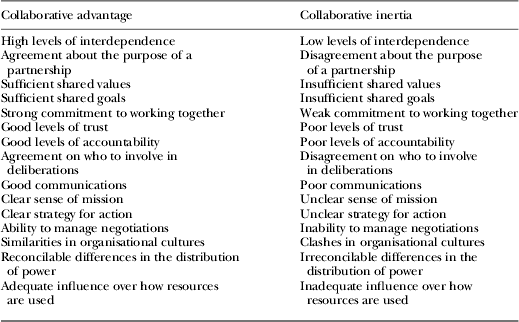
Managers' negotiating skills, their commitment to sharing resources and ideas, and how they involve individuals in relevant discussions, will also substantially influence the chances of organisations finding mutually useful ways of working together (Lasker, Weiss and Miller Reference Lasker, Weiss and Miller2001). Moreover, it is necessary to avoid collaborative inertia or unexpected poor partnership performance where ‘The output from a collaborative arrangement is negligible, the rate of output is extremely slow, or stories of pain and hard grind are integral to successes achieved’ (Huxham and Vangen Reference Huxham and Vangen2004, 191). Theory therefore suggests that various factors contribute to the achievement of collaborative advantage and the onset of collaborative inertia (Table 1).
Factors contributing to organisations achieving collaborative advantage and avoiding collaborative inertia

Source: Based on Huxham (Reference Huxham1993b).
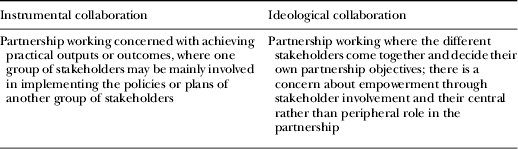
An examination of what partnerships do in practice might show how partner organisations find ways to agree on aims, share resources, build trust in each other and develop a commitment to working together that makes the achievement of collaborative advantage more likely. Alternatively, the results of the examination might show how differences in organisational culture, values and mission can cause collaborative inertia and what if anything can be done to resolve the situation. Huxham (Reference Huxham and Huxham1996) has produced a framework consisting of eight dimensions, each describing elements of partnership working that can complement or conflict with each other. The framework provides an interconnected set of contrasts or dimensions of partnerships used to improve understanding of their purpose. The two dimensions that describe instrumental collaboration and ideological collaboration are of particular interest in examining how partnerships might help to improve existing services or the development of genuinely new and innovative services (Table 2).
A description of instrumental and ideological collaboration
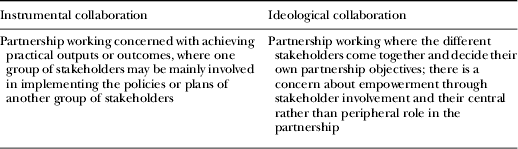
Source: Based on Huxham (Reference Huxham2000).
Whatever form partnership or collaborative working takes, there is an instrumental aspect to effecting task-based change and the achievement of some type of practical outcome and an ideological aspect to changing culture, values and relationships of power. However, in different situations partnerships can empower weaker organisations and help them to achieve their objectives, or increase the power of stronger organisations and help them to achieve their objectives.
Ultimately, the term partnership is not a neutral concept because the meanings assigned to it are, in part, a product of the exercise of power that structures a particular language of partnership working (Atkinson Reference Atkinson1999). Organisations need to occupy a legitimate position within a larger discursive arena and only a limited number of positions are perceived as legitimate at any given time (Hardy, Lawrence and Grant Reference Hardy, Lawrence and Grant2005). Organisations may make choices under one set of circumstances that are very different from the choices that they would make under another set (Immergut Reference Immergut1998). If the objective is to gain the trust of local communities, then the circumstances need to provide adequate opportunities for difference and diversity within partnerships to ensure local problems and priorities are effectively addressed (Lowndes and Sullivan Reference Lowndes and Sullivan2004). The ideas relating to collaborative advantage and inertia and instrumental versus ideological collaboration provided an underpinning framework that was used to examine partnerships between local authorities, third-sector organisations and older people in the LAP pilots.
Methodology
The national evaluation of the LAP pilots was led by researchers from the Local Government Centre at Warwick Business School, working with the Institute of Local Government Studies at the University of Birmingham. The researchers produced a series of specialist evaluation reports (Davis and Ritters Reference Davis and Ritters2007; Hilton Reference Hilton2008; Ritters and Davis Reference Ritters and Davis2008; Watt and Blair Reference Watt and Blair2009; Watt et al. Reference Watt, Blair, Davis and Ritters2007; Willis and Dalziel Reference Willis and Dalziel2009) and an end of programme report (Davis and Ritters Reference Davis and Ritters2009). This paper elaborates on a national evaluation team examination of the extent to which LAP pilots were a tool for capacity building that helped local authorities, third-sector organisations and older people to work more closely together to develop and deliver improved services. The research was undertaken by national evaluation team researchers at the Institute of Local Government Studies at the University of Birmingham (Willis and Dalziel Reference Willis and Dalziel2009).
There was a focus firstly on whether such capacity building demonstrated instrumental collaboration to achieve a tangible outcome such as a sustainable capability to produce improved quality of life outcomes for older people (through the more effective use of existing services or the creation of new services), and secondly on the ways that different factors such as the development of common goals, the sharing or combining of important resources, and the building of trust contributed (or not) to the achievement of collaborative advantage (where an objective is met that no organisation could have produced on its own). A theoretical distinction was drawn between capacity building that facilitates partnership working and the improvement of existing services and capacity building that facilitates partnership working and the development of genuinely new services. In addition, it was hoped the research would shed light on the following questions:
• What happens when organisations with very different cultures decide to work with older people to develop services to meet their needs?
• How does partnership or collaborative working affect older people's involvement in discussions and decision-making processes to improve or develop new services?
• What real powers do partnerships have over the commissioning and delivery of services at the local level?
• How can older people be involved from the outset in identifying priorities for action to improve their quality of life?
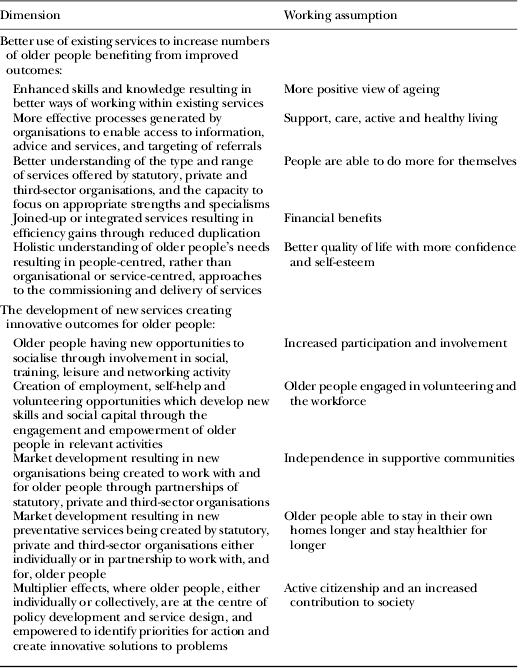
Ten capacity-building dimensions were developed, five focusing on the better use of existing services and five on the development of new services. These dimensions complement the working assumptions regarding evidence of potential benefits to organisations and older people that were developed for the national evaluation of the LAP pilots (Davis and Ritters Reference Davis and Ritters2009). The dimensions and associated working assumptions are set out in Table 3.
Mapping capacity-building dimensions against the LinkAge Plus national evaluation working assumptions
The evaluation comprised three key elements:
• An overview of current thinking, policy and practice in relation to capacity building and, in particular, work which had been designed to improve services and outcomes for older people.
• An examination of available evidence on capacity building collected from all of the eight LAP pilot areas. This involved an interrogation of extensive secondary material including initial pilot proposals, detailed monitoring reports and local evaluation materials submitted to the national evaluation team by the pilots.
• A systematic analysis of this material to determine the extent to which there was evidence of each of the ten capacity-building dimensions (see Table 3) and to explore the supplementary research questions identified above.
Whilst this material provided considerable in-depth evidence of capacity-building approaches, it was less comprehensive in enabling an overview of the extent to which the work of the LAP pilots had realised positive outcomes for, and the sustainable engagement and involvement of, older people. It also had the limitation of being secondary material, derived from primary research undertaken by the national evaluation team and reports prepared by staff working within the pilots and associated partner organisations. Although direct interviews with key stakeholders, including older people living in the pilot areas, would have undoubtedly strengthened this evidence, longer-term research is required to establish the extent to which positive and sustainable outcomes for older people have been achieved. Despite these limitations, the depth and range of the material examined from the different pilots provides confidence in the overall conclusions about how partnership and collaborative working can improve the local capacity of services to improve quality of life outcomes for older people. The next two sections present key evidence, firstly on capacity-building approaches to ensure the better use of existing services and, secondly, the development of new services aimed at improving quality of life outcomes for older people.
Better use of existing services for older people
Considerable evidence was found of the factors that facilitate effective partnership working as described by Huxham (Reference Huxham1993b) and Huxham and Vangen (Reference Huxham and Vangen2005, Reference Huxham, Vangen and Osborne2009), including an ability to get things on to relevant agendas, take part in inter-organisational discussions, develop partnership capacity that facilitates joint learning, and find better ways to work together to meet older people's needs. Such partnership working builds capacity when key staff from statutory and third-sector organisations are able to improve their knowledge and skills in the use of existing resources to achieve better service and quality of life outcomes for older people. Learning on the job, through day-to-day interaction with older people and colleagues in partner organisations, was an integral feature of all eight LAP pilot approaches. However, there was limited evidence of specific knowledge and skills training, particularly for staff in third-sector organisations, or of work directly involving the private sector.
An example of work specifically targeted at knowledge and skills development was the Leeds capacity-building grants, which benefited 58 third-sector organisations, including nine black and minority ethnic (BME) groups. The grants were used to invest in leadership and other types of skills training, equipment, planning and volunteer recruitment; to establish the role of older people as ‘peer mentors’; to purchase screen-reading software for blind Asian people; and to set up a website. The majority of the grants were spent on improving third-sector infrastructure but less than a third went directly to community-based organisations.
All of the LAP pilots sought to build capacity by working in partnership with other organisations to ensure older people were able to access understandable, reliable and locally available information and advice, and then be referred to services where appropriate. For example, the Salford LAP pilot created a specialist signposting service to provide older people with housing advice and help them make informed and sustainable housing choices. Salford's Corporate Customer Contact Centre used a database of residents to identify callers as being eligible for specific services provided by a network of partner organisations. These partner organisations were more connected in terms of being able to communicate with each other and avoid the duplication of the advice or help provided for older people. The Age Concern organisation in the city felt that the network was also a positive way to expand ‘The means through which people might engage with service providers’ (Johnson, Wiggan and Kawalek Reference Johnson, Wiggan and Kawalek2008, 24). This appeared to replicate the successful partnership working that Huxham (Reference Huxham1993a) has described and others (Andrews and Entwistle Reference Andrews and Entwistle2010; Bovaird and Tizard Reference Bovaird, Tizard, Bovaird and Loffler2009; Milbourne Reference Milbourne2009) have elaborated on where organisations improve their understanding of each other's work, avoid duplicating actions and activities, and recognise opportunities to build the capacity needed to achieve mutually desired objectives. To some extent the service was a victim of its own success since the popularity of, and consequent demands on, the new housing service were underestimated, causing some lengthy waiting times for help.
Other examples of capacity building included the Lancaster Care Navigator Service, which was delivered by the city council in partnership with a third-sector provider and run mostly by volunteers. As well as making referrals to partner organisations, the service also provided support and co-ordinated the arrangement of relevant care services for older people. The Devon pilot introduced a 360° wellbeing assessment tool called ‘Getting the Most Out of Life’. This tool aimed to assist with maintaining a coherent assessment framework, regardless of referral source or presenting problem, that would help to provide older people with access to information and services that enabled them to maintain an active and involved lifestyle. In addition to the straightforward provision of reliable and understandable information and advice, most of the LAP pilots sought to improve staff and older people's understanding about who offers what service. One part of Gateshead's Link-up project involved organisations working together to find better ways to deal with older people's concerns. Underpinning Link-up was a desire to co-locate useful information for professionals and older people. The result was the creation of more effective ways to understand what information and services are available and put older people in touch with appropriate organisations that can help them.
All of the LAP pilots promoted partnership and collaborative working to improve older people's access to services. The LAP pilot in Tower Hamlets was one of a number which set up a single point of access to services for older people through community network centres. A simplified process for obtaining services was created by partner organisations working out of the centres or in close contact with them. The Primary Care Trust demonstrated its support for the approach by matching local authority funding so that the work of the centres could be sustained when the LAP pilot funding ended. However, some difficulties were experienced that caused partnership inertia similar to that described by Huxham (Reference Huxham1993a). In particular, there were problems getting some statutory-sector organisations to be sufficiently flexible and responsive to older people's concerns and needs, and there were misgivings amongst some third-sector organisations that did not receive funds from the LAP pilot and might be disadvantaged as a result.
Other evidence emerged of a shift in policy from improving inputs and processes such as developing access, integration or partnership working, towards a holistic understanding of how to achieve people-centred outcomes. For example, a key aim of Nottinghamshire's First Contact project was to reduce preventable injuries in the home by organisations working together in a joined-up way to ensure that older people were able to gain access to preventative services. Huxham (Reference Huxham1993a) has described this type of partnership synergy and the development of collective capacity. It is a collective capacity developed through exploiting interdependencies (Cairns and Harris Reference Cairns and Harris2011; Gray Reference Gray1985; Wassmer and Dussauge Reference Wassmer and Dussauge2011) and agreeing on action to deal with problems (Fredericksen Reference Fredericksen1996). A multi-agency checklist acted as a referral gateway to a range of low-level preventative services for older people, linked through a customer contact centre. The partners involved included the Fire and Rescue Service, Adult Social Care, Health, the Police, the Pensions Service, Welfare Rights, housing agencies, voluntary organisations, and carers and community groups. First Contact provided strong evidence as to how new, more co-operative, working arrangements between statutory, voluntary and community organisations can result in the better co-ordinated delivery of a range of information and preventative services. First Contact estimated that each referral cost £31.77 whilst the cost of dealing with a hip fracture was estimated at £20,426. They concluded that if this approach helped to prevent a hip fracture in 0.13 per cent or more of the older people it helped, then it would be cost effective (see Watt and Blair Reference Watt and Blair2009).
Developing new services for older people
A number of the LAP pilots went further and helped to create partnership capacity that involved genuinely new and innovative ways of working with and for older people through different forms of collaboration, co-production and empowerment. The resultant outcomes emphasised the broader agenda of active citizenship through involvement in education and leisure activities and taking part in projects which viewed older people as active members of the team or workforce. Examples of the former included services designed to address broader community and social wellbeing outcomes by creating and maintaining social capital. The Tower Hamlets Community Network Centres used an outreach approach to address social isolation and promote community cohesion. The centres provided community resources such as a café, educational facilities and art classes to address mental wellbeing issues, and a cross-cultural model of day care for Bangladeshi older people.
There were a small number of examples of the development of employment, self-help and volunteering opportunities for older people. This included evidence of engagement with the private sector, a feature that was noticeable by its absence from much of the secondary data analysed for this research. The most significant employment and volunteering initiative was the Lancaster 50 Forward Employment Agency and Volunteering Bureau. This project was a partnership arrangement that included Lancaster District Older People's Partnership Board, Age Concern and a voluntary organisation called Signpost. It provided employment and volunteering opportunities specifically tailored to meet the needs of older people and empower them through engagement in paid or unpaid work. Over a period of one year, the project was involved in setting up partnership arrangements with 67 local employers. It helped 66 people into paid employment and placed 126 people with various voluntary and community-sector organisations. Gateshead Time Bank was a community involvement project run by Age Concern that focused on stimulating older people's mutual community support. Participants used their skills and time to benefit others, for which they received a one-hour Time Bank credit for every hour of time they gave that could be exchanged for help and support for themselves. Time Bank activities were decided by the demands and offers of people participating in the initiative and included basic housework, befriending, gardening, and helping out in charity shops and day centres. The research found that some types of support that were offered, including gardening and decorating, could be difficult for older people to provide to one another. To address this, they supplemented the Time Bank scheme with other types of volunteer help.
Some LAP pilots sought to stimulate the market to create new organisations that facilitated access to information and advice. However, the research found fewer examples of new organisations being created to provide services aimed at achieving a range of different outcomes for older people. One such project was Gloucestershire's Village Agents, which adopted an innovative community development approach. Village Agents were part of a network of local people employed for ten hours a week in 30 rural areas providing information, advice and a referrals service, for people living in isolated rural communities. They each covered between two and eight parishes with a population of approximately 1,500 older people. On average, the Village Agents were in contact each month with 1,660 people and made 230 direct referrals for services. In one year alone Village Agents made over 20,000 contacts with citizens and dealt with 2,684 enquiries including 192 referrals to the DWP, 136 referrals to fire and safety personnel, and 151 referrals to home improvement agencies (Wilson, Crow and Willis Reference Wilson, Crow and Willis2008).
The Village Agent project signalled a move away from a simple needs-led approach to problem solving towards a holistic people-centred model of active citizenship and the co-production of desired quality of life outcomes. For example, Village Agents and older people worked together to persuade a local bus company to relocate bus stops so that people living in isolated villages could get to and from the shops more easily; convinced the county council of the case for a library in a village hall; established Tai Chi classes; and promoted adult education sessions in a local pub. Moreover, when several towns and villages were cut off by severe floods the networks created by the Village Agents were able to provide an immediate local response, thus demonstrating its success in building flexible local capacity. The Village Agents initiative has not only been sustained beyond the LAP pilot funding period but has also inspired a number of similar community capacity-building projects in other English counties.
The imaginative thinking stimulated by LAP projects was further evidenced in the development of new preventative services with and for older people. An important feature of these projects is how both in initial concept and subsequent adaptive implementation, they reflected the different and diverse contexts of individual older people and the communities in which they live. The Devon Deep Outreach mentoring service was one such example of statutory and third-sector organisations working together to develop their knowledge and understanding of older people's needs and provide new types of preventative services. It was primarily a top-down capacity-building exercise with mentors, who were older people, trained to engage with other older people and encourage the development of activity groups that they could run themselves once they had been set up. In this way older people's skills and learning were enhanced and they were better equipped to be involved in a dialogue with service providers. Consequently, service provider knowledge and understanding of older people's circumstances and changing aspirations for the future were improved.
The Gateshead Older People's Assembly was an example of how older people were encouraged to be at the heart of policy development and service design. It was established as ‘the voice for older people in Gateshead’ to ensure that their views and opinions were considered in relevant strategic planning meetings and they were able to influence service development and delivery policies. One of the tasks undertaken by the Assembly was assessing the appropriateness, accessibility and effectiveness of service provision for older people delivered by a range of organisations. The Assembly's membership of around 1,700 older people was facilitated by a community development worker to co-produce research into social, economic, environment and health issues. Some of the benefits of partnership working that Huxham (Reference Huxham1993a) has described were apparent and included the usefulness of knowledge sharing, joint learning and the better use of resources to improve services. In addition, there was the empowerment of older people through capacity building in partnerships that enabled older people to get together and proactively participate in activities to influence service development and delivery at the local level.
Conclusions
This paper has examined how capacity-building partnerships involving eight English local authorities and third-sector organisations worked to deliver the DWP-funded LinkAge Plus pilots. The aim of the pilots was to find better ways to co-ordinate and manage the design and provision of services to meet the needs of older people. A range of approaches to working with older people were employed in different situations. In particular, a focus on the role of the local authority and third-sector organisations highlighted the different ways that capacity building in partnerships can stimulate action that empowers older people as active citizens. This work fitted well with the three LAP core principles relating to capacity building that were outlined earlier. Capacity building in partnerships also stimulated more joined-up working that resulted in improved knowledge and skills in providing existing services (with increased user satisfaction), improved effectiveness of processes (resulting in better access to information and services) and reduced duplication of effort. At the same time, new services emerged that meant older people were more involved in networking activities (that increased participation) and social capital was created through their engagement in policy making, identifying needs, service design and finding solutions to problems (which increased the contribution that they made to civil society activities).
The LAP pilots started to tackle and break down some of the barriers that made it difficult to empower older people as active citizens. There was much evidence of instrumental activity that helped to ensure the achievement of practical goals or outcomes. In a number of instances, partnership working and capacity building resulted in the development of synergy between organisations that contributed to the achievement of collaborative advantage, where something extra was produced by organisations working together. For example, the creation of opportunities for partnership working and capacity building was linked with the development of engagement and consultation practice and the promotion of older people's independence and wellbeing. There were only a few instances of ideological activity that challenged established values and ways of working to go beyond traditional health and social care approaches in the delivery of services for older people. At the same time, a number of partnership difficulties and tensions were encountered. For example, the continuation of top-down policy making and implementation was often at odds with work to create a more bottom-up approach to service development (and getting the balance right). Concerns also arose over differences in organisational cultures and values, obtaining access to important resources, control over agenda setting and ways of working. These difficulties contributed to different levels of collaborative inertia or partnership under-performance. Overall, it is not about saying particular ways of working will necessarily be more successful or not but different approaches will be more or less appropriate in working with different groups of older people in different contexts. Local authorities and third-sector organisations have an important role to play in service provision but quality of life outcomes for older people will depend on specific relations and those will depend much on partnership capacities.
Meanwhile, the impact of economic crisis and political decisions to reduce public spending on the longer-term sustainability of capacity-building work undertaken as part of the LAP pilot work will need to be monitored and assessed over an extended period of time. The New Labour Government that was in power from 1997 to 2010 set aside considerable amounts of monies for the development of an Office of the Third Sector and organisational capacity in the third sector to promote partnership working and the engagement of citizens, including older people, in decisions on matters affecting them and their quality of life. In turn, the Conservative and Liberal Coalition Government that came to power in 2010 said it wanted to maintain a high level of support for the third sector, with the Office of the Third Sector becoming the Office for Civil Society. It has also proposed setting aside new monies for organisational capacity building and to help with the transition from a reliance on grants to contracts to deliver services. There will be partnership activity and organisational capacity building that continues to happen despite the impacts of economic crisis and cutbacks in public spending. Indeed, a period of economic crisis may, in some instances, stimulate more partnership and joined-up working and efforts to find more efficient ways of using resources to achieve mutually desired organisational objectives. Nevertheless, there is likely to be a squeeze on support for infrastructure development to support partnership working and pressure to reconfigure or lose services at the national and local level. These developments could have a detrimental impact on the longer-term sustainability of partnerships and genuinely innovative partnership working. In turn, some of the good work associated with the active ageing initiative and projects like the LAP pilots that have enabled more older people to make a contribution to civil society may be undone.
Acknowledgements
The authors would like to acknowledge the work of Howard Davis and Katrina Ritters at the lead LinkAge Programme evaluation organisation, the University of Warwick Business School. The Department for Work and Pensions funded the LinkAge Programme and evaluation studies.