INTRODUCTION
Social scientists have long understood that linkages between the identities of actors and the nature of their actions in interaction constitute one of the central mechanisms by which social patterns are produced. In this respect, the ways in which identities are relevant for action-in-interaction constitute a basic link between individuals and what social scientists have termed “social structure” (cf. Bailey 2000; Collins 1988; Drew & Heritage 1992; Fenstermaker, West & Zimmerman 1991; Fenstermaker & West 2002; Giddens 1979, 1984; Goffman 1967, 1971, 1983a,b; Heritage 1984a; Kitzinger 2000; Kitzinger & Frith 1999, Lerner 1996; Maynard 2003; Schegloff 1991, 1992; West & Zimmerman 1987). Whether this link is conceived of in terms of the production and reproduction of structure through conduct (cf. Drew & Heritage 1992; Maynard 2003; Schegloff 1991, 1992; Wilson 1991), or whether the social structural features of populations are understood as the aggregated product of many such interactions (cf. Collins 1988; Giddens 1979, 1984), the link between identity and conduct in interaction is fundamental. This link arguably constitutes one of the most basic and pervasive “points of production” (Lerner 1996) for the large-scale social patterns that social scientists have sought to explicate as social structure.
Given this link, efforts to illuminate social structure are deepened, improved, and made more compelling whenever analysts can establish resources for explicating how participants' embodiment of different identities is relevant for actions in interactions, and is thereby consequential for the outcomes produced through them. In this article, we will contribute to this enterprise by describing some general methods speakers can use for making specific identities relevant in interaction. We will then provide an extended illustration of how these methods can be used as analytic resources by analyzing a phone call between two friends, one of whom we will argue relevantly embodies (and is treated by her co-participant as relevantly embodying) “grandparent” as an identity. The central mechanisms we will be concerned with involve members' methods for managing rights to identity-bound knowledge in self-other relations – or, as we will have it, the epistemics of social relations.
IDENTITIES IN INTERACTION
As Schegloff 1991, 1992 has noted, there are two primary methods for connecting social characteristics (gender, sex, race, ethnicity, class, familial status, etc.) to social organization. The first is statistical, addressed to aggregated populations, aggregated interactions, or historical periods that have been abstracted from the particulars of singular episodes of interaction. While such studies have significantly advanced our understanding of the relevance of identities for social life in grounded and sophisticated ways, establishing the mechanisms by which a specific identity is made relevant and consequential in any particular episode of interaction has remained much more elusive. That is, while analysts have established that identities matter for social life, and how they matter, identifying and describing the specific mechanisms by which those identities are sustained in interaction has proven much more difficult. Yet, as Schegloff 1991, 1992 has also noted, unless we can demonstrate the relevance of particular identities in specific encounters, the very mechanism by which outcomes visible in populations at large are produced will remain obscured from view. Thus, for analysts interested in what Schegloff 1992 called “the interaction/social structure nexus,” the challenge has been to identify and describe the range of practices through which identities – and whatever forms of power and inequality may be associated with them – are linked to specific actions in interaction.
In describing an alternative approach to investigating these issues, Schegloff 1991, 1992 identified two analytic challenges that confront efforts to link specific identities, or another social structural feature of a population or setting, to actions in particular episodes of interactions: (i) the problem of relevance and (ii) the issue of procedural consequentiality. As Schegloff notes, the descriptive adequacy of any term used to characterize a person or bit of conduct cannot justify its use; instead, characterizations of the participants should be grounded in aspects of what is going on that are demonstrably relevant to the participants “… at that moment – at the moment that whatever we are trying to provide an account for occurs” (Schegloff 1991:50). Once this has been established, there is the further challenge of showing that the identity (or other social structural feature of a population or setting) mattered in some way: How can an analyst demonstrate that it is consequential for the trajectory of a stretch of talk, for its content, for its character, or for the procedures used to organize it (Schegloff 1992)? The aim of such analyses is to explicate the mechanism by which the social structural features of the interaction (whether specified in terms of a setting, a set of identities, or some other contextual feature) have determinate consequences for the talk.
The “institutional talk” program (Drew & Heritage 1992) represents one type of approach to the problems identified by Schegloff. It addresses them by examining task-oriented conduct that is identifiably distinct from ordinary conversation, in an attempt to locate and ground the identification of institutional identities as relevant to the parties. Thus Heritage & Greatbatch 1991 argue that by conducting themselves in terms of a distinct turn-taking system institutionalized within news interview interactions, participants iteratively subscribe to the identities of news interviewer and interviewee as ongoingly relevant and procedurally consequential for their conduct. In an elaborate sequence of papers, Zimmerman and collaborators have identified a wide variety of conduct in calls to 911 emergency call centers, ranging from fine detail in the opening sequences of the calls through to massive consistencies in their overarching structure. The enactment of these features provides resources for the participants to establish the identities of “911 caller” and “911 call taker,” while departures from them significantly disrupt these identities and the role relationship that is forged through them between the parties (Zimmerman 1984, 1992, 1998; Wakin & Zimmerman 1999; J. Whalen & Zimmerman 1998; M. Whalen & Zimmerman 1987, 1990). Similar arguments have been made for a variety of interactions whose co-construction identifies them, and is designed to identify them, as work-related (Drew 2002, Drew & Heritage 1992, Drew & Sorjonen 1997, Heritage 1997).
However, the “institutional talk” program is a relatively narrow approach to the issues of membership categorization that Sacks and Schegloff raise. It focuses exclusively on “work interactions” rather than ordinary conversation more generally, and it does so through the prism of the participants' role obligations and their institutional backgrounds. Much more severe analytical problems emerge once we are in the open sea of ordinary conversation, and, paradoxically, these problems arise in their most severe form with the characteristics of participants that are potentially “omnirelevant” (for an approach that begins to specify the properties of such identities, see Bucholtz & Hall 2004). Characteristics such as gender, race, and class are elements of identity that are potentially available to be discursively invoked, or procedurally embodied, at any moment in an interaction's course. Yet, with some exceptions (Beach 1996, Hopper & LeBaron 1998, Kitzinger 2000, Maynard 2003), less headway has been made in describing how these identities are invoked or evoked in talk (see Antaki & Widdicomb 1998 for a related approach).
In this article, we suggest that the management of rights to knowledge and, relatedly, rights to describe or evaluate states of affairs can be a resource for invoking identity in interaction. Thus, rather than beginning with a specific identity and asking how it might be relevant for interaction, we will describe various practices of speaking through which participants can make relative access to knowledge and information relevant, and then demonstrate how those practices can be used to evoke the relevance of a specific identity.
As various researchers have noted, participants in interaction display sensitivity to what they have rights to know and say relative to their co-participants (Chafe & Nichols 1986, Drew 1991, Goodwin and Goodwin 1987, Kamio 1997, Stivers 2005, Willett 1988). For example:
- Members of tribes may treat their “ownership” of particular forms of knowledge or cultural resources as a defining characteristic (Moerman 1974, Sharrock 1974).
- Conversationalists treat one another as having privileged access to their own experiences and as having specific rights to narrate them (Sacks 1984).
- Callers to 911 emergency services report matters in quite distinctive terms if they are bystanders to, rather than victims of, an incident (M. Whalen & Zimmerman 1990).
- Patients often exhibit considerable reluctance to diagnose their medical problems when presenting them to physicians (Gill 1998).
- Journalists distinguish between first-hand and derivative access to unfolding events as relevant for their right to describe them (Raymond 2000).
In each of these cases, the conduct of participants reflexively constitutes a link between the identities of the speakers (conceived in various terms) relative to one another, and the local distribution of rights and responsibilities regarding what each party can accountably know, how they know it, whether they have rights to articulate it, and in what terms. In this respect, there can be direct links between the identities of participants and the rights and responsibilities associated with those identities that are directly implicated in practices of speaking. Insofar as these practices index participants' management of what M. Whalen & Zimmerman 1990 term “practical epistemology” in their relations with one another, we refer to this broad organizational domain as the “epistemics of social relations.”
As even the brief list of issues noted above suggests, the epistemics of social relations can evidently matter for many different types of conduct. For this essay, however, we will limit our analysis to sequences of action in which participants offer assessments (or evaluations) of states of affairs. Thus, in the following we will explicate how identities are made relevant in conversation as participants manage their relative access to, or rights to assess, knowledge, events, behavior, and the like in specific, locally organized sequences of talk. In short, we are concerned with the intersection of two ways of organizing conduct: the relevance of identities, and the organization of assessment sequences.
To explore these issues, we will analyze excerpts from a single telephone conversation. To set the stage for this analysis we briefly describe this interaction, its occasion, and the participants involved in it.
THE DATUM
The telephone call that will serve as the basis for our analysis was recorded in Britain in the 1980s as part of a larger corpus of phone calls. This call between Vera and Jenny, two middle-aged women who are friends, was made by Jenny, who was returning a call from Vera earlier in the day. The conversation directly follows, and largely focuses on, a visit by Vera's married son, daughter-in-law, and grandchildren. When the family arrived at Vera's house after a long car drive, the intervention of a neighbor recruited by Vera directed them to Jenny's house, where they had a cup of tea and waited for Vera to return. This brief visit to Jenny's house gave her direct access to Vera's family – a fact that turns out to be crucial when Vera and Jenny begin to discuss the visit and the grandchildren in particular.
As it happens, Vera's embodiment of her identity as a “grandparent” is partly shaped by the occasion of this call, and her son's family's visit. As a consequence, some facts about this trip, and their import for Vera's evident emotional state in the interaction, are relevant for understanding her conduct. In the opening of the call Vera reveals that the family has left earlier than expected in order to visit the “other” grandmother. One consequence of this premature departure was that her son reneged on an earlier plan to take Vera out to dinner that evening. Evidently, Vera's feelings have been hurt by these events. In common-sense terms, Vera's conduct in the interaction reflects a preoccupation with the fact of her family's premature departure; she is apparently emotionally raw and upset by it.
This preoccupation surfaces in a variety of environments (some of which we will analyze below). However, a particularly vivid illustration of it can be found in excerpt (1). This excerpt occurs in the middle of the call, after Vera and Jenny have discussed the fact of Vera's family's departure and (positively) assessed virtually every aspect of her family, and especially of her grandchildren. After Vera and Jenny have ostensibly moved on from their discussion of Vera's family to discuss other matters (such as a book both read), Jenny begins projecting the possible closure of the call by noting that she is going to have to make the evening meal – spaghetti and meatballs – since, as she puts it, there's nothing in town, Marks and Spencer's shelves were clear (indicating that she could not find any precooked food for the evening meal).1
Marks and Spencers is a chain store that sells high-quality precooked meals. Jenny's remark that Marks and Spencers shelves were clear indicates that no such (suitable) meals were available that evening.

We can notice that Vera's assertion (line 9) Well they wouldn't stay for a meal is offered in overlap with Jenny's description of Marks and Spencers. Three features of Vera's turn, its timing, and the talk that follows it reflect her emotional preoccupation with her family's recent departure.
First, Vera's turn in line 9 is clearly interruptive: In line 8, Jenny has begun to name a well-known British chain store (Marks and Spencers), which itself is the beginning of a new grammatical unit. As a consequence, not only is Jenny recognizably in mid-utterance, she is in mid-name, when Vera begins her turn. The interruptive character of this turn beginning reflects a self-oriented focus on Vera's part. For example, Jenny's B't thez no^thing in to:wn.= appears to be the first component of a “touched off” telling, and what Jenny says next may be projected by that. Further, the turn constructional unit about Marks and Spencers unpacks what was adumbrated in line 7. In this respect, Vera's utterance is deeply interruptive since it emerges in the midst of a course of action that Jenny was engaged in and, as indexed by the rush through from the first to the second turn constructional unit, to which she was strongly committed.
Second, after she can clearly hear that she is talking in overlap with Jenny, Vera persists talking in overlap with her until Jenny drops out (see Schegloff 2000). Moreover, in contrast to Jenny, she does so without registering the overlap through any hitches or perturbations in her talk, engaging in what Jefferson 2004 describes as “unmarked overlap competition.” When Jenny does drop out, Vera begins a new complaint, built off the first one. Vera first complains that they wouldn't stay for a meal and then adds a reference to her lost dinner invitation (which, she bravely asserts, she didn't want anyway).
Third, while there is some tangential relationship between Jenny's turn and Vera's – for example, both involve references to providing meals and their obstacles – Vera's turn cannot be understood as in any way responsive to Jenny's most proximate turns, nor to the ones that preceded it. At most, Jenny's mentioning the evening meal has occasioned a new order of recollection for Vera. Instead, Vera's turn abruptly returns them to the matter of her family's departure.
In effect, Vera's interruption of Jenny, and especially her complaint Well they wouldn'stay fer a meal, suggest that Vera is substantially absorbed with the premature departure of her family. While Jenny has clearly moved on to discuss other matters, Vera remains preoccupied with her own family's departure, so that the mere mention of the evening meal (by Jenny) is sufficient to prompt a wholesale interruptive departure by Vera. It is in this sense that Vera can be described as emotionally preoccupied; her focus on her family's departure occasions several such “eruptions” and interruptions during the course of the conversation. It is in this socio-emotional context that the two women's remarks about Vera's grandchildren should be set.
Having briefly sketched the circumstances of this interaction, we can now turn to explicating the resources for managing epistemic authority and subordination in assessment sequences. Once we have reviewed these resources, we will analyze an extended sequence between Vera and Jenny to explicate how Vera's identity as a grandparent is sustained as a relevant and consequential feature of their interaction.
RESOURCES FOR MANAGING EPISTEMIC AUTHORITY AND SUBORDINATION IN ASSESSMENT SEQUENCES
Since, as we noted above, assessment sequences constitute one main environment in which managing epistemic authority and subordination becomes relevant, it will be useful to review briefly some basic characteristics of them. This review will draw on work by Goodwin and Goodwin 1987, Pomerantz 1978, 1984 and Sacks 1987 on assessment sequences and agreements (respectively), and the analysis of epistemic authority and subordination in Heritage & Raymond 2005.
Most generally, as Pomerantz 1978, 1984 and Sacks 1987 note, in producing sequences of assessments, participants display an orientation to a preference for agreement, which is part of a broader set of institutionalized practices referred to collectively as “preference organization.” Analyses of preference organization describe a range of institutionalized interactional practices through which affiliative actions (generally agreements, acceptances, etc.) and their disaffiliative counterparts (generally disagreements, corrections, rejections, etc.) are produced. The most prominent organizational consequence of these practices is to maximize the likelihood of affiliative, socially solidary actions, and to minimize the consequences of disaffiliative, socially divisive ones (Heritage 1984a:265–80). As Heritage & Raymond 2005 note, however, even within sequences of action designed to achieve agreement (which are preferred) participants can become involved in complex negotiations concerning the management of their relative rights to knowledge and information. In what follows we will primarily investigate instances of agreement, and so it is the methods speakers deploy to manage or negotiate such rights relative to one another that will be of interest. As demonstrated in Heritage & Raymond 2005, three features of assessment sequences are especially relevant for such negotiations.
First, in order to offer assessments of states of affairs, and so in order to agree or disagree, parties must have some access to them. Evidently, without some form of access to a referent state of affairs, participants cannot offer evaluations of them. Thus, even when parties are inclined to agree with each other, unless both can claim access to the referent state of affairs, they can arrive at little more than a simulacrum of agreement.
Second, speakers rank their access to whatever is being evaluated (Goodwin and Goodwin 1987). For example, access can be first-hand and immediate, or it can be second-hand or mediated. Consider the difference between a person who has seen a movie and one who has only heard about it (e.g., by reading a review, or hearing about it from friends). The party who has seen the movie has first-hand, unmediated access to it, while the party who has heard about the movie has mediated, second-hand access to it. Consequently, the first party can claim superior rights regarding the content of the movie; she or he has primary access, while the other party's access is secondary, or derivative. In the terms of this article, these two participants have different epistemic rights relative to each other. It is important to note that such epistemic rights to assess are not solely (or even mainly) distributed on the basis of physical access to a referent state of affairs; they are socially distributed (M. Whalen & Zimmerman 1990, Heritage & Raymond 2005).2
This observation prompted one reviewer to ask, “Where does the access come from on which people base claims to the right to assess?” Exploring these sources may be a fruitful direction for future inquiry, however, it is not one that can be addressed using data examined in this article. As noted in Heritage & Raymond (2005:34), “Without some way of determining the parties' relative rights to knowledge independent of the talk, we must bracket the question of whether, or how, these relative rights exist independent of their assertion in the situation itself.” Similarly, in the present analysis we must bracket the issues of where these rights come from “in the first place” even as we can examine how participants systematically deploy a range of practices to patrol and defend them. With this caveat in mind, however, we can note that some social sources of epistemic authority would include professionalization (Starr 1982, Goodwin 1994), systematic social competition (Abbott 1988), training, specialization or the proper use of scientific practice (Mulkay & Gilbert 1982), or, in the case of personal experience, social processes tied to personhood and even sanity (Heritage & Raymond 2005), which themselves may reflect a long history of political and social struggle in specific locales (Berlin 2002). As indicated by even this abbreviated list, as well as the studies cited in the main text above, the social sources of epistemic rights are complex and varied.
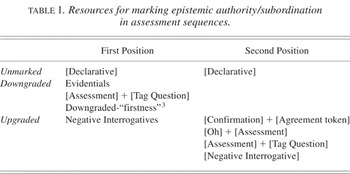
Third, offering a first assessment carries an implied claim that the speaker has primary rights to evaluate the matter assessed. This distributional claim is supported by three main types of evidence. (i) The distribution of practices described in Heritage & Raymond 2005 suggests a recurrent social need to compensate for the primary claims of first position and the secondary claims of second position (see Table 1): Practices for downgrading claimed rights to assess cluster in first position, while practices for upgrading claims cluster in second position. (ii) The deployment of these practices reflects speakers' recurrent need to manage the same contingency: First position assessments are rarely upgraded in the several hundred ordinary conversations examined, but they are quite commonly downgraded; similarly, second position assessments are rarely downgraded, but they are quite commonly upgraded.(iii) These distributional observations about the practices managing epistemic rights are buttressed by a complementary one regarding the speakers who deploy them: Downgraded first position assessments are generally produced by persons who, at least at first appearance, have lesser socio-epistemic rights to evaluate them. In addition, upgraded second position assessments are generally produced by persons who, at least at first appearance, have greater socio-epistemic rights to evaluate them. Finally, under conditions where both speakers have putatively equal access to a referent state of affairs, first speakers may downgrade initial assessments using a tag question format, while second speakers respond with declaratives. These two practices cooperate to cancel the epistemic implications of the first and second positioned status of their contributions. Thus, the distribution of practices in first and second position, the frequency of their deployment in each of these positions, and the putative rights of the speakers who deploy them in these positions reflects the fundamental association between the positioning of an assessment and the epistemic claims implied by that positioning (see Heritage & Raymond 2005 for a more extended discussion of these issues).
Resources for marking epistemic authority/subordination in assessment sequences.In some cases, speakers can downgrade the “firstness” of a first assessment, for example by prefacing it with so, as in so he's doing all right. One common sequential location in which such assessments can be produced is in response to tellings, as a practice for displaying some understanding of them. See Heritage & Raymond 2005 for an analysis of this practice.

This tacit feature of assessment sequences is crucial because assessments are always done in real time and are thus unavoidably organized as a series of turns. One speaker must go first and the other speaker(s) must follow. As a consequence, speakers cannot avoid having to manage their relative epistemic rights to evaluate states of affairs: Speakers must manage how the designs of their turns index their rights to assess referent states of affairs relative to co-participants, even as they manage – in real time – the position (e.g., first or second) in which those assessments are produced.
We can divide our review of these features of turn design into two sections: speakers' practices for managing first position assessments, and practices for managing second position assessments. We have schematically described these practices in Table 1 differentiating them according to the stance they take relative to a co-participant (e.g., unmarked, upgraded, or downgraded) and the position of the assessment (first or second position). This table illustrates our observation regarding the distribution of these practices into first and second positions, and it projects the order in which we will discuss them.
These resources were identified using a collection of more than 200 assessment sequences taken from ten large British and American corpora. In Heritage & Raymond 2005 we establish the robustness of these resources by reference to this larger pool of data, offering varied examples and detailed analyses of the interactional processes that underpin them. One way of appreciating the ubiquity of these practices, however, is to note that virtually all of them can be found in the single call that serves as the focus of our analysis in this paper. Thus, to further familiarize readers with the participants involved in this conversation, as well as these practices, we will briefly review their use by reference to examples taken from our primary datum, the telephone call between Jenny and Vera. In doing so, we will order our review by reference to the organization of assessment sequences as they occur in interaction. We will begin at the beginning: with first position resources and with the simplest of these, unmarked first position assessments.
MANAGING EPISTEMIC RIGHTS IN FIRST POSITION ASSESSMENTS
Unmarked first assessments
In unmarked assessments, speakers deploy simple declarative evaluations that claim unmediated access to the assessable. We call these “unmarked assessments” because they contain no design features that either strengthen or weaken the declarative claim that is made. For example, in excerpt (2) Vera explicates her assessment of her grandson, James (a portion of which appears in line 1, he's a nice devil…), by offering a contrastive assessment of Jillian. In assessing Jillian, Vera uses a declarative utterance to negatively evaluate the child's character:

In line 2, Vera says with Jillian she can be a nasty little bitch, thereby unequivocally asserting unmediated access to the referent. In this excerpt, then, Vera's declarative utterance flatly asserts an evaluation of the child on the basis of direct access to her.
Downgraded first assessments
Contrasting with unmarked first position assessments are those designed to exhibit downgraded epistemic access to a state of affairs. Two main resources can be used to accomplish this.
First, speakers can use “evidentials” (such as looks, sounds, seems, think) to mark their mediated access to a referent, and thus downgrade the claims made by the accompanying assessment. For example, in excerpt (3), Vera describes “reports” that she has heard about her grandchildren to warrant her treatment of a positive assessment as news.

It is clear from Vera's utterance in line 4, I've heard such bad reports about them, that the negative assessment she offers is based on second-hand information. This stands in contrast to the unmarked positive assessment she offers in line 1, which is evidently premised on direct access to the children. By using the evidential heard in her formulation (Chafe & Nichols 1986), Vera underscores that the evaluation she reports is premised on information provided by a third party. As this excerpt illustrates, speakers can use evidentials to downgrade the epistemic rights otherwise claimed by their assessments.
A second practice for downgrading first position assessments involves the use of tag questions. By adding a tag question to an assessment, speakers introduce an invitation to agree with it as a feature of its surface syntax. By doing so, speakers downgrade the superior access to a referent that a first position assessments would otherwise claim relative to a co-participant. For example, in excerpt (4) we can note that Jenny's assessment in line 3 refers to Vera's grandchildren.

Jenny modulates this declaratively formulated assessment – they're a lovely family now – by adding a tag question, aren't they. In accordance with what Sacks described as a preference for contiguity in conversation, the position of the tag question invites a response to it as the first matter to be addressed by the co-participant. In this way, Jenny formulates her turn as, in the first instance, a question to be answered rather than an assertion to be agreed with. In doing so, Jenny cedes epistemic authority in the matter to her co-participant, Vera. Thus, Jenny's introduction of the invitation to agreement in the surface design of her utterance indexes Jenny's position that Vera has primary rights to assess her own grandchildren.
In excerpts (3) and (4), then, first speakers use different methods of epistemic downgrading either to address the clear primary rights of a co-participant to assess the referent, or to mark the derivative character of the evaluation offered by them.
Upgraded first assessments
Just as assessments can be epistemically downgraded relative to the attributably superior rights of a recipient, they can also be upgraded. The primary resource speakers use to claim upgraded epistemic rights is the negative interrogative, as in excerpt (5), line 4. In this excerpt, Vera comments on her plan to have Mrs. Richards direct her family to Jenny's house on their arrival. Vera asserts her epistemic superiority regarding the fortuitousness of her plans in her negatively formulated query, Wasn't it lucky I told Missiz Richards to tell….

Vera's use of a negative interrogative to formulate her assessment embodies an upgraded claim of epistemic authority through at least three features of its design and sequential position. (i) By virtue of its interrogative syntax, this format strongly invites a second assessment by initiating a question-answer pair (Schegloff 1972). (ii) As Heritage 2002b notes, by building this interrogative using a negative form, Wasn't it…, the speaker invokes an established or settled position and, through that, a more extensive acquaintance with the referent state of affairs and/or rights to assess it. (iii) As a yes/no type of interrogative, Vera's assessment makes relevant a type-conforming response – “yes” or “no” – and thereby asserts command of the terms to be used by the recipient in the assessment of the referent (Raymond 2003). All three of these features cooperate to establish Vera's evaluative position as “settled” or “decided” and, as part of that, to assert her primary rights to assess her own action and its outcome.
The variations in the design of the assessments in excerpts (2–5) suggest three important features of first position assessments: (i) First assessments index a tacit claim to epistemic primacy; (ii) that claim can be modified, in that practices exist for asserting both upgraded and downgraded epistemic access and/or rights to assess a referent; and (iii) the use of any one of these practices reflects a choice on the part of the speaker because an unmarked method of assessment (e.g., the use of an unqualified declarative statement) – which embodies an unmarked claim of primacy – is also an available option.
With this brief sketch of some practices for managing epistemic primacy and subordination in first position assessments, we can now turn to review the resources available to speakers producing second position assessments.
MANAGING EPISTEMIC RIGHTS IN SECOND POSITION ASSESSMENTS
Speakers producing second assessments have a range of resources from which to choose that parallel those available to first position speakers; however their use is complicated by two factors. (i) The rights claimed by a second speaker must be managed relative to the claims embodied in first positioned assessments. (ii) This management must be accomplished by reference to the specific practices deployed by first speakers to index those claims. Thus, both the claims asserted by speakers in second position and the practices for asserting them typically reflect some sensitivity to the ways these two factors are managed in first position assessments.
As with our review of first position resources, we will begin with the simplest practices for producing responding assessments: unmarked second positioned assessments.
Unmarked second position assessments
In excerpt (6), Vera and Jenny are jointly assessing a book both have recently read. Their assessments in lines 8 and 9 directly follow a brief mention of the book and a query by Vera designed to establish Jenny's acquaintance with it (thereby anticipating the assessments that follow). Through this talk, then, joint access to the book has been established.

We can note that in response to Jenny's unmarked, first position assessment in line 8 (which expands her no response to Vera's query, the negative assessment serving as an account for it), Vera responds by agreeing in line 9, using a similarly unmarked second position assessment: No I didn'like it Jenny. As this example suggests, in contexts where equal access regarding states of affairs has been established, speakers responding to a declarative assessment in first position may decline to challenge the assertion of rights it embodies by producing a simple declarative assessment claiming unmediated access.
Upgraded second position assessments
In other cases, however, second speakers can manipulate their responses to upgrade their claimed epistemic access to and/or rights to assess a referent. In order to review these resources, we will begin with the mildest forms of upgrading and work up to the strongest practices for asserting epistemic authority. Two main kinds of resources can be deployed to upgrade second position assessments. (i) Speakers can convey that their position on the matter is already a “settled” one that is held independently of the view conveyed by the first speaker's assessment. By establishing the independence of the assessment they report, speakers undercut any relative inferiority in epistemic rights that sheer “secondness” might otherwise convey, and claim primary epistemic rights instead. (ii) Speakers can use interrogative syntax in second position to undercut, and supplant, the “firstness” of a first assessment. By producing an interrogative in second position, speakers in effect create a new first position assessment, seizing the epistemic rights that accrue to that position. Insofar as these latter practices make relevant a response by virtue of their interrogative syntax (despite being responses themselves), they constitute perhaps the strongest methods for asserting epistemic rights relative to a first speaker.
Upgraded second position assessments: Confirmation + agreement token
A relatively mild method for upgrading rights to assess a referent involves a [confirmation] + [agreement token] turn format, as in excerpt (7). Just prior to this excerpt, Vera has been comparing her enjoyment of her son's family's visit with the less positive experiences she has had with another family relation. Following Vera's explication of the source of her frustration with the children in this other family, Jenny offers an assessment built to display her understanding of Vera's telling. In line 1 Jenny notes that she thought they'd have grown out of it by now. Following this (into brief silence that begins to develop following Vera's agreeing yes) Jenny offers a summative assessment, They're not babies, are they, which explicates the basis for her prior evaluation and cedes epistemic authority to Vera. We can note that, by completing her assessment with a tag question, Jenny epistemically downgrades her first position assessment in deference to Vera's status as the children's relative.

Although the Jenny's use of the [assessment] + [tag question] format makes relevant “No, they are not” as a response (Raymond 2003), we can note that Vera actually reverses these two elements: first she confirms Jenny's evaluation by repeating the main content of it (they're not) and then she agrees with it, using the no made relevant by the tag question. By “confirming the assertion” before “responding to the question,” Vera breaks the preference for contiguity (Sacks 1987) and thereby treats the fact that she held this position prior to Jenny's assessment as the priority matter to be addressed, while deferring the agreement indexed by no as a secondary matter. As Heritage & Raymond 2005 note, the method by which this is achieved involves separating the action of agreeing from the action of confirming in a way that the “preferred” (or unmarked) ordering of responses to the question (“no, they're not”) does not (Raymond 2003, Schegloff 1996, Stivers 2005). Using this format, then, Vera matches Jenny's downgraded epistemic claim with her own upgraded claims in the matter.
Upgraded second position assessments: Oh-prefaced second assessments
A second practice for producing epistemically upgraded second assessments is oh-prefacing. In these cases, as Heritage 2002a notes, speakers can use oh as a change-of-state token to index the epistemic independence and priority of a responding assessment relative to a first assessment. In contrast to the cases where speakers “do confirming” in turn-initial position (as in excerpt 7), oh-prefaced second assessments can be produced in a much broader range of sequential contexts.
Excerpt (8) contains a particularly clear example of the stance taken by oh-prefaced second assessments. In this excerpt, Jenny finds herself having to respond to Vera's positive assessment (line 1), they were as good as gold and a subsequent elaboration that establishes the basis for her treatment of this positive evaluation as news (in line 5), I've heard such bad reports about them (which we discussed above in connection with excerpt 3).

Jenny's response in line 5 is designed to agree with Vera, while simultaneously disagreeing with the bad reports mentioned by Vera. To accomplish this, she produces an oh-prefaced, epistemically upgraded assessment: oh they were smashing. Evidently this assessment is built to index her own independent access to the referent as the basis for the position she takes. By oh-prefacing her assessment, Jenny underscores that she had already arrived at this view – a position that is further established by the were (w in they w'smashi:ng), which unambiguously bases the assessment on her personal experience of the children's visit. As Heritage 2002a notes, oh-prefacing is a resource through which a second speaker can convey that the assessment which follows is independent of the “here and now” of current experience and the prior speaker's evaluation. It achieves this outcome through a “change of state semantics” (Heritage 1984b) which conveys that the first assessment has occasioned a review, recollection, and renewal of the speaker's previous experience and judgment, and that it is this review that forms the basis for the second assessment.
In excerpts (7) and (8), speakers counter the downgraded rights associated with producing a second assessment by establishing that the position they report had been arrived at prior to, and independently of, the current circumstance of its production. In (7) this is accomplished with the [confirmation] + [agreement token] format; in (8) this stance is indexed via the speaker's use of an oh-prefaced assessment.
Upgraded second position assessments: Tag questions
In contrast to methods for conveying a “settled” position, speakers can deploy grammatical or syntactic resources that subvert the very “secondness” of their second position assessment. For example, one way of countering the “secondness” of a responding assessment is to add a tag question to a declaratively formed second position assessment. Although adding tag questions downgrades first position assessments, this function is reversed in second position, where tag questions serve to upgrade the epistemic rights claimed by a speaker: In second position, this format invites renewed agreement to a position that has already been taken by the first speaker, thus preempting “first position” in the sequence.
Excerpt (9) clearly illustrates the use of a tag question to upgrade the epistemic rights otherwise claimed by a second position assessment. In this excerpt, Jenny and Vera are discussing Vera's two grandsons. Following some discussion of the children, Jenny and Vera face a potential discrepancy regarding what they have just agreed on when (in lines 4–6) each names a different child to complete Jenny's observation he's a bright little boy. This discrepancy becomes apparent in lines 5 and 6 when Vera (the boys' grandmother) completes the assessment by naming Paul in overlap with Jenny's little James. As soon this discrepancy is evident, Jenny immediately defers to Vera and accepts Paul by repeating his name (line 5) and then offering several agreement tokens in lines 5 and 7.
Perhaps to counter the potential inference that she was simply “going along” with Vera in accepting Paul as the bright boy, Jenny offers a negative assessment of James in line 11, Yeh James's a little devil. By initiating her turn with Yeh, Jenny builds it as a continuation of the prior sequence, effectively offering the assessment as confirmation that she “meant” Paul in the first place, since she already viewed James as a little devil. Ironically, in solving this problem, Jenny inadvertently creates trouble of a different kind: In conveying that she meant to refer to Paul, Jenny comes to produce a declaratively formed, first position, negative assessment of Vera's other grandson, James.

Although Vera agrees with Jenny's assessment, as the boy's grandmother she resists the putatively superior access Jenny's first position assessment indexes. This resistance is reflected in two main features of her turn. First, it is most forcefully embodied in her use of a tag question in turn-final position. By deploying an interrogative form as part of a second position assessment, Vera marks her turn as a “new” first pair part. Second, the “firstness” of her assessment is also manifest in her use of James instead of “he.” By referring to James by name immediately after Jenny has done so (thereby using a locally initial reference form in a locally subsequent position; see Schegloff 1996), Vera effectively disregards Jenny's just prior reference to him, and by extension, her utterance. Finally, we can note that the status of Vera's utterance as a “first position” assessment is subsequently accepted by Jenny; she responds with a type-conforming Yeh- Yeah and elaboration that gives a potential (and decidedly pallid) specification of little bugger: he's into everything. Thus, while the interrogative syntax constitutive of tag questions functions to downgrade the epistemic rights claimed by a first position assessment, its import is reversed in second position assessments; speakers use the turn format [assessment] + [tag question] as a practice for asserting epistemic primacy in second position assessments.
Upgraded second position assessments: Negative interrogatives
Finally, the strongest claim to epistemic priority is asserted by the use of negative interrogatives. Just as negative interrogatives upgrade the epistemic claims embodied in first assessments (see the discussion of excerpt 5 above), they can also achieve this outcome for second assessments – with one addition. As with tag questions, when negative interrogatives are used in second position, they provide a putatively “new” first pair part for the previous speaker to respond to, and thus they attenuate their status as “second position” assessments. Since this is the sole resource identified in previous work (Heritage & Raymond 2005) that does not appear in this phone call, we will not discuss this practice in detail (see Heritage 2002b and Heritage & Raymond 2005 for analyses of the import of negative interrogatives generally, and their use to strongly assert epistemic rights in assessment sequences, respectively).4
For example, in the following excerpt Emma is calling to thank Margie for a recent lunch party, and she extends a compliment about the occasion into a sustained and favorable evaluation of the others present. Margy's response to Emma's assessment downgrades the virtues of the assessed party (Pat), while deploying a negative interrogative to assert upgraded rights to her opinion.

In praising Margy's friend Pat using a negative interrogative, Emma upgrades both her rights to assess the friend and the compliment that her assessment embodies. Perhaps to manage the receipt of this compliment in an appropriately downgraded fashion (Pomerantz 1978), Margy responds with an initial type-conforming agreement and a significantly weaker token of praise (pretty vs. Emma's a doll) (Pomerantz 1984). At the same time, she asserts her own primacy in assessing her friend by packaging her response as a negative interrogative.
Assessments in First and Second Position: Conclusions
In reviewing second position assessments, we have described a range of methods for upgrading the epistemic rights claimed by a speaker relative to first position assessments. Speakers can assert primary rights to assess a referent state of affairs by asserting that their position was already held independently of the current circumstance (as in excerpts 7 and 8), or they can use interrogative syntax to “reclaim” the first position assessment slot and, thereby, the epistemic rights that accrue to that position (as in excerpt 9). Together with the practices available to first position speakers, we can note the speakers can choose from an array of finely differentiated practices for managing their relative epistemic rights in assessment sequences.
As is reflected in the form of these practices and the distribution of the stances they index, even in circumstances where participants agree with one another, those participants can become involved in complex negotiations regarding their relative rights to produce assessments. In our review of these resources we have focused on how parties work to assert the appropriate rights to assess relative to their co-participants in isolated sequences of actions. These negotiations can become more complex, however, when participants attempt to achieve full agreement in circumstances where they have unequal rights to assess a state of affairs.
For example, on occasions (such as our phone call) where speakers orient to different epistemic rights to assess a referent, they face systematic contingencies related to achieving full agreement. A speaker in second position who also has relatively diminished rights to assess – like Jenny assessing Vera's grandchildren – risks being heard as being merely reactive. Because the first speaker (e.g., Vera) can claim primary rights to the referent, the second speaker risks being heard as “merely going along with” the first speaker in producing an agreeing assessment. Put simply, unless such second speakers can demonstrate the independence of their positions, their responses can result in relatively pallid forms of agreement.
On the other hand, there are risks associated with such speakers producing first position assessments: A speaker treated as having diminished assessment rights who produces a first assessment may risk appearing intrusive. This is especially true when the matters being assessed are of central importance to the life of the other speaker – as Vera's grandchildren evidently are for her. It may be added that, while Jenny is attempting to manage these contingencies, Vera simultaneously works to defend her rights as a grandparent and to achieve agreement with Jenny. Thus, while the valence of the assessments produced by each of these speakers may be perfectly aligned, achieving full agreement in light of their different epistemic rights to assess the grandchildren poses a very complex set of contingencies to be managed. To appreciate the complexity of accomplishing agreement in these circumstances, and to establish the link between these issues and the relevance of Vera's status as a grandparent, we can now turn to examine Vera and Jenny's extended discussion of Vera's grandchildren.
A SINGLE CASE ANALYSIS
In this section, we explore how the social identity “grandparent” is made relevant and consequential in the conversation between Vera and Jenny. As we have noted, access to the events of Vera's family's visit – and the behavior of Paul and James (the grandchildren) in particular, as well as the corresponding rights to assess them – are a matter of focused management by the participants. In light of this, Vera's status as a grandparent may seem unequivocal; after all, she is related to James and Paul, and Jenny is not. However, it is worth noting that Vera and Jenny can be identified using a variety of different terms. For example, they can be identified as women, as friends, as middle-aged, as parents, as British, as neighbors, and so on. Indeed, these identities are made relevant and consequential in this and other conversations between Vera and Jenny in the corpus of calls from which this is drawn. Moreover, as we noted above, Jenny had direct access to the behavior of the children and thus can claim independent access to them. Thus, the relevance and consequentiality of Vera's identity as a grandparent must be understood as an achieved outcome; it is the product of both Vera's and Jenny's concerted efforts to sustain the relevance of Vera's identity while also managing full agreement regarding her grandchildren. And as we shall see, Jenny is particularly concerned to support Vera as they discuss Vera's family. While this might seem a simple enough task, it involves a great deal of interactional work.
With this analytic and biographical context set, we can now turn to examine an extended stretch of talk (excerpt 10 below) in which Vera and Jenny discuss Vera's grandchildren. This excerpt is taken from near the beginning of the call. At this point, Vera and Jenny have discussed the fact of Vera's family's departure and some of her son's efforts to assuage her feelings about this. Directly following this, in line 1 (arrow a), Vera initiates talk about the family's visit by apologizing for having sent them to Jenny's house.
We can see Jenny's initial orientation to Vera as the children's grandparent in the compliment she offers in lines 5–6 (arrow b) as an expansion of her response to Vera's apology. Jenny's compliment culminates in an epistemically downgraded assessment of the children's appearance: The children are go:rgiss aren't they. Although Jenny initiates this assessment of Vera's grandchildren, she acknowledges Vera's primary rights in the matter by completing her assessment with a tag question that invites Vera's agreement.

Despite Jenny's downgrade, however, Vera asserts her primacy in these matters by avoiding a direct response to her; in overlap with Jenny's tag question, she says (arrow c) do you know, they- He wz - they were as good as gold. Two elements of Vera's assessment reflect this move: (i) She assesses the children's behavior rather than their appearance, and (ii) she formats this assessment with the preface do you know. While Vera evidently deploys this preface for contrastive effect, it is nonetheless brought off as an interrogative. At the very moment that Jenny yields to Vera's primacy in the matter, then, Vera initiates a shift to a different assessable and uses interrogative syntax (in second position) to undercut the responsiveness of her utterance. She thereby claims upgraded rights to evaluate the grandchildren by making her assessment the axial one to be agreed with. Notably, in responding to the interrogative with a type-conforming token, yes (line 10), Jenny ratifies this claim.
Directly following Jenny' assent, Vera retroactively warrants this shift by adding that she had heard such bad repo:rts about them. In this sequential environment, then, although Jenny has initiated an assessment of the grandchildren with a compliment built to respect Vera' primacy regarding her family, Vera builds her turn as if it were a first mention of the subject. Indeed, only by using the locally subsequent reference form (Schegloff 1996) they (lines 7–8) to refer to the children does she acknowledge Jenny's prior utterance. Across this stretch of talk, both participants use different methods to build their assessments in a manner that reflects Vera's primary rights to assess her grandchildren – and thus instantiate their orientations to her as their grandparent.
In light of Vera's “first position assessment,” Jenny must now respond to Vera's evaluation of the children. Notwithstanding her subordinated rights in the matter, Jenny has to establish an independent basis for her evaluation in order to achieve a full-bodied agreement with Vera. We can note, then, that Jenny's turn at line 12 (arrow d) is evidently designed to agree with Vera, and to underscore her disagreement with the bad reports that Vera had mentioned. She produces an oh-prefaced, epistemically upgraded assessment: oh they were smashing. This turn agrees with Vera's assessment, disagrees with the bad reports, and indexes her own independent access to the referent as the basis for her position. As we noted above, by oh-prefacing her assessment, Jenny underscores that she had already arrived at this view.5
As Heritage 1998 notes, the production of the oh within the same intonation contour as the comment or question that follows is critical to its achievement as a “preface.” In contrast to oh by itself (which can be used to mark the receipt of news), oh-prefacing exploits a “change of state semantics” to indicate a review, recollection, and renewal of a stance previously held by the speaker.
Despite these efforts to agree with Vera, however, Jenny's assessment occasions some troubles of its own. In her effort to join with Vera in rebutting the bad reports of the children, Jenny's assessment eventuates in a contamination of their agreement by grounding the rebuttal in her own experiences of their behavior. We can notice that in line 13 (arrow e), Vera abandons an and-projected continuation of her talk at line 11 in favor of mobilizing a “counter-agreement” – they were good here – that explicitly asserts (with here) her own home as the epistemic basis for her claims. Vera's conduct strongly suggests that, in the face of Jenny's oh-prefaced assessment, the task of asserting her epistemic rights in the matter of assessing the grandchildren's conduct has assumed real priority.
Subsequently in this sequence, following the flurry of negative evaluations of the children begun by Jenny (discussed above), the issue of managing epistemically aligned, full-bodied agreement explicitly reemerges at line 33 (arrow f). Vera says, mind you he was good Jenny, he was mischievous, but he was good. By prefacing her assessment with mind you Vera initiates a reversal of the terms in which James is to be assessed from the general and negative evaluations (e.g., as in little devil and little bugger in lines 27 and 30) to a particularized and positive evaluation based in her immediate experience of his behavior. Indeed, two features of Vera's turn at line 33 – the mind you preface and the address term Jenny – position this assessment as markedly contrastive with the vision of James that Jenny has so far collaborated in constructing. This environment poses special challenges for Jenny on two grounds. First, she must now find a way of credibly reversing her evaluation of James, a child she has just referred to as a little devil. Second, she must accomplish this in second position while avoiding the appearance of a merely “reactive” agreement, given her relatively diminished rights to assess the boy. In effect, Jenny must find a way of reversing the position she has just taken without appearing to be simply going along with Vera.
Jenny formats her new assessment in 35 (arrow g) to address just these issues: Oo he was beautiful here wasn't he. Three features of her turn are critical. First, by oh-prefacing her assessment Jenny asserts independent access to the child's behavior – a stance that is further indexed by her use of the word here, which markedly invokes her personal access to the children's behavior at her own home, as the basis for her revised position. Second, through the tag question Jenny positions what is, in real time, an agreeing responsive assessment as a “first position” assessment to be itself agreed with by Vera. While these features of Jenny's turn manage to avoid the appearance of mere “reactivity,” her subsequent assessment of the child's conduct – He wz very well beha:ved – backs off from the raw assertiveness of that position. Nonetheless, after acknowledging Jenny's assessments with Yes (lines 36 and 38), Vera renews her earlier assessment with a further agreement ('E wz well behaved he:re too:) that reasserts her own experience of the children as a further and final basis for the conclusion they are converging upon.
In this sequence, then, while the parties are working to achieve full agreement about the behavior of the children, they are also discomforted by how that agreement is to be managed, and which account will have epistemic priority as the basis for the conclusions they are jointly reaching. Jenny is attempting to establish the independent basis for her assessments so as to achieve full agreement, and thereby to avoid the appearance of mere reactivity. Vera, on the other hand, is careful to police the boundaries of her knowledge rights by asserting her epistemic priority as the children's grandparent.
Exit from the sequence is initiated by Jenny at line 40 (arrow h), with successively more encompassing assessments: yes, they're lovely little boys; mm I bet they're proud of the family; they're a lovely family now, aren't they. In this string of assessments Jenny first shifts to an assessment of both children, now built without reference to a specific location or behavior (as she had done in previous assessments). The summative character of this assessment can be understood (in part) as a product of Jenny's efforts to build a generalized assessment that is abstracted from particular events. Building on this assessment, she then shifts to an assessment of the family as a whole. This latter assessment is positioned from the perspective of Vera's son and daughter-in-law and so is (appropriately) epistemically attenuated with I bet. Such an assessment is potentially problematic, however, since it also excludes Vera's direct experience as a basis for agreement or evaluation. We can note, then, that Jenny quickly revises the assessment; her third assessment is built to index her own perspective with an epistemically downgraded, tag-questioned assessment (They're a lovely family now aren't they). By doing so, Jenny finally (re)creates an environment in which Vera's superior epistemic rights to evaluate the family are respected. In line 45, Vera matches Jenny's epistemically downgraded assessment by asserting primary rights in the matter using the [confirmation] + [tag question format], and this smoothes the way toward exit from the sequence in line 48. Exit from the sequence is managed by a flurry of yeses which hold the sequence open without adding to it substantively in a manner characterized by Jefferson (1983:19) as “topic attrition/topic hold.”
Across this extended stretch of talk, the participants' management of their different epistemic rights complicates the consensus that both parties are otherwise striving for. In the very process of trying to agree with each other, while managing the conflicting exigencies of establishing the independent basis for their assessments and simultaneously respecting their different rights to assess Vera's family, Jenny and Vera become entangled in a struggle regarding Vera's primary epistemic rights to assess her own grandchildren. As this analysis suggests, each speaker's orientation to the relevance of Vera's status as a closely related family member is consequential (i) for the design of their turns, (ii) for the content of those turns, and (iii) for the trajectory of this series of sequences as a whole. Even though the category “grandmother” is never explicitly articulated by either party, it is invoked via a relevance rule that provides for the asymmetry's maintenance (“if you can hear it that way, then do so”; Sacks 1972). Thus, throughout this sequence neither party can lose sight of the fact that Vera is the grandparent of the children.
CONCLUSION
Notwithstanding the idiosyncratic character of this conversation and its occasion, we believe that its consideration has broad relevance. First, by considering the resources through which Vera and Jenny sustain Vera's identity as a grandparent, we can project how these resources might be used in the analysis of other identities. Vera and Jenny monitor and assert rights to knowledge and information on a moment-by-moment basis, in an ongoing collaboration that sustains Vera's epistemic privileges and validates her identity as a grandparent. Vera is, in effect, policing the boundaries of knowledge to which she can claim special rights by virtue of her status as a grandparent, relative to Jenny. Jenny, on the other hand, is building her talk to manage full agreement with Vera, while also deferring to Vera's primary rights in the matter. It is by virtue of this policing and this deference that the participants co-construct and sustain Vera's identity as a grandparent through the series of sequences that comprise this interaction. Viewed in this light, it should be clear that these practices and these issues should be relevant to all identities and interactions in which discrepancies in knowledge and rights to knowledge are recognized by at least one of the participants.
By looking at how persons manage the rights and responsibilities of identities – the territories of ownership and accountability that are partly constitutive of how identities are sustained as identities – we are witnessing a set of resources through which identities get made relevant and consequential in particular episodes of interaction. In this respect, the foregoing analysis has explicated how an identity gets formed up as a personal characteristic of a speaker, how it comes to have interactional significance and is made real in a situated encounter, and how, ultimately, through repetition and reproduction it comes to be sustained as an enduring feature of a person. Thus, the way in which Vera and Jenny build and sustain Vera's identity as a grandparent amounts to only one instantiation of the numerous possible permutations that can be accomplished using the resources we have reviewed above. By examining how such rights to knowledge and action are shared by speakers, or how they are distributed between them, how they are respected or how they might be violated, and how they are used to establish agreement or how they might be used to foster conflict, we can begin to explicate how identities are produced and reproduced in specific episodes of interaction. In turn, this provides a window into how the complexity of social structure is produced and reproduced through actual conduct. Although this case may seem mundane or idiosyncratic, analyzing how the rights associated with an identity are defended and respected in this case offers resources with which to see how those rights might be violated or abused in others.
Second, this analysis reveals basic aspects of self-other relations. It should be evident that despite the particularity of this episode, the issues managed by these speakers are not unique to them. The manner in which both these parties deploy resources for managing epistemic primacy and subordination reflects what appears to be a basic dilemma of self-other relations. In managing her discussion with Vera, Jenny must both manage her independent access to the matters being assessed and avoid intervening too far into the “territorial preserves” (Goffman 1971, Heritage & Raymond 2005) – territories of feelings, knowledge, and ownership – that Vera evidently defends as her own.
This dilemma appears to be a direct product of the participants' management of their intersubjective grasp of the world, the relationship they build with each other based on that intersubjective grasp, and their simultaneous insistence on the independence of their access to the events under discussion. In this respect, the struggles evident in Vera and Jenny's interaction are an instance of what we might term the “distance-involvement” dilemma involved in constructing intimate self-other relations generally. In acts of affiliation, persons must manage the twin risks of appearing disengaged from the affairs of the other, or appearing over-involved with and even appropriating them. Given the fundamental character of this dilemma, it should not be surprising that we can identify a range of linguistic and sequential resources for managing epistemic priority and subordination. It is notable, however, that such resources, which are highly general, can nevertheless be used as materials in the fabrication of identities of exquisite specificity and particularity.