1. INTRODUCTION AND BACKGROUND
It is hard to overstate the importance of learning vocabulary in the process of learning a foreign language. Long and Richards (Reference Long, Richards, Daller, Milton and Treffers-Daller2007: xii) report that it is ‘the core component of all the language skills’. Wilkins (Reference Wilkins1972: 111) emphasises its importance by noticing that, ‘without grammar very little can be conveyed, without vocabulary nothing can be conveyed’. It is surprising, then, that we know so little about this aspect of language knowledge in British schools where the learning of a foreign language remains mandatory. A recent renaissance in the study of vocabulary learning has been restricted, largely, to the knowledge and progress of EFL learners. Macaro (Reference Macaro2003: 251) comments that it is a feature of research in foreign languages generally that very little literature exists which has a European, let a lone a British, perspective and which systematically investigates foreign languages other than English.
The collection of data on vocabulary knowledge and vocabulary size ought to be a highly useful exercise in the British, or any other, system for a number of reasons. Firstly, it allows teachers and learners to chart their progress in an important area of knowledge over the course of learning. Learning a foreign language is probably the largest and most academically taxing undertaking any student engages in at school and it is often difficult to detect real progress in knowledge or ability. But vocabulary is an area where recent innovations in testing method can make even relatively small incremental gains measurable. Being able to see progress, where it occurs, can be a reassurance and a motivation to all. Secondly, vocabulary knowledge can be countable in a way that other aspects of language knowledge are not. A mark of 8 out of 10 for an essay in French, for example, does not imply that the learner has twice the knowledge or ability of another learner who scores 4 out of 10. These are grades rather than scores and it is often hard to explain definitively how one grade of this kind relates to another. But a learner who knows 2000 words in a foreign language can be argued, rather more persuasively, to have twice the knowledge of someone with only 1000 words. Measuring the vocabulary knowledge of learners can help give a much better impression of the scale of learning which is taking place than is possible with other measures of language proficiency. Thirdly, and connected with the last point, it allows comparisons between learners, between groups of learners, and between systems to be made rather more systematically. Foreign language learning, and the learning of French in particular, is a subject area which is under criticism for a decline in standards (for example, Qualifications and Curriculum Authority, 2002; Milton, Reference Milton2006) but these concerns are hard to quantify or demonstrate explicitly. Despite these concerns the official line, at least from schools' ministers, is that there is no decline in standards and that the increasing numbers who take and pass exams, for example at ‘A’ level, is the result of improved teaching (Adonis, Reference Adonis2005: 2). If the techniques and systems we have for teaching foreign languages really are getting better then we ought to see this in learners' vocabulary knowledge and any differences ought to be quantifiable.
The broad purpose of this paper, therefore, is to report on the knowledge of learners of French in the British educational system, and to investigate in more detail how these scores compare with historical data and the knowledge of learners from previous eras. It will test learners who studied French more than a generation ago, to ascertain their vocabulary knowledge. A more considered conclusion can be reached as to whether the vocabulary knowledge of learners has changed over recent years.
2. LEVELS OF VOCABULARY KNOWLEDGE IN BRITISH SCHOOLS
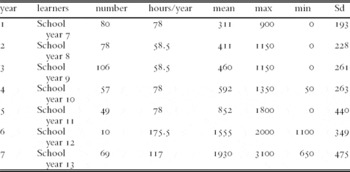
A study of 449 learners across all levels in a British school (Milton, Reference Milton2006) gave the results reported in Table 1.
Vocabulary knowledge in a British school, divided by year of study (Milton, Reference Milton2006, 192)

Year-end mean vocabulary scores at a British school and university.

These scores, which are estimates of the vocabulary knowledge of the 5000 most frequent words in French, suggest that learners reach GCSE after five years of study with about 850 of French on average, and take ‘A’ level two years later with just under 2000 words. Students, on average, gain about 170 words per year up to GCSE, and about 535 words per year between GCSE and ‘A’ level. When time in class is taken into account it emerges that learners progress at about 2.7 words per contact hour up to GCSE and at about 4.1 words per hour during the course of ‘A’ level study. These results are broadly similar to Milton and Meara's (Reference Milton and Meara1998) results which suggest that learners in a variety of language settings learn about three to four words per classroom hour. They are also, broadly, confirmed by recent replications (for example, David, forthcoming.).
While these scores take us only to the end of formal school study, they appear to provide a cogent picture of the way language develops. Vocabulary size tends generally to increase over the course of study as might be expected, and learners taking ‘A’ level, for example, have greater vocabulary knowledge than those taking GCSE exams, and these learners have greater knowledge than beginners at the end of only one year of study. Milton (Reference Milton2006: 193) also reports a statistically significant relationship between vocabulary size and ‘A’ level grade; the larger a learner's vocabulary size the more likely they are to get a higher grade.
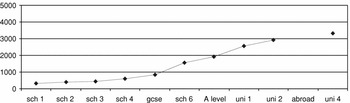
This study has been extended to include 66 students taking single and joint honours French at a British university using the same testing methodology. Students in their first, second and final year were tested in October at the very start of the academic year and again in June at the end of the academic year's study. Students taking the intercalary year abroad, however, could not be tested. While not a complete sample of students on these courses, it is thought that the results are representative of learners at this university, and a similar study in another British university by David (forthcoming) produces almost identical scores. The scores the university level students obtained are reported in Table 2 and when their year final scores are added to those of the students in the Milton (Reference Milton2006) school study, the progress it implies over the whole of foreign language learning in the British educational system can be seen in Diagram 1.
Vocabulary knowledge in a British university, divided by year of study
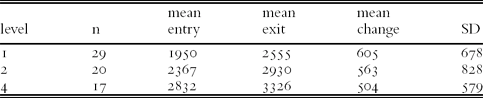
It appears that foreign language learners at university continue to learn vocabulary within the 5000 word band at the same kind of rate that they did at ‘A’ level; about 500 words per year. If it were not for the intercalary year progress would be completely, and rather impressively, regular from GCSE onwards.
The scores suggest some features that deserve closer investigation and explanation. Firstly, it appears that little vocabulary is learned during years 2, 3 and 4 of study although it is not immediately apparent why this should be so. If progress can be sizeable in year 1 and both sizeable and regular after year 4, why should this hiatus in learning occur? It appears that learners have been held back in this period. Secondly, it is hard to discern vocabulary gains during the year abroad. These figures suggest that learners enter their final year with approximately the same level of vocabulary knowledge that they had on completion of their second year, a feature also apparent in David (forthcoming) data. It is almost as though the intercalary year does not exist and learners progress after it much as they progressed before. This probably is not a ceiling effect. Learners are not approaching the maximum score of 5000 and native speakers and genuinely able French speakers, university lecturers for example, routinely score 5000 or very close.
In addition, the scores appear quite modest in scale given the years devoted to learning including, in the case of university graduates, a whole academic year spent in France. It raises the question whether school learners have the scale of vocabulary knowledge appropriate for communication in French at the CEFR's A2, B1 and B2 levels in the formal exam system. Meaningful communication in anything but the most contrived and predictable circumstances must be difficult with so few lexical resources. Learners at these levels who study English as a foreign language tend to have much larger vocabularies when tested by the same methodology. It raises too, the question of what level of competence we expect of our foreign language graduates when they appear to be far away from native-like levels of knowledge of frequent and important vocabulary.
These, then, are the levels of vocabulary knowledge current learners display. What evidence is there that standards have changed or that learners in the past knew more and were more competent?
3. HAS THERE BEEN A DECLINE IN STANDARDS OF FRENCH AT SCHOOL?
There are some reasons for thinking that French in particular has suffered a decline in the standard of the milestone exams at age 16 and 18, and a reduction in what we expect learners to gain during their language study. Reports from the Qualifications and Curriculum Authority concerning French GCSE, for example, report that ‘there was evidence that the standard declined between 1986, 1991 and 1996. This was not confined to accuracy, but also included linguistic range and critical response’. (Qualifications and Curriculum Authority, 2002: 1). It will be appreciated that in a subject where formal exams rely very heavily on the subjective evaluation of essays and oral interviews by many different markers, and for a quality as difficult to measure as critical response, it can appear hard to be certain of such changes, still less to quantify the scale of any change.
Milton (Reference Milton2004) points to a further problem in trying to gauge the maintenance of standards over time. Prior to 1988, it seems, the numbers of learners taking formal exams, the number of schools offering these exams, and the nature of the exams themselves, had remained fairly constant over time which allowed markers to norm reference their assessments. The introduction of GCSE changed both the number and nature of the students taking the age 16 exam, and the nature of the exam itself. Norm referencing was no longer possible and it is far from clear that criterion referencing has satisfactorily carried out the function of moderating the level of exams. Milton's (Reference Milton2004) paper points to the disproportionate increase in pass rates after the introduction of GCSE, and in the proportion of grade A awards in particular, which suggest grade inflation. The same paper analyses the lexical sophistication of the French texts used in ‘O’ level and GCSE over a 20-year period and reports a decline in lexical difficulty in these texts after the introduction of GCSE. These conclusions suggest both a decline in the knowledge and ability of learners, and in the standard of the age 16 exam. While is hard to find a change in teaching methodology which could produce an increase of 250% in the number of grade A awards within two years of the introduction of GCSE, a reduction in the difficulty of the exam could certainly produce this change.
The current levels of vocabulary knowledge reported in the previous section add to this picture. A number of studies, now rather old, review the scale of vocabulary learning before and just after the Second World War and in every case they report that learners had higher rates of vocabulary acquisition than are measurable today leading to the conclusion that ‘. . . the average French learner [today] learns less vocabulary than was the case two generations ago’ (Milton, Reference Milton2006: 202–203). There are methodological differences between the tests administered to current learners and historical learners, however, and while the size of the difference in their vocabulary sizes means that this conclusion is probably valid, it is hard to estimate how large that difference really is.
4. MEASUREMENTS OF VOCABULARY SIZE IN BRITAIN BEFORE GCSE
Studies reporting vocabulary knowledge among foreign language students in the British education system are few in number. Some of them are now distinctly venerable. Robson (Reference Robson1934) examined the first year of French learning in 16 schools of varying kinds: elementary, central, secondary, convent, high and grammar schools. The nature and range of teaching, and the volume of learning which resulted, appears very diverse. Classroom time varied from 25 to 130 hours, vocabulary exposure varied from 212 to 1112 words and passive vocabulary knowledge at the end of study varied from 132 to 665 words. Burns (Reference Burns1951) studied first year learners of French in British Grammar Schools. The mean estimated productive vocabulary was 555 words among these learners, and the mean passive receptive vocabulary was 718 words at the end of the academic year (p. 44).
Erigna (Reference Erigna1974) estimated that learners with five or six years of French, presumably those who had completed ‘O’ level and who might have progressed to their first year of ‘A’ level in the exam system of the time, possessed receptive vocabularies of 2500 to 3500 words with productive vocabularies of 1000 to 1500 words. It is not clear how these figures have been arrived at. Nonetheless, these particular estimates sit comfortably with the anecdotal evidence from the literature of language learners who took ‘O’ and ‘A’ level in the 1960s and 1970s and learners who have been tested for this study. These learners report that they expected to learn about 4000 words for ‘O’ level and double this to succeed at ‘A’ level. These kinds of estimates also sit well with learner recollections of how they managed to learn these volumes of vocabulary. Learners recall being given 60 words a week as part of the routine of foreign language study (Fine, Reference Fine2005: 7). Sixty words a week, every week over several years of study could certainly result in a vocabulary approaching 4000 words after five years even if some of the words were repeated and others forgotten. If the learners reported by Robson and Burns were to continue to learn at the rate they did in their first year, then, they also could have acquired the several thousand vocabulary items which Erigna reports. These, historical studies, are consistent with each other, therefore, and appear to tell a believable story about the scale of vocabulary learning at that time.
Another feature of Erigna's study (Reference Erigna1974: 260) is that it reports on the time spent learning French in school. In the first three years of French study the learners receive 280 hours of classroom instruction; about 50% more classroom input than current learners receive in the same period (see Table 1). Again, this figure is very similar to learners' own recollections where a 40 minute French class almost every day at school before 1980 is reported.
In all these articles the volumes of vocabulary being learned appear substantially larger than the recent studies suggest. However, differences in the testing method make this difficult to confirm unequivocally and make it difficult to estimate the scale of the difference. This difficulty is not easy to overcome unless all the learners take the same test so that scores can be directly compared.
5. EXTENDING THE COMPARISON USING THE SAME TESTS
To address this problem, the specific objectives of this study are:
• to test the vocabulary size of a sample of learners who studied French before GCSE and who took ‘O’ level around the time of Erigna's study, and
• to compare the scores they obtain with those gained by modern learners taking GCSE and other exams.
6. METHODOLOGY FOR ESTIMATING VOCABULARY SIZE
Since the 1930s the methodology for selecting the vocabulary to teach has been, at least in principle, relatively systematic. Writers generally attempt to incorporate into foreign language learning materials the most frequent words in the language. The most frequent words in a language provide most coverage of a text and are, arguably, the most useful as a consequence. Robson (Reference Robson1934: 265) draws explicit attention to Longman's Modern Method French Book where the contents are derived in this way, and modern textbooks continue to identify frequency criteria in their explanations of vocabulary choice (e.g. Rixon, Reference Rixon1990: 5). If this principle were rigorously applied then it would make testing relatively straightforward; a test of the most frequent words in the language would produce a good estimate of the learners' knowledge. However, books also need subject and thematic organisation if they are to be usable, and strict frequency-based selection does not allow this. Some vocabulary must, as a consequence, fall outside the most frequent lexical bands and this material can be chosen idiosyncratically which makes a single test for all users more difficult to construct.
To overcome these differences in the vocabulary the learners are exposed to, investigators who examine vocabulary size have traditionally worked with beginners only and have based vocabulary estimates on tests of the contents of the books the learners use (for example, Robson, Reference Robson1934 and Burns, Reference Burns1951). While these tests ought to have a strong frequency bias, it is unclear precisely how well these scores can compare with each other or with modern tests which are more strictly derived from frequency data and are designed to estimate knowledge of learners from a wide variety of learning backgrounds and at a variety of levels of knowledge and ability.
The test used to estimate vocabulary size in Milton (Reference Milton2006), for example, is an adaptation of the X_Lex vocabulary levels test (Meara and Milton, Reference Meara and Milton2003), an EFL vocabulary size test which tests knowledge of each of the first five, 1000 word frequency bands, estimates overall knowledge of this vocabulary, and gives an overall score of words known out of 5000. The French version is based on Baudot's (Reference Baudot1992) frequency lists. Since the most frequent 5000 words in Baudot's word lists provide fractionally under 95% coverage of the whole of his 1.2 million word corpus, this suggests that the results of this test might compare quite well with older tests. The older tests, and the books they were derived from, would have to contain very large volumes of infrequent and largely un-useful vocabulary to produce substantially different results. Nonetheless, since the content of these tests can no longer be checked this is still a potential source of difference and ideally learners should take the same test so results can be directly compared. The ‘O’ level takers in this study have therefore taken the French version of X-Lex like the learners in Milton (Reference Milton2006).
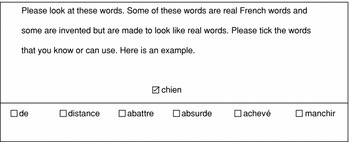
The French version of X-Lex is a Yes/No test which presents learners with 120 words, one by one. Learners have to indicate whether they know each word. There are 20 randomly selected words from each 1000 word frequency band and a further 20 pseudo words which are designed to look like words in French but are not real French words. The number of Yes responses to these pseudo words allows the score on the real words to be adjusted for guessing and overestimation of knowledge. Each Yes response to a real word scores 50 on this test, and each Yes response scores -250, allowing the adjusted estimate to be made. As in the Milton (Reference Milton2006) study testees with guessing rates above 20% were excluded. The test was delivered in a paper and pencil (15 testees) and computer versions (6 testees). Adamopoulou (Reference Adamopoulou2000) suggests in practice the scores produced by these two difference forms of the test vary scarcely at all. The test instructions, an example, and the first line of test items in the pencil and paper version of the test are shown in Diagram 2.
Illustration of test format.

7. THE SUBJECTS IN THIS STUDY
Test data was collected from 21 learners who had studied to ‘O’ level as part of their school study but who had not pursued their French, or used the language, subsequently. These learners varied in age from forty to over sixty. No regard was paid to the grade these testees had received at ‘O’ level and they varied from a Grade 1, the top grade, to a Grade 9, which was the greatest degree of graded failure possible. Testees were excluded if they had continued their study of French, say at evening class, or had lived for any length of time in France, although the occasional holiday in France was accepted. These criteria ruled out a large number of ‘O’ level takers and the remaining sample is opportunistic to a degree, but it should allow some estimate to be made of the vocabulary gained and retained by learners who studied to ‘O’ level more than twenty years ago.
It must be recalled that the proportion of the age group who took ‘O’ level French in the 1950s, 1960s and 1970s was much smaller than the proportion who now take GCSE. One of the reasons for making the change to GCSE was to increase the numbers taking milestone exams at age 16 and leaving school without qualifications. The ‘O’ level takers will have had a different learning experience. The majority of them had studied Latin at school and often another foreign language, and went on to study at university. The majority had also gone on to professional careers in areas such as education, the civil service and the social services. By no means all followed this career path, however, and 8 of the 21 testees had not gone to university, had remained housewives or had taken jobs such as bank cashier or travelling salesmen.
8. RESULTS
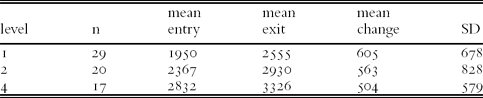
It is not immediately apparent what scores might be expected from the ‘O’ level group. It might be thought in the light of the studies discussed above, that these learners will produce larger scores on the vocabulary test than current learners, reflecting the greater vocabulary knowledge which was reported at the time. However, in all cases, considerable time has passed since the language was formally studied or even used and some attrition of word knowledge must have taken place. It is not entirely clear, therefore, what results may emerge. The results of the learners who took ‘O’ level are summarised in Table 3.
Vocabulary knowledge among learners who took ‘O’ level

Even after at least two decades of not using or learning French, and in some cases nearly fifty years of non-use, learners recall on average over 2000 words. There must be some attrition here. Levels at the time of taking their French language ‘O’ levels might reasonably be expected to have been higher. The highest scorer on the test, a lady now in her sixties, does not appear to have a freak test score but really did learn large numbers of vocabulary lists, lists of bird names and trees for example, many of which she can still recall.
9. DISCUSSION
9.1 Comparing ‘O’ level and GCSE vocabulary knowledge
At the outset of this paper it was suggested that the levels of French vocabulary known by current learners might be compared with the knowledge of learners who studied several decades ago in order to ascertain whether knowledge appears to have changed over time. The results obtained from the group which took ‘O’ level all those years ago suggest that passive vocabulary knowledge in a foreign language can be remarkably robust and that large volumes of words can be retained over decades even when the language is not being used. The mean score obtained is close to the bottom level of vocabulary knowledge Erigna (Reference Erigna1974) suggests for learners at this level. This difference can be accounted for in two ways. One is that Erigna's figures must have included some vocabulary outside the 5000 word range and this will not appear in the current estimate. But this may not be a huge amount because of the weight of the second reason. Notwithstanding the way this vocabulary has survived, there must have been some attrition over time and learners will have known more when they actually took the exam. It seems to me, therefore, that these figures support the idea that the estimates of vocabulary knowledge which were made some 30 years ago are consistent with those made using current methodology. Current results can also be compared directly with historical vocabulary size estimates despite the change in testing method. What does this tell us about the way French vocabulary knowledge in schools has changed over time?
At one level the conclusion to be drawn is very clear. Learners who took ‘O’ level all those years ago had greater vocabulary knowledge than equivalent learners taking the equivalent age 16 exam now. Their scores suggest they still have on average more than double, in fact closer to treble, the vocabulary knowledge of GCSE takers. Allowing for attrition over time the difference is probably even greater than this and Erigna's figures, which suggest they might have had vocabularies quadruple the size of modern learners, appear entirely believable. The importance of this cannot be under-estimated. This is not a change in abstract knowledge irrelevant to the communicative goals of modern language teaching, it implies that modern learners will be much weaker and less successful at every aspect of language, communication and language use. Learners cannot be as communicatively able with less than 1000 words of French as they will be with more than 2000 or 3000 of the most frequent words. If the objective in introducing and running the GCSE exam was to maintain the standard of the age 16 exam, so that users have a qualification we can all recognise and can understand, then GCSE has signally failed to achieve this. The vocabulary knowledge required for ‘O’ level in the 1970s is much closer to that required for ‘A’ level now, and the mean score of ‘O’ level takers, even after decades of non-use, is still higher than the current ‘A’ level mean.
It is worth asking the question whether a decline in the standard of the age 16 exam is unequivocally a bad thing. One of the features of GCSE is that it has brought into the sphere of the exam a much greater proportion of the age range, and many more school students now know some French, and have a qualification, than was the case 30 years ago. Probably this is a good thing. But this change has been bought at a price and that price appears not to be a reduction in the level of the age 16 exam to the standard where increased numbers of learners stand a chance of completing it. This would seem to me a price well worth paying provided this change in the overall standard of the exam has not compromised the ability of the most able learners to achieve their full potential. The question arises, therefore, whether the best performing students in the modern cohort, the ones who 30 years ago would have taken ‘O’ level, are attaining the levels of knowledge that Erigna reports.
Figures from WJEC exams (Milton, Reference Milton2004: 6) suggest that after the change from ‘O’ level to GCSE approximately double the number students took the age 16 exam in French. The best performing 24 learners in the Year 5 GCSE group in Table 1 have been separated out and the mean scores recalculated to allow the ‘O’ level group to be compared with an equivalent cohort from the modern group. The results are presented in Table 4.
Comparison of ‘O’ level group vocabulary scores with an equivalent GCSE cohort

These figures suggest that even most able learners taking GCSE know much less vocabulary than equivalent learners did on taking ‘O level. Even the best performing GCSE students have scores below the ‘O’ level takers’ mean score. Partly this must be the result of the reduction in the number of hours available for learning French. The figures produced by Erigna (Reference Erigna1974) as well as the recollections of learners confirm that this has occurred. Partly too, it will be the product of the way GCSE sets a low threshold of knowledge for completion, and teachers will inevitably teach to this threshold rather than press the best learners to achieve their fullest potential. The strikingly low figure for standard deviation among GCSE learners in Table 4, suggests to me that the most able current learners are capped in some way. These figures suggest very strongly that not only is the standard of the average student taking GCSE much lower than that of the average student who took ‘O’ level, but that the standard of the very best GCSE students fail to match that of the old ‘O’ level. A lower standard at the outset of study and up to age 16 must put pressure on the remainder of the French teaching system, for example at university where students are expected to study in France and through the medium of French.
9.2 Progress at University and the Intercalary Year
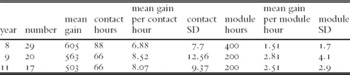
If the levels of vocabulary knowledge among learners have declined so much over recent decades, how has this change come about? It is possible to provide a convincing argument that the comparatively slower progress in learning vocabulary which current school students make is the result of a decline in the hours available for study. At university, however, learners continue to learn at about the same annual rate even though much more time is, in theory, available to them. How can this be explained? Most of this time will be spent studying through English, however, and even literature modules are likely to be tackled through translations. I suspect that part of the answer lies, again, with the hours available for classroom language teaching. University students have a number of timetabled, classroom hours which are explicitly devoted to language development including the introduction and learning of new vocabulary. But in addition, there are a large number of hours, 200 hours per language learning module, which are intended for learners to read, to write assignments and to study independently. How much of this second group of study hours are actually devoted to learning French is uncertain and very probably will vary enormously from one individual to another. Depending on which numbers of hours is taken as the basis of calculation, progress can vary considerably. Table 5 shows these separate calculations.
Vocabulary gain per hour of study in a British university

If students are devoting every hour that the modules make available to them in formal French study, then the progress they are making is small at around one to two words per hour. These figures are comparable with the rate of progress in Years 2, 3 and 4 of secondary school. In reality, some of this time at least will be taken up with testing and other activities rather than purely in vocabulary learning. Nonetheless, there is evidence that non-classroom activities such as reading in a foreign language or listening to foreign language songs, can lead to very rapid vocabulary growth when properly structured (for example, Horst and Meara, Reference Horst and Meara1999), and there seems little evidence that students are taking best advantage of the time available to them to advance and develop an essential area of their foreign language knowledge. When progress is recalculated so that only classroom hours are used, the figures which emerge are quite believable for able learners, and remember that university level learners should comprise only highly able and successful language learners. Figures of six to eight words per contact hour are reported for able learners elsewhere (for example, Vassiliu, Reference Vassiliu2001). My suspicion is that learners either are not using the time available for learning outside of the classroom or, if they are, then they are not taking good advantage of the time, perhaps because they do not know how to.
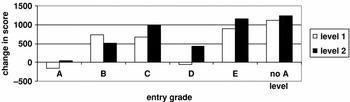
A second reason why many students may make only modest progress is the focus of the classroom teaching which is available to them. It appears that disproportionate effort is devoted to the least able students at the expense of the able. This can be seen when the progress of the university level 1 and level 2 students is subdivided by the grade they received at ‘A’ level as in Diagram 3.
Lexical growth at university and ‘A’ level grade.

Students who enter with a grade A, and consequently have a comparatively large vocabulary, make little or no progress. Students who have a grade E or no ‘A’ level at all make very impressive progress, on average about 1000 words in the year. My suspicion is that classroom materials and teaching effort are pitched at the level of the least able, giving the more able little opportunity to learn. Where students are expected at the end of the second year at university to spend a year independently in France it is, perhaps, understandable why teachers should focus their effort this way.
If progress at university in Britain appears perplexingly slow, the effect of the intercalary year is even less easy to understand. It is hard to see any vocabulary gain among the students in this study and certainly nothing like the very large gains reported in Milton and Meara (Reference Milton and Meara1995) who studied European learners on an equivalent exchange at a British university. This really needs investigation in much more depth, and probably with a 10,000 word test to give a better gauge of knowledge. These learners seem to be well below the levels needed for native like fluency and accuracy and it is strange that they do not improve, given the chance to live abroad, when European learners in Britain do improve. There appear to be some important differences in the experience of the intercalary year between the two groups.
The European learners in Britain studied by Milton and Meara (Reference Milton and Meara1995) were taking degree level courses with native speakers, and were obliged to take lectures, write assessed essays and pass exams for credit like every other student in the university. They continued to take formal language classes and took the Cambridge Proficiency in English exam at the end of their year abroad. Even if they did not mix as expected with native-speaking students, their social life with other overseas students appears to have been conducted with English as the lingua franca. They have had huge exposure to English, therefore, have been put under pressure to progress in English, and been given language support at an appropriate level to help them achieve this. British students in France may have a very different experience. It is not clear that they have to complete modules in France successfully to gain the credits they need at home, and given their level of language they would find it hard to do this. It is not clear that the British learners in France have formal French language classes nor the formal external language accreditation that their European counterparts sought. Nor do the British students in France, unless on a work placement, develop social patterns that involve the use of French. Socialising with other students frequently involved, as in Britain, mixing with other international students and the use of English, rather than French, as the general lingua franca. It would be wrong to disparage the potential value of time spent in the country of the language you are learning but the kind of large-scale progress which might reasonably expected from such an experience is missing in this group of learners. This should be a concern. The nature of the experience and the benefits derived from it require more and closer investigation. It seems quite likely that the nature of the student experience needs to be changed quite significantly if learners are to make the kind of progress which traditionally we have expected of them and any change will have to take into account the very modest levels of vocabulary and language knowledge that these learners now possess.
10. CONCLUSIONS
The introduction to this paper raised concerns that the standards of knowledge had declined among learners at British schools and taking formal exams in French. The examination of current and historical measurements of vocabulary size confirms that these concerns are not misplaced. The use of vocabulary size allows a comparison to be made and even allows a judgement to be made about the scale of this decline which appears enormous. Learners taking GCSE under the current system have only a half to a third of the vocabulary knowledge of learners who took ‘O’ level between 20 and 50 years ago. This lends credence to the figures provided by Erigna (Reference Erigna1974) and others which suggest that learners taking ‘O’ level about 30 years ago had vocabularies three or four times larger than current learners. It is hard to believe the claims that the increases in the numbers passing GCSE and gaining a grade A are the product of improved teaching, when the knowledge displayed by learners has diminished this dramatically. Even the best learners taking GCSE have only a fraction of the knowledge of learners taking age 16 exams historically. Because vocabulary knowledge is so central to language performance generally this must mean that learners are much less able in French generally than they were before the introduction of GCSE. It is not hard to suggest the reasons for this decline. Pressure to increase the numbers taking and passing the exam, coupled with a reduction in the classroom hours available for learning, and a change in the exam format, have probably made retaining continuity in standards impossible.
This reduction in standards has had implications for the rest of the language teaching system and for the learners themselves. If 16-year-olds know less on taking GCSE, then progress to ‘A’ level becomes much harder. There is evidence here that the standard of ‘A’ level has likewise been compromised as a result. The mean vocabulary size of ‘O’ level takers in this study is larger than the mean score for ‘A’ level students now entering university to study French. This in turn has consequences for the study of French at university. It appears that the efforts of French teachers are devoted to learners now entering the system with very low levels of French, and intermediate level students make little progress as a result. The cohort which completes two years of university study has levels of vocabulary knowledge which must make university study abroad through the medium of French incredibly difficult if not impossible. The effects of the year abroad have been little studied but this investigation suggests that, linguistically, learners may take little from the experience. Graduates in French now have a comparatively modest knowledge of the most frequent French vocabulary and the mean scores they produce fall within the vocabulary size range suggested by Erigna for ‘O’ level takers 30 years ago. This suggests that the goals of university study in a foreign language should be reassessed with native-like proficiency no longer being routinely achieved by the majority of graduates.
A final conclusion which emerges from this investigation is how potentially useful vocabulary measures can be in the process of measuring knowledge and comparing the standards of learners and exams over time. This is an area where intelligent discussion is bedevilled by the absence of objective and quantifiable information. This study has shown, however, that it is possible to make a quantified and objective measure of learners' knowledge and to draw meaningful conclusions from this information. It would surely be beneficial if learners, schools and examining authorities made greater use of these kinds of technique.