Introduction
A remarkable thing about conversation analysis (CA), and a good indication of its intellectual audacity, is the fact that it has advanced a number of really strong claims about the context-independent character and universality of the machinery by which interaction is constituted in spite of the scarcity of analyses of interaction in languages other than English. Throughout the years, a limited number of researchers (e.g. Moerman Reference Moerman1988) have tried to verify these claims and have effectively begun to analyze interactional materials in other languages collected in different sociocultural environments. It is only recently, however, that these efforts have culminated in a coherent “comparative” research agenda (see e.g. the papers in Sidnell Reference Sidnell2009b). By expanding the range of interactional materials that are subjected to analysis, these comparatively oriented CA practitioners seek to identify the effects of linguistic and social differences on the organization of interaction. Comparatism, according to this perspective, specifically refers to the triangulation of the local and the universal; the basic assumption behind the emerging program is that “the generic problems of human interaction (turn-taking and repair, for instance) are solved through the mobilization of the eminently local semiotic resources of a particular language in a particular social setting” (Sidnell Reference Sidnell2008:479). To put it differently, talk-in-interaction is “organized around a base of generic principles which are inflected by a variety of local conditions. Local circumstances, including grammatical patterns, onomastics, and demographic factors, can be seen to ‘torque’ the generic organization in different directions” (Sidnell Reference Sidnell2008:481–82).
These local factors include distinctive prosodic patterns (Local Reference Local, Couper-Kuhlen and Selting1996) and gestures (such as flashing one's eyebrow; Levinson Reference Levinson2005), specific morphological and syntactical properties of particular languages (which affect, for example, the projections that can be made regarding the possible completion of an ongoing turn-at-talk; Fox, Hayashi, & Jasperson Reference Fox, Hayashi;, Jasperson, Ochs, Schegloff and Thompson1996), taboos preventing the use of names and demographic factors (which may have an impact on the way reference to persons is achieved; Levinson Reference Levinson2005; Sidnell Reference Sidnell2008), and also—specifically relevant to our purposes—certain “language-specific objects” (Sidnell Reference Sidnell and Sidnell2009a:4), such as the English “change-of-state” token oh (Heritage Reference Heritage, Maxwell Atkinson and Heritage1984, Reference Heritage1998, Reference Heritage, Ford, Fox and Thompson2002a; Bolden Reference Bolden2006), the Mandarin particles a and ou (Wu Reference Wu2004), and Finnish nii (Sorjonen Reference Sorjonen2001).
This article presents an account of one such eminently local language-specific semiotic resource: the Kiswahili particle ah, which can frequently be found in the turn-initial position of a second pair part (although, as we shall see, it is in no way limited to this particular environment).
In phonetic terms, the object under investigation can be characterized as a string consisting of a glottal stop followed by a front open vowel and a laryngeal or uvular fricative. Pitch and loudness may vary, and both the vowel and the fricative can be subject to lengthening. The intensity of the particle's delivery and its duration are thus open to modification, but the evidence collected here nevertheless suggests that these different realizations may still be considered tokens of a single semantic type. It is this underlying semantic type that is the focal point for this article, rather than the internal variation in the particle's realization and the interactional work that is accomplished though its delivery (which would command a study in its own right).
The central claim of this article is that this ah-token constitutes a “response cry” (Goffman Reference Goffman1978) embodying the speaker's strong negative moral-affective stance toward something, either an accident in the flow of the talk (usually an unwelcome action by another speaker) or the particular item that is being talked about (a negatively evaluated event or individual). The particle is thus part of a category of “interactional (rather than mental) objects employed to communicate the speaker's public orientation to [a] particular issue” (Bolden Reference Bolden2006:664). The notion of public orientation must in this context be understood in a more restricted sense than is usually the case in the CA literature, where it routinely refers to a necessary constitutive feature of any utterance (or other meaningful form of conduct) for it to be meaningful: the fact that it discloses to the other interlocutors (e.g. through its placement) how its utterer made sense of the preceding turn and of the emerging interactional constellation. In the case of particles indexing stance, however, public orientation should be interpreted much more narrowly, as referring to a particular interactional “project” that serves a specific purpose in the sequence in question. This conception of public orientation as an interactional project is furthermore also consistent with Wu's (Reference Wu2004) contention that stance is not the representation of an underlying psychological disposition but “an emergent product which is shaped by, and itself shapes, the unfolding development of interaction” (Wu Reference Wu2004:3).
Data for this study are drawn from 2.5 hours of naturally occurring Kiswahili conversation, recorded during an eight-month fieldwork stay in Dar-es-Salaam, Tanzania, in the summer and autumn of 1996. An inspection of the corpus yielded twenty-seven instances of the token in question, of which a large majority (twenty-one tokens) occupied the turn-initial position of a second pair part (SPP). The corpus comprises five different conversations, which vary in length between a mere two minutes and a full hour (two sides of a sixty-minute audiocassette). They were all recorded by my informant, N, a sixteen-year-old school dropout, who features prominently in each of them. Apart from one extended conversation on religious topics with two people with whom N cooperates in the running of the local mosque, the other participants are for the most part late teenagers or early adolescents with whom N regularly spends time. Here the category “adolescent” must above all be understood in a sociocultural sense, though. One of N's regular buddies is Fundi (Kiswahili for ‘craftsman,’ the address term N customarily uses for this particular interlocutor), an unschooled immigrant from the south of the country, in his mid-forties but still unmarried (an important local criterion for measuring adulthood). Fundi makes a living as a shoe repairer (hence the address term fundi), and his shack along the roadside is a regular hangout (or kijiweni; cf. Weiss Reference Weiss2002) for local youth like N.
Determining the relevant community within which this practice of ah-prefacing thrives is tricky issue. The composition of the corpus quickly rules out age as a relevant parameter. However, because of the particular sociolinguistic composition of Dar-es-Salaam as the country's leading metropolis (even though in 1973, it officially relinquished its status as the political capital to Dodoma), mother tongue turns out an equally problematic benchmark. The conversations that were recorded are entirely in Kiswahili, Tanzania's undisputed lingua franca and official national language. None of the participants, however, has any ties to the Islamic population of the coastal “stone towns” that historically identifies itself as “Swahili” (Middleton Reference Middleton1992) and that still claims “ownership” of the language (Madumulla, Bertoncini, & Blommaert Reference Madumulla, Bertoncini;, Blommaert and Blommaert1999). Dar-es-Salaam is situated on the coastal strip opposite Zanzibar Island; in purely geographical terms, it thus falls within the Swahili sphere of influence, but migration in the colonial (Burton Reference Burton2005) and postcolonial era drastically altered the city's sociolinguistic composition. Processes of urban flight are deeply reflected in the composition of the corpus, as the participants whose interactional conduct is documented are all first- or second-generation immigrants from upcountry. Kiswahili, nevertheless, represents for the majority of them still the primary language into which they were socialized. N, for example, whose father's family originates from the southern coast but who was raised by relatives in Bagamoyo seventy kilometers to the north of Dar-es-Salaam, repeatedly reported “not being able to speak his own language (Kiyao).” The two exceptions are Fundi and Yusuf, two elder speakers who migrated to the city at a later stage in their life and whose speech shows marked influences from their respective ethnic languages.
All of this greatly complicates the issue of connecting interactional routines to the relevant “communities-of-practice” reflexively enacted through these routines (cf. the discussion of speech community in Duranti Reference Duranti1997). Anecdotal evidence indicates that, even though ethnic languages may occasionally still be used in restricted private contexts, Kiswahili is omnipresent in Dar-es-Salaam. Unfortunately, however, there is little accurate information on the position that it occupies in the repertoire of the city's inhabitants and on the specific notion(s) of community in which it might be implicated. Tanzania attracted a good deal of sociolinguistic attention because at one stage in its recent history, in the aftermath of its adoption of radical socialist Ujamaa politics in 1967, the country appeared to have opted for the total Swahilization of society. This new sociolinguistic attention, however, resulted mainly in studies of language in education (e.g. Mulokozi Reference Mulokozi and Blommaert1991; Rubagumya Reference Rubagumya1994) and of the role of language-planning efforts in nation building and in the reproduction and persistence of social inequality (e.g. Yahya-Othman Reference Yahya-Othman1997; Blommaert Reference Blommaert2005). Unfortunately, the recent interest in rap music (so called bongo fleva) and youth language (e.g. Reuster-Jahn & Kiessling Reference Reuster-Jahn and Kiessling2006; Englert Reference Englert2008) did not really rectify this, as these studies concentrate on an isolated variety but neglect the complex linguistic ecology that spawned it.
Importantly, the hypothesis advanced here regarding the particle's semantic core only hold to the extent that it can exhaustively account for all of the instances of the token found in the corpus. The analytical strategy adopted here is therefore reminiscent of the one adopted by Heritage and others vis-à-vis English oh (Heritage Reference Heritage, Maxwell Atkinson and Heritage1984, Reference Heritage1998, Reference Heritage, Ford, Fox and Thompson2002a; Bolden Reference Bolden2006). Concomitantly with the identification of a candidate semantic characterization, the various usages of the particle documented in the corpus are explicated in terms of the specific tasks that they are called upon for in their respective contexts. Collections of similar instances are examined for underlying regularities (and, wherever possible, confronted with seemingly “deviant” cases), so as to identify exactly how the particle contributes to the realization of the sequential environment in question and of the action(s) relevant therein, the particularized meanings it acquires in these contexts, and the processes of practical reasoning by which participants arrive at those meanings.
The first section below is dedicated to the usage that is quantitatively the most overwhelming. Here, we look at environments where ah initiates responses that can be characterized as disjunctive toward the preceding first pair part (FPP). The particle is here expressing the speaker's negative stance toward the preceding FPP, which suggest that its primary function is to be situated at the level of social affiliation (Stivers Reference Stivers2008). Next, we discuss a restricted number of non-disjunctive usages of the ah-preface, which confirm that it used to express a negative stance toward something but also indicate that the “object” of the particle's negative stance is not necessarily to be traced to the preceding turn. We then spell out the implications of this observation for the collection with which we started off the inquiry: if recovering the object of the stance indexed by ah indeed commands specific interactional work, the question arises as to why the particle's “stance-object” is in the case of dispreferred SPPs specifically to be traced to the preceding FPP. Which contextual factors are responsible for this specific “redressability pattern”? Furthermore, are there alternative “redressing options” available? In the final section, we briefly review the use of ah in the turn-initial position of FPPs.
A preliminary characterization
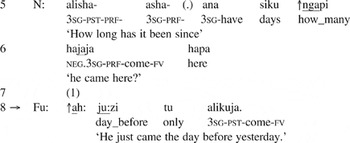
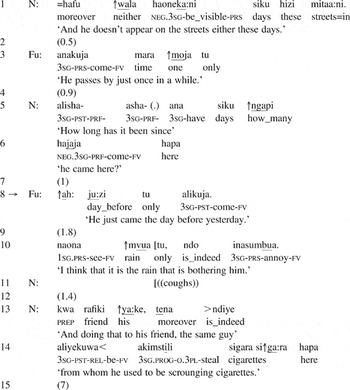
A good starting point for our inquiry into the semantics of turn-initial ah is the observation that it is frequently used for constructing responses that are in one way or another disjunctive vis-à-vis the framework of expectations set up by the preceding FPP. These disjunctive trajectories that receive an ah-preface come in various shapes. Dispreferred SPPs represent a first candidate for inclusion in the emerging collection. In the following excerpt, N and Fundi are discussing the whereabouts of a mutual acquaintance. The conversation was recorded at Fundi's shoe repair shack, the kijiweni where N regularly hangs out. Their mutual acquaintance used to be a frequent visitor too, but lately he has given up such loitering to dedicate himself to the small business that his father set up for him. In lines 5 and 6, N inquires after the last time their friend paid a visit to Fundi's (Fu) shop.
[N#I/A/1:529, first four lines omitted]Footnote 1

Because the polarity of the embedded clause in lines 5 and 6 is reversed, N's question carries the presupposition that their mutual friend did not pay a visit to the workshop for quite some time now. (Note that the initial syllables of line 5 (alisha- asha-) project a question with unequivocal positive polarity. Its subsequent replacement with a question format that allows the embedding of a negative subclause suggests that it is the lack of such a negative presupposition that constituted the “error” N accountably sought to correct with the self-repair.) In line 8, Fundi volunteers the information solicited by N, but his answer is preceded by a one-second pause (a common dispreference marker), whereas the insertion of tu ‘only’ marks that information as contradicting the negative presupposition of N's inquiry. Fundi's answer is prefaced with ah.
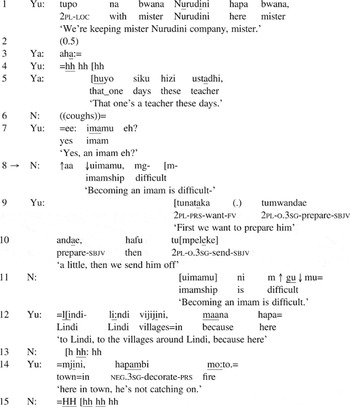
As indicated, disjunctive must be understood in a loose sense and covers a class of interactional phenomena with a wider range than dispreference in the strict sense. In the next excerpt, ah constitutes the preamble to a disagreement. It does so, however, in a sequential environment where the normal preference structure is reversed and the disjunctive course of action constitutes the preferred response. N is discussing religious affairs with his friend Yusuf (Yu) when their Arabic teacher Yassin (Ya) walks by and stops for a chat. Right after completing the greeting sequence, Yusuf prompts Yassin to participate in a collaborative teasing of N (who is referred to as Nurudini, a pseudonym, in line 1 of the excerpt) by mockingly “formally introducing” him to their teacher by means of the honorific ‘mister’ (bwana). In line 8, N issues an ah-prefaced objection (‘Becoming an imam is difficult’) in response to two prior compliments by Yassin (‘That one's a teacher these days’ in line 5) and Yusuf (‘Yes, an imam eh?’ in line 7). In environments like these, the normal preference for agreement is neutralized by a preference for avoiding self-praise, and disagreement is thus preferred (Pomerantz Reference Pomerantz and Schenkein1978). On this specific occasion, this regular preference for avoiding self-praise seems to be additionally enhanced by the fact that the praise N receives from his interlocutors pertains to his achievements in the religious sphere, where self-glorification would be particularly inappropriate.
[N#IV/A/1:693]

It is obvious that Yassin's and Yusuf's compliments to N form a collaboratively construed tease, as is made clear by Yusuf's anticipatory laughter in line 4 and his subsequent elaboration of the praise in lines 9–10, 12, and 14. N's response oscillates between a “serious” rejection of the playful contention (a “po-faced” receipt that testifies that the teasing is “close to home,” lines 8 and 11) and a recognition of its playful character (lines 13 and 15) (Drew Reference Drew1987). Because N's ah-prefaced rejection of the praise belongs to the ostensibly serious “po-faced” segment of his response (which does not officially recognize the preceding FPP as a tease), we may assume that the particle is used to indicate that a disjunctive course of action is being set up—in spite of the fact that the latter in this environment de facto constitutes the preferred SPP.
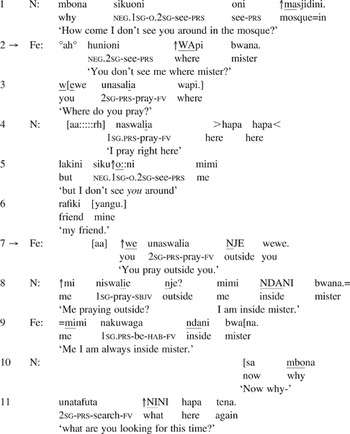
Another kind of disjunctive course of action that frequently receives an ah-preface is what the CA literature refers to as a counter (Schegloff Reference Schegloff2007:17ff)—responses to an FPP that reverse the flow of the sequence and impose a new source of sequential relevance constraining what should happen next (the latter being the crucial feature that distinguishes counters from insertion sequences, which barely defer the second speaker's response to the FPP until the problem that prevents the delivery of the expected SPP is solved). In the excerpt below, N confronts his friend Feri with an observation about the latter's behavior and solicits an account for it (thereby presenting the behavioral peculiarity in question as something that is “saliently absent”): N has been unable to spot his friend during prayer at the mosque lately. As I explain elsewhere (D'hondt Reference D'hondt1998, Reference D'hondt, Pinto, Dupret, Pierret and Spellman-Poots2012), this can be interpreted as an attempt on the part of N to call into question Feri's integrity as a “Muslim.” From the remainder of the excerpt, it is clear that this is also how Feri understood it. The excerpt contains two instances of an ah-prefaced counter, one in line 2 and another in line 7 (marked with an arrow).
[N#I/A/2:001]

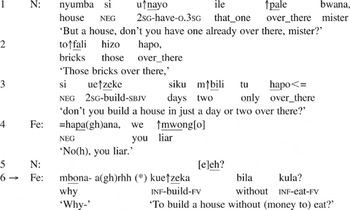
In lines 2 and 3, Feri responds to N's inquiry with two questions of his own: an ah-prefaced questioning repeat challenging the correctness of N's observation, followed by a counter-inquiry into N's praying habits. The latter concomitantly “explains away” N's mistaken observation and reciprocates the accusation of not taking religious prescriptions seriously. The overlap in line 4 betrays N's readiness to respond to Feri's questioning repeat “in its own right,” which indicates that the repeat effectively constitutes a counter. The second ah-prefaced counter occurs in line 7. In line 6, N issued a “my side telling” (Pomerantz Reference Pomerantz1980) that confronted Feri with N's perspective on his recent whereabouts (‘I don't see you around’), thereby casting a corresponding account by Feri for his absence as the preferred SPP. Far from coming up with such an account, however, Feri in line 7 retorts with a “B-event statement” (Labov & Fanshell Reference Labov and Fanshell1977) about N's conduct: he formulates an event about which the recipient is obviously entitled to know more than he himself is (‘You pray outside’), which in turn begs an elaboration by N in the next slot.Footnote 2 The robustness of this inferential link between ah-prefacing and doing a counter is nicely illustrated by the self-repair in (4) below. The excerpt is taken from the same encounter as (3) but occurred a few minutes later, by which time Feri and N's initial dispute about the other's lack of religious fervor had already cooled down. Feri, who supplements his meager income as a truck driver with informal self-employment as a moonlighting real estate agent, is complaining to N about the shortage of housing in the neighborhood. In lines 1 to 3, N responds to this lengthy complaint with a remark that wittingly downplays the gravity of Feri's predicament.
[N#I/A/2:047]

In the excerpt, N mockingly confronts his interlocutor with the pointlessness of his search for appropriate vacant housing by pointing out that he could easily build a house himself in just a few days' time. For this remark, N uses two consecutive negatively framed yes/no inquiries (Heritage Reference Heritage2002b). After a first denial by Feri in line 4, N in line 5 reaffirms the validity of his initial yes/no inquiries with a questioning eh. Feri's second response in line 6 starts off with an interrogative pronoun (mbona ‘why’) that initiates a question projecting an unspecified account by N as the preferred response, which he then immediately subjects to self-repair and replaces with an enhanced, “stronger” question (‘To build a house without (money to) eat?’) that limits the range of possible responses to a “yes” or a “no.” From the repairer's (Feri) perspective, the prefacing of the enhanced revision of the counter with ah apparently adds to the strength of the upgraded segment.
Excerpt (3) deserves yet closer scrutiny, however. In spite of the evidence it offers in support of the inferential link between ah-prefacing and doing a counter, it also demonstrates that ah-prefaced counters can freely be alternated with ah-prefaced composite responses that consist of an “answering” SPP (which fulfills the obligation to reply to the preceding FPP) in combination with a “fresh” FPP, which in turn curtails the first speaker's next response. In line 4, N first asserts that he does ‘pray right here’ (in response to Feri's second counter in line 3), to which he adds a “limited access display” (Pomerantz Reference Pomerantz1980) in line 5, which challenges Feri to come up with an account for his invisibility (cf. supra). We return to this shortly.
From a purely quantitative point of view, this collection of broadly conceived disjunctive courses of action vis-à-vis the framework of expectations set up by the preceding FPP represents by far the most prominent usage pattern found in the corpus: it accounts for eighteen ah-tokens on a total of twenty seven. It is also obvious, however, that this collection is subjected to extensive internal variation. Understanding the latter is crucial. Comparing the different types of disjunctive responses may help us to understand why the particle is so recurrently used in these contexts and what exactly it accomplishes therein.
A useful lead here is provided by the distinction Stivers (Reference Stivers2008) draws between social affiliation and structural alignment as distinct realms of interactional organization. Social affiliation refers to the empathy between interlocutors (or to the apparent lack thereof) and manifests itself, inter alia, in whether a story-recipient adopts the same evaluative stance vis-à-vis the events that are described and/or whether a second speaker's response matches the action preference set up by the preceding FPP. Structural (dis)alignment, in contrast, refers to the extent to which response actions are formally oriented to the ongoing activity, that is, whether they accept its terms and match the preference for a particular type of response implied by the design of the FPP.
The commonalities between the different types of disjunctive trajectory suggest that ah's primary task is situated in the realm of affiliation. For one thing, the fact that the particle also initiates preferred disjunctive courses of action reveals that its task is not to prepare the listener for the dispreferred nature of the upcoming SPP. Instead, as is demonstrated by N's ah-prefaced refusal to be complimented on his religious achievements in excerpt (2), it is the “superordinate” phenomenon of disaffiliation that is responsible for the ah-preface (and not the formal marking of dispreference in the strict sense). By extension, this also holds for “regular” dispreferred responses such as the one in excerpt (1). Here too, it can safely be assumed that ah does not index the SPP-producer's formal lack of compliance with the FPP's “action preference” (i.e. the fact that the SPP-producer is not going to deliver the response preferred by the FPP) but the more basic “stance of rejection” occasioned by that FPP, which “underpins” the speaker's dispreferred response: in this context, Fundi's denunciation of the negative presupposition that their friend did not pay enough attention to him lately, the “state of mind” that accountably induced him to respond in a dispreferred fashion.
A similar remark can be made about the third extract. The fact that ah here alternatingly prefaces counters and composite responses indicates that it is not the formal marking of the upcoming turn as structurally disaligned (i.e. the fact that it openly flouts the projected preference for a particular type of response) that is at issue but the underlying stance of rejection that prompted the speaker to produce such a disaligned response.
It is thus possible to discover a common denominator behind the various disjunctive usages of ah once we move from the realm of alignment to that affiliation. The present subcollection can be subsumed under a single semantic umbrella if we accept that the particle does whatever it does because of its capacity to bring across to the other participants the speaker's negative stance toward the immediately preceding action. It is by virtue of this semantic profile that it can be used for prefacing the variety of disaffiliative and disaligned responses that we just came across.
Affiliative ah
The next question is whether this semantic umbrella is a forthright manifestation of the particle's semantic core or merely represents the particularized outcome of the specific sequential environment in which that core is brought into play. In this section, we shall argue in favor of the last position. Below we discuss a limited number of cases in which the second speaker uses ah in an affiliative fashion—for conveying to the first speaker that he endorses the stance the latter adopted in his FPP—which strongly suggest that the account of ah developed thus far hides a yet-to-be-discovered, more general semantic profile. Quantitatively speaking, these affiliative ah-tokens are unquestionably outnumbered by their disaffiliative counterparts; the entire corpus contains just three instances of them. There is good reason to assume that these three tokens nonetheless represent the most “transparent” usage of the particle. Two of these three affiliative ah-tokens are freestanding ones, which means that they do not pave the way for a yet-to-come SPP but fully constitute the projected SPP in its own right. By abstaining from providing further elaboration, the speaker assumes the particle's core semantics to be sufficient for carrying out the task projected by the foregoing FPP. Freestanding ah-tokens are furthermore on the whole relatively rare, as the entire corpus only contains five instances of them; the fact that almost half of these can be found in the (itself quantitatively trifling) collection of affiliative ah-tokens adds to their analytical salience.
The one affiliative ah-token that is not freestanding is slightly more complicated and will be dealt with below in excerpt (6). The two remaining tokens are structurally fairly straightforward. In both cases, the second speaker issues an ah-SPP that is either directly latched onto the previous utterance or produced in partial overlap (and that is hence ostensibly formatted as preferred). He does so in response to an FPP that (i) projects agreement as the preferred next action and (ii) contains a negative evaluation of an “external” element in the environment equally accessible to the first as well as the second speaker. For reasons of space, only one case is discussed in detail.
[N#IV/A/A:795]

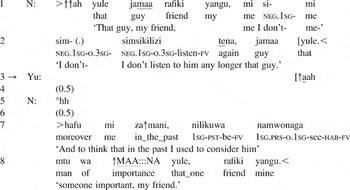
This excerpt is part of a longer talk between N and Yusuf in which they exchange a series of lengthy comments on a theological dispute dividing worshippers at their local neighborhood mosque into two opposing factions, pitting adherents of Islamic revivalism against practitioners of traditional Islam (Turner Reference Turner2009, D'hondt Reference D'hondt, Pinto, Dupret, Pierret and Spellman-Poots2012). N and Yusuf are both outspoken supporters of the revivalist camp. In the talk that came right before (of which I shall discuss another segment below), N made a series of hostile remarks about Ismail Abasi (a pseudonym), a local key figure of the traditionalist faction who openly criticized revivalism during a public meeting last week after Friday prayer. In lines 1 and 2 of the excerpt, N formulates a behavioral stance toward Abasi: he claims to be no longer paying attention to his teachings, implying that he used to do so in the past but that at present he finds doing so no longer right or meaningful; inevitably, this formulation of a stance also projects a strong negative assessment of his opponent.Footnote 3 In line 3, his interlocutor, Yusuf, produces an ah-token, partially in overlap with the last syllables of N's assertion. After a short gap, N self-selects and provides further comments on the topic (lines 7 and 8), using Abasi's persona for issuing a comment about his own past ignorance.Footnote 4 The conjunction halafu ‘moreover’ (here contracted to hafu) frames this remark as “further talk” and thereby treats the foregoing as completed. Importantly, Yusuf's ah-response in line 3 is thus treated as “sufficient” by its producer and recipient alike: Yusuf himself does not find cause to elaborate it, and after the pause, N continues with a new comment.
This leads to the hypothesis that this isolated ah-token is, on this occasion, sufficient because the environment in which it is recruited is so highly constraining: ah meets the constraints set by the FPP because the entire layout of the sequence encourages the participants to treat it as reciprocating the first speaker's negative assessment of Abasi's character (and hence as expressing the second speaker's agreement with the foregoing FPP). Like in the sequences from the previous section, the particle here indexes the utterer's negative stance, but the object of that stance is this time not the action by the previous speaker but the evaluative stance that the latter assumed toward an external item in their shared environment. The second speaker is thus using ah for expressing his affiliation with the first speaker. The sequence in question facilitates this usage of ah (i) because the foregoing FPP specified a “candidate object” for the negative stance indexed by it, and (ii) because that FPP projected agreement (with the first speaker's negative stance toward that object) as the preferred next action. The particle requires no elaboration because both the object of its stance and its affiliative orientation are in this environment fully transparent. The relative scarcity of freestanding ah-tokens shows that such transparency is the exception rather than the rule, however.
Excerpt (5) also epitomizes a major difference between freestanding ah-tokens in response to a first assessment and regular second assessments: whereas the latter always leave open the possibility of adding yet another assessment in the next slot, stand-alone ah-tokens effectively terminate the activity of assessing. The latter appears to be a consequence of the fact that these stand-alone ah-responses comprise a curious combination of, on the one hand, a display of “epistemic independence” (i.e. they demonstrate the speaker's autonomous access to the negatively evaluated item in question; cf. Heritage & Raymond Reference Heritage and Raymond2005) and, on the other hand, an ostensible refusal to elaborate or motivate one's epistemic position.
Can the one deviant case in which ah subsequently gets elaborated by the speaker somehow invalidate this analysis? Excerpt (6) comes from the same conversation as (5) but occurred slightly earlier, at the moment N and Yusuf's mutual foe Abasi entered their field of shared discursive attention for the first time.
[N#IV/A/1:721]

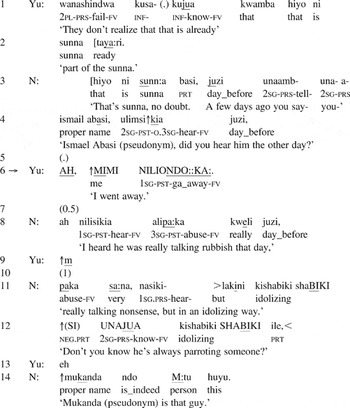
The excerpt provides independent validation for the hypothesis that ah can also express the speaker's negative stance toward an external item (in this case, Yusuf and N's opponent Abasi); but it is also exceptional in that the particle seems to require an additional turn component. The latter is required because the ah-preface and this additional component mutually elaborate each other: without this index of a negative stance in the turn-initial position, the segment mi niliondoka ‘I went away’ could be taken to imply in a neutral way that Yusuf had already left by the time Abasi assumed the floor; in conjunction with the ah-preface, however, it implies that he did listen to Abasi's sermon for a short while but ran away because he was offended by its content.
A close inspection of N's foregoing FPP shows that Yusuf's felt need to elaborate ah is strongly grounded in the particulars of the sequence in question. In lines 3 and 4, N is introducing a new topic laterally related to the ongoing topic “religious ignorance.” In line 4, he produces a preannouncement (Terasaki Reference Terasaki and Lerner2004) that concurrently projects an upcoming story, mentions that story's topic, and inquires into its newsworthiness (note that the placement of this FPP, that is, the fact that it constitutes a self-repair on an utterance in which a new topic is brought up, confirms its status as a preannouncement; the fault which N accountably self-corrects is that he took the newsworthiness of that new topic for granted). As a preannouncement, line 4 projects a subsequent stance-taking by N in the “third position,” conditional upon a “go-ahead” by Fundi in the “second position” (i.e. a recognition of the new topic's newsworthiness). This is not how Fundi reacts to it, however. His ‘ah, I went way’ in line 6 exemplifies what Schegloff (Reference Schegloff2007:41ff) refers to as a “preemptive” response; Fundi here not only cancels the newsworthiness of the new topic but at the same time, and in a forestalling fashion, produces the projected stance himself. Of particular interest is the already mentioned fact that in isolation, ah would never have been sufficient for being heard as pre-empting N's pre-announcement. It really needs the subsequent elaboration to be traceable to Abasi and thereby successfully preempt N's projected stance-taking in the third position. The major difference, therefore, between the freestanding usage documented in (5) and the elaborated (preemptive) usage in (6) is that in this last environment, the object of the particle's indexed stance, and related to that, the particle's affiliative orientation, are accountably not deemed sufficiently transparent by its producer.Footnote 5
The implications of this analysis of affiliative ah are far-reaching. First of all, this revised account severely narrows the particle's semantic core. Second, and also mutatis mutandis, it demonstrates that the transparency of the particle's stance-object and the question of who the speaker is affiliating with in uttering it are interactional issues that require the SPP-producer's active attention (even if, paradoxically, in instances such as (5) there is no need to do so explicitly because of the highly constraining nature of the environment in question). These new insights force us to in turn reconsider the disaffiliative usages described in the previous section: why exactly is the evaluative stance indexed by ah in these contexts ostensibly traceable to the foregoing action, and what role does the “remainder” of the dispreferred SPP play in this process?
Reconsidering dispreffered SPPs
Recalling the internally diversified nature of the collection of disjunctive responses discussed in the opening section, it is quite evident that this “redressability issue” poses itself most forcefully in the case of ah-prefaced dispreferred SPPs in the strict sense. For a recipient confronted with an ah-prefaced counter, for example, it is obvious that he must trace the object of the stance indexed by the preface to the preceding FPP because the subsequent counter is ostensibly disaligned toward that FPP. This is not the case, however, for ah-prefaced dispreferred responses in the narrow sense. Here, it is not so much the structural orientation of the ensuing component that accomplishes this task but its affiliative content, that is, the extent to which it “goes along” with what the previous speaker said or did in his FPP. In cases like (1), now, the remainder of the SPP indeed strongly suggests that it is the action performed in the previous FPP that the second speaker is disaffiliating with. The question arises, however, whether this must necessarily be so. If the fact that ah should be redressed to the action accomplished in the preceding FPP is a consequence of the second speaker's “post-particle” elaboration, could it then also conceivably be the case that the latter's “redressive efforts” direct the recipient's attention elsewhere, away from the previous FPP? In other words, are excerpts like (1) representative of all dispreferred SPPs, or is it possible to make further internal distinctions within that category?
Consider the following excerpt, taken from a conversation between N and Peter (Pe).
[N#I/A/3:030]

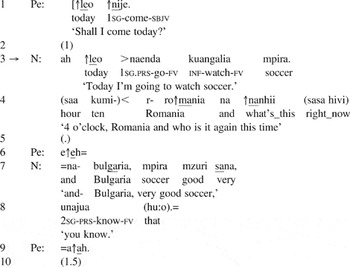
In excerpt (7), N responds to Peter's offer to pay him a visit with a report of his schedule that leaves it up to Peter to draw the inference that doing so would be ill-timed (Drew Reference Drew, Maxwell Atkinson and Heritage1984); this report of N's schedule is preceded by a pause and an ah-preface and followed by a secondary account spelling out to Peter why tonight's soccer match is a particularly interesting one. This excerpt exemplifies a first recurrent pattern that comes out of this reinspection of our collection of dispreferred seconds. Observe how in the remainder of line 3, N does not redirect Peter's attention to his own FPP for making sense of the ah-preface. Instead, he formulates a new item (in this case, his schedule for the rest of the day), which (i) prevents him from delivering the matching preferred course of action, and (ii) to which his interlocutor, Peter, hitherto did not have access. In doing so, N's full schedule comes to be specified as the object of the stance indexed by ah. Through ah-prefacing the revelation of the hitherto unavailable obstacle, the second speaker (N) is thus ostensibly assuming the same stance as the first speaker (Peter) regarding the desirability of the preferred course of action projected by the latter's FPP. In spite of the fact that N's response does not match the action preference specified by Peter's FPP (and strictly speaking thus qualifies as disaffiliative), his display of a negative stance is clearly meant to minimize the “face-threat” inherent in not doing the preferred SPP. The usage pattern documented here may therefore be qualified as affiliation-within-disaffiliation.
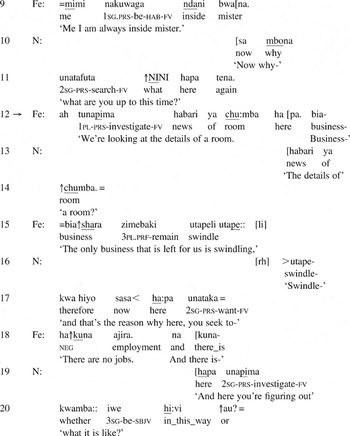
The following excerpt provides further illustration of the potential intricacy of such stance-taking and the sometimes delicate nature of the local tasks such affiliation-within-disaffiliation can come to accomplish. It is taken from the same (very brief) conversation between N and Feri as (3) and (4); temporally it follows immediately upon the “religious” dispute documented in excerpt (3), and thematically it introduces the topic of housing shortage about which N made a joke in excerpt (4). Prior to N's arrival, Feri (who earns a few shillings extra as a moonlighting real-estate broker) had also been making a line drawing in the sand, apparently as part of an attempt to visualize something to a third party (already present by the time N arrived but remaining silent throughout the subsequent conversation between N and Feri). In line 11, N inquires what exactly the two are trying to work out together. In line 12, Feri responds that he is describing to his interlocutor a vacant room in the vicinity. For practical purposes, the line numbering of excerpt (3) is continued.
[N#I/A/2:009]

What is particular about N's interrogative ‘What are you up to this time?’ in line 11 is that it appears to embody cross-cutting preferences (Schegloff Reference Schegloff2007:76ff). Interpreted as an “innocent” inquiry, it would project supplying the requested information as the relevant next action. In this environment, however, demanding an explanation can also be heard as a derogatory comment on the futility of the activity N's interlocutor and his companion are engaged in. Taken this way, N's interrogative comprises an accusation that singles out a denial by Feri as the preferred next action. This alternative parallel interpretation is warranted by the utterance's insistence on the iterative character of the activity inquired after (expressed in the demonstrative hapa ‘here’ and the adverbial tena ‘again’) and also by its specific position, right after the exchange of mutual accusations (cf. excerpt (3)) without the latter officially having been terminated.
Feri's ensuing SPP (from line 12 onwards) and N's subsequent reception of that SPP (from line 13 onwards) confirm that such a cross-cutting preference structure is indeed operative in this sequence. In line 12, Feri supplies the requested information and clarifies the nature of the activity he and his interlocutor are engaged in (‘We're looking at the details of a room’), but he then supplements this clarification with an exonerative account that simultaneously downgrades the activity in question and provides a justification for participating in it (‘The only business that is left for us is swindling,’ due to the lack of employment in the formal sector). Feri thus formats his response as though it was dispreferred (an admission of the futility of what he and his other companion are up to) and thereby demonstrates his orientation to the accusatory character of N's FPP. N, for his part, gives Feri remarkably little opportunity for doing so; as soon as Feri supplied the requested information, N interrupts him, first seeking confirmation of the information Feri supplied to him (in line 13) and then using that information as grounds for a follow-up question that is ostensibly informative (in line 19), thus officially disregarding the possibly accusatory character of his initial FPP.
The ah-preface of Feri's response in line 12 is in two ways implicated in demonstrating the speaker's orientation toward the accusatory character of N's FPP. First of all, the mere fact that it indexes a negative stance instructs the recipients to treat the upcoming clarification not as the response to an “innocent” inquiry but as part of an (dispreferred) “admission” that what Feri and his companion are up to is indeed futile. On top of this, the particle additionally communicates that Feri shares N's derogatory stance toward that activity (and that the informal sector is not his first choice for making a living). In this way, Feri here demonstrates his affiliation with the previous speaker within a dispreferred (and hence disaffiliative) response to the latter's FPP. What sets Feri's response apart from other instances of the usage pattern in question (like in excerpt 7), however, is that the beneficiary of this affiliatory “face-work” is not the first speaker who uttered the FPP, but Feri himself, who finds it necessary to apologize for the unofficial nature of his attempts to make money.
These dispreferred-but-nevertheless-affiliating SPPs, in which the ah-preface is subsequently specified as to be redressed to a hitherto unavailable item, can be used in response to a variety of first actions; the corpus contains instances where they are used to turn down an offer, to (not entirely successfully) respond to an inquiry, and even to (in an exonerating fashion) admit to an accusation. This relative inspecificity with regard to their context of deployment is all the more significant in view of the second regularity that emerges from this reinspection of disaffiliative ah-tokens. Recall from our earlier discussion of dispreferred ah-prefaced SPPs that for a sizeable portion of them, the elaboratory segment directs the SPP-recipient to the action carried out in the foregoing FPP for recovering the particle's stance-object. As it turns out, now, these truly disaffiliativeah-tokens (as we will call them from now on) occur exclusively in response to accusations that are gauged as a question. One type of accusation-gauged-as-question that are frequently receipted with a truly disaffiliative ah-prefaced SPP are yes/no inquiries (YNI) with reversed polarity. As Heritage points out, the latter derive their accusatory (argumentative, challenging, etc.) character from the fact that a negative interrogative is “recruited … to frame negative or critical propositions [about the conduct of the recipient or someone associated with him] while still inviting the recipient's assent” (2002b:1432–33). These critical propositions usually pertain either to a matter of common knowledge or to an item about which the recipient of the YNI already expressed a position in the prior talk. In this way, they are ostensibly “designed to favor a response … which contrast with their [recipients'] earlier statements or actions, while not permitting them do so without acknowledging inconsistency” (2002b:1439).
The excerpt with which we began our inquiry (see (1) above), presented as a longer excerpt in (9) below, exemplifies this pattern. As I explained, N and Fundi are looking into the whereabouts of an old friend who used to be a frequent visitor of Fundi's kiosk but now no longer shows up. In lines 5 and 6, N asks Fundi ‘How long has it been’ since their friend paid him a visit, to which Fundi responds with an ah-prefaced SPP.
[N#I/A/1:529]

N's interrogative in lines 5 and 6 is not a reversed-polarity YNI proper, as it does not project a “yes” or a “no” but an indication of quantity as its preferred response. However, the interrogative is nevertheless produced as ostensibly in disagreement with the position Fundi adopted in line 3 (as it is issued in response to the much stronger assertion by N in line 1, Fundi's downgraded agreement in line 3 (‘He passes by just once in a while’) can be heard as halfhearted and as forecasting an upcoming disagreement; cf. Pomerantz Reference Pomerantz, Maxwell Atkinson and Heritage1984:68). Because of the negative presupposition of the interrogative's embedded clause, N's question furthermore projects a concession that their friend did not come by for a long time as its preferred answer, thus accountably pressuring Fundi to assume a position that is inconsistent with what he stated earlier.Footnote 6 In line 8, after a pause that lasts a full second, Fundi delivers an ah-prefaced SPP. The SPP does supply the information solicited by N but is also unmistakably formatted as dispreferred. The insertion of tu ‘only’ furthermore marks its content as contradicting the negative presupposition of N's inquiry and thereby specifies the stance-object of the utterance's ah-preface as situated in the previous turn. In the remainder of the excerpt, the lingering disagreement between N and Fundi remains unsolved. After a 1.8-second pause during which no speaker self-selects, Fundi furnishes an additional account elaborating his earlier response (in line 10), in which he qualifies their mutual friend's seeming disappearance as (i) a recent phenomenon (ii) caused by contingent circumstances outside his control (the fact that streets are flooded in the rainy season, an annually returning phenomenon caused by the absence of proper water drainage). N again does not respond to this. After 1.4 seconds, however, he formulates an aggravating circumstance (their friend used to be begging cigarettes from Fundi) that further underscores the impropriety of his present negligence. Another seven seconds later, N suddenly jumps to a new topic (last night's soccer match). The irony behind the stance-taking in this fragment is of course that Fundi disaffiliates himself from N at the very moment the latter is articulating his indignation over a wrong inflicted to Fundi by a third party.
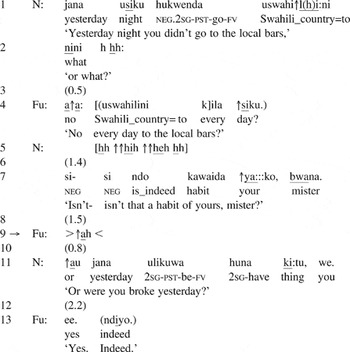
Excerpt (10) below is taken from the same conversation between N and Fundi, and affords us a glimpse of what exactly these ah-prefaced SPP are doing to the antecedent reversed-polarity YNI. In lines 1 and 2, N issues an accusatory YNI with reversed polarity. This time, however, Fundi does not initially respond to N's YNI with an ah-prefaced SPP but only later on, after N recycled it. Note that right before the excerpt began, Fundi gave N a detailed report of a television broadcast he had seen the previous evening. N's negative interrogative explores the consequences of this report by mockingly inquiring whether Fundi didn't pay a visit to “Swahili country” last night. Here the categorization “Swahili” is not used as the description of an ethnic identity but as referring to something that is “local”: in this context, it refers to the many hidden unlicensed bars serving illicit self-distilled liquor and catering to the impoverished segment of the urban population.
[N#I/A/1:026]

In line 1, N produces a negative declarative that is prosodically marked as a question (and subsequently “try-marked”, in line 2, by means of the interrogative nini ‘what’, here used as a tag), which formulates critical content directed at Fundi (by playfully alluding to his drinking habits). As the polarity of this YNI is reversed, it furthermore projects the positive assertion that Fundi did visit the local bars last night (Koshik Reference Koshik2002) and calls into question the veracity of his report of last night's television broadcast.Footnote 7 From here, the interaction takes an unexpected twist. Fundi's response in line 4 is not ah-prefaced but comprises the “regular” negative answer token a↑a: (which negates the proposition that he frequented a local bar),Footnote 8 followed by a questioning repeat that underscores the unfeasibility of “visiting the local bars every night.”Footnote 9 Apparently not satisfied by this “regular” negative answer, N in line 7 delivers yet another “hostile” reversed-polarity YNI, which explicitly presents Fundi's habit of frequenting the local bars as common knowledge. This time, Fundi reacts in a different way, however. In line 9, he produces a high-pitched ah-token (preceded by a 1.5-second pause and thus clearly marked as dispreferred) that successfully forces N to redesign his question in a less hostile way. In line 11, N produces a YNI with positive polarity that lacks the accusatory posture of the two preceding reversed-polarity YNIs. Instead of making an illusion to Fundi's drinking habits (which Fundi could not possibly affirmatively respond to without engaging in serious self-deprecation), he now offers a “reconcilatory” candidate account that explains Fundi's staying away from the local bars in terms of a contingent contextual circumstance (‘Or were you broke yesterday?’), which they both regularly find themselves confronted with.
To work out why the impact of these responses is so drastically different, Raymond's (Reference Raymond2003) distinction between type-conforming and nontype-conforming SPPs comes in particularly useful. Fundi's first response in line 4 mobilizes the type-conforming negative answer token a↑a: (hitherto referred to as “regular”). In doing so, Fundi explicitly acknowledges the reversed polarity of N's FPP and ostensibly designs his answer as being dispreferred. However, because he still responds to the preceding FPP in terms of its preferred answer-type (either a “yes” or a “no”), his answer is officially “ignoring” the accusatory character of N's FPP. As a corollary of this soft tactic, Fundi's denial gets treated as laughable (in line 5), and he finds himself faced with a new (one might add “upgraded”) hostile YNI that treats last night's incident as part of a broader pattern (and thus suggests that he is a drunk). Fundi's ah-response in line 9, in contrast, plainly ignores the constraint to produce a particular type of SPP set by the foregoing YNI. According to Raymond, such nontype-conforming responses “[reflect] the respondent's attempt to avoid the action that either a ‘yes’ or a ‘no’ would deliver in the sequence” (2003:949).
The reason behind the prevalence of ah-prefaced SPPs in such environments containing an accusation-gauged-as-question, as the analysis of (10) suggests, is hence to be found in the particle's nontype-confirming character. Thus, disalignment—and now I again refer to the distinction drawn by Stivers 2008—is here a key issue. In this sense, these truly disaffiliative dispreferred SPPs are much more akin to the ah-prefaced counters discussed in the beginning of this article than to the dispreferred-but-nevertheless-affiliating SPPs that we came across earlier in this section. In the case of counters and truly disaffiliative dispreferred SPPs, the particle's (dis)affiliative potential is exploited by the FPP-recipient for building a disaligned response that marks the foregoing FPP as inapposite. As noted earlier, the fact that the particle semantically indexes the speaker's stance toward something is here recruited for disaligning purposes. In the case of dispreferred-but-nevertheless-affiliating SPPs, in contrast, such disalignment is entirely absent. Here, the remainder of the turn directs the recipient's attention away from the foregoing SPP and reveals the existence of an obstacle preventing a preferred response. All of this is part of the speaker's attempt to soften an otherwise disaffiliative SPP.
Excerpt (10) forces us to partially reconsider our earlier analysis of the truly disaffiliative ah-preface in (9) in yet another way. It additionally suggests that such ah-prefaces target the foregoing FPP not solely because of the elaboration that follows in the subsequent SPP components but also because the preface itself manifestly ignores the type-preference imposed by the foregoing FPP.
This does not mean that under normal circumstances, an isolated ah is sufficient for doing a truly disaffiliative dispreferred SPP. Recall that ah can without problems be used in a freestanding fashion in environments where the foregoing FPP projects a negative assessment of an external element as the preferred next action (which we earlier referred to as affiliative ah). In those cases that we described as affiliation-within-disaffiliation, however, ah can for obvious reasons never be used in a stand-alone way, as it is a constitutive feature of this usage that the particle's stance-object is not yet available. Freestanding usage appears to be banned as well for the second family of usages that we came across in this section, as truly disaffiliative ah-tokens like in (9) also call for some form of specification indicating what it is exactly about the foregoing FPP that the second speaker finds inapposite. This specification is required, in spite of the evidence supplied by (10) that the particle's nontype-confirming character “independently” directs the recipient's attention to the foregoing FPP. Excerpt (10) is one of the rare instances where this specification requirement seems not to be operative and where an isolated ah is treated as sufficient by producer and recipient alike. The fact that the freestanding ah-response is issued in response to the second of a series of two hostile YNIs appears to play a crucial part in canceling the need for further elaboration. Apparently, Fundi assumes the specific aspect of the preceding FPP that he finds inapposite to be transparently deducible from the environment, more specifically, from the particle's “anamnesis,” that is, from the aligning dispreferred response that he offered in the response to the first hostile YNI.
Earlier, I mentioned that the corpus contains five instances of freestanding ah, two of which are transparent affiliative usages (which we discussed above). This leaves us with two yet unaccounted for freestanding ah-tokens, which for reasons of space, cannot be reproduced here. One is a freestanding ah-response offered in retort to a hostile YNI; unlike in (10), however, it is not treated as “sufficient” by the producer of the initial FPP, probably because it lacks a comparable anamnesis of aligning responses. The second freestanding ah-token is used to turn down a compliment (and is thus comparable to the one in excerpt (2)). Not coincidentally, this is again a highly constraining environment, where a mere sign of disapproval is sufficient for its object to be recoverable.
Ah-prefaced firsts
In the excerpts discussed above, we already came across a number of ah-tokens in the turn-initial position of an FPP, like in line 1 of excerpt (5) and line 8 of (6). The last of these two instances, in excerpt (6), proves particularly analytically challenging. Note that Yusuf's preemptive response in line 6 had a drastic impact on the delivery of N's projected story. In line 8, N continues with an utterance that by its very design presents itself as “undecided” (‘Ah I heard he was really talking rubbish that day’), and its ah-preface plays a decisive role in it being formatted as such. On the one hand, N's utterance officially projects itself as a new FPP (it does not officially abort the projected story by recognizing that Yusuf already knows about the sermon), but on the other hand, it also reciprocates Yusuf's stance-taking, albeit in an epistemologically downgraded way (as it qualifies itself as hearsay, whereas Yusuf ostensibly claimed at least partial first-hand access to the event). It is only in line 11, where N introduces Abasi's habit of parroting shaykh Mukanda as a mentionable new item (a topic that is not specifically related to last Friday's address and that is confirmed as newsworthy by Yusuf in line 13), that his narration acquires new momentum.
In these ah-prefaced FPPs, the particle's stance-object is inevitably fully specified by the ensuing FPP. The affiliative orientation expressed by it varies along with the context, however. In both (5) and (6), the ensuing FPP directs the recipient's attention to an external item that was already available in the preceding talk, and thus the FPP ostensibly affiliates itself with the preceding turn. This is not necessarily the case. In a limited number of other instances (not reproduced here), the FPP presents itself as taking issue with a foregoing SPP and hence serves a disaffiliatory purpose. (Note that for these disaffiliative FPPs, unlike for their disaffiliative SPP counterparts discussed at the end of the previous section (excerpts 9 and 10), the disaffiliative character of ah cannot be deduced from the fact that the particle is ostensibly disaligned toward the previous utterance: as the foregoing SPP terminates a sequence, it does not project any response at all, let alone one that would be restricted to a particular type.)
Conclusion
The analysis demonstrates that the Kiswahili particle ah must be understood as a response cry that indexes to the other interlocutors the speaker's negative evaluative stance toward a particular issue. In the turn-initial position of an SPP, it can either convey the speaker's affiliation with the previous speaker (in case the object of the indexed stance is traceable to a negatively evaluated item of the foregoing FPP) or his disaffiliation (in case the object is traceable to the action performed in that FPP).
The outcome of this analysis is in two ways significant. First of all, it provides further evidence of the vital role of “little words that matter” (Bolden Reference Bolden2006) for building actions that are attuned to its sequential environment and for negotiating affective and evaluative stances and acting out social relationships. Second, the analysis at once underscores the eminently local character of these interactionally salient “little words” and the deeply universal character of the machinery of conversation described by Sacks, Schegloff and associates. It is the universality of organizational practices like adjacency-pairing and preference organization that provided the point of entry for our attempt to uncover the specifics of the eminently local Kiswahili semiotic resource that “assists” in the situated implementation of this organizational machinery in the sequences that we analyzed. In this sense, the analysis epitomizes that the principles governing the organization of conversation are both universal and locally sensitive, as investigating the local sensitivity of talk presupposes the universality of the machinery that lies beneath it.
APPENDIX: TRANSCRIPTION CONVENTIONS
- .
final fall
- ,
continuing intonation
- ?
rising intonation
- ↑
sudden rise in pitch
- ↓
sudden drop in pitch
- :
elongation of a sound
- -
abrupt interruption of talk
- text
emphasis
- CAPITALS
louder than surrounding talk
- °text°
quieter than surrounding talk
- >text <
faster pace of speech than surrounding talk
- (1.5)
pause (in seconds and tenths of seconds)
- (.)
micro-pause (shorter than 0.2 seconds)
- =
latching with previous utterance
- [text
start of overlapping talk
- text]
end of overlapping talk
- ((text))
description of nonverbal activity
- →
line containing an analytically salient phenomenon