Introduction
With advancements in technology, the risk of non-natural disasters such as chemical, biological, radiological, and nuclear (CBRN) events has increased, leaving fatal consequences both in terms of human lives and financial costs over several decades. CBRN events occur either accidentally or intentionally. These incidents are often unpredictable and invisible, causing fear and anxiety, disrupting social well-being and mental health, and impairing the delivery of health care services in the community. Reference Farhat, Alinier and Gangaram1–Reference Carter, Drury and Amlot3 There are national and international concerns regarding CBRN events, primarily due to the unexpected nature of these events and the resulting consequences caused by a lack of awareness, resources, planning, and preparedness.Reference Yarmohammadian, Nasr-Isfahani and Anbari4 CBRN events, whether intentional or accidental, are significant from economic, political, social, security, and medical perspective.Reference Teymouri, Zareiyan, Pishgooie and Bagheri5 During the 1994 sarin gas terrorist attack in Japan, over 5000 people were affected, including more than 300 emergency responders. The primary concern for people during such incidents is health; hence, hospitals and health care system staff, especially emergency department (ED), are heavily involved.Reference Yarmohammadian, Nasr-Isfahani and Anbari4, Reference HR6 Hospitals bear the brunt of admissions and treatment of affected individuals.Reference Becker and Middleton7 ED Clinical Staff, referred to as first receivers, include doctors, nurses, health care specialists, and non-clinical staff. Reference Razak, Hignett and Barnes2
A 2020 study among 308 nurses from selected hospitals in Tehran found that the highest willingness and ability were related to participation in natural disasters like floods and earthquakes, while the lowest willingness and ability were reported for participation in CBRN events.Reference Sharififar and Shokouh8 Additionally, another study indicated that there is a low likelihood of nurses responding to nuclear/radiological disasters.Reference Veenema, Lavin, Bender, Thornton and Schneider-Firestone9
Preparedness at the individual and staff level requires increasing knowledge, improving attitudes, and acquiring necessary skills; at the local level, it requires planning, resource provision, and establishing a local management structure; and at the national level, it requires policy-making, guideline development, and operational instructions. The potential consequences and costs of unpreparedness for CBRN events can be immense.Reference Aminizadeh, Farrokhi, Ebadi, Masoumi, Kolivand and Khankeh10 Quick and appropriate response to CBRN events can significantly reduce the harmful effects on physical health, decrease mortality and mitigate the psychological impacts, all of which depend on the preparedness of hospital ED Clinical Staff.Reference Aminizadeh, Farrokhi, Ebadi, Masoumi, Kolivand and Khankeh11, Reference Latif, Abbasi and Momenian12 Lack of preparedness can lead to ineffective crisis management, increased fear and anxiety among the public and hospital staff and potentially inadequate care for the injured, setting the stage for a larger sociopsychological crisis.Reference Hoseini and Eslamian13 They have noted that many hospitals are still not adequately prepared for such incidents and face various challenges due to the differing pathophysiology of these events.Reference Aminizadeh, Farrokhi, Ebadi, Masoumi, Kolivand and Khankeh10, Reference Davari and Zahed14 Hospitals can appropriately respond to nuclear incidents with train ED clinical staff.Reference Davari and Zahed14 Those responding to these incidents face highly stressful situations that impact their physical and mental health.Reference Hick, Weinstock and Coleman15 ED clinical staff must prevent contamination by using personal protective equipment (PPE). Training ED clinical staff about radiation hazards enables them to provide safe care to patients.Reference Marzaleh, Rezaee, Rezaianzadeh, Rakhshan, Haddadi and Peyravi16 Despite recognizing the need for emergency preparedness training and programs in the health care sector, preparedness levels vary across countries, as does the level of understanding and training among ED clinical staff.Reference Wong, Turner, Boppana, Nugent, Coltman, Cosker and Blagg17 The role of emergency physicians in preparing for and responding to CBRN events is crucial worldwide.Reference Rega18
A report from a medical institute indicated that EDs are better prepared for such incidents than before but still have a long way to go.Reference Becker and Middleton7, 19 One challenge for ED clinical staff is the ambiguity in diagnosing the type of contaminant when a patient or victim arrives at the triage area. Another challenge is patient decontamination, which is related to the use of PPE. These are examples of the challenges faced by ED clinical staff in responding to CBRN events. Training is the only means to enhance the ED’s response preparedness for CBRN events, but it faces obstacles such as staff shortages and frequent relocation of train ED clinical staff.Reference Razak, Hignett and Barnes2
Various studies in Iran and around the world have assessed the preparedness of hospitals for CBRN events, and in each study, specific factors that affect the preparedness of hospital staff have been considered. However, there is no complete and comprehensive tool for assessing the preparedness of ED clinical staff in the face of CBRN events, and the present study aims to fill this gap and provide a new tool for assessing the preparedness of ED clinical staff in the face of CBRN events.
Methods
This study was a mixed-methods research aiming to design and validate a psychometric research instrument in 2025. In the qualitative phase, review of the literature was done to extract the factors involved in preparedness of hospital ED clinical staff in response to CBRN events, and design the items. The search components were: preparedness, emergency departments, HazMat incidents, and CBRN incidents. The literature search was conducted using the Persian and international databases, including Scopus, PubMed, Cochrane Library, Web of Science, ProQuest, and Magiran from January 1, 2005, to April 1, 2024. The tools for reviewing and assessing the quality of studies and selecting articles eligible for inclusion in the study were evaluated using the STROBE statement and COREQ criteria.Reference Vandenbroucke, Von Elm, Altman, Gøtzsche, Mulrow, Pocock, Poole, Schlesselman and Egger20, Reference Tong, Sainsbury and Craig21 Following the quality assessment of articles using these checklists, articles that did not meet the minimum quality standards were excluded from the study. At the end of the search, and after omitting duplicates, 2 members of the research team screened articles, and documents, according to their titles and abstracts, considering the inclusion and exclusion criteria. In case of any disagreement, a third author was consulted. In this study, an inter-rater reliability score of 75% was considered. Out of the 361 articles and documents gathered during the search, 154 were found to be relevant and, ultimately, 34 articles were included in the study. Based on the review of the literature regarding CBRN events, the items were extracted and validated.
In the quantitative phase, the validity of the questionnaire was evaluated in terms of face, content, and construct validity, and its reliability was evaluated based on internal consistency and stability (Cronbach’s alpha and intra-class correlation coefficient [ICC]). To investigate the qualitative face validity, the designed items were reviewed by 10 Clinical staff in hospital emergency departments. After evaluation of the qualitative face validity and modification of the deficiencies, the impact score (IS) was assessed to reduce and eliminate the inappropriate items and to determine the importance of each item. Each of the items was scored based on a 5-point Likert scale ranging from “quite important” (5) to “not important at all” (1). Then, the IS of each item was calculated using the following formulaReference Lacasse, Godbout and Series22:
 $$ \mathrm{Importance}\ast \mathrm{Frequency}=\mathrm{Impact}\ \mathrm{Score}\;\left(\mathrm{IS}\right) $$
In the qualitative method, the questionnaire was reviewed by Focus group (consisting of experts and specialists related to the subject), and items overlapping, and Necessity were explored. In the quantitative method, validity was evaluated by Lawshe’s technique. Content validity ratio (CVR)is one of the widely accepted quantitative methods of determining the CVR.Reference Sharififar, Farahani, Khoshvaghti and Marzaleh23 The questionnaire was reviewed by 10 specialists with sufficient experience in the aforementioned areas.Reference WH24 Then, the CVR was calculated to determine the importance of each item. The acceptable CVR value for each item varied depending on the number of experts assessing the content validity. To calculate the content validity index (CVI), the experts were required to evaluate each item in terms of “relevance,” “clarity,” and “simplicity,” using a 4-point scale. The items with CVIs above 83% were accepted. In the next step, the items were analyzed by a sample of 30 participants. Item analysis was done by determining the Cronbach’s alpha coefficient for the primary reliability, identifying the items that affected the reliability, and studying the correlations between the items. The items with correlation coefficients less than 0.6 were omitted.
To assess the construct validity of the questionnaire based on exploratory factor analysis, the sample adequacy was examined using the Kaiser-Meyer-Olkin (KMO) method.Reference Kaiser and Rice25 The KMO value was more than 0.6. Thus the sample adequacy was acceptable. To determine the construct validity, the questionnaire was distributed among 260 people. In the next step, Bartlett’s sphericity test was used to determine whether the obtained matrix was significantly different from zero. Based on the results, using factor analysis was justified. Items with factor loadings equal to or greater than 0.4 were retained.
The reliability of the questionnaire was evaluated based on internal consistency and stability. Stability was evaluated by the test-retest method. In this method, a test was given to a group of subjects more than once under the same conditions. To evaluate the reliability by this method, first the questionnaire was distributed among 30 nurses and then the retest was done in the same group after 7 days. The ICC value was obtained based on the scores of the 2 tests, which indicated the reliability of the tool. The ICC above 0.6 was considered optimal.
The most common method of evaluating the internal consistency of a tool is Cronbach’s alpha coefficient. Cronbach’s alpha indicates the proportion of a set of items that measure a construct. Cronbach’s alpha values above 0.7 are considered optimal.Reference JL26 To evaluate Cronbach’s alpha coefficient in this study, the questionnaire was distributed among 260 ED Clinical Staff. Then, a data analysis was done using the SPSS software, version 27.
This study was approved by the Committee of Ethics in Biomedical Studies (IR.AJAUMS.REC.1402.139). The participants were informed that they could attend the study in case they were willing to, and they were assured about the confidentiality of their information. After getting the necessary permissions from the Research Deputy of the Nursing Faculty and the approval letter of AJA University of Medical Sciences, the researchers presented the approval letter to the participants. They also introduced themselves and explained the research goals. Then, the individuals who were willing to participate in the study were selected and were informed that they could leave the study at any stage. Other ethical considerations included obtaining written consent forms from the specialists, ensuring the participants that they could receive the research results if they desired, appreciating all the people cooperating in the study, and gaining permission from the Ethics Committee.
Results
The extracted questionnaire included 6 dimensions and 65 items. The psychometric properties of this questionnaire were determined by studying its validity (face, content, and construct validity) and reliability (based on Cronbach’s alpha and test-retest method). The 6 dimensions of the questionnaire included (1) programs and guidelines, treatment of the injured; (2) exercise; (3) decontamination and waste management; (4) education and human resources; (5) prevention, coordination, and security; and (6) PPE. The results of item analysis regarding the correlation between the items did not lead to the removal of any items and all the items remained in the questionnaire. The results of face and content validity and Impact Score were approved, as presented in Table 1.
Evaluation of the face and content validity of the questionnaire

The final questionnaire included 65 items scored based on a 5-point Likert scale (ranging from “completely” [5] to “not at all” [1]) and was tested for construct validity.
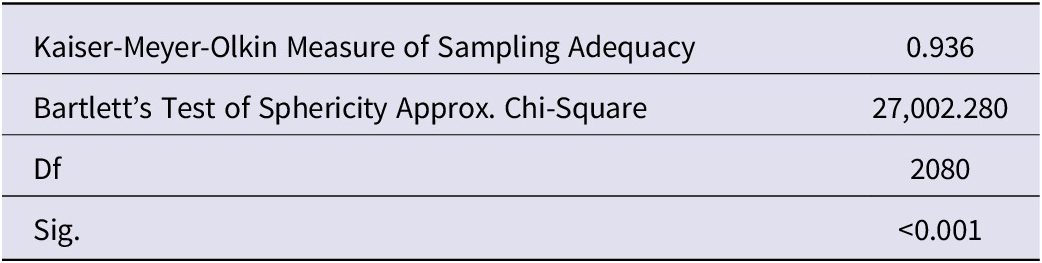
To determine the construct validity by exploratory factor analysis, first the sample adequacy was investigated based on KMO statistic, whose value was 0/936. The value of Bartlett’s sphericity test was also 27,002.280, which was significant at P < 0.001. Based on the resulted correlation matrix, factor analysis could be done in the study sample. The 2 abovementioned criteria were significant indicators to approve the sample adequacy and the possibility of factor analysis. The results of KMO statistic and Bartlett’s sphericity test have been presented in Table 2.
KMO sampling adequacy index and Bartlett’s sphericity test

The scree plot has been depicted in Figure 1. Accordingly, the 6 constructs of the questionnaire were efficient. The Eigenvalues of the extracted factors have also been shown in Figure 1.
The scree plot specifying the number of constructs of the ED clinical staff preparedness on CBRN events.

In this research, the factor loading of 0.41 was considered the minimum acceptable correlation between each item and the extracted factors. The 6 constructs of the questionnaire could explain the variance by 65.4%.
After having 260 questionnaires filled, the Cronbach’s alpha coefficient of the total questionnaire was obtained as 0.977. The ICC of the questionnaire was also obtained as 0.972. The ICCs, 95% confidence interval, and P value for the 6 constructs of the questionnaire have been presented in Table 3.
Evaluation of the reliability based on Cronbach’s alpha and ICC

In the study questionnaire, items 1-22 measured the Programs and guidelines, treatment of the injured, items 23-29 measured the Exercise, items 30-40 measured the decontamination and waste management, items 41-50 measured the Education and Human Resources, items 51-54 measured the Prevention, coordination and security, and items 55-65 measured the PPE. Overall, the questionnaire consisted of 65 items, including 22 items in the Programs and guidelines, treatment of the injured, 7 items in Exercise, 11 items in decontamination and waste management, 10 items in Education and Human Resources, 4 items in the Prevention, coordination and security, and 11 items in PPE. The total score was determined based on 5 ranges, including 65-116 (very low preparedness), 117-168(low preparedness), 169-220 (medium-level preparedness), 221-272 (high preparedness), and 273-325 (very high preparedness).
Discussion
This is one of the first research to investigate ED clinical staff preparedness on CBRN events in the world. According to the results, the study questionnaire was both reliable and valid and could be used to measure the ED clinical staff preparedness on CBRN events. The questionnaire included 6 dimensions and 65 items that clearly addressed the factors required for the ED Clinical Staff Preparedness on CBRN events. These dimensions included (1) programs and guidelines, treatment of the injured; (2) exercise; (3) decontamination and waste management; (4) education and human resources; (5) prevention, coordination, and security; and (6) PPE. Although there are several tools to investigate Hospital Preparedness on CBRN events in the world, no questionnaire was found to investigate ED clinical staff preparedness on CBRN events specifically. Thus, the research aimed to design a comprehensive tool with all the required dimensions.
Rebmann and Mohr performed a study to measure the nurses’ preparedness to respond to bioterrorism in Missouri. They used a tool including the dimensions of risk perception, vulnerability, seriousness, acquired education, participation in training, and individual response program.Reference Rebmann and Mohr27 Some of their criteria were similar to those of the present study. Nevertheless, the questionnaire designed in the present study was more comprehensive and could measure more clearly the ED Clinical Staff preparedness in response to CBRN events.
Young and Persell performed a study to measure the nurses’ preparedness in response to nucleus, chemical, and biological terrorism. They used a questionnaire including 19 dimensions about demographic properties, perception, concern about preparedness, willingness to work, expectation about the future terrorist incidents, impact on lifestyle, fear of terrorism, and terrorism victims. The Cronbach’s alpha coefficient for the items of that questionnaire was obtained as 0.745.Reference Young and Persell28
Huang and Liu investigated the emotional responses and coping strategies of nurses and nursing students during the COVID-19 pandemic. They found that females experienced severe anxiety and fear in this condition. They also reported that the participants in cities expressed higher levels of fear and anxiety compared to those in villages.Reference Huang, Xu and Liu29
Without planning, the emergency response of departments to CBRN events will be limited. Planning for CBRN response preparedness, as well as training programs, should be considered at three organizational, technological, and individual levels, as well as in short-, medium-, and long-term durations.30 The ability to quickly diagnose CBRN agents and promptly intervene with patients/injured in these events is crucial for preventing further disease development and maintaining the health of both responders and patients.Reference Grundmann31 Willingness of emergency nurses to promptly intervene with patients/injured of CBRN events largely depends on their clinical competency.Reference Aminizadeh, Farrokhi, Ebadi, Masoumi, Kolivand and Khankeh32
Hospital incident command system (HICS) leads to a systematic approach to preparedness and response to incidents in hospitals. It also enables unified and integrated command in dealing with CBRN events and provides a structure that improves coordination, control, and supervision of staff, operations, planning, support, and other essential functions for incident management. ED clinical staff should be aware of the activation and function of the HICS. They should also know the components of the HICS chart and be aware of the responsibilities of different HICS components to preserve their performance in response to CBRN events.Reference Bell, Weisfuse, Hernandez-Avila, Del Rio, Bustamante and Rodier33
Training and exercise are crucial factors in enhancing the preparedness of ED clinical staff for CBRN events. Without effective training and exercise, ED clinical staff lack the capacity for an adequate response. Physicians, nurses, and ED support staff are the 3 main groups that require training. Updated training guides are essential for enabling ED clinical staff to respond appropriately to disasters.Reference Djalali, Della Corte, Segond, Metzger, Gabilly and Grieger34, Reference Reilly and Markenson35
The presence of essential competencies in ED clinical staff, such as the ability to creatively solve and flexibly address incident problems, aware of my job description, as well as marital status, age, education, skills, and gender of ED clinical staff, is effective in their preparedness for CBRN events.Reference Teymouri, Zareiyan, Pishgooie and Bagheri5, Reference Hung, Lam, Wong, Wong, Chan and Graham36–Reference O’Sullivan, Dow, Turner, Lemyre, Corneil and Krewski38
CBRN events often result in multiple casualties, so the possibility of contamination of ED Clinical Staff is always a concern. When providing services to patients exposed to CBRN agents, the first priority is to protect the staff. Secondary contamination can have immediate or long-term health effects on first responders, potentially incapacitating them from direct patient care immediately after the incident or even leading to delayed effects.Reference Koenig, Boatright, Hancock, Denny, Teeter, Kahn and Schultz39 When injured from nuclear/radiological incidents are transferred to hospitals, decontamination infrastructure must be established in the ED to prevent secondary contamination of ED clinical staff and decontamination of injured should commence promptly.Reference Marzaleh, Rezaee, Rezaianzadeh, Rakhshan, Haddadi and Peyravi16, Reference Grundmann31 Standard operational procedures for decontaminating casualties, disposing of contaminated clothing, and preventing entry of contaminated wastewater from washing casualties into municipal sewage should be in place.Reference Teymouri, Zareiyan, Pishgooie and Bagheri5
Coordination is one of the main challenges in disasters, especially in CBRN events. ED must coordinate the mobilization of hospital resources during CBRN incidents.Reference Teymouri, Zareiyan, Pishgooie and Bagheri40 Coordination with external organizations (responders and supporters) and the establishment of memorandums of understanding and cooperation plans with other hospitals and local and national centers can improve the management of CBRN events.
Strategic and preventive infection control measures and programs such as hand hygiene, appropriate PPE use, and environmental disinfection can be positive steps toward improving ED clinical staff preparedness in response to biological disasters.Reference Rebmann and Mohr27, Reference Aminizadeh, Farrokhi, Ebadi, Masoumi, Kolivand and Khankeh32 Access to various drugs and vaccines will enhance the safety, health, and preparedness of ED clinical staff.Reference Sharififar, Jahangiri, Zareiyan and Khoshvaghti41, Reference Mortelmans, Gaakeer, Dieltiens, Anseeuw and Sabbe42
Maintaining a healthy and high-quality workforce in hospitals through continuous physical security and personal protection programs; training in safety principles; continuous monitoring of employees’ physical and mental health; financial incentives; providing suitable spaces for rest and meals for employees; and providing appropriate PPE against CBRN events are good management practices aimed at increasing ED Clinical Staff preparedness.Reference Beyramijam, Rasouli-Ghahfarokhi, Fathollahzadeh, Rahimzadeh, Shahabirabori and Aminizadeh43
ED clinical staff should contact the patients by using full personal protective equipment to ensure maximum protection. Choosing the PPE, proper way of wearing them and taking them off, and the process of quarantine and isolation are some of the main factors that ED clinical staff have to be aware.Reference Griffin, Ivascu and Lief44
Since CBRN events are a new event/disease, ED clinical staff should be aware of the transmission ways, symptoms, report CBRN events, code used for CBRN, quick evaluation of patients, isolation, triage, and hospital waste and wastewater disposal.
The questionnaire designed in the present study provided a comprehensive tool for measuring the ED clinical staff preparedness. Thus, it can be used as a standard tool for evaluation on ED Clinical Staff Preparedness to respond to the CBRN events in future studies. This tool can also make health managers and policy-makers aware of the ED clinical staff situations. Low preparedness of ED clinical staff can lead to their poor response to these events. The higher their preparedness, the lower the death rates and the severity of complications in the patients and the hospital staff.
One of the advantages of this questionnaire was that it was almost comprehensive and investigated different dimensions of preparedness. The strengths of this study included the utilization of a large number of specialists in ED clinical staff and disasters to evaluate the reliability and validity of the questionnaire and lack of any questionnaires to measure the ED clinical staff preparedness in response to CBRN events. However, the weaknesses of the questionnaire included the lack of access to all experts. Hence, the researchers made their best attempts to interact with all available experts.
Conclusion
CBRN incidents are multifaceted, and their management is complex, posing one of the most significant challenges the world faces. Addressing these challenges requires immediate attention and a systematic approach. Losing vital hospital staff, including ED clinical staff, during such incidents negatively impacts a hospital’s ability to provide effective patient care. ED clinical staff play a vital role in responding to CBRN events; therefore, policies, programs, coordination efforts, budgets, and other necessary measures are strongly recommended to increase ED clinical staff preparedness against CBRN events.
By fostering a positive attitude and increasing ED clinical staff confidence through planning and training, their preparedness to respond to such incidents improves. In this context, the developed questionnaire is suggested to be used in order to measure the hospital’s emergency clinical staff preparedness on CBRN events in Iran and other countries. Other tools are also recommended to be designed in order to measure the preparedness of other health care providers, such as in the hospital, such as clinical staff in special departments.
Acknowledgments
Hereby, the authorities and personnel of AJA University of Medical Sciences are greatly appreciated for paving the way for conducting this study.
Authors contribution
FGH and SAHP were responsible for the conception and design of the study. FGH, SAHP, AZ, SS, and SA supervised the whole study. FGH, SAHP, AZ, and SS prepared the first draft of the manuscript. FGH, SAHP, AZ, and SS did the analysis of the results and supervised the study. All authors have read and approved the final manuscript.
Funding statement
This project has partly been supported by a grant from AJA University of Medical Sciences with the code IR.AJAUMS.REC.1402.139.
Competing interests
The authors declare that there are no conflicts of interest regarding the publication of this manuscript.
Ethics standard
Informed consent was obtained from all individual participants in the study.