Politicians frequently turn to reputational arguments to bolster support for their proposed policies: Lyndon Johnson famously lamented that if the United States withdrew from Vietnam, the US “would be seen as an appeaser and we would find it impossible to accomplish anything for anybody anywhere on the entire globe,” while Ronald Reagan claimed that if the United States lost in Central America, “our credibility would collapse and our alliances would crumble.”Footnote 1 International Relations (IR) theory tells us that even though we can never fully overcome “the problem of other minds” and directly access the motivations of others, the public reasons actors resort to when justifying their policies are nonetheless worth paying attention to because they reflect their underlying beliefs about the types of arguments that will resonate with their audience.Footnote 2 Thus, although it is possible that the elites making reputational arguments are simply speaking to other elites rather than the public at large, the IR literature generally assumes that the same “cult of reputation” that consumes policymakers captures members of the public as well.Footnote 3 Indeed, reputational logics are posited to explain why publics punish leaders deemed culpable for unsuccessful wars, or penalize decision makers who sully the national honor by backing down on threats.Footnote 4 If publics respond to reputational rhetoric, elites have all the more incentive to invoke it.
Yet we have relatively little direct individual-level evidence testing whether (and exploring how) ordinary citizens care about reputation in foreign policy. The closest political scientists have come to studying the microfoundations of reputational judgments in crisis bargaining comes from a burgeoning literature on audience costs, but the reputational mechanism in this research program tends to be imputed rather than formally tested. In this paper, we turn to survey experiments to explore the kinds of reputational judgments ordinary citizens make in response to their country's behavior on the world stage. Our experimental evidence is intended to build a better understanding of the microfoundations of reputation costs in IR.
We propose a dispositional theory of reputation costs in which citizens facing ill-defined strategic situations turn to their core predispositions about foreign affairs in order to weigh competing reputational considerations. As a result, although the mass public indeed has a “taste” for reputation, it understands reputation in fundamentally different ways, with hawks concerned about the negative reputational consequences of inconsistency, and doves equally concerned with the negative reputational consequences of belligerence and interventionism. In this sense, our theoretical approach departs dramatically from canonical models of reputation in IR. Whereas classic models of reputation costs tend to model reputations as unidimensional by focusing on only one trait at a time, such that the crisis bargaining literature treats reputation as synonymous with reputation for resolve, we model reputations as multidimensional–actors can have reputations for multiple traits simultaneously, which raises important theoretical questions about how actors aggregate across these competing considerations. Whereas classic models of reputation costs view reputation as situationally derived, a property of the strategic environment that different actors assess in similar ways, we show that reputational costs are heavily dispositionally derived, in that different observers can look at the same action and draw different reputational conclusions. Whereas classic models of reputation costs treat reputational considerations as conceptually distinct from assessments of the intrinsic interests at stake in a dispute, we suggest that the two are endogenous: the same dispositions that determine how individuals assess the intrinsic merits of policies affect their estimates of the policies' reputational consequences.
Our findings thus offer both good and bad news for domestic theories of reputation in IR. The bad news is that because assessing reputation is an ill-structured problem, reputation costs are largely in our heads, driven more by our prior dispositions about foreign policy than the actual behaviors leaders engage in on the world stage. The good news is that reputation costs are in our heads: the mass public does indeed care about reputation, such that reputation costs are politically consequential—even if abiding by a different logic than that advanced by canonical models of reputation in IR.
The discussion that follows proceeds in three parts. First, we ground our investigation of reputation costs in the existing literature, which has tended to assume the resonance of reputation costs in the general public, but has rarely systematically explored their microfoundations. Second, drawing on research in foreign policy decision making and political psychology, we offer our dispositional theory of reputation costs in which actors in ill-defined situations turn to core dispositions to assess reputation costs—contrasting this with the typical portrayal of reputation in IR in which reputations tend to be treated as situational, and reputation costs as distinct from approval of the policies themselves. Third, we discuss our experimental design, and delve into our results, showing that although domestic audiences indeed care about reputation costs, they disagree on what generates them in the first place, with hawkish respondents emphasizing the negative reputational consequences of inconsistency, and dovish respondents equally concerned about the reputational consequences of belligerence. We find further evidence of this heterogeneity using structural topic models which show that the language hawks and doves use when they discuss reputation costs varies meaningfully and systematically, and moderated mediation models which show that although reputation costs are indeed present for both hawks and doves, domestic audiences are more polarized about reputation than our models in IR often assume. The findings have important implications for a variety of questions, ranging from the domestic politics of crisis bargaining, to the psychology of hawks and doves, to the consequences of complexity for our theoretical models in IR.
Reputation Costs in International Relations
There is a variety of work in IR that presumes that public opinion produces incentives for policymakers, which then shapes state behavior. Many of these models specifically focus on reputation costs.Footnote 5 For these models to work, two assumptions must be met. First, the mass public must care or otherwise have preferences about reputation, and second, policymakers must respond to these concerns.Footnote 6 In this piece, we focus on establishing this first link, exploring the microfoundations of reputation costs.
Although the literature on reputation in IR is vast and polyphonic, it suggests three broad points of particular importance for our purposes.Footnote 7 First, reputations are beliefs about a trait or tendency of an actor. They are Janus-faced, informed by behavior in the past, and used to predict behavior in the future.Footnote 8 When a policy negatively affects others' beliefs about a characteristic that an actor values, she incurs a reputation cost.
Second, although scholars disagree about how much control actors have over their reputations,Footnote 9 whether reputations adhere to leaders or states,Footnote 10 and why actors care about their reputations in the first place—whether because of instrumental reasons stemming from a logic of consequences (e.g., states cultivating a reputation for resolve to prevent being seen as an easy target), or normative reasons deriving from a logic of appropriateness (e.g., leaders carrying out actions to preserve the national honor), there is little disagreement that decision makers care about them, particularly with regard to reputations for resolve.Footnote 11 Walt claims the US suffers from a “credibility addiction” in which a desire to avoid reputation costs leads policymakers to pursue policies that harm the national interest, while Tang notes that policymakers subscribe to a “cult of reputation,” a “persistent obsession” with reputation costs manifested in Henry Kissinger's proclamation that “no serious policymaker could allow himself to succumb to the fashionable debunking of ‘prestige,’ or ‘honor’ or ‘credibility.”’Footnote 12
Third, because international relations is characterized by two-level games, reputation costs have both a foreign and domestic component.Footnote 13 Abroad, reputation matters as a first-order belief about a country or leader's characteristics. Many times when we study whether reputation matters in IR, we are interested in exploring the content of these first-order beliefs: how did the Germans make judgments about British and French credibility during the appeasement crises of the late 1930s?Footnote 14 What inferences did the Soviets draw from American defeats in Vietnam?Footnote 15 At home, however, reputation matters as a second-order belief: what domestic constituencies think others think about the country or leader's characteristics.Footnote 16 The domestic side of reputation costs may partially explain why leaders seem to care so much about reputation even though the empirical record suggests foreign rivals may not draw inferences from past actions in the manner that policymakers assume.Footnote 17 As Fearon points out, governments are on average more likely to lose power internally than by foreign invasion, which means that if domestic audiences care about their country's reputation, losing face can have more immediate consequences at home than abroad, whether by impeding leaders' legislative agendas, or causing them to lose office altogether.Footnote 18 Thus, IR scholars point to reputational mechanisms to explain why publics punish leaders deemed culpable for unsuccessful wars, why domestic audiences punish leaders who back down on threats in foreign policy crises, and why states use secrecy to dampen escalation pressures from both domestic and foreign audiences.Footnote 19
Given the domestic side to reputation costs, it should not be a surprise that policy-makers routinely invoke reputational logics to justify their policy choices, particularly regarding military interventions, where decision makers often face a tradeoff between saving face and losing lives.Footnote 20 In a public radio address at the outset of the Korean War, Harry Truman justified American intervention by pronouncing that failing to stand up to aggression in Korea “would be an open invitation to new acts of aggression elsewhere.”Footnote 21 In a public television address justifying the invasion of Cambodia, Richard Nixon suggested that the reputation costs that would ensue would damage not only the interests of the United States, but the international community, expressing concern that “if, when the chips are down, the world's most powerful nation … acts like a pitiful, helpless giant, the forces of totalitarianism and anarchy will threaten free nations and free institutions throughout the world.”Footnote 22 In publicly televised addresses explaining his decisions to send troops to Somalia and Haiti in 1993 and 1994, Bill Clinton repeatedly emphasized reputation costs, warning that in the absence of intervention “our credibility with friends and allies would be severely damaged,” stressing the importance of upholding “the reliability of the commitments we make and the commitments others make to us,” and warning that failing to respond would lead to “open season on Americans.”Footnote 23 Both advocates and critics of the 2003 Iraq War couched their arguments in terms of reputation, with the former alleging that withdrawal from Baghdad would embolden American enemies to unleash further attacks on the United States, and the latter arguing that continued American presence in Iraq was soiling America's reputation with its allies.Footnote 24
The frequency with which leaders resort to reputational rhetoric in these addresses is important because the public reasons leaders invoke when seeking to justify or legitimate their policies reflect their underlying beliefs about the types of arguments that will resonate with their audience, and thus the normative environment in which they are embedded.Footnote 25 It is possible of course, that politicians invoking reputational justifications are speaking primarily to other politicians, but the fact that decision makers employ these types of arguments publicly as much as they do privately points to a belief that reputational consequences count as “publicly acceptable reasons.” If elites did not think the public cared about reputation, they would use these arguments with each other, but not with the rest of us.
Despite the prevailing belief that domestic publics indeed care about reputation costs, there is very little direct empirical evidence that publics have a “taste” for reputation, and very little theoretical understanding of how. Experiments testing market-entry deterrence games in economics, for example, have found that participants generally care less about reputation than formal models predict.Footnote 26 Developmental psychologists have found evidence of concerns about reputation costs in children as young as five, but it is unclear how these concerns translate into a political domain where the reputations at stake belong to leaders and countries.Footnote 27
In an explicitly political domain, a proliferating body of research on domestic audience costs has pointed to reputation as the mechanism underpinning the drop in public support that occurs for leaders who fail to follow through on their threats in foreign policy crises, but in the experimental studies best suited to testing reputation costs, the reputational mechanisms tend to be inferred indirectly or addressed in brief, rather than as the subject of systematic investigations in their own right.Footnote 28
We believe pursuing microfoundations for reputation costs is thus a valuable enterprise: as Kertzer argues, building microfoundations for difficult-to-measure constructs like reputation and resolve is especially beneficial because without adequate microfoundations, political scientists are more likely to veer toward tautology, inferring the effects of the construct from the same outcomes we use it to explain.Footnote 29 Brewster also levies this charge against the study of reputation, where she notes that unless we can directly measure “reputation costs … any claim about the power of reputation remains non-falsifiable and therefore has less theoretical force.”Footnote 30 As Gelpi and Grieco point out, one of the strengths of the surge of recent experimental work on audience costs is that it provides direct evidence for the audience cost mechanism in a manner that previous observational work could not.Footnote 31 Exploring the microfoundations of reputation costs and providing direct evidence for their existence would perform a similarly valuable service.
Microfoundations for Reputation Costs
Our theory of the domestic politics of reputation costs is built on the premise that international relations is replete with what decision theorists and foreign policy scholars call ill-structured problems.Footnote 32 Unlike the emphasis of much rationalist and constructivist work on common knowledge or intersubjectivity, many problems in IR are characterized by complex or ambiguous environments where meaningful probability distributions are unknown, and actors often disagree on the rules of the game, or what situation they are facing.Footnote 33 Given that actors are often uncertain about the consequences of policy choices, and do not possess their own reputations and thus can only access them by drawing inferences about the beliefs of others, assessing reputation costs is a daunting task.Footnote 34
What makes calculating reputation costs particularly difficult is that reputation is multidimensional: actors can have reputations for multiple attributes simultaneously.Footnote 35 Indeed, actors in IR can have reputations for a panoply of characteristics, from resolve, to empathy, reliability, compliance, hostility, repaying sovereign debt, respect for human rights, honesty, and so on.Footnote 36 Behavior that may help one type of reputation may hinder another. Following through on a threat may help foster a positive reputation for consistency, for example, but also a negative reputation for belligerence. Thus, to make our theoretical models more tractable, classic models of reputation tend to bracket its multidimensional nature and focus on only one type of reputation at a time—in the crisis-bargaining literature, usually reputation for resolve.Footnote 37 However, actors in international politics, whether elites or masses, do not have the same luxury. Thus, the public's overall assessment of how foreign policy actions shape their country's reputation involves weighting multiple types of reputation simultaneously.Footnote 38
In treating reputation as unidimensional, existing scholarship on reputation has neglected to explore how actors weigh competing reputational considerations. To be clear, we are not faulting IR scholars for focusing on the particular types of reputation that interest them. As Lake and Powell note, “all theories attempt to simplify a complex reality, and … reflect judgments made by theorists as to what to put into their analyses and what to leave out.”Footnote 39 In so doing, however, IR scholars have ended up with what Fearon and Wendt call a “tacit ontology,” where simplifying assumptions made for purely analytic reasons end up shaping the questions we ask—and thus, the answers we get—about the constructs we study.Footnote 40 The fact that reputation costs become exponentially more difficult to calculate if we allow actors to have reputations for multiple traits simultaneously—such that we need to deliberately simplify our models to avoid theoretical chaos—is theoretically important because the same computational complexity that bedevils analysts is also confronted by the actors whose behavior we seek to model.Footnote 41 How do actors in IR go where IR scholars fear to tread?
We argue that, as is often the case when facing ill-structured problems, individuals turn to heuristics: cognitive shortcuts that seek to make complex problems simple.Footnote 42 Two such simplifying shortcuts are relevant to the study of reputation costs. First, members of the public can defer to elite decision makers to define the situation for them, consistent with an influential literature on elite cue-taking in foreign policy.Footnote 43 Indeed, much of the presidential rhetoric we described can be thought of as instances of leaders attempting to construct reputation costs in the minds of their constituents, although how much the public swallows what elites are feeding them is an open question—as is the question of how elites themselves come to make these assessments.Footnote 44 Second, rather than being dependent upon elites to define reputation costs for them, members of the public can rely on their pre-existing dispositions or orientations toward foreign affairs, an instance of a broader phenomenon of dependence on prior belief systems in the formation of political judgments.Footnote 45 Even foreign policy experts have been found to be “prisoners of our preconceptions,” “more theory-driven than data-driven in analyzing and making recommendations about international relations.”Footnote 46 Although there are important differences between these two images of public opinion in foreign affairs—the former is top-down, the latter is bottom-up—these two mechanisms complement one another: research on persuasion shows us that messages are most likely to resonate when they tap into pre-existing beliefs or orientations, such that understanding when messages work requires understanding individuals' predispositions or belief systems.Footnote 47 Our focus here is thus on this latter mechanism, and the role that general predispositions about foreign affairs play in shaping calculations of reputation costs in foreign policy.Footnote 48
Although there are any number of dispositions relevant to the study of reputation costs in foreign policy crises, we focus predominantly here on militant assertiveness, the ubiquitous division between hawks and doves that plays a prominent role in almost every model of the structure of American foreign policy attitudes.Footnote 49 Hawks and doves differ from one another in their beliefs about the motivations of adversaries in the international system and thus their assessments about the wisdom and efficacy of the use of force. We argue that these differences cause them to weight different types of reputations differently, and ultimately assess reputation costs in fundamentally different ways. Hawks tend to embrace “deterrence mindsets” that understand adversaries as being motivated by expansionist goals, thereby placing great weight on demonstrating resolve and carrying out assertive foreign policy postures in order to dissuade others from taking advantage of them.Footnote 50 Hawks thus think about reputation predominantly through the prism of resolve, whereby acting inconsistently and backing down from a threat is viewed as undermining resolve and generating reputation costs. Hawks only care about “reputation for honesty,” for example inasmuch as it implicates the credibility of one's threats; when Schelling claimed that reputation is “one of the few things worth fighting over,” he was not talking about, say, a reputation for compliance with international law.Footnote 51 Doves, on the other hand, subscribe to the “spiral model,” where conflict is often the result of misperceptions.Footnote 52 They thus perceive making threats and intervening in the affairs of other countries as costly and counterproductive, undermining opportunities for cooperation that would otherwise take place. Belligerence thus is understood as having negative reputational consequences by causing others to see a hypocritical disconnect between the liberal values we preach and the foreign policies we practice.Footnote 53 Hawkish and dovish segments of the public should therefore perceive substantially different reputational costs from one another, even in response to the exact same strategic situation.
It is worth noting how our theory differs from how reputation is often treated in IR. First, for entirely reasonable analytic purposes, classic models of reputation costs treat reputations as unidimensional by focusing on one trait at a time. Reputation is frequently modeled as “a probability distribution … regarding the likelihood that [an] agent is of one type rather than another,” with the crisis bargaining literature frequently treating “reputation” as shorthand for “reputation for resolve.”Footnote 54 In contrast, our theory understands reputation as multidimensional. Assessing reputation costs involves aggregating across multiple types of reputation simultaneously, forcing our attention on important questions about how this aggregation process takes place.
Second, the IR literature largely tends to study reputation situationally, pointing to how features of the strategic environment—such as the types of actions leaders pursue, or the number of opportunities for future interaction—incur reputation costs, so that it is assumed that different types of observers will reach identical conclusions from looking at the same behavior.Footnote 55 Huth notes that our theories of reputation in IR tend to assume: “1) The cognitive processes by which reputational inferences are drawn are similar across individuals; and 2) that the content of whatever inferences are drawn are also similar across individuals.”Footnote 56 Similarly, Mercer notes that deterrence theory tends to assume that “everyone will view our behavior similarly.”Footnote 57 This is largely the case because IR scholars frequently model reputation in well-defined strategic environments, whether in the form of formal models that assume the aggregation question away, or in stylized laboratory experiments where the situation is already defined for participants by the experimenter. In contrast, we suggest that the ill-defined nature of the strategic environment in many foreign policy crisis situations means that assessing reputation costs has an important dispositional component, such that hawks and doves will assess reputation costs differently. This also differentiates our approach from other work in IR that incorporates hawkishness into discussions of reputation, like Diesing, who assume that hawks or “hard-liners” tend to care about reputation costs, while doves do not.Footnote 58 In contrast, we argue that both hawks and doves care about reputation—they just aggregate reputational considerations in different ways.
Third, classic approaches to reputation in IR often treat reputational considerations at stake as distinct from an actor's intrinsic interests. Jervis notes that when actors back down in a foreign policy crisis, they sacrifice both intrinsic interests—the tangible objects at stake in the conflict, and strategic interests or reputation costs.Footnote 59 Many of the fiercest debates in deterrence theory revolve around the relative important of each type of factor; for Hopf and Press, for example, intrinsic interests trump past actions so that reputation costs are rarely as costly as we think.Footnote 60 Thinking about reputation costs as having an important dispositional component calls this dichotomy into question. If the same dispositions that determine how individuals assess the intrinsic merit of policies also affect their estimation of the policies' reputational consequences, intrinsic and strategic interests are intertwined.
Although our theory of the microfoundations of reputation costs perhaps draws on more explicitly psychological roots than some treatments of reputation in IR, it is not an “irrational” theory of reputation; psychology and rationality are not opposites.Footnote 61 If rational choice is about the study of choice under constraint, our interest here is in how individuals constrained by ill-defined strategic situations rely on prior beliefs to assess reputation costs.Footnote 62
Methodology
To examine how domestic audiences think about reputation costs in foreign policy, we fielded two online survey experiments in the summers of 2013 and 2014. The main experiment we focus on in our analyses was fielded in the summer of 2014 on a sample of 589 registered American voters recruited by Survey Sampling International (SSI).Footnote 63 We turn to survey experiments for two reasons. First is identification: reputation costs are difficult to study in an uncontrolled environment, since strategic leaders should shy away from incurring reputation costs in the first place. The experiment allows us to manipulate the strategic behavior of the president while holding other things constant, and test how participants assess the reputational consequences. Second is measurement: if we are interested in testing a dispositional theory of reputation costs, the suite of survey methods we employ here—from clean measures of hawkishness borrowed from political psychologists to identify our hawks and doves, to automated text analysis to show how they talk about reputation differently—is uniquely well-suited to answering the question we are interested in.
The experiment began by presenting respondents with an introduction:
The following questions are about US relations with other countries around the world. You will read about a situation our country has faced many times in the past and will probably face again. Different leaders have handled the situation in different ways. We will describe one approach US leaders have taken, and ask whether you approve or disapprove.
Respondents then read about a hypothetical international crisis where a foreign country sent its military to invade a neighboring country.Footnote 64 After reading that “A country sent its military to take over a territorial region in a neighboring country,” respondents were randomly assigned to one of three experimental conditions varying the president's behavior. In the “Stay Out” condition, respondents read that the president announced “the United States would stay out of the conflict,” whereupon the attacking country continued to invade. In the “Not Engage” condition, respondents read that the president announced that “if the attacking country continued to invade, the United States military would immediately engage and attempt to push out the attacking country”; the attacking country continued to invade, but the president did not engage. In this sense, the experimental setup is similar to those used in classic audience cost experiments, which are also interested in how domestic publics respond to presidents who back down after making a threat.Footnote 65 However, as Kertzer and Brutger show, these designs confound punishing the president for backing down with punishing the president for threatening to get involved in the first place.Footnote 66 We therefore use a third experimental condition to disaggregate these two treatments: an “Engage” condition, in which the president threatens force (announcing that “if the attacking country continued to invade, the United States military would immediately engage and attempt to push out the attacking country”), and then follows through on its threat and orders the US military to engage. Comparing the “Engage” treatment to the “Stay Out” treatment allows us to hold constant the effects of inconsistency while varying whether or not the president threatened force. In contrast, comparing the “Engage” and “Not Engage” conditions holds constant the president's threat of force but varies whether or not the president acted inconsistently. The experiment thus allows us to test how participants assess the reputational consequences of inconsistency and belligerence in foreign policy crises.Footnote 67
Following the scenario, we administered our dependent variable, asking participants to assess the reputation costs borne by both the president and the country as a whole (“On a scale of 1–5, how much damage do you think there would be to the President's [America's] reputation as a result of the President's handling of the situation?”), on a response scale ranging from “No damage” to “A lot of damage” such that higher values indicate steeper reputation costs. We chose to ask respondents about both the leader's and the country's reputation since the IR literature is divided about whether reputations are leader specific, country specific, or linked.Footnote 68 While our theory is agnostic about the relative importance of leader and country-specific reputations, we find nearly identical results for both leader- and country-specific reputations, a point we discuss further in Appendix §5. In addition to measuring reputation costs, the study also included a standard battery of demographic characteristics, and a measure of militant assertiveness (or hawkishness) modified from Herrmann, Tetlock, and Visser.Footnote 69
Results
Our analysis follows three steps. First, we present our average treatment effects, showing how our participants assessed reputation costs in response to belligerence and inconsistency; we then add our measure of militant assertiveness and a number of other individual-level variables to study the dispositional predictors of reputation costs. Second, we show how hawks and doves assess reputation costs in fundamentally different ways, both by presenting evidence of heterogeneous treatment effects, and using structural topic models to show that these differences are mirrored in the language hawks and doves use when they talk about reputation. Third, having explored the causes and character of reputation costs, we turn to their consequences, showing our participants punish leaders who suffer reputation costs—they just disagree on the policies that produced them.
Assessing Reputation Costs
We begin by estimating the average treatment effects, showing how the strategy the president employed—either belligerence, or inconsistency—affected the average leader-level and country-level reputation costs provided by our participants.Footnote 70 We find that inconsistency on the part of the president generates a significant reputation cost. The cost to the president's reputation is 0.755 (p < 0.00) and the country's reputation is 0.711 (p < 0.00), representing a 19 percentage point reputation cost for the president and a 18 percentage point reputation cost for the country.Footnote 71 In contrast to the strong inconsistency effect, we do not find that belligerence on average generates significant reputation costs for the president or the country, with the average treatment effects being −0.099 (p < 0.188) and −0.029 (p < 0.394) respectively, although as we suggest, these average treatment effects belie considerable heterogeneity across respondents.
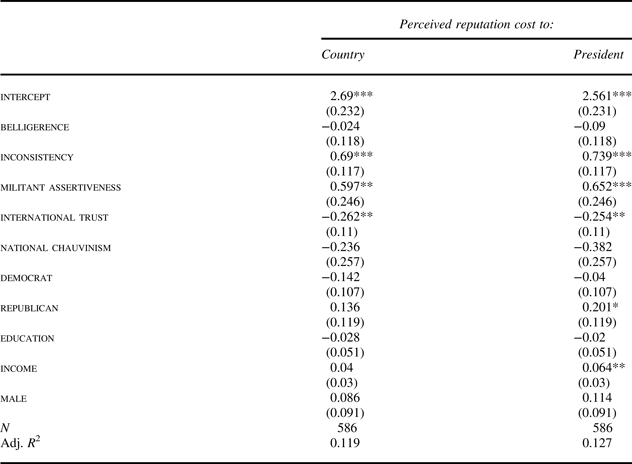
To assess the role of individual-level characteristics on perceptions of reputation costs, we also model the generation of reputation costs another way. Since the two reputation cost variables—the president's and country's reputation—are clearly correlated with one another (r = 0.86), rather than estimate separate regression models assuming the errors are uncorrelated, we more efficiently estimate a seemingly unrelated regression (SUR) model in Table 1. The SUR not only allows us to estimate our treatment effects on our two dependent variables simultaneously, but allows us to do so while controlling for a host of dispositional characteristics and demographic variables, giving us insight into the role that observer-level characteristics play in shaping perceptions of reputation costs.
Modeling perceptions of reputation costs

Notes: Coefficient estimates from a seemingly unrelated regression model. Reference category for partisanship: independents. *p < .1; **p < .05; ***p < .01.
As before, we see that on average, inconsistency significantly increases perceived reputational damages to both the country and the president (with effect sizes of 0.69 and 0.74 on a five-point scale, respectively). Yet we also see that even controlling for the president's strategic choices, certain types of people are systematically more likely to perceive the existence of reputation costs than others. Respondents higher in militant assertiveness, with more hawkish foreign policy preferences, generally perceive steeper reputation costs than individuals with more dovish foreign policy preferences, while individuals higher in international trust are significantly less likely to perceive reputation costs than their less-trusting counterparts. Higher levels of income are positively associated with the magnitude of reputation costs for the president, but not for the country as a whole. In general, then, these results tell us that there remains important variation in assessments of reputation costs even when controlling for the president's behavior on the world stage, and that we significantly improve our explanatory power when we take these dispositional characteristics into account.Footnote 72
How Do Hawks and Doves Understand Reputation Costs?
Heterogeneous Treatment Effects
If there is an important dispositional element to reputation costs, however, we would also expect it to manifest itself in terms of heterogeneous treatment effects: because they rely on their predispositions toward foreign affairs when aggregating reputational considerations, hawks and doves should offer significantly different reputational assessments in response to the exact same foreign policy behavior.
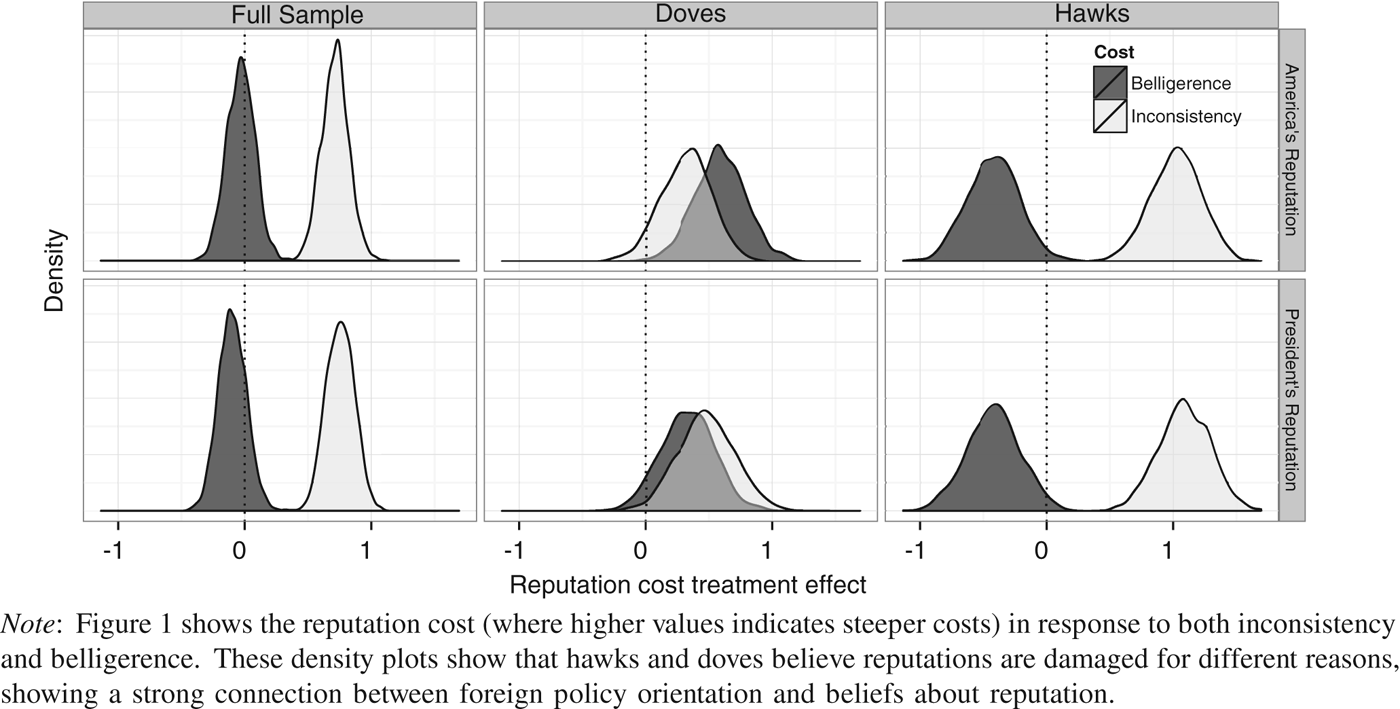
We thus split our sample into hawks and doves, plotting the bootstrapped distributions of reputation cost treatment effects in each subsample in Figure 1, along with the full sample results for purposes of comparison.Footnote 73 Hawks perceive significant reputation costs to leaders who act inconsistently, but believe the president and country's reputations are improved when the leader initiates threats, consistent with models that argue leaders can build stronger reputations by initiating conflicts and proactively building their reputation.Footnote 74 Doves, however, disagree: in contrast to those who believe that “threats have the virtue of being free when they succeed,” doves believe leaders' reputations are damaged when they initiate threats, regardless of the subsequent outcome.Footnote 75 Doves thus weight these reputational considerations in a systematically different fashion than hawks, perceiving both belligerence and inconsistency as reputationally costly. The results are consistent with a dispositional theory of reputation in which individuals draw on their pre-existing foreign policy orientations to make reputational judgments. The divergence between doves and hawks suggests limitations on the extent to which domestic audiences agree about reputation costs, reminding us that audiences' perceptions of reputation costs are closely tied to their foreign policy orientations and policy preferences, and that leaders have to manage their reputations among distinct domestic audiences with contrasting views of reputation.
Hawks and doves assess reputation costs in significantly different ways

How Do Hawks and Doves Talk About Reputation?
To further probe why doves and hawks perceive reputation differently, we look to how doves and hawks differ in their discussion of reputation and perceptions of reputational damage. Since our primary experiment does not include open-ended response questions, we turn to a supplementary experiment that follows the same overarching structure. This supplementary experiment was conducted using a sample of 1,173 respondents recruited using Amazon Mechanical Turk in the spring of 2013. Following their evaluation of how much damage respondents believed there to be to the country and president's reputation, respondents were then asked to “Please briefly explain your response about the president's [or country's] reputation.” We analyze these open-ended responses using a structural topic model (STM), a semi-automated text-analysis model drawing on advances in machine learning, to test whether the language our respondents use when they talk about reputation costs in our open-ended responses systematically varies with their predispositions toward militant assertiveness.Footnote 76 Since reputations are multidimensional, we expect that respondents will invoke a variety of types of reputational concerns when justifying their reputational assessments, but in line with our dispositional theory, we expect these considerations to arise in varying frequency among hawks and doves, such that the two groups will talk about reputation in fundamentally different ways.
Although the technical details of STMs are beyond the scope of this paper, one can think of them as an automated text-analysis technique that models text as a mixture of semantically interpretable “topics.” Because STMs are unsupervised, they allow researchers to “discover” topics in the text rather than assume their existence in advance, as would be the case in a supervised text analysis method in which our prior expectations about why doves and hawks have different reputational concerns might unconsciously drive our findings. Unlike with more traditional mixed-membership models used in text analysis like latent Dirichelet allocation (LDA), STMs let us leverage information about respondents (in our case, the participant's level of militant assertiveness, and the treatment to which the participant was randomly assigned in the experiment) when structuring the topics, rather than assuming that the content and prevalence of topics are constant across all of our participants in the study. In this way, STMs offer a statistical framework in which researchers can study discourse as a dependent variable.
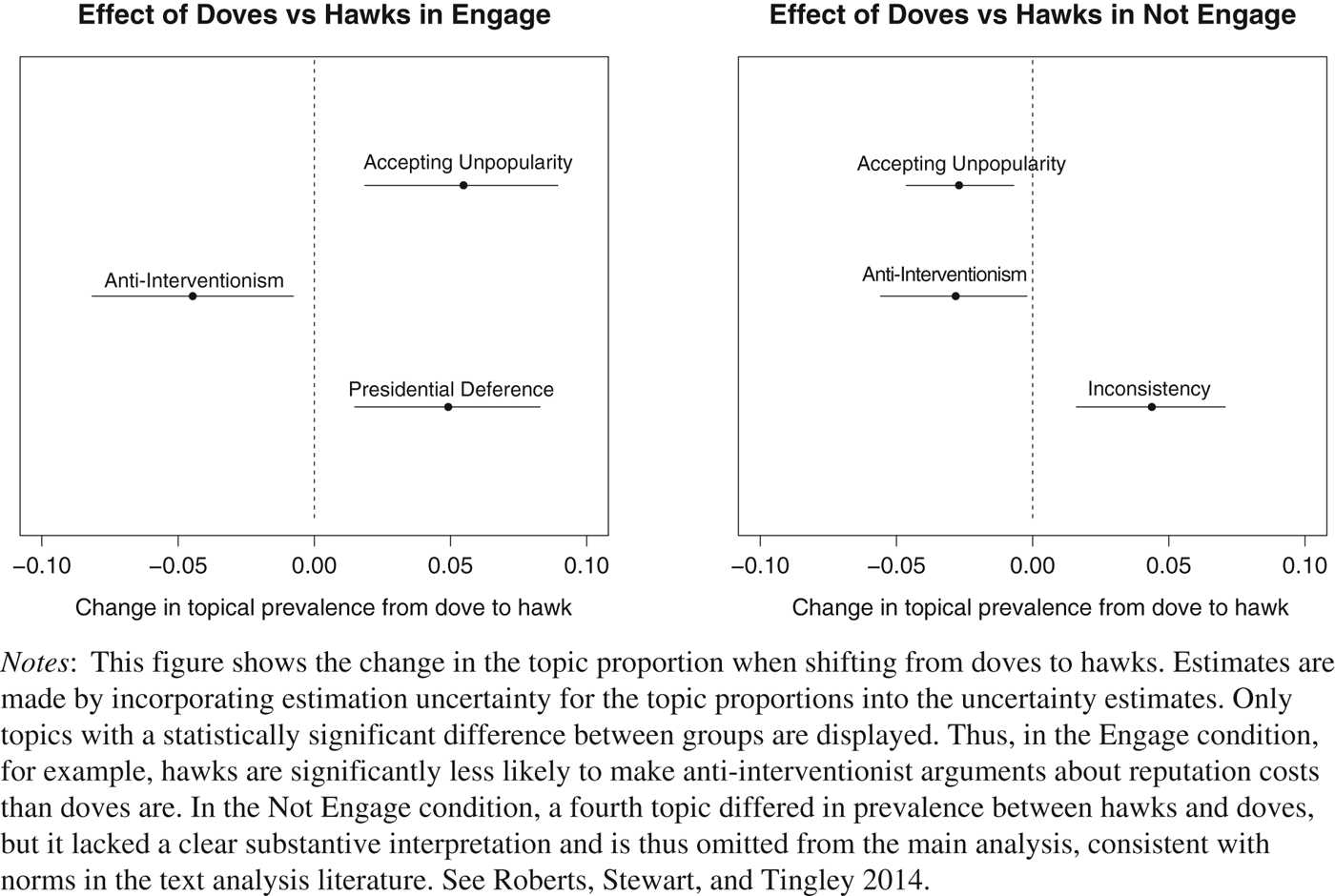
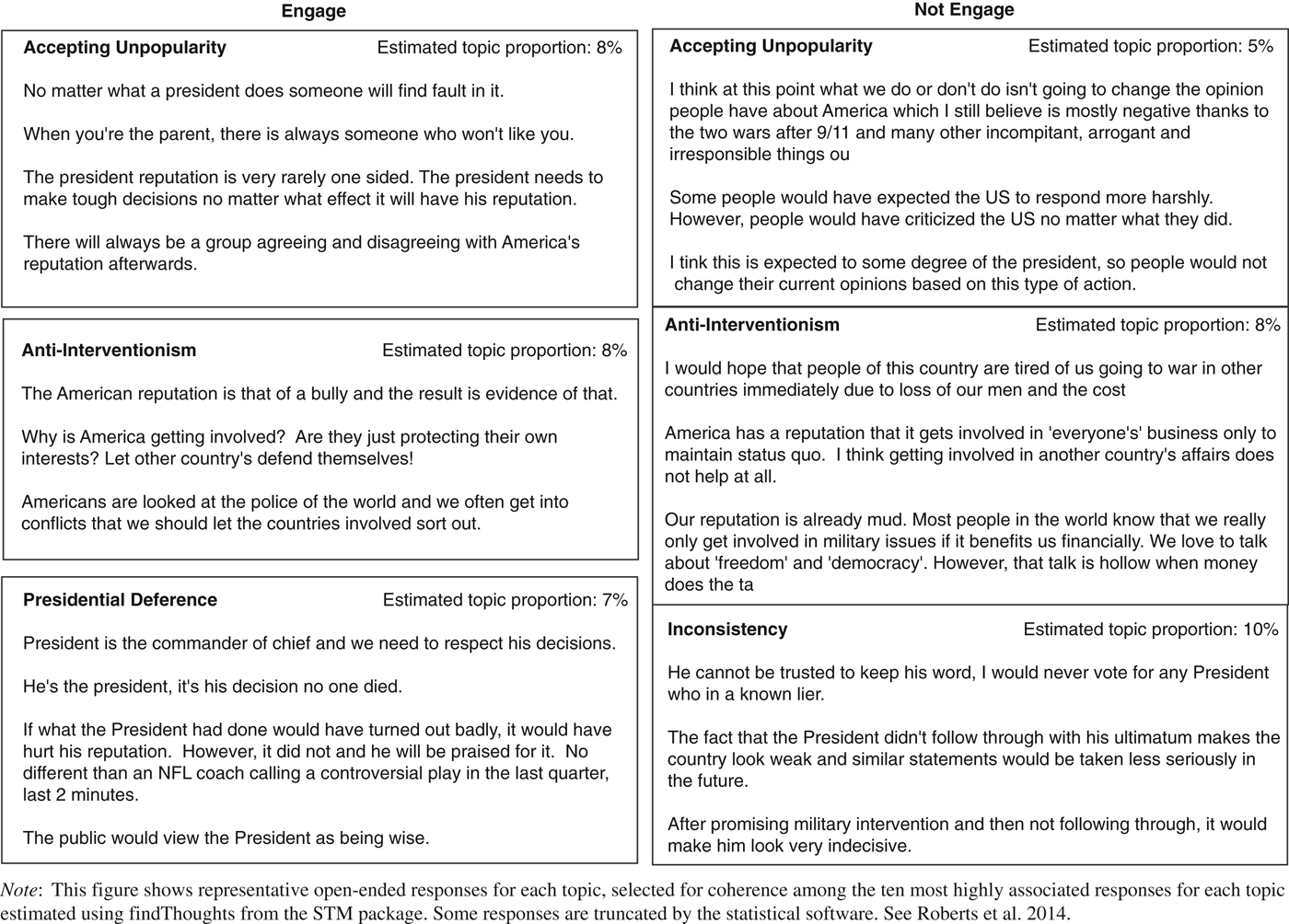
We therefore estimate a set of STMs on our participants' responses to the open-ended questions about reputation costs, using the models to identify whether certain topics are more likely to appear in the responses of doves and hawks, conditional on the assigned treatment in the experiment.Footnote 77 We look at the results in two steps. First, Figure 2 tells us how doves and hawks assigned to the same treatment condition differ in the language they use when discussing reputation costs, as measured by changes in topical prevalence. Second, to derive the labels for each topic and better illustrate what they mean substantively, Figure 3 presents a set of representative responses from participants.
Difference in topic proportion between doves and hawks

Representative responses for each topic

For the Engage condition, the results in the left-hand panel of Figure 2 tell us that doves and hawks significantly differ from one another on three substantively clear topics, representative responses for which are shown on the left panel of Figure 3.Footnote 78 First, when the president threatens force and follows through on it, hawks are significantly more likely to make comments regarding the inevitability of unpopularity. “When you're the parent,” one respondent writes, “there is always someone who won't like you.” “The president needs to make tough decisions no matter what effect it will have [on] his reputation,” another notes. These comments, which implicitly downplay the importance of reputation costs when threats are made, are significantly more likely to be made by hawks than by doves. Doves, on the other hand, are significantly more likely to respond to the president's use of force by discussing reputation costs in terms of anti-interventionism: “The American reputation is that of a bully and the result is evidence of that,” one respondent writes. Against outward-looking understandings of the American national interest exemplified by what Mead called the “Hamiltonian” and “Wilsonian” schools of American foreign policy, doves are more likely to denounce America's role as global police: “Why is America getting involved?” one respondent laments. “Let other [countries] defend themselves!”Footnote 79 Third, hawks are significantly more likely than doves to couch their discussions of reputation costs in terms of deference to the president, either pointing to the president's wisdom in producing a good foreign policy outcome (“He's the president, it's his decision, no one died”), or generally accepting the president's judgment (“President is the commander [in] chief and we need to respect his decisions”). These types of comments, with their emphasis on deference to authority, are consistent both with the “rally around the flag” phenomenon, and the general extent to which hawkish beliefs are associated with a greater emphasis on deference to authority and the entrenchment of hierarchy.Footnote 80
For the Not Engage condition, hawks and doves significantly differ from one another on four topics, three of which have a clear substantive interpretation, as presented in the right-hand panel of Figure 3. Whereas hawks were more likely to accept unpopularity or downplay reputation costs when the president makes a threat and follows through, the right-hand side of Figure 3 shows that when the president makes a threat and backs down, doves are more likely to make these arguments. “Some people would have expected the US to respond more harshly. However, people would have criticized the US no matter what they did,” one respondent writes. Another offers a more jaded version of this argument, noting that America's reputation has already been damaged by the belligerence of American foreign policy post-9/11: “I think at this point what we do or don't do isn't going to change the opinion people have about America.” Nonetheless, the parallel with hawks in the Engage condition is striking. We see further similarities with regard to anti-interventionism. Just as in the Engage condition, doves are significantly more likely to discuss reputational costs using anti-interventionist rhetoric than hawks are. “America has a reputation that it gets involved in everyone's business only to maintain [the] status quo,” one respondent writes. “I think getting involved in another country's affairs does not help at all.” Finally, and consistent with traditional understandings of the key mechanism behind audience cost theory, the third topic that significantly differs between doves and hawks involves inconsistency. Hawks are significantly more likely to discuss reputation costs in terms of expressing dissatisfaction for the president saying one thing and doing another than doves are. “He cannot be trusted to keep his word, I would never vote for any President who is a known [liar],” complains one participant. The national honor is also implicated: “The fact that the President didn't follow through with his ultimatum makes the country look weak and similar statements would be taken less seriously in the future,” worries another.
The value of structural topic modeling is that it is purely inductive: unlike with supervised text analysis methods, our prior expectations about how doves and hawks aggregate reputational considerations cannot steer our findings. Thus, the fact that we uncover patterns remarkably consistent with our theoretical priors about how doves and hawks assess reputation—with doves placing significant weight on the negative reputational consequences of intervention, while hawks place greater weight on the negative repuational consequences of inconsistency—is all the more striking. Interestingly, both hawks and doves demonstrate a willingness to discount potential reputation costs when the costs are produced by a policy consistent with their underlying foreign policy orientation. When the president makes a threat, consistent with hawkish predispositions, hawks indicate a willingness to accept unpopularity. Similarly, doves are also willing to discount potential reputation costs, but when the president backs away from a threat and pursues a more peaceful strategy. This pattern—consistent with motivated reasoning—thus calls the exogeneity of strategic and intrinsic interests into question: if the same dispositions that shape how we evaluate the intrinsic value of policies also shape how we estimate their reputational consequences, the conceptual distinctions between how much we value a policy intrinsically and what we think the reputational consequences of that policy will be begin to blur. This point raises some interesting implications for IR theory, which we return to in the conclusion.
Consequences of Reputation Costs
Thus far we have shown that ordinary citizens have a “taste” for a good reputation in foreign policy—a crucial exercise given the growth of theoretical models in IR in the past several decades that use public opinion as the channel through which reputation costs shape state behavior. While fully validating the next link in the model—that public opinion shapes state behavior—is well beyond the scope of this paper, our study lets us continue down the causal chain by examining the relationship between reputation costs and presidential approval, which, following Gottfried and Trager, we argue constitutes a crucial component of democratic leaders' incentive structures.Footnote 81 Examining the downstream effects of reputation costs on public approval is also valuable given the particular popularity of audience cost models, which generally assume a reputational mechanism to be driving domestic punishment but rarely test it directly.Footnote 82
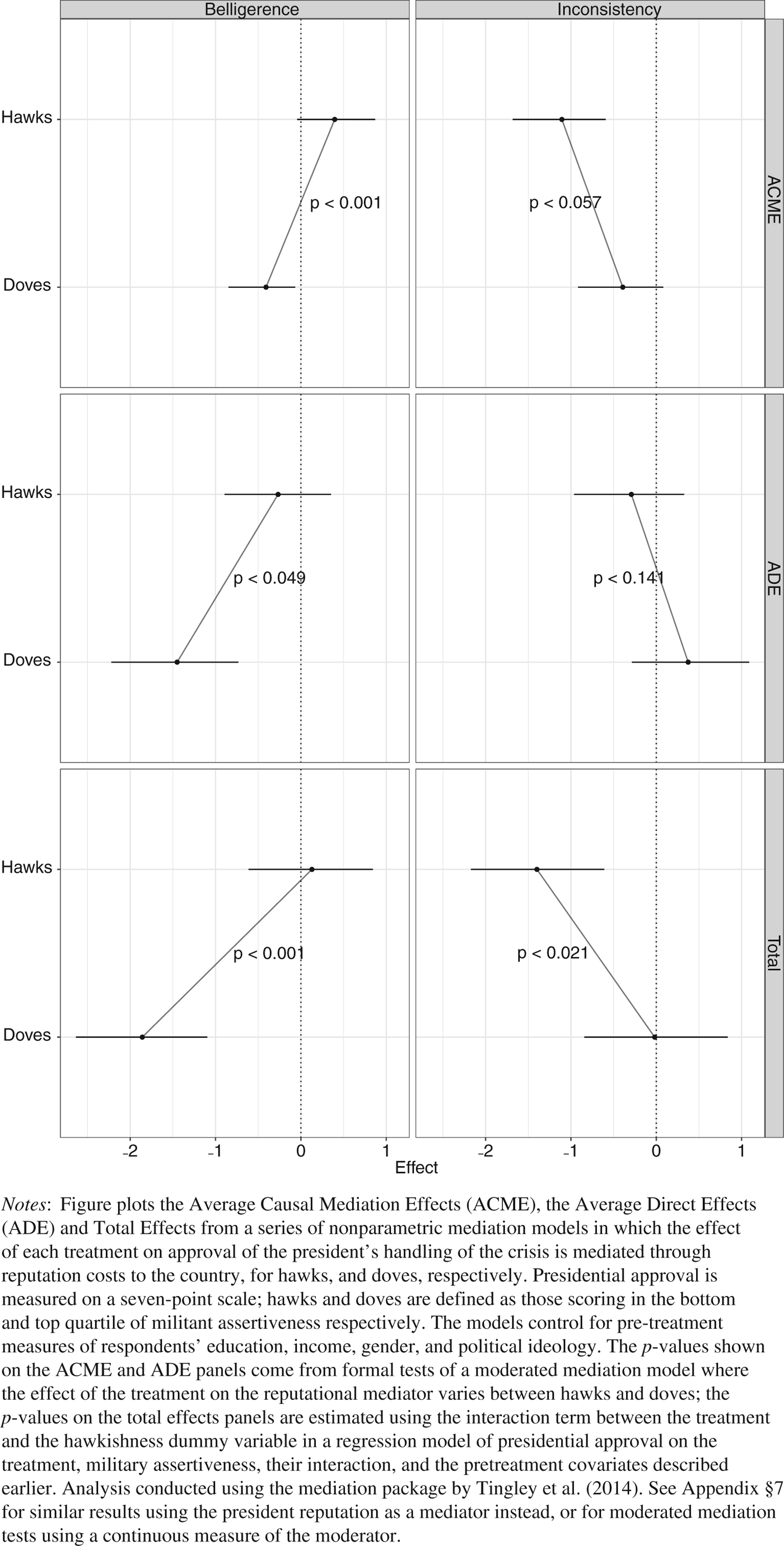
In addition to being asked to assess the reputational consequences of the president's behavior in the experimental scenario, participants were also asked to assess how strongly they approved or disapproved of the president's handling of the situation, on a seven-point scale.Footnote 83 The inclusion of an approval measure allows us to examine how concerns about reputation mediate participants' approval of the president's handling of the situation. We thus estimate a series of nonparametric mediation models testing whether the effects of inconsistency or belligerence on public support is mediated through reputational assessments, and, through moderated mediation tests, whether this effect varies between doves and hawks.Footnote 84
We begin by displaying the results of the mediation analysis for hawks and doves, separately, in Figure 4. The figure reconfirms that both hawks and doves care about reputation—they just think about it in different ways. Among doves, the average causal mediation effect (ACME) through reputation costs on our approval measure is negative both for belligerence (ACME: −0.41; p < 0.02) and inconsistency (ACME: −0.39; p < 0.11): both belligerence and inconsistency increase reputation costs, which decrease public support. In contrast, the mediation effect through reputation costs for hawks varies significantly based on the treatment. As with the case of doves, inconsistency displays a strongly negative mediation effect through reputation (ACME: −1.68; p < 0.01), although the magnitude of the effect is much greater for hawks than for doves. What is striking however, is that belligerence displays a significantly positive mediation effect through reputation in the belligerence treatment (ACME: 0.40; p < 0.08). Because hawks view reputation as being strengthened when the leader acts belligerent, reputation significantly improves approval for the president's handling of the crisis, which bolsters public support.
Reputational consequences of belligerence and inconsistency on presidential approval

We can test these differences between hawks and doves more formally using a moderated mediation model in which the relationship between the treatments and the mediator is permitted to vary with levels of hawkishness. As the p-values in Figure 4 show, the 1.02 unit difference in ACMEs for belligerence between doves and hawks is highly significant (p < 0.001).Footnote 85 The moderated mediation results for inconsistency also show notable differences between hawks and doves, with the negative ACME being −0.71 (p < 0.057) units greater for hawks than for doves.Footnote 86 These findings thus lend further support to the role of reputation as a micro-level mechanism underpinning the relationship between foreign policy behavior in crises and changes in public support, whether in an audience cost framework or in models of public opinion in foreign policy more broadly. The divergent role of reputation between doves and hawks raises new questions for how to think about the domestic politics of reputation in IR, which we turn to in the conclusion.
Conclusion
One of the striking patterns in the history of postwar American foreign relations has been the extent to which policymakers have been preoccupied with reputation, consistently invoking reputational logics when justifying their preferred foreign policy choices.Footnote 87 Morgan notes that this fixation on reputation was far more pronounced in the United States than in the Soviet Union, suggesting that it stems partially from the character of American domestic politics.Footnote 88 The fact that presidents, generals, and senators employ reputational arguments as frequently when they're speaking to the public as they do behind closed doors demonstrates the extent of the belief that reputational consequences count as “publicly acceptable reasons”; otherwise, decision makers would use these arguments with each other, but not with the rest of us. Yet despite the prevailing assumption that domestic publics care about reputation costs, we have very little direct evidence that publics care about reputation, and very little understanding of how.
To address these lacunae, we propose a dispositional theory of reputation costs in which citizens facing an ill-defined strategic situation turn to their core orientations about foreign affairs to help them weight multiple strategic considerations. We then tested this framework using a diverse array of methodological tools—from vignette-based survey experiments to automated text analysis—to gain a richer understanding of the microfoundations of reputation costs.
Some of our findings offer empirical evidence in favor of political scientists' theoretical predictions: for example, leaders who say one thing and do another incur reputation costs, which spill over into evaluations of the president's handling of foreign policy—a causal chain long assumed by audience cost scholars, though never tested formally. Given the large shadow that reputation costs cast in our experimental results, the frequency with which reputational rhetoric is employed by any decision maker with a microphone should not be surprising.
Other parts of our findings, though, encourage us to push in new directions: although ordinary citizens in the United States indeed care or otherwise have preferences about reputation, they do so in a way that violates the assumptions of our canonical models. Whereas IR scholars have tended to model reputation as unidimensional for analytic purposes, we show that its multidimensionality raises theoretically important questions about how actors aggregate multiple reputational considerations simultaneously. Whereas IR scholars have tended to study reputation situationally, we show how this multidimensionality leads it to have an important dispositional component, as the resonance of reputational rhetoric belies the heterogeneity with which reputation is perceived.
In particular, we find that audiences' perceptions of reputation costs are closely tied with their pre-existing foreign policy orientations. Certain kinds of people—especially citizens high in militant assertiveness—are more likely to perceive reputation costs regardless of what the president does. Moreover, hawks and doves tend to understand reputation costs systematically differently: hawks predict reputation costs for inconsistency, while doves envision negative reputational consequences for both inconsistency and belligerence. Automated text analysis of participants' open-ended responses suggests that hawks and doves even use systematically different language when they talk about reputation costs: doves more often make anti-interventionist arguments about reputation costs, focusing on the negative reputational consequences that accrue from getting involved in other countries' affairs, while hawks tend to focus on inconsistency. Interestingly, both hawks and doves tend to be dismissive of reputation costs when it involves policies that they approve of (following through on a threat to use of force, for hawks; choosing ultimately not to engage, for doves). These results thus enrich our understanding of the psychology of hawks and doves, illustrating the vital roles that reputational considerations play in both types of mental models. Contrary to what Snyder and Diesing argue, it is not that hawks or “hard-liners” care more about reputation than doves do, but rather, that they understand the phenomenon in different ways.Footnote 89 Future research should thus do more to explore the origins of these orientations, as well as explore the conditions in which hawks and doves are willing to revise their second-order beliefs about reputation.
In addition to illustrating the merit of bridging the disconnect between foreign policy analysis and “mainstream” IR,Footnote 90 the findings also suggest an under-appreciated paradox about deterrence theory. Deterrence theory is often built around a distinction between intrinsic and strategic interests, the former referring to how much you value the object or issue in dispute, and the latter reflecting the reputational consequences that retreating on this one issue will bear in the future.Footnote 91 One reason that leaders turn to reputational arguments to justify a particular policy choice involves the belief that the policy option is insufficiently attractive without an extrinsic rationale. In some variants of deterrence theory, you make a point of standing firm on issues you care intrinsically little about, precisely to eliminate all doubt about whether you would back down when vital interests are at stake.Footnote 92 From a strategic perspective, then, reputational arguments should be deployed at home primarily to persuade those who do not find a particular policy course inherently worthwhile, since those who support a policy on intrinsic grounds would not need reputational rhetoric to convince them of its merits. Yet the different ways doves and hawks think about reputation costs in our experiments raises the possibility that assessments of intrinsic and strategic interests are not as independent of one another as we often think: our participants dismissed reputation costs when it involved a policy they generally approved of, hawks reminding us that “when you're the parent, there is always someone who won't like you” when confronted with potential reputational consequences for using force, and doves noting that “people would have criticized the US no matter what they did” when asked about the potential negative reputational consequences for backing down on a threat. Disentangling the causal directionality here is beyond the domain of this paper, but it is worth noting that our pattern of results is entirely consistent with a process in which, rather than reputational considerations bolstering the degree of support for a policy, pre-existing levels of support for a policy shape perceptions of reputation costs. Scholars of reputation have long noticed the shadowboxing-like quality of policymakers' reputational rhetoric: the mismatch between the inferences policymakers assume foreign adversaries will make versus the lessons they actually take away.Footnote 93 If individuals do construct perceptions of reputational considerations backwards, inflating or deflating them based on their perceived desirability of the policy being pursued, it would offer further evidence of what Tang calls the “illogic” of reputation.Footnote 94
Because reputation for resolve is not a valence issue, the results illustrate a complicated incentive structure for leaders engaged in foreign policy crises, given that initiating threats can simultaneously generate reputational costs and rewards among two very different domestic audiences. As economists have noted, in the face of heterogeneous audiences, “identifying a ‘good’ reputation itself is non-trivial.”Footnote 95 Given this variation, leaders have an incentive to conduct foreign policy in a manner that balances reputational costs and benefits, which will vary based on the composition of their constituencies. Saunders notes that leaders' military intervention choices are partially a function of their causal beliefs about other states' internal institutions.Footnote 96 Our results suggest another relevant factor is leaders' beliefs about the distribution of hawks and doves in their own domestic constituency—a question political scientists currently know relatively little about. Scholarship that has evaluated politicians' beliefs about public opinion has largely tended to focus on domestic issues. Existing research suggests that both liberal and conservative politicians often overestimate the degree to which their constituents support conservative policies, which if true in the foreign policy realm would suggest that politicians may overestimate the reputational costs for acting inconsistently in a security crisis and similarly overstate the reputational rewards of making threats and standing firm.Footnote 97
To fully appreciate the domestic politics of reputation, more research is needed to evaluate the extent to which politicians are in tune with their constituents' reputational concerns, and—since leaders face the same aggregation challenges that ordinary citizens do—whether they rely on the same dispositional characteristics to calculate reputation costs at home as they do abroad. Although our focus here has been on the domestic politics of reputation costs—and thus, reputation as a second-order belief—there is little in our dispositional theory that precludes its applicability to reputation as a first-order belief. If assessing reputation is an ill-defined problem at home, it is surely just as ill-defined abroad; the dispositions we point to here should presumably be as relevant for foreign audiences as they are for domestic ones. If so, reputation-building strategies are likely to be less straightforward than our existing theoretical models claim because states likely face multiple reputations in the eyes of different beholders simultaneously. Ultimately, our findings paint a more complete picture of how reputation is perceived by domestic audiences and the nuanced incentive structures leaders face.
Finally, our approach here has implications for how we think about the role of complexity in IR. IR scholars are well aware of the challenges that causal complexity poses for our theories of politics.Footnote 98 Many of these discussions approach complexity from a philosophical or analytic perspective, as captured in deliberations on the desirability of parsimony as a theoretical goal, or in debates about whether an instrumentalist philosophy of science—in which models are evaluated based on their utility rather than the fidelity of their motivating assumptions—is theoretically satisfying.Footnote 99 Our interest here, though, is subtly different. The same complexity that challenges us as analysts also confronts the actors whose beliefs and behavior we study. As scholars, we are familiar with the tools we have developed to study a “cloudy” world as if it were “clock-like,” but outside of the cognitive tradition in foreign policy analysis, we have spent less time understanding the micro-processes through which the actors we study in IR carry out the same task—which might in turn suggest new ways that we as scholars might do the same.Footnote 100
Supplementary Material
Supplementary material for this article is available at <https://doi.org/10.1017/S0020818318000188>.