Introduction
Climate change has increased the frequency and severity of floods worldwide, posing escalating challenges to disaster preparedness and emergency medical response systems.Reference Baugh, Kemen and Messervy1 Floods differ from sudden-onset disasters such as earthquakes because they often allow some degree of advance warning.Reference Jonkman, Vrijling and Vrouwenvelder2 However, evacuation remains particularly difficult for vulnerable people.Reference Suzuki, Watanabe and Okuyama3 In disaster medicine, evacuation has been recognized as a critical factor determining morbidity and mortality rates during flood disasters.
So far, most research on medical evacuation has focused on hospitals and institutional settings.Reference Melnychuk, Sallade and Kraus4 Studies conducted in Japan, the United States, and Southeast Asia (including analyses of major flood events such as the 2011 Bangkok floods) have identified common challenges: infrastructure disruption, shortages of human resources, difficulties in inter-facility transportation, and interruptions to medical continuity.Reference Zane, Biddinger and Hassol5–Reference Langkulsen, Rwodzi and Van der Putten8 These studies have provided valuable insights into organizational decision-making, command structures, and system-level coordination during hospital evacuation. However, they primarily assume that patients are already embedded within healthcare institutions, where evacuation decisions are made collectively and supported by formal organizational systems.
In Japan, the evacuation of individuals requiring special support, including home-based medical care patients, is formally designated as the responsibility of local governments, and national policies and administrative frameworks have been established to promote community-level disaster preparedness, such as registries of individuals requiring evacuation support and individualized evacuation plans.9, Reference Nakai, Itatani and Horiike10 Despite these institutional efforts, governmental reports and prior academic research have consistently suggested a substantial gap between policy frameworks and their implementation in real-world disaster settings.11, Reference Yoshida, Sawano and Senoo12 In particular, how evacuation decisions are actually made and enacted at the household and community levels during floods remains insufficiently examined. This gap is especially critical for home healthcare patients, who differ fundamentally from hospitalized patients in several respects. Evacuation-related decisions for home healthcare patients are often made by the patients themselves or their family caregivers rather than by healthcare institutions.Reference Matsumoto, Nakai and Koga13, Reference Wyte-Lake, Claver and Dalton14 Many of these patients depend on medical devices, continuous caregiving, and stable living environments, making evacuation logistically complex and medically risky.Reference Wyte-Lake, Claver and Tubbesing15, Reference Kobayashi, Hanagama and Yamanda16 Consequently, evacuation may be delayed, declined, or replaced by last-minute hospital transfer when conditions deteriorate.Reference Wyte-Lake, Claver and Dalton14, Reference Kobayashi, Hanagama and Yamanda16 Although such situations partially overlap with hospital evacuation in practice, they arise from distinct decision-making processes and constraints that are not adequately captured in hospital-centered evacuation research.
Against this backdrop, there is a clear need for empirical investigation that focuses on how evacuation-related challenges are experienced and managed in practice, particularly among home healthcare patients. This study aimed to identify factors influencing evacuation outcomes across the preparation, evacuation, and post-evacuation phases by interviewing home healthcare patients and families, home healthcare providers, and municipal officials. By examining evacuation as a dynamic, phase-based process and integrating perspectives from multiple stakeholders, this study sought to clarify the practical challenges underlying the policy–practice gap and to explore effective support strategies tailored to the needs of home healthcare patients during floods.
Methods
Design, Setting, and Participants
This study employed a qualitative research approach, conducting interviews with family caregivers of home healthcare patients, home healthcare professionals, and municipal staff responsible for shelter management. Home-based medical care patients themselves were not interviewed due to difficulties in responding; patient-related perspectives were represented through family caregivers. Participants were recruited through snowball sampling via multiple channels, including Orange Home Care Clinic in Fukui City, Kagayaki Home Care Clinic in Kanazawa City, Fukui City Hall, and Iwaki City Hall, between July 2022 and March 2023. The study design adhered to COREQ (Consolidated Criteria for Reporting Qualitative Research) guidelines.Reference Tong, Sainsbury and Craig17
In qualitative research, sample size was based on “information power” rather than statistical calculations. This concept holds that the more relevant the sample is to the research aim, the fewer participants are needed.Reference Malterud, Siersma and Guassora18 This study considered 5 key elements: research aim, sample specificity, use of established theory, quality of dialogue, and analytical strategy. The focused objective of understanding caregiver and evacuation support experiences, combined with a specific target group and trained interviewers, allowed for rich data collection despite a small sample size.
Data Collection
Semi-structured interviews were conducted to explore: (1) challenges and responses during the evacuation preparation phase, (2) specific difficulties and support needs during evacuation, and (3) challenges in maintaining medical care in shelters. Interviews were conducted in Japanese, recorded with participants’ consent, and offered remotely via video call if preferred. All sessions followed COVID-19 prevention protocols. Participants were only informed that the interviewer was a medical student. All interviews were conducted by MY, a medical student trained in qualitative interviewing and the use of the semi-structured interview guide. MY had no prior relationship with any interviewee. The interview guide was developed by the research team.
Data Analysis
Verbatim transcripts were analyzed using thematic analysis to interpret participants’ experiences and identify key themes.Reference Braun and Clarke19 The process included:
-
1. Data Familiarization: Reading all transcripts to grasp overall content
-
2. Coding: Segmenting data and assigning initial codes
-
3. Theme Development: Grouping related codes into themes
-
4. Refinement: Reviewing themes for coherence
-
5. Reporting: Selecting and presenting core themes
Coding unit, quantification, and overlap
For descriptive purposes, we report the number of coded excerpts (N) within each phase. An excerpt was defined as a segmented portion of the interview transcript representing one unit of meaning and conveying a single dominant idea. Because participants contributed narratives of varying volume, the total number of excerpts differed by phase and across tables. To summarize the distribution of dominant topics, each excerpt was assigned one main theme and one subtheme (mutually exclusive coding within each phase table). Therefore, overlaps across themes are not displayed in Tables 2–4; the counts represent the distribution of dominant topics across excerpts, not participant-level exclusivity. Importantly, a single participant could contribute multiple excerpts assigned to different themes.
Multiple researchers independently coded and categorized the data. Analysis was conducted in Japanese, and findings were translated into English. Regular team meetings were held to ensure analytical reliability.
Ethical Considerations
This study was approved by the Medical Governance Research Institute Ethics Committee (Approval No.: MG2022-01). Written informed consent was obtained from all participants.
Results
Participant Characteristics
Participants were drawn from 3 regions. Interviews were not conducted with home-based medical care patients themselves due to their difficulty in responding; the patients’ perspectives were expressed through family caregivers. Quotations clearly indicate the role and pseudonym (e.g., Ns-001). As shown in Table 1, some participants drew on direct flood-related experience, while others discussed preparedness based on drills or anticipated scenarios.
Characteristics of interview participants (n = 13)

Evacuation Preparation Phase
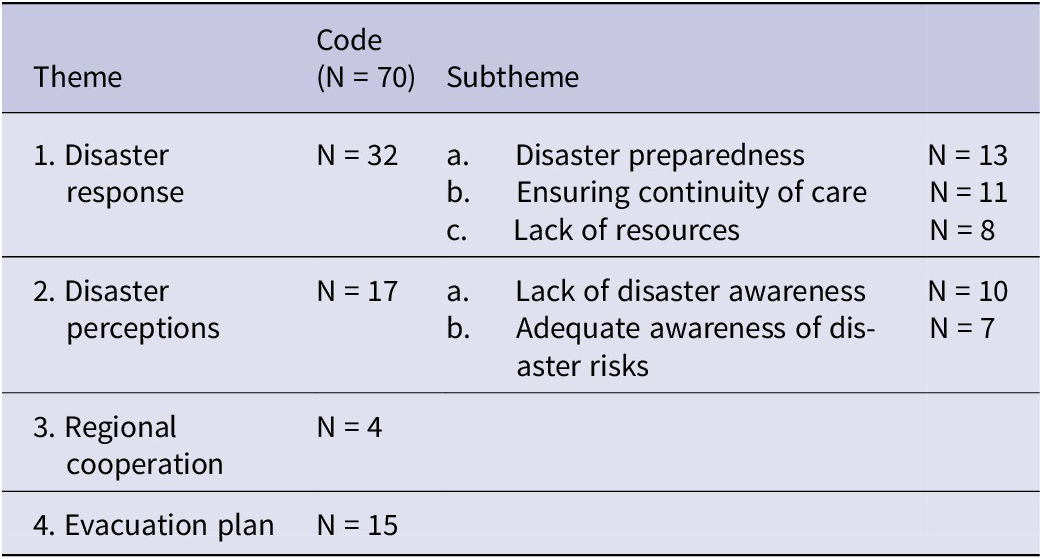
Four main themes emerged during the preparation phase: disaster response (N = 32), disaster awareness (N = 17), evacuation plan (N = 15), and regional cooperation (N = 4) (Table 2). Counts (N) represent the number of coded excerpts (meaning units) assigned to each primary theme. Disaster response included subthemes of disaster preparedness (N = 13), ensuring continuity of care (N = 11), and lack of resources (N = 8), while disaster perceptions comprised lack of disaster awareness (N = 10) and adequate awareness of disaster risks (N = 7).
N indicates coded excerpts (meaning units), not participants. Each excerpt was assigned one primary theme and one subtheme (mutually exclusive coding); therefore, overlaps are not displayed and counts sum to N. Participants could contribute excerpts to multiple themes.
Thematic analysis results of the evacuation preparation phase

1. Disaster response (N = 32)
This theme captured excerpts describing preparedness and anticipated challenges in responding to floods. It comprised 3 subthemes: disaster preparedness (N = 13), ensuring continuity of care (N = 11), and lack of resources (N = 8).
a. Disaster preparedness (N = 13)
Developing business continuity plans (BCPs) in healthcare organizations was seen as an important key to effective disaster response.
“I think that medical care services were even more lacking during the disaster. The only good thing was that it was after all the BCPs had been decided upon amongst the staff at the clinic.” (Dr-01)
b. Ensuring continuity of care (N = 11)
Similarly, challenges of ensuring continuity of medical and other care during disasters were also noted.
“There are indeed several private clinics in the community. Well, maybe we should have a discussion with them about what to do in emergencies.” (Dr-02)
c. Lack of resources (N = 8)
The 2 points mentioned above could be positioned as structural constraints in the realization of countermeasures. This resource constraint is recognized as a fundamental challenge in the realization of effective disaster management.
“Because the administration is reducing more and more people, reducing full-time and making them part-time. Yes, manpower, not enough manpower.” (Dr-02)
This theme highlights a challenge in the structure of the importance of building organizational readiness and ensuring continuity of care, and the lack of resources to limit these. This suggests the importance of prioritization in order to achieve effective disaster preparedness with limited resources.
2. Disaster perceptions (N = 17)
This theme presents preparedness and challenges with regard to disaster awareness (N = 17), with 2 conflicting aspects of residents’ perceptions of disasters emerging.
a. Lack of disaster awareness (N = 10)
First, inadequate awareness and response by residents to basic disaster-related information dissemination and warning systems were indicated.
“People who don’t read the community circular board don’t understand it. Yeah. So, we were told to gather when the sirens went off… And most of them didn’t show up.” (CG-01)
b. Adequate awareness of disaster risks (N = 7)
On the other hand, a high level of awareness of disaster risk management was identified at facility management level.
“These facilities, well, they probably all have hazard maps out… We need to put out something called a preparedness manual.” (CC-01)
Overall, disaster perceptions were mixed: family caregivers often described limited household-level engagement with hazard information, while staff participants described stronger facility-level preparedness awareness.
3. Regional cooperation (N = 4)
Examples of inter-agency coordination were mentioned in relation to supporting medically vulnerable residents during disasters. In this context, the agencies referred to include the electricity provider/utility responsible for priority power supply or restoration and prefectural public health nurses.
“People who have to be prioritized for electricity supply or… … the public health nurses from the prefecture or something like that, they’re in there when there’s a disaster, for people with that difficult disease or something.” (Ns-01)
Overall, participants referred to cross-sector coordination to support medically vulnerable residents during disasters.
4. Evacuation plan (N = 15)
Provider participants also described limited awareness of evacuation plans among some households receiving home medical care.
“Hazard maps for the people the doctor visits are not in my mind.” (SLP-01)
Thus, it is possible that medical personnel involved in home healthcare lack awareness of basic disaster prevention information such as hazard maps, and this needs to be improved.
Evacuation Phase
Three main themes were identified in the analysis of the evacuation phase: evacuation difficulties, evacuation assistance, and personal decision to evacuate (Table 3). Evacuation difficulties were most frequently identified (N = 17), followed by evacuation assistance (N = 9), and personal decision to evacuate (N = 2). In the evacuation phase, coded excerpts most frequently concerned evacuation difficulties and evacuation assistance. Participants described challenges related to assessing the condition of those requiring assistance, providing support under limited resources, and supporting decision-making about whether and when to evacuate, in addition to transportation.
Thematic analysis results of the evacuation phase

N indicates coded excerpts (meaning units), not participants. Each excerpt was assigned one primary theme and one subtheme (mutually exclusive coding); therefore, overlaps are not displayed and counts sum to N. Participants could contribute excerpts to multiple themes.
1. Difficulty in evacuation (N = 17)
This theme reveals the complex problem structure of evacuation during a flood event. Specifically, three different difficulties emerged, depending on the form of evacuation.
a. Difficulty in horizontal evacuation (N = 10)
The narratives clearly indicated that evacuation to higher ground is physically difficult, especially for those in need of assistance.
“If there is a tsunami or something like that, we have to run to higher ground, right? I can’t push my husband way up.” (CG-02)
b. Difficult to evacuate vertically alone during flooding (N = 3)
Challenges in vertical evacuation as an alternative to horizontal evacuation were also presented. In particular, the difficulty of using stairs was pointed out, and it became clear that there are serious limitations to evacuation options within buildings.
“Vertical evacuation is really difficult because he can’t go up the stairs.” (CG-01)
c. Time-consuming evacuation transfer(N = 2)
The survey showed that few people who need assistance are able to walk on their own in the first place, and even those who can walk on their own are unstable and take a long time to move around.
“First of all, few people can walk on their own. Even if they can walk, it takes a long time, or their walking is unstable, so it takes a long time to evacuate.” (Dr-01)
d. Difficulty in moving medical equipment (N = 2)
Complicating the mobility difficulties mentioned above, it is also important to recognize that moving home medical equipment can be difficult.
“For example, if a person is using home oxygen, it is quite a challenge to raise the machine together with the patient." (Dr-01)
These results indicate that evacuation difficulties are not simply a mobility issue, but a complex challenge that is multilayered and related to multiple factors: the physical characteristics of the person requiring assistance, the built environment, and medical care needs.
2. Evacuation assistance (N = 9)
The challenges in evacuation assistance appear as a series of problems that begin with a lack of human resources.
a. Lack of manpower (N = 5)
A fundamental staffing shortage situation that affects the operation of the support system was indicated.
“It’s not just the person, it’s the respirator, the oxygen, it’s really a lot of stuff, and one person can’t carry it. So, we need manpower, just manpower.” (CC-01)
b. Challenges for evacuee assistance programs (N = 2)
In fact, although support systems are in place, they are not being fully utilized.
“There is a support system in place, and if you register in advance, the system sends information to the community, but whether it is being fully utilized is still a bit of a work in progress.” (MO-03)
c. Experience of past disasters (N = 1)
On the other hand, the possibility of effective support with limited personnel was demonstrated.
“During a major snowstorm, when some clients couldn’t come to the day-care facility, our staff visited their homes and provided care, sometimes stepping in for patients’ mothers.” (CC-01)
d. Deciding whether to evacuate (N = 1)
It was also expressed concern that his condition could worsen as a result of the evacuation, indicating the difficulty in deciding whether to evacuate.
“Given that conditions can worsen, I think there is medical triage and lifestyle triage, so perhaps that is where it matters.” (Ns-01)
The analysis of evacuation support revealed a structural problem in which a lack of human resources limits the effectiveness of system operations. On the other hand, past disaster response experience suggests that effective assistance is possible even with limited resources. This indicates the importance of establishing an efficient support system that makes use of existing experience and knowledge, as well as human resource development, to support this system.
3. Individual decision to evacuate (N = 2)
Two subthemes were identified, related to the individual evacuation decision process.
a. Vertical evacuation during flooding (N = 1)
It showed the situation where vertical evacuation is being considered as an option in the event of flooding.
“When we think about flooding, well, if we have a landslide or something, well, if we get swept away or something, well, you know… Well, let them go as high up as possible.” (SLP-01)
b. Possible normalcy bias (N = 1)
A nurse participant described hesitation to evacuate despite official warnings, questioning whether it would be safe to remain at home—an account consistent with a tendency sometimes referred to as normalcy bias.
“Even though the news said we had to escape, I wondered if everything was okay here, and what was going on around me.” (Ns-01)
Across interviews, decision-related accounts rarely specified a single evacuation type; instead, participants described uncertainty and constraints shaping whether evacuation would be feasible, with only occasional references to options such as vertical evacuation. In one nurse account (n = 1), hesitation to evacuate despite official warnings was described, which may be consistent with a possible normalcy bias–like tendency.
Post-Evacuation Phase
The analysis of the post-evacuation phase identified 6 major themes: shelter living conditions, medical support, support systems, psychological and social support, human resources, and infrastructure (Table 4). In the post-evacuation phase, coded excerpts most frequently concerned shelter living conditions (N = 62), followed by medical support (N = 27) and support systems (N = 15). Psychological and social support (N = 9) and human resources (N = 9) were also described, along with infrastructure-related issues (N = 7). Participants reported challenges related to maintaining sanitary shelter conditions, securing essential supplies and medical support, and organizing support systems.
Thematic analysis results of the post-evacuation phase

N indicates coded excerpts (meaning units), not participants. Each excerpt was assigned one primary theme and one subtheme (mutually exclusive coding); therefore, overlaps are not displayed and counts sum to N. Participants could contribute excerpts to multiple themes.
1. Living conditions in shelters (N = 62)
The living environment of a shelter consists of three main elements:
a. Health and hygiene (N = 24)
Maintaining basic sanitary conditions in shelters is a crucial factor that determines the quality of evacuation life. In particular, the management of sanitary facilities, such as toilets, has been a significant challenge.
“Until then, everyone just left their waste as it was… it was like a pile of feces in the toilets.”(Dr-01)
b. Sustainability (N = 7)
The continuous supply of essential daily necessities required for evacuation life is a crucial factor in shelter management. In particular, securing drinking water and food remains a major challenge.
“We ran out of drinking water, so we really needed support for water and food.”(Dr-01)
c. The elderly and vulnerable people (N = 31)
Providing appropriate support and ensuring a suitable environment for individuals requiring special care are major challenges in shelter management. In particular, attention is needed for those requiring specialized care, such as individuals with dementia.
“For people with dementia, for example, can they even manage to live in a shelter? They probably wouldn’t even know where the toilets are.” (SLP-01)
Examination of shelter living conditions revealed that hygiene management, supply of essential goods, and support for individuals requiring special care are the 3 fundamental components of shelter operations. Proper measures for each element and a well-balanced management approach are essential.
2. Medical support (N = 27)
Medical support consists of 2 main aspects:
a. Medical care and access (N = 19)
Ensuring physical access to medical services during disasters is a core challenge in medical support. Restrictions on movement, such as road disruptions, significantly impact the healthcare delivery system.
“The roads were completely cut off, and there were so many recovery trucks along the way that it was really hard to get through.” Dr-01)
b. Home healthcare and the elderly (N = 8)
Medical support for individuals requiring home healthcare and the elderly is exploring new approaches different from traditional methods.
“If it’s difficult to reach the site, we could connect online. The potential for telemedicine during disasters—especially because it’s a disaster—is something to consider.” (Dr-01)
The needs of medical support revealed 2 key challenges: ensuring physical access and developing new methods of healthcare delivery. These findings highlight the need to establish a comprehensive medical support system that integrates both traditional healthcare methods and new technologies.
3. Support system (N = 15)
The support structure consists of 2 main elements:
a. Support organization management issues (N = 11)
Establishing an organized communication structure is a fundamental element of the support system. Clarifying the chain of command and ensuring the proper transmission of information are recognized as critical challenges.
“The chain of command should be well-structured, absolutely. There needs to be a clear system for managing information—decisions made at the top should be properly communicated down the chain.” (Dr-01)
b. Supporting organizational management (N = 4)
Gathering and prioritizing information are essential elements for effective support activities. Selecting necessary information and making appropriate decisions are critical tasks.
“The administration needs to properly identify what must be asked and what constitutes essential information. They need to enhance their own understanding as well.” (SLP-01)
Examination of the support system revealed that structured information management and concrete operational practices form the foundation of support activities.
4. Psychological and social support (N = 9)
Psychological and social support consists of the following 2 aspects:
a. Mental care (N = 8)
Maintaining the psychological well-being of disaster survivors is a critical challenge during evacuation. Addressing the psychological impact of disasters is essential. “It’s not just about physical illness, but also mental health. After the disaster, I felt extremely down and couldn’t sleep, so I wanted someone to help me.” (Dr-01)
b. Economic challenges of survivors (N = 1)
Economic difficulties faced by survivors are a crucial factor in rebuilding their lives. Financial constraints can prevent them from accessing necessary care. “Even if we want to send someone back home, it’s ultimately impossible because they just don’t have the money.” (Dr-01)
Findings related to psychological and social support revealed the necessity of addressing both mental and economic aspects. While these are distinct challenges, they both play a vital role in the comprehensive support of evacuees’ lives.
5. Human resources (N = 9)
a. Shortage of manpower (N = 9)
Ensuring sufficient human resources for support activities is recognized as a fundamental and critical challenge. “Well, to be honest, we were completely short on manpower.” (Dr-01)
Findings of human resources highlighted the fundamental importance of securing personnel for the implementation of support activities. This issue is positioned as a foundational element that impacts all aspects of support operations.
6. Infrastructure (N = 7)
Infrastructure development in evacuation shelters consists of the following 3 key challenges:
a. Information management in disasters (N = 4)
Ensuring evacuees’ access to information is a crucial foundation for shelter life. Establishing an environment that allows evacuees to maintain external connections and obtain necessary information is essential. “For those who came to the evacuation shelter, having tools for gathering information, like televisions, is really important.”
b. Securing power supply (N = 2)
A stable power supply in evacuation shelters is indispensable for operating various devices and maintaining daily life. “Most things run on batteries, but electricity is essential, not only for powering devices but also for ensuring safe transportation to secure locations.” (Dr-01)
c. Challenges in utilizing support systems for evacuees (N = 1)
Issues related to the existence and utilization of available support systems for evacuees were also highlighted. “You have to apply yourself and use the system on your own… If you don’t know about it, you can’t use it.” (MO-03)
The analysis of infrastructure revealed that access to information, power supply, and system utilization are the three fundamental components of shelter operations.
Discussion
This study provides a phase-based qualitative account of evacuation challenges faced by home healthcare patients during floods, integrating perspectives from patients and families, home healthcare providers, and municipal officials. Throughout the preparation, evacuation, and post-evacuation phases, our findings reveal the practical mechanisms underlying the gap between policy and practice. Even when disaster preparedness systems exist, translating plans into timely and safe actions is often hindered by insufficient feasibility at the household level, caregiver capacity, and operational coordination. This finding highlights that the evacuation of home-based medical care patients is not merely a transportation issue, but rather a complex and constantly evolving process shaped by dependence on medical equipment, the need for continuous care, and the allocation of human resources within the entire regional system.
Our findings do not claim direct equivalence with hospital evacuation; rather, they complement hospital-centered literature by adding community- and household-level perspectives on flood evacuation. Prior guidelines and empirical studies on hospital evacuation during floods and hurricanes highlight recurring system-level constraints—such as infrastructure disruption, transportation bottlenecks, and staffing limitations—shaping decision-making under uncertainty.Reference Zane, Biddinger and Hassol5, Reference Wyte-Lake, Claver and Tubbesing15, Reference Ricci, Griffin and Heslin20 Similar constraints emerged in our interviews, particularly from provider and municipal perspectives, suggesting that some structural barriers recur across settings during major floods. At the same time, home-based medical evacuation differs in decision locus and support capacity: whereas hospital evacuation is typically institution-led within formal command structures, home evacuation decisions often fall to patients and family caregivers with limited real-time clinical triage, and are further complicated by medical device dependence and the need for continuous caregiving.Reference Wyte-Lake, Claver and Dalton14–Reference Kobayashi, Hanagama and Yamanda16 When community shelter evacuation is not feasible, escalation to emergency hospital transfer may function as a contingency option, underscoring the operational linkage between community preparedness and medical surge/transfer planning.Reference Zane, Biddinger and Hassol5 Accordingly, flood-prone regions should consider home evacuation support and hospital transfer/surge response as a continuum requiring coordination among municipalities, healthcare providers, and welfare/home-care stakeholders, consistent with Japanese policy guidance on individualized evacuation planning and information sharing with relevant support actors.21
Across the three study regions, pre-disaster preparedness appeared heterogeneous. Staff participants described facility- and service-level arrangements such as hazard maps, preparedness manuals, and in some cases business continuity planning, whereas family caregivers often described limited household-level engagement with hazard information and warning systems; notably, limited hazard-map awareness was also reported among some home-care personnel. Taken together, these accounts suggest that what tended to work was internal organizational preparedness where it existed (e.g., role clarification and continuity planning), while what did not work consistently was translating plans and information into feasible, household-level evacuation actions and timely support for medically vulnerable residents.Reference Yoshida, Sawano and Senoo12
These patterns are consistent with broader evacuation literature highlighting structural constraints—such as limited resources, transportation barriers, and coordination challenges—as recurring obstacles during disasters. For example, Khorram-Manesh et al. (2014) analyzed medical evacuations during the 2011 Bangkok flood, reporting that infrastructure deficiencies and challenges in inter-hospital patient transport were the greatest barriers to emergency evacuation.Reference Khorram-Manesh, Angthong and Pangma22 Additionally, Lin et al. (2014) noted that a lack of collaboration with local communities weakens evacuation preparedness, a phenomenon commonly observed across various disasters.Reference Lin, Burke and Berg23 In our target communities, elements of preparedness were achieved at the organizational level (e.g., internal arrangements and role awareness in some services), but cross-stakeholder operationalization—particularly routine feasibility checks, shared understanding with households, and timely mobilization of support—was not consistently achieved, reflecting persistent resource constraints and formalized plans without effective implementation.
In the evacuation phase, physical mobility emerges as a critical issue. Transporting medical devices such as oxygen concentrators and electric beds complicates the evacuation process. Yazdani et al. (2022) analyzed models of medical patient evacuation during floods and identified road closures and a lack of emergency transportation as significant factors delaying evacuations.Reference Yazdani, Mojtahedi and Loosemore24 Furthermore, Miyatake et al. (2024) highlighted that individual differences in evacuation timing and decision-making are influenced by the physical and psychological burden of evacuation.Reference Miyatake, Yoshida and Kaneda25 Previous research (Ozaki et al.) also noted that normalcy bias may lead patients and families to delay or refuse evacuation, necessitating appropriate countermeasures.Reference Ozaki, Kanemoto and Wada26
The post-evacuation phase is characterized by challenges in maintaining shelter environments and sustaining medical support. Home healthcare patients face difficulties using medical equipment in shelters due to limited power supply and infrastructure constraints.Reference Wyte-Lake, Claver and Tubbesing15 Tokumaru et al. (2021) reported that inadequate medical support in shelters worsened patients’ health.Reference Tokumaru, Fujita and Nagai27 Additionally, risks such as infectious diseases and deteriorating sanitary conditions contribute to the decline in evacuees’ quality of life. Psychological support and mental health care are also crucial. Nakai et al. (2024) found that many home healthcare patients experience psychological stress and isolation after evacuation, potentially leading to long-term health issues.Reference Nakai, Oe and Nagayama28 Furthermore, a shortage of specialized personnel in shelters creates a bottleneck in medical support.
Addressing the challenges of home healthcare patient evacuation during floods requires a multifaceted approach. In the preparation phase, individualized evacuation planning, support measures for transporting medical devices, and strengthened community collaboration are essential. During evacuation, designated routes, assistive devices, and psychological education to support evacuation decisions are crucial. In the post-evacuation phase, infrastructure improvements to enable continuous use of medical devices, the introduction of telemedicine, and the establishment of mental health support systems are necessary. These efforts can only be effective if government agencies, healthcare providers, communities, patients, and their families work together. Moving forward, the systematic implementation and sustainability of these initiatives must be ensured.
Limitations
The strengths of this study include the multi-stakeholder sample. Additionally, the analysis was conducted by 3 independent researchers, with frequent meetings to integrate findings. However, this study has several limitations. First, as a qualitative study based on interviews with stakeholders from specific regions (Fukui City, Kanazawa City, and Iwaki City), the generalizability of the results should be interpreted with caution. Second, the interviewees were limited to those who had access to the internet, which may have restricted the sample size and excluded broader experiences and perspectives. Third, since the study was conducted during the COVID-19 pandemic, responses regarding shelter operations may have been influenced by infection control measures.
Future Perspectives
Based on the findings of this study, several future research directions can be considered. First, a quantitative study covering a broader range of regions is necessary to validate the generalizability of the qualitative insights obtained. Understanding the impact of regional characteristics and healthcare resource disparities on evacuation support systems could facilitate the development of more effective support models.
Additionally, developing and evaluating specific intervention methods for supporting home healthcare patient evacuation is a key challenge. Investigating the effectiveness of emerging medical service delivery methods, such as telemedicine during disasters, and standardizing evacuation procedures for patients using medical devices are crucial. Furthermore, although not fully explored in this study, standardizing measures for disaster response during infectious disease outbreaks, such as COVID-19, should also be considered.
Moreover, implementation research on interdisciplinary collaboration for evacuation support is essential. Establishing sustainable models for cooperation among healthcare providers, government officials, and community members is necessary to enhance evacuation support systems. Through these research efforts, improvements in disaster preparedness for home healthcare patients amid increasing flood risks can be expected.
Conclusion
This study identified challenges in the evacuation of home healthcare patients during floods across three phases: preparation, evacuation, and post-evacuation. Key issues include ensuring medical continuity during disasters, establishing evacuation support systems, and improving living conditions in shelters. Addressing these challenges requires a comprehensive approach involving collaboration among government agencies, healthcare institutions, and local communities. The insights from this study contribute to the enhancement of disaster preparedness for home healthcare patients in response to increasing flood risks.
Data availability statements
Data available on request.
Acknowledgments
The authors express their sincere gratitude to all the clinic staff members, patients, and caregivers involved in this study.
Author contribution
MY conducted the interviews. HM analyzed the data. HM, YK, and AO wrote the manuscript. All authors conceptualized and designed the study and revised the manuscript.
Funding statement
This study was supported by the Yuumi Memorial Foundation for Home Health Care. (Grant number not available.)
Competing interests
AO received a personal fee from MNES Inc, outside the submitted work. All other authors declare no conflicts of interest.
Role of the funder
The funder had no role in study design; participant recruitment or participation; data collection; analysis; interpretation of the results; manuscript preparation; or the decision to submit for publication.
Data disclosure statement
This information has not been published elsewhere.
Sources of support
None.