Introduction
Population dynamics patterns in animals due to prey–predator interactions have long been studied both theoretically (e.g. Lotka, Reference Lotka1925) and experimentally (e.g. Huffaker, Reference Huffaker1958). Apart from plant availability/structure combined with competition between parasitoids which is reported here, researchers have examined other ecological issues such as apparent competition (Bonsall & Hassell, Reference Bonsall and Hassell1998), host plant resistance (Karimzadeh et al., Reference Karimzadeh, Bonsall and Wright2004), host refuges (Begon et al., Reference Begon, Sait and Thompson1995) and host–parasitoid interacting populations in terms of system persistence (e.g. Utida, Reference Utida1967). For instance, Begon et al. (Reference Begon, Sait and Thompson1995) showed that certain refuge for preys from parasitoid attacks leads to the persistence of stable parasitoid–host interactions. Plant morphological characteristics such as dense trichomes, waxy leaves, leaf surface area and complex plant structure could impair host encounters by foraging parasitoids (Gingras et al., Reference Gingras, Dutilleul and Boivin2003). Three major components of a plant structure relevant to searching parasitoids are the plant size or surface area, structural heterogeneity and structural complexity (Andow & Prokrym, Reference Andow and Prokrym1990). Parasitoids are not always as efficient as they could be in the field due to the influence of plant structural complexity that causes many disruptions in parasitoid behavior (e.g. searching efficiency) and ecology (e.g. population size and dynamics) (Rehman & Powell, Reference Rehman and Powell2010). Theoretically, two opposite stability conditions are predictable for a host-searching parasitoid when the plant availability is high. First, due to the presence of sufficient food supplies, the herbivore fitness increases; this would result in higher population abundance and as a consequence, the parasitoid benefits directly from its host. For instance, specialist parasitism upon potentially abundant herbivore can lead to spectacular trophic cascades (Dobson & Crawley, Reference Dobson and Crawley1994). Second, under higher plant availability the herbivore benefits more from refuges due to more abundant plant structures; subsequently, the parasitoid suffers from the escaped host. The scenario is reverse when the plant availability is low, as the parasitoid suffers from lower host density due to lower plant availability. In contrast, parasitoid benefits regarding searching efficiency's budget due to lesser refuges for the prey and subsequently easier host locating.
It is not straightforward how changes in plant abundance and structure should affect the parasitoid population size and dynamics in the absence or the presence of competitors. Therefore, the current study aimed to qualify how the plant structure operates in the dynamics of interacting populations using time-series techniques, through the repeated measurement of population abundance in time for both the herbivore and parasitoids. Indeed, plants with high availability in the current study benefit the herbivore via two ways: (1) offering higher food supply and (2) supporting against parasitoids by giving higher refuges, conditions that are not possible under low plant availability. Based on these differences, we expected the herbivore to perform better on plants with complex structure (when plant availability is high) and therefore the parasitoids on plants with simple structure (when plant-related refuges are low). We also hypothesized that host parasitism should be greater on plants having a simple structure due to lesser refuges. In conclusion, we hypothesized that plant-related refuges for hosts from parasitoid attacks could lead to the persistence of stable parasitoid–host interactions.
Specialist herbivores are likely periodically and locally plant limited in both natural and agro-ecosystems. For instance, the specialist herbivore in mixed farming areas would suffer from starvation periods after harvesting and crop rotations due to the absence of their host. Similarly, through natural ecosystems many phenomena are suggested as limiting factors in getting enough food for the herbivore such as some phenological asynchronies between the host plants and herbivores. Apart from starvation caused by plant limitations, the herbivores would suffer from parasitoids due to less available refuges from plant structures. Plant limitation in this study was established based on restricting the number of potted plants in each replicate, and inevitably some starvation periods, to mimic the plant conditions in the areas in question.
Materials and methods
Plants and insects
Community modules tested here include plant→herbivore, herbivore↔parasitoid, parasitoid↔parasitoid and (parasitoid↔parasitoid)↔herbivore in terms of population size and dynamics patterns and interaction strength through nine generations of the herbivore which was suffering from resource limitations/less refuges in cases (in both time and space). Moreover, looking for the existence of a particular module, we assessed the interaction strength in each pair-wise interaction using the Paine removal matrix (Paine, Reference Paine1992). Specifically, because the two parasitoids have different attacking rates and handling times, the coexistence (or competitive exclusion) and their dynamics pattern will have different top-down roles on the herbivores.
The system examined in the current study was composed of two parasitoid species, Diadegma semiclausum (Hellén) and Cotesia vestalis (Haliday), a specialist herbivore species, Plutella xylostella (L.) and a canola cultivar (Brassica napus) as a host plant (Soufbaf et al., Reference Soufbaf, Fathipour, Karimzadeh and Zalucki2010a , Reference Soufbaf, Fathipour, Karimzadeh and Zalucki b ). B. napus cv. SLM046 (Seed and Plant Improvement Institute, Karaj, Iran) was grown in field soil without the use of any fertilizer under the greenhouse conditions (25±5 °C and L:D 16:8 h). P. xylostella larvae and pupae were originally collected from cabbage fields at Tehran University (Karaj, Iran). The P. xylostella colony was established on the test plant, and maintained under greenhouse conditions for four generations before initiating the experiments. The colonies of D. semiclausum and C. vestalis were maintained on P. xylostella larvae in ventilated Perspex cages (30×30×30 cm) in the standard constant environment (25±2 °C, 70±5% RH and L:D 16:8 h); the fourth generation adults of the parasitoids were used in the experiments.
Experimental design
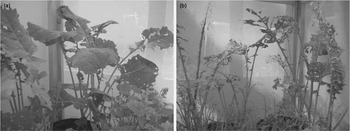
A microcosm experiment on the effect of resource limitation on population dynamics was then implemented using the canola cultivar under two different plant availabilities: high-availability setup, where a new plant was put in the cages just before the consumption of all leaves by P. xylostella larvae (in high P. xylostella densities usually every 2–3 days) (fig. 1a), and low-availability setup, where a new plant was provided in each cage every 8 days (fig. 1b). For each plant setup, three scenarios were established: P. xylostella+D. semiclausum, P. xylostella+C. vestalis and P. xylostella+both parasitoids. Each scenario was replicated four times. Each experiment started with five pairs (male and female) of 1-day-old P. xylostella adults, two pots each containing two 4-week-old plants (totally four individual plants) and aqueous sugar solution (10%) in each cage in 20 ml containers. After 20 days, when P. xylostella of all stages were present, two 2-day-old mated females of each parasitoid with one respective male were released to each parasitoid treatment cage. The cages (80×80×100 cm) were maintained under constant environmental conditions (25±1 °C, 65±5% RH and L:D 16:8 h). The experiment was run for 25 weeks and populations were monitored weekly by a census of living adults, and used as the estimate of abundance of each insect species. Population abundance of the protagonists was monitored weekly and the resulting population cycles were examined taking the Box–Jenkins methodology as a time-series modeling procedure (Box et al., Reference Box and Cox1994).
Plant treatments examined in the study as (a) high plant availability and so higher plant structure complexity and more available refuges and (b) low plant availability and so lesser plant structure complexity and lesser available refuges (photos of pre-test experiments).

Statistical analyses
Time-series statistics were used to explore patterns in the observed population dynamics. Mixed autoregressive-moving average (ARMA) models were fitted to the data for each species in single-parasitoid setups and again in mixed-species populations. Stationarity, a necessary condition for time-series data, was ensured by data transformation. Generally, log transformations and first-order differencing of the data were applied if the mean and variance were inconsistent through the series, respectively. The parametric power transformation technique proposed by Box & Cox (Reference Box, Jenkins and Reinsel1964) was applied based on the following formula to stabilize the variance:
 $$\mathop x\nolimits_t^{(\lambda )} = \left\{ \matrix{\displaystyle{{\mathop x\nolimits_t^\lambda - 1} \over \lambda} \quad {\rm if}\;\lambda \ne 0 \cr \log x_t \quad {\rm if}\;\lambda = 0 } \right\}$$
Based on the value of λ the preferred transformation was done; such that if λ was −1, −0.5, 0 and 0.5 then 1/x t , 1/√x t , log x t and √x t was performed respectively, apart from the value of 1, after which the transformation was not necessary. Autocorrelation and partial autocorrelation functions (ACF and PACF) were used as an initial approach for examining the periodicities, fluctuations and approximate orders of the underlying density-dependent processes generating the observed dynamics. Repeated measures analysis of variance (Proc. GLM, SAS, 2003) was performed to evaluate the effect of both plant availability and insect assemblage (between subject effects) and time (within subject effects) on insect populations over 25 weeks. The following removal matrix was used to define the interaction strength between two parasitoid species (I pq ) under two different plant availabilities (Paine, Reference Paine1992):
 $$I_{\,pq} = \displaystyle{{N_{PQ} - N_{PQ -}} \over {N_{PQ -} \times N_Q}} $$
where N PQ is the abundance of P (target) when the agent (Q) is present, N PQ− is the abundance of target when the agent is absent and N Q is the abundance of agent in the absence of target. Statistical time-series models were developed to explore the long-term consequences of interactions in the current insect assemblage and have the form
 $$R_t {\rm =} f\,(X)({\rm \pm} \varepsilon _t ) {\rm +} g(Z)$$
where R t =ln(N t+1/N t ) and f(X) is a function for density dependence; the Markov model was used to model the autoregressive process through a series. The function, g(Z), describes density-independent processes (Bonsall & Hassell, Reference Bonsall and Hassell1998). The exogenous component, ε t , was modeled as a random, with mean zero and variance σ2. To evaluate the suitability of the models, modified Box–Pierce χ2 statistics were determined considering non-significant P-values for the lags 12 and 24. Time-series analyses and modeling procedures were done according to Minitab (2007) and interaction strength analysis of variance, descriptive analysis and repeated measures ANOVA were performed according to SAS (2003).
Results
Descriptive statistics and population census analysis
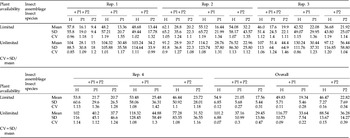
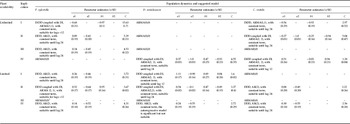
The mean number of P. xylostella adults and its parasitoids during the time-series experiments under both plant setups is shown in table 1; CV values show that the variation in P. xylostella population under limited plant availability is higher than the variation under other plant setup, while populations of both parasitoids are less variant under limited plant setup. For both parasitoids, under limited plat setup, the extinction risk was lower when parasitoids are engaged in competition, while under unlimited plant setup, the mentioned risk is higher when parasitoids compete (table 1). In all experiments, insects persisted during the 25-week period (time-series plots).
Descriptive statistics of Plutella xylostella (H), Diadegma semiclausum (P1) and Cotesia vestalis (P2) population sizes on canola cultivar SLM046 through mixed population (+P1+P2) and single-parasitoid setups (+P1 or +P2), under two different palnt availabilities (limited and unlimited) under constant environmental conditions in glasshouse. Means are extracted from 25 weekly counts for populations in each plant setup.

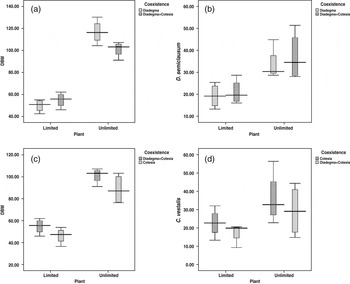
Repeated measures analysis revealed a significant effect of plant availability (F 1,18=199.52, P<0.0001) and insect assemblage (F 2,18=6.43, P=0.0078) on the population size of the herbivore, while insect assemblage had no significant effect on both parasitoids’ population size. The box plot for the presence or absence of one of the parasitoids on P. xylostella (fig. 2a and c) and on its competitor (fig. 2b and d) over the 25-week period reveals different degrees of dispersion around the median line and this dispersion index is most considerable in the case of competitor presence/absence effects on each parasitoid (fig. 2b and d) under the unlimited plant availability setup. However, the interaction strength between two parasitoids was not different under both plant setups (F 1,6=0.01, P=0.9378 and F 1,6=0.36, P=0.5729 for C. vestalis and D. semiclausum as agents in the removal matrix, respectively).
Interactive graphs of estimated marginal means (EMMEANS) for herbivore Plutella xylostella and two parasitoids Diadegma semiclausum and Cotesia vestalis under effects of fixed set of factors (plant availability and guild structure) on their abundances. Parts (a) and (b) show P. xylostella and parasitoid D. semiclausum EMMEANS under effects of two factors; (c) and (d) show P. xylostella and parasitoid C. vestalis EMMEANS under effects of two factors. Coexistence represents the guild structure as separate populations (P. xylostella with one parasitoid alone) or mixed populations (P. xylostella with both parasitoids). Results of statistical analysis using repeated measures ANOVA were represented in the text.

Time-series analysis and model criticism
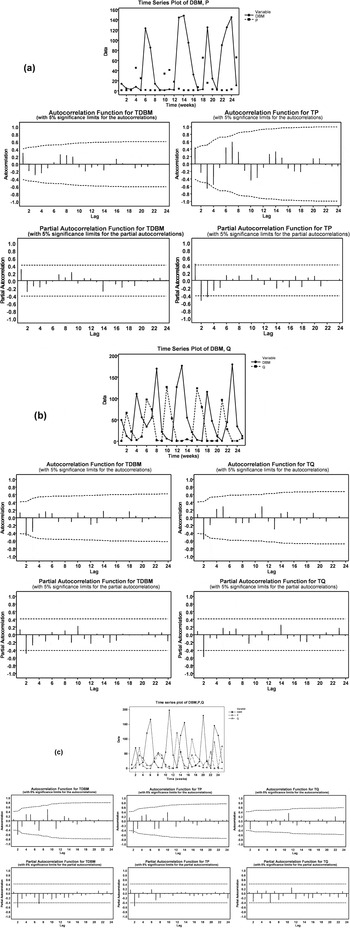
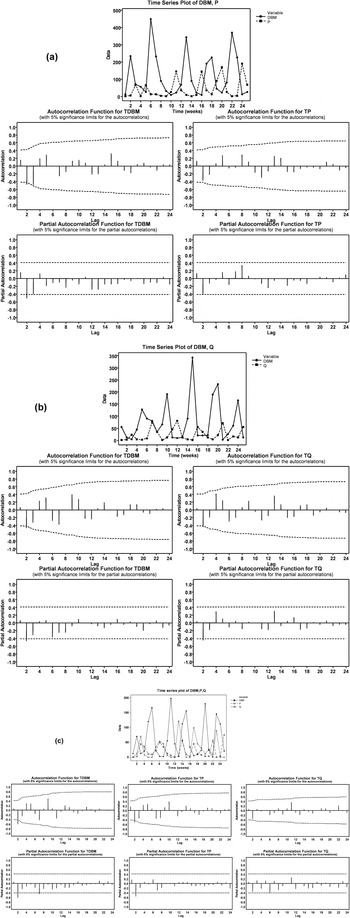
The results of ARMA modeling for mixed and single-parasitoid populations under limited plant availability (tables 2 and 3 respectively) identified a range of different process combinations underpinning the observed fluctuations. PACFs indicated that both density-dependent and -independent processes support the different observed series under both plant setups (figs 3 and 4).
Transformed time series, autocorrelation functions (ACF) and partial autocorrelation functions (PACF) for insect populations, Plutella xylostella (DBM), Diadegma semiclausum (P) and Cotesia vestalis (Q) under limited plant availability. TDBM, TP and TQ are transformed time series for P. xylostella (DBM), D. semiclausum (P) and C. vestalis (Q), respectively.

Transformed time series, autocorrelation functions (ACF) and partial autocorrelation functions (PACF) for insect populations, Plutella xylostella (DBM), Diadegma semiclausum (P) and Cotesia vestalis (Q) under unlimited plant availability. TDBM, TP and TQ are transformed time series for P. xylostella (DBM), D. semiclausum (P) and C. vestalis (Q), respectively.

Statistical modeling from population time-series data of Plutella xylostella, Diadegma semiclausum and Cotesia vestalis on canola cultivar SLM046 through mixed population (full system) under two different palnt availabilities (limited and unlimited) under constant environmental conditions in glasshouse. Mixed autoregressive-moving average (ARMA) models were fitted to the data for each species individualy in mixed populations.

DDD, DiDD, DI, ARMA and AR are abbreviations for delayed density dependent, direct density dependent, density independent, mixed autoregressive-moving average model and autoregressive model, respectively.
1 PACF showed a significant correlation at lag 5, but model fitting showed that no suitable model exists for describing the series behavior. C is an abbreviation for the estimated constant term.
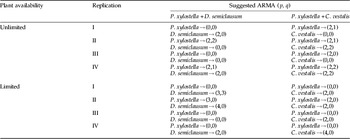
Statistical modeling from population time-series data of Plutella xylostella, Diadegma semiclausum and Cotesia vestalis on canola cultivar SLM046 through single-parasitoid populations (P. xylostella +D. semiclausum and P. xylostella +C. vestalis) under two different palnt availabilities (limited and unlimited) under constant environmental conditions in glasshouse. Mixed autoregressive-moving average (ARMA) models were suggested for each species data series individualy in each populations.

Linear statistical modeling under limited plant availability
Model suggestion for P. xylostella
For P. xylostella, co-occurring with D. semiclausum, ACF and PACF showed that neither a density-dependent component nor moving average process was identified. However, the found periodicity in the ACFs of P. xylostella was not significant (fig. 3a). For P. xylostella plus C. vestalis, PACF indicated that delayed density-dependent processes are prevalent in this case as a density-dependent component was identified at lag 2 that showed a dependence of the current population density of the herbivore on the 2-weeks ago population density (table 3, fig. 3b). In the full system (P. xylostella+D. semiclausum+C. vestalis), PACF showed a delayed density-dependent process as a promoter of herbivore dynamics (table 2, fig. 3c). Insect populations appeared to have periodic dynamics as significant periodicity was found in the ACFs of P. xylostella and D. semiclausum (fig. 3c). The herbivore time series were examined for ARMA models according to significant lags. The best model for P. xylostella in this case was
 $$\eqalign{\ln (x_t ) =\tab 3.66 + 0.52\,{\rm ln}(x_{t - 1} ) - 0.64\,{\rm ln}(x_{t - 2} ) - 0.95z_{t - 1} \cr\tab+ z_t (R^2 = 0.267)$$
Model suggestion for D. semiclausum
Under the single-parasitoid setup, the autoregressive process operated on the parasitoid dynamics (table 3, fig. 3a). A significant lag was at second one which showed density dependence of the parasitoid on its population 2 weeks ago. In the full system, PACF indicated that a delayed density-dependent process governed the parasitoid population dynamics at lag 2 (table 2, fig. 3c). The ACF of the parasitoid decayed to zero, which showed a damped oscillation in its dynamics. The dynamics of the parasitoid in the full system was evaluated as that could predict the current population abundance of the parasitoid based on its lagged population with a random effect:
 $${\rm ln}(x_t ) = 3.28 - 0.68\,{\rm ln}(x_{t - 2} ) + z_t (R^2 = 0.337)$$
Model suggestion for C. vestalis
In the P. xylostella+C. vestalis coexistence case, the parasitoid populations showed evidence of delayed density dependence (a pure second-order autoregressive process and prevalent PACF) (table 3, fig. 3b). ACF showed that lag 2 was significant and autocorrelations become progressively small as the lag increases (fig. 3b). Under the full insect assemblage there was neither delayed density-dependent nor density-independent pattern (table 2, fig. 3c). Indeed, partial autocorrelation indicated that delayed density-dependent processes are absent in this case.
Linear statistical modeling under unlimited plant availability
Model suggestion for P. xylostella
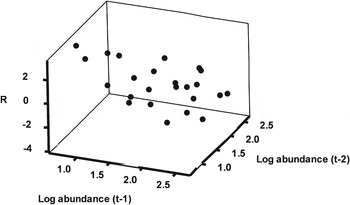
A second-order autoregressive process coupled with moving average was identified for the herbivore in all three coexistence cases (table 3, fig. 4a–c). In the full system (P. xylostella+D. semiclausum+C. vestalis) the population exhibited a different kind of non-stationarity, in which the mean stayed nearly constant, but the amplitude of oscillations increased with time (fig. 4c). However, a significant lag was obtained at lag 2 which showed the delayed density dependence for the herbivore in this case. The replacement rate N t /N t−1 was log transformed obtaining the rate of population change of the herbivore under the full system, r t =log(N t /Nt− 1). The scatter plot of the reproductive potential, r t , of P. xylostella versus time lags showed its delayed density-dependent population dynamics (fig. 5). The best model fitted to the herbivore time series was evaluated as
 $${\rm ln}(x_t ) = 4.53 + 0.34\,{\rm ln}(x_{t - 1} ) - 0.45\,{\rm ln}(x_{t - 2} ) + z_t (R^2 = 0.236)$$
Scatter plot of reproductive potential R t =ln(N t+1/N t ), for Plutella xylostella versus log abundance of its population in time t−1 and t−2 under unlimited plant availability co-occurring with both parasitoids (mixed population). The respective model is presented in the text.

Model suggestion for D. semiclausum
In both coexistence cases, neither the density-dependent component nor the moving average process was identified (tables 2 and 3; fig. 4a and c). The predominant model for the parasitoid in this case was a random process. No significant PACF showed that the density-dependent process did not govern the parasitoid population dynamics. As there was no suitable model to the time series, model diagnosis calculations were performed without software. To evaluate the existence of a trend in the model, t statistics with the following formulae was used:
 $$t{\rm = mean/SEmean = 2}{\rm. 937/0}{\rm. 335 = + 8}{\rm. 77}$$
As t>2, the constant term was significant. Consequently, the suggested model was determined as a random process with increasing trend (+8.77) as follows:
 $$x_t - x_{t - 1} = 2.93 + z_t $$
Discussion
To predict how a population changes with time numerically, abundances of interacting species are necessary to be valued; as population abundances of animals are usually interacted with population abundances of resources, natural enemies and competitors (Turchin & Taylor, Reference Turchin and Taylor1992). This prerequisite leads researchers to study community's interacting species concurrently in terms of population dynamics. An important interaction in the current experiment was competition of parasitoids on the escaped/easy to get to hosts under two different plant availabilities/structures, high and low, respectively. However, the herbivore, under limited plant setup and the absence of parasitoid competition inadequately showed the main pattern, delayed density dependence. The herbivore, P. xylostella, when suffering from lower food and refuges (usually due to skeletonized plant leaves by the herbivore larvae) showed no specific population dynamics pattern in the presence of either parasitoid D. semiclausum or C. vestalis; the dynamics was essentially random. But when interacting with both parasitoids simultaneously, its predominant dynamics pattern was delayed density-dependent. Under the other plant situation, unlimited availability, in which the herbivore did not suffer from starvation (or food stress) and could escape from parasitoids more easily, the herbivore showed a pattern of ARMA(1,1) predominantly in the presence of either the parasitoid D. semiclausum or C. vestalis. But when both parasitoids act in concert on the herbivore, the herbivore dynamics pattern was delayed density-dependent usually (significant lag at week 2, i.e. dependence on its population 2 weeks ago). The parasitoid, D. semiclausum, under different plant availabilities and different coexistence situations (either +competitor or –competitor) showed specific and predictable dynamics pattern that was governed mainly by the delayed density process (significant lags at weeks 2–4). The scenario was very different for the parasitoid C. vestalis under different experimental conditions. When the plant availability was low and the host was easier to be located, the presence of competitor had no effect on the population dynamics pattern of the parasitoid, C. vestalis. However, when high plant availability were established and subsequently the hosts escaped more easily from the parasitoids, parasitoid competition resulted in a change in population dynamics pattern of C. vestalis from ARMA(2,2) to ARMA(1,1). In these cases, however, the moving average process was significant that could be related to different characteristics (physical or chemical) of different individual plants that were replaced periodically through the experiment. Interestingly, under the full system conditions (herbivore+both parasitoids) plant availability had no substantial effect on the population dynamics of the herbivore, but for both parasitoids the dynamics patterns were different under different coexistence conditions (+competitor, −competitor). Among all cases, there were a few cases in which lag at week 1 was significant that suggested that direct density-dependent factors did not play a crucial role in the dynamics of the interactions predominantly.
In conclusion, the initial hypothesis on the persistence of the parasitoid–host interactions was confirmed for both plant conditions and all insect assemblages were tested through all.
Both insect assemblage and plant availability had profound effects on the mean population size of the herbivore. But, in contrast to plant availability, insect assemblage had no significant effect on the population size of both parasitoids in contrast to beneficial/costly interference concepts, under which each consumer potentially might be affected (positively and negatively, respectively) by its competitor (Amarasekare, Reference Amarasekare2002). Plant availability has been altered to give rise to strikingly different plant forms and structures. In this experiment, the structure of the crucifer studied constrained parasitoids searching for hosts. Both parasitoid species performed best under high plant availability which had the most complex structure in contrast to our initial hypothesis. However, the interaction strength between two parasitoids was not different under both plant setups. In one result, parasitoids could find more hosts due to higher availability of them as a result of higher plant resources offered to them. While, refuges were high as well, the mentioned option helped parasitoids to perform more powerfully.
Karimzadeh et al. (Reference Karimzadeh, Bonsall and Wright2004), using a P. xylostella–C. vestalis system, suggested that the host plant resistance has a profound effect on the population dynamics of P. xylostella, but not on its mean population size. Indeed, they found that the presence/absence of the parasitoid showed no effect on the herbivore mean population size. Obviously, the system examined by Karimzadeh et al. (Reference Karimzadeh, Bonsall and Wright2004) did not experience parasitoid competition, in contrast to the current study, and they used different bottom-up effects, plant resistance, versus the plant availability in the current study. Interestingly, dynamics of P. xylostella in our artificial system was governed mainly by a delayed density-dependent pattern under unlimited plant availability, while under other plant setup, P. xylostella showed this pattern inadequately (just in one case). Consequently, under both plant setups, our results differ from Karimzadeh et al. (Reference Karimzadeh, Bonsall and Wright2004), as they found diverse dynamics patterns governing P. xylostella on both tested plants.
P. xylostella had more extinction risk when two parasitoids compete under limited plant availability than under unlimited plant availability. However, when two parasitoids act in concert, the extinction risk of the herbivore was higher under both plant availabilities which could be probably due to the decrease in top-down force of interacting parasitoids. Indeed, the extinction risk of C. vestalis was higher than that of its competitor under both plant availabilities and different insect assemblages which could be probably due to its lower performance correlates such as searching efficiency than its competitor that is verified by some behavioral studies (e.g. Wang & Keller, Reference Wang and Keller2002). As an implicit result, C. vestalis acts better in the absence of a competitor but D. semiclausum works well when it is engaged in competition in terms of P. xylostella population control. According to the host–parasitoid mean population sizes, in one result D. semiclausum benefits from the coexistence and conversely C. vestalis suffers from the competitor presence. Consequently, Amarasekare's (Reference Amarasekare2002) assertion on these mechanisms can be verified. Behavioral studies on these two competing parasitoids in single arena showed diverse results; as in some cases D. semiclausum is the winner (Wang & Keller, Reference Wang and Keller2002), while C. vestalis excludes its competitor in some other cases (Shi et al., Reference Shi, Li and Li2004). However, the parasitoids’ functional response (Naji & Balasim, Reference Naji and Balasim2007) and parasitoids’ efficiency (Cassinari et al., Reference Cassinari, Groppi and Tebaldi2007) are key determinants in any analysis of the stability of tritrophic systems, which potentially could be affected by plant availability indirectly. However, these aspects have not been determined in the current study.
In summary, P. xylostella dynamics was not mainly identical under both plant setups and different insect assemblages. However, when both factors (plant availability and parasitoid competition) act in concert, the P. xylostella dynamics showed nearly the same pattern under both plant setups. For both parasitoids, dynamics was mainly governed by a delayed density-dependent process. It seems that when P. xylostella suffer from some starvation periods or resource limitation (less refuge), it does not show any known pattern in its dynamics when it is involved with one enemy (table 3); however, when P. xylostella encounters two competing enemies simultaneously, then the bottom-up effect are shown less clearly i.e. less effect of plant-related refuge. For both parasitoids when they acted alone, the plant availability did not affect their dynamics to any considerable extent. The latter result indicated that plant-related refuge could not affect the dynamics of both parasitoids when they did not experience a competitor.
Some applied implications
Understanding bottom-up and top-down force interactions considering some intra-level forces like competition among natural enemies remains a key focus for developing the integrated management programs for such systems from two important viewpoints: selecting the biological control agents and making decision on the cropping systems in which the planting quality and quantity play significant roles in the programs in question. Based on this study we would suggest that introducing two biological control agents concurrently, which are very similar ecologically, depressed less the population of shared host than when each parasitoid acts alone. However, the herbivore population size was depressed well and significantly when resource limitation was established. If there was no resource limitation at work for the herbivore, then both parasitoids showed more abundance under a coexistence situation. This means that experiencing an herbivore without food stress promotes the beneficial interference between two competing parasitoids; a phenomenon that has been demonstrated nowhere behaviorally. Restricted plant availability plus introducing just one parasitoid may be recommended more strongly in pure agricultural systems in which there are no native parasitoids. In other words, to manage guilds seems to be more effective by adding/removing some species than to manage the middle trophic level.