Scholars have indicated that legislators have three main goals: re-election (Arnold Reference Arnold1990; Fenno Reference Fenno1973; Mayhew Reference Mayhew1974), influence within the legislature (Campbell Reference Campbell1982) and the enactment of good public policies (Fenno Reference Fenno1973; Groseclose Reference Groseclose2001; Wittman Reference Wittman1983). Hence, the job of the legislator is multifaceted (Frantzich Reference Frantzich1979) and revolves around three main roles: legislation, oversight and representation (see, for example, McCubbins and Schwartz Reference McCubbins and Schwartz1984; Mayhew Reference Mayhew2000). This article concentrates on the goal of re-election, even though the two other goals are connected to each other, and examines the ability of legislators to be re-elected by fulfilling their three roles.
This study also re-examines Mayhew's claim (1974) that most legislators are motivated by a desire to be re-elected, and that this desire determines their legislative activity by advertising, credit claiming and position taking. We argue that different skills are required to be re-elected and to enact legislation.
Literature Review
Re-election
Re-election rates have important consequences for the quality of a democracy (Altman and Chasquetti Reference Altman and Chasquetti2005), so we should expand our understanding of this process. As a first step, we need to understand that in countries in which citizens vote for a political party rather than an individual, the key to an individual's success in elections is first that they are selected for a position on the party's list and then that they are placed high enough up on that list that they will actually receive a seat in the legislature if their party wins. Therefore, we will first review the selection process and then the re-election process.
Previous studies found that different candidate selection methods create different behaviours among legislators (Akirav Reference Akirav2010; Gallagher and Marsh Reference Gallagher and Marsh1988; Marsh Reference Marsh2007; Pennings and Hazan Reference Pennings and Hazan2001; Sheafer and Tzionit Reference Sheafer and Tzionit2006). Legislators have to raise their own money to lobby for selection by their parties (Pennings and Hazan Reference Pennings and Hazan2001) and try to attract the media through populist issues (Sheafer and Tzionit Reference Sheafer and Tzionit2006; Squire Reference Squire1988a). When seeking selection they connect with their constituents more intensely than previously (Gallagher and Marsh Reference Gallagher and Marsh1988; Pennings and Hazan Reference Pennings and Hazan2001), and they become more independent and more oriented towards individual concerns (Akirav Reference Akirav2010).
Having overcome the first hurdle of being selected by the party, what other factors determine the success of a legislator seeking re-election? The first factor is incumbency. Studies about incumbents’ re-election rates show that, although there is variance among democracies, being an incumbent is an advantage (Arian Reference Arian1994; Arnold Reference Arnold1990; Jacobson Reference Jacobson1996; Matland and Studlar Reference Matland and Studlar2004; Squire Reference Squire1988b). Political incumbents in all systems enjoy a privileged position within their own districts in terms of their visibility, name recognition and their ability to garner votes by providing services to constituents. In the last 30 years the resources of legislators have expanded to include permanent staffs, electoral offices and increased salaries (Cain et al. Reference Cain, Ferejohn and Fiorina1987; Heitshusen et al. Reference Heitshusen, Young and Wood2005; King Reference King1991). Rothental (Reference Rothental1996) identified the ‘five Ss’ inherent in a professional legislature: space, salary, session length, staff and structure. Hence, legislators from highly professionalized bodies are more likely to win re-election than members of less professionalized legislatures. Furthermore, professionalization promotes legislative institutionalization by establishing boundaries that shield members from external shocks (Berry et al. Reference Berry, Berkman and Schneiderman2000; Krasa and Polborn Reference Krasa and Polborn2010). Studies of the personal vote in the UK support the contention that servicing one's constituency is important to voters and contributes to a small but significant voting bonus for incumbents (Gaines Reference Gaines1998; Norton and Wood Reference Norton and Wood1990; Wood and Norton Reference Wood and Norton1992). The same trend emerges in studies of the US (Altman and Chasquetti Reference Altman and Chasquetti2005; Arnold Reference Arnold1990; Cain et al. Reference Cain, Ferejohn and Fiorina1987; Erikson Reference Erikson1972; Jacobson Reference Jacobson1996; Rocca and Gordon Reference Rocca and Gordon2010) and Canada (Cunningham Reference Cunningham1971; Krashinsky and Milne Reference Krashinsky and Milne1986; Soroka et al. Reference Soroka, Penner and Blidook2009). In the early 1990s, Arnold (Reference Arnold1990: 44) introduced the notion of the ‘traceability chain’, noting that ‘the incumbent performance rule provides citizens with an alternative approach for monitoring the performance of government and for rewarding or punishing those responsible for its performance’.
In contrast to the literature mentioned above, some scholars contend that individual candidates are essentially irrelevant to electoral outcomes. While there is at best a small incumbency advantage for sitting MPs (Gaines Reference Gaines1998), the swing ratio (the responsiveness of seats to votes) has been declining (Tufte Reference Tufte1973). There is no rise in incumbent re-election rates (Cover Reference Cover1977). Individual incumbents are no safer today than they were a generation ago (Ansolabehere et al. Reference Ansolabehere, Brady and Fiorina1992), and the rise in the vote margins for incumbents in the mid-1960s did not produce a commensurate increase in incumbent re-election rates (Collie Reference Collie1981).
Nevertheless, other studies are inconclusive as to the effect of incumbency on re-election (for example, Akirav Reference Akirav2010; Banks and Sundaram Reference Banks and Sundaram1998; Ferejohn Reference Ferejohn1986; Lott and Bronars Reference Lott and Bronars1993; Persson and Tabellini Reference Persson and Tabellini2000; Poole and Rosenthal Reference Poole and Rosenthal1997; Rothenberg and Sanders Reference Rothenberg and Sanders2000). Principal–agent theory studies the relationship between voters and incumbents. The basic assumption of the theory is that there is a moral hazard problem between the incumbents and the voters; the incumbents will pursue their own interests rather than those of the voters (see, for example, Banks and Sundaram Reference Banks and Sundaram1998; Ferejohn Reference Ferejohn1986; Persson and Tabellini Reference Persson and Tabellini2000). In the literature, this situation is called ‘shirking’ – the degree to which a politician's actions deviate from the wishes of his or her constituents. Rothenberg and Sanders (Reference Rothenberg and Sanders2000: 322) found that US congressmen do pay attention to what their constituencies want when they are up for re-election, but give less attention to such desires when they are not. Other scholars discovered no evidence of ideological shirking (for example, Lott and Bronars Reference Lott and Bronars1993; Poole and Rosenthal Reference Poole and Rosenthal1997). Politicians who face re-election are more likely to vote in accordance with their ideological beliefs because both the politicians and the voters value the politician's actions (Lott Reference Lott1987). In sum, we can say that the literature is inconclusive about the impact of incumbency on the probability of being re-elected. This article will examine incumbents in two parliamentary terms in order to see the changes over time and to determine whether an incumbent's activity is one of the explanations for his or her re-election.
A second explanation offered in the literature focuses on the electoral system. Mayhew's ‘electoral connection’ (1974) provides one of the major theoretical frameworks for understanding how legislators behave. Several studies examine how different electoral systems provide different incentives to politicians, thereby creating different kinds of connections between voters and legislators (Akirav Reference Akirav2010; Bowler and Farrell Reference Bowler and Farrell1993; Carey and Shugart Reference Carey and Shugart1995; Gallagher and Marsh Reference Gallagher and Marsh1988; Lancaster Reference Lancaster1986). Different electoral systems create different types of legislators, as is evident when we compare Germany (Lancaster and Petterson Reference Lancaster and Petterson1990; Stratmann and Baur Reference Stratmann and Baur2002) and Israel (Akirav Reference Akirav2010; Hazan and Rahat 2010).
A great deal of research also explores the link between electoral competition and legislative behaviour. Some posit that competition may influence how much legislating representatives do in office (Jones Reference Jones2003; Mayhew Reference Mayhew1974). In addition, a large body of literature investigates how electoral vulnerability affects legislators’ policy responsiveness to their constituencies (for example, Erikson Reference Erikson1979; Fiorina Reference Fiorina1974; Griffin Reference Griffin2006; Patterson Reference Patterson1961; Stone Reference Stone1979; Sulkin Reference Sulkin2009). The dominant normative claim is that electoral competition is good for democracy because it promotes representation and responsiveness.
The two-stage election process requires legislators to focus on two separate constituencies: the primary constituency and the general election constituency. The primary constituency is the party base, a small subset of voters who are more ideologically extreme than the moderate general election constituency (Aldrich Reference Aldrich1995; Mayhew Reference Mayhew1974; Norrander Reference Norrander1989). Thus, balancing these interests might prove difficult for legislators (Adams and Merrill Reference Adams and Merrill2008; Burden Reference Burden2001).
Latin American legislatures with diverse electoral systems vary a great deal in terms of the re-election of incumbents (Altman and Chasquetti Reference Altman and Chasquetti2005: 236). Altman and Chasquetti (Reference Altman and Chasquetti2005) observed a declining but still high rate of turnover of legislators in the Uruguayan Congress. The legislative turnovers are affected by a significant number of legislators who do not seek re-election. Matland and Studlar (Reference Matland and Studlar2004) analysed turnover rates from 25 industrialized countries and found that the average incumbency return rate is 67.7 per cent, and that the average turnover per year is 9.56 per cent. Their results show that frequency of elections, the opportunity for double listings, electoral volatility and legislative institutionalization have statistically significant effects on turnover rates.
In sum, we can say that differences in electoral systems and candidate selection methods lead to different outcomes. Some systems strengthen the power of the individual, some the power of the parties and some try to balance the power of the individual and the power of the party (Gallagher and Mitchell 2005; Hazan and Rahat 2010; Katz 2001; Norris 2001). In all of these systems, however, the candidates’ desire to be re-selected by their party and to be re-elected is essential. In this study, we look at three different kinds of candidate selection methods and a proportional electoral system without constituencies. Hence, it will be interesting to see how the system affects the re-election of incumbents.
The third explanation concerns effectiveness. The basic assumption behind this factor is that active legislators who are considered to be effective in their roles will gain the voters’ support. Scholars are inconclusive about this connection; most found empirical evidence for its existence (Arnold Reference Arnold1990; Brady et al. Reference Brady, Fiorina and Wilkins2011; Campbell Reference Campbell1982; Jacobson Reference Jacobson1996; Miquel and Snyder Reference Miquel and Snyder2006; Rocca and Gordon Reference Rocca and Gordon2010; Sheafer and Tzionit Reference Sheafer and Tzionit2006; Soroka et al. Reference Soroka, Penner and Blidook2009), but a few did not (Frantzich Reference Frantzich1979; Sheafer and Tzionit Reference Sheafer and Tzionit2006).
Arnold (Reference Arnold1990) dealt with the question of how legislators decide which side to support when a policy proposal comes before the US Congress. How do they estimate the impact that decisions in Washington might have on their electoral margins at home? In order to examine the question, he introduced the idea of the ‘traceability chain’, which he described as the ability of a citizen to trace an observed effect first back to a governmental action and then back to a representative's individual contribution (Arnold Reference Arnold1990: 47). Furthermore, traceability requires the existence of three conditions: a perceptible effect, an identifiable governmental action and a legislator's visible contribution. If all three conditions hold, it is likely that a legislator's constituents will assess his or her performance as good and will therefore re-elect the incumbent. Arnold (Reference Arnold1990) concluded by saying that legislators’ performances do affect their likelihood of being re-elected.
Following Arnold's conclusions (1990), Miquel and Snyder (Reference Miquel and Snyder2006) found that more effective legislators are less likely to be challenged and more likely to win re-election. Campbell (Reference Campbell1982) found that co-sponsorships can be used to political advantage when candidates are seeking re-election. Jacobson (Reference Jacobson1996) argued that if legislators deal with issues in which their constituents are interested, their probability of being re-elected increases. He claimed that in the US the Republicans Party won the 1994 election because it succeeded in framing local choices in national terms. In accordance with Jacobson's theory (1996), the 2010 election in the US created a dramatic change, sweeping many incumbents from the House of Representatives (Brady et al. Reference Brady, Fiorina and Wilkins2011). In both elections, the Democratic candidates were defeated by the Republican candidates mainly because the Democratic agenda was not close to that of their constituents. Empirically, both Jacobson (Reference Jacobson1996) and Brady et al. (Reference Brady, Fiorina and Wilkins2011) examined roll-call votes as a factor in the likelihood of being re-elected. This article examines the connection between legislators’ performance in the legislature and their likelihood of being re-elected, but we expand the examination to more than one parliamentary tool.
Other scholars have used various empirical approaches in examining this connection (Rocca and Gordon Reference Rocca and Gordon2010; Soroka et al. Reference Soroka, Penner and Blidook2009). Rocca and Gordon (Reference Rocca and Gordon2010) argued that non-roll call positions are used by interest groups to acquire information about the direction and intensity of legislators’ preferences. Legislators, in turn, use them to attract campaign contributions from potential donors. Their results showed a strong relationship between one form of non-roll call behaviour in the US Congress, bill sponsorship and contributions from ideological political action committees (PACs). They concluded that the position taken in non-roll call votes matters (Rocca and Gordon Reference Rocca and Gordon2010: 393). Soroka et al. (Reference Soroka, Penner and Blidook2009) examined dyadic representation, which is the relationship between the characteristics of the legislator's constituents and his or her behaviour in a parliamentary system. Their innovation was that they examined the dyadic representation outside the US and the roll-call voting contexts using oral questions. They found evidence of dyadic representation in Canada. This article also uses oral questions, but combines them with other parliamentary tools.
In contrast to these studies, Frantzich (Reference Frantzich1979: 425) noted that ‘legislative effectiveness fails to provide substantive electoral rewards to congressmen . . . those congressmen with impressive records in getting their legislation passed . . . were more likely to see a decrease in their electoral margin than those with less success in the legislative arena’. Sheafer and Tzionit (Reference Sheafer and Tzionit2006) found that the level of incumbents’ parliamentary activity had no impact at all on their electoral success, regardless of the candidate selection method. In sum, we can see that most studies found evidence that legislators’ performance affects their probability of being re-elected.
How can we explain the fact that in some cases being an active legislator does not help the individual get re-elected? One explanation for this disconnect relies on human nature. When you are active, you are seen and heard. Some may disapprove of the way you act or vote. In contrast, when you are quiet and unseen, you do not create antagonism.
In order to be seen and heard, legislators try to gain media attention. In the US, individual congressmen use the media to show their voters how active they are in order to be re-elected (Cook Reference Cook1986; Ornstein Reference Ornstein1983; Ranney Reference Ranney1983). Based on journalists’ ranking of legislators in several states, Luttbeg (Reference Luttbeg1992) found that legislators with the highest ranking have a 12 per cent higher probability of re-election than those with the lowest ranking. Thus, effectiveness is about the ability of legislators to do their jobs and demonstrate that ability to the voters. Arnold's traceability chain (1990) presents a similar perspective. Legislators expect that the voters will appreciate their fulfilment of their roles and will re-elect them.
Some scholars have found a connection between two of our explanations – incumbency and effectiveness. Being a senior incumbent is the dominant explanation for legislative effectiveness, legislative entrepreneurship and sponsorship of legislation (Anderson et al. Reference Anderson, Box-Steffensmeier and Sinclair-Chapman2003; Frantzich Reference Frantzich1979; Garand and Burke Reference Garand and Burke2006; Hamm et al. Reference Hamm, Harmel and Thompson1983; Hibbing Reference Hibbing1991; Mayhew Reference Mayhew2000; Miquel and Snyder Reference Miquel and Snyder2006; Moore and Thomas Reference Moore and Thomas1991; Schiller Reference Schiller1995). In sum, we can say that re-election is an important goal for legislators, but the connection between the legislators’ activities in the legislature and their ability to be re-elected is unclear and inconclusive.
The fourth explanation involves charismatic communication skills, which Sheafer and Tzionit (Reference Sheafer and Tzionit2006: 181) defined as the actor's demonstrated skills, performance and talent that are pertinent to the main arena in which she or he operates. In an era of mass communication that demands attention both from the voters and from legislators, having communication skills is an essential factor for legislators’ success and their ability to be re-elected (see, for example, Cook Reference Cook1986, Reference Cook1996; Mazzoleni and Schulz Reference Mazzoleni and Schulz1999; Prior Reference Prior2006; Sheafer Reference Sheafer2001; Sheafer and Tzionit Reference Sheafer and Tzionit2006; Squire Reference Squire1988a).
Several studies of the Israeli parliament underscore these points. Sheafer and Wolfsfeld (Reference Sheafer and Wolfsfeld2004) examined how legislators compete for media coverage and found that political standing and charismatic communication skills are important predictors of media exposure. Furthermore, the relative importance of these factors changes during different political seasons. Sheafer and Tzionit (Reference Sheafer and Tzionit2006) concentrated on the influences of the media and the political skills of political actors on their electoral success, demonstrating that both have a strong impact on the electoral success of Israeli members of the Knesset. Ironically, legislative activity alone had no impact on their electoral success. We do not examine the effect of charismatic communication skills on the probability of being re-elected, but we will address this factor in our conclusions.
While communication skills are important, the use of new communication technologies is increasingly a prerequisite for targeting voters directly. Such technologies bypass the mass media as well as the party organizations. Hence, the fifth and last explanation revolves around the information revolution that has accelerated since the invention of the internet and has an enormous effect on public life (Doron Reference Doron2011). Through the use of the internet, legislators and parties have become transparent and accessible to the public. Information about the legislators’ performance is available on the websites of the parliament and the personal websites of the legislators, and on their Facebook pages. In addition, the new technology makes direct contact between legislators and their constituents simple (Jackson Reference Jackson2003; Leston-Bandeira Reference Leston-Bandeira2012; Ward and Lusoli Reference Ward and Lusoli2005; Ward et al. Reference Ward, Gibson and Lusoli2007, Reference Ward, Lusoli and Gibson2008; Williams and Gulati Reference Williams and Gulati2008; Williamson Reference Williamson2009; Zittel Reference Zittel2008). Furthermore, parties use their websites during the election period to address the public directly (Foot and Schneider Reference Foot and Schneider2006; Gibson et al. Reference Gibson, Margolis, Resnick and Ward2003; Ward et al. Reference Ward, Gibson and Lusoli2008; Xenos and Foot Reference Xenos and Foot2005).
Thus, the factors affecting the probability of re-election have changed over time because of changes in candidate selection methods, in the electoral systems, in mass communications and in technology. Each factor, or combination of factors, has changed the rules of the political game. Therefore, it is important to examine traditional claims in this area with fresh new data about their existence or relevance.
Legislators’ Roles
As mentioned previously, legislators have three main roles: legislation, oversight and representation. Sometimes these roles overlap. Moreover, legislators act in two arenas – within their constituency and in the legislature. Each legislator determines how much time to devote to each area (Fenno Reference Fenno1978; Hall Reference Hall1996; Parker Reference Parker1986). In the legislature there are two formal arenas – the committees and the floor (Fenno Reference Fenno1973; Hall Reference Hall1996; Hazan Reference Hazan2001). In addition to the formal roles and activities of legislators, there are the informal roles and activities, which are hard to define and to measure. Indeed, the job of the legislator is multifaceted (Frantzich Reference Frantzich1979), ambiguous and highly demanding (Gallagher Reference Gallagher2005; Grant and Rudolph Reference Grant and Rudolph2004).
How do legislators decide where and when to invest their time? Such decisions arise from several sources. First, when they enter politics, individual candidates bring with them a background of education, experience and personal interests. This background may focus their interests on certain policy issues rather than others. Second, once in office, individuals may choose to work on those issues with which they feel most comfortable. This self-selection further strengthens whatever initial competence the candidate brings to those specific policy issues. Third, citizens organize themselves into parties based on their background and preferences, so that individuals who become candidates are first of all citizens with certain policy preferences. Fourth, parties can be seen as networks whose members cooperate in providing government services.
How do we measure legislators’ fulfilment of their roles? In light of Mayhew's ‘electoral connection’ (1974), how does the fulfilment of their role affect the likelihood of re-election? What do citizens expect from their representatives (Grant and Rudolph Reference Grant and Rudolph2004)? For example, scholars have found a gap between the reality of legislators’ jobs and the way the public sees them (Krasno Reference Krasno1994). Finally, is there any connection between the fulfilment of expectations and the re-election of the incumbents?
In this study, we will concentrate on the formal roles of legislators as they are practised on the floor: legislation, one-minute speeches, motions for the agenda and parliamentary questions. Legislation is about creating order, setting the political agenda and establishing democracy. Research in this field is wide-ranging and deals with three areas: setting the agenda (Cox and McCubbins Reference Cox and McCubbins2005; Laver and Shepsle Reference Laver and Shepsle1996; Tsebelis Reference Tsebelis2002), explanations for the increased amount of legislation (Anderson et al. Reference Anderson, Box-Steffensmeier and Sinclair-Chapman2003; Frantzich Reference Frantzich1979; Gladdish Reference Gladdish1990; Marsh and Marsh Reference Marsh and Marsh2002; Olson Reference Olson1994; Sinclair Reference Sinclair1986; Stratmann Reference Stratmann2000) and the content of the legislation (Clinton and Lapinski Reference Clinton and Lapinski2006; Mayhew Reference Mayhew1991).
Parliamentary questions are a tool with which legislators oversee the government. Scholars have dealt with the use of parliamentary questions to criticize and supervise the government's activities (for example, Akirav Reference Akirav2011; Cole Reference Cole1999; Franklin and Norton Reference Franklin and Norton1993; Penner et al. Reference Penner, Blidook and Soroka2006; Saalfeld Reference Saalfeld2011; Soroka et al. Reference Soroka, Penner and Blidook2009; Wiberg Reference Wiberg1994) and have tried to explain the variations in the number of parliamentary questions asked by legislators (Hayward Reference Hayward2004; Rasch Reference Rasch1994; Searing Reference Searing1993; Wiberg Reference Wiberg1994).
Motions for the agenda are a means of highlighting certain issues (Atkinson and Docherty Reference Atkinson and Docherty2004; Rasch Reference Rasch2000). Studies have looked at the ‘opposition days’ in the Canadian House of Representatives in which the opposition is allowed to submit motions for the agenda (Atkinson and Docherty Reference Atkinson and Docherty2004) and the voting pattern on motions in a variety of European legislatures (Rasch Reference Rasch2000).
One-minute speeches are about the ability of the legislator to talk directly both to other legislators and to the voters. Studies have looked at how members of the US Congress use one-minute speeches (Maltzman and Sigelman Reference Maltzman and Sigelman1996; Rocca Reference Rocca2007). Explanations for the number of one-minute speeches posit that they are most frequent among institutionally disadvantaged members of Congress (Morris Reference Morris2001; Rocca Reference Rocca2007), ideologically extreme members of Congress (Maltzman and Sigelman Reference Maltzman and Sigelman1996; Morris Reference Morris2001; Shepsle Reference Shepsle1979) and members of Congress who are members of minority parties (Maltzman and Sigelman Reference Maltzman and Sigelman1996; Morris Reference Morris2001). Other studies have considered the content of one-minute speeches (Polletta Reference Polletta1998; Hall Reference Hall2002). However, in spite of this literature, there is relatively little research on the determinants or effects of individual legislators’ performance (exceptions to this are Miquel and Snyder Reference Miquel and Snyder2006; Soroka et al. Reference Soroka, Penner and Blidook2009).
Hypothesis And Model
Hence, this study suggests a model for examining legislators’ performance by expanding the definition of legislators’ productivity to include the use of the formal tools available to them in a specific parliament. We regard activities as formal if they are based on the procedures of the legislatures. Hence, the model includes the use of four tools – legislation, motions for the agenda, parliamentary questions and one-minute speeches.
Table 1 presents the content of the productivity model. The model combines several tools available to legislators in the Israeli parliament. The table indicates their primary purposes, their degree of significance and the weight they have in the model. The model uses a scale from 0 to 100 to measure legislators’ productivity. We will start with an explanation of how we decided to weight each tool, and then we explain how we converted it to a scale from 0 to 100.
Productivity Model

Each tool receives a weight relative to the other tools. Our decision about the weight assigned to each tool is based on three different measurements. The first is theoretical and is based on the literature review in which we saw that scholars consider passing legislation as the most important role of a representative. The second measurement is the opinion of experts. We asked political scientists, parliamentary assistants, former members of the Israeli Knesset and political journalists to rank the importance of the different tools available to members of the Knesset.Footnote 1 Previous studies such as those of Mayhew (Reference Mayhew1991), Howell et al. (Reference Howell, Alder, Cameron and Riemann2000) and Miquel and Snyder (Reference Miquel and Snyder2006) have made similar use of experts. The experts’ results helped us create a sub-distribution between the different tools and within each one of them. The third measurement is statistical. We used a confirmatory factor analysis to determinate which tool is the most important and to rank the other tools relative to it. For the fourteenth Knesset (1996–9), the goodness of fit index was 0.9950, and the root mean square error of approximation (RMSEA) estimate was 0.000. For the sixteenth Knesset, the goodness of fit index was 0.9703, and the RMSEA estimate was 0.000. Both indicators confirm that the model fits the data.
The combination of the three components provides us with a valid model that we can use to address the validity problems of the scales in previous research. While we do not claim that our model is free of measurement problems, we have taken steps to try to overcome them. Thus, our model gives legislation significant weight compared to the other tools, making it account for 70 per cent of the total score in the scale. Most scholars agree that legislation is the most important tool available to legislators and use it to measure their performance (Frantzich Reference Frantzich1979; Mayhew Reference Mayhew2000; Miquel and Snyder, Reference Miquel and Snyder2006; Schiller Reference Schiller1995; Sheafer and Tzionit Reference Sheafer and Tzionit2006; Shomer Reference Shomer2009; Wawro Reference Wawro2000).
Within that 70 per cent we give more weight to passing a bill (final vote) than bringing one to the table (10 per cent for bringing a bill to the table, 30 per cent for a preliminary hearing and 60 per cent for passing a bill). Previous studies noted that the number of bills brought to the table has increased significantly. Therefore, we assigned a low weight to the introduction of a bill, but did give the ones that eventually passed greater weight.
Second, our model gives parliamentary questions weight, accounting for 12.5 per cent of the total score. We based this weighting on Wiberg and Koura's claim (Reference Wiberg and Koura1994) that parliamentary oversight is weaker than the power to legislate, but it is an important tool and no less important than legislation (see, for example, von Beyme Reference von Beyme2000; Copeland and Patterson Reference Copeland and Patterson1994; Olson Reference Olson1994). Within that 12.5 per cent, we give more weight to oral questions than to ordinary questions (60 per cent for oral questions and 40 per cent for ordinary questions). Third, our model gives one-minute speeches the most weight – 12.5 per cent – because of the initiative required and the time members of the Knesset spend on the floor during one-minute speeches. Fourth, in our model motions for the agenda account for 5 per cent of the total score, 60 per cent of which are urgent motions that display more initiative and 40 per cent of which are ordinary motions.
In order to compute the final score for each member of the Knesset, we multiply the number of pieces of legislation by the weights mentioned above. Then we multiply the parliamentary questions, one-minute speeches and motions for the agenda separately. After applying the appropriate percentage to each tool, we add all of the totals together to calculate the final score. This score demonstrates how each member of the Knesset makes use of the various tools in order to succeed in their role as legislator. As one can see, a total score of 100 per cent means that the member of the Knesset used all of the tools available to him or her to their maximum. We define those members of the Knesset with low productivity as those scoring between 0 and 30 per cent, those with medium productivity as scoring between 31 and 70 per cent, and those with high productivity as scoring between 71 and 100 per cent.
The productivity model described above is relevant for data from the sixteenth Knesset (2003–6) onwards, because one-minute speeches were added as a parliamentary tool in January 2000 in the middle of the fifteenth Knesset (1999–2003). To use the productivity model to assess Knesset terms prior to the adoption of one-minute speeches, we had to adjust it, based on the statistical analysis we conducted to validate the model. Therefore, we reweighted the components as follows: legislation accounted for 75 per cent of the total score, parliamentary questions accounted for 15.625 per cent and motions for the agenda accounted for 9.375 per cent. The internal coding remains the same as that for the sixteenth Knesset.
In light of the literature described above and the productivity model presented, we hypothesize as follows:
Hypothesis 1: The skills candidates need in order to be re-elected are different from the skills they need to fulfil their role as legislators.
We will test this hypothesis using the model described above and data from several sessions of the Israeli Knesset.
The Israeli Context
Since its establishment in 1948, Israel has had a proportional representation electoral system, except between 1996 and 2001. Thus Israel is considered as one constituency. The 120 members of the Knesset are elected by party lists. In 1992, three changes were adopted regarding the electoral system. First, there was the direct election of the prime minister.Footnote 2 Second, the threshold percentage for obtaining a seat in the Knesset was increased from 1 per cent to 1.5 per cent. Currently, the threshold for representation in the Knesset is 2 per cent – one of the lowest thresholds in Western democracies. Finally, before the general election in 1992 the Labour Party introduced closed primary elections for candidates by registered and paid-up party members. All of the other parties have a moderately inclusive candidate selection method called a ‘party caucus’ or an exclusive candidate selection method called an ‘arranged committee’.
During the thirteenth Knesset (1992–6), most parties began to consider the possibility of adopting primaries for choosing their candidates. Consequently, the candidate selection method soon became a major item on the public agenda. Before elections for the fourteenth Knesset took place, three more major parties decided to use primaries to determine their list of candidates: the Consolidation Party (Likud), the Energy Party (Meretz) and the Crossroads Party (Tsomet).
During the fourteenth Knesset, the debate regarding primary elections continued to be on the parties’ agenda, but now the voices were different. Members of the Knesset, journalists and academic researchers began to stress the disadvantages of having primary elections. Their voices were heard, and before the general election of 1999 three of the four parties that had adopted primaries reverted to their previous candidate selection method. Since 1999, the Labour Party has been the only party that still uses primaries as a candidate selection method, despite loud calls from within the party – as well as from the other three parties – to abandon them. In 2006, the Consolidation Party returned to selecting its members by primaries, and in 2012 the Jewish Home Party (Habait Hayehudy – formerly the National Religious Party, Mafdal) selected its members by primaries.
Method
In order to examine the research hypothesis, we gathered data from the fourteenth Knesset regarding legislators’ formal activities and their re-election to the fifteenth Knesset. The same kind of data was gathered for legislators from the sixteenth Knesset. We decided not to include the fifteenth Knesset for two reasons. First, during the fifteenth Knesset there was a special election just for the prime minister; Ariel Sharon defeated Ehud Barak and established a new government. Second, during the fifteenth Knesset a new parliamentary tool was adopted (one-minute speeches). Our measure for each parliamentary tool is for the whole term, so we could not include a partial measurement. Both Knesset terms (fourteenth and sixteenth) had elected a prime minister from the right wing. The fourteenth Knesset was characterized by a shrinking of party size, while in the sixteenth Knesset some of the parties regained their previous size.
The database contains the following information for each legislator: the number of bills tabled, the number of bills that were presented for a preliminary hearing and the number of bills that reached a final hearing. We added up the number of ordinary and oral parliamentary questions each legislator asked. We also totalled the number of ordinary and urgent motions for the agenda each legislator presented. For each legislator, we used the total number of one-minute speeches he or she presented. We also noted the gender, seniorityFootnote 3 and party affiliation of each legislator. Finally, we tabulated whether the legislator was re-elected to the following Knesset term (candidate was re-elected = 1, was not re-elected or did not run = 0).Footnote 4
Results
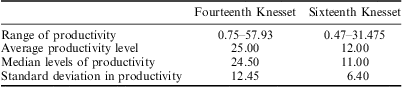
How productive are legislators in the Israeli parliament? Table 2 shows us an interesting picture. The range in the productivity model is between 0.75 and 57.93 in the fourteenth Knesset, and between 0.47 and 31.475 in the sixteenth Knesset. Some of the legislators are very productive, while others do almost nothing. The average productivity level in the fourteenth Knesset is 25, but just 12 in the sixteenth Knesset. The median levels of productivity show a similar picture: 24.5 in the fourteenth Knesset and 11 in the sixteenth Knesset. The standard deviation in the fourteenth Knesset is 12.45 and in the sixteenth Knesset it is 6.4. In both Knesset terms there were multiple modes. The data show us that the range of productivity in the sixteenth Knesset is greater than in the fourteenth Knesset. Furthermore, the central indices show that legislators from the fourteenth Knesset are more productive than the legislators from the sixteenth Knesset.
Productivity Levels of Members of the Knesset

This disparity can be explained by the characteristics of the fourteenth Knesset that were mentioned earlier. Four parties elected their candidates with primaries, the prime minister was elected directly for the first time and the larger parties began to fragment, strengthening the power of the small parties. All of these factors caused individual legislators to concentrate on their political survival (Akirav Reference Akirav2010; Shomer Reference Shomer2009). In this respect we can say that the fourteenth Knesset was individual oriented, while in the sixteenth Knesset it seemed as if the political system had returned to the way it had been before, namely, party oriented. Only one party selected its members using primaries, the direct election of the prime minister was eliminated and the disintegration of the major parties ended.
The Fourteenth Knesset
In order to examine the research hypothesis, we ran a logistic regression for the fourteenth Knesset with the dependent variable being re-election and four independent variables: productivity, gender, seniority and membership of the coalition or opposition. There were 68 relevant legislators,Footnote 5 of whom 10 were not re-elected and 58 were re-elected. None of the independent variables was found to be significant. Hence, in order to be re-elected, a legislator does not need to be productive. Instead, legislators need other skills. Evidence from previous studies is inconclusive about whether active legislators who are considered to be effective in their roles will gain the voters’ support in their re-election efforts. Some have established such a connection (Arnold Reference Arnold1990; Brady et al. Reference Brady, Fiorina and Wilkins2011; Campbell Reference Campbell1982; Jacobson Reference Jacobson1996; Miquel and Snyder Reference Miquel and Snyder2006; Rocca and Gordon Reference Rocca and Gordon2010; Sheafer and Tzionit Reference Sheafer and Tzionit2006; Soroka et al. Reference Soroka, Penner and Blidook2009), while much of the literature about legislative representation in the US makes the case that other skills, or at least constituent-oriented activity outside the formal sphere, can make an electoral difference and that legislators therefore invest in it (Cain et al. Reference Cain, Ferejohn and Fiorina1987; Fiorina Reference Fiorina1989; Fiorina Reference Fiorina2001; Grimmer et al. Reference Grimmer, Messing and Westwood2012). Cain et al. (Reference Cain, Ferejohn and Fiorina1987) described the behaviour of representatives in the US and UK and the response of their constituents as well. They showed how US congressmen and members of the UK Parliament earn personal support and how this attenuates their ties to national leaders and parties.
Fiorina (Reference Fiorina1989) found that the incumbency advantage came to the fore mostly because of the dramatic increase in the ‘casework style’ of representation. A few years later he found that everyone had started using the casework style and hence a high level of constituency service became the norm and was expected by the voters (Fiorina Reference Fiorina2001). Grimmer et al. (Reference Grimmer, Messing and Westwood2012: 717) showed that there is substantial variation in what legislators claim credit for and how often they claim credit for spending allocated to their districts. Our findings for the fourteenth Knesset accord with this. Thus, we need to look for other explanations, other skills that help legislators get re-elected.
In addition, re-election seems to be unrelated to whether the member of the Knesset is male or female, a member of the coalition or the opposition, or a senior or junior member. In order to verify the findings about productivity, we examined the re-election variable with every component of productivity (legislation, parliamentary questions and motions for the agenda), but did not find any significant link between productivity and re-election.
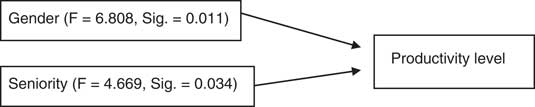
Furthermore, we examined those variables that affected the productivity level: gender, seniority and membership of the opposition or coalition. Figure 1 presents the findings. Female members of the Knesset were more productive than male members of the Knesset (F = 6.808, Sig. = 0.011), but we did not find any significant difference in the productivity level of those members of the Knesset who were in the coalition and those who were in the opposition. Looking at the incumbent variable (whether they were junior or senior), we found a significant difference between the productivity of junior and senior members of the Knesset (F = 4.669, Sig. = 0.034). Senior members of the Knesset tabled (F = 7.945, Sig. = 0.006) and passed (F = 12.316, Sig. = 0.001) more bills than junior members. The connection between incumbency and productivity is quite clear, but why did it have no effect on the chances of re-election in the fourteenth Knesset? Why was there no ‘electoral connection’ in the fourteenth Knesset?
Variables that Affected the Productivity Levels of Members of the Knesset

Several explanations can be offered. First, the fifteenth Knesset, into which 58 members of the Knesset from the fourteenth Knesset were re-elected, also had 37 newly elected members.Footnote 6 Therefore, although the results show that re-election did not occur as a result of legislators’ fulfilling their roles, incumbents did have an advantage over new candidates. This explanation relies on previous studies of incumbency turnover rates (Arian Reference Arian1994; Arnold Reference Arnold1990; Jacobson Reference Jacobson1996; Matland and Studlar Reference Matland and Studlar2004; Squire Reference Squire1988b). Second, legislators may have invested their time in other arenas and used tools other than the formal ones in order to get re-elected. Examples include media appearances, meeting with the voters, lectures to students and investing time in personal websites (see, for example, Jackson Reference Jackson2003; Ward and Lusoli Reference Ward and Lusoli2005). Third, while in the fourteenth Knesset four parties used primaries as their candidate selection method, in the fifteenth Knesset just one party did so. Perhaps the changes in the candidate selection methods caused different kinds of behaviour among incumbents and created a new opportunity for new candidates (for example, Akirav Reference Akirav2010; Sheafer and Tzionit Reference Sheafer and Tzionit2006; Sheafer and Wolfsfeld Reference Sheafer and Wolfsfeld2004; Shomer Reference Shomer2009). Did the same lack of association between legislative productivity and re-election hold true in the sixteenth Knesset?
The Sixteenth Knesset
For the sixteenth Knesset, we ran a logistic regression with re-election as the dependent variable and three independent variables: productivity, gender and seniority. We did not use the coalition/opposition variable because during the sixteenth Knesset there were two coalitions, making it difficult to disaggregate the data. There were 28 members of the fifteenth Knesset who were not re-elected to the sixteenth. The sixteenth Knesset was made up of 42 re-elected members and 37 newly elected.
In the sixteenth Knesset, senior legislators were 4.7 times more likely to be re-elected than junior legislators (Wald Chi-square = 6.0763, Sig. = 0.0137). This finding is consistent with previous studies demonstrating that senior incumbents are re-elected time after time (Altman and Chasquetti Reference Altman and Chasquetti2005; Cain et al. Reference Cain, Ferejohn and Fiorina1987; Cunningham Reference Cunningham1971; Erikson Reference Erikson1972; Heitshusen et al. Reference Heitshusen, Young and Wood2005; Krashinsky and Milne Reference Krashinsky and Milne1986). We did not find any significant difference in the productivity of junior and senior members of the Knesset. Therefore, in the sixteenth Knesset, which was less productive than the fourteenth, incumbency was more significant than productivity.
The gender variable was almost significant (0.078), considering the fact that there were 9 women and 61 men. Men were more likely to have been re-elected (Wald Chi-square = 3.1063, Sig. = 0.078). Several scholars have looked at the role of gender in parliaments (for example Box-Steffensmeier et al. Reference Box-Steffensmeier, de Boef and Lin2004; Childs Reference Childs2008; Devlin and Elgie Reference Devlin and Elgie2008; Salmond Reference Salmond2006; Wangnerud Reference Wangnerud2009). All of them found that female politicians bolster the position of women's interests and that female politicians invest much more effort than male politicians in order to justify their presence in parliament. Nevertheless, we found no significant difference in the productivity of male and female members of the Knesset. Again, the ability to be re-elected seems to have more to do with being a member of the male elite than about being productive. We also examined the adjustment of the model for its predictability and found it to be 78 per cent. The implication of this finding is that seniority and gender matter. If you are a senior member of the party and a man, you are much more likely to be re-elected than if you are a junior member or a woman. Again, productivity seems to have little to do with re-election.
As noted above, 42 members of the Knesset from the fifteenth Knesset were re-elected to the sixteenth Knesset. Similarly, 37 new members of the Knesset were elected to the sixteenth Knesset. The two Knesset sessions differ in the gap between the number of the re-elected incumbents and the newly elected members of the Knesset (58 incumbents compared to 37 new candidates in the fifteenth Knesset, and 42 incumbents compared to 37 new candidates in the sixteenth Knesset). Matland and Studlar (Reference Matland and Studlar2004) analysed turnover rates from 25 industrialized countries and found that the average incumbency return rate is 67.7 (Israel had a 63.8 incumbency return rate). Looking at the turnover per year, they found an average of 9.56 (in Israel, 9.6) (Arian Reference Arian1994; Matland and Studlar Reference Matland and Studlar2004: 93). The results of this study are in line with those of previous studies indicating that incumbency is the key to being re-elected, but why is that so?
Conclusion
It seems as if the skills needed to be re-elected are different from the skills needed to fulfil the legislator's roles of legislation, oversight and representation. In this respect we can identify two types of legislators – the ‘electable’ type and the ‘legislative activity’ type. Legislators seem to find it difficult to be both. Mayhew (Reference Mayhew1974) claims that most legislators are motivated by a desire to be re-elected, and that this desire motivates their activity through advertising, credit claiming and position taking.
However, the situation when Mayhew presented his electoral connection claim is significantly different from the reality of the last two decades. There have been changes in almost the entire traditional political environment, including in the candidate selection methods, the electoral systems, mass communications and technology – each of which separately or in combination with other factors have changed the rules of the political game. Thus, working in the legislature is just one factor, but no longer enough on its own to increase the likelihood of re-election.
Using fresh data, we examined the traditional claims about the factors that lead to a legislator's re-election. We found that while some still matter, others are now less relevant. We argue that different skills are required for different roles. If a legislator wants to be re-elected, he or she needs to understand that there is one set of skills to use for getting elected – such as charismatic communication skills (see, for example, Sheafer and Tzionit Reference Sheafer and Tzionit2006), the awareness and the ability to use new technologies to communicate with the voters (for example, Leston-Bandeira Reference Leston-Bandeira2012; Ward et al. Reference Ward, Lusoli and Gibson2007; Williams and Gulati Reference Williams and Gulati2008; Williamson Reference Williamson2009) and the investment of time in informal activities. It takes a different set of skills to fulfil the role of legislator. Dror (Reference Dror2011) counsels leaders to surround themselves with professional staff who will help them fulfil their roles. The same insight may be relevant to legislators. In order to get re-elected, choose a professional staff with skills in this area. After being elected, choose a professional staff that will help you to legislate, oversee the government and represent your constituency.
The lack of relationship between legislative productivity and re-election has major implications for both the political process in democracies and candidates. We must ask ourselves whether the format in which candidates currently campaign for re-election really results in the election of those who are best qualified to do the job of legislators. If we conclude that the skills needed for re-election are not congruent with those needed for productive legislation, then the answer may be ‘no’. Furthermore, if there is no association between legislative productivity and re-election, what motivation does a legislator have to fulfil the role for which he or she was elected?
Finally, from a practical point of view, those seeking re-election would do well to avail themselves of a professional staff who can help them develop the skills necessary to achieve this goal. Once in office, these legislators should consider other advisers whose expertise lies in helping the legislator fulfil the role for which he or she was elected.