Introduction
The Developmental Origins of Health and Disease (DOHaD) theory based on Prof David Barker’s work suggests that exposure to different environmental factors in intrauterine life influences the health and the risk of disease in later life in the offspring. Reference Barker, Winter, Osmond, Margetts and Simmonds1,Reference Yajnik, Deshpande and Jackson2 These factors include maternal nutrition, metabolism, stress, pollutants, etc., Reference Vorherr3–Reference Entringer, Buss and Swanson5 which act by influencing epigenetic changes in the fetal genome. Reference Gluckman, Hanson, Cooper and Thornburg6 Maternal nutrition (deficiency, imbalance, or overnutrition) is a major determinant of fetal health. There is increasing recognition of the role of micronutrients (vitamins and minerals), in addition to the well-known role of macronutrients (glucose, fatty acids, and amino acids derived from carbohydrates, fats, and protein) in these phenomena. Some of these examples include the role of folate and vitamin B12 (B12) deficiency in fetal neural tube defects (NTDs) and the effect of maternal diabetes on congenital anomalies and macrosomia. Reference Behere, Deshmukh, Otiv, Gupte and Yajnik7,Reference Kc, Shakya and Zhang8
Low B12 status is common in Indian pregnant mothers Reference Behere, Deshmukh, Otiv, Gupte and Yajnik7 and is ascribed to low intake of animal origin foods. Reference Yajnik, Deshpande and Jackson2 The low B12 status is associated with NTDs, fetal growth restriction, and maternal anemia. Reference Behere, Deshmukh, Otiv, Gupte and Yajnik7 In the pre-conceptional birth cohort, Pune Maternal Nutrition Study (PMNS), two out of three pregnant mothers had low B12 status, while low folate status was rare. Reference Yajnik, Deshpande and Jackson2 Maternal nutrition of these vitamins was associated with fetal growth and brain development. Reference Yajnik, Deshpande and Jackson2,Reference Bhate, Joshi and Ladkat9,Reference Rao, Yajnik and Kanade10 In addition, low maternal B12 and high folate status during pregnancy was associated with diabesity (adiposity and insulin resistance) in the offspring during early childhood. Reference Yajnik, Deshpande and Jackson2 These findings led to a randomized controlled pre-conceptional trial to provide physiological doses of B12 and other micronutrients to the adolescent participants of the PMNS to influence fetal growth, development, and future risk of diabetes (Pune Rural Intervention in Young Adolescents, PRIYA). Reference Kumaran, Yajnik and Lubree11 We have reported possible mechanisms of such an intervention on intergenerational programming. Reference Khare, Madhok and Patta12 Transcriptome measurements in the cord blood mononuclear cells (CMCs) of children born to mothers supplemented with B12+multi-micronutrients (MMN) showed differential expression of genes regulating mitotic processes and cell cycle dynamics. Reference Khare, Madhok and Patta12 These novel findings in a pre-conceptional human nutritional intervention provide a plausible molecular explanation for the DOHaD paradigm.
We have expanded our mechanistic study by using Weighted Gene Co-expression Network Analysis (WGCNA) to study the role of cord blood B12 concentration in regulation of gene expression in CMCs. This technique clusters the genes based on their expression patterns, which are then correlated with phenotypes of interest. Reference Langfelder and Horvath13 We used this information to investigate the association of micronutrients in the cord blood with gene expression. We focused our attention on dietary methyl donor vitamins: B12 (cyanocobalamin), B9 (folate), B2 (riboflavin), and B6 (pyridoxine), which influence one-carbon (1C) metabolism and are crucial for epigenetic regulation of fetal growth and development. We hypothesized that B vitamins, particularly B12, regulate the expression of fetal genes, influencing fetal growth and programming.
Methodology
Cohort establishment and ethics approval
The PRIYA trial is a randomized placebo-controlled trial, nested within a prospective follow-up of young adults of the PMNS at the Diabetes Unit, KEM Hospital Research Center, Pune, India. The PMNS is a birth cohort set up in 1993–1996. The offspring born in the cohort have been regularly followed up for their growth and cardiometabolic risk assessment over the last 30 years. PRIYA trial (2012–2020) was based on findings in the PMNS of the influence of maternal B12–folate imbalance on the risk of diabesity (adiposity and insulin resistance) in the offspring. The purpose of the PRIYA trial was to improve B12 and other micronutrient status of the participant adolescents in the PMNS birth cohort to influence the risk of diabesity in their offspring. The details of the trial are described previously. Reference Kumaran, Yajnik and Lubree11 Briefly, after obtaining the necessary regulatory approvals [Ethics Committee of the KEM Hospital Research Centre, Pune (October 2011; no. 1112A), and trial registration: CTRI (2012/12/003212) and ISRCTN (32921044)], adolescents in PMNS were screened for defined inclusion–exclusion criteria. Adolescents with medical illness, severe anemia (hemoglobin < 7g%), and very low B12 status (<100 pmol/l) were excluded. Included adolescents were treated with B12 (with or without MMN) or placebo. They were regularly followed for marriage and pregnancy (2012–2020). In female participants, supplementation was continued till delivery of the first child (2013–2020). The cord blood was collected at delivery and processed for gene expression analysis (CMCs) and micronutrient measurement.
RNA sequencing
The details of sample processing for gene expression analysis are described elsewhere. Reference Khare, Madhok and Patta12 In brief, the CMCs were isolated from cord blood by density gradient centrifugation. The CMCs were subjected to RNA sequencing, and the data was deposited in NCBI SRA (PRJNA756634). The sequence quality was determined using FastQC (v0.11.8). HiSAT2 Reference Kim, Paggi, Park, Bennett and Salzberg14 was used to align the raw sequence reads with the human genome (hg38, GENCODE). Reference Frankish, Diekhans and Jungreis15 featureCounts was used to assign the aligned reads to known genes. Reference Liao, Smyth and Shi16 The samples that showed poor alignment or assignment (<Q1-IQR*1.5) were excluded from the downstream analysis. Variance stabilizing transformation (vst) was applied on the raw count matrix to produce a stabilized, continuous dataset for further downstream analysis. Reference Love, Huber and Anders17
Weighted gene co-expression network analysis (WGCNA)
We performed co-expression network analysis with concentrations of micronutrients in the cord blood (B12, B9, B6, and B2). Reference Langfelder and Horvath13 Gestational age and sex of the baby were used as covariates for this analysis. We pooled the three intervention groups described previously. WGCNA (version 1.7.1) was applied on “vst” normalized data. A soft threshold power was selected using a scale-free topology criterion to construct a cluster dendrogram of genes. A module-trait heatmap was plotted, and the gene modules that showed significant correlation with the clinical measurements (r ≥ 0.3 and p < 0.05) were subjected to intramodular analysis. The modules that showed a significant correlation between gene significance (GS) and module membership (MM) (r > 0.4 and p < 0.05) were further subjected to gene enrichment analysis.
Gene enrichment analysis of modules and construction of correlogram of different traits
To explore the potential molecular functions of genes in each module, gene ontology (GO) analysis was performed using Shiny GO (version 0.80). Reference Ge, Jung and Yao18 Genes meeting the criteria for GS (corr > |0.2|) and MM (corr > |0.6|) were subjected to enrichment analysis. Relevant molecular functions and biological processes were selected (FDR-adjusted p value < 0.05), and the top 15 terms were shortlisted for visualization based on fold enrichment. To study the association between maternal and cord blood measurements, a correlogram was constructed using Pearson’s correlation method at 95% confidence.
Results
Cohort establishment and biochemical measurements of the participants
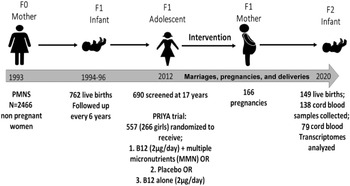
In the PRIYA trial, 557 participants were randomized (291 males, 266 females). This paper reports only on pregnancies in the female participants. Out of the 266 females, 166 married, became pregnant, and delivered 149 live births during the trial period (2013–2020). The average duration of supplementation was 54 months (min–max 24–83 months). This analysis includes the initial 88 samples, which were used for the transcriptome analysis. Reference Khare, Madhok and Patta12 Of these, 79 samples with high quality data and read alignment percentage were utilized for downstream analysis: the B12 alone group included 27, the B12+MMN group included 26, and the placebo group included 26 samples (Fig. 1 and Supplementary Figure 1).
Pune Maternal Nutrition Study (PMNS) and Pune Rural Intervention in Young Adolescents (PRIYA) trial (adapted from Khare et al., 2023). The PRIYA trial is nested within the PMNS. Daughters born in the PMNS (F1 generation) entered the trial at 17 years of age (2012), subsequently married, became pregnant, and delivered (2013–2020). A total of 79 cord blood samples from the F2 generation babies were subjected to Weighted Gene Co-expression Analysis (WGCNA).

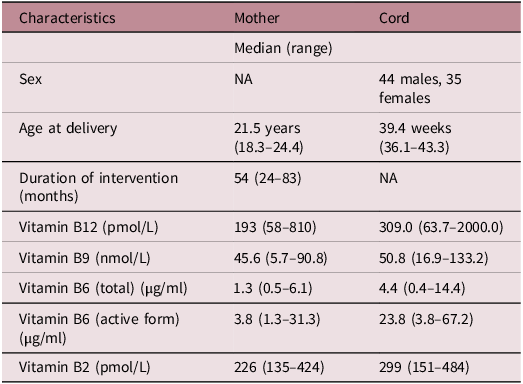
The maternal and cord blood characteristics are shown in Table 1. The median age of the mother was 21.5 years (18.3–24.4 years), and the maternal B12 concentration at 28 weeks of gestation was 193 pmol/L (58–810 pmol/L). The gestational age of the neonates was 39.4 weeks (36.1–43.3 weeks), and the cord blood B12 concentration was 309 pmol/L (63.7–2000.0 pmol/L). The maternal and cord blood concentrations of B2, B6 (total), and B9 are also shown in the table. Concentrations of all these nutrients were higher in the cord blood compared to those in the mother. There was a significant correlation between maternal and cord blood concentrations (Supplementary Figure 2).
Summary statistics for maternal and neonatal characteristics

Note: Data is presented as median (range).
Association of cord blood micronutrient concentrations with cord blood transcriptome
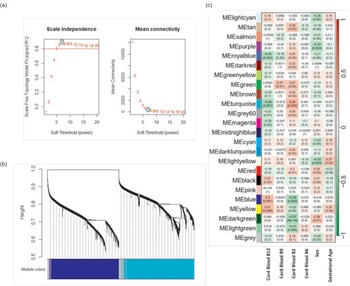
We took a correlation network-based approach (WGCNA) for identification of genes associated with different vitamin concentrations. WGCNA identifies genes with similar expression patterns (modules) that can be studied for association with clinical traits. The correlation network analysis resulted in identification of 23 modules from cord blood transcriptome (Fig. 2).
Co-expression analysis of cord blood transcriptomes and associations of identified modules with B vitamins by WGCNA. ( a ) Variance-stabilized gene expression values were clustered based on the scale independence and mean connectivity. ( b ) Cluster dendrogram showing 23 gene modules identified using a soft threshold of 7. ( c ) Module-trait heatmap illustrating positive correlations of the blue and yellow modules with B12 and a negative correlation of the turquoise module with B12 (module-trait correlation > 0.3; n = 79).

Cord blood B12 showed a significant positive correlation with blue and yellow modules, and a negative correlation with turquoise modules. Vitamin B2 showed a positive correlation with the turquoise module, and negative correlations with blue and darkgreen modules. Cord blood vitamin B6 and B9 did not show any significant associations with any modules. Modules significantly associated with B12 and B2 also correlated with the duration of intervention but not with specific blood cell types (Supplementary Figure 3).
Cord blood vitamins and enrichment analysis of genes
Vitamin B12
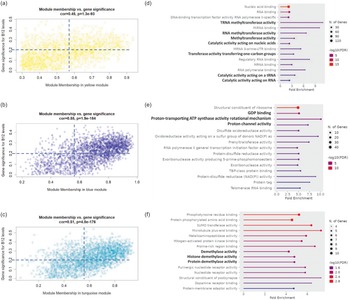
Cord blood B12 concentration was positively correlated with yellow and blue modules. The GO analysis of the yellow module showed enrichment of genes associated with tRNA methyltransferase activity, RNA methyltransferase, transferase activity transferring one-carbon groups, etc. (Fig. 3a and 3d), suggesting that the availability of B12 triggers the expression of enzymes involved in methylation reaction. The blue module showed functional enrichment of genes involved in GDP binding, Proton-transporting ATP synthase activity rotational mechanism, Proton channel activity, etc. (Fig. 3b and 3e). The latter two processes are central to energy metabolism, suggesting that B12 contributes to this metabolism. Cord blood B12 concentration was negatively associated with the turquoise module, which showed enrichment of the molecular functions such as histone demethylase, protein demethylase, etc. (Fig. 3c and 3f). The positive association of B12 with the expression of methyltransferases appears to complement its negative association with demethylases, and supports its role in synthesis of the methyl donor essential for various methylation reactions.
Enrichment analysis of key genes associated with cord blood B12 concentrations. Key genes in the ( a ) yellow, ( b ) blue, and ( c ) turquoise modules were identified using gene significance (GS)–module membership (MM) analysis (upper-right corner). Gene ontology analysis for enrichment of molecular functions in the key genes is shown for the ( d ) yellow, ( e ) blue, and ( f ) turquoise modules. The yellow module was enriched for genes involved in methylation, while the blue module showed enrichment for terms related to energy metabolism. The turquoise module was enriched for genes associated with demethylation reactions (cutoff values for GS and MM correlations: 0.2 and 0.6, respectively).

Vitamins B2
Cord blood B2 concentration was positively associated with the turquoise module and negatively associated with blue and darkgreen modules; of these, the darkgreen module did not show enrichment of any specific molecular functions, whereas turquoise and blue modules continued to show enrichment of genes associated with demethylation and energy metabolism, respectively. The reason behind this negative association is not immediately clear (Supplementary Figure 4).
Discussion
In this communication, we report gene expression patterns associated with B vitamin concentrations in CMCs of babies born in the PRIYA trial, irrespective of the intervention group. Our previous study identified 75 genes differentially expressed in the CMCs in response to B12+MMN intervention in the mothers. Reference Khare, Madhok and Patta12 We extended this work to study the association between gene expression and vitamin concentrations in the cord blood using WGCNA. We found 23 distinct gene modules based on their expression patterns in the cord blood. Cord B12 positively correlated with modules associated with RNA methylation and energy metabolism and negatively correlated with a module associated with protein/histone demethylation. Cord B2 inversely correlated with modules associated with B12. B6 and B9 did not show a significant association with any module. The results support our hypothesis that B vitamins, especially B12, may influence the gene expression in fetal development and reprogramming through epigenetic mechanisms.
B vitamins play a crucial role in 1C-metabolism. The 1C-metabolism consists of the folate cycle and the methionine cycle. B12 serves as a coenzyme for methionine synthase in the production of S-adenosylmethionine (SAM). Reference Kalhan19,Reference Lyon, Strippoli, Fang and Cimmino20 SAM functions as a methyl donor for DNA, RNA, and protein methylation processes. DNA methylation, the most extensively studied epigenetic modification, is recognized as a key mechanism for developmental reprogramming. RNA methylation, on the other hand, has varied effects depending on the type of RNA methylated. The mRNA methylation influences the translation of specific transcripts, whereas tRNA methylation contributes to its stabilization and the global regulation of protein synthesis. Reference Bove, Del Gaudio and Altucci21
In our analysis, the expression of six RNA/tRNA methyltransferases (DIMT1, NSUN6, TRMT13, THUMPD2, TYW3, and ALKBH8) showed a direct correlation with B12 concentrations. Among them, ALKBH8, a uridine tRNA methyltransferase, has been shown to play a significant role in embryonic development. Reference Nakai, Hase and Zhao22 The positive association between B12 concentrations with tRNA methylation (and potentially translation regulation) may complement its established role in amino acid synthesis. We also identified a negative correlation between B12 concentration and the expression of six histone demethylases, namely, KDM1A, JARID2, KDM4A, FBXL19, KDM5C, and PHF8. Covalent post-translational modifications (e.g., acetylation, methylation, phosphorylation) of histones represent another important epigenetic mechanism. Histone methylation influences gene expression and other cellular processes depending on the type and site of modification. Reference Khare, Habib, Sharma, Gadewal, Gupta and Galande23 KDM4A, targeting H3K9 and H3K36, and KDM1A, targeting H3K4 and H3K9, have been implicated in early embryogenesis. Reference Wu, Wary and Revskoy24–Reference Wasson, Simon and Myrick26 The negative correlation between B12 concentration (and possibly SAM) and demethylase expression points to a cellular mechanism that senses methyl-group availability. The preferential expression of specific histone demethylases suggests a sophisticated regulatory system functioning as an “epigenetic buffer” to adapt to nutritional fluctuations, with potential implications for the epigenetic inheritance of these expression patterns.
The B12 also showed a positive correlation with genes involved in transcription, cellular metabolism, and energy metabolism, in line with known functions of this vitamin. Reference Lyon, Strippoli, Fang and Cimmino20 The cord B2 inversely correlated with modules associated with B12. Specifically, B2 showed a weak but significant positive association with histone demethylation. The contrasting correlation between B12 and B2 is presently unexplained and necessitates additional investigation. In our analysis, B6 and B9 did not show a significant correlation with any gene modules.
There are limited studies on B vitamins and gene expression changes. Supplementation of Atlantic salmon with four key-1C-nutrients (methionine, vitamin B6, B9, and B12) has been shown to result in dysregulation of genes in the liver. Reference Saito, Espe and Vikesa27 B9 and B12 supplementation has been associated with differential expression of genes in liver and mammary biopsies in lactating cattle. Reference Ouattara, Bissonnette, Duplessis and Girard28 B6 intervention in piglets on a low protein diet has been associated with dysregulation of inflammatory cytokines and amino acid transporters in the jejunum and ileum. Reference Yin, Li and Wang29 Differential expression of genes involved in carbohydrate, lipid, and amino acid metabolism, and electron transport chain has been found in the liver in response to B1, B2, and B3 supplementation in mice exposed to hypoxia. Reference Liu, Gao and Pu30 B12 activated genes involved in fatty acid metabolism and epithelial cell proliferation while suppressing inflammatory responses in human ileal epithelial cells. Reference Ge, Zadeh and Mohamadzadeh31 Lower levels of total cobalamin have been linked to a decrease in NRF2 expression in postmortem frontal cortex in autism. Reference Schrier, Zhang, Trivedi and Deth32 A deficiency of B9 and B12 in mothers has been associated with placental dysregulation of MMP9 gene expression and preterm birth. Reference N., Am, M., Sh, F. and S.33
Studies linking interventions with expression of methyltransferases and demethylases remain scarce. In human neuroblastoma SK-N-BE cell lines and in mice brain, the activity of DNMT1 decreased under B deficiency and increased again upon SAM supplementation. Reference Fuso, Nicolia, Cavallaro and Scarpa34 An inverse correlation between plasma homocysteine concentrations and DNMT1 promoter methylation has been found in peripheral blood in healthy individuals. Reference Coppede, Stoccoro, Tannorella and Migliore35 These studies support our hypothesis that the availability of methyl donors regulates the expression of the methylating and demethylating enzymes. Our findings provide a novel explanation and an expanded role for epigenetic influences of B12 in its well-known contribution to fetal growth, development, and differentiation and to long-term health of the offspring (DOHaD paradigm).
Strengths and limitations
Strengths
We investigated continuous associations between cord blood concentrations of B vitamins and gene expression patterns in the cells of the cord blood rather than doing an intervention group analysis. This has an advantage in that it allowed us to study associations between the nutrients in the environment and molecular processes in the cells bathed in the cord blood.
Limitations
The study does not establish a causal link between B12 levels and the observed gene expression changes. The study also does not provide direct evidence of changes in methylation levels of target proteins or RNA molecules. Additionally, this study is limited to CMCs and does not explore the impact of micronutrients on other cell types. The study does not include other micronutrients (iron, ferritin, vitamin D, etc.), which could have some effects on the transcriptome. Lastly, being a cross-sectional analysis, the effects of molecular changes on long-term outcomes will be known only after a longitudinal follow-up.
In summary, we provide a possible role for B12 in regulating the genes involved in methylation/demethylation reactions in humans. This might suggest existence of a mechanism that senses the availability of methyl donors and modulates the expression of relevant enzymes, reminiscent of gene regulating mechanisms in prokaryotes. These mechanisms are important in epigenetic regulation of fetal growth, differentiation, and development. Future studies will be able to identify the direct targets of these methylation/demethylation reactions.
Supplementary material
The supplementary material for this article can be found at https://doi.org/10.1017/S204017442510038X.
Acknowledgments
The authors have no acknowledgments to declare.
Author contributions
The PRIYA trial was designed by CSY and CHDF. The transcriptome analysis was designed by SG and SPK. SAP performed the WGCNA with help from SBK, SA, VVW, RW, and VSK. The first draft was written by SAP under the guidance of SPK, and others contributed to editing and finalizing the manuscript.
Financial support
This work was supported by the Department of Biotechnology, Government of India (CEIB-BT/PR12629/MED/97/364/2016, “Centre of Excellence in Fetal Programming”). The PRIYA trial was also supported under an Indo-UK program by the Indian Council of Medical Research (ICMR) and the Medical Research Council (MRC), UK (No.58/1/8/ICMR-MRC/2009-NCD-II).
Competing interests
The authors have no conflicts of interest to declare.
Ethical Standard
The authors assert that all procedures contributing to this work comply with the national ethical guidelines for biomedical and health research involving human participants by the Indian Council of Medical Research (ICMR) and with the Helsinki Declaration of 1975, as revised in 2008, and have been approved by the King Edward Memorial (KEM) Hospital Research Centre ethics committee.