Rice plays a significant role in feeding an increasing population. Efforts are constantly being made to improve the yield and nutritional content of rice. In this process, many conventional and imidazolinone-resistant (Clearfield®) inbred and hybrid cultivars have been developed and are available to growers. The majority of the cultivated rice planted in the United States, including conventional and herbicide-resistant cultivars, is of a tropical japonica (hereafter referred to as japonica) genetic origin, rather than an indica as used in other regions of the world (Burgos et al. Reference Burgos, Singh, Tsend, Black, Young, Huang, Hyma, Gealy and Caicedo2014; Mackill Reference Mackill1995). Currently, several rice cultivars are resistant to imidazolinone herbicides and cultivars resistant to quizalofop, an acetyl CoA carboxylase (ACCase)-inhibiting herbicide, are nearing commercialization (Lancaster et al. Reference Lancaster, Norsworthy, Martin, Young, Scott and Barber2015). Conventional lines of rice are sensitive to quizalofop and imidazolinone herbicides (Meier Reference Meier2012; Street and Snipes Reference Street and Snipes1987).
These herbicide-resistant rice cultivars play a crucial role in a successful weed management program. The imidazolinone herbicides control a broad spectrum of problematic weeds, including barnyardgrass (Echinochloa crus-galli (L.) Beauv.) and many broadleaf weeds. It is imperative that growers integrate more than one site of action into weed management programs, otherwise overreliance on one herbicide site of action can lead to resistance (Norsworthy et al. Reference Norsworthy, Burgos, Scott and Smith2007, Reference Norsworthy, Scott and Johnson2012, Reference Norsworthy, Bond and Scott2013). The overreliance on and poor stewardship of the imidazolinone herbicides in imidazolinone-resistant rice led to herbicide resistance in multiple weed species, including barnyardgrass and weedy rice (Oryza sativa L.) (Burgos et al. Reference Burgos, Norsworthy, Scott and Smith2008, Reference Burgos, Singh, Tsend, Black, Young, Huang, Hyma, Gealy and Caicedo2014; Heap Reference Heap2016; Sudianto et al Reference Sudianto, Beng-kah, Ting-Xiang, Saldain, Scott and Burgos2013). The imidazolinone-resistant rice hectares rapidly increased from 2002 to 2008, which led to some cultivated imidazolinone-resistant rice outcrossing with weedy rice. Now growers are faced with controlling acetolactate synthase (ALS)-resistant weeds in rice systems with limited herbicide options.
Benzobicyclon is a 4-hydroxyphenylpyruvate dioxygenase (HPPD)-inhibiting herbicide that will control a broad spectrum of grasses, aquatics, broadleaves, and sedges, including those resistant to ALS-inhibiting herbicides (Komatsubara et al. Reference Komatsubara, Sekino, Yamada, Koyanagi and Nakahara2009). However, benzobicyclon must be hydrolyzed to have herbicidal activity. Benzobicyclon hydrolysate shows potent inhibition of HPPD, making the hydrolyzed form of benzobicyclon an effective herbicide. In Korea, transplanted japonica rice cultivars have shown excellent safety with benzobicyclon, while indica rice cultivars have shown severe phytotoxicity (Kwon et al. Reference Kwon, Shin, An, Lee, Min, Park, Shin, Jung and Kuk2012). Bleaching of leaf tissue is the primary symptom in weeds following an application of benzobicyclon (Almsick Reference Almsick2009; Komatsubara et al. Reference Komatsubara, Sekino, Yamada, Koyanagi and Nakahara2009). These symptoms may appear on new growth as early as one week after POST application and are followed by necrosis and eventual death of sensitive species.
Benzobicyclon has shown excellent control of sulfonylurea-resistant rock bulrush (Scirpus juncoides Roxb.) in Japanese rice fields at 200 to 300 g ai ha−1 (Komatsubara et al. Reference Komatsubara, Sekino, Yamada, Koyanagi and Nakahara2009). Benzobicyclon is being developed for use in US rice production systems as a postflood application (C. Sandoski, personal communication). This will be the first HPPD-inhibiting herbicide commercially available in US rice production. ALS-resistant rice flatsedge (Cyperus iria L.), yellow nutsedge (Cyperus esculentus L.), and smallflower umbrella sedge (Cyperus difformis L.) are becoming increasingly problematic for Arkansas growers (Norsworthy et al. Reference Norsworthy, Bond and Scott2013; Scott et al. Reference Scott, Norsworthy, Burgos, Rouse and Bagavathiannan2016). The increasing frequency of ALS-resistant rice flatsedge in rice fields is expected to lead to use of benzobicyclon across vast acreage (C. Sandoski, personal communication).
An important consideration is the production differences across the geographic regions in which rice is produced. Benzobicyclon has effectively been used in production systems that utilize a cultivar transplanted into a rice paddy (Komatsubara et al. Reference Komatsubara, Sekino, Yamada, Koyanagi and Nakahara2009; Senkino et al. Reference Sekino, Koyanahi, Ikuta and Yamada2008). Brazzle et al. (Reference Brazzle, Alonso, Holmes and Takahashi2014) documented that benzobicyclon has a potential fit in the water-seeded rice production systems in California. It is important to evaluate benzobicyclon in a drill-seeded production system, which is the predominant means of growing rice in the midsouthern United States.
It is known that there are differences in sensitivity to HPPD-inhibiting herbicides among japonica, indica, and japonica×indica rice cultivars (Kim et al. Reference Kim, Oh, Lee, Yeo, Lee, Cho, Song, Oh, Han, Seo, Jang, Na, Park and Nam2012; Kwon et al Reference Kwon, Shin, An, Lee, Min, Park, Shin, Jung and Kuk2012). Korean scientists evaluated the responses of 26 rice cultivars of varying backgrounds, including japonica, indica, and japonica×indica cultivars, to the HPPD-inhibiting herbicides mesotrione, benzobicyclon, and tefuryltrione (Kwon et al. Reference Kwon, Shin, An, Lee, Min, Park, Shin, Jung and Kuk2012). These herbicides were applied at various timings and doses onto transplanted cultivars. Kwon et al. (Reference Kwon, Shin, An, Lee, Min, Park, Shin, Jung and Kuk2012) observed that benzobicyclon was more injurious to japonica×indica crosses than it was to japonica cultivars. Injury observed included phytotoxicity, necrosis, detached leaves, and bleaching. These symptoms may appear on new growth as early as 1 week after a POST application and are sometimes followed by necrosis and eventual death of sensitive cultivars.
Kwon et al. (Reference Kwon, Shin, An, Lee, Min, Park, Shin, Jung and Kuk2012) reported that the highest levels of injury occurred when benzobicyclon was applied to the high-yielding japonica×indica–type cultivars 5 days after transplanting. The ‘Hyangmibyeo-1’ and ‘Dasanbyeo’ cultivars, both japonica×indica-type cultivars, were severely injured 7 days after application (DAA) of benzobicyclon at 400 g ai ha−1. Of the japonica-type cultivars, ‘Sinseonchalbyeo’ showed the highest injury at 7 DAA; albeit, injury was much less than that observed on cultivars having some indica background (Kwon et al. Reference Kwon, Shin, An, Lee, Min, Park, Shin, Jung and Kuk2012). Based on these results, it was hypothesized that the commonly grown japonica cultivars in the United States should exhibit greater tolerance to benzobicyclon than do the lesser grown indica cultivars.
Before a new herbicide site of action can be commercially marketed, extensive varietal testing must be conducted to determine if it is safe to use. Previous literature shows that injury can occur on certain rice cultivars when saflufenacil is applied POST. Montgomery et al. (Reference Montgomery, Bond, Golden, Gore, Edwards, Eubank and Walker2014) documented that ‘CLXL745’ sustained the highest level of injury (13%) of five cultivars when saflufenacil was applied at 50 g ai ha−1. CLXL745 exhibited more injury than inbred, long-grain cultivars ‘CL151’ and ‘Cheniere’. Other inbred, medium-grain cultivars had greater tolerance, exhibiting ≤10% injury. However, research has shown that no differences in rice tolerance occurred when twice the labeled rate of penoxsulam was applied to 10 different rice cultivars (Bond et al. Reference Bond, Walker, Webster, Buehring and Harrell2007). It is unknown at this time whether hybrids and inbred conventional medium- and long-grain, drill-seeded rice cultivars common to the midsouthern United States will respond negatively to benzobicyclon applied postflood. Hence, the objective of this research was to determine if benzobicyclon could safely be applied to different cultivars across multiple postflood timings and to determine if indica cultivars are more sensitive to benzobicyclon than japonica cultivars.
Materials and Methods
Tolerance to Postflood Timing
A field experiment was conducted in 2015 and 2016 at the Rice Research and Extension Center near Stuttgart, Arkansas on a Dewitt silt loam soil (fine, smectitic, thermic Typic Albaqualfs) to evaluate the tolerance of eight rice cultivars to benzobicyclon applied at different application timings. The experimental design was a randomized complete block design with a split-plot treatment structure, with a main plot of application timing and a subplot of rice cultivar with four replications. Each replication consisted of 4 bays with one timing randomly associated with each bay. This experiment required 16 bays. Individual bays were created for this experiment to prevent the bays treated with benzobicyclon from contaminating the nontreated bays. The bays measured 4.9 by 48.8 m levee to levee. Eight rice plots measuring 1.8 by 5.2 m were planted in each bay on May 7, 2015, and May 14, 2016, with a nine-row cone drill allowing for a 1-m alley between plots. Rice seeding rates for the inbred and hybrid cultivars were 61 and 40 seed per meter of row, respectively.
The bays were kept weed-free using labeled rates of herbicides as recommended by the University of Arkansas (Scott et al. Reference Scott, Norsworthy, Burgos, Rouse and Bagavathiannan2016). The weed-free program included clomazone at 360 g ha−1 applied PRE followed by propanil at 3,360 g ha−1 plus thiobencarb at 3,360 g ha−1 applied early POST followed by cyhalofop at 417 g ha−1 postflood. The main plot was treated with benzobicyclon at 494 g ha−1 at 1, 4, or 5 weeks after flooding (WAF) and included a nontreated control in each replication. Benzobicyclon was applied using a CO2-pressurized backpack sprayer consisting of a handheld boom equipped with 110015 AIXR nozzles (Teejet Technologies, Springfield, IL 62703) calibrated to deliver 143 L ha−1 at 276 kPa. The boom was equipped with five nozzles, and two passes per bay were made covering the entire water surface area. The subplot included eight rice cultivars comprising medium- and long-grain cultivars commonly grown in Arkansas: ‘Jupiter’, ‘Caffey’, ‘CL151’, ‘LaKast’, ‘XL753’, ‘CLXL745’, ‘Mermentau’, and ‘Roy J’. The flood was maintained at approximately an 8-cm depth throughout the season.
Japonica Versus Indica Rice Tolerance
In 2016, an experiment was conducted at three locations across Arkansas: the University of Arkansas Pine Bluff Farm near Lonoke on an Immanuel silt loam (fine-silty, mixed, active, thermic Oxyaquic Glossudalfs), Rice Research and Extension Center near Stuttgart on a Dewitt silt loam soil (fine, smectitic, thermic Typic Albaqualfs), and Southeast Research and Extension Center near Rohwer on a Sharkey silty clay soil (very fine, smectitc, thermic Chromic Epiaquerts).
This experiment was set up as a randomized complete block design with a split-plot treatment structure, with a main plot of herbicide rate and a subplot of rice cultivar. Individual bays were created for this experiment to ensure a permanent flood. The bays measured 42.6 m long and 9.1 m wide from center of levee to center of levee. Twenty-one plots measuring 1.8 by 5.2 m were planted in each bay with a 9-row cone drill allowing for a 1-m alley between plots on May 13, 14, and 19 at Rohwer, Stuttgart, and Lonoke, respectively. Rice seeding rates of the inbred and hybrid cultivars were 61 and 40 seed m−1, respectively.
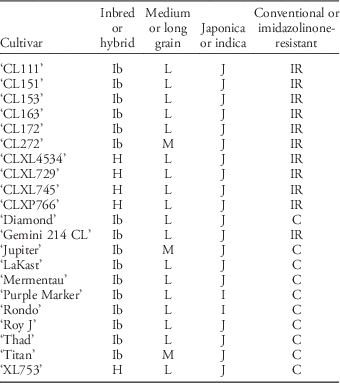
The experiment was kept weed-free through use of herbicides and occasional hand weeding. The weed-free program included clomazone at 360 g ha−1 applied PRE followed by propanil at 3,360 g ha−1 plus thiobencarb at 3,360 g ha−1 applied early POST. The two main plot treatments consisted of a premix containing benzobicyclon at 494 g ha−1 and halosulfuron at 72 g ha−1 applied 1 week after permanent flood establishment and a nontreated control. Benzobicyclon was applied as described above. The boom was equipped with six nozzles, and three passes per bay were made covering the entire water surface area. The subplot included 21 cultivars, which are described in Table 1. Each treatment combination of herbicide rate and cultivar was replicated four times, and the test required eight individual bays. The flood was maintained at approximately an 8-cm depth throughout the season.
Brief description of cultivars evaluated for tolerance to benzobicyclon.Footnote a

a Abbreviations: Ib, inbred; H, hybrid; M, medium; L, long; J, japonica; I, indica; C, conventional; IR, imidazolinone-resistant.
Assessments
For both experiments, rice tolerance was visually rated every 14 days after treatment on a scale of 0% to 100%, with 0% being no injury and 100% being death of the crop. Ratings were taken 2, 4, and 6 weeks after every application timing and were based on comparison with the nontreated control for the tolerance to postflood timing experiment. The japonica versus indica rice tolerance test was rated 2, 3, 5, and 6 weeks after application. Number of days to 50% heading was visually assessed in each plot and reported relative to the nontreated control for each cultivar. Plots were machine-harvested at crop maturity to determine rough rice yield adjusted to 12% moisture.
Statistical Analyses
All data were analyzed using JMP statistical software (JMP version 12.1, SAS Institute Inc., Cary, NC). In the timing experiment, years are presented separately because of a significant treatment by year interaction for some assessments. Data were analyzed within each cultivar, year, and assessment to evaluate if timing delayed heading or rough rice yield relative to the nontreated control for each cultivar. Delay in heading could not be subjected to ANOVA because many of the means had delays of zero days, meaning the data did not meet the assumption of homogeneity of variance. Therefore, means are reported followed by the standard error. Yield data were subjected to ANOVA and means separated using Fisher’s protected LSD (α=0.05).
Results and Discussion
Tolerance to Postflood Timing
In 2015, LaKast was the only cultivar to exhibit minimal injury at each of the timings. Injury to LaKast was 5% at 57 DAA when benzobicyclon was applied 1 WAF (V7 to V10 tillering), 7% at 34 DAA when benzobicyclon was applied 4 WAF, and 6% at 27 DAA when benzobicyclon was applied 5 WAF (data not shown). No injury was observed in 2016 to any of the eight rice cultivars, including LaKast, for each of the benzobicyclon applications (data not shown). The injury symptoms to LaKast in 2015 included mild chlorosis located at the water line on the sheath. Neither chlorosis nor necrosis was observed in the other rice cultivars from time of application through rice harvest. The cultivars in this study were of japonica background, which likely contributed to the high level of tolerance observed in this experiment (Hardke Reference Hardke2013a). However, Kwon et al. (Reference Kwon, Shin, An, Lee, Min, Park, Shin, Jung and Kuk2012) documented 50% to 80% injury to five japonica×indica lines following benzobicyclon at 400 g ai ha−1 in a Korean rice system. Similar to the results reported here, Kwon et al. (Reference Kwon, Shin, An, Lee, Min, Park, Shin, Jung and Kuk2012) observed minimal injury (0% to 10%) on 18 japonica lines. With LaKast only showing minimal injury, it appears that benzobicyclon at 494 g ai ha−1 applied 1 WAF (tillering), 4 WAF, or 5 WAF will not affect agronomic performance of the rice cultivars evaluated. The rice cultivars evaluated contained a functioning HIS1 gene, like most japonica cultivars, conferring tolerance to benzobicyclon; thus, little to no injury was observed.
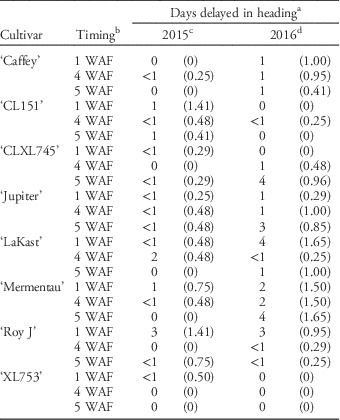
In 2015 and 2016, no more than a 4-day delay was observed across all cultivars to reach 50% heading (Table 2). Jupiter, Mermentau, LaKast, CLXL745, and Roy J showed the greatest delay in heading in either year. Roy J was delayed 3 days by the application (2× the anticipated rate) in 2015 and 2016 at 1 WAF (Table 2). There was no delay to 50% heading greater than 2 days in either year when benzobicyclon was applied 4 WAF. Delays in heading of up to 4 days in 2016, although minimal, could be due to environmental interactions with the herbicide; however, the ability for timely harvest of the rice would likely not be affected by a delay of ≤3 days to reach 50% heading (Bond et al. Reference Bond and Walker2012).
Days delay to 50% heading of eight rice cultivars in response to postflood applications of benzobicyclon applied at 494 g ai ha−1 plus 1% (v/v) crop oil concentrate in 2015 and 2016.

a Standard error of mean within a cultivar is reported in parentheses.
b Abbreviations: WAF, week after flood.
c Days until 50% heading on nontreated cultivars in 2015: ‘Caffey’, 71; ‘CL151’, 65; ‘CLXL745’, 66; ‘Jupiter’, 67; ‘LaKast’, 69; ‘Mermentau’, 65; ‘Roy J’, 78; XL753, 68.
d Days until 50% heading on nontreated cultivars in 2016: ‘Caffey’, 91; ‘CL151’, 84; ‘CLXL745’, 76; ‘Jupiter’, 87; ‘LaKast’, 85; ‘Mermentau’, 86; ‘Roy J’, 95; ‘XL753’, 84.
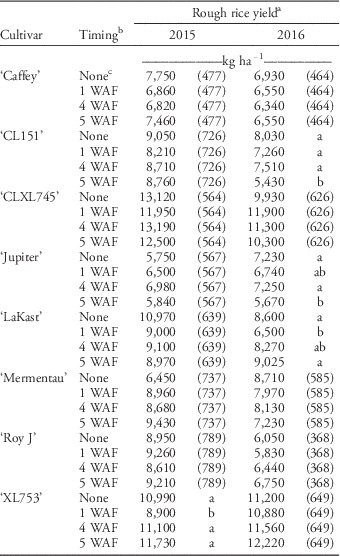
Rough rice yields differed among individual cultivars, as expected because medium-grain cultivars often have lower yields than long-grain cultivars (Hardke Reference Hardke2013b). Slight yield loss occurred for at least one of the three application timings versus the nontreated control for XL753 in 2015 and CL151, Jupiter, and LaKast in 2016 (Table 3). Otherwise, there was no apparent impact of benzobicyclon application timing on yield of the cultivars evaluated, leading to the conclusion that benzobicyclon can safely and effectively be applied up to 5 WAF without crop injury, delayed heading, or yield loss.
Rough rice yield of eight rice cultivars in response to postflood applications of benzobicyclon at 494 g ai ha−1 plus 1% (v/v) crop oil concentrate in 2015 and 2016.

a Means within a cultivar and column with the same lowercase letters are not different according to Fisher’s protected LSD (α = 0.05). Standard error of mean is reported in parentheses for those cultivars for which no application timing effect occurred.
b Abbreviation: WAF, weeks after flood.
c None: no benzobicyclon was applied to this cultivar.
Japonica versus Indica Rice Tolerance
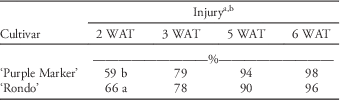
No injury to any of the 19 japonica cultivars was observed at any of the locations following the 1 WAF application of benzobicyclon plus halosulfuron (data not shown). This was expected, because japonica cultivars in Asia were reported to have excellent safety to benzobicyclon (Kwon et al. Reference Kwon, Shin, An, Lee, Min, Park, Shin, Jung and Kuk2012). The indica cultivars, ‘Purple Marker’ and ‘Rondo’, suffered severe injury including high levels of chlorosis 2 weeks after treatment. Rondo had 66% injury and Purple Marker had 59% at 2 weeks after treatment, with injury increasing as the season progressed (Table 4). By 6 weeks after treatment, Purple Marker and Rondo were injured 98% and 96%, respectively. It is unlikely that Rondo and Purple Marker have the HIS1 gene, resulting in them being susceptible to benzobicyclon (Kato et al. Reference Kato, Maeda, Sunohara, Ando, Oshima, Kawata, Yoshida, Hirose, Kawagishi, Taniguchi, Murata, Maeda, Yamada, Sekino and Yamakazi2015). Based on these results, indica-type cultivars appear to be highly sensitive to benzobicyclon and should not be used in a cropping system in conjunction with benzobicyclon.
Visible injury to indica cultivars from a premix containing benzobicyclon at 494 g ai ha−1 and halosulfuron at 72 g ha−1 plus 1% (v/v) crop oil concentrate at Lonoke, Rohwer, and Stuttgart, AR. All of the japonica cultivars had zero injury (data not shown).

a Abbreviation: WAT, weeks after treatment.
b Means within a column with different lowercase letters indicate a statistical difference according to Fisher’s protected LSD (α = 0.05). Absence of letters indicates the ANOVA did not show statistical significance at α = 0.05.
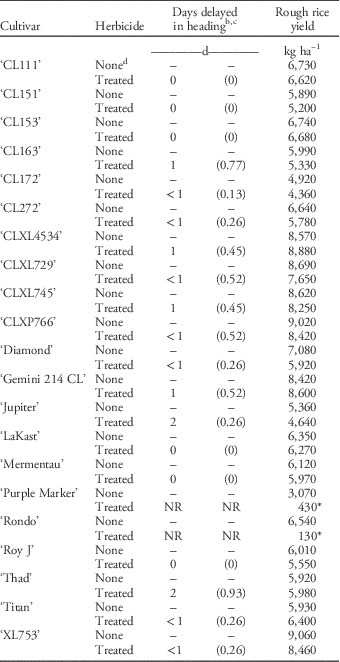
The japonica cultivars experienced minimal heading delays: the highest delay recorded was <2 days (Table 5). Likewise, there was no reduction in grain yield relative to the respective nontreated control for any of the japonica cultivars when treated with benzobicyclon at 494 g ai ha−1 plus halosulfuron at 72 g ai ha−1 applied 1 WAF (Table 5). Conversely, the few Purple Marker and Rondo plants that were severely injured but did survive following treatment with benzobicyclon had not reached 50% heading by the final heading date assessment. The severe injury from benzobicyclon to the indica cultivars resulted in 86% to 98% reduction in grain yield.
Response of 21 rice cultivars to application of a premix containing benzobicyclonFootnote a at 494 g ai ha−1 and halosulfuron at 72 g ha−1 plus 1% (v/v) crop oil concentrate 1 week after flood at Lonoke, Rohwer, and Stuttgart, AR. Asterisks denote a significant difference relative to its respective nontreated according to Fisher’s protected LSD (α=0.05).

a Benzobicyclon plus halosulfuron contained 1% (v/v) crop oil concentrate.
b Standard error of mean is reported in parentheses for nonsignificant means.
c Zero indicates zero days delayed to reach 50% heading. Indica cultivars did not reach 50% heading by the final heading evaluation and are denoted “NR”.
d None: no benzobicyclon was applied to this cultivar.
Results from this experiment are consistent with those of the previous postflood timing experiment indicating that benzobicyclon can safely be applied postflood to all japonica-type cultivars studied without concerns for injury, a substantial delay in heading, or a reduction in grain yield. Screenings for tolerance to benzobicyclon as new cultivars are commercialized should continue, because any presence of indica-type germplasm in the background of a cultivar could result in significant damage to the crop following a benzobicyclon application. Without the presence of a functioning HIS1 gene, injury can occur in indica rice (Kato et al. Reference Kato, Maeda, Sunohara, Ando, Oshima, Kawata, Yoshida, Hirose, Kawagishi, Taniguchi, Murata, Maeda, Yamada, Sekino and Yamakazi2015). Based on the previously published efficacy data on benzobicyclon (McKnight et al. Reference McKnight, Webster, Fish, Bergeron and Sandoski2014; Norsworthy et al. Reference Norsworthy, Sandoski and Scott2014; Sandoski et al. Reference Sandoski, Brazzle, Holmes and Takahashi2014), the herbicide should provide midsouthern US growers a new tool to control a wide assortment of weeds postflood in rice with minimal risk for injury to the crop.
Acknowledgments
Funding for this research was provided by the Arkansas Rice Research and Promotion Board and Gowan Company.