Introduction
The ability of a biopesticide formulation to conserve its biological and physical proprieties under different storage conditions is an important attribute for a commercial product. Over recent years, Metarhizium acridum (Driver & Milner) J.F. Bisch., Rehner & Humber (Hypocreales: Clavicipitaceae), has been developed for the control of locusts and grasshoppers (Lomer et al., Reference Lomer, Bateman, Dent, De Groote, Douro-Kpindou, Kooyman, Langewald, Ouambama, Peveling and Thomas1999). It is regarded as being of low risk to humans and livestock, while having few effects on non-target organisms (FAO, 2004). In addition to its slow action in comparison with synthetic chemical insecticides, storability of M. acridum remains an obstacle (FAO, 2007).
A workshop on the future of biopesticides for the desert locust Schistocerca gregaria (Forskål) (Orthoptera: Acrididae) control was held in Saly, Senegal (FAO, 2007), in which further studies on new formulations of M. acridum to evaluate their stability in long-term storage were recommended. As a result of this workshop, one collaborative programme was initiated to evaluate the virulence and storability of these formulations. This programme included several institutions of some of the countries affected by desert locusts, such as Mauritania (Centre National de Lutte Antiacridienne [CNLA]), Senegal (Le Centre Régional de Recherche en Ecotoxicologie et de Sécurité Environnementale [CERES-Locustox]), Kenya (International Centre of Insect Physiology and Ecology [icipe]) and Niger (the Regional Agro-Hydro-Meteorological Centre [AGRHYMET]). CNLA in Mauritania was mandated to carry out trials under laboratory and semi-field conditions to evaluate the virulence and storability of these formulations at ambient and low temperatures.
Biopesticide formulations must remain stable, preferably more than 18 months (Couch and Ignoffo, Reference Couch, Ignoffo and Burges1981), and conidial viability should not be affected during storage (Moore and Prior, Reference Moore and Prior1993). Initial moisture content of the conidia and storage temperature are considered as the major factors that influence conidial longevity (Stathers et al., Reference Stathers, Moore and Prior1993; Hedgecock et al., Reference Hedgecock, Moore, Higgins and Prior1995; Hong et al., Reference Hong, Ellis and Moore1997). Moore et al. (Reference Moore, Bateman, Carry and Prior1995) demonstrated that, under cold conditions (8 °C), 3 years of storage could be achieved for a dry formulation. On the other hand, at temperatures of 25–35 °C, oil would not be suitable for long-term storage of Metarhizium conidia (Stathers et al., Reference Stathers, Moore and Prior1993). Morley-Davies et al. (Reference Morley-Davies, Moore and Prior1996) suggested that varying conidial formulations could improve temperature tolerance of a fungal biopesticide.
The aim of this study was to evaluate the stability of five new formulations of M. acridum stored under ambient and low temperatures.
Materials and methods
Evaluation of conidial viability of new formulations of M. acridum stored under ambient and low temperatures
To surmount some of the problems with classical formulations, such as storability and sedimentation, Biological Control Products Ltd (Durban, South Africa) produced five new formulations of M. acridum. Formulations included two oil, one paste, one semi-solid and one powder coded as A2, B2, C2, D2 and E2, respectively. A2, B2 and D2 were produced in August 2007, while C2 and E2 were produced 2 months later. The formulations were stored at a low temperature (~2 °C) until use. Formulations A2, B2 and D2 were packed in 1-litre bottles, whereas formulations C2 and E2 were packed in 0.5 kg plastic and aluminium bags, respectively.
Each formulation was divided into two parts. One part was stored at room temperature and monitored for 12 months, and the other part was stored in the fridge and monitored for 30 months. During the study period, temperature was recorded every hour using a HOBO® U12-012 Data Loggers (Onset Computer Corporation, Bourne, MA, USA). During the first year, conidial viability was assessed either monthly or bimonthly through germination tests of both samples. Since no significant change of conidial viability was observed after this period for the formulation samples kept under low temperatures, conidial viability was checked twice, after 20 and 30 months of storage.
The germination test consisted of inoculating two or three Petri dishes containing Malt Extract Agar with an appropriate conidial suspension and incubating it for 24 h at 30 °C. To prepare the appropriate conidial suspension, 1 ml (or 1 g), according to the nature of the formulation, was taken and mixed with 9 ml of diesel. Succession of dilutions was made until the appropriate suspension of conidia was obtained, in general 103 to 104 conidia/ml. Each time, the dilution was agitated using a Vortex Genie 2™ electric mixer (Bender & Hobein AG, Zurich, Switzerland). The percentage of germination was assessed under a microscope at 400 × magnification. At least 300 germinated and non-germinated conidia (with the presence or absence of the germ tube) were counted. The percentage of germinated conidia (viability) was calculated using the following formula: (a/a+b) × 100, with a and b being germinated and non-germinated conidia, respectively (LUBILOSA, 1999).
Effect of long-term storage at low temperatures on the virulence of the new formulations of M. acridum
Bioassays were carried out after 4, 8, 20 and 30 months with the formulation samples kept at low temperatures ( − 1.2 to 15 °C). For each treatment, three replicates of 20 fourth-instar S. gregaria nymphs per cage (30 × 30 × 30 cm) were used. Twenty-four hours before the treatment, the nymphs were placed into these cages under shade conditions to adapt them to trial conditions. The nymphs were inoculated with 3.25 × 10⁴ conidia by using a micro-applicator (Burkard SA Co., Rickmansworth, Hertfordshire, UK). The drops of conidial suspension (1 μl) were applied under the pronotum of the nymphs (Prior et al., Reference Prior, Carey, Abraham, Moore and Bateman1995). The applied conidial concentration was equivalent to half of the recommended dose (25 g/ha = 1.25 × 10¹² conidia/ha), corresponding to 3.25 × 10⁴ conidia per fourth-instar nymph. We consider that the medium surface of the fourth-instar desert locust nymphs is about 2.6 cm2 calculated with Slifer's formula (cited in Uvarov (Reference Uvarov1966)): L× W+L× H+W× H, where L is the length, W is the width and H is the height. Untreated nymphs, used as the control (three replicates of 20 fourth-instar nymphs), were subjected to the same trial conditions. Temperature and relative humidity were recorded during the entire monitoring period using a HOBO (Honest OBserver by Onset) device. Treated and untreated nymphs were observed daily for behaviour and mortality during week 1.
Statistics
All results were analysed using SPSS 15.0 for Windows. Mean viability was subjected to logarithmic transformation (log10) to stabilize the variance and analysed using analysis of variance (Student–Newman–Keuls, ANOVA).
Results
Viability of M. acridum formulations stored at ambient temperature conditions
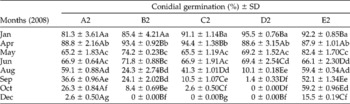
Germination tests of the formulations were carried out 4 weeks after the package was received from the manufacturer, i.e. January 2008. The results of the tests were as follows: 81.29 ( ± 2.09), 85.4 ( ± 2.44), 91.01 ( ± 0.66), 95.46 ( ± 0.44) and 92.92 ( ± 0.49) for A2, B2, C2, D2 and E2 formulations, respectively. After 4 months of storage (in April 2008) at 23–33 °C, conidial viability was between 87.9 and 94.4%. From May 2008 onwards (i.e. 5 months of storage), the germination rate decreased significantly in all the formulations (Table 1).
Conidial germination of the different formulations of Metarhizium acridum stored under ambient conditions

Mean values followed by the same upper case letter within the same row and by the same lower case letter within the same column are not significantly different (P>0.05; Student–Newman–Keuls, ANOVA).
After 8 months (in August 2008) of storage at ambient temperature conditions, conidial viability C2, B2 and D2 had considerably dropped, losing 58.7, 75.9 and 89.9% of viable conidia, respectively. During this period (summer season from April to September 2008), temperatures reached 38 °C on average under shade conditions. On the other hand, A2 and E2 showed a similar rate of conidial germination of 59% (P>0.05). Two months later, i.e. after 10 months of storage, only conidial viability in formulation E2 remained at this level. Under the study conditions (23–38 °C), all the tested formulations completely lost viability after 1 year of storage, except for E2, which maintained a level of germination of 15.5 ± 0.19%.
Viability of M. acridum formulations stored at low temperatures
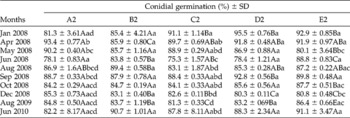
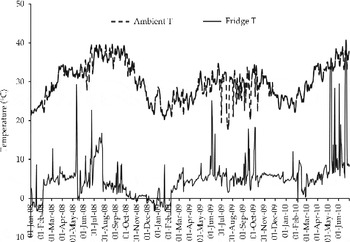
Table 2 shows the conidial viability of the five formulations monitored during 30 months under low temperatures ( − 1.2 to 15 °C). Temperatures recorded during the study period are shown in Fig. 1. There were important fluctuations of temperatures due to repeated power cuts, sometimes lasting several days, generally during the summer season when the overall demand for electricity in the region increased.
Conidial germination of the different formulations of Metarhizium acridum stored at low temperatures (in fridge)

Mean values followed by the same upper case letter within the same row and by the same lower case letter within the same column are not significantly different (P>0.05; Student–Newman–Keuls, ANOVA).
Average daily temperatures registered during the observation period from January 2008 to June 2010, by HOBO thermometers placed with the samples of the five new Metarhizium acridum formulations placed inside a fridge (to achieve low temperatures) and under room conditions (to achieve ambient temperature conditions). T = temperature.

After 30 months of storage under low temperatures, all the tested formulations had conserved their viability without any significant differences (P= 0.72, 0.183, 0.083, 0.200 and 0.196, for A2, B2, C2, D2 and E2, respectively). Temperatures recorded during this period were between − 1.2 and 15 °C. However, due to recurring power cuts, especially during the last months of the study, temperatures of more than 30 °C were recorded, sometimes for several days.
Effect of long-term storage at low temperatures on the virulence of M. acridum formulations
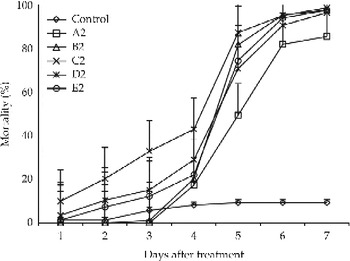
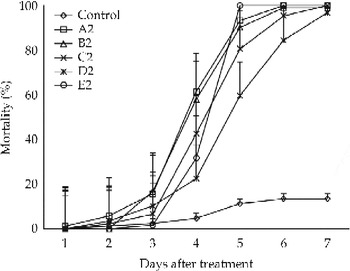
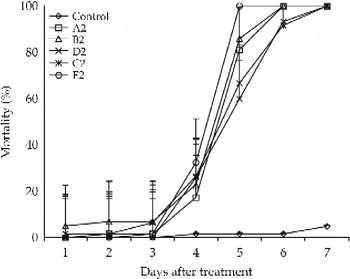
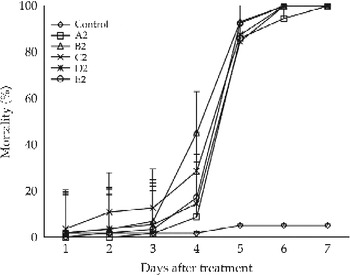
Figures 2–5 show the results of the bioassays carried out with the different formulations after 4, 8, 20 and 30 months of storage at low temperatures (see also Fig. 1). During the study period, all the formulations showed a similar efficacy, with 100% mortality of the treated nymphs being observed after 5–7 days. No significant differences in virulence, measured by the rate of mortality after 7 days, were observed between the formulations (P>0.05). After 30 months (the end of the evaluation), no significant differences regarding the speed of mortality were observed between the formulations. Five days after the treatment, the formulations showed the same level of virulence on the treated insects (P= 0.958). The LT90 (lethal time to kill 90% of the treated population) was 5.5, 5.4, 6.1, 5.9 and 5.7 days for A2, B2, C2, D2 and E2, respectively.
Mean cumulative mortality of fourth-instar nymphs of the desert locust treated with the five new formulations of Metarhizium acridum: oil (A2 and B2), paste (C2), semi-solid (D2) and powder (E2) after 4 months of storage in a fridge. Bars represent standard deviation.

Mean cumulative mortality of fourth-instar nymphs of the desert locust treated with the five new formulations of Metarhizium acridum: oil (A2 and B2), paste (C2), semi-solid (D2) and powder (E2) after 8 months of storage in a fridge. Bars represent standard deviation.

Mean cumulative mortality of fourth-instar nymphs of the desert locust treated with the five new formulations of Metarhizium acridum: oil (A2 and B2), paste (C2), semi-solid (D2) and powder (E2) after 20 months of storage in a fridge. Bars represent standard deviation.

Mean cumulative mortality of fourth-instar nymphs of the desert locust treated with the five new formulations of Metarhizium acridum: oil (A2 and B2), paste (C2), semi-solid (D2) and powder (E2) after 30 months of storage in a fridge. Bars represent standard deviation.

Discussion
The present study demonstrates that the five different formulations of M. acridum (oil, paste, semi-solid and powder) have greater stability when stored under low temperatures. In the long term, the nature of the formulation had no effect on conidial viability. Moreover, even with considerable temperature fluctuations, the formulations remained stable for more than 30 months without any significant loss of conidial viability or virulence. When stored under ambient temperature conditions, conidial viability remained good ( ≥ 88%) during the first 4 months of storage. After 6 months (January–June 2008) of storage at 23–33 °C, viability was reduced to 66–71%. With a conidial viability of 70%, the fungal biopesticide can still be used effectively against locusts and grasshoppers (LUBILOSA, 1999).
To our knowledge, no previous studies regarding these formulations have been published. Despite some difficulty of mixing the formulations before use, physical properties were not affected. Walsat et al. (Reference Walsat, Anderson and Stambough1970) and Stathers et al. (Reference Stathers, Moore and Prior1993) demonstrated that 8 °C is the optimum storage temperature of M. acridum conidia. McClatchie et al. (Reference McClatchie, Moore, Bateman and Prior1994) found that dried conidia were more tolerant to high temperatures than oil formulations. On the other hand, Moore et al. (Reference Moore, Douro-Kpindou, Jenkins and Lomer1996) showed that in medium-term (3–4 months) storage, the viability of dried conidia (powder formulations) was significantly affected when stored at 28–32 °C compared with 10–14 °C. Alves et al. (Reference Alves, Bateman, Gunn, Prior and Leather2002), testing several kinds of oil formulations, found that the viability of conidia in storage was affected by formulation, temperature and the length of storage. In our study, monthly temperatures recorded varied between − 1.2 and 15 °C. Under these conditions, no significant reduction of conidial viability was observed despite recurrent power cuts resulting in considerable increases in temperatures (more than 30 °C, sometimes for several days).
After 6 months of storage under ambient temperature conditions, the germination rate significantly decreased. This could be due to the increase of temperatures during the summer season (June–September). Temperature and moisture content are the major factors affecting conidial longevity (Hong et al., Reference Hong, Ellis and Moore1997). During short-term storage, conidial viability of an oil formulation was enhanced by storing the product at temperatures < 15 °C (Stathers et al., Reference Stathers, Moore and Prior1993). Alves et al. (Reference Alves, Bateman, Gunn, Prior and Leather2002) reported that the viability of conidia after medium-term storage (about 4 months) was better at 10 °C than at 27 °C. In this study, the viability of conidia stored at low temperatures did not significantly decrease and remained above 91% after 10 months.
In general, except for the powder formulation (E2), conidial viability decreased significantly with time. After 10 months of storage, the powder formulation had lost only 40% of viable conidia. During this period, temperatures occasionally exceeded 38 °C under shade conditions. Furthermore, when taking samples, dried formulations can be affected by the humidity of storage atmosphere. This could have a greater effect on conidial longevity (Hedgecock et al., Reference Hedgecock, Moore, Higgins and Prior1995; Hong et al., Reference Hong, Ellis and Moore1997). The other formulations, maintained under the same conditions, had lost between 75 and 100% of viable conidia. Alves et al. (Reference Alves, Bateman, Gunn, Prior and Leather2002) showed that the nature of the oil used for product formulation could greatly affect the viability of conidia during storage.
Our study demonstrates the good stability of the different new formulations of M. acridum. Under ambient conditions, conidia can remain viable for 6 months without any significant loss of viability. This period is sufficiently long; normal desert locust control campaigns do not last longer than 5–6 months. The mycoinsecticide can, therefore, be stored in the field, under shade, for some months without affecting its efficacy. During long-term storage at low temperatures, the nature of the formulation appeared to have no effect. This means that the formulations could remain viable even for a longer period under such conditions. Moreover, the formulations could support relatively high temperatures of up to 30 °C for several days. Because of its good infectivity (Prior et al., Reference Prior, Jollands and Le Patourel1988), especially under low humidity (Bateman et al., Reference Bateman, Carey, Moore and Prior1993), oil formulations are generally preferred for locust control. For long-term storage, it is preferable that the product is stored at low temperatures. In this case, one adequate fridge or cold room could be enough. If necessary, the product can be stored at ambient conditions for some months without any significant loss of viability. In this case, a powder formulation would be preferable.
Acknowledgements
We are grateful to all staff of the Akjoujt Research Station for their kind help. The authors thank Christiaan Kooyman for corrections and critical comments.