Implications
People are concerned about the welfare status of rabbits reared for meat production in small cages. This paper demonstrates that housing rabbits in individual or bicellular cages threatens their welfare by increasing their fear level and by limiting their possibility of expressing normal behaviour. In collective cages (9 rabbits/cage), social contacts and movements are permitted, and both fear response and behavioural patterns improve. The tonic immobility and the open-field tests can be used to compare the fear level of rabbits in different housing systems.
Introduction
The domestication of rabbits is relatively recent compared with other species kept for farming purposes, and for this reason, rabbits still exhibit several behaviours typical of wild specimens (Trocino and Xiccato, Reference Trocino and Xiccato2006; Verga et al., Reference Verga, Luzi and Carenzi2007). As a consequence, under the conditions of intensive commercial rearing systems described in the companion paper (Xiccato et al., Reference Xiccato, Trocino, Majolini, Tazzoli and Zuffellato2012), maintaining the welfare of rabbits may be somewhat of a challenge.
In the fattening stage, housing in individual or small-sized (two to six animals) cages does not permit the rabbits to express some of their typical activities, such as hopping, running or exploring. Rabbits may be bored, spend most of their time resting or show certain stereotypes, such as biting or licking the cage (Podberscek et al., Reference Podberscek, Blackshaw and Beattie1991; Szendrő and Dalle Zotte, Reference Szendrő and Dalle Zotte2011). Moreover, rabbits are prevented from fully expressing their social behaviour (Rödel et al., Reference Rödel, Monclús and von Holst2006).
In animals kept for production, both environmental challenges and social isolation are recognised as stressors, which could negatively affect the fear and anxiety levels of the animals (Forkman et al., Reference Forkman, Boissy, Meunier-Salaün, Canali and Jones2007) and thus their physiology and immune reaction (Koolhaas et al., Reference Koolhaas, Korte, De Boer, Van Der Vegt, Van Reenen, Hopster, De Jong, Ruis and Blokhuis1999). Specific tests are used to measure fear levels in several species (Forkman et al., Reference Forkman, Boissy, Meunier-Salaün, Canali and Jones2007), but few experimental data are available for rabbits (Verga et al., Reference Verga, Luzi and Carenzi2007): the tonic immobility test has been used to evaluate rabbit fear towards humans (Ferrante et al., Reference Ferrante, Verga, Canali and Mattiello1992; Trocino et al., Reference Trocino, Xiccato, Queaque and Sartori2004 and Reference Trocino, Xiccato, Majolini and Fragkiadakis2008; Verwer et al., Reference Verwer, van Amerongen, van den Bos and Hendriksen2009), and the open-field test has been used to obtain information on the fear of rabbits when exposed to an unknown environment (Meijsser et al., Reference Meijsser, Kersten, Wiepkema and Metz1989; Ferrante et al., Reference Ferrante, Verga, Canali and Mattiello1992; Xiccato et al., Reference Xiccato, Verga, Trocino, Ferrante, Queaque and Sartori1999).
The present study aimed to evaluate whether housing in individual, bicellular (2 rabbits) or collective (9 rabbits) cages changes the fear level and behavioural patterns of growing rabbits. Moreover, the effect of the age of animals on fear level and behaviour was assessed.
Material and methods
Animals and housing
A total of 384 rabbits of both genders from a cross-bred line (Hyplus, Grimaud Frères, France) were reared from weaning (27 days of age) to the day before slaughtering (75 days of age). The rabbits were kept in a brick shed equipped with a forced heating and cooling system to maintain the temperature within the range of 14°C to 25°C and were submitted to a natural photoperiod during the months of March and May.
The rabbits were divided into three experimental groups that were homogeneous in average live weight and variability: 72 rabbits were put into individual cages (25 cm wide × 40 cm long × 30 cm high; available surface per rabbit: 1000 cm2; stocking density: 10 rabbits/m2); 96 rabbits were put into 48 bicellular cages (2 rabbits/cage; 28 × 40 × 30 cm; available surface per rabbit: 560 cm2; stocking density: 18 rabbits/m2); and 216 rabbits were put into 24 open-top collective cages (9 rabbits/cage; 50 × 100 cm, available surface per rabbit: 555 cm2; stocking density: 18 rabbits/m2). Both the floors and walls of all cages were made of wire net. All cages were equipped with nipple drinkers (one in the individual and bicellular cages; two in the collective cages) and feeders for the manual distribution of diets (one in the individual and bicellular cages; two in the collective cages).
The rabbits were given ad libitum access to water and a diet suitable for growing rabbits (Xiccato et al., Reference Xiccato, Trocino, Majolini, Tazzoli and Zuffellato2012).
Test of tonic immobility
The tonic immobility test was conducted on 48 rabbits (16 rabbits per housing system) and repeated on the same animals at two ages: 42 and 70 days. One rabbit per each housing system was tested in sequence. The test was conducted in the same barn where individual, bicellular and collective cages were placed. The operator took the rabbits out of the cage and induced immobility by turning the animal on its back and onto the operator's arm. The immobile rabbit was laid down on its back on a V-shaped wooden structure (Ferrante et al., Reference Ferrante, Verga, Canali and Mattiello1992). A maximum of three attempts was carried out to induce immobility and the rabbits were left in the immobility condition for not more than 180 s.
Test of open field
The open-field test was conducted on 48 rabbits (16 rabbits/housing system) and repeated on the same animals at two ages: 39 and 73 days. One rabbit per each housing system was tested in sequence. The test was conducted in a pen (2 × 2 m) with 0.80-m-high wooden walls and a plastic floor divided into nine numbered squares. The pen was located in the same barn as the individual, bicellular and collective cages. The rabbits were submitted to the open-field test from 0800 to 1900 h. The total duration of each test was 12 min per animal. Each rabbit was taken from its cage and put in a closed wooden box (22 cm wide × 30 cm long × 30 cm high) connected to the pen by a sliding door. After 1 min, the sliding door was opened. The number of attempts the rabbit made and the time (latency) it took to enter the pen were recorded for 1 min. If, after this minute, the rabbit was still in the box, it was pushed into the pen, the sliding door was closed and the behaviour of the rabbit was video recorded for 10 min.
On the basis of the work of authors who had previously conducted open-field tests with rabbits (Meijsser et al., Reference Meijsser, Kersten, Wiepkema and Metz1989; Ferrante et al., Reference Ferrante, Verga, Canali and Mattiello1992), the following behaviours were considered: total displacements, the number of squares crossed in the pen; central displacements, the number of times the rabbits crossed the square in the middle of the pen; movement, the time spent in moving with fore and hind legs among squares; running, the time spent in running among squares; exploration, the time spent moving with forelegs or standing sniffing and looking around inside the same square; escape attempts, the number of rapid runs towards the corners of the pen; hops, the number of times the rabbit completely displaced its body by a hop; standing still, the time the rabbit spent still with its fore and hind legs not stretched and on the ground; rearing, the number of times the rabbit upheaved on its hind legs; grooming, the time spent in self-grooming; digging, the time spent in digging inside the pen; biting, the time spent in biting elements of the pen; resting, the time spent inactive, with the body touching the floor and fore and/or hind legs stretched on the ground; defecation, the number of times the rabbit defecated; and urination, the number of times the rabbit urinated.
Behavioural recordings
The behaviour of the rabbits was video recorded in 48 individual cages, 24 bicellular cages and eight collective cages, corresponding to the observation of 168 rabbits. The video recording was carried out for 24 h at two ages, 45 and 66 days, using the ‘scan sampling’ method, where 1 min was recorded each half-hour per each cage. During the night, minimal light was used to avoid disturbing the nictameral activities of the rabbits. The following behaviours were analysed: resting (with crouched or stretched body), self-grooming, allogrooming (through the wire net in individual cages), feeding, drinking, moving, running, hopping, standing still, rearing, biting, sniffing, abnormal behaviours and aggressive interactions (Morisse et al., Reference Morisse, Boilletot and Martrenchar1999; Dal Bosco et al., Reference Dal Bosco, Castellini and Mugnai2002).
Statistical analysis
The data of reactivity and behaviour were tested for a normal distribution by using the Shapiro–Wilk statistic and the PROC UNIVARIATE of SAS (Statistical Analysis System, 1991). Non-normally distributed data were submitted to the Kruskal–Wallis non-parametric test (PROC NPAR1WAY) for comparison by housing system or age. Normally distributed data were analysed by ANOVA with housing system, age and their interactions as the main effects and using PROC GLM. The Bonferroni t-test was used to compare means by groups of housing systems. Differences among means with P < 0.05 were accepted as representing statistically significant differences. The differences among means with 0.05 < P < 0.10 were accepted as representing tendencies towards differences.
The data of the behaviours expressed during the open-field tests were also submitted to Principal Component Analysis (PCA) using Unscrambler software (Unscrambler version 7.0, CAMO ASA, Trondheim, Norway) to reduce the number of original variables into principal components (PCs), explaining the variability among experimental groups and to detect relationships among the same variables (Bourguet et al., Reference Bourguet, Deiss, Gobert, Durand, Boissy and Terlouw2010; Budaev, Reference Budaev2010). At the first PCA analysis, some behaviours (central displacement, escape attempts, hops, rearing, grooming, digging, defecation and urination) were excluded from the data set because they did not contribute to explaining variance.
Results
Test of tonic immobility
The percentage of rabbits that entered into immobility tended to be higher (P < 0.10) in individual cages (90.6%) compared with those in bicellular and collective cages (75.0% and 68.8%; Table 1). The number of attempts necessary to induce immobility was lower and the duration of immobility was higher in the rabbits from the individual cages than those of the bicellular and collective cages (0.05 < P < 0.01).
Response of rabbits to the tonic immobility test

ne = non-estimable.
No r.s.d. can be estimated.
a,bWithin a row, means without a common superscript letter differ, P < 0.05.
*P < 0.05, **P < 0.01, ***P < 0.001.
1Rabbits that exhibited immobility within three attempts.
2Probability of χ 2-test.
3Data were non-normally distributed and submitted to the Kruskal–Wallis non-parametric test (PROC NPAR1WAY) for comparison by cage type or age.
The percentage of animals sensitive to the tonic immobility test significantly decreased when the age of the animals increased from 42 to 70 days (P < 0.001; Table 1), but the number of attempts necessary to induce immobility and the duration of immobility did not change.
Open-field test
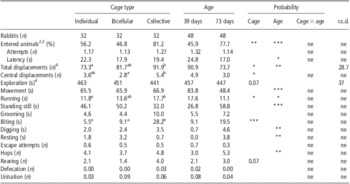
During the open-field test, the rabbits in collective cages were bolder and more likely to explore compared with the rabbits kept in individual or bicellular cages (Table 2). A higher percentage of these collectively caged rabbits entered spontaneously into the arena, they showed the highest number of total and central displacements and they spent more time running and biting parts of the pen.
Behaviour of rabbits during the open-field testFootnote 1

ne = non-estimable by Kruskal–Wallis non-parametric test (PROC NPAR1WAY).
a,b Within a row, means without a common superscript letter differ, P < 0.05.
* P < 0.05, **P < 0.01, ***P < 0.001.
1 If not differently specified, data were non-normally distributed and submitted to the Kruskal–Wallis non-parametric test (PROC NPAR1WAY) for comparison by cage type or age.
2 Rabbits that entered the pen spontaneously within 60 s.
3 Probability of χ 2-test.
4 Data with normal distribution submitted to PROC GLM with cage type, age and their interaction as main effects.
When the age increased, the percentage of rabbits that entered spontaneously into the pen increased (P < 0.001) and the latency to enter decreased (P < 0.05). In addition, the number of total displacements (P < 0.01) and the time spent moving (P < 0.001) and running (P < 0.05) across the arena decreased. However, when age increased, the rabbits stood still, dug and rested for a longer period of time and performed a higher number of hops (+77%).
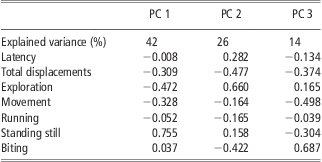
When the behaviours during the open-field tests were submitted to PCA, the first three PCs explained were 42%, 26% and 14%, respectively, of the total variance of the data, which is a cumulative explained variance equal to 82% (Table 3). The loading coefficients of the variables give the weight each variable has on each PC. In the first selected PC, standing still was loaded positively (0.755), whereas negative loadings were measured for exploration, movement and total displacements. In the second PC, exploration had the highest loading coefficient (0.660), whereas the number of total displacements and biting loaded negatively. Finally, biting had the highest weight in the third PC (0.687), with movement and total displacement showing negative loadings.
Loading coefficients of the variables of behaviour during the open-field test in the first three principal components in PCA
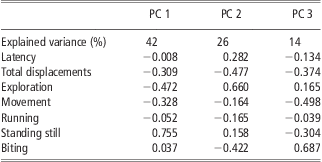
PCA = principal Component Analysis; PC = principal component.
Behavioural patterns during the 24-h period
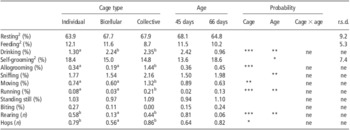
The rabbits spent the majority of the day (96.4%) resting (66.5%), self-grooming (16.1%), feeding (10.8%) and other minor activities (sniffing, 1.82%; standing still, 1.03%; biting, 0.13%) without significant differences ascribed to the housing system (average of behaviours registered at 45 and 66 days of age; Table 4). Only the time devoted to minor activities was affected by the type of housing: the rabbits in individual cages spent less time drinking (−44%, P < 0.001) than those in the bicellular and collective cages. The rabbits in individual and bicellular cages spent less time allogrooming (0.27% v. 1.44%), moving (0.67% v. 1.32%) and running (0.06% v. 0.21%) than the rabbits in the collective cages (0.01 < P < 0.001). In addition, the instances of rearing and hops observed were significantly different according to the housing system, with the lowest occurrence in the rabbits kept in bicellular cages.
Behaviour (% of budget time or number of events) of rabbitsFootnote 1

ne = non-estimable by Kruskal–Wallis non-parametric test (PROC NPAR1WAY).
a,b Within a row, means without a common superscript letter differ, P < 0.05.
* P < 0.05, **P < 0.01, ***P < 0.001.
1 If not differently specified, data were non-normally distributed and submitted to the Kruskal–Wallis non-parametric test (PROC NPAR1WAY) for comparison by cage type or age.
2 Data with normal distribution submitted to PROC GLM with cage type, age and their interaction as main effects.
When comparing the behavioural patterns at the two ages, the older rabbits drank less (−60%) and showed a lower rearing value (−93%) compared with the rabbits at 42 days (P < 0.01). However, the older rabbits spent more time self-grooming (+37%; P < 0.05), sniffing (+32%; P < 0.01) and running (6.5 times more; P < 0.01).
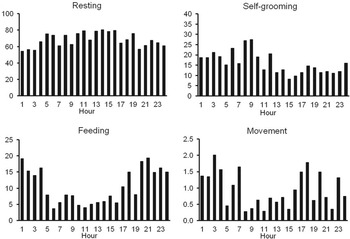
When looking at the observations along the 24 h (Figure 1), the time devoted to resting was always higher than 50%, with the highest occurrence (up to 80% to 85%) between 5 and 16 h. Self-grooming occurred to a higher extent between 24 and 12 h. Feeding started to increase at 17 h and remained high until 4 h. The time spent moving was very low and distributed along the days with a similar pattern of feeding.
Distribution of behaviours (% of budget time) according to the hours of the day (average of recordings at 45 and 66 days of age).

Discussion
Effect of the housing system
The housing conditions of farm animals may affect their welfare to different extents and from different points of view. According to the Farm Animal Welfare Council (2011), animals should be free from fear and distress and free to express normal behaviours by means of sufficient space, proper facilities and the company of congeners (Farm Animal Welfare Council, 2011).
Freedom from fear and distress is ethically motivated, but it is also of direct economic significance because animals under a continuous state of fear may develop chronic stress, with negative consequences on health and production (Koolhaas et al., Reference Koolhaas, Korte, De Boer, Van Der Vegt, Van Reenen, Hopster, De Jong, Ruis and Blokhuis1999; Forkman et al., Reference Forkman, Boissy, Meunier-Salaün, Canali and Jones2007).
In the conditions of our trial, the rabbits in individual cages showed a higher level of fear towards humans compared with the rabbits kept in bicellular and collective cages, as they were more sensitive to the immobility test. In fact, this test mimics a predator's attack, to which the animal may react through struggle or immobility. In birds, the duration of immobility has been proven to be positively correlated with fear (Forkman et al., Reference Forkman, Boissy, Meunier-Salaün, Canali and Jones2007). To our knowledge, no information is available on the reaction to the immobility test of rabbits kept in individual cages. Previous studies on rabbits reared in collective systems showed no difference in the immobility test, according to the stocking density or the type of cage floor (Trocino et al., Reference Trocino, Xiccato, Queaque and Sartori2004). However, a lower number of attempts were necessary to induce immobility when the rabbits were reared in straw-bedded collective cages compared with cages with other types of floors (plastic slat, steel slat or wire net; Trocino et al., Reference Trocino, Xiccato, Majolini and Fragkiadakis2008). In fact, a negative impact of straw on rabbit comfort has been proven on various occasions (Morisse et al., Reference Morisse, Boilletot and Martrenchar1999; Dal Bosco et al., Reference Dal Bosco, Castellini and Mugnai2002; Orova et al., Reference Orova, Szendrő, Matics, Radnai and Biró-Németh2005).
In the present study, the rabbits kept in individual and bicellular cages showed a higher fear level than those kept in collective cages, when exposed to the open-field test. This test is largely used to measure fear in farm animals by exposing them to a new environment and in a variety of situations and stimuli, and it mimics the risk of predation only for those species that evolved to hide, such as rabbits (Forkman et al., Reference Forkman, Boissy, Meunier-Salaün, Canali and Jones2007).
Rabbits kept in individual and bicellular cages showed a higher latency to enter the arena, which has been validated as the best indicator of general fear (Forkman et al., Reference Forkman, Boissy, Meunier-Salaün, Canali and Jones2007), whereas rabbits in collective cages showed more ‘bold’ behaviours (running, biting and rearing). According to Schepers et al. (Reference Schepers, Koene and Beerda2009), solitary-housed pet rabbits appeared more fearful during the open-field test compared with rabbits kept in groups. However, similar to what is described in birds and sheep, social isolation during the test could affect the behaviour of rabbits from collective cages, as movement may be related to group reinstatement, besides curiosity (Forkman et al., Reference Forkman, Boissy, Meunier-Salaün, Canali and Jones2007).
To our knowledge, only Xiccato et al. (Reference Xiccato, Verga, Trocino, Ferrante, Queaque and Sartori1999) found that farm rabbits kept in individual cages were more prone to exploration compared with rabbits kept in small-group cages (three animals).
In the present study, the PCA analysis of the open-field data showed that standing still on one side, and exploration, movement and total displacements on the other side, were negatively correlated on the first PC, as reported also by other authors (Ferrante et al., Reference Ferrante, Verga, Canali and Mattiello1992; Verga et al., Reference Verga, Norcen and Ferrante1994); exploration on one side and total displacement and biting on the other side were negatively correlated on the second PC; finally, biting and movement were negatively correlated on the third PC. Therefore, reaction of rabbits was explained first by a fearful approach based on standing still, then by a prudent aptitude (exploration) and finally by a bold explorative behaviour (biting). Similarly, when grouping open-field behaviours of rabbits by PCA, some authors (Ferrante et al., Reference Ferrante, Verga, Canali and Mattiello1992; Verga et al., Reference Verga, Norcen and Ferrante1994) described a shift from mere orientation to active responses for escaping stressors. Using factor analysis, Meijsser et al. (Reference Meijsser, Kersten, Wiepkema and Metz1989) found that the first factor (46% of the total variance explained) was associated with ‘bold’ behaviours, namely, hopping and rearing; the second factor (accounting for a further 20% of the explained variance) was associated with ‘prudent’ behaviours, that is, crouched moving (walking and moving the forelegs); and the third factor (10% of the total variance explained) was related to ‘fear’ behaviours, with the highest loading coefficient for standing stretched.
When we consider the possibility of expressing a normal behaviour, several concerns arise with farm-grown rabbits because conventional commercial cages are rather small (Trocino and Xiccato, Reference Trocino and Xiccato2006; Verga et al., Reference Verga, Luzi and Carenzi2007). In individual bicellular cages or small conventional collective cages with four to six animals, rabbits cannot move or run and cannot hop or rear, especially at older ages, as observed both in the present and in previous trials (Podberscek et al., Reference Podberscek, Blackshaw and Beattie1991; Dal Bosco et al., Reference Dal Bosco, Castellini and Mugnai2002; Postollec et al., Reference Postollec, Boilletot, Maurice and Michel2006). However, the effect of increasing available space on rabbit behaviour in collective housing systems (cages or pens) is not yet clearly understood (Postollec et al., Reference Postollec, Boilletot, Maurice and Michel2008; Buijs et al., Reference Buijs, Keeling and Tuyttens2011).
Moreover, rabbits kept in groups show wider behavioural patterns compared with those kept in individual or bicellular cages, with the disappearance of stereotypes, a reduction of time spent in feeding and resting and an increase in social activities, exploration and occasional aggressiveness (Podberscek et al., Reference Podberscek, Blackshaw and Beattie1991; Dal Bosco et al., Reference Dal Bosco, Castellini and Mugnai2002; Princz et al., Reference Princz, Dalle Zotte, Radnai, Bíró-Németh, Matics, Gerencsér, Nagy and Szendrő2008). In the present trial, the housing system did not affect the expression or instances of the main activities (resting and feeding) and stereotypical behaviours did not occur. However, the decrease in self-grooming in rabbits in collective cages compared with individual and bicellular cages may be positively considered.
Effect of age
When repeating the immobility test on the same animals at older ages, a lower number of rabbits were sensitive; therefore, some of the animals were habituated to the test. However, it is recognised that the frequent handling of rabbits reduces their fear towards humans during immobility or contact tests (Csatádi et al., Reference Csatádi, Kustos, Eiben, Bilkó and Altbäcker2005; Verwer et al., Reference Verwer, van Amerongen, van den Bos and Hendriksen2009).
During the open-field test, the older rabbits entered the arena earlier and increased the number of hops and the time spent standing still, digging and resting; however, they reduced movements, running and rearing. Similarly, when comparing the open-field behaviours of rabbits at 45 and 66 days, Xiccato et al. (Reference Xiccato, Verga, Trocino, Ferrante, Queaque and Sartori1999) observed decreased latency, escape attempts, number of total displacements and rearing, whereas they observed increased instances of standing still, exploring and grooming.
Changes in behavioural patterns with age were hardly appreciable in our trial. On average, and similar to previous studies, the rabbits spent most of their time resting, allogrooming, feeding and drinking (Morisse and Maurice, Reference Morisse and Maurice1997; Morisse et al., Reference Morisse, Boilletot and Martrenchar1999; Martrenchar et al., Reference Martrenchar, Boilletot, Cotte and Morisse2001; Dal Bosco et al., Reference Dal Bosco, Castellini and Mugnai2002; Trocino et al., Reference Trocino, Xiccato, Majolini and Fragkiadakis2008) and were more active during dark hours (Postollec et al., Reference Postollec, Boilletot, Maurice and Michel2006 and Reference Postollec, Boilletot, Maurice and Michel2008; Buijs et al., Reference Buijs, Keeling and Tuyttens2011), independent of age. Some authors described a significant increase in the frequency of resting and a decrease of movement (Morisse and Maurice, Reference Morisse and Maurice1997) and feeding (Morisse et al., Reference Morisse, Boilletot and Martrenchar1999; Martrenchar et al., Reference Martrenchar, Boilletot, Cotte and Morisse2001), whereas we recorded increased allogrooming at the older age. The higher frequency of running we observed at 66 days in comparison with 45 days of age may be associated with the beginning of aggressive interactions among the animals. However, neither real aggressive behaviours nor lesions on the animals were observed in the present trial.
Conclusion
Under the conditions of the present trial, the rabbits in individual cages exhibited the highest fear level and incomplete behavioural patterns. The limited space available for some activities and the absence of congeners were likely to increase the stress of rabbits and severely threatened their welfare. In contrast, the rabbits housed in collective cages with nine animals showed the lowest fear levels and the possibility of expressing more behaviours. Finally, the rabbits in bicellular cages exhibited an inconsistent pattern of fear towards humans or a new environment. Despite the freedom of movement being even more limited compared with animals in individual cages, probably the rabbits kept in bicellular cages were in a less stressful condition because social contacts were allowed.
Acknowledgements
This study was funded by the Italian Ministry of Education, University and Research MIUR (Project PRIN 2008 – Prot. 2008P4XY93_002). The authors wish to thank Dr Andrea Zuffellato (Veronesi Verona S.p.A.) for his technical assistance during the trial.