Bull sharks (Carcharhinus leucas) are widespread along the continental coasts of all tropical and subtropical seas but also occur around remote island states far away from continental waters (Compagno, Reference Compagno1984; Brunnschweiler & Earle, Reference Brunnschweiler and Earle2006; Brunnschweiler & Compagno, Reference Brunnschweiler and Compagno2007). Although sharks of the genus Carcharhinus are rather uniform and can be difficult to distinguish from one another in the field, the diagnostic features of this heavy-bodied species make it readily distinguishable from other species.
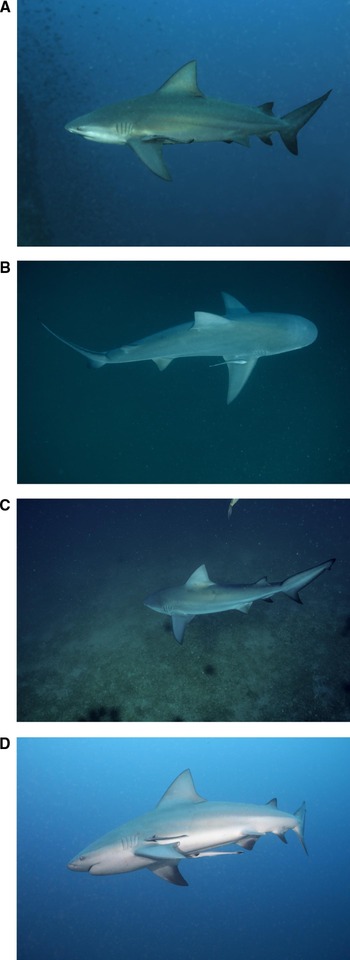
Chumphon Pinnacle is a popular dive location in the Gulf of Thailand offering excellent diving conditions that attract thousands of divers each year. Shark sightings at the site have consistently been reported as grey reef sharks (Carcharhinus amblyrhynchos) by local dive guides and professionals. Here, photographic evidence is presented showing that sharks encountered at Chumphon Pinnacle were misidentified in the past and are in fact bull sharks (Figure 1). The short, bluntly rounded snout and the large and broadly triangular first dorsal fin originating over or just behind pectoral insertion rules out these specimens to be grey reef sharks (Figure 2A).
(A–D) Bull sharks photographed at about 20–30 m depth on Barracuda Point, Chumphon Pinnacle, off Koh Tao in the Gulf of Thailand on 4 August 2007. Note the black posterior margin to entire caudal fin on (C) and the dusky fin tips on (A, C & D) similar to Figure 2A. The remoras accompanying the bull sharks are Echeneis naucrates, an echeneid known to attach to bull sharks (O'Toole, Reference O'Toole2002; Brunnschweiler, Reference Brunnschweiler2006).

(A) A female grey reef shark photographed on 24 February 2007 in the Maldives; (B) a female pigeye shark (TL 808 mm) caught off Bahrain.

A possible explanation for past species misidentification as grey reef sharks (Figure 2A) is that bull sharks encountered at Chumphon Pinnacle in most cases are small and seem to be juveniles. They often have conspicuously marked dusky fin tips (Figure 1C, D), a diagnostic feature especially found in juveniles and less so in adult bull sharks (Compagno, Reference Compagno1984). The Chumphon Pinnacle sharks are most similar in external morphology to the bull shark and the pigeye shark (Carcharhinus amboinensis). From the latter, the bull shark differs in its lower, less erect first dorsal fin and higher, more erect second dorsal fin. Furthermore, the ratio of first:second dorsal height is 3:1 or less in Carcharhinus leucas (Figure 1A), but over 3:1 in C. amboinensis (Figure 2B).
Despite common species misidentification, it has long been recognized that direct observations by divers can yield valuable information on the behaviour and ecology of fish (Myrberg, Reference Myrberg1973). Because underwater observations are made in the natural environment of the animal often without any manipulation, behavioural observations are mainly anecdotal in nature. Nevertheless, the results can provide excellent preliminary data that benefit from follow-up studies using other methods or provide researchers with rare opportunities to witness complete and natural acts of the secret life of fish (Brunnschweiler, Reference Brunnschweiler2005; Brunnschweiler et al., Reference Brunnschweiler, Andrews, Southall, Pickering and Sims2005; Brunnschweiler & Pratt, Reference Brunnschweiler and Pratt2008).
Only a few sites are known where free-ranging bull sharks are accessible for direct underwater observations (Brunnschweiler & Earle, Reference Brunnschweiler and Earle2006; Brunnschweiler & Van Buskirk, Reference Brunnschweiler and Van Buskirk2006). The identification of Chumphon Pinnacle as an encounter site for free-ranging bull sharks offers the possibility to set up an observation programme in the Gulf of Thailand that eventually adds to the knowledge about the behaviour and ecology of this little known apex predator.
ACKNOWLEDGEMENTS
This article would not have been possible without the invaluable help from Robin Nagy and Richard Campbell, who first highlighted the mistaken identity of these sharks. Special thanks to Robin for sharing his excellent set of underwater photographs including Figures 1 & 2A. John Randall kindly provided the photograph of the pigeye shark. The comments from two referees are well appreciated. J.M.B. is supported by the Save Our Seas Foundation and the Shark Foundation Switzerland.