Introduction
In an aging society the needs of patients coming into hospital are becoming more complex and challenging. Nursing a person with dementia in a hospital setting can be very stressful and demanding as staff must often make difficult choices in prioritizing care. Additionally other contributing factors such as staffing levels, pressure for a quick turnaround of patients, and a stress-inducing physical environment for the person with dementia do not help.
In the U.K. at any one time, older people occupy up to two-thirds of National Health Service beds, of whom as many as 60% have mental health needs, mainly dementia, delirium and depression (Royal College of Psychiatrists, 2005). As the population lives longer so the number of people with dementia will grow rapidly. According to Alzheimer Scotland, 1 in 90 Scots have dementia today. In 2031 it is estimated to be 1 in 50 (Alzheimer Scotland, 2007). Similarly, the number of people with dementia accessing acute care is rising.
Nursing a person with dementia requires understanding and caring for their sometimes complex needs. This can include emotional support, help with decision-making, intimate care, responding to behavior and personality changes, and coping with risks, in addition to other health problems. Further challenges can result from poor understanding of the needs of people with dementia and the lack of access to training. This raises issues for nurses who may find that ensuring the smooth running of the ward takes precedence over the individual needs of the patient with dementia. Staff can become “task orientated” and the needs of the person with dementia are easily ignored.
According to the National Institute for Health and Clinical Excellence (NICE), “Health and social care managers should ensure that all staff working with older people in the health, social care and voluntary sectors have access to dementia-care training (skill development), that is consistent with their roles and responsibilities” (guideline 42; NICE, 2006). Alzheimer Scotland calls for better dementia training. “People with dementia deserve appropriate care of a high standard from all the services they use” (Alzheimer Scotland, 2007). Nursing staff and other key disciplines in acute care settings need to be skilled and educated to support people with dementia.
Recent Scottish Government policies support this view and have examined the developing role of the healthcare workforce in Scotland with publications such as Delivering Care, Enabling Health (NHS Scotland, 2006) and Better Care, Better Health (NHS Scotland, 2007).
Changing the culture of care in a hospital environment to become more person-centered can be a painful experience for many managers. A number of studies indicate the importance of a supportive management team to help support the training process (Teri et al., Reference Teri, McCurry, Longsdon and Gibbons2005; Chang and Lin Reference Chang and Lin2005). Not only does the organization need to support learning but, as in any learning organization, the roles of key players also need to be identified. Communication between these “players” to establish the agenda for training has to be encouraged (Innes, Reference Innes2000) as there will be a competing agenda. For example, the culture of care may be defined as a tried and tested approach and “we have always done it this way” attitude. Change is seen as a threat, something special, seen to involve more work and taking time. However, all teams can be thought of as part of a “living system” where change actually occurs all the time (Binney and Williams, Reference Binney and Williams1996). Team members can be reluctant to give up the familiar. It is therefore no surprise that providing education courses on dementia as part of the continuing practice development of staff is still regarded by managers as a challenge. Potential problems are often identified as barriers, such as insufficient numbers of qualified staff being able to supervise the unqualified staff (Jack et al., Reference Jack, Brown and Chapman2004).
In the U.K. the Healthcare Assistant (HCA) has a front-line and crucial role in getting things done. Other job titles for this role are Nursing Auxiliary/Assistant, Clinical Support Worker and Healthcare Support Worker, but whatever the title patient care depends on this group. Significantly, since the 1980s, although the number of staff in this role has remained broadly constant, “there has been negligible attention paid to this grade and to the people who constitute it” (Thornley, Reference Thornley2000).
As a response to the crucial role of the HCA, an innovative educational program has been devised that aims to help Healthcare Assistants provide the best care for patients with dementia in a hospital setting, using a person-centered approach.
Why choose to train the Healthcare Assistant?
This group was targeted because of the recognition of the unique contribution they made to the well-being and care of people with dementia who are admitted as patients to a hospital ward. Registered nursing staff depend greatly on the assistance of the HCA, without whose support they would struggle to deliver care to the patients. Many tasks that used to be undertaken by registered nurses have been transferred to HCAs (Storey, Reference Storey2007). The profile of the HCA has thus changed in recent years and they are now being considered for registration by the Nursing and Midwifery Council. The Royal College of Nursing recognizes that those HCAs who work in direct clinical care with nurses are delivering nursing care and therefore should be regulated by the nursing regulatory body to strengthen public protection (Royal College of Nursing, 2006).
In reality, the HCA is often the staff member who has the most face-to-face contact and is most likely to form relationships with patients and relatives and carry out intimate care. Significantly the HCA will have the least formal training of all the ward staff yet, as soon as their employment begins, an expectation exists that the individual will have the skills to deliver hands-on care to patients whilst working in a very stressful environment.This does not protect the public and certainly does not protect the HCA. “NHS trusts are taking people off the streets and allowing them straight onto the wards. New HCAs are starting on wards without any experience” (Royal College of Nursing, 2006). The majority will receive compulsory training such as moving and handling, fire safety and infection control, while some HCAs are trained to do specific tasks, such as venapuncture and measuring vital signs – but no training is given regarding dementia care.
It is recognized that the quality of interactions between HCAs and people with dementia in a care setting can have a critical impact on quality of life of that person.(Beck et al., Reference Beck, Ortigara, Mercer and Shue1999) Effective education opportunities can help the HCAs interact more effectively (McCallion et al., Reference McCallion1999). The HCA is the staff member to whom the person with dementia is most likely to turn for assistance and reassurance. This may be a result of the HCA appearing less threatening than medical staff, and many older people have been heard to say that they “do not wish to bother the nurse.”
Development of the program
In developing the program, traditional methods of training were considered, such as cascade-type training, local training events and external trainer-led sessions. While each has its place, it was recognized that the “trickle-down approach” of cascade training, for example, places extra demands on those staff who have been trained to find the time to lead the training sessions within their team (Loveday, Reference Loveday2001). Inevitably this can lead to sessions not happening or the content being diluted or rushed. Release of staff from actual ward duties was also seen as a constraint and any proposed training program would need to accommodate this.
The importance of encouraging reflective practice for those attending the program was regarded as being an important foundation compared to mandatory type courses. Research reporting on educating dementia practitioners discusses skills training such as feeding skills (Chang and Lin Reference Chang and Lin2005; Chang et al., Reference Chang, Wykle and Madigan2006) or responding to problem behaviors (McCabe et al., Reference McCabe, Davison and George2007). But training alone is not enough to change practice (Lintern et al., Reference Lintern, Woods and Phair2000). Acquiring knowledge or facts about dementia is not, in itself, learning. For knowledge to be useful, practitioners must promote reflection and implement learning into their practice. It is therefore an ongoing process.
Learning occurs when it is part of a development of new ideas and involves applying these ideas into work situations. This process of reflection is used to describe an exploration of experience in order to lead to new understanding and appreciation (Boud et al., Reference Boud, Keogh, Walker, Edwards, Hanson and Raggatt1996). Essentially reflection is about recapturing the experience and thinking about it in order to lead to new understandings. By returning to the experience and recollecting what occurred, the feelings it aroused and personal reactions to the whole situation can consciously lead to learning taking place. Being aware of emotions and feelings can help identify the positives and barriers to practice.
To encourage participation the “added value” of the program to the participants would also need to be made explicit. The forthcoming registration by the Nursing Council would likely require evidence of study. It was felt that the program should link to the U.K. NHS Knowledge and Skills Framework (KSF). This is a national grading framework for health staff which links job requirements to levels of understanding required. Likewise the program would allow participants to provide evidence of study towards the objectives of the level 3 Vocational Qualifications in Health and Social Care units. In the light of these considerations it was felt important that there should be a key experienced person in each ward who would take responsibility for organizing and leading the various discussions.
Much has been written about the approach of the facilitator/educator/trainer and the impact this can have for the learner (e.g. Burnard, Reference Burnard1989; Cross, Reference Cross1992; Schon, Reference Schon, Edwards, Hanson and Raggatt1996; Weiner, Reference Weiner1997). Adult learners generally prefer to be involved in the learning process and are not passive recipients but have a wealth of personal and work experiences which they bring to the learning situation. It is these experiences that the facilitator of learning can look to in order to engage learners in the training/education program. The facilitator of a training or education program must also consider the contents of the materials and how exercises will be responded to by participants based on their preferred learning styles (Honey and Mumford, Reference Honey and Mumford1982).
A further consideration for the facilitator is the rationale for providing training/education. Weiner (Reference Weiner1997) suggests that it is important for a facilitator of a training program to locate the training within the institution. He suggests four underlying elements the facilitator should consider when designing a training program. It should be:
• part of a researched program, based on individual training needs;
• a reflection of the needs or interests of an organization's training department;
• a response to national or policy issues; and
• required to meet a shortcoming in the quality of an institution's service delivery.
It was with these points in mind that a pilot program for HCAs was devised and adapted over a nine-month period in 2006–2007. Individual training needs were identified through regular meetings with a small group of HCAs who were involved in giving feedback based on their testing of the training materials. The pilot took place in two wards specializing in old age psychiatry, specifically dementia.
For the pilot, two facilitators undertook a short training course that focused on facilitating learning with adults. Each facilitator then took responsibility for leading a small group of HCAs through six workbooks to complete the training. This allowed the authors to amend the workbooks and develop a guide for facilitators to lead group discussions. (Law et al., Reference Law, Lewis and Law2007) This meant that the workbooks presented up-to-date knowledge, evidence-based practice and real life situations that take place in the wards for patients and staff.
The course outline
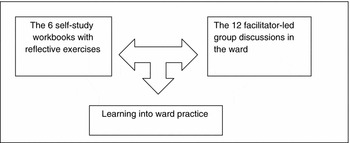
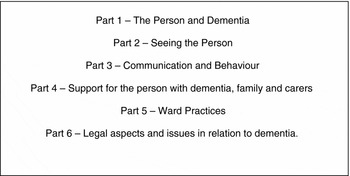
The program (Figure 1) uses six workbooks in a self-study format over a six-month period (Figure 2). Questions and scenarios are introduced that link to aspects of practice in an in-patient ward setting. There is a reflective exercise at the end of each booklet with a written reflective assessment. The program aims to help HCAs develop existing skills, gain new knowledge and improve care for people with dementia.
The program.

The content of the six self-study booklets.

Throughout the program there are 12 group discussions led by a facilitator. These take place during working hours, for a 2 hour period every two weeks and at the participants' place of work. The facilitator is normally an experienced registered nurse who understands the needs of patients with dementia and has a positive attitude to working with the HCAs. Knowledge of their participants and their local work environment enables facilitators to link experience, actions and new knowledge into actual practice. A facilitator's guide provides notes for each session and in addition each facilitator is given a resource pack containing further material.
The learning outcomes
In completing this program using the six self-study booklets, it is expected that each HCA will:
• exhibit a greater understanding of dementia and its impact upon individuals;
• engage in reflective evaluation of nursing interventions, and change practices accordingly;
• recognize a person-centered approach to care;
• demonstrate evidence-based nursing interventions;
• demonstrate a more expansive use of communication skills when interacting and understanding the needs of people with dementia; and
• recognize the role of the carer/family, their needs and possible support networks.
What have participants gained?
The fundamental challenge of this program was to encourage the HCA to adopt a person-centered practice and so focus on seeing the individual person and his or her needs rather than seeing “just another dementia patient.” The intention was to help participants gain knowledge so that they gained understanding of effective care for dementia patients. This new learning will empower the HCA by increasing their confidence and feeling of self-worth within the clinical and multidisciplinary team (Peterson et al., Reference Peterson, Berg-Weger, McGillick and Schwartz2002; Parks et al., Reference Parks, Haines, Foreman, McKinstry and Maxwell2005).
The benefits for participants who have completed the program
On completion of the six workbooks, participants are asked to write a reflective essay to establish what they have learned from the course. These essays have shown a development in understanding and change in attitudes and practice. The quotes in Box 1 are taken from a small sample of completed essays to illustrate this learning.
Box 1. Comments from participants' essays
Attitude change
“I have learned most of all to reflect on what I do within the ward as I realize that my actions and those of other staff can have a negative or positive impact on patients.” (HCA 1)
“I have found that doing the course has made me realize that people with dementia should be seen as individuals and not just symptoms of an illness.” (HCA 4)
“I feel I have expanded my knowledge about dementia and I now understand how it can impact on the patient and their family.” (HCA 10)
Practice change
“I now understand why having a life history for people with dementia is important as it helps you communicate and see the person as an individual.” (HCA 4)
“I now think that spending time talking to patients is a priority, even if it means you are just looking through their old photographs; it makes the person feel better about themselves.” (HCA11)
Being a team member
“I thought that just being a healthcare assistant I was just a small cog in the machine. Now I feel I have an important role in the team as HCAs spend more time with patients than anyone else.” (HCA 6)
The importance of the facilitator's role
To ensure that person-centered practice underpins the discussions the project team decided that each facilitator should be registered with the Dementia Services Development Centre at the University of Stirling and be required to attend an update session every six months. In addition, a member of the project team would attend either the first or second group discussion at the workplace. Each facilitator is expected to take responsibility for organizing a suitable meeting room, arranging dates for group discussions and informing the ward manager, making constructive comments to ensure best practice and helping HCAs obtain protected study time. Additionally, each facilitator is responsible for evaluating the sessions and providing feedback to the project team about the start date, those who attended, and any issues that arose in the group discussion that might require amendment of the study materials.
Conclusion
A strong ethos of this program is to use workplace facilitation by an existing member of the ward team. This has proved successful and has relieved the participants' initial anxieties and led to an improved learning environment. Similarly, the fact that the training takes place over six months proved to be successful as it provides for flexibility with off-duty rotas and allows for constant reinforcement of the person-centered care approach.
Following on from the initial pilot, the course has now been accredited by the Royal College of Nursing (RCN) in the U.K. Through the Dementia Services Development Centre at the University of Stirling this course has been made available to staff on a national level. The course is also being delivered in different ward settings such as long-stay facilities, rehabilitation units and medical wards. By incorporating ongoing feedback from participants, facilitators and managers, the content has been updated to reflect changes in practice and the realities of working in a hospital environment. Above all, it remains true to its original ethos of delivering person-centered care to improve the quality of care for people with dementia.
Conflict of interest
None.
Description of authors' roles
Alan Chapman had overall line-management responsibility for the HCA project and development; Shirley Law had day-to-day responsibility for the project implementation and development. Both authors shared in writing the paper.