Intensified Allied bombing brought World War II into the homes of the German civilian population in the spring of 1942. Aerial attack alerts and bombing raids shaped life in larger German cities such as Hamburg, Cologne, Essen, Berlin, Frankfurt am Main, and Dresden, and redefined the term home front. Bringing destruction, displacement and death, the war heavily affected urban populations in their physical and mental well-being for more than three years. Yet, somehow everyday life continued. As Fritz Limmer (1881–1947), a retired chemistry professor who spent the air war in the Hessian town of Darmstadt, observed during the summer of 1944 with regard to the effect the war was having on members of his family: “Grete and Helgard [his wife and daughter] just have to run to the movies after lunch. (Reverie.) I am astonished by Grete's behavior, as she knows nothing about her siblings’ fate in Romania. It defies comprehension. And all the talk about ‘finding relaxation’ doesn't impress me either.” He entrusted his diary with his fears about the cohesion of his family: “And thus the disintegration [Zerfall] among us continues unabated, at the precise moment when we can only endure this period through harmony. It will become even more difficult than it already is …”Footnote 1
Limmer's pessimistic observations prompt us to explore a society decisively shaped by war, as well as the corroding effects conflict had on the individual. In the male-defined sphere of military confrontation, the question of gendered experience invites particular attention.Footnote 2 With a whole generation of men gone to the battlefields of Europe and North Africa, involved in the administration and plundering of conquered territory, or participating in Germany's genocidal machinery (though joined in the death camps by a growing number of female auxiliaries in the Schutzstaffel [SS]), the exigencies of war on the home front not only had a lasting effect on gender relations in German society but also profoundly affected the idealized conceptions of womanhood and manhood in Nazi society.Footnote 3 To a certain extent, this was a reoccurrence of processes already observable in Germany during World War I, when “total mobilization destroyed the divisions between the military and civil society and between the ‘public’ and the ‘private’ spheres, only to replace them with the separation between the male combat zone of the battlefield and the female noncombat zone of producing and reproducing the means of destruction,” as women replaced the absent men in the war economy.Footnote 4
A new feature of World War II was the physical proximity of a growing number of women to death and destruction. Inspired by Michael Geyer's suggestion that the history of war should be written as “a history of organized deadly force,” Karen Hagemann has concluded that “the dimension of violence, which was generally exercised and suffered in gender-specific ways, should also be a central focus of a social and gender history of the … war.”Footnote 5 The present article explores how the experience of “deadly force”—as well as the gender- and age-related preparation with which individuals encountered war violence and made sense of it—shaped social reorganization during the final months of the war. It shows how female roles in relation to the state—regardless of whether women mended clothes, produced ammunition, or actively helped in combat to defend the home front—underwent a redefinition in Germany during World War II that ideologically recast all these activities as women's patriotic duty to the Fatherland. Nazi propaganda hoped to prevent a reoccurrence of the breakdown of the home front in 1918, which had contributed to Germany's willingness to end the war—and in which women had played an important role.Footnote 6 It utilized the “stab-in-the-back” myth, according to which the armistice and peace treaty ending World War I had represented a betrayal of military efforts by politicians on the home front, the so-called Novemberverbrecher (November criminals). Nazi propaganda used the myth effectively to gain an electoral following in the Weimar Republic and then employed it to mobilize Germany for war, exploiting feelings about the nation's earlier humiliation, its unfair treatment at Versailles, and a popular desire for renewed greatness.Footnote 7 Ingrained in collective memory and political culture, the way in which World War I had ended remained an influential lesson for the party and for wartime society alike.
The following study further complicates the dualism between “male battlefront” and “female home front” through an examination of the gendered experience of bombing in Darmstadt, a small town near Frankfurt am Main. Bombing offers a relatively “gender-neutral” wartime event as a historical context for gender analysis. This permits the following analysis to avoid recreating the archetypal division between male perpetrators and female victims, which has been the subject of passionate discussion in the field of women's history over the last three decades, centering on topics such as rape, expulsion, and other wartime events considered to be predominantly female ordeals.Footnote 8 Air raids have instead been at the center of a hard-fought historical debate about general German victimhood during World War II. The most contentious point in such discussions has been the concern that the acknowledgement of German suffering might somehow relativize Nazi war crimes, especially the Holocaust.Footnote 9 In light of such debates, it is worth emphasizing that this article does not measure or compare suffering but instead explores rational and affective capabilities for endurance and resilience during a state of emergency. It explores, above all, the affective dialogue between the personal sphere of survival and the public sphere of warfare, examining how these changed in relation to increasingly fluid gender roles in a besieged Third Reich. As we shall see, the aerial bombing put patriarchal society under pressure, thus setting the stage for a period of female self-sufficiency during the second half of the war. This already occurred in 1942, which means that increasing opportunities for female agency—usually associated with the “hour of the woman” during the final days of the war and Allied occupation in postwar Germany—had appeared much earlier.Footnote 10
Bombing, Volksgemeinschaft, and Morale
Strategic bombing was a new feature of aerial warfare, and the United States military had a vested interest in learning about its outcomes and efficiency. As soon as they entered Germany, American occupying forces began extracting strategic and military lessons from captured administrative records and from interviews with German officials, as well as with industrialists, workers, and other civilians. This effort led to the publication of a series of 208 studies about bombing in Europe (and Japan) during World War II, which became known as the United States Strategic Bombing Surveys (USSBS). Historians interested in air warfare over Nazi Germany have extensively used the USSBS reports on German morale. Shaped by the surveys’ initial purpose, their narratives have emphasized Allied air strategy, thus literally writing history from above. These historical works focus, by and large, on the material effects of the air raids.Footnote 11 Some nevertheless turn their attention to the home-front experience, and thus to the immediate chaos and suffering resulting from the raids.Footnote 12
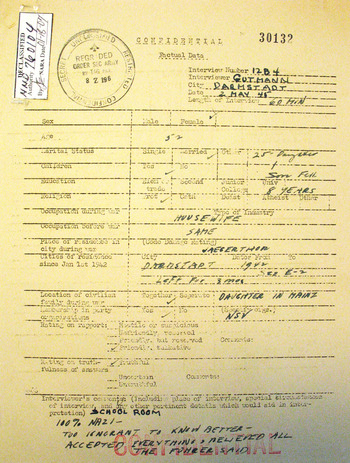
While the USSBS reports are popular among historians of the German home front, the interviews with civilians have been practically ignored as a source for getting at wartime experience. Over 170 interview transcripts (written in English) containing the home-front narratives of men and women from different social and generational backgrounds in Darmstadt have survived and are housed in the US National Archives at College Park, Maryland. The USSBS morale division group began the interview series in Darmstadt on April 4, 1945, more than a month before the war in Europe officially ended. Cover sheets provide information for each interviewee about sex, age, marital status, education, and occupation during the war, as well as about membership in NSDAP organizations, his or her personal material situation, number of children, and deaths in the family—thus allowing for an analysis according to social strata, gender, and age cohort (Fig. 1).
USSBS interview cover sheet (May 2, 1945). Source: National Archives at College Park, RG 243, Entry 6, Box 509, Folder 64b f23.

Using interviews as historical sources raises familiar questions about the reliability and veracity of memories. With that in mind, it should be noted, in the first place, that this set of interviews emerged from a specific context: they were recorded at a transformative moment, in the late spring of 1945, when Germans were trying collectively and individually to make sense of defeat in a war that had been meant to achieve German world domination. The context is thus very different from the longue durée perspective that Jörg Arnold offers in his comparative study of collective urban war memory in East and West German towns.Footnote 13 Placing the individual in relation to a nascent collective memory can nevertheless be useful as well for understanding these more immediate testimonies with regard to agency, subjectivity, and the construction of selfhood.Footnote 14 At the same time, it is important to contextualize the interviews and to be mindful of the power relations at play between the interviewers and their subjects.
The fact that the American occupiers conducted these interviews might lead to concerns about the respondents’ authenticity, as well as about the biases of the interviewers. German civilians may not have been willing to reveal the entire extent of their physical and psychological defeat to the former enemy, or they might have concealed their (prior) politics in order to avoid blame and punishment for the crimes committed during the Third Reich. The USSBS unit supplied interviewers, often native German speakers, with a detailed list of forty-three questions that studied respondents’ emotional constitution, changes in political attitudes and behavior, as well as “certain experiences and beliefs” assumed to “correlate with the morale effects produced by bombing.”Footnote 15 Information about specific objectives accompanied the questions, and instructed the interviewers to probe for detailed answers. A narrative arc and a strong element of guidance were thus built into the structure of the interview. But above all, interviewers strove to create an atmosphere of trust—by building good rapport, for example, and by guaranteeing full anonymity. This was meant to put the interviewee at ease and to overcome an initial attitude of “you Americans” versus “us Germans.” Interviewers rated both rapport, as well as the respondents’ perceived truthfulness, on the cover sheet, and noted any suspicions they had about the latter.
It seems that the peaceful nature of the American occupation led to growing trust in the new ruling authority, especially on the part of those Darmstadters who had suffered under Nazi surveillance. Responding to a question about how he was faring under the occupation, a former soldier and concentration camp inmate sounded almost relieved: “Things are now going good. I am now free and can speak freely. Before I lived always in fear, could not speak freely because of the Gestapo.”Footnote 16 Notwithstanding the analytical challenges posed by omissions and other forms of forgetting or misremembering, the interviews offer rich opportunity for a close examination of wartime experience. Writing on the merit of using biographical narratives for historical research, Mary Jo Maynes, Jennifer L. Pierce, and Barbara Laslett have argued that “human agency and individual social action is best understood in connection with the construction of selfhood in and through historically specific social relationships and institutions.”Footnote 17 Although the interview transcripts are not traditional forms of biographical writing, they nevertheless provide a tool for understanding the relationship between complex social actors and their society. They document one moment in the ongoing process of an individual, “with a real history and psychology,” constructing himself or herself in the specific context of wartime Nazi society and defeat.Footnote 18 Using the interviews, we can thus approach the home front from a more nuanced perspective, using narrative analytical approaches based on poststructuralist concepts of language as representative and constitutive of subjectivity, while simultaneously historicizing gender difference in lived experience.Footnote 19
The goal of Allied strategic bombing was to destroy both the wartime economy and the Nazis’ vaunted Volksgemeinschaft (people's community), especially the public solidarity with and loyalty to the Nazi regime that the latter concept implied. Morale became a prime target at the height of the war in 1942: if military success on the battlefield remained unattainable, it was hoped that American and British bombing, along with other demoralization efforts, could defeat Nazi Germany from within. The Allies believed that the German population, if put under sufficient material and social pressure, would eventually lose faith in its leadership, and that the home front would consequently collapse, repeating the situation of 1918 and leading to a quicker end to the war. By targeting the German war industry and its workers, bombing effectively caused an uneven share of hardships between urban and rural areas. This revived longstanding societal tensions between working-class and middle-class Germans.Footnote 20
By the time World War II ended for Germany on May 8, 1945, the consequences of Allied bombing had resulted in some 305,000 fatalities, 780,000 wounded, and 1,865,000 destroyed homes.Footnote 21 Close to 5,000,000 people were evacuated and approximately 20,000,000 had no access to basic utilities. Altogether, more than a third of the population had been physically affected in some way. Yet, even during the heaviest bombings in 1944–1945, there was neither widespread organized dissent against the Nazi regime, nor any strike action in the war industries.Footnote 22 Sociologists agree that the results of the United States Strategic Bombing Surveys indicate that the bombing failed to incite major panics or sustained chaos.Footnote 23 And even the US military analysts admitted in 1945 that strategic bombing had not been as successful as expected in undermining German morale or loyalty to the Nazi regime.Footnote 24 More recently, Nicholas Stargardt has suggested that, “far from leading to collapse, successive crises acted as catalysts of radical transformation … Major disasters like Stalingrad and Hamburg did indeed lead to a catastrophic fall in the regime's popularity, but they did not themselves call patriotic commitment into question.”Footnote 25 Though unpopular, he argues, the war remained legitimate in the eyes of most Germans.
Stargardt's is the latest contribution to a literature that has revised the previously common belief that dissolution of the supposedly monolithic Volksgemeinschaft meant the collapse of morale.Footnote 26 Earlier research has pointed to the fact that atomization of the home front existed alongside solidarity, as “individuals and groups were increasingly thrown upon their own resources—as multiple and competing communities of fate—amid the escalating chaos in Germany.”Footnote 27 Christian Goeschel has similarly argued that it was not a lack of social integration, but rather the specter of defeat, ideological fanaticism, or fear of the advancing enemy armies, that caused a dip in morale (followed by a wave of suicides) in the spring of 1945.Footnote 28
What is evident is that we need a more complex understanding of the nature of German wartime morale, one that goes beyond Volksgemeinschaft and similar, objectifying terminology. Morale has a collective emotional life; it is a relational concept that becomes traceable in the individual's interaction with culturally specific social dynamics or power techniques, such as the “stab-in-the-back” myth that the Nazis continued to employ in their mobilization propaganda—a collective memory of national shame and betrayal that could only be overcome if all Germans fulfilled their patriotic duty. Morale, then, is not a delimited object that can “break or be lost”: it is “commonplace, a dimension of all activities,” as Ben Anderson proposes.Footnote 29 Morale is thus defined by its “in-betweenness,” correlating with what affect scholar Brian Massumi has described as the individual's capacity for simultaneously affecting and being affected in an ongoing process of social change.Footnote 30 This suggests that the affect of morale can be traced, too, in the ways in which people adapted to or reacted against specific, yet changing, gender structures in the Third Reich, regardless of whether they did so knowingly. How, then, did morale relate to the gendered self? That is the primary subject of this article.
A suitable location for a case study looking at such subtleties of communal cohesion and gender relations under the bombs is Darmstadt, a town of moderate size in the then Gau (district) of Hesse-Nassau. Surrounded by densely forested rolling hills, the secluded town is situated in the Rhine-Main area about thirty kilometers from Frankfurt. Only half an hour by train from the rural, agriculturally rich Odenwald region, Darmstadt, the former administrative center of the Grand Duchy of Hesse, was a Beamtenstadt (civil servant town) with small industry and large residential areas in the 1930s, popular with tourists for its cultural riches and historic buildings—including a narrow but charming, late medieval town center. On March 5, 1933, 50 percent of the participating voters in Darmstadt cast their ballots for the NSDAP—altogether 30,932 votes, results that exceeded the Reich average of 43.9 percent. These elections saw a record voter turnout of 89 percent, which was not surprising, given that this was the first undemocratic election under the Third Reich.Footnote 31 During the Great Depression, Darmstadt had already become a stronghold of the Nazi party, which achieved above-average electoral results in Reichstag elections from 1930 onward.Footnote 32 Darmstadt's population, approximately 110,000 in 1939, remained relatively steady over the course of the war—until September 1944, when it dropped abruptly after large area bombings by the Royal Air Force (RAF).Footnote 33 The local food administration reported the lowest population count in January 1945 (50,487), signifying an overall decline of 54 percent. People returned with greater frequency only after the town had surrendered to the American army on March 25, 1945, pushing the number up to 54,274 by June 1945.Footnote 34
This article breathes life into these numbers to illuminate the gendered aspects of the extraordinary, yet almost daily, hardships that took place in Darmstadt during the final year of World War II. It traces in two steps the experience of bombing among members of the racially defined Volksgemeinschaft. The following section examines the spatial specificity of Darmstadt as an unlikely air raid target, alongside the regime's mobilization efforts, and explores how these influenced the population's psychological and emotional preparation for what transpired after 1942. This is followed by an analysis of the war's implications for the personal life of the Darmstadters, i.e., matters related to affective collectivity, relationships, as well as emotional and physical health. Because of the simultaneity of the Holocaust, the Jewish experience of the bombings (as well as that of ethnic minorities in Darmstadt) is difficult to reconstruct. Under escalating antisemitism and racial policy, and as quarterly reports of the Jewish Mutual Assistance Society and monthly residential reports by the Darmstadt Jewish congregation show, any Jews who had had the means and the foresight had already emigrated to the United States or to South America before the British began strategic bombing in 1942. The remaining 1,378 Jews in the region were sent to a crueler destiny in four deportation transports that departed from the Rhineland to the East in 1942 and 1943—more specifically, to the transfer ghettos Theresienstadt and Piaski-Lublin, from where many would go on to perish in the extermination camps in occupied Poland.Footnote 35 By the spring of 1943, Darmstadt had been stripped of its Jewish population, which is why their stories were not recorded in the USSBS interviews, and the interviewed Germans remained silent about the fate of “non-Aryans” (Nichtarier).Footnote 36 During the same period, several million people from Poland, from the so-called Protectorate of Bohemia and Moravia, and from Ukraine were forcibly shipped to the Reich to work in the war industries and in agriculture. More than 2,000 arrived in Darmstadt in the spring of 1942, and their number rose to 6,560 by May 1944; about two thirds were men. These were high numbers, yet the so-called Ostarbeiter never exceeded 12 percent of the overall workforce.Footnote 37 Falling outside the racialized Volksgemeinschaft, foreign workers were excluded, for the most part, from communal air raid protection.Footnote 38 They had an air defense status similar to that of Jews married to German citizens. As a rule, they were not allowed to look for shelter in communal cellars and were thus more or less left to fend for themselves. In addition to the general effects of the air war, the death toll among foreign workers was especially high because they were often housed in the vicinity of targeted industry.
Preparing for the Worst: Air Raid Protection
Until 1942 the German home front remained relatively untouched by the havoc of war. Great Britain flew minor bombing missions against industrial targets in the Ruhr beginning in the spring of 1940, but bombing as a means of warfare was still in its infancy, technologically as well as strategically.Footnote 39 After having used aerial bombing in the Spanish Civil War and the invasion of Poland, Adolf Hitler experimented with the bombing of British cities, including London, in air attacks in the fall of 1940. This campaign became known as the Blitz, the first intentional, large-scale bombardment of civilian areas that killed more than twenty thousand people.Footnote 40 Despite the bombings, the war in the West against the British did not proceed as quickly as the offensive against France had that summer—Operation Sea Lion, the planned invasion of Britain, did not occur, as a result—and Germany began preparations for the eventuality of extended air war with Britain in the fall of 1940.
German officials ranked the town of Darmstadt low in terms of the threat of an air raid because of its military insignificance and small-scale war industry.Footnote 41 The only decisive industrial sites were the Merck chemical plant, a renowned producer of pharmaceutical drugs, and the machinery manufacturer Röhm und Haas, which were both located in industrial outskirts in the northern part of town. Together, they produced over 50 per cent of the city's industrial production and employed 42.6 per cent of local industrial workers.Footnote 42 Darmstadt's overall industrial significance was negligible: less than 0.2 percent of total German production.Footnote 43 The Gau concentrated its protection and defense efforts instead on industrially and strategically important cities such as nearby Frankfurt am Main, which was indeed later heavily bombed.Footnote 44
In contrast to the rational calculations of the officials, Darmstadters asserted a number of arbitrary reasons why their city would be spared from bombing. Some thought that the Allies would not be able to find Darmstadt because of its secluded location in the forests. Others believed Britain would not dare attack the residence of Princess Margaret of Hesse and Rhine, the English wife of the grand duke of Hesse-Darmstadt, whose friendly ties to the British Crown were well known. Oddly enough, many also believed that the Merck factory's presence would forestall Allied bombing because of its international reputation as a producer of rare medications.Footnote 45 Explaining away the danger was an important psychological coping mechanism for a population under the threat of air raids: for them, it must have been a way to maintain normalcy and allow them to perform their quotidian tasks—or, like Fritz Limmer's wife and daughter, to enjoy simple pleasures such as going to the movies—in a war that was inexorably moving closer to home.
A cohesive air raid alarm system was already introduced in November 1940, possibly in expectation of retaliation for the Luftwaffe's recent bombings of British cities.Footnote 46 To avoid disrupting their normal life any more than necessary, officials considered ten minutes to be sufficient time for urban populations to retreat into shelters and bunkers. German radar was able to detect enemy planes long before they reached German territory, which would have allowed for earlier warnings were it not for the RAF's terror strategy. British pilots chose detours on their way to Germany in order to leave the Germans in the dark about the actual target.Footnote 47 At the height of the air war, this led to a “war of nerves,” especially in western Germany, because the alarms sounded in all cities as soon as Allied planes approached the Reich border close to the industrial centers along the Rhine and Ruhr rivers. By the time Darmstadt surrendered to American forces on March 25, 1945, the town's population had experienced more than seven hundred aerial warnings (Luftwarnungen) and alarms—but only seventeen actual attacks.Footnote 48
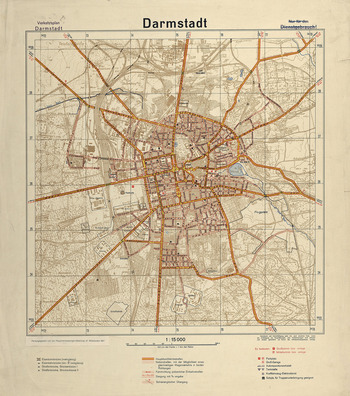
Map of Darmstadt, 1941. Source: Stadtarchiv Darmstadt, map collection.

When the attacks finally took place, most Darmstadters were mentally ill-prepared. What they could not know was that their city would become the testing ground for a new marking and bombing strategy of the RAF Bomber Command. Darmstadt was chosen at random for this maneuver, according to military historian Max Hastings: “In September 1944, 5 Group [an RAF bomber fleet] were seeking previously undamaged area targets of manageable size upon which to test the accuracy and effectiveness of various marking and bombing techniques at tolerable cost—in other words at limited penetration inside Germany.”Footnote 49 Spared thus far from heavy raids, Darmstadt fit that description perfectly. The Kavallerie Exerzierplatz (cavalry parade ground) was chosen as the marking point for the aerial attack because of its white soil, which was visible even by night. From here the bombers would fly along seven aiming lines, covering an area roughly shaped like a fan (later referred to as the “Todesfächer”), and drop their deadly cargo.Footnote 50
Apart from their stoic optimism that the town would be spared from raids, Darmstadters received little official guidance in preparation for such an enormous attack. It was true that administrative officials from Frankfurt had raised awareness of aerial defense in the whole Gau of Hesse-Nassau by issuing guidelines to surrounding police departments, as well as to NSDAP regional leaderships. But in most of these decrees related to air defense, self-protection (Selbstschutz) by the population itself occupied center stage, and, to a large extent, the protection measures did depend on public cooperation. In general, air raid protection designated housing communities (Hausgemeinschaften), consisting either of apartment building tenants or persons who lived in the same neighborhood, as the smallest unit in firefighting, first-aid services, and repairs.Footnote 51 Concerned about the negative effect of visible destruction on public support for the war, the authorities emphasized the central role of the cooperative housing community in clearing away the rubble as soon as possible—aided, of course, by mass organizations such as the Hitler Youth. Toward the end of the war, foreign workers, concentration-camp prisoners, and POWs were increasingly assigned to this task.Footnote 52
The citizens of Darmstadt were understandably dissatisfied with the level of local air raid protection: “These air raid precautions were nonsense. The water basins that they built were useless, what they should have done was to built [sic] shelters and bunkers rather than to have us sit in these cellars,” one interviewee grumbled.Footnote 53 Aerial defense officials regarded proper bunkers as unnecessary for a city facing a low-level threat. The public shelters within the city limits held only roughly twenty thousand people, which left the vast majority of the inhabitants to their own devices.Footnote 54 Most of the population stayed in their houses’ reinforced cellars—“self-protection shelters” (Selbstschutzräume) that supplied reasonable sanctuary during the first year of the air war, but that would become tragic deathtraps during the fire blaze of September 1944. In the apartment buildings of the inner city, the Hausgemeinschaft was responsible for the reinforcement of cellars, as well as of passageways to those of neighboring houses—a measure that would later save many lives.Footnote 55
The communal aspect of survival measures fueled the culture of denunciation that the Nazis had fostered since taking power in 1933.Footnote 56 Violations of blackout guidelines—such as accidentally switching on lights in rooms without mandatory window covers—were an easy way to turn in unloved neighbors to the local Gestapo. This made practical sense, but perplexing complaints were brought to the attention of the authorities as well. For instance, in February 1943, a woman denounced her neighbor for leaving white laundry out to dry in the garden, which allegedly revealed Darmstadt's location to enemy bombers at night.Footnote 57 Though both men and women contributed to this culture of denunciation, conflict resolution was distinctly gendered, as female disobedience to official guidelines usually attracted more scrutiny. During a light attack in April 1943, for example, neighborly animosities played out in the self-protection shelter of Eschollbrückerstrasse 44, where a man and a woman refused the orders of both the block warden (Blockwart) and the aerial defense warden to extinguish the flames. The man's refusal to do his duty (he claimed to have a bad stomachache) resulted in a shouting match with the wardens, but the police eventually accepted his reason for refusing to comply on health grounds. The woman, a trained member of the fire brigade auxiliary, refused to join the fire fighters because of maternal responsibilities: she had two children and her husband was serving in the war. She loudly challenged the wardens’ authority, pointing in particular to their inability to establish order in the overcrowded community shelter. An unsupervised woman, speaking up publically in such a fashion, attracted special scrutiny, and, in an official complaint, the air defense warden showed no compassion for her situation.Footnote 58 The resolute woman later demonstrated no remorse, but instead implied that her unfair treatment had reflected the misogyny of the wardens. During police questioning, she mentioned that the block warden had once beaten his wife nearly senseless in the communal shelter.Footnote 59 More to the point, she juxtaposed her failure to do her duty with the wardens’ failure to do theirs. She maintained, at the same time, that her principle responsibility was to look after her children, not safeguard the housing community from spreading fires. Her resistance shows that challenges to changing gender norms were also fought out, alongside neighborly quarrels, in matters concerning self-protection.
How women experienced the war depended on their specific situation, of course, yet some trends relating to age cohort, employment, and marital status can nevertheless be observed. Marital status was, in fact, an important social marker for women in Nazi Germany in light of those Nazi reproduction policies regarding “racial purity” and “hereditary health” that shaped female experiences of the early war years most explicitly.Footnote 60 Single women of all ages were the first to replace men in the war economy and be drafted into the Auxiliary War Service (Kriegshilfsdienst). Yet, in the later years of the war, an increasing number of married women was recruited into the workforce and into the auxiliary squads as well. At that point, motherhood and class shaped a woman's ability to decide whether to remain in the workforce. Childless or working-class married women often did not have the freedom to make this decision.Footnote 61
At the same time, a cohort of young, unmarried women who had joined the war effort during their Year of Duty (Pflichtjahr) experienced a higher degree of independence from their families during compulsory participation in organizations such as the Reich Labor Service for Female Youth (Reichsarbeitsdienst der weiblichen Jugend). Either way, the mobilization for total war across gender lines increased women's presence in the public sphere. By the spring of 1943, the female German work population in Darmstadt exceeded that of male German workers for the first time, reaching its peak in August 1943, with 24,985 women in the workforce.Footnote 62 Their presence in work environments that included foreign workers focused authorities’ suspicion and concerns about “moral degeneration” on working women in particular.Footnote 63 The Gestapo recruited NSDAP members to observe the foreign workforce and report any signs of German kindness beyond necessary forms of cooperation at the workplace.Footnote 64 Women became the main targets of this control measure, which is not to say that German men on the home front did not engage in relationships with foreign workers. An order about the prosecution of illegal sexual relations from Chief of Police Heinrich Himmler nevertheless referred exclusively to women.Footnote 65
Mobilization continued despite such concerns about the moral perils of increased female independence. In July 1943, the press announced that women were now to join the fire brigades because the men who had previously participated were now being called to serve in the military.Footnote 66 Within a year, about fifty thousand women between the ages of seventeen and forty had “volunteered” for this service.Footnote 67 Women joined the anti-aircraft (AA) forces in 1944 as well. The German press portrayed such work as a challenge to femininity because “natural inclination and tendency often stand in the way of matters that present no difficulties to men.” At the same time, it glorified female AA auxiliary service as a duty to the Fatherland: “In return, however, these women wear the soldier's garb of honor.”Footnote 68 Downplaying the military nature of this assignment while, at the same time, accommodating contemporary ideas about gender, the article applied clearly sexist rhetoric: “Continuous training and further knowledge of the instruments soon teaches the AA auxiliaries to love and look after their searchlights as only women can.”Footnote 69 It should be noted that assignment to the searchlights was more dangerous than handling an anti-aircraft gun: the former were highly visible even at several thousand feet in the air. And because they were an immediate threat to approaching bomber planes, they often became the first target.
Women thus performed male jobs in the war industry, as well as in military defense of their country. This not only represented an unprecedented level of involvement by German women in any war effort, but was also markedly different from World War I in terms of social acceptance.Footnote 70 The experience of duty and danger thereby contributed to increased female independence in Germany's patriarchal society, a dynamic that played out in family relations long before German defeat and Allied occupation—even if such public activity outside the home was largely limited to single women and adolescent girls.Footnote 71
Many mothers—and especially middle-class women—avoided being recruited into the war economy or the auxiliary services, but nevertheless became involved in the Nationalsozialistische Volkswohlfahrt (National Socialist People's Welfare, NSV) or the Nationalsozialistische Frauenschaft (National Socialist Women's Organization, NSF). Though their duties in this capacity did not, as a rule, go beyond the city limits, the war nevertheless changed their scope for agency as well, especially in their homes.Footnote 72 In Germany, the power of decision-making with regard to the upbringing and education of children was legally ascribed to the father, but wartime realities helped transfer this responsibility to many women, who, in the absence of their husbands, not only raised and protected the children alone or with the help of family members, but were also responsible for making major choices—for instance, with regard to evacuating or remaining in Darmstadt.Footnote 73 Mothers thus took on the roles of fathers as well, even as support from grandparents declined with increasing wartime deprivation.Footnote 74 The health of many elderly people became poorer because of air raids and the stress of daily alarms. Instead of alleviating the added responsibilities placed on young mothers, those older than fifty quickly became an additional burden and strain on financial resources. As one twenty-five-year-old widow and mother of a young boy explained, “I got a family ‘Unterhalt’ [support] of 140 RM when my husband was killed. That's what I lived on since. Also mother has money saved. Mother became very sick after [the attack of September 1944] and was in bed more than out of bed. I only helped out here and there. I had to stay home with my mother.”Footnote 75 After the raids, young women often were the quickest to adapt to the changed circumstances, procuring housing and clothing for the entire family, including for older males. Such role reversals clearly constituted a major shift in the generational and patriarchal structure of the German family.
Notwithstanding these changes in wartime family dynamics, housekeeping continued to be a primary area where women could prove their virtue—but daily air raid alerts made it difficult for women to perform their household chores. When asked what the worst thing had been about the raids, a thirty-four-year-old housewife and mother of two boys aged five and ten complained: “I could not take care of my household the way I used to.”Footnote 76 Alarms interrupted housekeeping activities such as grocery shopping or the preparation of food, which meant that the air war prevented housewives from fulfilling the traditional gendered expectations that persisted under Nazism.Footnote 77 This only added more social pressure on women, especially those already under observation because of absent husbands. It was not fear for their lives, but rather the daily experience of unfinished housewifely duties that undermined the resilience of these women, as they tried to maintain their sense of self by fulfilling their patriotic commitments.
Exhaustion and sleep deprivation were the most common adverse effects that the air raid alerts and bombings had on health. Shortages, especially of vitamin-rich foods and of soap, as well as the declining quality of meals, gradually led to weight loss and the general deterioration of physical health. Gastrointestinal illnesses, commonly caused by a lack of good nutrition, often had psychosomatic origins and affected both men and women.Footnote 78 Fritz Limmer, whose diary provides evidence of a surprisingly balanced diet, wrote almost weekly about his “catarrh,” i.e., gastroenteritis, a chronic inflammation of the gastrointestinal tract. Female interviewees, for their part, talked especially about their “nerves.” As one thirty-six-year-old housewife explained, “Every time the siren sounded, I went into a different shelter with the idea that the one I was in last time would surely be hit. It was a great fear that one had, a terrible fear, I think all women experienced it, the men not so, they stood outside and watched; but I put cotton in my ears to shut myself out as completely as possible. It was too awful to talk about.”Footnote 79 Other interviews document, however, that both men and women experienced such symptoms, which might signal a mental breakdown referred to as “alert psychosis.” Men seem to have been better at hiding their feelings. Be that as it may, this widespread phenomenon understandably increased the regime's concerns about morale.
In 1943, after the German population in the northwest had already endured months of sustained air attacks, the Hauptamt für Vollksgesundheit der NSDAP (Main Office for Public Health of the NSDAP) gave advice for forming “physical and mental ‘hedgehogs’ so that the points of attack by terror and bombs are greatly reduced.”Footnote 80 To lessen the tendency to panic, its officials recommended that Germans increase their perseverance by actively developing “positive energy”: this included “unrelenting toughness, fanaticism, and glowing hatred, which the soldier also only develops at such moments.”Footnote 81 These recommendations asked the civilian population, including women, to take on soldierly qualities, which further called into question the separation of life between the battlefront and the home front. Whereas girls and young women who had come of age in the militaristic environment of the Bund Deutscher Mädel (League of German Girls, BDM)—and were thus firmly indoctrinated by Nazi ideology—showed some of the requisite toughness, middle-aged and old women often had difficulty conjuring up the proper spirit required of membership in such an affective community of hatred.Footnote 82
Over the course of the early war years, gender roles in Nazi society became increasingly fluid, as women became caught between traditional expectations and the altered circumstances of their wartime mobilization. Not all women welcomed their increasingly militarized role, yet, most began to learn how to align their lives and their life narratives with their patriotic commitment—whether the latter was real or merely performative. Mobilization and the limited air raid protection measures the regime offered had a greater effect on social reorganization than it did on Darmstadters’ dispositions and readiness for the intensive phase of the air war.
The Brandnacht of September 11–12, 1944
The night of September 11–12, 1944 ended all illusions about the low probability of Darmstadt becoming a target of a large-scale aerial attack. With increasing Allied success in the skies over Germany and with a decreasing number of available targets, the RAF chose the relatively unprotected town as a testing ground for the new marking technique. In a USSBS interview, a thirty-three-year-old engineering assistant at the Technical University in Darmstadt recalled that the “attack came at 11:30 … We heard that there was a squadron over the Saar region headed east, then that there was one west of Frankfort [sic] headed east. Then that the one in the south had turned north at Heidelberg, and that the northern one had turned south at Frankfort. That could mean only one thing. Those planes had Darmstadt written on them.”Footnote 83 There was little time to rush to safety between the warnings and the actual attack, and RAF mosquito squadron No. 627 released the first target identification markers at 11:51 pm, three minutes after flares had illuminated the night sky over Darmstadt. Bombers dropped the first incendiaries three minutes later. These were followed over the next fifty-one minutes by 979 tons of explosives (so-called block busters, which sever the roofs and walls of houses to make them more vulnerable to firebombs), air mines, phosphorus bombs, and more incendiaries.Footnote 84
The effectiveness of this new carpet-bombing strategy along aiming lines was evident in the city's residential areas. In a matter of minutes, flames soared upward, producing smoke and high temperatures that even melted glass. As the young engineering assistant explained, the fires turned cellars into deathtraps: “The cellar started to get smoky. My neighbor and I helped old women that were there get out. We had to lead them by the hand. We got them into the bunker which we had built ourselves in the neighborhood.”Footnote 85 In a joint effort at self-protection, and in the absence of public bunkers in Darmstadt, his neighborhood had built its own. Since the beginning of the British strategic bombing campaign, Selbstschutz in Darmstadt had clearly become more than just a meaningless phrase—quite the opposite of what Neil Gregor suggests had been the case in Nuremberg, where the “vast bulk of the population fell into the category of Selbstschutz, which, essentially, meant that they were to take to their cellars and hope for the best.”Footnote 86 On the contrary, if resources were available, self-protection precautions not only increased chances of survival but could also help to sustain people psychologically. In other words, Selbstschutz offered people in less protected towns such as Darmstadt a sense of control because they felt that they had done everything in their power to increase their safety. It also contributed to the development of communal bonds and a sense of mutual responsibility, as illustrated by the actions of those men who helped evacuate older women from the basement. When remaining in the cellar became life-threatening, the members of this housing community jointly decided to make the risky switch to a safer bunker.
Knowledge about novel types of armaments and bombs became crucial for acting rationally and thus surviving in World War II. Besides dropping small incendiary bombs, which caused only limited fires and were therefore relatively easy to extinguish with water, the British bombing squadrons increasingly used larger canister bombs containing phosphorous solutions that caught fire upon contact with air. The force of impact spread the incendiary substance, causing everything that came into contact with it to burn immediately—and thus the fires to expand quickly. Sand, which soaked up the phosphorous, was the only efficient remedy.Footnote 87
Officials had tried to keep news about this novel British bomb from spreading. Their hesitance to share vital information with the public reflected a considerable dilemma for the state, which had to choose between practicable means for survival and a continued propaganda effort. Because officials had only shared this information with the exclusively male aerial defense auxiliaries of the early air war years, women were initially excluded from such crucial knowledge.Footnote 88 Furthermore, the newspapers and pamphlets like Sirene, which were published to educate the public about air raid protection, kept their advice extremely simple.Footnote 89 Ignorance about particular features of certain bombs made the female population physically and mentally more vulnerable during aerial attacks. Recalling her experiences during one of the early raids on Darmstadt in 1943, a thirty-four-year-old housewife apologetically mentioned not knowing what the appropriate conduct was near air mines that had been dropped: “When we had alarm [sic] I thought it was not actually a raid, but the bombs were dropping soon afterwards. I took my child, left everything, and ran to the cellar. About two houses away from us an air-mine dropped. The concussion was so great, my child and I were thrown on the floor. I did not know then that we had to lie down.”Footnote 90
Not only new weapons, but also the distinct political environment of the Third Reich made it difficult for many elderly people, especially less educated women, to adapt to the exigencies of aerial warfare, but they seemed neither afraid nor embarrassed to disclose their lack of knowledge about war strategy to the interviewers.Footnote 91 “I felt after the second big raid [i.e., the one in September 1944] that I did not want to continue with the war, but I was cought [sic] between the bombings and the Government. I knew that I could not say anything. My grandson told me so.”Footnote 92 This seventy-three-year-old housewife, who had relied on the assistance of younger male relatives to negotiate the challenges of Nazi society, constructed her sense of self as a victim of high-level politics, paralyzed by tension between her desire for peace and government demands that she be steadfast. Many younger women similarly feigned their ignorance of political matters, or refused to answer political questions, which sparked the suspicion of the interviewers about the respondents’ truthfulness.Footnote 93
It is worth noting that the memories and experiences of the previous war did not necessarily seem to have prepared older women for life on the home front. “I simply felt that the war should not have come. We older people suffered enough in the first war. I was very frightened when the war broke out,” a sixty-one-year-old widow told her interviewer.Footnote 94 Given that vital information about aerial attacks was hardly accessible for women until well into the strategic bombing phase, the female population was dependent, to some degree, on the knowledge of their male family members. Their ignorance on this score may have possibly led to a higher degree of fear and superstitious behavior on the part of women, e.g., the practice of switching shelters with each raid. Whereas men often described women as acting emotionally—or, in their parlance, “hysterically”—in the shelters, they themselves often tried to convey the impression of having been in complete control of the situation, as the earlier narrative of the young engineering assistant suggests.Footnote 95
Though his account shows how the population had benefitted from its own self-protection efforts during the major onslaught of September 1944, survival was dependent, of course, on a combination of factors. For instance, other Hausgemeinschaften decided to remain in their cellars even after the “all clear” had sounded. In a cruel twist of fate, an ammunition convoy, which had become stuck in Darmstadt after running out of gasoline, caught fire, and, for some time, its wagons exploded, one after the other, after the planes had turned away, creating the impression that bombs were still falling. As a result, many tenants waited too long to exit their shelters, and the fires remained unchecked. As the USSBS area study concluded, “This delay proved fatal to many. By the time the explosions from the convoy ceased, many cellars had been buried under heaps of rubble and people were trapped in their shelters and were suffocated by the smoke.”Footnote 96 The flames leaped quickly from house to house, especially in the medieval center of the town, where they created a firestorm of catastrophic dimensions. The blaze also reached Darmstadt's outskirts, where “the draft was such that the flames roared through the streets almost horizontally just above the ground.”Footnote 97
The young engineer and his wife were somehow able to escape the firestorm unharmed: “We stayed out in that open place for several hours. I was exhausted and didn't care about anything anymore. All I was interested in was the bare necessities of life for my wife and me.”Footnote 98 A twenty-three-year-old mother told a similar story:
I went into [the] basement—baby on my arms and dragging [my] old, blind mother behind—after seven minutes my home was on fire; the heat became so great that we had to get out of the cellar. We crawled [through the] cellar window out into the street. Air pressures of mines tossed me around from one side of [the] street to the other. I went to a friend's house and after we were in that cellar we had to get out of there, too, [because] it caught on fire too. Then we ran 4 km to a farmhouse. I lost everything.Footnote 99
The local fire brigade, which only consisted of 160 men and 13 engines, was overwhelmed by the extent of the fires, and their attempts to extinguish the flames thus seemed pointless against the backdrop of a burning town.Footnote 100 All that the people of Darmstadt could then do was to wait for the fires to stop raging, and then hurry to save their surviving possessions from looters. This proved to be extremely difficult psychologically, as the engineering assistant later explained:
It was only then, when the urge of life [sic] had returned to a certain extent, that I began to realize what had actually happened. To see the bodies of women and children lying around, to see the burned and charred remains of human beings, to step on something soft and realize that you had stepped on a human corpse: these are experiences which you do not forget ever. I can't tell more about it, even now.Footnote 101
Such stories recounting the horrors of the September night that became known as “die Brandnacht” surfaced repeatedly in the Darmstadt interviews, with most respondents either breaking into tears or stopping their accounts abruptly because of the disturbing memories. None of them had been psychologically braced for the terrifying sights they saw.Footnote 102 The young engineer and his wife sought consolation by finding a place to stay and seeking out familiar faces, always hoping that their loved ones had been able to keep safe. In fact, most of their family and friends had died or disappeared without a trace. His narrative of the September raid, which is the most complete of the ones found in the numerous interviews, not only provides a careful chronology of events, but also reveals the terrible experience of that night from a male perspective, with a strong underlying notion of male responsibility for the survival of women and the elderly.
Male accounts of the air raids do not contain the same range of emotions that exists in the female interviews, which may be ascribed to men's efforts to comply with contemporary expectations about gender. Whereas emotions relating to his own experiences are largely absent in the engineer's narrative, some measure of concern quickly surfaced when it came to his wife: “At first I used to worry about my wife when I was not at home; later I knew that she could take care of herself and was not worried.”Footnote 103 Here the man was clearly constructing his selfhood as the protector of his wife. A fifty-one-year-old civil servant also worried about his wife while away working a nightshift: “I thought: If it shall hit me, it will. I was more worried about my wife than about myself. My wife was completely hysteric[al]. I am an old soldier and can take it.”Footnote 104 While it was suitable and normal, in his view, for a woman to be emotional, he was much stricter in this respect when it came to himself. When other men talked about the attacks, their stories mostly centered on those people nearby at the time whom they considered weakest. The sight and sound of frightened women and children, in particular, affected men greatly: as one fifty-six-year-old city official recalled, “the shakings of the house, the crying of the women and children affected my nerves very badly.”Footnote 105
The trope of the “old soldier” and references to World War I recur in the interviews that were conducted with members of the so-called front generation (Frontgeneration). This not only suggests that older men drew on their previous wartime experiences as soldiers to cope with the domestic bombing attacks of the 1940s, but also supports Elizabeth Domansky's observation about changing gender roles in German society during World War I: that “men's dominance over women derived no longer from their role as fathers but from their role as soldiers.”Footnote 106 These men, who had seen death and destruction firsthand in combat, continued to hold in high esteem soldierly virtues such as honor and courage. The air war of the 1940s introduced, however, a strategy and technology with which even members of the Frontgeneration were unfamiliar. That generation may have been better prepared mentally for wartime suffering, but its members also felt powerless in the face of ongoing attacks: “As an old soldier, it wasn't so bad for me,” a fifty-three-year-old factory manager at Merck maintained. “Raids were hard on women and children. You wouldn't have won the war without air supremacy. The bombing attacks worked on our morale—gave us a sense of powerlessness. We'd see [the planes] going overhead 300 to 400 at a time, nothing we could do to stop them.”Footnote 107
Because individuals felt defenseless, the bombings affected morale, but not in the way that the Allies had expected: personal despair did not translate into collective resignation and a large-scale refusal to continue the war. The previous experience of having actively defended their country compounded the front generation's sense of helplessness, for they now found themselves in a passive role in a different kind of war in which they tried, but failed, to protect women and children. Not being able to fulfill what they perceived to be their manly duty must have been demoralizing for these older men. They nevertheless maintained in the interviews that the raids “neither weakened nor strengthened” their will to carry on with the war. The factory manager at Merck even felt compelled to justify his inability to contribute to the defense of Germany: “They can't say in this war the home front betrayed the fighting front. We did all we could, hung on till the last. We'd been through the worst here by September 1944. It couldn't [get] any harder for us.”Footnote 108 This statement, which clearly alludes to the “stab-in-the-back” myth, may provide one explanation for German resilience during World War II: an invisible bond with those fighting on the front, an affective community of shared hardships reinforced by Nazi propaganda. As long as the soldiers were fighting, the home front would not betray them.
The younger generation of men seemed to be psychologically better equipped for the air war than the World War I veterans were, and they generally reported fewer symptoms of alert psychosis than women did.Footnote 109 Some young men injured earlier in the war returned to Darmstadt, and their interviews revealed a high level of experience with stressful and life-threatening situations. These war-hardened soldiers, who had already “confirmed” their masculinity in combat, were able to establish a reasonably normal life during the air war. Along with the old veterans, they had a better understanding of Allied strategy and of warfare more generally. Asked if he blamed the Allies for having bombed Germany, a forty-seven-year-old business owner responded by drawing on his combat experience in France: “No. I saw what we did on the western front. I heard over the radio of the heavy destruction we had done to England. We did the same to others, why wouldn't they bomb us when they got the chance.”Footnote 110 By contrast, those men who lacked combat experience endeavored to establish their masculinity by using their intellect. Their political knowledge and strategic understanding made the bombing raids also seem reasonable to them—or at least explicable. Maintaining that he had expected to be bombed—one of a few who made this claim—a twenty-nine-year-old university research assistant recalled: “Yes, I expected it and was only amazed that it came at such a late date. Darmstadt was a railway junction and after all [had] some industries … I was prepared and know that air raids do occur in a war.”Footnote 111 By acknowledging the bombing of civilian targets as a legitimate war strategy, this younger generation of men connected their experience of wartime sacrifice to the demands of the national cause.
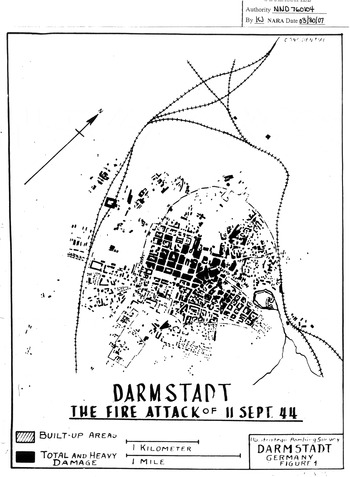
The experience of loss and destruction was ubiquitous among Darmstadters, according to Allied analysis. “The fleet of four-engined bombers, flying at high altitude, met no opposition from either anti-aircraft or enemy fighters. The mechanics of the raid, between the ‘target sighted’ and ‘bombs away,’ were almost perfunctory, and as a consequence Darmstadt was virtually destroyed,” the USSBS concluded in its assessment of the September raid.Footnote 112 The firestorm demolished approximately 78 percent of the city's structures, “dehoused” 70,000 inhabitants, and killed at least 8,433 people (Fig. 3).Footnote 113 The exact death toll remains uncertain to this day, but it is evident that the bombs did not discriminate according to nationality, party membership, age, or gender. Among the confirmed dead were 2,129 children, 492 forced laborers, and 368 prisoners-of-war. By October 1945, 2,742 female and 1,766 male civilians were reported dead, and fewer than 1,000 military personnel were killed in the attack.Footnote 114 The fact that most men between ages eighteen and forty-five had been recruited to posts away from home must have contributed to the gender imbalance of the death toll. The high number of child casualties could have been avoided, however, if the Darmstadters had been willing to send their children to the countryside with the child evacuation program known as the Kinderlandverschickung (KLV). But, as in other smaller German cities, parents chose to keep their children close in dangerous situations. As Julia Torrie has shown, family unity became an increasingly political topic that shaped especially women's wartime relationship with the regime.Footnote 115
Map showing bombing damage in Darmstadt. Source: National Archives at College Park, RG 243, Entry 6, Box 338, Folder 37.

In any event, the immediate reaction of the Darmstadters to the destruction of their hometown was pure shock and disbelief. After earlier raids, the inhabitants had—the police reported after the first larger attack in 1943—displayed resilience: “The population, especially the severely affected, accepted their fate and distress with patience.”Footnote 116 The authorities had done their best to alleviate the physical and mental pain caused by the bombings by repeatedly repairing utilities over the course of the air war. The presence of aid organizations had also projected a certain level of control and thus confirmed large parts of the population in their belief in the infallibility of the NSDAP and the achievements of German material culture.Footnote 117
That would eventually change. The enormous attack of September 11–12, 1944, affected the citizens of Darmstadt more intensely than the previous, smaller air raids had. Whereas some were so terrified that they decided to stay in the forest at night or hardly left the shelters all day long for fear of additional air raids, others, like the thirty-four-year-old mother of two boys mentioned earlier, became irrationally calm: “After living through the raid of September 11, I can say that I was used to them. The following raids hardly bothered me and [during] most attacks I stayed home.”Footnote 118 Or, as an exhausted forty-eight-year-old housewife recounted, “I was not afraid anymore. I just wished they would knock out the whole town so we could live in peace.”Footnote 119 She differentiated between the housing structures, which she seemed to accept as a legitimate military target, and the people living in them: in her eyes, the affective experience of a communal desire for peace dissociated the home front from the war goals of the political leadership. More than anything else, people became war-weary and angry at the regime: “Goebbels always said: ‘We must stand fast with strong hearts.’ (‘Wir müssen durchhalten und starke Herzen haben.’) He could afford to talk that way, he was sitting quite safely in his bunker and did not have to suffer and worry for his life,” one older woman grumbled.Footnote 120
Darmstadters blamed the town's defenselessness on Hitler's erroneous war strategy.Footnote 121 They felt self-pity and humiliation in the face of material deprivation, which contradicted their belief in Germany's leading role as a force for progress in the world. “We were living in a very primitive manner. We had no water for two months, no electricity for six weeks. I had to build a stove outside so I was able to cook,” a forty-two-year-old housewife and Frauenwerk member complained to the USSBS interviewer: “We had to live in a few rooms, we could not dress decently anymore.”Footnote 122 Overall, it seems that the widespread sense of deprivation disturbed people most and, with the exception of deaths in the family, had the strongest effect on German resilience, causing disagreements and loosening the affective bond of morale. Surrounded by destruction and death, the population believed that there was no safe place left.
At the same time, the government took great pains to restore trust on the home front. With smoke still lingering in the streets of Darmstadt, emergency relief organizations set to work.Footnote 123 With almost 80 per cent of the town's buildings in ruins, not everybody could find a place to stay despite the concerted efforts of those organizations. Darmstadt police estimated that 49,200 persons, i.e., about 50 percent of the population, had been sent to assembly points at the city's outskirts and then evacuated to eighteen nearby towns and villages after this raid—but “within a month, according to the food rationing office, approximately 14,500 persons returned and an additional 2,700 came back during November and December.”Footnote 124
At first glance it might seem curious that these Darmstadters chose to live in a demolished town instead of enjoying the safety that they could have had in the countryside. The press attempted to reinvigorate the concept of Volksgemeinschaft in the face of national emergency: “It is up to the rural population to help these people overcome their sacrifices as best they can and to make them feel that they have not been rendered homeless, but that … the entirety of the Greater German fatherland is a real home ….”Footnote 125 Fritz Deppert recounted decades later what it meant to be an evacuee in the countryside: “Being out of place. Partly also being humiliated. And then the terrible hunger. And close to the farmers, who had food to eat. That was the worst. I mean, if everybody had maybe starved together in solidarity, it would not have been that bad.”Footnote 126 Traditional tensions between town and country appear to have been a partial reason for this lack of solidarity. Furthermore, the experience of the September raid had been highly exceptional, and thus difficult to grasp for the peasant population living in the Odenwald region. As the interviews illustrate, Darmstadters felt that someone who had not experienced an attack of such magnitude could not possibly understand the plight they were suffering; the fact that the newspapers and radio broadcasts had only covered what was absolutely necessary about the Darmstadt raids was no doubt one reason for this.Footnote 127
By contrast, solidarity among Darmstadters themselves remained strong, as a thirty-one-year old war wife remembered: “Everybody that was able helped out. But it still didn't make up for what one lost.”Footnote 128 Some people even prioritized mutual assistance in the neighborhood over helping their own family: “When the raid was over we came out and were amazed at the sight. I went along to the corner where there was a house on fire and helped rescue an old man of 80 who was ill. Then I went to look for my cousin. Their house was burning too,” a young mother recalled.Footnote 129 While the media's silence about the extent of the raid was clearly motivated by propaganda considerations and wartime strategy, the experience of isolation in the countryside disabused disappointed Darmstadters of their belief in the Volksgemeinschaft, which was why many of them decided to return to their destroyed hometown and to the community that had shared similar experiences.Footnote 130 In such cases, morale was heightened through acts of solidarity; symbols alone were no longer sufficient.
This also held true for official symbolic gestures aimed at bridging the gap between individual suffering and the overall war effort—such as the badges for the wounded (Verwundetenabzeichen) that the town awarded to citizens who had been injured on the home front.Footnote 131 The use of more emphatic language in local newspapers to describe fatalities at home attempted this as well: “What shakes us most is the sight of so many mothers and children murdered during the latest raid [on Frankfurt]. They did not fall in vain! Even women, children and old people can fall like soldiers.”Footnote 132 Between the first larger attack of September 23, 1943, and the devastating raid almost twelve months later, the Darmstadt administration and police force similarly modified their language when talking about the effects of aerial attacks: after the September 1944 raid, police reports suddenly described air raid victims as Gefallene (fallen), a term usually used to refer to soldiers killed in action.Footnote 133 Nicholas Stargardt has observed an even earlier change of official language in the winter of 1942–1943, when, after the first large-scale air raids had taken place, the term Opfer (sacrifice), formerly reserved for fallen soldiers at the front, surfaced in reports about those who had died in Germany proper.Footnote 134 Officials thus first likened, and then eventually equated, the wartime plight of the civilian population to that of soldiers in defense of the country. Women were still not allowed to kill in battle for their country, yet, the sacrifice of their lives was acknowledged as equally patriotic. The badges awarded for injuries, as well as the shift in language, signify the dissolution of the binary gendered construction of home front and battlefront. At the same time, these efforts apparently had little effect in reassuring the civilian population of the regime's compassion and acknowledgement of their sacrifices under the bombs—or at least Darmstadters readily forgot about them. Not one of the interviewees, many of whom were wounded, even mentioned the badges in the spring of 1945. Official attempts to convey a sense of purpose for the suffering endured by German civilians had seemingly failed.
Conclusion
The myth of the German home front as a united Volksgemeinschaft had already crumbled by the time USSBS interviewers set to work in Darmstadt. Bringing points of contention and agreement between the state and its citizens to the fore, the September 1944 raid highlighted the ways in which a heavy aerial attack put the Nazi regime under great pressure to ensure continued steadfastness on the home front. Contrary to official desires to bolster communal cohesion, many aspects of gendered Nazi policy created instead an atmosphere of suspicion. Women were caught between the policing of their reproductive bodies and changing societal expectations about their increasingly militarized role in the war effort. Working in defense of the country, young women not only reintegrated themselves into the community that had scrutinized them as a result of Nazi reproductive policy, but also became a significant and officially acknowledged pillar of the public sphere as the end of the Third Reich approached. Their wartime experiences stimulated a change in gender relations that preceded “the hour of the women” associated with the occupation period, famously embodied by the Trümmerfrauen. Against the backdrop of the “stab-in-the-back” myth, men struggled with their failure to meet expectations as defenders of the home front and as protectors of women and children. This began with the war of nerves that took place under falling Allied bombs in bunkers, cellars, and other shelters, where the experience of helplessness undermined their soldierly self-perception. Moreover, the realities of everyday life in the destroyed town worked against official pleas for perseverance. Primitive living conditions frustrated large sections of the Darmstadt population and made them increasingly war-weary.
How German civilians related to the national—and local—community heavily determined morale on the home front and the will to go on in an unwinnable war. It was this interaction where the individual affected, and was affected by, gendered social and institutional structures. In the process of making sense of the air war and of defeat in the politicized setting of the USSBS interviews, ordinary Germans constructed their subjectivity by relating their stories—what they saw, how they acted, and what they felt—to others, although the interview questions specifically asked about personal experience. Such dynamics offer historians fruitful insights about home-front society during the latter stages of World War II and about the emergence of memory about the air war. In the first place, the narratives, with a high degree of self-awareness on the part of the respondents, played with the gendered expectations of their interviewers by evoking archetypes—for instance, those of the “vigilant” mother and “caring” daughter, the male “protector,” or the “helpless” older woman. Second, respondents constructed their gendered subjectivity in response to changed social and political dynamics under Nazism and the exigencies of war. Finally, they felt the need to justify their actions to the occupation authorities—not in an apologetic fashion, but rather in keeping with the call of duty to the Fatherland that had decisively shaped the mentality of German wartime society. It is remarkable to see the standard explanation for wartime behavior—which many Germans later used to justify why they had not spoken up when they witnessed injustices or why they had not spoken out against the regime's aggressive war plans—emerging in the USSBS interviews at such an early stage in the retrospective sense-making process. Using affect theory in the analysis of World War II home-front morale thus enriches our historical understanding of the relational process that made this a convincing narrative self—even before the extent of Germany's war crimes had been fully revealed.
Instrumental for survival during the chaotic hours of the air raids was, however, the solidarity of the neighborhood, even if it was temporally and spatially bound. Men and women connected with people in their vicinity who shared the same fate, and supported each other in the struggle to survive and resettle after the smoke had cleared. These spontaneous but real affective communities enabled them to continue living despite individual feelings of powerlessness and general indifference. Paradoxically, then, the Allied machinery of destruction helped create the social bond that Nazi ideology had striven in vain to achieve.