1. Introduction
The theory of the firm and hierarchies explains that workers come to work motivated by wage incentives or, if these are not sufficient, by control mechanisms that penalize those who do not comply with their contracts (Alchian & Demsetz, Reference Alchian and Demsetz1972). From this perspective, workers will try to minimize their effort if the control mechanisms are not adequate. This logic underlies much of the literature on absenteeism and, to a large extent, the classic definition of presenteeism, where the sick workers come to work under pressure from control mechanisms linked to the fear of losing their job (Johns, Reference Johns2010).
In this paper, we propose a new perspective of the principal-agent relationship on which the traditional model is based. In the traditional model, the company's sole objective is that the worker comes to work; therefore, the company will establish control mechanisms to avoid absenteeism, which will indirectly provoke presenteeism. Workers will respond by coming to work, depending on how strict these control mechanisms are and the penalties they may receive. From our perspective, the company also has incentives for sick workers to stay home to avoid the known costs of presenteeism. Furthermore, workers will also have incentives to come to work sick even though companies do not force them to do so. This approach allows workers to respond in one way or another to explicit incentives such as wages or implicit incentives related to motivation or responsibility.
Therefore, we argue that of presenteeism, or attending work whilst one is unwell (Aronsson & Gustafsson, Reference Aronsson and Gustafsson2005), cannot purely explained by the traditional rationale on the issue, where the company pressures workers to come to work for as long as possible. Aronsson and Gustafsson (Reference Aronsson and Gustafsson2005), for example, review previous literature and stress that the main attendance-pressure factors that cause presenteeism are: (a) fear of losing one's job and (b) the presumption that one's career development will be negatively affected by being absent. As an alternative to this perspective, we approach presenteeism as an agency problem where the sick workers obtain certain benefits for coming to work.
The traditional perspective of presenteeism is based on the idea that workers come to work to avoid certain costs. Such costs usually take the form of a negative signal for the absent workers, as firms may understand that they have a lower commitment to the company or a lower willingness to make an effort (Leigh, Reference Leigh1985). Further, Hirsch, Lechmann, and Schnabel (Reference Hirsch, Lechmann and Schnabel2017) argue that the probability of dismissal decreases by coming to work, generating an incentive to come in sick, especially for those workers with temporary contracts. In this line, there is much evidence that workers take less sick leave in times of high unemployment and, conversely, report more health problems in times of low unemployment (Boone & van Ours, Reference Boone and van Ours2006). This opportunistic worker behavior is the basis of our theoretical proposal, but instead of limiting their incentives to costs, we understand that there are also specific benefits to be gained by coming to work sick.
Consequently, we argue that in those relatively mild pathologies , where there is asymmetry in the information about the health status of the patients, workers may decide to come to work to gain something, and may decide not to follow the occupational health and safety (OHS) rules. Karanika-Murray and Biron (Reference Karanika-Murray and Biron2020), for example, claim that presenteeism can bring certain benefits to the sick individual, as it is a mechanism for adapting health and performance. The most important studies relating wages and presenteeism are presented in the review by Johns (Reference Johns2010). However, other implicit incentives such as motivation or commitment, for example, have received less attention.
Further, in the case of presenteeism, we argue that traditional organizational mechanisms such as supervision designed to correct opportunistic employee behavior will not be effective. First, instruments to monitor workers' health are designed to prosecute absenteeism or, in other words, to prevent healthy workers from claiming to be sick. The main goal of this monitoring system is attendance and therefore they may induce presenteeism instead of preventing it. Second, there is no penalty aimed at correcting presenteeism and generally this penalty affects to the loss of productivity related to presenteeism (Oyet, Reference Oyet2021). Indeed, sick workers at work are not generally prosecuted or punished for this action and therefore, if the incentives are sufficient, sick workers will come to work.
The contribution of the paper is threefold. First, by studying the behavior of the agent (worker), we analyze the effect of explicit and implicit incentives on presentist behavior. Second, by examining the response of the principal (firm), we assess the effectiveness of traditional monitoring mechanisms to respond to this behavior. Finally, in light of the results, we propose a series of human resources practices that allow a more adequate management of presenteeism for companies and workers.
2. The decision to work while ill: A moral hazard problem
In the same way as absenteeism (Johansson & Palme, Reference Johansson and Palme2005), presenteeism can be understood as a classic moral hazard problem in which the principal (company) does not observe the action of the agent (worker). In particular, we state that a fully informed and rational company would prefer to keep sick workers at home to avoid negative consequences such as being less productive and suffering more accidents (Niven & Ciborowska, Reference Niven and Ciborowska2015), having longer sick leave (Skagen & Collins, Reference Skagen and Collins2016) or increasing the risk of new epidemiological dangers (Webster, Liu, Karimullina, Hall, Amlot, & Rubin, Reference Webster, Liu, Karimullina, Hall, Amlot and Rubin2019). However, workers, taking advantage of the asymmetry of information regarding their health, decide to go to work while ill, generating potential negative consequences for the company and their colleagues (Miraglia & Kinman, Reference Miraglia and Kinman2017).
Arrow (Reference Arrow, Pratt and Zeckhauser1985) provides a definition of moral hazard in the management and economics literature. The ‘hidden action’ by the agent is the key element on this theoretical approach where individual behavior will be fundamentally driven by (1) the benefits of opportunistic behavior and (2) the risk of being caught.
2.1 The benefits of presenteeism
While most of the literature assumes that presenteeism is detrimental, there are some articles that have begun to explore its positive side. Karanika-Murray and Biron (Reference Karanika-Murray and Biron2020) extol its adaptive function in cases where impaired health can hinder job performance and perspective. In this line, some authors emphasize that presenteeism can help the progressive return to work or can prevent other illnesses, for example, mental illnesses (Howard, Mayer, & Gatchel, Reference Howard, Mayer and Gatchel2009). This line of research shows that presenteeism has, in some circumstances, a lower cost than expected and can even be good for health. However, in our model we are interested in the benefits associated with going to work when sick which, in some ways, are not substantially different from the benefits of going to work healthy.
For this purpose, we will distinguish between explicit incentives, which have received the most research attention in the field of presenteeism, and implicit incentives, the analysis of which is more incipient.
2.2.1. Explicit motivators: Work-related variables
Explicit motivating factors allow individuals to achieve external objectives, such as present and future income, wealth or better employment conditions (Bénabou & Tirole, Reference Bénabou and Tirole2003). In this area, much of the extant literature has focused on studying the impact of wages on presenteeism (Johns, Reference Johns2010). In particular, a positive relationship between wages and presenteeism can be expected simply because the loss of a well-paid job is more damaging than losing a poorly paid one (Hirsch, Lechmann, & Schnabel, Reference Hirsch, Lechmann and Schnabel2017). In this paper, we analyze commonly studied explicit motivating factors at work. Thus, we propose a general hypothesis that we later disaggregate into three sub-hypotheses:
H1. The likelihood of presenteeism is higher for jobs with explicit incentives.
First, pay-for-performance systems are a standard instrument for motivation for firms and, in certain circumstances, are associated with positive results such as better performance (Nyberg, Pieper, & Trevor, Reference Nyberg, Pieper and Trevor2016; Rynes, Gerhart, & Minette, Reference Rynes, Gerhart and Minette2004) and the achievement of several strategic goals (Gerhart & Fang, Reference Gerhart and Fang2014). Pay-for-performance, for example, enables firms to attract and retain qualified employees (Dello Russo, Mascia, & Morandi, Reference Dello Russo, Mascia and Morandi2018), as the best workers may be interested in performance-based pay. Further, a well-designed pay scheme may improve employees' performance by creating a link between effort and compensation.
According to Ren, Fang, and Yang (Reference Ren, Fang and Yang2017), pay-for-performance increases workers' effort, particularly discretionary or voluntary work effort. Previous empirical research has ascertained that pay-for-performance stimulates employees to put in more effort to increase their wages through performance (Lazear, Reference Lazear2000). In firms where pay-for-performance is in force, we argue that a sick worker may prefer to come to work in order to collect their wage premium. In other words, they may forego rest and recuperation to avoid the loss of performance-related pay. Furthermore, Flores, Fernández, and Pena-Boquete (Reference Flores, Fernández and Pena-Boquete2020) note that wage-related increases in presenteeism may even offset the positive effect of income on health. On the contrary, workers who receive fixed salaries will have a more secure income if they remain at home and, therefore, we posit that they are less likely to be presentists. This leads us to the first sub-hypothesis:
H1a. Productivity/performance-based pay increases the likelihood of presenteeism.
In addition, to retain employees, avoid loss of talent and maintain competitiveness, firms usually offer training to their employees (Huselid, Reference Huselid1995). This practice enhances individual capabilities and increases employees' skills (Dello Russo, Mascia, & Morandi, Reference Dello Russo, Mascia and Morandi2018), while simultaneously improving essential workplace attitudes and behaviors, which may positively affect employee performance (Bartel, Reference Bartel2000; Santos & Stuart, Reference Santos and Stuart2003). Job training also increases technical skills, work motivation and, consequently, employee engagement (Fletcher, Reference Fletcher2016). In addition, employees may see training as a way to develop their skills and maintain employment and career progression. This situation generates a strong sense of obligation that translates into more significant commitment and effort (Wright & Kehoe, Reference Wright and Kehoe2008).
The effect of training on presenteeism can be twofold. On the one hand, workers will want to receive training to improve their position in the company. If the training is face-to-face, as has been the general rule, workers will have an incentive to attend, even when they are sick. On the other hand, workers who have received significant training within the company will have a strong bond with it, as their skills will be highly specific to their current role. Their professional future will therefore be linked to the company that trained them. The motivation and commitment of trained workers may be higher, and therefore we posit:
H1b. On-the-job training increases the likelihood of presenteeism.
Promotion opportunities are one of the most important predictors of career success because they lead to higher pay and reinforce the status of employees. Thus, it is understood that employees with better career expectations are more attached to the company, more motivated and perform better than employees with lower career expectations. Previous studies have also observed that promotion possibilities strengthen employee obligation, which implies higher levels of voluntary effort (Frenkel & Bednall, Reference Frenkel and Bednall2016) and a willingness to work long hours (Lambooij, Flache, Sanders, & Siegers, Reference Lambooij, Flache, Sanders and Siegers2007).
Just as other authors have observed particularly intense efforts linked to promotions, it seems reasonable that this effort also affects the frequency of presenteeism. In the case of presenteeism, we understand that workers with better promotion expectations will have a stronger incentive to come to work. By contrast, those who work in temporary or circumstantial jobs (and therefore have careers that are not linked to their current firm) will find little benefit in putting their health at risk by coming to work when sick. Accordingly, we posit:
H1c. Good career prospects increase the likelihood of presenteeism.
2.2.2. Implicit motivators: Person-related variables
The aforementioned explicit incentives have been studied previously. However, the literature on implicit motivations is much less developed. In order to illustrate the relationship between implicit motivation and presenteeism, we will use a real-life example from the professional sports industry. When major sporting events are on the horizon, it is common for injured professional players to strain their health to participate in the match. For example, in the 2014 Champions League final, the two stars of Real Madrid and Atletico Madrid, Cristiano Ronaldo and Diego Costa, respectively, both played while suffering from severe limitations due to health and physical problems. The performance of both players in the final was disappointing: Diego Costa, for example, was substituted in the ninth minute of the match due to a muscle injury. The decision to play in the final can be described as a typical case of presenteeism, as players decide to work despite their inadequate health conditions. However, it is not easy to explain this case in light of traditional approaches and theories on presenteeism, as the players here voluntarily decide to play in the final, even though their jobs and wages are not at risk. It is likely the players freely agreed to play the game at the cost of their health because it was a final match, and their implicit motivation to participate was strong.
Implicit motivational factors are those that enhance employees' sense of autonomy or self-acceptance and provide them with a sense of accomplishment. By increasing individuals' sense of self-esteem, companies reinforce the psychological bond between the employee and the organization (Tyler & Blader, Reference Tyler and Blader2003). Implicit factors, unlike explicit ones, depend to a greater extent on the psychological and emotional characteristics of the individual. They cause employees to experience work as meaningful and worthwhile and feel responsible for the results of said work. In this paper, we study several (typically considered) implicit motivating factors at work. We propose a general hypothesis that we later disaggregate into three sub-hypotheses:
H2. The likelihood of presenteeism is higher in people who are intrinsically motivated.
Empowerment is a potent tool in the field of organizational performance. In addition to having positive effects on performance (Baird, Tung, & Su, Reference Baird, Tung and Su2020), empowerment is related to multiple employee well-being factors. Further, Liden, Wayne, and Sparrowe (Reference Liden, Wayne and Sparrowe2000) observe that the job satisfaction of empowered workers is higher or, in other words, that the cost of coming to work is lower. Employees' degree of freedom, control and independence over several job aspects also positively impacts their commitment to the firm due to increased influence and self-esteem (Bakan, Suseno, Pinnington, & Money, Reference Bakan, Suseno, Pinnington and Money2004). Zhang and Bartol (Reference Zhang and Bartol2010) further note that empowerment positively affects workers' intrinsic motivation, improving, for example, their participation in the organization and the creative process. In short, the prolific literature on empowerment concludes, without hesitation, that it positively affects motivation and, therefore, employee efforts. In this sense, we argue that workers who are motivated by their empowered jobs will come to work more regularly, even when they are sick; therefore, we posit:
H2a. Empowerment in the organization increases the likelihood of presenteeism.
Parallel to empowerment, the perceived usefulness of individual work has a similar effect on motivation and effort. In this case, however, it may be more illustrative to describe the effect on motivation and effort from the opposite situation: the lack of a sense of work. In these situations, when workers do not find meaning in their work, they may only respond to explicit incentives and control mechanisms. Indeed, Nikolova and Cnossen (Reference Nikolova and Cnossen2020) identified that job meaningfulness is related to parameters such as autonomy and competence, and its relationship with explicit incentives such as pay and conditions is shallow. However, they also highlighted that the parameter is a strong predictor of performance variables such as training decisions and is relevant to our hypothesis, absenteeism and late retirement. Specifically, they observe that workers with meaningful jobs choose to work longer hours, so they would likely do so when they are sick. This leads to our next sub-hypothesis, which states:
H2b. Job usefulness increases the likelihood of presenteeism.
Recognition can foster identification with the organization by satisfying employees' socioemotional needs, such as attention and respect. This improvement in workers' emotional status can lead to a higher level of commitment and effort. In particular, by increasing the individual's self-esteem, recognition encourages employees to increase their attachment to the company. Highly identified employees are therefore more likely to pursue the organization's objectives.
Certain empirical studies have discovered the existence of a relationship between recognition and performance indicators, such as productivity, innovation, and, excitingly for our study, turnover intention (Bhatnagar, Reference Bhatnagar2014). On the other hand, other experiments outlined a strong relationship between recognition and performance, mainly when recognition was provided only to the best performers (Bradler, Dur, Neckermann, & Non, Reference Bradler, Dur, Neckermann and Non2016). In sum, this literature stresses that recognition is part of the psychological contract between the employee and the company. Those workers who enjoy greater recognition tend to be more motivated to make more intense efforts. Among these efforts, we argue, is going to work sick, which leads to our next sub-hypothesis:
H2c. Recognition increases the likelihood of presenteeism.
3. Organizational response to presenteeism: Trust vs. supervision
When there is asymmetric information and objectives are not perfectly aligned, moral hazard situations may arise, such as those described previously. Direct supervision or control of workers' tasks is the most straightforward and immediate solution to moral hazards (Alchian & Demsetz, Reference Alchian and Demsetz1972). Through supervision, the company is able to detect undesirable behavior and correct it using a reward or punishment system. However, to control presenteeism, there are specific difficulties to implementing effective control mechanisms based on supervision.
However, presenteeism has not always been considered to be an undesirable behavior; indeed, on many occasions, going to work when one is sick has been taken as an indicator of commitment and effort (Johns, Reference Johns2010; Zhou, Martinez, Ferreira, & Rodrigues, Reference Zhou, Martinez, Ferreira and Rodrigues2016) and therefore may not be penalized. As a result, there is no reason why the supervisor would exhibit control over workers who come to work sick. In any case, the supervisor can monitor their performance and act to reverse this circumstance to the extent that the illness may limit worker's activity. Second, in the case of presenteeism, the information asymmetry is more significant than in the case of absenteeism, where doctors accredit sick leaves. The presentist does not have to justify their decision with the medical diagnosis of a third party. Therefore, the discretion of the decision is explicit, making it more difficult for the control mechanisms to act.
As explained, we hypothesize that traditional control mechanisms, designed to reduce absenteeism, are ineffective in controlling presenteeism, which leads us to posit:
H3a. Direct supervision has no effect on presenteeism.
When effective enforcement of control mechanisms is difficult, organizations have other mechanisms at their disposal to get their employees to comply with standards. The essential purpose is to create a favorable organizational context in which employees can align company objectives with their own. For example, fairly treating employees makes them follow the rules and procedures imposed by the company (Donze & Gunnes, Reference Donze and Gunnes2018). Further, trusting workers legitimizes the organization, which translates into greater employee engagement (Tyler, Reference Tyler2006). In summary, when the relationship between the company and the workers is based on fairness and reciprocity, it is plausible to replace control with trust.
In the case of presenteeism, where we insist, the individual decision of the employee to come to work is the crucial factor; trust between the company and the employee can play a fundamental role. We can also analyze the opposing situation of distrust, i.e., if the company does not trust (sick) workers, they know that their word will not be enough for the company to accept their diagnosis. In this circumstance, the compliant or highly motivated worker may decide to work if their pathology is not very serious. Wood, Michaelides, and Ogbonnaya (Reference Wood, Michaelides and Ogbonnaya2020), for example, reveal that a reduction in trust causes a corresponding reduction in absenteeism and, plausibly, increases presenteeism. On the contrary, if there is trust, workers who are not fit to work may rest without fearing being penalized or questioned. Accordingly, we posit:
H3b. The likelihood of presenteeism is lower when workers trust the company.
H3c. The effect of motivation on presenteeism is reduced when workers trust the company.
Thus, considering the findings of current research, we stress that acting exclusively on motivational factors and control mechanisms is not enough to control presenteeism, and HR need to put other mechanisms that have several effects at employees' disposal.
3 Methods
3.1. Database
Presenteeism is a worldwide phenomenon that has been studied in several countries around the world. However, it is difficult to make direct comparisons in prevalence rates across countries since most of the previous literature has only analyzed it within the context of a single country, each using different kinds of sample collections, methodologies or measures of presenteeism. In our case, we use a sample of European countries. Concretely, the data used for the empirical analysis of the present study come from the sixth European survey on working conditions, conducted by the European Foundation for the Improvement of Living and Working Conditions (Eurofound, 2022) between February and December 2015. The target sample in most countries was 1,000 interviews. A total of 43,850 workers aged 15 years and older in 35 countries were interviewed on different aspects of their work-life, such as working time, work organization, work-life balance and work-related health outcomes. The European Working Conditions Survey sample is representative of those employed during the fieldwork period in each of the countries covered.
We have excluded inactive workers from the sample according to the definition of presenteeism. Specifically, we exclude those who cannot work due to long-term illness and those who are retired, unemployed or in full-time education. For the same reason, self-employed workers and those over 65 years of age are also not considered. Finally, in line with previous literature, employees who report more than 70 days of absenteeism or presenteeism during the last year are omitted to exclude workers suffering from a chronic illness (Garrow, Reference Garrow2016). Considering these exclusions and the fact that the variables included in the study have omitted values, the final sample used in this study has 13,440 observations.
Using cross-sectional surveys to estimate regressions on dependent variables that are part of the survey has apparent limitations. However, in the case of presenteeism, the use of this type of survey makes, in our opinion, more sense. Unlike absenteeism, which has external diagnoses and official recorded data, presenteeism, to date, is a magnitude that depends almost 100% on self-diagnosis and is not recorded in any official statistics, mainly because it is not diagnosed by any medical professional. Consequently, secondary databases where individuals acknowledge having worked sick are practically the only information currently available. When investigating the practical implications thereof, we return to this problem and propose a number of measures to solve it.
3.2. Measures
3.2.1. Dependent variable
The dependent variable measures the propensity to presenteeism. We calculate the ratio as the days of presenteeism divided by the sum of the days of presenteeism plus the days of absenteeism (Gerich, Reference Gerich2016). Therefore, the dependent variable can range from zero, meaning that employees do not work when they are sick, to one, meaning that employees always work when they are sick. According to the previous literature, this measure of propensity to presenteeism has certain advantages over the direct measure of presenteeism (Gerich, Reference Gerich2016). By including absence days in the quotient, the propensity to be absent takes into account, in a way, workers' general state of health. Thus, we understand that the propensity of a worker who is, for example, present for some days and never misses work is higher than that of a worker who is present for the same five days but has been absent several days during the year due to health problems.
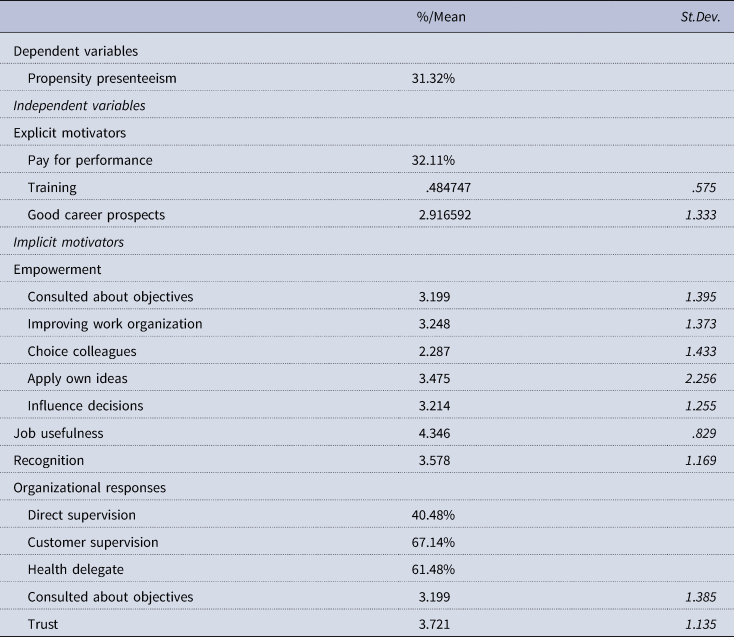
To measure presenteeism days, respondents report the number of working days they went to work while sick during the past 12 months. Our variable measures precisely the number of days worked while sick in a free-response format that several expert authors have found preferable to more common Likert-type responses (Caverley, Cunningham, & MacGregor, Reference Caverley, Cunningham and MacGregor2007). We obtained the number of absenteeism days following the same procedure. Table 1 illustrates the mean and standard deviation of the dependent variable.
Dependent and independent variables

3.2.2. Independent variables
As per the theory described previously, we classify the main independent variables of interest into three subgroups. The first group includes explicit motivators at work. Pay for performance takes a value of one when employees receive any payment such as those based on individual performance, team performance, productivity or company performance, and zero otherwise. On-the-job training considers whether employees have received employer-provided training or on-the-job training in the last 12 months. Finally, we measure the good career prospects by a variable that considers, on a 5-point Likert scale, whether employees' jobs offer good prospects for career advancement.
The next group of explanatory variables is related to intrinsic motivators at work. Here, empowerment is measured through an index (Cronbach's alpha .808) created through four items that measure workers' power to influence different aspects of their work. Job usefulness is measured with a 5-point Likert-type variable in which workers rate the usefulness of their work. Finally, recognition is measured with a 5-point Likert scale where the degree to which employees agree with the statement that their immediate boss praises and recognizes them when they do a good job. Table 1 shows the mean Likert scales.
The last group of variables is related to organizational responses to presenteeism. Direct supervision and customer supervision are both dichotomous variables that take a value of 1 when employees say that their work pace depends on their manager's direct control or demands from clients such as customers, pupils or patients and zero otherwise. Health delegate is a dummy variable that takes a value of 1 when a health and safety delegate or committee exists in the company and zero otherwise.
Aligned objectives is measured with a 5-point Likert scale, from 1 = never to 5 = always, if the firms consult employees when setting the objectives. Trust is measured on a 5-point Likert scale where employees directly rate their trust in the company's management. Table 1 shows the descriptive statistics.
3.2.3. Control variables
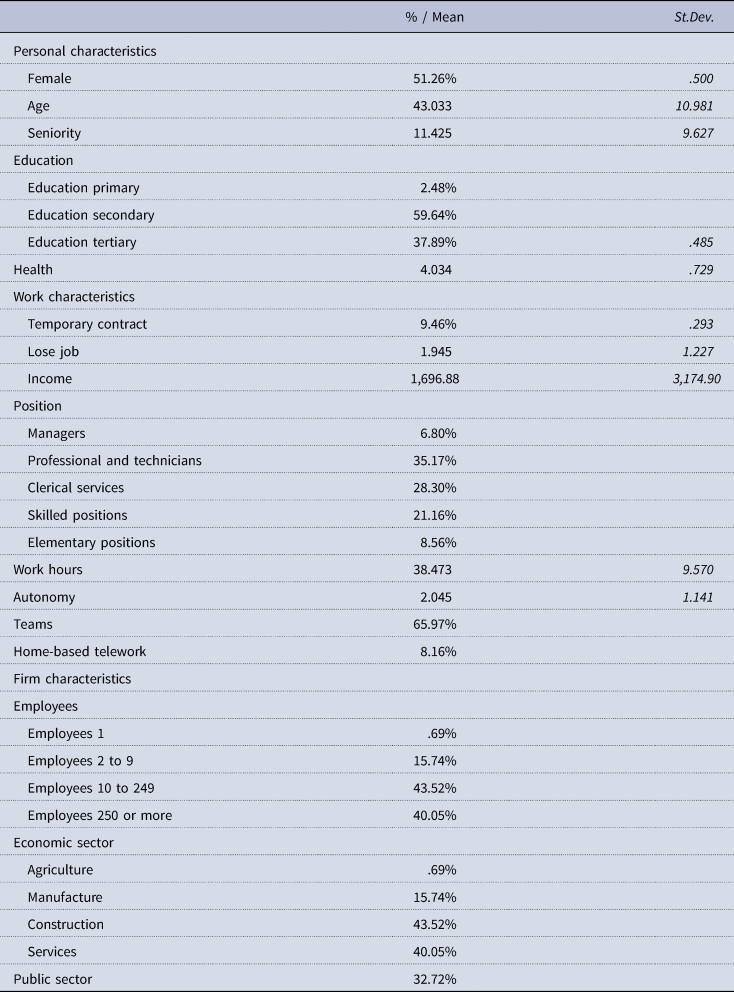
In the analysis, we have selected several control variables whose influence on presenteeism has been ascertained by other analyses (Webster et al., Reference Webster, Liu, Karimullina, Hall, Amlot and Rubin2019). These variables include individuals' personal and social characteristics (gender, age, education, seniority and health status), work characteristics (temporary contract, lose job, income, job position, number of working hours, autonomy, teams and home-based telework) and company characteristics (size, economic sector and public sector). Table 2 reveals the descriptive statistics of the control variables.
Control variables

2.3. Methodology
In the analysis, we estimate the determinants of presenteeism with three models. In the first model, we only consider the effect of the control variable, and therefore we reproduce the estimation of the most relevant previous analysis. In the second model, we add explicit and implicit motivators at work. Finally, in the third model, we include several types of control mechanisms that firms can adopt to reduce presenteeism. By comparing the goodness of fit of the models and measuring the effect of the individual variables, we can also calculate the joint explanatory power of each group of variables.
We assume that our dependent variable (presenteeism propensity) is a censored variable as we only observe the [0–1] range. It may well be that individuals with a ratio of 0 have a different propensity (they have not been sick that year), but we cannot observe that difference. The same is true for individuals with a ratio of 1. Accordingly, we estimate multilevel (by country) Tobit models with robust standard errors (robust variances are clustered at the country level, the highest level in our multilevel model). Concretely, it is modeled using the next estimation model.

for j = 1, …, 35 clusters, with the jth cluster consisting of n j observations, where, for the jth cluster, y j is the n j × 1 censored response vector, X j is the n j × p matrix of fixed predictors, analogous to that found in a standard linear regression model, with regression coefficients β, Z j is the n j × q matrix of random predictors, uj is the q × 1 vector of random effects and β is the p × 1 vector of regression coefficients on the fixed predictors. The random effects, uj, are assumed to be multivariate normal with mean 0 and variance Σ (Stata., 2019: 436).
In order to verify the robustness of our results, we have also estimated the same models using a hierarchical generalized linear model with binomial distribution and a log link function (Papke & Wooldridge, Reference Papke and Wooldridge1996). The results are robust.
Finally, given that the same respondents answer all variables (both dependent and explanatory), common method variance (CMV) may bias the association between the variables (Podsakoff, Mackenzie, Lee, & Podsakoff, Reference Podsakoff, Mackenzie, Lee and Podsakoff2003). However, in this case, some features in the survey are able to alleviate this problem. First, anonymity is fully guaranteed. As a result, privacy makes respondents less apprehensive about answering such questions. Secondly, the dependent and independent variables have a different format, different scales and belong to unrelated sections of the questionnaire. Finally, after performing Harman's one-factor test, the unrotated exploratory factor analysis of the dependent and independent items of the survey showed that four factors emerged with eigenvalues greater than one, with the variance explained by the first factor being only 23.42%. Consequently, CMV is not a major limitation.
4. Results
In the sample used in the empirical analysis, the propensity of presenteeism varies from 13.01% in Italy to 47.57% in France. While it is true that there are differences among countries on the propensity of presenteeism, which is quite difficult to interpret with the naked eye, the analysis shows that the variance explained by country-level variables are not as large: only 6.07% of the variance of the presenteeism propensity is explained by country-level variables. In any case, in the regressions presented below, the variability by country has been controlled with multilevel models.
4.1. Preliminary analysis
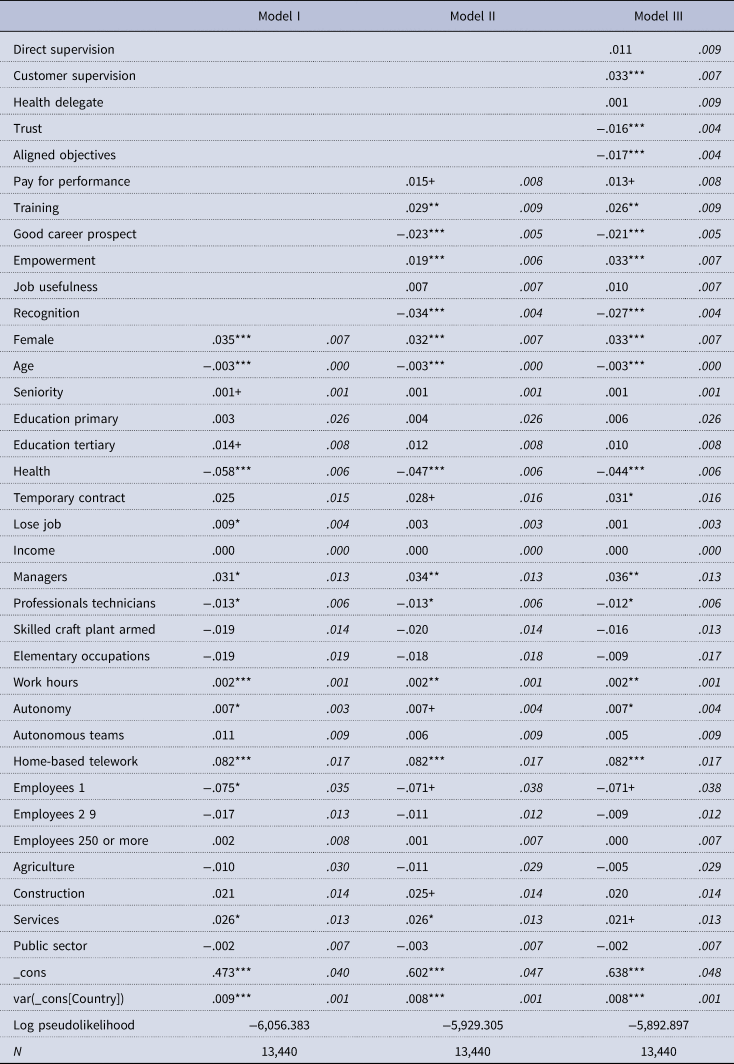
The first model only includes the control variables. The results in Table 3 are consistent with previous estimates; namely, we observe more presenteeism among women, which decreases with age and increases with education. Moreover, as highlighted by Ruhle et al. (Reference Ruhle, Breitsohl, Aboagye, Baba, Biron, Correia Leal and Yang2020), our results show that presenteeism is more frequent among unhealthy individuals than their healthy counterparts. Our analysis also confirms that job characteristics affect presenteeism. Consistent with previous studies, the possibility of job loss is positively related to presenteeism.
Multilevel motivational drivers of presenteeism

***p < .001, **p < .01, *p < .05, + p < .10.
Interestingly, in this first model, the possibility of losing one's job is significant, but when we consider the motivators, it is no longer significant, suggesting that moderation effects could be relevant. In addition, employees who work long hours and occupy a higher position in the company hierarchy are also more presentist. Likewise, home-based telework reduces presenteeism, which seems reasonable. Finally, concerning company characteristics, the results demonstrate that employees in the service sector are more likely to be presentist than those in the manufacturing sector and that those working in small companies are less presentist than those in medium-sized companies.
4.2. Test of hypotheses
Model II includes all variables related to motivators at work and organizational responses to presenteeism. To test whether the motivational factors as a whole help to explain the phenomenon of presenteeism, we performed the likelihood ratio test, which indicates that adding these new variables results in a statistically significant improvement in model fit (χ2: 300.91; p-value: .000). For the effect of individual new predictors of presenteeism included in the model, the results confirm that most (but not all) motivators positively affect presenteeism. The results support hypotheses 1a and 1b, according to which performance based pay and on-the-job training both increase the probability of presenteeism. Good career prospects, however, reduce presenteeism, contrary to hypothesis 1c.
Regarding intrinsic motivators at work, all of them affect presenteeism, but not always as we hypothesized. Specifically, empowerment increases presenteeism, which supports hypothesis 2a, but recognition by superiors reduces it, so we cannot accept hypothesis 2c. Furthermore, job usefulness also has a positive effect (significant only at 10%) on presenteeism, so the result is consistent (with some reservations) with hypothesis 2b. Finally, concerning variables related to the organizational response to presenteeism, we can see that direct supervision at work by the organization does not affect presenteeism, a result in line with hypothesis 3a. Similarly, in line with hypothesis 3b, we find that trust in management is an effective mechanism in reducing presenteeism.
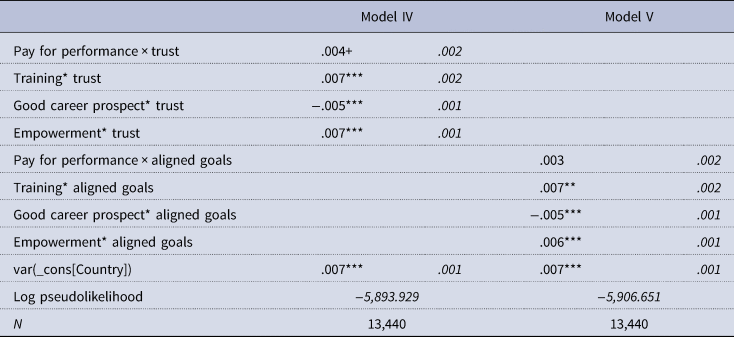
In order to test whether the effect of trust mitigates the (overall) positive effect of motivation on presenteeism, we have repeated Model II by introducing the interaction between the motivation and trust variables. To reduce (to some degree unavoidable) multicollinearity, we have also introduced the interactions one by one to control multicollinearity, at least to some extent. We, therefore, estimate that there are eight independent regressions. Table 4 shows that quite robustly, trust has no impact on the effect of motivation on presenteeism; hypothesis 3c is therefore rejected.
Moderators effects

***p < .001, **p < .01, *p < .05, +p < .10.
5. Discussion
Interpreting presenteeism from the perspective of moral hazard allows us to advance our knowledge in the following way. On the one hand, hypothesis 3a shows that the principal does not establish direct control mechanisms to avoid presenteeism. Before the pandemic, avoiding presenteeism was not an explicit objective of the company, so the company did not control this behavior. On the other hand, our analysis suggests that presenteeism largely depends on the worker's individual decision. As in other principal-agent relationships, our analysis shows that the agent will respond to implicit and explicit incentives informing the choice of working while sick.
This result differs from the interpretation of attendance-pressure factors literature on presenteeism (Aronsson & Gustafsson, Reference Aronsson and Gustafsson2005). In previous studies, presenteeism is posited as the agent's response to the control mechanisms established by the principal to prevent not presenteeism but absenteeism. When these control mechanisms designed to prevent opportunism by healthy workers were sufficiently burdensome to the workers, sick workers decided to respond by coming to work to avoid being penalized. The possibility of losing one's job is the fundamental penalty on which the employee must decide whether or not to work based on his or her health status (Hirsch, Lechmann, & Schnabel, Reference Hirsch, Lechmann and Schnabel2017).
The most recent literature on presenteeism notes that workers derive benefits (including health) from coming to work (Karanika-Murray & Biron, Reference Karanika-Murray and Biron2020). Our results on the effect of explicit (wages) and implicit (motivation) incentives are consistent with this perspective. First, our analysis demonstrates an apparent effect of motivation and its drivers on presenteeism. Motivated workers are, of course, fundamental to the proper performance of any organization and should therefore be an essential objective of any human resources department. Furthermore, some studies highlight that presenteeism can be positive in certain circumstances as it reinforces the sense of belonging and responsibility (Biron & Saksvik, Reference Biron, Saksvik, Quick and Cooper2010), substantial elements of motivated workers. Our results reinforce the idea that presenteeism is an ambivalent situation where workers (our work suggests motivated workers) can manage the health-work pairing to their advantage (Lohaus & Habermann, Reference Lohaus and Habermann2019).
Our analysis highlights the importance of interpersonal relationships and, in particular, mutual trust in the management of presenteeism. In agency theory, trust is a fundamental tool for solving moral hazard problems when information is asymmetric, as it is the case. In this sense, the validation of hypothesis 3b corroborates that trust prevents presenteeism. In the same line, Oyet (Reference Oyet2021) finds that presenteeism and its consequences on productivity worsen when superiors show inconsiderate attitudes. Other studies point to the responsible exercise of leadership as a fundamental tool for the proper management (not supervision) of presenteeism. In this sense, Haque, Fernando, and Caputi (Reference Haque, Fernando and Caputi2021) suggest that responsible and trust-based relationships between supervisors and supervisees can help reduce the adverse effects of presenteeism.
Finally, to properly understand the results, it is essential to underline that the sample was taken in Europe. The welfare systems of European countries offer some of the world's most generous sick leave coverage (Spasova, Bouget, & Vanhercke, Reference Spasova, Bouget and Vanhercke2016). Therefore, the decision to work or not to work may be affected by this circumstance to the extent that a European worker will have a lower cost for not coming to work than an American employee, for example. This fact suggests that the effect of the incentives we have identified in our work is likely to be stronger in a sample where sick leave coverage is lower.
6. HRM practices for the management of presenteeism
The practices proposed in this section transcend the specific situation of the pandemic. During the pandemic period, the sole objective of the companies was to avoid presenteeism through control. However, the literature that understands presenteeism as an adaptive practice and the evidence presented in our analysis suggests that presenteeism is a multifaceted phenomenon. Therefore, we propose a series of Human Resources practices in which the company and the employee should manage health and work in a balanced and beneficial way. It is essential to emphasize that these practices are aimed at managing presenteeism but can affect other parameters of the HR function, such as motivation or commitment. In situations when avoiding presenteeism becomes a priority, such as the latest pandemic, our proposal suggests that by altering, for example, the timing of incentives, we can find an appropriate response from workers who will avoid coming to work sick. As in other areas of HRM, it will be up to the organization to assess the benefits and costs of using some of these actions.
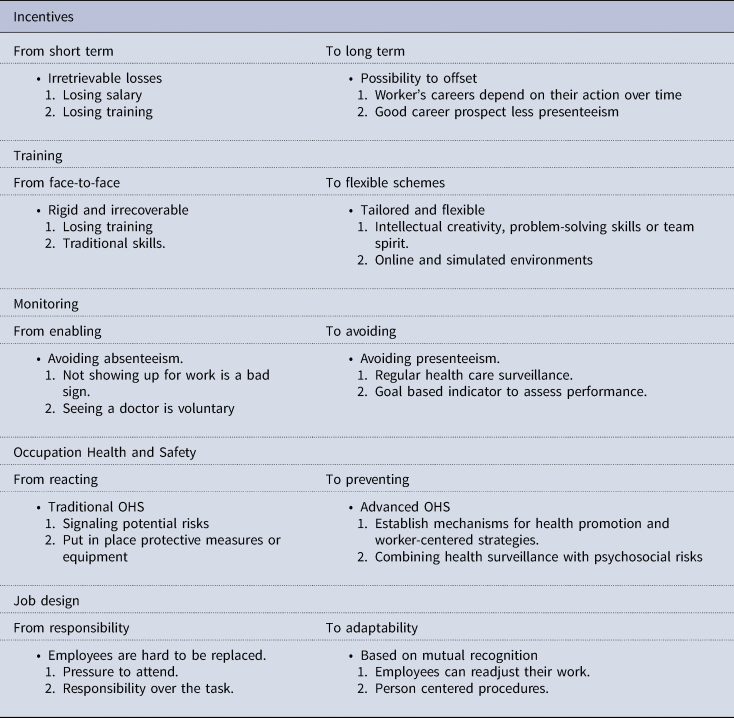
All practical implications are summarized in Table 5.
Policy implications

6.1. Incentives: From short term to long term
Incentives are tools for presenteeism management. Our analysis clearly reveals that the classic drivers of work motivation affect presenteeism, although not always in the expected way. On the one hand, concerning explicit incentives, we found an apparent difference between the effect of short-term incentives (wages and training), which increase presenteeism, and long-term incentives (good career prospects), which reduce it. In this sense, it seems sensible to think that the cost of absence from work is more direct and irretrievable in the case of immediate incentives. Not going to work means losing the salary bonus or the training day for good, so sick workers may ignore their health to go to work.
On the contrary, workers' careers depend on their actions over time, so there is less pressure to work when sick. The absence thus does not entail an irreparable loss, as other future actions may show workers' commitment. Moreover, the results show that those with good career prospects tend to be less presentist than those with poorer prospects, who probably need to make a stronger effort to improve their professional future. In this sense, Dubois and Vukina (Reference Dubois and Vukina2016) determined that the level of effort depends largely on the likelihood of and proximity to workers renewing their contracts. In parallel, our results indicate that long-term incentives allow workers, to some extent, to balance their efforts, spreading them over time and, therefore, reducing the probability of going to work sick. Therefore, long-term incentives are good tools for presenteeism management.
6.2. Training: From face-to-face to flexible schemes
Training provided by companies contributes to increasing workers' skills and productivity. As a result, workers have an incentive to attend such training since it helps them to keep their job and advance professionally (Fletcher, Reference Fletcher2016; Wright & Kehoe, Reference Wright and Kehoe2008). Our analysis suggests that this interest in training programs affects presenteeism, mainly if these face-to-face training plans are not flexible.
In-company training, like education, must be different from what it was three or four decades ago. Traditional face-to-face training can be made more flexible by integrating new methodologies and tools. The new models of employment and organization of work and production also require the constant updating of skills and knowledge. Intellectual creativity, problem-solving skills and team spirit require hybrid training programs that combine face-to-face with online training or simulated environments. This flexible training has two advantages; on the one hand, it reaches a broader audience and, on the other hand, it adapts to employees' day-to-day lives. Both circumstances reduce the opportunity cost of not attending training and therefore mitigate the risk of presenteeism, helping to manage it.
6.3. Monitoring: From enabling to avoiding
We argue that reforming the monitoring procedures is one of the key issues of the analysis, and it has important implications for presenteeism management. Specifically, the results corroborate the hypothesis that supervision has a limited impact on preventing presenteeism. This result is remarkably consistent across the different specifications we tested and suggests that classical monitoring mechanisms (based on on-the-job control and independent medical diagnoses) may not be adequate to prevent workers from coming to work sick.
In particular, we stress that a classic monitoring model aimed at avoiding absenteeism can alter workers' behavior. Specifically, these systems may encourage the presenteeism of many workers who do not wish to be identified as absentees. In the current system, requesting sick leave depends on employees' decisions; those workers who want to avoid portraying a weak level of commitment will not visit their doctor and come to work sick, this behavior being undetectable. Therefore, it is pertinent to consider a transformation of presenteeism where firms and administration design control systems can detect and prevent this undesirable behavior. There are two fundamental instruments for this purpose.
On the one hand, companies can invest in their health surveillance systems to identify workers who are not suitable to work. On the other hand, an employee performance appraisal should add policies other than ‘being present’ at the job. For example, the company can set targets and performance indicators so that workers can manage over time.
6.4. Occupational health and safety: From reacting to preventing
One of the fundamental objectives of OHS prevention mechanisms is the signaling of potential risks. This procedure involves identifying risks that could lead to accidents or harmful effects on the health of workers and subsequently putting in place the necessary protective measures or equipment to avoid them. Most of the risks analyzed traditionally include work factors, generally related to the work machinery used or work environment aspects. This traditional approach to OHS is eminently reactive and focused on avoiding accidents and injuries (Arocena & Núñez, Reference Arocena and Núñez2010). From this perspective, presenteeism is only relevant to the extent that it can generate accidents.
However, more advanced OHS management systems take a more holistic view of health and incorporate psychosocial risks (Hale & Hovden, Reference Hale, Hovden, Feyer and Williamson1998). These systems analyze the workplace to prevent occupational accidents and establish mechanisms for health promotion and people-centered strategies (Loeppke, Edington, & Bég, Reference Loeppke, Edington and Bég2010). New proposals and tools aimed at improving well-being are beginning to show very promising results (Levett, Coughlan, Longridge, Roumeliotis, & Adams, Reference Levett, Coughlan, Longridge, Roumeliotis and Adams2019). From this perspective, firms can effectively prevent presenteeism and manage it through the use of these new OHS management systems. Firstly, health specialists should monitor the health of workers regularly. Secondly, those responsible for psychosocial risk assessments should pay attention to perhaps non-obvious issues such as ‘excessive’ motivation or disproportionate commitment to the organization.
6.5. Job design: From responsibility to recognition
As for job design, we find an evident effect on empowerment. The very definition of empowerment contains two elements – autonomy and responsibility – which may explain the impact on presenteeism. Taking over the tasks of workers who perform their tasks autonomously is more complex than, for example, when workers are part of a team or their task is performed by machines. In these cases, their substitution is easier. Autonomous workers are therefore more challenging to replace, and, consequently, the cost of their absence to the organization is higher, so firms may pressure them or they may put pressure on themselves to come to work. Previous studies (Aronsson, Gustafsson, & Dallner, Reference Aronsson, Gustafsson and Dallner2000) have already observed that the irreplaceability of the worker is a potent inducer of presenteeism, which, when added to the extra motivation of empowered workers, may explain the results obtained. The arguments described also apply to the perceived usefulness of work where, however, we find a weaker relationship.
In terms of management recognition of employees' work, we identified results that contradict our hypothesis. Recognition, similarly to trust, is based on a reciprocal relationship, giving workers some assurance that management will believe that their health problem is real. Employees that receive recognition are more likely to understand and accept a firm's decision (Marchington, Reference Marchington and Storey2001) and thus are more likely to pursue organizational objectives and therefore follow their instructions regarding staying at home. The challenge in these cases is to design processes that adapt to people's circumstances. Specifically, the jobs must allow workers to readjust their tasks and duties when their health requires it. Doing this, job design is a tool to manage presenteeism.
6. Conclusions
Our research reinforces that presenteeism is not simply workers' response to controls designed to prevent absenteeism. Recent literature in which presenteeism is understood as an adaptive behavior and the pandemic experience also points in that direction. This new conceptual framework opens the door to new research where, for example, absenteeism is studied according to medical pathology or where issues related to telework or responsibility are incorporated into the analysis. In the same way, from the human resources management point of view, it is necessary to develop an effective management system for presenteeism, to which we have tried to contribute with the proposal of some human resources practices.
Further, empirically identifying presenteeism behavior is a major challenge, particularly to avoid the negative externalities associated with contagious presenteeism. Contagious presenteeism refers to the phenomenon that occurs when employees with infectious diseases come to work sick and infect their co-workers and customers (Pichler & Ziebarth, Reference Pichler and Ziebarth2017). This behavior is a public health problem and one of the drivers of the spread of contagious diseases. If contagion is unobservable, as is often the case at the beginning of illness episodes, government regulation can reduce market inefficiencies by forcing employers to offer monetary incentives for employees to stay home when sick. If these monetary incentives work, and both economic theory and empirical studies suggest that they do, then public sick pay systems reduce contagious presenteeism and the spread of illness.
Since the pandemic, the management of presenteeism has become a central issue for the company of the future. Thus, the model proposed in this paper shows that while short-term incentives favor presenteeism, long-term incentives and interpersonal relationships and empowerment contribute to its prevention. Likewise, investing in flexible training schemes and OHS prevention mechanisms contribute to the management of presenteeism, while supervision systems are ineffective.
There are two fundamental limitations to this paper: one is more structural, and the other is related to current events. The first is a limitation common to studies on presenteeism and refers to the very definition of ‘working sick.’ Workers report absenteeism with a medical diagnosis, with all the limitations concerning possible deception and fraud. However, this diagnosis is missing in the case of presenteeism. Furthermore, the pathologies of the presentist must be relatively mild, as they should be able to (at least try) to work, so the degree of subjectivity about what does or does not account as sick is enormous. Faced with the same symptomatology, let us say a bearable backache, one worker comes to work while another does not, but it is not clear whether the former is a presentist or the latter is an absentee. This lack of definition of the state of health in which workers can perform their work is a source of great controversy and significantly limits both research and the design of effective policies against presenteeism.
The second limitation refers to the timing of the study. The COVID-19 pandemic has dismantled the structures and practices that have dominated human resources management, pushing managers and workers into a new era. In this context, the paper's primary purpose is to highlight how unquestionable positive elements of human resources management such as employee motivation or empowerment can now offer negative nuances such as, for example, occupational risk through presenteeism.
Acknowledgement
The authors wish to thank for grants PID2020-114460GB-C32 and PID2020-115018RB-C31 funded by MCIN/AEI/10.13039/501100011033.
Conflict of interest
The authors declare none.
Imanol Nuñez (imanol.nunez@unavarra.es) is an assistant professor of Organizational Studies and HR Management at the Universidad Publica de Navarra. He also collaborates with the Institute for Employment Research (University of Warwick) and the Spanish National Institute for Occupational Health. His research is focused on well-being and satisfaction in the workplace.
Andrea Ollo-López (andrea.ollo@unavarra.es) is an assistant professor of Human Resources at the Universidad Publica de Navarra, which main research interest focuses on the determinants and effects of human resources management practices. Her research has been published in such journals as Academy of Management Perspective, Applied Psychology: Health and Well-Being, and Journal of World Business.