INTRODUCTION
Delirium is one of the most common neuropsychiatric complications in patients with advanced cancer, is associated with higher mortality and longer hospital stays, and causes severe distress for patients, families, and caregivers (Morita et al., Reference Morita, Tei and Tsunoda2001; Breitbart et al., Reference Breitbart, Gibson and Tremblay2002). Therefore, it is important to identify the underlying pathologies and alleviate the symptoms of delirium.
Thiamine is an essential coenzyme in intermediate carbohydrate metabolism, and its deficiency can cause Wernicke encephalopathy (WE), which is one of the causative factors of delirium. WE is a potentially reversible condition—when properly diagnosed and treated. However, if left untreated, it causes severe and irreversible damage to the brain (Korsakoff syndrome), leading to death. The estimated mortality rate is 17% (Victor et al., Reference Victor, Adams and Collins1971).
Although WE is recognized in 0.8–2.8% of autopsied samples, only 0.06-0.13% of patients are clinically diagnosed in the general population (Harper et al., Reference Harper, Gold and Rodriguez1989). This disorder often remains unrecognized because of the diversity of clinical symptoms (Isenberg-Grzeda et al., Reference Isenberg-Grzeda, Kutner and Nicolson2012). Although the typical clinical symptoms of WE are confusion, ocular palsy, and ataxia, only 20% of patients show these symptoms, and 30% show only mental changes (Harper et al., Reference Harper, Gold and Rodriguez1989).
WE is often recognized as a complication of alcoholism; however, recent research revealed that WE is also recognized in patients with anorexia nervosa (Handler & Perkin, Reference Handler and Perkin1982), hyperemesis gravidarum (Spruill & Kuller, Reference Spruill and Kuller2002), intravenous hyperalimentation without thiamine supplementation (Blennow, Reference Blennow1975), and malignant neoplasm (Sechi & Serra, Reference Sechi and Serra2007; Isenberg-Grzeda et al., Reference Isenberg-Grzeda, Hsu and Hatzoglou2014).
In oncological settings, the causes of WE can be categorized as consumption by rapidly growing tumors (van Zaanen & van der Lelie, Reference van Zaanen and van der Lelie1992), malabsorption from the gut (Yae et al., Reference Yae, Okuno and Onishi2005), decreased storage capacity (Onishi et al., Reference Onishi, Sugimasa and Kawanishi2005), and reduced intake (Onishi et al., Reference Onishi, Kawanishi and Onose2004). There are several reports of WE related to decreased appetite loss; however, the degrees of loss of appetite are not known.
In the present communication, we report a hospitalized patient with advanced cancer of the external genitalia who developed delirium during chemotherapy. Although we could not detect the underlying cause of this condition by routine laboratory examination, appetite loss for 20 days led to a suspicion of thiamine deficiency, and subsequent thiamine administration resulted in complete recovery from the delirium.
To determine the etiology of delirium, Francis's criteria (Francis et al., Reference Francis, Martin and Kapoor1990) were employed to standardize judgments. On the basis of clinical assessment and a medical chart review, a potential cause was categorized as: (1) definite: if it was temporally related, there was laboratory confirmation, the patient improved with treatment or cessation of exposure to the offending agent, and there was no other cause present; or (2) probable: if all the previous criteria were met but another main cause was present, or laboratory confirmation was not obtained.
CASE REPORT
A 63-year-old woman was referred by her oncologist for psychiatric consultation because of a sleep–wake cycle disturbance, disorientation, and bizarre behavior. She had been diagnosed with cancer of the external genitalia 16 months previously and had undergone vulvectomy and bilateral inguinal lymph node dissection.
Six months after surgery, inguinal lymph node enlargement was recognized, and it was diagnosed as a recurrence. She received concurrent radiation and six courses of weekly CDDP, followed by three cycles of CDDP plus 5-FU (CDDP at 75 mg/m2, 5-FU at 1000 mg/m2) before the admission focused on in the present paper (Peters et al., Reference Peters, Liu and Barrett2000).
Despite these treatments, left inguinal lymphadenopathy progressed, and an ulcer formed in that region. She was troubled by pain, exudate, and bleeding from the ulcer. She was admitted to our hospital for treatment of the ulcer in the left inguinal region and to relieve pain in the region, but management was difficult.
On day 13 after admission, she received the fourth chemotherapy (CDDP at 75 mg/m2, 5-FU at 1000 mg/m2). At night on day 16 after admission, she told a nurse that her husband had come to the hospital and that she would die if she slept. She talked all night long; however, most of what she said was incomprehensible.
On day 19, at the time of consultation with a psycho-oncologist, the patient was disoriented and unable to give the date or state the name of the hospital. She could not concentrate. When we stopped talking to her for a short period, she fell asleep. Gait disturbance was also recognized, while ocular palsy was not.
Her psychiatric features fulfilled the Diagnostic and Statistical Manual of Mental Disorders (DSM–IV–R) criteria (American Psychiatric Association, 2000) for delirium. To identify the underlying pathologies that had induced the delirium in our patient, we checked past medical history, laboratory examination results, and her general condition.
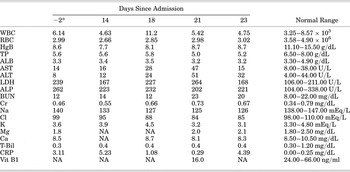
She had no past medical history of psychiatric illness or alcohol or drug abuse. Laboratory examination results from the time before admission until the day of consultation are listed in Table 1. Although hyponatremia was recognized, it had been recognized since day 14.
Laboratory examination

NA: not available.
* Two days before admission.
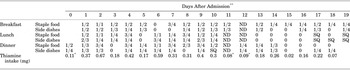
As for medications, she was taking 150 mg of pregabalin, 15 mg of metoclopramide, 15 mg of prochlorperazine, and 30 mg of oxycodone. The kinds and amounts of these drugs were the same as from before administration to the hospital until the days of consultation. We then checked on her nursing chart the amounts of food the patient had consumed, which were roughly recorded as: all (100%), 3/4 (75%), 1/2 (50%), 1/3 (33%), 1/4 (25%), SQ (small amount), and 0 (0%). We found that she had developed appetite loss from the day of admission to the hospital 19 days previously (Table 2). Furthermore, after day 13, when chemotherapy had been administered, her appetite loss worsened. From these findings, we suspected thiamine deficiency based on the fact that the duration of thiamine storage in the body is 18 days (MacLean et al., Reference MacLean, Rhode and Shizgal1983). We therefore administered 100 mg of thiamine intravenously, after which the patient slept well all night.
Percentage of food intake after hospital admission

ND: intake was not identified because she went from our hospital to her home. SQ: small quantity.
* On days 0, 11, and 12, total amount of thiamine was not determined because the patient did not stay in the hospital all day long
** We defined the date of admission as day 0.
The next day (day 20), her level of consciousness dramatically improved. She could maintain her concentration and was able to talk with medical staff and family members. Her disorientation also ceased.
The symptoms of delirium completely disappeared within three days. Her serum thiamine level measured using high-performance liquid chromatography was found to be 16 ng/ml (normal range: 24–66 ng/ml). Her daily thiamine intake from food was estimated by a clinical dietitian to be about 0.3 mg/day, which was quite low compared with the level required by women—1.1 mg of thiamine daily (Yates et al., Reference Yates, Schlicker and Suitor1998).
The clinical findings, effective alleviation of delirious symptoms after thiamine administration, low thiamine intake from food, and low level of thiamine in the serum fulfilled Francis's criteria for delirium induced by thiamine deficiency. Thereafter, the patient showed no signs of delirium for three weeks and was transferred to another hospital.
DISCUSSION
We experienced the case of a cancer patient who developed delirium due to thiamine deficiency. This is the first case report on nonalcoholic Wernicke's encephalopathy in a patient with cancer of the external genitalia. Correct diagnosis and subsequent treatment led to amelioration of the symptoms of delirium and prevented irreversible brain damage.
The cause of the delirium was unclear by routine laboratory examination and clinical symptoms. Although the level of sodium was below the normal range, this low level persisted after the delirium was resolved. The hyponatremia could thus not be regarded as the cause of the delirium. Persistent appetite loss after admission was the only key to a correct diagnosis.
The main reason for thiamine deficiency in this patient was dietary insufficiency due to loss of appetite. However, we face a problem in consultations with patients with delirium who show loss of appetite, since appetite loss is common and recognized in 50 to 80% of cancer patients (Hollen et al., Reference Hollen, Gralla and Kris1993). We also do not know the degree of appetite loss associated with development of thiamine deficiency.
As shown in Table 2, the degree of appetite loss in this patient was in line with that commonly recognized in advanced cancer patients. However, close examination of the patient revealed that she had taken only about 30% of the thiamine necessary for daily living for at least 19 days. Considering that the body pool of thiamine lasts 18 days (MacLean et al., Reference MacLean, Rhode and Shizgal1983), we should always consider the possibility of thiamine deficiency when appetite loss has lasted for at least this length of time. The degree of appetite loss in this patient might serve as a reference.
The second mechanism associated with thiamine deficiency is the adverse effects of chemotherapy. The degree of appetite loss of the patient deteriorated after chemotherapy at day 13. This regimen is recognized to be associated with the development of nausea and vomiting (Peters et al., Reference Peters, Liu and Barrett2000).
The third mechanism associated with thiamine deficiency is the direct effect of 5-FU on thiamine deficiency. Clinical and experimental studies have indicated that 5-fluorouracil may be associated with thiamine deficiency by increasing either utilization or breakdown of thiamine (Basu et al., Reference Basu, Aksoy and Dickerson1979; Aksoy et al., Reference Aksoy, Basu and Brient1980).
In this patient, marginal thiamine deficiency by appetite loss was exacerbated by an adverse effect of CDDP and an adverse and direct effect of 5-FU at day 13 post admission and led to a deficient level.
In conclusion, oncologists and medical staff must be aware of the possibility of Wernicke encephalopathy when patients with appetite loss and without thiamine administration develop delirium. Early detection and intervention may alleviate the symptoms of delirium and prevent irreversible brain damage. It is also speculated that there are patients who develop marginal thiamine deficiency due to appetite loss and/or chemotherapy. Early detection and intervention may prevent the development of delirium.
SUPPLEMENTARY MATERIALS AND METHODS
The supplementary material referred to in this article can be found online at journals.cambridge.org/pax.