West Indians in the United States are significant not only because of their overrepresentation among prominent or successful blacks, but also because their very different background makes them a test case of the explanatory importance of color, as such, in analyzing socioeconomic progress in the American economy and society, as compared to the importance of the cultural traditions of the American Negro.
—Thomas Sowell, “Three Black Histories,” Essays and Data on American Ethnic Groups (Reference Sowell, Sowell and Collins1978, p. 42)
INTRODUCTION
One of the distinguishing features of American sociology is the degree to which scholars have been simultaneously concerned with—and perplexed by—the concept of race and the causes of racial inequality (Du Bois Reference Du Bois1899, Reference Du Bois1903; Park Reference Park1914). Despite widespread agreement that racial stratification remains a distinctive feature of American society, there is little consensus concerning its causes. Some contend that racial discrimination is the primary cause of persistent Black-White racial inequality Footnote 1 (e.g., Bobo Reference Bobo1999; Bonilla-Silva Reference Bonilla-Silva1997; Darity Reference Darity2005; Feagin Reference Feagin2000). Others argue that African American cultural attributes are responsible for unrelenting racial disparities (e.g., Cosby and Poussaint, Reference Cosby and Poussaint2007; Lewis Reference Lewis1965; Mcwhorter Reference Mcwhorter2000; Moynihan Reference Moynihan1965; Patterson Reference Patterson1998; Thernstrom and Thernstrom, Reference Thernstrom and Thernstrom1997). In this study, I take the presence of a growing Afro Caribbean immigrant population Footnote 2 (Kent Reference Kent2007) and its relative position vis-à-vis African Americans, as a unique opportunity to contribute to this debate (Dodoo Reference Dodoo1997; Dodoo Reference Dodoo1999; Sowell Reference Sowell, Sowell and Collins1978).
Black immigrants from the Caribbean have long outperformed African Americans (or the descendants of American slavery) on nearly all measures of socioeconomic attainment, including employment rates and earnings (Model Reference Model2008; Reid Reference Reid1939). Several social scientists note that Afro Caribbeans have maintained this advantage despite sharing racialized physical features with African Americans (Butcher Reference Butcher1994; Chiswick Reference Chiswick1978; Model Reference Model1991, Reference Model1995, Reference Model2008; Sowell Reference Sowell, Sowell and Collins1978), yet few have explicitly recognized how these disparities can serve as a natural experiment where researchers might “hold race constant” and observe the degree to which cultural attributes contribute to unequal social and economic outcomes (Dodoo Reference Dodoo1997; Dodoo Reference Dodoo1999; Kalmijn Reference Kalmijn1996; Sowell Reference Sowell, Sowell and Collins1978). If Afro Caribbeans are able to “do better” than African Americans while sharing the same stigmatized set of racialized physical features, more widespread and disparate trends in racial stratification (between Blacks and Whites) might be a result of African American cultural attributes (Dodoo Reference Dodoo1997; Dodoo Reference Dodoo1999; Kalmijn Reference Kalmijn1996; Sowell Reference Sowell, Sowell and Collins1978). Footnote 3
Prior research has speculated on the potential causes of differing cultural attributes (i.e., differences in systems of slavery and racial composition between the United States and the Caribbean) and the relationship between these causes and various socioeconomic outcomes, but it has not yet observed or directly studied the actual role that cultural attributes might play (Model Reference Model2008; Sowell Reference Sowell1975, Reference Sowell, Sowell and Collins1978). Footnote 4 This study seeks to fill this gap in two ways. First, I situate this cultural explanation within the broader discussion concerning model minority groups and what they do or do not help us understand about the nature of racial inequality in the United States (Osajima Reference Osajima, Okihiro, Hune, Hansen and Liu1988; Prashad Reference Prashad2000; Sue and Kitano, Reference Sue and Kitano1973). Second, I use the only nationally representative social survey with oversamples of both African Americans and Afro Caribbeans (Heeringa et al., Reference Heeringa, Wagner, Torres, Duan, Adams and Berglund2004; Jackson et al., Reference Jackson, Torres, Caldwell, Neighbors, Nesse, Joseph Taylor, Trierweiler and Williams2004) in order to inform answers to the following questions: do Afro Caribbeans have greater model minority attributes than African Americans and are these attributes responsible for gaps in employment and income between these groups?
AFRO CARIBBEAN IMMIGRANTS IN THE UNITED STATES
Black migration from the Caribbean to the United States can be characterized by three major waves: pre-1930, 1930-1965, and post-1965. The first wave includes all pre-1930 migrants and ends with the passage of 1924 immigration reforms and the onset of the Great Depression. During the Great Depression, migration to the United States was both more difficult and less desirable. This second wave continued until 1965. The third period began with 1965 immigration reforms and continues into the present. Between 2000 and 2005, there were approximately 1.5 million Afro Caribbeans living in the United States (Logan Reference Logan, Shaw-Taylor and Tuch2007). Studies focused on labor market disparities between African Americans and Afro Caribbeans emerged in the latter half of the twentieth century (Butcher Reference Butcher1994; Chiswick Reference Chiswick and Fellner1979; Foner and Napoli, Reference Foner and Napoli1978; Model Reference Model1991, Reference Model1995; Sowell Reference Sowell, Sowell and Collins1978). For instance, in 2000, Afro Caribbeans were about 10% more likely to be employed than African Americans, and they earned about 13% more (Mason Reference Mason2010; Model Reference Model2008). A more recent study shows that between 2001 and 2007 Afro Caribbeans were about 6% more likely to have full time employment, and their weekly earnings were about 16% greater than those of African Americans (Mason Reference Mason2010).
Studies of Black ethnic disparities have not always considered the role of language-origin, but according to those that make this distinction, Afro Caribbeans of English-speaking language origin are the most likely to be employed and have the greatest earnings, followed by Spanish and French-speaking migrants (Kalmijn Reference Kalmijn1996; Model Reference Model1991). At least one study shows that, after controlling for select labor market characteristics, Afro Caribbean immigrants from English-speaking countries maintain their advantage over other language-origin groups and African Americans, while African Americans move ahead of Spanish and French-speaking Afro Caribbean immigrants (Kalmijn Reference Kalmijn1996).
The role of generational status has also been considered (Kalmijn Reference Kalmijn1996; Sowell Reference Sowell, Sowell and Collins1978). According to the 1970 U.S. Census, the family incomes of second-generation Afro Caribbeans were almost 60% greater than African Americans (Sowell Reference Sowell, Sowell and Collins1978). However, a study of the 1990 Census shows the second-generation to have hourly earnings that are essentially equivalent to African Americans (Kalmijn Reference Kalmijn1996).
THE AFRO CARIBBEAN MODEL MINORITY HYPOTHESIS
The model minority hypothesis is a lay theory and social discourse that assigns model minority Footnote 5 status to specific racialized minority groups in ways that often do not reflect the facts (Osajima Reference Osajima, Okihiro, Hune, Hansen and Liu1988; Prashad Reference Prashad2000; Sue and Kitano, Reference Sue and Kitano1973). The model minority narrative is therefore a racial trope used to argue that if one minority group can reach a certain level of socioeconomic status, other minority groups should also be able to reach or exceed this level; and to the extent that other minority groups do not, this is due to their lack of effort and too much time spent worrying about the prospect of racial discrimination (Prashad Reference Prashad2000). Ultimately, the model minority hypothesis works to maintain White hegemony by attributing racial stratification to the cultural attributes of racial minority groups instead of social structures (e.g., law, social customs, and wealth disparities) that work to maintain racial stratification (Bobo et al., Reference Bobo, Kluegel, Smith, Tuch and Martin1997; Bonilla-Silva Reference Bonilla-Silva1997; Darity Reference Darity2005; Pierre Reference Pierre2004; Sue and Kitano, Reference Sue and Kitano1973).
Development of the Hypothesis
The development of the Afro Caribbean model minority hypothesis began early in the twentieth century and solidified shortly after the modern Civil Rights Movement (Glazer and Moynihan, Reference Glazer and Moynihan1963; Pierre Reference Pierre2004; Sowell Reference Sowell1975; Tillery and Chresfield, Reference Tillery and Chresfield2012). Thomas Sowell is often cited as an early proponent of the argument that Afro Caribbeans outperform African Americans because of cultural differences (Sowell Reference Sowell1975, Reference Sowell, Sowell and Collins1978, Reference Sowell1981, Reference Sowell1983, Reference Sowell1984). He states:
… [Afro Caribbeans] are a group of great importance, not only in terms of their past achievements and their current roles, but perhaps even more as a means of gauging the socioeconomic effect of being black… as compared to the effect of the many cultural and institutional factors historically associated with the evolution of [African Americans]. [Afro Caribbeans] in the United States have long had a distinctive life style, set of values, and educational, economic, and cultural achievements very different from those of [African Americans] (Reference Sowell1975, p. 97).
He continues:
… [Afro Caribbeans] emphasized such traits as work, thrift and education—more generally achievements involving planning and working for the future, implying the emotional control for self-denial in the present and emphasizing the logical and mundane over the emotional, the imaginative, and the heroic. The opposite characteristics can be seen among … [African Americans], where advancement can be achieved in emotional and imaginative areas, such as oratory, lyric literature, and music, and which have produced many dramatic ‘leaders’ and heroes (Reference Sowell1975, pp. 130-1).
In essence, Sowell argues that the reason why Afro Caribbeans do better than African Americans is because they work harder and suffer from lower levels of “racial paranoia” (Jackson Reference Jackson2008; Metzl Reference Metzl2009). Various aspects of this view would later appear in the writing of other academics (Dodoo Reference Dodoo1997; Dodoo Reference Dodoo1999; Ogbu and Simons, Reference Ogbu and Simons1998; Ogbu Reference Ogbu1992; Portes and Zhou, Reference Portes and Zhou1993; Zhou Reference Zhou1997) and in the pages of local and national periodicals throughout the twentieth century (Pierre Reference Pierre2004). Indeed, scholars have recently observed that, “The relative economic success of black immigrants compared to [African Americans] was once considered evidence of a ‘black success story,’ not unlike the model minority image of Asian immigrants” (Read and Emerson, Reference Read and Emerson2005, p. 184).
Dimensions of the Model Minority Hypothesis
In this study, I extend literature on the “model minority myth” by applying it to a non-Asian descendent group and providing explicit tests of the cultural explanations others have offered for the relative labor market success of Afro Caribbeans. The Afro Caribbean model minority hypothesis posits that racial minorities succeed in the United States when they have a strong work ethic and divest in racial consciousness and contestation. Yet, proclamations about the value of hard work are associated with related claims, such as: economic autonomy (or a preference not to be dependent on the welfare state for resources and a propensity for self-employment), lower tendencies to exhibit oppositionality (or a willingness to abide by mainstream rules and authority figures), and certain aspects of family structure and functioning (e.g., being married and having more supportive families). Scholars also offer that Afro Caribbeans are less racially conscious and are therefore less likely to believe that their racial status restricts their opportunities for social mobility.
Work Ethic
Several scholars have claimed that Afro Caribbeans have a greater work ethic than African Americans (Bryce-Laporte Reference Bryce-Laporte1972, Reference Bryce-Laporte, Rose, Rothman and Wilson1973; Domínguez Reference Domínguez1975; Forsythe Reference Forsythe, Bryce-Laporte and Mortimer1983; Glantz Reference Glantz1978; Glazer and Moynihan, Reference Glazer and Moynihan1963; Sowell Reference Sowell1975). Nathan Glazer and Patrick Moynihan commented that, “[t]he ethos of the West Indians, in contrast to that of the Southern Negro, emphasized saving, hard work, investment, education” (italics added; 1963, p. 35). Similarly, Dennis Forsythe remarked that, “[Afro Caribbeans]… have historically emerged with a highly secularized Protestant ethic” (Reference Forsythe, Bryce-Laporte and Mortimer1983, p. 65). For these scholars, a major reason why Afro Caribbeans often achieve greater labor market success than African Americans is because their work ethic is more in line with the U.S. labor market.
Evidence supporting the idea that Afro Caribbeans value work more or work harder than African Americans is sparse and regionally specific. The earliest indirect support for this idea comes from the assumption that if Afro Caribbeans are doing better than African Americans, they simply must be working harder (Domínguez Reference Domínguez1975; Reid Reference Reid1939). One ethnographic study shows that White apple orchard owners thought Afro Caribbeans worked harder than African Americans (Foner and Napoli, Reference Foner and Napoli1978, p. 492). Other evidence comes from in-depth interviews with White employers in New York (Waters Reference Waters1999). As part of a larger and importantly nuanced study, Mary Waters (Reference Waters1999) reported that, “… whites saw the [Afro Caribbeans] as more ambitious [and] more hard-working… than the African Americans” (p. 121). However, beyond these perceptions, there is no systematic evidence for the claim that Afro Caribbeans have a greater work ethic than African Americans.
Economic Autonomy
According to Sowell, there are two reasons why Afro Caribbeans have a greater appreciation for economic autonomy than African Americans: Caribbean countries often lack a social welfare system, and Afro Caribbeans were allowed more self-sufficiency during slavery (Reference Sowell1975, p. 98-9). James Weldon Johnson (Reference Johnson1930) once commented that Afro Caribbeans, “…are characteristically sober-minded and have something of a genius for business, differing almost totally in these from the average rural Negro from the South” (Reference Johnson1930, p. 153). Economic autonomy is closely related to work ethic but is specifically identified by less dependence on the social welfare state, and when employed, a higher likelihood of self-employment.
Evidence of greater Afro Caribbean economic autonomy is limited. The informants that Waters interviewed, reported their belief that African Americans prefer welfare dependence to working – a trait they did not associate with Afro Caribbeans. According to Waters, “[White managers] claimed that [African Americans] preferred welfare to applying for entry-level jobs…” (1999, p. 118). Ultimately, most of the evidence for greater welfare dependence among African Americans comes from perception, not systematic study. However, there is evidence of greater rates of self-employment among Black immigrants (Bogan and Darity, Reference Bogan and Darity2008; Borjas Reference Borjas1986; Mason Reference Mason2010). Footnote 6 According to the U.S. Census, Black immigrants were more likely to be self-employed than African Americans in every decennial year between 1910 and 2000, except 1970 (Bogan and Darity, Reference Bogan and Darity2008). Another study reports that Afro Caribbeans were 62% more likely to be self-employed than African Americans between 2001 and 2007 (Mason Reference Mason2010).
Oppositionality
The concept of oppositionality has its roots in the literature on Black-White racial disparities in education (Harris Reference Harris2011; Harris Reference Harris2006; Harris and Robinson, Reference Harris and Robinson2007; Ogbu Reference Ogbu2003; Ogbu Reference Ogbu1978). However, it has also been applied in explaining disparities between African Americans and Black immigrants (Ogbu and Simons, Reference Ogbu and Simons1998; Portes and Zhou, Reference Portes and Zhou1993). Oppositionality refers to the idea that African American students have lower levels of academic achievement—and by inference, less labor market success—because they have developed a set of values that run counter to social mobility (Ogbu Reference Ogbu2003; Ogbu Reference Ogbu1978). That is, in a racist society, African Americans expect few returns for adopting mainstream attitudes and behaviors and are therefore more likely to disinvest in these attitudes and behaviors and actively “oppose” mainstream authority figures.
John Ogbu and colleagues further hypothesize that those who voluntarily migrate to a society with known high levels of racial discrimination are less likely to develop an oppositional posture (Ogbu Reference Ogbu1987; Ogbu and Simons, Reference Ogbu and Simons1998; Ogbu Reference Ogbu1992). Also, Afro Caribbeans come from nation-states where they are the racial majority and are more likely to identify with and acquiesce to the politics of the racial majority in their new country (Foner and Napoli, Reference Foner and Napoli1978; Ho Reference Ho1995). That is, Afro Caribbeans may “tend to acquiesce in their relationship with school personnel and White authorities in other societal institutions” in ways that African Americans do not (Ogbu Reference Ogbu1992, p. 291). Although several have asserted that oppositionality among African Americans contributes to racial disparities in education, studies that empirically test this idea have produced findings that do not support this speculation (Bennett and Lutz, Reference Bennett and Lutz2009; Harris Reference Harris2011; Harris Reference Harris2006; Harris and Robinson, Reference Harris and Robinson2007; Tyson et al. Reference Tyson, Darity and Castellino2005). Moreover, there is no systematic evidence for the idea that African Americans are any more “oppositional” than Afro Caribbeans.
Family Structure and Functioning
There is a long tradition of locating the cause of Black-White racial disparities in the “maladaptive” family structure and function of African American families (e.g., Cosby and Poussaint, Reference Cosby and Poussaint2007; Moynihan Reference Moynihan1965). In addition to speculation on negative outcomes associated with non-nuclear family structures (e.g., homes headed by single mothers), some argue that African American families are not as supportive as Afro Caribbean families (Paris Reference Paris1981). Several have speculated that Afro Caribbeans achieve greater labor market success than African Americans because Afro Caribbeans are more likely to be raised in two-parent nuclear families that are thought to be more supportive (e.g., Sowell Reference Sowell1975, p. 133).
Much of the evidence supports the claim that Afro Caribbean families are more likely to be nuclear than African American families. Afro Caribbeans report that their families are more supportive, “close-knit,” and strict than African American families (Waters Reference Waters1999; Waters and Skykes, Reference Waters, Skykes and Foner2009). However, there is also some evidence that Afro Caribbean families suffer from the effects of serial migration; that is, mothers often migrate first with the children and find it difficult to juggle work and parenting responsibilities (Kao Reference Kao2004; Waters Reference Waters1999). In terms of marriage, Afro Caribbeans have been as much as 50% more likely to be married than African Americans (Batson et al. Reference Batson, Qian and Lichter2006; Butcher Reference Butcher1994; Kent Reference Kent2007; Model Reference Model2008). Although early studies reported that African American families were about 30% more likely to be headed by a single mother (Farley and Allen, Reference Farley and Allen1987), more recent studies show that African American households are just 2% more likely than Afro Caribbean households to be headed by a single mother (Model Reference Model2008). One study shows that the disparity in income between husband-wife and female-headed families is greater for African Americans. Afro Caribbean female-headed families earn 41% less than husband-wife families, whereas African American female-headed families earn 49% less than husband-wife families (Farley and Allen, Reference Farley and Allen1987).
Racial Consciousness
According to some, Afro Caribbeans are less likely to believe that race will be a block to their social mobility (Glazer and Moynihan, Reference Glazer and Moynihan1963; Sowell Reference Sowell1975; Vickerman Reference Vickerman1999; Waters Reference Waters1999). Broadly, these scholars argue that lower race consciousness leads to greater Afro Caribbean success because it removes the perception of a “racial ceiling” and results in less antagonistic relations with White employers (Vickerman Reference Vickerman1999; Waters Reference Waters1999). The assertion that Afro Caribbeans are less race-conscious than African Americans primarily comes from the idea that they are the racial majority in their country of origin (Sowell Reference Sowell, Sowell and Collins1978). Therefore, many Afro Caribbeans have a “… long-standing belief that opportunities exist in the United States and that their own black skin has not, and will not, prevent them from taking advantage of those opportunities” (Waters Reference Waters1999, p. 150).
Research that compares the racial attitudes of African Americans and Afro Caribbeans is mixed. Ethnographic work suggests that both groups acknowledge they are Black, but that being Black is less central to the identity of Afro Caribbeans (Rogers Reference Rogers and Foner2001; Waters Reference Waters1999). In addition, Afro Caribbeans report they do not associate their Blackness with limitations in the way that African Americans do (Rogers Reference Rogers and Foner2001). While these ethnographic studies offer a comparison between Afro Caribbeans and African Americans, they generally only investigate Afro Caribbean views; often comparing these to “the literature” on African American racial attitudes. However, studies that explicitly compare these two groups find negligible differences (Benson Reference Benson2006; Smith Reference Smith2013).
Aside from the question of which group has greater racial consciousness is the presence of a link between racial attitudes and labor market performance. While some argue that a raceless identity promotes Black/Afro Caribbean achievement (Fordham Reference Fordham1988, Reference Fordham1996; Fordham and Ogbu, Reference Fordham and Ogbu1986), Footnote 7 others have found that a higher level of race consciousness is associated with greater success among African Americans (Anderson Reference Anderson1988; Arroyo and Zigler, Reference Arroyo and Zigler1995; Bowman and Howard, Reference Bowman and Howard1985; Edwards and Polite, Reference Edwards and Polite1992; Hemmings Reference Hemmings1998; Weinberg Reference Weinberg1977). Indeed, a recent study failed to find support for the idea that low race consciousness supports social mobility for African Americans (Harris and Marsh, Reference Harris and Marsh2010).
Much of the literature on labor market disparities between African Americans and Afro Caribbeans has attributed unequal outcomes to differences in cultural attributes. When taken together, these arguments fit neatly within the more general model minority hypothesis. That is, racial and ethnic minority groups (i.e., Afro Caribbeans) that work hard and disinvest in racial contestation will not experience the restricted social mobility that is often experienced by African Americans. Conversely, racial and ethnic minority groups (i.e., African Americans) that do not work hard and instead choose to “see race” and racial discrimination at every turn will suffer the consequences of these maladaptive cultural attributes. The goal of this study is to provide a systematic and generalizable investigation into the degree to which African Americans and Afro Caribbeans differ in terms of their relative levels of model minority attributes and whether Black ethnic disparities are a result of differences in these attributes.
DATA AND METHODS
In this study, I use survey data from the National Survey of American Life (NSAL; Jackson et al. Reference Jackson, Torres, Caldwell, Neighbors, Nesse, Joseph Taylor, Trierweiler and Williams2004). Although it is always challenging to assess culture using a social survey, the NSAL is uniquely suited for this study because it provides the first nationally representative study of both African Americans and Afro Caribbeans (Heeringa et al., Reference Heeringa, Wagner, Torres, Duan, Adams and Berglund2004), and it includes basic information on all the cultural attributes reviewed above. The survey is a multi-stage area probability sample composed of two portions: a face-to-face household survey and a re-interview pamphlet that respondents submitted by mail. I use items from both portions of the survey. The analytic sample only includes respondents age 18-64. Footnote 8
This study includes two Black ethnic groups: African Americans (n = 2,766) and Afro Caribbeans (n = 1,183). Generation and language-origin then subdivide Afro Caribbeans. Afro Caribbeans that were born in the Caribbean are coded “First-generation Afro Caribbeans” (n = 798). First-generation Afro Caribbeans are also coded into language-origin groups (Kalmijn Reference Kalmijn1996; Model Reference Model2008). There are 595 respondents from the English-speaking Caribbean and 203 from the French-speaking Caribbean. Footnote 9 I observe the second-generation separately. I coded all Black respondents born in the United States and having at least one Afro Caribbean parent, “Second-generation Afro Caribbean” (n = 385; Carliner Reference Carliner1980; Chiswick Reference Chiswick1977; Hook et al. Reference Hook, Brown and Kwenda2004; Model Reference Model2008; Sakamoto et al. Reference Sakamoto, Woo and Kim2010; Sowell Reference Sowell, Sowell and Collins1978). I then coded a dummy variable for “Black ethnicity, language-origin and generation”: 0 for African Americans, 1 for second-generation Afro Caribbeans, 2 for first-generation English-speaking Afro Caribbeans and 3 for first-generation French-speaking Afro Caribbeans.
I observe two labor market outcomes, labor market participation and annual income, the measures most commonly used in the literature on Black ethnic disparities (e.g., Model Reference Model2008). There were three categories for labor market participation: 0 for those who were out of the labor market, 1 for those that were unemployed, and two for those that were employed (part or full-time). I measure annual personal income with personal reports. In multivariate regression models, I use the log of annual income in order to reduce the effect of extreme values.
Model Minority Attributes (Independent Variables)
I use three indicators to measure work ethic. Respondents answered yes or no to the statement, “At times I refuse to hold a job, even when I am expected to.” This item was reverse-coded to assess willingness to work. Footnote 10 Respondents were also asked, “Below are some words used to describe good points and bad points about people in general. How true do you think they are about you?” Following the same primer, respondents were asked if they believed they were “hardworking” and/or “lazy.” There were four response options: very true, somewhat true, a little true and not true at all. I coded all responses to gage the degree to which the respondent had a greater work ethnic.
I measure economic autonomy in terms of participation in the welfare state and the tendency to be entrepreneurial. Three questions assess participation in the welfare state, “Did your family ever receive public assistance when you were growing up?” “Have you ever received public assistance since turning 18” and “Are you (your family) currently receiving public assistance?” If the respondent answered no to all three questions they were coded one, for never on welfare, all others were coded zero. Footnote 11 I measure entrepreneurialism in terms of whether or not respondents are currently, or have ever been, self-employed. If the respondent has ever been self-employed they are coded one on entrepreneurialism, all others are coded zero. Footnote 12 Those who are entrepreneurial and have never taken welfare payments are more economically autonomous than are those who have never been self-employed or taken welfare payments.
There are two indicators for oppositionality: childhood defiance and respect for authority. The preamble for childhood defiance reads: “Earlier in the interview you mentioned a period of time of six months or longer in your childhood or adolescence when you often did things that got you in trouble with adults. Which of the following things did you do during that time?” Then: “Did you often argue with or ‘talk back’ to adults?” “Did you frequently disobey rules at home, school, or work?” and “Did you annoy people on purpose by doing or saying things just to bother them?” Those who did not report “getting into trouble” where not asked these follow-up questions and were coded zero on childhood defiance. Those who answered yes to any of these three follow-up questions were coded one on childhood defiance. Footnote 13 In order to assess respect for authority, survey participants responded to the statement, “Obedience and respect for authority are the most important virtues children should learn.” The response options ranged from strongly agree to strongly disagree. Respondents with higher scores on childhood defiance and lower scores on respect for authority are more oppositional.
There are two measures of family structure and functioning: marital status and family support. I assessed marital status with responses to the question: “Are you currently married, living with a partner, separated, divorced, [or] widowed?” I categorized respondents according to whether they were married, divorced or single (i.e., never married). The four questions used to index family support are: “How often do people in your family—including children, grandparents, aunts, uncles, in-laws and so on—help you out?” “Other than your (spouse/partner), how often do your family members make you feel loved and cared for?” “… listen to you talk about your private problems and concerns?” “… express interest and concern in your well-being?” The Cronbach alpha for the index of family support is .70 for African Americans and .69 for Afro Caribbeans. Factor analysis revealed a single Eigenvalue of 1.65 for African Americans and 1.62 for Afro Caribbeans (Kim and Mueller, Reference Kim and Mueller1978).
Racial consciousness is composed of three measures of racial attitudes: racial salience, linked fate, and minority blame for racial inequality. One item measures racial salience in terms of the frequency with which one thinks about being Black. Respondents answered the question, “How often do you think about being Black?” The response options were: never, rarely, several times a week, once a day, several times a day, and all the time. I recoded these into: never, rarely, at least once a week, and all the time. The measure of linked fate is a single indicator composed from two questions: “Do you think what happens generally to Black people in this country will have something to do with what happens in your life?” and “Will it affect you a lot, some, or not very much?” I combined these questions to create four response options: none, not very much, some, and a lot. I observe minority blame for racial inequality with responses to the question, “If racial minorities don’t do well in life they have no one to blame but themselves.” Those who express higher racial salience, greater linked fate, and are less likely to blame minorities for racial inequality are more racially conscious than are others.
Control Variables
In multivariate models, I also assess: gender, age, education, work experience, urbanicity, region, and years since migration. Since women generally have lower socioeconomic status than men, I control for gender. Footnote 14 I control for age and age-squared because younger and older workers are known to have lower likelihoods of employment and lower incomes than those at the middle of the age distribution (Mincer Reference Mincer1974). I control for level of education because greater education is associated with greater labor market status and Afro Caribbeans are more likely to attend college than African Americans (Massey et al., Reference Massey, Mooney, Torres and Charles2007; Mincer Reference Mincer1974). I control for urbanicity because employment and income vary by size of the city or town. I include a dummy variable that indicates whether the respondent lives in a suburb because in this sample those living in suburbs had greater incomes. Region is a particularly important control variable because the majority of Afro Caribbeans live in the Northeast where wages are often higher than other parts of the country and African Americans are more likely to live in the South where incomes are lower (Mason Reference Mason2010). Therefore, I include a dummy variable for those respondents living in the South. I include years since migration to adjust for the role of immigrant acculturation (Chiswick Reference Chiswick1978). Since African Americans and second-generation Afro Caribbeans are born in the United States and have therefore not experienced immigrant acculturation, they are coded zero for years since migration (Hamilton Reference Hamilton2014).
Analysis Strategy
First, in order to assess the degree to which African Americans and Afro Caribbeans are different on the model minority attributes referenced in the literature, I report differences in model minority attributes between African Americans and Afro Caribbeans (by generational status and language-origin). I use η scores—a standardized measure of effect size—to assess the magnitude of differences across different measures (Grissom and Kim, Reference Grissom and Kim2005). I then focus on accounting for Black ethnic labor market disparities. I estimate a series of regression models (ordered logit for labor market participation and OLS for annual income). I present base models that include all control variables and a dummy variable for “Black ethnicity, language-origin, and generation.” I then add each model minority attribute separately and observe any changes in the set of dummy variables for “Black ethnicity, language-origin, and generation.” Then I observe a model with all model minority attributes taken together. Given exploratory findings for years since migration, I consider a model that includes the controls and years since migration, followed by a model with controls, years since migration and all model minority attributes. Since both African Americans and second-generation Afro Caribbeans have zero years since migration, I drop second-generation Afro Caribbeans from these models and capture the value for African Americans in the intercept (Gujarati Reference Gujarati2003; Hamilton Reference Hamilton2014). In all models, I calculate the percentage change in each of the disparity coefficients. This modeling strategy allows one to observe the degree to which Black ethnic differences in employment and income are associated with Black ethnic differences in levels of model minority attributes (Baron and Kenny, Reference Baron and Kenny1986).
RESULTS
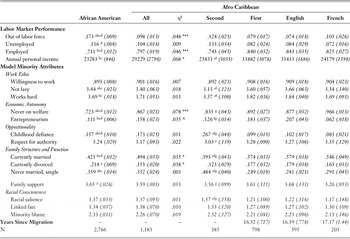
Table 1 reports unadjusted means for the observed labor market outcomes and model minority attributes by Black ethnicity, immigrant generation and language-origin. In line with expectations, Afro Caribbeans outpace African Americans in terms of both employment and income. For instance, Afro Caribbeans are about 12% more likely to have a job than African Americans (η = .046, p = .001). In terms of personal income, Afro Caribbeans took in about 26% more annually than African Americans (η = .068, p = .048). In general, African Americans and second-generation Afro Caribbeans are similar (or statistically no different). Particularly pronounced are disparities between African Americans and English-speaking Afro Caribbeans. By contrast, African Americans have incomes that are about the same as French-speaking Afro Caribbeans. First-generation Afro Caribbeans do not have greater labor market participation than the second-generation, but they do have greater incomes.
Descriptive Statistics for Labor Market Performance and Model Minority Attributes by Black Ethnicity, Immigrant Generation and Language-Origin (Unadjusted Means)

1 The eta score is for the comparison between African Americans and all Afro Caribbeans. Statistical significance: ^ = p <.10, * = p <.05, ** = p < .01, *** = p <.001.
a Statistical significance for the comparison between African Americans and Second Generation Afro Caribbeans, p <.10 .
b Statistical significance for the comparison between African Americans and First Generation Afro Caribbeans, p <.10 .
c Statistical significance for the comparison between African Americans and English-speaking Afro Caribbeans, p <.10 .
d Statistical significance for the comparison between African Americans and French-speaking Afro Caribbeans, p <.10 .
e Statistical significance for the comparison between Second Generation Afro Caribbeans and First Generation Afro Caribbeans, p <.10 .
f Statistical significance for the comparison between Second Generation Afro Caribbeans and English-speaking Afro Caribbeans, p <.10 .
g Statistical significance for the comparison between Second Generation Afro Caribbeans and French-speaking Afro Caribbeans, p <.10 .
Data for this table come from the National Survey of American Life, 2001-3.The table includes 3,949 respodents ages 18 to 64.
Black Ethnicity and Model Minority Attributes
Findings provide mixed support for expectations found in the literature regarding the cultural reasons for Black ethnic disparities. A strict reading of these expectations would be that Afro Caribbeans have greater levels of all-five model minority attributes (including all fourteen measured variables). However, this is not the case. Instead, when taken together, Afro Caribbeans as a whole have greater values on four measures within two constructs. However, Afro Caribbeans from English-speaking countries are different from African Americans on seven measures within three constructs. Importantly, the small size of the second-generation and French-speaking samples is likely to reduce the statistical power of comparisons.
First, findings for self-reported individual work ethic are generally in line with the literature, which expects Afro Caribbeans to have a greater work ethic. Although there is no clear distinction between African Americans and Afro Caribbeans in terms of their likelihood to refuse a job even when expected to work, first-generation Afro Caribbeans – particularly English speakers – were more likely than African Americans and second-generation Afro Caribbeans to report that they are not “lazy” and that they “work hard.”
Findings for economic autonomy are most closely in line with expectations. Afro Caribbeans are less likely to have received welfare and more likely to be entrepreneurial than African Americans. With respect to entrepreneurism, first-generation English-speaking Afro Caribbeans are more entrepreneurial than African Americans. African Americans and second-generation Afro Caribbeans are similar to one another, and African Americans are more entrepreneurial than French-speaking Afro Caribbeans. Differences in welfare participation are the largest in the table (η = .078, p = .000). Afro Caribbeans are about 20% more likely to have never taken welfare than African Americans. However, many Caribbean countries do not provide welfare and this likely shapes their rate of state support. In addition, some immigrants do not qualify for state payments. Therefore, the percentage for Afro Caribbeans might be biased downward as some Afro Caribbeans may have chose to take state benefits if they were available.
Results show some support for Black ethnic differences in oppositionality. While there are no detectable differences in either childhood defiance or respect for authority between African Americans and Afro Caribbeans in general, African Americans express less childhood defiance than second-generation Afro Caribbeans and they express more defiance than first-generation Afro Caribbeans. The second-generation reports less respect for authority than the first-generation. These findings are in line with the literature on Afro Caribbean parenting, where Afro Caribbean parents are reportedly more strict (Waters and Skykes, Reference Waters, Skykes and Foner2009), thereby creating a context for greater opposition and defiance among the second-generation.
Findings for family structure and functioning are mixed. In general, Afro Caribbeans are about 17% more likely than African Americans to be currently married, but African American and Afro Caribbeans are no different in terms of support. First-generation Afro Caribbeans are more likely to be married than the second-generation. This pattern of the first-generation being more likely to be married might be an artifact of immigration policies that favor family reunification. The primary distinction is between first-generation Afro Caribbeans in one group, and African Americans and second-generation Afro Caribbeans in the other group.
Finally, Table 1 presents findings for Black ethnic differences in racial attitudes that generally do not support predictions. Findings show no differences between most of the group comparisons; with the exception being that race is less salient for the first-generation than it is for the second-generation. Although the general pattern does not support expectations, the results for this specific measure of racial attitudes are in line with literature on the Afro Caribbean model minority hypothesis. However, when considering all measures of racial attitudes, the groups considered have racial attitudes that are quite similar.
Taken together, these findings provide mixed support for the notion that Afro Caribbeans represent a model minority vis-à-vis African Americans. That is, while there are instances when the expectations found in the model minority hypothesis hold true, there are more instances where the findings are not in line with expectations. This is less the case when African Americans are selectively compared to first-generation Afro Caribbeans. This more focused comparison results in African Americans being different from first-generation Afro Caribbean immigrants on about half of all variables used to assess model minority attributes. The clearest finding in support of the model minority hypothesis is that African Americans report less economic autonomy than Afro Caribbeans.
Explaining Black Ethnic Disparities
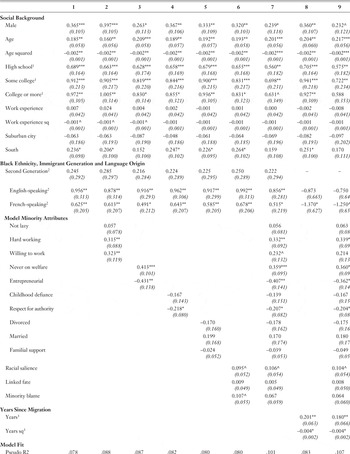
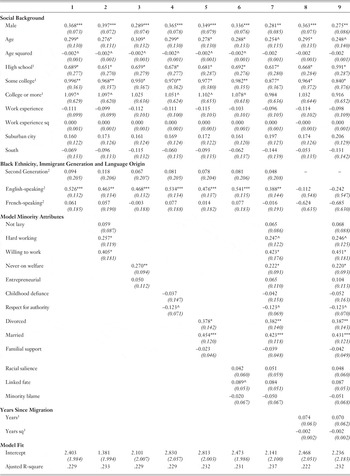
What role do differences in model minority attributes play in generating the observed Black ethnic labor market disparities? Tables 2 and 3 show that model minority attributes provide only a partial explanation for labor market disparities between African Americans and Afro Caribbeans. In fact, just 10% of the disparity in labor market participation between English-speaking Afro Caribbeans and African Americans is due to differences in model minority attributes. However, about 18% of the disparity in labor market participation between French-speaking Afro Caribbeans and African Americans can be attributed to model minority attributes. About 26% of the income disparity between African Americans and English-speaking Afro Caribbeans is due to differences in model minority attributes. All disparities between African Americans and second-generation Afro Caribbeans are explained by social background factors. These findings are not in keeping with the model minority hypothesis, which asserts that Black ethnic disparities in employment and income are entirely due to differences in cultural attributes.
Ordered Logit Regression Models of Labor Force Participaiton on Black Ethnicity, Immigrant Generation, Language Origin, Model Minority Attributes and Years Since Migration

1 Less than high school is the omitted comparison category.
2 African Americans are the omitted comparison category.
3 Since African Americans and Second Generation Afro Caribbeans were born in the US, they have zero years since migration.
The dependent variable is ordered where: 0 = not in labor force, 1 = currently unemployed and 2 = currently employed.
Results in this table are from the National Survey of American Life, 2001–3. There are 3,949 respondents ages 18 to 64 in models 1–7. There are 3,564 in models 8 and 9.
Statistical tests are two-tailed, diff > 0. Statistical significance: p < .10 = ^, p <.05 = *, p <.01 = ** and p <.001 = ***.
OLS Regression Models of Log Annual Income on Black Ethnicity, Immigrant Generation, Language Origin, Model Minority Attributes and Years Since Migration

1 Less than high school is the omitted comparison category.
2 African Americans are the omitted comparison category.
3 Since African Americans and Second Generation Afro Caribbeans were born in the US, they have zero years since migration.
Results in this table are from the National Survey of American Life, 2001–3. There are 3,949 respondents ages 18 to 64 in models 1–7. There are 3,564 in models 8 and 9.
Statistical tests are two-tailed, diff > 0. Statistical significance: p < .10 = ^, p <.05 = *, p <.01 = ** and p <.001 = ***.
The Model Minority Hypothesis and Years Since Migration
Scholars commonly consider years since migration in various studies of immigrant acculturation and labor market incorporation. Like other studies, accounting for years since migration provides insight into labor market disparities between African Americans and Afro Caribbeans (Butcher Reference Butcher1994; Chiswick Reference Chiswick1978; Model Reference Model2008). Years since migration explains the entire disparity in employment and income between African Americans and English-speaking Afro Caribbeans (see Model 8, Tables 2 and 3). Interestingly, controlling for years since migration results in greater employment rates among African Americans vis-à-vis French-speaking Afro Caribbeans.
The fact that years since migration explains Black ethnic labor market disparities runs against the basic assumptions of the model minority hypothesis. That is, it has long been suggested that the “years since migration effect” is attributable to the time it takes for Afro Caribbeans to acculturate to US customs (Chiswick Reference Chiswick1978). Although years since migration may be the crudest measure of acculturation, being successful because of altering oneself to fit the norms of a new cultural milieu does not fit neatly with the premise that fixed or constant cultural attributes associated with birth in the Caribbean are responsible for greater Afro Caribbean success vis-à-vis African Americans. The model minority hypothesis does not argue that constant and changing cultural attributes are simultaneously responsible for Black ethnic disparities. Rather, it argues that cultural values associated with being raised in one region are transplanted, maintained and responsible for success in another region.
In sum, these findings provide mixed and qualified support for the idea that cultural attributes are responsible for disparities between African Americans and Afro Caribbeans. Although Afro Caribbeans outpace African Americans on a number of model minority attributes, this is not the pattern of findings expected from the literature. Since differences on model minority attributes are not uniformly in favor of Afro Caribbeans – with African Americans and Afro Caribbeans essentially splitting the difference on work ethic, oppositionality, family structure and function, and racial attitudes – the full complement of model minority attributes explains between 10 and 26% of Black ethnic disparities in employment and income, leaving the majority of these disparities intact. Further analysis shows that differences in the marriage rate and the proportion never having taking welfare are responsible for the bulk of this reduction. These two attributes are both deeply shaped by immigration policy, making them less than purely cultural attributes, in the way that the model minority hypothesis would have it. Finally, years since migration, a measure of cultural change, provides more of an explanation than measures associated with the notion of cultural consistency.
DISCUSSION
Social scientists have offered a unique “Afro Caribbean model minority hypothesis.” In this study, I tested the degree to which this model minority hypothesis explains greater Afro Caribbean success vis-à-vis African Americans. I posed two specific questions: are Afro Caribbeans a model minority, and are group differences in model minority attributes responsible for Black ethnic disparities in employment and income? Findings show there are select instances when model minority attributes favor Afro Caribbeans. More importantly, these attributes only provide a partial account for Black ethnic disparities. There are two principal limitations to this study: the data are cross-sectional and therefore not ideal for making causal claims, and although the measures offered far exceed those in prior studies, survey research has known limitations in the study of culture.
Despite recent trends in the literature, it is not accurate to describe Afro Caribbeans as a “model minority” vis-à-vis African Americans. The model minority hypothesis would assert that Afro Caribbeans have favorable levels on all five model minority attributes, including all fourteen measures. This is not the case. Although Afro Caribbeans have favorable levels on select measures of model minority status, the literature would expect a more consistent and uniform pattern. Only one attribute favors Afro Caribbeans uniformly—economic autonomy. In the other four cases, there is either no clear difference or the story is more mixed and nuanced than expected. Although African Americans and Afro Caribbeans possess similar model minority attributes, existing differences explain between 10% and 26% of the Black ethnic disparities in employment and income.
This study does not lend credence to the idea that Afro Caribbeans are less race conscious than African Americans. First, there are no differences in racial attitudes between the two primary groups—African Americans and Afro Caribbeans. The only difference found was between first and second-generation Afro Caribbeans. Race is more salient for the second-generation than for the first (Waters Reference Waters1994). However, the groups considered do not differ in terms of linked fate or the expectation that what affects the lives of Blacks in general will in turn affect their own lives. They also do not differ in their assessment of minority fault in sustaining racial inequality. Importantly, the relationship between racial consciousness and labor market performance often does not confirm the assumptions of scholars. For instance, greater racial salience is associated with greater labor market participation, and those who believe that what affects the lives of other Blacks will likely affect their own lives have greater incomes. Ultimately, given very little support for group level differences in racial consciousness, findings in this study do not support the idea that Afro Caribbeans have greater labor market success than African Americans because they are less concerned with race.
Although there is some support for select aspects of “segmented assimilation” (e.g., the relative convergence of African Americans and second generation Afro Caribbeans; Portes and Zhou, Reference Portes and Zhou1993) there is much less support for the model minority hypothesis and its conception of African Americans as the most oppositional group. That is, first-generation Afro Caribbeans are the least oppositional (Ogbu and Simons, Reference Ogbu and Simons1998), but African Americans are not the most oppositional (Ogbu and Simons, Reference Ogbu and Simons1998; Portes and Zhou, Reference Portes and Zhou1993). The second-generation is more oppositional than first-generation Afro Caribbeans. African Americans are somewhere in the middle between first- and second-generation Afro Caribbeans. Proponents of segmented assimilation argue that the second-generation mimics African Americans in terms of their oppositionality, not that they exceed African Americans. However, I qualify these findings given the nature of the measures. Perhaps a more nuanced/inclusive assessment of oppositionality or even “oppositional culture” would provide clearer insight (Harris Reference Harris2011). Yet, studies that have closely examined the role of oppositional culture in Black-White racial disparities show no support for this theory (Harris Reference Harris2011). With this limitation in mind, this study represents the only nationally representative assessment of Black ethnic differences in oppositionality, and therefore provides important insight. Ultimately, as most of the differences in oppositionality between African Americans and Afro Caribbeans involve generational status; and all of the labor market disparities between African Americans and the second-generation are accounted for by differences in various background factors; any remaining differences in oppositionality between African Americans and the first-generation do not account for disparities between African Americans and first-generation Afro Caribbeans.
I find mixed support for the idea that Afro Caribbeans have family formations that are more nuclear and supportive than African Americans. Unexpectedly, African American and Afro Caribbean families are no different in their levels of support. At the primary group-level, Afro Caribbeans are generally more likely to be married than African Americans. Although second-generation Afro Caribbeans are less likely to be married than the first-generation, they are still more likely to marry than African Americans. However, when taken together, these findings are not in line with the idea that Afro Caribbeans have families that are uniformly “better” than African Americans. While Afro Caribbean families are more likely to be married, they are no more supportive than African American families. It is important to note the greater likelihood of marriage among first-generation Afro Caribbeans within the context of immigration policies that favor family reunification and may result in the overrepresentation of married Afro Caribbeans living in the US, vis-à-vis the rate of marriage in the country of birth. Still, those who are married have greater labor market participation and incomes than those who are not married. The fact that Afro Caribbeans are more likely married is responsible for no more than 10% of the disparity in employment and annual income.
In two of three cases, Afro Caribbeans reported greater work ethic than African Americans. This is the first known case of a direct test of Black ethnic differences in self-reported work ethic. Therefore, while not ideal, these measures provide an important contribution to the empirical record. These findings are generally in line with various field reports, which suggest that Afro Caribbeans and their employers believe they have a greater work ethic than African Americans. In the multivariate context, self-reported work ethic is associated with greater labor market participation and annual income. However, self-reported differences in work ethic do not explain meaningful portions of Black ethnic labor market disparities.
With important qualifications, findings for Black ethnic differences in economic autonomy favor Afro Caribbeans. However, support for greater Afro Caribbean economic autonomy is undercut by the limited availability of social welfare in many Caribbean countries and restrictions on access to social welfare for many immigrants living in the United States. That is, for those who were born in the Caribbean, it is unlikely that they had access to social welfare payments before moving to the United States, so it is difficult to know if they would “choose” welfare if they had the option. Then, after migrating to the United States, they may not have qualified for welfare payments – again possibly distorting the role of choice or preference. Evidence for this rationale is in the much greater rates of state dependence among second-generation Afro Caribbeans. Growing up in a society where welfare payments are available increases the portion of (second-generation) Afro Caribbeans getting state support. It is also important to understand that many, if not most, “choose” state support because they have no other options. Therefore, taking welfare may not be the cause of limited social mobility, and may instead be an indicator of it. These qualifications notwithstanding, Afro Caribbeans are less likely to be on welfare and more likely to be entrepreneurial than African Americans; and these differences are responsible for as much as 21% of the disparity.
Scholars focusing on cultural explanations for Black ethnic disparities often do not discuss years since migration. Since such explanations privilege the notion that Afro Caribbean migrants succeed because they retain various cultural attributes accrued in their countries of birth, acculturation to the United States and its most widely used measure, years since migration, is often not considered. However, findings in this study and others show that the longer migrants live in the United States, the better their labor market outcomes. Most argue that this is associated with increasing familiarity with American norms and values. This would suggest that Afro Caribbeans do not do better than African Americans because their “migrant norms” are more apt than the “native norms” of African Americans, but that learning new norms plays a critical role in Afro Caribbeans success.
When taken together, findings concerning the Afro Caribbean model minority hypothesis run parallel to findings concerning the model minority status of other racial groups (e.g., Asian Americans; Hurh and Kim, Reference Hurh and Kim1989). Despite fairly widespread and consistent claims that Afro Caribbeans constitute a distinct model minority group, my findings are mixed and cast doubt on such claims. Moreover, the role of model minority attributes in the manufacture of labor market disparities is partial – topping out at about 26%—and mostly due to differences in economic autonomy, as opposed to a more evenly divided contribution across the proposed set of model minority attributes.
Future studies that seek to consider the role of cultural attributes in these Black ethnic disparities should explore connections between “ethnic identity,” cultural attributes, and labor market performance. That is, one assumption in the present study is that Afro Caribbeans identify with “Caribbean culture” evenly. Future studies might compare African Americans to Afro Caribbeans with “high” and “low” “Afro Caribbean cultural identification,” in order to further test the Afro Caribbean model minority hypothesis.
In lieu of future studies that explore different ways to assess connections between cultural attributes and Black ethnic disparities, and the mixed support for this line of thinking in the present study, future studies might also investigate alternative explanations. One of the more prominent explanations for Black ethnic disparities is that Afro Caribbeans are a more selective population than African Americans (Butcher Reference Butcher1994; Chiswick Reference Chiswick1978; Hamilton Reference Hamilton2014; Model Reference Model2008). These scholars propose that those who choose to migrate from state-to-state or country-to-country are more “motivated” than non-migrants. Indeed, studies show that immigrants (including Afro Caribbeans) have more education than those they leave behind (Feliciano Reference Feliciano2005, Reference Feliciano2006). These scholars also provide a theory that is in closer keeping with the role of years since migration observed in the present study. They show that, although Afro Caribbean immigrants do not outpace African Americans upon arrival in the United States, after about ten or fifteen years they meet and overtake African Americans (Chiswick Reference Chiswick and Fellner1979; Model Reference Model2008). The most compelling evidence for this explanation is that African Americans who move from state-to-state do just as well or better than Afro Caribbean immigrants (Butcher Reference Butcher1994).
However, proponents of this explanation have yet to directly observe the levels of “motivation” they claim are behind such observations. Instead, they argue that motivation is largely unobservable (e.g., Massey et al., Reference Massey, Alarcon, Durand and Gonzalez1987). Therefore, the correlation between migration and greater attainment can also be due to social networks (Bashi Reference Bashi2007). If family and friendship networks somehow (at a minimum) co-determine migration, it could be the perception of motivation instead of actual motivation that determines who migrates. That is, friends and family often have more favorable views of potential migrants than other more objective actors and therefore might characterize a migrant as motivated when others might not. To the extent that this shapes their decision to help someone migrate, it is this inaccurate perception of motivation rather than actual levels of motivation that might be shaping the migration process. Although more work is needed on this thesis, a recent study shows that migrants are generally not more motivated than non-migrants and that adjusting for observed levels of these motivational characteristics does not reduce disparities between African Americans and Afro Caribbean immigrants (Ifatunji Reference Ifatunji2012b).
A less prominent alternative explanation considers the role of White employers (Bryce-Laporte Reference Bryce-Laporte, Rose, Rothman and Wilson1973; Model Reference Model2008; Vickerman Reference Vickerman1999; Waters Reference Waters1999). That is, some have argued that employers favor Afro Caribbean workers because they believe them to be better workers—a kind of “statistical discrimination” (Kirschenman and Neckerman, Reference Kirschenman, Neckerman, Jencks and Peterson1991). Although the present study casts doubt on the notion that Afro Caribbeans are better workers than African Americans, the idea that Afro Caribbeans are a model minority might influence employers’ perceptions of Afro Caribbeans as better workers; thus making employers more likely to hire and promote Afro Caribbeans even when their labor quality is similar to African Americans. Future studies should pursue this line of inquiry (e.g., Ifatunji Reference Ifatunji2012a).
CONCLUSION
The results of this study also contribute to the existing debate on race, ethnicity, and social inequality in the United States. Specifically, Thomas Sowell (Reference Sowell1975, Reference Sowell, Sowell and Collins1978) has proposed that what I term the “Black ethnic comparative” provides the opportunity for unique insight into the relative roles of racial discrimination and cultural attributes in the manufacture of Black-White racial inequality. Footnote 15 In this study, I “held race constant” while observing the role of cultural attributes in Black ethnic disparities. I find that cultural factors account for only a partial explanation of Black ethnic disparities. Therefore, it is unlikely that cultural attributes account for the lion share of Black-White racial inequality (Darity Reference Darity2005; Harris Reference Harris2011). Further, these findings suggest that encouraging Blacks/African Americans (and other racial minority groups) to adopt such attributes will likely not result in the elimination of racial inequality in the United States (Darity Reference Darity2002; Harris Reference Harris2011; Woodbury Reference Woodbury and Darity1993).
Despite findings concerning the inaccuracy of the model minority hypothesis, its use is likely to increase into the near and midterm as the primary response to those who would privilege the role of racial discrimination in the production of racial inequality. This will occur for two basic reasons. First, the model minority hypothesis fits well within other dominant American narratives (i.e., the “American Dream”). This makes its basic tenets familiar and easily deployed and understood by the public. Second, it directs attention away from public policy reform by focusing on the cultural attributes of racially stigmatized and marginalized groups, leaving “mainstream society” unaccountable. Therefore, the term “model minority” may not always be used, but racial consciousness and contestation will be increasingly discouraged, and hard work will be encouraged, in response to fiery demands for racial redress.