Research on the interpersonal problems of individuals with clinical anxiety has been rapidly accumulating (e.g., Cain, Pincus, & Grosse-Holtforth, Reference Cain, Pincus and Grosse-Holtforth2010; Newman & Erikson, Reference Newman, Erickson and Beck2010). This literature has shown that, in general, high anxiety is associated with exploitable, non-assertive, and/or overly nurturing interpersonal styles that are perceived by others as aversive and may lead to rejection. For example, Borkovec, Ray, and Stöber (Reference Borkovec, Ray and Stöber1998) argued that individuals with GAD often operate under the assumption that taking care of others is necessary for love and approval; however, this overly nurturing style actually reduces the probability of having interpersonal needs met. Instead, it may perpetuate interpersonal problems.
A large proportion of studies examining the role of interpersonal difficulties in anxiety have done so using the Inventory of Interpersonal Problems-Circumplex Scales (IIP-C; Horowitz, Alden, Wiggins, & Pincus, Reference Horowitz, Alden, Wiggins and Pincus2000). The IIP-C allows for assessment of interpersonal dysfunction according to the circumplex model of interpersonal behaviour. This theoretical model assumes that all interpersonal behaviour can be conceptually represented in a circular manner along the dimensions of dominance and affiliation. This two-dimensional, circular space can be further divided into eight subspaces (octants) that represent different combinations of these two dimensions and serve as useful descriptors of interpersonal behaviour. Although research with the IIP-C has revealed interpersonal difficulties among those with various anxiety problems, there is no specific subtype of interpersonal problems that is consistently linked to a single anxiety disorder diagnosis (Uhmann, Beesdo-Baum, Becker, & Hoyer, Reference Uhmann, Beesdo-Baum, Becker and Hoyer2010). As a result, it has been suggested that a dimensional approach to anxiety symptoms (as opposed to diagnostic categories) and interpersonal problems may be useful, particularly given the high degree of comorbidity and symptom overlap that exists between the anxiety disorders (Uhmann et al., Reference Uhmann, Beesdo-Baum, Becker and Hoyer2010).
Depression is also associated with interpersonal problems, including disruptions in marital relationships, low assertiveness, social withdrawal, and avoidance (Joiner, Reference Joiner, Gotlib and Hammen2002). Further, a submissive, non-assertive interpersonal style, in particular, has been associated with the poorest outcomes (i.e., more chronic course and poorer functioning; Cain et al., Reference Cain, Ansell, Wright, Hopwood, Thomas, Pinto and Grilo2012). Similarly, studies have shown interpersonal dependency to be a potential risk factor for depression (Mongrain, Lubbers, & Struthers, Reference Mongrain, Lubbers and Struthers2004). Thus, although it is clear that the interpersonal difficulties of individuals with depressive symptoms are various (in line with the findings with anxious samples), findings suggest that engaging in exaggerated efforts to please and accommodate others may be linked to experiences of rejection (Joiner & Metalsky, Reference Joiner and Metalsky2001). Such a maladaptive interpersonal style may thus serve as a risk factor for depression (Joiner, Reference Joiner, Gotlib and Hammen2002).
Although the aforementioned literature clearly implicates interpersonal difficulties in the aetiology and maintenance of anxiety (see Beck, Reference Beck2010) and depression (Joiner, Reference Joiner, Gotlib and Hammen2002), much less is known about whether interpersonal difficulties may be a mechanism that helps to explain the association between these problems. To this end, we posit three potential interpersonal problem types that may specifically account for the association between anxiety and depression symptoms. The first involves engaging in behaviours that are overly nurturing and accommodating, which may be perceived by others as aversive and, over time, be associated with rejection and isolation (Borkovec et al., Reference Borkovec, Ray and Stöber1998; Joiner & Metalsky, Reference Joiner and Metalsky2001). In the context of interpersonal relationships, this maladaptive pattern of excessive attempts to please others could reasonably heighten the risk for depression symptoms. The second involves a submissive, non-assertive interpersonal style that has been found to be associated with high levels of both anxiety and depressive symptoms (Borkovec et al., Reference Borkovec, Ray and Stöber1998; Cain et al., Reference Cain, Ansell, Wright, Hopwood, Thomas, Pinto and Grilo2012). The third interpersonal problem type that may account for the association between anxiety and depression involves the tendency of some anxious individuals to engage in socially avoidant behaviours (Przeworski et al., Reference Przeworski, Newman, Pincus, Kasoff, Yamasaki, Castonguay and Berlin2011), which may also be an associated risk for depression by limiting opportunities for positive reinforcement.
The purpose of this study is to examine interpersonal difficulties as underlying mechanisms of the relationship between anxiety and depression symptoms in a sample of late adolescents with clinical levels of anxiety. We specifically examined the IIP-SC interpersonal dimensions of overly nurturing, non-assertive, and socially avoidant interpersonal behaviours. We hypothesised that each respective behaviour would significantly account for the association between anxiety and depression symptoms. For enhanced generalisability, we tested our models using three broad types of anxiety symptoms: worry, trait anxiety, and anxiety symptoms specifically mapping onto anxiety disorders criteria (Diagnostic and Statistical Manual of Mental Disorders, 4th edition, text revision [DSM-IV-TR]; American Psychiatric Association, 2000).
Method
Participants and Procedure
The sample consisted of 144 late adolescents with clinical levels of anxiety and a mean age of 18.63 years (SD = 0.92). The sample was derived from previous investigations evaluating the role of temperamental and cognitive risk factors for anxiety disorders (Viana, Gratz, & Rabian, 2011; Viana & Gratz, 2012). Based on their scores on the Brief Symptom Inventory (BSI; Derogatis & Spencer, Reference Derogatis and Spencer1982) and following published clinical cutoffs (Derogatis, Reference Derogatis1993), participants who had a T-score ≥ 63 on any of the BSI anxiety subscales were included (see Derogatis, Reference Derogatis1993). Participants were recruited from introductory psychology classes at a large state university located in the northeastern United States. All questionnaires were completed online during a single assessment session; participants were not allowed to save their responses and return to them later. Course credit was given for participation.
Seventy-nine per cent were women (mean age = 18.64 years, SD = 0.93) and 20% were men (mean age = 18.55, SD = 0.87; age range = 18–22). Eighty per cent of participants identified as White American, 6% as Asian American, 7% as Hispanic/Latino(a), 2% as African American, 2% as Pacific Islander, and 3% as another or unspecified ethnic/racial background. Participants were predominantly single, never married (99%) and full-time (non-working) students (73%), although 24% worked part time. Given the small number of ethnic/racial minorities, race and ethnicity were collapsed into a single dummy coded variable (coded as White [n = 115, 79.9%] vs. Minority [n = 26, 18.1%]) in preliminary analyses including ethnicity/race (see Results). All procedures were approved by the institutional review board of the first author's institution.
Measures
Inventory of Interpersonal Problems – Short Circumplex (IIP-SC; Soldz, Budman, Demby, & Merry, 1999)
The IIP-SC is a 32-item self-report measure of problematic interpersonal behaviour. Respondents are asked to indicate on 5-point Likert-type scale (0 = not at all; 4 = extremely) the degree of distress associated with each item (e.g., ‘I try to please other people too much’) The IIP-SC yields eight subscales (i.e., octant scales), which correspond to the interpersonal content mapped by the circumplex model of interpersonal behaviour. Three subscales were used in the current study: socially avoidant (FG), non-assertive (HI), and overly nurturant (LM). Subscale scores range from 0 to 16 (α = .79 to .86).
Brief Measure of Worry Severity (BMWS; Gladstone et al., Reference Gladstone, Parker, Mitchell, Malhi, Wilhelm and Austin2005)
The BMWS is an eight-item self-report measure of worry severity and dysfunction in which respondents are asked to indicate on 4-point Likert-type scale (0 = not true at all; 3 = definitely true) the extent to which each item is accurate in describing their usual experience of worrying (e.g., ‘I often worry about not being able to stop myself from worrying’). Total scores range from 0 to 24 and are computed by summing responses to each item (α = .87). Gladstone et al. (Reference Gladstone, Parker, Mitchell, Malhi, Wilhelm and Austin2005) reported excellent internal consistency, and evidence of good construct and clinical discriminant validity for the BMWS.
State-Trait Anxiety Inventory-Trait Version (STAI-T; Spielberger, Gorsuch, & Lushene, Reference Spielberger, Gorsuch and Lushene1970)
The STAI-T is a 20-item self-report measure designed to assess chronic, cross-situational trait anxiety. Respondents are asked to rate how frequently they experience a variety of anxiety symptoms on a 4-point Likert-type scale (1 = almost never; 4 = almost always; e.g., ‘I feel nervous and restless’). Total scores range from 20 to 80 and are computed by summing items (α = .90). The STAI-T has demonstrated good test–retest reliability across a 3-month period (r = .73 and .77 for men and women, respectively; Spielberger et al., Reference Spielberger, Gorsuch and Lushene1970), as well as good construct validity (Metzger, Reference Metzger1976), and convergent validity with other measures of trait anxiety (Spielberger, Reference Spielberger1983).
Brief Symptom Inventory (BSI; Derogatis & Spencer, Reference Derogatis and Spencer1982)
The BSI is a 53-item self-report measure designed to assess the presence of psychological symptoms in clinical and community samples. The items are derived from the Symptom Checklist-90-R (SCL-90-R; Derogatis, Reference Derogatis1983). Respondents are asked to rate on a 5-point Likert-type scale (0 = not at all; 4 = extremely) the extent to which a particular symptom has caused distress ‘during the past 7 days, including today’. For the present study, the anxiety (e.g., ‘nervousness or shakiness inside’), somatisation (e.g., ‘pains in heart or chest’), obsessive–compulsive (e.g., ‘having to check and double-check what you do’), and phobic anxiety (‘feeling afraid in open spaces or on the streets’) symptom dimensions were averaged to create BSI mixed anxiety composite score, which includes 24 items (α = 0.86). The BSI depression symptom dimension (five items; e.g., ‘feeling lonely’ and ‘feeling hopeless about the future’) was used as an indicator of participants’ level of depressive symptoms (α = 0.83). Derogatis (Reference Derogatis1993) reported good 2-week test–retest reliability for the BSI symptom dimensions used in this study (0.68–0.91).
Data Analytic Approach
First, correlational analyses were used to examine associations among all variables. Second, t tests were conducted to examine whether there were main effects of demographic variables (i.e., gender and race/ethnicity) on other study variables. In regard to the t tests, a Holm's (Reference Holm1979) modified Bonferroni correction was used to control for increases in the probability of making a Type I error as a result of conducting multiple comparisons (Jaccard & Guilamo-Ramos, Reference Jaccard and Guilamo-Ramos2002).
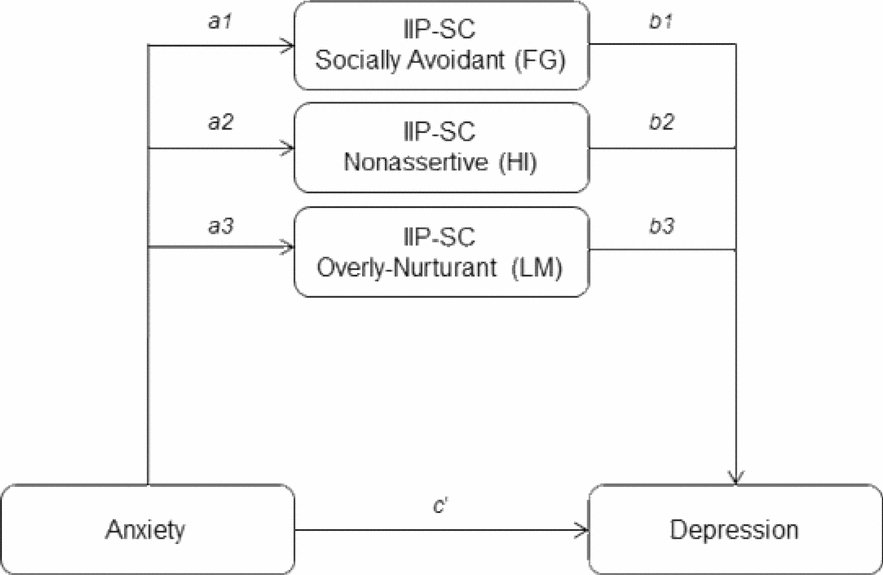
Finally, PROCESS (Hayes, Reference Hayes2012) was used to estimate the direct and indirect effects of anxiety on depression, with the three interpersonal subscales operating in parallel (see Figure 1). Parallel models were conducted separately for each measure of anxiety (i.e., worry, trait anxiety, and anxiety symptoms). PROCESS uses an ordinary least squares or logistic regression-based path analytical framework for estimating the direct and indirect effects; it also allows for tests of indirect models where the effects of multiple variables are assessed simultaneously. Following the recommendations by Preacher and Hayes (Reference Preacher and Hayes2008), the bootstrapping methods can be used for estimating the standard errors of parameter estimates and the bias-corrected confidence intervals of the indirect effects. Due to the correction it applies, the bias-corrected confidence intervals of the indirect effect are considered more accurate than non-corrected confidence intervals (Efron, Reference Efron1987). Indirect effects are considered significant when the bias-corrected confidence interval does not include zero (Preacher & Hayes, Reference Preacher and Hayes2008).
Model depicting direct (c’) and indirect effects (sum of a × b weights) of anxiety on depression.

Results
Descriptive Statistics and Preliminary Analyses
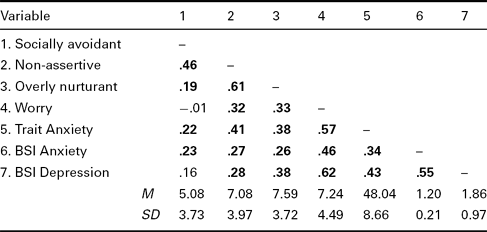
Means, standard deviations, and correlations among variables are presented in Table 1. The nature of the relationships between IIP-SC subscales was quite variable (rs range from .19‒.61). Worry was positively associated with the IIP-SC non-assertive and overly nurturant subscales. Trait anxiety was positively associated with all three IIP-SC subscales. Similarly, the BSI Anxiety score was positively associated with all three IIP-SC subscales. Finally, depressive symptoms were positively associated with the IIP-SC non-assertive and overly nurturant subscales. There was a high level of convergence between worry, trait anxiety, and anxiety symptoms in the sample (rs = .34‒.57). Additionally, depression symptoms were positively associated with worry, trait anxiety, and anxiety symptoms (rs = .43‒.62). Among potential covariates, race/ethnicity nor gender were significantly associated with any of the study variables.
Descriptive Statistics and Correlations for Study Variables
Note: n = 144. All correlations greater than .16 are significant (in bold, p < .05). Variables 1–3 = Inventory of Interpersonal Problems — Short Circumplex subscales; Worry = Brief Measure of Worry Severity; Trait Anxiety = State-Trait Anxiety Inventory, Trait Version; BSI = Brief Symptom Inventory.
Primary Analyses
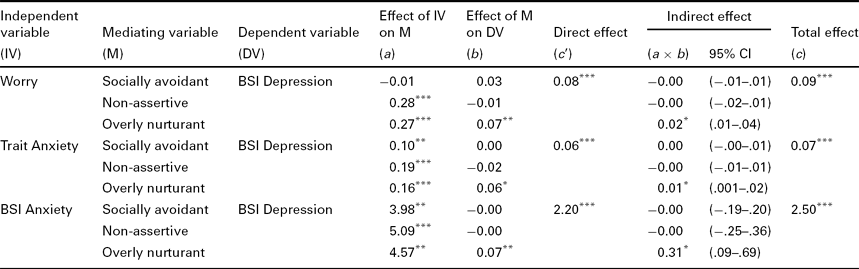
For all three measures of anxiety, total effects (c) indicated significant and substantial relations between anxiety and depression (see Table 2). The IIP-SC social avoidant and non-assertive subscales did not significantly account for the relationship between anxiety and depressive symptoms. However, the IIP-SC overly nurturant subscale significantly accounted for the relationship between anxiety and depression for the BMWS, the STAI-T, and the BSI Anxiety subscale. Partial correlations revealed that the IIP-SC overly nurturant subscale accounted for 18.48% of the variance in depressive symptoms explained by worry, 8.26% of the variance in depressive symptoms explained by BSI Anxiety symptoms, and 10.55% of the variance in depressive symptoms explained by the STAI-T. Despite significant indirect effects evidenced for all three anxiety measures, the direct effects (c’) remained significant for all measures of anxiety, suggesting that the overly nurturant subscale partially accounted for the relationship between anxiety and depressive symptoms.
Summary of Path Coefficients for Parallel Multiple Mediator Model Analyses (n = 144)
Note: 1,000 bootstraps. All path coefficients are unstandardised effects. Variables in column M = Inventory of Interpersonal Problems — Short Circumplex subscales; Worry = Brief Measure of Worry Severity; Trait Anxiety = State-Trait Anxiety Inventory, Trait Version; BSI = Brief Symptom Inventory. *p < .05. **p < .01. ***p < .001.
Discussion
This investigation examined whether interpersonal difficulties accounted, in part, for the association between anxiety and depression symptoms in a high-risk sample of late adolescents with clinical levels of anxiety. Analyses suggested that the association between anxiety and depression symptoms is partially accounted for by overly nurturing behaviours. Importantly, our results were consistent across three different anxiety predictors, suggesting that overly nurturing behaviours may operate similarly across different manifestations of anxiety. Such findings are largely consistent with empirical studies showing that excessive attempts to please and accommodate others may, over time, be perceived as aversive by others and lead to rejection (Borkovec et al., Reference Borkovec, Ray and Stöber1998). Hence, these interpersonal behaviours may ultimately contribute to our understanding of the anxiety-depression association. Further, our results speak to the unique role of the IIP-SC overly nurturing subscale in this association, given that our analyses tested the effects of each IIP-SC subscale while simultaneously controlling for the other IIP-SC subscales (thus accounting for any participant's potential tendency to endorse interpersonal problems across all three subscales).
Findings are also consistent with investigations on the interpersonal profiles of individuals with specific forms of psychopathology, particularly (a) social phobia, whose interpersonal profiles are often characterised as exploitable and overly nurturing (Cain et al., Reference Cain, Pincus and Grosse-Holtforth2010), and (b) GAD, who have been described as sacrificing their own needs in favour of the needs of others in an effort to seek approval from others (Newman & Erikson, Reference Newman, Erickson and Beck2010). Further, our study informs future longitudinal research efforts to explain the temporal associations between anxiety and depression by identifying one interpersonal mechanism potentially implicated in this association (Avenevoli, Stolar, Li, Dierker, & Ries Merikangas, Reference Avenevoli, Stolar, Li, Dierker and Ries Merikangas2001). Specifically, overly nurturing behaviours displayed by individuals with clinical levels of anxiety may serve as a risk factor for depression because of the aversive effects that these behaviours may have on others (Joiner, Reference Joiner, Gotlib and Hammen2002).
Contrary to our hypotheses, socially avoidant behaviours were not an underlying mechanism in the association between anxiety and depression symptoms. We propose two possible explanations for this finding; first, interpersonal problems characterised by social avoidance may be particularly salient among those with symptoms specific to social anxiety, which, unfortunately, we did not specifically assess. Indeed, studies have shown that a significant proportion of individuals with social anxiety display interpersonal problems characterised by cold and avoidant behaviours (Cain et al., Reference Cain, Pincus and Grosse-Holtforth2010). Hence, it may be that socially avoidant interpersonal behaviours may be associated with depressive symptoms particularly among those with social anxiety symptoms. Second, the negatively reinforcing properties of socially avoidant interpersonal behaviours may be rewarding enough that they offset any potential costs related to avoidance of social situations. In other words, for a subset of anxious individuals, avoiding social interaction is not associated with an increased risk for depression symptoms, but instead serves as an effective (albeit maladaptive) strategy to reduce anxiety-related distress.
Although the IIP-SC non-assertive subscale was significantly associated with both anxiety and depression at the bivariate level, it was not a significant underlying mechanism. This finding was also unexpected, given literature suggesting that submissive/non-assertive interpersonal behaviours are a strong predictor of the course of major depression (Cain et al., Reference Cain, Ansell, Wright, Hopwood, Thomas, Pinto and Grilo2012). It is worth noting, however, that when examined in isolation (i.e., excluding the remaining IIP-SC subscales from the analyses), the non-assertive subcale did emerge as a significant (partial) underlying mechanism in the anxiety-depression association for two of the three anxiety measures. Thus, our findings suggest that although non-assertiveness is an important variable in this relationship, its relevance is dampened in the context of other interpersonal difficulties (e.g., overly nurturing behaviours).
This study is not, of course, without limitations. First, our data are cross-sectional, which limits inferences regarding the direction or temporal order of the associations we examined. Prospective, longitudinal investigations are needed to increase confidence in the conclusions drawn from our results. In addition, some interpersonal problems may be differentially implicated in the development of depression symptoms (e.g., overly nurturing, reassurance-seeking behaviours; Joiner, Reference Joiner, Gotlib and Hammen2002), whereas other interpersonal problems (e.g., social avoidance) may be more central to the maintenance of depression problems. More research is thus needed to clarify exactly which interpersonal processes are specifically associated with the development and maintenance of anxiety and depressive problems.
An additional limitation is the reliance on self-report measures of emotional and interpersonal functioning. Future research should obtain peer or family ratings of subjects’ interpersonal behaviours, as well as behavioural and experimental assessment of interpersonal functioning. Future studies should also consider the use of clinician-administered structured interviews of anxiety and depression; although our anxious group likely shares similarities with clinical samples (as participants in reported clinical elevations of anxiety symptoms), clinic-referred samples tend to evidence greater problem severity (Goodman et al., Reference Goodman, Lahey, Fielding, Dulcan, Narrow and Regier1997).
Despite these limitations, our results have important implications. First, given our findings that interpersonal dysfunction, and overly nurturing behaviours in particular, may be one mechanism that is implicated in the anxiety-depression association, results speak to the benefits of incorporating assessment of interpersonal functioning (e.g., those measured by the IIP-SC) into standard evidence-based assessments of anxiety problems. Although this is not currently routine practice, a better understanding of interpersonal functioning may provide important information regarding interpersonal behaviours that may interfere with therapeutic progress. Second, our findings suggest that although several types of interpersonal difficulties are associated with both anxiety and depression, overly nurturing behaviours may be especially useful for identifying anxious individuals most at risk for depression-related problems. Third, to the extent that interpersonal problems are adequately identified, evidence-based treatments for clinical anxiety may incorporate strategies that address interpersonal dysfunction (e.g., assertiveness skills, pointing out how overly pleasing behaviours may be perceived as aversive by others) to prevent the future development of depressive problems.