The Περὶ Ἀλυπίας (PA) of Galen was thought lost until it was rediscovered in the Vlatadon monastery in Thessaloniki in 2005.Footnote 1 The treatise, a letter on consolation from grief, takes as its main subject Galen's own losses in the terrible fire at Rome in a.d. 192, previously known from Dio, Herodian, and other passages of Galen.Footnote 2 The new text gives considerable details of the fire's course and the warehouses and libraries it destroyed. In enumerating these losses, Galen tells us much about the contents and operation of Rome's imperial public libraries and his own use of them.
The topographical material contained in the PA has already been the subject of more than one article and will no doubt be revisited;Footnote 3 it seems likely, in particular, that the location of the Domus Tiberiana library, named in a difficult passage of the manuscript,Footnote 4 will attract further debate as difficulties within the text are resolved. The question of the physical location of Rome's imperial public libraries is important, but this article does not seek to challenge what has been written elsewhere on this matter; rather, it is concerned with what we can learn from the information in the Περὶ Ἀλυπίας about the contents and operation of the city's imperial libraries, and about the way in which at least one leading intellectual of the second century a.d. made use of them. The treatise is shot through with references to books and libraries, which Galen treats as an indispensable part of Rome's intellectual landscape and assumes his addressee and audience will appreciate.Footnote 5 It also contributes to our understanding of the development of the codex book formFootnote 6 and illuminates scholarly working practices in a part of the city that included public and private space, libraries, lecture-rooms, and warehouses for storage. In short, it is an invaluable new source for the book and library historian.
The material in the PA adds a weight of detail to the impression given of these libraries by other authors such as Galen's contemporary Aulus Gellius, and gives them a rather more prominent rôle in the pursuit of scholarship than we have seen before. Gellius’ library anecdotes, broadly speaking, place his use of Rome's libraries in the broader context of learned otium in various settings. His depiction of libraries includes their holdings of rare and valuable books but also discussions between mixed groups of visitors which use books as points of reference or departure.Footnote 7 Galen, however, presents his use of the libraries rather differently. He is more willing to allow scholarly practices of reading and writing to appear as part of his professional, rather than social, character. He openly discusses having paid to store the apparatus of his work alongside the collections of professional intellectuals like the γραμματικὸς Philides, whose books also burned,Footnote 8 and presents his library lucubrations as part of a systematic and wide-ranging set of book-based literary projects that begin with wide and meticulous reading and end in voluminous writing, and sometimes in the circulation (or ‘publication’) of finished texts of his own. In the PA he is especially keen to show that the libraries were an indispensable resource for this work as a scholar, rather than an agreeable backdrop or a place to check up an occasional reference.
The difference is partly one of self-presentation; both men are consciously choosing a particular mode of literary characterization for themselves, in which libraries play the parts assigned to them. Although Galen's impermeability to grief is the ostensible theme of the PA, it is clear that the treatise also belongs to his habit of discussing and defending his own work. As is well known, Galen tended to adopt a rather combative persona in his writings, delighting in unmasking the errors of others and consciously striving to demonstrate his own pre-eminence.Footnote 9 This trait is evident in his self-presentation as an intellectual throughout the PA which is not, of course, only a philosophical treatise, but also an elaborate attempt to set out his literary achievements after the fire and perhaps to explain his position in a difficult period at Rome more generally.Footnote 10 Nonetheless, Galen takes pains to set out details about his use of libraries in Rome which provide credible evidence, compatible with but amplifying other sources, and which therefore deserve careful study.
I GALEN'S PRIVATE COLLECTION: RENTED SPACE CLOSE TO LIBRARIES
Galen opens his account by telling us that the recent fire of a.d. 192 destroyed ‘everything that I had stored in the warehouses by the Sacred Way’, ἀπολ⟨λ⟩υμένων ἐν τῇ μεγάλῃ πυρκαϊᾷ πάντων ⟨τῶν⟩ ἀποκειμένων μοι πραγμάτων ἐν ταῖς κατὰ τὴν ἱερὰν ὁδὸν ἀποθήκαις.Footnote 11 This building must have been one of the warehouses flanking the upper Via Sacra near the Arch of Titus and the future site of the Basilica of Constantine, either the Horrea Piperataria on the north side of the street or the Horrea Vespasiani on the south.Footnote 12 Galen then gives details of the personal property he has lost, which clearly had a high financial worth and a profound impact on his capacity to continue his intellectual and professional projects: the items lost to the flames included silver, gold, documents, ‘a huge quantity of drugs of every sort’, medical instruments, and above all his precious and now irreplaceable collection of books.Footnote 13 Galen was not alone in choosing to keep a large store of his working materials in this warehouse, since he tells us many shared his reasons for choosing to pay a high price for storage there, that the γραμματικὸς Philides lost so many books stored there that he wasted away and died of grief,Footnote 14 and that others were so gravely affected by losses in the same fire that they went around as if in mourning.
Why should at least two professional intellectuals with large private collections of books choose to pay to keep them locked up in this storehouse? By the time of the fire Galen, at least, was a rich man. He had a house in Rome and a villa in Campania and intended to spend at least the summer of a.d. 192 working on his books in the latter in the manner typical of the learned Roman gentleman.Footnote 15 It was surely open to him to keep the possessions lost in the warehouse at home, had he wished to. Indeed, he states at PA 10–11 that the losses he suffered in the fire were even worse than they might have been because he had just moved a number of extra items from his house in Rome into storage on the Via Sacra in preparation for his stay in his Campanian villa (‘to keep them safe during my absence’). Items he moved before he set off included ‘household paraphernalia, drugs, books, and no small amount of silverware’.Footnote 16 The order in which Galen lists the items lost in the fire, with these household goods and books constituting an extraordinarily unfortunate extra loss on top of the ‘treasures’ (κειμηλίοις, PA 10) which he always kept in the Via Sacra building, suggests that it was his habit always to keep a large working collection of books and medical material there rather than ready to hand at home. The same seems to have been true of Philides, who also lost books, and of ‘many others’. By doing so all these depositors had to make a journey to reach their stored possessions, since the warehouse was ‘not near any private house’ (8). The price in both money and apparent inconvenience must have been worthwhile.
Galen names in some detail the qualities of the warehouse building that appealed to its depositors, concentrating on fireproofing and security measures:
they justified their confidence on the grounds that they were not made of wood, save for the doors, they were not near any private house, and they were under military guard because the archives of four imperial procurators were kept there. And this is precisely why we paid a higher charge for renting rooms in those warehouses, and stored our important possessions there in confidence. (PA 8)
In particular, Galen tells us that this building housed imperial procuratorial archives under guard. Here, then, is a rare glimpse into the mechanics of documentary archiving in the high empire, when the increased numbers of procuratorial officials seem to be generating substantial amounts of confidential or important paperwork, stored separately according to their source.Footnote 17 The word Galen uses for the building, ἀποθήκη, could also be used both for libraries and for other buildings that stored books: it means ‘warehouses’ at PA 18 but later in the same sentence implies ‘libraries’, and Dio uses it of the libraries of the Palatine and Trajan's Forum as well as of warehouse buildings lost in the fire of a.d. 192;Footnote 18 Galen himself says elsewhere that books at Alexandria were stored in ἀποθῆκαι before being housed in the library.Footnote 19 Although there is little in common between what we know of the architecture of these Sacred Way warehouses and the libraries of the Palatine, the nature of the storage offered by the ἀποθῆκαι of the PA hints matters of interest to a library historian: here are papers separated by origin and thus by subject material, stored in imperial warehouse or ‘stack’ accommodation with a guard on the door restricting access to — one presumes — known persons or those with some sort of identification. We know very little about door control or ancillary book storage space in the nearby public libraries that Galen goes on to mention, and it is tempting to see clues in these arrangements. Since Galen makes it clear that he and other private individuals also used the guarded building, for example, it is possible that whatever means the soldiers on duty used to identify bona fide visitors and archive users could also have served in other buildings, like libraries, that had to balance public access to precious documents with a degree of protection and control.
The building was thought to be secure, then, but it is likely that there were other reasons for men like Galen and Philides to have chosen to pay a premium to keep their books there. The building's supposed safety sounds like their reason for choosing this particularly expensive and secure warehouse (there were various others nearby), rather than for their initial decision to keep books and working materials in this area of the city. Had we known only that Galen kept materials in this warehouse it might have been argued that his special connections to the imperial court or his need for the Horrea Piperataria's exotic spices for medical use gave him reason and opportunity for doing so.Footnote 20 However, the PA makes no mention of this, and the fact that Galen tells us of the otherwise unknown grammarian Philides and ‘many others’ who had also lost possessions in the fire means that storage in this area was attractive to intellectuals of various disciplines who, we are told, paid for their accommodation on a commercial basis. We therefore need to find a factor that appealed not only to Galen but also to many other learned depositors.
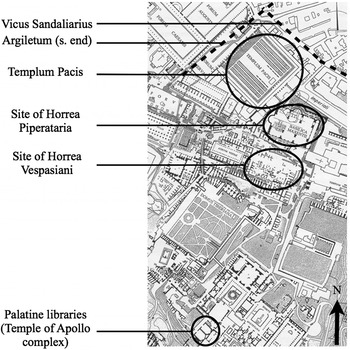
Map showing the location of warehouses and libraries, and the Argiletum and Vicus Sandaliarius. (Adapted by the author from Tucci, op. cit. (n. 3, 2008), 135, fig. 1.)

The answer is in the warehouse's location. The information that the PA adds to our understanding of Galen's reading and writing habits allows us to suppose that its position made it very attractive to those who, like Galen, pursued book-based scholarship in the nearby libraries. Galen names the Palatine library, the Templum Pacis library, and the Domus Tiberiana library in the PA and concentrates on the fact that the destruction of ‘libraries on the Palatine’, plural, meant he could not recover his lost work (τῶν ἐν τῷ Παλατίῳ βιβλιοθηκῶν πασῶν κατακαυθεισῶν ἐν ἐκείνῃ τῇ ἡμέρᾳ, PA 12). Here he may be referring both to the Augustan Palatine library and the nearby Domus Tiberiana library which, he seems to go on to say, had suffered from neglect and damp (PA 19).Footnote 21 All these libraries had been useful to him during his time in Rome, but his account concentrates for the most part on a principal Palatine library, which he refers to at PA 16 and appears to list separately to the other lost libraries at PA 18;Footnote 22 whatever fate had befallen the Domus Tiberiana library by the latter decades of the second century, this principal library was in good shape up until the fire. It seems likely, especially when we consider some of the books seen here by Galen, that this was Augustus’ Apollo library, dedicated in 28 b.c. and probably rehoused under Domitian in the pair of identical large apsidal halls that appears on Fragment 20b of the Forma Urbis.Footnote 23 Other nearby libraries such as those of Trajan's Forum, and perhaps of Hadrian's AthenaeumFootnote 24 (not mentioned in this treatise as they did not perish in the fire) added to this intellectual landscape. The PA fills in some useful details of the way in which readers and writers operated in and among these libraries, augmenting the impression given by anecdotes elsewhere in Galen or in Aulus Gellius.Footnote 25
The PA enumerates the many types of book with which Galen had been working in this area up until the fire: library books, ‘numerous and important’ (13–14, 16–17), and his own volumes which included carefully-corrected copies of books which had been ‘contaminated by scribal errors, so that I intended to make a fresh edition of my own’ (14), a two-part work on Greek words in comedy and prose of which the second half alone occupied forty-eight books (20, 28), a 6000-line epitome of Didymus (24), further compositions of his own (29), chapter summaries of medical and philosophical works (30), priceless collections of drug recipes in parchment codices (31–7), a treatise on the composition of drugs (37), and much else.Footnote 26PA 12–13 makes it clear that the Palatine libraries had provided the majority of the source material for this diverse range of projects, as Galen explicitly says that the loss of the libraries makes the recovery of his own work impossible. The range and quantity of these books suggests that it would have been useful to keep them, together with ancillary items such as writing equipment, close to the libraries where Galen found his source material, to avoid the need to carry them daily to and from his house and to enable him to have complete and ready access both to his own books and to the libraries during the course of his researches.
Galen gives us elsewhere an anecdote from the time before the fire that emphasizes the bookish nature of his intellectual life in this area of the city. In a bravura refutation of his critics in ‘one of the auditoria’ of (most probably) the Templum Pacis, Galen began his performance by setting out before him (τὰ) τῶν ἀνατομικῶν ἁπάντων βιβλία.Footnote 27 This piece of showmanship seems to have relied on his mastery of the entire written anatomical corpus: he invites his detractors to pick any part of the body and any authority; he will refute them. This must have involved a truly enormous range of books. Galen's next paragraphs list the summaries and commentaries that he subsequently made from a selection of those works, and these by themselves occupy 159 volumes, with a further 217 volumes of commentary on philosophical and logical proof.
Clearly, then, Galen's work in the libraries and auditoria of the Templum Pacis and Palatine involved the regular use of large numbers of books. The PA amplifies this picture, showing us that Galen's literary habits necessitated dividing his time between a series of libraries and his own large collection of books and other equipment, for which local storage was therefore important. This would be especially true if, as the PA implies, at least some of his source material was confined to the libraries he used.Footnote 28 The physical constraints imposed by the bulk and fragility of the books he used, and the need (familiar to any modern scholar) to be able to follow up promising cross-references quickly, meant that it was convenient to him to keep his valuable working collection of books in the warehouse, where he believed he could leave it safely and gain easy access to it during his days working among the area's libraries.
This is an important addition to our understanding of how the libraries of this part of Rome had, by the late second century a.d., shaped the cultural map of the city. Galen famously features as a guest in the Deipnosophistae of Athenaeus, whose patron Larensis is able to act as a literary patron, gathering scholars together, because of the huge libraries he has at home, which supposedly rival those of the Hellenistic kings.Footnote 29 The PA suggests that large book collections did indeed act as magnets for serious readers and important resources for their research, but it is the provision of such books in the imperial public libraries of central Rome rather than in private collections on which Galen dwells. Scholars like Galen and Philides were drawn, at some expense, to keep their own texts and materials alongside official archives within a convenient distance of centres of learned endeavour, including the imperial libraries, suggesting that these were indispensable resources for serious scholarship, perhaps providing the sort of bookish environment of which Athenaeus gives us a hyperbolic domestic version.Footnote 30
Over time this area of the city seems to have developed accordingly, becoming a centre for bibliophilic activities of various sorts. The Vicus Sandaliarius to the north-east of the Templum Pacis became by Galen's time the centre of the book trade (perhaps partly displacing the shoe-making for which it was named)Footnote 31 and a place where enough intellectuals were coming and going to engender impromptu literary gatherings and disputes in the street.Footnote 32 A century earlier the adjacent area, including the Argiletum, was mentioned three times by Martial as a place where his own books were for sale.Footnote 33 The book-sellers were probably attracted by the presence of likely bibliophilic customers in these streets, which led down into the imperial fora and thence across the Via Sacra to the Palatine or, like Galen, by the proximity of the libraries’ reliable master-copies; their potential customers, the PA implies, were there because the area was a magnet for those working in various intellectual disciplines, and a prime reason for this lay in the book collections and facilities for working provided by the area's group of imperial libraries and auditoria.Footnote 34
The overall effect was that spaces like the Templum Pacis became a ‘general meeting place for all those engaged in learned disputes, even before the fire’.Footnote 35 The provision of large public libraries, with unique holdings of rare books and accommodation for debates and lectures in their own spacious halls or adjacent buildings, had changed the makeup of this part of the city, at least for an intellectual like Galen, drawing in scholars and causing a knock-on effect in the area's commercial landscape, whether for storage space or books.Footnote 36 This drawing in of scholars suggests that the libraries did not lend their books, incidentally, since well-connected men like Galen could just have taken them home had that been permitted; by bringing readers to the books they held, the imperial public libraries gave an intellectual flavour to a whole district of the city.Footnote 37
II LIBRARY HOLDINGS
This gravitational pull exerted by the libraries was due in large part to their priceless and unique books. Establishing their content has hitherto been frustratingly difficult. Beyond a few chance references we have had little idea of the nature of their holdings, which has made it difficult to gauge their importance: were they luxury display-cases of commonplace classics, or something more genuinely important to the intellectual life of the city? The PA augments enormously our knowledge of the contents of the libraries of the Palatine hill, not only more than doubling our knowledge of individual books there, but telling us how they were regarded and used by at least one influential man of letters. In PA 13 Galen spells out for us the virtues of the collections, which had contained two categories of book of particular interest to him:
… works that were rare and not preserved anywhere else, (and) among works that were less rare but prized because of the precision of their text, the ‘Callinian’ (collection), the ‘Atticiana’, the ‘Peducinia’ and even the ‘Aristarcheia’, including the two Homers, and the Plato of Panaetius and many others of that sort, since preserved in these in each bookFootnote 38 were the words either written or copiedFootnote 39 by the individuals after whom the books are named. There were also many autograph copiesFootnote 40 of ancient grammarians, orators, doctors and philosophers. (PA 13)
This list of authors and bibliophiles has already been examined,Footnote 41 but it is worth adding to the discussion the significance of some of these names for the history of the Palatine libraries. Two of the names belong to known authors.
Aristarchus was the head of the Alexandrian library in the early second century b.c., the noted critic of Homer. His ‘two Homers’ may refer to his editions of the Iliad and Odyssey, used later by Didymus Chalcenterus.Footnote 42 These books, if we can believe Galen's statement that they were Aristarchus’ own copies, therefore survived the fire at Alexandria and came at some point to Rome. Strabo tells us that Augustus took over the appointment of the priest of the Mouseion and the careers of various directors of the imperial libraries at Rome show that they first held the directorship of the Alexandrian library.Footnote 43 Any of these men might have brought the Aristarchus books over with them as a gift to the emperor, but the most likely moments for their acquisition are immediately after Octavian took Alexandria, or when Domitian sent copyists there to restock Rome's libraries after the fire of a.d. 80.Footnote 44 Galen's text therefore strengthens our picture of the interaction of Rome's library system with Alexandria's and suggests that in at least some of its holdings it had come to supplant its Egyptian forerunner. If we date the acquisition of these prestigious texts to the Augustan period, as some of the following library holdings suggest we might, then we can see Augustus’ library foundation as an ambitious attempt to make Rome comparable to Alexandria as a centre of Classical learning.
Panaetius (c. 185–109 b.c.) was a Platonizing head of the Stoa.Footnote 45 He accompanied P. Cornelius Scipio Africanus to Asia Minor in 141 b.c. and then divided his time between Athens and the Scipionic circle at Rome. That family's literary reputation was well established. Scipio's father Aemilius Paulus had passed the large library of the vanquished Persius of Macedon to his sons after acquiring it as booty in 168 b.c. This was the first large book collection to be brought to Rome and seems to have had an immediate effect on the literary life of the city and of Scipio's family in particular.Footnote 46 Panaetius was thus part of a distinctive bookish circle at Rome and it seems likely that the Plato seen by Galen in the Palatine library came from his time with the Aemilii Pauli in the city; if so, it is quite possible that other volumes produced in the Scipionic circle ended up in the Palatine library, including first editions of their protégé Polybius.
We can see from Galen's list that the books held on the Palatine included works attributed to these particular famous scholars of previous centuries, but also what seem to be groups of books known by the name of their collectors or compilers, including the Καλλίνια, the Πεδουκίνια, and the Ἀττικιανὰ (the Ἀριστάρχεια is also a collection of books, apparently named after its scholar-editor). We know that Galen used the Ἀττικιανὰ as he tells us elsewhere that he found a variant reading there, an episode we can now link to his library reading.Footnote 47 As it happens, two of these collections were already known to us by name, but not the fact that they were kept on the Palatine. Lucian mentions Callinus and Atticus twice in a polemical treatise on book-collecting, each time as if their names are bywords for the production of especially fine books.Footnote 48 The obvious inference is that Galen's Καλλίνια and Ἀττικιανὰ refer to the same collections, and that he is using their famous names to establish quickly the scale of the losses caused by the fire. These holdings of the Palatine library had therefore acquired proverbial status as the acme of book production by the second century a.d., an indication of both the importance and the fame of the library's holdings — by Galen's time, if not before, the Palatine's empty shelves had indeed been filled with priceless books, a munus Apolline dignum.Footnote 49
Can we say anything of the provenance of these collections? Atticus, it now seems to be generally agreed, was the well-known first-century b.c. figure whose bibliophilic ability and interest was abundantly documented by his friends Cicero and Nepos.Footnote 50 He bought books, lent books, copied and arranged books; his name is surely the best fit for the collection in the Palatine. The collector who gave his name to the Πεδουκίνια is not so well known. Boudon-Millot suggests that he may have been called Pedoukos or Pedoukinos, but no collector of either name is known.Footnote 51 Reading the name as Peducaeus, however, gives us options. It is possible that a collector or compiler of this name came from the family that produced consuls in a.d. 110, M. Peducaeus Priscinus, and a.d. 141, M. Peducaeus Stloga Priscinus. But Jones’ suggestion is neater: Sextus Peducaeus, a literary acquaintance of Cicero and Atticus,Footnote 52 might well have had the means and interest to create a set of editions that came to bear his name. Jones also has a suggested identification for Callinos, compiler of the eponymous Καλλίνια: the pupil of the Peripatetic philosopher Lycon (c. 299–c. 225 b.c.) who was charged in his teacher's will with producing editions of his unpublished works.Footnote 53 The likely subject matter of such a collection certainly fits the Hellenistic philosophical matter, and particularly the Peripatetic works, which are the particular focus of the PA.
What does Galen's record of these books tell us? The book collections, if we accept these identifications, would have been between 200 and 450 years old by the time of the fire of a.d. 192, but were still referred to by the name of their original compilers. The fact that they were still recognized as single collections suggests that they came into the library in that form, by gift of their compilers, purchase, or bequest. The possibility that some or all of Atticus’ books passed into the Palatine library collections by such a route is strengthened by Galen's evidence for the presence there of the Ἀττικιανὰ.Footnote 54 Atticus’ daughter and heir Caecilia Attica married Augustus’ lieutenant Agrippa, who was a prominent exegete of the new regime's public deployment of its enormous collections of artworks and, we might suppose, books.Footnote 55 Caecilia disappears from the record after Agrippa's remarriage, but as her daughter married Tiberius it seems certain that the property she inherited from her father ended up sooner or later in Julio-Claudian ownership. We do not know what happened to Sextus Peducaeus, but it is likely that having served as propraetor in Spain in 39 b.c., he died during the reign of Augustus, and it is quite possible that any very valuable collection of books was then bequeathed to or purchased by the emperor for deployment in the Palatine library.
Even if we decide that we cannot identify the men after whom these book collections are named, Galen's description of the lost books has some interesting implications. The reference to named book collections suggests that the imperial Palatine libraries grew by acquiring large ready-made collections from private individuals, most probably in the early years of the Augustan library. The value of book collections qua collections was appreciated by Roman bibliophiles, as the story of Aristotle's book collection or the Philodemus collection in the Villa of the Papyri show: both retained at least a core of material that had been collected and then kept together for well over a century.Footnote 56 Galen's testimony suggests that the Palatine library's founders and users similarly recognized the intrinsic value of important book collections and preserved them in such a way that they were recognizable to readers two centuries later. Galen's ability to refer to these books as if they formed single collections known to his correspondent and wider readership suggests that they were shelved together, or at least labelled as having belonged to their respective eponymous compilers, and his praise shows that they had retained their reputation for excellence. The fact that Galen assumes that these items from the library had a proverbial reputation indicates a level of familiarity with at least some of their ‘treasures’ among the reading public.
Galen goes on to say that the Palatine library contained ‘many autograph copies of ancient grammarians, orators, doctors and philosophers’ (PA 13; see above n. 40), which, when added to the poetry that we already knew the library held,Footnote 57 suggests a catholic collection policy based on the quality of the books and the importance of the texts they held, rather than any specialism by subject. He then lists a second group of texts that he had read in Rome. He introduces this group by saying that they were rare works ‘that had been filled with scribal mistakes’ (14), of which he had made improved editions based on his own emendations. These books included works by ‘Theophrastus, Aristotle, Eudemus, Clitus, and Phaenias … and most of Chrysippus and all the ancient doctors’ (15). Apart from Chrysippus the Stoic and the unknown Clitus,Footnote 58 these are all Peripatetics. Whether or not these deficient copies were in the Palatine library is not explicitly clear. The fact that they were bad copies, whereas Galen has just praised the excellence of the library's holdings, suggests not; on the other hand, these must necessarily have been unique works (or their loss in the fire would not have been disastrous). At any rate, Galen immediately goes on to name Aristotle and Theophrastus again, and again says that he found many of these books in the Palatine library: both commonplace and rare works of the Peripatetic school were on the library's shelves in a.d. 192. He was thus able to read both excellent copies of standard works, and copies of works known nowhere else; he also supplemented his reading with books ‘procured’ elsewhere, perhaps by purchase (for the proximity of these libraries to the centre of Rome's book trade, see above).
This makes the books in the Palatine library part of the complicated history of the transmission of Aristotelian and Peripatetic thought to the West. Both Strabo and Plutarch suggest that the Peripatos went into decline after its books were bequeathed away from Athens to Neleus in Scepsis.Footnote 59 It was during this period that Lycon (successor to Theophrastus’ successor Strato) had Callinus make editions of his books, perhaps as part of the re-establishment of Peripatetic book collection in Athens. Plutarch and Strabo go on to state that at some point the library of Aristotle was bought by the collector Apellicon of Teos and ended up in his collection back in Athens in time for Sulla to take it to Rome. This collection included, says Plutarch, ‘most of the works of Aristotle and Theophrastus’ and was set in order in Rome by Tyrannio and then Andronicus of Rhodes. It may have absorbed Callinus’ books by the time Sulla acquired it, but of this we cannot be sure.
The contents of the collection seen by Galen and his use of what was probably Andronicus’ catalogue seem like a good fit for these Sullan books. If so, the books had a complicated history both before and after they reached the ownership of Sulla. Cicero was familiar with the library, ‘feasting’ on it at Cumae,Footnote 60 and seems to have taken over the services of Tyrannio as well; the latter held classes in Cicero's house in 56 b.c., and helped restore Cicero's Antium library after his return from exile, aided by three librarioli glutinatores loaned by Atticus.Footnote 61 If Cicero also acquired Sulla's books, as is sometimes suggested,Footnote 62 then these would presumably have passed by proscription into the hands of Antony and Octavian; certainly by the time of Asconius a good collection of Cicero's own papers was preserved somewhere in Rome, perhaps in one of the imperial libraries, showing that his literary effects survived his downfall. Alternatively Faustus Sulla's books could have passed into Caesarian hands after the downfall of Pompey's faction and Faustus’ death at the hands of Publius Sittius. Either way, the works of Aristotle and Theophrastus and editions of Callinus might well have passed into the Palatine library collections in this way, to be seen by Galen 230 years or so later. This fits Galen's assertion that the value of the books in the Palatine library is their authenticity and age, as well as their rarity, but even if they came via some other route Galen's unambiguous testimony is that the Palatine library held rare copies of Peripatetic philosophy and much else: for all the problems Galen identifies, it is clear that its rôle as a working library capable of sustaining literary research at the highest end of the spectrum (perhaps among a range of intended functions such as display, and housing Senate meetings) was taken seriously by its imperial patrons and scholar-directors over the twenty-two decades of its operation before the fire.
III ORGANIZATION OF THE LIBRARIES AND IMPLICATIONS FOR GALEN'S WORKING METHODS
The testimony of the PA is not limited to these new insights into the contents of the Palatine library. Galen also gives us new information about their organization (already hinted at by the existence of named collections) and operation.
PA 16 tells us that Galen made use of ‘the so-called Catalogue’ (ἐν τοῖς καλουμένοις πίναξι) as he read, copied, and corrected books from the Palatine libraries.Footnote 63 This Catalogue was not free of error, but it was the tool that Galen chose to use during his researches and which he assumes his anonymous correspondent will know:
You will be particularly distressed to learn that I had found some books in the Palatine library that were missing from the so-called Catalogue and, vice-versa, that some books were clearly not the work of the author whose name they bore, neither in language nor in ideas …Footnote 64
And again at PA 17:
… likewise works by Theophrastus and other ancient writers that were not recorded in the Catalogue, as well as others that were mentioned there, but did not circulate.Footnote 65
The document to which Galen refers here was probably not a specific catalogue of the Palatine library itself, still less a shelf-list in the modern sense: the usual Galenic sense of the adjective καλουμένος is either to flag an unusual technical term, which πίναξι is not, or to refer to a particularly well-known example. It is possible that the Palatine's catalogue was well-known enough to qualify for such a description, but Galen seems to expect his correspondent of the PA, an anonymous friend from his schooldays who was probably still resident in Pergamum,Footnote 66 to be familiar with it, so a general reference work with a life outside the Palatine library building seems more likely — Catalogue with a capital C. The Budé commentary identifies it as the Alexandrian catalogue,Footnote 67 but another good candidate that fits both descriptions — a work of especial relevance to the books Galen saw in the Palatine library and a book-list well-known enough to have an independent value — is the Catalogue descended from the lists of Aristotle's library drawn up in late Republican Rome by Tyrannio and then Andronicus of Rhodes, which would fit the subject matter of the books discussed above and is confirmed as current in the second century a.d. by Plutarch.Footnote 68
Even if Galen is not talking of a catalogue with a particular relevance to the Palatine library, his testimony is important, the first clear reference to a Roman library user actually consulting a catalogue in the conduct of his research. Such a catalogue, tracing its roots back to Callimachus’ homonymous Alexandrian Pinakes, was supposed to give a comprehensive list of works by a given author or in a given field; for its use in a library context we can compare Quintilian's conclusion to a long list of Greek poets with an airy reference to a similar-sounding type of document:
nec sane quisquam est tam procul a cognitione eorum [sc. poetarum Graecorum] remotus ut non indicem certe ex bibliotheca sumptum transferre in libros suos possit.Footnote 69
No-one, of course, is so completely ignorant of them [the Greek poets] that he can't at least pick up a catalogue from a library and copy it into his own books.
Galen seems to have been able to consult this Catalogue within the Palatine library, comparing its contents to the shelf-holdings. The copy he used for that purpose might have been his own or the library's (in which case one might have expected it to be rather more accurate). His working assumption seems to have been that the books on the shelves of the Palatine library would reflect the lists in the Catalogue, so that both would ideally be complete testaments of the outputs of the authors they house. It is the exceptions to this assumption that exercise Galen; in his excitement at finding a ‘lost’ work by an important author — one on the shelf but not in the Catalogue — or at proving the Catalogue's identification wrong by his analysis of a unique book, Galen is consciously presenting himself as the heir to the Alexandrian (and Pergamene) library scholars of the Hellenistic age, another instantiation of the trope in which a human intellect and memory complements, uses, and even surpasses the library as an authority.Footnote 70
The errors in cataloguing identified by Galen were probably not simple administrative mistakes indicating carelessness on the part of the library staff. Galen thought of himself as a textual critic of the first order and records his findings here in detail, as if to salvage some benefit from what had clearly been a long and diligent process of reading and copying. His conclusions might well have been matters of opinion rather than of fact, as his re-attributions were based on his judgement of the ‘language and ideas’ (λέξιν … διάνοιαν, PA 16) of the authors in question.
In either case it was at least in part the Palatine library's impressive holdings that allowed Galen to rescue the lost or misattributed works, despite his triumphant demonstration of its mistaken labelling, for some works correctly named by the Catalogue were uniquely preserved there. Galen appears to say at PA 17 that he managed to procure some of the works from other sources, but the overall logic of this section depends on the clear statement at PA 12–13 that the Palatine libraries contained works which could not be found anywhere else: they were the main source on which his work depended,Footnote 71 and the losses in the fire meant that this work and the texts on which it was based were permanently lost to the world.
The overall impression of the organization and contents of the libraries that emerges from this new information is consistent with that given by authors such as Aulus Gellius. The imperial libraries seem to have been accessible to serious ‘scholarly’ readers as well as to those like Gellius who wanted to discuss texts or other matters with colleagues, friends, and pupils; perhaps Galen was at the next table, poring over his manuscripts and notebooks. They were full of treasures, invaluable to those interested in a huge range of intellectual disciplines; Galen's new testimony adds a range of subject matter and specific items. The way in which this material was arranged and made accessible to readers was not random or careless — we have seen that the library kept precious book and book collections intact for more than 200 years, and Galen seems to have been able to read through a particular subject area — but it did have an element of the haphazard in it. Galen finds discrepancies and misattributions, and Gellius records similar glitches such as the incidents at NA 11.17 and 13.20, when books were brought to him in the library that he had not ordered and in one case could not identify. The libraries therefore seem to have had a system of recording and ordering contents that was good enough to send a reader or library attendant close to the right spot on the shelf, but which left room for error and ambiguity in their final selection of a book, and room for an unusually sophisticated reader (as Galen considered himself) to make corrections.
The fact that no-one in the library's two centuries of operation had spotted the errors in the Catalogue that Galen claimed to have identified might suggest something about the way he used the library. He would not have been able to make his findings by asking a member of staff to bring him, say, everything the library had by Theophrastus: he would have picked up the misattributions this way but not the works by that author, missing from the Catalogue, which he claims to have found there (which were presumably not labelled ‘Theophrastus’, but were among the mislabelled books of PA 16). It sounds instead as if he was able to consult and compare large numbers of books simultaneously, independently of the library's idea of their authorship: he probably had direct access to both Catalogue and bookshelves himself, then, and unless we are to assume that he went through every single scroll in the library one by one, it seems that he was able to direct his particular attention to a section of the library containing Hellenistic philosophy and especially Peripatetic work on science, the field to which he pays most attention in this discussion. This indirect evidence for readers’ ability to browse in shelving organized by genre usefully corroborates the picture built up from other sources.Footnote 72
We can recover other clues to Galen's working practices in and around these libraries from the PA. It is not likely that readers were allowed to borrow books from the Palatine library: Galen tells us that the Domus Tiberiana library, whose bailiff could famously be bribed by a well-connected would-be borrower, was at one stage almost ruined through the negligence of its custodians,Footnote 73 but the Palatine library had kept its stock of priceless autograph treasures intact until they burned in a.d. 192. We have now seen that Galen kept all his working materials close to the library, which further argues that he could not have borrowed books, since such books could have been brought back to his house or anywhere else he chose: the immobility of his source material meant that he needed to keep his own working collection close by. His nearby warehouse storage space, in a fireproof secure building under guard, was presumably windowless or ill-lit and not suited to protracted study. The most likely solution, then, is that Galen or his assistants consulted the books he mentions in the Palatine library itself, and made his initial working copies, notes, and documents there too, carrying them down the so-called Clivus Palatinus to his lock-up at the end of the day before heading home.
Given the scale of his work he must have made many visits and spent long hours in the library, which means we have to imagine a permanently-staffed building, open for long hours to frequent visitors,Footnote 74 with facilities for sitting, reading, and writing, for it is probable that Galen or his assistants not only read in the library, but also wrote there. The books that he lost in the fire included copies of ‘the writings of ancient authors corrected by my own hand’ (βιβλία … διὰ τῆς ἐμῆς χειρὸς ἀνδρῶν παλαιῶν τὰ συγγράμματα, PA 6).Footnote 75 Later he tells us that the warehouse had also contained copies of books which ‘after correction I had had transcribed afresh to provide almost a new edition’ (PA 14), made from works from the Palatine library (and elsewhere) including the rare volumes mentioned above (PA 16–17). Galen is careful to point out that these copies were made to an extremely high standard, with no errors of transcription, even down to the punctuation — which means that Galen had added all of this material to his working manuscripts.Footnote 76 His work, then, involved not only copious reading but also copious and diligent writing, and it included making copies of library books.
The mechanics of this process of reading, note-taking, and copying are worth considering. Galen tells us elsewhere in the PA that he considers 4,000 lines to be the maximum convenient length of a volume.Footnote 77 Copying even one such a volume would take many hours’ work. Galen surely made use of his secretarial staff for the majority of the routine copying work, given his busy professional life and superabundantly prolific output of books, sending them to the library (and his repository) to make many of his working volumes which he could correct (‘by my own hand’) for copying out fair. We can therefore conclude either that relatively low-status slave or commercial copyists were permitted in the libraries, or that they had dedicated copying staff of their own.
On the other hand, the intimate level of bibliophilic knowledge Galen displays in the PA suggests a personal familiarity with the Palatine library collections, and his concern with absolute precision of copying meant that he probably, at the least, superintended the process, visiting the library to check difficult readings in his copies against the originals kept there (through which he had to search in the first place to find his source material). His description of copying out many books from what was probably the Domus Tiberiana library sounds like bitter personal experience, too: the dampness of its location had caused the pages to stick together and caused ‘no little trouble’.Footnote 78
Since we can presume that the books were not permitted to leave the libraries, we must envisage that this work took place there, whether by Galen himself, his own staff, or the library's own copyists. This would have necessitated facilities for writing and for long periods of study within the libraries, which must therefore have had writing space, whether on the floor of the main book rooms or elsewhere. Various public library buildings in the Roman world have ancillary spaces near their main book room.Footnote 79 Perhaps we should imagine space for copying and similar activities accommodated in these, though the large principal halls common to many public libraries suggest the possibility of accommodating many readers, and perhaps writers, simultaneously amid the books, corroborating the picture sketched by Gellius when he writes of debates and discussions in the Domus Tiberiana library.Footnote 80 Chairs alone would do for private reading; it is possible that Galen dictated to a secretary, but his δια τῆς ἐμῆς χειρὸς strongly suggests he did at least some of his own note-taking, writing, and correction on occasion, and that he was therefore able to read one scroll and write in another, or a note-book, while in the library, a task that is so much easier with a table that it is (albeit a priori) hard to envisage their absence.Footnote 81
This adds considerably to our understanding of the function of these imperial public libraries. Users like Galen were able to make or commission copies of the texts they held, for the reasons listed in PA 13: library collections were felt to contain some of the oldest and best-authenticated copies available anywhere, so a careful process of copying from these books such as that spelled out by Galen allowed a diligent reader to short-cut decades of scribal error and produce a volume in which he could be confident. This might help explain the cluster of booksellers near the Templum Pacis discussed above. For Galen the ability to consult and make notes from or reliable copies of authentic texts is a prerequisite for the sort of study he wished to undertake, a fundamental element of his intellectual practice. His detailed insistence on this in the PA, to the extent of naming libraries and books that are now lost, is a sort of literary manifesto, part of the point of writing the treatise: he puts on record the extent of the work he had lost, and reminds his readers that the need for caution and careful evaluation of manuscripts was all the greater now that Rome's great authenticating library collections had disappeared.
IV GALEN AND PROVINCIAL LIBRARIES
Galen's appreciation of this rôle of libraries extended to his use of provincial public libraries to disseminate his own works. He tells us at PA 21 that he had lost multiple copies of his own completed works in the fire. He had had two copies made of each work, one to take with him to his summer villa in Campania and one to send to friends for what we might call distribution or publication (Galen uses the conventional word ἔκδοσις). The means of circulating his work was a preoccupation of Galen. The PA is itself a text which plays with the boundaries between private and public writing; ostensibly a private letter, it circulated widely enough to make it into Vlatadon ms 14, and part of its point might be to safeguard Galen's reputation. The destruction of his own book collection and of major Roman libraries that might well have held master copies of his own books, in the same way that they held copies of ancient authors that he regarded as authentic,Footnote 82 not only destroyed the fruits of a lot of hard work, but removed a safeguard for Galen and diligent readers like him: one means of checking the authenticity of books had gone. By putting the extent of his losses on record Galen perhaps hoped to stall opportunistic false attributions and establish what it was that he had achieved before the fire robbed him of the chance to publish it. He would return to this theme again in the opening sections of On My Own Books, recording his anxiety at the uncontrollable circulation attendant upon success, as commercial book-sellers and plagiarists got hold of works never intended for circulation, or passed off dubious works as his.
The rôle Galen gives to provincial public libraries in the process of ἔκδοσις is interesting in the light of these concerns. Of the two copies of each of his new books, one was intended to satisfy the requests of ‘friends back home’ who ‘were asking for copies of my writings to be sent to them so that they could deposit them in a public library, just as others had already done with many of our books in other cities’.Footnote 83
For Galen, then, one way of distributing his books into the wider world relied on deposition into public libraries. These would presumably guarantee as wide an exposure of the text as possible and, crucially, the preservation of a reliable copy: we can compare Galen's earlier approval of the authenticity of the public Palatine copies. The process still relies on the agency of a trusted friend, whom the recipient library can trust to have received the original work directly from Galen, but it must aim at a wider circulation than that which could have been achieved by circles of friendship alone. The use of a public city library to hold the text cuts out for Galen the risk of misattributed or miscopied versions circulating, and establishes for us a rôle for the provincial public library that mirrors that of its Roman counterpart.
This is a significant clue to the perceived purpose of the public library: it was there, in part, to act as a safe repository of works of guaranteed authenticity and to help transmit an approved canon of an author's works, mirroring the achievement of the Palatine libraries as documented in the PA. Libraries that would have been known to Galen in his native Asia included the Flavia Melitene library in the Pergamene Asclepieion and the Celsus library at Ephesus, among many others. Both of these large and prominent buildings probably held his medical texts, given their location in noted centres of medical scholarship and practice, and may well also have acted as the intended recipients for the lexicographical works mentioned in the PA. Each is architecturally similar to the libraries used in Rome by Galen, with a large open hall decorated with some magnificence, and wall niches for book cupboards (the Celsus library also had an internal colonnade and stylobate, like the Palatine Apollo library). They were both dedicated in the reign of Hadrian, a period of extensive library building across the eastern Empire, perhaps in emulation of the library building emperors Trajan and Hadrian.Footnote 84 In this they are typical of most of the known libraries of the Roman Empire: it is this sort of Romanizing public building that Galen had in mind for the ἔκδοσις of his books and which, as Nutton points out, may have helped preserve works of Galen and other authors whose Roman copies burned in a.d. 192.
The evidence of the PA suggests that such provincial libraries looked to Rome not only in their architecture and appointments, but also in their collections and the literary horizons of their founders and users. They were a means by which provincial literary culture could keep in touch with developments at the centre, outposts of Roman metropolitan literary and intellectual culture as well as the local scene, maintained by a network of men with connections to Rome and the scholarship and writing conducted there. It is notable that Galen, a Pergamene Greek writing in Greek for a Greek recipient, mentions only Greek books in the PA and throughout almost all of his voluminous corpus: the PA shows that by the late second century a.d. the holdings of Rome's libraries had made Rome a centre, if not the centre, of the sort of Hellenophone scholarship Galen wished to pursue in several disciplines. This is part of the much wider phenomenon of Greek literary life under the High Roman Empire; Athenaeus’ dinner party, at which Galen was a fictional guest, has already demonstrated Rome's rôle as a centre of both Latin and Greek literary culture. Galen in Rome was not cut off from his Greek colleagues and readers, but retained connections to an international network of circulating Greek texts. His ability to communicate with a provincial audience in his native language reinforced the complicated cultural relationship between Rome and its subject provinces: a lively Greek intellectual culture existed within, and was to an extent enabled by, as we see in the PA, an empire in which many precious books and the scholars who read them had moved to Rome. The PA allows us to add the particular rôle of public libraries both in Rome and the provinces to the prolific scholarship on this wider subject.Footnote 85
Galen's brief mention of provincial public libraries thus suggests something of their value to a town in the contemporary Greek East of the Second Sophistic, a movement much concerned with accommodating local intellectual pride and identity with acquiescence in the Roman imperial presence. A public library provided not only a visible index of a town's or patron's cultural resources, but also a prominent public affirmation that it and its population were plugged into a network of books, readers, writers, and ideas that reached the highest circles operating in centres such as Rome and Athens — centres that included non-pareil library resources like those so well illuminated by Galen in the PA.