Introduction
Banchinae (Hymenoptera) is a large, cosmopolitan subfamily comprising about 1800 described species classified in 65 genera and three tribes (Broad et al. Reference Broad, Sääksjärvi, Veijalainen and Notton2011; Yu et al. Reference Yu, van Achterberg and Horstmann2012; Quicke Reference Quicke2014). Only 338 described species are known from the Neotropical Region, the fauna from most countries are understudied, and the only well-documented country is Costa Rica, where 246 species are known (Yu et al. Reference Yu, van Achterberg and Horstmann2012). Besides Costa Rica, no comprehensive studies of any genus of the subfamily have been conducted in the Neotropical Region.
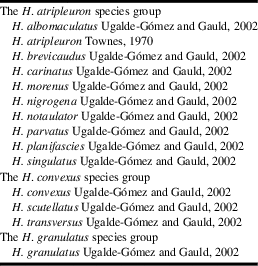
The genus Hapsinotus Townes, Reference Townes1970 is a moderately large Neotropical group belonging to the banchine tribe Atrophini. Currently, it comprises three species groups and 14 species (Table 1): 13 of which are found in Costa Rica, and the type species, Hapsinotus atripleurum Townes, Reference Townes1970, from Peru (Ugalde-Gómez and Gauld Reference Ugalde-Gómez and Gauld2002; Yu et al. Reference Yu, van Achterberg and Horstmann2012). No host records are available for species of Hapsinotus, but most banchines with long ovipositors, as is the case for the species of this genus, are expected to attack concealed hosts (Ugalde-Gómez and Gauld Reference Ugalde-Gómez and Gauld2002). In general, banchines are koinobiont endoparasitoids of Lepidoptera larvae and several of them are biological control agents (Ugalde-Gómez and Gauld Reference Ugalde-Gómez and Gauld2002; Quicke Reference Quicke2014).
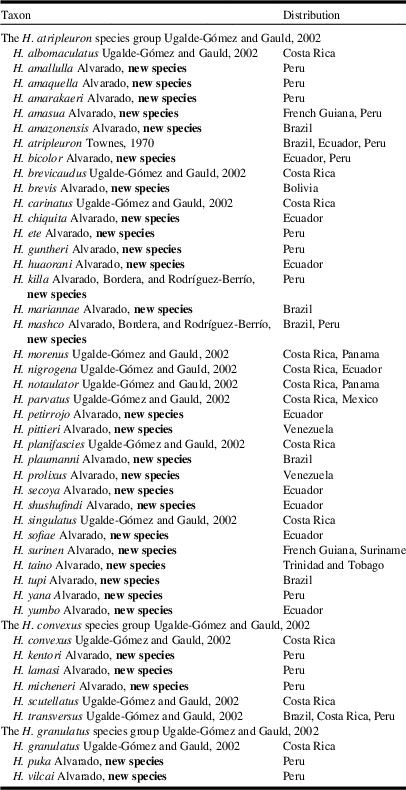
Hierarchical classification of currently described Hapsinotus species.

The aim of this paper is to describe and illustrate 31 new species of Hapsinotus, and to provide a key to all species within the genus. New data on species distributions, including and new country records for both the genus and several species, are reported.
Materials and methods
Morphological terminology and the style of descriptions follow that of Ugalde-Gómez and Gauld (Reference Ugalde-Gómez and Gauld2002). The ovipositor was measured from the point of insertion of the sheaths to the apex. Type material of all species was examined (except for H. singulatus Ugalde-Gómez and Gauld, Reference Ugalde-Gómez and Gauld2002), from material deposited in the Utah State University, Logan, Utah, United States of America (USUC) and Museo Nacional de Costa Rica, Santo Domingo de Heredia, Costa Rica (MNCR). Material formally deposited in the Instituto Nacional de la Biodiversidad, Costa Rica (INBio) is now housed in the MNCR, and the material formally deposited in American Entomological Institute (AEIC) is now housed in the USUC. The remaining material studied herein is located in the following institutions: Canadian National Collection of Insects, Arachnids, and Nematodes, Ottawa, Ontario, Canada (CNC); Entomological Museum Klaus Raven Büller, Universidad Nacional Agraria La Molina, Lima, Peru (MEKRB); San Marcos Natural History Museum, Lima, Peru (MUSM); Naturalis Biodiversity Center, Leiden, The Netherlands (NBCN); Natural History Museum, London, United Kingdom (NHML); and Snow Entomological Collection, Division of Entomology, University of Kansas Natural History Museum, Lawrence, Kansas, United States of America (SEMC). The type series of Hapsinotus singulatus was not examined, but the original description is sufficient for understanding the circumscription and identification of this taxon. Microphotographs were prepared using a Canon 7D digital camera attached to an Infinity K-2 long-distance microscopic lens (Infinity Photo-Optical Company, Boulder, Colorado, United States of America) in the laboratories of the SEMC. Digital photographs were combined by using the programme Combine ZP (also at the SEMC). Distribution maps were prepared using SimpleMappr (Shorthouse Reference Shorthouse2010), based on the collection of data of specimens and occurrence data recorded in the literature. Maps are only provided for the species described here and those for which new geographic localities are recorded.
Genus Hapsinotus Townes, Reference Townes1970
Hapsinotus Townes, Reference Townes1970: 22. Type species: Hapsinotus atripleurum Townes, Reference Townes1970, by original designation.
Diagnosis. Hapsinotus is distinguishable from other atrophine genera by having clypeus with median subapical part swollen and more-or-less overhanging clypeal margin such that margin is blunt (Fig. 11B–C), propodeum distinctly areolate but in several species only posterior transverse lateral and lateromedian longitudinal carinae at least partially discernible (Fig. 11E), pretarsal claws large with short pecten, metanotum with posterior ring sublaterally expanded into a large flat denticle (Fig. 11E) that points backwards towards lateral longitudinal carina (Ugalde-Gómez and Gauld Reference Ugalde-Gómez and Gauld2002).
Comments. Hapsinotus is most similar to Deleboea Cameron, 1903 and Mnioes Townes, 1946 as they have metanotum with posterior ring sublaterally expanded into a large, flat denticle. Hapsinotus generally has propodeum with anterior transverse carina discernible, this carina is absent in Deleboea and Mnioes. Hapsinotus has clypeus about 1.8–2.6 times as wide as long, with median subapical part swollen and more-or-less overhanging clypeal margin such that margin is blunt; while Deleboea has the clypeus about 3.5 times as wide as long, flat, with margin sclerotised and its margin weakly concave; and Mnioes has the clypeus about 1.5–1.6 times as wide as long, convex with apical margin weakly sclerotised its margin appears to have a median apical notch (Townes Reference Townes1970; Ugalde-Gómez and Gauld Reference Ugalde-Gómez and Gauld2002).
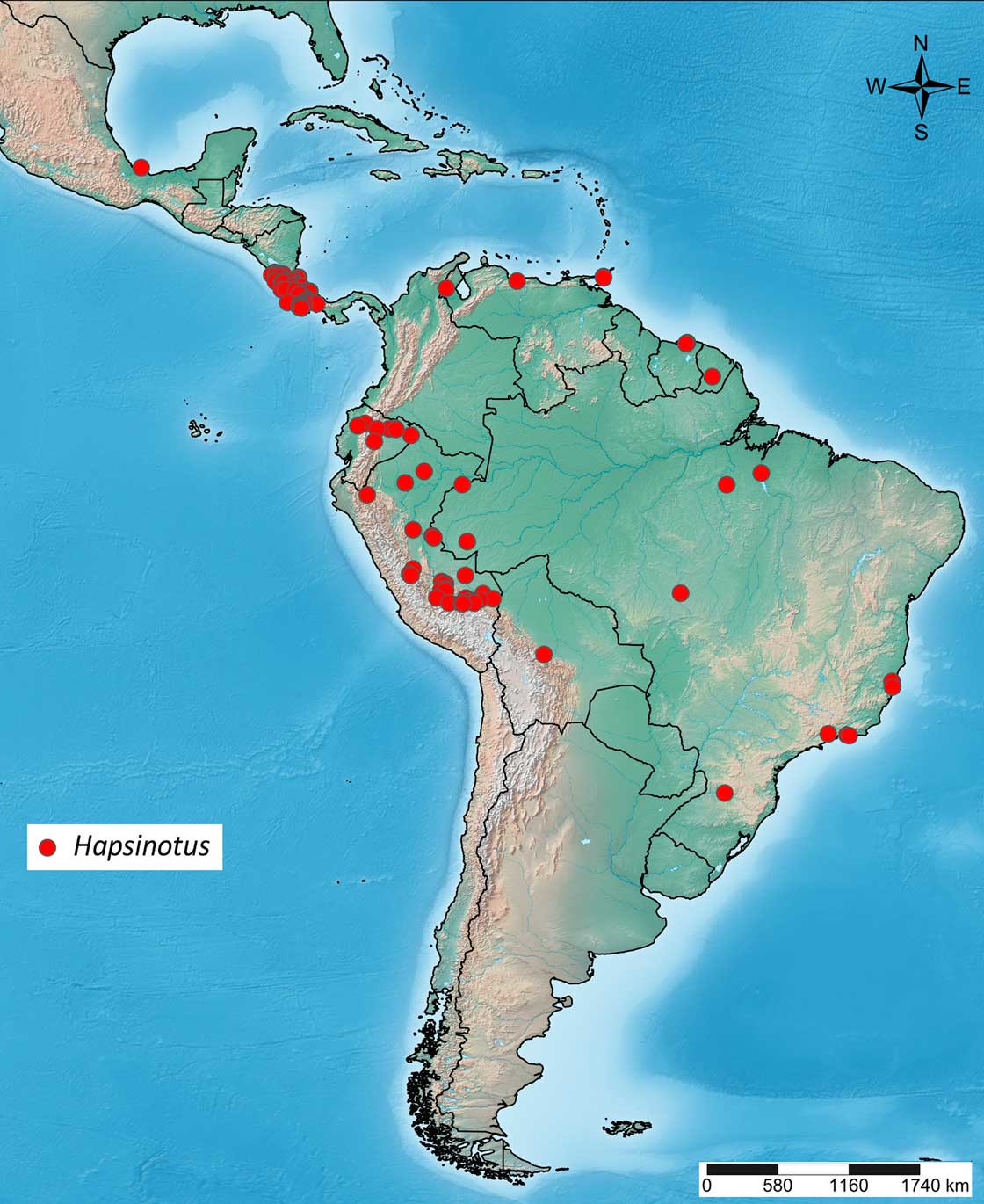
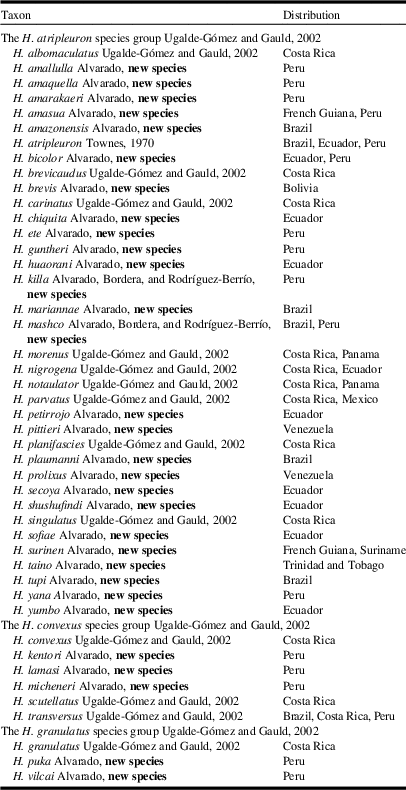
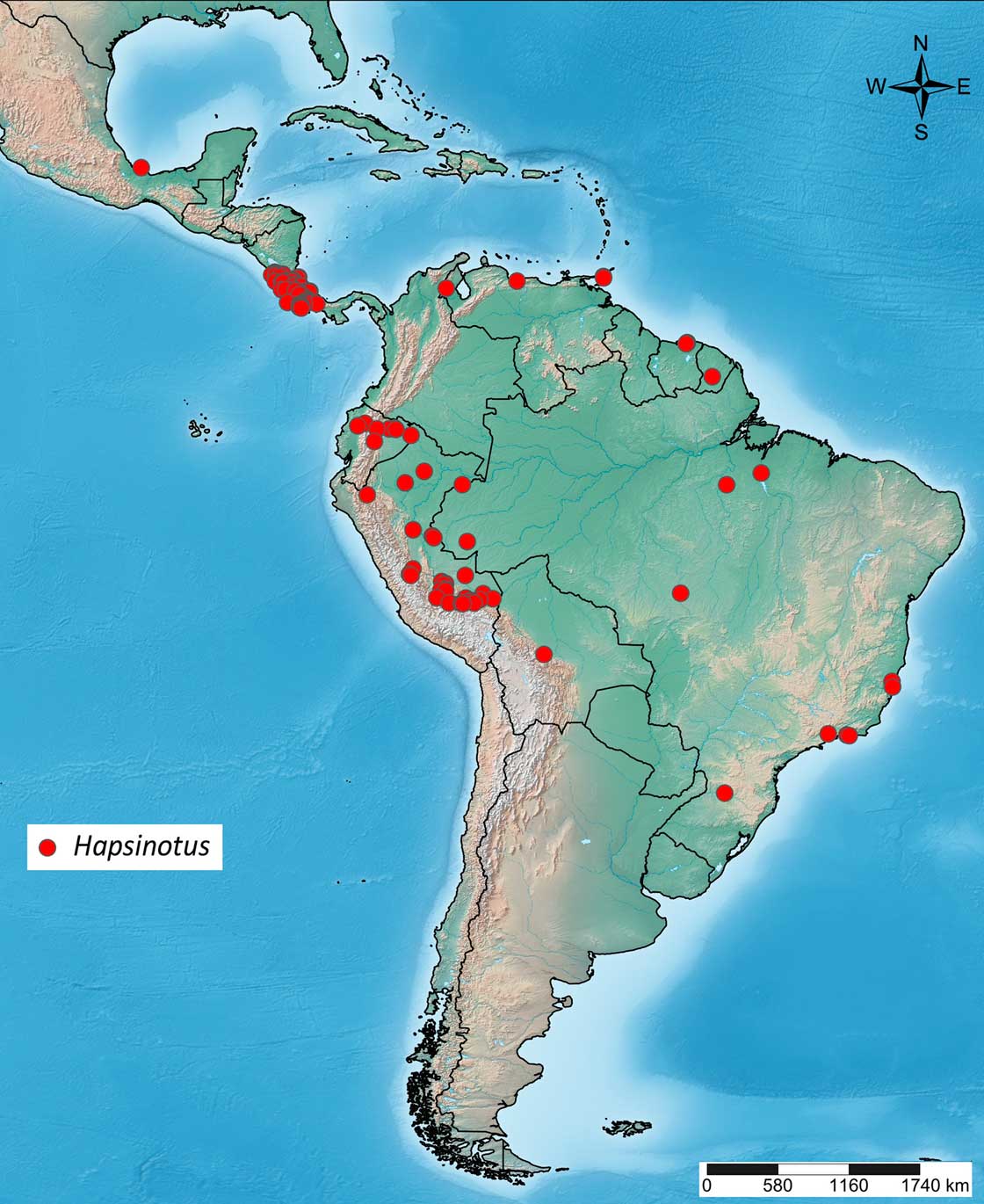
Remarks. This is the first comprehensive study of any genus of banchines in Neotropical region. Hapsinotus now comprises 45 species (Table 2), with means that the number of described species is being triplicated. Since the description of the genus – by Townes (Reference Townes1970) – only one article was written about this genus (Ugalde-Gómez and Gauld Reference Ugalde-Gómez and Gauld2002). The genus was known only from Costa Rica and Peru; now the distribution of the genus ranges from southern Mexico to southern Brazil. Despite the considerable expansion of distribution (Fig. 1), there are several gaps; no species are known from Colombia or from the Central American countries of Belize, Guatemala, Honduras, Nicaragua, and El Salvador.
Geographic distribution of Hapsinotus.
Hierarchical classification of currently described Hapsinotus species and their distribution.
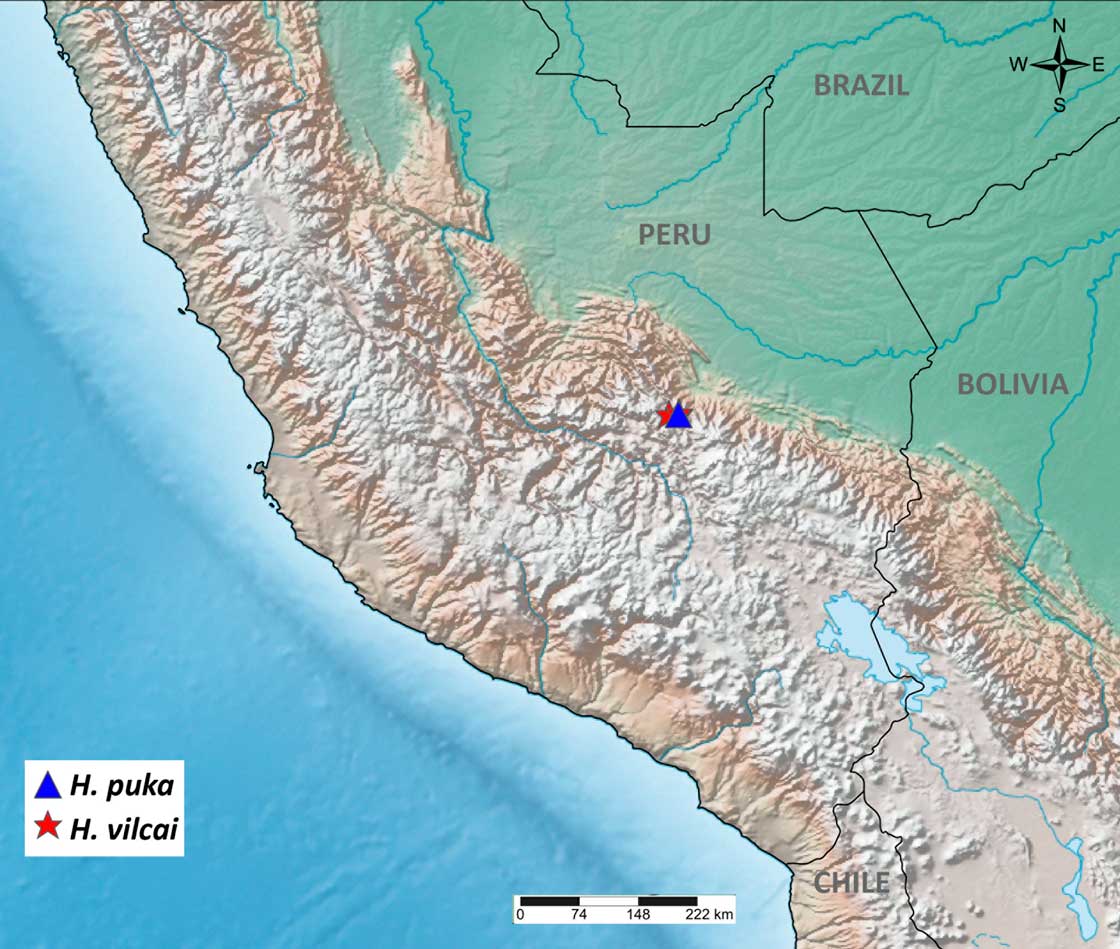
Hapsinotus species seem to occur only in wet forest, from sea level up to 3000 m. Most species and individuals occur from sea level up to approximately 1600 m, at higher elevation the occurrence with these taxa decreases, as was found in Costa Rica (Ugalde-Gómez and Gauld Reference Ugalde-Gómez and Gauld2002). This is especially true for the members of the H. atripleurum species group, which are commonly found in lowlands. However, the H. granulatus species group is more common from mid to high elevations, the two species found in Peru (H. puka new species and H. vilcai new species) were collected between 2000 and 2900 m and H. granulatus Ugalde-Gómez and Gauld, Reference Ugalde-Gómez and Gauld2002 (distributed in Costa Rica) ranges from 700 to 1800 m, while, H. convexus species group can be found along the entire range of elevation.
Ugalde-Gómez and Gauld (Reference Ugalde-Gómez and Gauld2002) discussed the difficulties delimiting the species in Hapsinotus; the morphological differences are subtle, and the colour is rather variable within the species. Several male individuals were examined (deposited in NBCN, NHML, and USUC) but could not be matched with any female species, with the sole exception of H. plaumanni new species. This case was possible to match the male and female due the distinctive colour of this species, but for the other male individuals present chromatically variations. Similar situation was found in the species described herein and a rather conservative approach was taken in terms of proposing new taxa.

The Hapsinotus atripleurum species group
Species of this group are characterised by having frons smooth and more-or-less polished between toruli and below median ocellus, without any trace of transverse swelling close to median ocellus; ovipositor sheath mostly black, but apically with apex conspicuously white (rarely pale brown); and fore wing with areolet open (Ugalde-Gómez and Gauld Reference Ugalde-Gómez and Gauld2002); lower end of occipital carina joining hypostomal carina close to base of mandible, at most at a distance of 0.2 times as basal mandibular width (Figs. 8C, 21D).
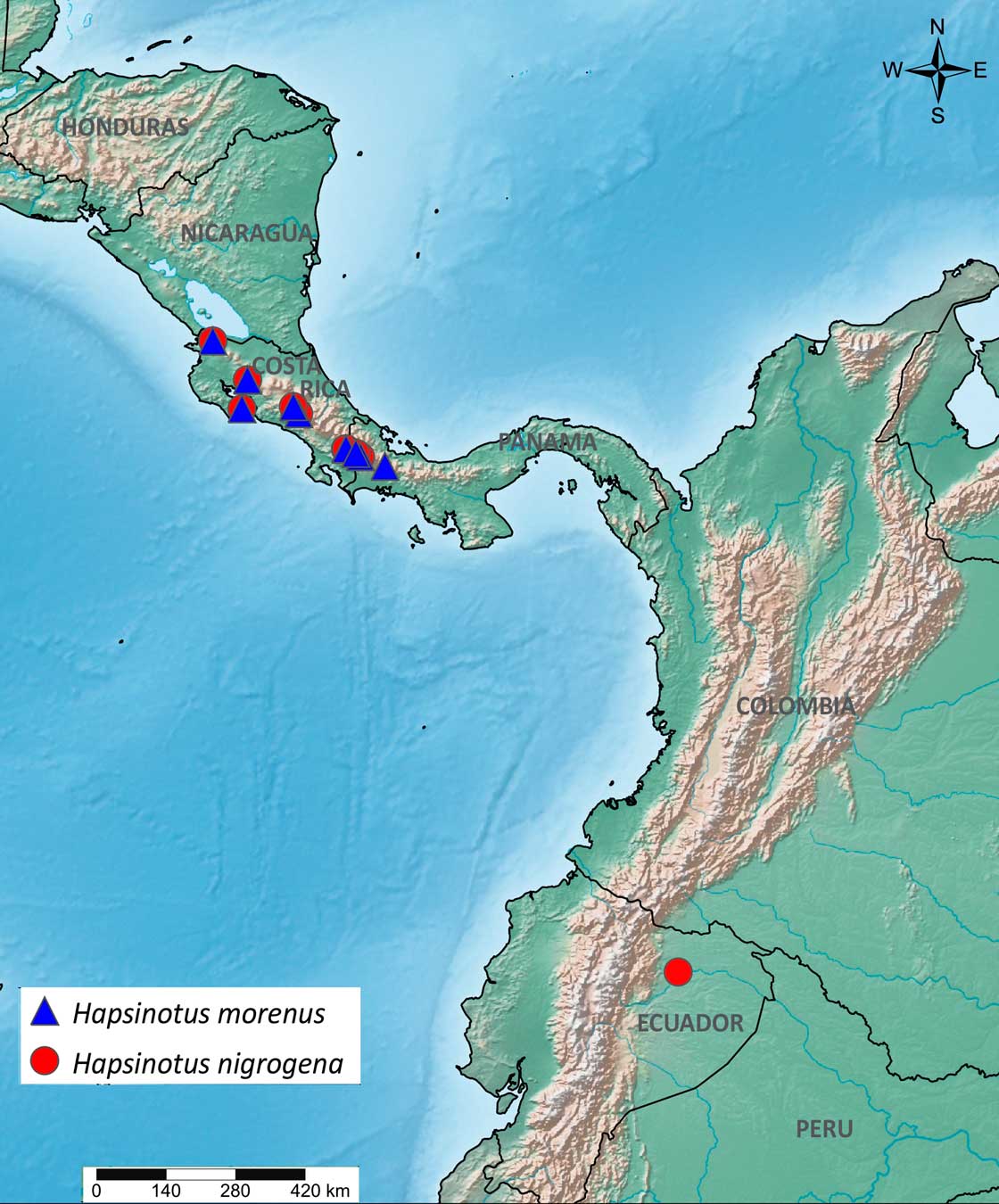
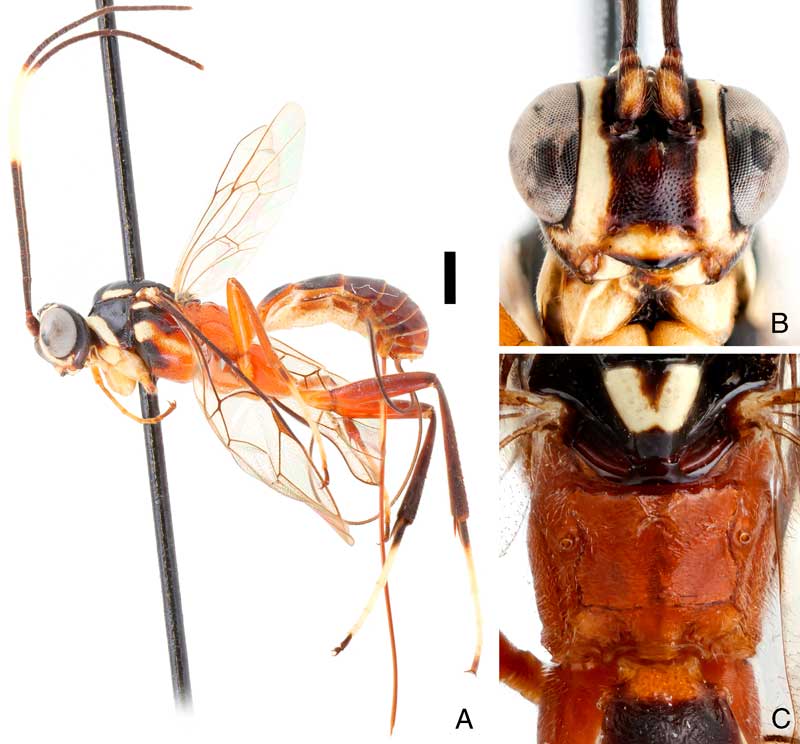
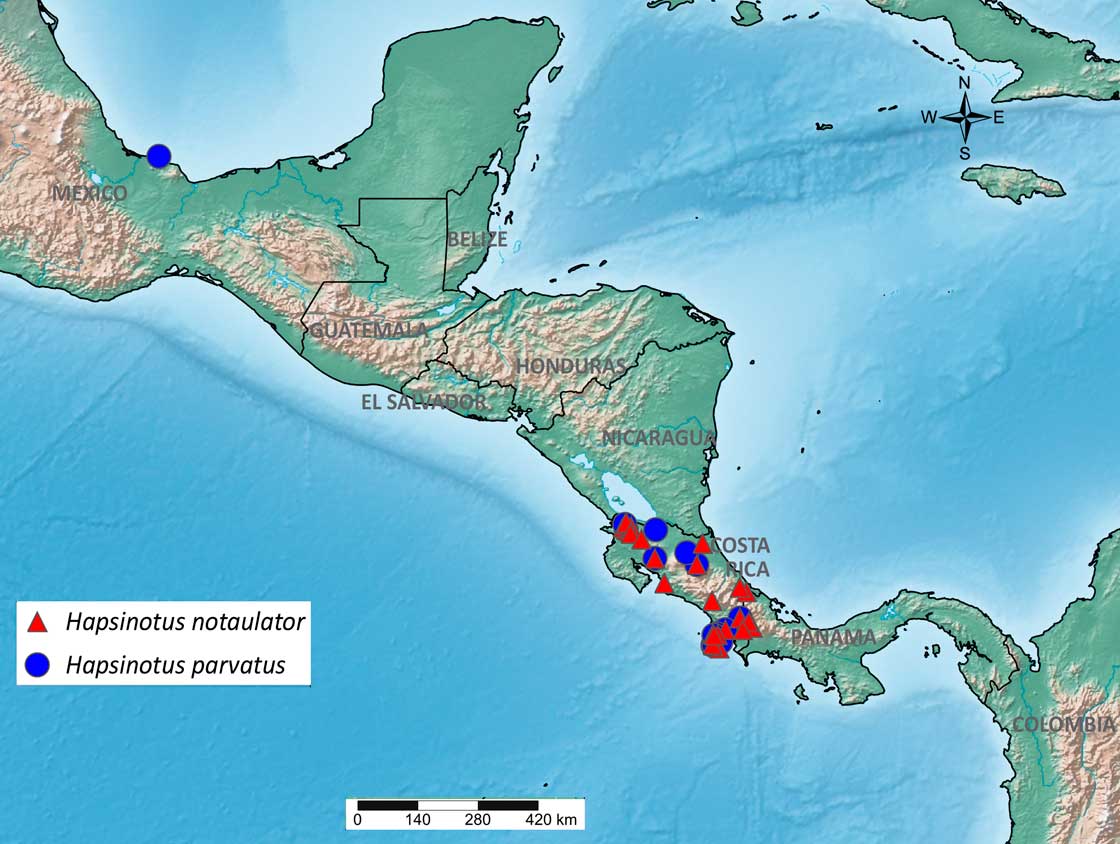
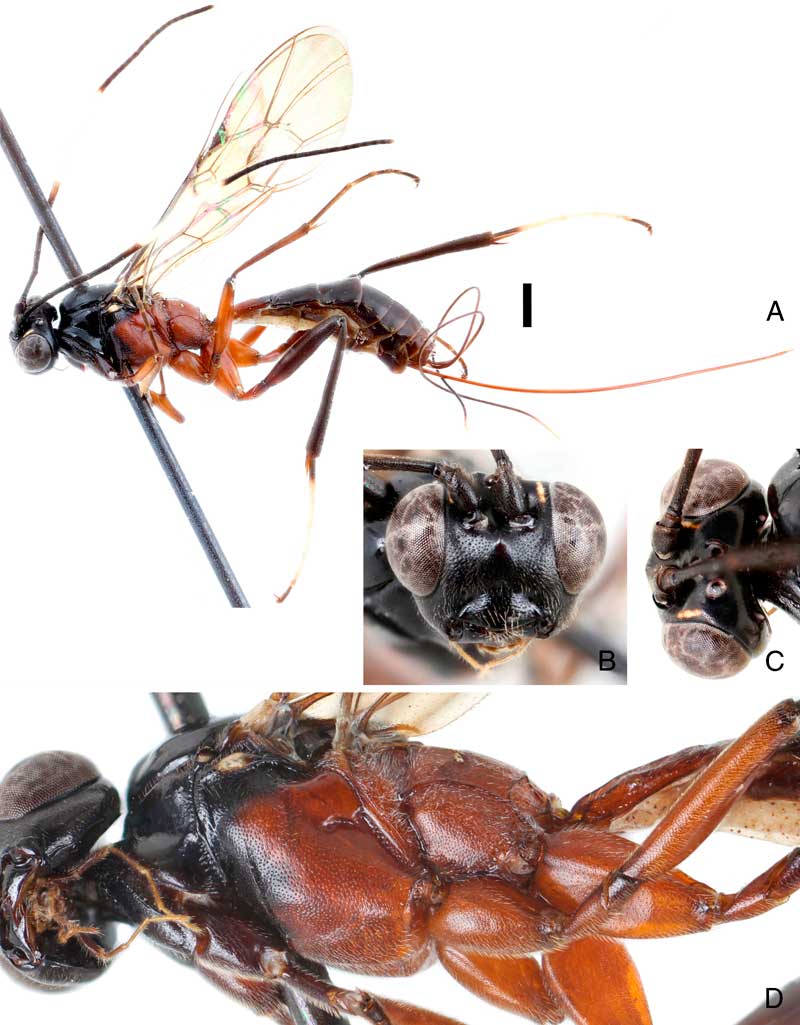
This species group includes: H. albomaculatus, H. amallulla, H. amaquella, H. amarakaeri, H. amasua, H. amazonensis, H. atripleurum, H. bicolor, H. brevicaudus, H. brevis, H. carinatus, H. chiquita, H. ete, H. guntheri, H. huaorani, H. killa, H. mariannae, H. mashco, H. morenus, H. nigrogena, H. notaulator, H. parvatus, H. petirrojo, H. pittieri, H. planifascies, H. plaumanni, H. prolixus, H. secoya, H. shushufindi, H. singulatus, H. sofiae, H. surinen, H. taino, H. tupi, H. yana, and H. yumbo.
Hapsinotus albomaculatus Ugalde-Gómez and Gauld, Reference Ugalde-Gómez and Gauld2002
Diagnosis. Face immediately below antennal insertion centrally with a moderate convexity; lateral ocellus separated from compound eye by more than 1.0 times maximum ocellar diameter; occipital carina mediodorsally evenly arcuate; head with pale mark on frontal orbit reaching back on to gena; genal orbits almost always entirely white; mesoscutum black with anterolateral corner and central spot white; metapleuron white; propodeum with white colour laterally between lateral longitudinal and pleural carinae and basally before anterior transverse carina. Additionally, female has protarsal claw quite strongly bowed, pectinate for at least 0.6 times its length, and ovipositor long, 2.7–3.1 times as long as length of metatibia.
Distribution. This species is only known from Costa Rica (Ugalde-Gómez and Gauld Reference Ugalde-Gómez and Gauld2002).
Material examined. Paratypes: 1♀ “Rancho Quemado, Pen. De Osa, A. C. Osa, Prov. Punta, COSTA RICA. 200 m. 1 NOV- 1DIC 1992, A. L. Marin S292500_511000 #3197” (MNCR); and 1♀ “COSTA RICA: Ptas Pv Nat. Pk. Corcovado Est. Sirena, 50 m 10xi.90 Trap 1 Gauld” (MNCR).
Hapsinotus amallulla Alvarado, new species
http://zoobank.org/urn:lsid:zoobank.org:act:95D0F565-E50B-48E9-855E-26D1C45D19D7
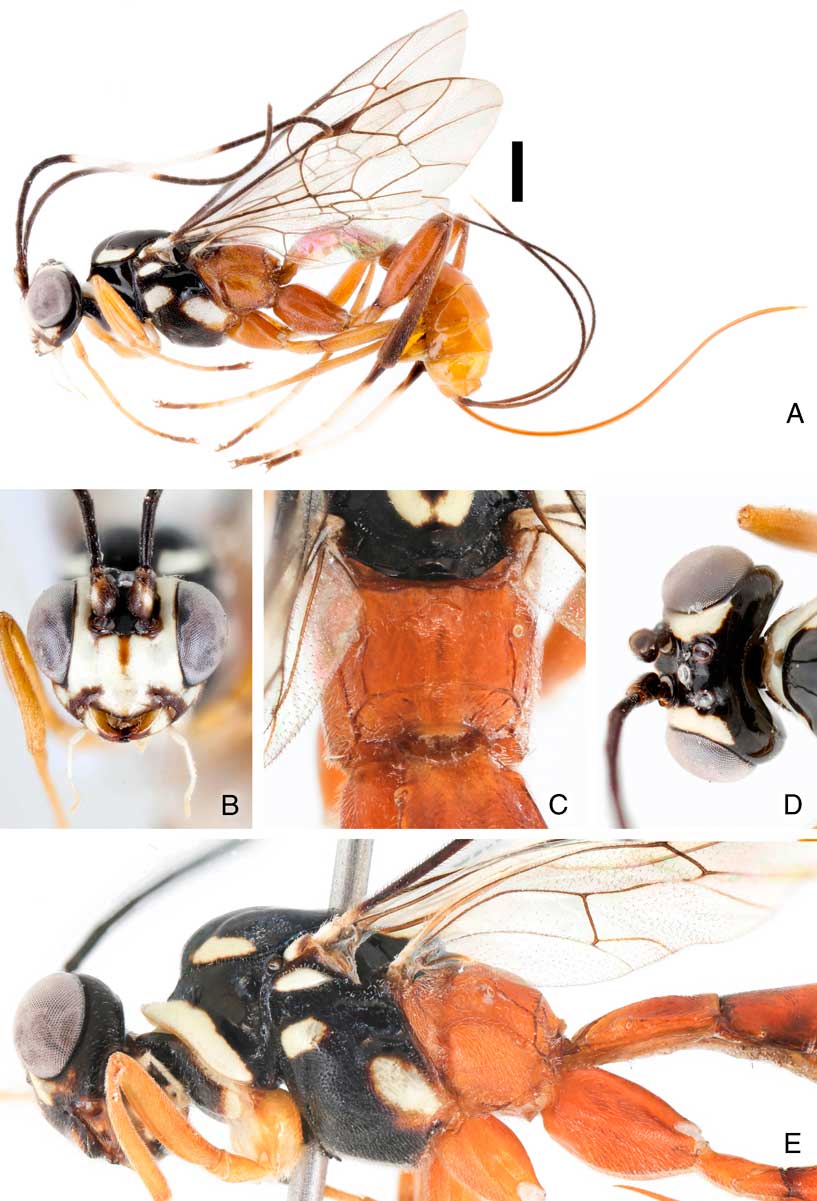
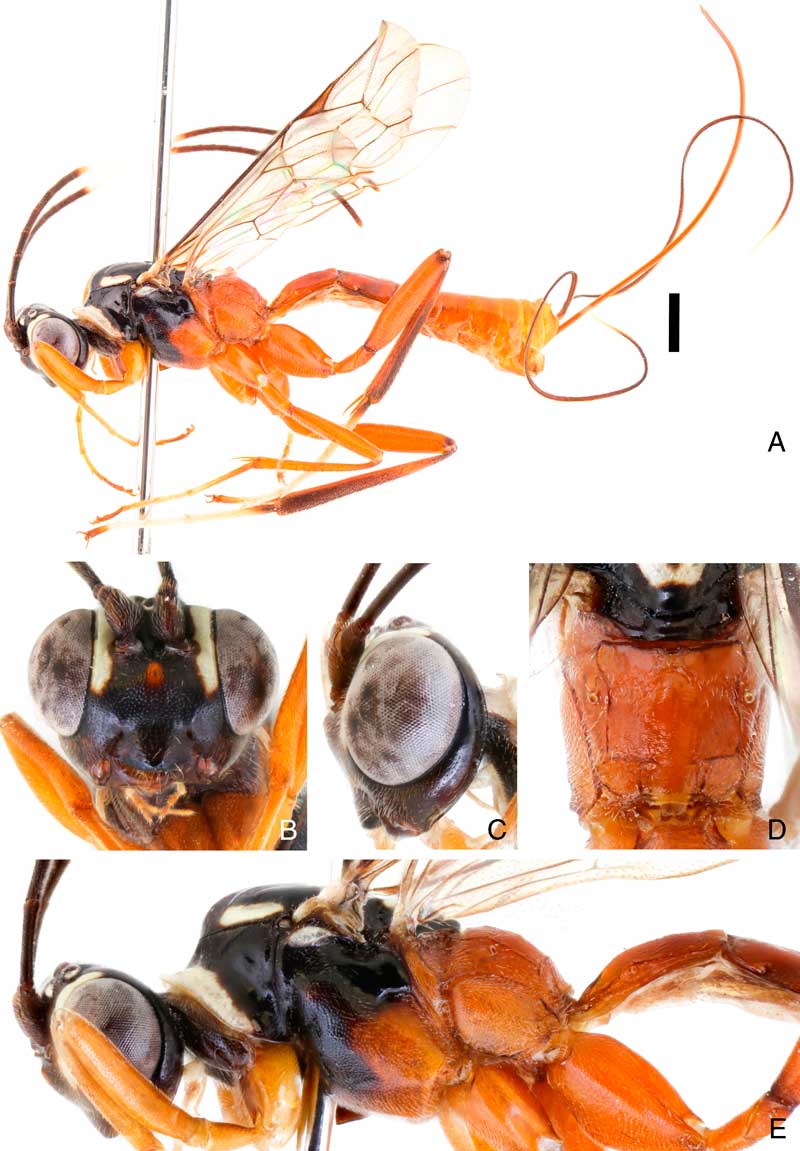
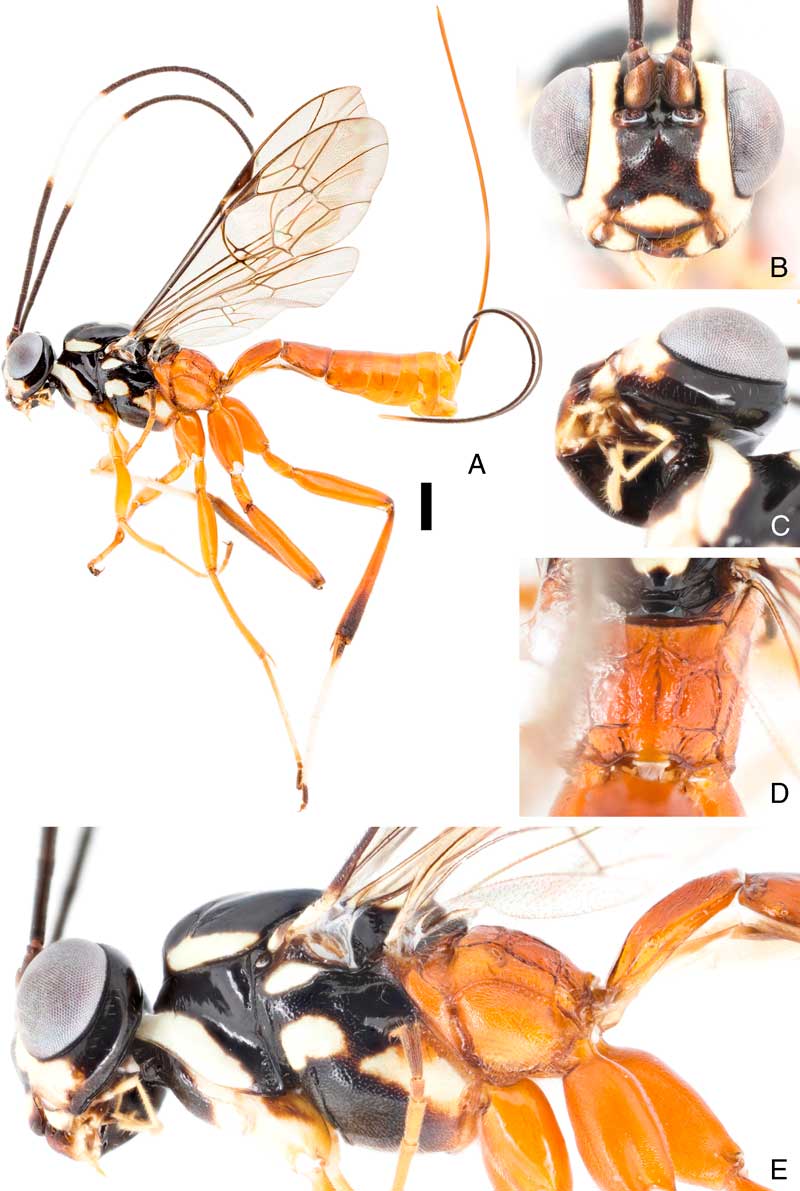
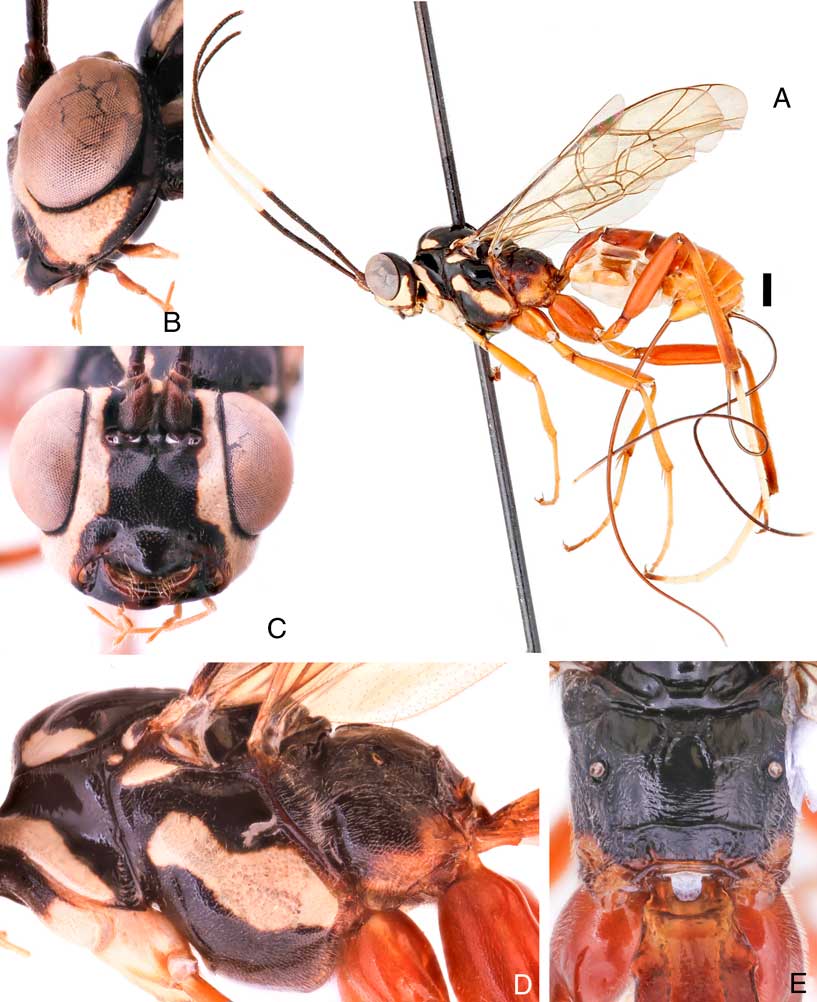
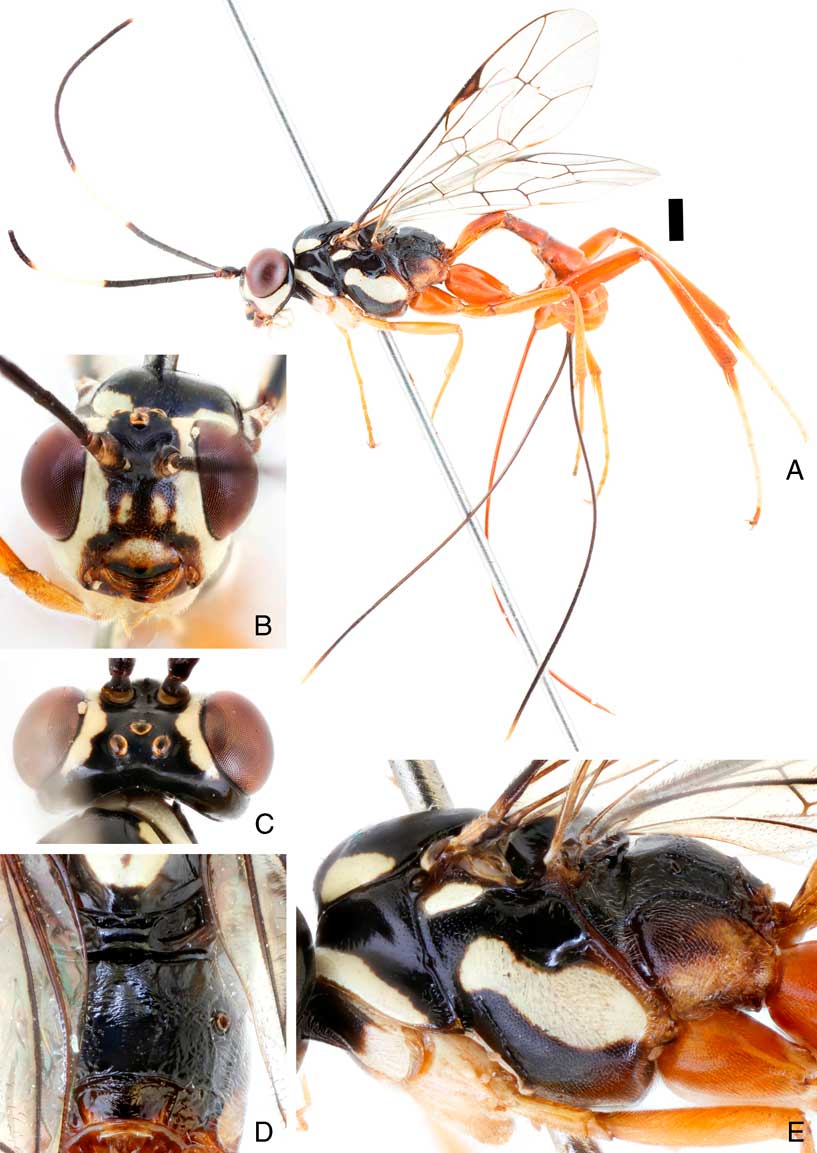
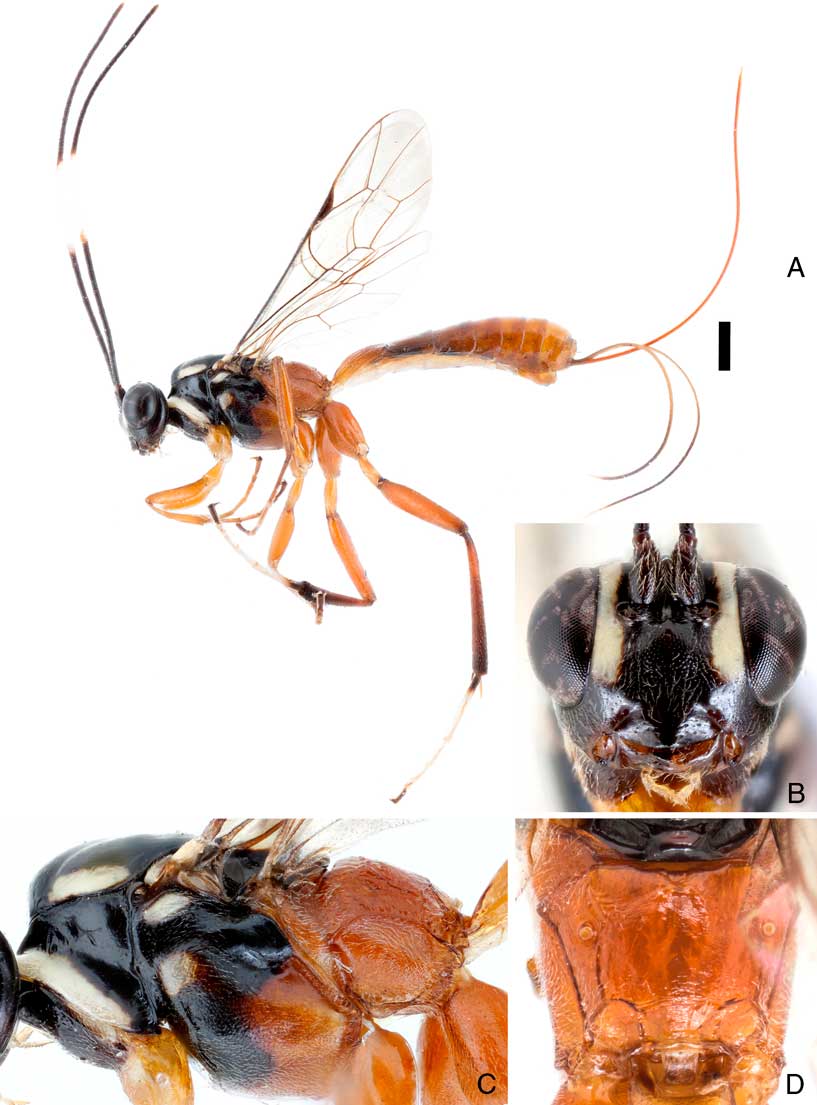
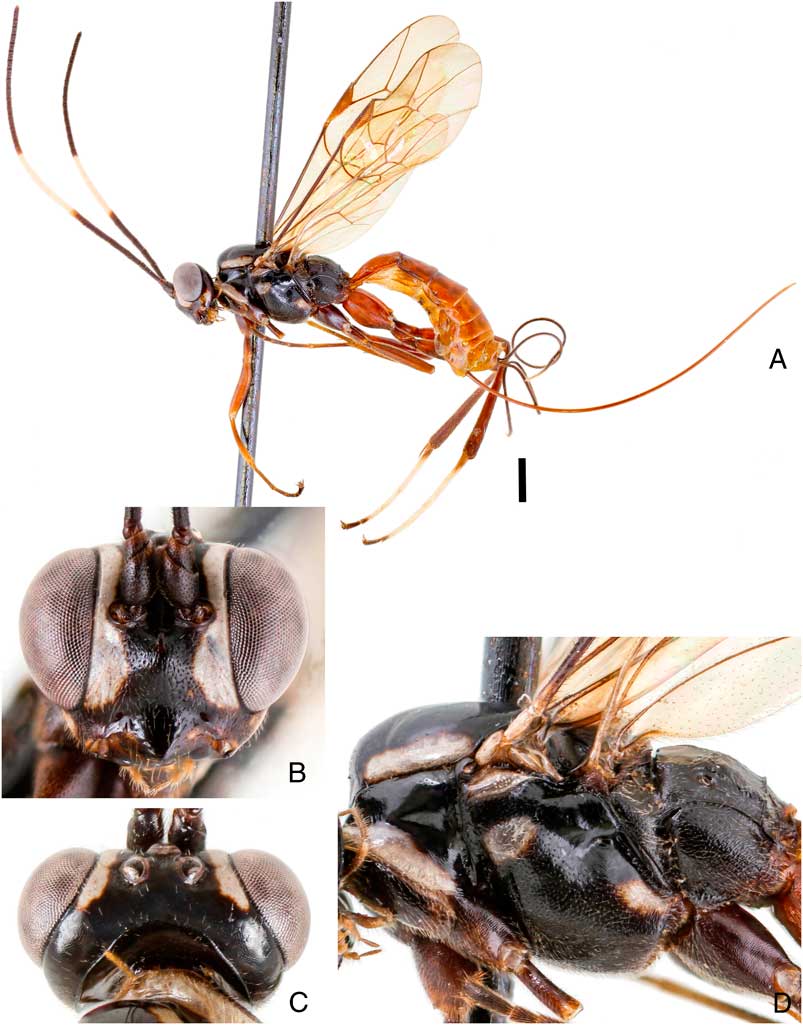
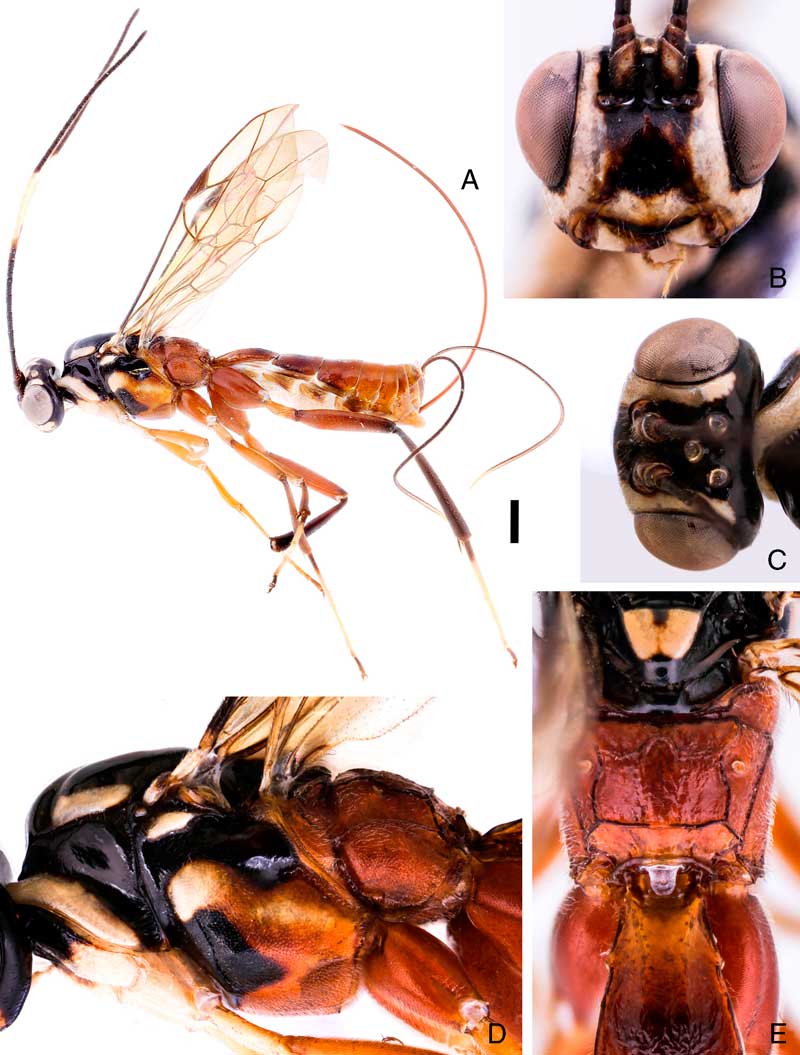
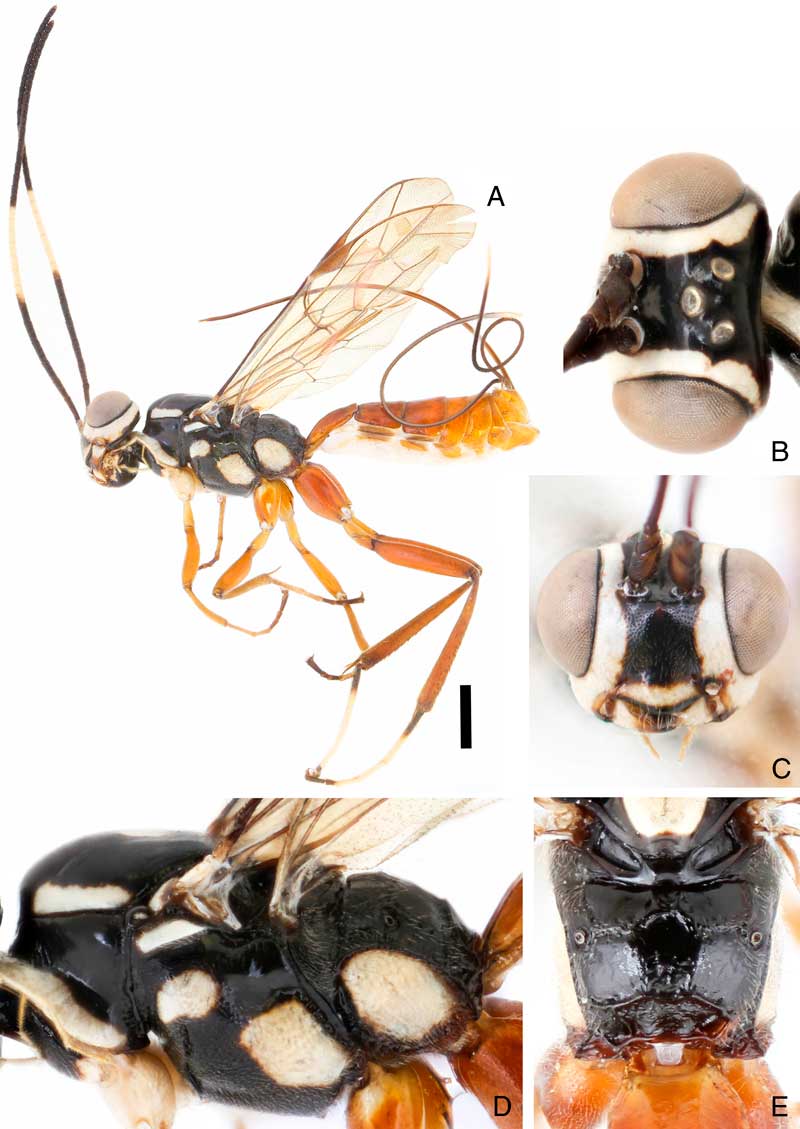
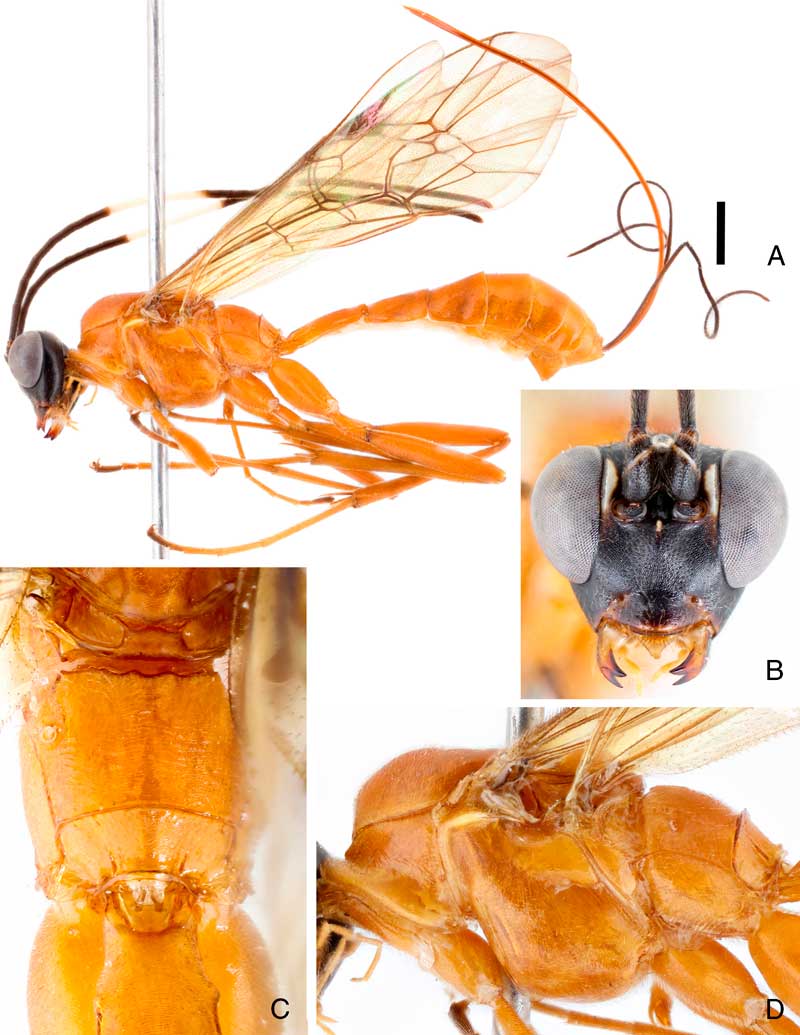
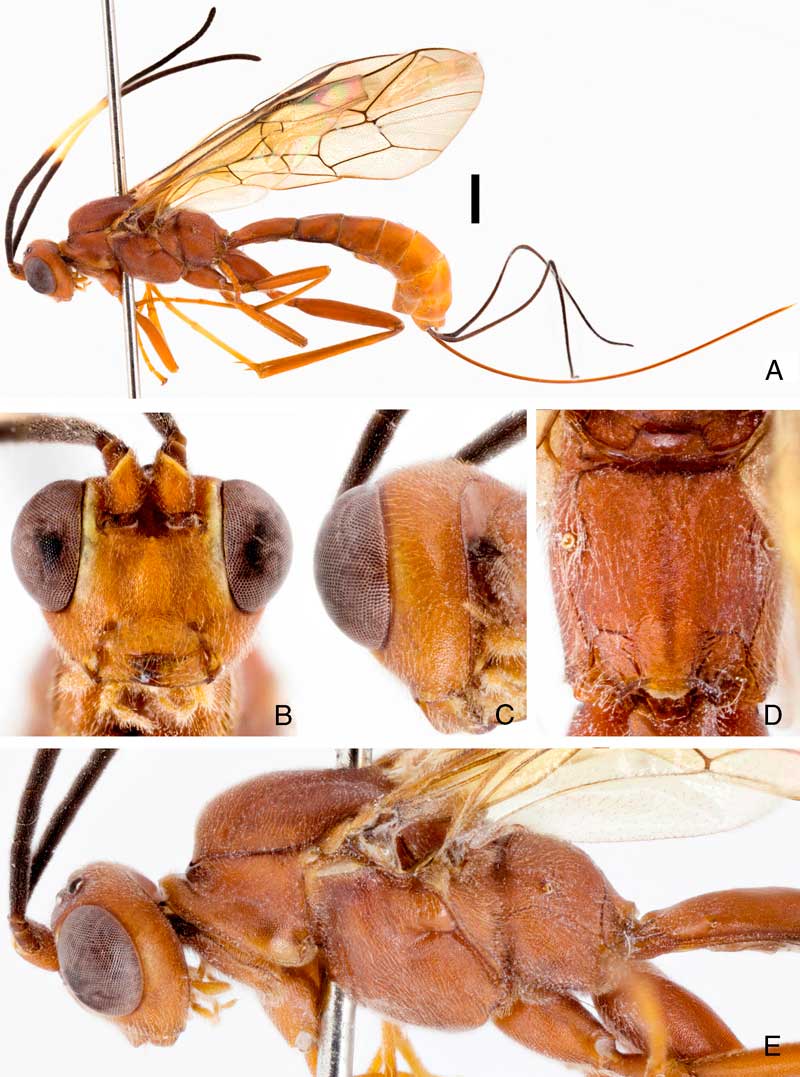
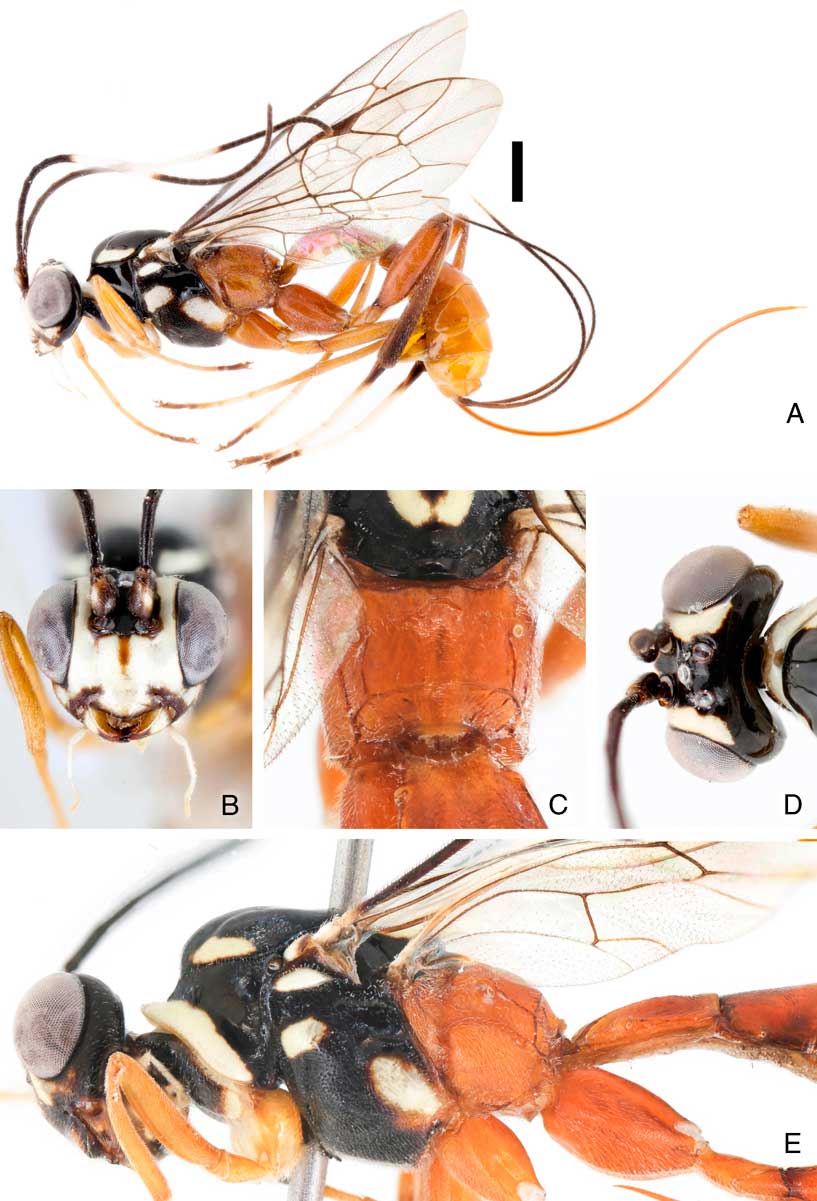
Morphology of Hapsinotus amallulla new species (holotype). A, Habitus (scale bar=1 mm); B, head, frontal view; C, propodeum; D, head, dorsal view; E, mesosoma, lateral view.
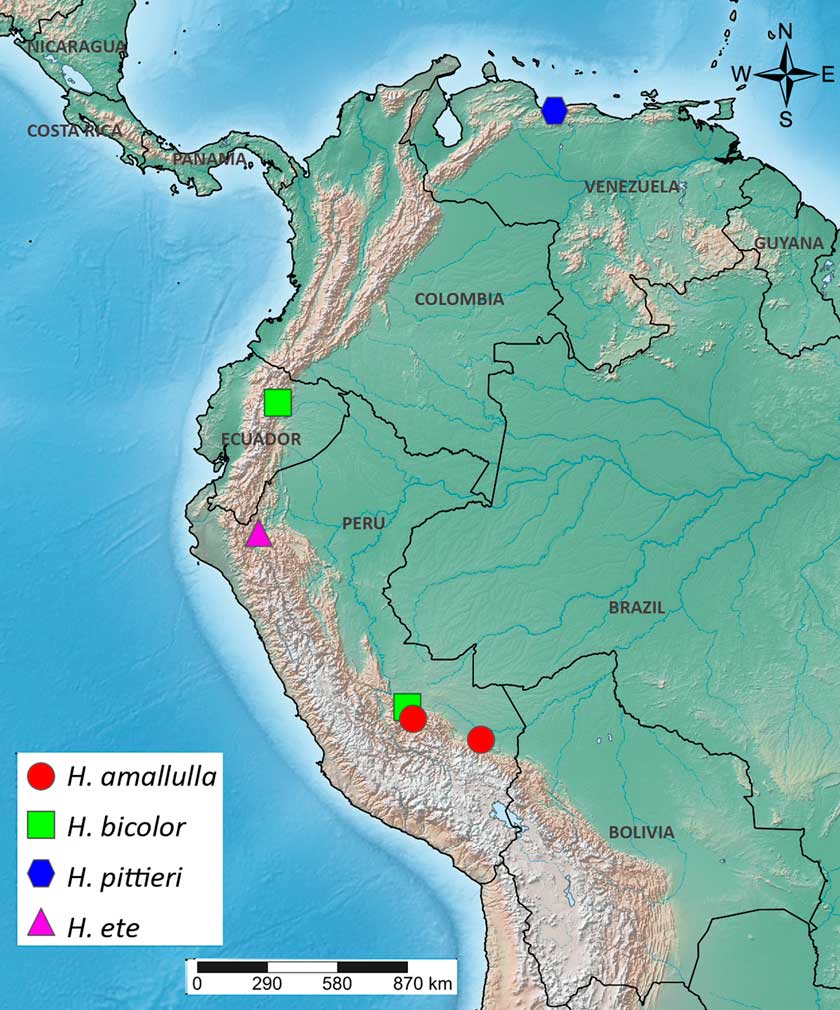
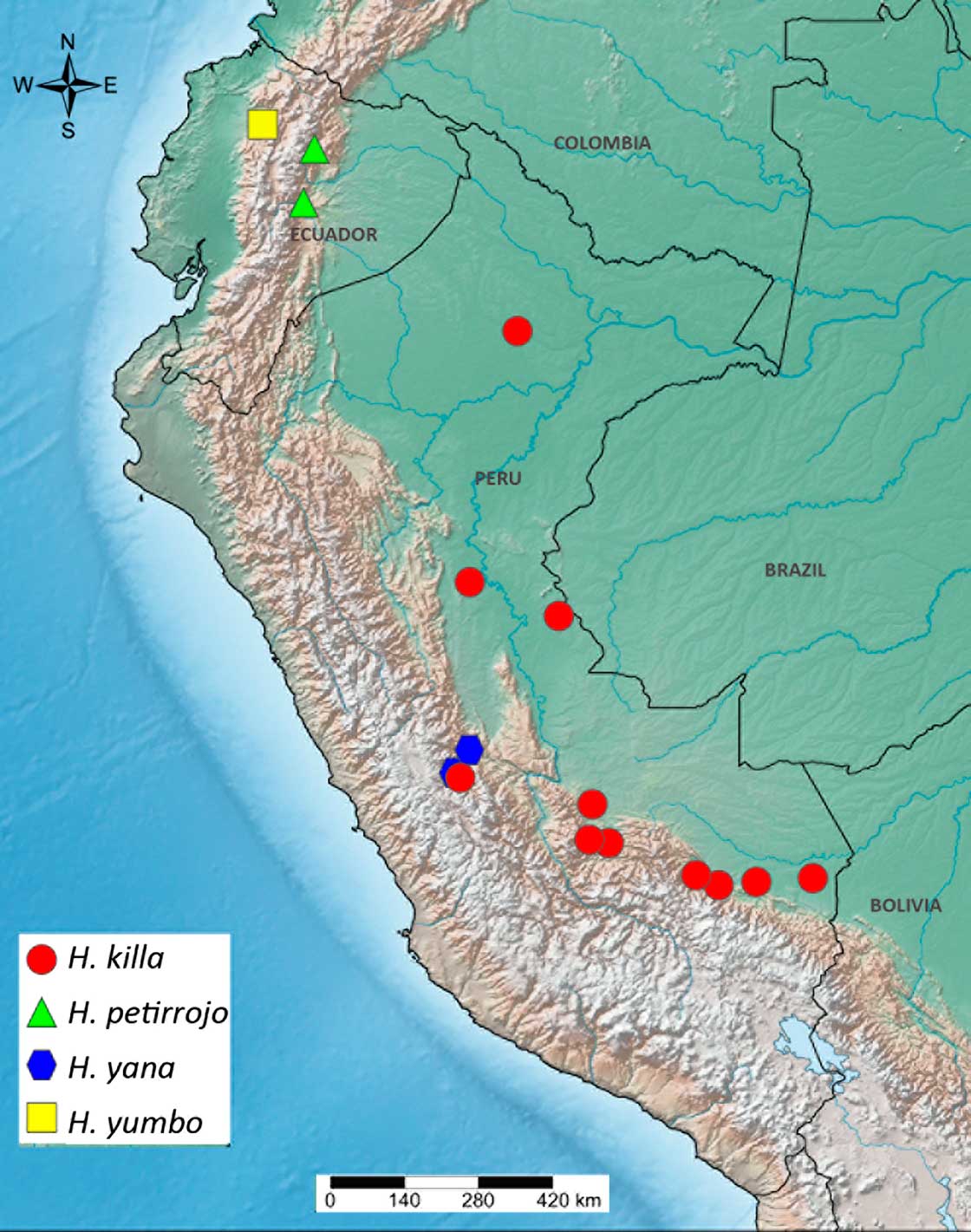
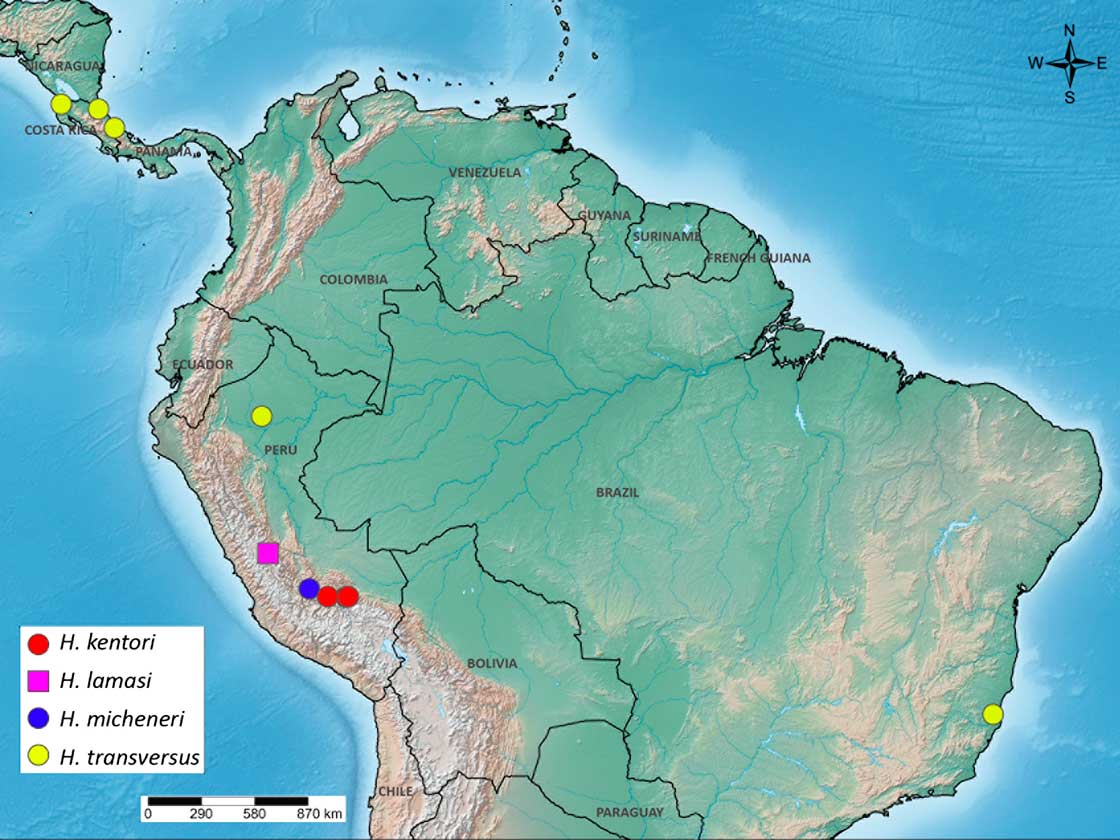
Geographic distribution of H. amallulla, H. bicolor, H. ete, and H. pittieri.

Diagnosis. Face immediately below antennal insertion with a median weak convexity; occipital carina mediodorsally evenly arcuate; protarsal claw long, abruptly and strongly curved, with short, sparse pectinae reaching at least 0.6 times its length; propodeum without lateromedian longitudinal carinae between transverse carinae (Fig. 2C); metasomal tergite I about 1.3 times as long as posteriorly wide, with lateromedian longitudinal carinae 0.7–0.8 times length of tergite; ovipositor 2.7–3.1 times as long as length of metatibia; head with facial and frontal orbits, clypeus and sometimes face and malar space, white (Fig. 2B); gena extensively black marked next to compound eye (Fig. 2A, D–E); mesoscutum black, anterolateral margin and a median spot white; mesosternum black (Fig. 2E); metapleuron and propodeum entirely orange (Fig. 2E); metafemur red at most with distal tip brown (Fig. 2A).
Description. Female: fore wing length 6.3 mm. Head. Clypeus (Fig. 2B) of moderate breadth, 2.6 times as wide as high, granulate with punctures separated by 2.0–4.0 times puncture width, slightly convex, slightly flared outwards (centrally softly conical), without a transverse subapical ridge, apical margin centrally more-or-less straight; mandible tapering slightly, teeth subequal; face granulate with punctures separated by 1.5–2.5 times puncture width, below antennal insertion with a weak median convexity; malar space about 0.7 times as long as basal mandibular width; frons faintly granulate, but smooth between toruli (without a median, longitudinal, sulcus-shaped impression); lateral ocellus separated from compound eye by about 1.4 times maximum ocellar diameter; distance between ocelli 1.4 times maximum ocellar diameter; occipital carina mediodorsally convex, lower-ventral end joining hypostomal carina close to base of mandible (carina about 0.2 times as long as basal mandibular width); gena in lateral view 0.3 times as long as compound eyes, granulate with punctures separated by 6.0–8.0 times puncture width; antenna with 32 flagellomeres. Mesosoma. Pronotum faintly granulate with isolated punctures on upper and posterior margins; without epomia, with wrinkle in same area. Mesoscutum faintly granulate and polished, with isolated punctures; notaulus barely impressed, extending through 0.2 times length of mesoscutum. Scutellum slightly convex, faintly granulate, without distinct lateral carina and median, pit-like impression. Mesopleuron granulate (except distal half of speculum smooth and without punctures) with punctures separated by 1.2–2.0 times puncture width; upper end of epicnemial carina is reaching about 0.2 times of way to anterior margin; metapleuron granulate with punctures separated by 0.5–1.0 times puncture width. Propodeum (Fig. 2C) granulate; anterior transverse carina faint between longitudinal carinae, strong centrally between lateromedian longitudinal carinae; posterior transverse carina complete and strong, faint between lateromedian longitudinal carinae; lateromedian longitudinal carinae absent before anterior transverse carina; lateral longitudinal carinae strong; area basalis with shape of inverted trapezoid; area externa about 1.6 times as wide as long. Protarsal claw long, slender, abruptly, and strongly curved, with short, sparse pectinae. Fore wing with 3rs-m absent, 2rs-m about 1.1 times as long as abscissa of M between 2rs-m and 2m-cu; Cu1 between 1m-cu and Cu1a 1.4 times as long as Cu1b; 1m-cu fairly evenly arcuate, without ramellus. Hind wing with distal abscissa of Cu1 and 1A sclerotised throughout. Metasoma. Tergite I about 1.3 times as long as posteriorly wide, lateromedian longitudinal carina distinct for 0.7 times length of tergite; tergite II about 0.7 times as long as posteriorly wide. Ovipositor about 2.8 times as long as metatibia; its apex slightly compressed with a narrowed apical section. Colour. Head black; mandible white, gradually changing on distal half to light brown; face white, brown between spiracle to next to malar space near to mandible, a red stripe from below median tubercle to middle face (Fig. 2B); orbits white (from face to beyond lateral ocellus); palpi white; antenna black with a white band on flagellum, scape lateroventrally white. Mesosoma with pronotum black, anterior margin white; mesoscutum black with anterolateral margins and central spot white; scutellum predominantly white, anteriorly (shaped as an inverted thin triangle) and posteriorly black; tegula white with posterior half brown; mesopleuron (Fig. 2E) and mesosternum black except subalar prominence, a white spot at end of epicnemial carina, and a white spot on lower posterior end; propodeum and metapleuron orange. Legs (Fig. 2A) predominantly orange except procoxa white, protarsomeres and mesotarsomeres 4–5 brown, mesotarsomere 1 with distal half gradually changing to white, mesotarsomeres 2–3 white, distal end of metafemur brown, metatibia dorsolaterally brown, metatarsomere 1 with distal 2/3 times its length and metatarsomeres 2–3 white, metatarsomere 1 with basal third of its length and metatarsomeres 4–5 brown; wings hyaline. Metasomal tergites orange; ovipositor sheath dark brown with distal apex white.
Male: Unknown.
Remarks. The paratype series varies from holotype in the following: clypeus breadth 2.5–2.6 times as wide as high; antenna with 30–32 flagellomeres; propodeum with area externa 1.6–1.7 times as wide as long; fore wing with 2rs-m 1.1–1.4 times as long as abscissa of M between 2rs-m and 2m-cu, and Cu1 between 1m-cu and Cu1a 1.4–1.5 times as long as Cu1b; tergite I with lateromedian longitudinal carinae 0.7–0.8 times length of tergite; tergite II 0.7–0.8 times as long as posteriorly wide; and ovipositor 2.7–3.1 times as long as metatibia. The paratypes have some differences in colour, face black with white spot below median tubercle and clypeus and malar space centrally white; procoxa light brown but ventrally white, and metatarsomere four white but dorsally brown.
Distribution. Peru (Fig. 3).
Etymology. The specific epithet amallulla means “do not lie” in Quechua and was one of the laws of the Incan Empire. It is treated as a noun in apposition.
Material examined. Holotype: ♀ “PERU: CU [Cusco], La Convención, ca [cerca] Timpia, Rio Shiguaniro, 470 m, 12°4'52''S / 72°48'25''W 16.X.2010, interception trap, F. Meza” (MUSM). Paratypes: 1♀ “PERU: MD [Madre de Dios], Reserva Com.[Comunal] Amarakaeri, 70°45'35.64''W, 13°3'25.78''S, 445 m. 07–09.XI.2010, M. Vilchez y C. Castillo” (MUSM); 1♀ “Avispas, Perú 30 m nr. Marcapata Oct 20–30, 1962 Luis Peña”, 1♀ “Avispas, Perú 30 m nr. Marcapata Sept. 1962 Luis Peña” (USUC).
Hapsinotus amaquella Alvarado, new species
http://zoobank.org/urn:lsid:zoobank.org:act:C895841D-0FC5-46ED-96E3-C63E13C52693
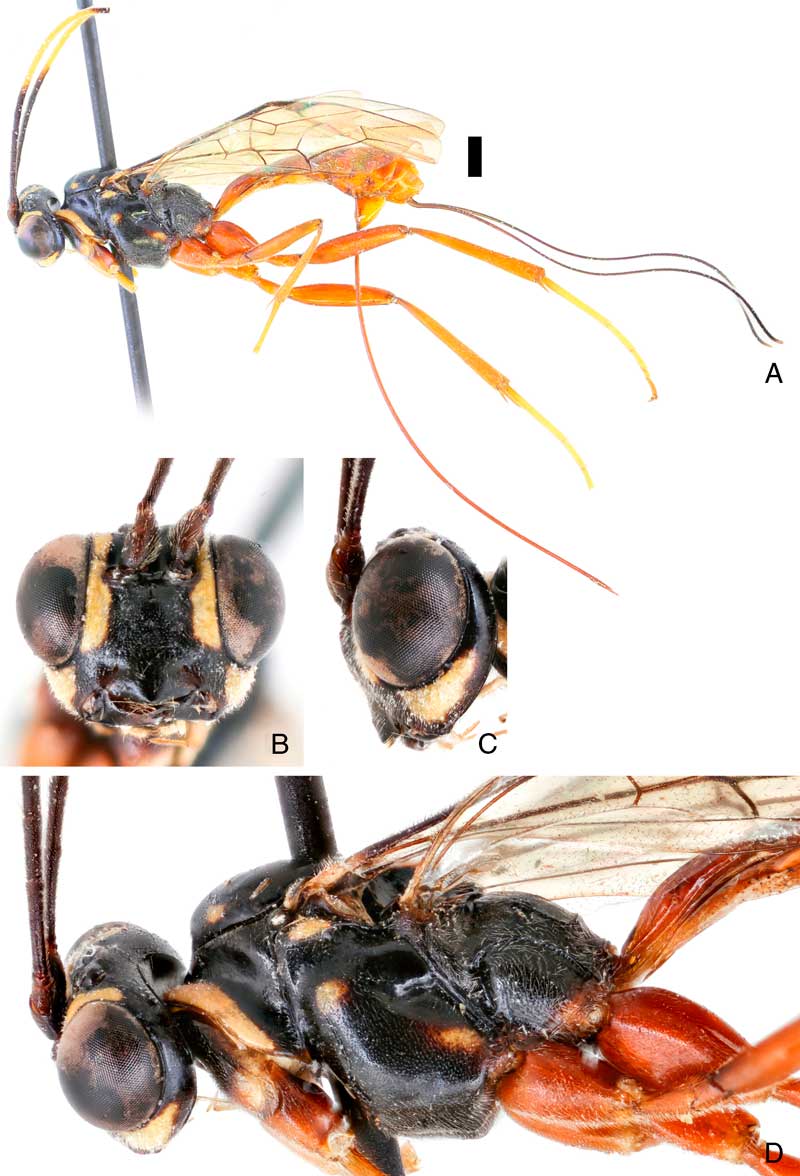
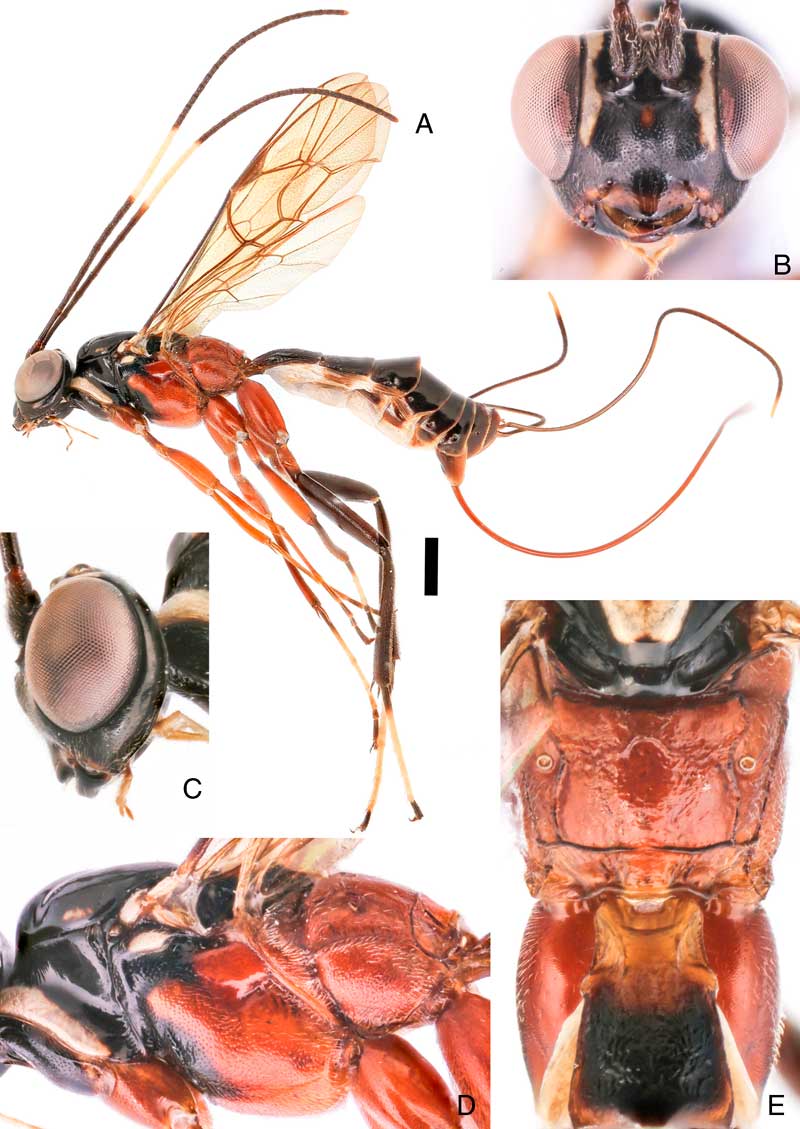
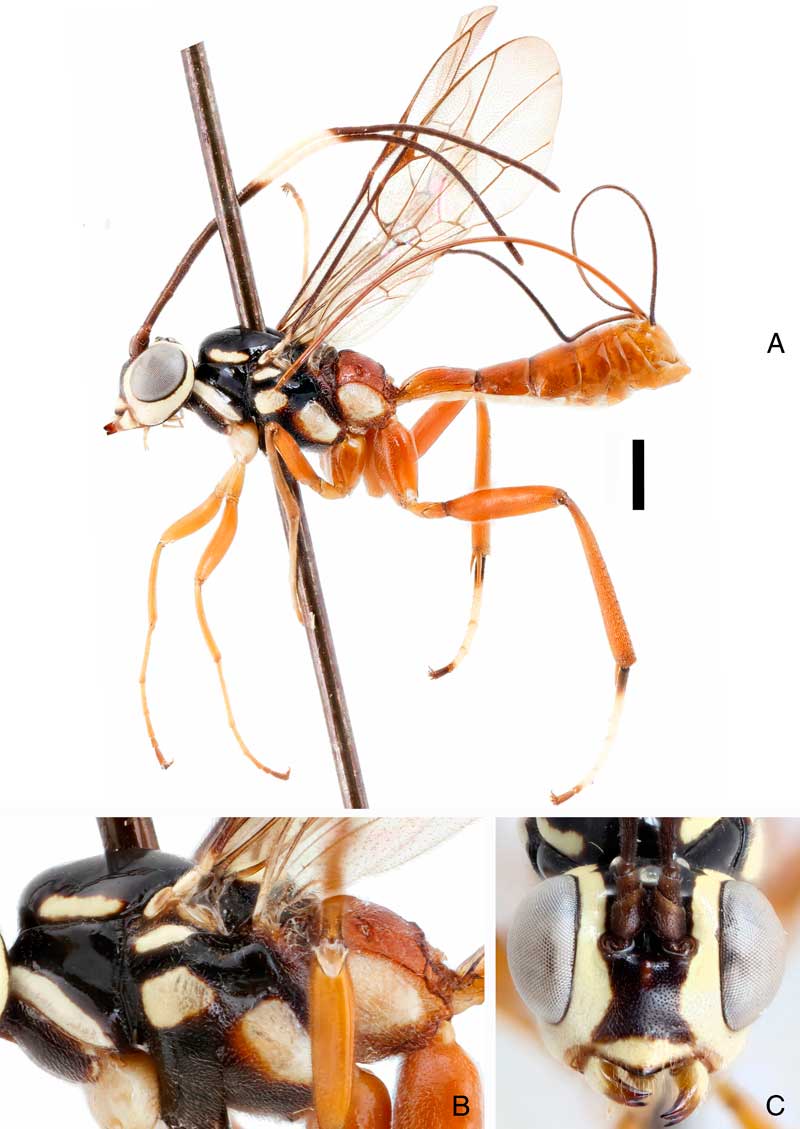
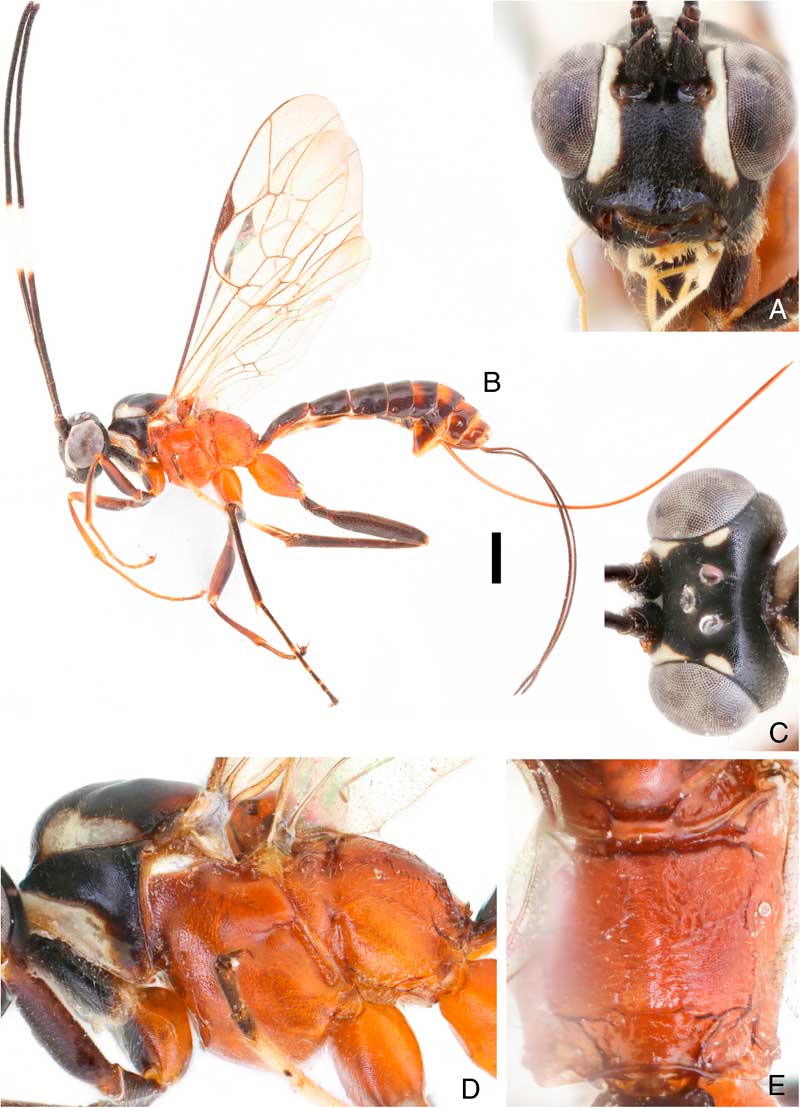
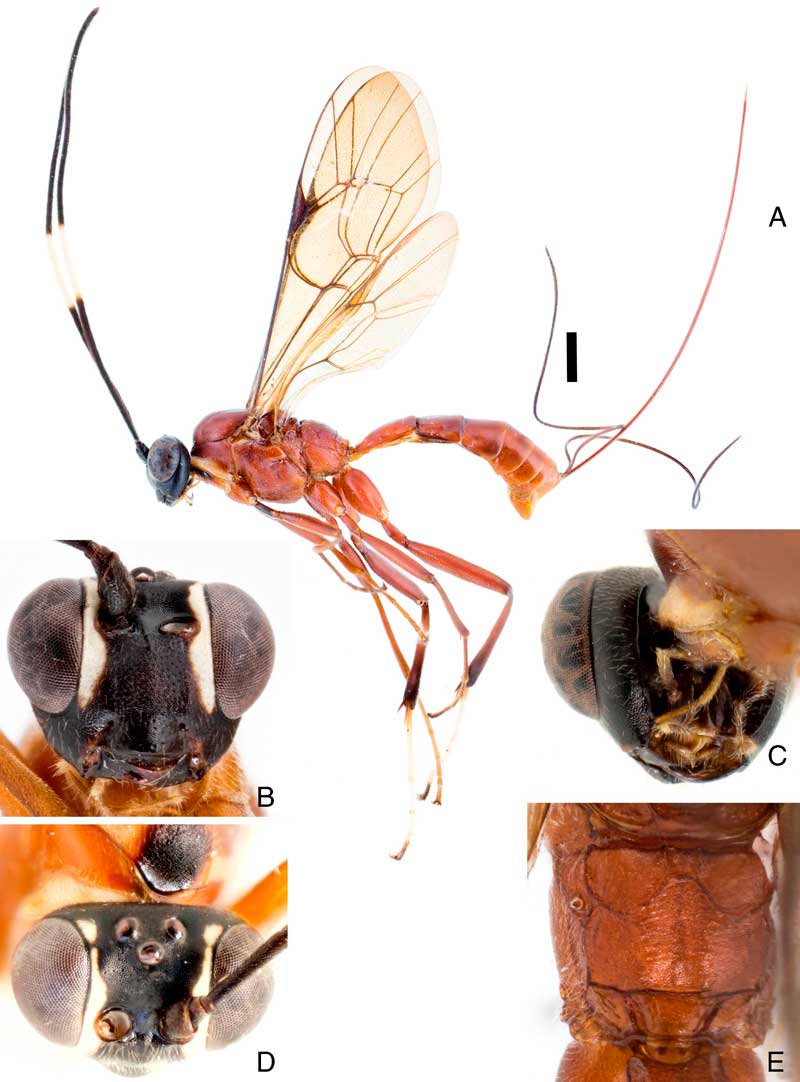
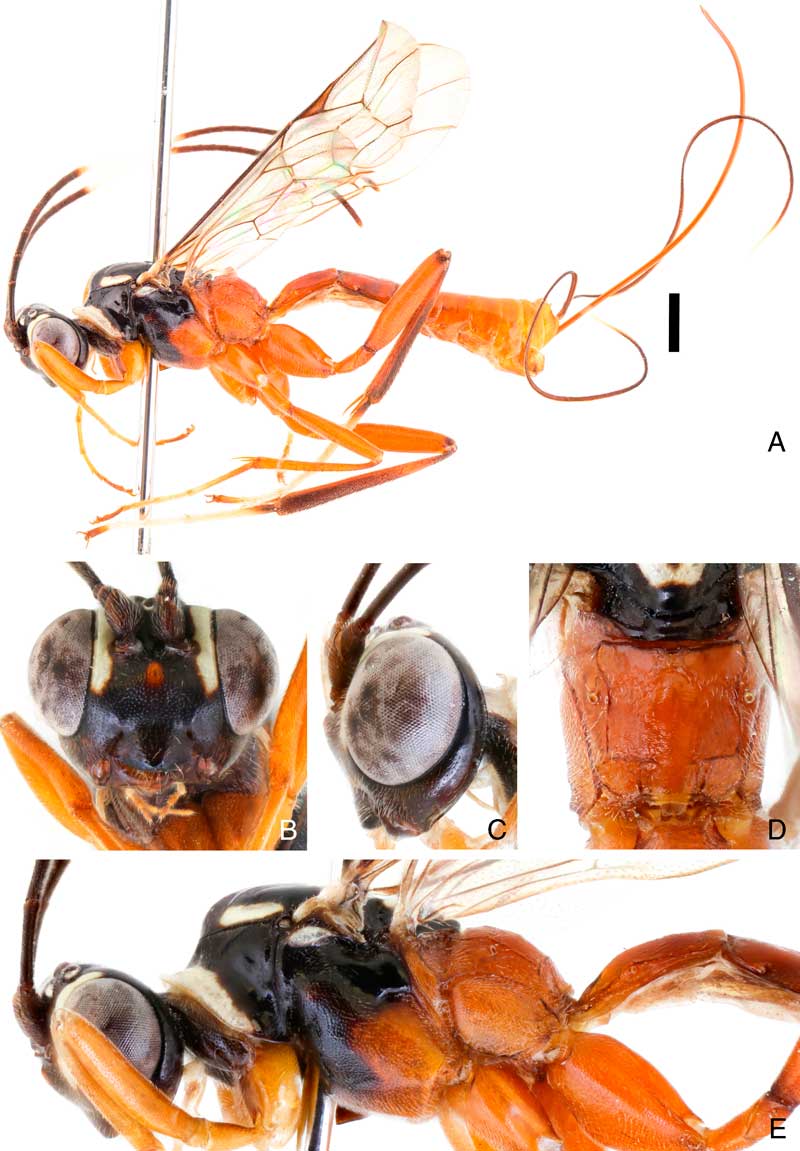
Morphology of Hapsinotus amaquella new species (holotype). A, Habitus (scale bar=1 mm); B, head, frontal view; C, head, lateral view; D, propodeum; E, mesosoma, lateral view.
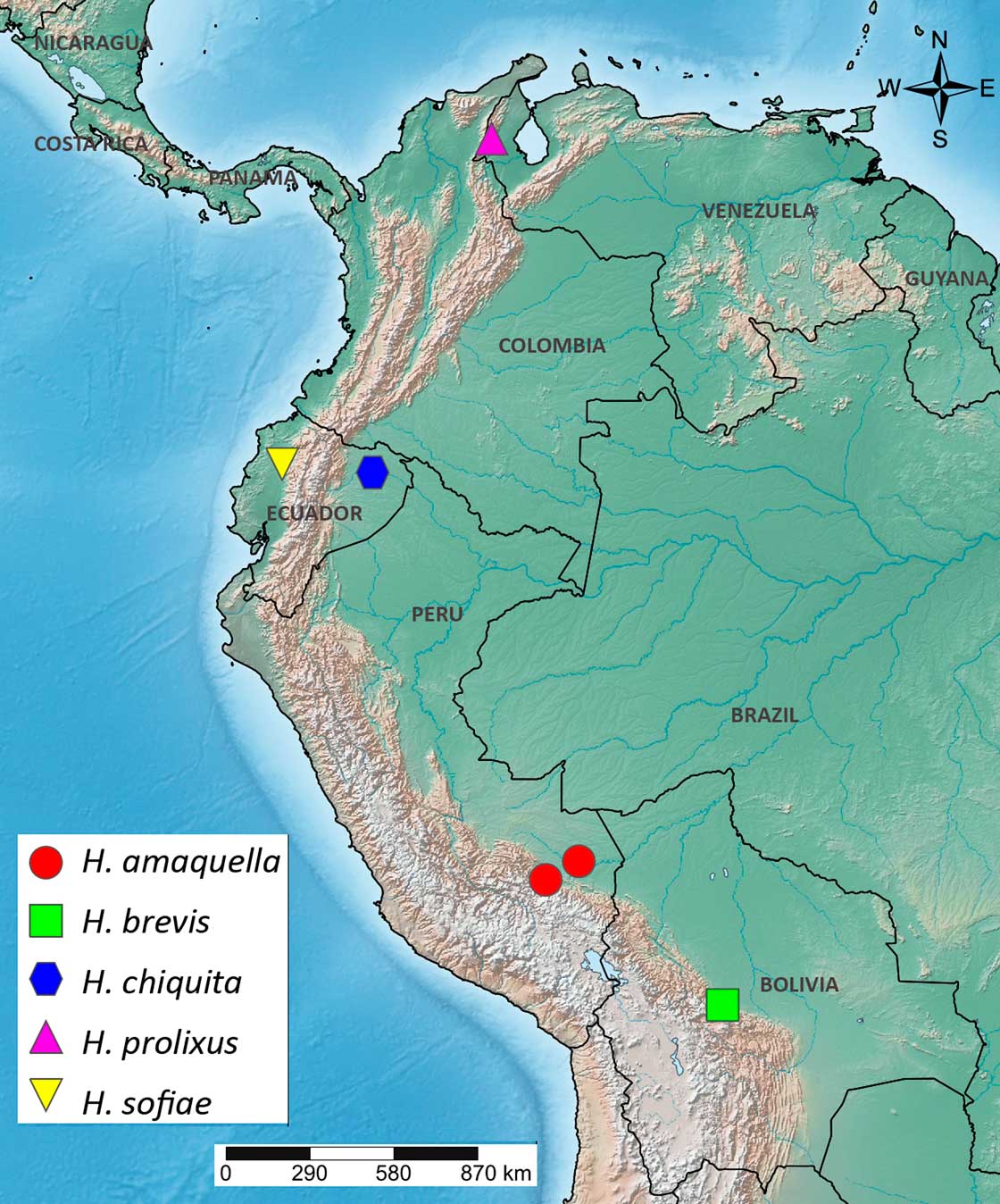
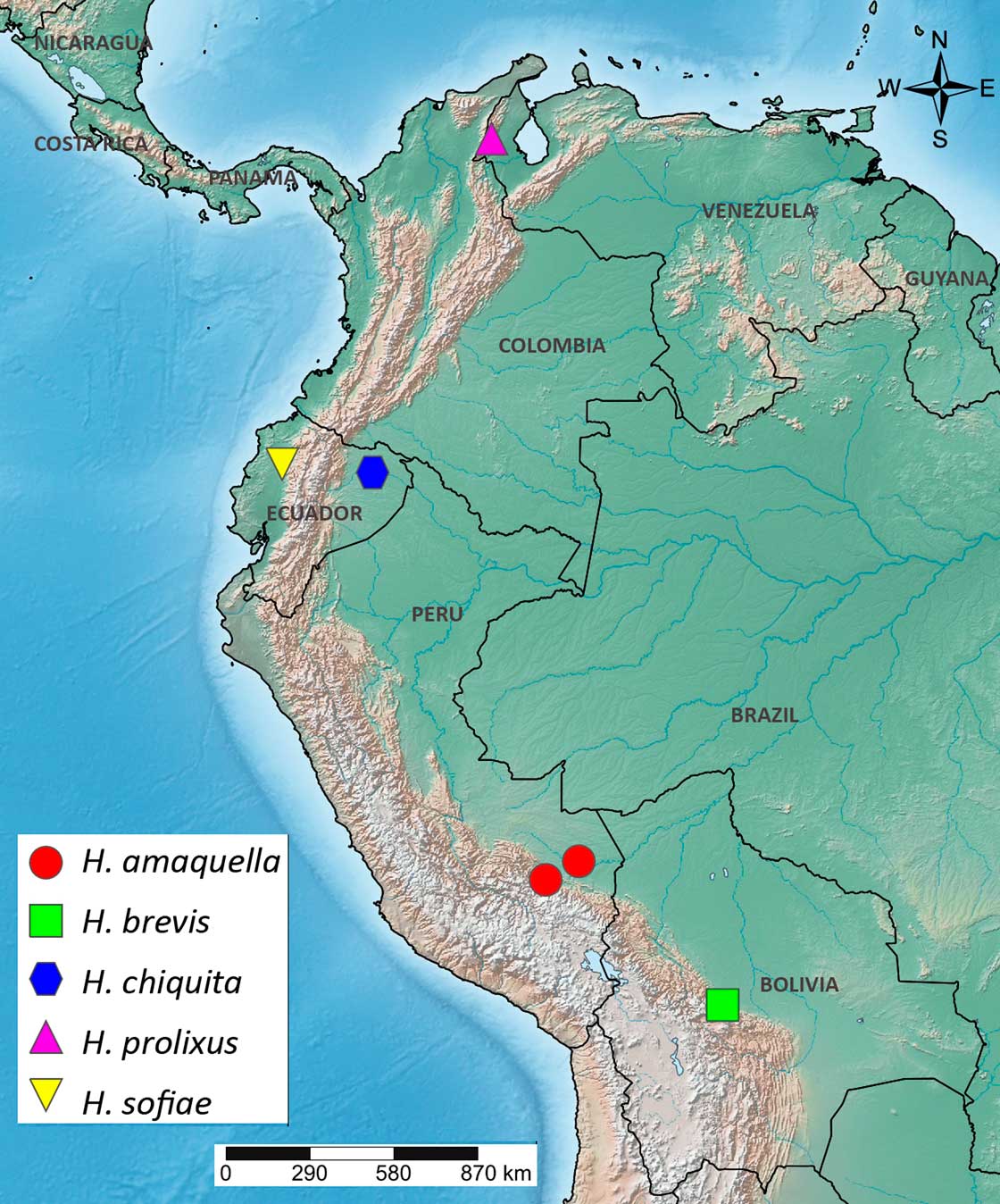
Geographic distribution of H. amaquella, H. brevis, H. chiquita, H. prolixus, and H. sofiae.
Diagnosis. Face immediately below antennal insertion with medial weakly to moderately convexity; protarsal claw long, abruptly and strongly curved, with short, sparse pectinae reaching at least 0.6 times its length; metasomal tergite I with lateromedian longitudinal carinae about 0.6 times length of tergite; ovipositor moderately long, 2.8 times as long as length of metatibia; head with pale mark on facial and frontal orbit reaching back to level of lateral ocellus; gena black next to compound eye (Fig. 4B–C); mesoscutum black with anterolateral white mark, without central white spot; metafemur orange, at most with distal tip brown (Fig. 4A); metapleuron and propodeum entirely orange.
Description. Female: fore wing length 6.6 mm. Head. Clypeus (Fig. 4B) of moderate breadth, 2.2 times as wide as high, granulate with punctures separated by 1.0–3.0 times puncture width, slightly convex, slightly flared outwards (centrally softly conical), without a transverse subapical ridge, apical margin centrally more-or-less straight; mandible tapering slightly, teeth subequal; face granulate with punctures separated by 1.0–2.5 times puncture width, below antennal insertion with a weak median convexity (Fig. 4C); malar space about 0.7 times as long as basal mandibular width; frons faintly granulate, smooth between toruli (without a median longitudinal sulcus-shaped impression); lateral ocellus separated from compound eye by about 1.5 times maximum ocellar diameter; distance between ocelli 1.5 times maximum ocellar diameter; occipital carina mediodorsally convex, lower-ventral end joining hypostomal carina close to base of mandible (carina about 0.2 times as long as basal mandibular width); gena in lateral view 0.3 times as long as compound eyes, granulate with punctures separated by 5.0–6.0 times puncture width; antenna with 32 flagellomeres. Mesosoma. Pronotum faintly granulate with isolated punctures on upper and posterior margins; without epomia, with wrinkle in same area. Mesoscutum faintly granulate and polished, with isolated punctures; notaulus barely impressed, extending through 0.4 times length of mesoscutum. Scutellum slightly convex, faintly granulate, without distinct lateral carina, with median, pit-like impression. Mesopleuron granulate (except distal half of speculum smooth and without punctures) with punctures separated by 1.0–2.5 times puncture width; upper end of epicnemial carina reaching about 0.2 times of way to anterior margin; metapleuron granulate with punctures separated by 0.5–1.0 times puncture width. Propodeum (Fig. 4D) granulate; anterior transverse carina faint, discernible centrally; posterior transverse carina strong, faint between lateromedian longitudinal carinae; lateral longitudinal carinae strong; lateromedian longitudinal carinae present only before anterior transverse carina; lateral longitudinal carinae strong; area basalis with shape of inverted trapezoid; area superomedia coffin shaped (about 2.7 times as long as wide); area externa about 1.6 times as wide as long. Prothoracic leg with pretarsal claw long, slender, and abruptly and strongly curved, with short, sparse pectinae. Fore wing with 3rs-m absent, 2rs-m about 1.3 times as long as abscissa of M between 2rs-m and 2m-cu; Cu1 between 1m-cu and Cu1a 1.5 times as long as Cu1b; 1m-cu fairly evenly arcuate, without ramellus. Hind wing with distal abscissa of Cu1 and 1A sclerotised throughout. Metasoma. Tergite I about 1.6 times as long as posteriorly wide, lateromedian longitudinal carina distinct for 0.6 times length of tergite; tergite II about 0.9 times as long as posteriorly wide. Ovipositor about 2.8 times as long as metatibia; its apex slightly compressed with a narrowed apical section. Colour. Head (Fig. 4B–C) black; mandible brown; palpi light brown with labial palpi 3–4 brown; orbits white (from mid face to after lateral ocellus); median tubercle reddish brown; antenna black with a white band on flagellum. Mesosoma (Fig. 4E) with pronotum black except anterior margin white; mesoscutum black except anterolateral margins white; scutellum predominantly white but anteriorly (shaped as inverted thin triangle) and posteriorly black; tegula white with posterior half brown; mesopleuron with anterior half black and posterior half orange, subalar prominence white and a reddish-brown spot at end of epicnemial carina; propodeum, metapleuron, and mesosternum orange. Legs (Fig. 4A) predominantly orange except procoxa ventrally, mesotarsomere 1 (with distal half changing gradually to white), protarsomere 5, mesotarsomere 5, metatarsomere 5, basal and distal end of metafemur and metatibiae laterodorsally brown; mesotarsomeres 2–4 white; metatarsomeres 1–4 white except basal quarter of metatarsomere 1 brown; wings hyaline. Metasomal tergites orange; ovipositor sheath dark brown with distal apex white.
Male: Unknown.
Remarks. The paratype differs from holotype in having antenna with 31 flagellomeres and face homogenusly black without a median reddish-brown tubercle.
Distribution. Peru (Fig. 5).
Etymology. The specific epithet amaquella means “do not be lazy” in Quechua and was one of the laws of the Incan Empire. It is treated as a noun in apposition.
Material examined. Holotype: ♀ “PERU: MD [Madre de Dios], Reserva Comunal Amarakaeri 12°58'57.54''S / 71°1'40.94''W 732 m, 30.IX–01.X.2010 Yellow [Pan trap] M. Vilchez, C. Castillo/PM14, B, 11/01, M1” (MUSM). Paratype: 1♀ “PERÚ: MD, Rio los Amigos CICRA 12.551520299°S / 70.104254549°W 279 m 30.V.2016 Malaise trap N. Zenteno” (MUSM).
Hapsinotus amarakaeri Alvarado, new species
http://zoobank.org/urn:lsid:zoobank.org:act:A2B1AA70-3DDA-45B1-8807-62C00F5DEBDD
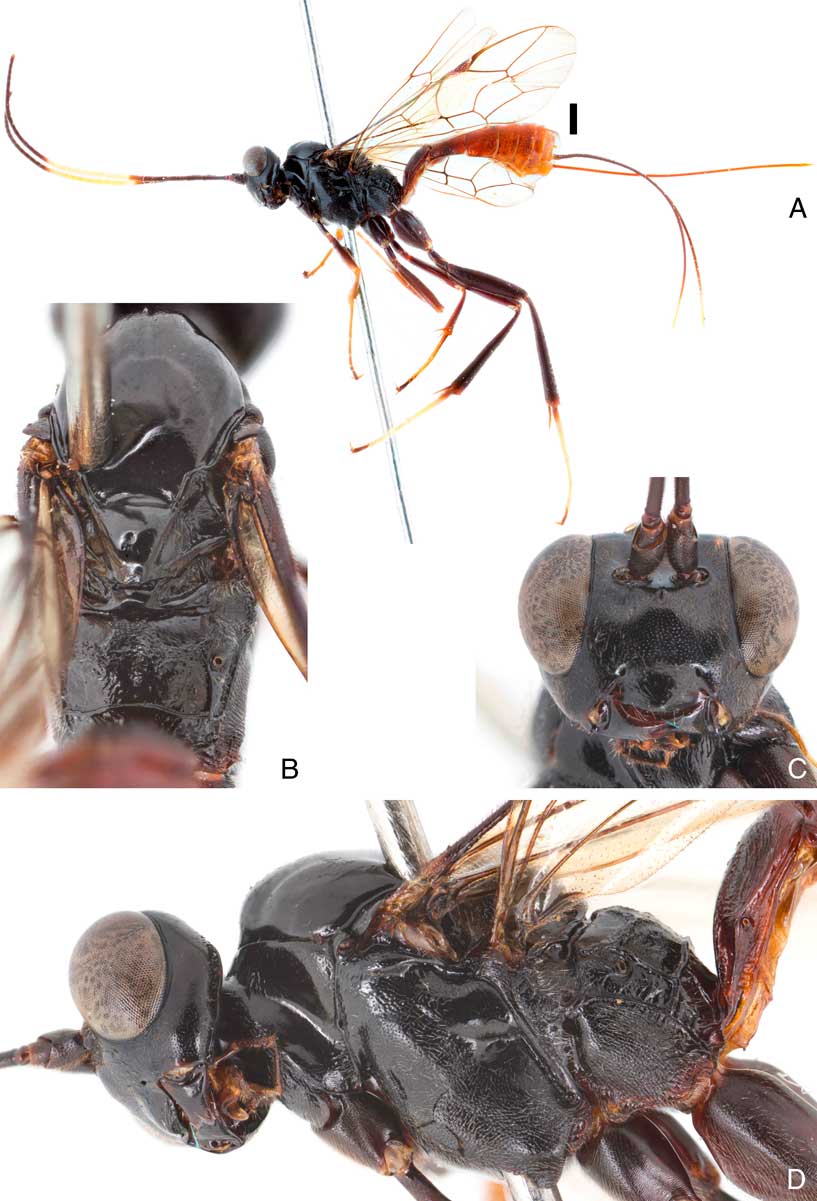
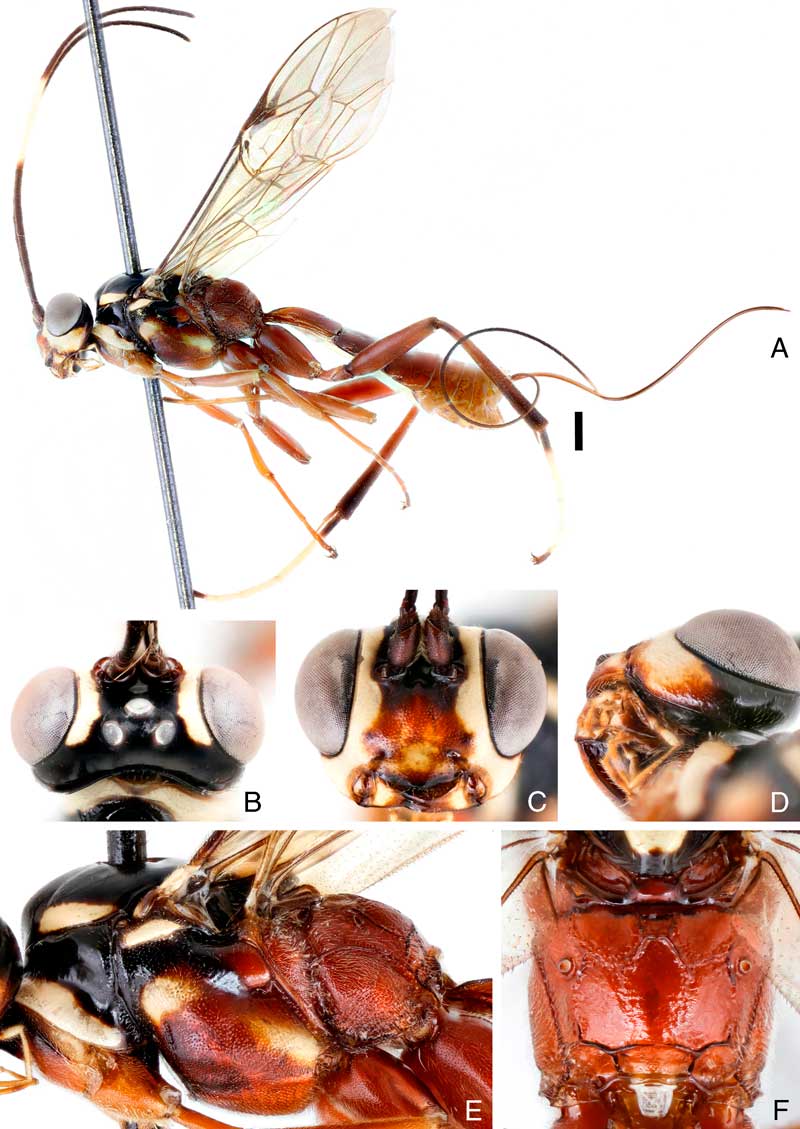
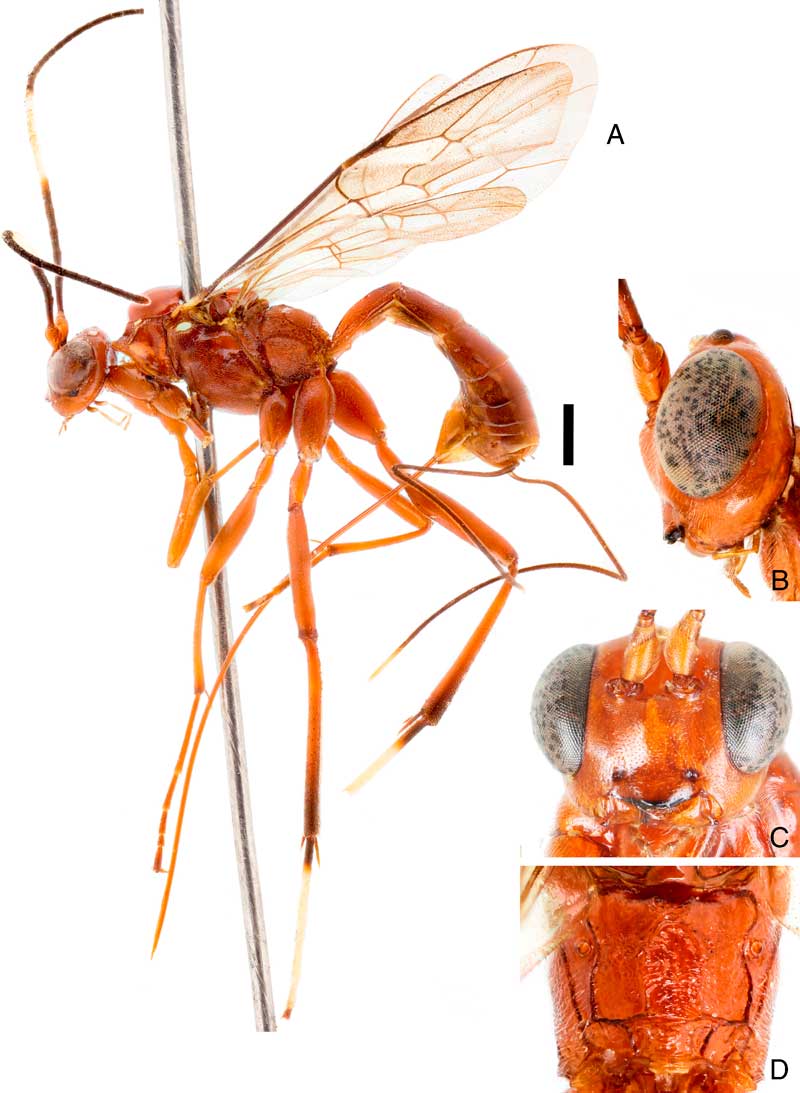
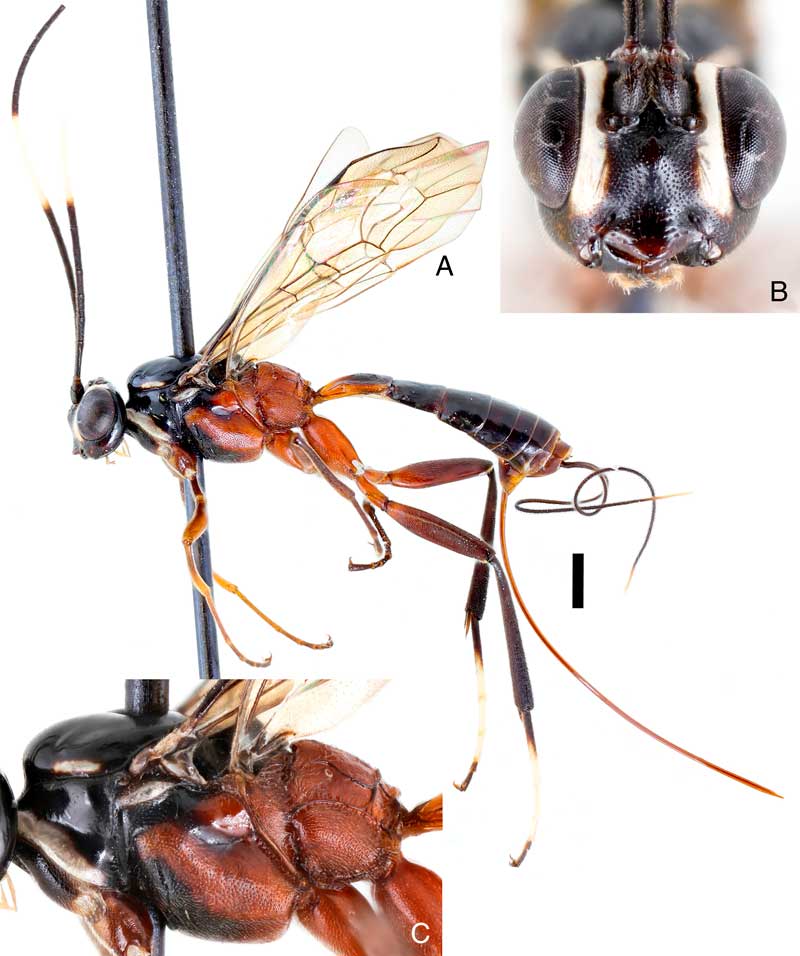
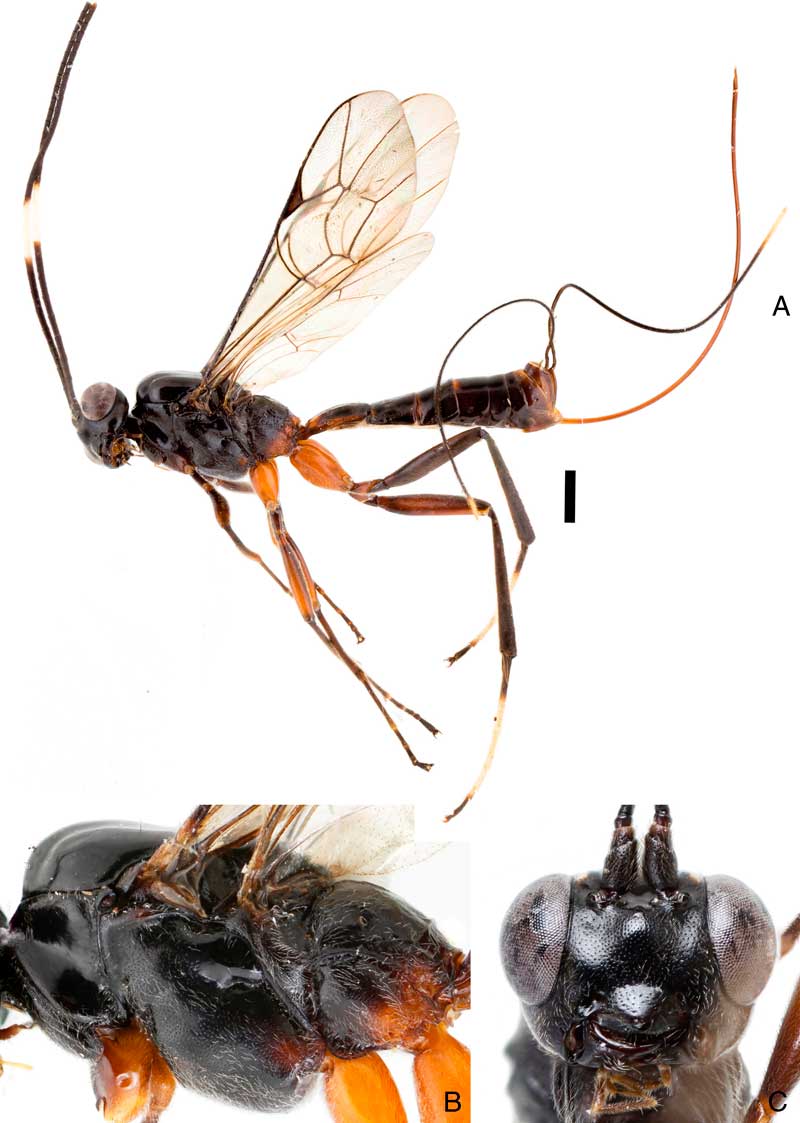
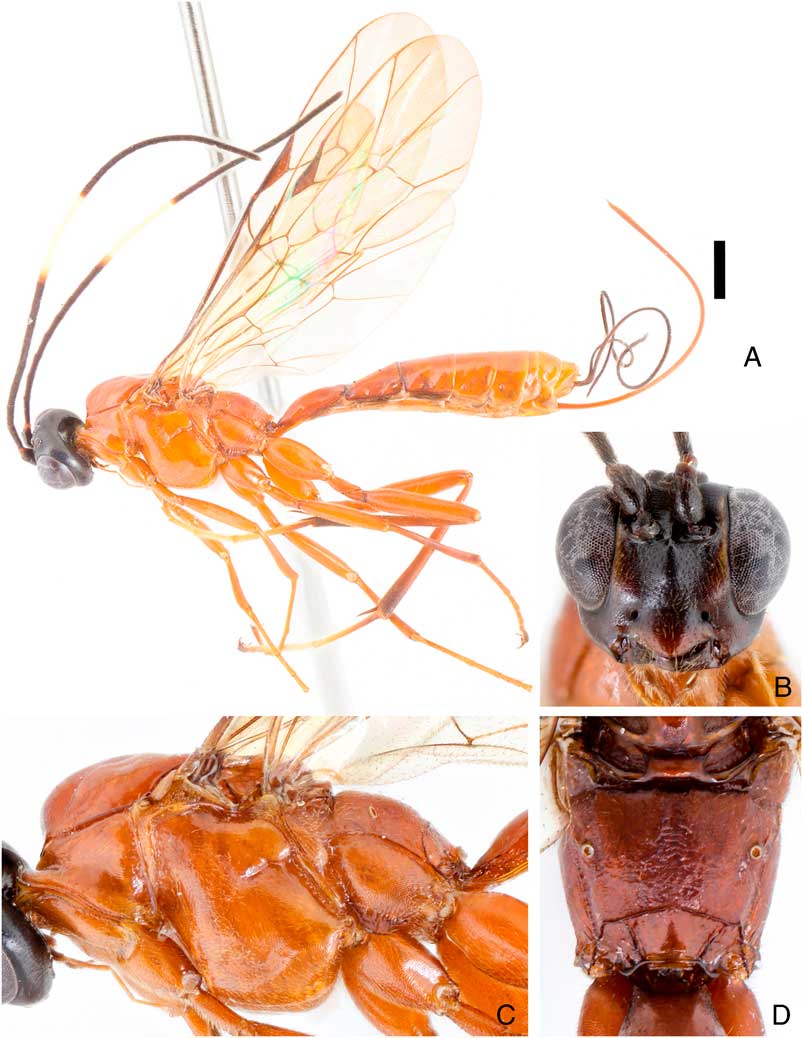
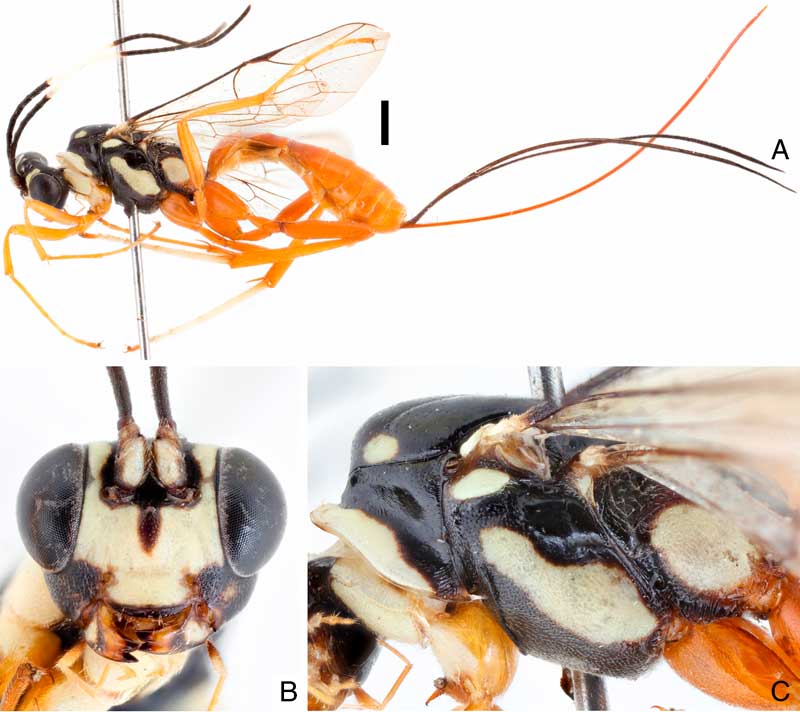
Morphology of Hapsinotus amarakaeri new species (holotype). A, Habitus (scale bar=1 mm); B, head, frontal view; C, head, lateral view; D, mesosoma, lateral view.

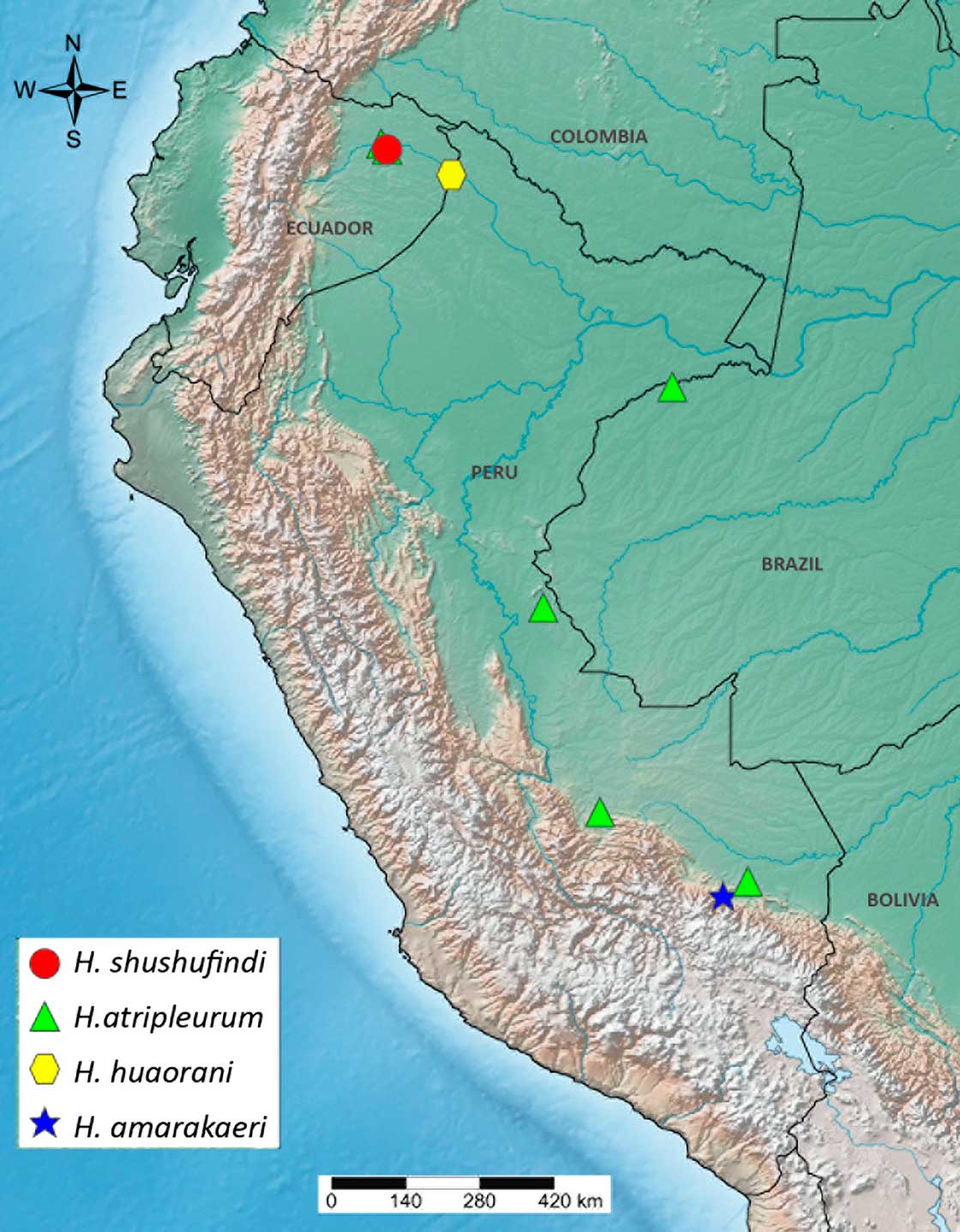
Geographic distribution of H. amarakaeri, H. atripleurum, H. huaorani, and H. shushufindi.

Diagnosis. Face immediately below antennal insertion with a medial weakly to moderately convexity; occipital carina mediodorsally evenly arcuate; protarsal claw moderately long, quite strongly bowed, pectinate for at least 0.6 times its length; propodeum with area superomedia 1.2 times as long as wide; ovipositor very long, 3.5–3.6 times as long as length of metatibia; head with pale mark on facial and frontal orbit reaching back to level of lateral ocellus; lower part of gena pale, upper part extensively black-marked next to compound eye (Fig. 6C); mesoscutum black with anterolateral small white marks; mesopleuron with white spots on upper end of epicnemial carina and other on lower posterior end (Fig. 6D); metapleuron predominantly black, sometimes posteriorly orange (Fig. 6D); propodeum black (Fig. 6A, D); metafemur red (Fig. 6A).
Description. Female: fore wing length 8.9 mm. Head. Clypeus (Fig. 6B) of moderate breadth, 2.0 times as wide as high, granulate with punctures (punctures separated by 1.0–2.5 times puncture width basally, posteriorly scatter), slightly convex, slightly flared outwards (centrally softly conical), without a transverse subapical ridge, apical margin centrally softly concave; mandible tapering slightly, upper tooth slightly longer than lower; face granulate with punctures separated by 1.0–1.5 times puncture width, below antennal insertion with a weak median convexity (Fig. 6B–C); malar space about 0.8 times as long as basal mandibular width; frons faintly granulate, but smooth between toruli (with median, longitudinal, sulcus-shaped impression from between toruli and median ocellus); lateral ocellus separated from compound eye by about 1.6 times maximum ocellar diameter, distance between ocelli about 1.6 times maximum ocellar diameter; occipital carina mediodorsally convex, lower-ventral end joining hypostomal carina close to base of mandible (carina about 0.2 times as long as basal mandibular width); gena in lateral view 0.3 times as long as compound eyes, granulate with punctures separated by 7.0–10.0 times puncture width; antenna with 16+ flagellomeres (antennae broken). Mesosoma. Pronotum faintly granulate with isolated punctures on upper and posterior margins; without epomia, with wrinkle in same area. Mesoscutum faintly granulate and polished, with isolated punctures; notaulus barely impressed, extending through 0.3 times length of mesoscutum. Scutellum slightly convex, faintly granulate, without distinct lateral carina and median, pit-like impression. Mesopleuron granulate (smooth and without punctures) with punctures separated by 1.5–2.5 times puncture width; upper end of epicnemial carina reaching about 0.3 times of way to anterior margin; metapleuron granulate with punctures separated by 0.5–1.0 times puncture width. Propodeum granulate; anterior transverse carina faint, well defined centrally; posterior transverse carina strong and well defined; lateral longitudinal carinae strong before anterior transverse carina, faint between transverse carinae, and absent after posterior transverse carina; lateromedian longitudinal carinae strong and well defined; area basalis with shape of inverted trapezoid; area superomedia more-or-less pentagonal (about 1.2 times as long as wide); area externa about 1.8 times as wide as long. Prothoracic leg with pretarsal claw long, slender, and abruptly and strongly curved, with short, sparse pectinae Fore wing with 3rs-m absent, 2rs-m about 1.7 times as long as abscissa of M between 2rs-m and 2m-cu; Cu1 between 1m-cu and Cu1a 1.8 times as long as Cu1b; 1m-cu fairly evenly arcuate, without ramellus. Hind wing with distal abscissa of Cu1 and 1A sclerotised throughout. Metasoma. Tergite I about 1.6 times as long as posteriorly wide, lateromedian longitudinal carina distinct for 0.7 times length of tergite; tergite II about 0.8 times as long as posteriorly wide. Ovipositor about 3.6 times as long as metatibia; its apex slightly compressed with a narrowed apical section. Colour. Head (Fig. 6B–C) black; mandible distally brown; orbits (from mid face to after lateral ocellus) off-white; spot on malar space and palpi off-white; antenna black with a yellowish-white band on flagellum. Mesosoma (Fig. 6D) with pronotum black except anterior margin yellowish white; mesoscutum black except a yellowish-white spot at centre of anterolateral margins; scutellum predominantly yellowish white but basally (shaped as inverted thin triangle) and posteriorly black; tegula yellowish white with posterior half brown; mesopleuron black with subalar prominence, a yellowish-white spot at end of epicnemial carina, and a yellowish-white spot in lower posterior corner; mesosternum, propodeum and metapleuron (except posteriorly light brown) black. Prothoracic leg with coxa (except ventrally brown) and trochanter reddish brown. Mesothoracic leg (Fig. 6A) reddish brown. Metathoracic leg (Fig. 6A) reddish brown except femur and tibia basally dark brown, tarsomere 1–4 yellowish white, and tarsomere 5 brown. Metasomal tergites reddish brown; ovipositor sheath dark brown with distal apex light brown. Wings hyaline.
Male: Unknown.
Remarks. The body is yellowish white instead of white is unusual for the genus so it may be a consequence of the exposure to a chemical substance.
Distribution. Peru (Fig. 7).
Etymology. The specific epithet amarakaeri is in honour to one of the groups of the Harakmbut, an indigenous people in Peru inhabiting Cusco and Madre de Dios. It is treated as a noun in apposition.
Material examined. Holotype: ♀ “Quincemil, Peru 750 m nr. Marcapata September, 1962 Luis Pena” (USUC). Individual missing several sections of the body: prothoracic legs missing after trochantellus, left mesothoracic leg, right mesotarsomeres, and part of the antennae.
Hapsinotus amasua Alvarado, new species
http://zoobank.org/urn:lsid:zoobank.org:act:25A34E64-BE14-4B6D-9E1F-5D3A5FF3A521
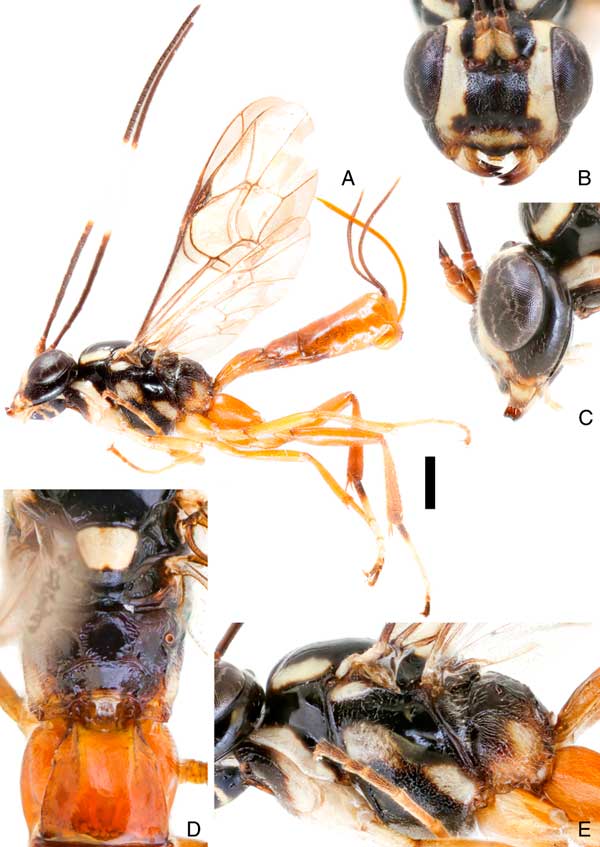
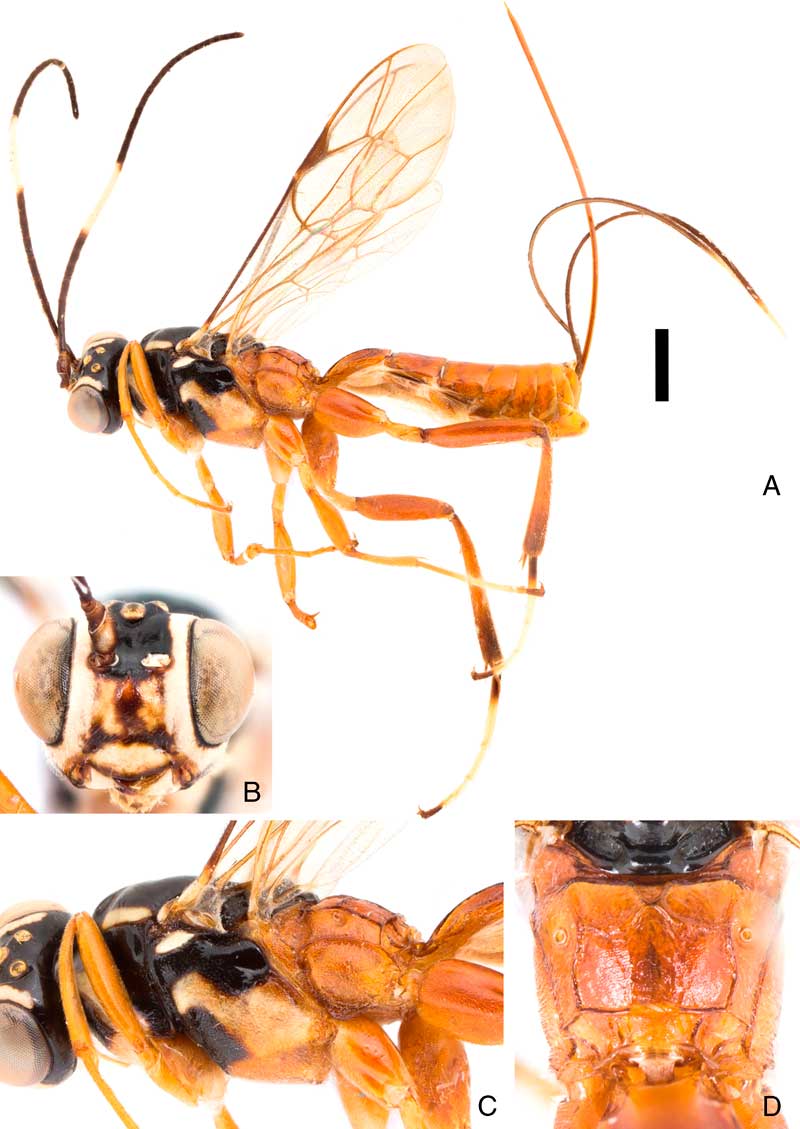
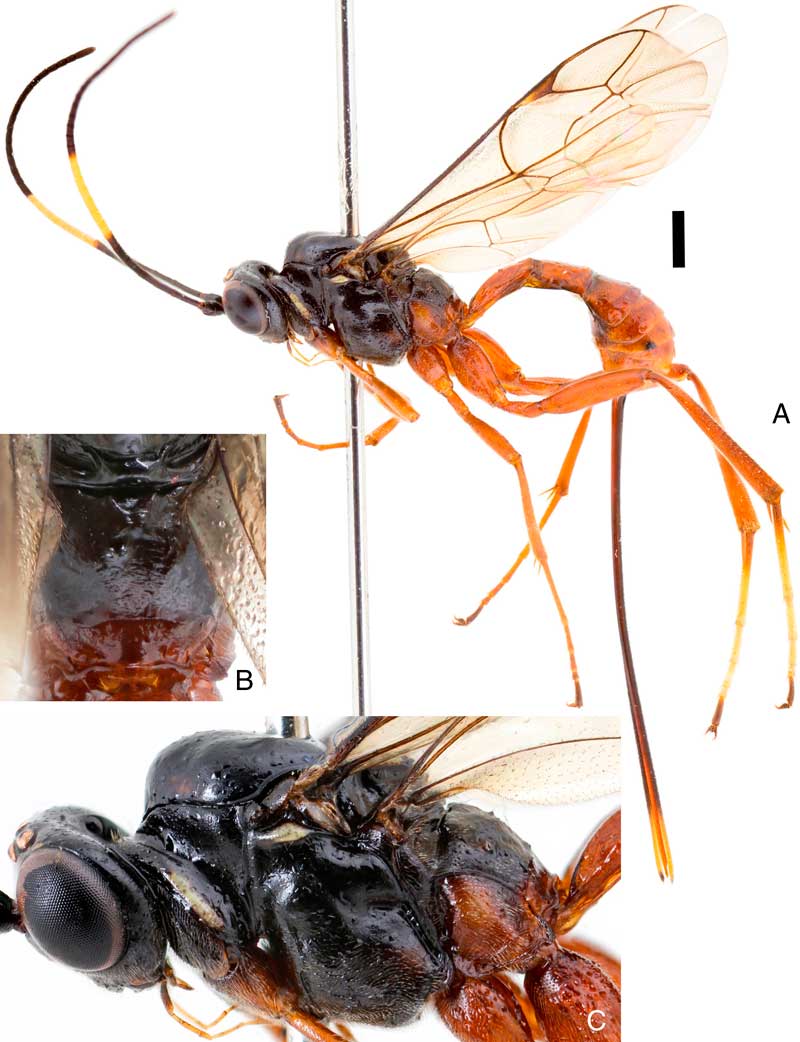
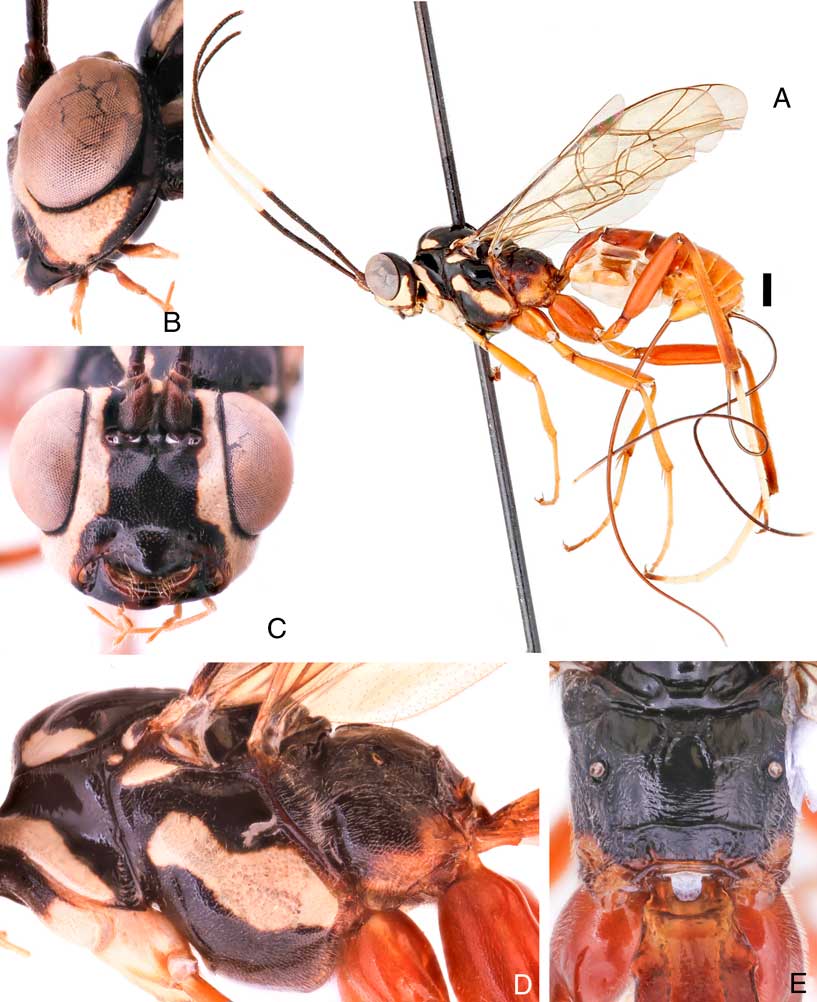
Morphology of Hapsinotus amasua new species (holotype). A, Habitus (scale bar=1 mm); B, head, frontal view; C, head, ventro-lateral view; D, propodeum; E, mesosoma, lateral view.

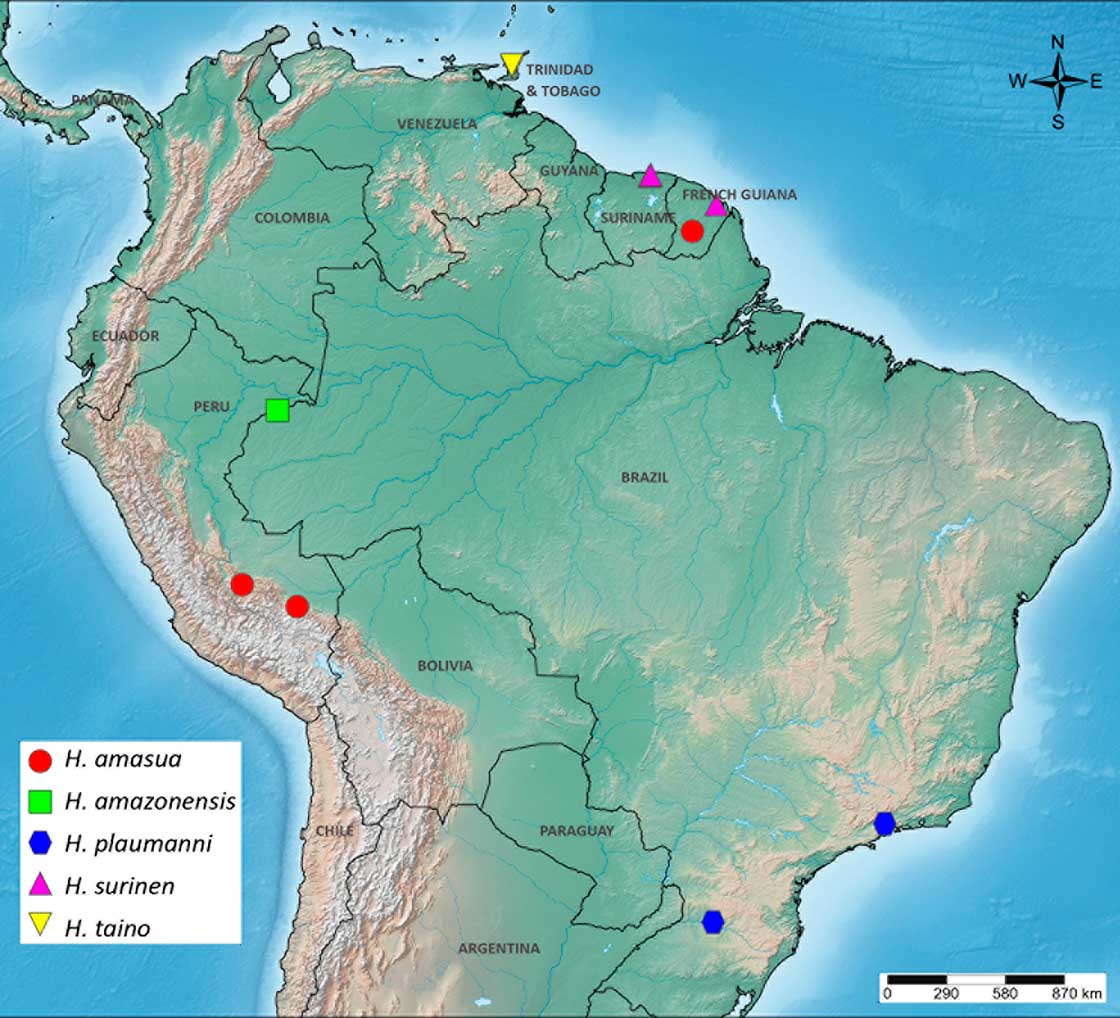
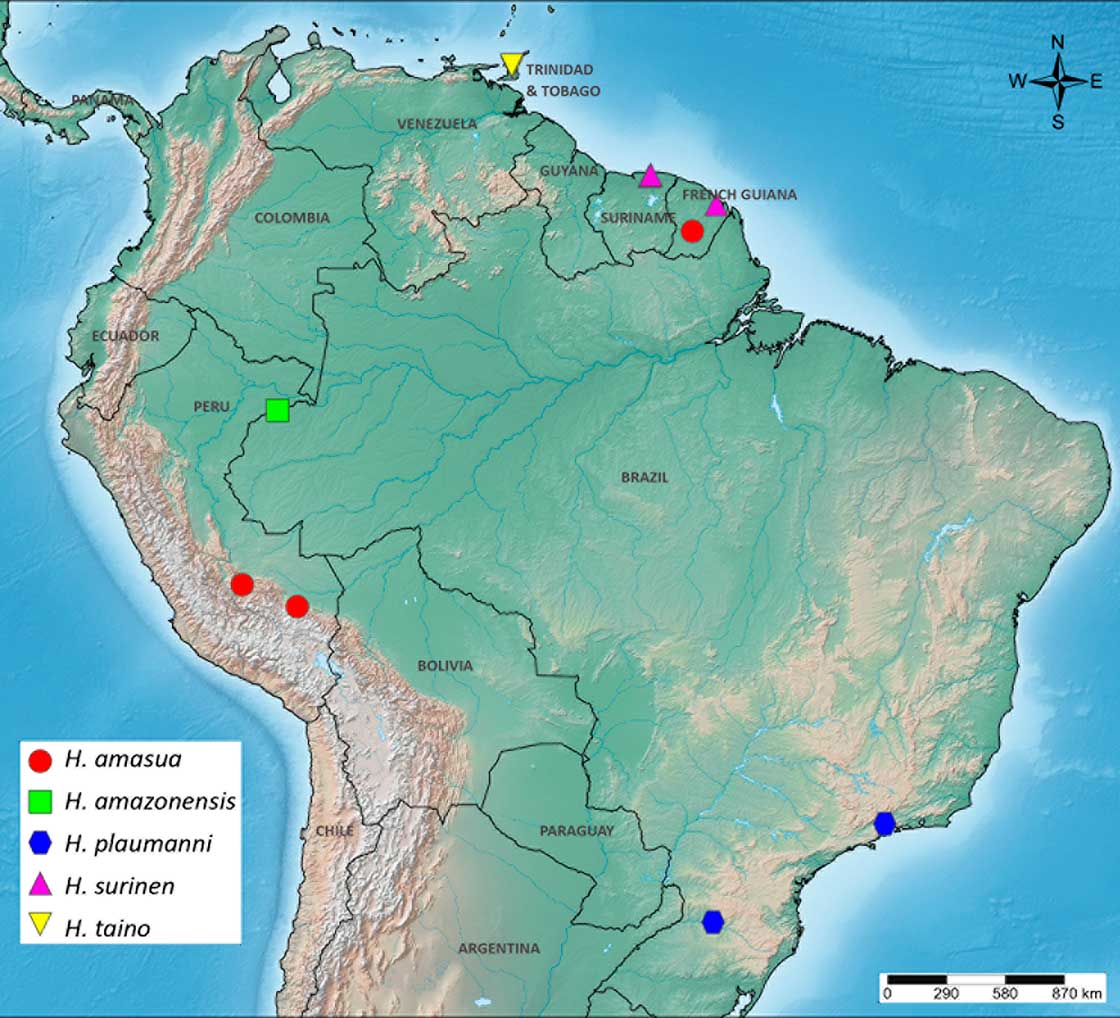
Geographic distribution of H. amasua, H. amazonensis, H. plaumanni, H. surinen, and H. taino.
Diagnosis. Face immediately below antennal insertion with a median strong convexity (Fig. 8B); occipital carina mediodorsally evenly arcuate; protarsal claw long, abruptly and strongly curved, with short, sparse pectinae reaching at least 0.6 times its length; propodeum with area superomedia coffin shaped, about 2.0 times as long as wide (Fig. 8D); lateromedian longitudinal carinae discernible between transverse carinae (Fig. 8D); metasomal tergite I about 1.4 times as long as posteriorly wide, lateromedian longitudinal carinae 0.7–0.8 times length of tergite; ovipositor 2.7 times as long as length of metatibia; head with facial and frontal orbits, clypeus an malar space white (Fig. 8B–C); gena extensively black-marked next to compound eye (Fig. 8E); mesoscutum black, anterolateral margin (Fig. 8E) and a median white spot white; mesosternum black (Fig. 8E); metapleuron and propodeum entirely orange (Fig. 8E); metafemur red at most, with distal tip brown (Fig. 8A).
Description. Female: fore wing length 6.6 mm. Head. Clypeus (Fig. 8B) of moderate breadth, 2.2 times as wide as high, granulate with isolated punctures, slightly convex, slightly flared outwards (centrally softly conical), without a transverse subapical ridge, apical margin centrally weakly concave; mandible tapering slightly, teeth subequal; face granulate with punctures separated by 1.5–2.0 times puncture width, below antennal insertion with a strong median convexity (Fig. 8A); malar space about 0.7 times as long as basal mandibular width; frons faintly granulate, but smooth between toruli (with median, longitudinal, sulcus-shaped impression between toruli); lateral ocellus separated from compound eye by about 1.1 times maximum ocellar diameter, distance between ocelli 1.3 times maximum ocellar diameter; occipital carina mediodorsally convex, lower-ventral end joining hypostomal carina close to base of mandible (carina about 0.2 times as long as basal mandibular width); gena in lateral view 0.4 times as long as compound eyes, faintly granulate with isolated punctures; antenna with 32 flagellomeres. Mesosoma. Pronotum faintly granulate with isolated punctures; without epomia, but with a weak wrinkle in a homologous place. Mesoscutum slightly granulate, polished, with isolated punctures; notaulus barely impressed, extending through 0.4 times length of mesoscutum. Scutellum slightly convex, faintly granulate, without distinct lateral carina and median, pit-like impression. Mesopleuron faintly granulate (except speculum smooth and without punctures) with punctures separated by 1.0–1.5 times puncture width; upper end of epicnemial carina reaching about 0.2 times of way to anterior margin; metapleuron convex, softly imbrincate with punctures separated by 0.4–0.8 times puncture width, distal third wrinkled. Propodeum (Fig. 8D) smooth; carinae strong; area basalis with shape of inverted trapezoid; area superomedia coffin shaped (about 1.9 times as long as wide); area externa about 1.4 times as wide as long. Prothoracic leg with pretarsal claw long, slender, and abruptly and strongly curved, with short, sparse pectinae. Fore wing with 3rs-m absent; 2rs-m about 1.5 times as long as abscissa of M between 2rs-m and 2m-cu; Cu1 between 1m-cu and Cu1a 1.8 times as long as Cu1b; 1m-cu fairly evenly arcuate, without ramellus. Hind wing with distal abscissa of Cu1 and 1A sclerotised throughout. Metasoma. Tergite I about 1.4 times as long as posteriorly wide, lateromedian longitudinal carina distinct for 0.8 times length of tergite; tergite II about 0.8 times as long as posteriorly wide. Ovipositor about 2.7 times as long as metatibia; its apex slightly compressed with a narrowed apical section. Colour. Head (Fig. 8A, C, E) predominantly black; mandible basally white, middle black, distally light brown; basal 2/3 of clypeus, palpi, and orbit (from lower third of gena to after lateral ocellus) white; antenna black with a white band on flagellum, scape ventrally white. Mesosoma (Fig. 8A, E) with pronotum black, anterior margin white; mesoscutum black, anterolateral margins and a central spot white; scutellum predominantly white, anteriorly (shaped as inverted thin triangle) and posteriorly black; tegula with anterior half white and posterior half brown; mesopleuron black but subalar prominence, a spot at end of epicnemial carina, and a spot next on lower posterior end (posteriorly orange) white; metapleuron and propodeum orange. Prothoracic leg (Fig. 8A) light brown; coxa ventrally white, tarsomere 4–5 brown; mesothoracic leg (Fig. 8A) orange; tarsomere 4–5 brown, distal half of tarsomeres 1–3 white; metathoracic leg (Fig. 8A) orange; distal dorsal half of femur gradually changing to brown, distal 4/5 of tarsomeres 1–4 white, basal 1/5 of tarsomere 1 and tarsomere 5 brown; wings hyaline. Metasomal tergites reddish brown; ovipositor sheath mostly black with distal apex white.
Male: Unknown.
Remarks. The paratype series varies from holotype in the following: lateral ocellus separated from compound eye by about 1.2 times maximum ocellar diameter, distance between ocelli 1.4 times maximum ocellar diameter, metasomal tergite I with lateromedian longitudinal carinae 0.7–0.8 times length of tergite, and ovipositor 2.7–2.8 times as long as metatibia.
Distribution. French Guiana and Peru (Fig. 9).
Etymology. The specific epithet amasua means “do not steal” in Quechua and was one of the laws of the Incan Empire. It is treated as a noun in apposition.
Material examined. Holotype: ♀ “PERÚ: CU. [Cusco] La Convención, Reserva Comunal Matsigenga 695 m, 12°09'41.31''S / 73°05'42.09''W 31.I-2.II.2011 C. Rossi” (MUSM). Paratypes: 1♀ “Quincemil, Perú 750 m nr. Marcapata Oct. 20–30, 1962 Luis Peña” (USUC); and 1♀ “FRENCH GUIANA: Saül, Pointe de vue de Belvedere, 1.5 m 3°22'N 53°12'34''W 7.III.2011 S.E.A.G. FIT [CNC493219]” (CNC).
Hapsinotus amazonensis Alvarado, new species
http://zoobank.org/urn:lsid:zoobank.org:pub:328BDEE1-E262-4590-A0FA-CC6CC019E8F0
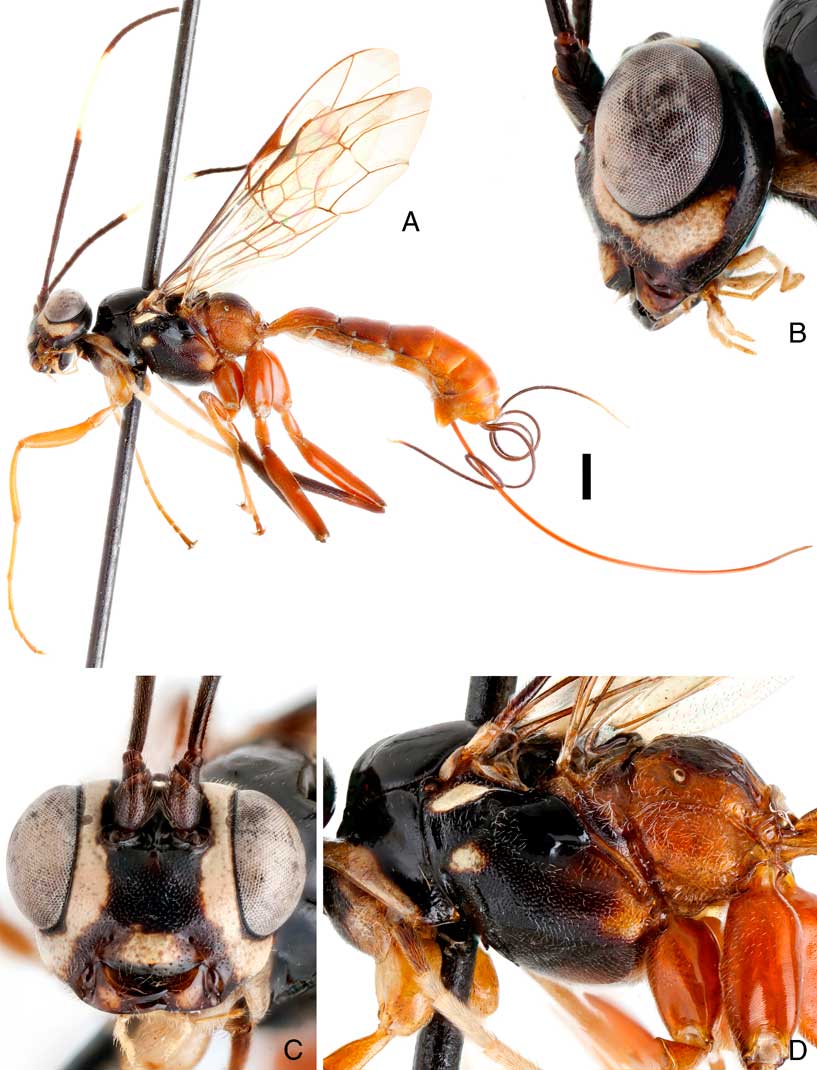
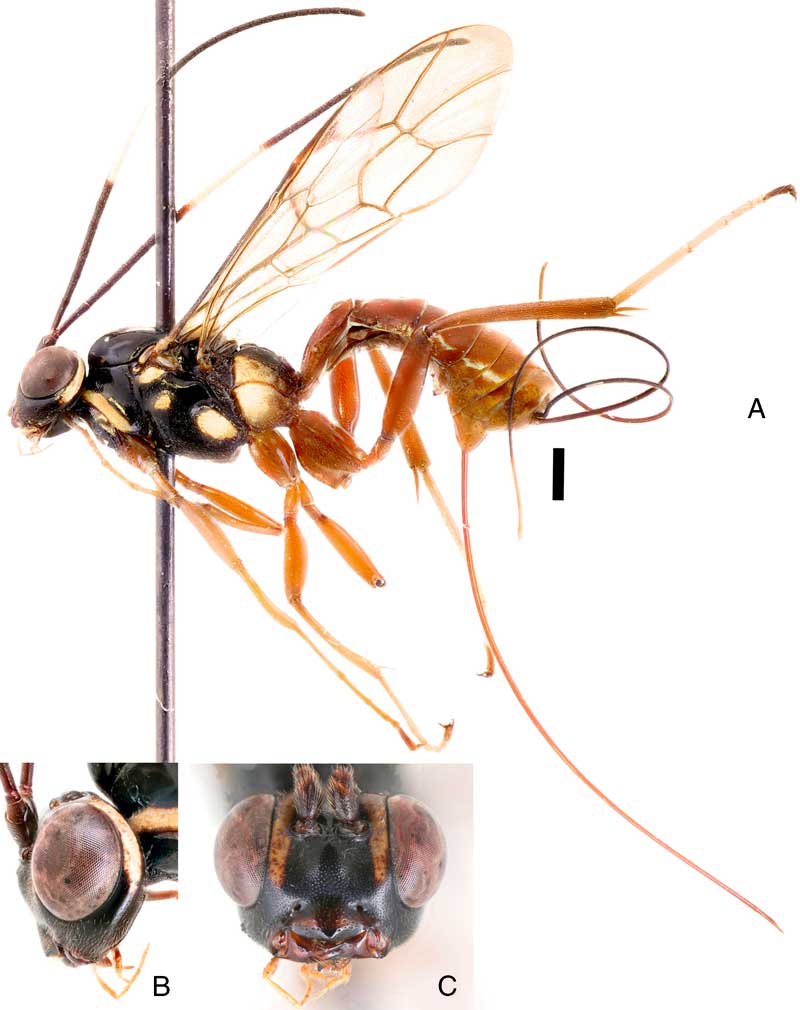
Morphology of Hapsinotus amazonensis new species (holotype). A, Habitus (scale bar=1 mm); B, head, lateral view; C, head, frontal view; D, mesosoma, lateral view.
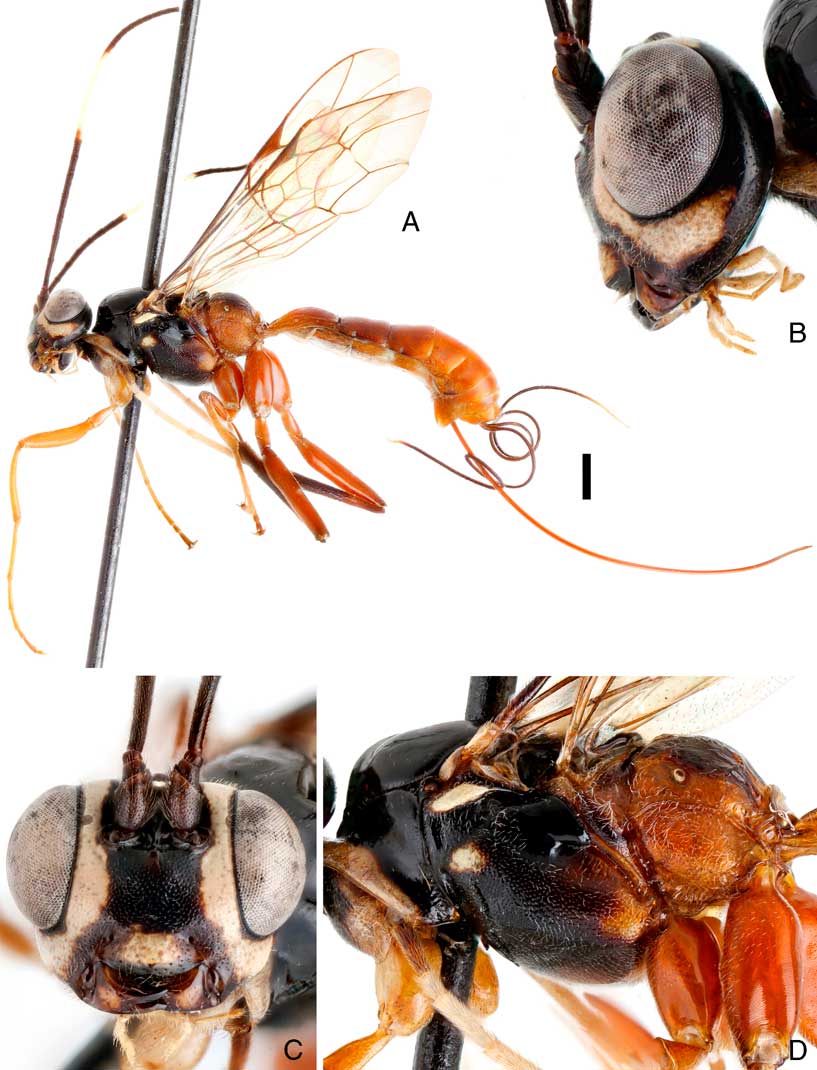
Diagnosis. Face, below antennal insertion with a weak median convexity (Fig. 10B–C); occipital carina mediodorsally evenly arcuate; lateral ocellus separated from compound eye by about 1.4 times maximum ocellar diameter; protarsal claw long, slender, abruptly and strongly curved, with short, sparse pectination at least along 0.6 its length; ovipositor long, 3.2 times as long as length of metatibia; pronotum with anterior margin white (Fig. 10A, D); mesoscutum and scape black (Fig. 10C–D).
Description. Female: fore wing length 7.2 mm. Head. Clypeus (Fig. 10C) of moderate breadth, 2.1 times as wide as high, granulate with punctures (punctures separated by 1.0–2.5 times puncture width), slightly convex, slightly flared outwards (centrally softly conical), without a transverse subapical ridge, apical margin centrally straight; mandible tapering slightly, upper tooth slightly longer than lower; face granulate with punctures separated by 1.0–1.5 times puncture width, below antennal insertion with a weak median convexity (Fig. 10B); malar space about 0.8 times as long as basal mandibular width; frons faintly granulate but smooth between toruli (with median, longitudinal, sulcus-shaped impression from between toruli), with a longitudinal, sulcus-shaped impression anterior to median ocellus; lateral ocellus separated from compound eye by about 1.4 times maximum ocellar diameter, distance between ocelli about 1.0 times maximum ocellar diameter; occipital carina mediodorsally convex, lower-ventral end joining hypostomal carina close to base of mandible (carina about 0.2 times as long as basal mandibular width); gena in lateral view 0.4 times as long as compound eyes, granulate with punctures separated by 4.0–9.0 times puncture width; antenna with 34 flagellomeres. Mesosoma. Pronotum faintly granulate with isolated punctures on upper and posterior margins; without epomia, with wrinkle in same area. Mesoscutum faintly granulate and polished, with isolated punctures; notaulus barely impressed, extending through 0.4 times length of mesoscutum. Scutellum slightly convex, faintly granulate, without distinct lateral carina and median, pit-like impression. Mesopleuron granulate (except speculum smooth and without punctures) with punctures separated by 0.5–1.5 times puncture width; upper end of epicnemial carina reaching about 0.3 times of way to anterior margin; metapleuron granulate with punctures separated by 0.5–1.0 times puncture width. Propodeum granulate; anterior transverse carina faint, well defined centrally; posterior transverse carina present and well defined but absent between lateromedian longitudinal carinae; lateromedian longitudinal carinae strong before anterior transverse carina, faint between transverse carinae, and absent after posterior transverse carina; lateral longitudinal carinae strong and well defined; area basalis with shape of inverted trapezoid; area superomedia more-or-less pentagonal (about 1.9 times as long as wide); area externa about 1.9 times as wide as long. Prothoracic leg with pretarsal claw long, slender, and abruptly and strongly curved, with short, sparse pectinae. Fore wing with 3rs-m absent, 2rs-m about 1.9 times as long as abscissa of M between 2rs-m and 2m-cu; Cu1 between 1m-cu and Cu1a 1.7 times as long as Cu1b; 1m-cu fairly evenly arcuate, without ramellus. Hind wing with distal abscissa of Cu1 and 1A sclerotised throughout. Metasoma. Tergite I about 1.4 times as long as posteriorly wide, lateromedian longitudinal carina distinct for 0.6 times length of tergite; tergite II about 0.7 times as long as posteriorly wide. Ovipositor about 3.2 times as long as metatibia; its apex slightly compressed with a narrowed apical section. Colour. Head (Fig. 10B–C) black; mandible centrally brown, orbits (from lower third of gena to after lateral ocellus) and palpi white; clypeus centrally white and laterally light brown, distal margin black; antenna black with a white band on flagellum. Mesosoma (Fig. 10D) with pronotum, anterior margin white; mesoscutum black, light brown spot at centre of anterolateral margin; scutellum predominantly white, anteriorly (shaped as inverted thin triangle) and posteriorly black; tegula white with distal margin brown; mesopleuron black, subalar prominence white, a spot at end of epicnemial carina white, lower posterior corner reddish brown (white on most distal lower corner); mesosternum black; propodeum brown, between pleural and lateral longitudinal carinae (but before posterior transverse carina) reddish brown, area petiolaris and posteroexterna reddish brown but centrally gradually changing to brown; metapleuron reddish brown; prothoracic leg (Fig. 10A) light brown, coxa anteriorly white; mesothoracic leg (Fig. 10A) orange, tibia and tarsomere 1–4 light brown, tarsomere 5 brown; metathoracic leg (Fig. 10A) reddish orange, femur basally and distally gradually changing to brown, tibia brown (basally light brown), tarsomere 1 with basal quarter of its length and tarsomere 5 brown, tarsomere 1 with distal 3/4 of its length and tarsomere 2–4 white; wings hyaline. Metasomal tergites reddish brown; ovipositor sheath dark brown with distal apex white.
Male: Unknown.
Distribution. Brazil (Fig. 9).
Etymology. The specific epithet amazonensis is based on the Brazil state where the holotype was collected, Amazonas.
Material examined. Holotype: ♀ “Amazonas, Brazil 71°38'W, 4°33'S IX.’79 Alvarenga” (USUC).
Hapsinotus atripleurum Townes, Reference Townes1970
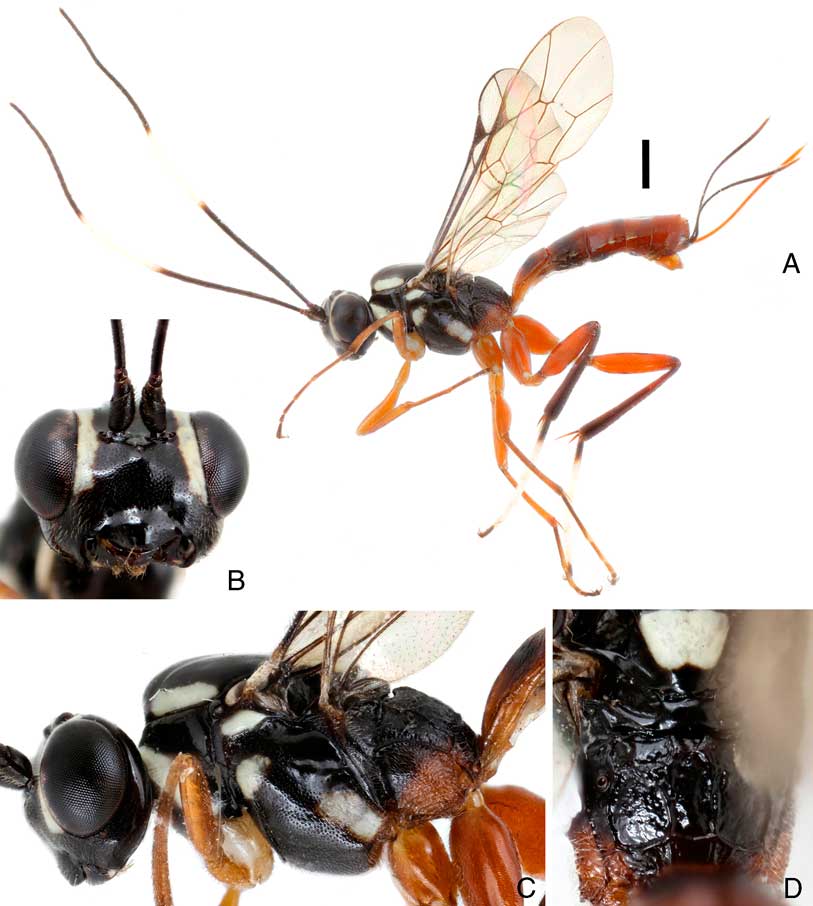
Morphology of Hapsinotus atripleurum Townes, Reference Townes1970. A, Habitus of paratype (paratype, scale bar=1 mm); B, head, dorso-lateral view (non-type); C, head, frontal view (non-type); D, mesosoma, lateral view (non-type); E, propodeum (non-type).
Diagnosis. Face below antennal insertion, with a medial weak convexity; occipital carina mediodorsally evenly arcuate; prothoracic pretarsal claw moderately long, quite strongly bowed, pectinate for at least 0.6 times its length; propodeum with area superomedia 1.5–1.8 times as long as wide (Fig. 11E); ovipositor very long, 3.5–3.6 times as long as length of metatibia; upper part of genal orbits extensively black-marked next to compound eye (Fig. 11B); mesoscutum black, anterolateral margin and central spot white; mesopleuron with a white diagonal stripe from upper end of epicnemial carina to its lower posterior end (Fig. 11D); metapleuron mostly black, posteroventrally light brown to orange (Fig. 11D); propodeum black (Fig. 11E); metafemur red (Fig. 11A).
Remarks. Additional characters to the original description are: clypeus 1.9–2.0 times as wide as high (Fig. 11C), malar space 0.7–0.8 times as long as basal mandibular width, lateral ocellus separated from compound eye by 1.1–1.3 times maximum ocellar diameter, distance between ocelli 1.1 times maximum ocellar diameters, antenna with 29–33 flagellomeres, propodeum (Fig. 11E) with area externa 1.4–1.6 times as wide as long, lateromedian longitudinal carinae faint but discernible between transverse carinae, fore wing with 2rs-m 1.7–1.8 times as long as abscissa of M between 2rs-m and 2m-cu; Cu1 between 1m-cu and Cu1a 1.4–1.6 times as long as Cu1b. Tergite I about 1.6 times as long as posteriorly wide, and metapleuron mostly black, with posteroventral part brownish orange. This species is quite alike to H. planifascies but H. atripleurum has the face slightly convex (Fig. 11B), not flat as in H. planifascies. Additionally, H. planifascies has mesopleuron black with a small white spot on upper end of epicnemial carina, while H. atripleurum has mesopleuron (Fig. 11A, D) black with a white diagonal stripe from upper end of epicnemial carina to its lower posterior end.
Distribution. This species was only known from Peru; its distribution is expanded to Brazil and Ecuador. This species occurs in lowland of the Amazon Basin (Fig. 7).
Material examined. Paratype: 1♀: “Avispas near Marcapata, 30 m, Peru, Oct. 20–30, 1962, L. Peña” (USUC). Non-type material: BRAZIL: 2♀♀ “Amazonas, Brazil 71°38'W, 4°33'S IX.'79 Alvarenga” (USUC). ECUADOR: ♀ “ECUADOR: Sucumbios, Rio Napo, Sacha Lodge, 0°30'S 76°30'W, 270 m, 20–30.IX.1994, Malaise trap, P. Hibbs [CNC493211]” (CNC); ♀ “ECUADOR: Sucumbios, Rio Napo, Sacha Lodge, 0°30'S 76°30'W, 270 m, 13–23.IV.1994, Malaise trap, P. Hibbs [CNC493212]” (CNC); and, ♀ “ECU: Napo, 250 m Limoncocha 21–28.VI.76 S. Peck” (USUC). PERU: 1♀: “PERÚ: UC [Ucayali]. Coronel Portillo, Calleria, Abujau 08°17'10.4''S/73°41'54.4''W 237 m 28–30.IV.2013 L. Sulca”; and, 1♀: “PERÚ: CU [Cusco], Camisea, Konkariari Creek, 11°48'S/72°52'W, 300 m, 27.X.1997, Malaise, J. Santiesteban & G. Valencia” (MUSM).
Hapsinotus bicolor Alvarado, new species
http://zoobank.org/urn:lsid:zoobank.org:act:20D785E0-8BDF-41EA-ADD8-6F65DB4A1C72
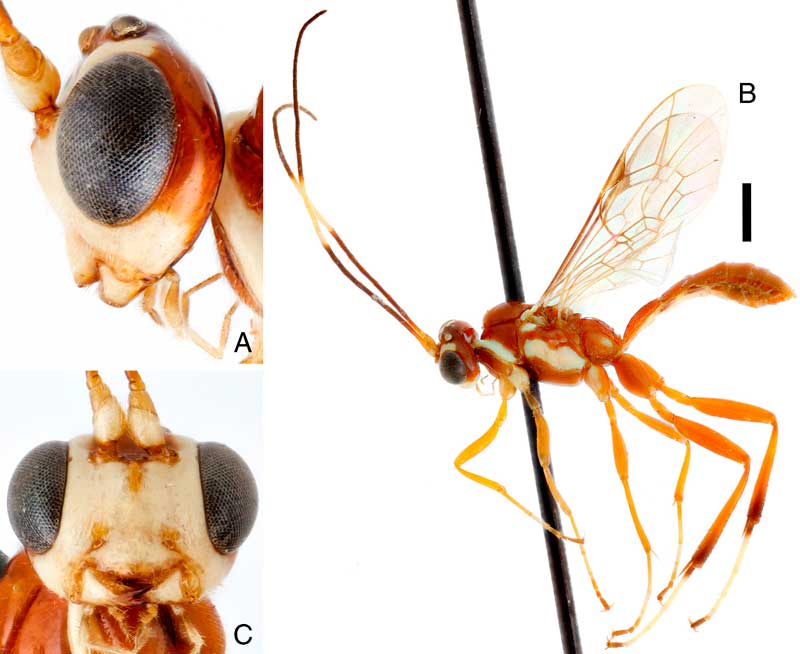
Morphology of Hapsinotus bicolor new species (holotype). A, Habitus (scale bar=1 mm); B, propodeum; C, head, frontal view; D, mesosoma, lateral view.

Diagnosis. Face below antennal insertion, with a medial weak convexity below median tubercle (Fig. 12C); occipital carina mediodorsally evenly arcuate; lateral ocellus separated from compound eye by 1.2 times maximum ocellar diameter; area superomedia hexagonal 1.3 times as long as wide (Fig. 12B); ovipositor long, 2.4 times as long as length of metatibia; prothoracic pretarsal claw long, slender, abruptly and strongly curved, with short, sparse pectinae at least along 0.6 its length; pronotum, mesoscutum and scape black (Fig. 12D); metasoma predominantly red (Fig. 12A).
Description. Female: fore wing length 9.3 mm. Head. Clypeus (Fig. 12C) of moderate breadth, 2.0 times as wide as high, granulate with isolated punctures, slightly convex, slightly flared outwards (centrally softly conical), without a transverse subapical ridge, apical margin centrally weakly convex; mandible tapering slightly, upper tooth longer than lower; face granulate with punctures separated by 1.5–2.0 times puncture width, below antennal insertion with a weak median convexity; malar space about 0.8 times as long as basal mandibular width; frons faintly granulate, but smooth between toruli (with median, longitudinal, sulcus-shaped impression from between toruli to median ocellus); lateral ocellus separated from compound eye by about 1.2 times maximum ocellar diameter, distance between ocelli 0.9 times maximum ocellar diameters; occipital carina mediodorsally convex, lower-ventral end joining hypostomal carina close to base of mandible (carina about 0.2 times as long as basal mandibular width); gena in lateral view 0.3 times as long as compound eyes, granulate with isolated punctures; antenna with 31–33 flagellomeres. Mesosoma. Pronotum faintly granulate with isolated punctures in upper, lower and distal sections; without epomia, but with a weak wrinkle in a homologous place. Mesoscutum faintly granulate and polished, with isolated punctures; notaulus barely impressed, extending through 0.3 times length of mesoscutum. Scutellum slightly convex, faintly granulate, without distinct lateral carina, with median, pit-like impression. Mesopleuron granulate (except speculum and surrounding area smooth, without punctures) with punctures separated by 1.5–2.0 times puncture width; upper end of epicnemial carina reaching about 0.2 times of way to anterior margin; metapleuron granulate with punctures separated by 0.5–1.0 times puncture width. Propodeum (Fig. 12B) granulate; anterior transverse carina weak but discernible; posterior transverse carina complete and strong; lateral longitudinal carinae strong; lateromedian longitudinal carinae present before posterior transverse carina faint but discernible between transverse carinae and after posterior transverse carina absent; area basalis with shape of inverted trapezoid; area superomedia hexagonal (about 1.3 times as long as wide); area externa about 1.9 times as wide as long. Prothoracic leg with pretarsal claw long, slender, and abruptly and strongly curved, with short, sparse pectinae. Fore wing with 3rs-m absent; 2rs-m about 1.4 times as long as abscissa of M between 2rs-m and 2m-cu; Cu1 between 1m-cu and Cu1a 2.1 times as long as Cu1b; 1m-cu fairly evenly arcuate, without ramellus. Hind wing with distal abscissa of Cu1 and 1A sclerotised throughout. Metasoma. Tergite I about 1.5 times as long as posteriorly wide, lateromedian longitudinal carina distinct for 0.7 times length of tergite; tergite II about 0.7 times as long as posteriorly wide. Ovipositor about 2.4 times as long as metatibia; its apex slightly compressed with a narrowed apical section. Colour. Head (Fig. 12C–D) black; mandible gradually changing on distal half to reddish brown; orbit (from mid frons to after medium ocellus) white; palpi brown; antenna black with a white band on flagellum. Mesosoma (Fig. 12D) black; legs (Fig. 12A) dark brown, protibia and protarsomeres 1–4 light brown, mesotibia and mesotarsemeres 1–4 light brown, distal 3/4 of metatarsomere 1 and tarsomeres 2–4 white; wings hyaline. Metasomal tergites reddish brown; ovipositor sheath dark brown with distal apex white.
Male: Unknown.
Remarks. The paratype is slightly larger (fore wing length 9.5 mm) than holotype. There are some differences in the paratype, it differs from holotype in the following: antenna with 31 flagellomeres, and metacoxa red.
Distribution. Ecuador and Peru (Fig. 3).
Etymology. The specific epithet is the Latin term bicolor, means “having two colours”, in reference to the bicoloured body. It is treated as a noun in apposition.
Material examined. Holotype: ♀ “PERU: Loreto Boquerón Abad 28.III.1962 J.M. Schunke B.M. 1962-491” (NHML). Paratype: 1♀ “Napo, Ecuador Baeza, 2000 m. Feb.’79 Mason” (USUC).
Hapsinotus brevicaudus Ugalde-Gómez and Gauld, Reference Ugalde-Gómez and Gauld2002
Diagnosis. Face, below antennal insertion, centrally with a moderate convexity; occipital carina mediodorsally evenly arcuate. Scutellum without median, pit-like impression; propodeum with anterior transverse carina centrally, close to its anterior margin, so area basalis indiscernible; area superomedia hexagonal, about 1.0 times as long as wide; ovipositor short, 1.4–1.5 times as long as length of metatibia; metapleuron and propodeum entirely reddish brown.
Distribution. Costa Rica (Ugalde-Gómez and Gauld Reference Ugalde-Gómez and Gauld2002).
Material examined. Paratype: ♀ “COSTA RICA: Limon Pv Cauhita NP 10 m vi.88 Gauld & Mitchel” (MNCR).
Hapsinotus brevis Alvarado, new species
http://zoobank.org/urn:lsid:zoobank.org:act:D4011D48-E986-4185-97A9-C402C58F2DB4
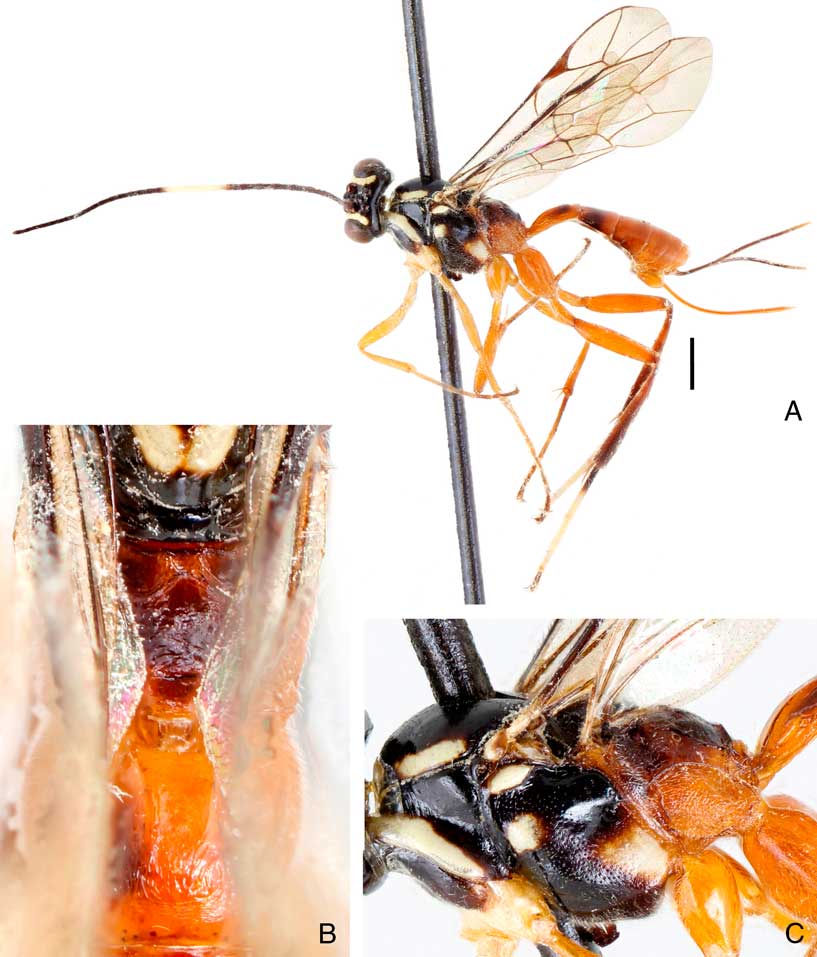
Morphology of Hapsinotus brevis new species (holotype). A, Habitus (scale bar=1 mm); B, propodeum; C, mesosoma, lateral view.
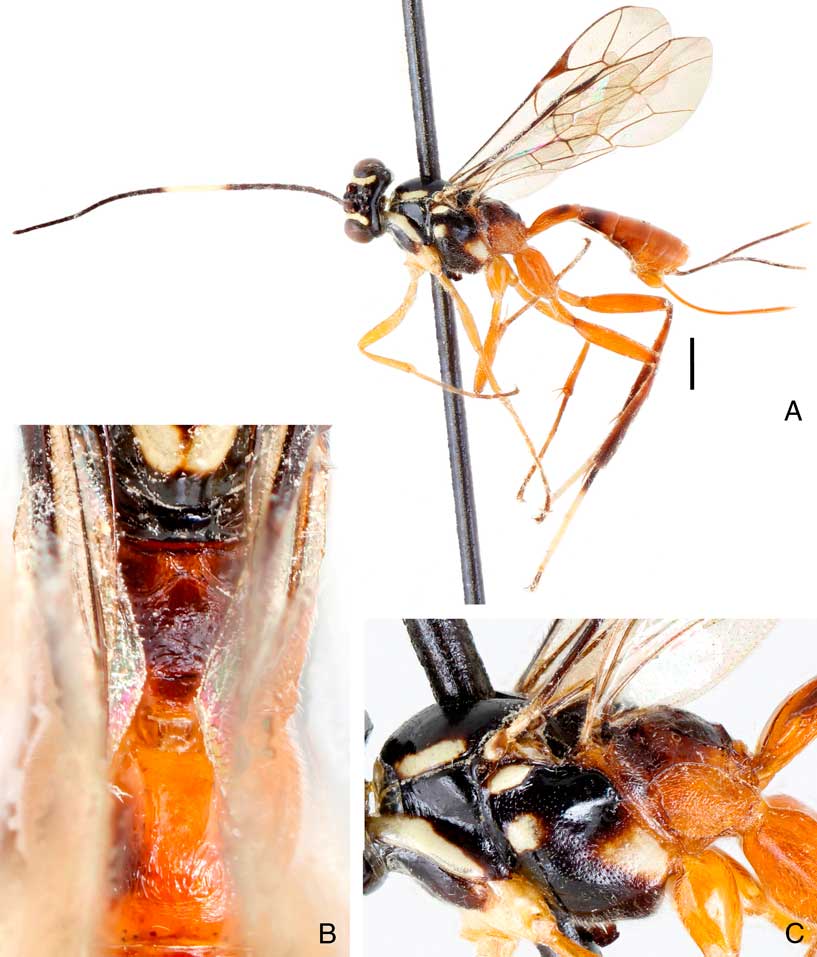
Diagnosis. Propodeum with anterior transverse carina centrally not close to its anterior margin, so area basalis discernible; area superomedia coffin shaped, about 2.1 times as long as wide (Fig. 13B); tergite I about 1.3 times as long as posteriorly wide; tergite II about 0.8 times as long as posteriorly wide; ovipositor short, about 1.5 times as long as length of metatibia; metapleuron entirely and evenly red (Fig. 13C).
Description. Female: fore wing length 6.4 mm. Head. Clypeus of moderate breadth, 2.4 times as wide as high, faintly granulate with isolated punctures, slightly convex, slightly flared outwards (centrally softly conical), without a transverse subapical ridge, apical margin centrally softly concave; mandible tapering slightly, upper tooth slightly longer than lower; face granulate with punctures separated by 1.0–2.0 times puncture width, below antennal insertion with a weak median convexity; malar space about 0.9 times as long as basal mandibular width; frons (Fig. 13A) faintly granulate, but smooth between toruli (with median, longitudinal, sulcus-shaped impression from between toruli to median ocellus); lateral ocellus separated from compound eye by about 1.9 times maximum ocellar diameter, distance between ocelli 1.7 times maximum ocellar diameter; occipital carina mediodorsally convex, lower-ventral end joining hypostomal carina close to base of mandible (carina about 0.2 times as long as basal mandibular width); gena in lateral view 0.3 times as long as compound eyes, granulate with isolated punctures; antenna with 29 flagellomeres. Mesosoma. Pronotum faintly granulate with isolated punctures; without epomia, with wrinkle in same area. Mesoscutum faintly granulate and polished, with isolated punctures; notaulus barely impressed, extending through 0.3 times length of mesoscutum. Scutellum slightly convex, faintly granulate, without distinct lateral carina, with median, pit-like impression. Mesopleuron granulate with punctures separated by 1.5–2.0 times puncture width (without punctures on speculum); upper end of epicnemial carina reaching about 0.2 times of way to anterior margin; metapleuron softly granulo-striate. Propodeum (Fig. 13B) granulate with anterior transverse carina faint, well defined centrally; posterior transverse carina well developed; lateral longitudinal carinae strong; lateromedian longitudinal carinae discernible between transverse carinae, well developed only before anterior transverse carina; area basalis with shape of inverted trapezoid; area superomedia coffin shaped (about 2.1 times as long as wide); area externa about 2.4 times as wide as long. Prothoracic leg with pretarsal claw long, slender, and abruptly and strongly curved, with short, sparse pectinae. Fore wing with 3rs-m absent, 2rs-m about 2.0 times as long as abscissa of M between 2rs-m and 2m-cu; Cu1 between 1m-cu and Cu1a 2.5 times as long as Cu1b; 1m-cu fairly evenly arcuate, without ramellus. Hind wing with distal abscissa of Cu1 and 1A sclerotised throughout. Metasoma. Tergite I about 1.3 times as long as posteriorly wide, lateromedian longitudinal carina distinct for 0.7 times length of tergite; tergite II about 0.8 times as long as posteriorly wide. Ovipositor about 1.5 times as long as metatibia; its apex slightly compressed with a narrowed apical section. Colour. Head dark brown; mandible and palpi light brown; orbits (from mid face to after lateral ocellus) white; antenna black with a white band on flagellum. Mesosoma (Fig. 13C) with pronotum black, anterior margin white; mesoscutum black, anterolateraly white; scutellum predominantly white, anteriorly (shaped as inverted thin triangle) and posteriorly black; tegula white, posterior half brown; mesopleuron black, subalar prominence, a spot at end of epicnemial carina, and a spot at lower posterior corner white; propodeum brown, laterally gradually changing to reddish brown; metapleuron reddish orange; mesosternum black. Prothoracic leg (Fig. 13A) reddish orange, coxa ventrally white, tarsomeres brown. Mesothoracic leg (Fig. 13A) reddish orange, tarsomeres brown. Metathoracic leg (Fig. 13A) reddish orange, femur basally and distally, tibia, basal half of tarsomere 1 and tarsomere 5 brown, distal half of tarsomere 1–4 white. Wings hyaline. Metasomal tergites reddish orange with two brown spots on tergites I and II; ovipositor sheath dark brown with distal apex white.
Male: Unknown.
Remarks. The individual is missing an antenna, the other antenna is glue to the head and the head is glue to the mesosoma.
Distribution. Bolivia (Fig. 5).
Etymology. The specific epithet brevis means “short”, is a reference to the length of the ovipositor. It is treated as an adjective in the nominative singular.
Material examined. Holotype: ♀ “Cristal Mayu Boliv [Bolivia] Cochabamba 300 m. XII.6.49 L. Peña” (USUC).
Hapsinotus carinatus Ugalde-Gómez and Gauld, Reference Ugalde-Gómez and Gauld2002
Diagnosis. Face, below antennal insertion, centrally with a moderate convexity; lateral ocellus separated from compound eye by more than 1.0 times maximum ocellar diameter; occipital carina mediodorsally evenly arcuate; propodeum with area superomedia weak but discernible, pentagonal, centrally broad; head with pale mark on facial and frontal orbits reaching back to level of lateral ocellus; genal orbits almost entirely white; mesoscutum black with anterolateral white marks, without central white spot; metapleuron white; propodeum black with white colour only laterally, between lateral longitudinal and pleural carinae. Additionally, female has prothoracic pretarsal claw quite strongly bowed, pectinate for at least 0.6 times its length and ovipositor long, 2.7–2.9 times as long as length of metatibia; and, male with orbits and face entirely white.
Distribution. Costa Rica (Ugalde-Gómez and Gauld, Reference Ugalde-Gómez and Gauld2002).
Material examined. Paratypes: 1♀ “COSTA RICA: Limon Pv 4 km N.E. Bribri 50 m IV-VI.90 Gauld” (MNCR), and 1♀ “COSTA RICA: Heredia Pv Chilamate 75 m VII-X.90 Gauld” (MNCR).
Hapsinotus chiquita Alvarado, new species
http://zoobank.org/urn:lsid:zoobank.org:act:F8F2A14A-A8CD-4D98-AB78-1628A18FBB75
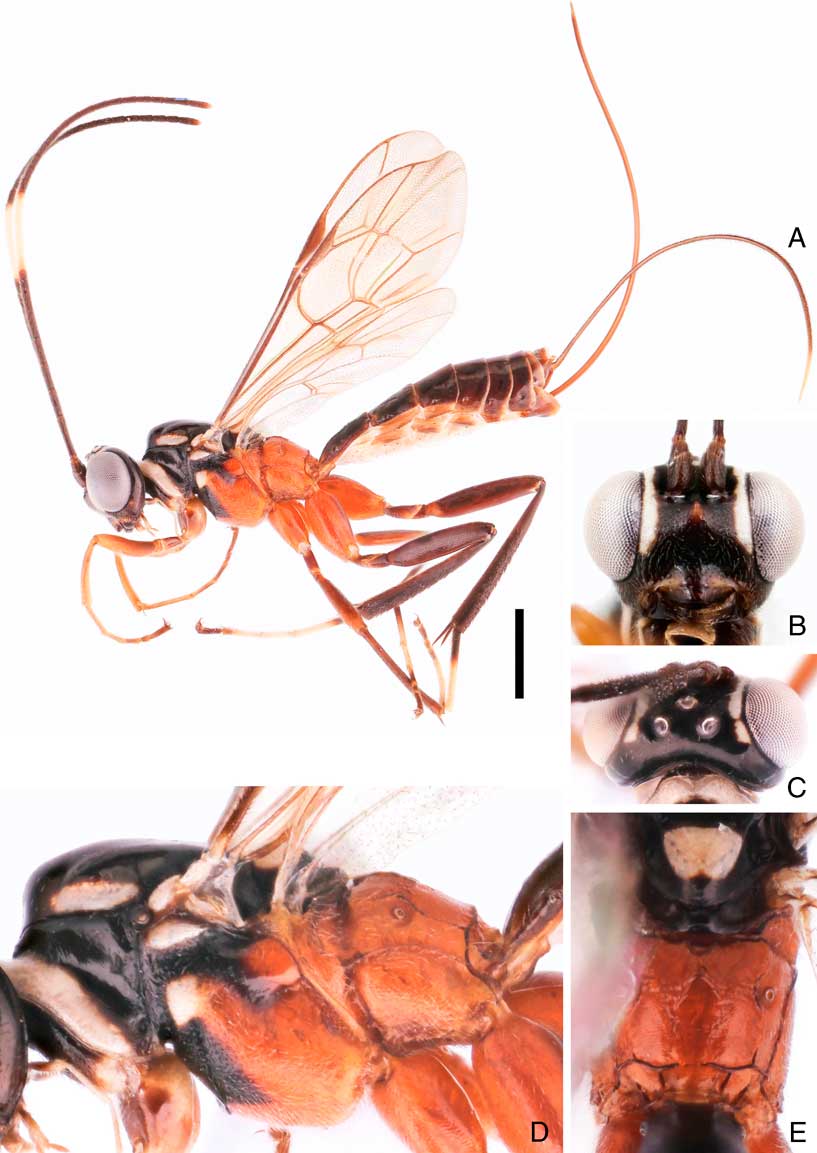
Morphology of Hapsinotus chiquita new species (holotype). A, Habitus (scale bar=1 mm); B, head, frontal view; C, head, dorsal view; D, mesosoma, lateral view; E, propodeum.
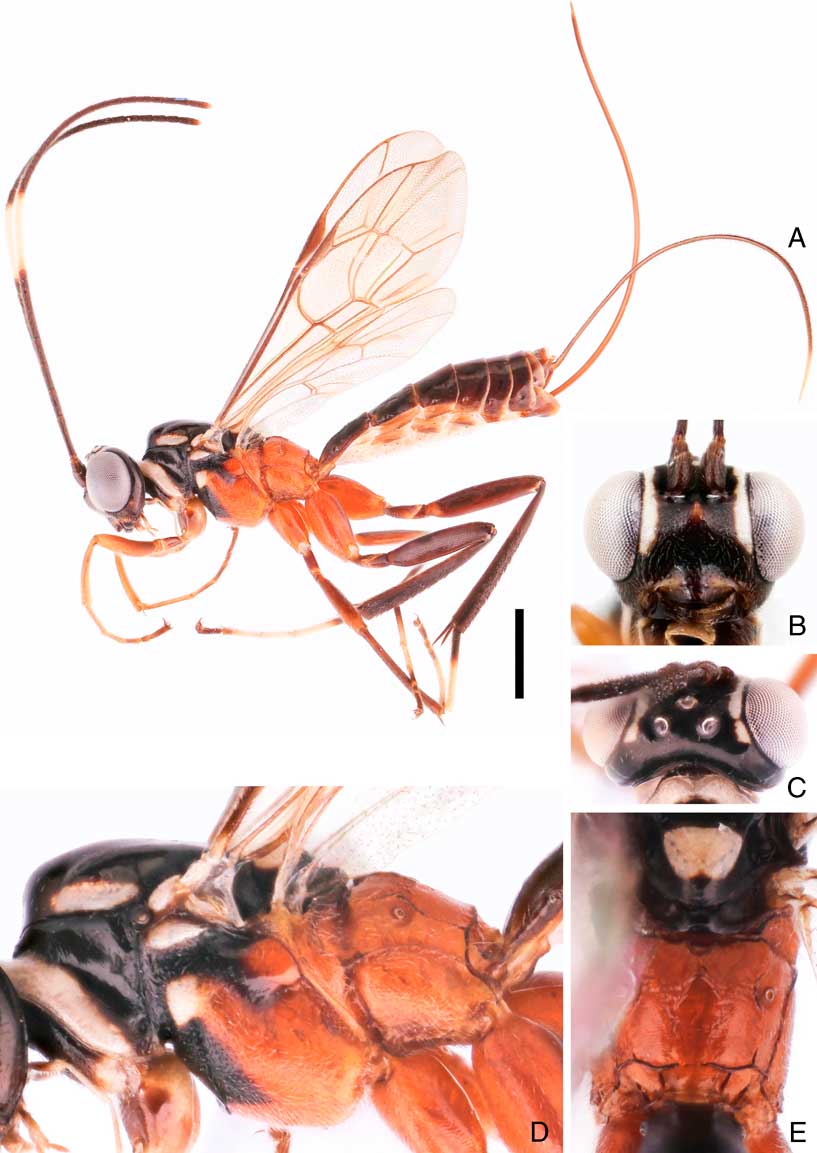
Diagnosis. Face, below antennal insertion, centrally moderately convex below median tubercle (Fig. 14B); occipital carina mediodorsally evenly arcuate; prothoracic pretarsal claw long, slender, abruptly and strongly curved, with short, sparse pectinae at least along 0.6 its length; propodeum with area externa about 1.3 times as wide as long (Fig. 14E); metasomal tergite I 1.6–1.8 times as long as posteriorly wide; ovipositor long, 2.9 times as long as length of metatibia; head with pale mark on frontal orbit reaching back to level of lateral ocellus; gena extensively black-marked next to compound eye (Fig. 14A); mesoscutum black with anterolateral white marks (Fig. 14D) and a median white spot; procoxa reddish brown, at most ventrally white cream; metafemur dark brown at most basally red (Fig. 14A).
Description. Female: fore wing length 4.8 mm. Head. Clypeus (Fig. 14B) of moderate breadth, 2.2 times as wide as high, faintly granulate with isolated punctures, slightly convex, slightly flared outwards (centrally softly conical), without a transverse subapical ridge, apical margin centrally slightly convex; mandible tapering slightly, upper tooth slightly longer than lower; face granulate with punctures separated by 1.0–2.0 times puncture width, below antennal insertion with a median convexity (Fig. 14A); malar space about 0.8 times as long as basal mandibular width; frons (Fig. 14C) faintly granulate, but smooth between toruli (with median, longitudinal, sulcus-shaped impression between toruli); lateral ocellus separated from compound eye by about 1.0 times maximum ocellar diameter, distance between ocelli 1.1 times maximum ocellar diameter; occipital carina mediodorsally convex, lower-ventral end joining hypostomal carina at base of mandible; gena in lateral view 0.3 times as long as compound eyes, granulate with isolated punctures; antenna with 28 flagellomeres. Mesosoma. Pronotum faintly granulate with isolated punctures on upper and posterior margins; without epomia, with wrinkle in same area. Mesoscutum faintly granulate and polished, with isolated punctures; notaulus barely impressed, extending through 0.3 times length of mesoscutum. Scutellum slightly convex, faintly granulate, without distinct lateral carina, with median, pit-like impression. Mesopleuron granulate (except smooth on distal half of speculum) with punctures separated by 0.8–1.5 times puncture width; upper end of epicnemial carina reaching about 0.2 times of way to anterior margin; metapleuron granulate with punctures separated by 0.5–1.0 times puncture width. Propodeum (Fig. 14E) granulate; anterior transverse carina faint, well defined centrally; posterior transverse carina strong; lateral longitudinal carinae strong; lateromedian longitudinal carinae present only before anterior transverse carina, fused before anterior transverse carina (area basalis triangular); area superomedia coffin shaped (about 2.1 times as long as wide); area externa about 1.3 times as wide as long. Prothoracic leg with pretarsal claw long, slender, and abruptly and strongly curved, with short, sparse pectinae. Fore wing with 3rs-m absent, 2rs-m about 1.7 times as long as abscissa of M between 2rs-m and 2m-cu; Cu1 between 1m-cu and Cu1a 1.4 times as long as Cu1b; 1m-cu fairly evenly arcuate, without ramellus. Hind wing with distal abscissa of Cu1 weakly sclerotised, and, 1A sclerotised throughout. Metasoma. Tergite I about 1.7 times as long as posteriorly wide, lateromedian longitudinal carina distinct for 0.6 times length of tergite; tergite II about 0.8 times as long as posteriorly wide. Ovipositor about 2.9 times as long as metatibia; its apex slightly compressed with a narrowed apical section. Colour. Head black; mandible brown distally gradually changing to light brown; clypeus laterally light brown; palpi white, first and basal 2/3 second maxillar palpomere and first labial palpomere brown; orbits white (from mid face to after lateral ocellus); antenna black with a white band on flagellum. Mesosoma with pronotum black except anterior margin white; mesoscutum black, anterolateral margin, and central spot white; scutellum predominantly white but posteriorly black; tegula white; mesopleuron (Fig. 14D) with anterior third black and distal 2/3 orange; subalar prominence, and a spot at end of epicnemial carina white; propodeum, metapleuron, and mesosternum orange. Prothoracic leg (Fig. 14A) brownish red except coxa ventrally and tibia white. Mesothoracic and metathoracic leg (Fig. 14A) black with coxae reddish orange, with distal half of mesotarsomere 1–2, distal half of metatarsomere 1, and metatarsomere 2–3 white. Wings hyaline. Metasomal tergites dark brown; ovipositor sheath dark brown with distal apex white.
Male: Unknown.
Remarks. This is the smallest species of the genus.
Distribution. Ecuador (Fig. 5).
Etymology. The specific epithet is the Spanish term chiquita, meaning “petite girl”, in reference to the small size body. It is treated as a noun in apposition.
Material examined. Holotype: ♀ “ECUADOR: Sucumbios, Rio Napo, Sacha Lodge, 0°30'S 76°30'W, 220–230 m, 27.VIII–10.IX.1994, Malaise trap, P. Hibbs [CNC493213]” (CNC).
Hapsinotus ete Alvarado, new species
http://zoobank.org/urn:lsid:zoobank.org:act:FB241353-A03F-4138-B796-B618401A4EF7
Morphology of Hapsinotus ete new species (holotype). A, Habitus (scale bar=1 mm); B, head, frontal view; C, mesosoma, lateral view; D, propodeum.
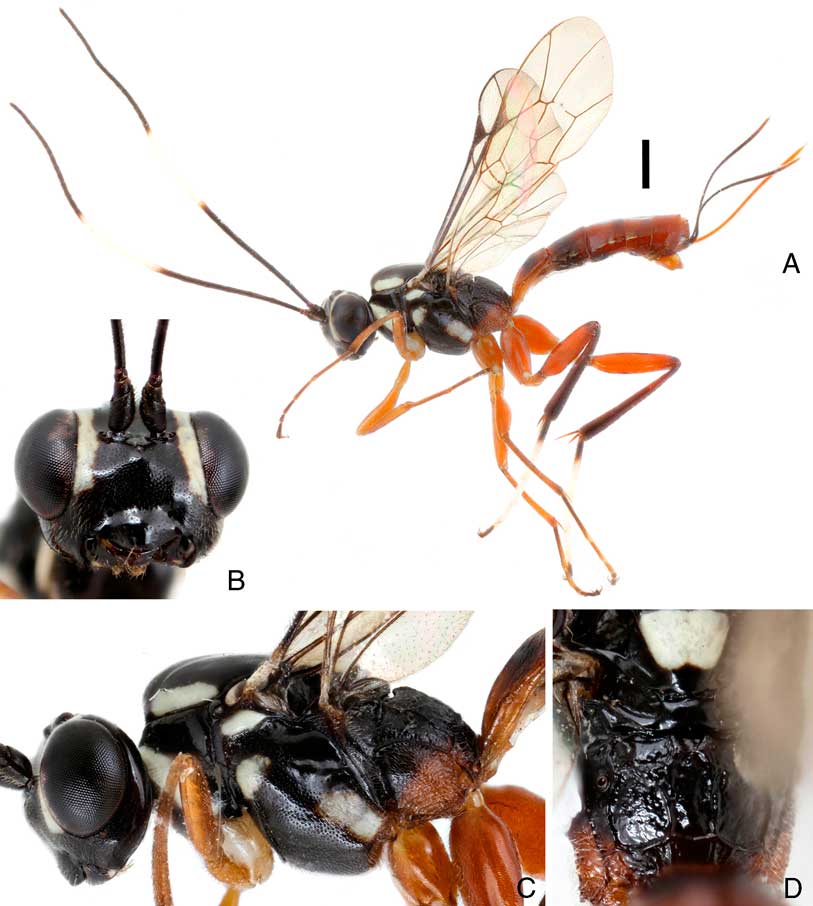
Diagnosis. Propodeum with anterior transverse carina centrally not close to its anterior margin, so area basalis discernible; area superomedia coffin shaped, about 1.9 times as long as wide (Fig. 15D); tergite I about 1.1 times as long as posteriorly wide; tergite II about 0.5 times as long as posteriorly wide; ovipositor short, about 1.5 times as long as length of metatibia; metapleuron with anterior half black and posterior half red (Fig. 15C).
Description. Female: fore wing length 6.1 mm. Head. Clypeus (Fig. 15B) of moderate breadth, 2.2 times as wide as high, faintly granulate with isolated punctures, slightly convex, slightly flared outwards (centrally softly conical), without a transverse subapical ridge, apical margin centrally softly concave; mandible tapering slightly, upper tooth slightly longer than lower; face granulate with punctures separated by 1.0–2.5 times puncture width, below antennal insertion with a weak median convexity (Fig. 15C); malar space about 0.9 times as long as basal mandibular width; frons faintly granulate, but smooth between toruli (with median, longitudinal, sulcus-shaped impression from between toruli to median ocellus); lateral ocellus separated from compound eye by about 2.1 times maximum ocellar diameter, distance between ocelli 2.0 times maximum ocellar diameter; occipital carina mediodorsally convex, lower-ventral end joining hypostomal carina close to base of mandible (carina about 0.2 times as long as basal mandibular width); gena in lateral view 0.4 times as long as compound eyes, granulate with punctures separated by 4.0–8.0 times puncture width; antenna with 32 flagellomeres. Mesosoma. Pronotum faintly granulate with isolated punctures on upper and posterior margins; without epomia, but with one wrinkle in a homologous place. Mesoscutum faintly granulate and polished, with isolated punctures; notaulus barely impressed, extending through 0.3 times length of mesoscutum. Scutellum slightly convex, faintly granulate, without distinct lateral carina and median, pit-like impression. Mesopleuron granulate (except smooth on speculum and area below speculum) with punctures separated by 1.0–1.8 times puncture width; upper end of epicnemial carina reaching about 0.2 times of way to anterior margin; metapleuron granulate with punctures separated by 0.5–1.0 times puncture width. Propodeum (Fig. 15D) granulate; carinae well defined; area basalis with shape of inverted trapezoid; area superomedia coffin shaped (about 1.9 times as long as wide); area externa about 1.7 times as wide as long. Prothoracic leg with pretarsal claw long, slender, and abruptly and strongly curved, with short, sparse pectinae. Fore wing with 3rs-m absent, 2rs-m about 2.0 times as long as abscissa of M between 2rs-m and 2m-cu; Cu1 between 1m-cu and Cu1a 2.0 times as long as Cu1b; 1m-cu fairly evenly arcuate, without ramellus, without a trace of a vein stub. Hind wing with distal abscissa of Cu1 and 1A sclerotised throughout. Metasoma. Tergite I about 1.1 times as long as posteriorly wide, lateromedian longitudinal carina distinct for 0.7 times length of tergite; tergite II about 0.5 times as long as posteriorly wide. Ovipositor about 1.5 times as long as metatibia; its apex slightly compressed with a narrowed apical section. Colour. Head (Fig. 15B–C) black; basal-lower section of mandible and orbit (from mid face to after lateral ocellus) white; palpi light brown, first malar palpi brown; antenna black with a white band on flagellum. Mesosoma with pronotum black, anterior margin white; mesoscutum white, anterolateral margins white; scutellum predominantly white, posterior margin black; tegula white, distal half dark brown; mesopleuron (Fig. 15C) black, subalar prominence, a spot at end of epicnemial carina, a spot at postero-lower corner white; propodeum (Fig. 15D) black, lower half laterally gradually changing to red; metapleuron anterior half black and posterior half red; mesosternum black, posteriorly orange. Prothoracic leg (Fig. 15A) predominantly orange, coxa basally white, tibia basally and tarsomeres brown. Mesothoracic leg (Fig. 15A) reddish orange; tibia brown; tarsomere 1 distal tenth light brown; tarsomeres 4–5 black; tarsomeres 2–3 light brown. Metathoracic leg (Fig. 15A) reddish orange; femur distally, tibia, basal third of tarsomere 1 (remaining white), and tarsomere 5 dark brown; tarsomeres 2–4 white. Wings hyaline. Metasomal tergites red with tergites I and II centrally dark brown; ovipositor sheath dark brown with distal apex light brown.
Male: Unknown.
Distribution. Peru (Fig. 3).
Etymology. The specific epithet ete means wasp in Awajún language. It is treated as a noun in apposition.
Material examined. Holotype: ♀ “PERU: AM. Bagua CCNN [comunidad nativa] Shaim, near 5°14'23.4''S, 78°27'56.2''W 327 m, 18–19.iv.2015, L. Sulca” (MUSM).
Hapsinotus guntheri Alvarado, new species
http://zoobank.org/urn:lsid:zoobank.org:act:88789B4F-B0A2-4DCA-89F7-6932894ED9BD
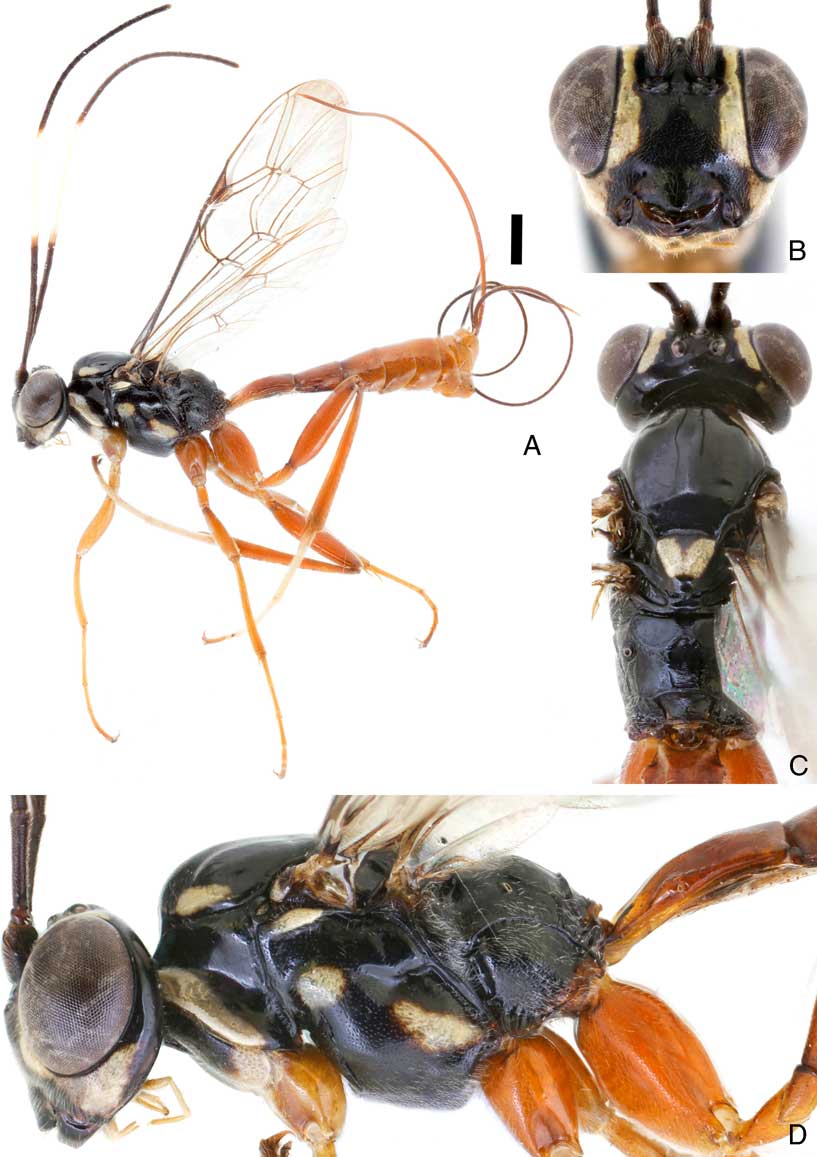
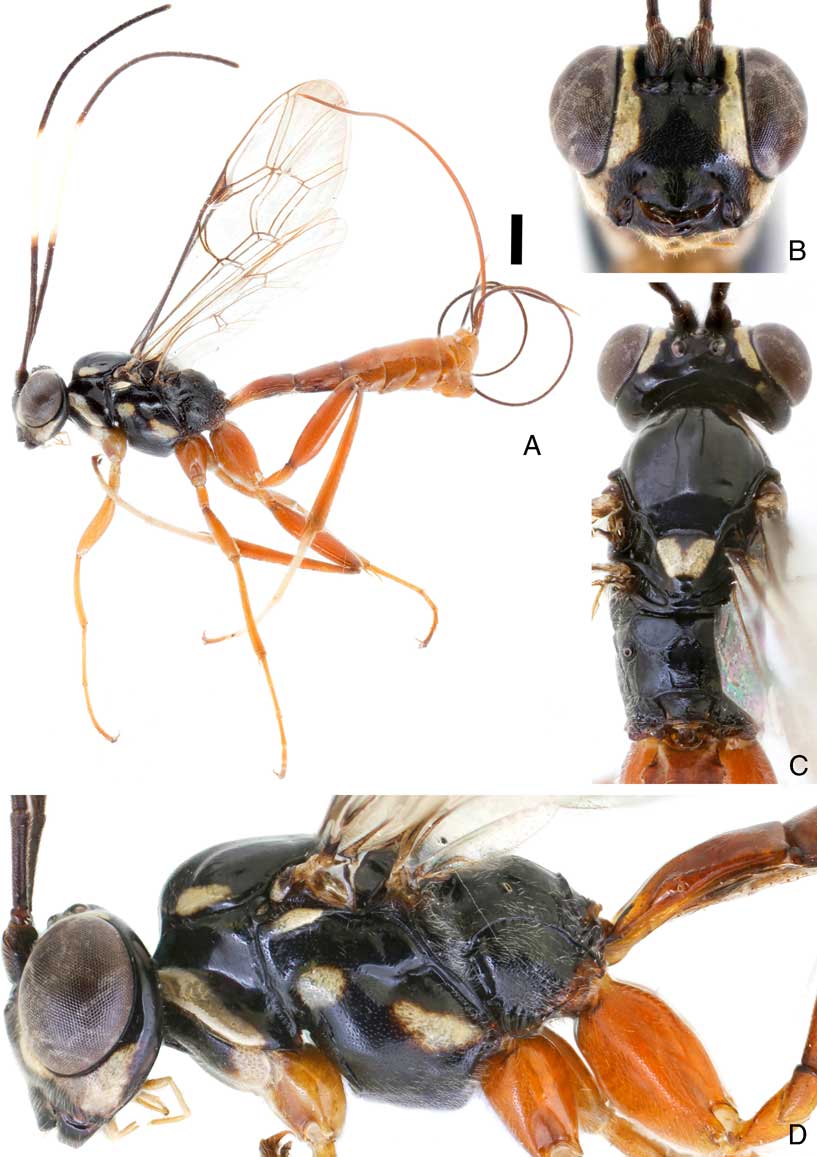
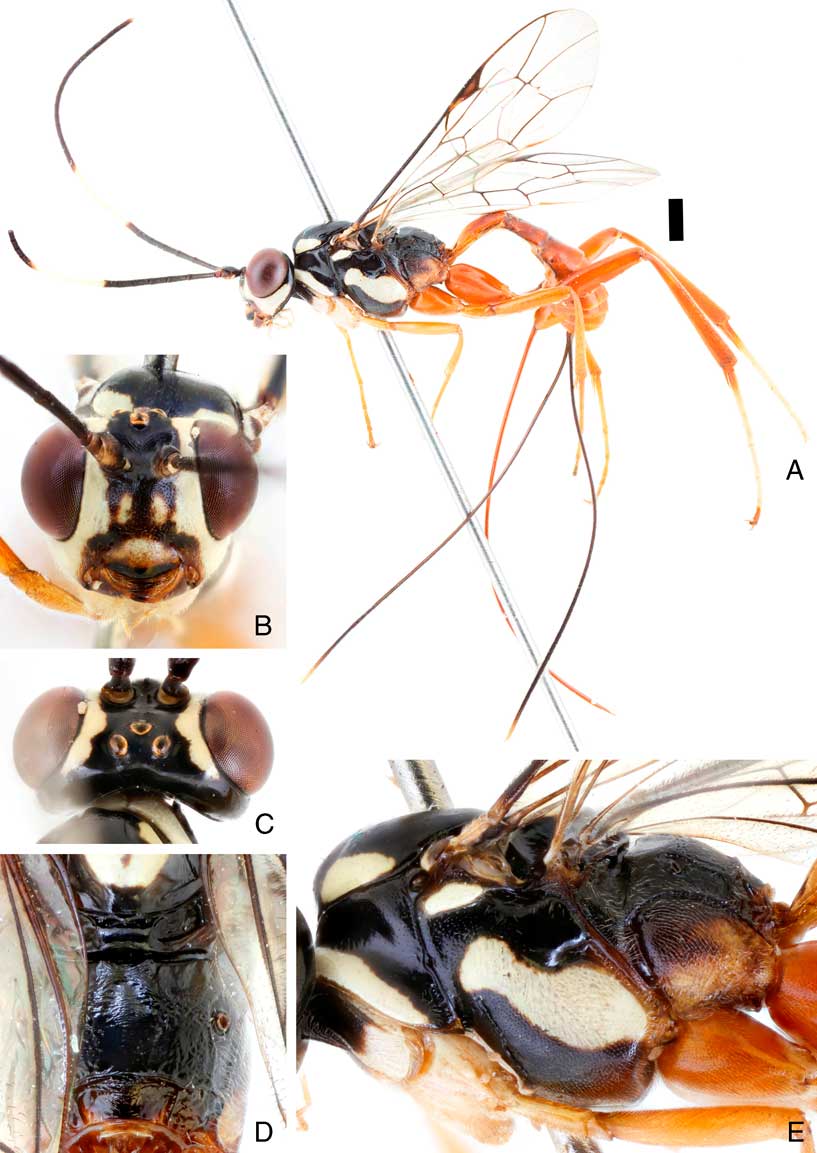
Morphology of Hapsinotus guntheri new species (holotype). A, Habitus (scale bar=1 mm); B, head, frontal view; C, head and mesosoma, dorsal view; D, mesosoma, lateral view.
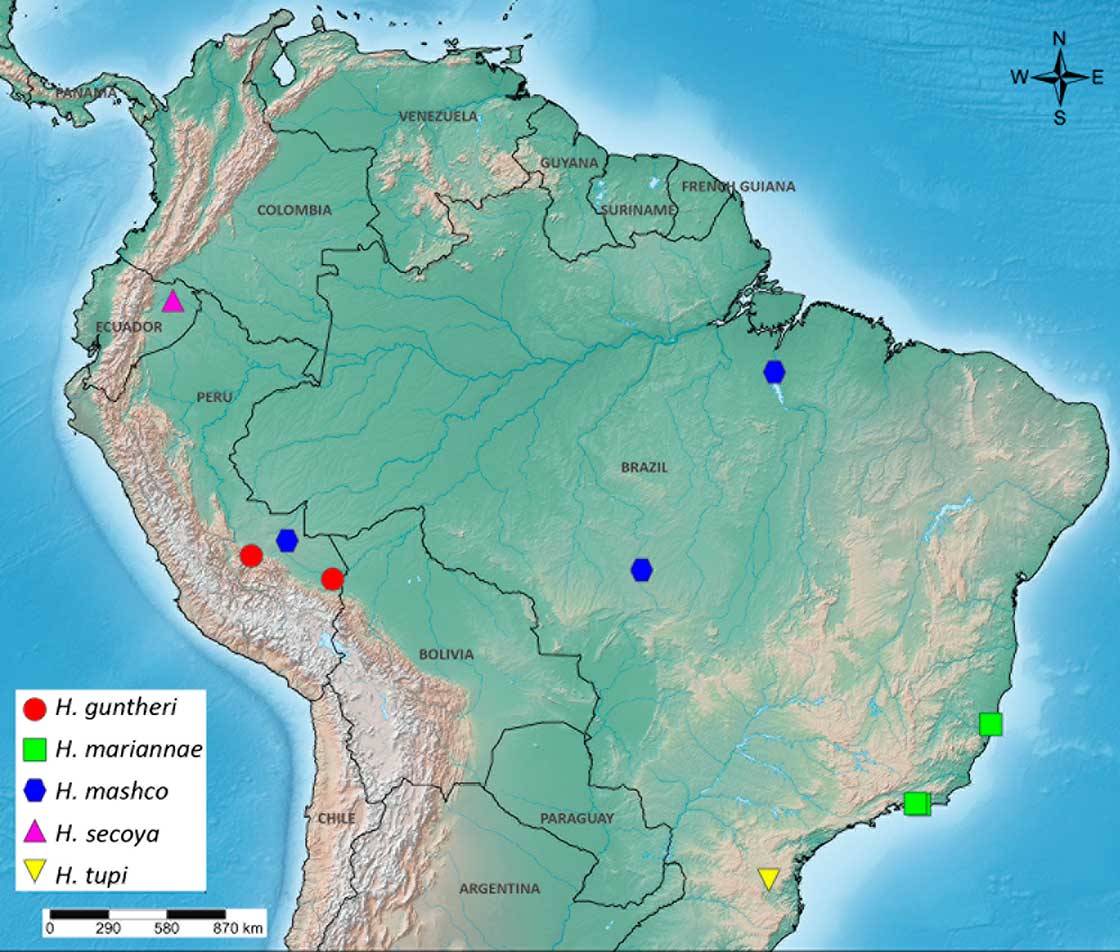
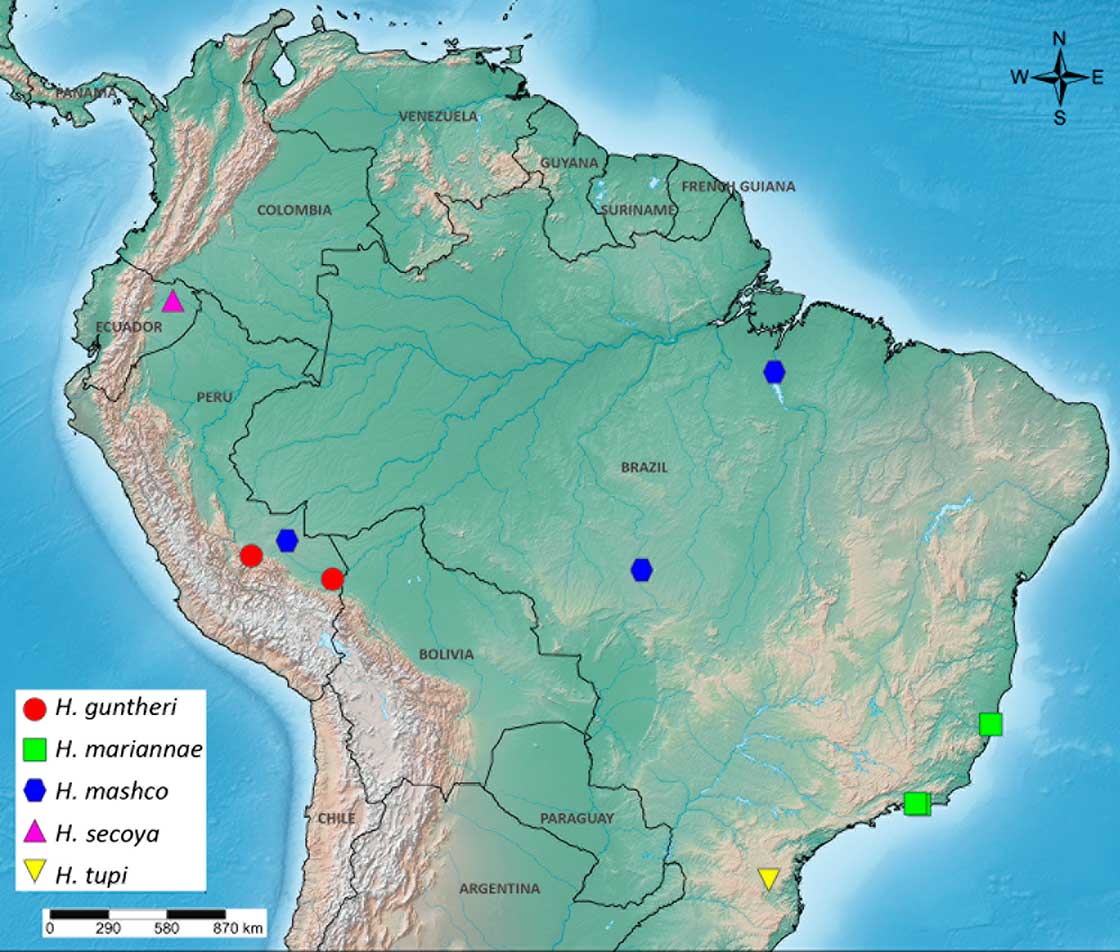
Geographic distribution of H. guntheri, H. mariannae, H. mashco, H. secoya, and H. tupi.
Diagnosis. Face, below antennal insertion with a weak median convexity (almost plane, Figs. 16B, D); occipital carina mediodorsally evenly arcuate; lateral ocellus separated from compound eye by about 1.5–1.6 times maximum ocellar diameter (Fig. 16C); prothoracic pretarsal claw long, slender, abruptly and strongly curved, with short, sparse pectinae at least along 0.6 its length; fore wing vein 1m-cu not angulate near centre, entirely curved, without ramellus; Cu1 between 1m-cu and Cu1a 1.8 times as long as Cu1b; ovipositor moderately long, 3.1–3.2 times as long as length of metatibia; head with pale mark on facial and frontal orbits (Fig. 11B) reaching back to level of lateral ocellus; malar space white; upper part of gena extensively black-marked next to compound eye (Fig. 16D); mesoscutum black, anterolateral margin white mark, without a median white spot (Fig. 16C–D); tegula basally white, and posteriorly black (Fig. 16D); metapleuron black (Fig. 16D) or bicolour but never entirely red; propodeum predominantly black; metafemur red at most with distal tip brown (Fig. 16A); ovipositor sheath mostly black with distal apex white.
Description. Female: fore wing length 6.7 mm. Head. Clypeus (Fig. 16B) of moderate breadth, 1.8 times as wide as high, granulate with isolated punctures, slightly convex, slightly flared outwards (centrally softly conical), without a transverse subapical ridge, apical margin centrally weakly concave; face granulate with punctures separated by 1.0–2.0 times puncture width, below antennal insertion with a weak median convexity (almost plane, Fig. 16D); malar space about 0.8 times as long as basal mandibular width; frons faintly granulate, but smooth between toruli (with median, longitudinal, sulcus-shaped impression from between toruli to median ocellus); lateral ocellus separated from compound eye by about 1.5 times maximum ocellar diameter, distance between ocelli 1.5 times maximum ocellar diameter; occipital carina mediodorsally evenly convex, lower-ventral end joining hypostomal carina close to base of mandible (carina about 0.2 times as long as basal mandibular width); gena in lateral view 3.0 times as long as compound eyes, faintly granulate with isolated punctures; antenna with 31 flagellomeres. Mesosoma. Pronotum smooth with isolate punctures; without epomia, but with a weak wrinkle in a homologous place. Mesoscutum smooth with punctures between notauli; notaulus barely impressed, extending through 0.4 times length of mesoscutum. Scutellum slightly convex, smooth, without distinct lateral carina and median, pit-like impression. Mesopleuron faintly granulate (except speculum smooth and without punctures) with punctures separated by 1.0–3.0 times puncture width; upper end of epicnemial carina reaching about 0.2 times of way to anterior margin; metapleuron convex, softly wrinkled with punctures separated by 1.5–2.0 times puncture width. Propodeum (Fig. 16C) faintly granulate; anterior transverse carina discontinuous but strong centrally (between lateromedian longitudinal carinae); posterior transverse carina complete and strong; lateral longitudinal carinae faint but discernible, absent before anterior transverse carina; lateromedian longitudinal carinae present before anterior transverse carina, faint but discernible between transverse carinae, and, absent after posterior transverse carina; area basalis with shape of inverted trapezoid; area superomedia coffin shaped (about 1.5 times as long as wide); area externa about 1.7 times as wide as long. Prothoracic leg with pretarsal claw long, slender, and abruptly and strongly curved, with short, sparse pectinae. Fore wing with 3rs-m absent; 2rs-m about 1.6 times as long as abscissa of M between 2rs-m and 2m-cu; Cu1 between 1m-cu and Cu1a 1.8 times as long as Cu1b; 1m-cu fairly evenly arcuate, without ramellus. Hind wing with distal abscissa of Cu1 and 1A sclerotised throughout. Metasoma. Tergite I about 1.7 times as long as posteriorly wide, lateromedian longitudinal carina distinct for 0.7 times length of tergite; tergite II about 0.7 times as long as posteriorly wide. Ovipositor about 3.2 times as long as metatibia; its apex subcylindrical with a narrowed apical section. Colour. Head (Fig. 16A–C) predominantly black; mandible and clypeus laterally dark brown; palpi white; orbit (from mid gena to after lateral ocellus yellow) white; antenna black with a white band on flagellum. Mesosoma (Fig. 16D) predominantly black; anterior margin of pronotum, anterolateral margin centrally mesoscutum (Fig. 16C), anterior half of tegula, subalar prominence, a spot at end of epicnemial carina, a spot next to its lower posterior end white; scutellum white but anteriorly (shaped as inverted thin triangle) black. Prothoracic leg (Fig. 16A) light brown, coxa ventrally and tarsomere 5 brown; mesothoracic leg (Fig. 16A) orange reddish, tarsomere 5 brown; metathoracic leg (Fig. 16A) reddish orange, tarsomeres 1–4 white, tarsomere 5 brown. Wings softly infuscate. Metasomal tergites reddish brown; ovipositor sheath mostly black with distal apex white.
Male: Unknown.
Remarks. The paratype varies slightly from holotype in the following: gena in lateral view 0.2 times as long as compound eyes, distance between ocelli 1.6 times maximum ocellar diameter, fore wing with vein Cu1 between 1m-cu and Cu1a 1.4 times as long as Cu1b, area superomedia 1.6 times as long as wide, area externa about 1.8 times as wide as long, metasomal tergite II about 0.8 times as long as posteriorly wide, and ovipositor about 3.1 times as long as metatibia. Additionally, paratype with two small stripes next to orbits in face.
Distribution. Peru (Fig. 17).
Etymology. The specific epithet guntheri is in honour to conservationist Max Gunther, one of the promoters of the creation of the Tambopata National Reserve. It is a masculine noun in the genitive case.
Material examined. Holotype: ♀ “PERÚ: MD [Madre de Dios], Tambopata, Explorer’s Inn, 12°50'31.6''S / 69°17'36.1''W 216 m. 27.IX.2009, Malaise trap, M. Alvarado y L. Sulca” (MUSM). Paratype: 1♀ “PERÚ: CU [Cusco], La Convención, Echarate, Comunidad Camisea. 72°56'25.6''W/11°45'47.8''S 415 m. M. Cardenas” (MUSM).
Hapsinotus huaorani Alvarado, new species
http://zoobank.org/urn:lsid:zoobank.org:act:E6D889DD-A485-428A-9833-D2023BC49DB3
Morphology of Hapsinotus huaorani new species (holotype). A, Habitus (scale bar=1 mm); B, head, frontal view; C, head, dorsal view; D, propodeum; E, mesosoma, lateral view.
Diagnosis. Face, below antennal insertion with a strong median convexity (Fig. 18B); occipital carina mediodorsally evenly arcuate; prothoracic pretarsal claw long, slender, abruptly and strongly curved, with short, sparse pectinae at least along 0.6 its length; fore wing vein with 1m-cu angulate near centre, with a distinct vein stub present at point of angulation (Fig. 18A); Cu1 between 1m-cu and Cu1a 1.0 times as long as Cu1b; ovipositor moderately long, 3.1 times as long as length of metatibia; facial and frontal orbits, and malar space white (Fig. 18B) lower part of gena white, upper part black-marked next to compound eye (Fig. 18A, C); tegula anteriorly white, and posteriorly brown; metapleuron anteriorly black, gradually changing on posterior 2/3 to light brown (Fig. 18E); propodeum black (Fig. 18D); metafemur red (Fig. 18A); ovipositor sheath mostly black with distal apex white.
Description. Female: fore wing length 7.5 mm. Head. Clypeus (Fig. 18B) of moderate breadth, 1.8 times as wide as high, granulate with isolated punctures, slightly convex, slightly flared outwards (centrally softly conical), with a weak transverse subapical ridge, apical margin centrally weakly convex; mandible tapering slightly, upper tooth slightly longer than lower; face granulate with punctures separated by 1.0–2.0 times puncture width, below antennal insertion with a strong median convexity; malar space about 0.8 times as long as basal mandibular width; frons (Fig. 18C) faintly granulate, but smooth between toruli (with median, longitudinal, sulcus-shaped impression from between toruli to median ocellus); lateral ocellus separated from compound eye by about 1.2 times maximum ocellar diameter, distance between ocelli 1.0 times maximum ocellar diameter; occipital carina mediodorsally convex, lower-ventral end joining hypostomal carina close to base of mandible (carina about 0.2 times as long as basal mandibular width); gena in lateral view 0.3 times as long as compound eyes, granulate with isolated punctures; antenna with 33 flagellomeres. Mesosoma. Pronotum smooth with punctures on upper margin and posterior margin; without epomia, but with a weak wrinkle in a homologous place. Mesoscutum faintly granulate and polished, with isolated punctures (more abundant between notauli); notaulus barely impressed, extending through 0.3 times length of mesoscutum. Scutellum slightly convex, smooth, without distinct lateral carina and median, pit-like impression. Mesopleuron granulate (except speculum smooth and without punctures) with punctures separated by 1.5–2.0 times puncture width; upper end of epicnemial carina reaching about 0.2 times of way to anterior margin; metapleuron granulate with punctures separated by 0.5–1.0 times puncture width. Propodeum (Fig. 18D) granulo-striate, anterior transverse carina faint but discernible; posterior transverse carina complete but faint centrally; lateral longitudinal carinae faint but discernible; lateromedian longitudinal carinae discernible before posterior transverse carina; area basalis with shape of inverted trapezoid; area superomedia coffin shaped (about 1.3 times as long as wide); area externa about 1.7 times as wide as long. Prothoracic leg with pretarsal claw long, slender, and abruptly and strongly curved, with short, sparse pectinae. Fore wing with 3rs-m absent; 2rs-m about 3.5 times as long as abscissa of M between 2rs-m and 2m-cu; Cu1 between 1m-cu and Cu1a 1.0 times as long as Cu1b; 1m-cu evenly arcuate, with a faint trace of a vein stub (Fig. 18A). Hind wing with distal abscissa of Cu1 and 1A sclerotised throughout. Metasoma. Tergite I about 1.4 times as long as posteriorly wide, lateromedian longitudinal carina distinct for 0.7 times length of tergite; tergite II about 0.7 times as long as posteriorly wide. Ovipositor about 3.1 times as long as metatibia; its apex subcylindrical with a narrowed apical section. Colour. Head (Fig. 18B–C) predominantly black; mandible and palpi pale brown; basal 2/3 of clypeus, orbit (from lower half of gena to after lateral ocellus), two maculae in centre of face white. Mesosoma predominantly black, anterior margin of pronotum, mesoscutum with anterolateral margins and central spot, anterior half of tegula, subalar prominence, mesopleuron (Fig. 18E) with a diagonal stripe from end of epicnemial carina to its lower posterior end white; scutellum white but anteriorly (shaped as inverted thin triangle) black; metapleuron anteriorly black, gradually changing on posterior 2/3 to light brown. Prothoracic leg (Fig. 18A) light brown, coxa laterally white; mesothoracic leg (Fig. 18A) orange; metathoracic leg (Fig. 18A) orange, distal 2/3 of tarsomeres 1–4 white, tarsomere 5 brown. Wings softly infuscate. Metasomal tergites reddish brown; ovipositor sheath mostly black with distal apex white.
Male: Unknown.
Distribution. Ecuador (Fig. 7).
Etymology. The specific epithet huaorani refers to Huaorani, the population that inhabited between the Curaray and Napo rivers in Ecuador. It is treated as a noun in apposition.
Material examined. Holotype: ♀ “ECUADOR: Orellana Nueva Rocafuerte 22-28.III.00 M. Cooper” (NHML).
Hapsinotus killa Alvarado, Bordera, and Rodríguez-Berrío, new species
http://zoobank.org/urn:lsid:zoobank.org:act:241F4488-1F7E-4930-8632-B5B85F1FAA01
Morphology of Hapsinotus killa new species. A, Habitus (holotype, scale bar=1 mm); B, head, frontal view (holotype); C, mesosoma, lateral view (paratype); D, propodeum (paratype).

Geographic distribution of H. killa, H. petirrojo, H. yana, and H. yumbo.
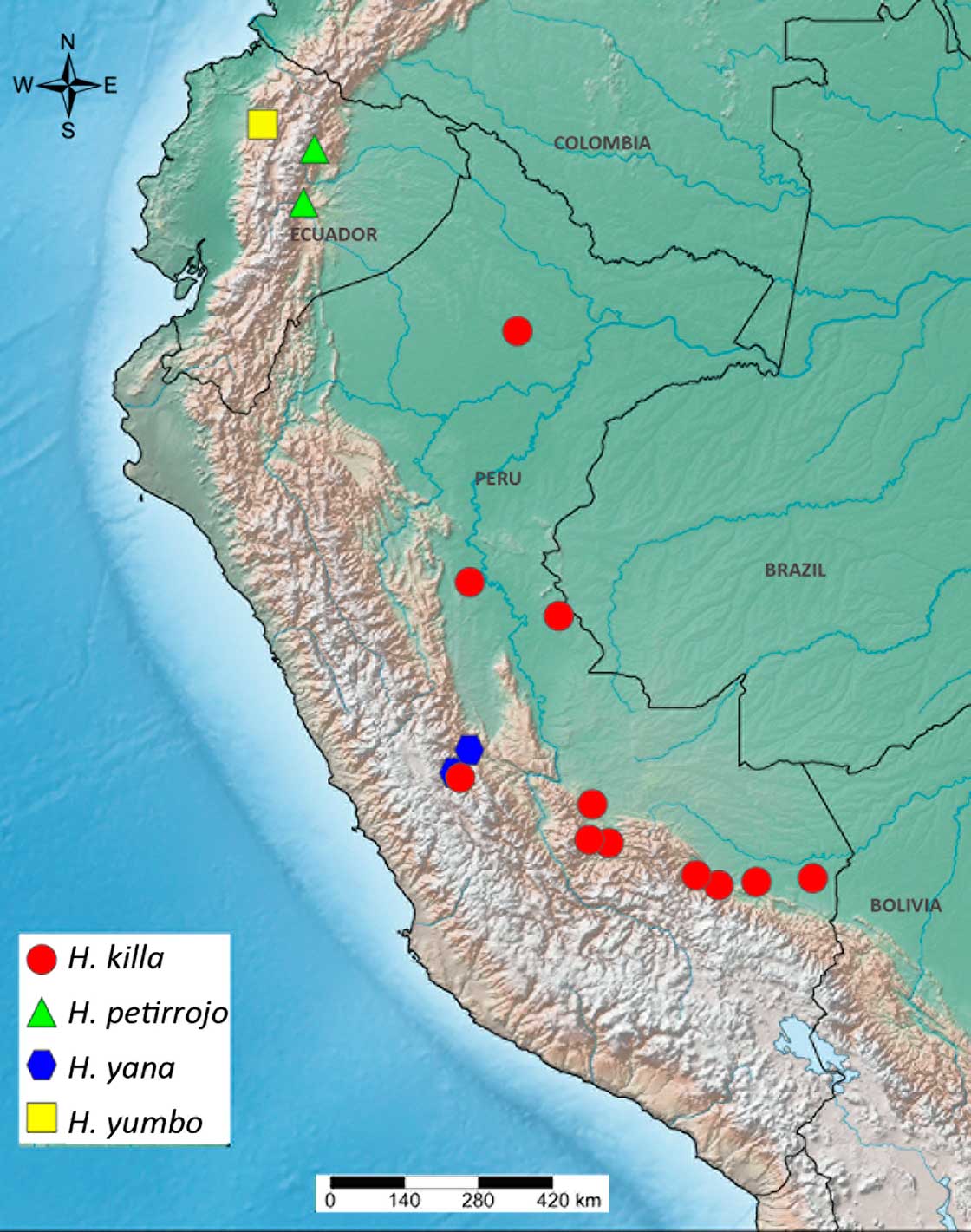
Diagnosis. Face, below antennal insertion with a weak median convexity below median tubercle; occipital carina mediodorsally evenly arcuate; clypeus 2.0–2.2 times as wide as long; propodeum with area superomedia coffin shaped, about 2.5 times as long as wide (Fig. 19D); prothoracic pretarsal claw long, slender, abruptly and strongly curved, with short, sparse pectinae at least along 0.6 its length; metasomal tergite I 1.4–1.7 times as long as posteriorly wide, lateromedian longitudinal carinae 0.7–0.8 times length of tergite; ovipositor moderately long, 2.9–3.2 times as long as length of metatibia; head with pale mark on facial and frontal orbits reaching back to level of lateral ocellus; orbital gena black (Fig. 19A); scape and malar space black (Fig. 19A); mesoscutum black, anterolateral margin (Fig. 19C) and a median spot white; mesosternum orange; metapleuron and propodeum entirely red; metafemur red (Fig. 19A), at most with distal tip brown.
Description. Female: fore wing length 6.7 mm. Head. Clypeus (Fig. 19B) of moderate breadth, 2.1 times as wide as high, faintly granulate with isolated punctures, slightly convex, slightly flared outwards (centrally softly conical), without a transverse subapical ridge, apical margin centrally softly concave; mandible tapering slightly, upper tooth slightly longer than lower; face granulate with punctures separated by 1.5–2.5 times puncture width, below antennal insertion with a weak median convexity; malar space about 0.7 times as long as basal mandibular width; granulate, but smooth between toruli (with median, longitudinal, sulcus-shaped impression from between toruli to median ocellus); lateral ocellus separated from compound eye by about 1.5 times maximum ocellar diameter, distance between ocelli 1.3 times maximum ocellar diameter; occipital carina mediodorsally convex, lower-ventral end joining hypostomal carina close to base of mandible (carina about 0.2 times as long as basal mandibular width); gena in lateral view 0.3 times as long as compound eyes, granulate with punctures separated by 4.0–8.0 times puncture width; antenna with 32 flagellomeres. Mesosoma. Pronotum faintly granulate with isolated punctures on upper and posterior margins; without epomia, with wrinkle in same area. Mesoscutum faintly granulate and polished, with isolated punctures; notaulus barely impressed, extending through 0.3 times length of mesoscutum. Scutellum slightly convex, faintly granulate, without distinct lateral carina and median, pit-like impression. Mesopleuron granulate (except smooth on distal half of speculum) with punctures separated by 0.8–2.0 times puncture width; upper end of epicnemial carina reaching about 0.3 times of way to anterior margin; metapleuron granulate with punctures separated by 0.5–1.0 times puncture width. Propodeum (Fig. 19D) granulate; anterior transverse carina faint, well defined centrally; posterior transverse carina strong but faint centrally between lateromedian longitudinal carinae; lateral longitudinal carinae strong; lateromedian longitudinal carinae present only before anterior transverse carina; area basalis with shape of inverted trapezoid; area superomedia coffin shaped (about 2.5 times as long as wide); area externa about 1.6 times as wide as long. Prothoracic leg with pretarsal claw long, slender, and abruptly and strongly curved, with short, sparse pectinae. Fore wing with 3rs-m absent, 2rs-m about 1.3 times as long as abscissa of M between 2rs-m and 2m-cu; Cu1 between 1m-cu and Cu1a 1.7 times as long as Cu1b; 1m-cu fairly evenly arcuate, without ramellus. Hind wing with distal abscissa of Cu1 and 1A sclerotised throughout. Metasoma. Tergite I about 1.5 times as long as posteriorly wide, lateromedian longitudinal carina distinct for 0.8 times length of tergite; tergite II about 0.8 times as long as posteriorly wide. Ovipositor about 3.1 times as long as metatibia; its apex slightly compressed with a narrowed apical section. Colour. Head (Fig. 19A–B) black; mandible brown; orbits white (from mid face to after lateral ocellus); palpi light brown, first malar palpi brown; antenna black with a white band on flagellum. Mesosoma with pronotum black, anterior margin white; mesoscutum black, anterolateral margin and central spot white; scutellum predominantly white, anteriorly (shaped as inverted thin triangle) and posteriorly black; tegula white, posterior half brown; mesopleuron (Fig. 19C) with anterior half black and distal half orange, subalar prominence and a spot at end of epicnemial carina white; propodeum, metapleuron, and mesosternum orange. Legs (Fig. 19A) predominantly orange, procoxa ventrally white, protarsomeres 3–5 infuscate, mesotibia, mesotarsomeres brown, metatibia dorsally brown and ventrally pale red, metatarsomere 1 with basal quarter and metatarsomere 5 dark brown, distal 3/4 of metatarsomere 1 and metatarsomeres 2–4 white. Wings hyaline. Metasomal tergites reddish orange; ovipositor sheath dark brown with distal apex white.
Male: Unknown.
Remarks. There is variation in the size of the specimens (fore wing length 4.9–7.4 mm). The paratype series varies from holotype in the following: clypeus 2.0–2.2 times as wide as high; malar space 0.7–0.8 times as long as basal mandibular width; lateral ocellus separated from compound eye by 1.2–1.8 times maximum ocellar diameter; distance between ocelli 1.1–1.4 times maximum ocellar diameter; antenna with 28–32 flagellomeres; notaulus barely impressed, extending through 0.3–0.4 times length of mesoscutum; scutellum with or without median, pit-like impression; epicnemial carina extending to 0.2–0.3 times of way to anterior margin; propodeum with area superomedia 2.5–2.6 times as long as wide, and area externa 1.6–1.8 times as wide as long; fore wing with 2rs-m 0.8–2.0 times as long as abscissa of M between 2rs-m and 2m-cu, and Cu1 between 1m-cu and Cu1a 1.3–2.0 times as long as Cu1b, metasomal tergite I 1.4–1.7 times as long as posteriorly wide, lateromedian longitudinal carinae 0.7–0.8 times length of tergite; tergite II 0.7–0.9 times as long as posteriorly wide; and ovipositor 2.9–3.2 times as long as metatibia. There is one specimen from Matsiguenga communal reserve (fore wing 5 mm) have a trace of vein 3rs-m enclosing a petiolate areolet; it is considered member of the species but not included in the type series (see below in non-type material).
There is also variation in the colour: face and clypeus centrally from black to gradually changing to white, the specimens that have white colour in the face also have mandible basally white; also, some specimens have mesopleuron with a white spot on lower posterior end (rarely mesopleuron with white spot longer forming a diagonal stripe from upper end of epicnemial carina to mesocoxa), and tergite II laterally infuscate.
Distribution. Peru (Fig. 20).
Etymology. The specific epithet killa means moon in Quechua language. It is treated as a noun in apposition.
Material examined. Holotype: ♀ “PERU: MD [Madre de Dios department] Tambopata, Explorer’s Inn, 12°50'31.6''S / 69°17'36.1''W 216 m. 09.XII.2008, Malaise trap, M. Alvarado y L. Sulca” (MUSM). Paratypes: 2♀♀ “Avispas, Perú 30 m nr. Marcapata Sept. 1962 Luis Peña” (USUC); 1♀ “PERU: CU, La Convención, Echarate, Zona de amortiguamiento de Megantoni, 12°12'43.32''S / 72°50'11.98''W, 663 m, 22–24.IV.2010, E. Razuri y C. Carranza”, 1♀ “PERÚ: CU [Cusco], La Convención, Reserva Comunal Matsigenga 695 m, 12°09'41.31''S / 73°05'42.09''W 31.I–2.II.2011 C. Rossi”, 1♀ “PERU: CU, La Convención, Echarate, Saniri, 11°38'9.6''[S] / 73°3'35''[W] 410 m, 28–30.XI.2011 P. Sanchez”, 1♀ “PERÚ: UC, [Ucayali] Coronel Portillo, Calleria 73°40'19.52''W / 08°18'51.81''S 268 m, 27.X.2012 P. Sanchez”, 1♀ “PERÚ: UC, [Ucayali] Contamana, Fray Martin de Pisqui 75°10'26.94''[W] / 7°45'41.73''[S] 144 m, 12.III.2011, L. Huerto”, 1♀ “PERÚ: MD [Madre de Dios]. Reserva Comunal Amarakaeri, 467 m 12°58'26.96''S / 70°56'21.59''W 27–29.X.2010, M. Vílchez”, and 1♀ “PE: LO, Alto Nanay, Qda Lobillos 109 m 18M 0566328E 9610579N 13.VIII.2008, M. Vilchez” (MUSM); 1♀ “Perú: [Junín] La Merced Fundo Génova [11°05'44.1''S / 75°21'17.1''W] 24/10–08/11/2008 Tampa Malaise 3 AECID-/013484/07” (MEKRB).
Non-type material: 1♀ “PERU: Dept. Madre de Dios: Amazonas Lodge, N Atalaya 12°52.2'S 71°22.6'W 480 m 10–13-XI-2007 D. Brzoska ex. Flight intercept trap PER1B07 002 [SEMC0870056]” (SEMC).
Hapsinotus mariannae Alvarado, new species
http://zoobank.org/urn:lsid:zoobank.org:act:1A2BF6E1-C7D5-4DE6-94B6-277C697CF230
Morphology of Hapsinotus mariannae new species. A, Habitus (holotype, scale bar=1 mm); B, head, dorsal view (paratype); C, head, frontal view (holotype); D, head, ventro-lateral view (holotype); E, mesosoma, lateral view (holotype); F, propodeum (paratype).

Diagnosis. Face below antennal insertion with a weak median convexity below median tubercle (Fig. 21C); occipital carina mediodorsally evenly arcuate; propodeum with area superomedia coffin shaped, about 1.6–2.0 times as long as wide (Fig. 21F); prothoracic pretarsal claw long, slender, abruptly and strongly curved, with short, sparse pectinae along at least 0.6 times its length; metasomal tergite I with lateromedian longitudinal carinae 0.7–0.8 times length of tergite; ovipositor 2.8–3.1 times as long as length of metatibia; facial and frontal orbits reaching back to level of lateral ocellus, malar space and lower part of gena white; upper part of gena black next to compound eye (Fig. 21B–D); mesoscutum black, anterolateral margin (Fig. 21E) and a median spot, white; metafemur red (Fig. 21A); mesosternum predominantly reddish brown (Fig. 21E); metapleuron and propodeum entirely red (Fig. 21E).
Description. Female: fore wing length 8.9 mm. Head. Clypeus (Fig. 21C) of moderate breadth, 2.3 times as wide as high, faintly granulate with isolated punctures, slightly convex, slightly flared outwards (centrally softly conical), without a transverse subapical ridge, apical margin centrally softly concave; mandible tapering slightly, upper tooth slightly longer than lower; face granulate with punctures separated by 1.5–3.0 times puncture width, below antennal insertion with a weak median convexity; malar space about 0.7 times as long as basal mandibular width; frons (Fig. 21B) faintly granulate, but smooth between toruli (with median, longitudinal, sulcus-shaped impression from between toruli to median ocellus); lateral ocellus separated from compound eye by about 1.2 times maximum ocellar diameter, distance between ocelli 0.9 times maximum ocellar diameter; occipital carina mediodorsally convex, lower-ventral end joining hypostomal carina close to base of mandible (carina about 0.1 times as long as basal mandibular width); gena in lateral view 0.3 times as long as compound eyes, granulate with punctures separated by 6–10 times puncture width; antenna with 33 flagellomeres. Mesosoma. Pronotum faintly granulate with isolated punctures on upper and posterior margins; without epomia, with wrinkle in same area. Mesoscutum faintly granulate and polished, with isolated punctures; notaulus barely impressed, extending through 0.2 times length of mesoscutum. Scutellum slightly convex, faintly granulate, without distinct lateral carina, with median, pit-like impression. Mesopleuron (Fig. 21E) granulate (except smooth on speculum) with punctures separated by 1.0–2.0 times puncture width; upper end of epicnemial carina reaching about 0.2 times of way to anterior margin; metapleuron granulate with punctures separated by 0.5–1.0 times puncture width. Propodeum (Fig. 21F) granulate; anterior transverse carina faint, well defined centrally between lateromedian longitudinal carinae; posterior transverse carina strong but faint centrally between lateromedian longitudinal carinae; lateral longitudinal carinae strong; lateromedian longitudinal carinae well define only before anterior transverse carina, discernible between transverse carinae, strong behind posterior transverse carina; area basalis with shape of inverted trapezoid; area superomedia coffin shaped (about 1.6 times as long as wide); area externa about 1.6 times as wide as long. Prothoracic leg with pretarsal claw long, slender, and abruptly and strongly curved, with short, sparse pectinae. Fore wing with 3rs-m absent, 2rs-m about 2.0 times as long as abscissa of M between 2rs-m and 2m-cu; Cu1 between 1m-cu and Cu1a 2.1 times as long as Cu1b; 1m-cu fairly evenly arcuate, without ramellus. Hind wing with distal abscissa of Cu1 and 1A sclerotised throughout. Metasoma. Tergite I about 1.4 times as long as posteriorly wide, lateromedian longitudinal carina distinct for 0.7 times length of tergite; tergite II about 0.8 times as long as posteriorly wide. Ovipositor 2.8 times as long as metatibia; its apex slightly compressed with a narrowed apical section. Colour. Head (Fig. 21B–D) predominantly black; mandible white distally gradually changing to brown; orbits white (from mid lower gena to after lateral ocellus); clypeus white, distal third dark brown; palpi light brown; face between orbits brownish red; antenna black with a white band on flagellum. Mesosoma (Fig. 21E) with pronotum black, anterior margin white; mesoscutum black, anterolateral margin and central spot white; scutellum predominantly white, anteriorly (shaped as inverted thin triangle) and posteriorly black; tegula white, posterior half brown; mesopleuron predominatly red; subalar prominence, a spot at end of epicnemial carina, and a spot on lower posterior end of mesopleuron white; dark brown from between white spot at end of epicnemial carina and subalar prominence extending to the anterior half of speculum; propodeum, metapleuron, and mesosternum red. Prothoracic leg (Fig. 21A) reddish orange, tarsomere 5 brown. Mesothoracic leg (Fig. 21A) reddish orange; tarsomere 1–4 dorsally light brown, tarsomere 5 brown. Metathoracic leg (Fig. 21A) red; femur basally and distally brown; tibia, on distal half gradually changing to brown; tarsomere 1 with basal third (remaining white) and tarsomere 5 dark brown; tarsomere 2–4 white. Wings hyaline. Metasomal tergites reddish brown; basal third of tergite I light reddish brown; tergites 4–8 light reddish brown. Ovipositor sheath dark brown with distal apex white.
Male: Unknown.
Remarks. The paratype series varies from holotype in the following: clypeus 2.1–2.4 times as wide as high; lateral ocellus separated from compound eye by 0.9–1.3 times maximum ocellar diameter, distance between ocelli 1.1–1.8 times maximum ocellar diameter; occipital carina joining hypostomal carina at 0.1–0.2 times as long as basal mandibular width; antenna with 31–32 flagellomeres. Scutellum with or without median, pit-like impression. Fore wing with 2rs-m 1.8–3.0 times as long as abscissa of M between 2rs-m and 2m-cu; Cu1 between 1m-cu and Cu1a 1.4–2.1 times as long as Cu1b. Propodeum with area superomedia 1.6–2.0 times as long as wide; area externa 1.5–1.9 times as wide as long. Tergite I 1.5–1.6 times as long as posteriorly wide. Ovipositor 2.8–3.1 times as long as metatibia. There is also some variation in the colour of the face between orbits, ranging from light brown with white spots to entirely dark brown.
Distribution. Brazil (Fig. 17).
Etymology. The specific epithet mariannae is in honour to Brazilian Entomologist Marianna Simões. It is a feminine noun in the genitive case.
Material examined. Holotype: ♀ “Floresta de Tijuca Guanabara, Brazil January 31, 1969 L. & J. Stange” (USUC). Paratypes: 1♀ “Floresta de Tijuca I. ’74 Guan., Brazil M. Alvarenga”, 1♀ “Linhares, E. Santo Sept., 1972 Brazil M. Alvarenga”, 1♀ “Represa Rio Grande Guanabara Brazil October, 1969 M. Alvarenga”, 1♀ “Represa Rio Grande Guanabara Brazil January, 1967 M. Alvarenga”, 2♀♀ “Represa Rio Grande Guanabara Brazil January, 1968 M. Alvarenga”, 1♀ “Represa Rio Grande Guanabara Brazil December, 1966 M. Alvarenga” (USUC).
Hapsinotus mashco Alvarado, Bordera, and Rodríguez-Berrío, new species
http://zoobank.org/urn:lsid:zoobank.org:act:CB4547FA-A1F7-4D40-A2F1-BF69AA850804
Morphology of Hapsinotus mashco new species (holotype). A, Habitus (scale bar=1 mm); B, head, frontal view; C, head, lateral view; D, propodeum; E, mesosoma, lateral view.
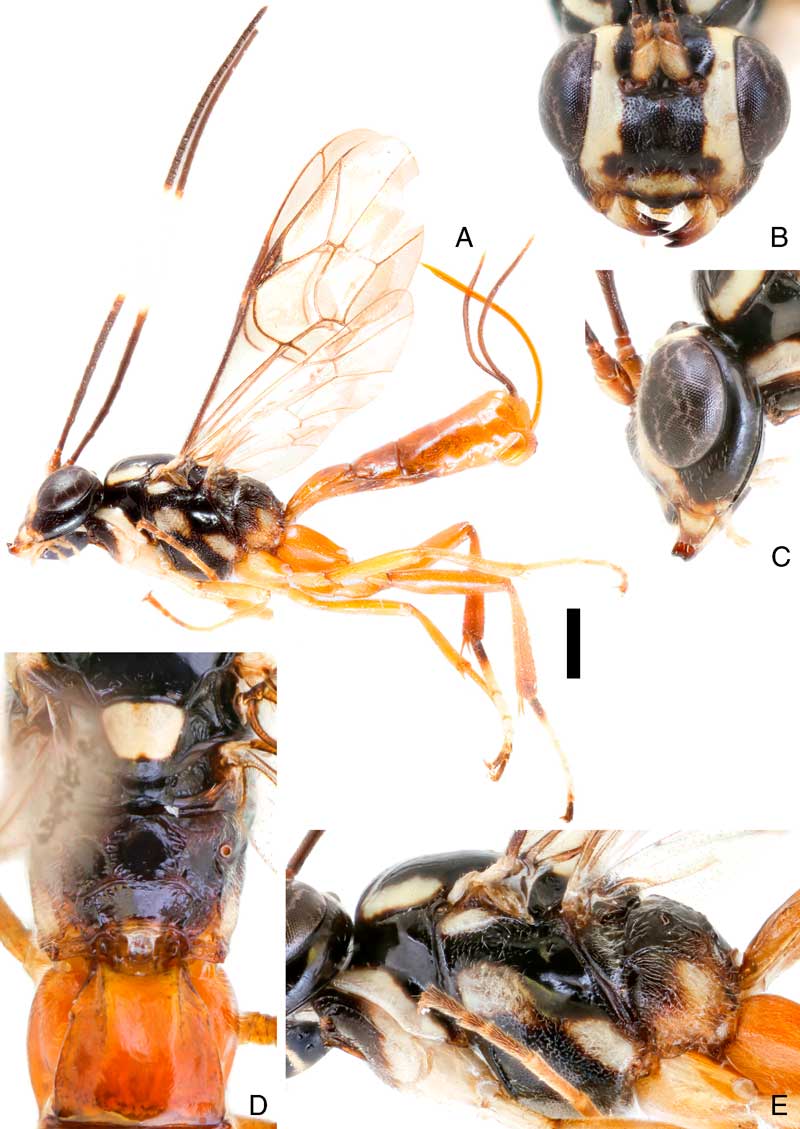
Diagnosis. Scutellum with median, pit-like impression; propodeum with anterior transverse carina centrally, close to its anterior margin, so area basalis indiscernible; area superomedia hexagonal, about 1.0 times as long as wide (Fig. 22D); ovipositor short, about 1.5 times as long as length of metatibia; propodeum black except posteriorly reddish-brown marked (Fig. 22D); metapleuron with anterior half black, posteriorly white (Fig. 22E).
Description. Female: fore wing length 5.8 mm. Head. Clypeus (Fig. 22B) of moderate breadth, 2.2 times as wide as high, granulate with isolated punctures, slightly convex, slightly flared outwards (centrally convex), without a transverse subapical ridge, apical margin entirely convex; mandible tapering slightly, teeth subequal; face granulate with punctures separated by 1.0–2.5 times puncture width, below antennal insertion with a weak median convexity (Fig. 22C); malar space about 0.9 times as long as basal mandibular width; frons faintly granulate, but smooth between toruli (with median, longitudinal, sulcus-shaped impression from between toruli to median ocellus); lateral ocellus separated from compound eye by about 2.1 times maximum ocellar diameter, distance between ocelli 2.0 times maximum ocellar diameter; occipital carina mediodorsally evenly convex, lower-ventral end joining hypostomal carina close to base of mandible (carina about 0.2 times as long as basal mandibular width); gena in lateral view 0.4 times as long as compound eyes, faintly granulate with isolated punctures; antenna with 32 flagellomeres. Mesosoma. Pronotum smooth with isolate punctures in upper and posterior margins, with a protrusion on dorsal margin; without epomia, but with a weak wrinkle in same area. Mesoscutum smooth (centrally faintly granulate) with isolated punctures; notaulus barely impressed, extending through 0.4 times length of mesoscutum. Scutellum slightly convex, smooth, without distinct lateral carina, with median, pit-like impression. Mesopleuron granulate with punctures separated by 0.3–1.5 times puncture width (except without setae on distal half of speculum); upper end of epicnemial carina reaching about 0.2 times of way to anterior margin; metapleuron granulate with punctures separated by 0.3–1.0 times puncture width. Propodeum (Fig. 22D) faintly granulate; anterior transverse carina complete (centrally close to anterior margin of propodeum, so area basalis indistinguisable); posterior transverse carina complete but faint between lateromedian longitudinal carinae; lateral longitudinal carinae strong and complete; lateromedian longitudinal carinae present and discernible; area superomedia hexagonal (about 1.0 times as long as wide); area externa about 2.9 times as wide as long. Prothoracic leg with pretarsal claw long, slender, and abruptly and strongly curved, with short, sparse pectinae. Fore wing with 3rs-m absent, enclosing a petiolate areolet, 2rs-m about 2.0 times as long as abscissa of M between 2rs-m and 2m-cu; Cu1 between 1m-cu and Cu1a 2.0 times as long as Cu1b; 1m-cu fairly evenly arcuate, without ramellus. Hind wing with distal abscissa of Cu1 and 1A sclerotised throughout. Metasoma. Tergite I about 1.1 times as long as posteriorly wide, lateromedian longitudinal carina distinct for 0.7 times length of tergite; tergite II about 0.5 times as long as posteriorly wide. Ovipositor about 1.5 times as long as metatibia; its apex slightly compressed with a narrowed apical section. Colour. Head (Fig. 22A–C) black; mandible white gradually changing on distal half to brown; basal half of clypeus, orbits (from malar space to behind lateral ocellus), palpi, scape, and pedicel ventrally white; flagellomeres black with flagellomeres 7–14 white. Mesosoma predominantly black; pronotum with anterior margin, mesoscutum with anterolateral margin and central spot white; scutellum predominantly white, basally and posteriorly black; tegula white; mesopleuron (Fig. 22E) with a diagonal stripe from upper end of epicnemial carina to its lower posterior end (interrupted centrally) white; metapleuron black, posterior half white (slightly whiter on upper section). Legs (Fig. 22A) predominantly orange; prothoracic leg with coxa and trochantellus white; mesothoracic leg with a white stripe between ventral and lateral coxa; mesotrochantellus white; basal half of mesotarsomere 1 black; metatarsomere 5 black, distal half of metatarsomeres 1–3 white; metatarsomere 4 brown. Wings softly infuscate. Metasomal tergites orange; ovipositor sheath dark brown with distal apex white.
Male: Unknown.
Remarks. The paratypes are slightly smaller than the holotype, fore wing length between 4.7 and 5.3 mm. There is some variation in the colour of the paratypes, they have the metapleuron with anterior 2/3 of metapleuron black and remaining white.
Distribution. Brazil and Peru (Fig. 17).
Etymology. The specific epithet mashco means “little” in Shipibo Conibo language. It is treated as a noun in apposition.
Material examined. Holotype: ♀ “Perú: [Junín department] La Merced Fundo Genova 16/11–07/12/2008 Tampa Malaise 4 AECID-/013484/07” (MEKRB). Paratypes: 2♀♀ “Tucurui, Para I.1979 Brazil M. Alvarenga”, and 1♀ “Sinop, M. Grosso 12°31'S 55°37'W Oct. 1975 Brazil M. Alvarenga” (USUC).
Hapsinotus morenus Ugalde-Gómez and Gauld, Reference Ugalde-Gómez and Gauld2002
Geographic distribution of H. morenus and H. nigrogena.
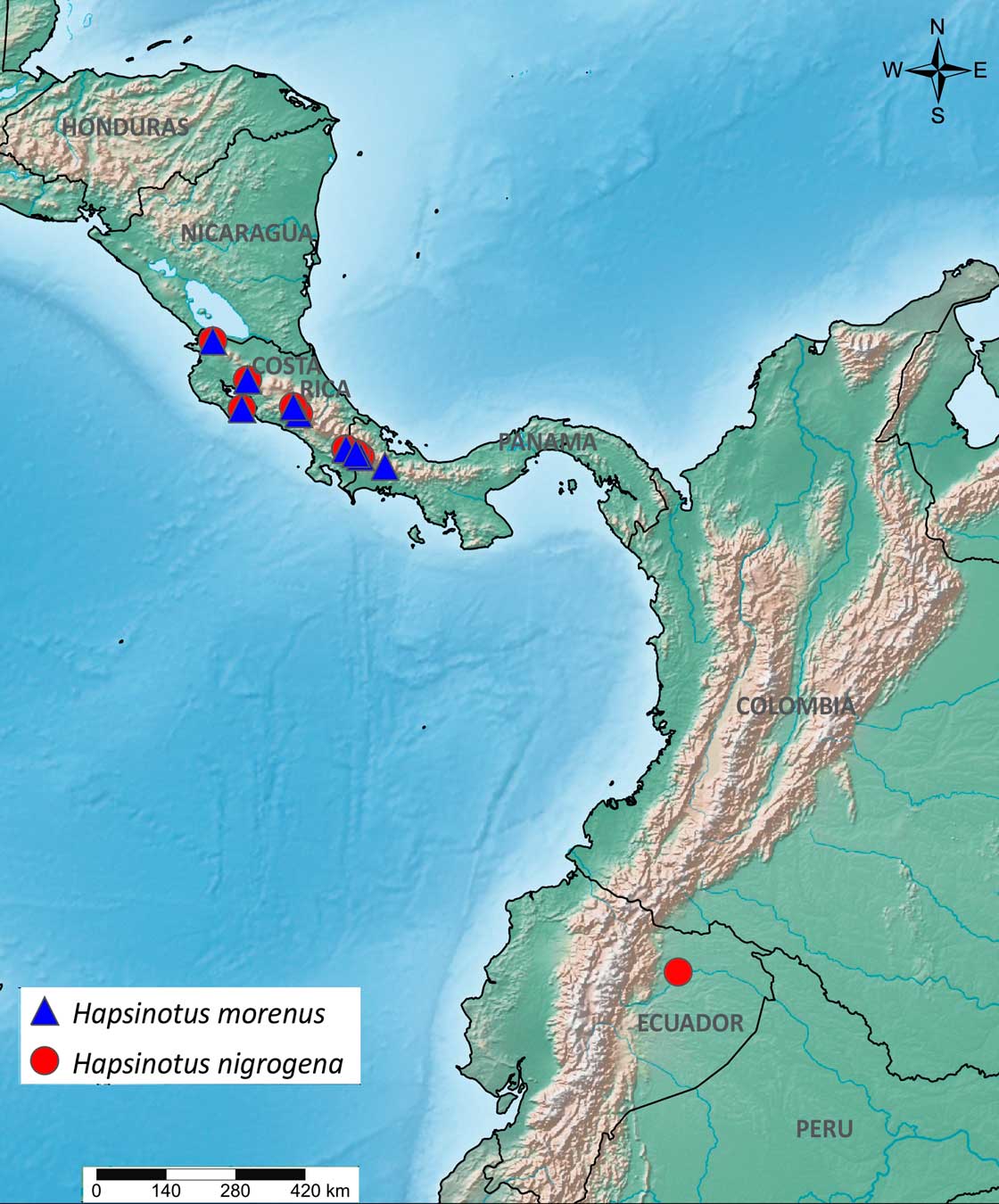
Diagnosis. Face, below antennal insertion, with a weak median convexity below median tubercle; occipital carina mediodorsally evenly arcuate; lateral ocellus separated from compound eye by 0.7–0.8 times maximum ocellar diameter; prothoracic pretarsal claw long, quite strongly bowed, pectinate to centre; ovipositor long, 2.6–2.9 times as long as length of metatibia; head reddish brown or light brown, with eye orbits entirely white; mesoscutum entirely reddish brown or light brown.
Distribution. This species was known only from Costa Rica (Ugalde-Gómez and Gauld Reference Ugalde-Gómez and Gauld2002), its distribution is expanded to Panama (Fig. 23).
Material examined: Paratype: 1♀ “San Luis, A.C. Arenal Prov. Punta, COSTA RICA 1040 m. 1993 Z. Fuentes” (MNCR). Non-type material: 1♀: “PANAMA: Chiriqui, Finca La Suiza, nr. Hornitos, 26.V–06.VI.2000, FIT, H & A Howden [CNC493220]” (CNC); 1♀: “COSTA RICA: Puntarenas Monteverde, 8 May 1989 1400 m, J. Ashe, R. Leschen, R. Brooks #066 ex: black light” (SEMC).
Hapsinotus nigrogena Ugalde-Gómez and Gauld, Reference Ugalde-Gómez and Gauld2002
Morphology of Hapsinotus nigrogena Ugalde-Gómez and Gauld, Reference Ugalde-Gómez and Gauld2002 (non-type). A, Habitus (scale bar=1 mm); B, head, frontal view; C, propodeum.

Diagnosis. Face, below antennal insertion, with a weak median convexity below median tubercle; occipital carina mediodorsally evenly arcuate; propodeum with area externa strongly transverse, more than 2.5 times as wide as long (Fig. 24C); prothoracic pretarsal claw long, strongly bowed, pectinate to centre; metasomal tergite I about 1.4–1.5 times as long as posteriorly wide; ovipositor long, 2.8–2.9 times as long as length of metatibia; head with facial and frontal orbits reaching back to level of lateral ocellus, and malar space, pale; gena extensively black-marked next to compound eye (Fig. 24A); mesoscutum black, anterolateral margin and two central marks white; procoxa white (Fig. 16A); metafemur dark brown (Fig. 24A).
Distribution. This species was known only from Costa Rica (Ugalde-Gómez and Gauld Reference Ugalde-Gómez and Gauld2002), its distribution is expanded to Ecuador (Fig. 23).
Material examined. Paratype: 1♀ “Est. Pitilla, 700 m, 9 km Santa Cecilia, P.N. Guanacaste, Prov. Guanacaste Costa Rica vii. 1992 P Rios” (MNCR). Non-type material: 1♀: “Coca Ecuador May 1965 Luis Peña” (USUC).
Hapsinotus notaulator Ugalde-Gómez and Gauld, Reference Ugalde-Gómez and Gauld2002
Geographic distribution of H. notaulator and H. parvatus.
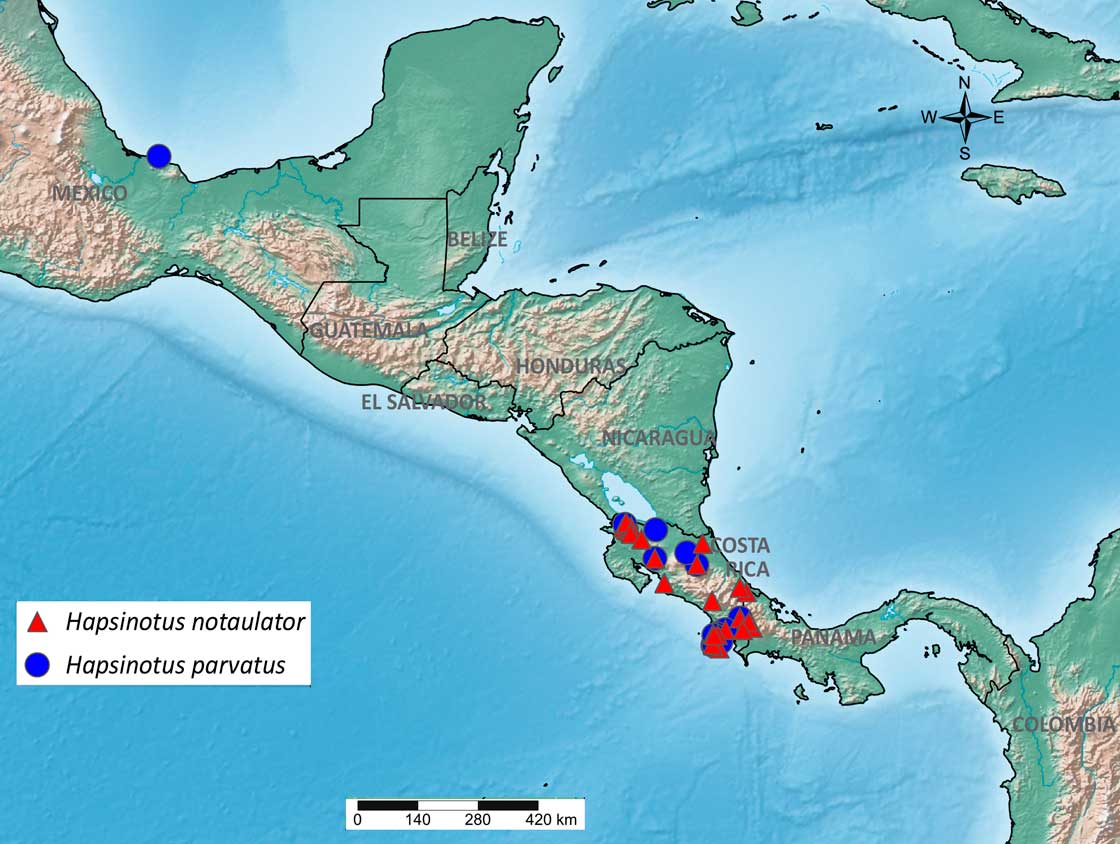
Diagnosis. Face, below antennal insertion, with a very weak medial convexity below median tubercle; occipital carina mediodorsally evenly arcuate; head black with clypeus, facial, frontal, and entire genal orbits white; mesoscutum black, anterolateral margin and central spot white; metapleuron and propodeum entirely red; procoxa generally orange or brown marked. Additionally, female has lateral ocellus separated from compound eye by more than 1.0 times maximum ocellar diameter; prothoracic pretarsal claw long, strongly bowed and pectinate to centre, and ovipositor 2.8–3.2 times as long as length of metatibia. Male has lower-ventral end of occipital carina joining hypostomal carina at base of mandible and propodeum with area superomedia weak but clearly elongate, more-or-less cuneiform, narrower anteriorly than posteriorly.
Distribution. This species was known only from Costa Rica (Ugalde-Gómez and Gauld Reference Ugalde-Gómez and Gauld2002), its distribution is expanded to Panama (Fig. 25).
Material examined. Paratype: 1♀ “COSTA RICA: Limon Prov 16 km W Guapiles on edge of Braulio Carrillo National Park 400 m iv.1989” (MNCR). Non-type material: 1♀: “Sta. Clara, Chiriqui V.31.77 Panama H. & A. Howden” (USUC).
Hapsinotus parvatus Ugalde-Gómez and Gauld, Reference Ugalde-Gómez and Gauld2002
Diagnosis. Face, below antennal insertion, with a weak convexity below median tuberclemedian tubercle; occipital carina mediodorsally evenly arcuate; head black with face, clypeus, facial, frontal, and entire genal orbits white; mesoscutum black with anterolateral white marks, without central white spot; metapleuron and propodeum entirely red; procoxa white. Additionally, female has lateral ocellus separated from compound eye by more than 1.0 times maximum ocellar diameter; prothoracic pretarsal claw long, strongly bowed and pectinate to centre and ovipositor moderately long, 1.8–2.2 times as long as length of metatibia. Male has lower-ventral end of occipital carina joining hypostomal carina at base of mandible and propodeum with area propodeum with area superomedia almost rectangular.
Distribution. This species was only known from Costa Rica; herein we found another individual that expands its distribution to Mexico (Fig. 25).
Material examined. Paratype: 1♀ “San Luis, Monteverde, A. C. Arenal, Prov. Punta, COSTA RICA, 1000–1350 m Apr–May 1993 Z. Fuentes, Malaise” (MNCR). Non-type material: 1♀ “33 km NE Catamaco Ver., Mexico 160 m July 1983 S. & J. Peck” (USUC).
Hapsinotus petirrojo Alvarado, new species
http://zoobank.org/urn:lsid:zoobank.org:act:769B1E4C-9F7F-405E-8E84-B5712864906B
Morphology of Hapsinotus petirrojo new species (holotype). A, Habitus (scale bar=1 mm); B, head, frontal view; C, head, dorsal view; D, mesosoma, lateral view.

Diagnosis. Face, below antennal insertion, with a weak median convexity (Fig. 26B); occipital carina mediodorsally evenly arcuate; lateral ocellus separated from compound eye by 1.0–1.2 times maximum ocellar diameter; propodeum with area superomedia coffin shaped 1.8–1.9 times as long as wide; prothoracic pretarsal claw moderately long, strongly bowed, pectinate for at least 0.6 times its length; fore wing with 2rs-m 1.1–1.2 times length of abscissa on M between 2rs-m and 2m-cu; ovipositor long, 3.1–3.2 times as long as length of metatibia; scape pronotum and mesoscutum entirely black (Fig. 26A); metapleuron and propodeum red (Fig. 26D); metasoma predominantly black (Fig. 26A).
Description. Female: fore wing length 8.0 mm. Head. Clypeus (Fig. 26B) of moderate breadth, 1.9 times as wide as high, faintly granulate with isolated punctures, slightly convex, slightly flared outwards (centrally softly conical), without a transverse subapical ridge, apical margin centrally softly concave; mandible tapering slightly, upper tooth slightly longer than lower; face granulate with punctures separated by 0.8–2.0 times puncture width, below antennal insertion with a weak median convexity; malar space about 0.8 times as long as basal mandibular width; frons (Fig. 26C) faintly granulate, but smooth between toruli (with median longitudinal concavity from between toruli); lateral ocellus separated from compound eye by about 1.1 times maximum ocellar diameter, distance between ocelli 0.9 times maximum ocellar diameter; occipital carina mediodorsally convex, lower-ventral end joining hypostomal carina close to base of mandible (carina about 0.1 times as long as basal mandibular width); gena in lateral view 0.3 times as long as compound eyes, granulate with isolated punctures; antenna with 31 flagellomeres. Mesosoma. Pronotum faintly granulate with isolated punctures on upper and posterior margins; without epomia, with wrinkle in same area. Mesoscutum faintly granulate and polished, with isolated punctures; notaulus barely impressed, extending through 0.4 times length of mesoscutum. Scutellum slightly convex, faintly granulate, without distinct lateral carina, with median, pit-like impression. Mesopleuron granulate (except without punctures on speculum) with punctures separated by 1.5–2.5 times puncture width; upper end of epicnemial carina reaching about 0.3 times of way to anterior margin; metapleuron granulate with punctures separated by 0.5–1.0 times puncture width. Propodeum granulate; anterior transverse carina faint, well defined centrally; posterior transverse carina strong and well defined; lateromedian longitudinal carinae faint but discernible, only well defined before anterior transverse carina; lateral longitudinal carinae faint but discernible, only strong next to spiracle; lateromedian longitudinal carinae present only before anterior transverse carina; area basalis with shape of inverted trapezoid; area superomedia coffin shaped (about 1.8 times as long as wide); area externa about 1.6 times as wide as long. Prothoracic leg with pretarsal claw long, slender, and abruptly and strongly curved, with short, sparse pectinae. Fore wing with 3rs-m absent, 2rs-m about 1.1 times as long as abscissa of M between 2rs-m and 2m-cu; Cu1 between 1m-cu and Cu1a 2.5 times as long as Cu1b; 1m-cu fairly evenly arcuate, without ramellus. Hind wing with distal abscissa of Cu1 and 1A sclerotised throughout. Metasoma. Tergite I about 1.6 times as long as posteriorly wide, lateromedian longitudinal carina distinct for 0.8 times length of tergite; tergite II about 0.8 times as long as posteriorly wide. Ovipositor about 3.2 times as long as metatibia; its apex slightly compressed with a narrowed apical section. Colour. Head (Fig. 26A–C) black; mandible white distally gradually changing to light brown; frons (between toruli to before median ocellus) white; maxilar palpi 1–3 brown; maxilar palpi 4–5, and labial palpi light brown; antenna black with a white band on flagellum. Mesosoma with pronotum and mesoscutum black; scutellum predominantly black with a light brown stripe laterally; tegula dark brown with distal lateral corner white; mesopleuron (Fig. 26D) reddish brown, anterior quarter black, subalar prominence centrally white; propodeum, metapleuron and mesosternum reddish brown. Prothoracic leg (Fig. 26A) with coxa, trochanter, trochantellus, and tarsomere brown; femur orange; tibia orange, dorsally brown. Mesothoracic leg (Fig. 26A) reddish brown, trochantellus, femur dorsally, and tarsomere brown; tarsomere 1–3 with distal end gradually changing to light brown. Metathoracic leg (Fig. 26A) with coxa and trochanter reddish brown; trochantellus, femur, tibia, and tarsomere 5 dark brown; tarsomere 1–4 white, basal third of tarsomere 1 dark brown; tarsomere 5 brown. Wings hyaline. Metasomal tergites black; tergite I reddish brown grading in distal quarter to black; tergites VI–VII dark brown; ovipositor sheath dark brown with distal apex white.
Male: Unknown.
Remarks. The paratype is smaller than holotype, fore wing length 6.2 mm. It differs from holotype by having clypeus of moderate 2.1 times as wide as high; lateral ocellus separated from compound eye by about 1.2 times maximum ocellar diameter; occipital carina end joining hypostomal carina at base of mandible at about 0.2 times as long as basal mandibular width; propodeum with area superomedia about 1.9 times as long as wide, and area externa about 1.2 times as wide as long; fore wing with 2rs-m about 1.2 times as long as abscissa of M between 2rs-m and 2m-cu; Cu1 between 1m-cu and Cu1a 1.6 times as long as Cu1b; tergite I about 1.7 times as long as posteriorly wide, lateromedian longitudinal carina distinct for 0.7 times length of tergite; tergite II about 0.9 times as long as posteriorly wide; ovipositor about 3.1 times as long as metatibia; and in colour mesopleuron with anterior third black, and subalar prominence light brown.
Distribution. Ecuador (Fig. 20).
Etymology. The specific epithet “petirrojo” is in honour to the colloquial name given to the bird Pyrocephalus rubinus (Boddaert, 1783), which has similar colour. It is treated as a noun in apposition.
Material examined. Holotype: ♀ “Napo, Ecuador Baeza, 2000 m. Feb.’79 mazon” (USUC). Paratype: 1♀ “Abitagua, Ecuador IV.15.40 1800 m W. Clarke.McIntyre” (USUC). Antennae broken, with only 19 flagellomeres.
Hapsinotus pittieri Alvarado, new species
http://zoobank.org/urn:lsid:zoobank.org:act:B3152C22-EE3C-42F4-A5AE-1995CA2FE64F
Morphology of Hapsinotus pittieri new species (holotype). A, Habitus (scale bar=1 mm); B, head, frontal view; C, head, dorsal view; D, mesosoma, lateral view.
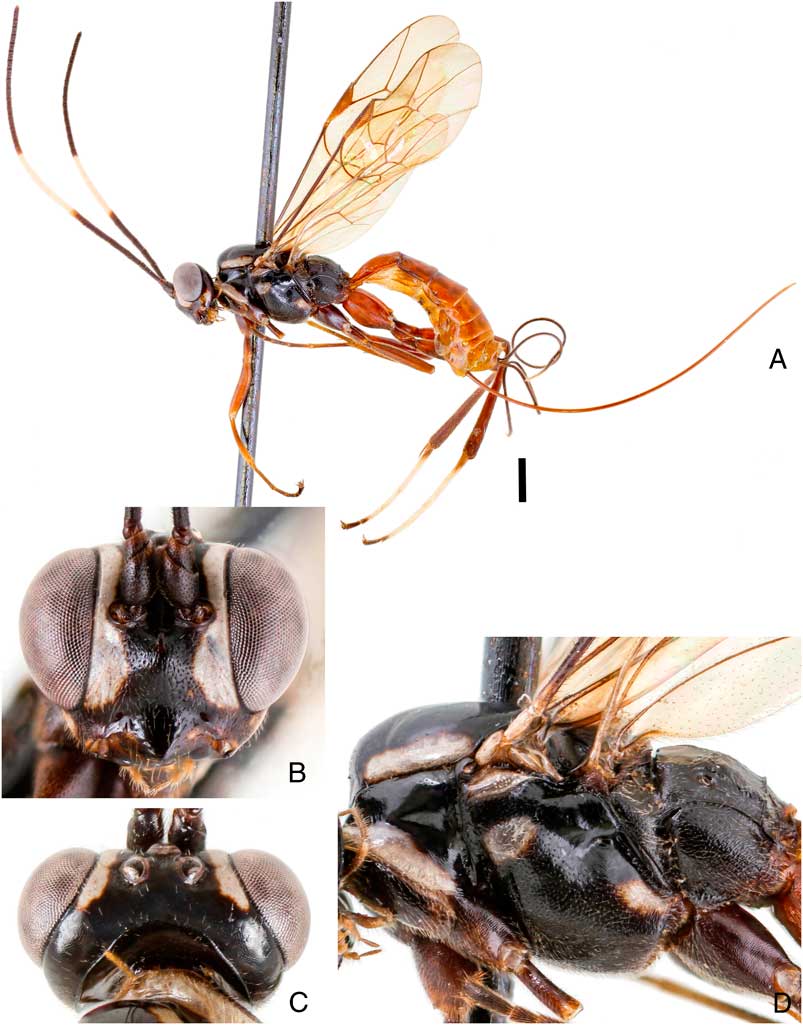
Diagnosis. Face, below antennal insertion with a weak median convexity (Fig. 27B); occipital carina mediodorsally evenly arcuate; lateral ocellus separated from compound eye by about 1.1 times maximum ocellar diameter (Fig. 27C); prothoracic pretarsal claw long, slender, abruptly and strongly curved, with short, sparse pectinae at least along 0.6 its length; fore wing vein 1m-cu not angulate near centre, homogeneously curved, without ramellus; Cu1 between 1m-cu and Cu1a 1.4 times as long as Cu1b; ovipositor moderately long, 3.3 times as long as length of metatibia; head with pale mark on facial and frontal orbits (Fig. 27B) reaching back to level of lateral ocellus; upper part of gena extensively black-marked next to compound eye (Fig. 27A); mesoscutum black. anterolateral margin (Fig. 27D) and median spot white; tegula white with posterior quarter brown; metapleuron and propodeum black (Fig. 27D); metafemur red (Fig. 27A); ovipositor sheath mostly black with distal apex white.
Description. Female: fore wing length 6.7 mm. Head. Clypeus (Fig. 27B) of moderate breadth, 2.0 times as wide as high, faintly granulate with isolated punctures, slightly convex, slightly flared outwards (centrally softly conical), without a transverse subapical ridge, apical margin centrally softly concave; mandible tapering slightly, upper tooth slightly longer than lower; face granulate with punctures separated by 1.5–2.0 times puncture width, below antennal insertion with a weak median convexity; malar space about 0.7 times as long as basal mandibular width; frons (Fig. 27C) faintly granulate, but smooth between toruli (with median longitudinal concavity between toruli); lateral ocellus separated from compound eye by about 1.1 times maximum ocellar diameter, distance between ocelli 1.3 times maximum ocellar diameter; occipital carina mediodorsally convex, lower-ventral end joining hypostomal carina close to base of mandible (carina about 0.2 times as long as basal mandibular width); gena in lateral view 0.3 times as long as compound eyes, granulate with isolated punctures; antenna with 29 flagellomeres. Mesosoma. Pronotum faintly granulate with isolated punctures on upper and posterior margins; without epomia, with wrinkle in same area. Mesoscutum faintly granulate and polished, with isolated punctures; notaulus barely impressed, extending through about 0.3 times length of mesoscutum. Scutellum faintly granulate, slightly convex, without distinct lateral carina, with median, pit-like impression. Mesopleuron granulate (except speculum without punctures) with punctures separated by 1.0–2.0 times puncture width; upper end of epicnemial carina reaching about 0.2 times of way to anterior margin; metapleuron granulate with punctures separated by 1.5–2.0 times puncture width. Propodeum granulate; anterior transverse carina faint, but discernible; posterior transverse carina strong and complete; lateral longitudinal carinae faint but discernible; lateromedian longitudinal carinae faint but discernible except strong before anterior transverse carinae; area basalis with shaped of inverted trapezoid; area superomedia coffin shaped (about 1.5 times as long as wide); area externa about 1.2 times as wide as long. Prothoracic leg with pretarsal claw long, slender, and abruptly and strongly curved, with short, sparse pectinae. Fore wing with 3rs-m absent, 2rs-m about 1.4 times as long as abscissa of M between 2rs-m and 2m-cu; Cu1 between 1m-cu and Cu1a 1.4 times as long as Cu1b; 1m-cu fairly evenly arcuate, without ramellus. Hind wing with distal abscissa of Cu1 and 1A sclerotised throughout. Metasoma. Tergite I about 1.7 times as long as posteriorly wide, lateromedian longitudinal carina distinct for 0.6 times length of tergite; tergite II about 0.9 times as long as posteriorly wide. Ovipositor about 3.3 times as long as metatibia; its apex slightly compressed with a narrowed apical section. Colour. Head (Fig. 27A–C) black; mandible basally brown; clypeus laterally light brown; orbits (from mid face to after lateral ocellus) and a spot on lower third of gena white; malar palpi light brown; labial palpi brown, palpi 2–3 grading distally to light brown; antenna black with a white band on flagellum. Mesosoma with pronotum black, anterior margin white; mesoscutum black, anterolateral margin and central spot white; scutellum predominantly white, anteriorly (shaped as inverted thin triangle) and posteriorly black; tegula white, posterior quarter brown; mesopleuron black, subalar prominence, a spot at end of epicnemial carina, and a spot at lower posterior corner of mesopleuron white; propodeum, metapleuron, and mesosternum black. Prothoracic and mesothoracic legs (Fig. 27A) brownish red, coxae brown. Metathoracic leg (Fig. 27A) brown, coxa dorsolaterally and femur dorsally reddish brown; tarsomere 1–3 white, basal third of tarsomere 1 reddish brown. Metasomal tergites reddish brown; ovipositor sheath dark brown with distal apex light brown. Wings hyaline.
Male: Unknown.
Remarks. The holotype is missing the left prothoracic leg beyond trochatellus.
Distribution. Venezuela (Fig. 3).
Etymology. The specific epithet pittieri is in honour of Henri Pittier, a distinguished Swiss geographer, botanist, and ethnologist, who devoted many years studying the flora and fauna in the Henri Pittier National Park. It is a masculine noun in the genitive case.
Material examined. Holotype: ♀ “Venez.: Aragua Rancho Grande VII.4-14.1986 1460 m B. Gill” (USUC).
Hapsinotus planifascies Ugalde-Gómez and Gauld, Reference Ugalde-Gómez and Gauld2002
Diagnosis. Face flat, with only median tubercle raised; ovipositor 3.6–3.7 times as long as length of metatibia; mesoscutum black, with only a central white spot; propodeum black, rarely red, with white laterally between lateral longitudinal and pleural carinae; metapleuron black with anterior half white.
Distribution. Costa Rica (Ugalde-Gómez and Gauld Reference Ugalde-Gómez and Gauld2002).
Material examined. Paratype: 1♀ “COSTA RICA: Prov. Puntarenas, Amistad National Park, Estacion Altamira, Sendero a Casa Coca, 1700 m, marzo 2000. D. Rubi. Malaise” (MNCR).
Hapsinotus plaumanni Alvarado, new species
http://zoobank.org/urn:lsid:zoobank.org:act:C0B50E60-D2CC-4CA1-A03D-636619154B69
Morphology of Hapsinotus plaumanni new species, female (paratype). A, Habitus (scale bar=1 mm); B, head, lateral view; C, head, frontal view; D, propodeum.

Morphology of Hapsinotus plaumanni new species, male (paratype). A, Head, lateral view; B, habitus (scale bar=1 mm); C, head, frontal view.

Diagnosis. Face with a weak median convexity below median tubercle (Figs. 28C, 29C); occipital carina mediodorsally evenly arcuate; mesoscutum orange (Figs. 28A, 29B), at most with faint brown marks but without discrete pale spots. In addition, female has prothoracic pretarsal claw long, strongly curved and pectinate for at least 0.6 times its length and ovipositor long, 3.2–3.4 times as long as length of metatibia.
Description. Female (Fig. 28): fore wing length 6.9 mm. Head. Clypeus (Fig. 28C) of moderate breadth, 2.1 times as wide as high, granulate with isolated punctures, slightly convex, slightly flared outwards (centrally convex), without a transverse subapical ridge, apical margin centrally concave; mandible tapering slightly, upper tooth longer than lower; face granulate with punctures separated by 1.0–1.5 times puncture width, below antennal insertion with a weak median convexity; malar space about 0.7 times as long as basal mandibular width; frons (Fig. 28C) faintly granulate but smooth between toruli (with median, longitudinal, sulcus-shaped impression from between toruli to median ocellus); lateral ocellus separated from compound eye by about 1.4 times maximum ocellar diameter, distance between ocelli 1.5 times maximum ocellar diameter; occipital carina mediodorsally evenly convex, lower-ventral end joining hypostomal carina close to base of mandible (carina about 0.1 times as long as basal mandibular width); gena in lateral view 0.4 times as long as compound eyes, granulate with isolated punctures; antenna with 31 flagellomeres. Mesosoma. Pronotum faintly granulate with isolated punctures; without epomia, with wrinkle in the same area. Mesoscutum faintly granulate and polished, with isolated punctures; notaulus barely impressed, extending through 0.3 times length of mesoscutum. Scutellum slightly convex, granulate, without distinct lateral carina, with median, pit-like impression. Mesopleuron granulate (except smooth on speculum) with punctures separated by 1.0–1.5 times puncture width; upper end of epicnemial carina reaching about 0.2 times of way to anterior margin; metapleuron granulate with punctures separated by 0.5–1.0 times puncture width. Propodeum (Fig. 28D) slightly wrinkled; anterior transverse carina faint but strong centrally (between lateromedian longitudinal carinae); posterior transverse carina complete and strong (faint between lateromedian longitudinal carinae); lateral longitudinal carinae strong; lateromedian longitudinal carinae present before anterior transverse carina and after posterior transverse carina, discontinuous but discernible between transverse carinae; area basalis with shape of inverted trapezoid; area superomedia coffin shaped (about 1.3 times as long as wide); area externa about 1.3 times as wide as long. Prothoracic leg with pretarsal claw long, slender, and abruptly and strongly curved, with short, sparse pectinae. Fore wing with 3rs-m absent, 2rs-m about 1.4 times as long as abscissa of M between 2rs-m and 2m-cu; Cu1 between 1m-cu and Cu1a 1.4 times as long as Cu1b; 1m-cu fairly evenly arcuate, without ramellus. Hind wing with distal abscissa of Cu1 and 1A sclerotised throughout. Metasoma. Tergite I about 1.5 times as long as posteriorly wide, lateromedian longitudinal carina distinct for 0.7 times length of tergite; tergite II about 0.7 times as long as posteriorly wide. Ovipositor about 3.3 times as long as metatibia; its apex slightly compressed with a narrowed apical section. Colour. Head (Fig. 28A–C) orange; orbit yellowish white (from upper face to after lateral ocellus); clypeus distally brown; palpi light brown; antenna black with a white band on flagellum, scape and pedicel light orange, basal half of first flagellomere and distal half of last flagellomeres reddish brown. Mesosoma orange, anterior margin of pronotum white; mesopleuron with a white spot in lower posterior; scutellum orange laterally white (only in holotype); subalar prominence (Fig. 28A) white. Legs (Fig. 28A) predominantly orange, metafemur gradually changing to dark brown distally; basal third of metatarsomere 1 and metatarsomeres 4–5 dark brown; 2/3 distal of metatarsomere 1 and metatarsomeres 2–3 white. Wings softly infuscate. Metasomal tergites orange; ovipositor sheath dark brown with distal apex white.
Male (Fig. 29): Similar to female but face (Fig. 29C), clypeus (but distal margin light brown), orbits from lower third of gena to after lateral ocellus (Fig. 29A), scape, anterior margin of pronotum, mesopleuron (Fig. 29B) with a diagonal stripe from end of epicnemial carina to its lower posterior end, metapleuron with a postero-dorsal spot, procoxa laterodorsally, and mesocoxa laterodorsally white; scutellum predominantly white, anteriorly (shaped as an inverted thin triangle) and posteriorly orange; pedicel and palpi light brown.
Remarks. The paratype series varies from holotype in the following: clypeus 2.0–2.2 times as wide as high; distance between ocelli 1.1–1.6 times maximum ocellar diameter; occipital carina joining to hypostomal carina at 0.2 times as long as basal mandibular width; antenna with 29–31 flagellomeres; propodeum with area superomedia 1.3–1.5 times as long as wide, and area externa 1.2–1.4 times as wide as long; fore wing with 2rs-m 1.3–1.4 times as long as abscissa of M between 2rs-m and 2m-cu, and Cu1 between 1m-cu and Cu1a 1.4–1.8 times as long as Cu1b; metasomal tergite I 1.5–1.6 times as long as posteriorly wide, lateromedian longitudinal carinae 0.7–0.8 times length of tergite; tergite II 0.7–0.8 times as long as posteriorly wide; and ovipositor 3.2–3.4 times as long as metatibia. Paratypes with pronotum, mesopleuron, and mesoscutum entirely orange in paratypes.
Comments. Within the H. atripleurum species group, there are only two species with mesoscutum orange, H. plaumanni and some individuals of H. morenus. Hapsinotus plaumanni has the mesoscutum entirely orange while H. morenus, when has it orange (or reddish brown), then anterolateral margins white.
Distribution. Brazil (Fig. 9).
Etymology. The specific epithet plaumanni is in honour to German entomologist and botanist Fritz Plaumann. It is a masculine noun in the genitive case.
Material examined. Holotype: ♀ “BRAZIL: Nova Teutonia, 27°11', 52°23'L, 8.IX.1938, Fritz Plaumann, B.M.1938-682” (NHML). Paratypes: 1♀ “BRAZIL: Nova Teutonia, 27°11', 52°23'L, 4.I.1938, Fritz Plaumann, B.M.1938-682”, and 1♀ “BRAZIL: Nova Teutonia, 27°11', 52°23'L, 7.XII.1937, Fritz Plaumann, B.M.1937-748” (NHML); 1♀ “Nova Teutonia Santa Catarina X.22.52 Braz[Brazil] Fritz Plaumann”, 1♀ “Nova Teutonia Santa Catarina X.4’48 Braz[Brazil] Fritz Plaumann”, ♀ “Nova Teutonia Santa Catarina XI.25.53 Braz[Brazil] Fritz Plaumann”, 1♀ “S.J. Barreiro, Serra da Bocaina, Braz. [Brazil] 1650 m XI-68 Alvarenga & Seabra”, 1♂ “Nova Teutonia Santa Catarina III.27.52 Braz[Brazil] Fritz Plaumann”, and 1♂ “Nova Teutonia Santa Catarina Mar.1971 Brazil Fritz Plaumann” (USUC).
Hapsinotus prolixus Alvarado, new species
http://zoobank.org/urn:lsid:zoobank.org:act:D2DEF316-AE85-4211-B97A-95E1DBD32B76
Morphology of Hapsinotus prolixus new species (holotype). A, Habitus (scale bar=1 mm); B, head, lateral view; C, head, frontal view.

Diagnosis. Face, below antennal insertion with a weak median convexity (Fig. 30B); occipital carina mediodorsally evenly arcuate; prothoracic pretarsal claw long, strongly bowed, pectinate for at least 0.5 times its length; ovipositor very long, 3.5–3.6 times as long as length of metatibia, head black with pale marks on facial and frontal orbits reaching back to half upper genal orbit (Fig. 30B–C); lower genal orbit black next to compound eye (Fig. 30B); mesoscutum black with a small white spot on centre of anterolateral margin (Fig. 30A), without median white mark; propodeum black with area between pleural and lateral longitudinal carinae white (Fig. 30A); metapleuron with anterior half white and posterior half light brown (Fig. 30A); metafemur red (Fig. 30A).
Description. Female: fore wing length 8.3 mm. Head. Clypeus (Fig. 30C) of moderate breadth, about 2.2 times as wide as high, faintly granulate with isolated punctures (more separated distally), slightly convex, slightly flared outwards (centrally softly conical), without a transverse subapical ridge, apical margin centrally softly concave; mandible tapering slightly, upper tooth slightly longer than lower; face granulate with punctures separated by 1.5–2.5 times puncture width, below antennal insertion with a weak median convexity (Fig. 30B); malar space about 0.8 times as long as basal mandibular width; frons faintly granulate, but smooth between toruli (with median, longitudinal, sulcus-shaped impression from between toruli and before median ocellus); lateral ocellus separated from compound eye by about 1.3 times maximum ocellar diameter, distance between ocelli about 1.1 times maximum ocellar diameter; occipital carina mediodorsally convex, lower-ventral end joining hypostomal carina close to base of mandible (carina about 0.2 times as long as basal mandibular width); gena in lateral view 0.3 times as long as compound eyes, granulate with isolated punctures; antenna with 32 flagellomeres. Mesosoma. Pronotum faintly granulate with isolated punctures on upper and posterior margins; without epomia, with wrinkle in the same area. Mesoscutum faintly granulate and polished, with isolated punctures; notaulus barely impressed, extending through 0.4 times length of mesoscutum. Scutellum slightly convex, faintly granulate, without distinct lateral carina and median, pit-like impression. Mesopleuron granulate (except smooth on distal half of speculum) with punctures separated by 1.0–3.0 times puncture width; upper end of epicnemial carina reaching about 0.2 times of way to anterior margin; metapleuron granulate with punctures separated by 1.2–2.5 times puncture width. Propodeum granulate; anterior transverse carina faint, well defined centrally; posterior transverse carina strong and complete; lateral longitudinal carinae strong; lateromedian longitudinal carinae strong only before anterior transverse carina, faint but discernible between transverse carinae, absent after posterior transverse carina; area basalis with shape of inverted trapezoid; area superomedia coffin shaped (about 1.7 times as long as wide); area externa about 1.4 times as wide as long. Prothoracic leg with pretarsal claw long, slender, and abruptly and strongly curved, with short, sparse pectinae. Fore wing with 3rs-m absent, 2rs-m about 1.1 times as long as abscissa of M between 2rs-m and 2m-cu; Cu1 between 1m-cu and Cu1a 2.0 times as long as Cu1b; 1m-cu fairly evenly arcuate, without ramellus. Hind wing with distal abscissa of Cu1 and 1A sclerotised throughout. Metasoma. Tergite I about 1.3 times as long as posteriorly wide, lateromedian longitudinal carina distinct for 0.7 times length of tergite; tergite II about 0.8 times as long as posteriorly wide. Ovipositor about 3.6 times as long as metatibia; its apex slightly compressed with a narrowed apical section. Colour. Head (Fig. 30B–C) black; mandible brown; orbit white (from mid face to mid gena); palpi light brown, first labial palpi, malar palpi 4 and 5 brown; antenna black with a white band on flagellum. Mesosoma with pronotum black, anterior margin of white; mesoscutum black; a small spot on centre of anterolateral margin white; scutellum predominantly white but anteriorly (shaped as an inverted thin triangle) and posteriorly black; tegula white, distal half brown; mesopleuron (Fig. 30A) black, subalar prominence, a spot at end of epicnemial carina, and a spot on lower posterior corner of mesopleuron white; mesosternum black; propodeum black, area between pleural and lateral longitudinal carinae (but before posterior transverse carina) white, area coxalis light brown; metapleuron with anterior half white and posterior half light brown (Fig. 30A). Prothoracic leg (Fig. 30A) reddish orange, coxa anteriorly brown and a small perpendicular stripe, laterally, white. Mesothoracic leg (Fig. 30A) reddish orange. Metathoracic leg (Fig. 30A) reddish brown to orange, tarsomeres 1–4 white, basal third of tarsomere 1 light brown, tarsomere 5 brown. Wings hyaline. Metasomal tergites reddish brown; basal third of tergite I; tergites IV–VIII red. Ovipositor sheath dark brown with distal apex white.
Male: Unknown.
Distribution. Venezuela (Fig. 5).
Etymology. The specific epithet prolixus means “long” in Latin, in reference to the length of the ovipositor. It is treated as an adjective in the nominative singular.
Material examined. Holotype: ♀ “Tucuco [Los Ángeles del Tucuco], Zulia Venez. IV.26.81 H. K. Townes” (USUC).
Hapsinotus secoya Alvarado, new species
http://zoobank.org/urn:lsid:zoobank.org:act:92DDAB83-1266-4F4B-AF2A-FE42D7FB82A4
Morphology of Hapsinotus secoya new species (holotype). A, Habitus (scale bar=1 mm); B, head, frontal view; C, head, dorsal view; D, mesosoma, lateral view; E, propodeum.
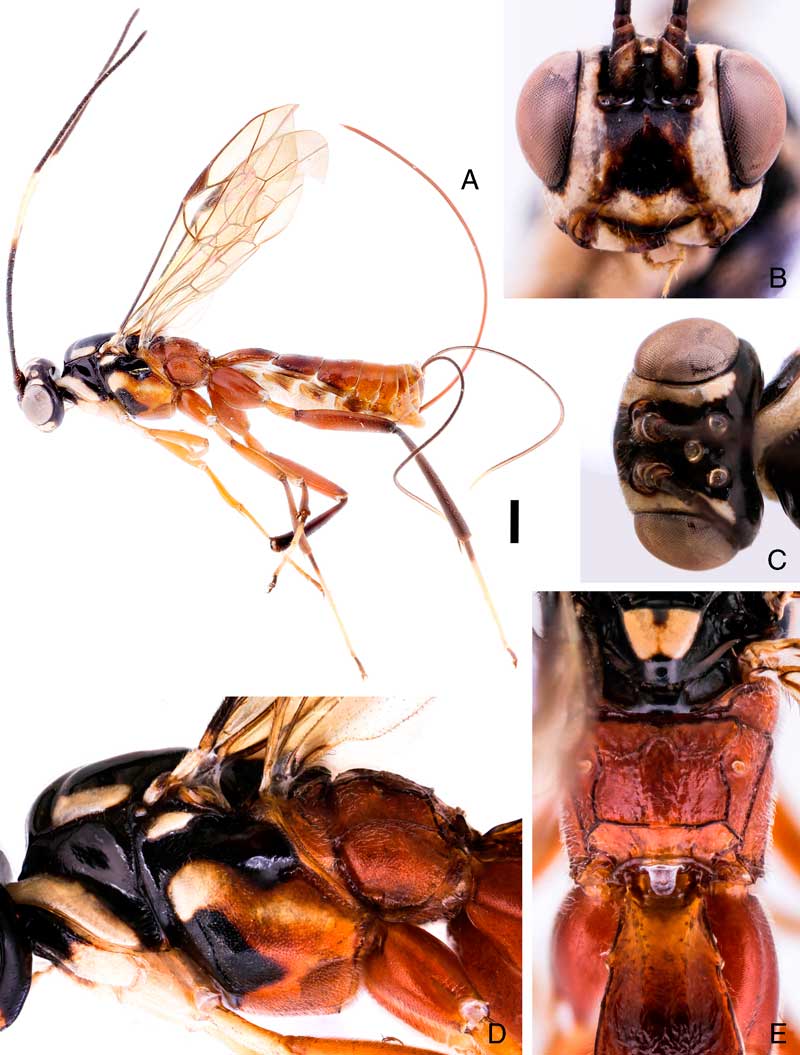
Diagnosis. Face, below antennal insertion with a moderate median convexity below median tubercle; occipital carina mediodorsally evenly arcuate; clypeus 2.4–2.5 times as wide as long; propodeum with area superomedia coffin shaped, about 2.4 times as long as wide (Fig. 31D); prothoracic pretarsal claw long, slender, abruptly and strongly curved, with short, sparse pectinae at least along 0.6 its length; metasomal tergite I with lateromedian longitudinal carinae 0.7–0.8 times length of tergite; ovipositor moderately long, 3.1 times as long as length of metatibia; face eye orbit white, reaching back to level of lateral ocellus; orbital gena extensively black (Fig. 31A); scape ventrally, and malar space white (Fig. 31B); mesoscutum black, with anterolateral marks (Fig. 31D) and a median spot white; mesosternum reddish orange; metapleuron and propodeum entirely reddish orange (Fig. 31D); metafemur red (Fig. 31A), at most with distal tip brown.
Description. Female: fore wing length 6.5 mm. Head. Clypeus (Fig. 31B) of moderate breadth, about 2.5 times as wide as high, faintly granulate with isolated punctures, slightly convex, slightly flared outwards (centrally softly conical), without a transverse subapical ridge, apical margin centrally softly concave; mandible tapering slightly, upper tooth slightly longer than lower; face granulate with punctures separated by 1.5–2.0 times puncture width, below antennal insertion with a median convexity; malar space about 0.7 times as long as basal mandibular width; frons (Fig. 31C) faintly granulate, but smooth between toruli; lateral ocellus separated from compound eye by about 1.3 times maximum ocellar diameter, distance between ocelli 1.3 times maximum ocellar diameter; occipital carina mediodorsally convex, lower-ventral end joining hypostomal carina close to base of mandible (carina about 0.2 times as long as basal mandibular width); gena in lateral view 0.4 times as long as compound eyes, granulate with isolated punctures; antenna with 31 flagellomeres. Mesosoma. Pronotum faintly granulate with isolated punctures on upper and posterior margins; without epomia, with wrinkle in the same area. Mesoscutum faintly granulate and polished, with isolated punctures; notaulus barely impressed, extending through 0.3 times length of mesoscutum. Scutellum slightly convex, faintly granulate, without distinct lateral carina and median, pit-like impression. Mesopleuron granulate (except smooth on distal half of speculum) with punctures separated by 1.5–2.0 times puncture width; upper end of epicnemial carina reaching about 0.3 times of way to anterior margin; metapleuron granulate with punctures separated by 0.8–1.5 times puncture width. Propodeum (Fig. 31E) granulate; anterior transverse carina faint, well defined centrally; posterior transverse carina strong but faint centrally between lateromedian longitudinal carinae; lateral longitudinal carinae strong; lateromedian longitudinal carinae present and strong only before anterior transverse carina, remaining discernible; area basalis with shape of inverted trapezoid; area superomedia coffin shaped (about 2.4 times as long as wide); area externa about 1.7 times as wide as long. Prothoracic leg with pretarsal claw long, slender, and abruptly and strongly curved, with short, sparse pectinae. Fore wing with 3rs-m absent, 2rs-m about 1.9 times as long as abscissa of M between 2rs-m and 2m-cu; Cu1 between 1m-cu and Cu1a 1.6 times as long as Cu1b; 1m-cu fairly evenly arcuate, without ramellus. Hind wing with distal abscissa of Cu1 and 1A sclerotised throughout. Metasoma. Tergite I about 1.4 times as long as posteriorly wide, lateromedian longitudinal carina distinct for 0.8 times length of tergite; tergite II about 0.7 times as long as posteriorly wide. Ovipositor about 3.1 times as long as metatibia; its apex slightly compressed with a narrowed apical section. Colour. Head (Fig. 31A–C) black; mandible white, gradually changing on distal half to light brown; clypeus white, distally and basally black; orbit (from lower gena to after lateral ocellus) white; palpi white, fifth maxillar palpomere and first labial palpomere light brown); a red spot below median tubercle; antenna black with a white band on flagellum, scape ventrally white. Mesosoma with pronotum black, anterior margin white; mesoscutum black, anterolateraly and central spot white; scutellum predominantly white, anteriorly (shaped as an inverted thin triangle) and posteriorly black; tegula white, posterior third brown; mesopleuron (Fig. 31D) with anterior half black and posterior half orange; subalar prominence, a spot at end of epicnemial carina, and a diagonal stripe from mid mesopleuron its lower posterior end white; propodeum, metapleuron, and mesosternum reddish orange. Prothoracic leg (Fig. 31A) predominantly light brown, coxa (but ventrally light brown), trochanter, and trochantellus off-white; tarsomere 2–3 white; and tarsomeres 5 brown. Mesothoracic leg (Fig. 31A) with coxa reddish orange; trochanter, trochantellus (laterally gradually changing to white), and femur light brown; tibia reddish brown, tarsomere 5 and tarsomere 1 with basal third dark brown; distal 2/3 of tarsomeres 1–4 white. Metathoracic leg (Fig. 31A) with coxa and femur reddish orange; trochanter and trochantellus light brown; tibia brown; basal third of tarsomere 1 and tarsomere 5 dark brown; distal 2/3 of tarsomeres 1–4 white. Wings hyaline. Metasomal tergites reddish orange, basal half of tergite I light brown; ovipositor sheath dark brown with distal apex white.
Male: Unknown.
Distribution. Ecuador (Fig. 17).
Etymology. The specific epithet “secoya” refers to the Secoya people that inhabit the Peruvian and Ecuadorian Amazon region. It is treated as a noun in apposition.
Material examined. Holotype: ♀ “ECUADOR: Sucumbios, Rio Napo, Sacha Lodge, 0°30'S 76°30'W, 270 m, 14–24.V.1994, Malaise trap, P. Hibbs [CNC493214]” (CNC).
Hapsinotus shushufindi Alvarado, new species
http://zoobank.org/urn:lsid:zoobank.org:act:C79C16D7-06A2-43E2-80E5-61DCE745152C
Morphology of Hapsinotus shushufindi new species. A, Habitus (holotype scale bar=1 mm); B, head, frontal view (holotype); C, head, lateral view (holotype); D, mesosoma, lateral view (holotype); E, propodeum (paratype).

Diagnosis. Face, below antennal insertion with a median moderate convexity (Fig. 32B–C); occipital carina mediodorsally evenly arcuate; propodeum with area externa about 1.7–1.8 times as wide as long (Fig. 32E); lateral ocellus separated from compound eye by 0.9–1.0 times maximum ocellar diameter; prothoracic pretarsal claw long, slender, and strongly bowed, pectinate for at least 0.5 times its length; propodeum with lateromedian longitudinal carinae present, not fused before anterior transverse carina, so area basalis trapezoidal (Fig. 32E); metasomal tergite I 1.6–1.8 times as long as posteriorly wide; ovipositor long, 3.1–3.4 times as long as length of metatibia; mesoscutum black with anterolateral margins white (Fig. 32D), without median white mark; head (Fig. 32A–C) black, with facial and frontal orbits reaching back to level of lateral ocellus, white; procoxa reddish brown (Fig. 32A); metafemur dark brown (Fig. 32A); metatarsomeres 2–4 white (Fig. 32A).
Description. Female: fore wing length 5.7 mm. Head. Clypeus (Fig. 32B) of moderate breadth, 2.1 times as wide as high, faintly granulate with isolated punctures, slightly convex, slightly flared outwards (centrally softly conical), with a faint transverse subapical ridge, apical margin convex, centrally straight; mandible tapering slightly, upper tooth slightly longer than lower; face granulate with punctures separated by 2.0–2.5 times puncture width, below antennal insertion with a median moderate convexity (Fig. 32C); malar space about 0.7 times as long as basal mandibular width; frons faintly granulate, but smooth between toruli; lateral ocellus separated from compound eye by about 0.9 times maximum ocellar diameter, distance between ocelli 1.0 times maximum ocellar diameter; occipital carina mediodorsally convex, lower-ventral end joining hypostomal carina close to base of mandible (carina about 0.2 times as long as basal mandibular width); gena in lateral view 0.3 times as long as compound eyes, granulate with isolated punctures; antenna with 31 flagellomeres. Mesosoma. Pronotum faintly granulate with isolated punctures on upper and posterior margins; without epomia, with wrinkle in the same area. Mesoscutum faintly granulate and polished, with isolated punctures; notaulus barely impressed, extending through 0.3 times length of mesoscutum. Scutellum slightly convex, faintly granulate, without distinct lateral carina, with median, pit-like impression. Mesopleuron granulate (except faintly granulate and polished on speculum) with punctures separated by 1.0–2.5 times puncture width; upper end of epicnemial carina reaching about 0.2 times of way to anterior margin; metapleuron granulate with punctures separated by 1.5–2.0 times puncture width. Propodeum (Fig. 32E) granulate; anterior transverse carina faint, well defined centrally; posterior transverse carina strong but faint centrally between lateromedian longitudinal carinae; lateral longitudinal carinae complete; lateromedian longitudinal carinae present only before anterior transverse carina, discernible as an elevation between transverse carinae; area basalis with shape of inverted trapezoid; area superomedia coffin shaped (about 2.2 times as long as wide); area externa about 1.8 times as wide as long. Prothoracic leg with pretarsal claw long, slender, and abruptly and strongly curved, with short, sparse pectinae. Fore wing with 3rs-m absent, 2rs-m about 0.9 times as long as abscissa of M between 2rs-m and 2m-cu; Cu1 between 1m-cu and Cu1a 1.5 times as long as Cu1b; 1m-cu fairly evenly arcuate, without ramellus. Hind wing with distal abscissa of Cu1 and 1A sclerotised throughout. Metasoma. Tergite I about 1.8 times as long as posteriorly wide, lateromedian longitudinal carina distinct for 0.8 times length of tergite; tergite II about 0.9 times as long as posteriorly wide. Ovipositor about 3.3 times as long as metatibia; its apex slightly compressed with a narrowed apical section. Colour. Head (Fig. 32A–C) black; mandible distally gradually changing to brown; orbits from mid face to after lateral ocellus white; palpi white, maxillar palpomere 1, basal half of maxillar palpomere 2, labial palpomere 2, basal half palpomere 2 brown; clypeus medially and malar space (next to mandible) light brown; below median tubercle red; antenna black with a white band on flagellum. Mesosoma (Fig. 32D) with pronotum black, anterior margin white; mesoscutum black, anterolateral margin white; scutellum predominantly white, anteriorly (shaped as an inverted triangle) and posteriorly black; tegula white, posterior third brown; mesopleuron (Fig. 32D) red, anterior third black, subalar prominence white; propodeum, metapleuron, and mesosternum reddish orange. Prothoracic leg (Fig. 32A) predominantly orange; coxa ventrally and laterally, trochanter, femur basally, tarsomeres brown. Mesothoracic leg (Fig. 32A) with coxa red, trochanter, trochantellus, femur basally, and tibia brown; basal half of tarsomere 1 and tarsomeres 4–5 dark brown; distal half of tarsomeres 1–3 white. Metathoracic leg (Fig. 32A) with coxa red, trochanter and trochantellus brown, femur, tibia, tarsomere 5 and basal third of tarsomere 1 dark brown; distal 2/3 of tarsomeres 1–4 white. Wings softly infuscate. Metasomal tergites dark brown but anterior half of tergite I (Fig. 32E) light brown; ovipositor sheath dark brown with distal apex white.
Male: Unknown.
Remarks. Paratypes slightly larger than holotype, fore wing length 6.0–6.5 mm. The paratype series varies from holotype in the following: clypeus 2.1–2.2 times as wide as high; malar space 0.6–0.7 times as long as basal mandibular width; lateral ocellus separated from compound eye by 0.9–1.0 times maximum ocellar diameter, and distance between ocelli 0.8–1.0 times maximum ocellar diameter; occipital carina joining to hypostomal carina at 0.1 times as long as basal mandibular width; antenna with 30–31 flagellomeres; propodeum with area superomedia 2.1–2.3 times as long as wide, and, area externa 1.7–1.8 times as broad as long; fore wing with 2rs-m 0.9–1.1 times as long as abscissa of M between 2rs-m and 2m-cu, and Cu1 between 1m-cu and Cu1a 1.4–1.6 times as long as Cu1b; metasomal tergite I 1.6–1.7 times as long as posteriorly wide tergite II 0.8–0.9 times as long as posteriorly wide; and ovipositor 3.1–3.4 times as long as metatibia.
Distribution. Ecuador (Fig. 7).
Etymology. The specific epithet shushufindi refers to the region in the province of Sucumbios, which comes from the combination of two words from the Cofan language, “shushu” meaning peccary and “findi” meaning hummingbird. It is treated as a noun in apposition.
Material examined. Holotype: ♀ “ECUADOR: Sucumbios, Rio Napo, Sacha Lodge 0°30'S 76°30'W, 220–230 m, 24.III.1994 Malaise trap, P. Hibbs [CNC493215]” (CNC). Paratypes: 1♀ “ECUADOR: Sucumbios, Rio Napo, Sacha Lodge 0°30'S 76°30'W, 220–230 m, 23.IV–4.V.1994, Malaise trap, P. Hibbs [CNC493216]”, and 1♀ “ECUADOR: Sucumbios, Rio Napo, Sacha Lodge 0°30'S 76°30'W, 220–230 m, 27.VIII–10.IX.1994, Malaise trap, P. Hibbs [CNC493217]” (CNC).
Hapsinotus singulatus Ugalde-Gómez and Gauld, Reference Ugalde-Gómez and Gauld2002
Diagnosis. Face immediately below antennal insertion with a broad, weak convexity; occipital carina mediodorsally with a sharp V-shaped depression; prothoracic pretarsal claw very long, slender, and weakly curved, only pectinate on extreme base; ovipositor long, 2.6 times as long as length of metatibia; mesoscutum black, anterolateral margins and a central spot white; metapleuron and propodeum reddish brown.
Distribution. Costa Rica (Ugalde-Gómez and Gauld, Reference Ugalde-Gómez and Gauld2002).
Comments. The holotype of this species is deposited at the NHML. It was not examined, but the original description is sufficient for understanding the circumscription and identification of this taxon.
Hapsinotus sofiae Alvarado, new species
http://zoobank.org/urn:lsid:zoobank.org:act:392D17EA-F0EF-4E89-ACF1-E68C3F9DA097
Morphology of Hapsinotus sofiae new species (holotype). A, Habitus (scale bar=1 mm); B, head, frontal view; C, mesosoma, lateral view.
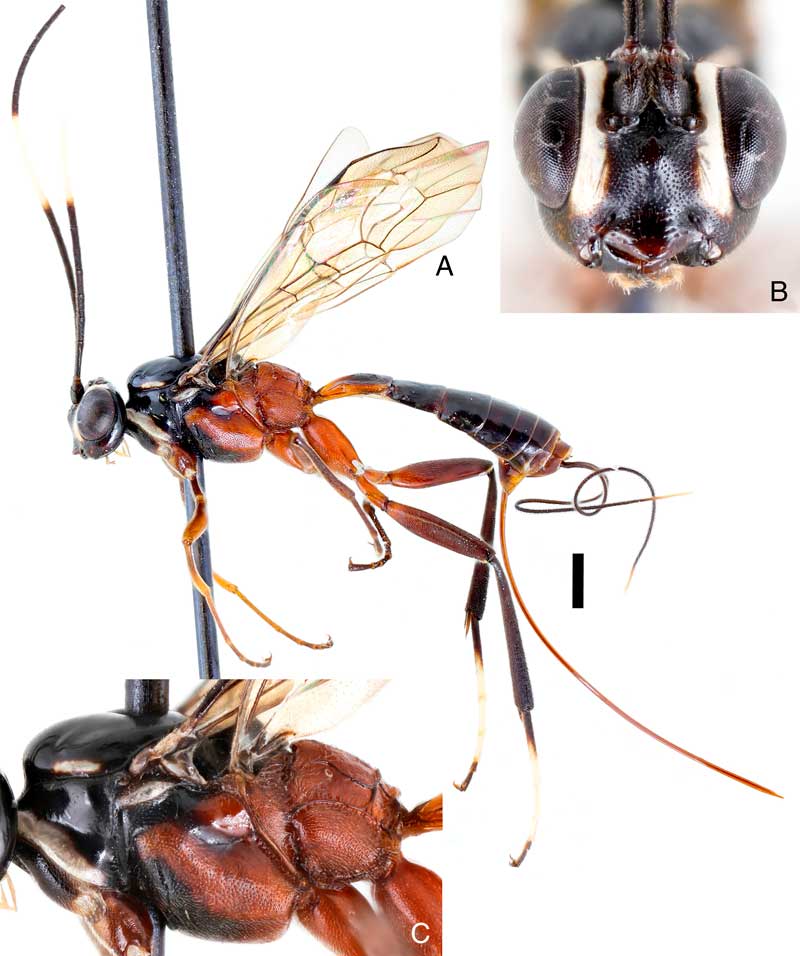
Diagnosis. Face, below antennal insertion with a weak median convexity (Fig. 33B); occipital carina mediodorsally evenly arcuate; propodeum with area externa about 2.2 times as wide as long; lateral ocellus separated from compound eye by about 1.3 times maximum ocellar diameter; prothoracic pretarsal claw long, slender, and strongly bowed, pectinate for at least 0.5 times its length; propodeum with lateromedian longitudinal carinae present, not fused before anterior transverse carina, so area basalis trapezoidal; metasomal tergite I 1.6 times as long as posteriorly wide; ovipositor long, 2.6 times as long as length of metatibia; mesoscutum black with anterolateral margins (Fig. 33C) and two central spots white; head (Fig. 33B) black, with facial and frontal orbits reaching back to level of lateral ocellus, white; procoxa reddish brown (Fig. 33A); metafemur mostly dark brown (Fig. 33A); metatarsomere 4 brown (Fig. 33A).
Description. Female: fore wing length 6.6 mm. Head. Clypeus (Fig. 33B) of moderate breadth, about 2.1 times as wide as high, faintly granulate with isolated punctures, slightly convex, slightly flared outwards (centrally softly conical), without a transverse subapical ridge, apical margin centrally softly concave; mandible tapering slightly, upper tooth slightly longer than lower; face granulate with punctures separated by 1.0–2.0 times puncture width, below antennal insertion with a weak median convexity; malar space about 0.9 times as long as basal mandibular width; frons faintly granulate, but smooth between toruli (with median longitudinal concavity from between toruli); lateral ocellus separated from compound eye by about 1.3 times maximum ocellar diameter, distance between ocelli 1.2 times maximum ocellar diameter; occipital carina mediodorsally convex, lower-ventral end joining hypostomal carina close to base of mandible (carina about 0.1 times as long as basal mandibular width); gena in lateral view 0.4 times as long as compound eyes, granulate with isolated punctures; antenna with 24+ flagellomeres. Mesosoma. Pronotum faintly granulate with isolated punctures; without epomia, with wrinkle in the same area. Mesoscutum faintly granulate and polished, with isolated punctures; notaulus barely impressed, extending through 0.4 times length of mesoscutum. Scutellum slightly convex, faintly granulate, without distinct lateral carina, with median, pit-like impression. Mesopleuron granulate (except without punctures on speculum) with punctures separated by 0.8–2.0 times puncture width; upper end of epicnemial carina reaching about 0.3 times of way to anterior margin; metapleuron granulate with punctures separated by 0.5–1.0 times puncture width. Propodeum granulate; anterior transverse carina faint, well defined centrally; posterior transverse carina strong and well defined; lateral longitudinal carinae strong; lateromedian longitudinal carinae present only before anterior transverse carina; area basalis with shape of inverted trapezoid; area superomedia coffin shaped (about 2.1 times as long as wide); area externa about 2.2 times as wide as long. Prothoracic leg with pretarsal claw long, slender, and abruptly and strongly curved, with short, sparse pectinae. Fore wing with 3rs-m absent, 2rs-m about 0.8 times as long as abscissa of M between 2rs-m and 2m-cu; Cu1 between 1m-cu and Cu1a 1.2 times as long as Cu1b; 1m-cu fairly evenly arcuate, without ramellus. Hind wing with distal abscissa of Cu1 and 1A sclerotised throughout. Metasoma. Tergite I about 1.6 times as long as posteriorly wide, lateromedian longitudinal carina distinct for 0.7 times length of tergite; tergite II about 0.8 times as long as posteriorly wide. Ovipositor about 2.6 times as long as metatibia; its apex slightly compressed with a narrowed apical section. Colour. Head (Fig. 33A–B) black; mandible and clypeus distally gradually changing to brown; orbits white (from face to beyond lateral ocellus); palpi light brown; antenna black with a white band on flagellum. Mesosoma with pronotum black, anterior margin white; mesoscutum black, anterolateral margin and central spot white; scutellum predominantly black, laterally white; tegula white with posterior half brown; mesopleuron (Fig. 33C) reddish brown with anterior quarter black (between subalar prominence and anterior half of speculum black); subalar prominence white; propodeum and metapleuron reddish brown; mesosternum reddish brown, anterolaterally black. Prothoracic leg (Fig. 33A) with coxae, trochanter, trochantellus, and tarsomere brown; femur brown gradually changing at middle to orange; tibia orange. Mesothoracic leg (Fig. 33A) with coxa, trochanter, and trochantellus red; femur, tibia, and tarsomere brown. Metathoracic leg (Fig. 33A) with coxae, trochanter, and trochantellus reddish brown; femur (except basally reddish brown), tibia, basal half of tarsomere 1, and tarsomere 4–5 dark brown; distal half of tarsomere 1–3 white. Wings hyaline. Metasomal tergites (Fig. 33A) black, tergite I light brown gradding posteriorly to black (laterally light reddish brown); tergites VII–VIII dark brown; ovipositor sheath dark brown with distal apex white.
Male: Unknown.
Distribution. Ecuador (Fig. 5).
Etymology. The specific epithet sofiae is in honour to Ecuatorian Entomologist Sofia Muñoz. It is a feminine noun in the genitive case.
Material examined. Holotype: ♀ “Sto. Domingo 700 m Ecuador II.26.81 Henry Howden” (USUC). Antennae broken, left antenna with 13 flagellomeres and right antenna with 24 flagellomeres.
Hapsinotus surinen Alvarado, new species
http://zoobank.org/urn:lsid:zoobank.org:act:D5C32E8F-A510-4D53-B10F-5B067C6C52A7
Morphology of Hapsinotus surinen new species. A, Habitus (holotype, scale bar=1 mm); B, head, frontal view (holotype); C, mesosoma, lateral view (holotype); D, propodeum (paratype).

Diagnosis. Face, below antennal insertion with a moderate median convexity below median tubercle; occipital carina mediodorsally evenly arcuate; clypeus 2.4–2.5 times as wide as long; propodeum with area superomedia coffin shaped, about 2.9 times as long as wide (Fig. 34D); prothoracic pretarsal claw long, slender, abruptly and strongly curved, with short, sparse pectinae at least along 0.6 its length; metasomal tergite I with lateromedian longitudinal carinae 0.7–0.8 times length of tergite; ovipositor moderately long, 2.7–2.8 times as long as length of metatibia; face eye orbit white, reaching back to level of lateral ocellus; orbital gena extensively black (Fig. 34A); scape ventrally and malar space white (Fig. 34B); mesoscutum black, anterolateral margin (Fig. 34C) and a median spot white; mesosternum orange; metapleuron and propodeum entirely red (Fig. 34C); metafemur red (Fig. 34A), at most with distal tip brown.
Description. Female: fore wing length 5.1 mm. Head. Clypeus (Fig. 34B) of moderate breadth, 2.4 times as wide as high, faintly granulate with isolated punctures, slightly convex, slightly flared outwards (centrally softly conical), without a transverse subapical ridge, apical margin centrally straight; mandible tapering slightly, upper tooth slightly longer than lower; face granulate with punctures separated by 1.5–2.5 times puncture width, below antennal insertion with a median convexity; malar space about 0.7 times as long as basal mandibular width; frons (Fig. 34B) faintly granulate but between toruli (with median, longitudinal, sulcus-shaped impression from between toruli to median ocellus); lateral ocellus separated from compound eye by about 1.3 times maximum ocellar diameter, distance between ocelli 1.2 times maximum ocellar diameter; occipital carina mediodorsally convex, lower-ventral end joining hypostomal carina close to base of mandible (carina about 0.2 times as long as basal mandibular width); gena in lateral view 0.3 times as long as compound eyes, granulate with punctures separated by 4.0–8.0 times puncture width; antenna with 30 flagellomeres. Mesosoma. Pronotum faintly granulate with isolated punctures on upper and posterior margins; without epomia, with wrinkle in the same area. Mesoscutum faintly granulate and polished, with isolated punctures; notaulus barely impressed, extending through 0.3 times length of mesoscutum. Scutellum slightly convex, faintly granulate, without distinct lateral carina and median, pit-like impression. Mesopleuron granulate (except smooth on distal half of speculum) with punctures separated by 0.5–1.0 times puncture width; upper end of epicnemial carina reaching about 0.2 times of way to anterior margin; metapleuron granulate with punctures separated by 0.4–0.8 times puncture width. Propodeum (Fig. 34D) granulate with carinae strong and complete; area basalis with shape of inverted trapezoid; area superomedia coffin shaped (2.9 times as long as wide); area externa 1.7 times as wide as long. Prothoracic leg with pretarsal claw long, slender, and abruptly and strongly curved, with short, sparse pectinae. Fore wing with 3rs-m absent, 2rs-m about 1.4 times as long as abscissa of M between 2rs-m and 2m-cu; Cu1 between 1m-cu and Cu1a 1.8 times as long as1 Cu1b; 1m-cu fairly evenly arcuate, without ramellus. Hind wing with distal abscissa of Cu1 and 1A sclerotised throughout. Metasoma. Tergite I about 1.4 times as long as posteriorly wide, lateromedian longitudinal carina distinct for 0.7 times length of tergite; tergite II about 0.8 times as long as posteriorly wide. Ovipositor about 2.7 times as long as metatibia; its apex slightly compressed with a narrowed apical section. Colour. Head (Fig. 34A–B) black; mandible white, gradually changing on distal half light brown; orbit white (from lower gena to after lateral ocellus); clypeus white, basally and distally black; face white, centrally brown and next to clypeus brown; median tubercle reddish brown; palpi white; antenna black with a white band on flagellum. Mesosoma with pronotum black, anterior margin white; mesoscutum black, anterolateral margin and central spot white; scutellum predominantly white, anteriorly (shaped as an inverted triangle) and posteriorly black; tegula white, posterior third brown; mesopleuron (Fig. 34C) with anterior half black and posterior half orange; subalar prominence white; a stripe from end of epicnemial carina to lower posterior end of mesopleuron white; propodeum, metapleuron, and mesosternum orange (Fig. 34C–D). Legs (Fig. 34A) predominantly orange; prothoracic leg with coxa white, tarsomeres 4–5 infuscate; mesothoracic leg with coxa ventrodistally white, and with distal third of tarsomeres 1–4 white, tarsomere 5 brown; metathoracic leg with trochanter and trochantellus light brown, femur light brown gradually changing distally to dark brown, tibia brown, tarsomeres white except basal half of tarsomere 1 and tarsomere 5 dark brown. Wings softly infuscate. Metasomal tergites (Fig. 34A) orange; ovipositor sheath dark brown with distal apex white.
Male: Unknown.
Remarks. The paratypes are slightly larger than the holotype, fore wing length 5.5–5.8 mm. The paratype series varies from holotype in the following: clypeus 2.4–2.5 times as wide as high; lateral ocellus separated from compound eye by 1.2–1.3 times maximum ocellar diameter, distance between ocelli 1.2–1.3 times maximum ocellar diameter; antenna with 30–31 flagellomeres; scutellum with or without median, pit-like impression propodeum with area externa 1.6–1.7 times as wide as long; fore wing with 2rs-m 1.4–1.6 times as long as abscissa of M between 2rs-m and 2m-cu; Cu1 between 1m-cu and Cu1a 1.6–1.8 times as long as Cu1b; metasomal tergite II 0.7–0.8 times as long as posteriorly wide; and ovipositor 2.7–2.8 times as long as metatibia. Additionally, one paratype has propodeum with lateromedian longitudinal carinae between transverse carinae present and discernible but not as strong as in holotype.
Distribution. French Guiana and Suriname (Fig. 9).
Etymology. The specific epithet “surinen” refers to groups of people that inhabited Suriname. It is treated as a noun in apposition.
Material examined. Holotype: ♀ “SURINAME. Paramaribo, resort Leiding. 05°48'40''N–55°17'03''W 17.II–1.III.2006, Malaise trap. Leg M. Reemer. Alt. sea level” (NBCN). Paratypes: 1♀ “Paramaribo, Surinam MaRetraite II.10–11.1964, D.C. Geijskes” (USUC); 1♀ “SURINAME. Distr. Commewijne, Peperpot. 05°46'08.0''N–55°07'33.2''W 24.II–1.III.2006, Malaise trap. Leg. M. Reemer. Former coffee and cocoa plantation of Peperpot. Secondary forest on moist clay soil. Alt. sea level” (NBCN), and 1♀ “FRENCH GUIANA: Patawa, Kaw mountains, 4°33.562'N 52°12.425'W 12.II–3.III.2007, Malaise trap. K. Sarv [CNC493218]” (CNC).
Hapsinotus taino Alvarado, new species
http://zoobank.org/urn:lsid:zoobank.org:act:CAE0857C-29B7-4E4E-A3FC-C782A9799201
Morphology of Hapsinotus taino new species (holotype). A, Habitus (scale bar=1 mm); B, head, dorsal view; C, head, frontal view; D, mesosoma, lateral view; E, propodeum.

Diagnosis. Face, below antennal insertion with a weak median convexity (Fig. 35B); occipital carina mediodorsally evenly arcuate; lateral ocellus separated from compound eye by 1.2 times maximum ocellar diameter; prothoracic pretarsal claw long, strongly curved, pectinate for at least 0.6 times its length; metasomal tergite I about 1.3 times as long as posteriorly wide; ovipositor long, 2.8 times as long as length of metatibia; head black with clypeus, mandible, and eye orbits entirely, white (Fig. 35B–C); mesoscutum black, except anterolateral margins (Fig. 35D) and central spot white; metapleuron white (Fig. 35D); propodeum black (Fig. 35E).
Description. Female: fore wing length 5.7 mm. Head. Clypeus (Fig. 35C) of moderate breadth, 2.3 times as wide as high, faintly granulate with punctures separated by 5.0–6.0 times puncture width, slightly convex, slightly flared outwards (centrally softly conical), without a transverse subapical ridge, apical margin centrally softly straight; mandible tapering slightly, upper tooth slightly longer than lower; face granulate with punctures separated by 1.0–2.0 times puncture width, below antennal insertion with a weak median convexity; malar space about 0.8 times as long as basal mandibular width; frons (Fig. 35B) faintly granulate, but smooth between toruli (with median, longitudinal, sulcus-shaped impression between toruli); lateral ocellus separated from compound eye by about 1.2 times maximum ocellar diameter, distance between ocelli 1.2 times maximum ocellar diameter; occipital carina mediodorsally convex, lower-ventral end joining hypostomal carina close to base of mandible (carina about 0.1 times as long as basal mandibular width); gena in lateral view 0.2 times as long as compound eyes, granulate with isolated punctures; antenna with 30 flagellomeres. Mesosoma. Pronotum smooth; without epomia, with wrinkle in the same area. Mesoscutum faintly granulate and polished, with isolated punctures; notaulus barely impressed, extending through 0.4 times length of mesoscutum. Scutellum slightly convex, faintly granulate, without distinct lateral carina, with median, pit-like impression. Mesopleuron granulate (except smooth on distal half of speculum) with punctures separated by 1.5–2.0 times puncture width; upper end of epicnemial carina reaching about 0.3 times of way to anterior margin; metapleuron granulate with punctures separated by 2.0–3.5 times puncture width. Propodeum (Fig. 35E) granulate; anterior transverse carina faint, well defined centrally; posterior transverse carina strong; lateral longitudinal carinae faint but discernible; lateromedian longitudinal carinae strong before anterior transverse carina, faded but discernible between transverse carinae, absent after posterior transverse carina; area basalis with shape of inverted trapezoid; area superomedia coffin shaped (about 1.7 times as long as wide); area externa about 1.8 times as wide as long. Prothoracic leg with pretarsal claw long, slender, and abruptly and strongly curved, with short, sparse pectinae. Fore wing with 3rs-m absent, 2rs-m about 2.0 times as long as abscissa of M between 2rs-m and 2m-cu; Cu1 between 1m-cu and Cu1a 1.3 times as long as Cu1b; 1m-cu fairly evenly arcuate, without ramellus. Hind wing with distal abscissa of Cu1 and 1A sclerotised throughout. Metasoma. Tergite I about 1.3 times as long as posteriorly wide, lateromedian longitudinal carina distinct for 0.7 times length of tergite; tergite II about 0.8 times as long as posteriorly wide. Ovipositor about 2.8 times as long as metatibia; its apex slightly compressed with a narrowed apical section. Colour. Head (Fig. 35A–C) black; mandible white, distal half brown; palpi, upper half of clypeus and orbits (interrupted in upper 2/3 of gena) white; antenna black with a white band on flagellum. Mesosoma with pronotum black, anterior margin white; mesoscutum black, anterolateral margin and central spot white; scutellum predominantly white, anteriorly (shaped as an inverted thin triangle) and posteriorly black; tegula white, posterior half brown; mesopleuron (Fig. 35D) black, subalar prominence, a spot at end of epicnemial carina, and a spot at its lower posterior white; propodeum and mesosternum black (Fig. 35D–E); metapleuron (Fig. 35D) white with borders black. Prothoracic and mesothoracic leg (Fig. 35A) predominantly orange; prothoracic leg with coxa white, trochanter light brown and tarsomeres brown; mesothoracic leg with tarsomeres 3–5 brown, distal half of tarsomere 1 and tarsomere 2 white. Metathoracic leg (Fig. 35A) reddish orange, trochanter and trochantellus light brown, basal third of tarsomere 1 and tarsomeres 4–5 dark brown, and distal 2/3 of tarsomeres 1–3 white. Wings softly infuscate. Metasomal tergites reddish orange; ovipositor sheath dark brown with distal apex white.
Male: Unknown.
Remarks. Paratypes slightly smaller than holotype, fore wing length 5.0–5.1 mm. Additionally, paratype series varies from holotype in having antenna with 30–31 flagellomeres.
Distribution. Trinidad (Fig. 9).
Etymology. The specific epithet “taino” is in honour to Taíno, the indigenous people that inhabited the Caribbean and Florida. It is treated as a noun in apposition.
Material examined. Holotype: ♀ “TRINIDAD: 19 km N Arima Lalaja Trace, 650 m 8–24.WI.1993, montane rainforest, MT [Malaise trap] S. & J. Peck, 93-19 [CNC493221]” (CNC). Paratypes: 2♀♀ “Morne Bleu 2700’ Trinidad Aug. 7–28, 1969 H. & A. Howden” (USUC).
Hapsinotus tupi Alvarado, new species
http://zoobank.org/urn:lsid:zoobank.org:act:815DEEA8-B6E0-4A0B-936E-E2581507F019
Morphology of Hapsinotus tupi new species (holotype). A, Habitus (scale bar=1 mm); B, mesosoma, lateral view; C, head, frontal view.
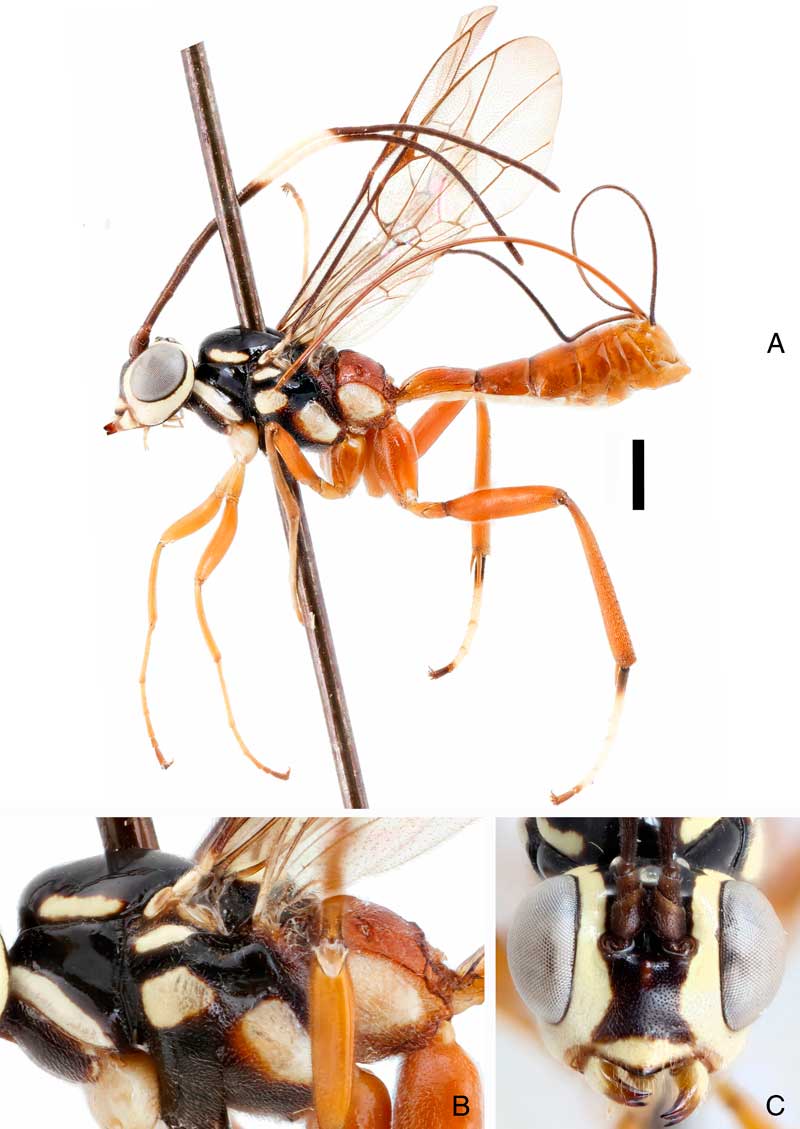
Diagnosis. Face, below antennal insertion with a weak median convexity (Fig. 36C); occipital carina mediodorsally evenly arcuate; lateral ocellus separated from compound eye by 1.6 times maximum ocellar diameter; prothoracic pretarsal claw long, slender, abruptly and strongly curved, pectinate for at least 0.5 times its length; metasomal tergite I about 1.6 times as long as posteriorly wide; ovipositor long, 2.9 times as long as length of metatibia; head black with clypeus, mandible, malar space and eye orbits entirely and widely, white (Fig. 36A, C); mesoscutum black, with anterolateral margins white (Fig. 36B) metapleuron white with reddish-orange borders (Fig. 36B); propodeum entirely reddish orange (Fig. 36B).
Description. Female: fore wing length 5.1 mm. Head. Clypeus (Fig. 36C) of moderate breadth, about 2.1 times as wide as high, faintly granulate with isolated punctures, slightly convex, slightly flared outwards (centrally softly conical), without a transverse subapical ridge, apical margin centrally softly concave; mandible tapering slightly, upper tooth slightly longer than lower; face granulate with punctures separated by 0.7–1.5 times puncture width, below antennal insertion with a weak median convexity (Fig. 36A); malar space about 0.8 times as long as basal mandibular width; frons faintly granulate, but smooth between toruli (with median, longitudinal, sulcus-shaped impression from between toruli to median ocellus); lateral ocellus separated from compound eye by about 1.6 times maximum ocellar diameter, distance between ocelli about 1.8 times maximum ocellar diameter; occipital carina mediodorsally convex, lower-ventral end joining hypostomal carina close to base of mandible (carina about 0.1 times as long as basal mandibular width); gena in lateral view 0.3 times as long as compound eyes, granulate with punctures separated by 4–6 times puncture width; antenna with 31 flagellomeres. Mesosoma. Pronotum faintly granulate with isolated punctures; without epomia, with wrinkle in the same area. Mesoscutum faintly granulate and polished, with isolated punctures; notaulus barely impressed, about 0.4 times length of mesoscutum. Scutellum slightly convex, faintly granulate, without distinct lateral carina, with median, pit-like impression. Mesopleuron granulate (except smooth on speculum) with punctures separated by 0.8–1.5 times puncture width; upper end of epicnemial carina reaching about 0.3 times of way to anterior margin; metapleuron granulate with punctures separated by 1.5–2.5 times puncture width. Propodeum granulate; anterior transverse carina faint, well defined centrally; posterior transverse carina strong but faint centrally; lateral longitudinal carinae strong; lateromedian longitudinal carinae present only before anterior transverse carina; area basalis with shape of inverted trapezoid; area superomedia coffin shaped (about 2.0 times as long as wide); area externa about 1.6 times as wide as long. Prothoracic leg with pretarsal claw long, slender, and abruptly and strongly curved, with short, sparse pectinae. Fore wing with 3rs-m absent, 2rs-m about 1.6 times as long as abscissa of M between 2rs-m and 2m-cu; Cu1 between 1m-cu and Cu1a 1.3 times as long as Cu1b; 1m-cu fairly evenly arcuate, without ramellus. Hind wing with distal abscissa of Cu1 and 1A sclerotised throughout. Metasoma. Tergite I about 1.6 times as long as posteriorly wide, lateromedian longitudinal carina distinct for 0.6 times length of tergite; tergite II about 0.7 times as long as posteriorly wide. Ovipositor about 2.9 times as long as metatibia; its apex slightly compressed with a narrowed apical section. Colour. Head (Fig. 36A, C) black; mandible basally white and distally brown; clypeus (except distal fifth black) and orbits white; palpi light brown; antenna black with a white band on flagellum. Mesosoma with pronotum black, anterior margin white; mesoscutum black, anterolateral margin white; scutellum predominantly white, anteriorly (shaped as an inverted thin triangle) and posteriorly black; tegula white, posterior half brown; mesopleuron (Fig. 36A–B) black, subalar prominence, a spot at end of epicnemial carina, and a spot on lower posterior corner white; mesosternum black, posteriorly orange; propodeum reddish orange, metapleuron white, reddish-orange borders. Prothoracic leg (Fig. 36A) predominantly orange, coxa white; trochanter light brown. Mesothoracic and metathoracic legs (Fig. 36A) orange; mesotarsomeres 2–3 white; metatarsus 1 with basal half (distal half white) and metatarsomeres 4–5 brown, metatarsomeres 2–3 white. Wings hyaline. Metasoma reddish orange; ovipositor sheath dark brown with distal apex white.
Male: Unknown.
Distribution. Brazil (Fig. 17).
Etymology. The specific epithet “tupi” is in honour to the Tupi people, one of the most important indigenous peoples in Brazil. It is treated as a noun in apposition.
Material examined. Holotype: ♀ “Itaum, M. Grosso III.1974 Brazil M. Alvarenga” (USUC).
Hapsinotus yana Alvarado, new species
http://zoobank.org/urn:lsid:zoobank.org:act:A677F033-02DD-4803-AF88-823D959E6C66
Morphology of Hapsinotus yana new species (holotype). A, Habitus (scale bar=1 mm); B, mesosoma, lateral view; C, head, frontal view.
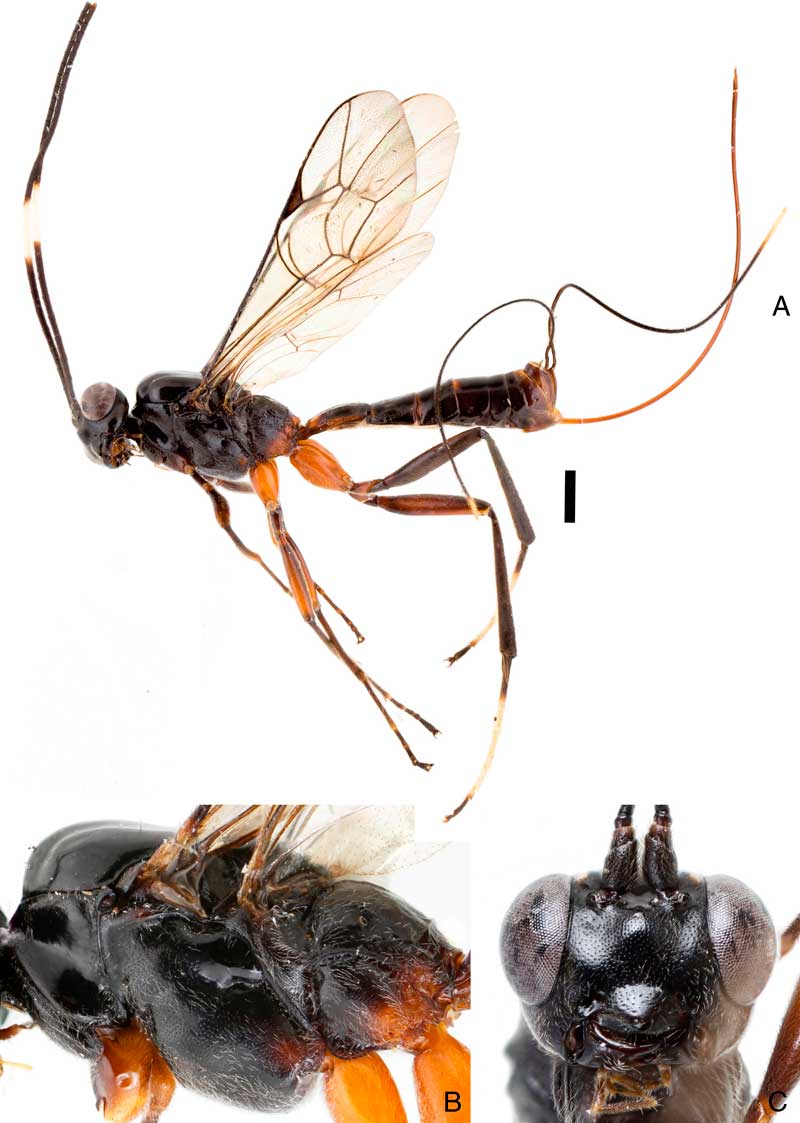
Diagnosis. Face, below antennal insertion, with a moderate median convexity (Fig. 37C); occipital carina mediodorsally evenly arcuate; lateral ocellus separated from compound eye by 1.0–1.2 times maximum ocellar diameter; propodeum with area superomedia coffin shaped, 1.9–2.1 times as long as wide; prothoracic pretarsal claw moderately long, strongly bowed, pectinate for at least 0.5 times its length; fore wing with 2rs-m 1.4–1.8 times as long as abscissa of M between 2rs-m and 2m-cu; ovipositor long, 3.1 times as long as length of metatibia; scape, pronotum, and mesoscutum entirely black (Fig. 37A–B); propodeum black (Fig. 37B); metasoma predominantly black (Fig. 37A).
Description. Female: fore wing length 7.7 mm. Head. Clypeus (Fig. 37C) of moderate breadth, 1.9 times as wide as high, granulate with isolated punctures, slightly convex, slightly flared outwards (centrally softly conical), without a transverse subapical ridge, apical margin centrally concave; mandible tapering slightly, upper tooth longer than lower; face granulate with punctures separated by 1.0–1.5 times puncture width, below antennal insertion with a weak median convexity; malar space about 0.7 times as long as basal mandibular width; frons faintly granulate, but smooth between toruli (with median, longitudinal, sulcus-shaped impression from between toruli to median ocellus); lateral ocellus separated from compound eye by about 1.2 times maximum ocellar diameter, distance between ocelli 0.9 times maximum ocellar diameter; occipital carina mediodorsally evenly convex, lower-ventral end joining hypostomal carina close to base of mandible (carina about 0.2 times as long as basal mandibular width); gena in lateral view 0.3 times as long as compound eyes, granulate with isolated punctures; antenna with 28 flagellomeres. Mesosoma. Pronotum faintly granulate with isolated punctures in upper section; without epomia, but with a weak wrinkle in a homologous place. Mesoscutum faintly granulate and polished, with isolated punctures; notaulus barely impressed, extending through 0.3 times length of mesoscutum. Scutellum slightly convex, faintly granulate, without distinct lateral carina and median, pit-like impression. Mesopleuron granulate with punctures separated by 1.5–2.5 times puncture width (except without setae on speculum); upper end of epicnemial carina reaching about 0.2 times of way to anterior margin; metapleuron convex, granulo-striate with isolate punctures. Propodeum faintly granulate; anterior transverse carina discontinuous but strong centrally (between lateromedian longitudinal carinae); posterior transverse carina complete and strong; lateral longitudinal carinae present only before anterior transverse carina; lateromedian longitudinal carinae present before anterior transverse carina, discontinuous but discernible between transverse carinae, and absent after posterior transverse carina; area basalis with shape of inverted trapezoid; area superomedia coffin shaped (2.1 times as long as wide); area externa about 1.5 times as wide as long. Prothoracic leg with pretarsal claw long, slender, and abruptly and strongly curved, with short, sparse pectinae. Fore wing with 3rs-m absent; 2rs-m about 1.8 times as long as abscissa of M between 2rs-m and 2m-cu; Cu1 between 1m-cu and Cu1a 1.3 times as long as Cu1b; 1m-cu fairly evenly arcuate, without ramellus. Hind wing with distal abscissa of Cu1 and 1A sclerotised throughout. Metasoma. Tergite I about 1.6 times as long as posteriorly wide, lateromedian longitudinal carina distinct for 0.5 times length of tergite; tergite II about 0.8 times as long as posteriorly wide. Ovipositor about 3.1 times as long as metatibia; its apex slightly compressed with a narrowed apical section. Colour. Head (Fig. 37A, C) black; mandible gradually changing on distal half to reddish brown; orbit white (from mid frons to after medium ocellus); palpi brown; antenna black with a white band on flagellum. Mesosoma (Fig. 37B) black, subalar prominence, a spot on lower posterior section of mesopleuron, posterior half of metapleuron, and propodeum posteriorly (behind posterior transverse carina) reddish orange. Prothoracic leg (Fig. 37A) brown, coxa dorsally gradually changing to light brown, femur light brown and tibia with apical half gradually changing to light brown. Mesothoracic leg (Fig. 37A) dark brown, coxa reddish orange; femur apically gradually changing to reddish orange. Metathoracic leg (Fig. 37A) dark brown; coxa, trochanter, and femur ventrally reddish orange; distal half of tarsomeres 1–3 and basal half of tarsomere 4 white. Wings hyaline. Metasomal tergites black except tergite I laterally and anteriorly reddish brown, and tergites VII–VIII brown; ovipositor sheath mostly black with distal apex white.
Male: Unknown.
Remarks. The paratype varies from holotype in the following: malar space about 0.8 times as long as basal mandibular width; lateral ocellus separated from compound eye by about 1.0 times maximum ocellar diameter, distance between ocelli 0.9 times maximum ocellar diameter; antenna with 31 flagellomeres; scutellum with median, pit-like impression; propodeum with area superomedia 1.9 times as long as wide; fore wing with 2rs-m about 1.4 times as long as abscissa of M between 2rs-m and 2m-cu; and, metasomal tergite I about 1.5 times as long as posteriorly wide, lateromedian longitudinal carina distinct for 0.6 times length of tergite.
Distribution. This species was collected in two primary forests of central Peru, between 1593 and 1702 m of elevation (Fig. 20).
Etymology. The specific epithet yana means black in Quechua language. It is treated as a noun in apposition.
Material examined. Holotype: ♀ “PERÚ: JU [Junín], Chanchamayo, SN [Santuario Nacional] Pampa Hermosa 10°59'48.9''S / 75°25'35.3''W 1593 m. 23–31.v.2011. Light trap. M. Alvarado” (MUSM). Paratype: 1♀ “PERÚ: PA [Pasco], Villa Rica, ZA [Zona de Amortiguamiento] del Bosque de Protección San Matias San Carlos 75°12'55'' / 10°38'36'' 1702 m. 03–05.v.2012 Malaise trap V. Borda & L. Figueroa” (MUSM).
Hapsinotus yumbo Alvarado, new species
http://zoobank.org/urn:lsid:zoobank.org:act:093DDCE2-639C-4674-A1BF-950B09D5FA9C
Morphology of Hapsinotus yumbo new species (holotype). A, Habitus (scale bar=1 mm); B, propodeum; C, mesosoma, lateral view.

Diagnosis. Face, below antennal insertion, with a median moderate convexity, entirely black; occipital carina mediodorsally evenly arcuate; prothoracic pretarsal claw long, strongly bowed, pectinate for at least 0.5 times its length; ovipositor moderately long, 2.9 times as long as length of metatibia; head black with pale mark on facial and frontal orbits reaching back to level of lateral ocellus (Fig. 38C); mesoscutum black (Fig. 38C); metapleuron bicolour, red anteriorly, dark brown posteriorly (Fig. 38C); propodeum predominantly black; metafemur reddish brown (Fig. 38A); ovipositor sheath mostly black with distal apex white, ending with a black mark (Fig. 38A).
Description. Female: fore wing length 7.9 mm. Head. Clypeus of moderate breadth, 1.9 times as wide as high, granulate with isolated punctures, slightly convex, slightly flared outwards (centrally softly conical), without a transverse subapical ridge, apical margin centrally weakly concave; mandible tapering slightly, subequal teeth; face granulate with punctures separated by 1.5–2.0 times puncture width, below antennal insertion with a median convexity; malar space about 0.8 times as long as basal mandibular width; frons faintly granulate, but smooth between toruli (with median, longitudinal, sulcus-shaped impression from between toruli to median ocellus but faint between toruli); without a transverse swelling; lateral ocellus separated from compound eye by about 1.1 times maximum ocellar diameter, distance between ocelli 0.9 times maximum ocellar diameter; occipital carina mediodorsally convex, lower-ventral end joining hypostomal carina close to base of mandible (carina about 0.1 times as long as basal mandibular width); gena in lateral view 0.3 times as long as compound eyes, granulate with isolated punctures; antenna with 33 flagellomeres. Mesosoma. Pronotum smooth with isolate punctures; with a convex protuberant on dorsal margin; without epomia, but with a weak wrinkle in a homologous place. Mesoscutum faintly granulate and polished, with isolated punctures; notaulus barely impressed, extending through 0.2 times length of mesoscutum. Scutellum slightly convex, smooth, without distinct lateral carina and median, pit-like impression. Mesopleuron granulate (except smooth and without setae on speculum) with punctures separated by 1.5–3.0 times puncture width; upper end of epicnemial carina reaching about 0.2 times of way to anterior margin; metapleuron granulate with punctures separated by 1.0–2.0 times puncture width. Propodeum (Fig. 38B) granulate; anterior transverse carina faint but discernible; posterior transverse carina complete and strong; lateral longitudinal carinae faint but discernible; lateromedian longitudinal carinae faded, only strong before anterior transverse carina, and absent after posterior transverse carina; area basalis with shape of inverted trapezoid; area superomedia coffin shaped (about 1.3 times as long as wide); area externa about 1.2 times as wide as long. Prothoracic leg with pretarsal claw long, slender, and abruptly and strongly curved, with short, sparse pectinae. Fore wing with 3rs-m absent; 2rs-m about 2.8 times as long as abscissa of M between 2rs-m and 2m-cu; 2rs-m about 1.4 times as long as abscissa of M between 2rs-m and 2m-cu; 1m-cu evenly arcuate, Cu1 between 1m-cu and Cu1a 1.3 times as long as Cu1b; without ramellus. Hind wing with distal abscissa of Cu1 and 1A sclerotised throughout. Metasoma. Tergite I about 1.5 times as long as posteriorly wide, lateromedian longitudinal carina distinct for 0.7 times length of tergite; tergite II about 0.7 times as long as posteriorly wide. Ovipositor about 2.9 times as long as metatibia; its apex slightly compressed with a narrowed apical section. Colour. Head (Fig. 38A, C) black; mandible and palpi brown; orbits yellow (from mid frons to after lateral ocellus, interrupted at middle); antenna black with a white band on flagellum. Mesosoma (Fig. 38C) black; subalar prominence and lower half of anterior margin of pronotum white; metapleuron and propodeum posteriorly (behind posterior transverse carinae) reddish brown (Fig. 38B). Legs (Fig. 38A) reddish brown except tarsomeres 5 brown; metatarsomeres 2–4 white; distal 2/3 of metatarsomere 1 gradually changing to white. Wings softly infuscate. Metasomal tergites reddish brown; ovipositor sheath mostly black with distal apex white, ending with a black mark (Fig. 38A).
Male: Unknown.
Distribution. Ecuador (Fig. 20).
Etymology. The specific epithet yumbo refers to Yumbo, the ancestral culture that inhabited midlands between the Andes and the Pacific coast in present-day Ecuador. It is treated as a noun in apposition.
Material examined. Holotype: ♀ “ECUADOR: Pichincha Mindo 1400 m, X. M. Cooper” (NHML).
The Hapsinotus convexus species group
Species of this group are characterised by having frons strongly granulate; below median ocellus with a distinct transverse swelling close to median ocellus; ovipositor sheath entirely black; fore wing with areolet open (Ugalde-Gómez and Gauld Reference Ugalde-Gómez and Gauld2002) occipital carina lower end joining hypostomal carina at about 0.4–0.6 times as long as basal mandibular width.
This species group includes: H. convexus, H. kentori, H. lamasi, H. micheneri, H. scutellatus, and H. transversus.
Hapsinotus convexus Ugalde-Gómez and Gauld, Reference Ugalde-Gómez and Gauld2002
Diagnosis. Face, below toruli with a strong median convexity; scutellum weakly convex; facial and frontal orbits and central part of face white; mesoscutum black with anterolateral pale marks; metapleuron red.
The male of this species is the only known of the group. It can be distinguished from all other known males of the genus by having the lower-ventral end of occipital carina joining hypostomal carina far from base of the mandible, at least at a distance of 0.4–0.6 times the basal mandibular width and the frons strongly granulate below median ocellus, with a distinct low lateral swelling close to this ocellus.
Distribution. Costa Rica (Ugalde-Gómez and Gauld Reference Ugalde-Gómez and Gauld2002).
Material examined. Paratypes: 2♀♀ “COSTA RICA: Limon Prov. 16 km Guapiles on Edge of Braulio Carrillo NP 400 m I–IV.91 Gauld” (MNCR).
Hapsinotus kentori Alvarado, new species
http://zoobank.org/urn:lsid:zoobank.org:act:DEABB4D6-1AA3-424D-8D96-CF312972BC8D
Morphology of Hapsinotus kentori new species. A, Habitus (holotype, scale bar=1 mm); B, head, frontal view (holotype); C, propodeum (paratype); D, mesosoma, lateral view (holotype).
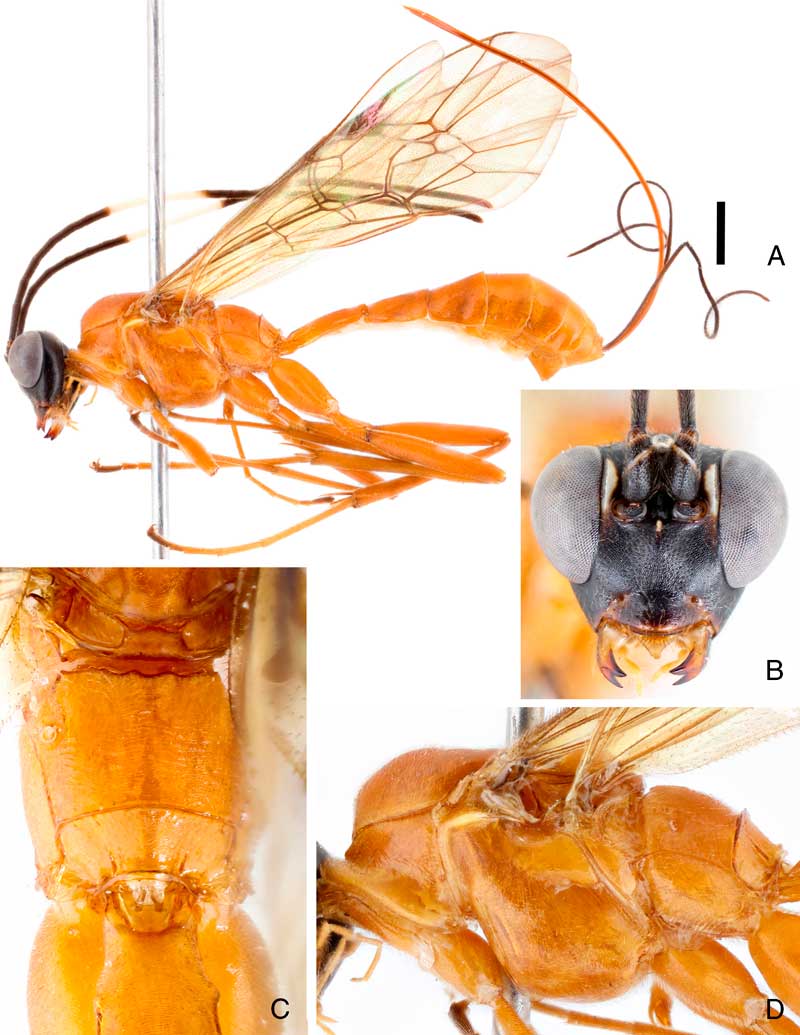
Geographic distribution of H. kentori, H. lamasi, H. micheneri, and H. transversus.

Diagnosis. Antenna with 37–39 flagellomeres; mesoscutum entirely orange; metathoracic leg with tibia and tarsi orange.
Description. Female: fore wing length 8.1 mm. Head. Clypeus (Fig. 39B) of moderate breadth, 2.0 times as wide as high, granulate with isolated punctures, slightly convex, slightly flared outwards (rounded centrally), with a transverse subapical ridge close to and parallel with impressed margin, distal margin homogeneously convex; mandible tapering slightly, upper tooth longer than lower; face granulate with punctures separated by 1.5–2.0 times puncture width, below antennal insertion with a median weak convexity; malar space about 0.9 times as long as basal mandibular width; frons granulate with a median transverse swelling (with a small concavity below median ocellus, with median, longitudinal, crest-shaped protuberance); lateral ocellus separated from compound eye by about 1.0 times maximum ocellar diameter, distance between ocelli 1.0 times maximum ocellar diameter; occipital carina mediodorsally evenly convex, lower-ventral end joining hypostomal carina above base of mandible (carina about 0.5 times as long as basal mandibular width); gena in lateral view 0.4 times as long as compound eyes, granulate with punctures separated by 3.0–5.0 times puncture width; antenna with 39 flagellomeres. Mesosoma. Pronotum granulate without epomia, but with a weak wrinkle in a homologous place. Mesoscutum granulate with isolated punctures; notaulus impressed, extending 0.6 times length of mesoscutum. Scutellum slightly convex, faintly granulate, without distinct lateral carina, with median, pit-like impression (except in one paratype). Mesopleuron granulate with punctures separated by 1.5–2.5 times puncture width; upper end of epicnemial carina reaching about 0.4 times of way to anterior margin; metapleuron granulate with isolated punctures. Propodeum (Fig. 39C) granulate with transverse striae; anterior transverse carina absent; posterior transverse carina complete, lamellate; lateral longitudinal carinae absent; lateromedian longitudinal carinae present only posteriorly (behind posterior transverse carina but not reaching to it, so not closing any areae). Prothoracic leg with pretarsal claw long, slender, abruptly and strongly curved, with short, sparse pectinae. Fore wing with 3rs-m absent; 2rs-m about 1.2 times as long as abscissa of M between 2rs-m and 2m-cu; Cu1 between 1m-cu and Cu1a 1.8 times as long as Cu1b; 1m-cu fairly evenly arcuate, with a faint trace of a vein stub. Hind wing with distal abscissa of Cu1 and 1A sclerotised throughout. Metasoma. Tergite I about 1.7 times as long as posteriorly wide, lateromedian longitudinal carina distinct for 0.3 times length of tergite; tergite II about 0.9 times as long as posteriorly wide. Ovipositor about 2.8 times as long as metatibia; its apex slightly compressed with a narrowed apical section.
Colour. Head (Fig. 39A–B) dark brown; mandible gradually changing on distal half light reddish brown; clypeus laterally and distally; palpi and median tubercle light brown; orbits white (from upper mid half of face to before median ocellus); antenna black with a white band on flagellum. Mesosoma and metasoma (Fig. 39A, D) orange; subalar prominence light brown; mesotarsomere 5 and metatarsomere 5 brown; wings softly infuscate; ovipositor sheath brown.
Male: Unknown.
Remarks. There is some variation in the size of the individuals, fore wing length between 7.5 and 8.5 mm. The paratype series varies from holotype in the following: malar space 0.9–1.0 times as long as basal mandibular width; lateral ocellus separated from compound eye by 1.0–1.1 times maximum ocellar diameter, distance between ocelli 1.0–1.1 times maximum ocellar diameter; gena in lateral view 0.4–0.5 times as long as compound eyes; occipital carina joining hypostomal carina at 0.5–0.6 times as long as basal mandibular width; antenna with 37–38 flagellomeres; scutellum with or without median, pit-like impression; fore wing with 2rs-m 1.0–2.4 times as long as abscissa of M between 2rs-m and 2m-cu; Cu1 between 1m-cu and Cu1a 1.4–2.2 times as long as Cu1b; metasomal tergite I 1.6–1.8 times as long as posteriorly wide, lateromedian longitudinal carinae 0.3–0.5 times length of tergite; tergite II 0.7–1.0 times as long as posteriorly wide. Ovipositor 2.8–3.1 times as long as metatibia. Additionally, some paratypes have traces of the vein 3rs-m.
Distribution. This species was collected Peru, between 2050 and 2700 m of elevation (Fig. 40).
Etymology. The specific epithet kentori means wasp in Matsiguenga language. It is treated as a noun in apposition.
Material examined. Holotype: ♀ “PERÚ: CU [Cusco], C.I. [Centro de Investigación] Wayquecha 13°10'31''S / 71°34'53''W 2692 m, 14.IX.2007. Malaise trap 5(2 días) C. Castillo” (MUSM). Paratypes: 1♀ “PERÚ: CU [Cusco], C.I. [Centro de Investigación] Wayquecha 13°10'31''S / 71°34'53''W 11.IX.2007. 2692 m, Malaise trap 5 C. Castillo leg”, 2♀♀ “PERÚ: CU [Cusco], Valle de Koshnipata [Cosñipata], Rocotal, 13°6'47.7''S / 71°34'13.3''W 2052 m, 10.XII.2007 Malaise. C. Castillo”, and 1♀ “PERÚ: CU [Cusco], Valle del Qosñipata, Rocotal, 13°06'48''S / 71°34'13''W 2052 m, 7.I.2008 Malaise trap 10A. C. Castillo” (MUSM).
Hapsinotus lamasi Alvarado, new species
http://zoobank.org/urn:lsid:zoobank.org:act:E8C97846-EC1C-41D0-92BE-4B3B9C279A17
Morphology of Hapsinotus lamasi new species (holotype). A, Head, frontal view; B, habitus (scale bar=1 mm); C, head, dorsal view; D, mesosoma, lateral view E, Propodeum.
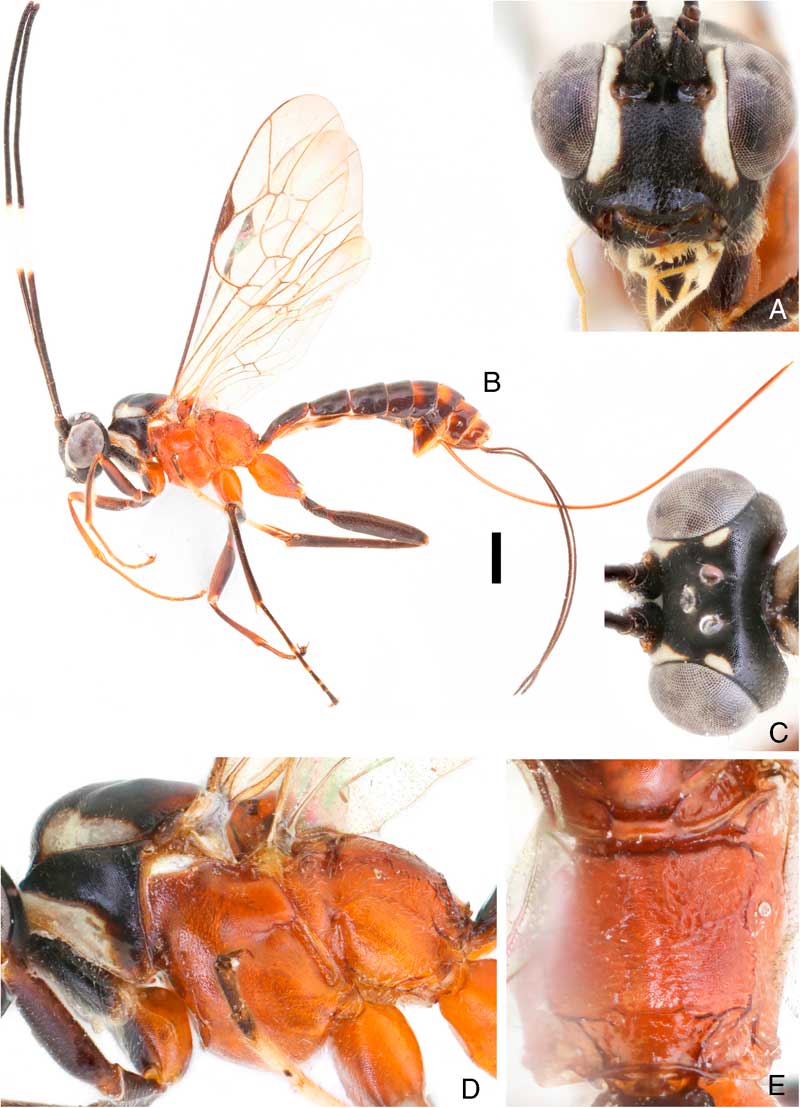
Diagnosis. Face, below toruli with a weak median convexity (Fig. 41A); lateral ocellus separated from compound eye by about 1.0 times maximum ocellar diameter (Fig. 41C); mesoscutum predominantly black at most with a few pale markings anteriorly (Fig. 41D); metapleuron and propodeum entirely red (Fig. 41D).
Description. Female: fore wing length 6.5 mm. Head. Clypeus (Fig. 41A) of moderate breadth, 2.9 times as wide as high, granulate with punctures separated by 2.5–4.0 times puncture width, slightly convex, slightly flared outwards (centrally softly conical), with a soft transverse subapical ridge close to and parallel with impressed margin, distal margin homogeneously convex; mandible tapering slightly, upper tooth slightly longer than lower; face granulate with punctures separated by 1.0–2.0 times puncture width, below antennal insertion with a strong median convexity (Fig. 41B); malar space about 0.7 times as long as basal mandibular width; frons (Fig. 41C) granulate, not polished below median ocellus, with a median transverse swelling, without a median longitudinal texture; lateral ocellus separated from compound eye by about 1.0 times maximum ocellar diameter, distance between ocelli 1.0 times maximum ocellar diameter; occipital carina mediodorsally convex, lower-ventral end joining hypostomal carina above base of mandible (carina about 0.4 times as long as basal mandibular width); gena in lateral view 0.3 times as long as compound eyes, granulate with isolated punctures; antenna with 32 flagellomeres. Mesosoma. Pronotum granulate without epomia, but with a weak wrinkle in a homologous place. Mesoscutum granulate with isolated punctures; notaulus barely impressed, extending through 0.5 times length of mesoscutum. Scutellum slightly convex, faintly granulate, without distinct lateral carina, with median, pit-like impression. Mesopleuron granulate with punctures separated by 1.0–3.0 times puncture width; upper end of epicnemial carina reaching about 0.3 times of way to anterior margin; metapleuron granulate with isolated punctures. Propodeum (Fig. 41E) granulate; transverse and longitudinal carinae discontinuous but discernible; area basalis with shape of inverted trapezoid; area superomedia coffin shaped (about 1.7 times as long as wide); area externa about 1.3 times as wide as long. Prothoracic leg with pretarsal claw long, slender, and abruptly and strongly curved, with short, sparse pectinae. Fore wing with 3rs-m present, enclosing a petiolate areolet, 2rs-m about 1.4 times as long as abscissa of M between 2rs-m and 2m-cu; Cu1 between 1m-cu and Cu1a 1.3 times as long as Cu1b; 1m-cu fairly evenly arcuate, without ramellus. Hind wing with distal abscissa of Cu1 and 1A sclerotised throughout. Metasoma. Tergite I about 1.4 times as long as posteriorly wide, lateromedian longitudinal carina distinct for 0.4 times length of tergite; tergite II about 0.8 times as long as posteriorly wide. Ovipositor about 2.3 times as long as metatibia; its apex subcylindrical with a narrowed apical section. Colour. Head (Fig. 41A–C) black; mandible apical third light brown; orbit (from face to medium ocellus and a small orbit (spot like) near lateral ocellus (Fig. 42C)) white; palpi white; antenna black with a white band on flagellum. Mesosoma (Fig. 41B, D) predominantly red; propleuron black; pronotum black except anterior margin white; mesoscutum black, anterolateral margins white, posteriorly gradually changing to red; subalar prominence white. Prothoracic leg (Fig. 41B) with coxa red, anteriorly black; trochanter and trocantellus black; femur and tibia brown, gradually changing to light brown ventra-distally; tarsomeres brown. Mesothoracic and metathoracic legs (Fig. 41B) dark brown; mesocoxae and metacoxae red anteriorly and posteriorly gradually changing to brown; distal half of metatarsomere 1 and metatarsomeres 2–3 white. Wings hyaline. Metasomal tergites dark brown with tergites V–VIII basally reddish brown; ovipositor sheath dark brown.
Male: Unknown.
Distribution. Peru (Fig. 40).
Etymology. The specific epithet lamasi is in honour to Peruvian entomologist Gerardo Lamas. It is a masculine noun in the genitive case.
Material examined. Holotype: ♀ “PERÚ: JU [Junín], Chanchamayo, SN [Santuario Nacional] Pampa Hermosa 10°59'48.9''S / 75°25'35.3''W 1593 m. 23–31.v.2011. Pan trap. M. Alvarado leg” (MUSM).
Hapsinotus micheneri Alvarado, new species
http://zoobank.org/urn:lsid:zoobank.org:act:0B2790CD-FA3E-432A-BB39-2A9249F571B6
Morphology of Hapsinotus micheneri new species. A, Habitus (holotype, scale bar=1 mm); B, head, frontal view (holotype); C, mesosoma, lateral view (holotype); D, propodeum (paratype).

Diagnosis. Antenna with 32–33 flagellomeres; mesoscutum orange, basally on central lobe dark brown; metathoracic leg with tibia gradually changing to brown on distal half and tarsomere 2–4 white (Fig. 42A).
Description. Female: fore wing length 7.9 mm. Head. Clypeus (Fig. 42B) of moderate breadth, 1.8 times as wide as high, granulate with isolated punctures, slightly convex, slightly flared outwards (centrally softly conical), without a transverse subapical ridge; mandible tapering slightly, upper tooth slightly longer than lower; face granulate with isolated punctures, below antennal insertion with a strong median convexity; malar space about 0.7 times as long as basal mandibular width; frons granulate with a median transverse swelling (with a small concavity below median ocellus); lateral ocellus separated from compound eye by about 1.0 times maximum ocellar diameter, distance between ocelli 1.2 times maximum ocellar diameter; occipital carina mediodorsally evenly convex, lower-ventral end joining hypostomal carina above base of mandible (carina about 0.4 times as long as basal mandibular width); gena in lateral view 0.5 times as long as compound eyes, granulate with isolated punctures; antenna with 32 flagellomeres. Mesosoma. Pronotum granulate without epomia, but with a weak wrinkle in a homologous place. Mesoscutum granulate with isolated punctures; notaulus barely impressed, extending through 0.3 times length of mesoscutum. Scutellum slightly convex, faintly granulate, without distinct lateral carina and median, pit-like impression. Mesopleuron (Fig. 42C) granulate (except smoother on distal half of speculum) with isolate punctures; upper end of epicnemial carina reaching about 0.4 times of way to anterior margin; metapleuron granulate with isolated punctures. Propodeum (Fig. 42D) granulate; anterior transverse carina faint but discernible; posterior transverse carina complete, lamellate; lateral longitudinal carinae absent; lateromedian longitudinal carinae faint but discernible behind posterior transverse carina; area basalis with shape of inverted trapezoid. Prothoracic leg with pretarsal claw long, slender, abruptly and strongly curved, with short, sparse pectinae. Fore wing with 3rs-m absent, 2rs-m about 1.3 times as long as abscissa of M between 2rs-m and 2m-cu; Cu1 between 1m-cu and Cu1a 1.8 times as long as Cu1b; 1m-cu fairly evenly arcuate, without ramellus. Hind wing with distal abscissa of Cu1 and 1A sclerotised throughout. Metasoma. Tergite I about 1.8 times as long as posteriorly wide, lateromedian longitudinal carina distinct for 0.3 times length of tergite; tergite II about 0.8 times as long as posteriorly wide. Ovipositor about 2.9 times as long as metatibia; its apex slightly compressed with a narrowed apical section. Colour. Head (Fig. 42A–B) black; mandible and clypeus dark brown; orbit light reddish brown (from malar space to before lateral ocellus); palpi orange; antenna black with a white band on flagellum. Mesosoma and metasoma (Fig. 42A) predominantly reddish orange; mesoscutum antero-centrally dark brown; metafemur grading posteriorly to brown; tarsomere 1 with basal fifth (remaining light brown) and tarsomere 5 dark brown; tarsomeres 2–4 white; wings hyaline; ovipositor sheath dark brown.
Male: Unknown.
Remarks. The paratype slightly smaller than holotype, fore wing length 7.4 mm. It varies from holotype in the following: clypeus 1.9 times as wide as high, malar space about 0.8 times as long as basal mandibular width; distance between ocelli 1.0 times maximum ocellar diameter; occipital carina joining hypostomal carina at 0.5 times as long as basal mandibular width; gena in lateral view 0.4 times as long as compound eyes; antenna with 32 flagellomeres; fore wing with 2rs-m about 1.1 times as long as abscissa of M between 2rs-m and 2m-cu; propodeum with lateromedian longitudinal carinae well defined behind posterior transverse carina; and metasomal tergite I about 1.7 times as long as posteriorly wide.
Distribution. Peru (Fig. 40).
Etymology. The specific epithet micheneri is in honour to American entomologist Charles Michener. It is a masculine noun in the genitive case.
Material examined. Holotype: ♀ “PERU: CU [Cusco], Qosñipata valley C.I. [Investigation center] 8.XII.2007 13°11'21''S / 71°35'05''W 2865 m, Malaise 7, C. Castillo” (MUSM). Paratype: 1♀ “PERU: CU [Cusco], Wayrapata Camp, 13.VIII.1998, 2320 m 12°51'S / 73°30'W, Ground Malaise, Camisea project/WA04.0813 M04” (MUSM).
Hapsinotus scutellatus Ugalde-Gómez and Gauld, Reference Ugalde-Gómez and Gauld2002
Diagnosis. Face, below toruli with a strong median convexity; scutellum strongly convex; orbits light brown on frons, between toruli and median ocellus; mesoscutum and metapleuron entirely black.
Distribution. This species is known only from Costa Rica (Ugalde-Gómez and Gauld Reference Ugalde-Gómez and Gauld2002).
Material examined. Holotype: ♀ “San Luis, 1040 m, R.B. Monteverde, Prov. Puntarenas, Costa Rica, Ago 1992, Z. Fuentes L-N 250850, 449250” (MNCR).
Hapsinotus transversus Ugalde-Gómez and Gauld, Reference Ugalde-Gómez and Gauld2002
Morphology of Hapsinotus transversus Ugalde-Gómez and Gauld, Reference Ugalde-Gómez and Gauld2002 (non-type). A, Habitus (scale bar=1 mm); B, head, frontal view; C, mesosoma, lateral view.
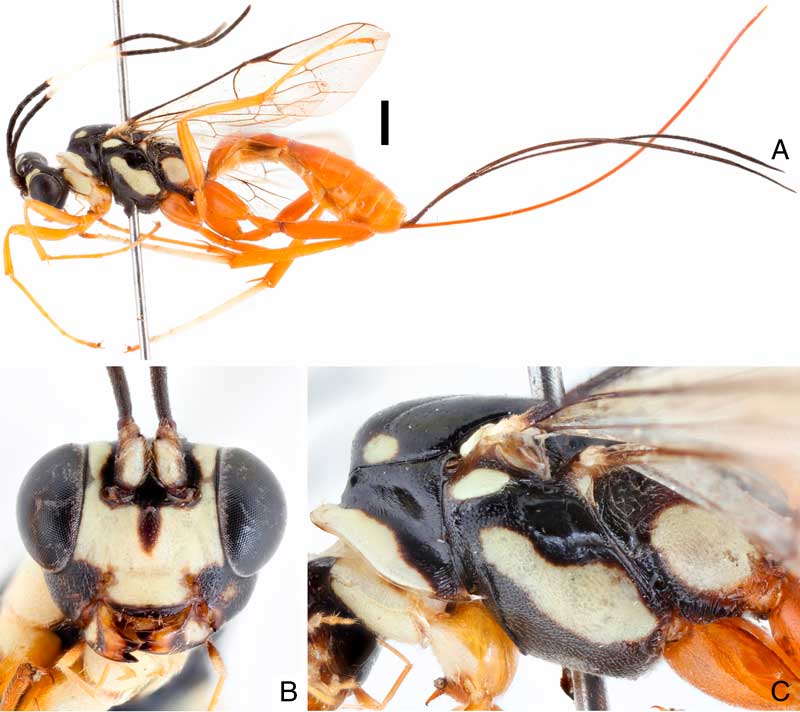
Diagnosis. Face, below toruli with a weak median convexity (Fig. 43B); lateral ocellus separated from compound eye by about 1.5 times maximum ocellar diameter; mesoscutum predominantly black at most with a few pale markings anteriorly (Fig. 43C); metapleuron white, periphery with anterior and dorsal margin black and distal and ventral margin red (Fig. 43C).
Distribution. This species was only known from Costa Rica; herein the distribution is expanded its distribution to Brazil and Peru. This is the species of Hapsinotus with wider distribution (Fig. 40).
Material examined. Paratype: 1♀ “Sector Cocori, 30 km al N. Cariari Prov. Limón, COSTA RICA, 100 m Nov.1993 E. Rojas LN 286000_567500 #2474” (MNCR). Non-type material: BRAZIL: 1♀: “Parque Sooratama LINHARES Espirito Santo BRASIL III-1953 Pedro Almeida Teles” (USUC). PERU: 1♀: “PE [PERU]: LO [Loreto], Rio Urituyacu, ca. [cerca] Ayahuasca, 25.III.2010 4°20'31''S/75°49'3''W 110 m, malaise, C. Castillo” (MUSM).
The Hapsinotus granulatus species group
Species of this group are characterised by having frons (Fig. 46D) strongly granulate below median ocellus with a distinct transverse swelling close to median ocellus, ovipositor sheath entirely black, fore wing with areolet present (Ugalde-Gómez and Gauld Reference Ugalde-Gómez and Gauld2002), occipital carina lower end joining hypostomal carina at 0.4–0.6 times as long as basal mandibular width (Fig. 46C).
This species group includes: H. granulatus, H. puka, and H. vilcai.
Hapsinotus granulatus Ugalde-Gómez and Gauld, Reference Ugalde-Gómez and Gauld2002
Diagnosis. Face, below antennal insertion with a strong median convexity (as in Fig. 44B); propodeum without anterior transverse carina, posterior transverse carina strong and complete; head orange or reddish brown; metatibia infuscate distally.
Distribution. Costa Rica (Ugalde-Gómez and Gauld Reference Ugalde-Gómez and Gauld2002).
Material examined. Paratype: 1♀ “COSTA RICA, San Jose, Zurqui de Moravia, 1900 m. IX–X.1993 col P. Hanson” (MNCR).
Hapsinotus puka Alvarado, new species
http://zoobank.org/urn:lsid:zoobank.org:act:91D83850-7A58-4C33-8E81-5974E4C5BB22
Morphology of Hapsinotus puka new species (holotype). A, Habitus (scale bar=1 mm); B, head, frontal view; C, head, latero-posterior view; D, propodeum; E, mesosoma, lateral view.
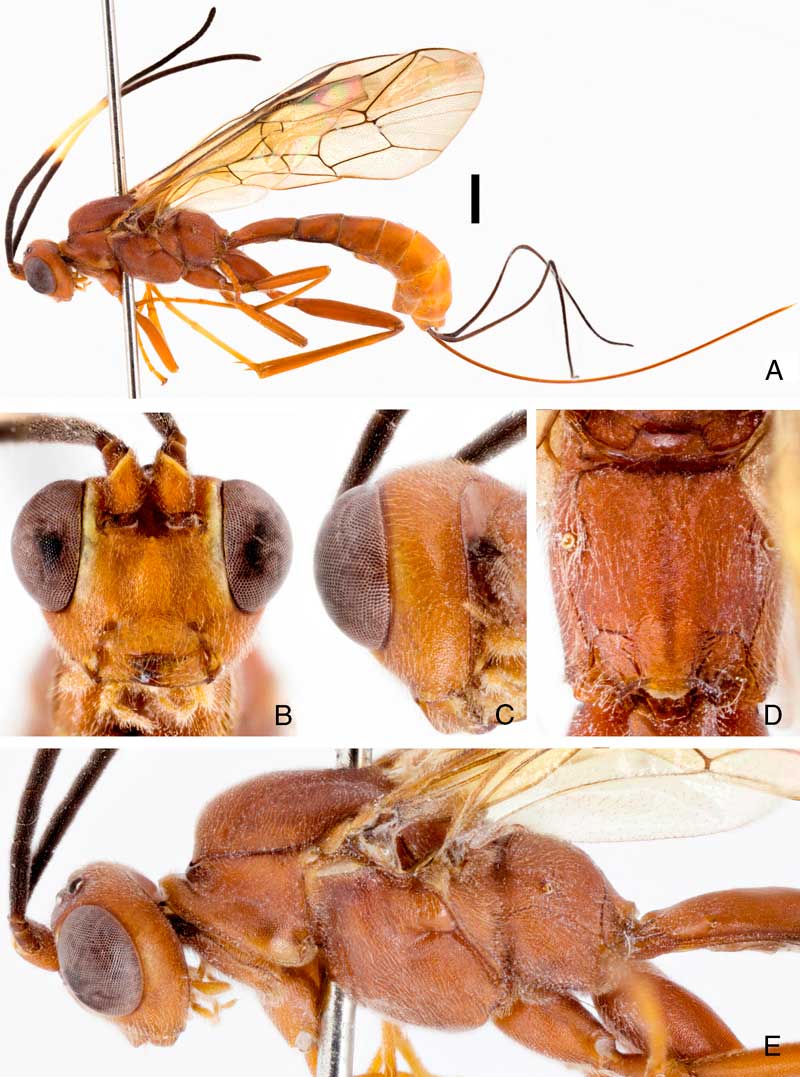
Geographic distribution of H. puka and H. vilcai.
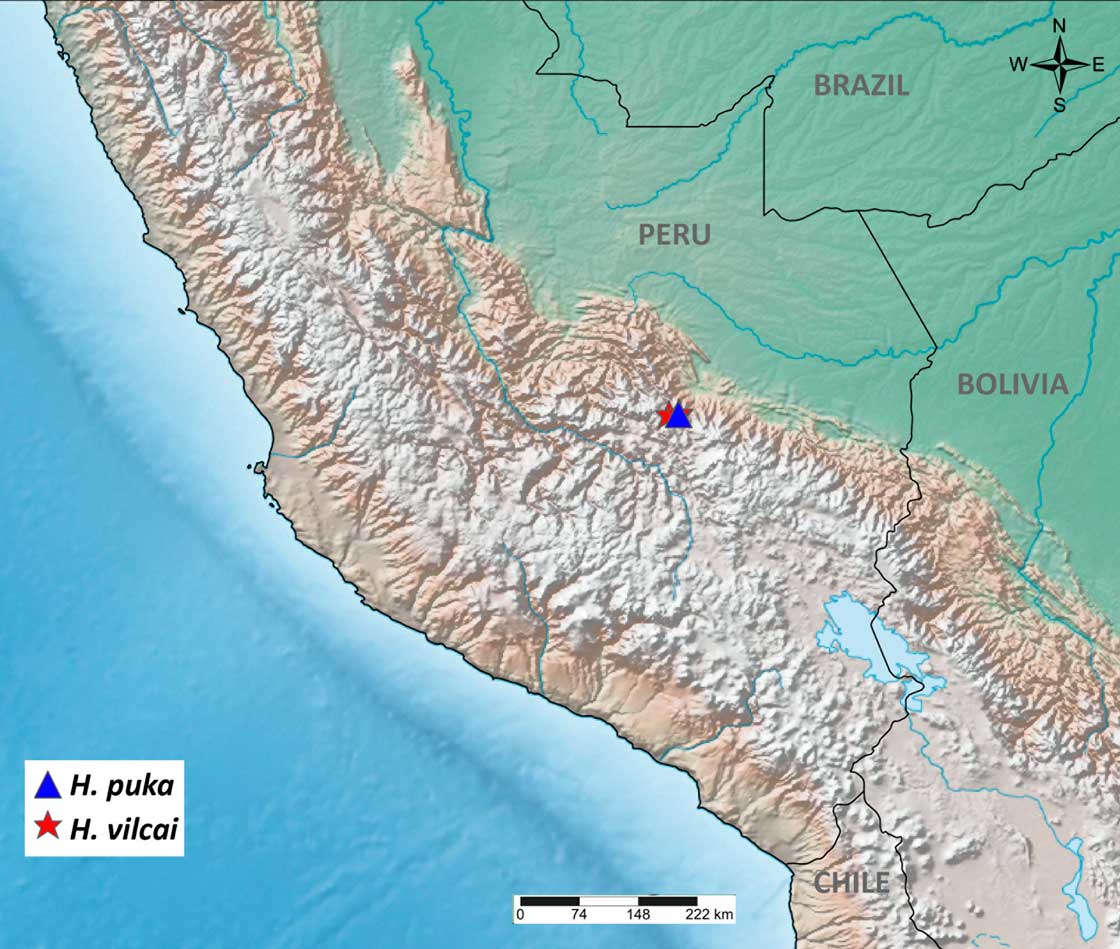
Diagnosis. Face, below antennal insertion with a weak median convexity; propodeum without anterior transverse carina, posterior transverse carina faint, centrally absent (Fig. 44D); head orange or reddish brown with or without yellow orbits on face (Fig. 44B); metatibia entirely orange (Fig. 44A).
Description. Female: fore wing length 7.9 mm. Head. Clypeus (Fig. 44B) of moderate breadth, 2.6 times as wide as high, granulate with faint punctures, slightly convex, slightly flared outwards (rounded centrally), with a soft transverse subapical ridge close to and parallel with impressed margin, distal margin centrally straight; mandible tapering slightly, upper tooth longer than lower; face granulate, below antennal insertion with a weak median convexity; malar space about 1.1 times as long as basal mandibular width; frons granulate with a median transverse swelling (with a small concavity below median ocellus); lateral ocellus separated from compound eye by about 1.3 times maximum ocellar diameter, distance between ocelli 1.4 times maximum ocellar diameter; occipital carina mediodorsally evenly convex, lower-ventral end joining hypostomal carina above base of mandible (carina about 0.5 times as long as basal mandibular width); gena in lateral view 0.4 times as long as compound eyes, granulate; antenna with 37 flagellomeres. Mesosoma. Pronotum granulate without epomia. Mesoscutum granulate with faint punctures; notaulus barely impressed, extending through 0.4 times length of mesoscutum. Scutellum slightly convex, granulate, without distinct lateral carina and median, pit-like impression. Mesopleuron granulate with faint punctures; upper end of epicnemial carina reaching about 0.3 times of way to anterior margin; metapleuron granulate with faint punctures, with wrinkles in broadened anterior lobe of submetapleural carina. Propodeum (Fig. 44D) granulate with faint punctures; anterior transverse carina absent; posterior transverse carina strong between pleural and lateromedian longitudinal carinae, and faint between lateromedian longitudinal carinae (absent centrally); lateral longitudinal carinae strong but faint before spiracle and after posterior transverse carina (so area posteroexterna enclosed); lateromedian longitudinal carinae present basally, faint (area between carinae, concave), and present behind posterior transverse carina. Prothoracic leg with pretarsal claw long, slender, abruptly and strongly curved, with short, sparse pectinae. Fore wing with 3rs-m present, enclosing a petiolate areolet, 2rs-m about 0.8 times as long as abscissa of M between 2rs-m and 2m-cu; Cu1 between 1m-cu and Cu1a 1.7 times as long as Cu1b; 1m-cu fairly evenly arcuate, with a faint trace of a vein stub. Hind wing with distal abscissa of Cu1 and 1A sclerotised throughout. Metasoma. Tergite I about 1.9 times as long as posteriorly wide, lateromedian longitudinal carinae absent; tergite II about 0.8 times as long as posteriorly wide. Ovipositor about 2.7 times as long as metatibia; its apex slightly compressed with a narrowed apical section. Colour. A predominantly orange; orbit (from face to frons beyond medium ocellus) yellow; antenna black with a white band on flagellum; subalar prominence white (Fig. 44E); wings softly infuscate; ovipositor sheath dark brown.
Male: Unknown.
Distribution. Peru (Fig. 45).
Etymology. The specific epithet puka means red in Quechua. It is treated as a noun in apposition.
Material examined. Holotype: ♀ “PERU: CU [Cusco], Qosñipata valley C.I. [investigation center] 5.I.2008 13°10'41''S / 71°35'02''W 2874 m, Malaise 6, C. Castillo” (MUSM).
Hapsinotus vilcai Alvarado, new species
http://zoobank.org/urn:lsid:zoobank.org:act:BCCB3D97-93C9-4516-B7A5-DE74A7214AD2
Morphology of Hapsinotus vilcai new species. A, Habitus (paratype, scale bar=1 mm); B, head, frontal view (holotype); C head, posteroventral view (holotype); D, head, dorsal view (paratype); E, propodeum (paratype).
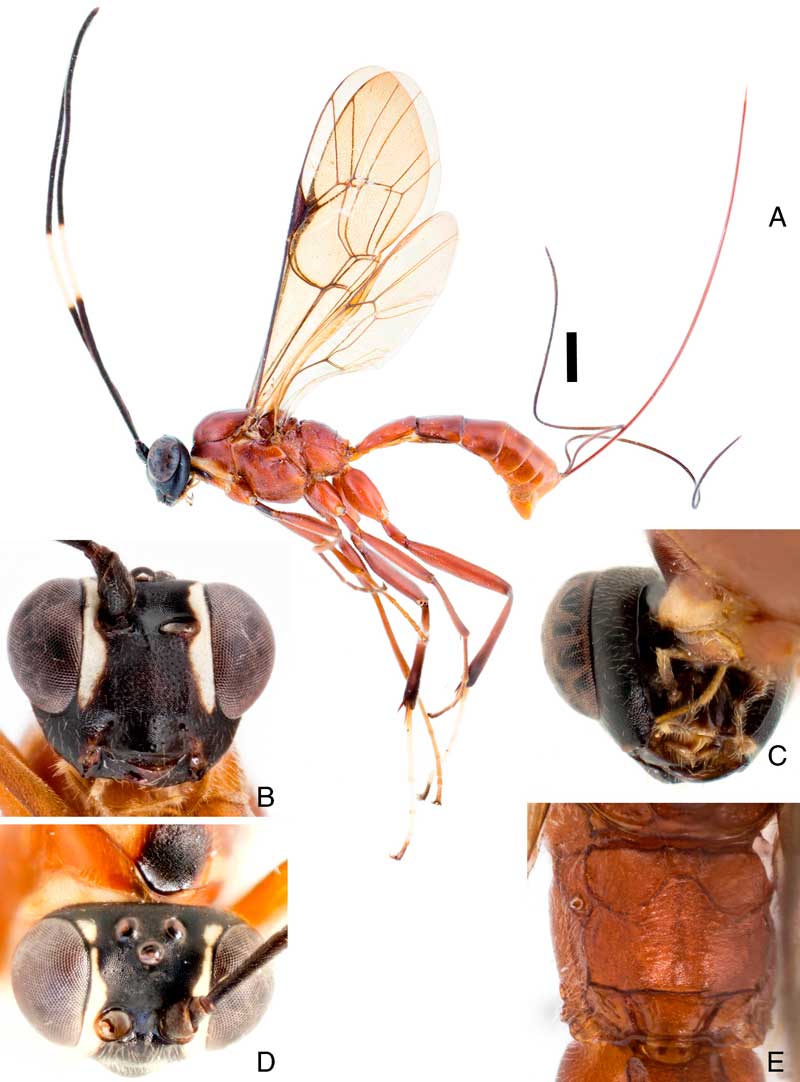
Diagnosis. Propodeum with anterior transverse carina present (Fig. 46E) and head black with white orbits on face and frons (Fig. 46B).
Description. Female: fore wing length 7.9 mm. Head. Clypeus (Fig. 46B) of moderate breadth, 2.0 times as wide as high, granulate with isolated punctures (sparse basally), slightly convex, slightly flared outwards (rounded centrally), with a transverse subapical ridge close to and parallel with impressed margin, distal margin homogeneously convex; mandible tapering slightly, teeth subequal; face granulate with punctures separated by 0.5–2.0 times puncture width (closer centrally), below antennal insertion with a weak median convexity (Fig. 46A); malar space about 0.9 times as long as basal mandibular width; frons (Fig. 46C) granulate, not polished below median ocellus, with a median transverse swelling (with a small depression before median ocellus and a small, crest-like protuberance at middle); lateral ocellus separated from compound eye by about 1.1 times maximum ocellar diameter, distance between ocelli 1.1 times maximum ocellar diameter; occipital carina mediodorsally evenly convex, lower-ventral end joining hypostomal carina above base of mandible (carina about 0.5 times as long as basal mandibular width); gena in lateral view 0.4 times as long as compound eyes, granulate with punctures separated by 1.5–2.5 times puncture width; antenna with 35 flagellomeres. Mesosoma. Pronotum granulate without epomia, with wrinkle in the same area. Mesoscutum faintly granulate with isolated punctures; notaulus impressed, extending 0.7 times length of mesoscutum. Scutellum slightly convex, faintly granulate, lateral carinae distinct reaching to 0.2 times length of scutellum; with median, pit-like impression. Mesopleuron granulate with punctures separated by 1.0–3.0 times puncture width; upper end of epicnemial carina reaching about 0.3 times of way to anterior margin; metapleuron granulate with punctures separated by 6.0–8.0 times puncture width, with strong wrinkles from broadened anterior lobe of submetapleural carina to distal end of metapleuron. Propodeum (Fig. 46E) granulate; anterior transverse carina vestigial but discernible; posterior transverse carina complete and strong; lateral longitudinal carinae strong but vestigial between transverse carinae; lateromedian longitudinal carinae present before anterior transverse carina but vestigial between transverse carinae and after posterior transverse carina strong; area basalis with shape of inverted trapezoid; area superomedia coffin shaped (about 1.1 times as long as wide); area externa about 1.4 times as wide as long. Prothoracic leg with pretarsal claw long, slender, and abruptly and strongly curved, with short, sparse pectinae. Fore wing with 3rs-m present, enclosing a petiolate areolet, 2rs-m about 1.4 times as long as abscissa of M between 2rs-m and 2m-cu; Cu1 between 1m-cu and Cu1a 2.1 times as long as Cu1b; 1m-cu fairly evenly arcuate, with a faint trace of a vein stub. Hind wing with distal abscissa of Cu1 and 1A sclerotised throughout. Metasoma. Tergite I about 1.6 times as long as posteriorly wide, lateromedian longitudinal carina distinct for 0.4 times length of tergite; tergite II about 0.8 times as long as posteriorly wide. Ovipositor about 2.9 times as long as metatibia; its apex slightly compressed with a narrowed apical section. Colour. Head (Fig. 46A–D) black; orbits (from face to beyond lateral ocellus) white; palpi light brown; antenna black with a white band on flagellum. Mesosoma (Fig. 46A) orange; pronotum with anterior margin of white; mesoscutum with a dark brown spot antero-centrally, white band anteriorly (between notaulus and lateral margin); subalar prominence white. Legs (Fig. 46A) predominantly orange, metafemur dorsally; metatibia with distal half gradually changing to reddish brown; metatarsus white, tarsomere 1 basally light brown, tarsomere 5 dark brown. Wings softly infuscate. Metasomal tergites orange; tergite I with two brown spots centrally; tergite II laterally light brown; ovipositor sheath dark brown.
Male: Unknown.
Remarks. Paratypes slightly smaller than the holotype, fore wing length 7.3–7.6 mm. The paratype series varies from holotype in the following: clypeus 1.9–2.0 times as wide as high; malar space 0.9–1.0 times as long as basal mandibular width; distance between ocelli 0.9–1.1 times maximum ocellar diameter; gena in lateral view 0.4–0.5 times as long as compound eye; antenna with 34–35 flagellomeres; propodeum with area superomedia 1.1–1.3 times as long as wide; area externa 1.3–1.4 times as wide as long; fore wing with 2rs-m 1.2–1.4 times as long as abscissa of M between 2rs-m and 2m-cu; Cu1 between 1m-cu and Cu1a 1.7–2.1 times as long as Cu1b; metasomal tergite I about 1.7 times as long as posteriorly wide, lateromedian longitudinal carinae 0.3–0.4 times length of tergite; tergite II about 0.7 times as long as posteriorly wide. Additionally, one paratype differs from holotype in having orbits only reaching to centre of frons, and both paratypes differ in having mesoscutum without white band.
Distribution. Peru (Fig. 45).
Etymology. The specific epithet “vilcai” is in honour to Peruvian painter and naturalist Oscar Vilca. It is a masculine noun in the genitive case.
Material examined. Holotype: ♀ “PERÚ: CU [Cusco], C.I. [Centro de Investigacion] Wayquecha 13°10'31''S / 71°34'53''W 11.IX.2007. 2692 m, Malaise trap 5 C. Castillo leg” (MUSM). Paratypes: 1♀ “PERÚ: CU [Cusco], Valle del Qosñipata, Rocotal, 13°06'48''S / 71°34'13''W 2052 m, 7.I.2008 Malaise trap 10A. C. Castillo”; and 1♀ “PERÚ: CU [Cusco], Valle del Cosñipata, Rocotal, 13°06'55''S / 71°34'14''W 2085 m, 12.II.2007 Malaise trap 9, C. Castillo” (MUSM).
Acknowledgements
Gavin Broad and Bernardo Santos read the submitted manuscript and returned very useful suggestions and corrections. The first author was supported by a fellowship from the Fondo para la Innovación, Ciencia y Tecnología, Peru. Field collections were financed by the Universidad Nacional Mayor de San Marcos (project CON/CON 111001161); Tambopata Research Society, Agencia Española de Cooperación Internacional para el Desarrollo, Spain (project A/013484/07); and Asociación para la Conservación de la Cuenca Amazonica (awarded to Carol Castillo). The visit to MNCR by M.A. was supported by Consejo Nacional de Ciencia, Tecnología e Innovación Tecnológica, Peru and the Tinker Foundation, New York, New York, United States of America; while research permits were issued by the Ministry of Environment, Peru. The authors are grateful to Dave Wahl (USUC), Guisella Chávez Guevara (MNCR), Gavin Broad (NHML), Andrew Bennett (CNC), and Frederique Bakker (NBCN) for permitting examination of material and to the students of the Entomology Department of MUSM and Sofia Muñoz for helping us to pick up names for the species. For helpful discussions and comments, thanks to Michael S. Engel. This is a contribution of the Division of Entomology, University of Kansas Natural History Museum.