We hold as undeniable truths that the governments of the various States, and of the confederacy itself, were established exclusively by the white race, for themselves and their posterity; that the African race had no agency in their establishment; that they were rightfully held and regarded as an inferior and dependent race, and in that condition only could their existence in this country be rendered beneficial or tolerable.
That in this free government all white men are and of right ought to be entitled to equal civil and political rights; that the servitude of the African race, as existing in these States, is mutually beneficial to both bond and free, and is abundantly authorized and justified by the experience of mankind, and the revealed will of the Almighty Creator, as recognized by all Christian nations . . . (“A Declaration of the Causes Which Impel the State of Texas to Secede from the Federal Union,” February 2, 1861.Footnote 1
I. Introduction: Racism as a Constructed Ideology
There are many notions of racism, which might be defined simply as bigotry or prejudice toward “other” races.Footnote 2 The sense in which we intend the term is closer to the notion of “institutional racism” coined by Stokely Carmichael and Charles Hamilton.Footnote 3 That is, bigotry justifies, but is also nurtured by, the separation and degradation of the “inferior” race. This means, of course, that the inferiority is a consequence of the institutions that reify bigotry, because — in the United States, at least — blacks were forced into servitude, denied education, and prevented from using the social and cultural capital of the family. Belief in the objective truth of the bigotry that justified the institutions of racism was partly fostered by alleged “facts”: blacks were lazy, stupid, morally dissolute, and so on. But beliefs were also kept in line by the fierce, and sometimes violent, ostracism that was used to punish dissenters. And sometimes even worse tactics were used.
Our theoretical claim is that racism is a specialized ideology, which was first consciously (though perhaps not intentionally) devised, and later evolved, to serve two conflicting purposes.Footnote 4 First, the ideology of racism served a legal-economic purpose. Racism legitimated the then-existing treatment of slaves among Southern whites, thereby taking moral debates about the maintenance of the “peculiar institution” off the region’s domestic political agenda. It therefore helped preserve the value of property rights in the permanent labor services of African slaves on plantations and in the related activities to which they were assigned in the “slave” states and territories.Footnote 5 This value, which has been estimated as ranging from 1.5 to 2 billion dollars, was a significant part of the equity value of the Southern economy.Footnote 6 The loss of this value would have bankrupted the Southern elite of planters and lenders overnight.
Second, racism allowed slave owners to resolve a knotty spiritual problem: How could a morally good person own slaves? Nearly all slave owners considered themselves, and by appearances were, Christians. Many were devout, and studied the Bible for guidelines on how to live their lives. Even those who had few personal religious commitments depended on the esteem and good will of others in the Christian community to validate their membership in the elite.
The ideology of racism allowed slave owners to live with the contradiction between owning slaves and seeing themselves as Christian.Footnote 7 Racism portrayed African slaves as being less than human (and therefore requiring care, as a positive duty of the slave owner, as a man cares for his children, who cannot care for themselves), or else as being other than human (and therefore being spiritually no different from cattle or horses, and therefore requiring only the same considerations for maintenance and husbandry).
The notion that slaves were less than, or other than, human protected the property interests of slave owners, and preserved the ability of slave owners to be perceived — and to perceive themselves — as moral beings. The development of the Southern states’ civil law, combined with elites’ pre-existing conception of the nature of their black labor force, justified the ideology of racism, in which slavery was viewed as a positive good.
Presumably, it need not be said, but must be said nonetheless, that this process of justification through the construction of an ideology with moral implications is evil. By explaining the process of its creation and describing the economic forces that made the justification of slavery imperative, we are in no way excusing the actions, or thoughts, of slave owners and Southern elites who were complicit in the oppression, rape, torture, and killing of millions of Africans. Even those who escaped the worst treatment were torn violently from their homelands and families. Rather, it is precisely this moral evil, justified as a positive moral good, that gives rise to the research question of how prevalent this kind of constructed moral system might be. To put it starkly, if the reader (or the authors) had been born to a wealthy slave-owning white family in 1820, would that person have had the independent moral strength to reject slavery? We would all like to think so. But after reading documents, letters, and other accounts of the actions and statements of those involved, we are not so sure.
II. Antebellum Southern Accounts of Race
Changes in the moral norms and social customs in the U.S. South in the first half of the nineteenth century can, perhaps, best be understood as an attempt to cope with the ambiguity of the relation between the master and the slave. The dilemma, recognized since the most distant antiquity, is how to resolve the tension between “men as equals” and “master rules slave.” Aristotle discusses the problem in a passage of his Politics:Footnote 8
A question may indeed be raised, whether there is any excellence at all in a slave beyond and higher than merely instrumental and ministerial qualities — whether he can have the virtues of temperance, courage, justice, and the like; or whether slaves possess only bodily and ministerial qualities. And, whichever way we answer the question, a difficulty arises; for, if they have virtue, in what will they differ from freemen? On the other hand, since they are men and share in rational principle, it seems absurd to say that they have no virtue . . . .
[W]hy should one of them always rule, and the other always be ruled? . . . How strange is the supposition that the one ought, and that the other ought not, to have virtue! . . . Here the very constitution of the soul has shown us the way; in it one part naturally rules, and the other is subject, and the virtue of the ruler we maintain to be different from that of the subject; the one being the virtue of the rational, and the other of the irrational part . . . . For the slave has no deliberative faculty at all . . . .
This tension — “all men are created equal” in a country of slave owners — played a prominent role in political thought around the time of the Revolution. The Founding generation expressed deep reservations concerning the morality of the “peculiar institution” of slavery. Filled with the Enlightenment ideal that rational men could design a society free of oppression and want, this generation could not reconcile their principles with the ugly realities of the slave trade and the plantation economy. However, despite the widespread tacit acceptance of its immorality, slavery was too integrally woven into the South’s social and economic fabric for abolition to be a practical option, even if the economics had been more ambiguous.Footnote 9
Colonial American political thought was replete with arguments in favor of domestic slavery. Politicians, clergy, and social critics applauded slavery for its important contributions to economic development, the spiritual benefits for Christianized slaves, and in utilitarian terms, to the happiness of the whole, though at the expense of the few.Footnote 10 However, following the Revolution, proslavery arguments entered a quiescent period, while the South wrestled with the moral and economic consequences of its “peculiar institution.” But there was during the 1830s an explosion in proslavery discourse inconsistent with many of the values embraced only a few years before. This transitional period, and this transition, will be our focus.
In terms of the theory of ideology, during this period of proslavery inactivity, orthodox and heterodox views about the status of slaves contended in elite discourse as relative and respectable equals. The orthodox view was based on the belief that slavery was actually ennobling for the slave. Henry Holder (1788) writes,
[Their removal from Africa was] a species of dispensation of Providence in their favour, to bring them to a better state of civilization than they could attain to in their domestic residence; and such it must undoubtedly prove in a very high degree, when it is their fortune to fall into the hands of rational and benevolent owners.Footnote 11
In addition to this spiritual enlightenment, Robert Walsh (1819) argued,
The physical condition of the American negro is, on the whole, not comparatively along, but positively good, and he is exempt from those racking anxieties — the exacerbations of despair, to which the English manufacturer and peasant are subject to in their pursuit of their pittance.Footnote 12
These beliefs helped to legitimate opposition to the region’s abolitionist minority.
The heterodoxy’s discomfort with slavery during the years following the Revolution rested on a variety of moral and economic considerations. First, the incompatibility of slavery with liberal ideals seemed undeniable. This contradiction was brought into high relief because one of the most widely used rhetorical strategies of white Southerners during the rebellion was to condemn the British for imposing slavery on white Americans. The historian William Cooper notes:
All the characteristics associated with political slavery — dependence, tyranny, oppression, defenselessness — glowed especially brightly among a people who owned slaves, for those words described their own human institution.
Conscious of this association, southerners directly connected their political contest against England with their domestic institution. When southerners cried out, as they often did, “slavery or independence,” there could be no more mistake about their meaning.Footnote 13
Though the region’s elites may have varied in the weight they gave to natural rights in regard to justifications for antislavery, there is no doubting their recognition of a tension between rights to liberty and property rights in man. They recognized their need for reasons that others would accept. And that project occupied their minds, their pens, and their printing presses for decades. What emerged was a sense that slaves would have been unable to lead safe or fulfilling lives, even if granted their freedom. It is true, on the one hand, that this was absurd nonsense. But it is a mistake to underestimate the importance of such palliatives for the conscience, ameliorating the guilt felt by owners.
Second, the planting class blamed slavery and the unsustainable agricultural practices that it promoted for the decline in economic circumstance. George Washington, for one, condemned the slave economy for the agricultural depression of the revolutionary war period caused by soil exhaustion and overproduction of cash crops. He wrote, “I never ride to my plantations without seeing something which makes me regret having continued so long in the ruinous mode of farming [tobacco production], which we are in.”Footnote 14 Following the Revolution, many farm owners, especially in the Upper South, turned from tobacco cultivation to the more sustainable production of wheat and an assortment of other crops. Because these crops were less labor-intensive in cultivation, tobacco producers were left with unwanted surplus slave laborers.Footnote 15
The conflict was not simply economic, however. There were real divisions in the South, and even in individual Southerners, over justifying slavery. Miller argues that the contradictions in Thomas Jefferson’s thought at the time of the Founding can be viewed as a microcosm of society’s schizophrenia.Footnote 16 Jefferson’s original draft of the Declaration of Independence condemned George III’s acceptance of the slave trade as a “cruel war against human nature itself.” In later years, he was led to conclude in a famous letter to John Holmes, “But as it is, we have the wolf by the ears, and we can neither hold him, nor safely let him go. Justice is in one scale, and self-preservation in the other.”Footnote 17 Nevertheless, consistent with their reservations about the morality of the slave regime, the Founders established an institutional framework during the earliest part of the nineteenth century that prevented the unfettered growth of slavery via the Northwest Ordinance’s restrictions on the expansion of slavery to new territories and the abolition of the slave trade.Footnote 18
During the late-1820’s and early-1830’s, there was, however, a marked transformation in the region’s political and intellectual thought. By rejecting the inherent equality of men, at least the equality of their “souls,” the South was able to reconcile its Enlightenment ideals, or “American core values,” with the continued — and expanding — slave regime.
In 1829, only a few years after Jefferson’s grudging acceptance of slavery in his letter to Holmes, Stephen Miller, the governor of South Carolina, makes the first clear statement that slavery is a “positive good.”Footnote 19 Shortly after Miller’s speech, a measure to emancipate Virginia’s slaves — with reparations to slave owners, not to slaves — came before the state’s General Assembly. After extensive debate in 1831–1832, the measure failed in the Virginia legislature, and no serious subsequent attempts at abolition were undertaken in any legislature in the entire region.Footnote 20
If the Virginia debates mark the transformation in the political history of slavery, then Thomas Dew’s critique of the debate marks the turning point in its intellectual history. Dew, a professor at the College of William and Mary, condemned the proponents of the Virginia bill for their “quackery.” Dew claimed that legislation founded upon abstract principles — what we might now call ideal theory — without reference to context, was doomed to fail.Footnote 21 The state simply could not afford to buy all of its residents’ slaves, because of the working of supply and demand. Dew’s logic was based on scarcity — that the cost of buying the slaves would increase with the number of slaves purchased as labor became more scarce, until the point where a slave would be worth more to the slave owner than the state could afford.
Dew argued further that even if the state could afford to purchase all of the slaves at fair market prices, Virginia could not afford to send them abroad, even if a home could be found for them. Then, echoing Jefferson, he contended that a race war would result if the emancipated slaves remained in Virginia. Dew appears to have made a conscious decision to make a virtue of necessity. Since it would be too costly to return blacks to freedom, why not argue that blacks are better off as slaves? He articulated an explicitly racist philosophy whereby the paternalistic relationship between master and slave “protected” the black worker from the slaves’ “natural” disposition to idleness:
In the free black, the principle of idleness and dissipation triumphs over that of accumulation and the desire to better our condition; the animal part of the man gains the victory over the moral, and he, consequently, prefers sinking down into the listless, inglorious response of the brute creation, to rising to that energetic activity which can only be generated amid the multiplied, refined, and artificial wants of civilized society.Footnote 22
Of course, “idleness” in a setting where the worker was not compensated for working was more the effect of slavery than a just cause for justifying it, but Dew had chosen a path of argument and he followed it to the end.
Southern political leaders turned their attention toward preventing abolitionists from outside the South. The Nullification Crisis, Bloody Kansas, and the Runaway Slave Act laid bare the growing importance of slavery to national politics and the solidification of public opinion in the South around the maintenance of the institution following the Virginia Debates. Works by Southern intellectuals such as George Fitzhugh — built on the foundation of Dew — reflect this change in Southern attitudes. Fitzhugh propounded the benefits of the paternalistic socioeconomic relationship between master and slave:
“Property in man” is what all are struggling to obtain. Why should they not be obliged to take care of man, their property, as they do their horses and hounds, their cattle and their sheep? Now, under the delusive name of liberty, you work him “from morn to dewy eve” — from infancy to old age — then turn him out to starve. You treat your horses and hounds better. Capital is a cruel master. The free slave trade, the commonest, yet the cruelest of trades . . .Footnote 23
Fitzhugh made an explicitly proto-Marxist argument: the only alternative to a violent revolution of the working class, engendered by industrial capitalism and competition, was slavery.Footnote 24 Importantly, the resulting peace was not simply a result of repression, but was also harmony: slavery was (compared to wage labor) a positive good for the worker. Both Dew and Fitzhugh (and many others)Footnote 25 recognized the importance of giving reasons for why it was ethically good for society’s elites to provide for the well-being of workers, and then argued that only slavery could do that, given the disparities in talents and moral capabilities of human beings.
III. The Constructed Ethical Argument for Slavery — Two Snapshots
At the time of the American Revolution, the general view was that slavery was a necessary evil. After about 1830, the region’s political thought regarding the “peculiar institution” was transformed through a process of debating reasons and justifying slavery as a positive good. This second view came to dominate Southern debates, certainly in public and generally in private, in the decades just before the Civil War. These two views of slavery, bundled together with broader conceptions of the good, formed the basis for the changing elite ideology in the South. And the mechanisms societies can deploy to maintain conformity with these “justified reasons” were deployed with full force against dissent.
The notion that slavery was a necessary evil took hold in Southern political thought in the decades preceding the Revolution. There were three axioms that constituted the fundamental principles of Southern elites during this period, in terms of their conclusion that slavery was wrong, temporary, but necessary “for now.”
First, slavery was wrong, even evil, because of its harmful effects on the character of slave owners and the Southern economy, not to mention the institution’s incompatibility with the liberal ideals of the period. Thomas Jefferson, for one, lamented the impact of slavery on planter character:
There must doubtless be an unhappy influence on the manners of our people produced by the existence of slavery among us. The whole commerce between master and slave is a perpetual exercise of the most boisterous passions, the most unremitting despotism on the one part, and degrading submissions on the other.Footnote 26
James Madison also famously noted the tension between slavery and revolutionary ideals when he writes in Vices of the Political System of the United States, “Where slavery exists the republican theory becomes still more fallacious.”Footnote 27
The second axiom was the belief that slavery was temporary. Abolition would happen, probably soon, but in any case inevitably. Modern historian William Freehling notes that the Southern Founders took advantage of every realistic opportunity to hamstring the advancement of slavery during the first years of the republic, and it seemed that the trend would continue into the nineteenth century.Footnote 28 Thomas Jefferson looked to the next generation of Virginians to continue this tradition and set the precedent for abolition throughout the South. He writes, “These [young Virginians] have sucked in the principles of liberty, as it were, with their mother’s milk; and it is to them I look with anxiety to turn the fate of this question. Be not therefore discouraged.”Footnote 29 After a visit to Virginia after the revolution, Lafayette’s private secretary echoed Jefferson’s sentiments, “It seems to me that slavery cannot subsist much longer in Virginia; for the principle is condemned by all enlightened men; and when public opinion condemns a principle, its consequences cannot long continue.”Footnote 30
Third, delaying (just and inevitable) emancipation was nonetheless necessary. The necessity was derived from the linked beliefs (a) that blacks were inherently inferior, (b) that antebellum slave owners were not responsible for the existence of slavery, and (c) that emancipation without separation would bring an increased threat of interracial violence. Central to antebellum justifications for the maintenance of the slave regime, at least over the short-run, was the belief in the degraded condition of blacks. Thomas Jefferson noted that despite his (claimed) desire to find scientific evidence for the equality of the races, his observations about the intelligence and talents of his slaves, along with a comparison of the achievements of the slaves of his period with the white slaves of ancient Rome, demonstrated the inherent inferiority of blacks.Footnote 31
These intellectual justifications aside, Southerners were also motivated by simple (and plausible) fear, as the belief in the potential for interracial violence was ubiquitous. Whatever else it did, emancipation would increase slaves’ ability to lash out against whites. Consequently, even those opposed to slavery favored delaying emancipation until some other arrangement could be made. The Saint-Domingue slave rebellion of the early-1790s led to the extermination of virtually the entire white population on the Caribbean island and ended with rule by the newly freed slaves. This rebellion, followed shortly thereafter by Gabrielle’s conspiracy in Virginia, exacerbated Southern concerns about policing their slaves and resulted in legislative action outlawing manumission and limiting the economic and personal freedoms of slaves and freedmen.Footnote 32
By the end of the 1830s, a new orthodoxy had emerged in the South, as “the wolf by the ears” was replaced by “slavery as a positive good.” This new scheme had an analogous system of three axioms. First, Southern elites believed that slavery was “good,” both for the planter and the slave. Proslavery theorists drew evidence from theology, pointed to the beneficial impact of slavery on republican government, cited Greek and Roman precedents, and based arguments on the emerging fields of political economy and sociology. Thornton Stringfellow developed an influential Biblical justification for slavery (1841). He argued:
Under the Gospel, it has brought within the range of Gospel influence, millions of Ham’s descendants among ourselves, who, but for this institution, would have sunk down to eternal ruin; knowing not God, and strangers to the Gospel. In their bondage here on earth, they have been much better provided for, and great multitudes of them have been made the freemen of the Lord Jesus Christ, and left this world rejoicing in hope of the glory of God. The elements of an empire, which I hope will lead Ethiopia very soon to stretch out her hands to God, is the fruit of the institution here. An officious meddling with the institution, from feelings and sentiments unknown to the Bible, may lead to the extermination of the slave race among us, who, taken as a whole, are utterly unprepared for a higher civil state; but benefit them, it cannot. Their condition, as a class, is now better than that of any other equal number of laborers on earth, and is daily improving Footnote 33 (emphasis added).
James Henry Hammond looked to the beneficial effects of slavery on the republican citizenry. He claimed:
Slavery is truly the “corner-stone” and foundation of every well-designed and durable “republican edifice.” With us every citizen is concerned in the maintenance of order, and in promoting honesty and industry among those of the lowest class who are our slaves.Footnote 34
Finally, as noted earlier, Fitzhugh argued that wage labor — in effect, renting the worker — was far inferior to ownership. This is an interesting argument, at least rhetorically. When Fitzhugh said: “You treat your horses and hounds better,” because they are owned rather than rented. Southern elites anticipated and exploited the modern recognition of moral hazard in rentals, summarized by the aphorism “In the history of the world, no one ever washed a rental car!”Footnote 35 As these arguments gained acceptance in Southern society, the squeamishness of the Southern Founders largely faded away.
Second, by the end of the 1830s, rather than thinking that slavery would end naturally, or soon, Southerners convinced themselves — partly because of economic developments — that slavery would endure indefinitely. That was a marked change in sentiment from just the earlier years of the same decade. The series of events from 1831 to 1832 culminating in the defeat of the Nat Turner uprising and the famed Virginia legislative debates marked a critical juncture in the change in Southern sentiment toward slavery.Footnote 36
Third, Southerners came to frown upon manumission as being inhumane, arguing that slave ownership entailed positive responsibilities for the master. Underlying this axiom was the continued belief in — combined with ever more elaborate justifications for — the inferiority of blacks. There were at least two competing sets of racist assumptions that led, inexorably, to unavoidable obligations for the ruling class. During the 1840s and 1850s, many Southerners began to accept the conclusions from ethnology, which attempted to prove “scientifically” the stark differences between blacks and whites. For example, Josiah Nott argued:
That the Negro and Indian races are susceptible of the same degree of civilization that the Caucasian is, all history would show not to be true — that the Caucasian race is deteriorated by intermixing with the inferior races is equally true.Footnote 37
A difficulty arose, of course: a science that promoted a theory of polygenesis could not be universally accepted by the South’s substantial — and highly orthodox — religious community, notwithstanding the “mudsill” or “Ham’s children” claims of Stringfellow. Regardless of the theoretical underpinnings, throughout the antebellum period there was widespread consensus about the inferiority of blacks. This belief initially justified not freeing one’s slaves unless they had a certain capacity to care for themselves. As William Gillmore Simms noted:
The question with us is, simply as to the manner in which we have fulfilled our trust. How have we employed the talents which were given us — how have we discharged the duties of our guardianships? What is the condition of the dependent? Have we been careful to graduate his labors to his capacities? . . . Have we sought to improve his mind in correspondence with his condition? Have we raised his condition to the level of his improved mind? Have we duly taught him his moral duties — his duties to God and man? . . . Let him carefully put them to himself, and shape his conduct, as a just man, in compliance with what he should consider a sacred duty, undertaken to God and man alike.Footnote 38
Eventually, the very racism used to justify slavery as the right of whites to subjugate blacks was transformed to justify a duty of whites to “care for” blacks, much in the manner of domesticated cattle or horses. Black Africans had been unworthy of independent existence, and so could be enslaved. Now, Black Americans were incapable of independent existence, and were dependent on (though benefitted by) the slave “family.” William Harper delivered a lengthy and sophisticated version of this narrative, from which it is worth quoting a substantial paragraph:
I am sure that it is unnecessary to say to an assembly this, that the conduct of the master to his slave should be distinguished by the utmost humanity. That we should indeed regard them as wards and dependents on our kindness, for whose well-being in every way we are deeply responsible. This is no less the dictate of wisdom and just policy, than of right feeling. It is wise with respect to the services to be expected from them. I have never heard of an owner whose conduct in their management was distinguished by undue severity, whose slaves were not in a great degree worthless to him. A cheerful and kindly demeanor, with the expression of interest in themselves and their affairs, is, perhaps, better calculated to have a better effect on them, than what might be esteemed more substantial favors and indulgencies. It is wise too in relation to the civilized world around us, to avoid giving occasion to the odium which is so industriously excited against ourselves and our institutions . . . It is detached instances of [cruelty and mistreatment] of this sort, of which the existence is, perhaps, hardly known among ourselves, that, collectively with pernicious and malevolent industry, affords the most formidable weapon to the mischievous zealots, who array them as being characteristic of our general manners and state of society.Footnote 39
The hubris of this statement is breathtaking. If “undue severity” is “perhaps, hardly known,” then why does it occur frequently enough that the effect is known to be “worthless” slaves? Kind treatment is thus an obligation for the judicious slave owner, but is also “wise in relation to the civilized world.” Most importantly, the perception of kind, cheerful treatment needs to be maintained as a unified narrative, though “more substantial favors and indulgencies” were not necessary. It is tempting to see these suggestions as what would later be called pure propaganda, but Southern elites appear to have worked to persuade themselves that this narrative was actually true.
And in a way that is the heart of our story. On the television program “Seinfeld,” George famously said, in the café: “Jerry . . . remember: It’s not a lie if you believe it.”Footnote 40 Southern whites needed a story to tell the world, but they convinced themselves.
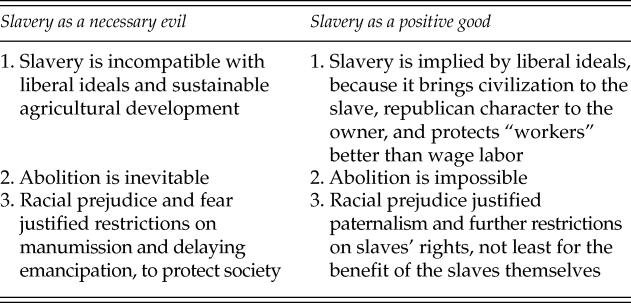
It is useful to summarize the “two snapshots” of slavery we have discussed in this section. Like any summary, some damage will be done to details, but the differences are important and worth highlighting. Before (about) 1830, Southerners — especially elites — had both portrayed and conceived of slavery as a “necessary evil.” After (about) 1835, Southern elites almost universally portrayed — and, importantly, conceived of — slavery as a “positive good.” The differences are presented in Table 1.
Two Snapshots of Southern Elite Views of Slavery.

It is useful to consider some visual evidence of the comparison that these conceptions represent. This is particularly true since it is easy to be incredulous at the claim that slavery somehow benefited the slaves themselves. It is important to emphasize that we are not in any way endorsing this view, but rather are presenting a means of understanding the argument made by Southern elites after 1835. Both of the images can be found on the cover of Tise (1987), who describes their origin.
The first figure is a vision of the black African before and after being transported to America. The “before” picture, labeled “The Negro As He Was,” shows a savage dressed in rags, sitting on a rough log and standing on human bones, presumably implying both early death and cannibalism.
The second drawing shows attentive and well-dressed black “servants” admitted to the “Big House” to participate in conversation. Even in the “after” picture the artist cannot bring himself to put “the Negro” actually at the table with the master race of whites, but they are in the room.
The second comparison is perhaps even more important, because it argues more than simply that blacks are better off as slaves in America than as freemen in Africa. The claim of the drawing is that black slaves in the South are better off than free workers in the North, a common trope of proslavery in the time of the Industrial Revolution. The Northern worker is exploited, rented, and then turned out to the poor house. There is no reason for Northern factory owners and capitalists to care for workers, because their satanic mills have plenty of other human grist. This is an explicit and striking proto-Marxist conception of wage labor, and Southern elites seized on it as a key part of their narrative.
“The Northern Laborer” goes directly from the workhouse to the poor house. If he is injured, misses a debt payment, or starves, he is simply cast aside, because no one has reason to care for him. He is a rental laborer. The “Southern Laborer” (and we fully realize the distasteful hypocrisy in calling slaves “laborers”) is presented as being attended and cared for cradle to grave. The reason is that slaves are owned, not rented. This argument was more persuasive, at least to those already disposed to believe in the value of the “peculiar institution,” than one might think looking back with hindsight.
IV. Proslavery as a Tactical Political Reaction
The strengthening of the orthodoxy in the region after 1831 was accompanied by increased consistency within the proslavery camp. Drew Gilpin Faust writes, “The defenses of slavery of this period were . . . remarkably consistent with one another . . . The high level of conformity within proslavery thought was not accidental. Consistency was seen as the mark of strength and the emblem of truth.”Footnote 41 The Southern elites did not have meetings, or enter conspiracies. They just agreed on reasons, because it became clear that such consensus was politically necessary.
Of course, there were outside forces at work also. Freehling focuses on the abolitionist Postal Campaign of 1835 and its ramifications.Footnote 42 Funded by the Tappan brothers’ dry-goods fortune, the rapidly growing American Antislavery Society (AAS) decided that it was time to convert the American mainstream, beginning with the South. Hoping to tap into the region’s heterodox sentiments, the AAS mailed intentionally “incendiary” pamphlets in enormous quantities, flooding Southern post offices and panicking both local and state officials.
Apparently the AAS miscalculated the region’s sentiments. Southerners, believing the pamphlets were a ruse to stir-up black revolt, descended in mobs onto their post offices, and used the letters to fuel public bonfires. The Postal Campaign linked Southern concerns over social control with antislavery agitation and shadowy “outsiders.” These attitudes were reinforced by the ensuing presidential election of 1836 in which both the Democratic and Whig parties campaigned on a proslavery platform in the region. Any subsequent domestic arguments for gradual emancipation were suppressed by mobs, who had internalized the reasons for slavery and were willing to defend the reasons that now underpinned and supported the orthodoxy.
Another “outside” force was the attempt by courts to solve problems of moral hazard and costs of liability. This issue was particularly pronounced in the master’s relations with individuals who rented slaves, with his overseers, and with slave patrols. In each of these instances, the actor other than the master had an incentive to mistreat the slave in order to promote his own short-run interests, since he had no interest in the slaves’ long-run productivity. As a result, these individuals might be inclined to subject the slave to extremely excessive punishments to increase short-run productivity at the expense of long-run gains, engage in minimal monitoring of the slave thereby increasing the likelihood of a runaway, and so forth. Wahl discusses cases similar to these, where the courts ruled to protect the masters’ interest.Footnote 43 Law regarding moral hazard, like that related to adverse selection, may have provided the basis for a belief in a paternalistic slave regime, regardless of its daily reality.
Regardless of the jurists’ goals that led to these decisions, the legal limits on the treatment of slaves may have provided a focal point, in the sense described by Shelling, around which a convention, or ideology may have formed. To the extent that slave owners perceived themselves to be caring for their slaves by providing food, clothing, health care, and so forth, and that the law regulated their conduct (Wahl in fact argues that the courts offered greater and greater protections in the decades before the Civil War) such that they theoretically were not allowed to greatly mistreat their slaves, then this may have laid the groundwork for the paternalism advocated by Fitzhugh and others. To further buttress this claim, the work of Robert Fogel and Stanley Engerman suggests that typically, slaves were well cared for (again, in the sense that horses were well cared for; slaves were not treated like human beings).Footnote 44 Thus institutions and reality reinforced one another in a manner consistent with the development of a paternalistic ideology. Moreover, because the perception was that the slave owner was caring for his inferior, rather than paying an equal (in some, perhaps Christian or Enlightenment sense) his wages in basic necessities, the ideology of racism was able to take root. Paternalism was necessary to care for someone who was something less than or other than a human being.
V. Conclusion
As we have tried to document, the Southern states of the United States had a system of slavery that was perceived as evil, but (internally, at least) this evil was thought to be necessary and temporary. In response to a series of events and ideational innovations, this consensus was transformed. The nature of the humanity of chattel slaves was transformed so that they had no “standing” in the new consensus. The fact that they would not have found the rules acceptable or justifiable was no more germane than it would have been for a horse to reject a saddle or imprisonment in a paddock. The saddle and the paddock are not just useful for the horse’s owner (though they surely are useful). Rather, the “keeping” of the horse can be justified as a positive good for the horse itself. The horse is domesticated, lacks moral agency, and is simply not capable of taking care of itself. Only a cruel person would look at the attempts of the horse to escape, and conclude that the horse’s freedom is therefore justified.
In more recent times, this approach was summarized in the Rawlsian “original position,” where people ask themselves whether particular arrangements are acceptable or justifiable while separating themselves from their actual positions as a consequence of adopting (or rejecting) those rules.Footnote 45 John Tomasi has called Rawls’s use of the idea “the unoriginal position” and points to a passage in Hayek that takes much the same logic and applies it to fairness in laws.Footnote 46 But an even earlier “original position” can be found in Montesquieu, and its value for our purpose is that it addresses slavery directly:
Every day one hears it said that it would be good if there were slaves among us. But, to judge this, one must not examine whether they would be useful to the small, rich, and voluptuous part of each nation; doubtless they would be useful to it; but, taking another point of view, I do not believe that any one of those who make it up would want to draw lots to know who was to form the part of the nation that would be free and the one that would be enslaved. Those who most speak in favor of slavery would hold it the most in horror, and the poorest of men would likewise find it horrible. Therefore, the cry for slavery is the cry of luxury and voluptuousness, and not that of the love of public felicity. Who can doubt that each man, individually, would not be quite content to be the master of the goods, the honor, and the life of others and that all his passions would not be awakened at once at this idea? Do you want to know whether the desires of each are legitimate in these things? Examine the desires of all.Footnote 47
It is likely true that if the Rawlsian principle were followed, and if people (including Southern slave owners) did not know who, on leaving the room, would be slave and who would be free, that there would be little support for the institution of slavery. But that is precisely why the project of “constructed racism” was central to the intellectual atmosphere in the American South in the early 1830s: elites had to give sufficient reasons for owning other human beings, and self-interest could not be the primary explanation, not even in one’s own mind.
The problem is that the project of ideational creation by Southern elites redefined the personhood of slaves, so that the question of acceptability or justifiability was no longer important or even feasible. If slavery and “care” for chattel — in which horses and slaves are effectively grouped together — are justified as a duty for the owner and a positive good for the worker, then it makes no more sense to “ask” the slave than it does to “ask” the horse if it wants to run free.
Obviously, we are not suggesting that slavery was in fact acceptable or justifiable. Our claim instead is the much more modest one that Southern elites managed to persuade themselves, and to coopt dissent in their closed society, in ways that we expect to be common among human social groups. “Information” is a kind of feedback, from which mistakes can be inferred. Douglass North was skeptical that there could be the sort of convergence, requiring both willingness to accept moral rules and that those moral rules are consistent with reasons that can be accepted and justified. He said:Footnote 48
Individuals typically act on incomplete information and with subjectively derived models that are frequently erroneous; the information feedback is typically insufficient to correct these subjective models. Institutions are not necessarily or even usually created to be socially efficient; rather they, or at least the formal rules, are created to serve the interests of those with the bargaining power to create new rules.
Thus, we think that there are important questions that can be raised about whether the judgments of the parties actually involved in, and benefitted by, a political and economic system are reliable guides to form a basis for moral judgments. This is precisely the justification given for Montesquieu’s “veil of ignorance” — as Rawls would later call it — regarding the legitimacy of slavery.
But the capacity of human beings, especially bright, well-educated human beings, to confect and then internalize legitimating rationales, is a daunting obstacle to theories of moral reasoning based on good faith efforts to put one’s self in the place of others. If the “other” is an animal, and in fact an animal that actually benefits from paternalistic dominance, then only a cruel person would defend the autonomy of that “other.” The capacity for self-deception, the tendency to elide self-interest into justice, and the power of social conformity as a means of requiring compliance, are barriers to change and bulwarks of protection for unjust, but widely accepted, social norms. As Montesquieu put it, “Those who most speak in favor of slavery would hold it the most in horror”; and yet arguments for slavery, and then arguments for Jim Crow, were widely repeated and (in our view) believed by elites and yeoman alike in the American South. The racism that plagued the United States in the twentieth century was the result of a conscious project of ideological reconstruction in the nineteenth century.