Introduction
Preterm birth is a risk factor for poor performance on tasks of fine motor skill, visual perception, memory, language, and general IQ (Bhutta, Cleves, Casey, Cradock, & Anand, Reference Bhutta, Cleves, Casey, Cradock and Anand2002; Bracewell & Marlow, Reference Bracewell and Marlow2002; Goyen, Lui, & Woods, Reference Goyen, Lui and Woods1998; Rose & Feldman, Reference Rose and Feldman1996; Wolke et al., Reference Wolke, Samara, Bracewell and Marlow2008). In addition, preterm children have often been shown to have lower academic achievement than term children (Botting, Powls, Cooke, & Marlow, Reference Botting, Powls, Cooke and Marlow1998; Huddy, Johnson, & Hope, Reference Huddy, Johnson and Hope2001; Johnson et al., Reference Johnson, Hennessy, Smith, Trikic, Wolke and Marlow2009). Gestational age (GA) is associated with cognitive function, as IQ decreases with every week gestation before 33 weeks (Bhutta et al., Reference Bhutta, Cleves, Casey, Cradock and Anand2002; Johnson, Reference Johnson2007). Thus, children born very preterm (VPT), that is, before 33 weeks gestation, are at particular risk for cognitive deficits which may interfere with everyday functioning, such as learning and behavior at home and in school. Previous studies have shown general cognitive function, assessed with measures of IQ, cannot fully explain the extent of learning and behavioral difficulties shown in preterm children (Delobel-Ayoub et al., Reference Delobel-Ayoub, Arnaud, White-Koning, Casper, Pierrat, Garel and Larroque2009; Johnson et al., Reference Johnson, Hennessy, Smith, Trikic, Wolke and Marlow2009; Wolke et al., Reference Wolke, Samara, Bracewell and Marlow2008). There is thus a need for studies to identify the specific neuropsychological profile underlying these difficulties with everyday functioning in preterm children.
An increasing number of studies have shown that executive function and attention are often impaired in VPT children, adolescents, and young adults (Aarnoudse-Moens, Smidts, Oosterlaan, Duivenvoorden, & Weisglas-Kuperus, Reference Aarnoudse-Moens, Smidts, Oosterlaan, Duivenvoorden and Weisglas-Kuperus2009; Anderson & Doyle, Reference Anderson and Doyle2004; Bayless & Stevenson, Reference Bayless and Stevenson2007; Bohm, Smedler, & Forssberg, Reference Bohm, Smedler and Forssberg2004; Edgin et al., Reference Edgin, Inder, Anderson, Hood, Clark and Woodward2008; Espy et al., Reference Espy, Stalets, McDiarmid, Senn, Cwik and Hamby2002; Kulseng et al., Reference Kulseng, Jennekens-Schinkel, Naess, Romundstad, Indredavik, Vik and Brubakk2006; Marlow, Hennessy, Bracewell, & Wolke, Reference Marlow, Hennessy, Bracewell and Wolke2007; Nosarti et al., Reference Nosarti, Giouroukou, Micali, Rifkin, Morris and Murray2007, Reference Nosarti, Giouroukou, Healy, Rifkin, Walshe, Reichenberg and Murray2008; Pizzo et al., Reference Pizzo, Urben, van der Linden, Borradori-Tolsa, Freschi, Forcada-Guex and Barisnikov2010; Snyder, Davis, Burns, & Robinson, Reference Snyder, Davis, Burns and Robinson2007; Taylor, Minich, Klein, & Hack, Reference Taylor, Minich, Klein and Hack2004; for reviews, see Mulder, Pitchford, Hagger, & Marlow, Reference Mulder, Pitchford, Hagger and Marlow2009; van de Weijer-Bergsma, Wijnroks, & Jongmans, Reference Van de Weijer-Bergsma, Wijnroks and Jongmans2008). Moreover, problems with executive function and attention in VPT children are often observed above and beyond depressed general cognitive function (Aarnoudse-Moens et al., Reference Aarnoudse-Moens, Smidts, Oosterlaan, Duivenvoorden and Weisglas-Kuperus2009; Bohm et al., Reference Bohm, Smedler and Forssberg2004; Marlow et al., Reference Marlow, Hennessy, Bracewell and Wolke2007; Nosarti et al., Reference Nosarti, Giouroukou, Micali, Rifkin, Morris and Murray2007; Pizzo et al., Reference Pizzo, Urben, van der Linden, Borradori-Tolsa, Freschi, Forcada-Guex and Barisnikov2010). Executive function and attention have been shown to be important factors associated with everyday functioning in the behavioral and educational domain in term children (Blair & Razza, Reference Blair and Razza2007; Bull, Espy, & Wiebe, Reference Bull, Espy and Wiebe2008; Gathercole et al., Reference Gathercole, Alloway, Kirkwood, Elliott, Holmes and Hilton2008; Gathercole, Pickering, Knight, & Stegmann, Reference Gathercole, Pickering, Knight and Stegmann2004; St Clair-Thompson & Gathercole, Reference St Clair-Thompson and Gathercole2006), so it would be important to study whether they are also associated with the everyday difficulties associated with VPT birth.
Executive function and attention are higher order cognitive skills needed for goal directed behavior (Lezak, Reference Lezak1982; Luria, Reference Luria1966). Current evidence suggests the concept of executive function consists of at least three interrelated but independent subfunctions (Huizinga, Dolan, & van der Molen, Reference Huizinga, Dolan and van der Molen2006; Lehto, Juujarvi, Kooistra, & Pulkkinen, Reference Lehto, Juujarvi, Kooistra and Pulkkinen2003; Miyake et al., Reference Miyake, Friedman, Emerson, Witzki, Howerter and Wager2000), including the ability to suppress an automatic response (“inhibition”), manipulate information in short-term memory (“working memory”), and switch between different tasks or rule sets (“shifting”). Additional complex executive functions may also be distinguished, such as the ability to plan ahead (“planning”), and access related information stored in memory (“verbal fluency”) (Brocki & Bohlin, Reference Brocki and Bohlin2004; Welsh, Pennington, & Groisser, Reference Welsh, Pennington and Groisser1991). Moreover, three different attentional networks have been described, including the ability to focus on relevant information in the environment (“orienting/selective attention”), achieve and maintain an alert state (“alerting/sustained attention”), and process conflicting information (“executive attention”) (Posner & Petersen, Reference Posner and Petersen1990; Raz & Buhle, Reference Raz and Buhle2006). Attention and executive function skills have often been shown to be interrelated. For example, Friedman et al. (Reference Friedman, Haberstick, Willcutt, Miyake, Young, Corley and Hewitt2007) showed that teacher-rated attention problems at age 7–14 years were significantly associated with executive functioning at age 17 years. Gathercole et al. (Reference Gathercole, Alloway, Kirkwood, Elliott, Holmes and Hilton2008) found children with low working memory were frequently rated by teachers as having elevated attention problems. Thus, as executive function and attention are multidimensional and interrelated concepts, it is important to conduct a joint investigation of these skills using a broad range of measures to accurately evaluate performance of VPT children in these areas.
The effect of preterm birth on complex cognitive functions, such as executive function, may be mediated by more basic processing capacities, according to the developmental cascade model proposed by Rose, Feldman, Jankowski, and van Rossem (Reference Rose, Feldman, Jankowski and van Rossem2008). Specifically, preterm children have been shown to have slower processing speed than term children in infancy (Rose, Feldman, Jankowski, & van Rossem, Reference Rose, Feldman, Jankowski and van Rossem2005, Reference Rose, Feldman, Jankowski and van Rossem2008), toddlerhood (Rose, Feldman, & Jankowski, Reference Rose, Feldman and Jankowski2009), and middle childhood (Rose & Feldman, Reference Rose and Feldman1996), potentially due to reductions in white matter concentration (Soria-Pastor et al., Reference Soria-Pastor, Gimenez, Narberhaus, Falcon, Botet, Bargallo and Junque2008). Furthermore, slow processing speed has been shown to underpin scholastic and behavioral difficulties in VPT children (Mulder et al., Reference Mulder, Pitchford and Marlow2010, Reference Mulder, Pitchford and Marlow2011). Thus, processing speed may mediate the effect of VPT birth on executive function and attention development. However, only two previous studies investigating executive function and attention in relation to processing speed have been conducted with VPT children. Aarnoudse-Moens et al. (Reference Aarnoudse-Moens, Smidts, Oosterlaan, Duivenvoorden and Weisglas-Kuperus2009) investigated group differences between VPT and term children on measures of inhibition and shifting and showed that inhibition problems were not accounted for by processing speed. In addition, Pizzo et al. (Reference Pizzo, Urben, van der Linden, Borradori-Tolsa, Freschi, Forcada-Guex and Barisnikov2010) studied attentional network development in VPT children and showed deficits in executive attention could not be explained by reduced processing speed.
However, these previous studies only investigated children aged 5–6 years. This is problematic because executive function and attention skills undergo rapid developmental changes at early school age in term children and their development follows a complex non-linear trajectory that is task- and skill-dependent (Garon, Bryson, & Smith, Reference Garon, Bryson and Smith2008; Romine & Reynolds, Reference Romine and Reynolds2005), so VPT children may deviate from the typical developmental pathway. Thus, it remains uncertain whether or not executive function and attention problems are mediated by processing speed at later ages in VPT children.
This study investigates the extent to which executive function and attention are problem areas in VPT compared to term children in middle childhood, an important age when children are preparing for the transition to secondary school. Based on previous findings that preterm birth influences complex cognitive function through impairment in more basic processing abilities (Rose & Feldman, Reference Rose and Feldman1995; Rose et al., Reference Rose, Feldman, Jankowski and van Rossem2005, Reference Rose, Feldman, Jankowski and van Rossem2008), we hypothesized that (1) processing speed would be reduced in VPT children (GA<31 weeks) compared with term children at age 9–10 years, (2) performance on a wide range of executive function and attention subskills would be impaired in this VPT sample compared to term, and (3) processing speed may mediate the relation between VPT birth and executive function and attention development in middle childhood.
Methods
Ethical approval for the study was granted by the Leicestershire, Northamptonshire, & Rutland Research Ethics Committee 1.
Participants
This study comprised a cohort of 135 VPT children (GA < 31 weeks) born in either of two hospitals in Nottingham (Nottingham City Hospital or Queen's Medical Centre) between February 1997 and February 1999 and known to be alive at discharge. Exclusion criteria were (1) not attending mainstream school, (2) congenital abnormalities, and (3) severe disabilities causing a child to be unable to perform the behavioral tests. Of the 135 VPT children, 132 were traced and invited to take part in the study, 4 of these had severe impairments leaving 56 of 128 children who agreed to participate (44% response rate). The group of 56 VPT participants had a mean GA of 27.6 weeks (SD = 1.8; range, 25.0–30.9) and comprised 23% multiples (five pairs of twins and one set of triplets).
Participating and nonparticipating VPT children did not differ in terms of gender or the number of multiples (p > .05). Very preterm children were asked to invite a classmate to take part in the study as a control, who was matched on age (±3 months) and gender. The control group included 22 term-born children, as not all VPT children were able to find a suitable control. There was no significant difference between VPT and term children in gender distribution (45% males in both groups; p > .05) or chronological age (VPT M = 117 months; SD = 4; range, 111–124; Term M = 117; SD = 5; range, 110–126; p > .05).
An indication of SES was determined using the Income Deprivation Affecting Children Index (IDACI) 2007, based on a child's postcode. The IDACI score reflects the percentage of children < 16 years of age living in income deprived families in a postcode area (Communities & Local Government, English Indices of Deprivation 2007). The VPT children who participated in the study had a significantly lower mean IDACI score than those who did not participate (ΔM = .07; 95% confidence interval, .01–.13). In addition, parents reported on maternal education in a questionnaire. Importantly, there were no significant differences between the VPT and term group in IDACI score (VPT M = .18; SD = .15; Term M = .20; SD = .15; p > .05) or maternal education (qualification >16 years; VPT = 41.1%; Term = 50.0%; p > .05).
Neuropsychological Tests
IQ
This was assessed using ten core subtests of the Wechsler Intelligence Scale for Children, 4th UK edition (WISC-IV) (Wechsler, Reference Wechsler2004). Verbal Comprehension Index (VCI), Perceptual Reasoning Index (PRI), Working Memory Index (WMI), Processing Speed Index (PSI), and Full Scale IQ (FSIQ) scores were computed, each with a mean standard score of 100 (SD = 15).
Executive function and attention
A battery of executive function and attention tests was chosen to assess the range of subskills described above. Six subtests from the Test of Everyday Attention for Children (TEA-Ch) (Manly et al., Reference Manly, Robertson, Anderson and Nimmo-Smith1999) and two from the NEPSY (Korkman et al., Reference Korkman, Kirk and Kemp1998) were administered. Also, two subtests of processing speed from the TEA-Ch were scored, one requiring a manual motor response and one requiring a verbal response. These are basic measures of response speed, which differ from the PSI from the WISC-IV, in that the subtests that form this Index are complex measures that potentially involve other skills than processing speed.Footnote 1 The following subtests were used to assess executive function, attention, and processing speed:
Selective attention
Sky Search (TEA-Ch) was used to assess selective attention. Children were required to find targets (pairs of identical space ships) whilst ignoring distracters (pairs of dissimilar space ships) in a large display. Although there was no time limit on this task, children were instructed to work as quickly as possible. In a separate motor control condition, children circled targets in a large display without distracters. Accuracy (number of targets found) on the selective attention condition was scored. Although a time-per-target score could also be computed for this condition, this measure is confounded with processing speed so just the accuracy measure was used. In addition, the motor control time-per-target score was used as a measure of motor processing speed.
Sustained attention
Score! (TEA-Ch) was given to measure sustained attention. Children listened to a tape recording of identical tones presented at irregular intervals and counted the number of tones. There were 10 different trials of varying length; the tape duration was ∼5.5 min. The number of correct trials was scored.
Inhibition
Two tasks were given to assess inhibition. Walk Don't Walk (TEA-Ch) was administered to assess response inhibition and sustained attention. Children were given an A4 paper depicting 20 identical paths and were asked to listen to the presentation of identical tones on a tape and “tread” on steps of the path by marking them with a pen in response to each tone (Go tones); when a different tone (NoGo tone) was played, the next step should be inhibited. This subtest included 20 trials and the tape played faster toward the later trials. The number of errors was scored (i.e., the number of trials on which the child did not successfully inhibit a response to a NoGo tone).Footnote 2
Second, Opposite Worlds (TEA-Ch) was given to measure inhibition through interference suppression. Children named aloud a written string of 24 numbers (1 and 2) as quickly as possible and were instructed to say the numbers as they were in the Same World condition, but to say the opposite in the Opposite Worlds condition (i.e., 1 = 2 and 2 = 1). A Same World item was administered first, followed by two Opposite World items, and another Same World item. Total time taken to complete the two items of Opposite World was used as a measure of inhibition. Response time on the first Same World item was taken as a measure of verbal processing speed. Only the first item was used, as the second Same World item potentially involves shifting skills when children have to change rules across the Opposite to Same World conditions.
Working memory
Two measures of working memory were determined.
First, Digit Span Backwards was computed from the WISC-IV Digit Span subtest. In this subtest, children listened to strings of numbers of increasing length and repeated them in either the same (Digit Span Forwards) or reverse (Digit Span Backwards) order to which they were presented. A raw score for Digit Span Backwards was computed (i.e., the number of items completed correctly), as backward span is thought to give a measure of working memory, whereas forward span is a measure of short-term memory.
Second, Letter-Number Sequencing (WISC-IV) was used as a further measure of working memory. Children listened to strings of letters and numbers in random order of increasing length, and repeated them by saying the numbers first, starting with the lowest number, followed by the letters in alphabetical order. For example, given “1–B–3–G–7” response should be “1–3–7–B–G”. An item was scored correct if a child repeated the full sequence in the correct order. The total number of items correct was scored.
Verbal fluency
Verbal fluency (NEPSY) was used to measure semantic and phonemic fluency. For semantic fluency, children named as many animals (item 1) or things to eat or drink (item 2) as they could think of within 1 min. For phonemic fluency, children generated as many different words as possible starting with the letter S (item 1) or letter F (item 2) within 1 min. The total number of words produced was computed separately for semantic and phonemic fluency. In phonemic fluency, no credit was given for incorrect responses, nonsense words, repetitions, or names of people and places.
Shifting
Creature Counting (TEA-Ch) was given to measure shifting skill. Children were asked to switch between counting upward and downward creatures presented in seven different trials of varying length (range, 9–21 creatures). Arrows placed between the creatures at irregular intervals told the child when to switch (range, 2–6 switches per trial). Accuracy (number of correct trials) was scored. A shifting timing measure could also be computed; however, this measure is confounded with processing speed so only the accuracy measure was used.
Planning
Tower (NEPSY) was given to measure planning and problem-solving abilities. Children were asked to move three different colored balls on three pegs of different sizes until they matched a model shown in the stimulus book. The number of moves that needed to be made was specified in advance. There were 20 different trials of increasing difficulty. The maximum time allowed was 30 s on items 1 to 4, and 45 s on the 16 remaining items. The test was discontinued after four consecutive failed trials. The number of correct trials out of 20 was scored.
Procedure
Very preterm and term children were invited for an assessment day at the University of Nottingham. Each child was administered the neuropsychological tests individually in a quiet laboratory designed for testing children. The WISC-IV was administered first, followed by the executive function and attention test battery. Written consent was obtained from parents and children before the assessments. Parents received a report of their child's performance on the developmental assessments, and each child received £25 for their participation in the study.
Analyses
Group comparisons
First, regression analyses were conducted to compare IQ, processing speed, and executive function and attention between VPT and term children with group entered as a dummy variable in the analyses (term = 0; preterm = 1). Raw scores on measures of processing speed, executive function and attention, which were converted into Z-scores, were used as the groups were matched for chronological age and the age range was limited.Footnote 3 Comparisons based on scaled and raw scores gave the same pattern of results. All results are reported at 2-tailed level of probability (α = .05).
Mediator analyses
Second, we studied whether or not processing speed mediated the relationship between VPT birth and executive function and attention. Therefore, processing speed was added as an independent variable to the hierarchical regression models already including birth group. Motor processing speed was entered in the regression only for measures requiring a manual motor response (i.e., Sky Search, Walk Don't Walk, and Tower), while verbal processing speed was entered in the regression only for measures requiring a verbal response (i.e., Score!, Opposite Worlds, Digit Span, Letter-Number Sequencing, Verbal Fluency, and Creature Counting). Preliminary analyses showed there were no significant differences in executive function and attention between VPT boys and girls (p > .05) or children born before 28 or at 28–30.9 weeks GA (N = 30; N = 26, respectively, p > .05). Thus, gender and GA were not entered in the regression analyses.
Residuals from each model were tested for normality using Shapiro-Wilks test. In cases of skewed residuals we explored if excluding extreme outliers or applying data transformations altered the model fit. The change in explained variance before and after including processing speed as independent variable was studied. An effect size index for R 2 was computed (ES index = R 2/(1 − R 2) with .02 considered a small, .15 a medium, and .35 a large effect (Cohen, Reference Cohen1992). In addition, we studied the significance of group as a predictor when controlling for processing speed. Finally, a formal test of mediation was conducted to investigate whether the indirect effect of VPT birth on executive function and attention through processing speed was significant, following the bootstrapping method suggested by Preacher and Hayes (Reference Preacher and Hayes2004) which is preferable for smaller samples to more commonly used methods such as the Sobel test. The indirect effect was obtained using 5000 bootstrap resamples and its significance established by determining whether or not the 95% confidence interval of the effect overlapped with zero.
Results
Group Comparisons
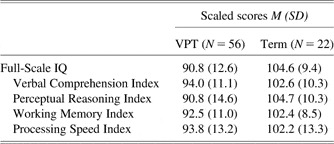
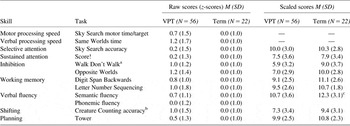
Test performance was compared between VPT and term children on measures of IQ, processing speed, and executive function and attention. Descriptive statistics are shown in Table 1 for IQ and Table 2 for all other measures.
Descriptive statistics for very preterm and term children on IQ test

Descriptive statistics for very preterm and term children on processing speed, executive function, and attention tests

Note. Higher z-scores indicate worse performance on each subtest (z scores of subtests measuring accuracy have been reflected).
aVPT N = 53; term N = 21.
bOne preterm child was unable to count downward and could, therefore, not be given this task.
cScaled score based on semantic and phonemic fluency.
IQ
VPT children performed significantly less well than term children on Full Scale IQ (B = −13.8; SE = 3.0; β = −.47; p < .001), and the Verbal Comprehension (B = −8.7; SE = 2.7; β = −.34; p = .002), Perceptual Reasoning (B = −13.9; SE = 3.4; β = −.42; p < .001), Working Memory (B = −9.9; SE = 2.6; β = −.40; p < .001), and Processing Speed Indices (B = −8.4; SE = 3.3; β = −.28; p = .013). Within the VPT group, 25% (14/56) of children had Full Scale IQ <85 (−1 SD) compared to 5% (1/22) of term children (χ2(1) = 3.04; p = .081). The same pattern of results was found for VPT children with and without a matched control child, indicating comparable performance.
Processing speed
Both verbal and motor processing speed were reduced in VPT compared to term children (B = 1.2; SE = 0.4; β = .35; p < .001; B = .69; SE = 0.4; β = .22; p = .050, respectively).
Executive function and attention
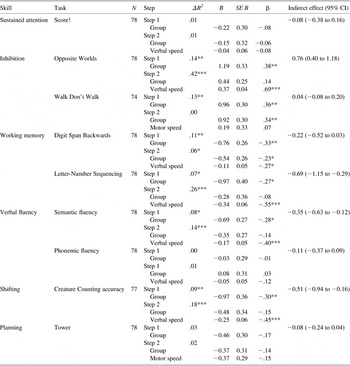
Significant group differences, favoring the term over the VPT group, were shown for inhibition, working memory, semantic fluency, and shifting (Table 3). Effect sizes for R 2 ranged from small to medium. No significant group differences were shown for sustained attention, phonemic fluency, and planning and effect sizes for R 2 ranged from very small to small. The selective attention accuracy variable was problematic in the regression analysis due to severe skew that could not be resolved by transformations. Thus, a non-parametric Mann-Whitney U-test was used instead, showing there was no significant difference between groups in selective attention accuracy (Z = −0.31; p = .760). Excluding three VPT children with significant motor impairment (for example using aids to assist mobility) from these analyses did not alter the pattern of findings. When comparing the VPT scores to test norms (M = 10; SD = 3), mean scores fell below the average range (<1 SD of norm group mean) on response inhibition. On most other measures, the VPT group scored in the low-average to average range compared to test norms.
Summary of hierarchical linear regression analyses predicting executive function and attention (z-scores) test scores from birth group and processing speed

Note. *p < .05; **p < .01; ***p < .001. Selective attention accuracy data were too skewed for regression analysis (see text).
Mediation
Next, we studied whether processing speed mediated the effect of VPT birth on executive function and attention. Results are reported in Table 3. Processing speed was a significant mediator in the relation between VPT birth and inhibition of interference, working memory (Letter-Number Sequencing test), semantic fluency, and shifting accuracy, and accounted for the significant group differences. Effect sizes for ΔR 2 were medium to very large. In contrast, processing speed did not significantly mediate the relation between VPT birth and response inhibition (effect size for ΔR 2: zero) and working memory (Digit Span Backwards test, effect size for ΔR 2: small). Re-analyzing the regression models described above while excluding three VPT children with significant motor impairment did not alter any of the conclusions. Processing speed was not significantly associated with executive function and attention in the regression analyses for measures that showed no significant group difference between VPT and term children.
Discussion
We set out to investigate the development of executive function and attention in VPT children compared to term controls in middle childhood, and to study whether processing speed mediated the effect of VPT birth on executive function and attention test performance. Our findings are summarized and discussed below.
First, processing speed was significantly reduced in VPT compared with term children in our study as has previously been shown in other preterm samples (Rose & Feldman, Reference Rose and Feldman1995; Rose et al., Reference Rose, Feldman, Jankowski and van Rossem2005, Reference Rose, Feldman, Jankowski and van Rossem2008). Second, also in agreement with our predictions, VPT children in middle childhood showed impairment in a range of executive function skills compared to their term peers. However, some variation in the pattern of results occurred, which is in agreement with a recent meta-analysis showing that the extent of executive function problems observed in preterm children is strongly dependent on the specific skills assessed and measures chosen (Mulder et al., Reference Mulder, Pitchford, Hagger and Marlow2009). In the current study, group differences favoring term children were shown on inhibition, semantic fluency, shifting, and working memory. In contrast, no group differences were found on selective and sustained attention, planning, and phonemic fluency. These differential findings may potentially be explained by the influence of processing speed on task performance: tasks strongly associated with processing speed were most likely to elicit group differences between VPT and term children. Thus, findings from this study highlight the importance of carefully considering task selection to assess cognitive function in VPT children.
Third, processing speed mediated the significant effect of VPT birth on executive function for most skills (i.e., inhibition of interference, one working memory test, semantic fluency, and shifting). This study adds to previous research by showing most difficulties with executive function in VPT children in middle childhood are associated with impairment of basic processing abilities. This finding is in agreement with other studies showing the effect of VPT birth on cognitive function is mediated by impairment in underlying information processing capacity (Rose & Feldman, Reference Rose and Feldman1995, Reference Rose and Feldman1996; Rose et al., Reference Rose, Feldman, Jankowski and van Rossem2005, Reference Rose, Feldman, Jankowski and van Rossem2008, Reference Rose, Feldman and Jankowski2009).
However, in the present study performance on the response inhibition measure was not mediated by processing speed. At early school age, Aarnoudse-Moens et al. (Reference Aarnoudse-Moens, Smidts, Oosterlaan, Duivenvoorden and Weisglas-Kuperus2009) also showed VPT children to have problems with inhibition that were unaccounted for by processing speed, and Pizzo et al. (Reference Pizzo, Urben, van der Linden, Borradori-Tolsa, Freschi, Forcada-Guex and Barisnikov2010) found the executive attention network, which is closely linked to inhibitory control, to be a particular weakness. Thus, inhibition has been established to be a particular problem area in VPT children both in early and middle childhood across different methodologies.
Finally, a discrepancy in findings occurred between the two measures of working memory used, Digit Span Backwards and Letter-Number Sequencing. Although group differences between VPT and term children were elicited using both measures, only the group difference in Letter-Number Sequencing was mediated by processing speed. This conflicting finding may be due to reduced variance in test scores on the Digit Span Backwards measure as 57% of VPT children achieved one of two scores around the centre of the distribution on this test. We have previously shown the Letter-Number Sequencing subtest to be more strongly associated with behavior and academic attainment than Digit Span Backwards (Mulder et al., Reference Mulder, Pitchford and Marlow2010, Reference Mulder, Pitchford and Marlow2011), indicating that Digit Span Backwards was a less sensitive measure of individual differences in working memory in our sample.
Neurological Basis
General reductions in processing speed and specific problems with response inhibition in VPT children may have a neurological basis. First, changes in white matter might underlie the processing speed difficulties shown in preterm children. Recent studies have shown that white matter microstructure is affected in preterm children compared to term born children (Vangberg et al., Reference Vangberg, Skranes, Dale, Martinussen, Brubakk and Haraldseth2006), even in studies where children with abnormalities on neonatal ultrasound were excluded (Constable et al., Reference Constable, Ment, Vohr, Kesler, Fulbright, Lacadie and Reiss2008; Huppi et al., Reference Huppi, Maier, Peled, Zientara, Barnes, Jolesz and Volpe1998). White matter injury can occur in the neonatal period for numerous reasons, including ischemia, hypoxia, suboptimal nutrition, or tissue inflammation (see Hart, Whitby, Griffiths, & Smith, Reference Hart, Whitby, Griffiths and Smith2008; Peterson, Reference Peterson2003). White matter microstructure has been linked to cognitive function in preterm children (Counsell et al., Reference Counsell, Edwards, Chew, Anjari, Dyet, Srinivasan and Cowan2008; Skranes et al., Reference Skranes, Vangberg, Kulseng, Indredavik, Evensen, Martinussen and Brubakk2007; Yung et al., Reference Yung, Poon, Qiu, Chu, Lam, Leung and Khong2007), and white matter abnormality has been related to executive function skills (Edgin et al., Reference Edgin, Inder, Anderson, Hood, Clark and Woodward2008). At a functional level, alterations in the organization of neural networks have been shown in VPT compared with term children, suggesting changes in connectivity (Curtis, Zhuang, Townsend, Hu, & Nelson, Reference Curtis, Zhuang, Townsend, Hu and Nelson2006; Peterson et al., Reference Peterson, Vohr, Kane, Whalen, Schneider, Katz and Ment2002). Thus, suboptimal white matter development and myelination, and/or alterations in connectivity in VPT children might lead to slow processing speed early on, which could impact on subsequent learning, IQ, and complex cognitive skills such as executive functions. These associations need further investigation. In particular, the pathway from early brain injury to the development of basic cognitive skills required for achievement of more complex cognitive skills needs to be studied longitudinally.
Second, response inhibition problems in VPT children might be associated with more specific neural impairment. A pattern of regionally specific brain abnormalities has been shown to occur in preterm children, with volumetric reductions in the basal ganglia, corpus callosum, amygdala, and hippocampus (Peterson et al., Reference Peterson, Vohr, Staib, Cannistraci, Dolberg, Schneider and Ment2000). Response inhibition tasks involve some of these areas particularly affected by prematurity, such as the basal ganglia (see Aron et al., Reference Aron, Durston, Eagle, Logan, Stinear and Stuphorn2007). Moreover, recent functional MRI studies have shown altered patterns of activation on a response inhibition task in VPT adolescents and adults compared to term born individuals (Lawrence et al., Reference Lawrence, Rubia, Murray, McGuire, Walshe, Allin and Nosarti2009; Nosarti et al., Reference Nosarti, Rubia, Smith, Frearson, Williams, Rifkin and Murray2006). These findings suggest that response inhibition tasks may be sensitive to specific neurological abnormalities in survivors of VPT birth. However, response inhibition has recently been shown not to be associated with everyday functioning in the academic and behavioral domain in VPT children in middle childhood (Mulder et al., Reference Mulder, Pitchford and Marlow2010, Reference Mulder, Pitchford and Marlow2011). Thus, studies are needed to explore the impact of specific response inhibition problems on other areas of everyday functioning, such as motor control and clumsiness, in VPT children.
Implications
The current study has clear implications for research and practice. First, the findings show that appropriate task selection is critical for evaluation of neuropsychological function in preterm children and task demands in terms of speed versus accuracy need to be considered carefully. Second, we have recently shown slow processing speed to interfere with attainment and behavior in school in VPT children (Mulder et al., Reference Mulder, Pitchford and Marlow2010, Reference Mulder, Pitchford and Marlow2011). However, results from the selective attention task in the current study indicate that VPT children are able to achieve a similar level of accuracy when working on a task as term children, as long as the child is given as much time as they need to finish the task. This finding concurs with Snyder et al. (Reference Snyder, Davis, Burns and Robinson2007) who showed that when 4–6 years old very low birth weight (VLBW) children were given enough time between presentation of a cue and a target on an orienting task reaction time was similar to that of normal birth weight children. However, when given limited time the performance of VLBW children was significantly slower compared to the normal birth weight group. Thus, providing preterm children with additional time to complete their schoolwork might facilitate their learning.
Limitations
A possible limitation of this study is that, due to the relatively low response rate within the VPT group, the impact of neonatal and environmental factors on executive function development could not be studied. Also, as participating VPT children were from slightly higher SES background than VPT children who did not participate, the level of executive function impairment may be underestimated in this study. Moreover, as perinatal background information for non-participants was not available for our study, we could not establish whether drop-out was selective with respect to perinatal risk. However, the conclusion from this study (i.e., that the effect of preterm birth on executive function is mediated by processing speed) should not be affected by the degree of selective drop-out, as it has recently been shown that selective drop-out does not impact on the association between variables in a large longitudinal cohort study of child behavioral development (Wolke et al., Reference Wolke, Waylen, Samara, Steer, Goodman, Ford and Lamberts2009).
A further limitation is that some of the measures of executive function used in this study were speeded and our findings may, therefore, be partly due to shared method variance; however as a strong association between the non-speeded Letter-Number Sequencing task and processing speed was also identified this cannot completely account for our findings. In addition, although we selected processing speed measures across different response modes (i.e., motor and verbal), it may have been preferable to have matched mode of presentation (i.e., auditory or visual) across the processing speed and executive function and attention tasks so as to control for sensory processing. Finally, this study could only investigate patterns of association between processing speed and executive function and attention; longitudinal studies are needed to investigate the direction of effects.
Acknowledgments
HM is supported by the Medical Research Council. We thank all of the parents, children, and teachers who have been involved in this study. We also thank Sarah Beaven for help with IQ testing and Professor Cees van der Eijk (University of Nottingham) for providing support with the statistical analyses. Conflict of interest: none declared.