Asymptomatic bacteriuria (ASB) is defined as the presence of up to 2 pathogens in a properly obtained urine sample, at a concentration of at least 105 colony-forming units (CFU)/mL, in a person with no symptoms or signs indicating a urinary tract infection (UTI) (eg, urgency, increased frequency, dysuria, flank pain, or fever). Reference Chu and Lowder1,Reference Rubin, Shapiro, Andriole, Davis and Stamm2 ASB is commonly misdiagnosed as a UTI. Reference Fridkin, Baggs and Fagan3 Although ASB is common, its prevalence varies in the population depending on age, gender, hormonal status, sexual activity, and presence of genitourinary structural disorders. Reference Zalmanovici Trestioreanu, Lador, Sauerbrun-Cutler and Leibovici4
Among patients with urinary catheters, it is often difficult to distinguish ASB from symptomatic UTI or other fever-related sources. In 100% of patients with urine catheter for >1 month, bacteria will grow if a culture is obtained but does not necessarily represent a UTI. Reference Steward, Wood, Cohen, Smith and Mackowiak5 Febrile illness among patients with a urinary catheter and positive urine culture can lead to a misdiagnosis of catheter associated UTI (CAUTI), although in many cases there is another source of infection and the bacterial growth actually represents ASB. Reference Steward, Wood, Cohen, Smith and Mackowiak5 This also results in higher rates of CAUTI attributed to the facility. Moreover, urine cultures are frequently ordered from afebrile patients with chronic catheters, for a wide variety of “indications,” further increasing rates of ASB misdiagnoses. In common practice, urine cultures are ordered for patients with catheters and impaired cognition (either chronic or acute). Reference Nicolle, Bradley and Colgan8 However, in a typical report, 22% of urine cultures represent ASB among these frail patients. Reference Force, Owens and Davidson13
The composition of pathogens that cause ASB is similar to that of pathogens that cause symptomatic UTI, with Escherichia coli being the most common organism. Reference Bengtsson, Bengtsson, Bjorkelund, Lincoln and Sigurdsson6 Among patients with genitourinary disorders or among elderly institutionalized individuals, there is a wider range of pathogens, including a high prevalence of multidrug-resistant organisms (MDROs). In the presence of foreign bodies in the urinary system, polymicrobial bacteriuria is also very common. Reference Nicolle7
In certain populations, “treatment” of ASB is recommended by certain professional societies: patients prior to invasive urologic procedures, Reference Nicolle, Bradley and Colgan8 among pregnant women, Reference Nicolle, Bradley and Colgan8 and among kidney transplant recipients. Reference Alangaden9 However, prescribers often treat ASB as a UTI even when it is not indicated, specifically among the elderly with cognitive impairment, and/or patients with indwelling urinary catheters, where symptoms are absent. This is a common error, but nevertheless, only a limited number of studies have assessed the risk factors for antimicrobial administration and have quantified the impact of this questionable practice. “Treatment” of ASB may lead to undesirable consequences, such as emergence and/or acquisition of MDROs, side effects from antibiotic usage (eg, hypersensitivity reactions), and Clostridioides difficile infection (CDI), Reference Youngster, Lazarovitch and Bondorenco10 but quantified controlled data are lacking. Moreover, antimicrobials prescribed for ASB are associated with increased costs to healthcare systems and a negative ecological impact. Reference O’Donnell, Walsh, Tang and Weinberg11 The lack of scientifically established data might be the reason that preventive resources to curb these practices are not uniformly implemented. Reference Saint, Greene and Krein12 We evaluated predictors of antimicrobials misuse among patients with ASB to quantify the impact of this practice on various clinical outcomes.
Methods
Design and setting
We conducted a retrospective case-control and cohort analysis at the Shamir (Assaf Harofeh) Medical Center (SMC), an 877-bed university-affiliated institution in Central Israel, for calendar year 2017. The study was approved prior to its initiation by the local institutional review board committee. The infection control unit at SMC routinely reviews and reports every positive urine culture, as mandated by the Israeli Ministry of Health (MOH). 14
Data collection
All patient-unique samples were included, including from patients who were cultured in the emergency room and eventually not admitted. The following data were collected: demographics, background/chronic conditions, various exposures to healthcare, acute illness indices, microbiological data, therapeutic data, and various clinical, microbiological, and fiscal outcomes. MDROs included any of the following: methicillin-resistant Staphylococcus aureus (MRSA), vancomycin-resistant enterococci (VRE), Pseudomonas aeruginosa (nonsusceptible to ≥3 classes of supposedly effective antibiotics), extended-spectrum β-lactamase–producing Enterobacterales (ESBL), Acinetobacter baumannii (non-susceptible to ≥3 classes of supposedly effective antibiotics), and carbapenem-resistant and/or carbapenemase-producing Enterobacterales (CRE, CPE). Reference Johnstone15
Inclusion and exclusion criteria
The study population consisted of patients <18 years of age, with a positive urine culture, according to the definition of the US Centers for Disease Control and Prevention (CDC). 16 Positive urine culture was defined as the growth of 1 or 2 (but not >2) pathogens, at concentrations of >105 CFU/mL, with isolation of certain pathogens not included if the isolation was from a single sample (eg, Candida spp). Reference Chu and Lowder1 Patients were not eligible for inclusion if they met any of the following criteria: (1) age younger than 18 years; (2) pregnancy or peripartum period; (3) prior or right after urologic procedure; (4) kidney transplant recipients; and (5) neutropenia (absolute neutrophil count <0.5 cells/μL). Patients with bacteriuria were categorized as having ASB if there was no documentation of signs or symptoms meeting diagnostic criteria for UTI as per CDC criteria. 16 Specifically, patients could not have one of the following documented symptoms: suprapubic tenderness, costovertebral pain, urgency, increased frequency or dysuria. Patients older than 65 years, with no indwelling catheter and fever (>38°C), could still have ASB if the fever was due to a different established (according to CDC criteria Reference Chu and Lowder16) infectious syndrome. Patients with acute alterations in mental status, who often cannot communicate symptoms, were categorized as having ASB if they had none of the aforementioned signs or symptoms.
Statistical analysis
All data were analyzed using SPSS version 25.0 software (2018; IBM, Armonk, NY). We performed 3 analyses according to conventional methods Reference Marchaim, Levit and Zigron17 : (1) descriptive statistics to characterize the study population with ASB; (2) univariable and multivariable (logistic regression) case-control analysis of predictors for prescribing antibiotics for ASB; and (3) univariable and multivariable cohort analyses (logistic and Cox regressions), quantifying the impact of prescribing antibiotics for ASB on various clinical outcomes. These outcomes included mortality parameters, length of hospital stay from culture to discharge among survivors of the index hospitalization, functional status deterioration, “acquisition” of MDROs, later acute CDI, additional hospitalizations in 3 months, and discharge to long-term care facility (LTCF) after surviving the index hospitalization and being initially admitted from home.
Results
Descriptive statistics
During the study period, of the 2,557 positive urine cultures, 397 were duplicates (ie, non–patient-unique cultures), 283 were obtained from pediatrics (<18 years), and 586 patients were excluded due to other exclusion criteria (eg, pregnancy, urologic procedure). Of the 1,530 patient-unique cultures, 610 (40%) patients had ASB. The median age of the ASB population was 80 years (IQR, 70–87), 381 (63%) were women, 503 (83%) were older than 65 years, and 209 (34%) were chronically cognitively impaired. In addition, 254 (42%) were hospitalized in the previous 3 months and 309 (51%) stayed in LTCF during the previous 3 months. The median time from admission to ASB diagnosis was one day, which implies that most ASBs were diagnosed upon admission. Also, 186 patients (31%) had fever due to other infectious syndromes on the day of ASB diagnosis. The in-hospital mortality rate was 24%. Among survivors of the index hospitalization, the median length of stay from culture to discharge was 9 days; 40% experienced a functional status deterioration; and 38% of those admitted from home were eventually discharged to a LTCF. In the 3 months after discharge, 40% were readmitted, 18% acquired ≥1 MDRO, and 7% developed acute CDI. The 90-day mortality rate for the entire ASB population was 34%.
In total, 696 pathogens were isolated from 610 patients with ASB: 84% were gram-negative organisms, most commonly E. coli, K. pneumoniae, and P. aeruginosa. Among the 696 pathogens, 36% of the 610 patients had at least 1 MDRO isolated, most commonly ESBL-producing Enterobacterales (23%) or P. aeruginosa (5.4%).
Patients with ASB who received antibiotics
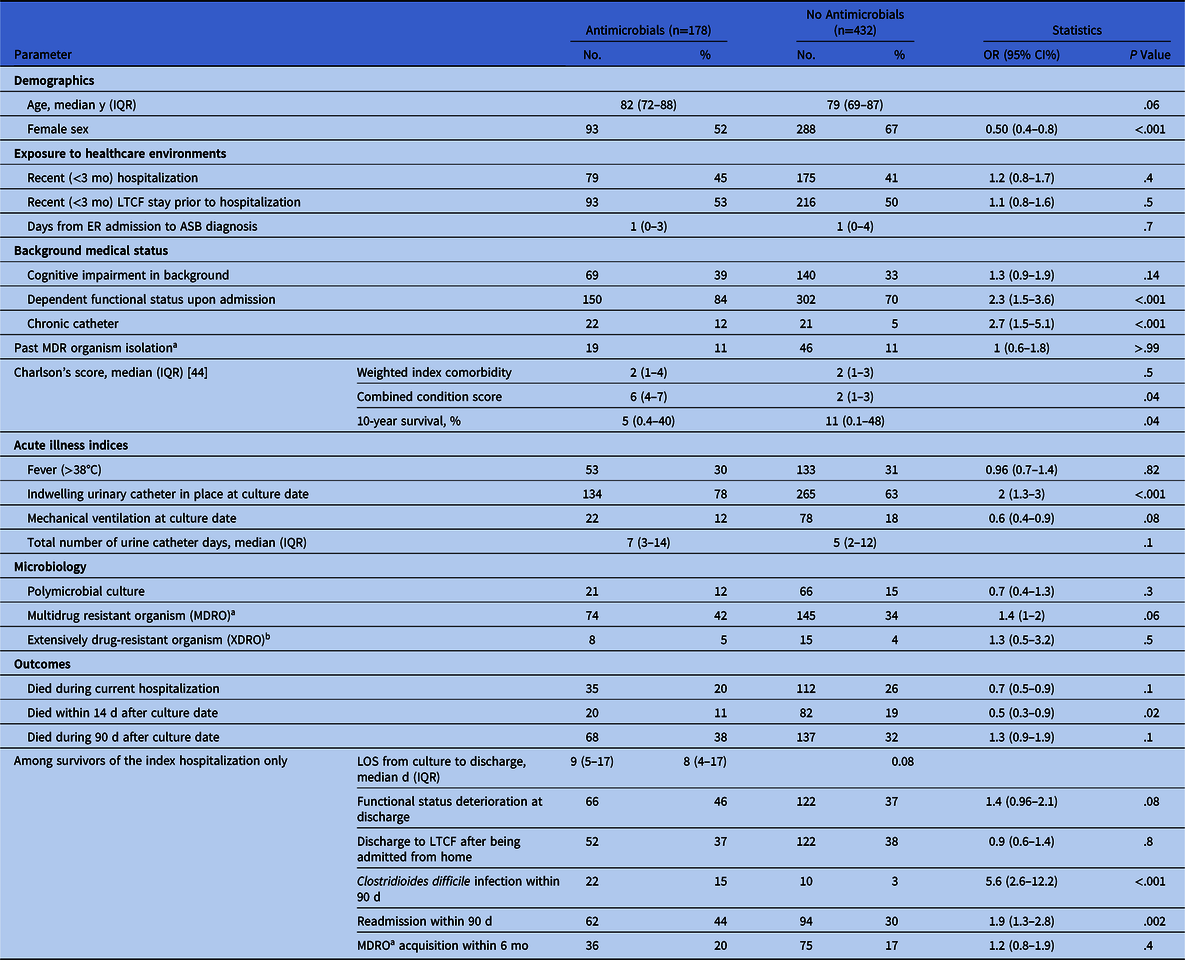
Antimicrobial therapy, which was administered specifically to “cover” the pathogen grown from the urine culture, was administered to a total of 178 (29.2%) patients with ASB. The proportion of febrile patients aged >65 years with no urine catheters and a different nonurinary source of infection was similar between the group of patients who received antibiotics and the group of patients who did not receive antibiotics. Table 1 lists predictors and outcomes associated with antimicrobial therapy. Administration of antimicrobials was more common among men, among patients with dependent functional status, patients admitted to a medical floor, patients with urinary catheter at the time of ASB diagnosis, and patients with a higher Charlson comorbidity scores (Table 1). Reference Charlson, Pompei, Ales and MacKenzie18 In multivariable analysis, the independent predictors that remained significantly associated with antibiotic misuse were male sex (aOR, 2; 95% CI, 1.25–2.6; P < .001) and dependent functional status in baseline (aOR, 2.3; 95% CI, 1.4–3.6; P < .001).
Univariable Analyses for Patients With Asymptomatic Bacteriuria (ASB) Who Received Antimicrobials

Note. ASB, asymptomatic bacteriuria; OR, odds ratio; CI, confidence interval; IQR, interquartile range; LTCF, long-term care facility; ER, emergency room; MDRO, multidrug-resistant organism; ICU, intensive care unit; GFR, glomerular filtration rate; XDRO, extensively drug resistant organism; LOS, length of stay.
a MDRO include methicillin-resistant Staphylococcus aureus (MRSA), vancomycin-resistant enterococci (VRE), extended-spectrum β-lactamase (ESBL)–producing Enterobacterales, Acinetobacter baumannii, Pseudomonas aereuginosa.
b XDRO include MRSA with vancomycin MIC ≥2 mg/L, vancomycin-resistant enterococci (VRE), carbapenem-resistant (meropenem MIC>1 mg/L) or carbapenemase-producing Enterobacterales (CRE), carbapenem-resistant Acinetobacter baumannii, carbapenem-resistant Pseudomonas aereuginosa.
Outcomes of patients with ASB who received antimicrobials
The short-term mortality rates (ie, in-hospital and 14-day rates), were lower among patients with ASB who received antibiotics. In the multivariable regression model, antibiotic administration did not remain independently associated with favorable 14-day survival rates (aOR, 0.7; P = .30). The 90-day mortality rate was nonsignificantly (P = .10) higher among patients who received antibiotics (Table 1). In the multivariable model, antibiotics administration was not independently associated with 90-day mortality. The length of stay from the date of urine culture to discharge, among survivors of the index hospitalization, was 1 day longer for patients who received antibiotics (P = .08 between groups).
Among survivors of the index hospitalization, antibiotic misuse was associated with higher rates of readmissions, and higher rates of CDI, within 90 days (Table 1). In separate multivariable regression outcome models, antibiotic administration for ASB remained independently associated with additional readmissions (aOR, 1.7; 95% CI, 1.1–2.6; P = .02) and with later CDI (aOR, 4.5; 95% CI, 2–10.6; P < .001), both within 90 days.
Discussion
ASB is a very common condition in hospitals and in the community, especially among elderly patients with indwelling urinary catheters and/or among cognitively impaired individuals, i.e., lacking the capability to provide history information pertaining to symptoms and complaints. One mistake leads to another, and the mistake of ordering a culture, often leads to improper administration of antibiotics. With the exception of certain populations and conditions, numerous recent guidelines have advocated against the use of antibiotics for ASB. However, only a few studies have analyzed and quantified the impact of this practice on various clinical outcomes. Reference Chu and Lowder1 This type of controlled data could convince administrators to invest and allocate preventive resources toward the reduction of ASB in general (many measures will reduce the CAUTI rates as well) and could reduce the improper administration of antibiotic to patients with ASB.
In this large study, we reviewed 1,530 patient-unique positive urine cultures. Among them, 610 patients (40%) were diagnosed with ASB and 178 were administered antibiotics. Our findings highlight the high prevalence of ordering urine cultures with no established indication and the burden of improper administration of antibiotics to this population. The study included an elderly population (>80%), with a median age of 80 years, severe baseline comorbidity indexes, multiple recent exposures to health services, and severe acute illness indices. The analyses provided genuine predictors for antibiotic administration, and quantified the independent association of this practice with several outcomes.
The composition of pathogens in this study were reminiscent of analyses recently performed elsewhere. Reference Petty, Vaughn and Flanders19 Overall, close to 85% of pathogens were gram negative, and ~15% of patients had a polymicrobial culture. The rate of MDROs was extremely high (36%), specifically ESBLs and P. aeruginosa. This situation created a doubled synergistic epidemiological threat because patients “acquired” a condition that could adversely impact their hospitalization outcomes due to possible poor management (ie, the ASB) and also “acquired” a condition that is independently associated with worse outcomes both to current and future hospitalizations (ie, the MDRO acquisition event). Reference Adler, Friedman and Marchaim20
Although multiple potential characteristics were associated with the inappropriate use of antibiotics for ASB (Table 1), only male sex and poor functional status at baseline remained significant and independent predictors. Poor functional status is frequently coupled with the presence of permanent urinary catheter, poor cognition, and lack of ability to provide information pertaining to symptoms, leading to the permissive administration of antibiotics. All other parameters dropped in the regression model. This finding has also been reported recently in a publication that included 46 hospitals from the state of Michigan Reference Petty, Vaughn and Flanders19 ; therefore, antibiotic administration to functionally dependent patients should be closely monitored and ASB ruled out prior initiation of therapy. Male sex, the additional independent predictor for antibiotic administration, might represent in this cohort a confounding effect to other epidemiological parameters. A subanalysis was performed to investigate this hypothesis but was inconclusive. Future studies, conducted at other facilities and on different populations, should trial the generalizability of this finding.
As depicted in Table 1, the clinical outcomes of patients who received antibiotics were significantly worse, except the early mortality parameters, though this trend was reversed as well after 3 months. In separate regression models, conducted for each outcome with univariable significant association, antibiotics administration was independently associated with a nearly 2-fold increase in the probability of being readmitted within 90 days and with a 4.5-fold increase in the probability to develop acute CDI, within 90 days. The mortality data also imply that the improper administration of antibiotics for ASB might only be evident long after the patient has been discharged. These findings should prompt practitioners and administrators to invest efforts in reducing antibiotic administration for ASB and to discourage the practice of obtaining urine cultures from certain high-risk groups with no signs or symptoms of UTI.
Acknowledgments
Financial support
This research received no specific grant from any funding agency in the public, commercial, or not-for-profit sectors.
Conflicts of interest
All authors reported no conflicts of interest relevant to this article.