Introduction
As gerontologists we are certainly not ignorant of older people's pasts, their younger selves. Long-term memory, for example, is a common research interest incorporating both biomedical perspectives (Park et al. Reference Park, Smith, Lautenschlager, Earles, Frieske, Zwahr and Gaines1996) and interpretations of its personal, institutional and cultural significance (Degnen Reference Degnen2015; Katz Reference Katz2012; Katz and Peters Reference Katz and Peters2008; Philpin et al. Reference Philpin, Merrell, Warring, Hobby and Gregory2014). Elsewhere, the idea of ‘lifecourse‘ is of increasing importance across many sub-fields of gerontology. It positioning the oldest phase of life, the transition into it and all the changes it involves, with respect to other phases taking a broader, often full-life, perspective (Bailey Reference Bailey2009; Gearing Reference Gearing1999; Grenier Reference Grenier, Twigg and Martin2015; Hörschelmann Reference Hörschelmann2011; Jarvis, Pain and Pooley Reference Jarvis, Pain and Pooley2011; Katz Reference Katz2006; Quadagno Reference Quadagno1999; Schwanen, Hardill and Lucas Reference Schwanen, Hardill and Lucas2012). This, in turn, is complemented by a broader participation in the longitudinal study of life (Raina et al. Reference Raina, Wolfson, Kirkland, Griffith, Oremus, Patterson, Tuokko, Hogan, Wister, Payette, Brazil and Shannon.2009; Steptoe et al. Reference Steptoe, Breeze, Banks and Nazroo2012) and, from a critical perspective, consideration of the passage and flow of time (Baars and Visser Reference Baars and Visser2007; McHugh Reference McHugh2009; Neale and Flowerdrew Reference Neale and Flowerdew2003; Neale, Henwood and Holland Reference Neale, Henwood and Holland2012). Beyond this, a concern for older people's pasts also arises in a long-standing focus on intergenerationality in research where, for example, studies consider how the perspectives of older generations come from their life experiences and collide with those of younger generations (Antonucci, Jackson and Biggs Reference Antonucci, Jackson and Biggs2007; Coupland, Coupland and Grainger Reference Coupland, Coupland and Grainger1991; Fox and Giles Reference Fox and Giles1994; Hopkins and Pain Reference Hopkins and Pain2007; Hopkins et al. Reference Hopkins, Olson, Pain and Vincett2011; Mancini and Blieszner Reference Mancini and Blieszner1989; Tarrant Reference Tarrant2010; Vanderbeck Reference Vanderbeck2007).
However, although as gerontologists we might consider how older peoples’ pasts impact upon their present situations and experiences, rarely do we consider these pasts with any real conviction, delving into the intricacies and details; they being primarily explanatory contexts, not of central interest themselves (i.e. being more concerned with historically contextualising/positioning the ‘now’, more so than co-equally investigating the ‘then’ and ‘now’). Perhaps to some scholars this is simply the nature of gerontology? The view being that to pay any more attention to pasts would be crossing into historical research, a different intellectual territory and pastime with different ends; the preserve of other scholars. But this view, I argue, assumes that the intricacies and detail are superfluous. What if they were not and, gerontologically speaking, led to a better explanation of contexts that shaped the present for older people and, historically speaking, led to a unique understanding of the past? Then could and should gerontologists contribute both gerontology and history simultaneously to the overall research record, bringing together and enriching both sets of knowledge? Certainly there would have to be a strong argument for extending our disciplinary parameters in this way. There is clearly some precedent, as we shall see later, for example in the pathbreaking work of gerontologists Peter Townsend in the 1950s and Joanna Bornat in the last 15 years, focused on oral history and also its overlaps with reminiscence (Bornat Reference Bornat2001; Bornat and Tetley Reference Bornat and Tetley2010; Townsend Reference Townsend1957). Arguably a powerful case study can also help further illustrate these types of theoretical and disciplinary possibilities, and this is what this paper aims to provide. Indeed, by focusing in depth on a particular group of people and place (older residents of Teignmouth, Devon, United Kingdom), it conveys the complex relational entanglements, co-dependence and co-production of themselves, their setting, their pasts and their presents. Understanding these relationalities might become, I argue, the objective of a more strongly emerging research tradition.
As my words have thus far indicated, the theoretical perspective that the paper takes is, broadly speaking, ‘relational’. Indeed, in recent years a relational turn has taken hold across the social sciences involving a specific way of understanding and looking at the world (see Andrews, Evans and Wiles Reference Andrews, Evans and Wiles2013; Crossley Reference Crossley2010; Donati Reference Donati2010). This has included a fundamental observation that all phenomena – whether individuals, groups, institutions or social processes – are relationally networked, constituted and defined in multiple ways. In other words, all phenomena are necessarily relational and cannot be understood alone. With regards to places, for example, rather than thinking about them as discrete bounded areas (such as mapable administrative units) or as fixed, parochial centres of meaning (such as a lone house, town, neighbourhood or city), a relational perspective understands them as co-produced through their historical and contemporary connections, often with other places (Andrews, Evans and Wiles Reference Andrews, Evans and Wiles2013). With regard to time, a further relational understanding is that these networks are never closed or their relations complete (Andrews, Evans and Wiles Reference Andrews, Evans and Wiles2013). Due to a never-ending influx of material, emotional, informational and symbolic influences all phenomena are forever temporary accomplishments constantly changing and developing, constantly ‘coming into being’ (and thus are always relational to what went before; Darling Reference Darling2009; Jones Reference Jones2009). Over seconds, minutes, hours, weeks, months, years, decades and centuries, this constant temporal re-adjustment continues unabated and, through the flow of time, certain events emerge within networks (what we know as historical events), leaving their mark like ‘hauntings’ from the past (Amin Reference Amin2004). Meanwhile, according to a relational perspective, time-points – such as specific ages, for instance – are mere moments in the meeting of relational flows and trajectories that continue their paths (Malpas Reference Malpas2012; Massey Reference Massey2005). Relational thinking is thus a way to try to acknowledge and account for these types of processes. Practically speaking, in qualitative studies one uses it when formulating research questions, whilst engaging with respondents, and whilst analysing, interpreting and writing. In the current study, relationalities run throughout, including ‘then/past and now/present’, ‘us and them’, ‘near and far’, ‘here and there’, ‘person/body and weapon/object’ – helping to frame and explain so much of what went on and how it is still important.
The Teignmouth case study
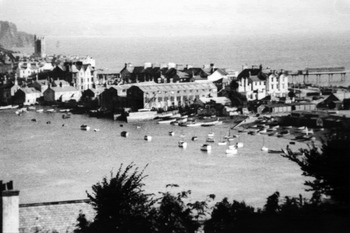
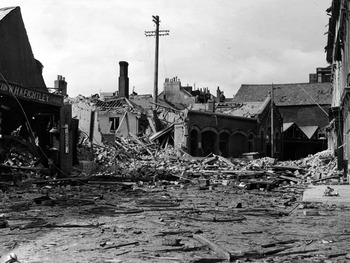
Selecting a study site, participants and a recent historical period was, of course, an important decision. However, the town of Teignmouth in Devon (a small rural seaside resort on the south coast of England) and the period 1939–1945 was a compelling choice for the author for three reasons. First, I grew up there from birth until 18 years of age, and had focused on it exclusively in previous research (Andrews and Kearns Reference Andrews and Kearns2005; Andrews et al. Reference Andrews, Kearns, Kontos and Wilson2006). Hence, I was already very familiar with it, and with many older residents and their collective history – a distinct advantage when it comes to understanding the context and conducting field research. Second, ‘the seaside’ has already provided a popular venue for the social study of ageing in diverse contexts such as retirement migration (Cribier Reference Cribier1987; Drysdale Reference Drysdale1991; Law and Warnes Reference Law and Warnes1973; Williams, King and Warnes Reference Williams, King and Warnes1997), residential accommodation and care (Andrews and Phillips Reference Andrews and Phillips2002; Phillips and Vincent Reference Phillips and Vincent1986, Reference Phillips and Vincent1988), imagery and identity (Blaikie Reference Blaikie1997) and positive ageing (Lieblich Reference Lieblich2014). Thus, wartime Teignmouth could provide very different historical stories and interpretations of this particular socio-geographical phenomenon; ones based in adversity. Third, and by far the most compelling reason, was the residents’ remarkable experiences during this specific period. Indeed, during World War II, Teignmouth's small ship manufacturer (the Morgan Giles Shipyard), turned its full production to Admiralty demands (see Figure 1). This activity, coupled with Teignmouth's close proximity to the Devonport Naval Base at Plymouth (approximately 45 miles), meant that the town became an objective for bombing (Andrews et al. Reference Andrews, Kearns, Kontos and Wilson2006). Hence, we already know that the war impacted heavily upon a local population and place that might otherwise be considered to be an unlikely target. Between the evening of 7 July 1940 and the afternoon of Monday 29 May 1944, the town experienced 22 air raids and 460 sirens. Over 1,000 incendiaries and 79 high explosives were dropped on Teignmouth, killing 79 people and injuring 151. Of the town's 2,957 houses, 228 were either completely destroyed or damaged beyond repair whilst less than one-quarter were left unscathed (Andrews et al. Reference Andrews, Kearns, Kontos and Wilson2006) (see Figure 2). Over four years, the raids were always sudden and severe, and small fighter aircraft tended to dive and ‘attack’ targets rather than jettison their payloads from high altitudes. Teignmouth is thus an important instance of a small British town in wartime; a place with a significant history, the type of which is often neglected in academic and public scholarship dominated by the telling of ‘bigger’ stories of combat and homefront in high-profile places, often through archival research at ‘grander’ regional or national scales (e.g. Beevor Reference Beevor2002, Reference Beevor2009; Gardiner Reference Gardiner2004, Reference Gardiner2010).
The Morgan Giles Shipyard – centre building.

Bomb damage on Brunswick Street.

The oral history tradition: from history to gerontology
As both a qualitative methodology and research approach, oral history has made a significant contribution to the social study of modern times (see Douglas, Roberts and Thompson Reference Douglas, Roberts and Thompson1988; Dunaway and Baum Reference Dunaway and Baum1984; Perks and Thomson Reference Perks and Thomson2006; Prins Reference Prins and Burke1991; Thompson Reference Thompson2000; Thomson Reference Thomson2008; Yow Reference Yow2014). It, in simple terms, involves talking to people – and most often older people due to their advanced years and duration of their lived experience – about their past to add to the historical record, ranging from prominent or rare events and circumstances to everyday life. As Thomson (Reference Thomson2007) describes, as a tradition it can be traced back over six decades, its development characterised by three paradigmatic shifts, each leaving a lasting mark on scholarship. The first of these involved a general (re)emergence in the 1950s and 1960s of memory as a source of ‘people's history’. This was a return in the popularity of eyewitness accounts following the dominance of archival material in 19th century at the birth of contemporary academic history (Thomson Reference Thomson2007).
The second, from the 1970s onwards, was probably most significant in terms of intellectual development and involved a post-positivistic interest in memory and subjectivity. As Thomson (Reference Thomson2007) explains, this was largely a response to the archival historians’ critiques of the reliability of oral accounts. Whilst scholars at this time celebrated the subjectivity of oral history – particularly as it demonstrates relationality between the then and now – they also reminded archival historians of their own subjectivities (Thomson Reference Thomson2007). Years later, the legacy of this second shift is twofold. On one level, whilst recognising the parameters and limitations of oral accounts – being, for example, partial, selective, myth-laden, biased by situation and the unconscious (Norquay Reference Norquay1999; Prescott Reference Prescott1999) – the expectation of complete objectivity and transparent statements of ‘truth’ has waned, and a consensus opinion has emerged that oral accounts can be celebrated as important representations and cultural constructions, with value in this respect (Gluck Reference Gluck1999). On another level, the need for highly self-reflective method, analysis and writing is recognised in this second phase of scholarship (see Thomson Reference Thomson2007). For example, with regard to interview techniques (Morris Reference Morris2002), how subjects construct their narratives (Gluck Reference Gluck1999; Errante Reference Errante2000; Norquay Reference Norquay1999), the blending of subject narratives and academic narration (Good Reference Good2000; Jones Reference Jones2004), and associated issues of authority, form and meaning (Frisch Reference Frisch1990; Portelli Reference Portelli1991; Thomson Reference Thomson2003).
The third shift, from the late 1980s onwards, has involved changing roles for oral historians and ways of going about their research (Thomson Reference Thomson2007). In terms of the former, many oral historians have become more active in public life as advocates and even activists for their subject groups and histories, supporting particular social and political agendas. Notably, this is reflected and facilitated by the increasing inter-disciplinarity in oral history and the involvement of social scientists such as anthropologists and sociologists (Dunaway and Baum Reference Dunaway and Baum1984) and most recently social and health geographers who have illuminated place-histories and dynamics (Andrews et al. Reference Andrews, Kearns, Kontos and Wilson2006; Butler Reference Butler2007; George and Stratford Reference George and Stratford2010; Riley and Harvey Reference Riley and Harvey2007). In terms of the latter, and the going about of oral history, the digital revolution created new ways of finding, recording, keeping and analysing oral accounts (including internet, video) (Thomson Reference Thomson2007). Meanwhile, more theoretical debates have grown on an array of performance and relational issues in the research encounter and process, including the role of the self, subjectivity and inter-subjectivity, and power (Abrams Reference Abrams2010). In sum, after five plus decades of application and development, oral history is theoretically well-supported, and the empirical fields covered by oral history are unsurprisingly vast. War and conflict, for example, has figured significantly as a broad theme, and the focus reflects the usefulness of the approach to discover and articulate the actions and emotions involved in the most traumatic and significant of human experiences (Allison Reference Allison2004; Carlson Reference Carlson1997; Hemmings Reference Hemmings1996; Nutkiewicz Reference Nutkiewicz2003; Stave, Palmer and Frank Reference Stave, Palmer and Frank1998; Summerfield Reference Summerfield1998; Tollefson Reference Tollefson1993; Wolf Reference Wolf2002).
An oral history approach might seem like a radical departure for gerontology but, as suggested earlier, there is some important precedent here. Classic research conducted by the pathbreaking gerontologist Peter Townsend famously recollects social change in East London, framing older peoples’ then current experiences in the past. Based on over 180 life history interviews, his book The Family Life of Older People articulated a range of social historical changes and, in particular, transition of family, kinship and social/community networks (Townsend Reference Townsend1957). Later, based on 160 structured interviews conducted between 1957 and 1962, his unpublished ‘Katherine Buildings’ collection continued the same lines of inquiry but focused on a specific tenement block (Charlesworth and Fink Reference Charlesworth and Fink2001). As an academic endeavour, Townsend's work might well have been not only one of the first studies in social gerontology, but also the first ‘historical gerontology’; learning simultaneously about older people and their places of residence both in the present and in their younger lives. Such is the prominence of Townsend's work that in more recent years his study areas and subjects have been revisited by other scholars and used as a baseline to see how social processes and experiences have changed in the intervening period (see Bernard et al. Reference Bernard, Phillipson, Phillips and Ogg2001; Johnson et al. Reference Johnson, Rolph, Smith and Smith2010; Phillipson et al. Reference Phillipson, Bernard, Phillips and Ogg1999). Moreover, in the case of Townsend's work, the reflections of his participants, now being over 50 years old, are historically relevant themselves (as any qualitative social science research would become due to the passage of time) (Andrews et al. Reference Andrews, Kearns, Kontos and Wilson2006).
Despite this early promise, however, oral history is still rare in gerontology. Instead, reminiscence is far more common, but not for the purpose of writing history. In ‘applied’ gerontology and geriatric care, reminiscence is an interpersonal, often group practice with therapeutic goals. Evaluative research in this area has centred, for example, on purposes, techniques and outcomes of reminiscence (see Bluck and Levine Reference Bluck and Levine1998; Bornat Reference Bornat1985; Buchanan et al. Reference Buchanan, Moorhouse, Cabico, Krock, Campbell and Spevakow2002; Cohan and Taylor Reference Cohan and Taylor1998; Coleman Reference Coleman1986; Hsieh and Wang Reference Hsieh and Wang2003; Lin, Dai and Hwang Reference Lin, Dai and Hwang2003; Webster, Bohlmeijer and Westerhof Reference Webster, Bohlmeijer and Westerhof2010; Westerhof, Bohlmeijer and Webster Reference Westerhof, Bohlmeijer and Webster2010). Studies have found reminiscence to have a moderate impact on life satisfaction and emotional wellbeing, particularly for older people living in community settings (Bohlmeijer et al. Reference Bohlmeijer, Roemer, Cuijpers and Smit2007), and particularly if conversation is focused on specific ends, such as to relieve isolation, fear, boredom and bitterness (Cappeliez, O'Rourke and Chaudhury Reference Cappeliez, O'Rourke and Chaudhury2005; Cappeliez and O'Rourke Reference Cappeliez and O'Rourke2006). Importantly, beyond caring and clinical contexts, scholars recognise that reminiscence also occurs ‘naturally’ in individuals and their everyday lives, either alone or in company, sometimes substantively and sometimes in brief fleeting moments. Here the idea of the ‘reminiscence bump’ is important, referring to a tendency for all people – including older people – to have increased recollection of past events that occurred during their childhood and early adulthood (i.e. the ‘bump’ being this younger time period), it being key when constructing a life narrative, because it was when they formed their identity (Conway et al. Reference Conway, Wang, Hanyu and Haque2005; Glück and Bluck Reference Glück and Bluck2007). This has notable implications for oral history research as it suggests that older people might be particularly good sources of information on events that occurred some decades ago.
Importantly, as also noted earlier, gerontologists have established some connections between oral history and reminiscence (Heikkinen Reference Heikkinen2000). This occurred initially over 30 years ago in a seven-paper special edition of the International Journal of Aging and Human Development, which, although not comparing and contrasting in a deep or theoretical way, established some alignments and common attention (see e.g. Baum Reference Baum1980; Butler Reference Butler1980; Gerfo Reference Gerfo1980; Harris and Harris Reference Harris and Harris1980). Since then, the work of Joanna Bornat has been most influential (see Bornat Reference Bornat1985, Reference Bornat1994, Reference Bornat2001; Bornat and Tetley Reference Bornat and Tetley2010; Bornat et al. Reference Bornat, Perks, Thompson and Walmsley2005). Bornat (Reference Bornat2001) argues, for example, that the traditions of reminiscence and oral history have existed for some time as somewhat ‘separate universes’ occupied by gerontologists and historians, respectively (in contrast to reminiscence, oral history, for example, considers social life more broadly beyond the individual and focuses more on the past, rather than on how the past relates to the present) (Andrews et al. Reference Andrews, Kearns, Kontos and Wilson2006). However, Bornat concludes that, despite these contrasts, there are similarities between reminiscence and oral history in terms of a common focus on ‘interrogation’ in the methods employed, an emphasis on the contexts of accounts and how they are responded to by professionals tasked to listen, and the emphasis placed on shared ownership of research between older people and these professionals. Hence, much of Bornat's work supports the future co-development of the two traditions. At the least, it suggests that a cohort of gerontologists are relatively well-equipped – at least methodologically – to turn their hands to oral history research. This is important if, in future, the approach is to be extended and developed more broadly.
Methods
Any single interview approach that seeks to obtain data that is both historical and contemporary social scientific in will necessarily be, in terms of form, a hybrid of an oral history interview (concerned with the past) and a conventional qualitative interview (concerned with the present). Indeed, this was reflected in the structure and content of the interviews in the current research. Seventeen interviews were completed with older people who had lived in Teignmouth during and since World War II, 12 being conducted in 2005, two in 2007 and three in 2012 (the long time-frame reflecting the continuation of an open-ended project motivated by a desire to collect as much information as possible). Respondents were recruited by a local historian who had come to know, or know of them, during her long-term work in the town. She was a member of the research advisory group and had been fully involved in the project since its inception. With the exception of two who were in residential care, all the respondents were living independently in their own homes, which also served as the venues for interviews. Their ages ranged from 68 to 94 at the time of data collection. In terms of their ages during wartime (1939–1945), the average age at the commencement of war was 15, and at the end 21. However, a considerable variation in the age meant that some were children throughout (N = 5), some grew from teenagers into adults (N = 6) and others were adults throughout the conflict and had partners fighting in the armed services (N = 6). With the exception of one, all respondents were female. This gender bias was a reflection of gender differences in lifespan, and that a far greater proportion of local older women (rather than local older men) have been available to take part in the study. It was also a reflection of the socio-historical situation, and that those who ‘stayed home’ were predominantly women whilst young men often served in the military.
The majority of interviews took approximately one hour to complete, but the exact length depended on how much the particular respondent wished to say and the length of time that they were able to dedicate to the process. Audio-tapes and digital recorders were used to capture all conversations, and detailed notes were completed in a field diary following each interview to record relevant contextual observations. On the whole, conversational practice was free-flowing and unhindered, and most respondents required only the most basic of prompts to elaborate on their practices and experiences. Reflecting the semi-structured approach used, towards the end of each interview respondents were given an opportunity to take conversations in the direction that they wished and to discuss matters of particular importance to them.
All interviews conducted in 2005 were initially analysed during that year (forming the data used for publication the following year; see Andrews et al. Reference Andrews, Kearns, Kontos and Wilson2006). Interviews conducted in 2007 and 2012 were analysed in 2007 and 2013, respectively. However, due to the considerable length of time elapsed since the 2005 interviews, these were re-visited and partly re-analysed in 2013. This involved a great deal of re-familiarising and some limited re-coding, with the current publication specifically in mind. Hence a form of ‘secondary analysis’ was conducted here. Basic thematic analysis was conducted (familiarisation, drawing out initial codes, establishing firm codes and sub-codes/themes), whilst a computer software program helped with the basic management, organisation, splitting and serialisation of the data. This process is responsible for the establishment of the following three substantive themed findings sub-sections: (a) new relationships with and within place, (b) new social relations within place, and (c) relationality through time. Indeed, whilst (a) and (b) are concerned with historical relationalities in ‘the then’, (c) is concerned with contemporary gerontological relationalities between ‘the then and now’. To protect respondent's identities, all names used are pseudonyms, yet are consistent replacements. Looking forward, respondents were promised that their words – the data – would be kept in a secure place and would not be made available to individuals beyond the current study.
Findings
New relationships with and within place
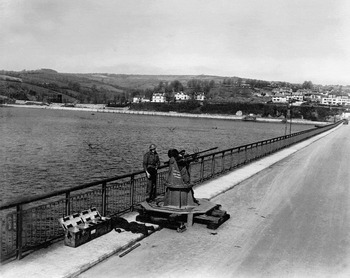
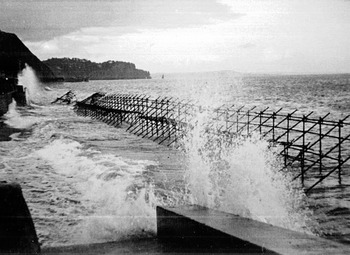
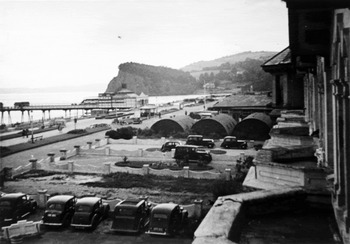
In the early war years, following some civic protest, Teignmouth was armed and fortified for defence purposes. An array of weaponry that was gradually positioned included two sets of electronically fired rocket launchers, two sets of Bofors Cannons, two Coastal Naval Guns and two Hispano machine guns (see Figure 3). Anti-invasion barricades and barbed wire were also lined along the beach (much of which itself was designated out-of-bounds) and anti-shipping wire was stretched across the mouth of the local river (see Figure 4). Accommodation sufficient for 12 army regiments was also provided both within and immediately outside the town (see Figure 5). Respondents provided detailed accounts of this happening, their quotations revealing information on three levels: on the basic events, the actions and reactions of others, and their own actions and reactions. Ruth and Alice commented:
I was 27 when war began and I recall people talking about the barriers when they were installed. Meetings were held because people still felt unprotected, leading to a general outcry about the lack of guns. Once they were installed, I felt very much relieved … everyone felt better. Later on in the war, some guns were put in the fields behind the house we were living in on Yannon Drive. That was even better.
Anti-aircraft gun on Shaldon Bridge.

Anti-Invasion barricades on the beach.

Army Nissen huts on hotel lawns.

I was annoyed when restrictions, including rolls of barbed wire on the prom, stopped the use of west beach and entrance to the Pier. Gradually, these measures were accepted as necessary and few people tried to venture on the beach in the early days of the war. We did not know if mines had been buried in the sand. The town's restrictions were not eased officially until after D-Day.
Despite these measures, Teignmouth was attacked, as explained earlier, in the form of air raids. Residents provided detailed accounts of these, including their physical and emotional reactions, the memories of which were still vivid. Ada and Dot recalled in detail:
When Teignmouth had its worst raid I had a group of about a dozen young children in my charge. I heard loud bangs of explosions and remember looking up the road towards my home to see if it was okay. I tried to get the cellar door open but it would not budge. The children were upset but it was all over in a flash. I never saw an enemy plane at close quarters but, on another occasion, whilst I was out with a friend out on the Den (a field), the siren went off, so we made down Den Road. At Dole's shop on the corner of Bank Street, a raid began. We lay down on the pavement with our hands over our heads, tucking in under the shop canopy. Luckily for us, the glass did not shatter.
I was playing on the beach just east of the pier and my dad was talking to his friends on the wall just above. The first plane I had ever seen in my life was flying up and down and I watched it for a while before getting bored and resuming play on the beach. Suddenly, I looked up and saw a black object dropping from the plane, a huge explosion followed, flames, black smoke then dead silence. Even the gulls stopped. Then it was pandemonium, people shouting and screaming, running everywhere. I grabbed my socks and shoes and raced up to my dad. He picked me up and ran all the way home with me in his arms, to my weeping mum who was pregnant. It was the first time I knew fear. I realised that these people could just come in here and bomb us, and there wasn't a thing we could do about it.
These oral accounts provide first-hand interpretations of the impact of what otherwise might be reported in historical documentation as dates, times or casualty lists. They provide detailed insights into key events, and what was experienced and negotiated emotionally and personally.
The war changed the ways in which residents used and negotiated their town on a daily basis. At times this was unavoidable, as Alice commented earlier, due to state-enforced regulatory measures and certain areas becoming out-of-bounds (largely due to the siting of gunnery, dangerous bombsites and anti-invasion measures). Nevertheless, some residents found ways to resist these spatial restrictions the like of which have become folklore of everyday life on the British homefront (Gardiner Reference Gardiner2004). Edith, for example, commented:
We'd play on invasion barricades, even in bomb sites, collecting things, up to no good. But we were kids. There was one near my house. My mother never knew that we went there. It could be disrespectful but you don't think like that when you're 12.
Impacts of bombing, and the injury and death that resulted, induced an uneasy and negative ‘sense of place’ in residents, and they would modify their behaviour to avoid certain places. The following quotation by Mabel demonstrates practical adjustments made in daily routines to avoid places of perceived high risk, and also illustrates a retrospective analysis on her part:
I would avoid the seafront defences and bridge because they are wide open spaces likely to be targets. I'd also avoid the docks and Morgan Giles because they were too. In retrospect, it didn't matter however if you went into town or stayed on the outskirts because all kinds of houses got hit in all locations. But it made us feel safer and gave us some control.
The threat of German invasion and its possible consequences, particularly after ‘Dunkirk’ and the evacuation of the British Expeditionary Force from the continent in June 1940, further impacted upon the perception of a coastal town as an unsafe place. This perception was particularly the case as Teignmouth's beach and deep-water port made it a potential landing site. John stated:
We were sure something would happen and we'd be first in line, right in the line of attack in the middle of the battle. This was very frightening and you rehearse what you might do, defend or play nice. It's happened before.
Importantly, John's quotation highlights how often a respondent's perception is relational to their broader knowledge of the town's history. This history includes Teignmouth being invaded by French forces in 1340 and 1690, the latter time causing extensive damage to property and to the wellbeing of locals. Moreover, a threat of invasion arguably continued until the Battle of Waterloo in 1815 (Andrews and Kearns Reference Andrews and Kearns2005; Andrews et al. Reference Andrews, Kearns, Kontos and Wilson2006). These are, indeed, well-known and documented local histories, continued now in a new context. Elsa commented on her planning:
I was never more terrified in all my life. It stayed with me for a long time afterwards. I relived it every night in my mind. I was worried about my Mum and wondered what on earth I would do if anything happened to her. I worked out a strategy in my mind. I could clean, make beds, learn to pay bills, go to work and be independent.
Emotions run high throughout many of the stories told, even 70 years later. As other quotations have described earlier, respondents were worried about threat to themselves and family and some – as above – envisaged the very worst scenarios. Notably, this envisioning and speculation is common in, and a strength of, oral history, providing insights into different/possible histories that could have happened. Indeed respondents’ comments might be purely speculative and might not reflect what, in reality, they would have done, although at the very least they provide a unique perspective on their mindset and intentionality.
New social relations within place
According to respondents, in Teignmouth, a small town where the local population faced a similar set of challenges, the war brought increased social co-operation and cohesion. This was reflected in a responsibility for the welfare of fellow citizens, and related agency to assist them in times of need; a form of circumstantially created and related social capital. Ruth commented:
There was a lot of coming together and being concerned for your fellow citizen. We shared information that could help one another. If you did something for someone, then they might do something for you. If you gave them something they needed, helped them out with their children or house, that sort of thing.
Indeed, respondents claimed that, during the war, there was a temporary breakdown of traditional class divides. These stories are often presented by public and officialdom as an important lesson for contemporary society (on how humankind can unify under duress) but, at the same time, some critics of oral history claim that they can be very typical manifestations of overly positive nostalgia that might not accurately reflect the past social reality (see also Watson and Wells Reference Watson and Wells2005). Nevertheless, as Gluck (Reference Gluck1999) suggests, and as we indicated earlier, oral histories are just as much about how some features of the past exist as a current cultural representation.
Related to a degree of greater social cohesion was a sense of ‘doing your bit for the town’. For some, this involved caring for fellow residents, such as seniors, helping them with shopping or dealing with the various challenges of wartime rationing and other restrictions. For others, it involved ‘official’ duties and jobs including volunteer work outside normal paid employment in key roles. Providing some additional personal detail that augments dominant historical narratives on ‘duty’ and ‘virtue’ of working for the war effort, May stated:
Once a week, I undertook fire watching duty, first at Orchard Gardens then at Bitton House. We had helmets and trousers issued and took a pillow to rest on, although we did not get much sleep. I managed to have some mirth after pushing beds together but one well-built girl announced that when she wanted to turn over, so we all had to turn over! Mr Henshaw, the Fire Officer called in periodically to remind us to be on the alert. The drill was that if anything happened we must go outside and deal with it even though I am unsure quite what I would have done if the need ever arose. Thank God we never had to do anything.
During the war years, getting by and coping was an everyday challenge and included a great deal of resourcefulness. Olive expanded on the problem of food rationing and how she bent the rules and coped, her comments providing a personal version of well-documented histories of informal/illegal/underground economies and the wartime ‘black market’:
Life was changed by food shortages and we were grateful for what little we got in the way of eggs, meat, bacon and milk without missing luxuries. Using basic foodstuffs, we made up simple but tasty meals. Queues were a regular feature! My aunt joined one not knowing what it was for and got some birdseed for her trouble! Sometimes we got something from ‘under the counter’ – a bit of fish, meat or sugar. It was not too illegal or profiteering – simply a small town trying to survive.
In the later years of the war, Teignmouth experienced the influx of many allied soldiers, who were housed in local hotels or, as indicated earlier, barracked just outside the town (Andrews et al. Reference Andrews, Kearns, Kontos and Wilson2006). This was a significant social change. For many residents, this was the first time that they experienced ‘foreigners’ and sustained contact with ‘outsiders’. For example, respondents reported meeting ‘Indians’ and ‘black people’ for the very first time. The most numerous outsiders were American troops, based in the town whilst training and waiting for the Normandy ‘D-Day’ landings. These stories highlight the position of a small town in a far wider military network stretching to an international scale, and its unique local impact. Olive noted:
Indian soldiers with pack-mules camped at Shaldon and the Queens Royal Regiment took over seafront hotels. It was gradual and accepted piecemeal. I saw the turban-wearing mounted Indian Cavalry from a tented camp at Teign Snape, Ringmore. I was impressed by their smartness when they rode their horses into the village for shoeing and felt patriotic, aware that they were helping us with the war. The Yanks arrived all flash and rich like movie men. You have to realise that most of us had never been to another country, let alone America. It was a big shock in 1943 when they arrived in huge numbers. It made us feel that the war was changing and a Second Front Invasion was imminent. They occupied hotels, the Den Pavilion for a Food Hall and set up their own hospitals, one in Mount Everest above the Grammar School.
In many respects, these narratives reiterate what are well-reported and popular cultural histories of World War II; the Yanks ‘oversexed, overpaid and over here’. However, in contrast to the dominant narratives of unwanted invaders of British life, in local oral histories we can observe the existence of friendship and emotional attachment. Alice mentioned:
There was one officer who would talk to us and give us food. I think he missed his own family, so we were nice to him. I felt sorry for him … I don't know that happened to him, whether he made it through.
But respondents also conveyed other stories that challenge dominant narratives about allied cohesion. Dot commented on racism and violence within the ranks:
I've always remembered conflict between white Americans and black – who were non-combatant. What struck me was the attitude of some of them towards blacks. I saw white sailors taunting them into a fight. I was shocked to see someone picked on because of the colour of their skin. It was offensive. This was pure bullying. They beat hell out of him. I felt so sorry for the victim. It was the first time I became aware of colour prejudice. I saw this happen two or three different times.
Other outsiders included evacuees, typically children sent from large cities – such as London – that were experiencing air raids. The government's opinion being that small rural towns were less likely to be targeted (this being, in most cases, correct). Here Nancy provides a local and powerful perspective on this national policy and practice:
The first weekend after war was declared, hundreds of children evacuees poured into town on the train. They were taken to the school and the appealing ones were selected immediately but others had to be taken round to homes where occupants were obliged to house them. One little boy who was not wholly white-skinned had a ten shilling note sewn into his jacket as a bonus for whoever took him home.
Coping strategies and new social relations also took the form of residents learning about the world beyond Teignmouth in order to inform and empower themselves. This representing an inflow of geo-political information into the town (different from the inflow of military ordinance, hardware, bodies and cultures previously described). Nancy continued:
Instead of turning away from what frightened me the most, I actually turned towards the war and began a programme of self-education. I looked at daily papers, studied maps and the latest news of invasion and constantly quizzed my mother about countries. Geography became all-important in my quest for knowledge. I kept a notebook, listing the names of all the places mentioned in reports and even now, can remember these names. My concept of various countries was broadened and I was aware that this knowledge was far removed from anything in school. I learned so much, I can't tell you!
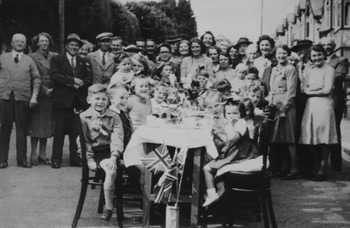
In the context of the end of the war, new social relations in Teignnouth took on far more positive and celebratory forms, including the reuniting of loved ones and local events. Importantly, the respondents specifically recalled the positive emotions in street parties (see Figure 6), as the relief and happiness were expressed in the same streets that had been damaged during the international conflict (Andrews et al. Reference Andrews, Kearns, Kontos and Wilson2006).
The Third Avenue street party.

Relationality through time
As noted previously, how the respondents’ pasts relate to their presents is important, particularly in terms of the way in which they and their history are evoked and treated, their views on this and their own self-perceptions. Indeed, relations between past and present are complex and multifaceted, yet are well illustrated by the respondents’ feelings towards particular buildings, and the memories and emotions their presence still evokes like ‘hauntings’ from the past. Many were negative and fearful, yet some were more positive. Alice recalled:
I do not remember VE Day as well as VJ Day when the sailors at Courtney Arms brought out bunk beds and lots of other stuff to the middle of the road. They lit a huge bonfire and we all danced round it. Hokey Cokey. The Legion was packed with people. My Mum came to find me and took me home. I still remember the party when I walk past the building. Like I remember the deaths if I walk past others.
Many of the stories told so far illustrate how the emotions (of war) and the local landscape, both past and present, are interwoven. Beatie remarked on her lifelong mental health challenges largely resulting from her wartime experiences as a young woman in the town:
After a raid involving the deaths of people in their own homes very close to mine, I heard a baby cry under the rubble. It seems to have been the catalyst to my decision that there was no point in going on with life. The world seemed to have gone mad. I walked, fully clothed into the river and was found unconscious by two fishermen. I gave a promise to my mother that I would never do it again. Not long afterwards, I met and married my first husband but was widowed within three weeks. Less than a year later my brother was killed during a raid on Teignmouth and once again I was devastated. My family all moved out into the countryside to get away from the raids. At the end of the war, I married a soldier and went up country to live but after a number of years, I returned home without him. I had suffered two nervous breakdowns and saw a psychiatrist who asked me to draw or write whatever came into my head. I drew a slice through an orange and filled the segments with words such as ‘fear’ and ‘anger’, the emotions that ruled my life for some time.
Indeed, many respondents have had to cope with the personal, psychological, family, social and other impacts of the war ever since, recovery and reconciliation being a life-long process, achieved uniquely for each individual. For all respondents, however, remaining in or returning to ‘their town’ was an important part of this process.
During interviews, respondents often compared their past selves to their present selves, the latter being relational to the former, and actively measured, compared, contrasted. The similarities and distances were both celebrated and disliked. May commented on a variety of associated issues, including the role of the past and its recognition in her self-identity and place-identity:
I'm a different person for sure, but all that made me. It made the town. I get upset if I am disrespected by children because of what we went through so they can ride their skateboards and be free. But most of them are fine and people become more appreciative as they get older.
In particular, respondents highly valued the small number of local public heritage exhibitions and products/events that had been produced over the years, showing ‘their’ war history to a new generation (particularly a local museum display, and regular slide shows from a local historian). Moreover, respondents of the most recent interviews were very interested in a Facebook group/page named ‘History of Teignmouth’ that, with 1,800 members, was posting a number of pictures from 1940s Teignmouth. Although it was oftentimes younger relatives who had shown them this social media site, they were still happy to browse and recall particular persons and events (not to mention that many were happy that ‘younger people’ had ‘gone to the trouble’ of creating and maintaining it). Indeed, this interest supports wider academic concern for ‘the local’ in heritage studies, and a professional concern for heritage stewardship and promotion (Kelly Reference Kelly2004).
With regard to oral history methods, an important point about talking with older people about the past is their experiences in doing this, and their thoughts on its value. For the most part, the respondents both enjoyed the interview process and recalling the past, and saw some value in participating. In many cases it had been the first time in many years they had been specifically asked about it, and this they appreciated. May and Tina commented:
I think that young people are not very aware or interested in that period of history but I'm delighted if I find that someone is deeply interested in it. I'm glad for the books local historians have done which provide a true record of that time. I enjoy reflecting on it, revisiting the past is a pleasure. I wouldn't have had those days any different except for the experience at the school … We must not forget what happened. Wars are still going on all over the world and this country should never forget the young people who died in planes, in ships and on land.
Local history needs to be documented and Teignmouth has some fine examples but it really depends on where the place is as to how well it is done. I enjoyed taking part in the research project. I did not feel angry or upset addressing these issues, just glad to be of help with something positive.
Indeed, there was a general sense that the research project, in addition to being historical, was in some way celebratory of their lives during and since the war, and respondents saw no problem with combining these two facets. One did get the sense that many respondents neither understood nor cared about the exact differences between media/heritage oral history and academic oral history, although most were concerned that their stories be disseminated as widely and publicly as possible. This preference is food-for-thought for academics considering ‘knowledge translation’ of oral history in terms of how and to whom.
Towards a combined ‘historical gerontology’
The Teignmouth study makes two specific academic contributions, each of which illustrate the potential and merit of combining both modern history and social gerontology. The first of these is theoretical, involving showcasing the relationalities implicit in, and uncovered by, talking to older people via oral history methods. Through the telling of some powerful stories, the study conveys the complex relationships between people and place and past and present. Specifically, with respect to ‘the then’, and respondents’ historical experiences during this period, it demonstrates new relationalities with and within place. For example, their unique interactions during the war with structures and technologies (such as rules, bombs and barriers) and other people (such as soldiers and outsiders) which themselves were connected to wider historical, social, political and military networks. With respect to ‘the then and now’, and how historical experiences continue to reverberate, it demonstrates relationality through time. For example, respondents’ perceptions of their own and their town's wartime histories, how this gels or conflicts with public awareness and behaviour, and how this history connects to their current lives and identity. Indeed, these relationalities might be the ‘glue’ that binds the different disciplines and certainly suggest that exploring their common ground would be an academically worthwhile endeavour.
The second of these contributions is empirical, uncovering specific and often neglected histories and their contemporary resonance. The very same powerful stories bring attention to marginal people and places, both of which are sometimes missed ‘off the map’ of formal historical scholarship. They also pay attention to the local impact of ‘big’ histories and thus stories that might even contrast with dominant narratives. Moreover, they give attention to detail, the individual, and the emotional and ‘everyday’ in terms of the negotiation of social life and circumstance. Specifically, in the current study these contributions inform the idea of ‘homefront’. Indeed, the mainstream historical literature tells us that due to the limited scale of military encounters between nations, throughout much of modern history and during many wars, civilian populations and national social life were minimally impacted. The origins of homefront are, however, located in the functioning of the modern industrial-backed wars of the twentieth century that necessitated comprehensive economic and social support for the conduct of much more extensive military activity. Hence, ‘home’ is regarded as effectively the second ‘front’ (or secondary effort), a necessary foundation to war. In terms of its operationalisation, homefront is the key concept of a multifaceted political rhetoric and agency that regulates and enforces economic activities and public behaviours, and more subtly encourages public participation through identity with, and responsibility for, a place (homeland). But, during times of war, a realisation of the potential contribution of a successful homefront has led to them becoming regarded as legitimate targets for military attack, and concurrently the extension of the term to capture public morale and spirit in the face of such attacks. In terms of war heritage, very specific and nostalgic versions of homefronts are told and sold, often part of substantial heritage industries. In many cases, such heritage reproduces similar positive morale-building images and versions as produced by officialdom at the time of war. These dominant narratives often become part of a nation's ongoing identity and pride. Beyond macro-scale archival historical analysis (see Noakes Reference Noakes1992), it is however frequently left to local (lay) historians to tell the neglected and marginal stories of everyday homefronts, such as Teignmouth, often to small public audiences. Either that, or a few are partially uncovered by a limited number of academic studies using biography, auto-biography and, like the current research, oral history methodologies (Andrews et al. Reference Andrews, Kearns, Kontos and Wilson2006; Banister Reference Banister2001; Henderson Reference Henderson2006; Parker Reference Parker2002; Stanley Reference Stanley1994). Indeed, part of this latter tradition, the current research shows the many relationalities that made the small-town British coastal homefront and how, through older people, it resonates through time. Beyond the homefront, any time period in living memory might be focused on by gerontologists using oral history; the argument being that people and place are relational and co-produced at all times. There really is no limit apart from human memory and lifespan. Sadly though, as time passes, every year the reach of living memory retracts in alignment. As another generation passes, their stories are many times lost forever, never to be retrieved.
In research terms, however, oral history is certainly not a ‘done deal’ and we still need to consider how it might be methodologically and analytically refined and developed. For example, with regard to interview techniques (Morris Reference Morris2002) and – the embracing of cultural reconstruction notwithstanding – ‘narrator reliability’ (including issues such as forgetting, selective memory recall, situation bias and the roles of the conscious and the unconscious; Norquay Reference Norquay1999; Prescott Reference Prescott1999). Moreover a whole series of emotional and psychological issues in reliving the past are important, particularly when the past is traumatic (Burnell, Coleman and Hunt Reference Burnell, Coleman and Hunt2010). In moving forward we also need to consider how oral histories might be combined with other methods and approaches to provide more than one lens and insight such as engaging with artefacts, photography and archive material. More generally, consideration also needs to be given to what might be involved empirically, topically and methodologically in terms of scope more generally beyond oral history. This is a far larger consideration that can be covered here that needs attention in its own right. However, as Skinner, Cloutier and Andrews (Reference Skinner, Cloutier and Andrews2015) argue, it might on a different level include exploring the contributions that older people and older age have historically made to the world and societies at large, including to art, literature, politics, religion, science, economics, social movements and other important fields of human agency. This would involve consideration of how being older can be significant – perhaps due to older people possessing a mature, reflective or spiritual outlook on life, particular or greater experience, or due to social or economic circumstances encountered during later life (see e.g. debates on ‘late style’: Amigoni and McMullan Reference Amigoni, McMullan, Twigg and Martin2014; Said Reference Said2006). Many studies here might fall into one of two categories. First, biographical research focused on influential historical figures in their older age (see Cameron and Forrester Reference Cameron and Forrester1999; Watkins and Cowell Reference Watkins and Cowell2006, Reference Watkins and Cowell2012). Second, biographical and other research focused on specific groups (such as aboriginal people and ‘elders’, as covered in more ‘contemporary’ work: Beckford et al. Reference Beckford, Jacobs, Williams and Nahdee2010; McGregor Reference McGregor2005; Wilson Reference Wilson2003). These are different yet just as important space and time relationalities, and attention is needed to a full range of approaches.
Finally, there are a range of disciplinary – parameter and structural – issues to consider. We need to think further and broadly about the academic connections between history and gerontology, and also about the potential contribution of gerontology – empirically, theoretically and methodologically – to the emerging multi-disciplinary field of ‘memory studies’ concerned critically with how and why individuals, groups, cultures and societies remember or do not (see Olick Reference Olick2008; Radstone Reference Radstone2008; Roediger and Wertsch Reference Roediger and Wertsch2008). Practically, there are questions including where would historical gerontology be published: in gerontology journals and books, history journals and books, or both? Could and would gerontology conferences and meetings accommodate it? What sources of funding might be available for this research, and what are the roles of existing and new sources? Indeed, these types of questions inevitably arise with any field of research which takes a new direction and breaks new ground.
In sum, the protection and appreciation of older age has always been an objective of social gerontology. Studying modern history represents another way of working towards this broad objective by telling the stories of unknown past people and places, or shedding new light on known past people and places and exploring their reverberation and impact in the present. If, as scholars, we are interested in ageing and society then we must be interested in older people's past lives and social contexts, what they were like and how they, others and we feel about them now.
Acknowledgements
All photographs are from the Viv Wilson Archive, Teignmouth, Devon (permission obtained for reproduction). Many thanks also to Viv for conducting a set of initial interviews.