

1. THEORETICAL BACKGROUND
This article will examine the role of power and accidents in causing institutional changes, employing the theoretical perspective of historical institutionalism. It is a response to the call for more investigation on ‘institutional dynamism’, a summons by those who believe that existing historical institutionalist analyses have focused too much on ‘comparative statics’,Footnote 1 ‘institutional stasis’,Footnote 2 and ‘static and linear premises’.Footnote 3
Since the ‘rebirth of institutionalism’ in the 1980s, historical institutionalism has emerged as a major research pillar in political science.Footnote 4 Major features of this theoretical perspective can be summarised as follows:
First, whereas “old institutionalism” defines institutions mainly in terms of formal structures, historical institutionalism widens the concept to include both formal and informal procedures, norms, and conventions. Second, in contrast to rational choice and game theory's focus on equilibria, historical institutionalism's primary interest is in historical processes, legacies, and contingencies. Central to this is the idea of path dependence, which will be examined in greater detail below. Third, when analyzing institutions' effect on individual behavior, historical institutionalism blends the “calculus approach” (which focuses on utility maximization) with the “cultural approach” (which emphasizes moral and cognitive factors). Fourth, instead of assuming that everyone is on an equal footing when making choices, historical institutionalism highlights power asymmetry among individual actors. Fifth, rather than taking institutions as the single explanatory variable, historical institutionalism examines interactions between institutions and other factors such as socioeconomic changes, ideological flows, and actors' interests and strategies, thereby situating institutions in broader contexts. Sixth, while rational choice theory takes individual preferences as given, historical institutionalism goes further, to ask how such preferences are formed and constructed. Finally, when formulating research programs, historical institutionalism tends to be driven by “big” and “real-world” questions, such as the occurrence of revolutions and evolution of social systems.Footnote 5
According to historical institutionalism, institutions exist to provide actors with information so that they may undertake strategic behaviour and identity formation, and institutions endure because deviation from them incurs significant costs. Thus once formed, institutions are resistant to major changes. They tend to be ‘path dependent’, that is, they evolve along ‘paths’ defined by the historical legacies of existing institutions, resulting in consequences and inefficiencies that are unexpected at the time of formation of the institutions. It is at ‘critical junctures’, where ‘branching points’ for institutions to shift to other paths exist, that institutional changes will occur.Footnote 6
The above idea of ‘path dependence’ has often been reduced to the simplistic assertion that ‘history matters’, or ‘the past influences the future’.Footnote 7 A more rigorous analysis regards path dependency as the pattern of sequential events with three essential elements. First, history plays an important role in causal processes. Second, there are contingent occurrences, which make initial conditions unable to predict final outcomes. Third, and finally, contingent events are followed by relatively deterministic, causal and inertial patterns.Footnote 8 Because it places emphasis on the ‘structure’ of path-dependent events (the historical causal pattern), historical institutionalism has been criticised as leading to a general neglect of the role of ‘agency’ and ‘political actors’ in the study of institutional stability on the one hand, and as offering no help in understanding institutional change on the other.Footnote 9
According to the structuralist path-dependency perception, historical institutionalism tends to assume that institutional stability is the norm. The fact is that cases of institutional change are not so rare and therefore should merit more academic attention. To explain institutional changes, historical institutionalism often relies on the notion of ‘critical junctures’.Footnote 10 According to Ruth Berins Collier and David Collier, a ‘critical juncture may be defined as a period of significant change, which typically occurs in distinct ways in different countries (or in other units of analysis) and which is hypothesized to produce distinct legacies’. It is triggered by ‘cleavage (or crisis)’ which disrupts ‘antecedent conditions’, and is followed by institutional and political processes that produce and reproduce a stable ‘legacy’.Footnote 11 Critical junctures are therefore moments at which institutional change may take place.
However, Giovanni Capoccia and Daniel Kelemen argued that critical junctures do not necessarily result in institutional changes.Footnote 12 According to them, ‘critical junctures are relatively short periods of time during which there is a substantially heightened probability that agents’ choices will affect the outcome of interest'.Footnote 13 Whether there will actually be any subsequent change depends on how actors respond. ‘Hence, change is not a necessary element of a critical juncture. If change was possible and plausible, considered, and ultimately rejected in a situation of high uncertainty, then there is no reason to discard these cases as “non-critical” junctures.’Footnote 14
Central to Capoccia and Kelemen's analysis is that it is ‘agents’ choices', rather than accidents, that determine whether and how changes will occur at critical junctures. According to them, institutional economics' view that changes are the result of ‘chance’ and ‘random small events’ neglects the power dimension.Footnote 15 Political science, however, provides a remedy for this weakness, because this discipline's ‘analyses of critical juncture (and synonyms) most often focus not on random small events but instead on decisions by influential actors – political leaders, policymakers, bureaucrats, judges’. Responding to the example given by the institutional economist Brian Arthur, that driving on the right- or left-hand side of a road is a random outcome, Capoccia and Kelemen argued that, ‘in the case of the direction of traffic, it is in actuality decisions of political elites, rather than the consequences of a host of microscopic decisions by drivers, that are often decisive’. Therefore ‘power asymmetries’, at critical junctures, provide the opportunity for ‘key actors’ to play a role that is more important to the outcome than is the accident.Footnote 16 Similarly, though less vigorously, Robert Goodin noted that:
accidents and errors are rarely purely stochastic; and even when they are, they nonetheless typically arise in the backwash of intentionality, through the oversights and miscalculations of purposive agents engaged in projects of their own. Thus, what intentional agents intentionally do is important even in modeling social and institutional change as essentially accidental.Footnote 17
To conclude this theoretical introduction, it can be argued that while historical institutionalism tends to explain institutional stability in terms of path dependency and institutional changes in terms of accidents, greater attention should be paid to the role of ‘agency’ and ‘political actors’. Focusing on institutional changes, this article will examine how political power interacts with accidents during critical junctures.
2. POWER AND ACCIDENTS IN INSTITUTIONAL CHANGES
Accidents are often treated as unexplainable contingencies. For example, Goodin defined accidents as situations in which there are ‘no forces of natural or social necessity at work, no larger causal mechanisms driving things’.Footnote 18 Instead of using this definition an accident will be regarded herein as an event which, until it happens, is unrelated and unknown to the sequence of events in observation. While an accident has its own causal pattern or sequence of events, it is independent of the sequence of events to which it may be related. Whether or not a particular event is an accident is a matter of perspective. The Asian tsunami in December 2004 is certainly an accident for those tourists whose travel plans led them to the place where the events transpired. However, it is not an accident in the sense that it is a natural consequence of an earthquake in Indonesia, which was in turn preceded by some movements along a fracture in the Earth's crust. The tourists were unfortunate in that their intended sequential events (travelling in the area) were disrupted because they found themselves at the intersection of an unintended sequence of events (the earthquake and then the tsunami). For many of the tourists, the tsunami was a critical juncture at which their life was changed, but from a broader perspective, it was a ‘conjuncture’: a coming together – or temporal intersection – of separately determined sequences. According to James Mahoney, conjunctures which intersect at some point of time may or may not change the direction of the sequences of events.Footnote 19
Whether accidents will lead to institutional changes or not may depend on the time horizon. As Paul Pierson noted, contemporary political research has been preoccupied by short time horizons both in terms of cause and outcome. The result is that ‘we miss a lot’. Pierson used natural disasters (such as tornados and earthquakes) to illustrate that accidents may be found to have ‘slow-moving causal processes’ if a longer time horizon is adopted.Footnote 20 In fact, natural disasters have often been cited as accidents that do lead to institutional changes.Footnote 21 Mainstream disaster studies have adopted a ‘physical agent or hazards’ perspective, by which a disaster ‘is conceived in terms of flow charts, or a causal chain, beginning with the impact of a physical agent’, ‘external’ to the social system. This approach has been criticised for resulting in ‘an unsociable realm of impacts and energy, feedback and stability, information and control’.Footnote 22 What has largely been neglected is that disasters are also ‘social constructions’,Footnote 23 because events may become a ‘disaster’ due to specific social circumstances. For example, an earthquake is more likely to result in a disaster in areas where there is a housing problem of some kind. There is thus a ‘social influence’ which can have an impact on human vulnerability to disasters. In other words, disasters are not completely the result of ‘external agents’.Footnote 24 While in historical institutionalist analyses critical junctures are often associated with ‘exogenous shocks’,Footnote 25 the impact of a disaster could be endogenised under specific socio-political contexts.
In fact, as Siobhan Harty noted, the division between the exogenous and endogenous may sometimes be blurred. ‘An exogenous shock might emerge in response to factors that are endogenous to an institutional system.’Footnote 26 The research presented here studies the case of two natural disasters in Hong Kong – the bubonic plague in 1894, and the severe acute respiratory syndrome (SARS) outbreak in 2003 – to see how these two seemingly exogenous shocks (epidemics) could be made endogenous by those with political power in order to bring about intended medical-institutional changes. Because of their unpredictability, and the potential damage they may cause to human life and social order, epidemics can be considered a kind of natural disaster.Footnote 27 In 1894, bubonic plague broke out in Hong Kong. A local Chinese hospital (i.e. a hospital where inpatients were treated with Chinese medicine) was criticised as being ineffective in handling the crisis, and was subsequently forced to Westernise. The accidental nature of this event has led a historian of this hospital to conclude that ‘in studying history, even the history of a social institution, one must make allowances for contingencies’.Footnote 28 Over a century later a reversal occurred when Chinese medical practitioners were allowed to re-enter the same hospital during the SARS outbreak of 2003. The latter epidemic, again, was widely conceived as an ‘accident’.Footnote 29
These two epidemics thus seem to support the view that it is ‘accidents’ that produce critical junctures wherein institutional changes take place. In the following sections, we will investigate whether this is true by examining the history of the making and remaking of the Chinese hospital referred to above from 1870 to the present. We will situate the process in the context of the power dimension of two handovers of Hong Kong's sovereignty (one in 1842, and another one in 1997), so as to ‘endogenise’ the two ‘accidents’. Our ‘unit of analysis’ will be the institutional setting of the hospital.Footnote 30 Employing historical institutionalism, we define a hospital as an institution consisting of a formal Weberian-type bureaucratic structure, and an informal system of norms and beliefs, grounded on humanitarian values which provide a basis for deviance from formal rules and procedures.Footnote 31 Such formal and informal interactions among professionals, administrators and patients produce a ‘negotiated order’ that constitutes the major institutional characteristic of the modern hospital.Footnote 32 Our case will be complicated by the fact that, while hospitals are central to Western medicine, this modern institution is favourable to one form of Chinese medicine, but unfavourable to another.
3. CASE STUDY: THE MAKING AND REMAKING OF A CHINESE HOSPITAL IN HONG KONG
3.1. Chinese medicine, traditional Chinese medicine, and the Chinese hospital
This case studyFootnote 33 will begin with an explanation of three terms crucial to our study: ‘Chinese medicine’ (zhongyi  ; CM), ‘traditional Chinese medicine’ (chuantong zhongyi
 ; TCM) and ‘Chinese hospital’. CM refers to all forms of medicine that had been practised in China before the arrival of Western medicine. The term was coined in the nineteenth century in face of serious challenges from Western medicine. On the other hand, TCM is an English term created in the mid-1950s by China's foreign-language publications, for the purpose of gaining foreign recognition of the kind of official medicine sanctioned by the newly established People's Republic of China. It refers to the ‘modernised’, ‘scientific’, ‘systematic’ and ‘standardised’ CM. There is no specific term for TCM, however, in the Chinese language because the term CM already implies that it is part of Chinese tradition.Footnote 34
The origin of CM can be traced to 2700 BC. The arrival of the Jesuits in China in the late sixteenth century marked the beginning of contact between CM and Western medicine. The two different kinds of medical knowledge coexisted in China for some time. However, the failures of China to resist the Western imperialistic invasion from the mid-nineteenth century to the first half of the twentieth century resulted in a loss of confidence in almost all aspects of Chinese tradition, including its medicine. CM was criticised as lacking scientific foundation, and was regarded as an obstacle to the modernisation of China's heath-care system.Footnote 35
In 1949, the communist People's Republic of China was founded. A few years later, CM began its transformation into a new form of medical knowledge known as TCM. According to TCM, CM is too ‘coarse’ and ‘primitive’, and the contribution of TCM was to ‘modernise’ and ‘standardise’ CM, making it ‘scientific’ enough for integration with Western medicine. By 1956, TCM was founded as China's official form of medicine. Although based on CM, TCM is ‘Westernised’ in the sense that it employs Western biomedical terms and concepts, and is institutionalised under a structure that is based on Western medicine.Footnote 36
For CM practitioners, the ‘integration of Chinese and Western medicine’ in TCM has been so biased towards Western medicine that CM has not been able to maintain its identity for a number of reasons. First, it is Western medical doctors who certify TCM knowledge; second, the administrative hierarchy is staffed mostly with Western medical doctors; and finally, some TCM practitioners are ranked according to the Western medical knowledge they possess. Thus, under the hegemony of ‘scientism’, TCM is actually ‘Westernised’ and ‘governed’ by Western medicine.Footnote 37
The inferior position of CM is particularly observable in the institutional setting of hospitals. While a hospital is central to Western medicine,Footnote 38 the same cannot be said for CM. CM's major methods of diagnosis could be conducted in simple clinics, and herbal medicine could be prepared at home. There is nothing central to CM that requires it to be practised in a hospital-like setting.Footnote 39 Nevertheless, CM hospitals did exist in Chinese history. From the seventh to the tenth century, they appeared in the form of bing fang (
 ) (stalls for the sick), mostly located in temples and run by monks and nuns. By the mid-nineteenth century, CM hospitals were established all over imperial China, mostly run and financed by the local elite.Footnote 40
Nevertheless, as mentioned above, hospitals are not essential to CM. In contrast, TCM is inseparable from hospitals. It is therefore essential to differentiate CM hospitals from TCM hospitals. While CM hospitals refer to simple places where CM services are provided without employing any major scientific-medical equipment, TCM hospitals are modern institutions fitted with Western biomedical diagnostic devices ranging from electrocardiograms to magnetic resonance imaging machines. Standard Western medical procedures such as blood tests, urine analysis and stool examination are required when patients are admitted to TCM hospitals. In fact, the creation of TCM as an official form of medicine was closely linked with the construction of TCM hospitals across the country, making hospitals as vital to TCM as they are to Western medicine.Footnote 41
With the above background information about CM and TCM hospitals, we can now examine the rise and fall of Tung Wah as a CM hospital during British colonial rule of Hong Kong, and the subsequent attempt to convert it into a TCM hospital after the handover of Hong Kong's sovereignty to China.
3.2. History of Tung Wah Hospital
3.2.1. Emergence (1870–1893)
In the mid-nineteenth century, with the emergence of Hong Kong as a trade port, there was a constant flow of immigrants from mainland China to the British colony. Many of them died alone on this ‘alien’ island, and the corpses were often disposed of in the hills without proper ritual. With contributions from local gentry and businessmen, a small common hall in memory of ancestors, the Kwong Fook I-ts'z (
 ), was established in 1851 to house the death tablets (plaques cast with the names of the dead) and coffins awaiting shipment to the home towns of the dead in accordance with Chinese customs. Some poor and terminally sick people also came to the hall to await their death. In 1869, the local press reported on the intolerable sanitary conditions of the Kwong Fook I-ts'z. Subsequently, the colonial government in Hong Kong planned to remove it. However, a group of local gentry and businessmen managed to convince the government to provide land and funding for the conversion of the Kwong Fook I-ts'z into a Chinese charity hospital. The Tung Wah Hospital was thus established in 1870 as a ‘public free hospital for the treatment of the indigent sick among the Chinese population’. Implicit autonomy was granted by the Governor of Hong Kong, to allow Tung Wah to be run as a CM hospital.Footnote 42
With considerable local popularity and strong fund-raising capacity, Tung Wah gradually grew beyond its original role as a CM hospital. Apart from taking care of patients, it also provided non-medical welfare services to the poor, acted as a bridge between local people and the colonial government, arbitrated disputes among the Chinese population according to traditional principles, maintained local customs and social practices, and protected Chinese interests under colonial rule. By performing these functions, the hospital helped the early British colonisers maintain social stability at a time when they knew little about local customs and traditions.Footnote 43
However, the colonial government's policy towards Tung Wah began to change in 1882, due to growing intolerance of Tung Wah's involvement in non-medical affairs. Moreover, the colonial government was concerned with the increasing influence of Tung Wah among the local Chinese community. Finally, direct contact between Tung Wah leaders and imperial Chinese officials was regarded as a threat to British rule in Hong Kong. The colonial government thus began to set boundaries for Tung Wah's activities and to balance its influence with other societal groups, in order to prevent it from growing into an uncontrollable native power. At the same time, solidarity within Tung Wah declined as some members of local elites became more receptive to Western ideas. Finally, a plague in 1894 dealt a severe blow to Tung Wah's autonomy.Footnote 44
3.2.2. From bubonic plague to the end of Chinese medicine services for inpatients (1894–1945)
In early 1894, bubonic plague broke out in Guangzhou, and spread later to Hong Kong. The colonial government sent a Western doctor to inspect some cases in Tung Wah Hospital. This marked the beginning of a struggle between the CM hospital and Western medical authorities. The government announced a series of measures, including house-to-house searches for infected persons and the quarantine of patients. The strategy for dealing with the outbreak was based on Western public health concepts and these sanitary measures ran into conflict with Chinese customs.Footnote 45
Chinese patients, fearful of Western medical treatment, sought shelter at Tung Wah, bringing the hospital to the forefront of the battle between Chinese and Western medicines and their respective institutions. Tung Wah was unable, however, to keep Western doctors out of the CM hospital. The plague, which subsided in July 1894, devastated the political strength of Tung Wah. The CM hospital was portrayed by the local English press as being both medically inferior and as having a vested interest in seeking political power in the name of traditional medical care. In subsequent years, Tung Wah's autonomy declined further, and the CM hospital was gradually Westernised.Footnote 46
In 1931, Tung Wah expanded into a group consisting of three Western hospitals, and began to be known as the Tung Wah Group of Hospitals. Subsequently, the group grew further into one of the largest voluntary organisations in Hong Kong.Footnote 47 During the Japanese occupation (1941–1945), Tung Wah remained as the major charity in Hong Kong. Moreover, as a result of the discontinuation of the interference from the British colonial government, Tung Wah's Board of Directors seemed to regain some autonomy, including authority over matters related to recruitment of medical staff. However, soaring prices of Chinese herbal medicines during wartime made it difficult for Tung Wah to maintain its CM services. In 1945, due to the continued shortage of Chinese herbal medicines, Tung Wah finally ceased offering CM services, and all inpatients were treated with Western medicines although, at the time, it was expected that CM services would resume after the war.Footnote 48
3.2.3. Post-war changes (1946–present)
In August 1945, the Japanese surrendered and British colonial rule was restored in Hong Kong. Soon after the war there were proposals to resume CM services for Tung Wah inpatients, but these were never realised during the period of British rule after the Second World War.Footnote 49 According to a Tung Wah spokesperson, their records offer no explanation for the failure to restore CM.Footnote 50 On the other hand, our archival research found that from the end of the Japanese occupation in 1945 up to the mid-1990s, there was no voice from the hospital, at least not a public one, calling to restore its unique role as a CM hospital. In such a way, Tung Wah was transformed into a purely Western hospital, with its CM service reduced only to the provision of free CM diagnoses to outpatients (herbal medicines not included).
Tung Wah's autonomy was further eroded in 1991, when it was incorporated into the Hong Kong Hospital Authority. To continue to receive public funding, Tung Wah, like other subvented hospitals, had to hand over a large part of its autonomy to the new central administration of public hospitals. After negotiation with the government, the only ‘autonomy’ that Tung Wah could retain was to continue offering free services to outpatients and to inpatients of 600 hospital beds. The issue concerning the role of CM seemed to be absent from the agenda throughout this period.Footnote 51
It was not until the mid-1990s that Tung Wah once again placed emphasis on its CM origin. However, by this time what it was promoting was no longer CM, but TCM. Instead of local CM practitioners, TCM practitioners from mainland China were hired to practise in the hospital's outpatient clinics.Footnote 52 In 2000, Tung Wah announced that it already had a ‘comprehensive plan’ for developing TCM services. Instead of re-establishing a CM hospital, Tung Wah proposed to offer combined Chinese-Western medical treatments to inpatients, thereby placing the hospital in a ‘leading role in integrating East and West’. The whole idea was based on TCM hospitals in mainland China.Footnote 53
However, all these efforts stopped short of actually allowing TCM practitioners to treat hospital inpatients. It was the SARS outbreak in the early years of the new century that led to a breakthrough in this regard. In November 2002, the first known case of SARS occurred in Foshan, a Chinese prefecture about 100 km from Hong Kong. Within a few months a worldwide outbreak ensued.Footnote 54 Because the plague was caused by a new, unknown virus, Western medicine was uncertain of the best treatment for the disease, but for TCM practitioners, SARS is a kind of ‘warmth-factor disease’ (wenbing,
 ), which they claimed to have the experience to handle.Footnote 55 In May 2003, shortly after the identification of the first SARS victim in Hong Kong, the Hospital Authority permitted two TCM practitioners from mainland China to participate in the treatment of SARS patients in a hospital under the Tung Wah Group.Footnote 56 This marked the first entry of TCM practitioners into Tung Wah's inpatient care wards, after the hospital had been completely Westernised for almost six decades. However, other hospitals in Hong Kong still refused to offer TCM treatment to SARS patients, even in cases in which they were unable to offer any effective Western medical treatment, because these hospitals, being Western medical institutions, had no legitimate way to employ TCM. Even in cases where family members of SARS patients had prepared herbal medicine under instructions of qualified TCM practitioners, Western physicians-in-charge still disallowed its use because they believed this would involve huge legal risk.Footnote 57
However, about a year later, the Hospital Authority announced that Tung Wah's TCM treatment of SARS patients was effective.Footnote 58 The Hospital Authority also agreed ‘in principle’ that Tung Wah might extend its TCM treatment to inpatients of general medicine, oncology and dermatology, if the patients so requested and if the Western physicians-in-charge so agreed. The plan was to offer TCM treatments with 30 to 40 hospital beds on a trial basis. The Hong Kong Government's Secretary for Health supported this initiative by saying that Tung Wah was the best place for such a ‘pilot study’. According to a local press report, it was SARS that had caused this new trend.Footnote 59
4. POWER AND GERMS
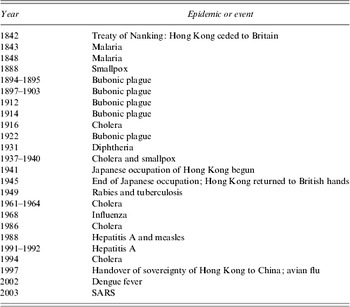
The above discussion seems to suggest that unknown epidemics were the cause both of the fall of CM and its revival in the form of TCM in Tung Wah. From 1870 to 1893, Tung Wah's CM services for inpatients played an important role in Hong Kong's public health system. The bubonic plague in 1894 marked the decline of such status, and the SARS outbreak in 2003 provided a historical opportunity for its revival. However, as indicated in Table 1, epidemics have in fact recurred throughout the history of Hong Kong.
Epidemics and sovereignty changes in Hong Kong since 1842

Source: Hong Kong Museum of History, ‘We shall overcome: plagues in Hong Kong’ (Leaflet distributed in the special exhibition ‘We shall overcome: plagues in Hong Kong’, Hong Kong Museum of History, 2003).
There have been claims that CM offers effective ways to cope with at least some kinds of the epidemics that have prevailed in Hong Kong, such as bubonic plague, cholera and smallpox.Footnote 60 One might ask why did the bubonic plague in 1894 and the SARS outbreak in 2003, but not the other epidemics, cause such controversy about the institutional status of CM and TCM hospitals in Hong Kong? In the following section, we will argue that this is because the two outbreaks under study are exceptional, in the sense that they ‘conjunctured’, i.e. occurred in conjunction, with major political changes. In process-tracing jargon, there were ‘convergent colligations’Footnote 61 on those two occasions.
4.1. The 1842 Treaty of Nanking and the bubonic plague of 1894
In the immediate years that followed the ceding of Hong Kong to Britain in 1842, malaria was a major threat to the life of British soldiers and European settlers in this colony. The British colonial government responded by establishing the Committee of Public Health and Cleanliness, and the Colonial Hospital.Footnote 62 However, this Western approach did not prevent the government from approving the foundation of Tung Wah as a CM hospital in 1870. In that early colonial period, then, CM was allowed to coexist with Western medicine in the public health system, reflecting the relatively equal power position of CM and Western medicine at that time.
Coincidentally, in the same year in which Hong Kong was ceded to Great Britain, Edwin Chadwick published his Report on an inquiry into the sanitary conditions of the labouring population of Great Britain, which laid the foundation of the subsequent British public health revolution. The first British Public Health Act, passed in 1848, was based largely upon improvements in sanitation and the ‘sanitary idea’.Footnote 63 Improvement of public health was to occur through the construction of drainage and sewage removal systems, the provision of cleansing, paving and potable water, and the sanitary regulation of dwellings. As mentioned above, it was the need to alleviate the insanitary conditions of Kwong Fook I-ts'z that led to the establishment of Tung Wah hospital. Indeed, the formation of Tung Wah could be seen as a project for sanitary improvement in Hong Kong. Though a CM institution, the Chinese hospital had no conflict with the British ‘sanitary idea’.
Since the mid-nineteenth century, the ‘sanitary idea’ in Britain has gradually given way to the more interventionist approach of ‘state medicine’. The essence of state medicine is that the state should undertake compulsory preventive methods to protect public health, even at the cost of infringing individual liberty. The first case of state medicine in Britain was the introduction of compulsory vaccination for all children in 1853.Footnote 64 In Hong Kong, ironically, it was the CM hospital Tung Wah which helped the colonial government to promote vaccination. CM practitioners had inoculated against smallpox since the Song Dynasty (960–1279 AD), and Tung Wah as a charity began to provide free vaccinations to the public as early as 1876. Even Hong Kong's Governor Sir John Pope Hennessy praised Tung Wah for its contribution to the control of smallpox through vaccination. In 1884, three decades after compulsory vaccination was introduced in Britain, the colonial government suggested that Tung Wah follow suit. Tung Wah was able to convince the government that it would be more desirable to persuade rather than to coerce the population to accept vaccination. However, when an epidemic of smallpox broke out in Hong Kong in 1888, compulsory vaccination was enacted.Footnote 65
As mentioned above, by the early 1880s, Tung Wah had grown into a powerful organisation that was regarded as politically threatening to the colonial government. The fact that compulsory vaccination was enforced, disregarding the advice from Tung Wah, was a strong signal that the colonial government was the real authority in charge, regardless of how popular Tung Wah was among the local Chinese people. On the other hand, towards the end of the nineteenth century, increasing Western military supremacy resulted in ‘a great divergence’ between Chinese and Western medicines, which, according to Ruth Rogaski, ‘was primarily political, and not medical, in nature’.Footnote 66 Finally, the bubonic plague in 1894 provided an opportunity for the colonial government to enforce Westernisation of Tung Wah, though there was in fact no evidence that Western medicine was more effective than CM in handling the plague.Footnote 67
On the other hand, the rise and fall of Tung Wah as an autonomous CM hospital reflected the transition of the British concept of public health from ‘sanitary idea’ to ‘state medicine’. By the late nineteenth century, state medicine was considered a necessary part of the vehicle required to modernise colonial Hong Kong.Footnote 68 When the idea of state medicine had become so powerful that it justified the state as the ‘panoptic overseer of communal life’ in the British homeland,Footnote 69 the existence of an autonomous CM hospital in colonial Hong Kong was regarded as intolerable. In short, with the ceding of the sovereignty of Hong Kong to Britain in 1842, the political as well as the medical history of Hong Kong was subject to British power.
4.2. The 1997 political handover and the 2003 SARS outbreak
The SARS outbreak in 2003 was apparently the immediate ‘green light’ that allowed the practice of TCM in Tung Wah. However, Tung Wah had actually been promoting TCM, but not CM, in Hong Kong's public health system since the mid-1990s, when British rule over Hong Kong was about to expire. The background of this trend can be traced earlier to 1982, when official talks between China and Britain about the political future of Hong Kong commenced.
The Sino-British agreement concluded in December 1984, after two years of negotiations, that Britain would hand over the sovereignty of Hong Kong to China in 1997.Footnote 70 Before this agreement was reached, Tung Wah was careful not to take sides. It emphasised that it was not a political group, but only a charity that was hoping for ‘as least change as possible’. For China, however, Tung Wah, being one of the most influential local organisations, was a clear target ripe for conquest. The son of China's paramount leader, Deng Xiaoping, thus visited Tung Wah to talk about ‘growing friendship between Hong Kong and China’. When members of Tung Wah's Board of Directors visited Beijing, they were praised for contributing to the stability of Hong Kong, and were ensured that the Chinese government's support to Tung Wah would continue after 1997. After the conclusion of the Sino-British agreement in 1984, official visits between Tung Wah and the Chinese authorities became more frequent.Footnote 71
With the end of the British rule over Hong Kong in 1997, it became politically correct to call for the inclusion of TCM, the official medicine of China, into Hong Kong's public health system. Hence, according to the Basic Law of Hong Kong, ‘[t]he government of the Hong Kong Special Administrative Region shall, on its own, formulate policies to develop Western and traditional Chinese medicine and to improve medical and health services [Article 138; official English translation; present author's italics].’ The word ‘traditional’ is absent in the Chinese version of the Basic Law. It is not clear whether those drafting the Basic Law, and the English translators, were aware of the distinction between CM and TCM. However, for the Hong Kong general public, CM is by nature traditional and is therefore assumed to be the same as TCM. The two terms have thus been used interchangeably in post-1997 Hong Kong. In the discussion which follows the two will be combined together as CM/TCM, in situations where the concepts of CM and TCM are mixed together.
Immediately after the political handover, Hong Kong Chief Executive Tung Chee Hwa announced in his first policy address that a regulatory framework of CM/TCM would soon be established. In July 1999, the Chinese Medicine Ordinance was enacted, according to which a Chinese Medicine Council of Hong Kong was established to regulate CM/TCM practice. In 2001, the Hong Kong Medical Council revised its code of medical practice to allow Western medical doctors to administer ‘alternative’ medicines including CM/TCM.Footnote 72
During British colonial rule, CM in Hong Kong, as also in Singapore and Taiwan, was free from state regulation. It was therefore possible for CM to survive the mainland Chinese transformation of CM into TCM. However, Tung's regulatory framework which has emerged in Hong Kong since the political handover in 1997 is based largely on Chinese state-sanctioned TCM. Local CM practitioners have to be assessed according to TCM knowledge, which is unfamiliar to most of them. Whereas in the early twentieth century Tung Wah had the authority to accredit CM practitioners in overseas Chinese communities such as Singapore, it has currently invited a mainland Chinese hospital to assess its TCM practitioners.Footnote 73 It would therefore be misleading to speak of a revival of CM in post-colonial Hong Kong. Rather, CM is being ‘colonised’ by TCM.
It is in this context that Tung Wah began to promote TCM, instead of CM, in Hong Kong in the mid-1990s. As noted above, hospitals are inseparable from TCM. It is therefore essential for Tung Wah to advocate the establishment of a TCM hospital, instead of restoring the old, purely CM hospital. In June 2005, Tung Wah introduced a programme that would offer TCM treatment to 500 inpatients, and ‘scientific’ measures were used to verify its effectiveness. Subsequently, a TCM ward was established, with 30 to 40 beds served by 20 Western medical doctors and eight TCM practitioners.Footnote 74 This marked an important step in Tung Wah's move towards establishing a TCM hospital, after the hospital was completely Westernised half a century ago. While the Hospital Authority still has strong reservations about the idea of a TCM hospital, the general political environment has changed in favour of it. Both the Hospital Authority and Tung Wah have admitted that SARS was a catalyst, but not the cause, of the change.Footnote 75
5. CONCLUSION
It has often been argued that epidemics have profound political and social impacts. There is a body of literature regarding the influence of epidemics on the rise and fall of civilisations, and the ways in which they may have shaped the organisation of power and the operation of belief and value systems.Footnote 76 These analyses may lead to the view that accidents matter, given the sporadic nature of epidemics. Put in the context of historical institutionalism, it may be argued that accidents such as epidemics are a cause of institutional changes. If that is the case, our political world should be as unpredictable and unmanageable as accidents, and political science will be ‘at the edge of chaos’. There is in fact such a theoretical tendency in historical institutionalism, which, as the current author has noted elsewhere, is based on a worldview characterised by uncertainty and unpredictability.Footnote 77
However, our case study of the history of Tung Wah Hospital in Hong Kong indicates that power matters more than accidents. It shows that while epidemics appear to be an immediate cause of institutional changes, the choice of how medical institutions are configured is essentially a political issue. The disappearance of CM and the emergence of TCM in Tung Wah were both preceded by an unknown epidemic, respectively the bubonic plague in 1894 and the SARS outbreak in 2003. However, the more important background is that two changes in sovereignty, respectively the ceding of Hong Kong to Britain in 1842, and the political handover in 1997, preceded each of the epidemics. After all, it is power more than the actual epidemic that determined whether a medical regimen could survive over time.
It would be useful to situate our analysis in the spectrum of views regarding the importance of accidents in social–political studies.Footnote 78 For social theorists such as Vilfredo Pareto, Karl Popper, Anthony Giddens and Michel Foucault, accidents matter and their social impact should be taken seriously. The opposite view holds that accidents could be discarded as an irrelevant factor that has no explanatory power. Max Weber's position may be found somewhere in between these two groups.Footnote 79 There is a similar spectrum in political science. At one end, there are attempts to emphasise the importance of accidents in understanding a political system,Footnote 80 the political thought of MachiavelliFootnote 81 and the Soviet collapse.Footnote 82 At the other end is the century-long view that accidents should be rejected as an explanatory variable, in order to make politics a science capable of formulating generalisations.Footnote 83
This study analyses two accidents (epidemics) in a power context (changes of sovereignty), and the finding is that power matters more than accidents. That is not to deny the importance of accidents. It is true that major institutional change may often occur in the sequences of events that follow an accident. However, it is more likely to happen in cases where those sequences of events correspond with power dynamics. While accidents matter in the sense that they produce windows of opportunities for institutional change to take place, power matters more in the sense that political actors select which accidents are to matter – a situation somewhere between the two extremes of the spectrum of views regarding the importance of accidents in social–political studies.
This study contributes to work on historical institutionalism by highlighting the role of political power in institutional change. Historical institutionalism, which has become one of the most important research pillars in political studies, tends to assume that institutional stability is the norm, and institutional changes are largely occasional events. While institutional stability is explained in terms of path dependency, institutional changes are often attributed to exogenous forces such as accidents. Recent discussions on historical institutionalism have focused on two major criticisms. First, institutional changes are not as rare as historical institutionalism supposes; and second, for theoretical consistency institutional changes should also be explained in terms of endogenous factors.Footnote 84 Our research has shown how accidents could be made endogenous under certain power contexts.Footnote 85 In line with Capoccia and Kelemen's analysis,Footnote 86 through political manoeuvres, powerful actors within a system may decide whether institutional changes take place or not during critical junctures. Power therefore matters more than accidents in causing institutional changes.
 ), 9 May 2003; Dagong Daily (DD,
 ), 18 March and 15 July 2003; Dongfang Daily (DFD,
 ), 2 and 8 April 2003; Dushi Daily (DSD,
 ), 15 September 2003; Ming Daily (MD,
 ), 6 May 2003; Pingguo Daily (PD,
 ), 8 April 2003; Taiyang Daily (TD,
 ), 2 April 2003; Wenhui Daily (WD,
 ), 3 July and 11 October, 2003; Xinbao Business News (XBBN,
 ), 9 and 30 April, 22 September and 31 October 2003; Xinaggang Business Times (XBT,
 ), 13 June 2003; Xin Daily (XD,
 ), 22 October 2003; Xianggang Jingji Daily (XJD,
 ), 28 March 2003.
 ), Remaking ‘patients’: politics of space under the conflict between Chinese and Western medicine (1832–1985) [
 :
 (1832–1985)] (Beijing, 2006), 250–9; Xiaoqing Ye, ‘Regulating the medical profession in China: health policies of the nationalist government’, in Alan K. L. Chan, Gregory K. Clancey and Hui-Chieh Loy eds., Historical perspectives on East Asian science, technology and medicine (Singapore, 2002), 198–213.
 ) ed., Saving Chinese medicine (
 ) (Guilin, 2006), 210, 217–18, 223–4, 250–1; Yang, Remaking ‘patients’, 284–91.
 ), Source and flow: the formation and evolution of Tung Wah Hospital (
 –
 ) (Hong Kong, 2009), 18–19, 26 and 142; Sinn, Power and charity, 18, 30–47, 52, 60–9 and 79–81; Yongguang Xie (
 ), History of Chinese medicine in Hong Kong (
 ) (Hong Kong, 1998), 125–30.
 ), ‘Establishing Tung Wah – The first Chinese hospital in Hong Kong’ (
 –
 –
 ), in Elizabeth Sinn (
 ) and Liu Runhe (
 ) eds., Be more charitable, and follow the right way: collected essays in commemoration of the 135th anniversary of Tung Wah Group of Hospitals (
 –
 ) (Hong Kong, 2006), 32–3; Sinn, Power and charity, ch. 4; Huiling Wang (
 ), ‘Hong Kong's public health and the evolution of Chinese and Western medical service in Tung Wah’ (
 ), in Elizabeth Sinn (
 ) and Liu Runhe (
 ), Be more charitable, and follow the right way: collected essays in commemoration of the 135th anniversary of Tung Wah Group of Hospitals (
 –
 ), 40–1.
 ), Sharing merits – the growth of Tung Wah with Hong Kong 1870–1997 (
 –
 1870–1997) (Hong Kong, 2010), 58–64 and 73–81.
 ), Minutes of board meetings (
 ), B41/43, 00960; B44/45, 00962; B45/46, 00963; Wang, ‘Hong Kong's public health’, 69–70.
 ), 5 December 1986; Gauld and Gould, The Hong Kong Health Sector, 51–73; Huaqiao Daily (HD,
 ), 25 May 1991; Jing Daily (JD,
 ), 24 August 1989; Kuai Daily (KD,
 ), 3 December 1986; MD, 21 February 1990; WD, 18 January 1990; Ting, Sharing merits, 353–61; XD, 3 November 1989; Xianggang Times (XT,
 ), 26 March 1991.
 )’, DVD produced by the Medical Section (
 ) of TWGH (Hong Kong, 2006); DD, 19 July and 13 December 2000; MD, 11 December 2000; SCMP, 14 December 2000.
 ), When Chinese medicine meets Western medicine – history and ideas (
 –
 ) (Hong Kong, 2004), 486.] But for Chinese TCM practitioners, there is no problem to claim that TCM does provide effective treatment to SARS. [See Tietao Deng (
 ) ed., History of Chinese epidemic prevention (
 ) (Nanning, 2006), 701–6; Tian Hai (
 ) and Xiaowei Yi (
 ), Calamity of Chinese medicine: a century-long debate about the preservation and abolition of Chinese medicine (
 –
 ) (Beijing, 2008), 216–27].
 ), 14 March 2006.
 ), 31 January 1985; Ting, Sharing merits, 372–8; TWGH, Ten years after handover; mind connected for hundred years – Tung Wah's dream of motherland (
 ,
 :
 ) (Hong Kong, 2008), 15 and 34–6; WD, 13 February, 15 and 19 September 1984; 3 May 1985; XBT, 6 September 1984.