Blood and body fluid exposure (BBFE) is an event defined as any percutaneous or mucocutaneous (splash to the mucosa of the eye, the mouth, or nonintact skin) exposure to blood, a blood-soiled biologic fluid, or a fluid known to transmit bloodborne pathogens (eg, amniotic fluid, pericardial fluid, semen, vaginal secretions). 1 BBFE is a serious daily risk to healthcare personnel (HCP). Occupational infection following BBFE has been described for more than 60 different bloodborne pathogens. However, the main concerns are the hepatitis B virus, the hepatitis C virus, and the human immunodeficiency virus (HIV).Reference Tarantola, Abiteboul and Rachline 2
In healthcare facilities (HCF), in order to reduce BBFE, standard precautions have to be followed when HCP are exposed to blood and body fluids.Reference Decker, Deitchman and Buchta 3 Standard precautions include the immediate disposal of needles and other sharp objects in safety containers after their use and the use of appropriate protective barriers for BBFE, including gloves and protective eyewear. In addition, if hepatitis B virus vaccination has been mandatory in France for HCP since 1991, a safe working environment including organization, training, and access to safety-engineered devices (SED) is also expected.
BBFE surveillance has been a priority in nosocomial infection control in France since 1998. A standardized national surveillance has been conducted in France since 2002.
The aim of this study was to assess the temporal trend of reported BBFE in French participating HCF from 2003 to 2012 with a focus on those enrolled every year from 2008 to 2012 (stable cohort 2008–12). It was also to make observations regarding the decreasing BBFE rate and the possible impact of SED use.
METHODS
BBFE were reported prospectively by HCP to the occupational health departments of French participating HCF on a voluntary basis, from January 1 through December 31 of each year. Data were collected using 2 anonymous standardized forms: one for describing circumstances of each reported BBFE (mechanism, type of device, infectious status of source patient, follow-up) and another for describing HCF activities including number of hospital beds, staff expressed in full-time equivalent HCP per category with a focus on physicians, nurses, nurses’ aides who work under the supervision of nurses to provide basic nursing and personal care to patients, and some medical devices purchased (intravascular catheters, blood gas syringes, needle for implantable ports, and unfractionated heparin syringes), particularly SED used to prevent percutaneous injuries. Data were entered into a data file and aggregated at national level once a year to be analyzed.
Of all the BBFE, preventable BBFE were defined (according to the exposure matched with the mechanism) as the subset of BBFE that could have been avoided if HCP had followed standard precautions.
The reported BBFE annual incidence rate was assessed per 100 hospital beds, per 100 full-time equivalent staff/year, and also per 100,000 units of medical devices purchased. Poisson regression analysis was performed to assess the reported BBFE incidence rates trend in hospitals that had both participated all 5 years and provided relevant denominator data. P≤.05 was considered to be significant.
RESULTS
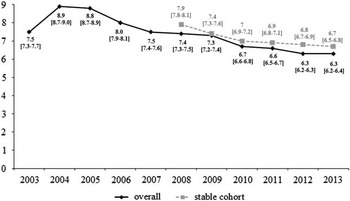
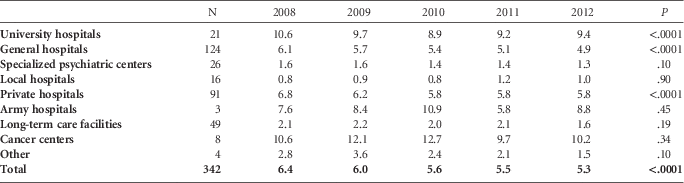
From 2003 to 2012 (217 HCF and 79,780 beds in 2003 to 1,008 HCF and 300,047 beds in 2012) and among the stable cohort 2008–12 (342 HCF), reported BBFE incidence rate per 100 beds decreased by 16.0% and 13.9%, respectively (Figure 1). In almost every type of HCF, percutaneous BBFE incidence rate per 100 beds has decreased significantly among the stable cohort 2008–12 (Table 1). However, this decrease reached statistical significance only in teaching, general public, and private hospitals.
Trends in reported blood and body fluid exposure incidence rates per 100 beds from 2003 to 2012 (diamonds) and among the stable cohort 2008–12 (squares).

Trend in Reported Percutaneous Blood and Body Fluid Exposure Incidence Rates per 100 Beds Among the Stable Cohort 2008–12

From 2003 to 2012, incidence rates decreased from 6.5 BBFE/100 full-time equivalents (95% CI, 6.3–6.7) to 5.7 (5.6–5.9) for nurses (−12.3%); from 2.3 (2.1–2.4) to 1.5 (1.4–1.6) for nurses’ aides (−34.8%); and from 2.5 (2.2–2.9) to 2.3 (2.2–2.5) for physicians (−8.0%). Among the stable cohort 2008–12, BBFE incidence rates decreased from 6.9 (6.7–7.1) to 5.6 (5.4–5.8) for nurses (−18.8%); from 1.8 (1.7–1.9) to 1.4 (1.3–1.5) for nurses’ aides (−22.2%); and from 3.0 (2.7–3.3) to 2.5 (2.2–2.8) for physicians (−16.7%).
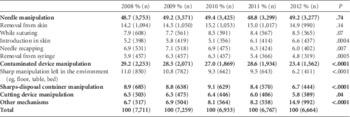
Whatever the personnel category, percutaneous injuries were the most frequently reported BBFE (84.0% in 2003 and 79.1% in 2012), mainly by needlestick (53.1% in 2003 and 48.8% in 2012). The main mechanisms of percutaneous BBFE are available in Table 2. Whereas needle manipulation trend remained steady and still high, the proportion of contaminated device manipulation injuries has decreased significantly. Percutaneous injuries occurring when needles are introduced into skin have increased significantly.
Main Mechanisms of Percutaneous Injuries Among the Stable Cohort 2008–12

Compliance with glove use increased (59.1% in 2003 to 67.0% in 2012), as did sharps container accessibility (68.1% in 2003 to 73.4% in 2012). These trends were also highlighted among the stable cohort 2008–12 (Table 3).
Trend in Compliance With Glove Use and Needle Container Accessibility Among the Stable Cohort 2008–12

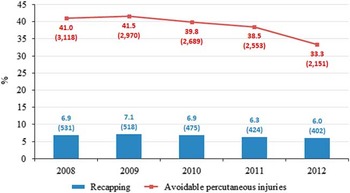
From 2003 to 2012, the avoidable percutaneous injuries proportion decreased from 48.3% to 30.9% (−36%; P=.03) whereas the proportion of recapping was steady (5.8% in 2003 and 5.7% in 2012). Among the stable cohort 2008–12, this significant decrease has also been shown: −18.8% in the proportion of avoidable percutaneous injuries (P<.001) with a significant decrease (–13.0%; P=.007) in the proportion of recapping (Figure 2).
Trend in the frequency of both avoidable percutaneous injuries and recapping among the stable cohort 2008–12, % (n).

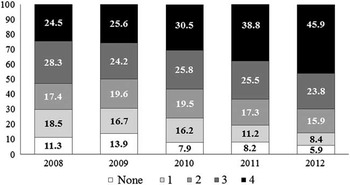
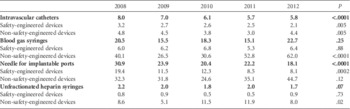
A significant increase in the proportion of SED purchased was observed from 2008 to 2012 (Figure 3). In the same time, using SED was systematically associated with a lower frequency of percutaneous injury, whatever the implied device (P=.003), and for most SED, a downward trend in needlestick injury incidence rate has been observed (Table 4).
Trend in the proportion of healthcare facilities that have purchased more than 1 safety-engineered device among the 4 devices taken into account from 2008 to 2012 (intravascular catheters, blood gas syringes, needles for implanted ports, and unfractionated heparin syringes).

Trend in Needlestick Injuries Incidence Rate per 100,000 Purchased Devices Among the Stable Cohort 2008–12

NOTE. The needlestick injuries incidence rate counts injuries that involved a given device.
The knowledge of the patient source’s status has changed over the period. Unknown HIV status of the source decreased to 16.4% (n=3,080) in 2012 (vs 18.9% in 2003), while unknown hepatitis C virus status of the source decreased to 18.6% (n=3,387) (vs 20.6% in 2003) (P<.0001). Rates of hepatitis B virus surface antigen and hepatitis C virus were 1.7% in 2003 and 1.5% in 2012 and 5.3% in 2003 and 4.3% in 2012, respectively, whereas the rate of HIV infection was 2.3% in 2003 and 2.8% in 2012.
After exposure, 93.8% of HCP immediately washed their injured area (93.6% in 2003) and 95.9% of them used antiseptics (96.8% in 2003) after cleaning when it was a percutaneous injury. Most HCP had a first viral serological test (95.9% in 2012, 97.1% in 2003) and a second test later (78.6% in 2012, 93% in 2003). Postexposure prophylaxis prescription decreased to 10.3% of exposed personnel when HIV status of the source was positive or unknown (11.4% in 2003).
DISCUSSION
This tenth year of surveillance has provided us the opportunity to assess the progress made in French HCF to improve prevention of BBFE. Even if the coverage of French HCF is not exhaustive, a real dynamic has been observed. Indeed, more than 70% of hospital beds were covered by this surveillance in 2012 (16.9% in 2003). Thus, AES-RAISIN data confirm that this network is well established in France.
Considering that all French HCF accounted for 415,209 beds, 26,158 BBFE could have occurred in France in 2012. Compared with 2003 (BBFE incidence rate: 7.5 per 100 beds and 35,364 estimated declared BBFE), we could estimate the yearly number of prevented accidents between those 2 times to be nearly 9,000. From 2003 to 2012 and among the stable cohort 2008–12, AES-RAISIN data have confirmed the trend towards a significant reduction in BBFE incidence, −16.0% and −13.9%, respectively.
In any event, percutaneous BBFE incidence was higher for university hospitals, army hospitals, and cancer centers. This could be partly explained by a shorter mean hospital stay associated with more likely at-risk exposure in such acute care facilities. Further analyses are needed to assess these hypotheses because more and more patients are cared for under such conditions.
Previous results have indicated that HCP safety has sharply increased in France during recent years.Reference Venier, Vincent and L’hériteau 4 These encouraging results may be partially explained on the one hand by an improvement in compliance with standard precautions and protocols to prevent exposure to BBFE and on the other hand by the increase of safety device disposal use (Figure 2). We observed a drop in the injury rate per 100,000 devices ordered, regardless of whether these devices were safety engineered or not (Table 4), suggesting that the overall reduction of needlestick injury was partly related to better compliance with standard precautions, training, and information. However, these undertaken efforts need to be maintained. For example, continuous efforts are still needed to avoid percutaneous injury due to recap, an outcome that still represented 5.7% of exposures in 2012 (5.8% in 2003). Although such injury has decreased significantly from 2008 to 2012 (Table 2), the proportion of percutaneous injuries that occurred while needles are introduced into skin has increased significantly. Several hypotheses may be cited. First, there is poor knowledge of the use of devices, notably when introducing new SED. To improve training and education in the use of needles is of great importance and should be carried out.Reference Shen, Jagger and Pearson 5 Second, environmental backgrounds and poor working conditions (eg, stressful situation, understaffing, emergency context, turbulent patient) could be implicated. Certainly, efforts to improve working conditions need to be sustained. Third, this increase could be explained by a decrease of other mechanisms. In 2012, even if the trend was promising, percutaneous injuries could have been avoided in 30.9% of cases if standard precautions had been followed (48.3% in 2003). Moreover, since circumstances and mechanisms may be different depending on personnel categories, each of them should be considered independently when developing education strategies to encourage compliance to prevent BBFE. By participating in this surveillance, HCF acquire better knowledge of BBFE (notably BBFE circumstances) and can implement measures in order to improve global BBFE prevention. HCF are also able to compare their results with national data, according to HCP categories, in order to create an enabling environment that drives the prevention program in the different types of HCF and in targeted high-risk occupational categories and settings. However, in this study, we have no way to assess how control strategies were conducted and what kinds of educational initiatives were carried out in participating HCF.
Regarding SED, an increase in their use was observed over the years, whatever the type of device, while the injury rate per 100,000 devices was systematically lower with SED than with non-SED. This result was also highlighted by Lamontagne et alReference Lamontagne, Abiteboul and Lolom 6 a few years ago. However, the use of SED varies across institutions. In France, previous research highlighted that the purchase of safety equipment was more common in nonprofit institutions (public hospitals first, followed by private facilities operating within the National Health System) than in private HCF.Reference Floret, Abiteboul and Ayzac 7 These results may therefore be improved by French legislation (Arrêté du 10 juillet 2013 relatif à la prévention des risques biologiques auxquels sont soumis certains travailleurs susceptibles d’être en contact avec des objects perforants) that transposed into law the Council Directive 2010/32/EU of May 10, 2010, implementing the Framework Agreement on prevention from sharps injuries in the hospital and healthcare sector. In 2001 the US Occupational Safety and Health Administration strongly recommended that SED should replace conventional items to minimize blood exposure risk to personnel. Phillips et al,Reference Phillips, Conaway, Parker, Perry and Jagger 8 whatever the denominator examined, have suggested an association between the increase in SED and resultant injuries, and the reduction in overall injury rates, with the law influencing both. However, we do not have enough hindsight to assess the impact of the legislation on SED purchase and use yet. Thus, observing trends in France will provide information on this topic. To the best of our knowledge, there are no data available at the European level.
Better knowledge of the status of source patients may also have contributed to improving the preventive management; this may account for why exposed HCP postexposure prophylaxis has been less delivered these past years. Modifications of recommendations in the past few years of HIV treatment have led more patients to achieve undetectable viral load, explaining possibly the decrease of postexposure prophylaxis prescription. Furthermore, no HIV seroconversion in HCP has been reported recently in France, while the risk still persists. These results are corroborated by recent investigations carried out in France.Reference Lot and Abiteboul 9 , Reference Baudu, Lot and Abiteboul 10 The introduction of point-of-source tests (eg, HIV tests) may improve the quality of the system in this respect.Reference van Wijk, Pelk-Jongen, Wijkmans, Voss and Schneeberger 11
Similarly, efforts should be maintained to improve hepatitis B virus vaccination. The coverage is indeed high but still less than expected (95.5% in 2012) for a mandatory vaccination—in any case, in line with the result reported by Guthmann et alReference Guthmann, Fonteneau and Ciotti 12 in an ad hoc survey undertaken in order to measure vaccination coverage of HCP in France in 2009—but better than coverage among HCP in the United States (61.7% in 2007).Reference Lu and Euler 13
Finally, a number of limitations should be considered. First, there is a risk of recruitment bias that could underestimate the true incidence of BBFE in French hospitals. The BBFE prevention culture may be greater in hospitals that volunteered to participate in the AES-RAISIN network. Thus, trends observed in AES-RAISIN may not perfectly match with those observed elsewhere. Moreover, literature shows that 27% of paramedics and more than 50% of surgeons did not report their BBFE.Reference Venier, Vincent and L’hériteau 4 In this surveillance, we were unable to establish the frequency of underreporting, especially for surgeons who are notorious for underreporting their BBFE.Reference Au, Gossage and Bailey 14 Thus, efforts should be made to decrease underreporting that may lead to inaccurate information regarding the overall risk of exposure. Winchester et alReference Winchester, Tomkins and Cliffe 15 have suggested that regardless of increasing education and awareness, a simple approach to reporting should encourage further reporting of BBFE exposures. Thus, an electronic reporting system accessible on all workplace computers has been suggested. Indeed, full documentation of exposure injuries is needed to guide prevention improvements.Reference Nagao, Iinuma and Igawa 16
The analysis is restricted to nurses, nurses’ aides, and physicians, the categories that most HCP used to declare their BBFE. But ancillary workers were excluded. Their BBFE were not reported to the occupational health departments of participating French HCF. Thus, we cannot rule out an underestimation of the sharps injury rate especially for hospital employees and for contractors working both on-site and off-site. However, among the stable cohort 2008–12, we can observe that the HCF percentage of technical professionals performing these tasks (eg, cleaners, laundry workers, waste handlers) has still been the same.
In conclusion, by participating, HCP gain better knowledge of BBFE, become aware of BBFE circumstances, and enhance prevention in order to improve overall BBFE prevention. HCP safety may have been substantially increased these past years. However, efforts undertaken to improve safety need to be sustained.
Acknowledgments
Financial support. None reported.
Potential conflicts of interest. All authors report no conflicts of interest relevant to this article.