

It is not clear that anything would have been different in the 2007–2009 crisis had Basel III already been in place.
(Admati and Hellwig Reference Admati and Hellwig2013: 96)As finance has become more complicated, regulators have tried to keep up by adopting ever more complicated rules. It is an arms race that underfunded government agencies have no chance to win.
(Kenneth Rogoff, The Guardian, 10 September 2012)I
This year marks the 41st anniversary of a series of bank failures, part of financial disruptions commonly associated with the breakdown of the Bretton Woods system. In summer 1974, two challenges in particular contributed to the bankruptcy of several banks on both sides of the Atlantic, raising problems for which financial regulators were ill-prepared and for which there was little or no helpful historical precedence. First, increasing inflation and volatile foreign exchange rates stimulated demands for financial products to control risk (Eichengreen Reference Eichengreen1996, p. 142). Second, inflation and petrol dollars added greatly to bank liquidity and transformed its nature.
Though not the first period of central bank cooperation, the 1970s witnessed an upsurge of efforts to agree international banking rules, the birth of the Basel Accords, which have become the principal avenue for international and national bank regulation. Today, however, seven years after the 2008 Banking Panic, many observers are not satisfied with the extent and quality of bank oversight, as the above comment by Rogoff suggests (see also Admati and Hellwig Reference Admati and Hellwig2013; Haldane and Madouros Reference Haldane and Madouros2012).Footnote 1 There is substantial evidence that the number of worldwide banking crises, their severity, and cost to society, including government bailouts, have increased since 1970 (Calomiris and Haber Reference Calomiris and Haber2014). At the very least, the Basel Accords have had a decidedly mixed record of stemming the tide of financial instability.
We provide a broader picture of the forces that finally shaped these rules over several decades, in particular the Basel I regulations or Cooke ratio, which continue to provide the underlying structure for most of today's international bank regulation. Putting Basel I into its political-economic context suggests that this regulatory paradigm not only did not respond to the problems of the 1970s and 1980s, but also may have contributed to new ones, including many current issues in global finance. We challenge some core tenets of historical accounts and the efficacy of international attempts to stabilize international finance. In particular, the article tries to understand why Basel I focused exclusively on capital adequacy and credit risk. We argue that this choice was surprising, given that the bank failures in the 1970s at least were mostly caused by a mixture of currency, interest rate and liquidity risk, often in combination with fraud. Moreover, although bank failures in the 1980s were at first blush triggered by credit risk, the underlying reason for these credit losses was a mixture of interest rate, currency and macroeconomic risk, again enhanced by fraud.
We also provide empirical evidence that the level of capital introduced in 1988 was too low to have made a substantial difference for the banking failures of the 1980s, confirming Alan Greenspan's assessment of ‘the arbitrariness of the capital ratios and their inappropriateness for predicting and limiting bank failures’, a weakness he also contends central bankers appreciated well into the 1990s (Greenspan Reference Greenspan1998, p. 165). Neither the failures of the 1970s nor a meaningful part of the failures of the 1980s would have been avoided had the Basel rules defined in the 1988 Accord already been in place. Finally, we will suggest that the approach of the Basel Committee contributed to the emergence of the ‘too big to fail’ phenomenon, which has led to the assumption that governments would protect creditors and depositors from the risks taken by megabanks (Haldane and Alessandri Reference Haldane and Alessandri2009).
Our article contributes to the small but growing literature about the establishment of the Basel regulations. In particular we complement Goodhart's (2011) detailed presentation of the history of the Basel Committee on Banking Supervision (BCBS). In contrast to Goodhart, however, we put the main lines of argument into their historic context, notably adding facts and data known to committee members but not necessarily discussed in the (winnowed) official documents on which Goodhart relies. Kapstein (Reference Kapstein1991) traced the process, but his discussion largely leaves out the economic context. Tarullo (Reference Tarullo2008) contains a comprehensive and very critical discussion of the earlier Basel regulations, but mostly focuses on Basel II regulation. Our point that Basel regulations were not well grounded in economic analysis has been made by several authors, such as Miller (Reference Miller1995), Hellwig and Staub (Reference Hellwig and Staub1996), Allen and Gale (Reference Allen, Gale, Arnott, Greenwald, Kanbur and Nalebuff2003) and Admati and Hellwig (Reference Admati and Hellwig2013). Even the dependence modern international banking has on implicit government guarantees has been pointed out before by Haldane and Madouros (Reference Haldane and Madouros2012). Our contribution here is to highlight the inadequacy of the original rules in light of the perceived original problems, discuss why the approaches were chosen, delineate their continuity in subsequent attempts to bolster bank safety, and suggest how and why they may have contributed to increased risk taking.
The rest of this article is divided into six sections. The next section contains evidence that credit risk, as a standalone risk, played a minor role in the 1970s bank failures and that US regulators, in contrast to some European ones, were much more likely to protect depositors and bank creditors of failed banks. In Section iii, we briefly describe the emergence and the governance of the Basel Committee on Banking Supervision. In Section iv, we discuss some motives for the 1986 US and UK initiatives, which rapidly broke the stalemate in defining the major features of the 1988 Basel I regulations. Section v compares the Basel I rules to the then prevailing approaches to bank regulation and demonstrates the inappropriateness of the new rules. Section vi traces the evolution of the Basel Accords and other regulatory initiatives since 1988 and argues that the flaws in Basel I's original approach hampered the committee's efforts to reform it. We conclude in Section vii by describing an alternative to the Basel approach.
II
The origins of the Basel Committee on Banking Supervision go back to the early 1970s. By the time President Nixon took the United States off the gold standard, virtually unregulated Euromarkets, dominated by big US and UK banks, had already altered the competitive banking landscape. In particular, Euromarkets created a challenge for the smaller, more domestically bound banks of many countries. In contrast to the larger, internationally active ones, these banks had little capacity to escape national regulation. As a consequence, national authorities, under pressure to respond with lighter regulation, removed liquidity standards and reserve requirements together with the deposit rate ceilings. For example, in the fall of 1971, the Bank of England installed the ‘Competition and Credit Control’, which replaced direct lending ceilings imposed on smaller banks with control of money supply through open market operations, reduced the minimum liquidity requirement for deposit taking banks from 28 to 12.5 percent, and eliminated the legal restrictions on deposit rates (Goodhart Reference Goodhart2014; Moran Reference Moran1984). Other countries enacted similar initiatives at the same time.
This deregulation enabled a number of aggressive smaller banks in Europe and the United States to enter new market segments, especially those created by the increased macroeconomic volatility starting in the late 1960s. The first indication that these developments could be problematic came from the ‘secondary banking crisis’ in the United Kingdom. This crisis had its roots in an almost classic combination of interest rate risk, accompanied by credit risk, enhanced by fraud and weak liquidity positions. Large interest rate jumps triggered by the first oil crisis in 1973/74 contributed to a drop in real estate values, which led to higher default rates and lower profitability for smaller ‘secondary’ or ‘fringe’ banks. The resignation of a recent appointee to the board of London and Country Securities, one of the larger secondary banks, brought the crisis to a head. His departure led to a collapse of trust and a string of additional revelations about the bank's unsavory business practices from the newly elected board (Capie Reference Capie2010). The public began to suspect that other smaller banks might have similar problems and started to withdraw deposits.
Remarkably, during this crisis, the Bank of England did everything to make sure that depositors did not lose their money. In order to buy more time, it pushed the large clearing banks, to which depositors had brought the money withdrawn from the secondary banks, to lend this cash back to the failing banks at a low interest rate. In parallel, the Bank of England required the troubled banks' shareholders to recapitalize their institutions or tried to find an acquirer, a strategy that became known as the ‘lifeboat concept’. Interestingly, at the same time, criminal prosecution against key personnel of the troubled banks was commenced, a step believed to constitute an effective part of the regulatory tools. One of the directors of London and Country Securities, for example, went to prison and two others had to pay heavy fines (Bär Reference Bär2004).
The UK's secondary banking crisis was only the beginning. The failure of two US banks in 1973, National Bank of San Diego and then Franklin National, and the German Herstatt in 1974, followed in short order. Their problems could be traced to similar root causes: a combination of fraud, currency speculation and classic interest rate risk. However, the reaction of regulators could not have been more different.
From the failure of the relatively small National Bank of San Diego, US authorities learned a lesson that most likely conditioned their reactions in the more important failure of Franklin National. National Bank of San Diego failed because of fraudulent activities by its owner C. Arnholt Smith and was taken over by Crocker National Bank in conjunction with the Federal Deposit Insurance Corporation (FDIC). The FDIC initially refused to honor some of the bank's letters of credit, which had been bought by European banks, claiming that these banks had been aware of the fraud (FDIC 1998, p. 251; Bär Reference Bär2004). This led to a general mistrust of smaller US banks. As a consequence, US banks started to lose foreign deposits, a decline in business that the Board of Governors of the Federal Reserve System (Fed) wanted to head off. Therefore, when Franklin National went under because of huge foreign exchange losses,Footnote 2 the Fed decided that any threat not to honor foreign depositors by a US bank would lead to a dramatic loss of confidence in US banks and in international currency markets. Despite allegations of mafia ties and fraud by Franklin's controlling shareholder, the Fed decided that all creditors deserved protection and injected a total of $1.8 billion into Franklin National (Spero Reference Spero1999). Franklin was later bought by the European American Bank (EAB), a consortium of European banks, including Deutsche Bank, in order to get EAB a foothold in the US retail market (Kobrak Reference Kobrak2007).
The UK reaction to the secondary banking crisis, as well as the US reaction to Franklin National, contrasts sharply with the Bundesbank's conduct in the Herstatt crisis. A small bank, which had grown from 15 employees to one of the largest private banks in Germany, with 850 employees, in less than 20 years, I. D. Herstatt KGgA's traditional banking business generated low profits. The bank tried to compensate with highly speculative currency trades executed by a group of six traders in their twenties. In a series of events that closely resembled the recent Société Générale / Kerviel debacle, Iwan D. Herstatt claimed that the FX department had manipulated the bank's computer system (Herstatt Reference Herstatt1992) in order to exceed temporarily its limit by up to 750 million marks, a charge contested by some of the employees.Footnote 3
The bank's failure is still well known. It drew attention to a new sort of risk, ‘Herstatt risk’ or ‘settlement risk’, for spot FX transactions, previously assumed to be risk free. When the bank was closed at 15:30 on 26 June 1974, many foreign correspondence banks had already transferred the Deutsche Mark side of the daily currency deals to Frankfurt. Today, this risk can be completely avoided by an instantaneous clearing mechanism, which took 30 years to put in place (Goodhart Reference Goodhart2011: 4).
More important for purposes of this discussion was the Bundesbank's refusal to bail out any of the creditors. The Bundesbank considered saving failing banks outside its mandate, but probably also saw the occasion as a useful way to calm down what it perceived as speculative excesses in the currency markets. In stark contrast to the US regulators, the Bundesbank imposed severe losses on foreign creditors. Indeed, initial estimates of the foreign banks' losses were enormous. Only after a surprising and controversial court decision were the losses of foreign banks reduced to manageable amounts (Bär Reference Bär2004). Nevertheless, the Bundesbank's stance contributed to dampening currency and interbank markets, highlighting the systematic risk of cross-border transactions. Given the Bundesbank's focus, the consequences of the Herstatt failure for the bank's depositors, its owner and its management were dire. While German retail depositors got back around 80 percent of their deposits (Koch Reference Koch2012), the decision makers at Herstatt were also criminally prosecuted.Footnote 4
The Bundesbank's handling of the Herstatt failure was heavily criticized by German and foreign bankers alike. The Board of Governors of the Federal Reserve System even sent a representative to Germany to protest formally the Bundesbank's decision.Footnote 5 This small bank's failure also fundamentally changed West Germany's banking landscape. Even renowned private banks were no longer accepted as counterparties on international money markets. As a consequence, at least 12 smaller institutions closed or were absorbed by larger and financially stronger partners.Footnote 6
Fraud played a role in all the examples cited, but it is not obvious whether fraud was the cause or rather the consequence of failure. The complicating factor is that as with crises, it is not always clear when fraud begins, and it is likely that as the net worth of the bank declines, the incentive to engage in fraud rises, and management's incentives to oversee the institution declines. In some cases, however, fraud was central to the bank's failure. The 1976 failure of the Belgian Banque pour l'Amérique du Sud (BAS) and its controlling entity the American Bank & Trust (ABT) serves as a fascinating and well-documented example. This complex story involved the alleged laundering of ransom money for an Argentinian guerrilla group, a dead lawyer whose deep-frozen body was found on the streets of Buenos Aires. The bank's owner, David Graiver, disappeared in a mysterious plane crash in Acapulco (probably staged) together with approximately $50 million dollars that he had withdrawn directly from bank accounts or transferred to related companies (Karp Reference Karp1979; Haden-Guest Reference Haden-Guest1979).
This case again illustrates the difference between the very cautious treatment of bank depositors in the United States and in the United Kingdom, and that by regulators in continental Europe: all domestic and almost all foreign creditors of ABT were fully reimbursed in the United States, whereas the Belgian deposit insurance refused to reimburse the dollar-denominated deposits of BAS. Despite Herstatt's serious consequences, this difference was still apparent in the early 1980s. Take, for example, the different handling in 1982 of Banco Ambrosiano's failure in Italy, on the one hand, and that of Continental Illinois in 1984, during the height of the Less-Developed Country (LDC) debt crisis. Continental Illinois was the eighth large largest bank in the United States and depended on short-term deposits made by large international investors. When these creditors started to withdraw their funds, the FDIC and the Fed stepped in. While management was removed and shareholders wiped out, all depositors and even bondholders were bailed out. This created public outrage at the time, especially considering that the FDIC, seeking to encourage depositor discipline, had just announced a pilot program in which uninsured depositors and other creditors were only reimbursed a part of their investment. The perceived difference in treatment between large and small banks led to the first popularization of the term ‘too big to fail’ by Congressmen (FDIC 1997).
This bailout of large depositors contrasts with the stance of Italian authorities in the case of Banco Ambrosiano's failure. Banco Ambrosiano had developed a complex Enron-like network of subsidiaries, in which stock values were artificially inflated by cross-lending among the different companies. When these artificial values dropped, the bank collapsed. Italian authorities agreed to bail out the creditors of the parent bank, but refused any help to the foreign creditors of the bank's Luxembourg subsidiary, Banco Ambrosiano Holdings. Luxembourg authorities did not view the subsidiary as a bank holding company and refused to give Italian regulators access to information, despite the subsidiary's heavy borrowing on the interbank markets and its ownership of two banks (Vale Reference Vale, Evanoff, Kaufman and LaBrosse2007). Ultimately, Banco Ambrosiano's creditors were saved by a last-minute cash injection of $246 million from the IOR (Instituto per le opera di religione), the Vatican bank from which Roberto Calvi, Banco Ambrosiano's CEO, had obtained a ‘letter of comfort’, which IOR decided to honor (Bär Reference Bär2004).
In Appendix A, we have constructed a more complete list of bank failures during the 1970s and 1980s, trying to identify the causes of each failure and the loss-absorbing entity. The precise origin of failure is often difficult to identify. During the 1970s, well over half (8 out of 13) of the failures in North America and Europe resulted from a combination of risks: pure fraud, currency risk and interest rate. In the 1970s, the failures related to credit risk mostly concerned smaller banks and often involved concentrated or related lending, often again in combination with fraud. In the early 1980s, the causes of bank failures shifted. The failure of Continental Illinois in particular and the general LDC and the S&L crises involved credit risk. But on closer inspection, this credit risk entailed indirect exposure to market risk: Continental Illinois failed because of dangerous overexposure to energy prices through loans to energy companies acquired from the failed Penn Square Bank. The LDC and the S&L crises were in fact consequences of increases in interest rates and the dollar value, as LDC borrowers were unable to pay higher variable-based interest rates and reimburse principal on their dollar-denominated securities. The savings and loans sector was brought down by a mismatch of interest rates on their assets and liabilities. Credit risk was mainly produced in the later stage of the S&L crisis, as troubled banks gambled on very high-risk ventures (Heffernan Reference Heffernan1996, pp. 268–7).
Our table of bank failures also highlights that, given the absence of explicit and complete deposit insurance in most European bank failures, private creditors took at least some of the losses. In contrast, since the early 1970s (and until the recent crisis), in the United States and United Kingdom very few private creditors were forced to absorb losses caused by a bank's failure. The importance of petrodollars for the financing of these countries' banks and current account deficits seems to have played a role in these differences (Goodhart Reference Goodhart2011, p. 34).
III
Given its importance to the world economy, the Basel Committee on Banking Supervision (BCBS) has a curious history. Formed under the auspices of the Bank of International Settlements (BIS), itself a relic of another financial era (James Reference James1996), the BCBS preceded the crises of the early 1970s. It began its life in 1972 as a ‘Groupe de Contact’ that was set up by six EEC countries with the intention to foster communication among national authorities and to coordinate banking on an international level. Bank failures and turmoil in raw materials markets in 73/74 convinced the G10 that the make-up of the Groupe was too narrow to serve as a place for central bankers to discuss common approaches to issues such as liquidity, solvency and exposure issues, especially as the issues went well beyond Europe (Goodhart Reference Goodhart2011). At the end of 1974, the central bank governors of the G10 therefore set up the BCBS. Its principal mission was the coordination of international banks, in order to avoid banks escaping effective supervision. As one author concluded, ‘The many agreements and concordats show that this Committee's main concern is coordinating supervision, not financial stability’ (Heffernan Reference Heffernan1996, p. 11).
Indeed, until then, Eurocurrency markets, which were absorbing most of the petrodollars, were largely unregulated. From 1974 to 1978, international lending tripled and the portion of offshore bank assets that came from oil producing countries grew from 10 to 25 percent. About 70 percent of the $162 billion invested by OPEC countries went into direct bilateral lending or Eurodeposits, which were recycled in developing country debt. Much of the increase was interbank, as those banks that ran out of borrowers lent to those with more opportunities than deposits (James Reference James1996).
Some banks tried to add to their profits by speculating on interest rates, mismatching sources and uses of funds.Footnote 7 The magnitude of the exposures was extraordinary but the profits were even higher, at least on a non-risk adjusted basis. In 1982, 32 percent of all Citibank's income came from Latin America which only represented 16 percent of its assets (James Reference James1996). As a consequence, normal credit evaluation procedures were ignored, even when they were encouraged by national and international regulators.
Until the failures of Franklin and Herstatt, most monetary authorities evidenced little concern. But in the summer of 1974, its complacency began to break down. Although neither Franklin National nor Herstatt were major, money-center banks, their inability to fulfill their contractual foreign exchange obligations led to blockages in international transfers, just at a time when money was pouring into banks from petrol-producing countries. Many big banks delayed doing business with small American, European and Asian banks for fear that they were unable to satisfy their counterparty obligations (Goodhart Reference Goodhart2011, pp. 32–3). Managing the short-term deposits and exposures in the Euromarkets required seamless movement of funds; any hesitancy about counterparties added transaction costs.
The BCBS took on these challenges with many disadvantages. During the period 1974–97, the committee had six chairs, all central bankers, some of them specialists in regulation, but who only devoted approximately 20–25 percent of their time to the BCBS. The group met four times a year. As the issues faced by the BCBS became broader and more detailed, the BCBS created a number of working groups. Neither the chairs nor the other members of the committee had an official mandate from either their governments or even their central banks. Though a group of like-minded experts, it required unanimity for its outputs, which were recommendations to the G10. Member central banks realized that the BCBS could serve as an antidote to awkward questions about excessive LDC lending and about what central bankers were doing to shore up the world's financial architecture (Goodhart Reference Goodhart2011, p. 86).
Until the LDC defaults, virtually no progress had been made in reforming international finance. Indeed, the BCBS's early efforts to create an early warning system (EWS) for international financial crises produced no warning for the defaults, no concerns about foreign exchange speculation, and no standards of hedging exposures. The committee's principal tangible achievement was the Concordat, an attempt to clarify supervisory authority among internationally active banks. Although this clarification was certainly a precondition for any reform of international finance, it was not itself a major contribution to the stability of the financial system. Indeed, as it turned out, the Concordat needed several rapid revisions to fulfill its original mission, first after the Banco Ambrosiano and then again when the BCCI failure exposed weakness of the initial framework (Alford Reference Alford2005).
With different procedures and attitudes, as well as conflicting national ambitions, getting a consensus among the G10 countries on even some vague ‘best practice’ came slowly. While the participants understood the value of simplicity in capital adequacy, national interest stood in the way. Debates revolved around risk weighting for investments, the components of capital and the number and components of asset categories. But technical analysis seemed always to play second fiddle to country preferences, which for Europeans included bank investments in government and quasi-government paper. The increasing evidence of ‘shaky’ LDC debt compounded the problem (Goodhart Reference Goodhart2011, pp. 157–60).
IV
In the mid 1980s, US officials became increasingly impatient with the pace in Basel. The Latin American debt crisis threatened to bring down the large US banks and increased the political pressure to rein in these banks' speculative excesses. Given the earlier experiences with the National Bank of San Diego and an increasing current account deficit, letting a large bank fail was out of the question. More capital was therefore negotiated as the quid pro quo of the implicit government guarantee of multinational banks (James Reference James1996). In 1983, the US Congress passed the International Lending Supervision Act (ILSA), requiring higher capital standards and greater supervision of US banks' foreign lending.
In this context, the ultimate purpose of capital adequacy ratios was to reduce the cost of future bailouts rather than to stabilize the banking sector. Indeed, even if a bank failed, higher capital ratios imply lower cash injections from the government in case of failure. The complex bargaining process between the US Congress and the banking sector about sharing potential bailout costs helps explain the eventual reliance on capital adequacy as the primary regulatory tool without extensive empirical or theoretical justification about bank failures (James Reference James1996).
Understandably, those countries whose banks suffered less from the LDC crisis had little interest in capital adequacy controls. What changed the dynamics of the decision-making process was the rapid market share increases of mostly Japanese and French banks in the Eurodollar markets. American banks viewed their new capital adequacy regulations as a competitive disadvantage. As a consequence, the US Congress put pressure on the chair of the Fed to push for higher, harmonized capital ratios, a pressure passed on to the BCBS via the G10. After a half-hearted response from the other Basel Committee countries, in 1986, the United States and United Kingdom used a tactic that is well known from trade negotiations. They went their own way, creating their own capital adequacy ratio (CAR), implicitly threatening other countries with exclusion from their markets if those countries failed to apply the same standards (Kapstein Reference Kapstein1991).
This American and British action put pressure on the BCBS, whose German, Japanese and French representatives dissented from tighter CARs and whose complaints had to be integrated into the outcomes. Without any legal authority, suddenly the BCBS shifted from merely making recommendations to formulating regulations for the G10 as well as other countries (Goodhart Reference Goodhart2011, pp. 5, 194–5).
The French and Japanese banks indeed had extraordinarily low equity ratios (around 2 percent), even if it is doubtful whether this was the reason for their competitive pricing. As Admati and Hellwig (Reference Admati and Hellwig2013) have stressed, the Modigliani and Miller (Reference Modigliani and Miller1958) capital structure irrelevance results should also apply to the banks. Therefore, apart from taxes and other transaction costs, capital structure should not affect the cost of capital. A more likely explanation of the French and Japanese banks' low cost of financing was government guarantees (implicit for Japanese banks and explicit for the government-owned French banks), as well as a low-equity return required from government and Keiretsu shareholders, especially compared with those required by US and UK equity markets. In addition to this low required return on equity, Japanese as well as French banks also had a very low cost of debt, as they drew cheap deposits from sheltered domestic sources with uncompetitive credit practices. For example, in France, until 2005, banks were legally forbidden to pay interest on checking accounts (Fonteny et al. Reference Fonteny, Kierzenkowski and Lascar2006). In Japan, the postal savings system tapped into a large portion of a market with very high savings at extremely low interest rates. The Basel capital adequacy ratios may therefore not have substantially affected the cost of capital nor stabilized these countries' banks as the Japanese and French banking crisis in the 1990s demonstrated. However, they certainly limited the expansion of Japanese and French banks, as both were unable to raise new capital from their shareholders.
National competition, then, not bank safety, provided the context for the acceptance of the US capital adequacy requirements, the ‘prudential Cooke Ratios’. In fact, the text of the accord explicitly states two ‘fundamental objectives’, the prudential one of ‘soundness and stability of the international banking system’ and the reduction of ‘competitive inequality among international banks’ (Basel Committee 1988, paragraph 3). The relative importance of the two objectives is difficult to assess but Tarullo (Reference Tarullo2008) observes that ‘by the time hearings on the proposed Basel accord were held by the banking committee of the House of Representatives in April 1988, not a single member of the committee inquired into whether the proposal was adequate to protect the safety and soundness of the financial system. Nearly every question was focused on whether US banks … would be competitively disadvantaged’ (p. 52). American banks had always considered that ‘Euro-Dollars Are Our Dollars’Footnote 8 (our emphasis) and were not willing to let the Japanese and French banks capture substantial market shares.
V
Surprisingly, capital adequacy had only emerged in the 1980s as an important tool for banking supervision and regulation. Goodhart (Reference Goodhart2011, p. 197) provides an internal document showing that even among the BCBS countries capital adequacy played little or no regulatory role. France, Italy as well as the United States and the United Kingdom had no capital adequacy ratios in the early 1980s. Only in 1982 did the United States start to enforce explicit capital requirements (Morgan Reference Morgan, Newman, Milgate and Eatwell1992; Baer and McElravey Reference Baer and McElravey1992). As late as in the 1970s, the US Office of the Comptroller of the Currency (OCC) explicitly emphasized the importance of a variety of nonfinancial factors in assessing the adequacy of a bank's capital (Tarullo Reference Tarullo2008). With the 1978 establishment of the Federal Financial Institution Examination Council, this multifaceted approach was formalized and became the CAMELS framework, under which a bank's capital level, asset quality, management, earnings, liquidity and sensitivity to market risk all come together to provide an assessment of the bank's stability.
There are a number of good reasons why capital adequacy was not viewed as a useful concept by many bank regulators. Most importantly, the experience of the bank failures had demonstrated that losses were typically substantially larger than what even reasonably high capital levels could have absorbed. For example, Continental Illinois had approximately $40 billion in assets in 1984, but received a total of $5.5 billion of new capital and $8 billion in emergency loans, implying that an equity ratio of far more than 30 percent would have been necessary to prevent a failure, even in the absence of a run by international creditors (FDIC 1998).
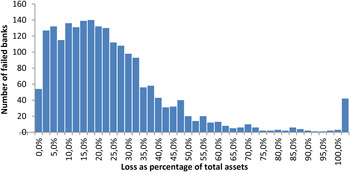
These figures are not at all unusual. The FDIC provides loss estimates for 2,093 out of the 2,402 bank failures and assistance programs from 1986 to 2000. The average loss during this period amounted to 24 percent of the bank's assets; the median loss was still 19 percent of assets. Figure 1 was generated using information about bank failures in the United States provided by the FDIC, using all bank failures and assisted banks for which loss estimates are available.
Distribution of losses for failed US banks, 1986–2000

Only 15 percent of the losses are below 5 percent of assets and 20 percent below 8 percent, which implies that only a very small fraction of failures could have been prevented with Basel I type capital adequacy. Note that in some cases the losses exceed the size of the bank's balance sheet, presumably because of large off-balance-sheet exposures. Obviously, some of these losses are produced by transaction- and ‘fire-sale costs’ after banks become financially distressed. Precise information on the origin and timing of the losses is difficult to obtain for a larger sample, but for banks such as Continental Illinois, American Bank and Trust or Herstatt, analyzed above in detail, losses exceeded the bank's capital before financial distress.Footnote 9
Another major shortcoming of the Basel I regulations is their focus on book equity, an easily manipulated measure. During the 1990s, the Japanese, in particular, used a large range of techniques to produce high capital adequacy ratios, while remaining economically insolvent. These included: under-reserving against recognized bad loans (Fukao Reference Fukao, Blomstrom, Corbett, Hayashi and Kashyap2003), underreporting the number of bad loans (Hoshi and Kashyap Reference Hoshi and Kashyap2004), ever-greening loans to underperforming companies (Peek and Rosengren Reference Peek and Rosengren2005), including deferred taxes in capital, even though deferred tax assets cannot be used as a buffer against failure, and finally ‘double gearing’, the practice of lending money to other institutions, which then in turn reinvest these funds as Tier 1 or Tier 2 capital.
This evidence did not deter regulators from relying on capital adequacy. Given that the role of capital as a buffer was clearly at odds with the evidence, in the 1980s a new argument emerged. Capital was viewed as a way of decreasing banks' incentives to take high risk, because well-capitalized banks had a higher ‘franchise value’ or, in current jargon, more ‘skin in the game’. Even if high equity levels would not be sufficient to save a bank from imprudence, the argument runs that high capital levels thwarted excessive risk taking.
Unfortunately, there is evidence that under some circumstances higher capital levels can lead to an ever higher appetite for risk. In an early paper on this topic, Sheldon (Reference Sheldon1996) reports that capital to asset ratios correlate inversely with Moody's ratings and other measures of bank default probability. Although Sheldon recognized that this relationship might result from reverse causality, his results suggest that the disciplining effect of high capital ratios is likely to be small. The jury is still out on the disciplining effect of capital, stimulating many new studies (VanHoose Reference Vanhoose2007; Stolz Reference Stolz2002). Jeitschko and Shin (Reference Jeitschko and Shin Dong2007) found a positive relationship between risk taking and high capitalization for publicly traded banks, but a negative one for privately held ones. Laeven and Levine (Reference Laeven and Levine2009) showed it is not so much the banks' capital levels that have a disciplining effect on risk taking but rather their governance structures.
Overall, the Basel I standards represented a modest improvement on existing international bank averages, despite their generous definitions of capital and lax valuations of some risks, but parts had some indirect pernicious and unforeseen consequences. With the newly implemented Basel regulations, existing multi-criteria approaches were perceived as outdated, inefficient and, therefore, wound down. The Basel standards may also have had a perverse effect on bank capitalization strategies. Instead of viewing banks with high levels of equity as prudent and conservatively financed, financial analysts started to consider equity levels above the regulatory minimum as ‘inefficient use of capital’, a view for which there is no academic support (Admati and Hellwig Reference Admati and Hellwig2013).
VI
To its credit, from the beginning, the BCBS recognized the severe limits of the rules that it had proposed. The official 1988 document clearly acknowledged that Basel I was a highly imperfect set of rules, covering only a small part of bank risks. The committee had even mapped out a process for improving the first standards (Goodhart Reference Goodhart2011, p. 191). Remarkably, however, further updates of the Basel framework did not focus on interest rate risk in the banking bookFootnote 10 or liquidity risk, both of which had been recognized as essential during the earlier years of the committee. Extensions dealt with market and operational risk, certainly important but arguably less crucial to banking than the risks identified earlier by the committee.
Even today, there are still some gaping holes in the overall framework. For example, the BCBS has only begun to study the allocation of prudential capital to interest rate risk in the banking book, setting up a Task Force on Interest Risk (TFIR). Similarly, until the introduction of the ‘Supervisory framework for measuring and controlling large exposures' (BCBS 2014) in 2014, no form of concentration risk had been considered in the calculation of capital requirements.
Although the Basel Committees initiated a broad process bent on increasing international capital market safety and reducing monitoring costs, their recommendations remained narrow and ill focused. Despite the limits of capital adequacy as a tool for reducing system risk, the capital adequacy ratio continued to serve as a blueprint and core for future efforts. In fact, there is much evidence that the BCBS spent a great deal of time not on completing the initial set of rules by including risks that had been omitted by the Basel I regulations, but rather on mitigating distortions created by its first attempt at international regulation.
In particular, the risk weightings under Basel I created new problems. The pragmatic grouping of assets remained ‘ad hoc and broad-brush, based on subjective (and political) judgment, not on any empirical studies’ (Goodhart Reference Goodhart2011, p. 195). The possibility that the Basel I Accord might itself contribute to serious distortions in bank asset portfolios and funding received little or no attention at the time. The Basel II rules, however, tried to address this issue by introducing finer risk weightings, but the attempt to make capital adequacy requirements more risk sensitive led regulators as well as the industry into a quagmire of complexity that consumed considerable resources and stalled regulators' efforts. Basel II rules also encouraged the banks to model risk in the same way, which increases the covariance of their portfolios and therefore the risk of systemic crises.
To obtain these risk weightings, the BCBS relied either on the assessment of external rating agencies or on the banks' own internal ratings derived with statistical risk assessment techniques developed by major banks in the 1980s and 1990s. Both approaches failed in the crisis: rating agencies produced highly misleading ratings for large classes of financial assets, in particular for Asset Backed Securities (ABS), in large part because of the conflicts of interest inherent in the ‘issuer pay model’ adopted in the 1970s. The banks' own internal models were not much better, probably because of a similar conflict of interest. Expecting banks to assign truthful ratings to their own clients, thereby degrading their own capital adequacy levels, seems particularly naïve.
Even assuming that banks have incentives to estimate correctly their counterparties' risk, the precision of the statistical tools prescribed by Basel II relied on the assumption that historical patterns and relationships used to calibrate the degree of risk would continue into the future. Given the very rapid transformation of financial markets, this was a rather tenuous hypothesis, especially during turbulent times. The Basel Committee's own recent ‘Regulatory consistency assessment programme’ provided evidence to support this conclusion (BCBS 2013). It found that major banks obtained vastly different risk weightings when assessing the same portfolio of loans, although they were ostensibly using the same techniques.
Overall, the extensions of the initial Basel Accord seemed to have weakened rather than strengthened the regulatory framework. As Daniel Zuberbühler stated in 1996:
Compared with the present Swiss capital adequacy ratios for market risks, however primitive and incomplete they may be, the implementation of the Basle standard approach, let alone the models approach, would bring about a further erosion of the once tough capital requirements. Every adaptation to the international minimum standards since 1989 has decreased the amount of required capital in Switzerland. (Hellwig and Staub Reference Hellwig and Staub1996, p. 769)
The Basel Committee is now examining some more radical changes in methodology. It is considering undoing much of the risk-weighting methodology, which was at the heart of the Basel II rules and which remained fundamentally unchanged in Basel III updates (Heltman Reference Heltman2014). In a consultation document (BCBS 2014), the Basel Committee also indicated that it may introduce a ‘risk driver’ approach for some types of credit risk, a broad analysis of what contributes to risk for determining the standardized risk weights. Together these reforms amount to a fundamental revision of Basel III rules that some observers are already referring to as the Basel IV framework (KPMG 2015).
VII
In light of nearly three decades of increasing international financial regulation, determining whether the glass is half full or half empty is complicated. For 30 years, regulators made great strides in exchanging information, developing a common language, codifying and harmonizing national regulations. We have argued here that, although the Basel Accords represent a remarkable achievement in international cooperation, gaining sufficient support for acceptance required placing a bet on a methodology that has not produced a reliable framework for prudential regulation and perhaps even blocked other approaches.
Regulators were aware of the shortcomings of the first set of standards and mapped out a process of continuous improvement built on the initial set of rules, but adherence to fundamentally flawed concepts has hindered and still hinders achievement of this socially vital objective. With its focus on capital regulation and credit risk, the Basel process led bank regulation on a path away from broader, earlier forms of regulation and toward one that is narrow and based on questionable assumptions.
There are alternatives to the ‘command and control’ approach of the Basel rules. Regulators and academics have begun to realize that the root cause of financial crises lies not just in a financial system's technical characteristics, but rather in misguided incentives. Trying to fix capital adequacy ratios, restricting the banks' scope of business activities, and monitoring complicated financial measures only treats symptoms, if banks' or bank employees' incentives are geared to high risk. Acting directly on incentives results in a ‘market-mimicking’ approach to regulation that offers a more elegant and probably more efficient mechanism than the old-style bureaucratic command and control thinking (Roe and Troege Reference Roe and Troege2013).
As a consequence, regulatory initiatives trying to shape incentives rather than micro-manage banks' business decisions are gaining traction. For example, the key suggestion of the UK's 2013 Parliamentary Commission on banking standardsFootnote 11 included new rules on senior management remuneration that were implemented in the UK's 2013 Banking Reform Act. The resolution and restructuring frameworks introduced in the European Union, moreover, are intended to increase creditors' incentives to monitor bank risk. But fixing the individual banker's incentives is unlikely to work well in organizations with overall distorted, risk-taking corporate cultures. Even shareholders require more incentives to go beyond ‘narrow compliance’ (Tarullo Reference Tarullo2014). Cihák et al. (Reference Cihák, Demirgüç-Kunt and Barry2013) proposed using ‘incentive audits’ as a new tool to identify misalignments between the public's interest and the potential for private profits in large banks. Unfortunately, these initiatives have had no traction inside the Basel process.
Surprisingly, one area has received relatively little attention: fixing regulators' and governments' incentives. Clearly, long before the 2008 Bankers' Panic, regulators and their charges shared assumptions and attitudes, which can be both useful for implementing policy and impediments to critical thinking. But today's consensus among the regulated and regulators around a shared faith in the rationality of market-makers and mathematical methodology has led to repeating the banks' mistakes (Barth et al. Reference Barth, Caprio and Levine2012). Perhaps we do not need more regulations but rather better incentives for regulators to use their powers to challenge bankers' innovative zeal. Not only is the revolving door between the regulators and banks a danger, as some critics have claimed, but so too are the political/economic benefits of some banking practices to the very politicians – and their constituencies – to whom regulators are ostensibly responsible. Our story suggests that many governments profited from some of the international banking practices, a regulatory disincentive that contributed to a very dangerous financial architecture (Rajan Reference Rajan2010).
Appendix A
Bank failures 1970s–1990s: cause and resolution
In this table we have extracted the likely reason for the bank's failure and the origin of the compensation for the bank's losses from a number of sources (Goodhart Reference Goodhart1995; Gup Reference Gup1998; FDIC 1997; OECD 1993; Perez Reference Perez1997; Pohl and Freitag Reference Pohl and Freitag1994; Sprague Reference Sprague1986; Thompson Reference Thompson1991; Vale Reference Vale2006; Vives Reference Vives1990).Whenever possible we have tried to identify the principal reason for the bank's losses, classified into four categories (1) credit risk, (2) fraud, (3) market risk (4) liquidity risk, depending on what key words we could identify from the sources cited above. If available we have also tried to extract the underlying reason for the emergence of these losses such as related and concentrated lending.
Bank failures 1970s–1990s: cause and resolution