





-
• Transcutaneous auricular vagus nerve stimulation (taVNS) was associated with increased empathic choice compared to sham stimulation.
-
• A group × ethnicity interaction indicated that the stimulation effect was selectively larger for outgroup (African) faces, in the absence of a detectable baseline ingroup bias.
-
• These exploratory behavioural findings are consistent with the aversiveness reduction hypothesis of empathy, but should be interpreted cautiously because no autonomic or neural index of vagal engagement was obtained.
-
• The sample was small (N = 28; 14 per group) and the study was exploratory; the design was sensitive only to large effects, and although the key interaction survived bootstrap and Bayesian re-analysis, it remained marginal (p = 0.048) with a credible interval bordering on null, so replication is essential.
-
• No autonomic (e.g. heart rate variability, skin conductance) or neural index was collected, so successful vagal engagement and the proposed aversiveness-reduction mechanism were inferred rather than directly verified.
-
• Although trait empathy was assessed and groups were balanced, no baseline measures of implicit bias, intergroup contact, familiarity, or attitudes, and no state-level dissociation of personal distress from empathic concern during the task, were obtained, limiting interpretation of the social–cognitive processes involved.
-
• Group membership was operationalised solely by perceived race (Asian vs. African faces), a proxy that may not capture psychologically validated ingroup/outgroup boundaries.
-
• The adapted task included 40 trials (20 per ethnicity); while sufficient for the mixed-effects analysis, this is shorter than the standard EST and limits the precision of individual-level behavioural estimates.
-
• All participants were East Asian and tested in a single session, restricting cross-cultural generalisability and precluding conclusions about durability or cumulative effects.
Introduction
Empathy, the ability to share and understand the emotional states of others, plays a fundamental role in prosocial behaviour and social cohesion (Singer et al., Reference Singer, Seymour, O’Doherty, Kaube, Dolan and Frith2004; Decety, Reference Decety2010). Neuroimaging research has established that observing others in pain activates the affective components of the pain matrix – particularly the anterior insula and anterior cingulate cortex – representing a shared neural code for experienced and vicarious affect (Singer et al., Reference Singer, Seymour, O’Doherty, Kaube, Dolan and Frith2004). However, empathy is not uniformly distributed across social targets. A robust finding in social neuroscience is the ingroup empathy bias: individuals tend to empathise more readily with members of their own racial or social group than with outgroup members (Xu et al., Reference Xu, Zuo, Wang and Han2009; Avenanti et al., Reference Avenanti, Sirigu and Aglioti2010; Han, Reference Han2018). Xu et al. (Reference Xu, Zuo, Wang and Han2009) demonstrated that anterior cingulate cortex responses to observed pain were significantly greater for racial ingroup than outgroup faces, while Avenanti et al. (Reference Avenanti, Sirigu and Aglioti2010) showed that sensorimotor resonance with pain, measured via transcranial magnetic stimulation, was reduced for other-race individuals and correlated with implicit racial attitudes. This bias extends beyond pain to emotional sharing more broadly: EEG studies reveal that neural mirroring of actions and affective states is present for ingroup but absent or attenuated for outgroup members, with the magnitude of this empathy gap predicted by prejudice levels (Gutsell & Inzlicht, Reference Gutsell and Inzlicht2010, Reference Gutsell and Inzlicht2012). Importantly, such parochial empathy has downstream behavioural consequences, predicting reduced altruism and greater endorsement of passive harm toward outgroups (Bruneau et al., Reference Bruneau, Cikara and Saxe2017). We note, however, that racial group membership is only one – and an imperfect – proxy for the psychological boundaries that drive these effects, a caveat we return to below.
A longstanding theoretical debate concerns the motivational underpinnings of empathy for suffering. The empathy–altruism hypothesis proposes that empathic concern is an other-oriented emotional response that directly motivates helping behaviour (Batson, Reference Batson2011; Batson et al., Reference Batson, Lishner and Stocks2015). Under this account, personal distress and empathic concern represent qualitatively distinct vicarious emotions with different motivational consequences: personal distress produces egoistic motivation to reduce one’s own aversive state, whereas empathic concern produces genuinely altruistic motivation directed at relieving the other’s suffering (Batson et al., Reference Batson, Fultz and Schoenrade1987). In contrast, the aversiveness reduction hypothesis suggests that witnessing others’ distress produces personal aversive arousal, and that apparent empathic behaviour is primarily motivated by the desire to reduce one’s own negative state (Cialdini et al., Reference Cialdini, Brown, Lewis, Luce and Neuberg1997). Multimethod studies have shown that physiological markers distinguish these two responses: heart rate deceleration during exposure to a needy other indexes outward-focused sympathy and predicts increased helping, whereas heart rate acceleration indexes self-focused distress and predicts helping only when escape is difficult (Eisenberg et al., Reference Eisenberg, Fabes, Miller, Fultz, Shell, Mathy and Reno1989; Reference Eisenberg, Eggum and Di Giunta2010). If aversive arousal is indeed a key barrier to empathic engagement, then reducing this arousal might increase, rather than decrease, willingness to empathise – particularly toward targets for whom the baseline affective cost is highest.
Transcutaneous auricular vagus nerve stimulation (taVNS) offers a non-invasive means of modulating autonomic nervous system activity. By delivering electrical impulses to the auricular branch of the vagus nerve through the skin of the ear, taVNS has been associated with increased parasympathetic tone and reduced sympathetic reactivity, although effects on peripheral autonomic indices are heterogeneous across studies (Bretherton et al., Reference Bretherton, Atkinson, Murray, Clancy, Deuchars and Deuchars2019; Machetanz et al., Reference Machetanz, Berelidze, Guggenberger and Gharabaghi2021; Forte et al., Reference Forte, Favieri, Leemhuis, De Martino, Giannini, De Gennaro, Casagrande and Pazzaglia2022). According to polyvagal theory (Porges, Reference Porges2007), the myelinated ventral vagal complex supports a social engagement system that links cardiac regulation to facial expression, vocalisation, and attentional orienting toward social cues. Enhanced vagal tone has been proposed to facilitate social engagement by promoting a calm physiological state conducive to affiliative behaviour. Consistent with this framework, a meta-analysis reported a reliable association between heart rate variability – a proxy for vagal tone – and compassion-related responding (Di Bello et al., Reference Di Bello, Carnevali, Petrocchi, Thayer, Gilbert and Ottaviani2020), and individual differences in heart rate variability predict trait empathy (Kogan et al., Reference Kogan, Oveis, Carr, Gruber, Mauss, Shallcross, Impett, van der Lowe, Hui, Cheng and Keltner2014; Lischke et al., Reference Lischke, Pahnke, Mau-Moeller, Behrens, Grabe, Freyberger, Hamm and Weippert2018). Previous research has demonstrated that taVNS can enhance emotion recognition from faces (Sellaro et al., Reference Sellaro, de Gelder, Finisguerra and Colzato2018), modulate attentional resource deployment toward socially relevant cues (Maraver et al., Reference Maraver, Steenbergen, Hossein, Actis-Grosso, Ricciardelli, Hommel and Colzato2020), and increase cooperative behaviour in social dilemma tasks (Oehrn et al., Reference Oehrn, Molitor, Krause, Niehaus, Schmidt, Hakel, Timmermann, Menzler, Knake and Weber2022). However, its effects on empathic decision-making and intergroup empathy bias remain unexplored.
The present study investigated whether taVNS modulates empathic choice using the Empathy Selection Task (EST) (Cameron et al., Reference Cameron, Hutcherson, Ferguson, Scheffer, Hadjiandreou and Inzlicht2019; Ferguson & Inzlicht, Reference Ferguson and Inzlicht2023). The EST provides a behavioural measure of motivated empathy by offering participants repeated choices between empathising with or merely describing the emotional expressions of target individuals. Robust empathy avoidance has been observed across multiple studies, driven by perceived cognitive costs of empathising (Cameron et al., Reference Cameron, Hutcherson, Ferguson, Scheffer, Hadjiandreou and Inzlicht2019), and the task demonstrates good test–retest reliability (Ferguson & Inzlicht, Reference Ferguson and Inzlicht2023) and sensitivity to motivational manipulations (Ferguson et al., Reference Ferguson, Cameron and Inzlicht2020). We adapted the EST to include both ingroup (Asian) and outgroup (African) targets to examine whether taVNS differentially modulates empathic choice across group boundaries. Given the exploratory, single-session design, we tested two hypotheses: (1) the active stimulation group would show greater empathic choice than the sham group, and (2) the effect of stimulation would differ across ingroup and outgroup targets.
Material and methods
Participants
Twenty-eight healthy participants (17 male, 11 female; all East Asian) were recruited from Korea University. Participants were screened using the Center for Epidemiologic Studies Depression Scale (CES-D) (Radloff, Reference Radloff1977) to exclude individuals with elevated depressive symptoms that might confound empathic responding. Participants were randomly assigned to either the active taVNS group (n = 14) or the sham stimulation group (n = 14). This sample size was determined by participant availability rather than an a priori power calculation; the study is therefore best regarded as an exploratory pilot, and the implications for statistical power are addressed in the Statistical analysis section and Discussion. To verify that randomisation produced comparable groups, participants also completed trait measures of empathy (Interpersonal Reactivity Index, including its Empathic Concern and Personal Distress subscales; Balanced Emotional Empathy Scale). The active and sham groups did not differ on any of these dispositional measures or in sex distribution (all p > 0.28; see Results), indicating that the groups were balanced on baseline empathic disposition.
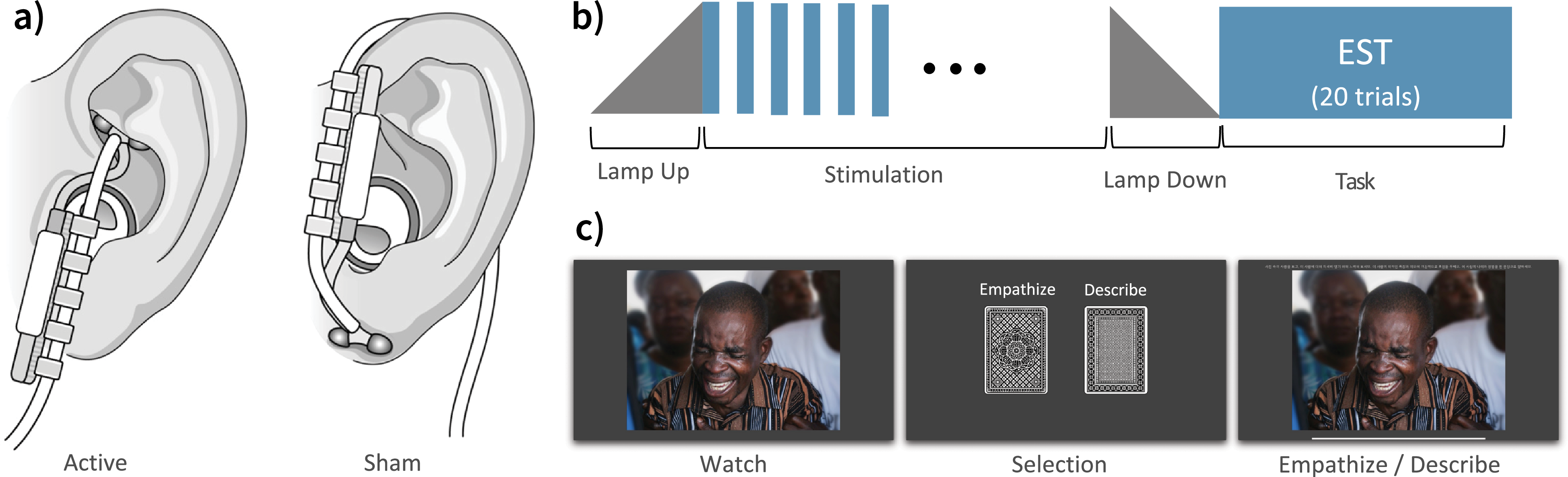
(a) Placement of the transcutaneous vagus nerve stimulation (tVNS) device. The stimulation electrode was positioned in the cymba conchae of the left outer ear to target the auricular branch of the vagus nerve. (b) Stimulation protocol and task timing. Biphasic electrical stimulation (0.5 mA, 25 Hz) was applied in alternating 30 s ON/30 s OFF intervals. Each trial included a ramp-up (‘ramp up’), stimulation period, ramp-down (‘ramp down’), followed by the task phase. (c) Empathy selection task (40 trials, 20 per ethnicity; adapted from Cameron et al.). Participants viewed emotionally evocative images, selected between ‘empathise’ and ‘describe’ options, and then performed the chosen task.

taVNS procedure
Stimulation was delivered using a Cerbomed NEMOS device (tVNS Technologies GmbH), following established reporting guidelines (Farmer et al., Reference Farmer, Strzelczyk, Finisguerra, Gourine, Gharabaghi and Hasan2021). In the active condition, the stimulation electrode was placed on the cymba conchae of the left outer ear to target the auricular branch of the vagus nerve. Biphasic electrical stimulation was applied at an intensity of 0.5 mA and a frequency of 25 Hz, with alternating 30-second ON and 30-second OFF cycles. The sham condition followed an identical procedure with the electrode placed on the earlobe, a location not innervated by the vagus nerve. Stimulation was administered for 15 minutes prior to the behavioural task (Figure 1). No autonomic readout (e.g. heart rate variability) was recorded during stimulation; consequently, the present design does not provide independent confirmation that active stimulation produced the intended shift in autonomic balance.
Empathy selection task
The EST (Cameron et al., Reference Cameron, Hutcherson, Ferguson, Scheffer, Hadjiandreou and Inzlicht2019; Ferguson & Inzlicht, Reference Ferguson and Inzlicht2023) was adapted to include both ingroup and outgroup facial stimuli. On each trial, participants first viewed a face displaying a negative emotion (lament or pain). An initial watching stage provided the ethnic cue (ingroup or outgroup) before the selection. Participants then chose to either ‘Empathise’ (share and feel the person’s emotion) or ‘Describe’ (objectively describe the physical features of the expression), and subsequently performed the chosen task. The task comprised 40 trials: 20 featuring Asian (ingroup) faces and 20 featuring African (outgroup) faces, presented in a newly randomised order for each participant so that ingroup and outgroup trials were intermixed and counterbalanced over the session. The valence and arousal of the facial stimuli were validated by independent raters (Asian: valence = 1.20, arousal = 4.71; African: valence = 1.18, arousal = 4.80), confirming comparable emotional intensity across stimulus categories.
The 40-trial length (20 per ethnicity) represents a shortening of the original EST so that the full task could be completed within the limited post-stimulation window, during which taVNS-related autonomic effects are expected to be present (Cameron et al., Reference Cameron, Hutcherson, Ferguson, Scheffer, Hadjiandreou and Inzlicht2019). We acknowledge that this short form provides fewer observations per cell than the longer versions of the EST; nevertheless, the design preserves 20 binary observations per within-subject cell, which supported the mixed-effects structure described below, and the by-subject random-effects estimates indicated reliable individual differences in empathic choice (random-intercept SD on the logit scale = 0.82).
Statistical analysis
A generalised linear mixed model (GLMM) with a binomial distribution and logit link function was used to evaluate the effects of taVNS stimulation (Active vs. Sham) and stimulus ethnicity (Ingroup vs. Outgroup) and their interaction on the probability of empathic choice on each trial. To account for repeated measures, the model included a by-participant random intercept and a by-participant random slope for the within-subject factor of ethnicity. Fixed effects were coded with the active group and outgroup (African) targets as reference categories. Effects are reported both as log-odds coefficients (β) and as odds ratios (OR = e β ) with 95% confidence intervals (CI), the latter providing a more interpretable index of effect magnitude. Models were fitted by maximum likelihood (Laplace approximation) in R using lme4.
Given the small sample, we performed three additional checks to gauge the robustness of the key effects. First, because the maximal random-effects structure was mildly over-parameterised at this sample size (a singular intercept–slope correlation), we refitted a reduced random-intercept-only model, which yielded essentially identical fixed effects (interaction β = 0.50, p = 0.050). Second, we conducted a parametric bootstrap (2,000 simulations) of the group × ethnicity interaction. Third, we re-estimated the model in a Bayesian framework (brms; weakly informative Normal(0,2.5) priors; four chains; all R̂ = 1.00) and report posterior ORs with 95% credible intervals (CrIs) and posterior probabilities of direction.
Because the sample size was fixed by availability rather than an a priori calculation, we also conducted a sensitivity analysis. At the participant level (two groups of n = 14, α = 0.05 two-tailed, power = 0.80), the study was sensitive only to large between-group differences (Cohen’s d ≈ 1.06); smaller, potentially meaningful effects could not be reliably detected. This participant-level constraint, together with the marginal interaction, underscores that all inferences are exploratory and warrant confirmatory replication.
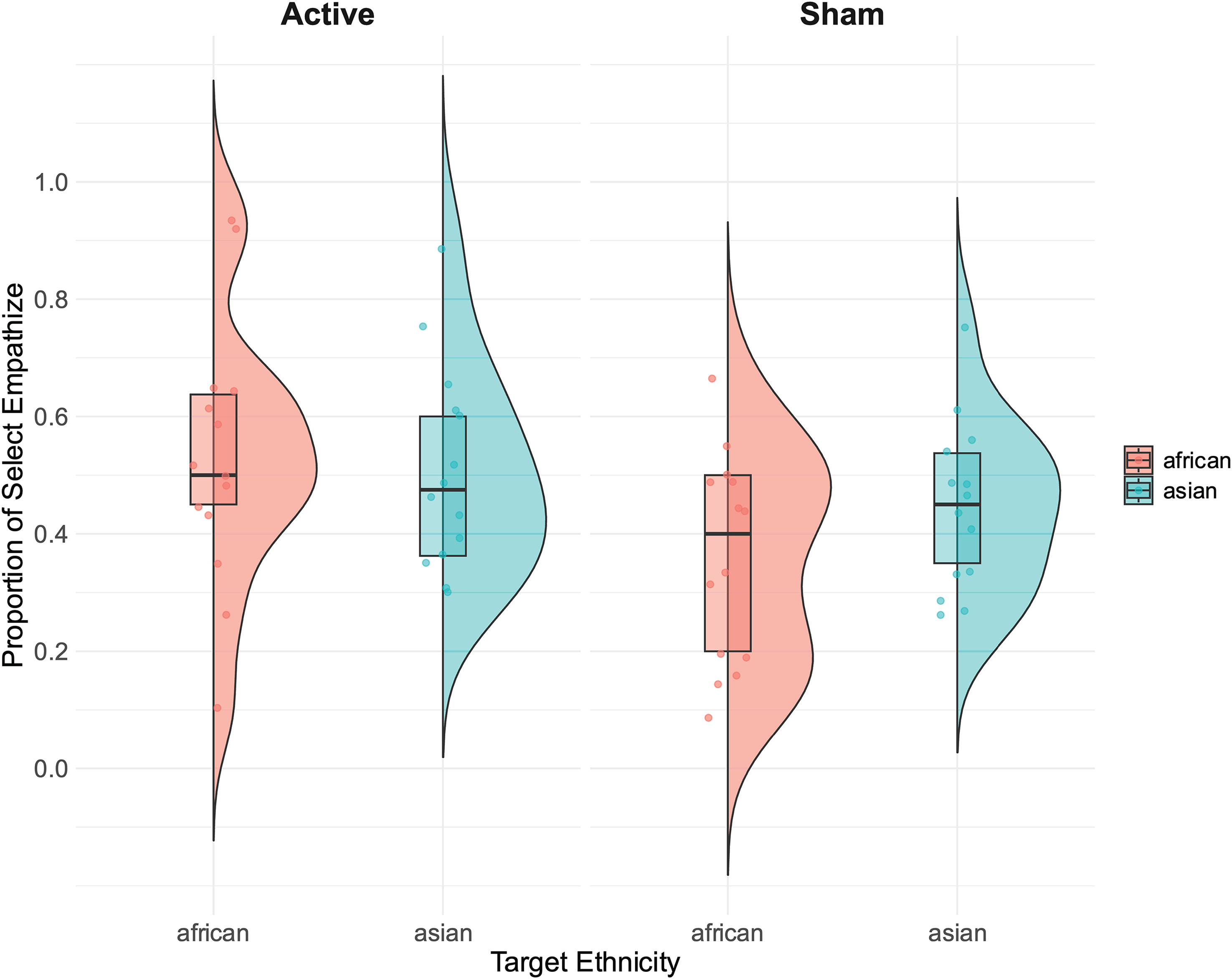
Proportion of empathic choice by stimulation group (Active vs. Sham) and target ethnicity (African vs. Asian). Violin plots display the distribution of empathic choice proportions across participants. The active taVNS group showed higher empathic choice overall, with the difference from sham most pronounced for outgroup (African) targets.

Results
The active and sham groups did not differ at baseline on any trait empathy measure (Interpersonal Reactivity Index total and Empathic Concern, Personal Distress, Perspective-Taking, and Fantasy subscales; Balanced Emotional Empathy Scale) or on sex distribution (Welch t-tests and χ 2, all p > 0.28), supporting the comparability of the randomised groups.
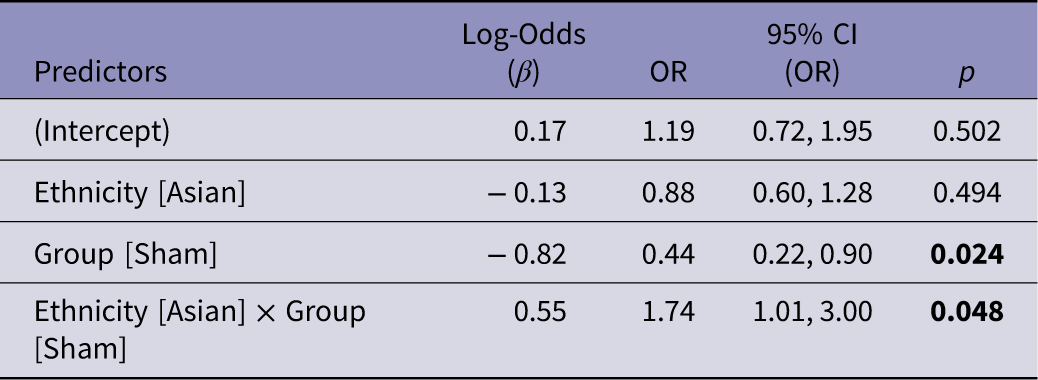
The GLMM results are reported in Table 1. The fixed effects indicated that the sham group showed a significant decrease in the log-odds of empathic choice relative to the active group (β = − 0.82; OR = 0.44, 95% CI [0.22,0.90], p = 0.024), consistent with greater overall empathic choice under active taVNS. The main effect of target ethnicity was not statistically significant (β = − 0.13; OR = 0.88, 95% CI [0.60,1.28], p = 0.494), indicating that no baseline difference in empathic choice between ingroup and outgroup targets was detected in this sample.
Generalised linear mixed model results for empathic choice. Odds ratios (OR) are exponentiated log-odds coefficients; the reference categories are the active group and outgroup (African) targets

Table 1. Long description
A table with five rows and five columns presenting generalized linear mixed model results for empathic choice. The columns are labeled Predictors, Log-Odds (β), OR, 95% CI (OR), and p. The rows are labeled with different predictors and their corresponding values. Row 1: (Intercept), 0.17, 1.19, 0.72, 1.95, 0.502. Row 2: Ethnicity [Asian], -0.13, 0.88, 0.60, 1.28, 0.494. Row 3: Group [Sham], -0.82, 0.44, 0.22, 0.90, 0.024. Row 4: Ethnicity [Asian] x Group [Sham], 0.55, 1.74, 1.01, 3.00, 0.048. The table shows the log-odds coefficients, odds ratios, 95% confidence intervals, and p-values for different predictors. The sham group showed a significant decrease in the log-odds of empathic choice relative to the active group. The main effect of target ethnicity was not statistically significant.
A significant interaction between target ethnicity and stimulation group was observed (β = 0.55; OR = 1.74, 95% CI [1.01,3.00], p = 0.048). Decomposed in terms of the stimulation contrast, the reduction in empathic choice under sham was pronounced for outgroup (African) targets but attenuated for ingroup (Asian) targets, so that active taVNS raised empathic choice selectively toward outgroup faces (Figure 2). This pattern was robust across analytic approaches: a reduced random-intercept model reproduced it (p = 0.050), a parametric bootstrap excluded zero (95% bootstrap CI for the interaction [0.02,1.11]; bootstrap p = 0.022), and a Bayesian re-analysis placed 96.7% of the posterior mass above zero (OR = 1.67, 95% CrI [0.97,2.89]). We nonetheless emphasise that the interaction was marginal and that its Bayesian credible interval narrowly included an odds ratio of 1.0; the effect is therefore best regarded as supported but not decisive, pending replication. By contrast, the main effect of stimulation was more robust (Bayesian OR = 0.46, 95% CrI [0.22,0.94]; posterior probability of a reduction under sham = 98.3%).
Importantly, because no baseline main effect of ethnicity was present – and the behavioural ingroup-bias index did not differ from zero across the sample (mean = 8.0%, t = 1.30, p = 0.203) – the data do not indicate a pre-existing ingroup empathy bias that taVNS subsequently reduced. Descriptively, an ingroup bias was present in the sham group ( + 20.8%) but absent in the active group ( − 4.7%). The pattern is therefore more accurately described as a target-specific enhancement of empathic choice toward outgroup faces under active stimulation than as the attenuation of an established bias – a distinction we develop in the Discussion.
Discussion
The present study provides preliminary, exploratory evidence that taVNS modulates empathic decision-making, with an apparently selective effect on empathic choice toward outgroup targets. The active taVNS group exhibited higher empathic choice than the sham group, and this difference was most pronounced for outgroup (African) facial stimuli among East Asian participants. These findings extend the growing literature on taVNS effects on social cognition (Sellaro et al., Reference Sellaro, de Gelder, Finisguerra and Colzato2018; Maraver et al., Reference Maraver, Steenbergen, Hossein, Actis-Grosso, Ricciardelli, Hommel and Colzato2020; Oehrn et al., Reference Oehrn, Molitor, Krause, Niehaus, Schmidt, Hakel, Timmermann, Menzler, Knake and Weber2022) by providing a first, tentative indication that vagal nerve stimulation may influence motivated empathic choice across group boundaries. Given the small sample, the marginal interaction, and the absence of physiological verification, however, all interpretations below are offered as hypotheses for future confirmation rather than as established mechanisms.
The main effect of stimulation group on empathic choice is consistent with the aversiveness reduction hypothesis (Cialdini et al., Reference Cialdini, Brown, Lewis, Luce and Neuberg1997), which posits that personal distress arousal – rather than other-oriented concern – often drives empathic avoidance. The EST was specifically designed to capture this motivated avoidance: people consistently choose to describe rather than empathise because empathising is cognitively and affectively costly (Cameron et al., Reference Cameron, Hutcherson, Ferguson, Scheffer, Hadjiandreou and Inzlicht2019; Ferguson et al., Reference Ferguson, Cameron and Inzlicht2020). If taVNS reduces sympathetic arousal through vagal activation (Machetanz et al., Reference Machetanz, Berelidze, Guggenberger and Gharabaghi2021; Forte et al., Reference Forte, Favieri, Leemhuis, De Martino, Giannini, De Gennaro, Casagrande and Pazzaglia2022), it may have lowered the aversive cost of engaging with others’ negative emotions. This account is congruent with Batson et al.’s (Reference Batson, Fultz and Schoenrade1987) distinction between personal distress and empathic concern, and with evidence that physiological indices of sympathetic activation (heart rate acceleration) during exposure to others’ suffering predict avoidance, whereas parasympathetic-mediated deceleration predicts approach and helping (Eisenberg et al., Reference Eisenberg, Fabes, Miller, Fultz, Shell, Mathy and Reno1989). We stress, however, that this mechanism was not directly tested: no autonomic or neural index was recorded, so we cannot confirm that active stimulation altered sympathetic–parasympathetic balance or that any such change mediated the behavioural effect. The link to aversiveness reduction therefore remains inferential.
Several alternative explanations are equally compatible with the data and cannot be ruled out. First, taVNS modulates attentional resource deployment toward social cues (Maraver et al., Reference Maraver, Steenbergen, Hossein, Actis-Grosso, Ricciardelli, Hommel and Colzato2020), so the effect could reflect enhanced attention to or processing of emotional faces rather than reduced affective cost per se. Second, vagal afferent stimulation engages brainstem and midbrain pathways implicated in reward and salience signalling, raising the possibility that altered salience or reward valuation, rather than distress reduction, shifted choice. Third, taVNS may have produced a more general increase in prosocial motivation or approach orientation (Oehrn et al., Reference Oehrn, Molitor, Krause, Niehaus, Schmidt, Hakel, Timmermann, Menzler, Knake and Weber2022) that is not specific to aversive-arousal mechanisms. Finally, non-specific influences – expectancy, demand characteristics, or arousal/alertness changes – cannot be excluded in the absence of physiological monitoring and blinding checks. Disentangling these accounts will require designs that incorporate autonomic and neural measures alongside instruments that separate personal distress from empathic concern.
The apparent selectivity of the effect for outgroup targets is intriguing but must be interpreted with particular care, because no baseline ingroup empathy bias was detected (the main effect of ethnicity was non-significant). The intergroup empathy bias is well documented at neural, physiological, and behavioural levels (Xu et al., Reference Xu, Zuo, Wang and Han2009; Avenanti et al., Reference Avenanti, Sirigu and Aglioti2010; Gutsell & Inzlicht, Reference Gutsell and Inzlicht2010; Reference Gutsell and Inzlicht2012; Han, Reference Han2018), and is thought to arise partly from heightened threat-related arousal toward outgroup members (Cikara & Van Bavel Reference Cikara and Van Bavel2014). If the affective cost of empathising is ordinarily higher for outgroup targets, then reducing that cost could disproportionately benefit outgroup engagement. However, the absence of a measurable baseline bias in our data means that the present results are better characterised as a selective increase in outgroup empathic choice than as the reduction of a pre-existing ingroup bias; the two are conceptually distinct, and our design cannot adjudicate between them. It is also possible that the interaction reflects sampling variability given the small sample and marginal significance, and the pattern may not replicate.
This tentative interpretation can nonetheless be situated within evidence that intergroup empathy is malleable. Zhou et al. (Reference Zhou, Pang, Pu and Han2022) found that sustained cross-cultural contact reversed the typical ingroup bias, and Cikara & Van Bavel, (Reference Cikara and Van Bavel2014) emphasised that group boundaries are dynamic and context-dependent. Autonomic modulation via taVNS may represent one further avenue through which empathic engagement with outgroup members could be facilitated. Because parochial empathy predicts consequential outcomes such as reduced altruism and endorsement of passive harm (Bruneau et al., Reference Bruneau, Cikara and Saxe2017), interventions capable of broadening empathic engagement would carry applied significance – provided the present effect proves robust in adequately powered, mechanistically instrumented studies.
Several limitations qualify these conclusions. First, the sample was small (N = 28) and the study exploratory; the sensitivity analysis indicates the design could reliably detect only large effects. We therefore subjected the key effects to bootstrap and Bayesian re-analysis: both supported the interaction (bootstrap p = 0.022; 96.7% posterior probability of a positive effect), but it remained marginal and its Bayesian credible interval narrowly included no effect, so the finding requires replication in an adequately powered, pre-registered study. Second, the study relied exclusively on behavioural measures; no autonomic (e.g. heart rate variability, skin conductance) or neural index was obtained, so successful vagal engagement and the proposed mechanism remain unverified. Third, although dispositional empathy was measured and did not differ between groups, no baseline measures of implicit bias, intergroup contact, familiarity, or attitudes were collected, and the trait instruments used cannot substitute for a state-level dissociation of personal distress from empathic concern during the task; this limits interpretation of whether the effect reflects increased empathy, reduced bias, or other processes. Fourth, group membership was operationalised solely by perceived race (Asian vs. African faces); this is a coarse proxy for psychologically meaningful group boundaries and does not capture implicit attitudes or individuating information. Fifth, the adapted task included 40 trials (20 per ethnicity), shorter than the standard EST, which constrains the precision of individual-level behavioural estimates. Finally, all participants were East Asian and tested in a single session, limiting cross-cultural generalisability and precluding conclusions about durability or cumulative effects (Bretherton et al., Reference Bretherton, Atkinson, Murray, Clancy, Deuchars and Deuchars2019).
In conclusion, this exploratory study offers initial, provisional evidence that taVNS may increase motivational empathy and selectively enhance empathic choice toward outgroup negative emotions. The results are consistent with – but do not directly test – the aversiveness reduction hypothesis, and several alternative mechanisms remain viable. Adequately powered, pre-registered studies that incorporate autonomic and neural measures, baseline assessments of empathy and intergroup attitudes, and validated operationalisations of group membership will be essential to confirm whether autonomic modulation via taVNS can reliably narrow intergroup empathy disparities.
Acknowledgements
J.C.K. thanks all participants for their contribution to this research. J.C.K. would also like to acknowledge YJ.E. Joh, for this serendipitous encounter. Will you marry me, Eishu?
Funding statement
This work was supported by the National Research Foundation of Korea (NRF) grant funded by the Korean Government (MSIT) (RS-2023-00272947, NRF-2021R1A2C1009482).
Competing interests
The authors declare no conflicts of interest.
Ethical standards
The study protocol was approved by the Institutional Review Board of Korea University (IRB-2019-0105). All participants provided written informed consent prior to participation. The study was conducted in accordance with the Declaration of Helsinki.

 Open access

