INTRODUCTION
The universally accepted approach to treating cancer is through surgery, radiotherapy or chemotherapy. In addition, palliation and symptomatic control is usually established through the use of orthodox medicines. However, it has been calculated that up to 36% of patients with cancer in the United Kingdom have used complementary and alternative medicines (CAM) for some form of therapy or relief from their condition.Reference Molassiotis, Fernadez-Ortega, Pud, Ozden, Scott and Panteli1 The CAM includes ‘all such practices and ideas which are outside the domain of conventional medicine and defined by its users as preventing or treating illness, or promoting health and well being’.Reference Berman2 These practices are intended to complement mainstream medicine by contributing to holistic patient care and satisfying a demand not met by conventional practices. They include therapies, such as acupuncture, aromatherapy, diet and nutritional therapies, herbal medicine, homeopathy, hypnosis and massage as well as yoga, Tai Chi and meditation. These therapies are of particular relevance to care of the cancer patient who may have to cope with weeks, months and even years of treatment and follow-up visits to the hospital. The perception of cancer as a life-threatening disease may make these patients more likely to seek emotional, social and spiritual support for their diagnosis and they may perceive their quality of life is significantly improved through use of CAM.Reference Tovey3
Some of the limiting factors in the wider use of CAM are the potentially high costs involved when it is not integrated into the National Health Service (NHS) setting. Private acupuncture sessions in Cornwall cost on average £25 to £35 but can be as much as £80 (at one clinic in Truro). Currently, there is no NHS acupuncture provision for oncology patients within the county.
The Sunrise Appeal, our local cancer charity, funds a part-time acupuncture service in the clinical oncology department. The charity was originally launched in 2001 as a one-year appeal to raise money for the new oncology facilities at the Royal Cornwall Hospital. The purpose-built ‘Sunrise Centre’ now houses two linear accelerators, a CT scanner, clinic rooms and office space for medical, physics and other clinical and non-clinical staff. The Sunrise Appeal continues to receive generous donations from patients and the public and they award funds for research and education in the oncology department as well as for non-essential equipment. Their aim is to keep Cornwall at the forefront of radiotherapy. Recently, they have awarded a grant of £690,000 to upgrade our third linear accelerator installation to Varian True beam™.
Other options for patients are private treatment with local CAM therapists or other private providers of acupuncture, such as physiotherapists. Acupuncture is available on the NHS to a limited number of patients in the Royal Cornwall Hospital Pain Clinic. Another limiting factor in the wider use of CAM in general is the variable availability of treatment and the variation in the standards of CAM training across the United Kingdom. In recent years, acupuncture and osteopathy and some other CAM have become vocational Bachelors degree level courses with external validation making integration into the NHS more feasible. Given these factors and the relatively low volume of empirical research into the use of CAM for cancer patients, it is not surprising that few oncologists would recommend CAM, even though many cancer patients who have not used CAM said they would have done so, especially if clear information was available about the potential benefits and the safety of using CAM alongside conventional treatments.4
Acupuncture has emerged as one of the most accepted CAM to orthodox medicine and an attractive prospect for integration into the NHS due to the growing body of evidence for its use. Many physiotherapists use acupuncture as part of their usual practice. There are also several therapy radiographers in the United Kingdom who practice acupuncture and many more doctors in hospitals and in general practice who use acupuncture for their patients. The British Medical Acupuncture Society have 2,500 members (all of whom are doctors or healthcare professionals) practicing acupuncture here in the United Kingdom.
For these reasons and because of ‘the shift in the approach to care and support for people affected by cancer to a greater focus on recovery, health and well-being after cancer treatment’, consideration of the potential benefit of an acupuncture service in oncology seems appropriate.5 Initially, it was important to establish for which symptoms acupuncture could provide effective benefit. In order to do this, it is useful to understand the mechanisms of acupuncture treatment which are theorised by both traditional Chinese medicine proponents, according to ancient texts and more recently by Western scientific theory.
Traditional Chinese Medicine (TCM) theory describes a holistic concept of health and TCM practitioners seek to bring balance to all aspects of the patient including the emotional, spiritual and physical using traditional forms of diagnosis, such as pulse-taking and observation and questioning of the patient followed by acupuncture treatment. They seek the root cause of disease by identifying patterns of disharmony in the body or by assigning characteristics of certain elements to illness. For example, in TCM theory the heart, which describes the whole circulatory system as well as the heart itself, is also said to have an emotional aspect to it and houses the ‘Shen’ or spirit of a person. It is thought to influence emotional health and the ability to sleep soundly at night as well as affecting relationships with others. The TCM heart is also assigned to the element of fire. In TCM theory, anxiety, insomnia and palpitations may be attributed to an imbalance of the heart or of the element of fire.Reference Kaptchuk6 Good health is attained through the balance of Yin and Yang, of Qi (energy) and Shen (spirit) and Jing (similar to DNA) among other substances, such as blood within the different organ systems and in relation to the external environment (Western medicine might call this idea of balance, homeostasis). Acupuncture is practised to increase, decrease or modify the flow of energy in the body to maintain health.Reference Kaptchuk6
A literature search to establish the current evidence for acupuncture using CINAHL, Medline and AMED was conducted using the following keywords: Acupuncture and Cancer, acupuncture and …, pain, hot flushes/flashes, nausea and vomiting, depression and anxiety, constipation and diarrhoea, oncology, xerostomia, dry mouth, dyspnoea, COPD, fatigue, quality of life, and acupuncture mechanisms.
In the current conventional bio-medical model, acupuncture stimulates nerve fibres which block pain signals by inhibiting transmission of nerve impulses.Reference Filshie and White7 It can also bring about the release of serotonin and regulates the release of other neurotransmitters, such as endorphins and metenkephalin which have a range of functions associated with the efficacy of acupuncture treatment including pain inhibition. Acupuncture may produce autonomic effects that strengthen the body’s homeostatic response.Reference Filshie and White7 This may in part explain the positive effects of acupuncture on, for example, hot flushes.Reference Filshie, Bolton, Browne and Ashley8 In addition acupuncture stimulates adrenocorticotropic hormone (ACTH) release from the pituitary gland into the bloodstream and activates the adrenal gland to release cortisol a naturally occurring steroid that has anti-inflammatory properties. These mechanisms do not fully explain the specific effects of acupuncture, such as the anti-emetic action of point ‘P6’ on the wrist. Also they do not explain the ‘clinically relevant long-term pain relieving effects of acupuncture (> 6 months) seen in a proportion of patients’Reference Carlsson9 They do inhibit incoming pain sensation locally and also produce a generalised, morphine-like, pain-relieving effect along with an anti-inflammatory effect and a general sense of improved well-being that patients using acupuncture claim to experience.Reference Cabýoglu, Ergene and Tan10
The current evidence for acupuncture indicates which patients would benefit from a service provision in oncology. There is clear evidence that acupuncture could be used to reduce the severity or even to alleviate chemotherapy-induced nausea and vomiting.Reference Ezzo11 This makes these symptoms prime targets for an oncology service. There is also evidence to support further investigation of the use of acupuncture for a range of symptoms associated with cancer and the side effects of treatment. Given the mechanism of acupuncture, hot flushes, often poorly controlled by current pharmacological treatments, would be another candidate symptom of acupuncture treatment. This may be of particular benefit to patients with breast cancer who experience hot flushes, as the majority consider their quality of life to be adversely affected by this distressing symptom.Reference Glaus, Boehme, Thürlimann, Ruhstaller, Hsu Schmitz and Morant12 Although the reports of the efficacy of acupuncture to treat hot flushes has been variable, there is however some evidence that acupuncture could be used as a safe and cost-effective treatment in the management of vasomotor symptoms among these patients and could therefore provide some benefit.Reference Filshie, Bolton, Browne and Ashley13,Reference Lee, Kim, Choi and Ernst14 There is also some evidence that it could be used to reduce the frequency of episodes (and distress) of hot flushes experienced by males receiving hormonal treatment for prostate cancer.Reference Frisk, Spetz, Hjertberg, Petersson and Hammar15
Other potential candidate symptoms for treatment with acupuncture considered at the time of introducing a service include irradiation-induced xerostomia in patients with head and neck cancer.Reference O Sullivan and Higginson16 There was evidence that dyspnoea related to malignancy could be relieved with acupuncture treatment.Reference Bausewein, Booth, Gysels and Higginsin17 In addition, there was limited evidence that acupuncture may be useful for constipation and diarrhoea although it was inconclusive.Reference Lim, Manheimer, Lao, Ziea, Wisniewski and Liu18 A recent literature search using CINAHL, Medline and AMED found no further evidence to support the use of acupuncture for diarrhoea and constipation in cancer patients and it is no longer offered to patients with those symptoms.
A suitable focus for an acupuncture service is indicated by the positive effects of acupuncture on pain, mood and general well-being. The experience of depressive symptoms, pain and fatigue are prevalent among patients with cancer.Reference Carr19 Recent research has found evidence of some benefit for cancer patients seeking acupuncture, but poor methodological quality and insufficiently powered trials in this area of research have prevented a recent Cochrane collaboration review from recommending acupuncture for depression.Reference Smith, Hay and MacPherson20 Similarly, acupuncture is not yet recommended for anxiety despite evidence to the contrary.Reference Pilkington, Kirkwood, Rampes, Cummings and Richardson21 There is however encouraging evidence that acupuncture produces a measurable benefit in cancer-related symptoms of pain and quality of lifeReference Dean-Clower, Doherty-Gilman, Keshaviah, Baker, Kaw and Lu22 and therefore was considered appropriate for inclusion in an acupuncture service in oncology.
There is a clear and current need to commission services to support patients who may be dealing with the enduring effects of cancer treatments.Reference Allberry23 Acupuncture may now have a pivotal role alongside orthodox medicine in oncology. Indeed, acupuncture has already been integrated into some oncology clinics in the United States with some success.Reference Johnstone, Polston, Niemtzow and Martin24 Following a search of the literature, it became evident that the integration of acupuncture in oncology centres in Europe and the United Kingdom has not been so well documented. Nevertheless, the development of a pilot project to investigate the benefits of an acupuncture service running concurrently with traditional oncology treatments was supported by the oncologists, the radiotherapy management and senior nursing staff at the Royal Cornwall Hospital, as well as the Sunrise Appeal Committee (funders of the project).
This acupuncture service was integrated within the conventional healthcare setting. It was operated over an 18-month period at the Sunrise Centre at the Royal Cornwall Hospital and the benefits to the service users were evaluated throughout the duration of the project. This project was the first fully integrative service of its kind in the South West and provided an acupuncture service with an NHS ethos to oncology patients.
CONTEXT AND POPULATION
At the time of this study, the Sunrise Centre provided the infrastructure for radiotherapy and chemotherapy outpatient treatment for oncology patients in Cornwall, covering a predominantly rural population of around half a million people. The Centre is staffed by five clinical and one medical oncologist as well as one consultant in palliative care. It has two radiotherapy suites and more than eight clinic rooms, one of which was used for the acupuncture service. There are also future plans for an information and support centre to include complementary therapies for oncology patients in Cornwall.
AIMS AND OBJECTIVES
This study was conducted to evaluate the introduction of an acupuncture service for oncology patients and to describe the experience of patients using the service.
The objectives of the study were
1 To identify patients experiencing one or more of the following symptoms: nausea, vomiting, hot flushes, pain, breathlessness, dry mouth (due to irradiation of salivary glands or poly-pharmacy induced), anxiety, depression, fatigue, diarrhoea or constipation and general difficulties in coping.
2 To offer an acupuncture service for those meeting the first objective, having obtained verbal and written consent.
3 To evaluate their response to treatment, changes in their well being and documenting their experience.
4 To establish a system to quantify the symptoms, the effects of treatment and medication using validated standards, reliable and reproducible measures.
5 To produce a profile of the service users, their experiences and any reported benefits in symptom measures or quality of life over time to determine feasibility of establishing a permanent acupuncture service.
6 To compare effects of acupuncture with pharmaceutical costs prior to and during the service being in operation.
TREATMENT MATERIALS AND METHODS
In this study, Seirin J type No 5 (0.25) × 30 mm single-use stainless steel disposable acupuncture needles with a guide tube were used as well as ear seeds (1 mm non-allergenic seeds attached to adhesive tape that could be placed over acupuncture points in the ear). Patients with nausea were offered sea-bands (elastic wrist bands which have a bead sown into them that exerts pressure on P 6, the acupuncture point on the inner forearm proximal to the wrist crease effective for nausea) to wear between treatment sessions to augment the acupuncture effects.
At the first session, the acupuncturist would ask the patient about their general health and well being and take a detailed history to exclude any contra-indications to acupuncture. At the beginning of each subsequent session, the acupuncturist would ask the patient about their general health and well being and enquire about any changes in the symptoms they had been referred for and record this in the patient notes. An acupuncture treatment then followed.
Techniques of acupuncture were traditional Chinese acupuncture and auricular (ear) acupuncture. This involves giving individualised treatments according to traditional point selection. In practice, this means that, for example, Patient A experiencing nausea and Patient B also experiencing nausea receive different acupuncture treatments because Patient A may also have fatigue and Patient B could, in addition, be suffering pain due to neck and shoulder tension. The acupuncturist remained with patients following insertion of the needles and patients were able to talk or rest quietly as they wished.
De Qi, the subjective experience of a transient sensation around the needles site often referred to as a ‘pulling’ or ‘dragging’ sensation or as a ‘dull ache’ was elicited by turning the needle gently while in place (manual manipulation) and this was ceased to prevent discomfort as soon as the patient became aware of the sensation or if there was visible muscle twitching or redness around the needle (a sign of de Qi).
Treatments were 20–30 min duration. Up to 15 needles were used on each patient at each session. Acupuncture is contra-indicated on the affected limb by surgery (lumpectomy or mastectomy for breast cancer) or by the presence of swelling, and or lymphodoema or infection. Needles were inserted to a depth and at an angle appropriate to the anatomy of the area being treated (5–10 mm in most cases).
Patients were generally not expected to undress for treatment unless acupuncture points on covered areas, such as the back or abdomen, were used. To minimise the risk of fainting, patients were either reclined or semi-reclined, if they were unable to lie down on the treatment couch or they had their legs elevated, if they were in a wheelchair.
Patients had acupuncture once a week for 6–10 weeks. Every effort was made to fit the acupuncture appointments around the patient’s treatment or outpatient appointments, although acupuncture did sometimes involve extra visits to the department. The Sunrise Appeal funded hospital transport for those patients unable to bring themselves. The service was run by a single acupuncturist who is a member of the British Medical Acupuncture Society and a member of the British Acupuncture Council as well as employed as a senior therapy radiographer by the Royal Cornwall Hospitals NHS Trust.
Permissions
The Cornwall and Plymouth Research Ethics Committee (now known as South West 1 Research Ethics Committee) advised that this project is not one that is required to be ethically reviewed under the terms of the Governance Arrangements for Research Ethics Committees in the United Kingdom. The protocol for this acupuncture service was submitted and authorised by the Medical Director and the Director of Nursing and Therapies Royal Cornwall Hospitals Trust in February 2005.
Referral methods and eligibility
Patients were initially referred for acupuncture and given an information leaflet by the either the oncologists, review radiographers, treatment radiographers or nurses. This could be at any point in the patient’s treatment schedule or during follow-up providing the patient was in agreement and met the inclusion criteria detailed below. Eligible patients could also self-refer. However, acupuncture was only offered to patients with the agreement of their oncologist or consultant in palliative care. Following a detailed discussion about the risks and benefits of acupuncture, formal verbal and written consent was obtained from the patient by the acupuncturist at their first appointment using the Royal Cornwall Hospitals Trust Consent Form 3 for procedures where consciousness is not impaired. The case history was also taken at this time. Each patient was given an information leaflet about the service if they had not already received one.Reference Salmon25
Inclusion criteria
1 Patients currently under the care of a Consultant Oncologist or Consultant in Palliative Care at the Royal Cornwall Hospital.
2 Patients previously treated or currently being treated for a diagnosis of cancer.
3 Patients experiencing at least one of the following symptoms/problems listed including nausea, vomiting, hot flushes, pain, breathlessness, dry mouth, anxiety, depression, fatigue, diarrhoea or constipation and general difficulties in coping.
4 Patients with a performance status on the Karnofsky scale with a score of 20 or more.Reference Schag, Heinrich and Ganz26
5 Patients aged 18 or above.
Exclusion criteria
Patients with valvular heart disease where there is a risk of bacteraemia.
Patients with serious disorders of blood clotting (haemophilia).
Patients who are pregnant or suspect they may be pregnant.
Measures
This project was primarily an observational case study based on the experience and response to treatment of patients accessing the acupuncture service.
The results were used in order to examine the practicability and benefit to patients of running an acupuncture service in oncology. Each patient was required to complete the EQ5D Quality of Life questionnaireReference van Agt, Essink-Bot, Krabbe and Bonsel27 before and after the final treatment and two months post-treatment to assess any change they perceived in their quality of life from the treatment. In addition, patient’s symptoms were recorded before and after a course of acupuncture by the acupuncturist. Each symptom was graded according to the National Cancer Institute Common Terminology Criteria for Adverse Events version 3.0,28 which provides a numerical value of between 1 and 5 which enabled statistical analysis of each patient’s symptom.
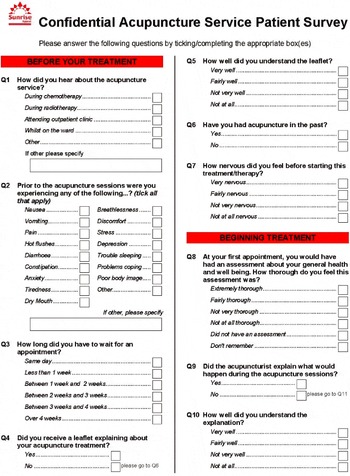
Other validated questionnaires were administered to patients when they had been referred for a particular symptom or problem. Patients referred with mild depression completed the Hospital Anxiety and Depression Scale (HADS)Reference Zigmond and Snaith29 and those with fatigue completed the Fatigue Visual Analogue Scale (FVAS).Reference Mendoza, Wang, Cleeland, Morrissey, Johnson and Wendt30 The Dry Mouth Visual Analogue Scale (DMVAS)Reference Ship, McCutcheon, Spivakovsky and Kerr31 was also utilised for participants with xerostomia. These measures were used at the start (pre-acupuncture) and at the end of a course of treatment. The patients experience of the service was evaluated using a purpose-designed survey given to patients at the end of their acupuncture treatment (see Appendix I). This survey was completed anonymously by all patients and independently analysed to reduce bias. Tests for a statistical significance were applied to data generated from both the objective symptom and quality of life questionnaires.
Patients were asked for details of any medications they were taking at every treatment session. The enquiry was intended to determine whether acupuncture treatment had any adverse or beneficial interaction on the medication required by patients. They were not encouraged to reduce their medications but to consult with their doctor (facilitated by the acupuncturist) if they (the patient) determined it may be appropriate, for example, if they had a reduction in a symptom, such as pain, for which they were taking medication.
The patient survey and other data were used to describe the service users demographic and their experience of the acupuncture service.
RESULTS
Between April 2005 and October 2007 (excluding one year of maternity leave by the acupuncturist), an acupuncture service was available for oncology patients at the Sunrise Centre, Royal Cornwall Hospital, Truro. In total, 107 patients were referred by their Consultant Oncologist or other Clinical Oncology staff having been identified as meeting the inclusion criteria for the service. Interestingly, there were no referrals for patients experiencing diarrhoea.
Full data sets were completed for 47 participants. Two patients refused further treatment following one or more acupuncture sessions. Three patients that were referred did not start treatment due to progression of their disease and deterioration in their health. One patient did not commence with acupuncture treatment as it was found that she had heart valve disease and acupuncture posed a risk of bacteraemia for her. This contra-indication to acupuncture was not identified until the patient came for her first acupuncture appointment and it highlighted the need to inform medical and other healthcare professionals about the various contra-indications to acupuncture. Seventeen patients were too ill to complete their course of treatment. A total of 60 participants failed to attend their final appointment due to the reasons previously mentioned, illness or other unknown reasons, and therefore their data set is incomplete.
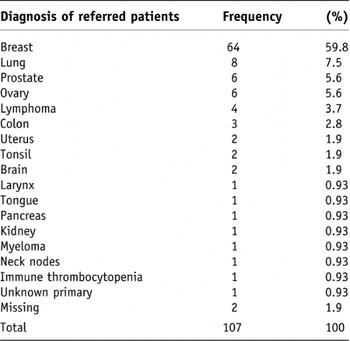
Of those referred, 84% were female and 16% were male which is in keeping with the fact that commonly, more women use complementary therapy than men.Reference Downer, Cody, McCluskey, Wilson, Arnott and Lister32 The majority of patients referred for acupuncture had a diagnosis of breast cancer (59%) which is also expected given the fact that breast cancer forms the bulk of new cancer cases in females in the United Kingdom.33 The distributions of other patient diagnosis are shown in Table 1.
Distribution of the primary cancer diagnosis of the 107 patients referred to the acupuncture service between April 2005 and October 2007

Almost 75% of all referrals for acupuncture were from the consultants, the review radiographer team or the Cancer Nurse Specialists for patients undergoing radical or adjuvant treatment for their cancer. These patients were being seen regularly by their consultant or other healthcare professionals because they were on active treatment for their cancer and experiencing acute symptoms and side effects of the treatments. Patients receiving radiotherapy treatment were not inconvenienced by extra visits to the department as their acupuncture treatments were booked close to their radiotherapy appointments. Other referrals came from the clinic nurses, chemotherapy nurses and one from a community Macmillan Nurse.
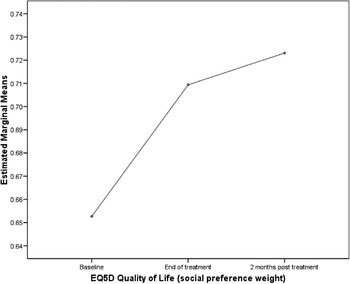
Independent analysis of all of the study data was conducted by the Research and Development Support Unit (RDSU) at the Royal Cornwall Hospital. The RDSU conducted an analysis of covariance using the linear model taking into account the variables across the treatment time period, moderately increasing the power of the study by accounting for some of the variables within the study period. Paired ‘t’ tests were used to describe the comparison before and after each set of acupuncture sessions. Analysis of the responses to the EQ5D quality of life questionnaire showed a linear improvement between both the start of their acupuncture sessions and the end of treatment (p = 0.050). An improvement was also observed between the end of patient's treatment and two months after treatment which although interesting is not a statistically significant result (p = 0.747). Patients were at varying stages of their cancer treatment or had finished treatment, and so there were many variables across the treatment time period. The results are in summarised in Figure 1.
EQ5D quality of life graph showing linear improvement in quality of life from baseline to two months post-acupuncture treatment.

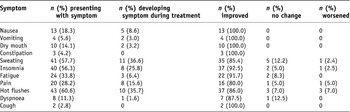
It can be seen from Table 2 that the results of the symptom-grading before and after a course of acupuncture treatment show some improvements across the range of symptoms, including hot flushes, insomnia and sweating that patients were experiencing.
Changes in symptoms from presentation to completion of acupuncture treatment according to validated symptom measures (n = number of patients)

A total of 18 patients were referred for acupuncture because they had symptoms of fatigue and all of those patients completed the Brief Fatigue Inventory (FVAS). Out of this group, 11 had improvements on the FVAS scale. This is not a statistically significant result (p = 0.058) but a positive improvement in fatigue was reported from Time 1 (start of treatment) to Time 2 (end of treatment). The mean difference between scores on the FVAS from Time 1 to Time 2 was significant (p = 0.039). On average, patients had a 12-point improvement on the FVAS following acupuncture.
There were 16 patients experiencing symptoms of depression who were referred for acupuncture, of these 11 had symptomatic improvement, 2 got worse and 3 recorded no change. Additionally, there were 20 anxious patients who had acupuncture and of these 18 became less anxious, 2 got worse and none stayed the same. The HAD Scale administered to those with anxiety and or depression showed that there was a significant (p = < 0.001) reduction in anxiety following acupuncture. The results for depression showed improvements on the HAD scale but these were not significant (p = 0.058).
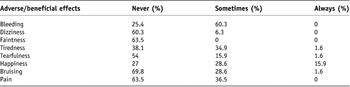
The patient survey was a 32-item purpose-designed questionnaire that patients completed anonymously after their final acupuncture appointment and returned to the department by post or left at the reception desk in the department. In Table 3, the most common adverse effects of acupuncture treatment identified by patients in the survey are illustrated. Bleeding was the most common adverse event although some patients also reported bruising and/or pain. Of those patients who reported experiencing pain 1.6% said it was ‘very painful’, 7.9% said it was ‘fairly painful’ and 27% said it was ‘not very painful’. A total of 63.5% said that they never experienced pain during acupuncture.
Adverse/side effects of acupuncture reported by patients

The majority of patients (74.6%) received an appointment within 2 weeks of referral for acupuncture and all patients were given a standard acupuncture information leaflet at the start of their treatment.Reference Johnstone, Polston, Niemtzow and Martin24 A total of 98.4% of patients were seen at the stated time for the majority of appointments. One patient had to wait under 15 min for an appointment. All patients felt that their appointments were convenient for them and 96.8% felt that enough time was allocated for their appointment.
A total of 55.6% of patients were not nervous prior to their first acupuncture treatment despite the fact that only 28.6% of patients had previous personal experience of acupuncture treatment and only 6.3% were very nervous prior to their first acupuncture session. As many as 17.5% reported feeling fairly nervous and 20.6% were not very nervous prior to their first acupuncture treatment.
As many as 95.3% of patients were either very satisfied or satisfied with the acupuncture treatment itself, and 95.2% said that they felt the service should continue.
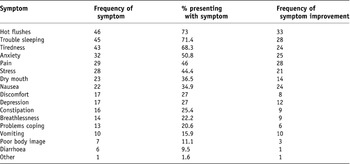
Many patients reported that acupuncture had improved their symptoms and Table 4 demonstrates the subjective benefits of acupuncture highlighted by patients. For example, in responding to the survey, 33 out of 46 people stated that the acupuncture treatment had helped their hot flushes and 28 out of 29 patients reported that acupuncture had helped their pain.
Frequency/percentage patient self assessment of symptoms

Following a course of acupuncture, as many as 71.4% of patients said that they perceived an improvement in their own ability to cope with their illness. Over 80% reported that that acupuncture had improved their symptoms, and 77.8% agreed that they felt more relaxed as a result of the acupuncture treatment.
Various anomalies in the data occurred as patients who used the acupuncture service were at many different stages of treatment. Initially this seemed to be data error but one example is that the 22 patients who said that they were experiencing nausea at the start of acupuncture and then at the end of treatment 24 patients stated that acupuncture had helped their nausea. This was due to variables across the treatment time period such as patients starting radiotherapy or chemotherapy during their acupuncture sessions and so developing symptoms increasing the numbers experiencing nausea.
The data concerning the use of medications by participants was incomplete and was not analysed.
Similarly the data for patients experiencing dry mouth were incomplete and there were too many variables within the group. The aetiology of dry mouth across this set of patients was varied. Some had dry mouth due to radiotherapy and others due to the effects of pharmaceutical treatment.
DISCUSSION
There were no serious adverse events resulting from acupuncture treatment in this cohort of 107 patients. Overall, the acupuncture service has fitted well into the oncology department in Cornwall. Most of the aims and objectives of the study were achieved. However, no healthcare professionals referred any patients for acupuncture treatment who were experiencing constipation or diarrhoea. This would seem to suggest that the current standard of care for these two symptoms is effective.
Unfortunately the fifth objective, to compare the effects of acupuncture with pharmaceutical costs prior to and during the service being in operation, was not achieved. During the study, patients were asked to provide details about the medications they were taking at each acupuncture session. It became clear that when asked, many patients were not aware of all the names of the drugs they are taking and the dose. The data collected were not detailed enough to conduct a useful analysis. There was a large amount of data collection for each patient given that many of them were on active treatment for their cancer and a lack of resources prevented accurate recording of medication use from week to week. The collection of accurate information regarding medications used by cancer patients may be facilitated by accessing prescription records rather than by directly asking the patient.
Future research to investigate the potential benefit of acupuncture for dry mouth is needed to determine the potential benefit of acupuncture for xerostomia in cancer patients.
All medical and other healthcare professionals in the department have utilised the acupuncture service for their patients and the generally positive experiences of the patients themselves have been the best advertisement for the service. Data collection was time-consuming because of the various measuring tools being used. Some patients were required to complete several measuring tools because of multiple symptoms. The purpose-designed database on a laptop that was taken into the treatment room made data collection relatively easy, however, and there was no need for secondary input of data following treatment sessions. The complete data set at the end of the study amounted to 47 patients, which was disappointing. Some of the patients using the service may have given acupuncture a lower priority than other treatments as it was not intended to cure their cancer. The effects of acupuncture build up over a course of treatment and some patients may need to have as many as five sessions before they start to see a benefit which is quite a long wait when you are making extra visits to hospital for a treatment. There is no known ‘wash out’ period for acupuncture treatment, which can be defined as a period of time where the participant returns to the same state that they were in before treatment began.34 It is not known how long the effects of acupuncture can last but the continued improvement in quality of life in patients who completed their sessions in the two months following acupuncture treatment may have shed some light on this question. However, this improvement over time could simply be attributed to the natural recovery of patients with an accompanying increase in their quality of life following treatment for cancer. This uncertainty can be explained by the fact that the analysis of the EQ5D quality of life questionnaire does not differentiate between those who were ill or well at baseline or between those who were having treatment or not at baseline and so the observed improvement may have been natural progression as a result of the timing of their acupuncture and/or where they were in their treatment schedule. In other words, the methodology used does not account for other variables across the treatment time period so patients may have started or finished radiotherapy or chemotherapy or received additional treatments for their symptoms during their acupuncture sessions, which may have altered the data positively in favour of acupuncture or negatively against it. Also, the EQ5D graph (Figure 1) represents the patients who completed baseline measures, a course of treatment, end of treatment measures and the two-month follow-up questionnaire. It is feasible, therefore, that these patients with full data sets may have completed their acupuncture sessions because they felt it was an effective treatment for their symptoms and those with incomplete data sets may have stopped their acupuncture due to an opposite effect, resulting in a positive outcome for the EQ5D measure.
The results in Table 2 demonstrate that patients experience a benefit from acupuncture for several symptoms including the largest referral groups (breast cancer patients experiencing hot flushes, sweating and insomnia). Without a placebo or control group incorporated in the design of the study, the results signify that acupuncture may provide some benefit to cancer to patients but this study was insufficiently powered to show a statistically significant difference in changes in symptoms across the measured period. This inclusion of patients on all forms of treatments is the hallmark of the pragmatic trial, which aims to reflect the likely use of treatments in real life everyday clinical practice. In everyday practice, acupuncture is unlikely to be given to oncology patients in isolation from radiotherapy and chemotherapy and with no other pharmacological agents in the mix. This is a problem when designing a study to evaluate the efficacy of acupuncture for cancer patients.
The results for the hot flushes measures were not statistically significant but patients did report a benefit from the acupuncture treatment. One possible theory to explain this is that the hot flush grading tool28 was not sensitive enough. The tool did not measure severity, intensity and frequency of hot flushes separately but as a whole with hot flushes being graded as either mild moderate or severe. Increasing the sensitivity of measures using more detailed validated scales would distinguish the effects of acupuncture more specifically. However, this study was not intended to prove the efficacy of acupuncture. It was designed to investigate the efficiency and practicability of a service. Despite the limitations of the study design, the results of this study are encouraging and suggest that that a future acupuncture trial involving greater numbers of participants with an experimental design (to include randomisation and a control group) focusing on the use of acupuncture for hot flushes associated with hormonal treatments for cancer would be worthwhile. The need for a robust trial into the use of acupuncture for hot flushes in breast cancer is highlighted by this study and othersReference Glaus, Boehme, Thürlimann, Ruhstaller, Hsu Schmitz and Morant12 for two main reasons. First, breast cancer patients with distressing hot flushes form the bulk of referrals for acupuncture highlighting a gap in effectiveness in the current treatment of hot flushes. Second, the results for hot flushes in this study showed improvements in symptoms in this patient group. A team of specialists in breast cancer, clinical trials and research methods and the researcher here at the Royal Cornwall Hospital are currently applying to the National Institute of Health Research to their Research for Patient Benefit Fund to conduct a randomised controlled trial comparing Venlafaxine (a selective serotonin uptake inhibitor currently given to patients with hot flushes) with acupuncture in patients with breast cancer. If the application is successful, a project will begin next year to examine the benefits of acupuncture versus Venlafaxine for hot flushes in breast cancer.
In reference to the other symptoms for which acupuncture was offered for, without control group these results cannot provide definitive evidence for the use of acupuncture for the specific symptoms of cancer and side effects its treatments. Nevertheless, the positive benefits of acupuncture perceived by patients in this study signify the need for further more rigorously designed trials particularly in the subject areas of fatigue, anxiety and depression with a much larger cohort of patients.
Overall, the study has been a success and the data collected has been very useful in forming part of the basis for the design of a larger clinical trial.
CONCLUSION AND RECOMMENDATIONS
The results of this service evaluation demonstrated that an acupuncture service for Oncology is practicable and that more importantly patients benefit from the service.
A detailed examination of the multiple pharmaceuticals employed for cancer patients and whether acupuncture could potentially reduce this was not within the scope of this study.
The study was not sufficiently powered to adequately describe the effects of acupuncture on dry mouth in cancer patients.
The results for the hot flushes measures were not statistically significant but patients did report a benefit from the acupuncture treatment and a larger more rigorously designed study is warranted to fully investigate the use of acupuncture for hot flushes in cancer patients taking hormonal therapy.
Acupuncture may also improve quality of life in some cancer patients and further study in this topic area is warranted.
In addition, the need for more research is indicated by the positive results for acupuncture in the treatment of fatigue and anxiety.
Acknowledgements
Grateful thanks go to Colin Pritchard from the Research and Development Support Unit in the Knowledge Spa and to Dr Nick Morley in the Cancer Clinical Trials Unit at the Royal Cornwall Hospitals NHS Trust (RCHT). Thanks also to Chik Tan for IT support and the design of a secure database suitable for use in this study. Thank you to all my colleagues in Clinical Oncology at RCHT for your continued support for this project.
Declaration of interest
This study was funded by the Sunrise Appeal, Registered Charity No.1084193.