INTRODUCTION
Organizational survival and growth may be threatened unless strategic decisions are made through an effective process, and comprehensiveness is the most fundamental aspect of effective decision-making processes (Miller, Reference Miller2008). Issues that confront senior executives are often complex and unstructured, and it is difficult to predict the significance of a change and the impact of proposed solutions with certainty (Mitchell, Boyle, & Nicholas, Reference Mitchell, Boyle and Nicholas2016). Without comprehensive strategy formulation, enterprises may make poor strategic judgments and thus suffer great losses, especially in a complex and volatile environment (Bourgeois & Eisenhardt, Reference Bourgeois and Eisenhardt1988). Top management teams undertake critical strategy-making decisions and thus need to engage in comprehensive strategic decisions to enhance their capacity to adapt and maintain the organization's alignment with its environment to cope successfully (Carmeli, Friedman, & Tishler, Reference Carmeli, Friedman and Tishler2013; Thomas & Ambrosini, Reference Thomas and Ambrosini2015). TMT SDC is a key attribute of the strategic decision-making process that represents its effectiveness (Miller, Reference Miller2008). It is defined as the extent to which TMTs attempt to be exhaustive and inclusive in the process of formulating strategic decisions (Fredrickson & Mitchell, Reference Fredrickson and Mitchell1984; Miller, Burke, & Glick, Reference Miller, Burke and Glick1998).
Although scholars have examined the importance of TMTs in firms’ strategic decision-making processes, research exploring the role of TMTs in the process is still limited. On the one hand, previous SDC research has focused on overall TMT characteristics (e.g., Carmeli et al., Reference Carmeli, Friedman and Tishler2013; Miller et al., Reference Miller, Burke and Glick1998; Talaulicar, Grundei, & Werder, Reference Talaulicar, Grundei and Werder2005) rather than CEO leadership behaviors. The CEO is usually the most powerful leader in a TMT and firm with a disproportionate influence on TMT decision processes (Hambrick, Reference Hambrick1994). Effective decision making cannot occur without effective leadership by CEOs, which requires them to use appropriate leadership behaviors to facilitate TMT members’ efforts, coordination, and collaboration (Friedman, Carmeli, & Tishler, Reference Friedman, Carmeli and Tishler2016). Unfortunately, the unique influence of CEO leadership remains largely uncharted and few studies have examined how various CEO leadership behaviors affect SDC. On the other hand, prior CEO-TMT research argues that considering only CEOs or only the overall TMT is insufficient as CEOs and TMTs interact to affect organizational behaviors (Cannella & Holcomb Reference Cannella, Holcomb, Dansereau and Yammarino2005; Hambrick, Reference Hambrick1994; Lo & Fu, Reference Lo and Fu2016). Although an increasing number of upper echelon studies have investigated the CEO-TMT interface, defined as the linkage and interaction between a CEO and other top managers, they have focused on its effects on organizational outcomes, such as firm performance (Lo & Fu, Reference Lo and Fu2016), strategic choices (Reimer, Van Doorn, & Heyden, Reference Reimer, Van Doorn and Heyden2018), and decision outcomes (Lin & Rababah, Reference Lin and Rababah2014). Little attention has been paid to strategic decision-making processes, which shape organizational resource allocation and subsequent firm performance (Baum & Wally, Reference Baum and Wally2003; Hurt & Abebe, Reference Hurt and Abebe2015). Thus, a closer look at the effect of CEO leadership and the interaction between a CEO and TMT members on SDC is necessary to further understand the role of the upper echelons in strategic decision-making processes which in turn influence firm performance.
Therefore, our study addresses two main research questions: 1) What is the relationship between CEO leadership, SDC, and subsequent firm performance? 2) What is the role of CEO-TMT interaction in the strategic decision-making process? Specifically, we examine the different effects of CEO empowering leadership and CEO directive leadership on SDC. Research has suggested that the distribution of power in TMTs should be considered in strategic decision-making (Finkelstein, Reference Finkelstein1992), because it affects TMT members’ decision involvement (Bunderson, Reference Bunderson2003) and information processing capabilities (Haleblian & Finkelstein, Reference Haleblian and Finkelstein1993). Thus, we focus on empowering leadership and directive leadership, which reflect different patterns of power distribution within a TMT, as empowering leadership often involves power sharing between a CEO and subordinates (Vecchio, Justin, & Pearce, Reference Vecchio, Justin and Pearce2010) but directive leadership involves using positional power to guide team members (Lorinkova, Pearsall, & Sims, Reference Lorinkova, Pearsall and Sims2013). That is, empowering CEOs share power, whereas directive CEOs keep their power centralized and exercise it over their followers (e.g., Boulu-Reshefa, Holt, Rodgers, & Thomas-Hunt, Reference Boulu-Reshef, Holt, Rodgers and Thomas-Hunt2019; Lorinkova et al., Reference Lorinkova, Pearsall and Sims2013). Despite the potential significance of these leadership styles in TMT decision-making, prior studies have only compared their effectiveness at lower levels of the managerial hierarchy (e.g., Lorinkova et al., Reference Lorinkova, Pearsall and Sims2013; Martin, Liao, & Campbell, Reference Martin, Liao and Campbell2013), without considering their potential effects on TMT strategic decision-making processes.
Moreover, research on the CEO-TMT interface suggests that although CEOs are the primary leaders of a firm, they do not function in isolation from other TMT members (Finkelstein & Hambrick, Reference Finkelstein and Hambrick1996). CEOs frequently interact with TMT members; therefore, the TMT constitutes a CEO's proximate work environment (Peterson, Smith, Martorana, & Owens, Reference Peterson, Smith, Martorana and Owens2003). Thus, the functioning of a CEO is subject to the contextual effects of TMT processes (Liu, Fisher, & Chen, Reference Liu, Fisher and Chen2018). Hence, we incorporate a task-related TMT process – TMT cognitive – conflict as the contingent factor in the CEO leadership-SDC relationship. Cognitive conflict is task-oriented and occurs when differences exist in judgment or viewpoint (Amason & Sapienza, Reference Amason and Sapienza1997) in team interactions and information processing (Hu, Wu, & Gu, Reference Hu, Wu and Gu2019). Teams with different levels of cognitive conflict are expected to vary in the way they influence the effectiveness of CEO leadership, and thus TMT cognitive conflict interacts with CEO leadership to influence team processes (Liu et al., Reference Liu, Fisher and Chen2018).
Based on data gathered from 126 Chinese enterprises, we find that CEO empowering leadership promotes SDC, whereas directive leadership only improves SDC at a low to moderate level, and subsequently SDC enhances firm performance. Moreover, TMT cognitive conflict weakens the positive effect of empowering leadership on SDC.
Taking a systematic approach by integrating CEO-TMT dynamics into SDC, which in turn influences firm performance, we offer a holistic view of how upper echelons influence firm performance. Thus, this study makes contributions to the strategic decision-making processes and upper echelons literatures in two important ways. First, while previous studies have focused on overall TMT characteristics and few studies have compared directive leadership and empowering leadership, this study explores the different effects of these CEO leadership styles on SDC, which subsequently affects firm performance. Thus, this study not only enriches the research on SDC's antecedents, but also adds to the literature on upper echelons by examining how CEO leadership influences firm performance. Second, we examine the contingent role of TMT cognitive conflict in the CEO leadership-SDC relationship and find that TMT cognitive conflict mitigates the positive effect of empowering leadership on SDC but has no effect on the directive leadership-SDC relationship. Our findings show how TMT cognitive conflict interacts with different leadership styles to affect SDC in different ways and thus it furthers the understanding of the boundary conditions of CEO leadership's influence on TMT decision-making processes. This study also enriches the CEO-TMT interface research by exploring the effect of CEO-TMT interaction on SDC, and thus it answers the call for more research into the role of the CEO-TMT interface in strategic processes (Bromiley & Rau, Reference Bromiley and Rau2016).
THEORETICAL BACKGROUND AND HYPOTHESES DEVELOPMENT
Strategic Decision Comprehensiveness
In strategic decision-making, firms usually deal with information-processing requirements through two models: the incremental and synoptic models (Atuahene-Gima & Li, Reference Atuahene-Gima and Li2004; Fredrickson & Mitchell, Reference Fredrickson and Mitchell1984). The incremental decision-making process is a remedial response to current problems or dissatisfaction with a current state (Fredrickson & Mitchell, Reference Fredrickson and Mitchell1984). With an incremental model, top managers consider a few options and view strategy as loosely coupled decisions, which is a process of adaptation in light of experience and thus unfolds in small, incremental, tentative steps as a pattern of orders emerges (Atuahene-Gima & Li, Reference Atuahene-Gima and Li2004; Fredrickson & Mitchell, Reference Fredrickson and Mitchell1984). In contrast, a synoptic decision-making process is a rational, comprehensive, and proactive process that executives initiate in response to current problems and future opportunities, involving activities such as setting goals, monitoring environments, assessing internal capabilities, evaluating alternatives, and developing an integrated plan to accomplish organizational goals (Atuahene-Gima & Li, Reference Atuahene-Gima and Li2004; Fredrickson & Mitchell, Reference Fredrickson and Mitchell1984). The synoptic decision-making process is based on the rational mode that is the benchmark against which all others are considered, because it is based on the assumption that humans behave with bounded rationality (Das & Teng, Reference Das and Teng1999). Many organizational analysts assert that a rich and comprehensive strategic decision-making process, a synoptic model, is superior to an incremental model in most situations, because concerted effort in the generation and consideration of multiple alternatives is pivotal to properly understanding situations and making rational choices in volatile environments (Eisenhardt, Reference Eisenhardt1989; Jones, Jacobs, & Vonriesen, Reference Jones, Jacobs and Vonriesen1991; Mitchell et al., Reference Mitchell, Boyle and Nicholas2016).
The most fundamental attribute of a synoptic model is ‘comprehensiveness’ in strategy formulation. Proponents of a synoptic model argue that in strategic decision-making processes, managers should consider a variety of possible solutions and rationally integrate different perspectives into a final decision (Fredrickson & Mitchell, Reference Fredrickson and Mitchell1984). We follow this model to investigate strategic decision comprehensiveness, which is rooted in the synoptic model and thus considered one of the most salient and enduring characteristics of strategic decision-making (Heavey, Simsek, Roche, & Kelly, Reference Heavey, Simsek, Roche and Kelly2009; Miller, Reference Miller2008). Comprehensiveness emphasizes that managers should take a broad view to analyze strategic issues, extensively gather relevant information, create multiple alternatives, and evaluate the alternatives by adopting different decision criteria (Heavey et al., Reference Heavey, Simsek, Roche and Kelly2009; Mitchell et al., Reference Mitchell, Boyle and Nicholas2016). It is relevant to all the four stages of strategy formation: situation diagnosis, alternative generation, alternative evaluation, and alternative integration into a final decision (Fredrickson & Mitchell, Reference Fredrickson and Mitchell1984; Mitchell et al., Reference Mitchell, Boyle and Nicholas2016).
Papadakis, Lioukas, and Chambers (Reference Papadakis, Lioukas and Chambers1998) classified factors that may affect strategic decision-making processes into three categories: decision-specific characteristics, TMT characteristics, and contextual factors, of which TMT characteristics have attracted the most attention. Scholars supporting this perspective contend that the roles of top managers are important to determine strategy content and process (Hambrick & Mason, Reference Hambrick and Mason1984; Papadakis et al., Reference Papadakis, Lioukas and Chambers1998), because the same internal or external stimulus may be interpreted quite differently by managers in different firms or even within the same firms (Hambrick & Mason, Reference Hambrick and Mason1984). Although some studies on SDC serving as the key dimension of strategic decision-making processes have investigated the role of top managers, they mostly examined the TMT as a unit without differentiating the CEO from other senior managers (e.g., Souitaris & Maestro, Reference Souitaris and Maestro2010; Talaulicar et al., Reference Talaulicar, Grundei and Werder2005), thus neglecting the individual characteristics of CEOs and their specific influence on TMT decision-making activities. However, an increasing number of studies have criticized this approach, contending that the CEO is the most powerful person in the TMT, who disproportionately, sometimes even dominantly, influences TMT function and outputs (e.g., Carmeli et al., Reference Carmeli, Friedman and Tishler2013; Georgakakis, Greve, & Ruigrok, Reference Georgakakis, Greve and Ruigrok2017; Hambrick, Reference Hambrick1994). TMT characteristics do not occur in isolation, but rather significantly relate to CEO leadership styles, because CEOs have disproportionate influence on TMT characteristics and outputs (Hambrick, Reference Hambrick1994; Ling, Simsek, Lubatkin, & Veiga, Reference Ling, Simsek, Lubatkin and Veiga2008). Further, an increasing number of studies call for more attention to the role of the CEO-TMT interface and appeal for a focus that is neither on the overall influence of the TMT nor the unique influence of CEOs (Bromiley & Rau, Reference Bromiley and Rau2016; Liu et al., Reference Liu, Fisher and Chen2018). They argue that although the roles that CEOs and TMTs play may be distinct, they are both critical for a firm's strategic decisions and thus considering the interaction between CEO and TMT by investigating them simultaneously is necessary (Georgakakis et al., Reference Georgakakis, Greve and Ruigrok2017; Lo & Fu, Reference Lo and Fu2016).
Further, although the importance of SDC to firm performance has been supported by many studies, the conclusions are inconsistent. A number of studies support a positive effect of SDC on organizational performance (e.g., Reina et al., 2017; Thomas & Ambrosini, Reference Thomas and Ambrosini2015), while some scholars suggest no or a negative effect (Fredrickson & Mitchell, Reference Fredrickson and Mitchell1984; Walters & Bhuian, Reference Walters and Bhuian2004). However, the findings are still insufficient, and thus the topic deserves further exploration.
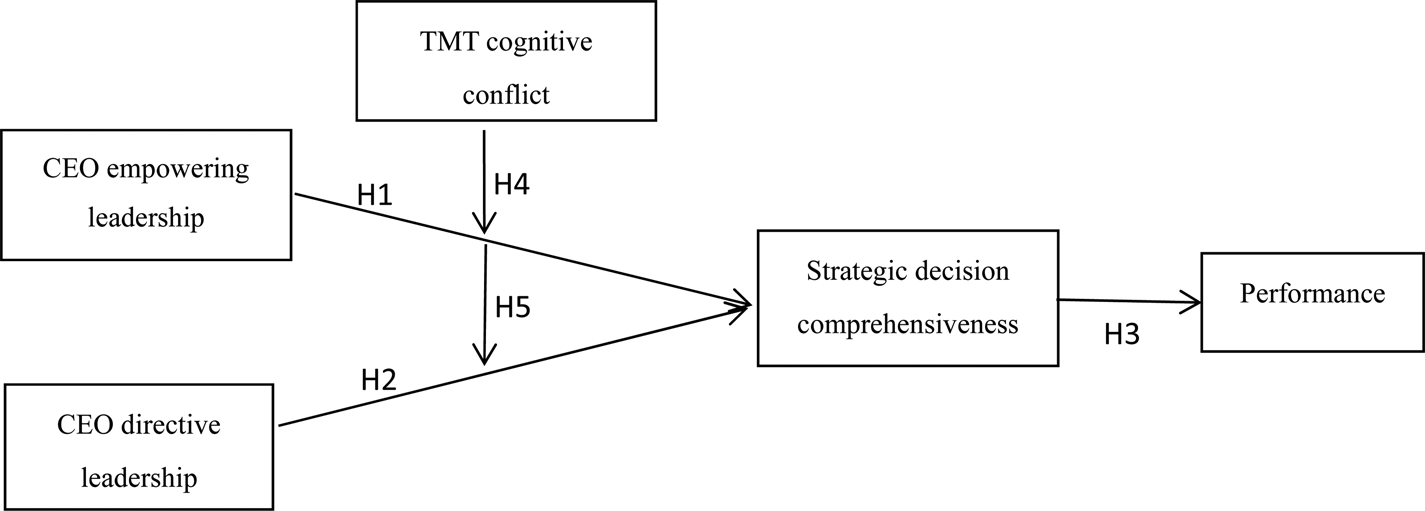
Hitherto, we know little about the impact of CEO leadership on SDC and subsequent firm performance, as well as the contingent role of TMT cognitive conflict. Thus, this study investigates the linkage between CEO leadership, SDC, and subsequent performance as well as the moderating effect of TMT cognitive conflict in the context of Chinese firms. Our theoretical model is shown in Figure 1.
Conceptual model

CEO Leadership and Strategic Decision Comprehensiveness
A growing body of strategic leadership research points out that power is unequally distributed within TMTs, and that the CEO is the most powerful executive whose leadership style disproportionately affects TMT function (Hambrick, Reference Hambrick1994; Ling et al., Reference Ling, Simsek, Lubatkin and Veiga2008). CEOs may play a more important role than other TMT members, and they must adopt appropriate leadership behaviors to product effective team decision-making, such as balancing contradictions and differences between team members, integrating different opinions, and making full use of members' expertise (Georgakakis et al., Reference Georgakakis, Greve and Ruigrok2017).
Empowering leadership and directive leadership are two important and foundational models of leader behaviors (Lorinkova, Pearsall, & Sims, Reference Lorinkova, Pearsall and Sims2013; Martin et al., Reference Martin, Liao and Campbell2013), which contrast regarding the degree of autonomy and direction provided by the leader (Martin et al., Reference Martin, Liao and Campbell2013). Empowering leadership focuses on sharing power with subordinates, granting them considerable autonomy to develop their capacity through self-leadership in independent decision-making, and encouraging self-reward and participation in decision-making (Cheong, Spain, Yammarino, & Yun, Reference Cheong, Spain, Yammarino and Yun2016; Lorinkova et al., Reference Lorinkova, Pearsall and Sims2013; Pearce et al., Reference Pearce, Sims, Cox, Ball, Schnell, Smith and Trevino2003); whereas directive leadership is related to the CEO's positional power that is generally not delegated. With directive leadership, CEOs focus on behaviors that guide subordinates with clear directions, detailed instructions, and occasional condemnation to achieve the desired outcomes (House, Reference House1971; Lorinkova et al., Reference Lorinkova, Pearsall and Sims2013; Martin et al., Reference Martin, Liao and Campbell2013). Empowering leadership is likely to operate through enhancing subordinates’ sense of psychological empowerment, discretion, and responsibility to realize increased coordination and collective information processing (Lorinkova et al., Reference Lorinkova, Pearsall and Sims2013; Martin et al., Reference Martin, Liao and Campbell2013). Conversely, directive leadership emphasizes behaviors such as setting specific goals and providing clear guidance and regular feedback, which enhances team performance by reducing process loss and decreasing task ambiguity and the difficulty of task accomplishment (House, Reference House1996; Lorinkova et al., Reference Lorinkova, Pearsall and Sims2013; Martin et al., Reference Martin, Liao and Campbell2013).
CEO empowering leadership and SDC
Self-determination theory states that intrinsic motivation is generated from the satisfaction of innate psychological needs. If individuals’ basic psychological needs are satisfied, their innate motivations can be improved, resulting in the internalization of organizational goals and improvement in task devotion, innovation, and eventual performance (Gagné & Deci, Reference Gagné and Deci2005). There are three basic psychological needs that predict human behaviors: 1) The need for autonomy, which implies that individuals want to make autonomous choices rather than be controlled by others; 2) the need for competence, which implies that individuals want to perceive that they are competent to complete their tasks and achieve expected outcomes; and 3) the need for relatedness, which implies that individuals want to establish mutual, interdependent trust with others (Chiniara & Bentein, Reference Chiniara and Bentein2016; Deci & Ryan, Reference Deci and Ryan2000).
First, with a high level of empowering leadership, TMT members’ psychological empowerment is greatly enhanced (Lee, Willis, & Tian, Reference Lee, Willis and Tian2018), which effectively eliminates their sense of powerlessness to satisfy their need for autonomy (Lorinkova et al., Reference Lorinkova, Pearsall and Sims2013). This is particularly important for TMT members who are leaders in their own right and already enjoy relative autonomy (Beckman & Burton, Reference Beckman, Burton and Carpenter2011). Empowering CEOs gives TMT members a high degree of discretion and decision-making power, encourages them to develop their potential to solve problems, and thus, TMT members have a high degree of autonomy in decision-making processes. Second, empowering leadership can effectively satisfy TMT members’ need for competence. Chebat and Kollias (Reference Chebat and Kollias2000) posited that with a high level of empowering leadership, team members are clearer about their roles and responsibilities in the decision-making process and extend the initial cognition of their roles. Thus, their task-related passion, self-efficacy, and self-adaptability are promoted, which helps reduce task-related pressure and vagueness, making them more competent and confident to cope with challenging tasks. Third, with enhanced interaction and communication between TMT members, members’ need for relatedness will be satisfied. Unlike the lower levels of an organization, the communication and interaction between TMT members are less frequent due to their relatively small role interdependence (Beckman & Burton, Reference Beckman, Burton and Carpenter2011). However, when making strategic decisions, as members of a firm's top decision-making team, they must work interdependently and collaborate frequently (Finkelstein & Hambrick, Reference Finkelstein and Hambrick1996). CEOs supporting empowering initiatives may make more effort to create a harmonious atmosphere, to encourage friendly interaction, and deepen communication between TMT members, which benefits mutual cognition and understanding (Lorinkova et al., Reference Lorinkova, Pearsall and Sims2013) and promotes good relationships.
With CEO empowering leadership, TMT members’ basic psychological needs can be satisfied, and thus their intrinsic motivation is increased. In this case, ashamed of any passive attitude, TMT members are willing to create value for the team by devoting more effort to decision making, such as spending more time and energy on gathering information and deeply thinking about strategic issues. In addition, empowering leaders encourages subordinates to express their opinions, participate in decision-making, and perform autonomously (Kim & Beehr, Reference Kim and Beehr2018), which enables TMT members to perceive strong support and trust, and thus improves their psychological safety and confidence. Hence, they will bravely raise different views in the decision-making process without worrying about challenging the CEO's authority. Meanwhile, interpersonal conflict is reduced, enabling members to focus on decision-making, to collaborate, and to raise different opinions. The exchange of different perspectives enhances the comprehensiveness of TMT decision-making. Thus, we argue that CEO empowering leadership promotes the comprehensiveness of TMT decision-making by satisfying TMT members’ basic psychological needs, increasing their internal motivation, and stimulating them to engage in and devote more effort to the decision-making process.
Hypothesis 1: CEO empowering leadership positively affects strategic decision comprehensiveness.
CEO directive leadership and SDC
Directive leaders centralize decision making and direct team activities (Faraj & Sambamurthy, Reference Faraj and Sambamurthy2006). Directive leadership, defined as task-oriented behavior (Euwema, Wendt, & Van Emmerik, Reference Euwema, Wendt and Van Emmerik2007) and characterized by command-and-control rules (Akhtar, Kaur, & Punjaisri, Reference Akhtar, Kaur and Punjaisri2017), is likely to function following principles proposed by path-goal theory (House, Reference House1996). Path-goal theory states that directive leadership can play an incentive role in promoting subordinates’ efforts, because such leaders facilitate subordinates’ effective performance and complement their deficiency by reducing their task fuzziness and promoting task devotion (House, Reference House1971; House & Mitchell, Reference House and Mitchell1974). Directive CEOs clarify roles and tasks for TMT members, remove obstacles to completing tasks, and provide members with clear objectives, guidance, rewards, and punishments (House, Reference House1996; Lorinkova et al., Reference Lorinkova, Pearsall and Sims2013; Martin et al., Reference Martin, Liao and Campbell2013).We argue for a non-linear relationship between CEO directive leadership and strategic decision comprehensiveness, because CEO directive leadership has two countervailing mechanisms: a positive mechanism dominant at a low to moderate level that CEO directive leadership can promote SDC by concentrating TMT cognitive resources on decision-making; a negative mechanism escalating rapidly at higher levels that CEO directive leadership will decrease SDC by creating barriers for effective information processing.
On the one hand, CEO directive leadership prompts SDC by concentrating TMT cognitive resources on decision-making, as comprehensive strategic decisions involve the systematic assessment of wide-range information, requiring team members to allocate ample cognitive resources to decision-related tasks (Mitchell et al., Reference Mitchell, Boyle and Nicholas2016). First, TMT members receive specific guidance that helps them understand exact task expectations and gives them clear directions and approaches to successfully complete tasks. Thus, TMT members will not waste extra cognitive resources on understanding their roles but concentrate on decision-making and considering more alternatives (Lorinkova et al., Reference Lorinkova, Pearsall and Sims2013). Second, although directive leaders do not proactively invite members to participate in decision-making, CEOs can clearly allocate jobs based on members’ expertise and encourage them to take advantage of their know-how (Hmieleski & Ensley, Reference Hmieleski and Ensley2007). For instance, directive CEOs may assign team members to gather information and provide specific knowledge in their areas of expertise (Hmieleski & Ensley, Reference Hmieleski and Ensley2007). By doing so, repetitive work and redundant information can be largely reduced to ensure that sufficient cognitive resources can be applied to gather and assess unique and high-quality information to facilitate the search and examination for various decision options. Third, goal-oriented directive leaders can drive TMT members to make decisions comprehensively by providing extrinsic motivations. Such leaders offer rewards to members based on subordinates’ ability and performance (Zhang, Wang, & Zhang, Reference Zhang, Wang and Zhang2018), which motivates members to complete tasks more effectively for better outcomes (Martin et al., Reference Martin, Liao and Campbell2013). To obtain rewards, members are motivated and willing to make more effort and allocate more cognitive resources to decision-making in terms of information search, analysis, and solution proposition and thus contribute to promoting the comprehensiveness of strategic decisions. Therefore, while SDC requires TMT members to allocate considerable cognitive resources to information processing (Mitchell et al., Reference Mitchell, Boyle and Nicholas2016), directive CEOs can help TMT members to concentrate on the allocation of cognitive resources by providing them with clear guidance, arrangements, and extrinsic motivations, thus contributing to strategic decision comprehensiveness.
On the other hand, CEO directive leadership also has its drawbacks to SDC, as it may create barriers for effective information processing by hindering the expression of dissenting voices, reducing members’ motivation to devote sufficient cognitive resources to decision-making, and constraining team communication and collaboration for information processing. First, highly directive CEOs are unlikely to encourage TMT members involved in decision-making and tend to require members to follow directions without disagreement (Lorinkova et al., Reference Lorinkova, Pearsall and Sims2013), which results in a decline in opportunities for TMT members to express different opinions about decision issues and subsequently impedes the emergence of diverse views and solutions. As such, TMT members are likely to be cautious and may even withhold thoughts that contradict the CEO's views (Talaulicar et al., Reference Talaulicar, Grundei and Werder2005), leading to superficial and artificial agreement in decision-making. Hence, highly directive leadership may result in fewer alternatives being generated and discussed (Leana, Reference Leana1985). Second, since team members may enjoy individual autonomy in task completion (Beckman & Burton, Reference Beckman, Burton and Carpenter2011), a high level of CEO directive leadership may limit subordinates’ autonomy and reduce their psychological security and job satisfaction (Edmondson, Reference Edmondson1999), resulting in a reduction in TMT members’ work motivation and initiatives. When TMT members are not satisfied or agree with assigned tasks, they may not acknowledge team objectives, and thus procrastinate and work in a perfunctory manner (Zhou, Du, Shi, & Horlen, Reference Zhou, Du, Shi and Horlen2016). Hence, in the decision-making process, although directive CEOs can assign tasks to TMT members according to their different expertise, members are not willing to apply adequate cognitive resources to gather high-quality information and think deeply for alternative solutions, but simply complete their assigned tasks (Martin et al., Reference Martin, Liao and Campbell2013). Consequently, the amount of information they access may be insufficient and the quality of information available to CEOs may be lower, which is detrimental to comprehensive decision-making. Third, a high level of directive behaviors is unfavorable for information exchange and knowledge sharing within TMTs. Because of the bottom-up communication of directive leadership, communication, and collaboration between TMT members are hindered, which is harmful to information exchange and knowledge sharing and thus constrains the TMTs’ information processing capabilities and the comprehensiveness of subsequent decision-making. As such, because of the decline in the amount and quality of information and reduction in the diversity of perspectives and solutions created and discussed, comprehensive decision-making will be hindered.
The above arguments suggest that when the level of CEO directive leadership is low or moderate, the drawbacks of CEO directive leadership are moderate and its positive effects on SDC are dominant to exceed its negative effects, leading to the increase in SDC. Directive CEOs provide clear guidance to team members, allocate tasks by leveraging members’ expertise, and offer extrinsic motivations to them. Through these efforts, directive CEOs are able to help team members concentrate on the full use of their cognitive resources to enhance SDC. However, a high level of directive behaviors may discourage team members from proposing diverse views, reduce their initiative to search for alternatives, and constrain team collaboration for information sharing, resulting in less effective information processing and fewer strategic solutions. As such, when the level of CEO directive leadership becomes high, its negative effects on SDC become increasingly apparent to offset its benefits and eventually exceed its benefits, deterring further increase in the comprehensiveness of strategic decisions. Therefore, we propose that:
Hypothesis 2: CEO directive leadership has an inverted U-shaped relationship with strategic decision comprehensiveness.
SDC and Firm Performance
The effect of SDC on performance is an issue of significance and long-standing (Mitchell et al., Reference Mitchell, Boyle and Nicholas2016). Prior research provides inconsistent findings on the influence of SDC on firm performance. In this study, we argue for a positive relationship between SDC and firm performance. First, SDC improves decision quality, which is one of the most important determinants of firm performance (Eisenhardt, Reference Eisenhardt1989; Meissner & Wulf, Reference Meissner and Wulf2014). A TMT engaging in comprehensive decision-making may seek and acquire substantial information from inside and outside the firm, which can enable decision-makers to gain a broad range of knowledge (Heavy et al., Reference Heavey, Simsek, Roche and Kelly2009). SDC depicts the TMT's approach to information processing during decision-making and underpins the systematic collection and processing of information (Carmeli et al., Reference Carmeli, Friedman and Tishler2013; Mitchell et al., Reference Mitchell, Boyle and Nicholas2016). This exhaustive and systematic information processing can help TMTs conduct continuous and deep analysis of environmental changes and foster holistic consideration of important factors in the decision-making processes. Such information processing can reduce uncertainties in decision-making (Carmeli et al., Reference Carmeli, Friedman and Tishler2013), mitigate cognitive biases (Mitchell et al., Reference Mitchell, Boyle and Nicholas2016), and thus enhance decision-makers’ capabilities to predict risks and accurately evaluate the probability of future events for opportunities. As such, with comprehensive strategic decisions, decision quality of the team can be improved, which subsequently enhances firm performance (Meissner & Wulf, Reference Meissner and Wulf2014).
Second, TMTs engaging in comprehensive decision-making may have higher decision commitment and implementation motivation, which facilitates the success of the implementation efforts. Having invested heavily in the comprehensive decision-making process, TMT members are more likely to be committed to implementation (Miller, Reference Miller2008; Thomas & Ambrosini, Reference Thomas and Ambrosini2015). Moreover, Heavy et al. (Reference Heavey, Simsek, Roche and Kelly2009) argue that examining multiple alternatives from diverse perspectives can provide managers with decision confidence, and thus induce their commitment to the implementation of selected strategic decisions for higher performance.
Third, although prior research suggests that implementation of comprehensive strategic decisions may involve more time and resources, which are likely to negatively affect firm performance (e.g., Fredrickson & Iaquinto, Reference Fredrickson and Iaquinto1989; Fredrickson & Mitchell, Reference Fredrickson and Mitchell1984), implementing comprehensive decisions may not incur longer time or consume more resources in turbulent business environments, such as those in China. In turbulent conditions, TMTs should have flexibility to cope with environmental changes. While TMTs invest a great deal of resources to implement comprehensive decisions, once environmental changes happen, top managers can quickly respond by choosing one that suits the change without taking extra time and resources from multiple strategic alternatives, and thus improve implementation outcomes (Thomas & Ambrosini, Reference Thomas and Ambrosini2015). Therefore, we propose that SDC positively impacts performance.
Hypothesis 3: There is a positive relationship between strategic decision comprehensiveness and firm performance.
The Moderating Role of TMT Cognitive Conflict
Cognitive conflict happens when team members have debates about task-related issues (De Dreu, Reference De Dreu2006; Mooney, Holahan, & Amason, Reference Mooney, Holahan and Amason2007). We propose that TMT cognitive conflict negatively moderates the relationship between CEO empowering leadership and SDC, because task-related conflict can decrease the effect of CEO empowering leadership on improving the satisfaction of members’ basic psychological needs and subsequently reduce TMT members’ intrinsic motivations. First, as TMT cognitive conflict increases, the effect of CEO empowering leadership on satisfying TMT members’ need for autonomy declines. Jehn and Bendersky (Reference Jehn and Bendersky2003) suggested that task-related conflict is less likely to occur when team members work autonomously. With high cognitive conflict, rather than making independent decisions, TMT members may have to debate other members to reach consensus in decision-making. As such, it is hard for TMT members to make decisions autonomously without considering others’ views, even when empowered by the CEO. Consequently, cognitive conflict may decrease TMT members’ perceived autonomy granted by CEO empowering leadership.
Second, cognitive conflict may weaken TMT members’ sense of competence intensified by CEO empowering leadership. Empowering CEOs invest trust in TMT members and improve their self-efficacy (Lorinkova et al., Reference Lorinkova, Pearsall and Sims2013), which can lead to a collective sense among TMT members that they are highly confident and competent. However, in the presence of high cognitive conflict, on the one hand, different members have divergent views on the same task and thus do not easily reach consensus (Jehn & Bendersky, Reference Jehn and Bendersky2003); on the other hand, confrontations of opposing views that create stress and distrust in team members may emerge during decision-making (De Clercq & Belausteguigoitia, Reference De Clercq and Belausteguigoitia2017; Friedman, Tidd, Currall, & Tsai, Reference Friedman, Tidd, Currall and Tsai2000). As such, their confidence in accomplishing tasks will be reduced. Hence, confronting high cognitive conflict, empowered TMT members may still perceive more difficulties and feel less competent to complete the tasks.
Last and foremost, with high cognitive conflict, empowering team members becomes difficult to satisfy TMT members’ need for relatedness. Since empowering CEOs offer TMT members more opportunities to interact with each other, they are more likely to find similarities or dissimilarities between themselves and other members. In this case, with high cognitive conflict, they are more likely to find the dissimilarity with team members regarding their beliefs and values (Mooney et al., Reference Mooney, Holahan and Amason2007). Members may identify teammates who share similar beliefs and values and feel closer to them (Miller et al., Reference Miller, Burke and Glick1998). According to self-categorization theory, when team members are dissimilar with respect to cognitive thinking, they may engage in categorization based on observable characteristics (Turner, Reference Turner and Tajfel1982). Once categorization takes place, it subconsciously engenders positive assessments about members who are similar and negative opinions of those who are dissimilar (Tajfel, Reference Tajfel1982). In this sense, although empowering CEOs facilitate interaction and communication and thus promote good relationships among TMT members, these relationships will be undermined by TMT cognitive conflict. Therefore, in a TMT with high cognitive conflict, it is harder for CEO empowering leadership to satisfy TMT members’ basic psychological need for relatedness, and thus more difficult to effectively improve their intrinsic motivation. As a result, the effect of CEO empowering leadership on comprehensive decision-making by improving TMT members’ intrinsic motivation is mitigated. Therefore, we propose that:
Hypothesis 4: TMT cognitive conflict will weaken the positive effects of CEO empowering leadership on strategic decision comprehensiveness.
We also argue that TMT cognitive conflict can influence the effectiveness of CEO directive leadership on SDC. On the one hand, the benefits of a CEO's directive behaviors on SDC can be weakened by TMT cognitive conflict as it mitigates the effects of directive CEOs on decision-making. First, although CEO directive leadership can drive TMT members to focus their cognitive resources on decision-making through offering guidance and reducing members’ fuzziness of tasks and roles, cognitive conflict is likely to increase the uncertainty and thus intensifies TMT members’ ambiguity (De Clercq & Belausteguigoitia, Reference De Clercq and Belausteguigoitia2017; De Dreu & Weingart, Reference De Dreu and Weingart2003), impelling them to waste cognitive resources to understand tasks and roles. With the increase of cognitive conflict, the differences in values and perspectives may bring challenges regarding reaching consensus, and it becomes difficult to ensure that TMT members have a clear understanding of an issue (Parayitam, Olson, & Bao, Reference Parayitam, Olson and Bao2010). As such, TMT members need to spend more time and effort on identifying and comprehending their roles and tasks and thus cannot fully focus on decision-making issues. Second, as cognitive conflict intensifies, TMT members’ cognitive load and stress increases (De Dreu & Weingart, Reference De Dreu and Weingart2003), which interferes with their cognitive flexibility and limits their cognitive ability to cope with work demands (De Clercq & Belausteguigoitia, Reference De Clercq and Belausteguigoitia2017), constraining the development of their cognitive resources. Hence, with high cognitive conflict, TMTs’ available cognitive resources that directive CEOs can deploy for decision-making decrease, resulting in less comprehensive decisions. Third, when task disagreements are not resolved, TMT cognitive conflict may turn into affective conflict (Mooney et al., Reference Mooney, Holahan and Amason2007), which produces distraction from decision-related tasks and leads TMT members to spend more time and energy focusing on each other (De Dreu, Reference De Dreu2006). As such, as TMT cognitive conflict reinforces, team members may give priority to solving interpersonal conflict and thus be less motivated to concentrate their cognitive resources on decision-making. Therefore, while directive CEOs help team members concentrate on applying their cognitive resources for SDC, TMT cognitive conflict constrains the positive influence.
On the other hand, TMT cognitive conflict also weakens the negative effects of directive leadership on SDC. First, highly directive CEOs result in fewer opportunities for TMT members to participate in decision-making and express their views openly, subsequently reducing SDC. However, TMT cognitive conflict, to some extent, can break these constraints caused by high CEO directive leadership, as it enables TMT members to exercise their voices in the decision process (Li & Li, Reference Li and Li2009). Research has suggested that as cognitive conflict increases, team members have more opportunities to voice their views on debated issues (Amason, Reference Amason1996). And the team with cognitive conflict often has a norm of openly challenging one another on issues related to tasks (Janis, Reference Janis1972; Talaulicar et al., Reference Talaulicar, Grundei and Werder2005), which can increase members’ courage to resist pressures of conformity (De Dreu, Reference De Dreu2006). Thus, with high cognitive conflict, TMT members are more willing to challenge directive CEOs’ decisions and voice their dissenting views. Second, high directive leadership may lower motivations of TMT members to devote cognitive resources to decision-making. Nevertheless, team members engaging in high levels of cognitive conflict are often more proactive as they believe that they can influence the task domain (Giebels, de Reuver, Rispens, & Ufkes, Reference Giebels, de Reuver, Rispens and Ufkes2016). They may have a sense that they can affect team decisions at least to some extent as they know that their inputs will be discussed in open negotiations and debates. Hence, TMT members experiencing cognitive conflict tend to have higher initiatives. Third, high CEO directive leadership hinders information exchange and knowledge sharing necessary for effective information processing. With cognitive conflict, however, team members can be promoted to exchange ideas and share various opinions through discussion and debates (Mooney et al., Reference Mooney, Holahan and Amason2007). As such, with TMT cognitive conflict, drawbacks of CEO directive leadership in constraining effective information processing can be mitigated, and thus the negative effects of CEO directive leadership on SDC are weakened.
Given the above arguments, we argue that TMT cognitive conflict flattens the inverted U-shaped relationship between CEO directive leadership and SDC. Experiencing high cognitive conflict reduces the benefits of CEO directive leadership for SDC by weakening the directive CEOs’ roles on concentrating the TMT cognitive resources on decision-making, it also helps TMT members to break constraints caused by highly directive CEOs, thus limiting the negative consequences of high directive leadership. Therefore, we propose that:
Hypothesis 5: TMT cognitive conflict will flatten the inverted U-shaped relationship between CEO directive leadership and strategic decision comprehensiveness.
METHODS
Sample and Data Collection
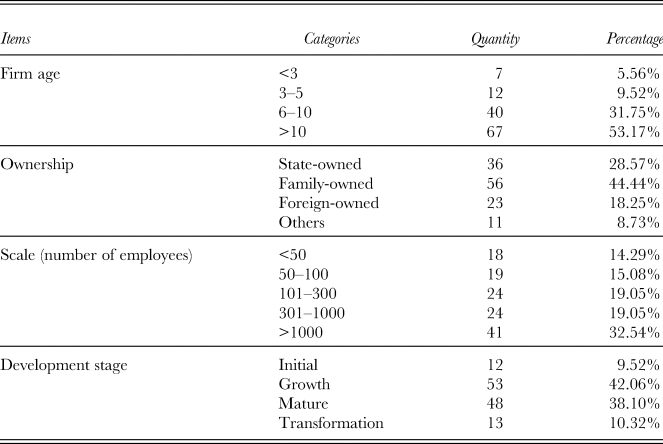
Data was collected through a questionnaire survey. We collected data from December 2010 to April 2011 from six different provinces in eastern, central, and western China. They represent different levels of economic development across different main economic development regions in China, including the Yangtze River region, Pearl River region, Bohai Sea region, Western region, Northeastern region, and Middle region. The purpose is to reduce potential bias owing to differences in the economy and culture across different regions. We randomly selected 300 firms out of a list of over 1000 firms obtained from the Economy Commerce Committee, a special administrative setup by the government for managing firms. The descriptive characteristics of the sample firms are shown in Table 1.
Descriptive statistics of sample firms

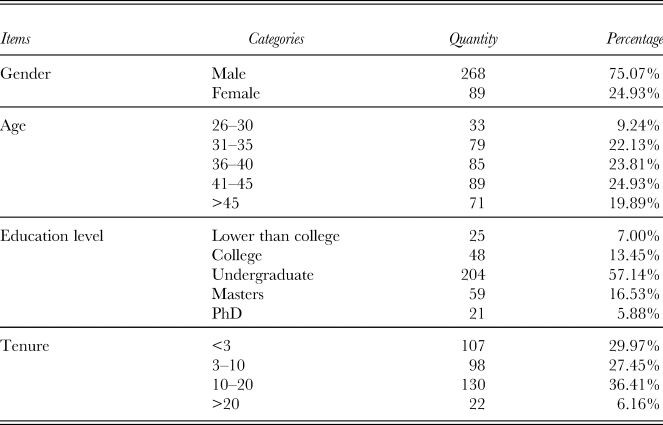
We chose top managers as our respondents to ensure that they had adequate knowledge and information in terms of their firms’ strategic management activities. We required at least three members (i.e., CEOs and other senior executives (e.g., CFO/COO/SVP)) to answer questions respectively to ensure the reliability of the data. For the TMTs with no more than 3 members or firms with less than 50 employees, we asked at least two members to fill out the questionnaire. Eventually, we received 510 responses from 182 firms. Owing to missing and invalid data, our final sample includes 357 valid answers of 126 firms, leading to an effective response rate of 42 percent. This response rate is an effective rate in TMT studies (Baruch, Reference Baruch1999). To test the potential no-response bias, we undertook the T-test by comparing the responding and non-responding firms in terms of age, size and sales. All t-values were not statistically significant, indicating that non-response bias was not a major problem in this study. Table 2 describes the TMT member statistics.
Descriptive of top managers

Measures
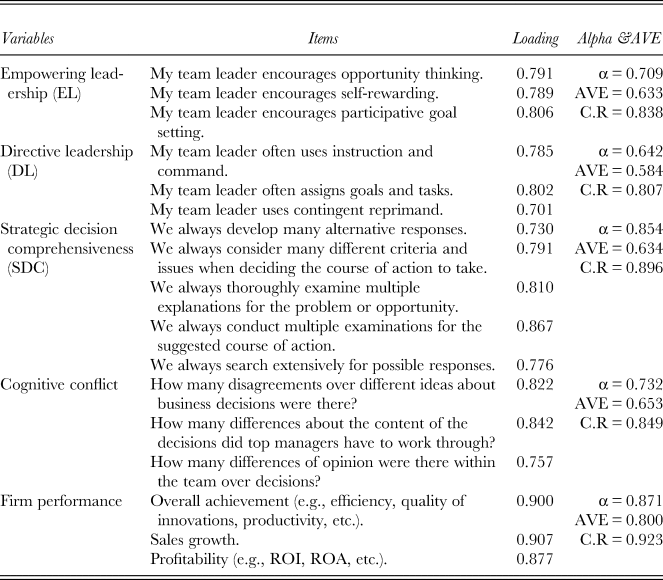
We used five-point Likert scales to measure all scales (Table 3), ranging from 1 ‘strongly disagree’ to 5 ‘highly agree’. To make it applicable in the context of China, we carefully designed our questionnaire. The survey instrument was conducted in Chinese. Because the original scales in prior research on strategic leadership and decision-making processes were developed in English, our questionnaire was developed through a back-translation process (Brislin, Reference Brislin, Lonner and Berry1986). All items were first translated into Chinese by two management professors competent in both languages and then back-translated into English independently by another management professor. To ensure accuracy, we invited a bilingual management scholar to compare the Chinese and English versions of the questionnaire, and found the two versions were comparable to a high degree of accuracy. We further invited three academic experts to identify any ambiguous or irrelevant items in our questionnaire, and then modified the minor discrepancies identified.
Reliability and validity test of key constructs

Although our study is not cross-cultural, the measurement in this study might have a semantic equivalence issue. To prove the validity of our measures in the Chinese context, we collected additional evidence.
First, we examined the perspectives of both insiders’ and outsiders’ on the measures’ semantic equivalence (Schaffer & Riordan, Reference Schaffer and Riordan2003). We consulted another two management professors in cross-cultural research outside of the current research project and three managers. According to their feedback, none of the items has been identified that cannot be generalized to Chinese culture. Moreover, they conceptualized these measures in ways that were in line with the original definitions of these measures. In addition, a pilot test was conducted with five top managers from five firms. In order to be better understood, we further carefully refined the questionnaire regarding both design and wording according to their suggestions.
Second, we conducted exploratory factor analysis (EFA) for each measure and all measures respectively to confirm the validity of our factor structures. EFA for each measure led to a single-factor solution. These results discussed under each measure below. And EFA for all measures yielded a 5-factor solution, and the items attached to each factor is consistent with our scales of each variable. These results provided construct validity evidence of our factor structures in Chinese context.
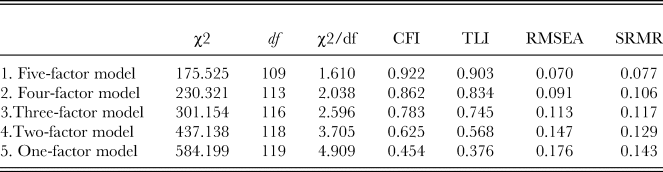
Third, we undertook a series of confirmatory factor analysis (CFA) to confirm the distinctiveness of the multi-item variables in this study, including SDC, empowering leadership, directive leadership, cognitive conflict, and firm performance. The results of CFA in Table 5 showed that compared to other alternative models, the hypothesized five-factor model fits the data best (χ2(df = 109) = 175.525, χ2/df = 1.610, CFI = 0.922, TLI = 0.903, RMSEA = 0.070, SRMR = 0.077), which provides the evidence of the discriminant validity of our measures.
SDC was measured with a five-item scale developed by Miller et al. (Reference Miller, Burke and Glick1998), as shown in Table 3. SDC measures entrepreneurs’ rationality and comprehensiveness in strategic decision-making processes. EFA yielded a single-factor solution (eigenvalue = 3.168, average factor loading = 0.795, explaining 63.353% of the total variance).
Firm performance was measured using three items, adding a new item to the two-item scale used by Plambeck and Weber (Reference Plambeck and Weber2010), as shown in Table 3. Firm performance measures the company's performance relative to the industry average, and Likert scales were adopted to evaluate firm performance, ranging from 1 ‘far below average’ to 5 ‘far above average’. EFA led to a single-factor solution (eigenvalue = 2.402, average factor loading = 0.895, explaining 80.075% of the total variance).
Empowering leadership and Directive leadership were measured by items modified from scales in Hmieleski and Ensley (Reference Hmieleski and Ensley2007), as shown in Table 3. According to the results of factor analysis, the factor loading of one item of empowering leadership: ‘My team leader encourages independent action’ is 0.38, far below 0.60, and thus this item is eliminated. Similarly, one item of directive leadership: ‘My team leader conducts active management by exception’ was also eliminated because of its low factor loading (0.34). EFA on both empowering and directive leadership yielded a single-factor solution with average factor loadings of 0.763 and 0.795, explaining 58.323% and 63.312% of the total variance, respectively.
Cognitive conflict was measured by a scale adapted from Li & Li (Reference Li and Li2009). Three items were used to measure cognitive conflict: 1) How many disagreements over different ideas about business decisions were there? 2) How many differences about the content of the decisions did top managers have to work through? 3) How many differences of opinion were there within the team over decisions? (1 = none, 5 = a great deal). EFA yielded a single-factor solution (eigenvalue = 1.959, average factor loading = 0.807, explaining 65.290% of the total variance).
Control variables
In order to account for alternative explanations, we controlled for a number of factors that potentially affect SDC and performance. Strategic decision-making processes may vary depending on the firm's age, size, and ownership type (Fredrickson & Iaquinto, Reference Fredrickson and Iaquinto1989; Goll, Reference Goll2005; Papadakis et al., Reference Papadakis, Lioukas and Chambers1998). Firm size was measured by calculating the natural logarithm of the number of employees. Firm age was measured by the natural logarithm of the number of years since the formation of the firm. We used a dummy variable to control for ownership type of our sample firms (1 = state-owned, 0 = others). In order to control for industry effects, we used a dummy variable to control manufacturing industry. Because in munificent environments, firms can obtain more resources to make comprehensive decisions, we controlled for the influence of environmental munificence. We also controlled for the influence of TMT demographic attributes, which have potential impacts on TMT decision comprehensiveness and firm performance, such as TMT educational diversity (Simons, Pelled, & Smith, Reference Simons, Pelled and Smith1999). We measured the educational diversity using the Blau (Reference Blau1977) index, which were calculated as 1 – ΣSi 2, Si is the proportion of TMT members in the ith category (see Table 2) (Yi, Ndofor, He, & Wei, Reference Yi, Ndofor, He and Wei2018).
Data Aggregation
Each respondent was asked to rate their perceptions of constructs used in this study. The team-level constructs of each variable needed aggregation of multiple ratings from multiple respondents. To justify aggregation, we calculated interrater agreement (James, Demaree, & Wolf, Reference James, Demaree and Wolf1993) and two intraclass correlations, ICC(1) and ICC(2) (James, Reference James1982; Shrout & Fleiss, Reference Shrout and Fleiss1979). For SDC, the values for the mean rwg, ICC(1), and ICC(2) values were 0.93, 0.42, and 0.68 respectively; for firm performance, we justified averaging responses to create a team-level variable on the basis of a mean rwg of 0.92, an ICC(1) of 0.51, and an ICC(2) of 0.73; for empowering leadership, the rwg mean value was 0.93, ICC(1) was 0.36, and ICC(2) was 0.62; for directive leadership, the rwg mean value was 0.83, ICC(1) was 0.25, and ICC(2) was 0.50; for cognitive conflict, The values for the mean rwg, ICC(1), and ICC(2) values were 0.93, 0.25, and 0.50, respectively. Overall, these results provided support for aggregating these constructs for the team-level analysis.
RESULTS
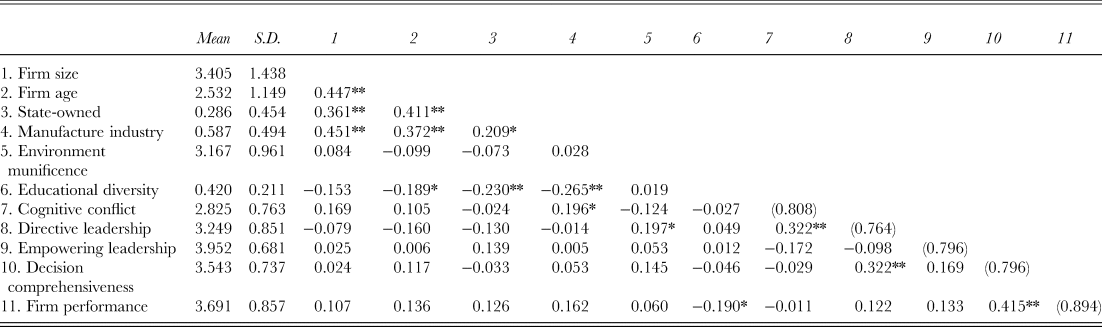
Table 4 shows the results of the descriptive statistics and correlations analyses. Interfactor correlations are below the 0.6 threshold and the maximum VIF value in all equations is 2.72, which indicate that our estimations are not likely to be biased by multicollinearity problems.
Descriptive statistics and correlation matrix (n = 126)

Notes: * , **, and *** indicate that correlation is significant at the 0.05, 0.01, 0.001 level (two tailed); Numbers in parenthesis on the diagonal line are the square roots of AVEs.
Reliability and Validity
We took measures to test reliability and validity of our constructs. First, we assessed composite reliability using Cronbach's α. As shown in Table 3, Cronbach's α values of constructs used to capture SDC, empowering leadership, cognitive conflict, and performance are above 0.70, and the value for directive leadership is 0.64, all greater than the 0.60 cutoff (Bagozzi & Yi, Reference Bagozzi and Yi1988). Therefore, the results support the reliability of the constructs.
Second, we ran validity analyses for each construct. We operationalized the convergent validity using both factor loadings and the average variance extracted (AVE). As shown in Table 3, the factor loadings are mostly above 0.60 and the AVE values are all above 0.50, indicating convergent validity for each construct. We then checked the discriminant validity. As shown in Table 4, the square roots of the AVEs are greater than the correlations and thus support good discriminant validity.
Confirmatory Factor Analyses
To test the validity of the measurement model, we conducted confirmatory factor analyses (CFAs) with Mplus 7.4. As shown in Table 5, the hypothesized five-factor model demonstrates a good fit to the data (χ2(df = 109) = 175.525, χ2/df = 1.610, CFI = 0.922, TLI = 0.903, RMSEA = 0.070, SRMR = 0.077). We also conducted CFAs on the four combinations: (1) combination of CEO empowering leadership and CEO directive leadership; (2) combination of CEO empowering leadership, CEO directive leadership and cognitive conflict; (3) combination of CEO empowering leadership, CEO directive leadership, cognitive conflict and SDC; (4) combination of all variables. Results in Table 5 demonstrated that the five-factor model yielded a better fit than other models. Therefore, both construct validity and discriminant validity were supported.
Results of confirmatory factor analysis

Notes: Five-factor model: hypothesized model. Four-factor model: CEO empowering leadership and CEO directive leadership were combined. Three-factor model: CEO empowering leadership, CEO directive leadership and cognitive conflict were combined as one variable. Two-factor model: CEO empowering leadership, CEO directive leadership, cognitive conflict and strategic decision comprehensiveness were combined as one variable. One-factor model: All variables were combined together.
Assessing Common Method Bias
We also examined the potential of common method bias in three ways. First, we ordered the questionnaire items randomly. Second, the survey items did not have right, wrong, or socially desirable answers. Third, following Podsakoff and Organ (Reference Podsakoff and Organ1986), we tested for the occurrence of the bias via Harman's one-factor test and confirmatory factor analysis (CFA). In the unrotated factor solution, the largest factor explains 25.73% of the total variances. When linking all items to a single factor, the model result suggests that a single factor underlies all the variables. Given the results shown in Table 5, we conclude that this single-factor model does not fit the data well and cannot be accepted (χ2(df = 119) = 584.199, χ2/df = 4.909, CFI = 0.454, TLI = 0.376, RMSEA = 0.176, SRMR = 0.143). However, when the common factor was removed from the model and all items were assigned to their theoretical constructs, the model fits the data well (χ2(df = 109) = 175.525, χ 2/df = 1.610, CFI = 0.922, TLI = 0.903, RMSEA = 0.070, SRMR = 0.077) (Table 5). The results of this CFA test thus suggest no serious threat of common-method bias.
Tests for Endogeneity
Our survey is cross-sectional in nature and thus raise potential endogeneity concerns. Leadership adopted by CEOs may not be random and CEOs may make choices about their leadership in specific situation (Yun, Faraj, & Sims, Reference Yun, Faraj and Sims2005). We used instrumental variables (IVs) to investigate potential endogeneity of CEO leadership. Because our sample size is limited, we adopted an estimator of IV, named limited information maximum likelihood (LIML), which is essentially a linear combination of the ordinary least squares (OLS) and two-stage least squares (2SLS) estimates but can be virtually unbiased and more effective than 2SLS in the case of small sample sizes as well as weak instruments (Bascle, Reference Bascle2008; Stock & Yogo, Reference Stock, Yogo, Andrews and Stock2005; Ullah, Zaefarian, & Ullah, Reference Ullah, Zaefarian and Ullah2020).
We chose CEO succession origin and business scope as instrumental variables for CEO empowering leadership. Compared to inside CEOs promoted from within the firm, CEOs hired from outside the firm lack firm familiarity and have a limited understanding of the firm's resources, constraints, and administrative heritage (Friedman & Saul, Reference Friedman and Saul1991; Zhang & Rajagopalan, Reference Zhang and Rajagopalan2010). To make appropriate strategies, they may choose empowering leadership to advocate team cooperation and encourage other executives to participate in and have a voice in decision-making. We used a dummy variable to control for CEO succession origin (1 = outside, 0 = internal). Further, with the increase of the business scope, a firm may invest in new businesses, which requires managers to acquire and absorb new knowledge and skills (Wang, Huang, & Shou, Reference Wang, Huang and Shou2015). However, CEOs alone may not make it, as they have limited rationality and energy (Lo & Fu, Reference Lo and Fu2016). As such, those CEOs may prefer empowering team members to leverage their expertise in decision-making for new businesses. Business scope was measured by a one-to-five Likert scale, which reflects the degree of business scope expansion of the firm (Goodstein, Gautam, & Boeker, Reference Goodstein, Gautam and Boeker1994).
The two instrumental variables for CEO directive leadership we chose were TMT affective conflict and whether foreign-owned. With high team affective conflict, TMT members not only refused to compromise but also diverted their attention from work to personal frictions (De Dreu & Weingart, 2003). In this case, to avoid wasting time and escalating conflicts, CEOs may be more likely to follow directive leadership, making decisions on their own and directly assigning tasks to members. We measured affective conflict with a one-to-five Likert scale which reflects the extent of personal friction in the TMT during business decisions (Mooney et al., Reference Mooney, Holahan and Amason2007). Moreover, there are significant cultural differences between foreign-owned firms and domestic firms (Gamble, Reference Gamble2000). The foreign-owned firms in our sample are comprised mostly of investors from western countries. China is characterized by high power distance, while power distance in western countries is relatively low (Zhang & Begley, Reference Zhang and Begley2011). Thus, compared to domestic firms, directive leadership is less likely to be adopted by managers in foreign-owned firms, as they are influenced by western culture values. We used a dummy variable to control for this factor (1 = Foreign owned, 0 = otherwise).
According to Semadeni, Withers, and Certo (Reference Semadeni, Withers and Trevis Certo2014), we examine the relevance (i.e., strength) and exogeneity (i.e., validity) of instruments before understanding the results of LIML models. We first undertook the Wald test (F-statistics) and the results showed that the F statistic (F = 9.257, p = 0.000, for empowering leadership; F = 9.350, p = 0.000, for directive leadership) above the Stock-Yogo critical value for the weak instrument test based on LIML size (8.67 for 2 IVs) (Stock & Yogo, Reference Stock, Yogo, Andrews and Stock2005), providing evidence to support the relevance of our instruments. Second, the Sargan test returned non-significant results (p = 0.493, for empowering leadership; p = 0.312, for directive leadership), suggesting the exogeneity of instruments is supported (Bascle, Reference Bascle2008). Overall, these results support the relevance and exogeneity of the instruments, indicating these instruments are qualified in this study (Semadeni et al., Reference Semadeni, Withers and Trevis Certo2014).
Implementing the LIML procedure with all control variables, we found that the coefficient for empowering leadership remained significantly positive (β = 0.570, p = 0.017) and the coefficient for directive leadership squared was significantly negative (β = −0.121, p = 0.039). Finally, we tested for potential endogeneity. Using these valid instruments in the LIML procedure, the Hausman's test of endogeneity was insignificant (p = 0.167, for empowering leadership; p = 0.209, for directive leadership), indicating that the regressors (empowering leadership and directive leadership) were exogenous. Thereby, we conclude that there was no evidence of endogeneity in our model.
Hypothesis Testing
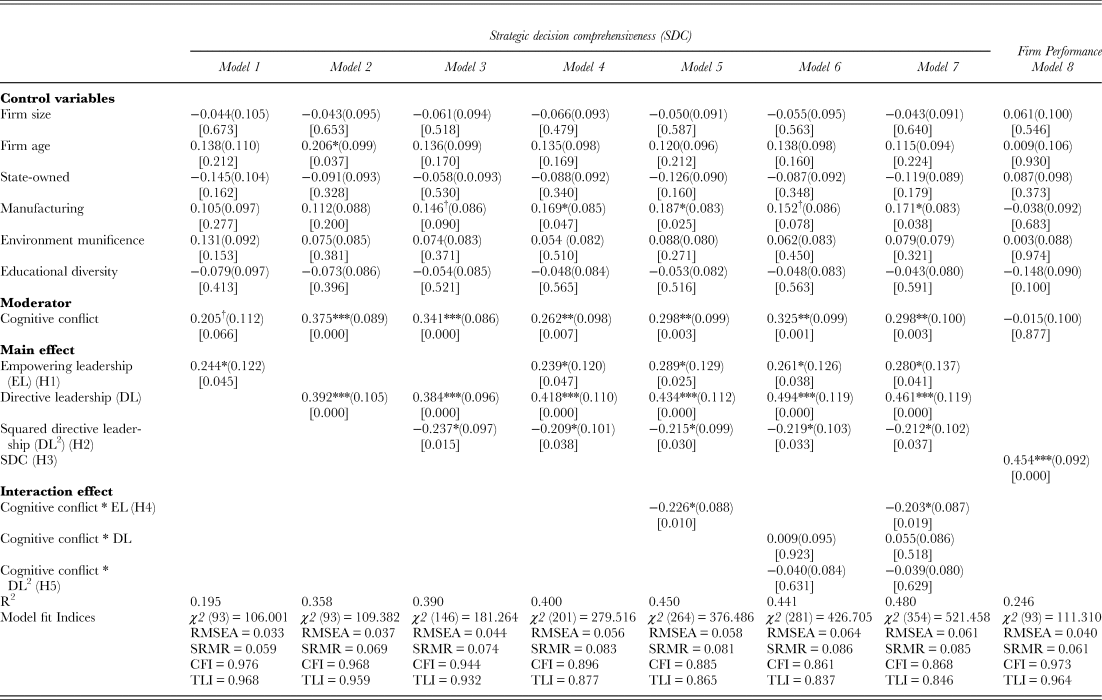
We tested the proposed hypotheses via structural equation models (SEMs) by Mplus version 7.4. Tables 6 present the SEM results.
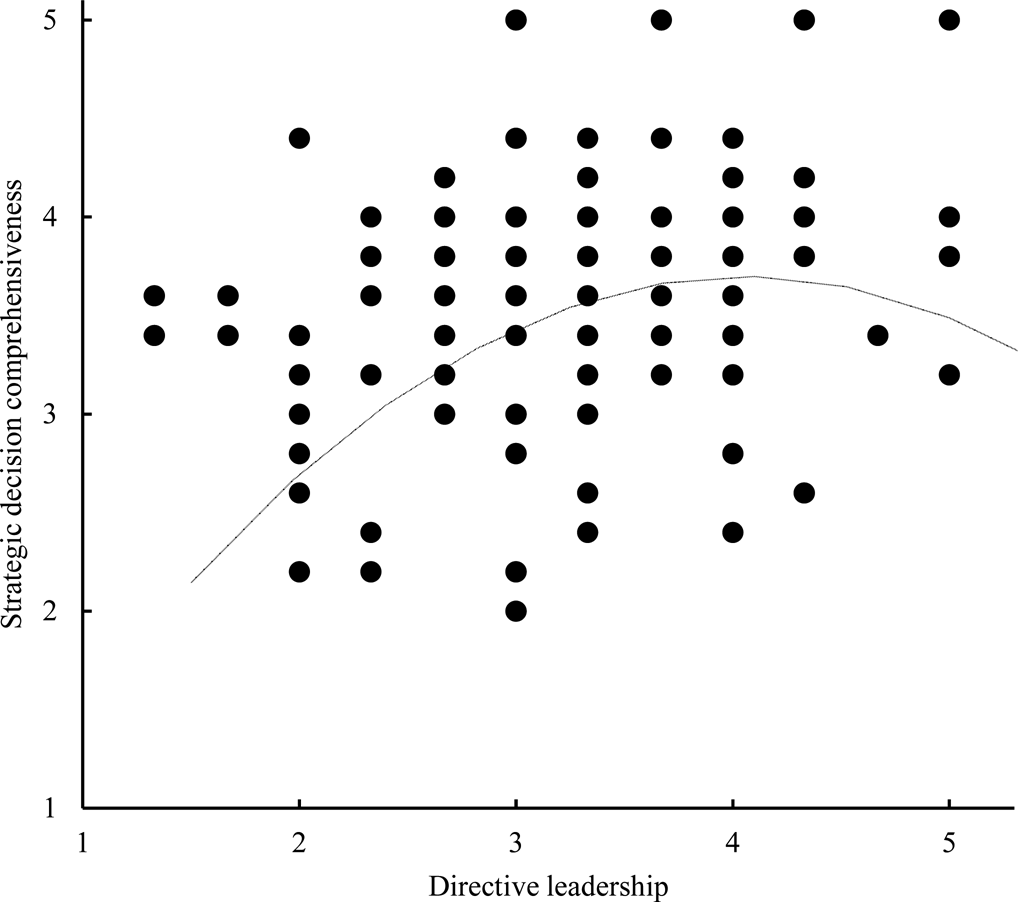
We performed respective analyses to test the effects of the two leadership types on SDC. Hypothesis 1 suggests that CEO empowering leadership positively influences SDC. As shown in model 1 Table 6, the result provides support for the positive effect of CEO empowering leadership on SDC (β=0.244, p = 0.045). Hypothesis 1 is thus supported. Hypothesis 2 predicted an inverted U-shaped relationship between CEO directive leadership and SDC. As shown in model 3 Table 6, the coefficient for the directive leadership squared term suggests a statistically significant and negative effect (β=−0.237, p = 0.015) on SDC, providing support to the inverted-U shape. Figure 2 is drawn to help understand this non-linear relationship. In Figure 2, we plotted the original data points of SDC on the vertical axis and CEO directive leadership on the horizontal axis, using scatter and quadratic fit plots to indicate relationship between the two variables. The figure presents an inverted-U shaped curve. As shown in Figure 2, SDC rises with the increase of directive leadership to a threshold indicated by the regression results (DL = 4.059), beyond which SDC declines. Thus, Hypothesis 2 receives support. Hypothesis 3 predicted a positive relationship between SDC and firm performance. As shown in model 8 Table 6, SDC positively affects firm performance (β = 0.454, p = 0.000), supporting Hypothesis 3. In addition, because of the debate about whether SDC is beneficial on firm performance, prior research increasingly focuses on the contingencies of this relationship (e.g., Miller, Reference Miller2008; Mitchell et al., Reference Mitchell, Boyle and Nicholas2016). Thus, we also conducted post hoc analyses to examine the contingent role of CEO empowering and directive leadership in SDC-firm performance relationship as CEO leadership not only affects strategy formulation but also is key to successful strategy implementation (Narikae, Namada, & Katuse, Reference Narikae, Namada and Katuse2017). CEO empowering leadership may negatively affect the SDC-firm performance relationship because it is relatively time consuming and costly for empowered executives to process diverse information and develop strategic consensus for strategy implementation (Hmieleski & Ensley, Reference Hmieleski and Ensley2007). In contrast, CEO directive leadership has the potential to strengthen SDC-firm performance relationship as it can reduce the costs and time of strategy implementation as well as enhancing the efficiency (Hmieleski & Ensley, Reference Hmieleski and Ensley2007; Lorinkova et al., Reference Lorinkova, Pearsall and Sims2013; Martin et al., Reference Martin, Liao and Campbell2013). The results of our post hoc analyses provide support to expected moderating influence of CEO leadership; that is, CEO empowering leadership weakens the relationship between SDC and firm performance (β = −0.312, p = 0.047) and CEO directive leadership strengthens this relationship (β = 0.211, p = 0.044).
The effect of CEO directive leadership on SDC

Standardized estimates of the direct and moderation path (n = 126; DV = SDC, firm performance

Notes: Standard errors are shown in parentheses; p values are shown in brackets. † p < 0.10; * p < 0.05; ** p < 0.01; *** p < 0.001.
Next, we tested the moderating effect of TMT cognitive conflict (Hypothesis 4 and 5). In model 5 Table 6, we examine the interaction effects between empowering leadership and cognitive conflict on SDC. The results in model 5 show a significant and negative interaction effect between empowering leadership and cognitive conflict on SDC (β = −0.226, p = 0.010). To better illustrate the moderating effects of cognitive conflict, we plotted interaction graphs. In Figure 3, we used scatterplots to present the dispersion of different levels of TMT cognitive conflict, with SDC on the vertical axis and empowering leadership on the horizontal axis. It suggests that for cases facing high TMT cognitive conflict, empowering leadership is less likely to influence SDC. Similarly, Figure 3 shows that the slope of empowering leadership on SDC is positive and much steeper when the level of TMT cognitive conflict is low (mean-1SD). It becomes much flatter when the level of TMT cognitive conflict is high (mean+1SD). Therefore, Hypothesis 4 is supported. In model 6 Table 6, we test the interaction effects between directive leadership and cognitive conflict on SDC. However, the results in model 6 show that the path from the interaction of cognitive conflict with squared directive leadership to SDC is insignificant (β = −0.040, p = 0.631). Thus, Hypothesis 5 is not supported.
The moderating effect of TMT cognitive conflict on the CEO empowering leadership – SDC relationship

DISCUSSION
Strategic decision comprehensiveness is an important feature that reflects the effectiveness of a strategic decision-making process. However, prior research on SDC that incorporates the influence of TMTs, mostly examined the TMT as a unit rather than differentiating the CEO from other senior managers, which neglects the individual characteristics of a CEO and their specific influence on TMT decision-making activities (e.g., Souitaris & Maestro, Reference Souitaris and Maestro2010; Talaulicar et al., Reference Talaulicar, Grundei and Werder2005). Moreover, the effect of CEO-TMT dynamics on the decision-making process has not been fully explored. Addressing these literature gaps, this study examines the impact of different CEO leadership styles on SDC and the influence of SDC on performance, while treating TMT cognitive conflict as a moderator. Based on data gathered from 126 Chinese firms, we found that 1) CEO empowering leadership positively affects SDC; 2) CEO directive leadership has an inverted U-shaped relationship with SDC; 3) SDC improves firm performance; and 4) TMT cognitive conflict weakens the relationship between CEO empowering leadership and SDC. Our findings provide both theoretical and practical implications for managers.
Theoretical Implications
By systematically investigating CEO-TMT dynamics, we holistically explored the influence of upper echelons on SDC and subsequent firm performance. Thus, this study contributes to research on strategic decision-making processes and upper echelons in a couple of ways. First, different from previous studies that focus on the role of the overall characteristics of TMTs, we incorporate CEO leadership styles into the research on SDC by examining how various CEO leadership styles differently affect the comprehensiveness of TMT decision-making, which in turn, influences firm performance. Although prior research has documented TMT effects on SDC, most studies have not distinguished the CEO from the TMT and thus are likely to have omitted the potentially distinct and important role of the CEO, who has greater decision-making power than other executives and can exert significant influence in TMT decision-making processes through leadership behaviors. Strategic leadership research has emphasized the CEOs’ unique role in affecting strategic outcomes by configuring the TMT and its processes (e.g., Ma & Seidl, Reference Ma and Seidl2018). A decision-making process cannot be comprehensive without appropriate CEO leadership to create favorable conditions for a TMT to proactively engage in decision-making, resulting in higher performance. However, hitherto the understanding of how various CEO leadership types affect the TMT decision-making process differently is limited. Our study reveals that different CEO leadership styles exert divergent effects on SDC; that is, although an increase of empowering leadership results in more comprehensive decision-making, the positive effect of directive leadership on SDC ends at a threshold point, beyond which the influence becomes negative. Thus, incorporating a strategic leadership perspective to examine how different CEO leadership styles (empowering and directive) affect the comprehensiveness of TMT decision-making and subsequent firm performance brings a new theoretical angle to the research on the antecedents of SDC, and expands our knowledge of the role of CEO leadership in strategic decision-making processes, which in turn affect firm performance.
Second, we identify important contingent conditions by examining the moderating effects of TMT cognitive conflict in the CEO leadership-SDC relationship. As the CEO-TMT research suggests that because CEOs and TMTs interact while both play crucial roles in firms’ strategic decision-making, it is insufficient to investigate the role of either alone (Cannella & Holcomb Reference Cannella, Holcomb, Dansereau and Yammarino2005; Lo & Fu, Reference Lo and Fu2016). Although prior upper-echelons research has endeavored to explore the effects of the CEO-TMT interface on organizational outcomes (e.g., Georgakakis et al., Reference Georgakakis, Greve and Ruigrok2017; Lo & Fu, Reference Lo and Fu2016), its role in strategic decision-making processes has seldom been investigated. As recent studies have appealed for more research into the effects of the CEO-TMT interface on strategy processes (Bromiley & Rau, Reference Bromiley and Rau2016) and on whether the effectiveness of a CEO is dependent on TMT processes (Liu et al., Reference Liu, Fisher and Chen2018), we focus on the contingent role of an important task-related TMT process – cognitive conflict. Findings suggest that for a TMT with high cognitive conflict, the positive relationship between CEO empowering leadership and SDC is mitigated. Although CEO empowering leadership and TMT cognitive conflict both can improve SDC alone, the effect of their combination is unbeneficial for SDC. Our results also show that the inverted U-shaped relationship between directive leadership and SDC is not significantly affected by the level of cognitive conflict. A possible explanation may be the high power distance in our specific research context. China is a country scored high in the dimension of power-distance (Hofstede, Reference Hofstede2001). Zhang and Begley (Reference Zhang and Begley2011) found that within an environment with high power distance, team members rigidly follow supervision and implement decisions made by managers. In this case, directive leaders may attach great importance to their authority and their influence on subordinates. Hence, when TMT members voice different views from the CEOs’, directive CEOs are unlikely to listen to other executives. Rather, they may make decisions themselves without others’ input. Therefore, TMT cognitive conflict is less likely to influence the effectiveness of directive CEOs on SDC in our unique research context. In conclusion, the incorporation of TMT cognitive conflict not only facilitates the understanding of the boundary conditions of CEO leadership's role in strategic decision-making processes, but also further integrates the CEO-TMT research with research on strategic decision-making processes.
Practical Implications
This study also has provided practical implications for managers. First, senior managers should understand that it is not easy to determine which type of CEO leadership is absolutely better than the other. Either type may promote the effectiveness of strategic decision-making processes, but not under a high level of CEO directive behaviors. Hence, it is important for CEOs to control their degree of directive leadership if they adopt directive leadership to manage the TMT decision-making for SDC. Managers should also be aware of the relevant negative effects of directive behaviors. CEOs with a directive leadership style should minimize the drawbacks of directive leadership in the strategic decision-making process. For instance, a CEO should consult other executives for their opinions on a regular basis, encourage subordinates to advise proactively, and promote interaction and communication between TMT members. In contrast, when adopting empowering leadership behaviors, CEOs should avoid the superficial delegation of power to subordinates. They should authorize with full trust to motivate subordinates, thus satisfying their basic psychological needs.
Second, managers should acknowledge the impact of TMT cognitive conflict when they use leadership behaviors to influence SDC. CEOs need to be aware that when TMT cognitive conflict is high, the role of empowering leadership in facilitating decision comprehensiveness is greatly mitigated. To promote a comprehensive decision-making under high TMT cognitive conflict, CEOs should appropriately reduce the level of empowerment and adopt conflict management strategies to lower the level of cognitive conflict. In addition, CEOs need to know that TMT cognitive conflict may be difficult to play a role in influencing the effect of their leadership on strategy formulation when they adopt directive leadership. CEOs preferring directive leadership should also appropriately learn to listen to different voices and allow their subordinates to express their opinions.
Limitations and Future Research Directions
This study has several limitations and thus opens venues for future research. First, the intrinsic weakness of data collected from questionnaires is that the data are cross sectional. Although the results of the endogeneity test suggest that there was no evidence of endogeneity in this study, we expect that future research could consider gathering panel data to replicate our proposed relationships. Second, this study focuses on the direct relationship between CEO leadership and strategic decision comprehensiveness without investigating alternative team processes, such as strategic decision speed. Moreover, decision speed may interact with SDC to affect firm performance. Thus, these interesting research questions may intrigue future research to investigate the relationships between leadership behaviors and other team processes, as well as interaction effects of different team processes on firm performance. Third, focusing on the effect of power distribution within TMTs on decision-making, we only compare the distinct effects of empowering vs. directive leadership that can reflect different patterns of power distribution within a TMT, rather than investigating other leadership styles. Future research could incorporate and compare the roles of other CEO leadership styles in the TMT decision-making process. Fourth, although the results of our post hoc analyses show that CEO leadership moderates the SDC-firm performance relationship, we are not able to investigate its moderating role in our hypothesis development, given the theoretical framework of this study. However, we acknowledge its potential as contingencies to explain the inconclusive findings on the SDC-performance relationship. We further expect that future research can investigate the moderating role of CEO leadership in implementing comprehensive decisions to affect firm performance. Fifth, when measuring empowering leadership and directive leadership, we had to drop items because of low factor loadings. One possible explanation is that our data were collected from a unique research context and specific leadership behaviors may exist in different types of firms due to differences in firm sizes and/or ownership types. We thus further conducted post hoc differentiation tests by firm size and ownership types. Results of the T-tests suggest a significant difference between large (number of employees > 1000) and small firms. Hence, future research could gather data from other research contexts and replicate the measurement to verify the reliability and validity of the constructs. Finally, we only focus on the contingent role of TMT cognitive conflict. Further research could consider the moderating effect of other important TMT attributes, such as TMT cohesion, and thus further enrich the research on the effect of CEO-TMT dynamics on strategic decision-making processes.
Supplementary Material
The supplementary material for this article can be found at https://doi.org/10.1017/mor.2021.10