Ending long-standing conflicts is a first-order global goal; dozens of countries have been affected by ongoing armed civil conflict over the past decade.Footnote 1 Given the growing proportion of civilian victims in political conflicts, there has been a concomitant increase in the number of people exposed to stressful events associated with such conflict. However, debate over the psychological effects of war and terrorism, and their political ramifications, remains in its nascence. One question in particular demands attention: how (and to what extent) does individual-level exposure to political violence (EPV) impact civilians’ willingness to compromise for peace – that is, to negotiate the core issues underlying a given prolonged conflict? We argue that (1) not all civilians amid conflict are exposed to violence the same degree and (2) variations in exposure may be associated with differences in attitudes toward peace. Civilians who are highly distressed and threatened as a result of exposure to war and terrorism are less likely to support diplomatic negotiation and peace.
We disaggregate data from Israel and Palestine to analyze the micro-foundations of prolonged conflict by examining EPV and its political effects. First we discuss the association between EPV and attitudes toward peace, and the psychological stress-threat mechanisms that characterize this process. Next, we present two-wave panels conducted in Israel and Palestine (the West Bank, Gaza Strip and East Jerusalem) in tandem. Our findings demonstrate that prolonged EPV has consequences beyond the harmful effects on individuals. Specifically, the concomitant psychological distress and sense of threat play an important role in modifying the attitudes of Israelis and Palestinians toward peace.
EXPOSURE TO VIOLENCE AND ATTITUDES TOWARD PEACE
In recent years, a growing body of work in political science has examined the effects of ongoing terrorism and political violence in the Middle East, Africa and Europe on political attitudes. Some studies, drawing on insights from economics, show that higher levels of terrorism translate to higher levels of right-wing voting and risk-seeking behaviors.Footnote 2 Social psychologists have sought to uncover the mechanisms underlying such effects by drawing on the study of emotions,Footnote 3 societal norms,Footnote 4 racial prejudice,Footnote 5 terror management theoryFootnote 6 and contact interventions.Footnote 7 However, most studies that have examined these effects at the individual level have questioned respondents about their sentiments and perceptions of threat, but not about their direct exposure to violence.Footnote 8 For instance, surveys of Americans following 9/11 point to heightened feelings of threat and anxiety, but do not differentiate between respondents who were exposed to the attacks through news reports and those who witnessed them in person, or who lost a family member or friend. To the best of our knowledge, no study has accounted for the effect of prolonged individual-level EPV on attitudes toward peace.
The post-traumatic stress literature has provided numerous insights into the mental health impact of EPV.Footnote 9 In political scholarship, EPV was recently used to explain an array of political attitudes – support for combatants in Afghanistan,Footnote 10 support for exclusionismFootnote 11 or intragroup retaliation in Israel,Footnote 12 conservatism in the United StatesFootnote 13 and voting behaviorFootnote 14 – but not attitudes toward peace. This study is based on the premise that EPV is key to understanding the relationship between terrorism and political violence, on the one hand, and attitudes toward peace and compromise on the other.
THE DISTRESS-THREAT MEDIATION HYPOTHESIS
We posit that prolonged EPV produces high levels of psychological distress and threat perceptions, which in turn may lead to a refusal to support peace. This argument is driven by both a psycho-political explanation that we term the ‘stress-based model of political extremism’Footnote 15 and by the Shattered Assumptions theory,Footnote 16 according to which EPV causes people to feel vulnerable and threatened – feelings that people seek to buffer via defensive coping attitudes aimed to protect the self.Footnote 17 These attitudes can include inflexibility, stubbornness and an unwillingness to compromise. In the political sphere, this inflexible attitude toward compromise can become linked to political views extant in the public discourse – as seen, for example, in the classic arguments between hawks and doves.
It is well established in the stress literature that EPV can be psychologically traumatic, with severe mental health consequences – heightened anxiety, depression, subjective sense of insecurity, vulnerability and post-traumatic stress disorder (PTSD) – which is generally unnoticed in political research.Footnote 18 Not surprisingly, people who experience serious loss, disruption, injury or the death of a loved one tend to show more severe psychological distress than those who suffer fewer consequences.Footnote 19 According to Rony Berger, a psychologist and expert in responses to trauma, ‘people in societies beset by prolonged conflict live under a sense of constant threat and, in reaction, develop symptoms of anxiety’.Footnote 20
A key factor connecting EPV to attitudes toward peace is perceptions of threat – that is, the appraisal of danger that the ‘other’, or out-group, poses to the life or well-being of the individual or to the security or self-concept of the group (the latter is also known as sociotropic threat).Footnote 21 Threat perceptions are heightened in situations of prolonged conflict; seemingly unrelated events are liable to be seen as threats. This is true for both relatively circumscribed and acute incidents of political violence, such as NYC 9/11, Madrid 3/11, London 7/7 or Oslo 7/22,Footnote 22 as well as violence over prolonged periods.Footnote 23
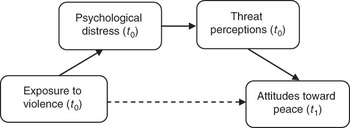
Indeed, since 9/11, a growing number of researchers have begun to examine the impact of terrorism and violence.Footnote 24 The current study joins others in examining the impact of threat perceptions as drivers of harsh counter-terrorism policies and increased intransigence,Footnote 25 and adds the new elements of individual-level EPV and psychological distress. We hypothesize that psychological distress and threat perceptions will mediate the relationship between EPV and negative attitudes toward peace.
The research model, presented in Figure 1, can be expressed in the following equation, where exp i stands for individual-level exposure to political violence, ps for psychological distress, tp for threat perceptions, Y for attitudes toward peace, and t for the time lag between 2007 (t 0) and 2008 (t 1):
 $${\rm Y}={\minus}{\rm (exp}_{i} {\plus}ps{\plus}tp{\rm )}\,{\asterisk}\,t.$$
Hypothesized model explaining changes in attitudes toward peace as a result of exposure to ongoing conflict

ISRAELIS AND PALESTINIANS IN THE RANGE OF FIRE
Asymmetric in nature,Footnote 26 marked by a large power imbalanceFootnote 27 and a reality of structured inequalities,Footnote 28 the Israeli–Palestinian conflict is one of the deepest and most prolonged conflicts in modern history.Footnote 29 Even in times of relative peace, the daily stress of enduring occupationFootnote 30 for the Palestinians, or maintaining vigilance against terrorist attacks or rocket fire for Israelis, takes its toll on the mental, cognitiveFootnote 31 and physicalFootnote 32 functioning of those living in the shadow of this conflict. Of specific relevance to the underlying mechanisms in our study are far-reaching indications that prolonged exposure has led to heightened levels of psychological distress and threat perceptions in both populations.Footnote 33 For example, more than one-third of the subjects in some Israeli studiesFootnote 34 reported some form of impairment caused by post-traumatic stress. Similarly, a study in the Palestinian territoriesFootnote 35 shows an extremely high prevalence of conflict-related PTSD and depression among Palestinians. These and other statistics underscore the tremendous level of stress and threat engendered by the high levels of violence endemic to this conflict.
RESEARCH DESIGN AND METHOD
The study uses two original two-wave panels representing adult Israeli Jews (n=996) and Palestinians (n=631) from low- and high-risk areas.Footnote 36 The longitudinal design enables careful causal analysis, allowing us to draw inferences about the impact of EPV on attitudes toward peace over time. Large-N panels permit a unique between-subjects design to determine how ‘like’ populations responded to the conflict.
Sample
The Israeli sample
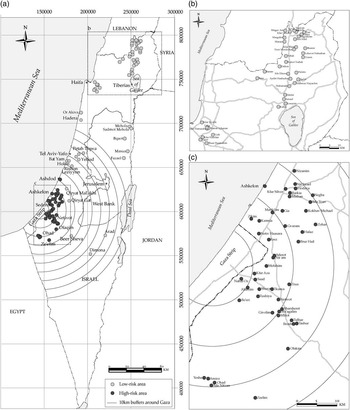
Respondents at t 0 were recruited between 30 May and 18 July 2007, using a random telephone survey based on stratified samples to ensure that the sample would be representative of Israeli Jews. The respondents’ localities were defined as representing either high- or low-risk areas (Figure 2a). Those who agreed were surveyed again (t 1) six months later (18 November 2007 to 31 January 2008), with a final sample of 996 respondents.Footnote 37
Arc GIS-generated map for the Israeli sample showing communities that were highly affected and less affected by Palestinian violence

The Palestinian sample
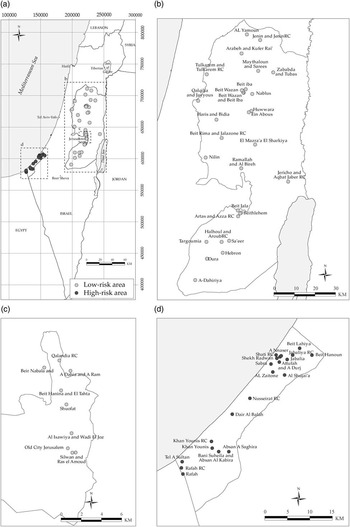
We employed a stratified cluster random sampling strategy for Palestinian adults living in the West Bank, Gaza Strip and East Jerusalem.Footnote 38 As with the Israeli sample, the respondents’ localities were defined as representing either high or low risk (Figure 2b). At t 0, face-to-face interviews were conducted between 16 September and 16 October 2007. The six-month follow-up interviews (t 1) took place between 24 April and 17 May 2008,Footnote 39 resulting in a final sample of 631 respondents.
Arc GIS-generated map for the Palestinian sample showing communities that were highly affected and less affected by Israeli violence

Measures
We designed a closed-ended questionnaire incorporating four measures: EPV, psychological distress, threat perceptions and attitudes toward peace.
Individual-level EPV
Individual-level EPV was assessed using three items, in line with the approach proposed by Lyall, Blair and Imai.Footnote 40 Respondents were asked whether they had experienced any of the following as a result of Palestinian rocket fire or terrorist attacks (for Israelis) or Israeli attacks or violence (for Palestinians): (1) the death of a family member or friend; (2) witnessing an attack or being present at a site where there were injuries or fatalities; and/or (3) injury to oneself, a family member or a friend. Responses were coded as 0 (‘Not exposed to any of these events’) or 1 (‘Exposed to at least one event’).
Psychological distress
Psychological distress was assessed using a seventeen-item scale of post-traumatic stress symptoms.Footnote 41 Respondents were asked to report on the frequency of symptoms over the preceding month on a scale from 1 (‘Not at all’) to 4 (‘Extremely frequent’). Total scores were calculated as the average of all seventeen responses. Cronbach’s alpha for the scale was 0.89 for the Israeli sample and 0.84 for the Palestinian sample.
Threat perceptions
Threat perceptions were measured using a two-item scale based on studies conducted in the United StatesFootnote 42 and in the Israeli–Palestinian context.Footnote 43 We asked respondents how concerned they were about the possibility of an actual threat to their security from the other side (for example, for Israeli Jews: massive missile attacks; for Palestinians: a large-scale military attack). Answers ranged from 1 (‘Not at all’) to 4 (‘To a very great degree’). The ratings on the two items were averaged to create a single score (Cronbach’s alpha was not calculated for these items).
Attitudes toward peace
Attitudes toward peace were assessed using items tapping a likely framework for compromise in peace negotiations. Israeli respondents were asked: ‘What is your opinion about a peace settlement with the Palestinians in return for restoring the 1967 borders with some border adjustments?’ Palestinian respondents were asked: ‘What is your opinion about signing a peace agreement with Israel based on a two-state formula while (1) forgoing return of the refugees into the state of Israel and (2) forgoing Palestinian sovereignty over parts of Jerusalem?’ In all cases, respondents rated their agreement on a scale from 1 (‘Strongly object’) to 6 (‘Strongly support’). The ratings on the two items for the Palestinian sample were averaged to create a single score (Cronbach’s alpha was not calculated for the two items).
Covariates included gender (female=0, male=1), age (years) and attitudes toward peace at t 0 (same measure as at t 1 above).
Data Analysis
We used AMOS 6 to perform Multigroup Structural Equation Modeling, which allows simultaneous testing for regression weights, variances and errors across groups on the basis of analysis of covariance structures.Footnote 44 It allows the validation of important aspects of the suggested model by comparing them to their possible alternatives (that is, inverse causality or a direct relationship instead of the proposed mediation). To examine the invariance or variance of peace outcomes between the two subject populations, we calculated maximum likelihood estimates for both models, evaluated by (1) fit measures, namely χ 2 and degrees of freedom, NFI, TLI and CFI in combination with RMSEAFootnote 45 and (2) comparisons of nested modelsFootnote 46 based on χ 2 differences for restricted and unrestricted models.
Results
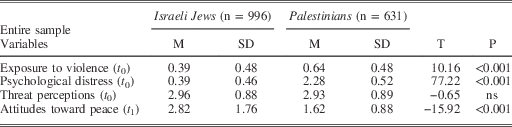
EPV was high overall; 49 per cent of all respondents had experienced at least one violent event (as described in the measures). As Table 1 shows, Palestinians had higher levels of both EPV (M=0.64, SD=0.48) and psychological distress (M=2.28, SD=0.52). Israeli Jews reported lower levels of EPV (M=0.39, SD=0.48), and more positive attitudes toward peace (that is, a greater willingness to compromise) (M=2.82, SD=1.76). Interestingly, Israeli Jews and Palestinians reported similar threat perceptions (M=2.96, M=2.93, respectively).
Descriptive Statistics of Research Variables, and Comparison between Israeli Jews and Palestinian Samples

Exposed vs. Not Exposed
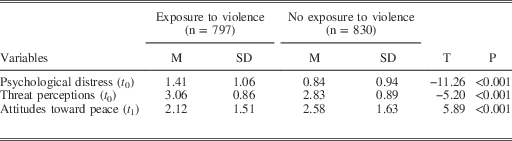
Table 2 presents means and standard deviations of the research variables by EPV. As expected, individuals exposed to at least one violent event scored significantly higher on psychological distress and threat perceptions than those who were not exposed. Conversely, exposed individuals were less likely to report positive attitudes toward peace.
Comparison between Exposed and Non-exposed Participants, entire sample (Israeli Jews and Palestinians)

Multigroup Model
We examined the role of psychological distress and threat perceptions as mediators between EPV and attitudes toward peace across the two samples.Footnote 47 We constrained the regression weights for both groups to be equal. This model was compared to a ‘fully free’ model (allowing for variance across the two groups). As seen in Table 3, the findings reveal no significant differences between the two models and an excellent fit to the data (χ2(7)=11.06, p >0.05, CFI=0.99, NFI=0.99, TLI=0.96). This supports the parsimonious model, in which the hypothesis holds for both Israelis and Palestinians.
Goodness-of-fit Indices and Comparison

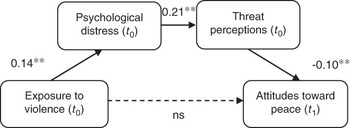
Figure 3 presents the standardized path coefficientsFootnote 48 for both groups in the constrained model. The results rule out a direct relationship between EPV and attitudes toward peace. Instead, they support our hypothesis of a mediated path between EPV and civilians’ refusal to compromise in prolonged conflict through psychological distress coupled with threat perceptions. Three findings are crucial: (1) EPV has a positive and statistically significant effect on psychological distress, (2) higher levels of psychological distress are associated with higher levels of threat perceptions and (3) threat perceptions have a negative and statistically significant effect on support for peace. Given the mediation process, the overall effect of EPV on attitudes toward peace is small, yet the novelty of the findings is our ability to rule out a direct effect in favor of the mediation model.
Psychological distress leading to threat perceptions, leading to more negative attitudes toward peace among Israelis and Palestinians **p<0.01

Beyond merely asserting an association between EPV and distress, these data provide additional support for our thesis that Palestinian and Israeli attitudes to war and peace should be understood as pivoting on the personal experiences of individuals and related stress reactions. This finding corroborates our basic argument that the contribution of mental health must be acknowledged in any attempt to explain civilians’ attitudes amid violent conflict.
Further mediation (bootstrapping) analysis revealed the following results: for psychological distress (as a mediator between EPV and threat perceptions), ß=0.03, SE=0.007, CI=0.019–0.042, p<0.01 for Israelis, ß=0.029, SE=0.006, CI=0.019–0.040, p<0.01 for Palestinians; while for threat perceptions (as a mediator between psychological distress and a willingness to compromise), ß=−0.01, SE=−0.003, CI=−0.015–0.004, p<0.01 for Israelis, and ß=−0.023, SE=0.008, CI=−0.036–0.009 p<0.01 for Palestinians. Along with the auxiliary testing for the threat model alone,Footnote 49 this process again supports our prediction that the effects of exposure to violence play a role in translating EPV into attitudes toward peace, and that – as per our novel finding – these effects are fully mediated by psychological reactions among both parties to the conflict. Hence, the findings affirm that prolonged EPV reduces individuals’ willingness to compromise to the extent that it triggers psychological distress, which intensifies threat perceptions.
DISCUSSION AND CONCLUSION
The relationship between terrorism and political violence on the one hand, and political attitudes on the other, has long presented an alluring puzzle. Recently, researchers have begun to articulate the role of psychological mechanisms in this process, but the dynamics of how prolonged EPV influences attitudes toward peace, and the role of psychological components, have remained unclear. We employed a powerful design with 1,627 subjects from 149 communities across Israel and Palestine (East Jerusalem, the West Bank and Gaza). Contrary to the view that is often promulgated by both state and non-state actors – namely, that force promotes political solutionsFootnote 50 – our findings provide powerful evidence that EPV reduces individuals’ willingness to compromise. Our analyses reveal that under prolonged EPV, elevated levels of distress influence perceptions of threat, which in turn are associated with more intransigent and militant attitudes.
Despite existing assumptions in political scholarship that the sufferings of individuals exposed to violence play a minor role in larger geopolitical decision making, the current study of Israelis and Palestinians – in line with other emerging work pursued in the Middle EastFootnote 51 – points to such individual-level outcomes as key micro-foundations of conflict. At the theoretical level, our work extends previous research on political attitudes among civilians living amid political violence by connecting individual trauma subsequent to such violence with collective attitudes toward peace and compromise. We propose a mediation model linking individual-level EPV to reduced support for compromise and peace, with psychological distress and threat perceptions as the mechanism bridging the two. More important, we test and validate this model in a large sample of civilians on both sides of the Israeli–Palestinian conflict.
At a practical level, our work provides useful guidance for practitioners who advocate peace. Specifically, the findings highlight the fact that EPV functions as a barrier to peace. It thus demonstrates the importance of removing violence, particularly violence directed at civilians, from the political landscape. In addition, our findings emphasize that actions to reduce threat perceptions are crucial to the success of any peace negotiations. As a start in this direction, acknowledging and legitimizing the losses of the other side is imperative for building support in constituencies that find moving toward peace most challenging.
The Israeli–Palestinian conflict offers ample evidence that without peace-building processes to encourage people on both sides of the conflict to change entrenched and polarizing attitudes, waves of violence will continue to take their psychological and political toll. Civilian casualties constitute impediments to breaking the cycle of violence, as affected civilians and their communities become increasingly resistant to peace. From a defensive coping perspective,Footnote 52 hardening their hearts by adopting self-defensive attitudes may be the most effective way for individuals victimized by violence to help themselves. However, only by changing those dynamics can we hope to create a psychological-societal infrastructureFootnote 53 capable of sustaining formal political agreements in conflict-ridden regions of the world.