Implications
The sequential feeding, a feeding system that alternates different diets over a given period, is proved to have some economical value in avian production. In this work, growing geese were sequentially fed with low-protein diet during the more physically active phase and high-protein diet during the less active phase to improve the utilization of protein. Results showed that sequential feeding improved growth rate and feed efficiency compared with control feeding in geese.
Introduction
Poultry industries still have many problems to be overcome. A lot of researchers tried to resolve some problems using alternating feeding system. For examples, De Basilio et al. (Reference De Basilio, Vilarino, Yahav and Picard2001) offered broilers high-energy low-protein diet during the warmer phase of the day and high protein diet during the cooler phase to decrease the heat stress from the thermogenic effect of protein. Penz and Jensen (Reference Penz and Jensen1991) offered high-protein diet during the early hours of the day when the protein requirement is greater during albumen formation and low-protein diet during the remainder hours to meet the protein requirement of laying hens more closely. Umar Faruk et al. (2010Reference Umar Faruk, Bouvarel, Même, Roffidal, Tukur, Nys and Lescoata and Reference Umar Faruk, Bouvarel, Même, Rideau, Roffidal, Tukur, Bastianelli, Nys and Lescoat2010b) also made efforts to conveniently utilize the locally produced cereals by alternating cereal and balancer diet. The practice of feeding which alternates different diets over a given period or cycle is called sequential feeding by some authors.
Sequential feeding may also improve the efficiency of protein utilization in mammals. Without changing the total amount of protein given each day, consuming 80% of the daily protein intake during one meal (the pulse pattern) led to a higher nitrogen balance than spreading protein intake over the daily meals in elderly women (Arnal et al., Reference Arnal, Mosoni, Boirie, Houlier, Morin, Verdier, Ritz, Antoine, Prugnaud, Beaufrere and Mirand1999), though the benefit of pulse pattern was not observed in young women (Arnal et al., Reference Arnal, Mosoni, Boirie, Houlier, Morin, Verdier, Ritz, Antoine, Prugnaud, Beaufrere and Mirand2000a). The pulse pattern of protein supply was able to induce, in young women as elderly women, lower postabsorptive leucine oxidation and endogenous leucine flux than the spread pattern (Arnal et al., Reference Arnal, Mosoni, Boirie, Gachon, Genest, Bayle, Grizard, Arnal, Antoine, Beaufrere and Mirand2000b). The pulse pattern of protein supply was also found to increase the feeding-induced stimulation of muscle protein synthesis in rats (Arnal et al., Reference Arnal, Mosoni, Dardevet, Ribeyre, Bayle, Prugnaud and Mirand2002).
Under the common management system, goose is a diurnal rather than nocturnal animal. We did also find that the mean fasting carbon dioxide production rate during daytime was higher than that during nighttime in geese (Chu, Reference Chu2012). Owing to the higher energy expenditure in daytime, the higher thermogenic effect of dietary protein, and increased protein synthesis induced by pulse supply of protein, we tried to spare a small amount of protein in daytime and add the retrenched protein in nighttime to increase the utilization of protein. This practice is similar to that of sequential feeding mentioned above. Briefly, we tried to improve the efficiency of dietary protein utilization by the sequential feeding with low- and high-protein diets in geese. Because plasma levels of metabolites reflect the metabolism of nutrients, we also compared the postprandial responses of plasma metabolites to feeding between treatments in this study.
Material and methods
The experimental protocols used in the present study were approved by Tunghai University Experimental Animal Care and Use Committee. This study comprises two trials. During the experimental period, geese were exposed to natural photoperiod and ambient temperature. Water was provided ad libitum. The mash feedstuff was supplied in a bucket pan feeder (44 cm OD) in each pen.
Trial I
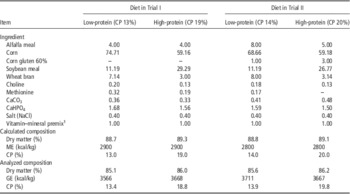
This trial was conducted to determine the effects of sequential feeding under time-restricted feeding system. This trial was conducted in May and early June. Seventy-two 2-week-old White Roman goslings were randomly allotted into either sequential feeding (S1) or control feeding (C1) group. Each group contained six pens (1.8 m×1.2 m) with three male and three female goslings each. The day length (from civil dawn to civil dusk) increased from 13 h 51 min to 14 h 28 min, and the daily mean temperatures ranged between 22°C and 29°C during the experimental period. All goslings were allowed free access to feeds for 1 h at morning (0700 h) and evening (1700 h), respectively, from 2 to 8 weeks of age. Goslings in S1 group were supplied with the low-protein diet containing 13% CP at morning and the high-protein diet containing 19% CP at evening. Goslings in C1 group were supplied with the same diet (16% CP; mixed equally with the two diets mentioned above) at both morning and evening. The composition of the experimental diets is shown in Table 1.
The composition of experimental diets for both trials

ME=metabolizable energy; GE=gross energy.
1 Vitamin–mineral premix provided per kilogram of diet: vitamin A, 18 000 IU; vitamin D3, 2250 IU; vitamin E, 22.5 IU; vitamin K, 4.5 mg; vitamin B1, 1.5 mg; vitamin B2, 9 mg; vitamin B6, 1.5 mg; vitamin B12, 15 μg; pantothenic acid, 22.5 mg; niacin, 105 mg; folic acid, 1.2 mg; biotin, 0.15 mg; Mn, 120 mg; Cu, 45 mg; Zn, 120 mg; Fe, 12.5 mg; I, 0.3 mg; Mo, 0.3 mg; Co, 0.15 mg; Se, 0.15 mg.
The feed intake of each meal was recorded, and BW was recorded weekly. At the end of experiment (i.e. 8 weeks of age), 12 geese each group were determined the postprandial glucose, triacylglycerols and uric acid responses to feeding. A half of those geese were performed at morning, the others at evening. For the postprandial response test, blood samples were collected from metatarsal vein into heparinized tubes at 1, 2, 3 and 4 h after feeding. The plasma samples were separated by centrifugation (3000×g for 15 min). The plasma levels of glucose, triacylglycerols and uric acid were determined by using an automatic blood biochemistry analyzer (VITROS® DT60 II Chemistry System, Johnson & Johnson Ortho Clinical Diagnostics, Raritan, NJ, USA). For assessing the postprandial response of each analyzed plasma metabolite, the area under the plasma concentration v. time curve (AUC), which is commonly used to indicate the persistence of a metabolite in plasma after a meal, was calculated by using the trapezoidal rule.
Trial II
This trial was conducted to determine the effects of sequential feeding under ad libitum feeding system. This trial was conducted in October. Twenty-four 4-week-old White Roman goslings were randomly allotted into either sequential feeding (S2) or control feeding (C2) group. Each group contained six pens (1.8 m×1.2 m) with one male and one female goslings each. The day length (from civil dawn to civil dusk) decreased from 12 h 43 min to 12 h 6 min, and the daily mean ambient temperatures ranged between 25°C and 28°C during the experimental period. Goslings were fed ad libitum from 4 to 8 weeks of age. The diets were altered at 0600 and 1800 h, respectively. Considering the expected higher ambient temperature than that in Trial I, the dietary CP levels were slightly increased and metabolizable energy were slightly lowered in Trial II compared with those in Trial I. The composition of the experimental diets is shown in Table 1. In S2 group, the goslings were supplied with low-protein diet containing 14% CP at morning and high-protein diet containing 20% CP at evening. In C2 group, the goslings were offered the same diet mixed with the two diets mentioned above according to the ratio consumed by S2 group on the preceded day to equalize the CP contents in the rations. The feed intake was recorded twice daily, and the BW was recorded weekly.
Statistics
All data were analyzed by the general linear model procedure of SAS statistical software (SAS Institute Inc., Cary, NC, USA). In initial and final BWs and daily gain, each individual was considered as an experimental unit, and the data were analyzed using two-way (treatment×sex) ANOVA. In feed intake and feed efficiency (FE), each pen was considered as an experimental unit, and the data were analyzed using one-way ANOVA. Effects of treatment and time on the feed and nitrogen intakes were analyzed by repeated measures ANOVA. Effects of treatment and meal time on the AUC of plasma metabolites were analyzed by two-way (treatment×meal time) ANOVA. Statistical significance of differences among means was determined by least square means.
Results
Trial I
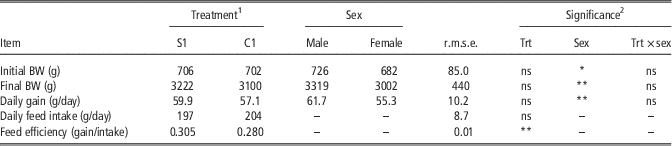
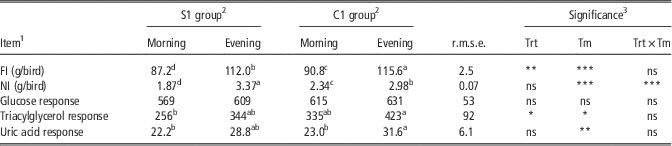
All geese survived at the end of the experiment in this trial. Male geese had significantly higher (P<0.05) initial and final BWs and daily gains than the females (Table 2). Daily feed intake was not influenced by feeding regimen (P>0.05; Table 2). The daily gain in S1 group during the experimental period was slightly higher than that in C1 group, though it was not significant (P>0.05; Table 2). The FE in S1 group during the experimental period was significantly higher (P<0.05) than that in C1 group (Table 2). The feed intake at evening was significantly higher (P<0.05) than at morning (Table 3). Daily nitrogen intake was not significantly different (P<0.05) between groups. The nitrogen intake at evening was significantly higher (P<0.05) than that at morning, and there was a significant interaction between feeding regimen and time, as expected (Table 3).
Effect of sequential feeding with low- and high-protein diets on the growth performances in White Roman geese during 2 to 8 weeks of age (Trial I)

r.m.s.e.=root mean square error.
1 S1 group was offered 13% CP diet at morning and 19% CP diet at evening for 1 h each, whereas C1 group was offered the same diet (16% CP; mixed equally with the two diets mentioned above) at both morning and evening.
2 ns P>0.05; *P<0.05; **P<0.01.
Effects of sequential feeding with low- and high-protein diets and time of the day on the intakes of feed and intake during 2 to 8 weeks of age and the areas under curve of postprandial plasma metabolite levels at 8 weeks of age in White Roman geese (Trial I)

r.m.s.e.=root mean square error.
a,b,c,dMeans within a row with no common superscript letters differ significantly (P<0.05).
1 FI and NI designate feed intake and nitrogen intake, respectively; postprandial plasma levels of glucose, triacylglycerols and uric acid response to feeding are expressed as the areas under curve (arbitrary unit).
2 S1 group was offered 13% CP diet at morning and 19% CP diet at evening for 1 h each, whereas C1 group was offered the same diet (16% CP; mixed equally with the two diets mentioned above) at both morning and evening.
3 Trt=treatment; Tm=time; *P<0.05, **P<0.01, ***P<0.001, ns P>0.05.
When the changes in plasma levels of metabolites after feeding were expressed as AUC, the plasma glucose and uric acid were not affected by feeding regimen, but the AUC of plasma triacylglycerols in S1 group was lower (P<0.05) than that in C1 group (Table 3). The AUC of plasma triacylglycerols and uric acid at evening were significantly higher than those at morning (P<0.05; Table 3).
Trial II
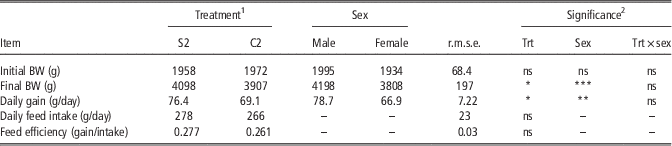
All geese completed the experiment in this trial. Male geese had significantly higher (P<0.05) final BWs and daily gains than the females (Table 4). Daily feed intake was not affected by feeding regimen (P>0.05; Table 4). The daily gain in S2 group during the experimental period was significantly higher than that in C2 group, thus the final BW in S2 group was also significantly higher (P<0.05) than that in C2 group (Table 4). The FE in S2 group during the experimental period was slightly higher than that in C2 group, though it was not significant (P>0.05; Table 4). Feed intake and nitrogen intake were not affected by feeding regimen (P>0.05; Table 5). However, the feed intake and nitrogen intake during nighttime (from 1800 to 0600 h) were significantly higher (P<0.05) than those during daytime (from 0600 to 1800 h; Table 5). There was a significant interaction (P<0.05) between treatment and time for nitrogen intake, as expected (Table 5).
Effect of sequential feeding with low- and high-protein diets on the growth performances in White Roman geese during 4 to 8 weeks of age (Trial II)

r.m.s.e.=root mean square error.
1 S2 group was fed ad libitum with 14% CP diet from 0600 to 1800 h and 20% CP diet from 1800 to 0600 h, whereas C2 group was fed ad libitum with the same diet (mixed with the two diets according to the ratio of diets consumed by S2 group on the preceded day) at both phases.
2 Trt=treatment; ns P>0.05; *P<0.05; **P<0.01; ***P<0.001.
Effects of sequential feeding with low- and high-protein diets and time of the day on the intakes of feed and nitrogen in White Roman geese during 4 to 8 weeks of age (Trial II)

r.m.s.e.=root mean square error.
a,b,c,dMeans within a row with no common superscript letters differ significantly (P<0.05).
1 S2 group was fed ad libitum with 14% CP diet from 0600 to 1800 h and 20% CP diet from 1800 to 0600 h, whereas C2 group was fed ad libitum with the same diet (mixed with the two diets according to the ratio of diets consumed by S2 group on the preceded day) at both phases.
2 Day, from 0600 to 1800 h; night, from 1800 to 0600 h.
3 Trt=treatment; Tm=time; **P<0.01, ***P<0.001, ns P>0.05.
Discussion
The sequential feeding did not affect the daily feed intake in both trials of the present study (Tables 2 and 4). However, sequential feeding led significantly higher FE in Trial I (Table 2), and significantly higher final BW and daily gain in Trial II (Table 4). Although the significant effects of sequential feeding on growth traits differed between Trials I and II, they did not conflict. The variations in significant effects of sequential feeding between trials might be attributed to the difference in feeding system. Geese in Trial I were time-restrictedly fed, whereas those in Trial II were fed ad libitum. In the previous studies, we found that time-restricted feeding lowered daily feed intake and daily gain, and increased FE in fattening geese compared with ad libitum feeding (Ho et al., Reference Ho, Wu, Chen and Yang2014; Lui et al., Reference Lui, Chu, Wu and Yang2014). In Trial I, lowered daily gain caused by time-restricted feeding might attenuate the positive effect of sequential feeding on the daily gain, and result in nonsignificantly increased daily gain; increased FE caused by restricted feeding might amplify the positive effect of sequential feeding on the FE. On the other hand, the increased daily gain led by ad libitum feeding amplified the positive effects of sequential feeding on daily gain and final BW in Trial II. It is tentatively suggested that sequential feeding improves FE when geese are restrictedly fed, and improves daily gain when geese are fed ad libitum.
The benefits of sequential feeding found in this study were not found in most published reports in broilers. When broilers were fed high-protein diet (26% CP, 3056 kcal metabolizable energy (ME)/kg) from 1600 to 0900 h and energy-rich diet (8.6% CP, 3530 kcal ME/kg) from 0900 to 1600 h, they had less weight gain, poorer FE and similar feed intake compared with the broilers subjected to the control feeding (20.7% CP, 3198 kcal ME/kg) (De Basilio et al., Reference De Basilio, Vilarino, Yahav and Picard2001). Broilers received a control diet from 1200 to 2330 h and then a low-protein and isocaloric diet (about 2% CP lower than the control diet) from 0030 to 1200 h had lower nitrogen intake, the same feed intake and weight gain compared with the controls, but had a higher feed conversion rate (i.e. lower FE) and a better utilization rate of dietary nitrogen (Sirri and Meluzzi, Reference Sirri and Meluzzi2012). Compared with that of the chickens fed the complete diet (19% CP and 2820 kcal ME/kg from 2 to 4 weeks of age; 17.2% CP and 2880 kcal ME/kg from 4 to 7 weeks of age), feed intake and weight gain were significantly reduced when chickens were fed protein-rich diet (30.1% CP, 2470 kcal ME/kg) during the first 8 h of light each day and energy-rich diet (9.2% CP, 3120 kcal ME/kg) during the remainder hours of the day, but the weight gain was increased when they were offered with diet moderately protein-rich (26.4% CP, 2590 kcal ME/kg) and moderately energy-rich (16.2% CP, 2910 kcal ME/kg) alternately (Bouvarel et al., Reference Bouvarel, Barrier-Guillot, Larroude, Boutten, Leterrier, Merlet, Vilarino, Roffidal, Tesseraud, Castaing and Picard2004). When broilers were supplied with diet moderately protein-rich (21.2% CP, 3020 kcal ME/kg) during one-half of the time and with diet moderately energy-rich (14.2% CP, 3350 kcal ME/g) during the other half of the time each day, their weight gain, feed intake and feed conversion rate were not different from those of broilers fed complete diet (17.8% CP, 3160 kcal ME/kg) (Bouvarel et al., Reference Bouvarel, Barrier-Guillot, Larroude, Boutten, Leterrier, Merlet, Vilarino, Roffidal, Tesseraud, Castaing and Picard2004). Broilers that were offered ground corn (9.2% CP, 3350 kcal ME/kg) during the day (from 0900 to 1600 h) and control diet (19.5% CP, 3200 kcal ME/kg) during the night (from 1600 to 0900 h), though consumed the same quantity of feed, had less weight gain and higher feed conversion rate from 28 to 41 days of age compared with the broilers fed the control diet ad libitum (Lozano et al., Reference Lozano, De Basilio, Oliveros, Alvarez, Colina, Bastianelli, Yahav and Picard2006). When the CP intakes of broilers are calculated on the tabular data of the references mentioned above, it is found that the CP intakes in sequential feeding groups are lower than those in the control groups in all studies, except for one study (Bouvarel et al., Reference Bouvarel, Barrier-Guillot, Larroude, Boutten, Leterrier, Merlet, Vilarino, Roffidal, Tesseraud, Castaing and Picard2004), in which the group sequentially fed with moderately protein- and energy-rich diets (26.4% and 16.2% CP, respectively) had higher CP intake and weight gain than the control group. From the calculated CP intakes and the shown data of growth traits, it can be induced that the sequential feeding lowers or does not affect weight gain and FE of broilers when the CP intake decreases; whereas sequential feeding increases weight gain when the CP intake increases.
The sequential feeding regimens in broilers in the most reports mentioned above reduce CP intake, and hence reduce the weight gain and FE. These results are contrary to our study in geese, in which the sequential feeding did not influence the CP intake, but increased FE or weight gain. The timing of high-protein diet supply, the contents of protein and other nutrients in low-protein diet, the palatability of diet, the intakes of nutrients and the variation among species might account for the contrast results between our study in geese and other studies in broilers. However, the benefits of sequential feeding were seen in egg production of hens in some articles. Umar Faruk et al. (2010Reference Umar Faruk, Bouvarel, Même, Roffidal, Tukur, Nys and Lescoata, Reference Umar Faruk, Bouvarel, Même, Rideau, Roffidal, Tukur, Bastianelli, Nys and Lescoat2010b and Reference Umar Faruk, Bouvarel, Mallet, Ali, Tukur, Nys and Lescoat2011) found that laying hens subjected to sequential feeding with whole wheat grain at morning and protein–mineral concentrate at afternoon had lower feed conversion rate than those fed wheat-concentrate-mix, even had less feed intake and lower feed conversion rate than those fed complete diet. However, Keshavarz (Reference Keshavarz1998) found that the feeding regimens providing an adequate level of protein (16%) only during the morning and inadequate level of protein (10%) during the afternoon or, conversely, cannot maintain the satisfactory egg production performance of laying hens compared with the control group that received a diet with 16% protein both during the morning and afternoon, though the egg production was not different from the hens received a diet with 13% protein both during the morning and afternoon. Summarized above articles, the sequential feeding had no disadvantageous effect at least in hens, even if it could not improve the FE in some circumstances.
In this study, male goslings had higher BW and daily gain than females in both trials, exhibiting a significant sexual dimorphism. The sexual dimorphism in body size was also found in previous studies (Lin et al., Reference Lin, Chang, Wu, Chen, Jea, Lee and Fan2007; Ho et al., Reference Ho, Wu, Chen and Yang2014).
Under the restricted feeding system in Trial I, the voluntary feed intake at evening consistently accounted for 56% of daily intake, and was significantly higher than that at morning in both groups (Table 3). Similar results were seen in the ad libitum feeding system of Trial II. The voluntary feed intake from 1800 to 0600 h (largely dark) also consistently accounted for 56% of daily intake, and was significantly higher than that from 0600 to 1800 h (daytime) in both groups (Table 5). These results indicated that the short-term regulation of feed intake (or satiation) can be modified by the time of day.
The AUC of postprandial plasma triacylglycerols and uric acid at evening were significantly higher than those at morning, regardless of the feeding regimens (Table 3). The increased postprandial metabolite responses in evening might partly be explained by the higher intake, but the effect of circadian clock could not be excluded. In human, the glucose tolerance is decreased at evening and night with evidence for insulin resistance at night (reviewed by Morgan et al., Reference Morgan, Hampton, Gibbs and Arendt2003). Plasma triacylglycerols after a standard meal also is influenced by both the circadian clock and sleep time with higher levels during biological night (defined as the time between the onset and offset of melatonin secretion; Morgan et al., Reference Morgan, Arendt, Owens, Folkard, Hampton, Deacon, English, Ribeiro and Taylor1998). In pigs, the postprandial plasma concentrations of glucose and urea (the major product of amino acid catabolism in mammalians) were not affected by the meal time; however, when postprandial plasma concentrations were expressed as a response over preprandial concentrations, the diurnal rhythm for urea appeared, with a significantly smaller postprandial urea response in the morning (from 0600 to 0900 h) compared with that in the evening (from 1800 to 2100 h) (Koopmans et al., Reference Koopmans, van der Meulen, Dekker, Corbijn and Mroz2005). The insulin stimulation test showed that the pigs fed identical meals at 12-h intervals followed a clear diurnal biorhythm in protein anabolism, with greater amino acid utilization and lower plasma urea response in morning compared with that in evening, though the glucose utilization was not affected by the meal time (Koopmans et al., Reference Koopmans, van der Meulen, Dekker, Corbijn and Mroz2006). In the present study, the amplitude of increase in nitrogen intake at evening (+80%) exceeded that of increase in AUC of uric acid (+30%) in S1 group, whereas the amplitude of increase in nitrogen intake at evening (+27%) was slightly less than that of increase in AUC of uric acid (+37%) in C1 group (Table 3). The higher relative amplitude of increase in feed intake v. AUC of uric acid may account for the higher FE found in the sequential feeding group in the present study.
In conclusion, the sequential feeding regimen with low-protein diet at morning or during daytime and high-protein diet at evening or during nighttime improves the daily gain and FE in growing geese. Feed intake and postprandial plasma levels of metabolites are not affected by feeding regimen, but are influenced by circadian clock, with higher feed intake and higher postprandial plasma metabolite responses to feeding at evening.
Acknowledgment
This work was supported by a grant from Council of Agriculture, Executive Yuan, ROC (97AS-2.1.3-AD-U1).