Introduction
In light of declining fertility rates and rapidly aging populations, childhood disability is an emergent global health priority and important public health issue (Kumar et al., Reference Kumar, Roy and Kar2012). The United Nations Convention on the Rights of Persons with Disabilities (CRPD) issued in December 2006 clearly encourages the development of comprehensive rehabilitation services and programmes. The goal is to maximise mobility, sensory-processing, communication, vision, and cognition to reduce disability. Studies have shown that zero to six years is the appropriate age to begin rehabilitation, as interventions at this stage have the greatest impact on physical recovery and can minimise the future impact of a disability on daily activities and social integration (Li and Chen, Reference Li and Chen2017). Rehabilitation is a process with slow results and a long cycle, especially given that some common childhood disabilities require lifelong rehabilitation (Nyante and Carpenter, Reference Nyante and Carpenter2019).
There were 1,229,829 Chinese children aged zero to fifteen with a disability identity certificate in 2021 (CDPF, 2021). There are more children with disabilities in rural China than in urban areas; however, the gap between the need for rehabilitation services and their use is larger in rural areas, and parents of children with disabilities have experienced limited access to quality rehabilitation services (Fisher and Shang, Reference Fisher and Shang2013). The Chinese government has placed great emphasis on rehabilitation services for children with disabilities, and has issued successive policies in this regard, such as the Implementation Plan for the Precise Rehabilitation Service for Persons with Disabilities (2016). The ‘Opinion of the State Council on Establishing a Rehabilitation Assistance System for Children with Disabilities’ was circulated in 2018, and China formally established a Rehabilitation Assistance System (RAS) for children with disabilities. China had 9,775 rehabilitation institutions by the end of 2019, with 190,000 professionals and technicians, and 181,000 children with disabilities aged zero to six receiving basic rehabilitation services (CDPF, 2020).
Local governments have developed their own service standards under the guidance of RAS. There is not a uniform standard – for example, our research site LinYi has extended the upper age limit of its rehabilitation and assistance for children with disabilities from six to seventeen, and its assistance standard is 20,000 CNY per year. The standard is moderate, lower than that of developed cities like Beijing (36,000 CNY)Footnote 1 , but higher than that of less developed cities like Shigatse (12,000 CNY)Footnote 2 . Children with disabilities are entitled to free rehabilitation services at designated rehabilitation institutions (not including individual fee-based services). However, in the course of our fieldwork, we found that most families of children with disabilities in rural areas discontinued using these free services. We adopted a qualitative method to explore the reasons why some families of children with disabilities discontinue using free rehabilitation in rural areas. The study explores these questions in the dimensions of policy implementation, service provision, and use of services. We hope that the findings of this study will provide inspiration for improving rehabilitation services for children with disabilities.
Literature review
Early intervention and rehabilitation can effectively change the course of a disability, especially in childhood; it can also prevent secondary disability (Nair et al., Reference Nair, Mathews, George, Philip and Sathy1992). However, the slow recovery process is a great challenge for caregivers of children with disabilities. China’s traditional ‘family-centred’ culture means children with disabilities are primarily cared for by their families, namely their parents, with limited access to social services, as well as a lack of resources and policies at the local level (Shang and Fisher, Reference Shang and Fisher2014). Some rural areas view the birth of children with disabilities as a form of punishment for past sins and the stigma attached to disability can cause parents to feel ashamed and lose ‘face’ (Ge et al., Reference Ge, Chen, Tang and Cong2021). This leads to discrimination against children with disabilities and their families in the areas of care and protection, economic security, rehabilitation services, and social participation (Shang et al., Reference Shang, Fisher and Xie2011). Parents of children with disabilities often experience great income stress, deteriorating physical health, great psychological stress, limited social interactions, and shrinking social networks (Chen and Yu, Reference Chen and Yu2023).
Social policies must respond to this important public health issue by providing children with disabilities rehabilitation services and social support that meet their actual needs (Yousafzai et al., Reference Yousafzai, Farrukh and Khan2011). Children with disabilities in China require a variety of rehabilitation services, including medical rehabilitation, rehabilitation training, psychological counselling, knowledge dissemination, assistive devices, and referral services (Fisher and Shang, Reference Fisher and Shang2013). A strong demand exists among parents for policy support, professional guidance, physical and psychological development of children, parenting skills, information on rehabilitation services, psychological development of parents, etc. (Gu et al., Reference Gu, Chen and Cao2012). Parents need family-centred rehabilitation and expect professionals to develop one-on-one rehabilitation programmes with regular rehabilitation coaching and in-home visits (Wang, Reference Wang2019). Parents typically require rehabilitation services that are individualised, specialised, and systematic (Tang et al., Reference Tang, Yang and Li2020).
The key determinants of whether parents take rehabilitation measures for their children with disabilities in China are the family income, whether the child is an only child, the parents’ literacy, knowledge of rehabilitation services, and the child’s degree and type of disability (Li et al., Reference Li, Shao, Liang, Sun, Liu, Shi and Qu2008). In China, rehabilitation organisations and rehabilitation facilities have made substantial progress since RAS was implemented in 2018. However, there is a gap between the supply of rehabilitation services and the demand for them; rehabilitation services are underutilised, their content is limited to functional training, and rehabilitation institutions in rural areas are poorly equipped and understaffed (Cui, Reference Cui2017). Although a three-level rehabilitation service system has been established in most areas of China, it lacks connections between service providers, lacks professionals, limits rehabilitation services, and has serious lags in organisational development and resource allocation (Zhang and Shen, Reference Zhang and Shen2014).
Families with children with disabilities are more likely to discontinue or never start rehabilitation services due to these problems. An empirical survey based on Beijing showed that, although the percentage of children with disabilities receiving rehabilitation services is greater than 70 per cent, less than 30 per cent continue with the services for more than three years (Liu and Zhou, Reference Liu and Zhou2016). In general, children with disabilities are most likely to discontinue rehabilitation services within three to nine months of starting, which is contrary to the goal of continuous rehabilitation (Zhou et al., Reference Zhou, Jiang and Zou2007). In summary, there are two main reasons why families of children with disabilities discontinue using rehabilitation services. The first is family factors, including income pressure, family care deficits, the physical limitations of caregivers, social pressure on family members, and so on. The second is limitations within rehabilitation services, including a disparity between service supply and demand, a lower level of professional training, and an insignificant rehabilitation effect (Deng, Reference Deng2012; Liu and Zhou, Reference Liu and Zhou2016). In contrast, family-centred education has been shown to enhance the skills, knowledge, and abilities of parents, which increases the likelihood that they will participate in rehabilitation programmes (Wong et al., Reference Wong, Lai, Martinson and Wong2006).
Existing research has not conducted a sufficiently detailed analysis of families who discontinue rehabilitation services for their children with disabilities. Previous study also has insufficiently explored the deep-seated reasons behind this phenomenon. In addition, most current studies are based on urban rather than rural areas. However, rural areas have more children with disabilities, greater demand for rehabilitation services, and a greater scarcity of services. Research by Fisher and Shang (Reference Fisher and Shang2013) found that most families (60 per cent) of children with disabilities in rural China lack access to health and rehabilitation services for a variety of reasons, including lack of information, shortage of services, and affordability. However, since China implemented nationwide RAS in 2018, the above constraints appear to have been, for the most part, mitigated. Why, then, do families of children with disabilities discontinue free rehabilitation services? Focusing on rural areas and using a semi-structured in-depth interview, this study examines the deep reasons behind such decisions in terms of developmentalism.
Methods
Research design and recruitment of participants
Descriptive phenomenology was chosen as the design guide for this study. This design guide allows researchers to authentically listen to participants’ understanding and recognition of phenomena, look for culturally derived interpretations of the social world, and to critically reflect on the assumptions they bring to the research process (Jootun et al., Reference Jootun, McGhee and Marland2009). Qualitative study based on in-depth interviews was adopted as the methodology.
This study was conducted at ShanQuan Rehabilitation Service Center for Children with Disabilities, the largest in LY county, HeiLong province, situated in a midsize city in east China. LY has jurisdiction over four districts and nine towns, covering a total area of 2500 square kilometres, with a permanent resident population of 109.68 million, mainly in rural areas. The majority of this population is rural and its economic-social levels are around the median for China, which suggests that it might be reflective of the national situation more broadly. SQ is the first and largest rehabilitation service institution for children with disabilities in LY, with two medical specialists, four social workers, and forty-two therapists. SQ has set up collective training rooms, personalised training rooms, and multi-functional training rooms, which can provide rehabilitation service for 200 children with different types of disabilities. Its services mainly include Sensory Integration (SI), Physical Training (PT), Occupational Therapy (OT), etc.
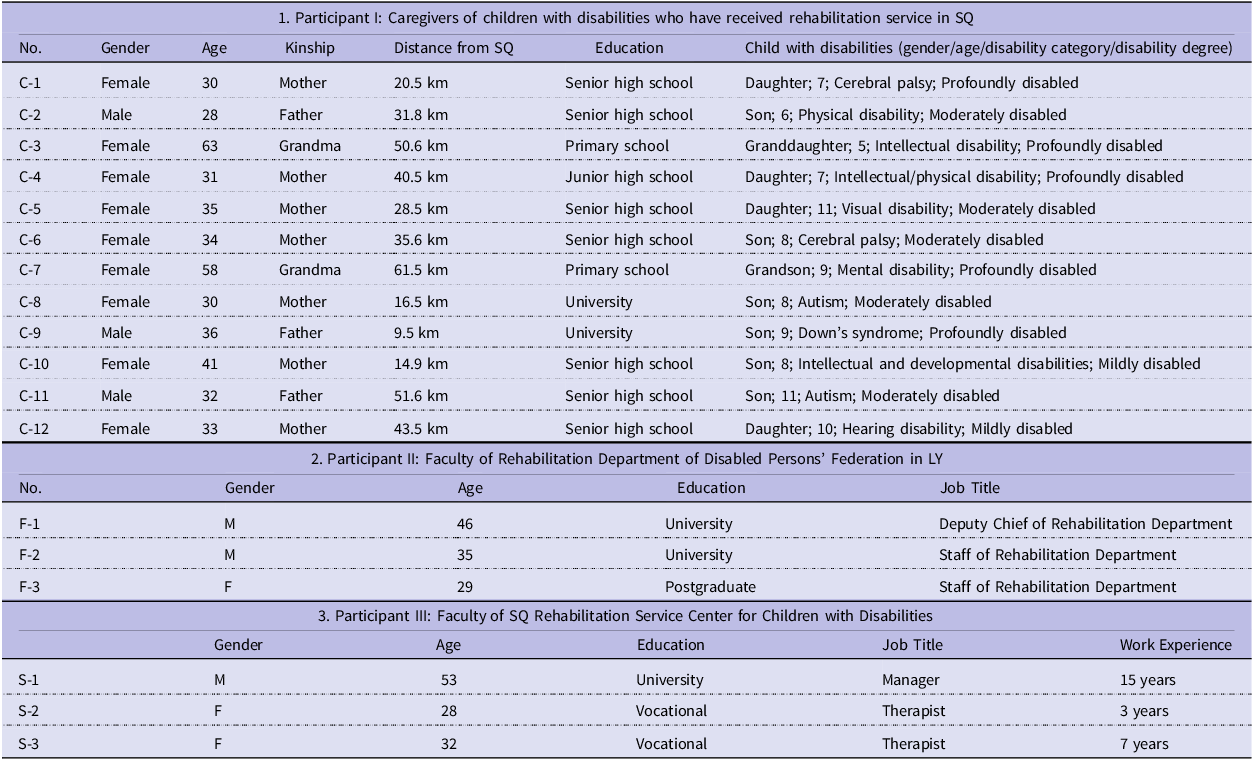
We recruited the interviewees through the SQ Rehabilitation Service Center. Its manager provided us with a list of registered children. Purposive sampling was used to recruit twelve carers of children with disabilities. Specific criteria relevant to this study were considered in the recruitment of participants, such as gender, age, distance from SQ (as distance affects service usage), family economic status, and the category and degree of disability of the child. Based on the above criteria and recommendations from SQ’s managers, we selected participants who could provide us with the most information possible. A second set of participants was selected from the Rehabilitation Department of the Disabled Persons’ Federation in LY (three) and SQ (three), which provided us with the perspective of policy implementers and service providers. The description of participants is presented in Table 1.
Description of participants

Table 1 Long description
A table comparing participants' details in a study on rehabilitation services. The table has three main sections: Participant I, Participant II, and Participant III. Participant I includes caregivers of children with disabilities who have received rehabilitation service in SQ, with columns for No., Gender, Age, Kinship, Distance from SQ, Education, and Child with disabilities (gender/age/disability category/disability degree). Participant II includes faculty of the Rehabilitation Department of Disabled Persons' Federation in LV, with columns for No., Gender, Age, Education, and Job Title. Participant III includes faculty of SQ Rehabilitation Service Center for Children with Disabilities, with columns for Gender, Age, Education, Job Title, and Work Experience. Each section lists individual participants with specific details under each column.
Data collection
The data were collected during 2019 and 2020. Semi-structured in-depth interviews were chosen as the data collection method. We drafted an interview outline. For the caregivers of children with disabilities, the principal questions were: Can you share your experience of your child’s rehabilitation service? What difficulties did you encounter in this process? Are you satisfied with these services? Why did you decide to give up rehabilitation services? Questions for service providers focused on their thoughts and opinions about providing services for children. Also included were opportunities for respondents to describe the services they provided, their own motivation, and their perceptions of disability. Questions put to policy implementers included their experiences, processes, and constraints. Each interview was audio-recorded and lasted between sixty and ninety minutes. Data saturation was discussed with the co-authors and no new codes have been obtained; the data saturation is thus considered complete. An ethics review for this research was conducted by the university ethics committee. We signed a declaration form concerning the confidentiality and informed consent of participants prior to each interview.
Data analysis
This study adopted an inductive thematic analytic approach informed by interpretive description to recognise and categorise potential patterns in the raw data (Braun and Clarke, Reference Braun and Clarke2006). We listened a second time to the recording to better understand the content of the data. We performed the initial data-driven coding by noting essential information when reading the transcribed interviews. It was a more grounded approach. We extracted eighteen initial codes, such as ‘deviation from actual needs’. Then, we re-examined the logical relationship between different initial codes, and extracted six secondary themes through a conceptualisation process, such as ‘benefit maximisation’. We then examined the structure of each sub-theme, and finally extracted three core themes related to the main body of rehabilitation services.
Theoretical perspective: The discourse of developmentalism
In order to frame and explain the data collected, the analysis draws upon the discourse of developmentalism. Developmentalism, which emerged after the Second World War, is a discourse of power and a theory of linear progress that combines evolutionism, modernisation theory, and developmental thinking. It is seen as a recipe for social change (Pieterse, Reference Pieterse1991). Although liberal developmentalism and third-generation developmentalism emerged during the development process of developmentalism, their core ideas are not fundamentally different. This study will emphasise the two core connotations of developmentalism. The first is economic developmentalism, in which economic growth (defined by development, productivity, and competitiveness) is an overriding priority goal. In economic developmentalism, the state plays a leading role in the market and is committed to building a productive and elitist society, avoiding a conflict of goals by making no commitment to social welfare (Ziya, Reference Ziya1991). The second is corporatism, in which government, local communities, and enterprises form a corporate organisation. This forms a ‘shared development’ contract and thus ensures the success of the development strategy (Ge, Reference Ge2015).
Since China entered the international market, its undisputed priority has been efficiency and economic development. Consequently, the principle of ‘productivism’ has dominated Chinese citizens’ thought and actions over the past thirty years, leading them to act consciously or unconsciously in accordance with the logic of developmentalism (Ku and Lee, Reference Ku and Lee2003). The consequence of developmentalism is an imbalance between economic growth and social development, and the emergence of a peculiar social phenomenon in which ‘high-speed economic growth and low-level social welfare’ coexist (Holliday, Reference Holliday2000). Within a developmentalist discourse, society is regarded as a giant political-economic machine moving at high speed. Each member of this society must function as an efficient and standardised ‘part’ of the machine (Ge et al., Reference Ge, Chen, Tang and Cong2021). Thus, under developmentalistic standards, persons with disabilities are perceived as troublesome and worthless ‘social burdens’, and therefore defined as ‘outsiders’ who can be sacrificed and abandoned (Ge, Reference Ge2015). Within a developmentalist discourse, the development and social integration of persons with disabilities is extremely difficult.
Besides expressing ideas, discourse is also used to exchange ideas through coordination between policy actors in the construction of policies and programmes (Schmidt, Reference Schmidt2008). Policy implementers, service providers and service users think and act in developmentalist logic unconsciously. According to our interview process, rural families of children with disabilities discontinue rehabilitation services for subjective reasons (the families feel hopeless, don’t want to waste time on therapy, etc.) and objective reasons (they plan to have another child, lack alternative care services, etc.). We can use developmentalism to examine why, despite the implementation of free rehabilitation assistance policies, families of children with disabilities discontinue using these services.
Findings
Given the influence of subjective and objective factors listed above, these families decided to discontinue rehabilitation for their children with disabilities. Based on the data analysis, this study found that policy makers, service providers, and service users are all subtly affected by the discourse of developmentalism – the fundamental reason for these families to make this decision. Therefore, this study reflects critically on the influence developmentalism has on these families and their use of rehabilitation services.
Perspectives from rehabilitation policy: children with disabilities are not a priority
Policy misreading: Focused on symptoms rather than the root cause
Dominated by the discourse of developmentalism, policy implementers are mainly concerned with maximising the benefits of state funds invested in rehabilitation services. Based on data analysis and related policy texts, we found that ‘rehabilitation value’ is a common policy phrase. For example, the implementation measures for rescue rehabilitation assistance for zero to six year-old children with disabilities in HL Province clearly stipulates: ‘assessed by the expert group, if there is really no rehabilitation value, the parents of the children with disabilities should be notified and the project assistance should be suspended’Footnote 3 . From reports by the staff and therapists of the local Disabled Persons’ Federation, we found that policy implementers consider rehabilitation value the highest priority. The conclusion seems to be that if children with disabilities have no ‘rehabilitation value’, they will not contribute to economic growth and may even be a burden to economic development, and therefore cannot be prioritised.
Our rehabilitation service for children with disabilities aims to restore them to normality after rehabilitation. However, some children with profound disabilities (like myasthenia gravis) find it hard to reach an average level of ability. The results are usually imperceptible because they require long-term treatment. To put it bluntly, this is a waste of national resources. (F-2).
Central government policy connotations are proximity rehabilitation, that is, providing convenient and accessible services for children with disabilities nearby. Local governments, by contrast, attempt to demonstrate their performance by investing more financial subsidies in rehabilitation facilities in county centres, thus creating a ‘model’, as opposed to rehabilitation facilities in towns or villages that are closer to the children they serve. Consequently, rehabilitation facilities in the county centre are better equipped, located, and staffed by professionals than those in towns and villages. To receive rehabilitation services, most parents had to travel farther. Access to care is affected by distance from rehabilitation institutions. Their willingness to use rehabilitation services is reduced by the distance and increased transportation costs.
We are a bit far away from the designated rehabilitation facility (fifty one point six kilometre), so I live near the institution with my child and go home once a week. My husband works outside to earn money, and I am the only one taking care of the children. I got pregnant last year. I could no longer leave my home to take the child for rehabilitation service. (C-11).
Distorted policy practices: Theoretical rather than effective
The provincial Disabled Persons’ Federation has declared that it attaches great importance to the rehabilitation of children with disabilities, and has introduced a series of policies to further this endFootnote 4 . However, financial expenditure in this area accounts only for a small proportion of public financial expenditure, and the social support is relatively insufficient. In HL Province, for example, the province’s general public financial expenditure for 2019 reached fifty point one five billion CNY, but the expenditure invested in the rehabilitation services was only ten million CNY – accounting for only 0.002 per cent of the total. Therefore, although these policy implementers claim to provide rehabilitation services and social support, this nominal support is inadequate when compared with the vast need for rehabilitation services and the heavy financial pressure of caring for children with disabilities.
In fact, we are also under great pressure at work. Our department is in a weak position, let alone fight for more financial support. The Ministry of Finance allocates very little funds to us, and there are many children with disabilities in our district. We have no other choice but to use limited resources to prioritise support for those who are more likely to recover. (F-1).
When assessing the effectiveness of rehabilitation services for children with disabilities, some important criteria for policy makers are the number of children receiving rehabilitation, the yearly increase in that number, and the rate of children accessing rehabilitation services. These criteria lead policy makers to focus on hitting targets rather than on the actual quality of rehabilitation, such as the effectiveness of the services offered and the feedback from families accessing them. This abstract evaluation index leads the rehabilitation policy to be theoretical rather than practical. This in turn makes it difficult to effectively carry out personalised rehabilitation services and receive follow-up evaluations on them, and therefore makes it difficult to guarantee that policies will be successful.
In assessing our performance, they look at how many children have been served this year and how much they have grown compared to last year, and these ‘numbers’ indicate obvious improvements. Unless registered users increase, they will consider that we have done a poor job and deduct points. (F3).
Perspectives from a rehabilitation service provider: financial gain
Target alienation: disregard of actual needs
In a corporatist country shaped by a discourse of developmentalism, government and rehabilitation institutions are actually stakeholders: the government purchases services and entrusts institutions with providing rehabilitation services for children with disabilities, and in turn rehabilitation institutions receive financial subsidies from the government to maintain their daily operations (Ge, Reference Ge2015). It should be noted that the government grants subsidies to rehabilitation institutions based on the number of children the institution provides services to: the standard of LY city, for example, is 20,000 CNY per child per year. The practice of taking the number of children receiving rehabilitation services as the evaluation indicator and basis of subsidy payments has led to target alienation: rehabilitation institutions are more inclined to accept children with a mild disability who can be effectively rehabilitated in a short period of time, while those with profound disabilities and a need for longer rehabilitation are excluded. Neither the original intention of the policy maker nor the actual needs of families of children with disabilities are met by this policy.
In general, we prefer to accept those children with mild disabilities to our institutions to receive rehabilitation service, because these children are relatively easy to rehabilitate, see positive results in a short space of time, and easily pass evaluations by Disabled Persons’ Federation. In fact, when severely disabled children come to our institution to register, we are reluctant to accept these children. (S-2).
Every child with a disability is unique. Even for the same type of disability, individual characteristics and rehabilitation needs are quite different. The rehabilitation services offered must take these differences into account. However, through the interviews we conducted, we found that the rehabilitation services provided by institutions are mostly in the form of collective training and standardised procedures rather than individualised, one-on-one services. This limits the effectiveness of rehabilitation services.
The child has not improved much after rehabilitation training. Collective training is less effective. I just spoke with the therapist. It is difficult for the therapist to pay attention to all the children who need rehabilitation services at the same time. Our therapist suggested one-on-one sessions, but they are too expensive for us. (C-9).
Benefit maximisation: logic dominated by economic thinking
At present, rehabilitation institutions receive two types of income. The first type is a fixed income from government subsidies, which are standardly 20,000 CNY per year for each children with disabilities (such as in LY city). The second type, extra income from one-on-one personalised services, is a floating income. Dominated by a discourse of developmentalism, rehabilitation institutions choose the form and content of their services based on cost minimisation and benefit maximisation.
The main income of these institutions is the government subsidy based on how many children with disabilities have been provided with rehabilitation. Therefore, in order to obtain more subsidies, rehabilitation institutions often seek more children with mild disabilities to register in their institution. The institution’s main goal is to increase the number of children. “We get one more subsidy for one more child”, S1 said. In order to reduce costs, rehabilitation institutions will often hire non-professionals who work as therapists after brief training. In addition, institutions do not prioritise updating their equipment and improving their facilities, which makes it difficult to guarantee that there will be a consistent professional level among rehabilitation services. Some families lose trust in rehabilitation institutions and decide to withdraw from their programmes, but institutions can still receive subsidies even if children withdraw.
In fact, our operation is relatively difficult. The government provides very few subsidies for us. When you subtract rent, therapist salaries, equipment fees, and other operating costs, there is little left. We also want to buy better equipment and hire more professionals. But there is no way: the institution must survive… (S-1).
In order to obtain additional income, institutions often focus on improving the quality of personalised services (which have higher professional standards, more targeted service plans, and follow-up service and evaluation), so as to encourage more families to select one-on-one personalised services. However, although these services are effective, they cannot be provided for free and are often costly. Most of the families of children with disabilities in rural areas are relatively poor and cannot afford the high fees. This has formed a conundrum for these families: the free rehabilitation services offered are not effective, but the effective services are costly. As a result of this conundrum, most rural families with children with disabilities lack confidence in free services but cannot afford the fees for personalised ones, and so discontinue using rehabilitation services.
There is only one therapist in the group class, and many children are together. The therapist can’t give one-on-one guidance, so the effect is limited. I heard that one-on-one personalised service is very helpful. Families with good income can afford it, but we can’t. (C-4).
Perspectives from a rehabilitation service user: Children with disabilities have no future
The core concern and primary goals: children with disabilities should become ‘normal’
For parents, the main purpose of rehabilitation is to restore the physical abilities of children as much as possible so that they can live independently. It is important to these parents that their children be mobile and appear ‘normal’, because only in this way can they live a ‘normal’ life and not become a burden to their family members. They hope that their children will be able to support themselves and thrive in the future by making up for their congenital physical defects. In spite of five or six years of rehabilitation, the effect is limited, undermining the family’s hopes. Families begin the rehabilitation process hopeful about the outcome, gradually become disappointed, and end up hopeless.
My expectation when I was pregnant was that my child would be successful and respected. But now I have adjusted my expectations. I don’t expect him to succeed. I hope he can walk and take care of himself like a normal child after rehabilitation. If not, he will be a burden. (C-8).
Parents may have expressed concern and uncertainty about rehabilitation services before they began using them, but still hoped the services would be effective. Due to the subtle influence of developmentalism, society as a whole adheres to the principle of ‘efficiency first’. One of the main criteria for parents to judge the quality of rehabilitation services is whether results can be seen in a short period of time. However, rehabilitation for children with disabilities is a relatively long and slow process. If a child’s condition does not visibly improve after several years, the parents will lose patience and trust in the rehabilitation services provided by the institution, and will eventually discontinue using these services.
The therapists lack professionalism, and the overall quality of service… does not meet my expectations. We’ve been here more than three years, but nothing’s changed. In addition to paying related expenses, I also have to delay making money to support my family. The rehabilitation is useless, so I gave up. (C-2).
Alternative strategy: A healthy child as replacement
Within the discourse of developmentalism, a healthy and talented child is regarded as the pride and hope of a family. Children with disabilities are therefore regularly regarded as worthless and ‘family burden’, unable either to inherit their family lineage or to take care of their parents in the future. Some parents are pessimistic and hopeless, unable to see a positive future for their children, and therefore are less willing to use rehabilitation services. The circumstances of such families are mostly negative: they may have lower economic, educational, and social status. They lack hope for their children’s futures, reluctance to receive rehabilitation services, and an objectively difficult family situation. Parents will consider having another healthy child if the child does not improve much after a period of rehabilitation. This will give the family new hope.
I really don’t know why I have a disabled child. My life was gloomy at that time, and I was almost in tears every day. There is no hope for a child with a disability, and we will have to take care of him in the future. I really can’t see any hope, and I also don’t know what to do in the future. (C-4).
Influenced by traditional Buddhist beliefs, giving birth to children with disabilities is shameful and stigmatised in China. Negative labels (such as ‘karmic obstacles’ and ‘ominous signs’) are sometimes attached to families of children with disabilities (Miles, Reference Miles2000; Chen and Yu, Reference Chen and Yu2023). The basic expectation of the parents from rehabilitation services is that their child not be perceived as abnormal or defective – that is, the child’s appearance and behaviour should conform to social expectations and thus enable the whole family to avoid excessive criticism. If the rehabilitation services fail to meet this basic expectation, parents will discontinue using rehabilitation services and instead adopt an alternative strategy: to give birth to a healthy child who will have a bright and hopeful future. In this situation, most parents will choose to devote more family resources to the healthy child.
In rural areas, one is discriminated against simply for not having a boy in the family, let alone for having a disabled child. We have no choice but to have another healthy child, or our family will have no hope and be looked down upon by others. We did not abandon the disabled child. We tried our best to take care of the disabled child while ensuring the full development of a healthy child. (C-5).
Discussion
A deep-rooted creed in developmentalism is that economic development naturally leads to political democracy and social progress. Therefore, in countries where the discourse of developmentalism is prevalent, economic development is prioritised above social policy and social welfare. The welfare model in these countries is a version of ‘productive welfare capitalism’, which subordinates social policy to economic policy (Holliday, Reference Holliday2000). Therefore, rehabilitation services are also subordinate to economic development. In the twenty-first century, China has attached great importance to the construction of the rehabilitation service system for children with disabilities, attempting to restore physical ability so that these children can eventually contribute to future economic development. However, distorted policy practices have deviated from the original policy objectives.
A society dominated by the discourse of developmentalism requires that individuals conform to high standards and social norms. Within this discourse, due to physical and social constraints, children with disabilities are regarded as deviant, abnormal, and ‘socially defective’ (Ge, Reference Ge2015). Affected by the traditional ‘family-centred’ culture, having a child with disabilities means that the family bear the primary responsibility for the child’s care. Whether a child is ‘normal’ not only affects the life trajectory of the whole family, but also whether the child can participate in and be accepted by the society in general. However, implicit behind the assumption of ‘normal’ is ableism, which can create prejudice and exclusion (Dauncey, Reference Dauncey2020). Disability discourse in traditional Chinese culture has historically been one of ‘normalcy’ and expediency pre-economic development. This is reinforced by developmentalism discourses, in combination with which they have a mutually reinforcing effect.
Parents’ perception of disability is affected by a variety of factors such as society and culture, traditional customs, and personal experience. Using the Sydney study, Baker and Donelly (Reference Baker and Donelly2001) proposed an environmental approach to service that includes perceptions of disability, family, and social context. Research on south Asian immigrant mothers of children with disabilities in Canada found that social blame, stigma, and isolation have a greater impact on the use of rehabilitation services (Daudji et al., Reference Daudji, Eby, Foo, Ladak, Sinclair, Landry, Moody and Gibson2011). Rural areas in China are close-knit societies where having a child with a disability is regarded as shameful, and this forms parents’ expectations of rehabilitation services: they expect their children with disabilities to become ‘normal’. In rural areas, mothers are often the primary caregivers for children with disabilities. If mothers are unable to continue bringing their children with disabilities to rehabilitation (due to their own health or other problems), they are forced to stop therapy. Therefore, the lack of alternative caregivers places further restrictions on children with disabilities’ access to rehabilitation services.
Physical impairment implies moral or social impairment, with the underlying attitude that a person with a physical impairment cannot fulfil their responsibility to their family (Qu, Reference Qu2020). The Chinese proverb ‘Raise children to guard against ageing’ illustrates the traditional reciprocal relationship between generations, in which parents raise children who are expected to eventually care for their elderly parents. However, for a long time, China has used ‘canfei’ to refer to the persons with disabilities: this phrase can be translated as ‘useless’ and ‘ineffectiveness’ (Dauncey, Reference Dauncey2020; Ge et al., Reference Ge, Chen, Tang and Cong2021). Canfei as a stigmatising term denies children with disabilities any possibility of value and worth (Dauncey, Reference Dauncey2020). Therefore, parents will actively cooperate with the service plan formulated by the therapist at the initial stage hoping to grasp the golden period (zero to six years old) of children’s rehabilitation and minimising the degree of their disabilities. Nevertheless, due to some subjective or objective constraints, they discontinue using the free rehabilitation services.
Conclusions
This study is a qualitative study conducted in SQ, LY City, providing an inspirational interpretation and framework for outlining the basic situation of families who discontinue rehabilitation services for their children with disabilities and for understanding the reasons that lead to this decision. The discourse of developmentalism, with its emphasis on economic development and efficiency, subtly affected people’s thinking and actions. The core priority of policy implementers tends to be economic growth, this in turn leads to insufficient resources, poor policy orientation, and overly theoretical policy implementation. Service providers and institutions often regard children with disabilities as an opportunity for profit. They follow the logic of the market economy and the principle of maximising benefits when providing rehabilitation. The primary goal of service users such as parents is for their child to function ‘normally’ one day. They expect rehabilitation services to demonstrate positive results in a short period of time. If rehabilitation fails to meet their expectations, they will choose to discontinue these services and transfer their hopes to a healthy child.
This study can provide some inspiration for improving rehabilitation services for children with disabilities. First, the government should regard disability as an important public health issue, strengthen the financial support for and supervision of rehabilitation services, and avoid poorly oriented policies. Second, children with disabilities must be accurately identified and provided with individualised rehabilitation services; rehabilitation institutions should be supervised and their infrastructure and professional staff should be improved comprehensively. In addition, psychological counseling and emotional comfort support are offered to parents of disabled children; home-based rehabilitation training is provided to parents to encourage them to carry out their child’s rehabilitation programmes at home. Support empowers caregivers and strengthens their capacity and resilience, which are essential for coping (Yousafzai et al., Reference Yousafzai, Farrukh and Khan2011).
This study also has two main limitations. First, it is mainly based on the perspectives of policy implementers, service providers and service users, but may ignore some other factors such as the content and process of service delivery, and the interaction between therapists and families of children with disabilities. These key issues have yet to be examined. Secondly, this study also has some limitations in qualitative research methods, such as a small sample group. Finally, given that China’s demographics are complex, the applicability to other regions of these conclusions remains to be discussed.
Acknowledgements
This study is supported by the National Social Science Foundation (23CSH095), Social Sciences Project of Shandong Province (23DSHJ04) and The Fundamental Research Funds of Shandong University. The authors wish to thank the interviewee who participated in the study for their assistance and for generously sharing their experiences.