1. Introduction
Many egalitarians incorporate a concern for interpersonal welfare inequality as part of their favored axiology – that is, they take it to be a bad-making feature of outcomes.Footnote 1 It is natural to think that, if inequality is in this sense a bad, it is an impersonal bad (one that makes an outcome worse, while not in itself being worse for any person). This natural thought has been challenged. Some writers claim that egalitarian judgments can be accommodated by adopting an expanded view of a person's good, according to which being worse off than others is one of the factors that, in itself, makes one's life go worse.Footnote 2 The putatively impersonal bad of inequality is thereby “dispersed” among individuals. I argue that this dispersion strategy fails. In a slogan: if you care about inequality, do not disperse it.
2. Personal goods, pattern goods, and dispersion
I will take the following framework for granted. An outcome is represented by a vector with two dimensions, corresponding to persons and times. Three relations – general betterness, personal betterness, and personal betterness at a time – are defined on the set of possible outcomes. Each relation can be represented by a value function (respectively: v(.), gp(.), and gpt(.)). Personal betterness and personal betterness at a time are cardinally measurable and interpersonally comparable. How good an outcome is depends on how good it is for each member of its population (i.e., v(.) = f(g1, g2, . . . , gn)), and how good it is for a person depends on how good it is for her at different times (i.e., gp(.) = f(gp1, gp2, . . . , gpn)).
We can next draw a distinction. Personal goods contribute to an outcome's value only via their contribution to some person's good. Personal goods thus show up at particular locations in the vector; a personal good is something that partly determines how things are for some particular person. Other goods contribute to an outcome's value other than via their contribution to persons’ good. Some of these are pattern goods: goods that show up only in the pattern of how wellbeing is distributed over persons or times. (There is a parallel distinction between personal and pattern bads.)
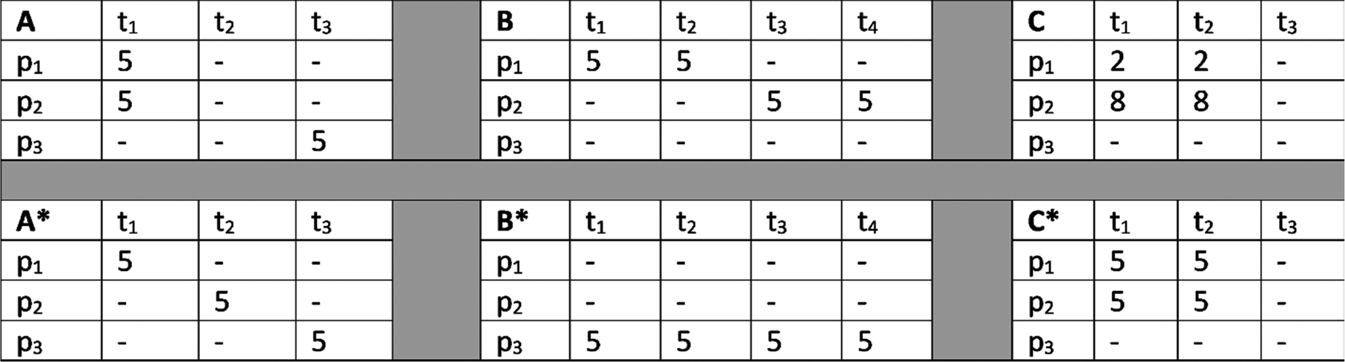
It will help to introduce some candidate pattern goods and bads. Consider the three outcome pairs shown in Figure 1:
Candidate pattern goods and bads.

Some people judge that A is in one respect worse than A*, because in A there is a period during which there is no high-quality life.Footnote 3 Some judge that B* is in one respect better than B, because in B* people have longer lives.Footnote 4 Some judge that C is in one respect worse than C*, because in C wellbeing is less equally distributed among people.Footnote 5 These judgments seem to concern patterns of various kinds in the distribution of wellbeing.Footnote 6
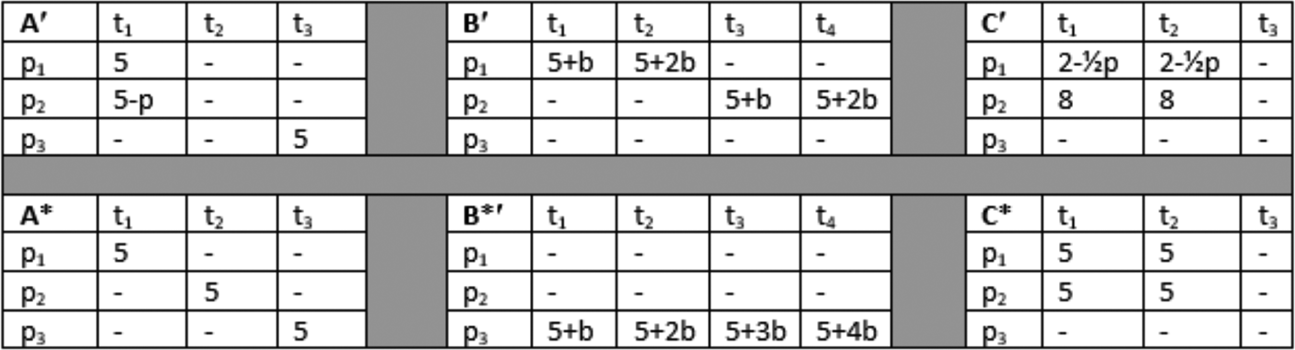
Appearances may deceive. A good that appears to be a pattern good may not be one. If we accept an expanded view of a person's good, we can “disperse” apparent pattern goods into persons’ good at particular times. In the formal framework, dispersion corresponds to a recharacterization of the outcome vector: to account for the pattern good (bad), a bonus (penalty) is added to (subtracted from) how good an outcome is for some person at some time.Footnote 7 Figure 2 shows a recharacterization of the three outcome pairs above, in which the apparent pattern goods and bads have been dispersed.
Dispersing apparent pattern goods and bads.

Given these recharacterizations, the judgments about these outcomes mentioned above can be recovered without appeal to pattern goods or bads. As Figure 2 also illustrates, this dispersion strategy for an apparent pattern good or bad corresponds to a substantive axiological claim. It is the claim that the good or bad in question is among the facts that determine how good an outcome is for a person.
In some cases, this claim would not be plausible. Dispersion must be well-motivated: there must be something in virtue of which the good in question determines how a particular person's life goes. Figure 2's A′ may be an example of a failure to meet this condition. Holding other things fixed, it would arguablyFootnote 8 be implausible to claim that it would be worse for p2 that she lives in a world that will later be devoid of high-quality life for a time. If empty periods are a bad, then, they may be a genuine pattern bad.
In other cases, this claim would be implausible for a different reason. Dispersion must not distort the good in question: it must not leave us unable to recover fixed judgments that reflect our pre-theoretic understanding of the good. The dispersion of longevity's value illustrated in Figure 2's B*′ may be an example of a failure to meet this condition. Broome (Reference Broome2004) argues that if longevity is dispersed in this way, then:
(1) An outcome containing N long lives would be worse than an outcome containing N very short lives and one other, Methuselah-like life.Footnote 9
But, if we assume that our pre-theoretic understanding of longevity includes the judgment that:
(2) It is better that a given fixed total of wellbeingFootnote 10 be “packaged” into fewer rather than more lives,
then (2) conflicts with (1). So accommodating a concern for longevity via the dispersion strategy illustrated by B*′ would leave us unable to recover (2). The dispersion strategy for longevity would in this sense distort the good that it attempts to accommodate. If so, then longevity could not plausibly be dispersed into particular times in this way.Footnote 11
We thus have two necessary conditions for successful dispersion. Call them the Well-Motivated and Non-Distortion conditions. We can next ask if the attempt to disperse inequality's badness satisfies these conditions.
3. Inequality: do not disperse
Broome (Reference Broome1991, Reference Broome2004) claims that inequality's badness can be successfully dispersed. I disagree. The problem is not that dispersion obviously fails to satisfy the Well-Motivated condition. As in the case of longevity (and unlike the case of empty eons in the history of the universe), it is not implausible to claim that inequality's badness is connected to particular persons – namely, those who are worse off. But dispersing inequality's badness fails to satisfy the Non-Distortion condition. In particular, dispersion makes inequality greedy in a sense that, as I explain in this section, is at odds with our pre-theoretic understanding of it. So inequality should not be dispersed.
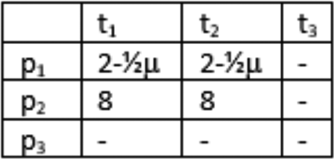
To see the source of the greediness problem, consider a standard version of egalitarianism, according to which it is non-instrumentally bad if some people's lives go worse than others’ do,Footnote 12 and let us then try to account for egalitarianism, via dispersion, in a simple case. Look again at Figure 2's outcome C. To disperse the badness of the inequality among these people, we subtract a penalty p from p1's wellbeing. It is a fixed judgment in our pre-theoretic understanding of inequality's badness that the badness of a given inequality depends on the size of the difference between the better-off and worse-off.Footnote 13 So the size of p must be sensitive to how much worse off p1 is than p2. Let μ correspond to the penalty appropriate to a difference in wellbeing of 12 units. Subtracting μ from p1's wellbeing would yield the outcome shown in Figure 3:
Dispersing inequality's badness (I).

Would the outcome represented in Figure 3 be Figure 2's C′, the outcome in which the appropriate penalty p has been subtracted? No. The penalty that has so far been subtracted corresponds to a welfare difference of 12 units. But, if the dispersion strategy is correct, that is not the size of the difference between p1 and p2: p1 is worse off than p2 by at least 12 + μ. The dispersion strategy therefore requires us to make a further downward adjustment ν to p1's wellbeing, such that μ + ν is the penalty that corresponds to a wellbeing difference of 12 + μ units. But, having made that adjustment, the disperser is not yet done. For, if the dispersion strategy is correct, p1 is not worse off than p2 by only a margin of 12 + μ either; she is worse off than p1 by at least 12 + μ + ν, which necessitates a further downward adjustment ξ to her wellbeing – and so on. Thus, to account for egalitarianism via dispersion in this case, the penalty p that we subtract must be the sum of this infinite series μ, ν, ξ, . . . of downward adjustments. If inequality's badness is dispersed, the worse-off are made worse off again, which worsens inequality, which makes the worse-off worse off yet again, and so on. That is the sense in which attempting to disperse inequality's badness makes inequality greedy.
So far, I have just assumed egalitarianism in the simple form stated above and mechanically applied the dispersion strategy to an outcome. In so doing, I have noted a striking fact about the operation of the dispersion procedure – that the penalty subtracted must be the sum of an infinite series of sub-penalties μ, ν, ξ, . . . – and I have given that fact the name “greediness”. I have not yet asked why greediness is a problem. Before addressing that question, let me rule out two misunderstandings of why greediness is a problem. First, although dispersion entails subtracting a penalty that corresponds to the sum of an infinite series, the problem need not be that dispersion makes inequality infinitely bad. That would be so only if the series μ, ν, ξ, . . . did not converge – that is, if it failed to sum to a finite value. But, by selecting an appropriate weight for inequality's badness, it is possible to make the series converge to whatever finite value one wishes. Likewise, then, the greediness problem is also not that dispersion makes inequality bad to a (finite but) implausibly large degree. Put differently: the disperser can avoid making inequality bad to an implausibly large degree, in either of the foregoing senses, by first determining the size of the total penalty p that she wants to subtract from p1's wellbeing, and then claiming that p consists of a series of sub-penalties μ, ν, ξ, . . ., each sub-penalty corresponding to one of the portions of the wellbeing difference between p1 and p2 that were described in the previous paragraph.Footnote 14
Second, it is easy to confuse the greediness problem with (and so think that it rests on) a kind of illicit double-counting. To see why it does not, focus first on what would be a case of illicit double-counting. Look at outcomes B′ and B*′ in Figure 2 again. It would be an obvious mistake to claim that, in addition to the better quality of the life in B*′, a further respect in which B*′ is better than B′ is that it contains a longer life. That good has already been accounted for via dispersion; it is partly why the life in B*′ is better. Now look at outcomes C′ and C* in Figure 2. It might be superficially tempting to think that, in addition to the worse quality of p1's life in C′, a further respect in which C′ is worse than C* is that p1 is worse off than p2. But that would be to make the same double-counting mistake; by hypothesis, that bad has already been accounted for via dispersion. The greediness problem is not the result of such double-counting. I did not ask: “After the badness of the total inequality between p1 and p2 has been dispersed, isn't there more for the disperser do?” The answer to that question is “No”. I asked: “After the badness of one portion of the inequality between p1 and p2 has been dispersed, isn't there more for the disperser to do?” The answer to that question is “Yes”.
The greediness problem need not be that dispersion makes inequality infinitely bad or overly bad, and it is not a kind of illicit double-counting. So why is greediness a problem? Reconsider the series μ, ν, ξ, . . . that makes up the penalty p. Recall that this series corresponds to a set of substantive claims: that it is bad, to degree μ, for p1 to be worse off than p2 (with respect to health, say), and that it is bad, to degree ν, for p1 to be worse off than p2 (with respect to the inequality in health), and that it is bad, to degree ξ, for p1 to be worse off than p2 (with respect to the inequality that is due to the inequality in health) – and so on. This does not, I take it, describe the structure of any egalitarians’ concern about an outcome that contains, say, a sighted child and a blind child. When egalitarians judge that something is regrettable about such an outcome, their judgment is explained fully by the difference in health, or health-related wellbeing, between these children.Footnote 15 That judgment cannot be recovered, if inequality's badness is dispersed.Footnote 16 Dispersion can recover the extension of egalitarians’ judgments, but dispersion would force egalitarians to revise the grounds of those judgments, in a way that is unfaithful to the concern that motivates egalitarianism. That is why greediness is a problem. It is the reason that dispersing inequality's badness fails to satisfy the Non-Distortion condition.Footnote 17
The distortion problem may arise in a different form. On some egalitarian views, inequality in lifetime wellbeing is not the only site of egalitarian concern. Look at outcomes D and D* in Figure 4, interpreting the numbers as a pre-dispersion characterization. Even if p1 and p2 have the same lifetime wellbeing in both outcomes, some egalitarians believe that D would be worse. They believe it would be better if some person were not worse off than another at every time.Footnote 18
Dispersing inequality's badness (II).

Consider an amendment to egalitarianism, motivated by this thought, which adds that (only) when there is lifetime equality does such “simultaneous-segment” inequality detract from an outcome's value. Let us then try to accommodate this egalitarian view, via dispersion, in Figure 4's outcome E. In this outcome, p2 is worse off than p1 during t2. Is this fact a site of egalitarian concern? Suppose first that it is. Then, given the dispersion strategy, apparently its disvalue should be dispersed into p2's wellbeing during t2. But then p2 and p1 are not equally well off overall, and so the t2-inequality is not a site of egalitarian concern. Suppose on the other hand that it is not. Then, since p2 and p1 are equally well off overall, the t2-inequality is a site of egalitarian concern. So, if it is, then it isn't, and if it isn't, then it is. In other words: the dispersion strategy makes this egalitarian view incoherent. The egalitarian view in question might not be thought especially plausible. And so one might think that it could, harmlessly, be revised in a way that would avoid this implication.Footnote 19 But the present point does not turn on the view's plausibility. The present point is that the view, whether or not it is especially plausible,Footnote 20 does not seem incoherent. But the position that inequality's badness can be accommodated via dispersion would make it so. To the extent that one thinks the view coherent (if not plausible), and so to be adjudicated upon on its merits by intra-egalitarian debate, this is another reason not to disperse inequality's disvalue.
4. Can egalitarianism be revised to avoid the greediness problem?
The source of the greediness problem is the “regress” of sub-penalties of μ, ν, ξ, . . . that dispersion requires to be subtracted from the worse-off person's good. To see how the friend of the dispersion strategy might object to the argument from the greediness problem, we can next return to the case in §3 and ask why the disperser was forced to make, not just a single adjustment μ to p1's wellbeing (corresponding to a difference of 12 units of health-related wellbeing), but also the further series of adjustments ν, ξ, . . . . The answer lies in the combination of the dispersion strategy with the version of egalitarianism that we have so far been assuming, which requires comparing the whole of a person's good with others’ good. That suggests the following natural objection to my argument:
(*) By egalitarian lights, only this difference of 12 units between p1's good and p2's good counts – that is, only this portion of the difference between their goods is a site of egalitarian concern.
If (*) could be supported, then once μ has been subtracted from p1's wellbeing, the disvalue of inequality would be fully dispersed. The regress of sub-penalties having been blocked, the greediness problem would not then arise.
To accept (*) would be to block the regress of sub-penalties by making a “cut” within persons’ good, excluding one portion of persons’ good from the scope of egalitarian concern. To accept (*), in other words, is to accept a revision to egalitarianism as it was formulated in §3. To evaluate this objection, we can ask whether the objector can provide a reason to accept (*) – that is, to accept the revised version of egalitarianism – that is faithful to the view's underlying motivations. We can distinguish two ways of motivating the cut. The first motivates the cut on the basis of the connection between the excluded portion of a person's good and the presence of inequality. The second motivates the cut on some basis independent of this connection. Neither way of supporting (*), I shall next argue, saves the dispersion strategy.
To see the problem with the first way of supporting (*), consider the simplest version of this way of making the cut. The idea is to revise egalitarianism to be the view that it is non-instrumentally bad if some people's lives go worse off than others’ do, considering only the portion of their wellbeing that is not itself the result of inequality. This revised egalitarian view, however, is not well-motivated. Consider Fair-minded Francis. Francis learns that he is unfairly worse off than another person, Frances. Because he is fair-minded, this makes him distraught: he experiences genuine pain and suffering. And this suffering makes him worse off than Frances again. Because it is the result of inequality, the revised egalitarian view sees nothing further to regret about the portion of the difference between Francis’ and Frances’ wellbeing that is due to this suffering. This implication of the revised view, I take it, is unacceptable by egalitarian lights. Francis's life contains a significant quantity of suffering, not due to his choice or fault, that Frances's life does not. If the dispersion strategy precludes the egalitarian from recognizing that fact as a bad-making feature of an outcome, then the dispersion strategy fails to satisfy the Non-Distortion condition.
The disperser might make the rejoinder that there is reason to distinguish between diminutions to a person's wellbeing that are caused by inequality and those that are constituted by the presence of inequality, and claim that only the former are a site of egalitarian concern. She could propose, in other words, revising egalitarianism to be the view that it is non-instrumentally bad if some people's lives go worse off than others’ do, considering only the portion of their wellbeing that is not itself the non-causal result of inequality. That would not implausibly imply that Francis's inequality-caused suffering is outside the scope of egalitarian concern, but it would still exclude μ. In reply, however: why should the nature of the relation between inequality and the diminution of someone's wellbeing be thought to make a difference, by egalitarian lights? Whether inequality diminishes someone's quality of life via a relation as metaphysically tight as constitution or via one as loose as causation is orthogonal to the basis of egalitarian concern: namely, how the quality of different lives compares. This first way of supporting (*), I conclude, fails: it either has implausible implications or is inconsistent with the motivations that underlie a concern for inequality.
The failure of the first way of supporting (*) naturally suggests a second, alternative route by which one might attempt to do so. One might propose instead that there is some independent basis, consonant with the underlying motivations of a concern for inequality, that also implies a cut within persons’ good that would block the regress of sub-penalties. To illustrate the idea, it will help to consider, first, the following toy version of it. Suppose one were to revise egalitarianism to be the view that only health-given wellbeing is the fundamental currency of egalitarian concern. Then the penalty μ, although it is a way in which p1 is worse off than p2, would not be the kind of inequality that lies within the scope of egalitarian concern; it would be a respect in which p1 was worse off than – but not a respect in which she was less healthy than – p2. Thus the regress of sub-penalties, and with it the greediness problem, would be avoided. (This way of making the cut within persons’ good differs from the way considered in the previous paragraph, in that it does not exclude μ from the scope of egalitarian concern merely on the grounds that it is the result of inequality, but rather on the grounds of some independent restriction on the scope of egalitarian concern.)
Now clearly the illustrative toy version of the idea will not, itself, do; it would be arbitrary and ad hoc to restrict the scope of egalitarian concern only to health-given wellbeing. The question on the table is whether a more plausible version of the idea is available.Footnote 21 Shlomi Segall has suggested a version of egalitarianism that might be thought to fit the bill. Segall suggests that what is non-instrumentally bad is inequality of what he calls subjective wellbeing, and he glosses subjective wellbeing as “[that which] potentially matters to [people]”.Footnote 22 Reconsider outcome C from the perspective of this view. Suppose we can assume that the health-related component of a person's good is part of her subjective wellbeing, but that the penalty μ, although it makes her life go worse (i.e., is a component of her good), is not part of her subjective wellbeing. Then one could claim that, although μ is among the facts that makes p1's life go worse than p2's, that is not the kind of difference in their respective goods that is a site of egalitarian concern. The regress of sub-penalties would be avoided.
This view, however, either excludes too much or fails to avoid the greediness problem. Suppose first that “potentially mattering to people” is specified by some independent criterion – for example, a so-called experience requirement according to which only what features as part of people's conscious experiences is eligible to count as potentially mattering to them (in the relevant sense of that phrase). Then, although the view would exclude the penalty μ from itself being an object of egalitarian concern, it would exclude too much. It would also exclude the difference in wellbeing between two people, one of whom is, unbeknownst to them but through no fault or choice of their own, being cheated on by their spouse. But excluding this difference between these persons’ goods (if indeed it is one)Footnote 23 would exclude too much. If this is genuinely a way in which someone's life goes worse than another's, then the egalitarian is not unmoved by this kind of difference in how these lives go.Footnote 24 On the other hand, if “potentially mattering to people” is not specified by an independent criterion like the experience requirement, then the subjective-welfare proposal does not tell against μ being an object of egalitarian concern – that is, nothing would exclude it potentially mattering to people, in the relevant sense, that they are not worse off than others. On this specification of the subjective-welfare proposal, it would not avoid the greediness problem. I conclude, therefore, that there is no plausible way of revising egalitarianism, while retaining a concern for how persons’ goods compare, that avoids the greediness problem.
It is a corollary of my arguments, then, that what Segall (Reference Segall2016: 113) calls his hybrid view – according to which inequality is bad for the worse-off in a way that does not affect their subjective wellbeing – is not a stable view about the site of egalitarian concern. To the extent that Segall's hybrid view is motivated by a concern to recover the judgment that the worse-off have a complaint about inequality, I am sympathetic to its motivation. But the view that inequality is purely a pattern bad is not at all inconsistent with the view that worse-off persons have complaints concerning inequality; one merely has to countenance persons having complaints with respect to facts other than how their own lives go. And this claim need not be unintuitive: although it might be implausible to suggest that people could have complaints about some fact not appropriately related to their lives, the pattern fact in question here is not such a fact.
One might reply, on Segall's behalf, that the following is a plausible and sensible way of reconciling dispersion with a version of egalitarianism that restricts the scope of egalitarian concern to subjective welfare (with the bounds of subjective welfare, in turn, being limited by the experience requirement). Suppose p1 is worse off than p2 because she has, unbeknownst to her, been unfairly discriminated against. Then, to the extent that the effects of this discrimination show up in her conscious experiences (e.g., insofar as they result in an episode of ill health), they are within the scope of egalitarian concern. But the fact of having been discriminated against, itself, although it is a further respect in which her life goes worse, is outside the scope of egalitarian concern. I reply that this case is not importantly different from the case of the spouse who, unbeknownst to her, is cheated on. Insofar as one thinks that this event (as opposed to mere effects of it that show up in this person's conscious experiences) is genuinely a way in which this person's life goes worse, there are no grounds for excluding it from the scope of egalitarian concern. Likewise, if one thinks that the fact of having been discriminated against is a genuine respect in which p1's life goes worse, there are no grounds for excluding it from the scope of egalitarian concern. As suggested in footnote 23, attempts to rescue dispersion in this way appear to be attempts to (a) count being worse off than another as part of a person's good; (b) take the scope of egalitarian concern to be a comparison of different persons’ goods; but also (c) exclude being worse off than another from the scope of egalitarian concern. But (a)–(c) form an inconsistent triad. It is, of course, possible to retain a commitment to (b) and (c) by claiming that being worse off than another can be counted as part of a person's good only in what might be called a purely formal way – that is, purely as an accounting device and not corresponding to any substantive claims about a person's good. But the opponent of dispersion can happily agree: as noted in Section 2, this would be to abandon the attempt to disperse inequality's badness in the sense at issue.Footnote 25
5. Conclusion
I conclude with a summary of the argument. One kind of egalitarianism is motivated by a concern about how different persons’ goods compare. The dispersion strategy is the claim that egalitarian badness of this kind can be accommodated as a special kind of personal bad. The dispersion strategy succeeds only if it does not distort the (dis)value that it aims to accommodate. But dispersing inequality's badness would distort the (dis)value that it aims to accommodate. It would make inequality greedy, in a sense that forces egalitarians to revise the grounds of their judgments about why some outcomes are regrettable, with respect to the egalitarian ideal, in a way that is not consonant with the view's motivations. And revisions to egalitarianism that aim to avoid the greediness problem, while preserving a concern for how different persons’ goods compare, are either implausible or not consonant with the view's motivations. So, for this kind of egalitarianism, the dispersion strategy fails.Footnote 26