While recent debates over the European migrant crisis and US border detention policy have galvanized attention on refugees and asylum seekers in the West, much of the burden of hosting forcibly displaced people (FDP) is borne by the developing world: more than 85 percent of the world's FDP reside in developing countries.Footnote 1 At the same time, there is a striking dearth of research on developing countries’ forced displacement policies in both academic and policy circles.Footnote 2 This oversight is driven partly by a lack of data on asylum and refugee policies outside the countries of the OECD, but also by the presumption that de jure policies are inconsequential in the developing world, due to weak policy enforcement and (allegedly) limited policy knowledge.Footnote 3
We address this knowledge gap, leveraging an original data set, the Developing World Refugee and Asylum Policy (DWRAP) data set, which covers ninety-two countries from 1952 to 2017. The new data set allows us not only to identify temporal and spatial variation in developing countries’ de jure policies on FDP, but also to analyze both the determinants and effects of their asylum policy reforms.
Understanding the trends, determinants, and consequences of de jure forced displacement policies in the developing world is important because of the disconnect between theories of migration policymaking and empirical realities. Although migration—particularly forced displacement—is concentrated in the global South, the existing literature has a substantial North-centric bias.Footnote 4 Indeed, as Adamson and Tsourapas recently noted, “the field of migration studies lacks an adequate comparative framework for understanding the emergence of different forms of state migration management regimes outside the Global North.”Footnote 5 This North-centric bias represents a critical challenge for migration scholarship because asylum policymaking is likely to follow a different path in the developing world.Footnote 6 In particular, the size of FDP flows, the strength of transnational kinship networks (due to artificial borders), the level of insulation from public opinion (due to weak electoral institutions), and the extent of external pressure (partly due to aid dependency) are greater in the global South than in the developed world. Moreover, because the vast majority of refugees that developing countries host are from neighboring countries, the implications of policy choices are far more localized in the developing than in the developed world. Examining asylum policy in developing country settings, then, stands to facilitate theory-building, new empirical tests of existing theories, and improved policy planning and advocacy.
We develop and test a theory of forced displacement policy liberalization. We identify intense episodes of civil war in neighboring countries as the primary impetus for forced displacement policy reform in the developing world. By shifting expectations of FDP inflows, intense civil war in neighboring countries raises the salience of forced displacement, spurring (at times) policy change. The direction of policy reform hinges on related considerations, some of which are unique to developing country settings. In particular, we anticipate and find evidence that states pursue liberalization when political elites have co-ethnics who are discriminated against in neighboring countries. In this circumstance, forced displacement policy can provide relief to noncitizen ethnic kin and ease their integration. We also expect that displacement policy liberalization is used by regimes dependent on external economic assistance to curry political favor with Western governments keen to deflect asylum flows from the global North. While this dynamic is present in some notable cases (e.g., Uganda under Museveni, Guinea under Conté, and Kenya under Moi), we do not find evidence that these (salient) cases generalize broadly.
This study makes three contributions to the literature on migration policy. First, we develop a new set of theoretical expectations with respect to the determinants of de jure asylum and refugee policy in the developing world, and test them using DWRAP. To the best of our knowledge, ours is the first study that assesses asylum and refugee policymaking in a large panel of developing countries.Footnote 7 Our findings contribute to understanding migration policymaking in the global South and to debates about its commonality with and difference from developed countries’ asylum policymaking. Thus our study helps rectify the North-centric bias in existing models of forced displacement policy.
Second, our results challenge the conventional wisdom that political violence causes migration policy restriction.Footnote 8 Our theoretical framework and results show that neighborhood civil wars spur policy reform in general, but not necessarily restriction. In the context of proximate civil conflict, developing countries may respond with policy liberalization, especially if elites’ ethnic kin are likely to comprise a significant share of FDP inflows and hence stand to benefit from integrative migration policies. More broadly, by challenging the dominant view that regional violence induces restriction, our theory and evidence highlight how forced displacement policy can be used as another lever for states to indirectly affect regional conflict dynamics. Existing work highlights how countries may respond to neighborhood civil war by, for instance, supporting co-ethnic rebels.Footnote 9 Our results suggest that forced displacement policy liberalization can complement state intervention in neighboring civil wars by providing an exit option for war-affected co-ethnics in neighboring countries.
Third, we introduce a new data set, which more than doubles the country coverage of existing asylum policy indices. This data set enables researchers to evaluate existing empirical findings in a broader comparative context, and to explore new questions about the determinants and effects of asylum policies in the developing world. The prevailing neglect of policy regimes in developing countries represents a critical knowledge gap because, as our findings suggest, policy trajectories are both different and consequential in the developing world. For example, studies focusing on asylum policy in OECD countries find increases in policy restrictiveness over time (see Figure 3 later in the paper). By contrast, using DWRAP we show that asylum and refugee policies in the developing world are becoming more liberal over the same period (see Figure 2 later in the paper). These divergent trajectories open new avenues for future research. Further, our method of coding asylum policies is simple and scalable. Whereas many existing indices of migration policy involve subjective judgments, we rely on legal texts, demonstrating how UNHCR submissions to the Universal Periodic Review can be used to identify the corpus of asylum and refugee laws across countries. In doing so, our guidelines make it straightforward to both replicate our coding and extend it to new countries in the future.
The remainder of the paper proceeds as follows. First, we describe how and why migration policymaking is likely to differ between the developing and developed worlds. Then, we develop a set of hypotheses on the determinants of FDP policymaking in the global South. Third, we introduce our new data set and describe trends. Finally, we test our theoretical expectations, focusing on when policies change and the conditions under which they liberalize.
Before proceeding, a brief note on terminology is warranted. Throughout, we refer to “migration,” “asylum and refugee,” and “forced displacement” policymaking interchangeably. Migration policies govern the movement of people into a country. Forced displacement policies apply to two categories of migrants: refugees and asylum-seekers. Refugees are individuals recognized as having fled their homes for reasons specified in the 1951 Convention Relating to the Status of Refugees, and asylum seekers are individuals asking for refugee status. We use the term “forcibly displaced people” (FDP) to refer to refugees and asylum seekers jointly. Our decision to situate refugee and asylum policy in the broader context of migration policy reflects the insights of the literature on mixed migration. Highlighting the intersection of multiple causes of flight, including violence and economic opportunity, this literature argues persuasively that sharp legal distinctions between FDP and other migrants are problematic.Footnote 10
Migration Policy in Developing Versus Developed Countries
Developing countries host the overwhelming majority of the world's FDP— 85 percent of the 79.5 million FDP worldwide in 2019.Footnote 11 More strikingly, least developed countries, which account for 1.2 percent of global GDP, host 27 percent of FDP. Only one developed country, Germany, is among the top ten host countries in total FDP population, and no developed country is a top FDP host on a per capita basis.Footnote 12 However, the literature on migration policymaking, and particularly forced displacement policymaking, relies overwhelmingly on evidence from a small number of rich consolidated democracies.Footnote 13 This bias represents a critical gap in the literature, limiting the generalizability of existing theories of migration policymaking, and our understanding of global forced displacement.
The politics of migration policy differ between developing countries and developed countries.Footnote 14 This is because developing (host) countries face a unique array of domestic and international pressures around migration and forced displacement.Footnote 15 These include larger FDP flows, increasingly protracted periods of displacement, stronger transnational kinship networks, weaker state institutions, greater budgetary pressures, and challenges of nation and state building, among others. At the same time, developed countries have significantly broader welfare provisions, parties that are organized on a left–right ideological spectrum (rather than nonprogrammatic parties), and democratic governments that are generally more attuned to public opinion. Thus, policymakers designing forced displacement policies in the global South confront a variety of distinct opportunities and constraints.
Building on a growing qualitative literature on migration policy in developing countries, we argue that three key assumptions implicit in canonical models of migration management are unlikely to hold in the global South. Unpacking these assumptions is essential because they reveal unique influences on migration policymaking in developing countries.
Global Versus Local Policy Impacts
A key assumption in the literature is that policymakers favor restriction due to concerns about the global implications of policy reforms. However, the effects of migration policies are expected to be significantly more localized in the global South. Advanced industrial countries are integrated into world markets, supply chains, and transportation networks. Correspondingly, though distance between origin and destination countries always raises the costs of movement, wage differentials make the former attractive to prospective migrants globally.Footnote 16 By contrast, FDP flows to hosts in the South come overwhelmingly from neighboring countries: in the past decade, between 73 and 82 percent of all FDP fled to a contiguous neighbor.Footnote 17
Consequently, while policymakers in developed countries consider how migration policies may attract migrants worldwide, policymakers in the global South generally consider how policies will affect migration flows from their neighborhoods only.Footnote 18
The regional nature of displacement in the global South means that factors like transnational kinship weigh more heavily on policymakers than they do in developed contexts.
Rich Versus Poor Economies
Second, existing theories of migration policymaking often assume that host countries are wealthy, industrial economies.Footnote 19 While developed countries fear political fallout from greater competition between migrants and local low-skill workers, low-income countries sometimes view FDP as an asset in themselves.Footnote 20 This is partly because, unlike in OECD countries, the human capital of the median FDP in the global South is greater than the human capital of the median resident in a host community.Footnote 21 Thus, host countries in the developing world may seek to facilitate self-reliance and grow local economies in host communities by affording FDP rights to employment, land, education, and free movement, among others.
Developing countries also face unique economic pressures stemming from slow growth, large debt burdens, and aid dependence. Such dependency precipitated the emergence of the “grand compromise,” whereby developed countries offered aid and trade concessions to developing countries in exchange for refugee hosting.Footnote 22 The explicit aim of the compromise is to reduce the number of FDP in the global North by financing a larger share of the monetary burden of hosting FDP borne by developing countries. By making migration policies in the global South and North interdependent,Footnote 23 the “compromise” incentivizes governments, especially in sub-Saharan Africa and the Middle East, to leverage FDP hosting in exchange for Western aid.Footnote 24 These considerations around aid in migration policymaking are obviously unique to the global South.
Reliance on external economic assistance can constrain and not only facilitate policy liberality. For example, in the 1980s and 1990s, fiscal austerity reduced the ability of (some) hosting countries in the global South to extend relatively generous support to refugees.Footnote 25 This has been the case in Tanzania, where structural adjustment reforms forced social spending to be scaled back, ultimately causing the collapse of a previously generous, integrative refugee policy in favor of encampment in rural settlements subsidized by external assistance from the UN and other aid agencies.Footnote 26
Liberal Versus Illiberal Regimes
Third, prominent theories of migration management assume that host countries are liberal, consolidated democracies.Footnote 27 Migration policy in these settings represents a balance between liberal values, public opinion (which commonly but not uniformly supports restriction), interest-group advocacy, and labor-market considerations. By contrast, most developing countries are governed by hybrid regimes with weak electoral institutions. In nondemocracies, governments tend to be more insulated from public pressure. Thus, these regimes can more easily alter migration policies to support broader strategic aims. In fact, adopting relatively generous migration policies may paradoxically be easier in illiberal states, where external pressure promotes openness while insulation from public opinion mitigates possible mass demands for greater restrictions.Footnote 28
A Theory of Policymaking on Forced Displacement
What factors determine when and how countries in the global South reform their asylum and refugee policies? Building on a rich qualitative literature on developing world migration policy,Footnote 29 our theoretical framework identifies different data-generating processes underpinning the decision to reform policy and the direction of reform. Reform occurs when major shocks, namely civil wars in neighboring countries, increase expectations of FDP inflows, forcing a policy response. When the (relatively rare) decision to reform is made, different factors influence the direction of reform— liberalization or restriction (though decisions about whether to reform and the direction of reform typically occur simultaneously). In this study we chiefly focus on correlates of policy liberalization because forced displacement policies are trending in a more liberal direction over time in the global South (see Figure 2).
We argue that civil war in a country's neighborhood is the primary impetus for policy change. By contrast, factors that are auxiliary to regional civil wars—such as status of co-ethnics abroad and (in some cases) the extent of aid dependence— determine the direction of policy reform. This theoretical approach challenges prominent models of migration policymaking that view violence in origin countries only as a catalyst for restrictive policies in destinations.Footnote 30
The Decision to Reform Policy
Because they are politically sensitive, migration policies are typically slow to change.Footnote 31 As Beine and coauthors note, changes in policy occur “episodically … with longer periods of constancy punctuated by changes via legislative reforms.”Footnote 32 This stability is partly due to the relative difficulty of altering migration policies. Politicians face a host of barriers to policy reform, including intra-elite disagreements and bureaucratic hurdles.Footnote 33 Another reason for infrequent policy change is that migration is often a lower-salience issue in the global South, which allows governments, especially in low-income countries, to pursue vague policies and delegate FDP management to international organizations and nongovernmental organizations (NGOs).Footnote 34 In particular, governments delegate management responsibilities to the UNHCR, partly to insulate themselves from politically fraught decisions about FDP.Footnote 35
The decision to reform asylum and refugee policies, then, must be precipitated by factors that foster elite consensus on the need for reform, and that raise the salience of migration as a national policy issue. Factors that increase policymakers’ expectations of FDP inflows provide just this spark.Footnote 36 Anticipation of increased inflows raises concerns among prospective host countries of a concomitant increase in the (political and economic) costs of hosting. This is because larger displaced populations are costlier to manage, ceteris paribus.Footnote 37 Greater flows of FDP also reduce the attractiveness of outsourcing migration management to the UN and other nongovernmental bodies.Footnote 38 As forced displacement becomes more salient, governments in host countries prefer greater control, partly due to anxieties over national sovereignty.Footnote 39 In short, when the expected magnitude of migrant flows into a country increases, expectations of costs increase, raising the salience of migration and spurring elite consensus on the need for policy reform.
We do not anticipate heterogeneity across regime types in responsiveness to large FDP influxes for two reasons. First, large migrant inflows generate expectations of greater hosting costs irrespective of hosts’ political institutions.Footnote 40 Although certain regimes (e.g., personalist autocracies) may find it easier than others (e.g., democracies) to rapidly shift displacement policies, there are common incentives to react when expected hosting costs increase. Second, regardless of regime type, most developing governments are acutely sensitive about national sovereignty. Concerns that international actors will supplant national institutions in the absence of a policy response to refugee influxes create a strong incentive to reform de jure migration policies when the expected magnitude of FDP inflows increases.Footnote 41
We argue that intense civil wars in neighboring countries are the primary factor policymakers use to calibrate expectations of FDP inflows. Globally, civil wars are the principal cause of forced displacement (see Figure 4).Footnote 42 The greater the violence, the more people flee to neighboring countries,Footnote 43 producing waves of FDP.Footnote 44 In recent episodes, civil conflict forced 6.6 million people from Syria, 2.7 million from Afghanistan, 2.2 million from South Sudan, and 1.1 million from Myanmar. The growing use of forced displacement as a deliberate wartime strategyFootnote 45 has only sharpened the link between civil conflict and FDP flows.
We therefore hypothesize that civil conflict in a country's neighborhood is the chief impetus for migration policy change in the global South.
H1 Developing countries are more likely to reform their asylum policies when intense armed conflicts are occurring in their neighborhood.
This hypothesis dovetails with findings in both developedFootnote 46 and developingFootnote 47 contexts about how security threats can spur migration policy changes. The negative regional externalities of civil wars are well known,Footnote 48 and of these, FDP flight is perhaps the most widespread.Footnote 49 Evidence also suggests that FDP flows can spur civil conflict spillovers by facilitating transnational flows of arms and combatants.Footnote 50 Displacement also risks regionalizing civil wars by triggering clashes between the neighboring origin and host countries.Footnote 51 Further, as costs mount, host countries may face financial crisisFootnote 52 and local backlash.Footnote 53 These factors help explain why existing models explicitly assume that policy restriction is the likely response to conflict.
By contrast, we contend that increasing policy restrictiveness is but one possible response. In the global South, colonialism left artificial borders and numerous split ethnic groups.Footnote 54 As a result, conflicts in one state often affect groups with kinship ties in neighboring states.Footnote 55 Conflicts, then, may precipitate policy liberalization when the ethnic kin of groups in a potential host country are affected by war in neighboring origin countries. Because of shared identity ties, host countries may choose to respond generously to co-ethnic FDP.Footnote 56 By way of illustration, Chaulia describes how transnational kinship ties motivated Tanzania's liberal response to FDP from Burundi, the Democratic Republic of the Congo, and Mozambique in the 1960s and 1970s.Footnote 57 Countries also have incentives to liberalize policy as a means of integrating war-displaced migrants, attenuating the effect of FDP on strife in host communities.Footnote 58
Transnational Ethnic Kin and Policy Liberalization
There is ample evidence that ethnic networks pull migrants to specific destinations.Footnote 59 Before individuals migrate, kin groups can relay information about the conditions in prospective destinations, as well as risks along the way. In destination countries, kin networks ease integration,Footnote 60 reduce the risk of xenophobic attacks,Footnote 61 and help secure higher-paying jobs and better housing.Footnote 62 The more localized nature of migration in the developing world reinforces the importance of transnational ethnic kinship. However, while kin are a known pull factor in models of migrant decision making, little work explores their relevance in migration policymaking.Footnote 63 Because borders were often drawn arbitrarily in the global South, splitting ethnic groups between countries, ethnic kin are an important policy influence.
Cross-border kinship plays an especially critical role in policy responses to regional civil wars. Many conflicts in the global South, and particularly those that produce the most FDP, have an explicit ethnic dimension.Footnote 64 In origin countries, the presence of ethnic minority groups with powerful kin in neighboring countries can spur nationalizing campaigns directed at expulsion.Footnote 65 Forced displacement of minority groups during civil war aims at dampening violent group mobilization,Footnote 66 removing potential “fifth columns,”Footnote 67 and consolidating territorial control.Footnote 68
When groups are subject to wartime violence and discrimination, co-ethnic elites in neighboring countries frequently pursue policies intended to support kin abroad. Policy responses include sponsoring co-ethnic rebel groups,Footnote 69 giving humanitarian aid to kin in war-affected countries,Footnote 70 and punitively sanctioning countries engaged in expulsion.Footnote 71 These policies aim to deter or limit civil war violence and displacement targeted at foreign kin.
We argue that countries may also respond to the outbreak of civil war in their neighborhood with measures intended to provide an exit option for targeted co-ethnics. By liberalizing asylum and refugee policies, prospective host countries can assist kin fleeing the conflict and create a hospitable and open environment to ease integration. Consistent with this view, recent work suggests that de facto migration policies favor co-ethnic FDP.Footnote 72
Specifically, policy liberalization is more likely when the co-ethnics of national political elites are excluded from political power in neighboring countries. In the context of civil war, relative disparities between ethnic groups in access to state power portend violent mobilization.Footnote 73 Under such conditions, asylum policy changes in prospective host countries are likely to affect individuals with whom policymakers share an identity. Liberalization, then, follows as a function of co-ethnic solidarity.Footnote 74
When co-ethnics flee persecution, host state elites may seek to improve their conditions by liberalizing policy, especially if such assistance is supported by the public. Policy liberalizations undertaken in Armenia and Azerbaijan between 1992 and 1999 are instructive. As conflict raged over the disputed region of Nagorno-Karabakh, the expectation of co-ethnic refugee flows induced policymakers to institute extensive, liberal policies for FDP.Footnote 75
H2a Developing countries enact more liberal asylum policies when co-ethnics of their political elites are discriminated against abroad.
Of course, not all regimes face equal incentives vis-à-vis co-ethnics.Footnote 76 We anticipate that more democratic regimes are more likely to enact more liberal asylum policies when co-ethnics of their political elites are discriminated against abroad. Crucially, kinship serves as a heuristic for parties and voters in the information-poor environments of the global South.Footnote 77 As a result, elites in electorally competitive regimes face incentives to wield policymaking with an eye toward ethnic kin. Welcoming coethnics can broaden an incumbent's power base and improve their electoral fortunes.Footnote 78
A failure to assist ethnic kin in times of need may prove unpopular for incumbent politicians.Footnote 79
H2b The effect of elite kin discrimination on asylum policy liberality will be stronger for more democratic countries.
External Economic Assistance and Policy Liberalization
Apart from transnational kinship ties, external economic assistance may also affect migration policymaking in the global South. In the context of civil war, external assistance to conflict-affected countries and neighboring states often rises significantly, both to suppress violence and to facilitate reconstruction.Footnote 80 Aid also floods into war-wracked regions in direct response to forced displacement.Footnote 81 Since developed countries increasingly seek to restrict the flow of refugees from South to North, they have an interest in promoting more liberal policy regimes in developing countries, especially those proximate to ongoing conflicts. Policy liberalization in the global South helps absorb regional FDP flows, reducing the hosting burden of countries in the global North.Footnote 82 The incentive for developed countries to deflect FDP is especially great when flows originate from places experiencing civil war; publics perceive FDP fleeing conflicts as security risks, and often oppose their resettlement.Footnote 83
Foreign aid is critical to many developing countries, so rich countries can use it to pressure them to reform their asylum and refugee policies. Of course, developed countries must offer additional assistance to offset the costs of hosting large displaced populations.Footnote 84 Bubb, Kremer, and Levine show that foreign assistance is an efficient solution to the negative externalities of policy restrictions in the West, and thus Western actors should compensate developing countries for hosting forced migrants.Footnote 85
There is mounting empirical evidence that such a dynamic is unfolding.Footnote 86 Some donor countries now explicitly tie external assistance packages to cooperative agreements with developing countries over migration management.Footnote 87 Correspondingly, countries such as Turkey,Footnote 88 Jordan,Footnote 89 Libya,Footnote 90 and MoroccoFootnote 91 are known to engage in such “migration diplomacy.”
H3a Developing countries enact more liberal asylum policies when they are more dependent on external economic assistance.
Not all aid-receiving countries are equally vulnerable to donor pressure.Footnote 92 We hypothesize that external economic assistance to developing countries will be most effective at buying policy liberalization when the recipients are both aid dependent and illiberal. These countries are vulnerable to pressure from developed countries keen to deflect FDP flows and they stand to curry international favor by adopting a more open displacement policy regime such as Western actors desire.
Illiberal countries are more likely to respond to external economic incentives for several reasons. For one, autocrats are more insulated from public opinion, reducing the risk of domestic backlash to policy liberalization. Second, for illiberal countries that depend on external assistance, liberalizing asylum policy may be a strategic move to deflect attention from ongoing abuses by demonstrating a (symbolic) commitment to liberal international norms.Footnote 93
The benefits of strategic policy liberalization for repressive regimes, then, are threefold. First, by building international credibility through asylum policy liberalization, illiberal regimes can generate goodwill, which in turn serves as political cover for lingering abuses. Second, liberalization makes authoritarian regimes seem like pliant partners, facilitating durable relationships with Western donors. Third, autocrats often rely on patronage to remain in power. Cooperation with the West on asylum policy can be a lucrative source of external revenue that can be used to sustain patronage networks, as in Gaddafi's Libya.Footnote 94 Kenya's liberalization under Moi and Mozambique's liberalization under Chissano are also illustrative.Footnote 95 These leaders pursued displacement policy liberalization to garner sustained international economic assistance while engaging in continued domestic repression.
H3b The effect of aid dependence on asylum policy liberality will be stronger for less democratic countries.
Measuring Asylum Policy in the Developing World
To test the hypotheses, we construct an original data set of all national laws pertinent to forcefully displaced populations in a sample of ninety-two African, Middle Eastern, and South Asian countries between 1951 and 2017. In total, the DWRAP data set includes 229 unique, national-level migration laws.Footnote 96 Construction of DWRAP considerably expands the geographic and temporal scope of asylum policy indices. In Table 1, we outline the temporal and geographic coverage of existing migration policy data sets compared to DWRAP, demonstrating the extent to which existing data are OECD-centric. Because there has been no systematic mapping of domestic laws and policies on forced displacement in the developing world, most of the world's asylum seekers and refugees reside in developing countries that are excluded from existing data sets. DWRAP thus represents the most expansive coding of asylum and refugee policies in the developing world to date.
Country coverage of prominent migration policy indices

Notes: “Asylum specific” indicates whether the index includes indicators specific to displacement policy. Hatton's data represent the only other index we are aware of that is dedicated solely to mapping asylum and refugee policy. Other data sets capture asylum policy as one component in a broader tracking of immigration policy. Statistics for Beine et al. refer to planned coverage. The year range for de Haas, Natter, and Vezzoli is actually longer for some countries, but coding is most reliable after 1945. The single European country included in DWRAP is Cyprus, because it is in the Western Asia region of the UN geoscheme.
We conceptualize refugee and asylum policy as a combination of policy provisions regulating five core dimensions—access: the ease of entrance and security of status; services: provision of public services and welfare; livelihoods: the ability to work and own property; movement: encampment policies; and participation: citizenship and political rights. Consequently, for each law we code fifty-four provisions across these five policy fields. To allow fine-grained aggregation, we categorize the five policy dimensions into fourteen policy strands: status security, control measures, family unity, legal recourse, education, aid, health care, property, land, employment, settlement policy, document access, citizenship, and political rights. The provisions we code were selected after an exhaustive reading of migration policy coding guidelines employed in other key data sets, as well as UNHCR's reports on asylum policy. More details about the coding procedures are provided in the online supplement.Footnote 97 The empirical tests suggest that our policy indices have construct validity by showing they associate with observed variables in ways consistent with theoretical expectations.Footnote 98
Our data cover de jure policies on asylum and forced migration. Focusing on de jure (rather than de facto) policies has theoretical and empirical advantages. First, de jure policies offer a more objective measure because coding is based on legal texts, rather than subjective judgments about policy enforcement. Second, the international community can advocate adoption of certain policies, but enforcing implementation is much more difficult. By studying de jure policies, scholars can explore how policies, once implemented, create their own constituencies advocating implementation. For example, when Uganda mandated that refugee children have access to health and education, local communities near settlements pushed for the expansion of schools and clinics that serve both refugee and host populations.Footnote 99 Third, charting the de jure environment in countries is important for understanding whether gaps, when they emerge, are a product of deficient policy frameworks or deficient enforcement of existing policies.
In developing DWRAP, we selected countries for inclusion according to their UN geoscheme region. Specifically, we selected all countries in Eastern Africa, Middle Africa, Northern Africa, Southern Africa, Western Africa, Western Asia, Central Asia, and Southern Asia. These regions were selected because they are underrepresented in existing migration policy indices, and because countries in these regions are large origin and destination states for externally displaced populations. In 2017, about 70 percent of all asylum seekers originated from and 35 percent sought refuge in DWRAP-covered countries; likewise, DWRAP countries produced 87 percent and hosted 81 percent of the world's refugees.Footnote 100
We use 1951 as our start date because it marks the signing of the landmark Convention Relating to the Status of Refugees.Footnote 101 Before World War II, countries generally did not adopt formal asylum and refugee policies, and the announcement of the 1951 Convention was a watershed moment in the diffusion of national and international asylum policy. Since coding back sixty-six years raises measurement challenges, we evaluate the texts of laws individually, going systematically through national legal frameworks to code along the fifty-four provisions outlined in Table A.3. This approach facilitates reliable coding of historical policies.Footnote 102 By contrast, most existing migration policy indices rely on expert surveys. While this has the benefit of enabling an assessment of de facto policy provisions, it limits how far back in time one can code.Footnote 103
The corpus of laws and policies pertinent to forced migration was identified chiefly using UNHCR submissions to the Universal Periodic Review, a mandated, cyclical review of UN member states organized by the Office of the High Commissioner for Human Rights. Individual countries, UN agencies, and third-party stakeholders may submit publicly available reports on human rights practices in individual countries under review to a Compilation Report. In practice, the UNHCR submits to the Universal Periodic Review process for virtually every country in a given cycle. UNHCR submissions detail the evolution of a state's forced displacement policies, or lack thereof, as well as states’ international legal obligations to FDP, and details of states’ de facto protection environments, including instances of refoulement and other violations of migrants’ rights. We use legal instruments referenced in UNHCR submissions to identify key laws and policies in individual states.Footnote 104 We supplement information from UNHCR submissions with information from the UNHCR's Refworld database, the International Labour Organisation's NATLEX database, the International Organisation for Migration's Migration Law Database, the UN Office on Drugs and Crime's SHERLOC database, and the Law Library of Congress. Using these sources, we are able to locate full texts of more than 90 percent of the national laws in our data set. We rely on secondary sources, including historical reports and NGO assessments, to code provisions of the laws for which we cannot locate full texts.Footnote 105
We use a straightforward aggregation procedure to transform the policy coding into a scale of displacement policy liberality. Specifically, we use a series of summary indices to aggregate from individual policy provisions to policy strands, policy strands to policy fields, and policy fields to policies. Each summary index is the mean of standardized outcomes weighted by the inverse of the covariance matrix, which maximizes the information captured in the index. To test the robustness of our results to the aggregation schema, we also show that principal component analyses give a similar decomposition of the data (Table A.5), and that identical results emerge when we aggregate indices using the equally weighted mean of standardized outcomes. Each index is further scaled to range from 0 to 1. By constructing index scores for policy strands, policy fields, and policies, we ensure comparability of policy regimes within and across countries over time.
Two Stylized Facts
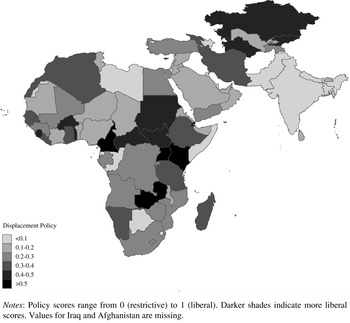
Drawing on these new data, we present two stylized facts about displacement policies in developing countries. First, there is much diversity in asylum policy liberality, as shown in Figure 1, which plots asylum policy scores from DWRAP in 2017, the last year of our data set. This variability, which cannot be simply explained away by regional clustering, underscores the importance of our theory-building exercise.
Global South displacement policy in 2017

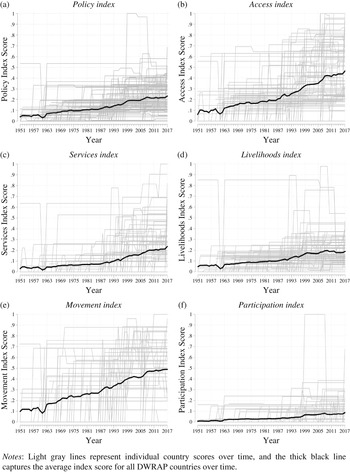
Second, our data suggest that developing countries have been gradually liberalizing their asylum and refugees policies at a time when developed countries have been moving in a more restrictive direction.Footnote 106 Figure 2 depicts the sample average increase in our asylum policy measure over time.Footnote 107 Policy liberalization has been especially pronounced with respect to the access and movement domains. Moves away from encampment and toward enhanced access to travel and identification documents are particularly important drivers of this trend. By comparison, liberalization of policy on livelihoods and participation has been more slight, on average. These policy dimensions, including employment and citizenship rights, are critical for refugee integration, but also politically sensitive, often sparking native opposition.Footnote 108
Global South displacement policy over time

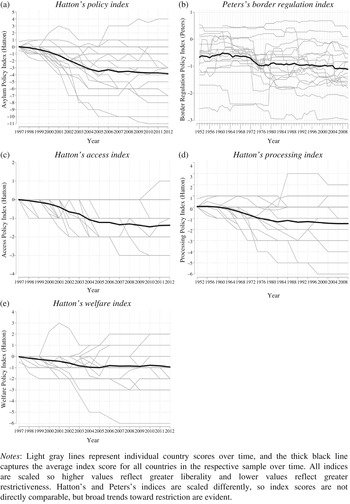
Importantly, the liberalizing trend in asylum policy across the global South is taking place at a time when refugee policies are becoming increasingly restrictive (Figure 3) in OECD countries. Divergent asylum policy trajectories across the global North and global South reinforce our study's assumption that a different set of analyses is needed to understand migration policymaking in the developing world.
Global North displacement policy over time

Empirical Strategy
To test the study's hypotheses, we leverage our fine-grained measure from DWRAP. We focus on when countries substantially reform their refugee and asylum policies. This focus reflects the fact that policies tend to change suddenly, not gradually—in fact, no change occurs in most country-years. In our primary analyses of policy determinants, therefore, the dependent variable is an indicator for policy change.
We define a policy reform as a one-standard-deviation change in a country's policy score from year t-1 to year t.Footnote 109 We focus on one-standard-deviation changes because these reflect substantial, substantive modifications to countries’ asylum policy environment. Changes of smaller magnitude typically capture more limited legal and procedural modifications to policy frameworks, rather than substantive changes in policies themselves. In total, we record 71 changes of at least one standard deviation, including sixty-two liberalizations and nine restrictions, from 1951 to 2017.Footnote 110 Correspondingly, we use two binary dependent variables in our primary models: change, which refers to a one-standard-deviation shift in a country's policy score; and liberalization, which refers to a one-standard-deviation increase in a country's policy score. We focus on policy liberalization because we document many more liberalizing than restrictive changes. Nevertheless, we report results for restriction, a one-standard-deviation reduction in a country's policy score, in Table A.36.
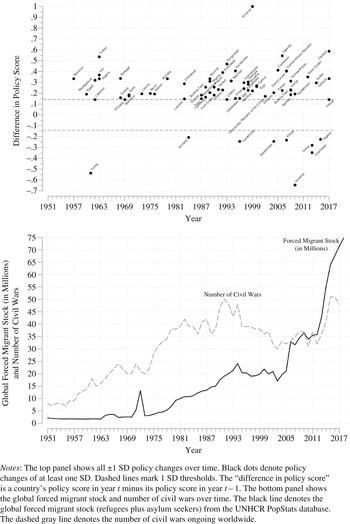
We plot all policy changes of at least one standard deviation in the top panel of Figure 4, and the number of such changes over time in Figure A.14. All such changes are described in Table A.15. More than half of all asylum policy changes of at least one-quarter of a standard deviation (71 of 135 cases) are changes of at least one standard deviation. These reforms are temporally concentrated after the end of the Cold War, a period characterized by an increased incidence of civil war, and consequently, a dramatic increase in the global stock of refugees (bottom panel of Figure 4).
Policy reforms (top panel) and civil wars and forced migrant stocks (bottom panel) over time

Variable Description
We consider several independent variables corresponding to Hypotheses 1 through 3. To test our expectation about the relationship between conflict and policy change, we use data from the UCDP Armed Conflict data set.Footnote 111 Usefully for our purposes, this data set disaggregates armed conflicts by intensity measured in battle deaths, which permits us to test whether the mere occurrence of conflict in a country's neighborhood is associated with asylum policy changes, or whether only intense conflicts (which are more likely to generate refugee flight) drive reforms. We use a binary measure of intense, proximate civil wars in our main analyses, which takes a value of 1 if a country has a contiguous neighbor experiencing a civil war causing 1,000 or more battle deaths in the prior year and 0 otherwise.
Hypotheses 2a and 2b refer to transnational ethnic kin. Data on politically relevant ethnic groups, their access to state power, and their transnational ties come from the Ethnic Power Relations (EPR) data set.Footnote 112 Our measure of transnational ethnic power disparity is a binary indicator. Following EPR, we define elite ethnic groups as those that enjoy a status of at least the senior partner level. These groups exert influence on policymaking processes by virtue of the positions their members hold in government. Politically excluded ethnic groups are defined as those that are powerless or discriminated against. Excluded groups face tacit or overt barriers to accessing political institutions. Combining these definitions, we expect policy liberalization when transnational co-ethnics of a country's political elites are excluded abroad. Transnational kin tend to be regionally concentrated, and status differentials are most salient for groups in close proximity.Footnote 113 Thus our indicator takes a value of 1 when a country's political elites (ethnic groups at the senior partner level or higher) have politically excluded transnational kin (groups that are powerless or discriminated against) in another country in the region; and 0 otherwise.Footnote 114
Hypotheses 3a and 3b concern countries dependent on external economic assistance. To measure aid dependence, we take the five-year lagged moving average of net bilateral aid from donors on the Development Assistance Committee (DAC) of the OECD, divided by a country's GDP.Footnote 115 Because this measure is skewed, we transform it by taking the inverse hyperbolic sine. Our conditional hypotheses entail interactions between the level of democracy and elite kin discrimination (H2b) and aid dependence (H3b). To measure democracy, we use V-Dem's electoral democracy (polyarchy) index.
Our core specification also includes covariates that capture other factors relevant for migration policymaking. We measure wealth using PPP-adjusted GDP per capita. We also measure GDP shocks, defined as annual reductions in PPP-adjusted GDP in the top 15 percentiles of negative change. Other covariates include countries’ population, transnational terror incidents, and trade-to-GDP ratio. Time-variant covariates are lagged one year to mitigate temporal confounding. To conserve space, we present variable definitions and descriptive statistics in Tables A.16 and A.17 in the online supplement.Footnote 116
Estimation
Because we are interested in modeling when developing countries reform their asylum policies, our primary estimation is a series of hazard models.Footnote 117 The hazard is the conditional probability of failure. Repeated failures are a feature of the process we model: some countries reform their asylum policies several times over the course of the study period. For instance, Burkina Faso made substantial liberalizing changes in its policy framework in both 1988 and 2008. More broadly, repeated failures—in this case, asylum policy changes of at least one standard deviation—account for about one-quarter (17 of 71) of the changes we observe.
In traditional hazard modeling approaches, event times are assumed to be conditionally independent. This assumption is unlikely to hold in our setting for two reasons. First, event dependence means the risk of failure is correlated within units. The clustering of terminations among countries means that previous failures raise the risk of future failures. Second, there is likely unobserved heterogeneity across countries with respect to failure susceptibility. Covariates account for some of this heterogeneity, but it is unlikely that we can control for all factors that affect the risk of policy change, given the empirical complexity of migration policymaking. If unit heterogeneity in the propensity for policy change is also correlated with the likelihood of neighborhood armed conflict, our estimates will be biased.
Given the dual threats of event dependence and unobserved unit heterogeneity, we follow Box-Steffensmeier, De Boeuf, and Joyce and employ a conditional frailty gap-time Cox model.Footnote 118 This model is conditional because it stratifies the risk set by the number of failures a unit has experienced. By allowing the baseline hazard to vary by the number of failures, stratification helps control for event dependence. We use gamma-distributed frailties to account for unobserved heterogeneity in each country's propensity to fail.Footnote 119 This shared-frailty approach allows for partial pooling across countries while accounting for heterogeneity. Frailties are thus equivalent to random effects in other modeling contexts. Because we employ a Cox estimator, we make no additional parametric assumptions about the shape of the hazard function. Our choice of estimator follows other prominent analyses.Footnote 120
The hazards in our framework can be written as
 $$\lambda _{u, s}( t) = \lambda _{0s}( t-t_{s-1}) e^{\kappa ( \hbox{intense, proximate civil conflict}_{u, s}) + \theta ( X_{u, s}) + \gamma _u}$$
 $$\lambda _{u, s}( t) = \lambda _{0s}( t-t_{s-1}) e^{\alpha ( \hbox{kin status}_{u, s}) + \beta ( \hbox{aid dependence}_{u, s}) + \theta ( X_{u, s}) + \gamma _u}$$
where (1) corresponds to H1 and (2) corresponds to H2a and H3a; u indexes countries, and s denotes the event number, which stratifies the risk set. λ0s is the baseline hazard rate, and (t − ts −1) specifies a gap-time formulation, where the hazard is the risk of failure for event s since the occurrence of event s − 1. k is the effect of intense civil conflict occurring in country u's neighborhood. α gives the effect when country u's political elites have excluded kin abroad. β is the effect of aid dependence. θ are estimates from a vector of covariates, and γu are gamma-distributed, unit-specific frailty terms. In all models, we cluster standard errors by country and use Efron's method for ties. For simplicity, we report standardized coefficients rather than hazard ratios.
Qualitative Data
Our empirical analysis also benefits from insights gleaned from 126 qualitative, semistructured interviews and focus group discussions with FDP, UN, and government officials, and NGO representatives, conducted in Uganda in June and July 2017.Footnote 121 We selected Uganda for our fieldwork because it hosts an exceptionally large forced migrant population—fourth-most globally in total stock and seventh-most on a per capita basisFootnote 122—and because its asylum policy has drastically liberalized in the past decade. Uganda is a typical case in terms of responsiveness of inflows to policy.Footnote 123
The evolution of Uganda's policy environment is depicted in Figure A.21. Between 2006 and 2017, Uganda's policy score increased 538 percent, and its annual number of forced migrant arrivals increased 2,811 percent. This dramatic policy liberalization reflected the passage of Uganda's 2006 Refugees Act and 2010 Refugees Regulations, which replaced the Control of Aliens Refugees Act of 1960. These policies are widely regarded as some of the most liberal in the developing world, affording refugees rights such as free movement, education, employment, and plots of land for cultivation. The case is not intended as a decisive test of the theory; rather, qualitative insights interspersed throughout help illustrate theoretical mechanisms and provide context for our quantitative results.
Civil Conflict and Asylum Policy Change
Turning to our empirical analysis, we find robust support for Hypothesis 1. Armed conflicts in neighboring countries are the primary impetus for asylum policy change in the developing world. We argue earlier that such conflicts shift expectations of FDP inflows, which in turn induce prospective host countries to reassess (and at times reform) their asylum policies. As a preliminary test, contingency tables (Tables A.23–A.25 in the online supplement) indicate that policy changes occur disproportionately when a country's neighbors are experiencing civil wars. The association is especially striking when, in year − 1, a neighboring country is experiencing an intense civil war, defined as causing at least 1,000 battle deaths in the prior calendar year. Such episodes account for nearly 40 percent of all one-standard-deviation policy changes.
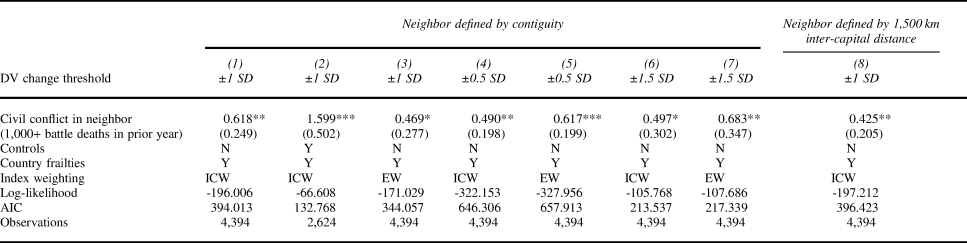
Table 2 provides a more formal test of Hypothesis 1. In columns 1 through 7 we define a country's neighborhood in terms of contiguity, so coefficients refer to the occurrence of armed conflict in any of a state's territorial neighbors. In column 8 we define a country's neighborhood in terms of 1,500 kilometers of inter-capital distance, so coefficients refer to the occurrence of armed conflict in the broader set of countries surrounding a state; this column ensures that our core result is robust to how we define a country's neighborhood. The main dependent variable (used in columns 1, 2, 3, and 8) is an indicator for one-standard-deviation policy changes. Column 1 estimates a sparse model including only the coefficient of interest, our conflict indicator, and country-level frailty terms (i.e., random effects). In column 2 we introduce additional controls for political and socioeconomic conditions in a country.Footnote 124 Columns 3, 5, and 7 use the equally weighted policy index to ensure that our results are robust to the aggregation scheme. To verify that our core finding is robust to the change threshold we choose, in columns 4 and 5 we study one-half-standard-deviation policy changes as the dependent variable, and in columns 6 and 7, one-and-one-half-standard-deviation policy changes.
Conditional frailty models of policy change

Notes: Robust standard errors clustered by country in parentheses. The table displays standardized coefficients rather than hazard ratios. The models are stratified by the number of one-standard-deviation policy changes a country has made. Frailty terms are for country. Efron's method is used for ties. ICW refers to our main index, which is aggregated by inverse-covariance weighting. EW refers to our alternate, equally weighted index. *p < .10; **p < .05; ***p < .01.
Across all models, we find that countries are more likely to reform their asylum policies when intense civil wars are occurring in a neighboring state. Exponentiating the large, statistically significant coefficient from column 2, our best-fitting model, suggests that when one of a country's neighbors is experiencing an intense civil war, the target country is approximately 395 percent more likely to change its asylum policy by at least one standard deviation. The minimum estimated coefficient from column 8 still suggests that when one of a country's neighbors is experiencing an intense civil war, the target country is approximately 53 percent more likely to alter its displacement policy by at least one standard deviation. This result helps contextualize the importance of Fearon and Shaver's conclusion that battle deaths, and expectations thereof, drive refugee outflows during civil wars.Footnote 125
As an additional check, in Figure A.26 we consider the relationship between neighborhood armed conflict and policy change at different levels of conflict intensity. We find that the policy-change-inducing effects of neighborhood armed conflicts are specific to intense civil war episodes rather than low-intensity conflicts. This suggests that conflict spurs policy reform by increasing neighboring countries’ expectations of FDP flows.Footnote 126 More broadly, this finding lends confidence in our specification, and suggests that civil war battle deaths drive both forced displacement and displacement policy changes.
The Determinants of Policy Liberalization
Elites and Co-ethnics
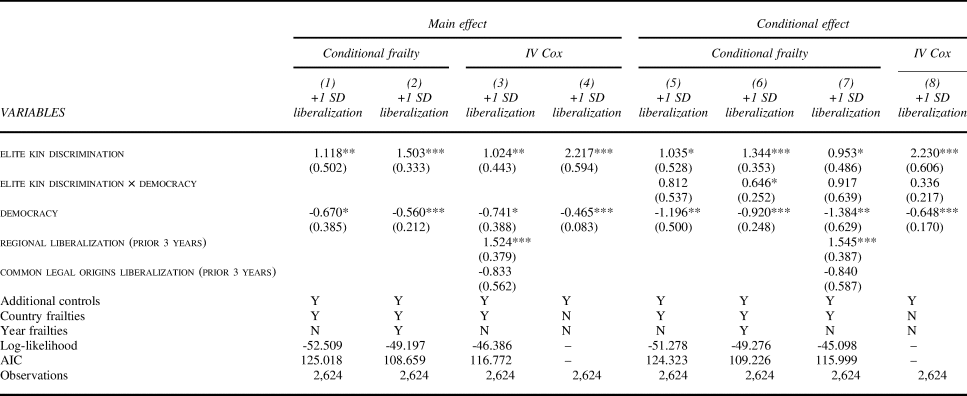
Hypotheses 2a and 2b anticipate that countries, and particularly more democratic countries, enact liberalizing reforms when elites’ co-ethnics are discriminated against abroad. We assess these hypotheses in Table 3. Columns 1 and 5 represent our baseline, conditional frailty specifications. In columns 2 and 6 we add frailty terms for years. In columns 3 and 7 we introduce spatial lags to capture policy diffusion. These terms assess whether the probability of liberalization changes when a regional neighbor liberalizes, or when a country that shares the same legal origins liberalizes. To address the potential endogeneity of elite kin discrimination, we estimate instrumental variable (IV) models in columns 4 and 8. We instrument for elite kin discrimination using a country's number of contiguous neighbors and the fractal dimension of its borders.Footnote 127 Countries with more contiguities have more split, cross-border ethnicities, raising the odds that an ethnic group is politically empowered in one country but excluded in another. Likewise, straighter borders reflect colonial-era boundary-making ignorant of local ethnic conditions. Tests suggest the proportional hazards assumption is satisfied (Figure A.27).
Co-ethnicity, transnational kinship, and policy liberalization

Notes: Robust standard errors clustered by country in parentheses. The table displays standardized coefficients. The models are stratified by the number of liberalizing policy changes a country has made. Efron's method is used for ties. Democracy is a standardized index from V-Dem. Additional controls include neighborhood civil war, aid dependence, GDP per capita, negative GDP shocks, population, trade-to-GDP ratio, and transnational terrorism and civil conflict in the host country. IV Cox models are fit using the two-stage procedure described in Sjolander and Martinussen Reference Sjolander and Martinussen2019. *p < .10; **p < .05; ***p < .01.
We find robust support for Hypotheses 2a and 2b. Because elite kin discrimination is a binary variable, the substantive interpretation is straightforward. In line with Hypothesis 2a, the association between elite kin discrimination and policy liberality is large, positive, and statistically significant. Exponentiating the coefficient from our best-fitting specification, in column 2, suggests that the hazard of liberalization is 350 percent greater when national political elites’ co-ethnics in neighboring states are politically discriminated against. Elite kin discrimination increases the probability of policy liberalization by 818 percent in our IV model (column 4).
Interviews we conducted in Uganda corroborate the role of elite concerns about ethnic kin in neighboring states. For example, an international-NGO employee working on refugee outreach in Kampala told us that border artificiality in Uganda meant the logic of governance often made co-ethnicity a paramount regional policy consideration:
Some colonialists draw a line here, but the tribes are split on both sides, and that's really clear. It is that from northern Uganda to South Sudan, even DRC, they are brothers and sisters. Even literally, they have family on both sides … The reason is mainly ethnic contiguity … In Uganda it's all about your tribe, where your village is. And all of this—tribes and villages—which are then more connected to South Sudan or DRC than other places. So maybe these refugees are treated a little better.Footnote 128
Other interviewees specifically highlighted Ugandan elites’ considerations about co-ethnic Bantu peoples in Rwanda and the Democratic Republic of the Congo as a cause of liberal policies toward FDP from these countries.Footnote 129 During the 1994 Rwandan genocide, Ugandan president Yoweri Museveni welcomed Rwandan refugees as an extension of his campaign to support Rwandan rebel leader Paul Kagame. Kagame was raised in the same region of Uganda that Museveni was from, and served as a founding member of Museveni's National Resistance Army in the 1980s. An international aid worker in Uganda told us that ties between Museveni and Kagame were emblematic of the broader power of “Ugandan-Rwandese at the higher end of [Ugandan] society,” who promoted Ugandan openness toward co-ethnic refugees from Rwanda.Footnote 130
In columns 5 to 8 we probe the conditional effect of elite kin discrimination across levels of democracy. We argue that incumbent elites have incentives to welcome co-ethnic FDPs as a means of bolstering their bases of support, particularly in electorally competitive environments. Elite kin discrimination significantly increases the probability of liberalization at all levels of democracy (H2a). In line with H2b, moreover, this effect is greater in more liberal countries. Coefficients on the interaction term are consistently positive, and achieve statistical significance in our best-fitting specification, in column 6. For ease of interpretation, we plot substantive effects in Figure 5. The effect of kin discrimination on the risk of policy liberalization increases about 335 percentage points as democracy increases from the twenty-fifth to the seventy-fifth percentile. This suggests that an electoral logic (at least partly) underlies elites’ considerations vis-à-vis kin.Footnote 131
Elite kin discrimination has a larger effect in more democratic settings

Importantly, more democratic countries may find it harder to liberalize migration policy because without incentives to welcome FDP owing to co-ethnicity, publics often oppose migrant influxes.Footnote 132 Estimates in Table 3 corroborate this intuition. Without liberalizing pressures tied to transnational kin, a one-standard-deviation increase in democracy reduces the probability of liberalization by 110 percent. Finally, asylum policy appears to diffuse spatially within regions. Regional diffusion makes sense in our theoretical framework because neighborhood civil wars and kin discrimination are regionally concentrated, cross-border phenomena.
Robustness of Liberalization Results
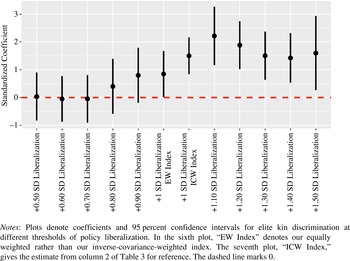
To probe the robustness of our core findings we conduct a host of additional tests. First, in Figure 6 we plot the estimated coefficients for our main variable, elite kin discrimination, at different thresholds of policy liberalization, and using a different aggregation scheme for our index. Elite kin discrimination explains large policy changes, but only weakly predicts smaller, procedural policy changes. This finding comports with our theoretical logic, because policymakers have incentives to make conditions as hospitable as possible when co-ethnic flows are anticipated.
Robustness of elite kin discrimination results

In Figure A.28 we re-estimate our core specification with a series of additional controls. The effect of elite kin discrimination on asylum policy liberalization remains large, positive, and significant, even after we control for a country's policy level, colonial history, unemployment, natural resource endowments, Chinese economic assistance, ruling party political orientation, strategic wartime displacement in the country's neighborhood, the Cold War and post-9/11 eras, and the number of laws and policies on displacement a country has enacted. The effect of elite kin discrimination also holds when we exclude country-years with no migration laws enacted, and exclude newly independent countries with an incentive to shift policies inherited from colonial powers.Footnote 133
Figure A.29 verifies that our results are robust to the inter-capital distance threshold we use to define the region within which status differentials between kin groups are most salient. Figure A.30 tests for influential observations by iteratively dropping countries that experienced liberalizing policy changes above the ninetieth percentile of the annual difference in policy score. In Table A.31, we consider a competing-risks estimator. In Table A.32 we depart from a survival modeling approach and instead estimate two-stage Heckman and conditional mixed process models, along with a random effects OLS model. Here, we take the difference in a country's policy score from year t − 1 to year t as the main outcome of interest. Our main finding that the risk of policy liberalization increases when political elites’ co-ethnics are discriminated in neighboring countries holds.
Finally, in Figure A.33 we disaggregate our full index measure into its constituent policy fields: access, services, livelihoods, movement, and participation. Elite kin discrimination is associated with one-standard-deviation liberalizations of access, services, livelihoods, and participation, and the largest effect is on livelihoods. These results provide additional support for our theoretical logic. Given the centrality of employment rights for migrant integration and self-reliance,Footnote 134 it makes sense that policy liberalization targeted at elites’ co-ethnics should prioritize the policy domains most consequential for migrant integration.
Transactional Aid
Moving to H3a and H3b, is it the case that countries dependent on external economic assistance engage in strategic asylum policy liberalization? We argue that aid-dependent countries are vulnerable to pressure from developed donors, which promote policy liberalization as a means of containing FDP in the global South. This incentive is particularly great for illiberal aid-dependent regimes, which can use strategic policy liberalization to cultivate goodwill and generate political cover. In the Ugandan case, these expectations seem to hold. Uganda is an authoritarian regime that engages in substantial violations of civil liberties but maintains a liberal asylum policy, which helps the regime retain generous external assistance packages and generates political cover for the government's illiberal activities. For instance, one activist told us:
The new Refugee Act is doing well but it serves diplomatic purposes I think … I'm questioning the motive behind the act, and the spirit behind the Uganda Refugees Act of 2006 … It shows well in London, Brussels, Geneva … Maybe other countries are not smart enough to have this policy on paper, where Uganda goes to Geneva and everybody claps.Footnote 135
For what illiberal practices does Uganda's liberal policy provide cover? Another humanitarian worker we spoke with pointed to Uganda's military engagements in East Africa, as well as Museveni's business interests in the region:
It is a really smart policy—having this policy that really takes off pressure in this region, and then you have a blind eye to other activities … He gets away with a lot of things … This refugee policy—it's covering up this other policy of creating instability around Uganda, and then creating this haven. There are a million refugees here. That's not a stabilizing factor. He [Museveni] is gaining a lot from it … so much positive coverage. I like the policy, but not if it's feeding into creating more refugees.Footnote 136
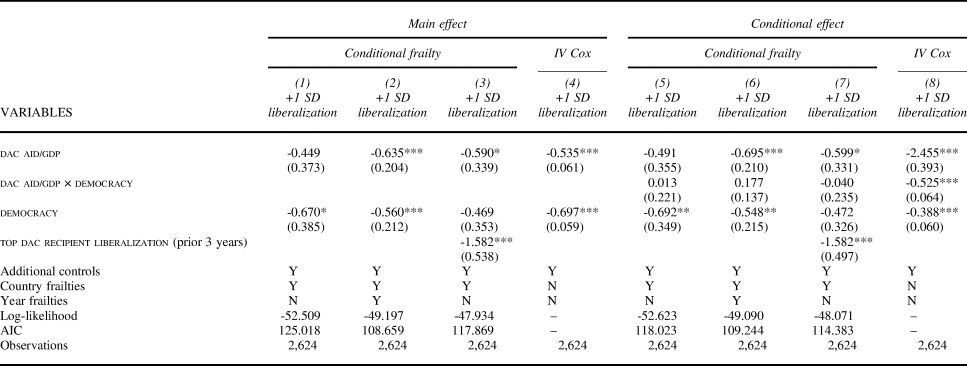
To explore whether these dynamics generalize, we conduct several additional tests (Table 4). As in Table 3, we introduce the main conditional frailty specification in columns 1 and 5, add year frailties in columns 2 and 6, and test for diffusion dynamics in columns 3 and 7. We include an indicator for whether a country in the top decile of DAC aid inflows liberalized its asylum policy in the prior three years. The logic is that countries should emulate the policies of top aid recipients, understanding that liberalization often accompanies increased aid flows.
Aid dependence and policy liberalization

Notes: Robust standard errors clustered by country in parentheses. The table displays standardized coefficients. The models are stratified by the number of liberalizing policy changes a country has made. Efron's method is used for ties. DAC aid/GDP is the standardized, five-year lagged moving average of DAC aid receipts as a percentage of GDP. Democracy is a standardized index from V-Dem. Additional controls include neighborhood civil war, elite kin discrimination, GDP per capita, negative GDP shocks, population, trade-to-GDP ratio, and transnational terrorism and civil conflict in the host country. IV Cox models are fit using the two-stage procedure described in Sjolander and Martinussen Reference Sjolander and Martinussen2019. *p < .10; **p < .05; ***p < .01.
Caution is required when interpreting these results, however, because DAC aid inflows are endogenous. It is difficult to identify the causal effect of aid on asylum policy reform because reforms may follow aid, or aid may follow reforms.Footnote 137 Aid is also endogenous to refugee flows.Footnote 138 In columns 4 and 7 we therefore estimate an IV model, instrumenting for DAC aid inflows using the interaction of donor-government fractionalization and each recipient country's probability of receiving aid.Footnote 139
Contrary to Hypotheses 3a and 3b, we find no evidence that aid-dependent countries are more likely to liberalize asylum policy, or that this effect is greater among more illiberal regimes. The evidence suggests that Uganda's case does not generalize widely.Footnote 140 Coefficients are imprecisely estimated and occasionally significantly negative. Based on our best-fitting specification (column 2), increasing aid dependence by one standard deviation reduces the risk of liberalization by 89 percent. In Figure A.34 we plot substantive effects of the interaction term, which reveal little variation in the effect of aid dependence across levels of democracy. In Figure A.35, we show that the effect of aid dependence remains null or negative when we control for the strategic relevance of host countries, which may give them greater leverage over aid.Footnote 141
Given the qualitative evidence from Uganda, what explains the absence of a more general relationship between aid and liberalization? Several possibilities stand out. It could be that highly aid-dependent countries have low capacity, and merely liberalize their de facto environments, such as by relaxing enforcement, without changing their de jure frameworks. We cannot test this proposition, but it is a valuable avenue for future work. Two other possibilities also stand out. In columns 3 and 7 of Table 4 we include an indicator for whether a country in the top decile of DAC aid inflows liberalized its asylum policy in the prior three years. We expected that aid-dependent countries would emulate top aid recipients. Instead, we find that the risk of policy liberalization declines 386 percent when top aid recipients have recently liberalized.
This suggests two potential phenomena. First, it may be that countries observe liberalization by top aid recipients and free ride. If the fiscal fruits of liberal policy reforms (e.g., increased aid) are generally insufficient to cover increased expenditures stemming from a concomitant rise in FDP arrivals, developing countries considering liberalization might refrain from doing so when top aid recipients—which can better afford the increased hosting burden likely to accompany liberalization—make liberal reforms.Footnote 142 Second, it could be that developing countries learn about donor commitment and demands by observing liberalizations undertaken by top aid recipients. In particular, other states may observe the extent to which donors durably increase funding to top, liberalizing recipients, and the extent to which donors demand increased accountability over aid given in return for policy liberalization. If donor commitment to top aid recipients wanes quickly after the latter liberalize, or if donors demand intrusive accountability mechanisms over transactional aid-for-liberalization, countries may refrain from liberalizing when top recipients do because of “negative” learning.
Our qualitative evidence comports with this explanation. While they did suggest that Uganda engaged in transactional liberalization, our interviewees also expressed concern about the failure of the Uganda Solidarity Summit on Refugees, held in Kampala on 22 and 23 June 2017. The summit, which sought to raise USD 2 billion, raised only USD 385 million to fund Uganda's liberal policy. The head of a UNHCR implementing partner organization told us:
Of that, only 10 to 20 million was new [previously uncommitted] money. I just don't know how long the policy is sustainable if donors aren't willing to keep pace and put in their due. As proof the summit was a disaster, it's not even on the agenda of the interagency meeting today. So the challenge becomes twofold because the international community said we would get money, and we haven't … Commissioners in these [refugee-hosting] areas won't take them [more refugees] because the money is not forthcoming.Footnote 143
Nor is this problem unique to Uganda. A Tanzanian aid worker also spoke about Tanzania's failed plan to naturalize Burundian refugees:
The problem is they were expecting a lot of money from development partners for that. The international community had promised a lot, and Tanzania didn't get it. That's the constant trouble. There is never enough funding. And I wonder when the African countries will get tired of failed promises. If the money is not forthcoming, the initiatives will stop.Footnote 144
This evidence suggests that the problem of insufficient aid is ubiquitous, and implies that one reason for the null results on H3a and H3b is that developing countries are justifiably skeptical of aid-for-liberalization schemes. But built-in donor accountability mechanisms may also deter aid-dependent regimes from accepting aid in exchange for policy reform. In Uganda, a damning UN audit released in November 2018 uncovered massive fraud, including inflated FDP figures, waste, and undocumented payments to government officials from the refugee aid budget. Four government officials, including the commissioner for refugees, were sacked as a result, and in February 2019 the UK and Germany suspended refugee aid to Uganda until “the implementation of stringent integrity measures.”Footnote 145 This episode highlights a potential cost of aid in return for liberalization—increased donor scrutiny—which could deter countries from pursuing transactional aid.
Discussion
Determinants of Policy Restriction
Our primary interest is in the drivers of liberalization because asylum policy is trending in this direction in the developing world. However, in a few cases, refugee policies became more restrictive (nine observations with a one-standard-deviation restriction). Our theoretical framework anticipates that neighborhood civil war provides an impetus for reform, but that other factors determine the direction of reform.Footnote 146 In particular, neoclassical economic models suggest that migration policy restriction increases with a country's wealth.Footnote 147
We explore the relationship between GDP per capita, negative GDP shocks, and restrictive policy changes in Tables A.36 and A.37 and Figure A.38. In our liberalization models, both GDP per capita and negative GDP shocks are negatively correlated with liberalization. Consistent with those findings, our restriction models indicate that increasing GDP per capita by one standard deviation is associated with a 91 percent increase in the probability of a one-standard-deviation restrictive reform.Footnote 148 Though we hesitate to draw strong inferences given the small number of restrictive reforms, replicating this result builds confidence in our data.
Do De Jure Policies Matter?
Our DWRAP data set measures the de jure rather than the de facto policy environment. An obvious question is whether de jure forced displacement policies really matter, given potential enforcement gaps. A standard approach to build confidence in migration policy indices is to regress policy scores on migrant flows.Footnote 149 Establishing that more liberal policies attract more FDP flows increases confidence in our policy measure. To the best of our knowledge, no study outside the OECD context has tested whether the target country's policies influence asylum seekers’ decision making. Encouragingly, in a companion paper we demonstrate that more liberal policies are associated with greater FDP flows, conditional on facilitating factors that enable the diffusion of information about policies in host countries, such as transnational kin and mobile penetration.Footnote 150
Conclusion
In this paper, we introduce a new data set of de jure asylum policies in the developing world—the most expansive of its kind—and use it to study the correlates of asylum policymaking in the developing world. In doing so, we contribute to several important academic and policy discussions. Above all, we offer the first systematic mapping of the policy space on forced displacement in the developing world. While recent crises have pinned attention on forced displacement in the West, developing countries bear the overwhelming burden of hosting refugees. Because studies have focused almost exclusively on OECD countries, analyses of migration policymaking have ignored the areas where the problem of forced displacement is most severe. By mapping developing-world asylum policies in a comprehensive, transparent way, we nearly double the country coverage of popular migration policy indices.
Second, we also contribute to academic and policy discussions on the determinants of displacement policy and its trajectory. Unlike previous analyses which find a general tightening of forced migration policies in the developed world, we demonstrate that developing countries, especially in sub-Saharan Africa, have pursued gradual policy liberalization. Moreover, we show that policy liberalization has been particularly prominent on status and entry procedures (access) and rights to free movement and documents (movement), and weaker on civic participation and citizenship rights.
Existing theories of migration policymaking exhibit a substantial North-centric bias, and we contribute new evidence that places scope conditions on existing theoretical models. Specifically, we establish four critical factors associated with asylum policy change in the developing world. First, we show that intense civil wars are a precipitating factor for large policy shifts. Second, we show that policy liberalizations are often a form of solidarity with kin who are excluded from power in a neighboring country. Third, while there are striking examples of strategic policy liberalization by aid-dependent countries, this does not appear to be a more general pattern. Fourth, national wealth is associated with policy restrictions in the developing world, as it is in developed countries.
Above all, this paper highlights critical differences in the constraints and opportunities developing versus developed countries face around forced displacement. Recognizing the unique factors confronting policymakers in the global South, such as transnational ethnic kin and external economic assistance, helps challenge orthodoxies in the scholarship on migration. A particularly fruitful avenue for future work will be to apply our theoretical framework and other recent work on developing-world migration policyFootnote 151 to understand the de facto migration policy space in the global South. Exploring the extent to which displacement policies are a significant pull factor, and the role regime type plays in asylum policymaking, are other important avenues for future research made possible by DWRAP.
Replication Data Statement
Replication files for this article may be found at <https://doi.org/10.7910/DVN/OB6FHX>.
Supplementary Material
Supplementary material for this article is available at <https://doi.org/10.1017/S0020818321000369>.
Acknowledgments
We thank Sarah Bermeo, Maggie Peters, Jim Fearon, David Leblang, Beth Elise Whitaker, Alex Braithwaite, and participants at the Penn Identity and Conflict Lab, the UNHCR–World Bank Group Joint Data Center on Forced Displacement, and the 2020 Annual Conference of the Southern Political Science Association for helpful comments and advice. We also thank two anonymous reviewers and the editors and staff of International Organization for feedback. Excellent research assistance was provided by Leila Braganza, Phoebe Quinton, and Sean Lee. This research received IRB approval from the University of Pennsylvania (#827614).
Funding
Generous support for this research was provided by the Fels Policy Research Initiative at the University of Pennsylvania and the King Center on Global Development at Stanford University.