Introduction
The impact of herbivorous insects, particularly pests, has become increasingly pronounced among the numerous challenges confronting agriculture. These pests can significantly impair crop yields, with estimates indicating that insect-related crop damage typically ranges from 5% to 40%, and during severe outbreaks, losses can escalate to as much as 70% (Ali and Rizvi, Reference Ali and Rizvi2007; Schwägerl, Reference Schwägerl2016; Vreysen et al., Reference Vreysen, Klassen and Carpenter2016). Notably, lepidopteran species, which include various moths and butterflies, have emerged as major pests in agricultural settings, causing substantial economic losses. These pests are responsible for approximately 60–70% of yield losses across diverse ecological conditions (De Groote, Reference De Groote2002; De Groote et al., Reference De Groote, Overholt, Ouma and Mugo2003; Dhaliwal et al., Reference Dhaliwal, Jindal and Dhawan2010). The larval feeding behaviour of these insects, characterised by voracious leaf consumption, poses a dual threat to crop health by compromising both the quality and quantity of agricultural produce (Li et al., Reference Li, Tang, Meng, Zhou, Liang, Yang and Shao2025).
In Pakistan, species such as Pieris brassicae (Linnaeus, 1758: Lepidoptera: Pieridae) commonly known as the cabbage butterfly, exemplify the challenges posed by lepidopteran pests. The larva of this species feeds extensively on economically important crops, particularly those within the brassica family, leading to significant defoliation and subsequent yield losses. The destructive feeding habits of P. brassicae larvae not only damage plant foliage but also adversely affect overall plant growth and health. Young caterpillars can wreak havoc at every developmental stage, from seedlings to flowering plants, thereby compromising both the quality and market value of crops (Lal and Ram, Reference Lal and Ram2004; Sachan and Younas, 2004; Younas et al., Reference Younas, Naeem, Raquib and Masud2004; Hasan and Ansari, Reference Hasan and Ansari2010a). A single larva of this pernicious pest can consume up to 70–80% leaf area of a cabbage plant (Hussain et al., Reference Hussain, Ullah, Anwar, Ali, Ali, Haq, Ahmad, Awan, Shakir, Iftikhar and Sana2022). These larvae mainly cause damage to almost 83 species of Brassicaceae and Cruciferiae family and 30–40% of crop loss occurs in India due to this major pest (Lone et al., Reference Lone, Kumari and Khan2023). The economic implications of these pest infestations are profound, as they can diminish crop productivity and threaten food security. In response to the escalating threats posed by pest infestations, traditional pest management strategies have primarily relied on chemical control methods. While the use of agrochemicals can provide immediate relief from pest populations, their widespread application has led to several adverse effects, including the development of insect resistance, environmental degradation, and health risks for humans and non-target organisms (Deguine et al., Reference Deguine, Ferron and Russell2008; Hashemi and Damalas, Reference Hashemi and Damalas2011; Weller et al., Reference Weller, Raaijmakers, Gardener and Thomashow2002). Frequent application of pesticides also causes secondary outbreaks of pests and resistance in pest species which brings imbalance in the biodiversity of the environment (Boedeker et al., Reference Boedeker, Watts, Clausing and Marquez2020).
These concerns have underscored the pressing need for environmentally sustainable pest management alternatives. Biological control strategies, particularly the use of natural enemies such as parasitoids, have gained recognition as viable options for managing pest populations while minimising environmental impacts (Delfosse, Reference Delfosse2000; Salim et al., Reference Salim, Gökçe, Naqqash and Bakhsh2016). Hymenopteran parasitoids, particularly those belonging to the family Braconidae, are increasingly recognised for their effectiveness as biological control agents against herbivorous insects. Species like Cotesia vestalis Haliday, 1834, (Hymenoptera: Braconidae) play a crucial role in pest management by parasitising the larvae of various lepidopteran pests, including P. brassicae. The life cycle of these parasitoids involves laying eggs within the host’s body, leading to the eventual death of the host and the emergence of the parasitoid. Given that many braconid species exist worldwide, their ecological importance in regulating pest populations and preventing crop damage is well-documented (Billah et al., Reference Billah, Kimani-Njogu, Wharton, Woolley and Masiga2008; Whitfield, Reference Whitfield2003).
As the agricultural sector in Pakistan seeks sustainable solutions to combat the challenges posed by insect pests, understanding the interactions between P. brassicae and its natural enemies such as C. vestalis becomes essential. This knowledge can inform the development of integrated pest management (IPM) strategies aimed at enhancing crop yields while preserving environmental health. Saini et al. (Reference Saini, Sharma and Chandel2019) and Rezaei et al. (Reference Rezaei, Karimzadeh and Shakarami2020) conducted studies to control Plutella xylostella, an important insect pest of cropland ecosystem by using C. vestalis in different geographical ranges. Chau et al. (Reference Chau, Kieu, Dung, Quoc and Phuong2019) used C. vestalis to control lepidopteran pest species in Vietnam. While in Kenya such types of studies that involve C. vestalis as a biocontrol agent were also conducted by Mukembu (Reference Mukembu2022). In Japan, Uefune et al. (Reference Uefune, Yoneya, Yamamoto and Takabayashi2021) also used C. vestalisas biological control agent against lepidopteran insect pests.
As C. vestalis has been reported as successful biological control agent against P. brassicae but very limited data are available on its effectiveness in local agricultural practices. The present study hypothesises that C. vestalis can prove to be an effective control agent in reducing the pest population of P. brassicae in field application. The main objective of the present study was to evaluate the extent of damage caused by P. brassicae and to analyze the efficacy of C. vestalisin controlling this pest species. By understanding the biology, behaviour, and host plant preferences of P. brassicae, along with the potential for C. vestalis as a biological control agent, the study addresses a fundamental knowledge gap related to biological control practices. The findings will provide a foundation for developing effective, environmentally friendly pest management strategies tailored to the specific agricultural context.
Materials and methods
Collection and rearing of P. brassicae larvae
First, instar larvae and fertilised eggs of P. brassicae were collected from agricultural fields at the University of Agriculture Faisalabad (31.4336 latitude and 73.0683 longitude) a location known for diverse brassica crops. The specimens were transported to the Pest Control Laboratory within the Department of Zoology and Fisheries at the same university for further rearing. In the laboratory setting, the larvae were housed in glass cages constructed with wooden frames, measuring 32 × 30 × 30 cm. These cages were fitted with fine mesh to ensure adequate ventilation while preventing the escape of the larvae. Each cage was maintained with three to five larvae to facilitate their growth and to allow for easy monitoring of individual feeding behaviours.
Assessment of foraging and developmental parameters
To systematically evaluate the foraging behaviour and developmental parameters of the larvae, freshly excised leaves from four natural diet plants – cauliflower (Brassica oleracea var. botrytis), cabbage (Brassica oleracea var. capitata), brassica (Brassica rapa), and turnip (Brassica rapa subsp. rapa) were provided. Host plants were selected based on the presence of P. brassicae larvae in the cropland ecosystem (natural environment). As these larvae naturally grow on these plants, the main purpose of the selection of these plants was to assess the damage caused by P. brassicae larvae on these plants. The effects of food type on the body size and developmental duration of the larvae were assessed based on a methodology adapted from Maalik et al. (Reference Maalik, Mushtaq, Batool, Ehsan, Bano and Hafeez2022). Pre-weighed leaves and shoots of each plant species were offered as feed, and consumption was measured at 24-hour intervals. To control evaporative loss during this period, equivalent pre-weighed leaves of each plant type were placed in separate, identical cages under the same environmental conditions but devoid of larvae. After 24 hours, all cages were meticulously cleaned, and the remaining food along with any excreta was collected and recorded. Fresh pre-weighed leaves were then provided to ensure continuous access to food. The calculation of feed consumption was done by following formula:
 \begin{align*}
&{\rm Food\ consumption}\\
&\quad {\rm =\, Initial\ weight\ of\ food\, - \, (evaporative\ loss}\\
&\qquad{\rm -\, remaining\ food\ after\ 24\ hours)}
\end{align*}
This feeding regimen was maintained until the larvae ceased feeding and entered the pupation stage. The pupae were subsequently weighed to evaluate the relationship between dietary intake and larval growth. A feeding index was calculated by dividing the mean pupal weight by the mean weight of plant tissue consumed, following the methodology established by Greenberg et al. (Reference Greenberg, Sappington, Legaspi, Liu and Setamou2001). This index provides insight into the efficiency of food conversion and the nutritional value of different host plants.
Adult longevity assessment
Upon emergence, adult P. brassicae was transferred to separate cages for longevity assessment. In these cages, the adults were provided with cotton soaked in a 20% honey solution as a carbohydrate source and fresh flowers to simulate natural feeding conditions. Each longevity experiment was conducted under controlled laboratory conditions with relative humidity maintained at 60 ± 5%, a temperature range of 20 ± 5°C, and a photoperiod of 16:8 hours for day and night cycles (table 1). This experimental setup aimed to reflect optimal environmental conditions for adult longevity while minimising stress factors. All experiments were repeated three times to obtain accurate results.
Different experimental parameters used during present studies

Parasitisation by C. vestalis
To investigate the potential for biological control, a pair of adult C. vestalis, a well-known parasitoid from the Braconidae family, identified by the morphological terminology followed by Goulet and Hubert (Reference Goulet and Hubert1993) and Whitfield et al. (Reference Whitfield, Wharton, Marsh and Sharkey1997) was introduced into a separate glass cage containing 6–7 P. brassicae larvae. The 2nd and 3rd instar larvae of P. brassicae were used as hosts. The adult C. vestalis were supplied with a 20% honey solution to sustain them during the parasitisation process, and fresh leaves were concurrently added to provide nourishment for the lepidopteran larvae. Once parasitised, the larvae were carefully transferred to distinct cages to monitor the emergence of the parasitoids. The success of parasitisation was measured by the rupturing of host larvae and cocoon formation by parasitoid larvae. This experimental trial was replicated three times to achieve accurate and precise results. This step was critical in assessing the effectiveness of C. vestalis in managing P. brassicae populations.
Statistical analysis
The interactions between the host and parasitoid were rigorously analysed using regression analysis in Microsoft Excel 2010. The relationship between the populations of C. vestalis and P. brassicae over time was plotted through linear regression to illustrate their dynamic association. For regression analysis, C. vestalis and P. brassicae were collected for 12 months by sweep net method and quadrat method, respectively. The number of P. brassicae and C. vestalis that were collected and used for regression analysis. As larval development duration is dependent on the type of host plant being used as food so level of significance between larval duration and per day consumption and total food consumption by larvae of P. brassicae was statistically analyzed by one-way ANOVA followed by Tukey’s post hoc test, with a significance threshold set at P < 0.05. The relationship between food consumption and pupal weight was analysed by paired sample t-test using SPSS software (IBM SPSS Statistics for Windows, Version 21.0) (IBM Corp., Armonk, NY, USA). The Pearson chi-squared test has been applied to analyse the level of significance between food type and adult emergence rate. Mixed-effect model was also applied to analyse the relationship between food consumption and pupal weight.
Results
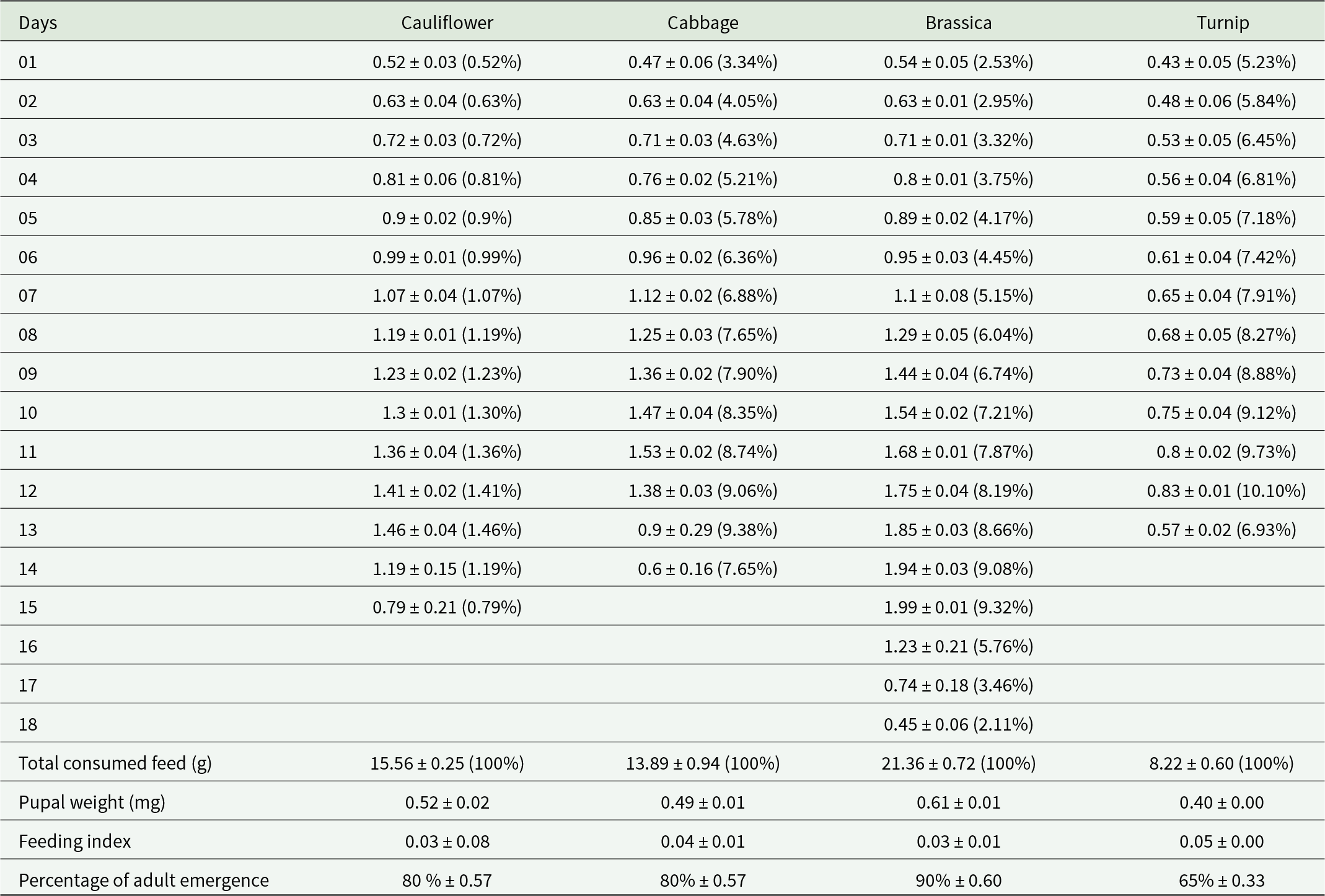
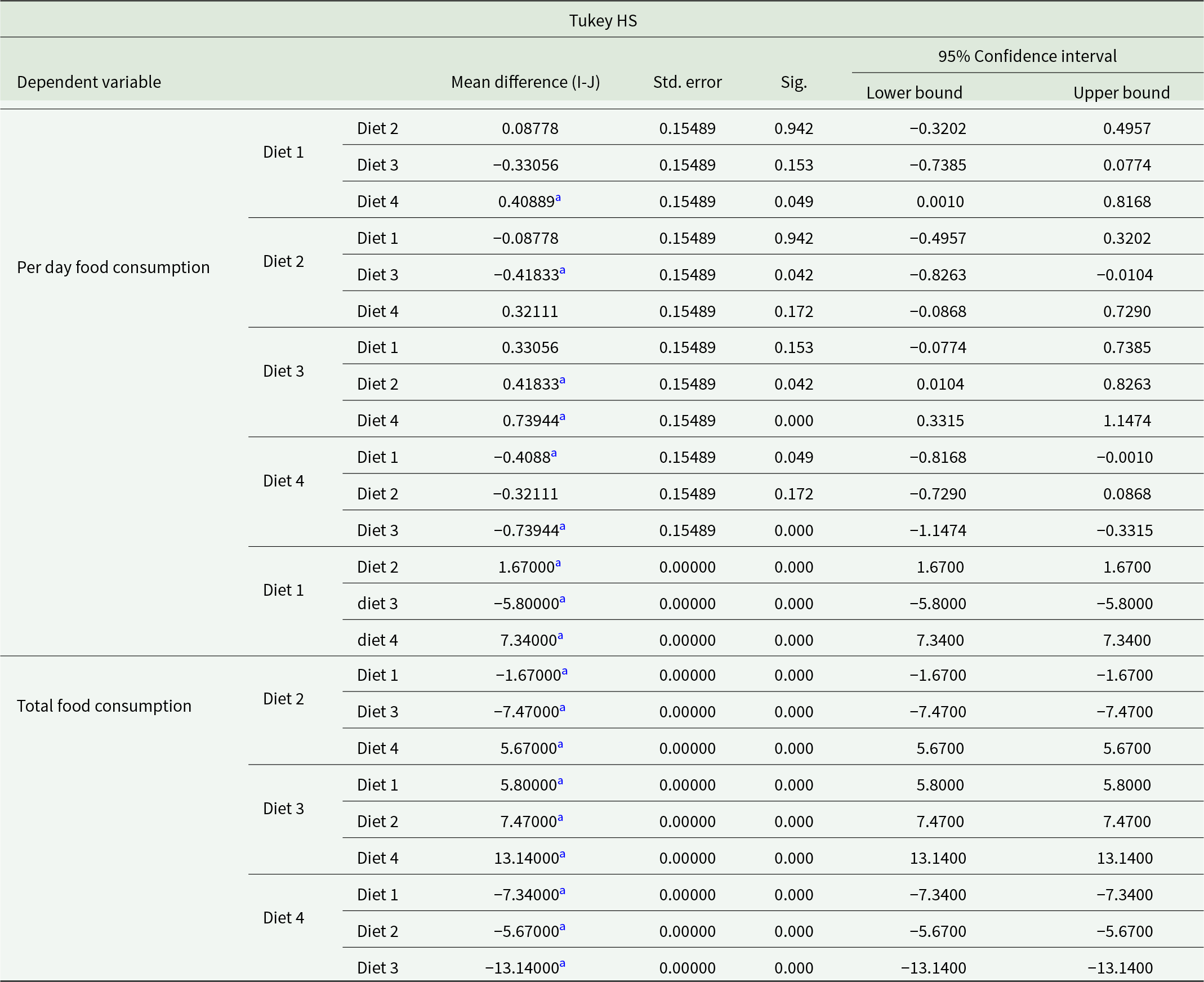
The daily food consumption by P. brassicae larvae was recorded for each of the four diets. The larval life span ranged from 13 to 18 days when feeding on turnip and brassica. On Brassica, there was a consistent increase in foraging from day 1 to day 15, reaching a maximum consumption of 9.32%. On cauliflower, the highest consumption occurred on day 13, with 1.46% consumed. For cabbage, the peak consumption was 8.74% on day 11, while for turnip, the highest rate was 10.10% on day 12 (table 2). Tukey post hoc test was applied to determine which specific diet significantly differed from another diet. Results showed that there was a significant difference (P < 0.05) between food consumption of cauliflower vs turnip, cabbage vs brassica, and brassica vs turnip (table 3).
Per day and total food consumption (mean ± standard error) in grams (along with percentage) by larvae of P. brassicae under controlled conditions (RH (60 ± 5%), temperature (20 ± 5°C) and photoperiod of 16:8 hours)

Tukey’s multiple comparison test to show how many results are significant

a The mean difference is significant at the 0.05 level.
Diet 1 = cauliflower, Diet 2 = cabbage, Diet 3 = brassica, Diet 4 = turnip.
Total food consumption and pupal weight
Among the four diets evaluated, Brassica emerged as the most preferred food source for P. brassicae larvae, with a total consumption of 21.36 ± 0.72 g. This was significantly higher than the consumption of cauliflower, which amounted to 15.56 ± 0.05 g, and cabbage, which reached 13.89 ± 0.94 g. Turnip was the least favoured diet, with only 8.22 ± 0.60 g consumed (P < 0.001). Tukey’s post hoc test also indicated that significant differences exist between all four food types. The statistically significant differences in total food consumption among the diets indicate that P. brassicae larvae exhibit distinct preferences based on the nutritional value and palatability of the plant species. The relationship between food intake and pupal weight was evident, as larvae feeding on Brassica not only consumed the most but also attained the highest pupal weight at 0.61 ± 0.01 g. In contrast, those on turnip had the lowest pupal weight of 0.40 ± 0.00 g. Larvae fed on cauliflower and cabbage had intermediate pupal weights of 0.52 ± 0.02 g and 0.49 ± 0.01 g, respectively. By paired sample t-test significant results (P-value = 0.13) were found by comparing food consumption and pupal weight. The results were further confirmed by a mixed-effect model and there was a significant relationship between food consumption and pupal weight (Sig. 0.000). This trend illustrates a direct correlation between dietary intake and pupal weight, suggesting that higher consumption of nutrient-rich diets directly supports larval growth and development.
Adult emergence percentage
Figure 1 illustrates the adult emergence rates from pupae reared on each plant diet. The highest emergence rate was recorded for larvae fed on Brassica, reaching 90%, while the lowest emergence rate was observed in those feds on turnip, at 65%. By chi-squared analysis significant relationship was obtained between the type of food and adult emergence rate. This emergence rate displayed a positive correlation with pupal weight, where heavier pupae resulted in a greater likelihood of successful adult emergence, emphasising the critical role of dietary nutrition in the developmental success of P. brassicae.
(a) comparison of total feed consumption, (b) pupal weight, and (c) percentage of adult emergence on four selected host plants namely cauliflower, cabbage, brassica, and turnip. Asterisk indicates that pupal weight has been multiplied by 10 to make the value visible on the graph.

Larval response to parasitisation by C. vestalis
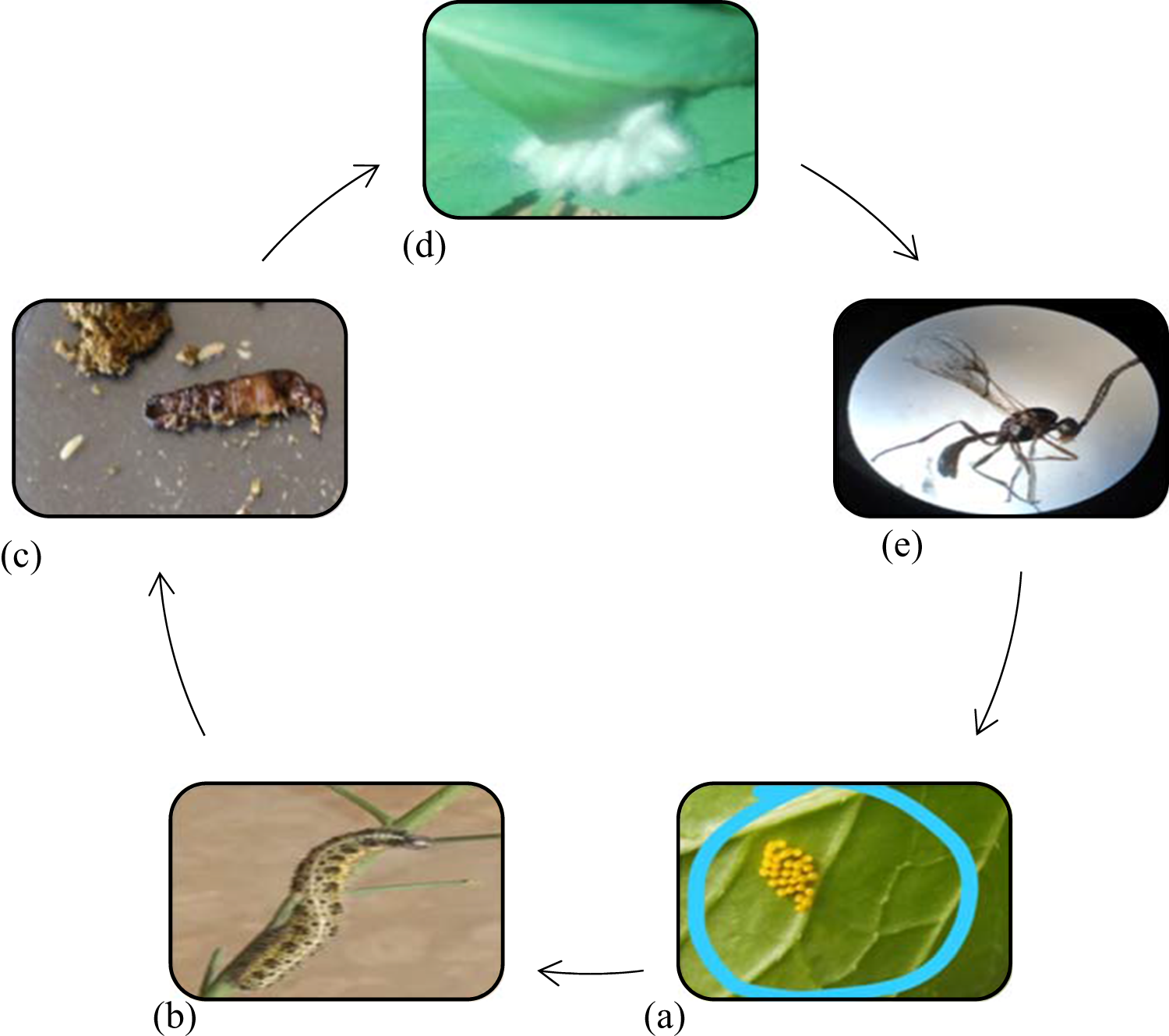
During the parasitisation process, after completing its development within the P. brassicae larva, the body of the caterpillar ruptured, adhering to the cage surface. This behaviour enabled C. vestalis to spin a cocoon around the host, a critical stage in the parasitoid’s life cycle. Following an average incubation period of 6.33 ± 0.94 days, the cocoons produced adult braconids, which exhibited an average lifespan of 2 ± 0.45 days (fig. 2). This rapid life cycle highlights the efficiency of C. vestalis as a biological control agent against P. brassicae, further emphasising the ecological implications of this host–parasitoid interaction. The use of this crucial biological control agent with reduce the overreliance on pesticides thus reducing the harmful impact of chemicals.
Pictorial representation of different stages of C. vestalis parasitising P. brassicae (a) eggs of P. brassicae (b) larva of P. brassicae (c) larva parasitised by C. vestalis (d) cocoon of C. vestalis (e) adult of C. vestalis.

Host–parasitoid association
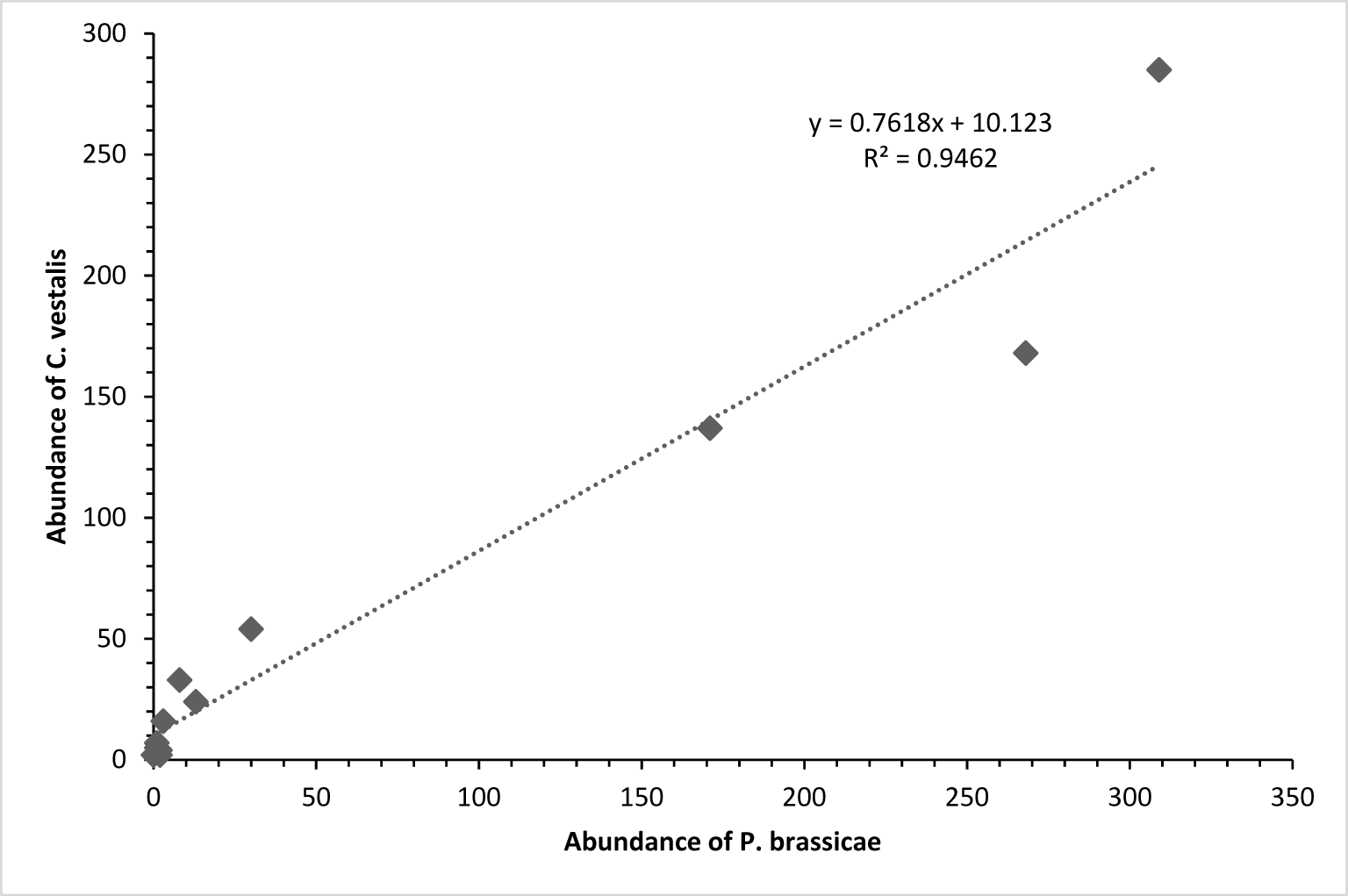
Linear regression analysis confirmed a robust correlation between C. vestalis parasitoid and the life cycle of Pieris brassicae, with a high R 2 value of 0.9462. This indicates a strong association close to unity (fig. 3), suggesting that as parasitisation increases, there is a corresponding impact on the developmental metrics of P. brassicae. This finding provides important insights into the dynamics of host–parasitoid relationships and the potential for utilising C. vestalis in integrated pest management strategies to control populations of P. brassicae effectively. These detailed explanations enhance the scientific rigour of the findings while clarifying the relationships among the various factors studied.
Linear regression curve showing a relationship between C. vestalis and P. brassicae.

Discussion
Host plant preferences and developmental patterns in P. brassicae
In the present study, P. brassicae larvae were provided with four economically significant crops cauliflower, cabbage, brassica, and turnip as food sources to assess their feeding preferences and developmental parameters. Among these host plants, brassica emerged as the preferred diet for P. brassicae, with the highest foraging rates and optimal growth metrics. Conversely, turnip was identified as the least favoured food source, reflected in this diet’s reduced consumption rates and slower larval development (Ijaz et al., Reference Ijaz, Afzal, Shabbir, Iqbal and Rafique2023; Le Thanh et al., Reference Le Thanh, Hoang, Thumanu, Saengchan, Daddam, Sangpueak, Papathoti and Buensanteai2023; Mukanga et al., Reference Mukanga, Matimelo, Lwinya, Machuku, Chilipa, Lupapula, Tembo and Chipabika2024; Pangaribuan et al., Reference Pangaribuan, Widagdo, Hariri, Siregar and Sardio2023; Phal et al., Reference Phal, Soytong and Poeaim2024). The relationship between the type of host plant and the extent of foraging, developmental duration, and pupal weight showed a strong correlation, underscoring the importance of host plant selection in the life cycle of these pests. Previous research has indicated that, during periods of food scarcity, P. brassicae larvae may extend their developmental period to ensure adequate nutrient intake, thereby enhancing their chances of survival despite limited resources (Shafiei et al., Reference Shafiei, Moczek and Nijhout2001). Host plant selection plays a crucial role in influencing the growth rate of larvae; slower growth rates and prolonged pupal stages are often indicative of limited food availability, which can have significant implications for pest management strategies (Schuder et al., Reference Schuder, Hommes and Larink2004).
Biological control of P. brassicae using C. vestalis
Understanding the ecological and economic damage caused by P. brassicae larvae is essential for developing effective pest management strategies. In this context, the potential of C. vestalis, a parasitic wasp, was evaluated as a natural biological control agent against P. brassicae. A gravid female parasitoid can parasitise only one host larva at a certain time. These parasitoids lay their eggs within the body of the host larva, and as C. vestalis larvae complete their development, they consume the host from the inside, eventually causing the host’s body to rupture and die. C. vestalis showed effectiveness for all larvae except for those larvae that feed on turnip due to secondary plant compounds. This unique parasitic relationship is critical for the successful life cycle of the parasitoid. Similarly, Bracon hebetor Say (Hymenoptera: Braconidae) has also proved to be an effective biological control agent against many species of Lepidoptera including Galleria mellonella (Adly and Marzouk, Reference Adly and Marzouk2019). Present studies align with the finding of Karut et al. (Reference Karut, Karaca and Döker2023) in which two Hymenopteran larval parasitoids Bracon didemie and Dolichogenidea appellator were used to analyse the efficacy against Tuta absoluta (Meyrick) (Lepidoptera: Gelechiidae) and it was found that B. didemie has more potential to control economically important pest T. absoluta that causes damage to tomato fields (Adilkhankyzy et al., Reference Adilkhankyzy, Tleubergenov, Shissenbayeva, Uspanov and Duisembekov2025; Akbar et al., Reference Akbar, Aleem, Sandhu, Shamoon, Fatima, Ehsan and Shaukat2023; Almuzaini, Reference Almuzaini2024; Arafa and Kandil, Reference Arafa and Kandil2024).
The findings from this study demonstrate that C. vestalis has a strong association with P. brassicae, functioning as an effective endoparasite. This relationship not only highlights the potential for biological control in managing pest populations but also emphasises the importance of integrating natural enemies into pest management programmes to reduce reliance on chemical pesticides (Ramzan et al., Reference Ramzan, Abid, Zafar, Anwar, Nadeem, Tanveer and Fatima2023; Rejab et al., Reference Rejab, Manam, Fauzi, Mohamed and Ngah2023; Zarikian et al., Reference Zarikian, Vardanyan, Rukhkyan, Hovhannisyan, Barseghyan, Dudukchyan, Akopyan and Harutyunova2024). Barratt et al. (Reference Barratt, Moran, Bigler and van Lenteren2018) revealed that the major limitation towards the implication of biological control programmes is the lack of communication and engagement of benefits obtained from the biological control programme. Better communication and improved knowledge about the environmental, social, and economic benefits of biological control programmes while targeting decision-makers, land managers, key stakeholders, and politicians is a crucial step. Environmental conditions such as temperature, humidity availability of preferred larval host, host plants, and presence of competitors such as other Hymenopterans also affect the efficacy of C. vestalis. Zhang and Chaudhary (Reference Zhang, Chaudhary and Mason2021) suggest that comprehensive communication will help to bring initiatives and incentives that will be in favour of the biological control programme. The use of C. vestalis as a biological control agent will reduce the chemical application on crops and it will also be an environmentally friendly approach and hence it will be feasible in integrated pest management. As study has been conducted in laboratory conditions with narrow host range so this is a limitation of study. Efficacy of C. vestalis in different climatic zones in the presence of other parasitoids and predators should also be studied. By leveraging the natural parasitising behaviours and mass rearing of C. vestalis, agricultural systems can enhance pest control while promoting sustainable farming practices and minimising environmental impact. In future economic analysis of mass rearing and comparison of long-term economic return of biological vs chemical control could be explored. Integration of this biological agent with other pest control strategies will prove to be an efficient and environment-friendly technique in the future (Bouchentouf et al., Reference Bouchentouf, Chafai, Bechchari, Maatougui and Khalid2024; Elkhalifa et al., Reference Elkhalifa, Altilmisani, Albishri, Gad, Al-Dubai and Al-Wesabi2024; Haroon et al., Reference Haroon, Anas, Naurin, Afzal, Irfan, Tariq, Idrees, Taj and Rukh2023; Huang et al., Reference Huang, Che and Zhong2024).
Conclusion
The study highlights the effectiveness of C. vestalis as a biological control agent against P. brassicae, presenting a sustainable approach to managing pest populations in Brassica crops. The parasitisation and subsequent impact on the larval development of P. brassicae indicated that C. vestalis can significantly reduce pest density and potentially minimise the reliance on chemical pesticides. Agricultural practices can enhance crop yield by integrating biological control methods while promoting environmental sustainability. Future research should focus on optimising the mass rearing of parasitoids, release strategies, and evaluating the long-term effects of C. vestalis in various Brassica-growing environments to ensure effective pest management.
Supplementary material
The supplementary material for this article can be found at https://doi.org/10.1017/S0007485325100187.
Author contributions
S.M., S.M., N.B.: Methodology, supervision, experimentation, and data curation; M.B., N.E., A.H.: Validation and Software, writing, investigation, drafting, statistical analysis, and validation; M.M.: Writing and drafting, and research design; T.A., H.Q., M.A.I., W.Z.: writing, Software, Resource, research design, validation, data collection, drafting, statistical analysis; H.A., K.H.A., N.Y.R., K.A.: writing, funding, statistical analysis, Resource, software, validation. All authors have read and approved the final manuscript and declare that they have no competitive interest.
Data availability
The author confirms that all data generated or analysed during this study are included in this published article.
Ethics approval and consent to participate
We all declare that manuscript reporting studies do not involve any human participants, human data, or human tissue. So, it is not applicable.
Study protocol must comply with relevant institutional, national, and international guidelines and legislation
Our experiment follows the relevant institutional, national, and international guidelines and legislation.
Competing interests
The authors declare no competing interests.