




No CrossRef data available.
Developmental properties of transactional models: The case of life events and mastery from adolescence to young adulthood
Published online by Cambridge University Press: 01 December 2004
Abstract
That behavior reflects ongoing transactions between person and context is an enshrined proposition of developmental theory, although the dynamic properties of these transactions have not been fully appreciated. In this article, we focus on reciprocal links between the Pearlin mastery scale and life events in the transition to adulthood, a strategic relationship given that control orientations are thought to mediate links between stressors and a range of indicators of distress, and given that life events become increasingly likely in young adulthood. Drawing on 12 waves of data from the Youth Development Study, spanning ages 14–15 to 26–27, we examine a series of growth curve models that interrelate mastery and life events. Results for females reveal that mastery during the senior year of high school predicts life events for the following 4-year period, which in turn predicts mastery over the 5-year period spanning ages 21–22 to 26–27. For males, mastery during the senior year (and perhaps the sophomore year) predicts subsequent life events, which in turn have short-term implications for mastery. Thus, transactions between life events and mastery are observed, although the temporal patterns of these exchanges are complex. These findings are discussed in terms of the developmental properties of transactions between person and context.The Youth Development Study is supported by grants from the National Institute of Child Health and Human Development (HD44138) and the National Institute of Mental Health (MH42843). Support for the research reported in this article comes in part from a subcontract to the first author (“Role configurations and well-being in the transition to adulthood”). The authors thank Lance Erickson and Sondra Smolek for helpful assistance.
Information
- Type
- Research Article
- Information
- Copyright
- © 2004 Cambridge University Press
Many developmentally sensitive models of human development recognize the importance of exchanges between person and context. The classical theories of Piaget and Vygotsky, for example, emphasize how people react to and also create their proximal settings. In contemporary developmental psychology, Sameroff formulated a transactional model that views behavior as the result of exchanges between individual and context (e.g., Sameroff & MacKenzie, 2003). In sociology, selection–causation models acknowledge that (a) personal attributes lead people to settings and contribute to the subsequent transformation of these settings, and in turn, (b) contexts influence people as they adapt (or fail to adapt) to situational imperatives. Thus, for example, selection–causation patterns have been observed between socioeconomic status and mental health (e.g., Miech, Caspi, Moffitt, Wright, & Silva, 1999) and psychological functioning and work conditions (e.g., Finch, Shanahan, Mortimer, & Ryu, 1991).
Despite the prominence of transactional thinking in developmental science, empirical tests of such ideas typically involve variations of a crosslagged panel model, which posits that both the person and context exhibit stability over time and they predict each other, contemporaneously and/or in a lagged fashion. According to such an operationalization, for example, a Time 1 measure of person is thought to predict a Time 2 measure of context that, in turn, predicts a Time 3 measure of person (see Sameroff, 1995, for figures illustrating such an approach). Missing from this analytic strategy, however, is an appreciation for the dynamic properties of both behavior and context. As Sameroff and MacKenzie (2003, p. 619) observe, “all too often … [the transactional model] is used to emphasize a linear environmentalism at the expense of the more complex interplay between dynamic systems.” The purpose of this article is to promote developmental thinking about transactional models by drawing on an empirical study of life events and mastery.
The transition from adolescence to young adulthood brings with it increased heterogeneity in the life course with respect to a wide range of indicators of well-being (e.g., Call, Riedel, Hein, McLoyd, Petersen, & Kipke, 2002; National Research Council, 2001). In part, this diversity may reflect new sources of distress, because this period of life is often punctuated by life events and other changes that introduce the possibility of novel strains. Many life events become possible, or much more likely, only after adolescence, including, for example, serious financial problems, getting arrested or incarcerated, serious illness, injury or death of a spouse, and divorce or separation.
Although, with very few exceptions, developmental studies view indicators of distress and other forms of compromised functioning as consequences of the stress process, stressors—even life events—are not randomly distributed in the population. Rather, a small number of studies suggest that life events are particularly common among people with diminished personal resources, as indicated by, for example, lowered self-conceptions (Thoits, 1994), delinquency (Hoffman & Cerbone, 1999), and impairments in mental health (Kim, Conger, Elder, & Lorenz, 2003). In turn, these findings suggest a reciprocal link (or transaction) between stressors and distress. Whereas getting arrested or attempting suicide is likely to be highly distressful, distressed and otherwise-troubled people get arrested or attempt suicide in the first place. Do life events create discontinuity in well-being during the transition to adulthood? Or are life events both caused by and the cause of factors that explain well-being, in which case they accentuate a trend that already exists?
Further, from a developmental perspective, little is known about the temporal nature of these cycles, particularly as youth leave adolescence and encounter many new stressors for the first time. If control orientations and life events are reciprocally interrelated, what are the dynamic properties of such a relationship? The question can be answered by considering the dynamic properties of mastery as a predictor, how long their effects on life events persist, and in turn the dynamic properties of life events as predictors of mastery and the duration of their effects. That is, viewed developmentally, transactions between person and experience are potentially quite complex.
In this article, we draw on data from the Youth Development Study and growth curve models to consider the selection–causation dynamic between mastery and life events from adolescence to young adulthood. We focus on the Pearlin Mastery Scale because of its close conceptual connection to control beliefs, which are known to mediate the link between many stressors and forms of distress (Aneshensel, 1992; Pearlin, Menaghan, Lieberman, & Mullan, 1981; Tram & Cole, 2000). The models allow us to examine how developmental patterns of mastery during high school predict life events after graduation and how these life events in turn are associated with developmental patterns of mastery in young adulthood to age 27. We begin by examining relevant literature and proposing a series of developmental hypotheses with respect to transactional models.
Reciprocal Links Between Life Events and Mastery
Although a large body of research shows that psychosocial stressors such as life events lead to decrements in manifold dimensions of physical and psychological well-being, very little research has examined the converse: that individual functioning leads to these stressors. To the extent that selection into stressors is operative, this omission may lead to empirical research that overstates their causative role. In concept, prior psychological functioning could be associated with later exposure to stressors. Hammen (1991) proposed a “stress generation model” to account for why clinically depressed people experienced more stressors than controls, although an increasing number of studies extend these insights beyond special populations. Indeed, internalizing and externalizing symptoms may often interfere with interpersonal relationships, which can lead to disruptions in the workplace and family, unlawful and risky behaviors, and victimization. Thus, for example, Potthoff, Holahan, and Joiner (1995) observed that depression predicted the level of subsequently experienced stressors, which were largely interpersonal tensions and conflicts. Further, control beliefs may lead people with a greater sense of efficacy to engage in preventive measures (e.g., preemptive coping) that lessen the likelihood of life events. Thus, agency is thought to enhance the fit between a person and her or his roles and relationships at work and in family life (Clausen, 1993; Shanahan & Elder, 2002), lessening the possibility of life events in these domains.
Some empirical evidence likewise suggests that reciprocal patterns exist between life events and indicators of psychological functioning. Kim and colleagues (2003) examined crosslagged panel models of stressful life events and latent constructs of internalizing (depression and anxiety) and externalizing (delinquent) symptoms extending from the 7th to the 12th grades. Both constructs had significant lagged effects on life events: with increasingly levels of delinquent behaviors and depression and anxiety, youth were increasingly likely to experience life events through the following year. In turn, life events had lagged or contemporaneous effects on delinquency and internalizing symptoms (for further evidence linking delinquent acts with later life events, see also Aseltine, Gore, & Gordon, 2000; Hoffman & Cerbone, 1999; Leadbetter, Kuperminc, Blatt, & Hertzog, 1999; for evidence linking internalizing symptoms with later life events, see also Swearingen & Cohen, 1985).
Given the present interest in mastery, Thoits' (1994) study of adults is particularly instructive. Drawing on two measurement occasions, she classified the stress associated with major life events in the workplace and in work and love as (a) solved, (b) unsolved but attempted to solve, and (c) unsolved and did not try. Scores on Pearlin's mastery scale were highest at Time 1 for adults who reported no problematic situation; significantly diminished for adults who encountered life events and solved them; and lowest for people who encountered life events and did not solve them. That is, mastery predicted the subsequent experience of life events and attempts to resolve their attendant stress.
Although conceptual considerations and some empirical evidence suggest that stressors such as life events and indicators of well-being, including mastery, are reciprocally interrelated, the dynamic properties of these transactions have not been conceptualized or empirically studied. In response to this neglect, we propose a series of hypotheses that characterize a developmental view of transactions between person and context. First, the link between the predictor and predicted variable may be governed by several mechanisms that are not mutually exclusive. A “recency hypothesis” suggests that relationships are stronger in magnitude the more closely in time two variables (e.g., mastery and life events) are measured. A “sensitive time hypothesis” suggests that specific measurement occasions of person (mastery) or context (life events) will be most salient. A “distal effect hypothesis” holds that the predictor variable can exert effects over long periods of time. In fact, the predictive link between personal characteristics and life events has been observed from as little as 3 weeks (Potthoff et al., 1995) to as much as 2 years (Thoits, 1994), and the predictive link between life events and personal characteristics has been observed also from as little as 2 weeks (Potthoff et al., 1995) but for as much as 15 years (Ensel & Lin, 1996).
Second, in addition to these distinctions, which describe the “predictive reach” of one variable to another, a developmental view would also consider how long such effects persist. Effects may be characterized by “short-lived” or “long-term” hypotheses, the latter possibly reflecting a deflection in a developmental trajectory. Prior research shows that the duration of stressors depends on prior circumstances and the responses that they evoke (Harnish, Aseltine, & Gore, 2000), suggesting that the implications of stressors such as life events may also vary in their duration. To our knowledge, however, no research has examined how long the effects of stressors on personal characteristics such as mastery persist.
Finally, perhaps “across-wave” properties of these repeated assessments are important. That is, it may be that dynamic features of mastery and life events are reciprocally interrelated, not scores at particular points in time. In some instances, the duration of a contextual feature may be salient to behavior, consistent with a hypothesis of “cumulative effects.” For example, the duration of poverty predicts diverse behavioral outcomes (Duncan & Brooks–Gunn, 1995; see Elder & Shanahan, in press) perhaps, in part, because chronic poverty promotes a sense of learned helplessness and drains people of their coping resources and social supports. The duration of a personal attribute may indicate constancy in manifold dimensions of person and context that raise the threshold of changes in context necessary to produce changes in person.
Hypotheses about rate of change in behavior or context may also describe crosstime phenomena that are important to the study of transactional models. For example, Ge, Lorenz, Conger, Elder, and Simons (1994) observed that the rate of change in depressive symptoms was associated with the rate of change in life events. Rate of change may be important because it captures long-term patterns of experience. Consistent with White's (1959) classic formulation, youth with faster rates of increase in mastery may be experiencing on-going, reinforcing exchanges between their actions and a sense of competence; in turn, such youth may be more likely to exercise their sense of mastery to prevent life events through a wide range of strategies. Youth with faster rates of increase in life events may be experiencing a cascading effect whereby stressors build upon one and another (e.g., Ensel & Lin, 1996), which could, in turn, diminish a sense of mastery.
The hypotheses about level of mastery and life events may also describe important elements of their reciprocal exchange. It may be that rate of change is actually quite modest in magnitude, in which case it is likely to have little explanatory capacity. In the case of mastery, perhaps one's core identity—as indicated by levels of self-conceptions—is what motivates behavior (Gecas, 1991), including strategies to prevent and avoid life events. In the case of life events, level may reflect an overall propensity to experience stressors, including life events, due to a multitude of social and personal factors.
In addition to these developmental ideas, we also consider whether reciprocal patterns between life events and mastery differ by males and females. Although some evidence suggests no gender differences in reciprocal links between stressors and indicators of distress and well-being (Aseltine et al., 2000; Kim et al., 2003; Potthoff et al., 1995; Swearingen & Cohen, 1985), several well-executed studies document that life events, depressive symptoms, and their links vary by gender at various stages of adolescence (Garber, Keiley, & Martin, 2002; Ge et al., 1994; Leadbetter et al., 1999). As Leadbetter and colleagues (1999) observe, girls are thought to be more susceptible to distressful reactions to life events because of their higher levels of interpersonal vulnerability (i.e., preoccupation with relationships, intense need for closeness in relationships, feelings of loneliness), and also may be more likely to experience life events, at least in early and mid-adolescence. Further, the levels of mastery and their covariates are known to vary between adolescent boys and girls (American Association of University Women, 1992; Finch et al., 1991). Thus, the evidence is currently mixed whether links between life events and mastery are moderated by gender, but both prior empirical studies and conceptual considerations support the need for further study of this issue.
As the foregoing suggests, life events and mastery are likely to be reciprocally interrelated, although very little is known about the dynamic properties of these transactions and whether they differ by gender. Developmentally, what are the temporal properties of mastery and life events that lead to one another, and how long do such effects persist? We examine these issues with dynamic models of mastery and life events that allow us to examine the merit of the recency, sensitive time, and distal effect hypotheses, as well as the possible importance of the rates of change in and levels of mastery and life events.
Data and Measures
The Youth Development Study
The target population consisted of all ninth-grade students enrolled in the St. Paul, Minnesota, Public School District who were not prevented from filling out a questionnaire because of a disability (n = 2321). A random selection of 1785 students and their parents were invited to participate in the research; consent to participate was obtained from 1139 parents and their adolescent child, resulting in a 64% response to invitation rate. The present analyses focus on the 1010 students who were initially surveyed in the early months of 1988. (A subsample of 129 Hmong [a culturally distinct group from Southeast Asia] were not included.)
The Youth Development Study panel has been surveyed annually from the 9th (1988) to the 12th (1991) grades in high school, with excellent panel retention (92.7%) through this period. Yearly questionnaires, administered in school, included a large battery of items tapping experiences in work, occupationally relevant attitudes, and plans for the future. After the young people left high school, they were surveyed annually by mail. The questionnaires again addressed work experiences and orientations, and detailed monthly patterns of (via life history calendars; Freedman et al., 1988) residential arrangements, educational attendance, and both part- and full-time labor force participation. The panel continues to be followed and surveyed.
Data for this article come from multiple waves up to and including Wave 12, which was collected in 2000 when the participants were 26 or 27 years of age. The 12-year retention rate was 75.8%. Although males and socioeconomically disadvantaged young people were more likely to leave the study, the social background of 1st-wave and 12th-wave panel members, and their work-related attitudes and plans (measured in the ninth grade), were quite similar. An inspection of key variables used in this study indicated that 777 respondents provided valid data for the life events inventory, while larger numbers of respondents provided data for self-efficacy. Given the centrality of the life events measure and full information maximum likelihood (FIML) assumption that data are sparsely missing, we restricted analysis to these 777 cases. A comparison of the 777 cases with the original sample of 1010 respondents revealed that the groups did not differ in their Wave 1 mastery; unfortunately, no data on life events were available at this initial wave, prohibiting us from exploring further differences between the groups.
The local character of this panel poses certain advantages (facilitating the logistics of the research and enhancing respondent commitment), although it also raises issues of generalizability. The panel has been shown to represent well the St. Paul community and its student body at the initiation of the study (Mortimer et al., 1992). How does this population compare to a nationally representative population? To answer this question, we compare population characteristics of the United States and St. Paul from the 1980 US Census and the St. Paul Public School District. The St. Paul public school population is more racially diverse than the nation as a whole. Although the representation of African Americans and Native Americans is comparable (e.g., among the former, 11.7% in the United States, 9.8% in St. Paul), St. Paul has a greater percentage of Asians and Pacific Islanders (3.9%) when compared with the United States (1.6%). The greatest difference can be found between the Other designation from the US Census (2.6%) and the local sample's Other and Mixed Race categories (6.8%). Comparisons of economic indicators indicate that St. Paul is somewhat more affluent than the country: per capita income is slightly higher ($7,694 in St. Paul, $7,298 in the United States), unemployment is lower (4.7% in St. Paul, 6.5% in the United States), and the number of families classified as impoverished is lower (8.0% in St. Paul, 9.6% in the United States). Thus, St. Paul is more racially and ethnically diverse and economically disadvantaged than the US population.
Mastery
Mastery was assessed with the Pearlin Mastery scale, which measures “the extent to which people see themselves as being in control of the forces that are important in their lives” (Pearlin et al., 1981, p. 340). Respondents rated the following items on a scale of 1 (strongly disagree) to 4 (strongly agree): “There is really no way I can solve some of the problems that I have” (external item), “Sometimes I feel that I am being pushed around in life” (external item), “I have little control over the things that happen to me” (external item), “I can do just about anything,” “What happens to me in the future depends mostly on me,” “I mostly feel helpless in dealing with the problems in life” (external item), and “There is little I can do to change many important things in my life” (external item). These items were summed within waves to create a scale ranging from 0 to 28. Mastery was assessed during each year of high school, and again in 1995 (ages 21–22), 1998 (24–25), and 2000 (26–27).
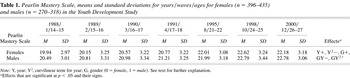
For descriptive purposes, we examined a series of generalized estimating equations (population-averaged models; Hardin & Hilbe, 2003) that predict mastery by wave, wave-squared, gender, and all second-order multiplicative interactions. (The models differed in their assumptions about the within-group correlational structure, but all of the estimated models led to the same substantive conclusions.) The means, standard deviations, and statistical trends are reported in Table 1, which shows that mastery increased until 1998 (when the respondents were 24–25 years of age) and then declined slightly in 2000. Males report slightly higher mastery, although girls' mastery increases at a slightly faster rate and then declines at a slightly faster rate in 2000. These annual assessments were used as the observed indicators of mastery in the structural equation models.
Pearlin Mastery Scale, means and standard deviations for years/waves/ages for females (n = 396–435) and males (n = 270–318) in the Youth Development Study

Life events
In 1995, students were asked to indicate whether they had experienced a series of 18 life events in the past 1, 2, 3, 4, or 5 years. For the purpose of this analysis, one index was created that reflect the sum of events experienced between 1991–1992 (the year following the last assessment of mastery in high school) and 1994–1995 (mastery was reassessed in 1995). That is, we focused on life events that would have occurred between measurement occasions of mastery. Total life events reflect the sum of all 18 items.
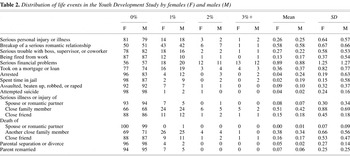
The events, distributions, and descriptive statistics are shown for males and females in Table 2. The items tap diverse domains, including relatively rare events such as the death of a spouse and a suicide attempt (less than 1 and 3% of the total sample experienced these events, respectively), but also fairly common events such as the breakup of a serious romantic relationship and a serious financial difficulty (roughly 54 and 44% of the total sample experienced these events, respectively).
Distribution of life events in the Youth Development Study by females (F) and males (M)

Virtually all of the events occur infrequently, with between 80 and 100% of the respondents typically reporting that a specific event did not occur between 1992 and 1995. Commonly experienced events, however, include breakup of a serious romantic relationship, serious financial problems, serious illness or injury of a close family member, and death of a close family member. The results also show that, perhaps excepting serious financial problems, a specific event is not likely to occur more than once over the 4-year period. At the item level, then, the distributions are often skewed, with very small numbers of respondents reporting up to 12 events per year, but the vast majority reporting either 0 or 1 events.
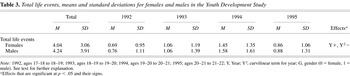
The items were summed to create the total life events variables; Table 3 reports the means, standard deviations, and statistical trends for the scales. Once again, generalized estimating equations (population-averaged models with differing assumptions about the distribution of life events [normal, Poisson, and negative binomial] and the within-group correlational structure) that predicted life events by wave, wave-squared, gender, and all second-order multiplicative interactions were examined. All of the models pointed to the same conclusion: the total number of life events increased between 1992 and 1994, and then decreased significantly in 1995. Although it may appear that males are somewhat more likely to experience an event, no significant gender difference is observed. Because of possible overdispersion in the annual life events distributions, the variables examined in Table 3 (e.g., total life events in 1992) were winsorized such that the highest category contained at least 5% of the observed cases. These recodings affected a small number of cases. These slightly truncated variables were then summed to create the variables used in the models. (All of the analyses were performed with both truncated and raw variables and the substantive conclusions are identical. The distributions of the raw life events variables are not ideal, however, for structural equation models.)
Total life events, means and standard deviations for females and males in the Youth Development Study

Analytic Strategy
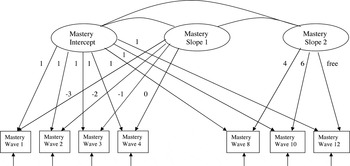
Our fundamental concern is the dynamic properties of reciprocal associations between mastery and life events from adolescence to young adulthood. The data provide a unique opportunity to address this theme because mastery was measured between 1988 and 1991 (covering the 4 years of high school, ages 14–15 to 17–18), life events that occurred between 1991–1992 and 1994–1995 were assessed, and then mastery was assessed again on three occasions: at Wave 8 in 1995 (ages 21–22), Wave 10 in 1998 (ages 24–25), and Wave 12 in 2000 (ages 26–27). The pattern of repeated measures allows us to estimate the latent growth curve model shown in Figure 1. According to this specification, the repeated measures of mastery reflect an intercept (placed at senior year in high school), a slope unique to mastery through the high-school years, and slope unique to Waves 8, 10, and 12. Because of our interest in gender differences, our first task in interrelating mastery and life events is to identify the unconditional growth model for males and females using multiple group comparisons.1
The data would also allow for both a unique intercept and slope for Waves 8, 10, and 12 (as opposed to the model in Figure 1). Such a model allows not only for differences in rates (and direction) of change between the high-school and young adult periods, but also for “jumps” in level between the two time periods, permitting discontinuity in individual trajectories. Analyses reveal that this model was not supported by the data, which instead supported the model shown in Figure 1. That is, mastery reflects one intercept and a combination of slopes representing a continuous trajectory.

The unconditional growth curve model of the Pearlin Mastery Scale in the Youth Development Study.
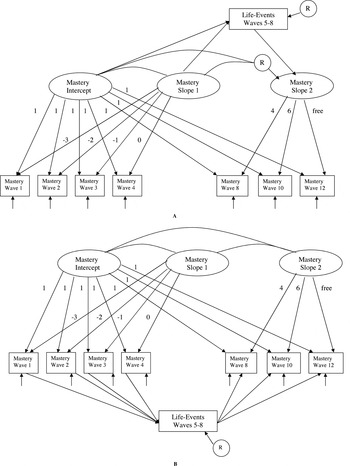
Life events are then introduced into the unconditional model according to several specifications that bear on our developmental ideas. No one model can test all of the ideas (i.e., regarding recency, distal, and sensitive time effects, or regarding the importance of durations and rate of change), and so we test a series of models that, when viewed jointly, allows us to draw conclusions about the developmental properties of transactions between life events and mastery. The total number of life events can be incorporated into the growth model as shown in Figure 2A and B. Both of these models consider how dynamic characteristics of mastery predict number of life events experienced over the 4-year period covering ages 17–18 to 18–19 to ages 20–21 to 21–22. The model shown in Figure 2A tests whether the latent intercept and first slope predict subsequent life events, which in turn, predict the second slope. We refer to this specification as the “trajectory model,” because life events are posited to reflect an earlier rate of change in mastery and, in turn, are posited to deflect the subsequent rate of change in mastery. Such a model provides evidence relevant to the recency hypothesis (i.e., the effect of senior high mastery on life event), the effect of the cumulative number of life events on mastery, and whether the rate of change in mastery is responsive to life events.

The (A) trajectory and (B) wave-specific models of mastery and the total number of life events.
The model shown in Figure 2B tests whether the observed indicators of mastery during high school predict the number of life events experienced in the subsequent 4 years, which in turn, predict the observed indicators of mastery in Waves 8, 10, and 12. Because the model includes the latent components of the growth curve, the model tests whether time-specific deviations from the underlying growth pattern predict, and are predicted by, total number of life events. We refer to this specification as the “wave-specific model” because life events are thought to reflect mastery at specific times and predict later mastery at specific times. Note that the model tests the effects of specific waves, controlling other measurement occasions, making this a rigorous test of the sensitive time hypothesis. This model provides evidence relevant to the sensitive time, distal, and recency hypotheses by predicting life events with each of the four high-school mastery waves and then again with respect to the response of mastery during the transition to young adulthood (e.g., if mastery at Wave 4 predicts life events or life events predict mastery at Wave 8, these would constitute recency effects).
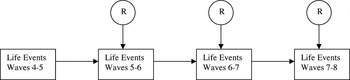
Repeated measures of life events can be modeled in several ways. Latent growth models have been used to study life events (e.g., Ge et al., 1994) based on the premise that number of life events experienced over time is a continuous developmental trajectory (i.e., the repeated measures of life events all reflect an underlying function of growth). In the present case, analyses revealed that the data did not support a range of plausible growth curve models. Alternatively, life events can be studied using an autoregressive model, as shown in Figure 3. This model assumes that each value for life events depends on the immediately prior value, a realistic assumption given that life events can trigger one another and given that a range of unmeasured, relatively stable factors may cause life events. An autoregressive model is thus fitted to the data.

The autoregressive model of life events.
The resulting model of life events then replaces the total number of life events in Figure 2A and 2B. The “trajectory autoregressive model” (i.e., the autoregressive model replacing total life events in Figure 2A) tests whether the latent parameters describing growth in mastery predict, and are predicted by, specific waves of life events. The “wave-specific autoregressive model” (i.e., the autoregressive model replacing total life events, Figure 2B) provides an exhaustive test of the sensitive time hypothesis. It tests whether wave-specific deviations from the underlying growth pattern of mastery in high school predicts specific waves of life events in the following 4-year period (controlling for prior wave of life events); the model also examines whether these life events significantly predict wave-specific deviations in growth in mastery in the subsequent 5-year period. Both of these models provide insights about whether it is the cumulative pattern of life events or specific times that are responsive to and that predict mastery.
Juxtaposing the results from these models provides evidence that bears on the temporal dimensions of the reciprocal links between mastery and life events, as well as on the recency, sensitive time, and distal effect hypotheses. Given the multitude of statistical tests performed, findings that form meaningful patterns will be emphasized. The analyses were conducted with STATA 8 and AMOS 4. AMOS provides an FIML estimator that permits the inclusion of cases with partially missing data under the assumption that the missing data are missing at random.
Findings
Bivariate patterns among mastery and life events: High school to young adulthood
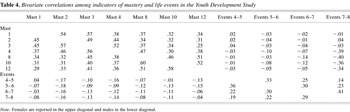
We begin with an inspection of bivariate correlations among the indicators of mastery and life events, as shown in Table 4. (All |r| greater than .10 in magnitude are statistically significant, p < .05.) Not surprisingly, mastery is highly correlated across the high-school years and into adulthood, with correlations somewhat stronger between immediately consecutive measurement occasions. Correlations among consecutive mastery scores typically range between .45 and .60, although the correlation between mastery at Time 1 and Time 12 attenuates (r = .34 for girls, r = .29 for boys). Although the occurrence of life events are often thought to reflect an appreciably “random” component, life events are significantly and moderately intercorrelated. Once again, these correlations are stronger for consecutive measurement occasions (r = .30–.41 for girls, r = .29–.36 for boys), but remain moderately to weakly correlated across a 3-year period.
Bivariate correlations among indicators of mastery and life events in the Youth Development Study

How are mastery and life events interrelated through high school and young adulthood? Mastery during the high-school years is weakly related to number of life events experienced in the 4 years following high school for both boys and girls (excepting mastery 4 and life events 7–8, which are moderately correlated). Life events are likewise weakly correlated with subsequent mastery for boys; these relationships are likewise weak for girls, although they become stronger with successive measurement occasions, and are moderate in size for life events 7–8. Thus, the bivariate patterns suggest the associations between earlier mastery and subsequent life events are similar in magnitude to associations between life events and subsequent mastery.
Mastery from adolescence into young adulthood
To study how growth in mastery and life events are interrelated, we first turn to an unconditional growth model of the Pearlin Mastery Scale. In preliminary analyses, we examined a series of growth curve models for the total sample and for boys and girls, including a simple linear model and various specifications that allowed for spline functions. Analyses revealed that a two-slope spline function fit the data well for both the total sample and subgroups defined by gender. According to this model, changes in mastery are described by two segments. The first segment models the linear changes in mastery scores during the high-school period. The loadings for this first slope (−3, −2, −1, 0) position the intercept at the senior year of high school. The second segment of the spline models changes during young adulthood. In the second segment, a nonlinear trend is present. The loading at Wave 12 was freely estimated to account for the plateau effect observed in the means and population-averaged patterns of Table 1. The estimation of both segments allows individual trajectories to change course between high school and young adulthood. For instance, an individual might report increasing feelings of mastery during high school, but then show decreasing feeling of mastery during young adulthood. The ability to predict such developmental deflections (e.g., as a function of intervening life events) is a key advantage of this model. Analyses also showed that the error variances for the observed indicators at Waves 8, 10, and 12 could be constrained to be equal.
Next, a series of multiple group comparisons were conducted between males and females to determine which parameters could be constrained to be equal between the two groups without a significant decrement in overall model fit. Those comparisons reveal that the six factor variances/covariances, and the five unique residual variances could be constrained to be equal between males and females; the factor means, however, differed significantly and were thus freely estimated.
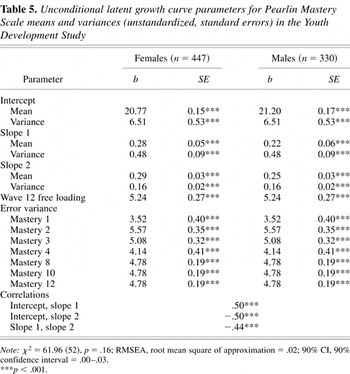
The parameters for the final unconditional model of mastery (shown in Figure 1) are reported in Table 5. The model fits the data well, χ2 (52) = 61.96, N = 777, p = .16. As indicated, all of the factor variances/covariances and error variances could be constrained to be equal between males and females. The means, however, differed between these groups, with males having a slightly higher intercept and females having a slightly faster rate of change over time. All of the parameters are statistically significant, indicating that there is variability about the growth curve's latent constructs and observed indicators that can be explained by exogenous variables.
Unconditional latent growth curve parameters for Pearlin Mastery Scale means and variances (unstandardized, standard errors) in the Youth Development Study

Mastery and number of life events from adolescence to young adulthood
The number of life events was then added to the unconditional model of mastery. For the trajectory model (Figure 2A), the total number of life events experienced between 1992 and 1995 was added to the model such that the intercept and first slope predicted life events, which in turn, was allowed to predict the second slope. (Residual variances were added to the life events variable and slope 2 as parameters freely estimated for each gender and the intercepts of life events and slope 2 were also freely estimated, but the model was otherwise unchanged from the unconditional model.) For the wave-specific model (Figure 2B), the total number of life events was added to the model such that the first four observed indicators of mastery predicted life events, which in turn predicted the last three observed indicators. (Once again, the residual variance and intercept of life events was freely estimated, as were the residual variances of the predicted mastery indicators.2
With respect to all wave-specific models in this article, models were also estimated to insure that all parameters describing slope 2 could be held invariant between genders, because that factor takes on a different meaning from the unconditional model (namely, change adjusted for the effects of life events on the observed indicators). Tests revealed that the two covariances, variance, and the free loading associated with slope 2 could all be constrained across genders without a significant decrement in model fit.
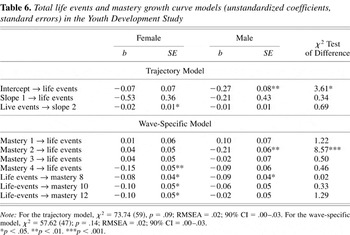
Table 6 reports the findings with respect to total number of life events. Both the trajectory and wave-specific models fit the data reasonably well, as indicated by chi-square tests and root mean square error. In this and the remaining tables, the far-right column provides the test statistic for a formal test of the difference in magnitude of the effect sizes between males and females. The trajectory model section in Table 6 shows that, for girls, total life events predicts rate of change in mastery in the subsequent 5-year period (β = −.11, z = −2.04). Thus, the trajectory model does not suggest a reciprocal relationship between mastery and life events for girls, although life events predicts rate of change in mastery from ages 21–22 to 26–27 for girls. The wave-specific model section in Table 6 shows that mastery during the senior year in high school predicts total life events for girls (β = −.17, z = −2.82). In turn, total life events predict all three mastery indicators for the subsequent 5-year period. This pattern is consistent with the trajectory model, which shows that life events predicts rate of change over this period of time. Viewed jointly, the two models suggest that, for females, mastery during the senior year in high school predicts total life events in the subsequent 4-year period and that these life events in turn predict rate of change in mastery over the next 5 years. In other words, the effect of mastery on life events is limited to recent mastery, the effects appear to persist, and the effects of life events on mastery cover a long duration.
Total life events and mastery growth curve models (unstandardized coefficients, standard errors) in the Youth Development Study

Interestingly, Table 6 leads to different conclusions for boys. The trajectory model in the table shows that mastery during the senior year in high school predicts total number of life events experienced over the 4-year period following the administration of the survey during the senior year (β = −.23, z = −3.30). The trajectory model provides no evidence, however, that life events are associated with a decrement in later mastery. The wave-specific model in the table sheds further light on these relationships. It suggests that mastery at Time 2 predicts life events (β = −.23, z = −3.31) and provides no evidence that mastery during the senior year of high school has a significant effect on life events. It also shows that life events have an effect on mastery (β = −.08, z = −2.12), although this effect is limited to Wave 8. Taken together, the two models suggest that the growth pattern of mastery predicts life events for the boys, while life events are associated with a decrement in mastery at Time 8.
Summary
For the girls, total number of life events experienced in the 4 years after the survey's administration during the senior year are predicted in the short-term by mastery (i.e., by mastery at Wave 4 only), while the implications of these life events are long lasting, covering the subsequent 5-year period (ages 21–22 to 26–27). For the boys, mastery during the sophomore year in high school appears particularly salient in predicting subsequent life events and, in turn, the implications of these life events are short lived (i.e., restricted to Wave 8). A reciprocal relationship between total life events and mastery is observed for both girls and boys.
A dynamic view of life events in the transition to adulthood
Although the previous findings show that mastery and number of life events are reciprocally interrelated in dynamically interesting ways, life events may also be examined with their longitudinal properties in mind. We begin by examining a univariate autoregressive model of life events (shown in Figure 3) covering Waves 5, 6, 7, and 8; these data collection points refer to life events experienced between Waves 4 and 5, 5 and 6, 6 and 7, and 7 and 8, encompassing ages 17–18 to 21–22, respectively. Analyses revealed that each wave of life events significantly predicted the following two measurement occasions, and that the means, variances, and lagged paths among the life events indicators could be constrained between genders. The resulting model fit the data well, χ2 (15) = 14.72, N = 777, p = .47. The regression paths among the immediately successive waves of life events were moderate in magnitude (βs = .29–.35 for both boys and girls) and highly significant; the paths between life events at Time 2 and 4, and between Time 3 and Time 5, were weak in magnitude but significant (p < .001). Given the small magnitude of the effect of these lags, they were dropped from the model for the sake of parsimony. The model's parameters and overall fit is consistent with the assumptions of the autoregressive model, suggesting that this model is an appropriate way to model life events across measurement occasions. This life events model was then interrelated to mastery according to model specifications shown in Figure 2A and 2B.
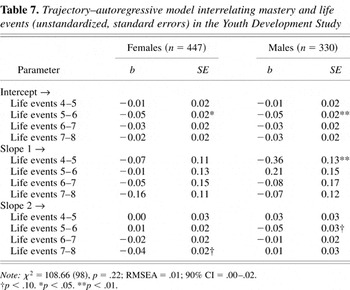
The results for the model shown in Figure 2A with the autoregressive model are shown in Table 7. The model is identical to the trajectory model presented in Table 5, except the autoregressive model now replaces the total number of life events. (The residual variances of the life events are constrained to be equal across genders, as supported by the univariate model.) The model fits the data well, χ2 (98) = 108.66, N = 777, p = .22, although there are few significant paths among mastery and life events. For both boys and girls, mastery during the senior year of high school is associated with significantly fewer life events (β = −.10, z = −2.25 for girls; β = −.11, z = −2.51 for boys). This is consistent with prior findings (i.e., the wave-specific model showed that mastery during the senior year predicted total number of life events for girls, and the trajectory model showed that the intercept predicted life events for the boys.) For boys, the slope describing rate of change during high school predicted number of life events experienced in the year following the survey administration during the senior year (β = −.27, z = −2.74); the difference between boys and girls in this effect size is marginally significant (Δχ2 = 3.35, p < .10).
Trajectory–autoregressive model interrelating mastery and life events (unstandardized, standard errors) in the Youth Development Study

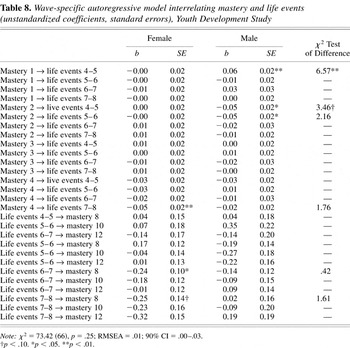
Finally, we substituted the autoregressive model for total life events in the wave-specific model shown in Figure 2B. This model explores whether wave-specific deviations from the underlying growth pattern of mastery in high school predict specific waves of life events (controlling the prior waves of life events), and whether these life events in turn predict wave-specific deviations from the growth of subsequent mastery. The results are reported in Table 8, and show that, for girls, mastery during the senior year of high school predicts life events in Waves 7–8, which is somewhat consistent with the wave-specific model (showing mastery at Wave 4 predicting total life events) and the autoregressive trajectory model (showing the intercept predicting life events at Waves 5–6). In addition, for the girls, Table 8 shows that life events in Wave 7 predicts mastery in Wave 8 (β = −.10, z = −.2.29) and life events in Wave 8 predicts mastery in Wave 12 (β = −.10, z = −2.16).
Wave-specific autoregressive model interrelating mastery and life events (unstandardized coefficients, standard errors), Youth Development Study

For the boys, mastery during the freshmen year leads to an increase in life events at Waves 4–5 (β = .20, z = 3.12); the bivariate correlation between these two variables is positive but very small, suggesting that this is an anomalous finding. Mastery during the sophomore year predicts life events at Waves 4–5 (β = −.16, z = −2.39) and Waves 5–6 (β = −14, z = −2.08), consistent with the wave-specific model (showing that mastery at Wave 2 predicts total number of life events).
Summary
Viewing life events as a autoregressive model supports several conclusions. For females, mastery during the senior year diminishes life events experienced after high school; the trajectory–autoregressive model shows this effect with respect to life events at Waves 5–6, while the trajectory wave-specific model shows this effect at Waves 7–8. The models also suggest an effect from life events at Waves 7–8 on mastery: the trajectory autoregressive model shows that life events at this time predict rate of change in mastery from ages 21–22 to 26–27, and the wave-specific autoregressive model shows the effect at mastery Wave 8. For the males, the intercept predicts life events at Waves 5–6 and the slope predicts life events at Waves 4–5; further, mastery at Wave 2 predicts life events at Waves 5 and 6.
Conclusions and Discussion
That behavior and context are reciprocally interrelated is an enshrined proposition of developmental theory. However, surprisingly little research has examined the stress process with this proposition in mind. Further, the developmental properties of transactional exchanges are rarely considered. The present article highlights how dynamic properties of an indicator of personal functioning (mastery) and a stressor (life events) are reciprocally interrelated during the transition to adulthood. We focus on mastery and life events as a strategic case study, because constructs related to control beliefs (including mastery) are thought to mediate the association between stressors (such as life events) and a wide range of indicators of distress (e.g., Aneshensel, 1992; Tram & Cole, 2000). Thus, the present study provides evidence directly relevant to the stressor–mastery link, and is suggestive of links between life events and outcomes such as depressive symptoms and anxiety.
Developmentally, mastery can be viewed in terms of its level during the senior year, a unique rate of change through the high-school years, and a unique rate of change starting 4 years after high school, as found in the latent growth curve model shown in Figure 1. The dynamic nature of life events is best depicted in these data as an autoregressive model, covering the 4-year period beginning with the survey's administration during the senior year, as shown in Figure 3. As the models in Tables 5, 6, 7, and 8 make clear, reciprocal patterns can be modeled with these distinctions in mind. The models are not mutually exclusive nor are they nested, suggesting that some or all may be true to varying degrees. As Curran and Bollen (2001) have observed, autoregressive and growth curve models reveal different aspects of development, reflecting different assumptions about behavioral change and different properties in the observed data, and should thus be viewed as potentially complimentary. In the present case, such models highlight the developmental properties of the reciprocal links between mastery and life events. Findings show reciprocal patterns, although the temporal nature of these links differs between females and males.
For females, the evidence suggests that mastery in the last year of high school predicts life events for the 4-year period following graduation. The wave-specific model shows that mastery during the senior year predicts total number of life events experienced in the subsequent 4-year period, while the autoregressive wave-specific model predicts life events roughly 4 years after high-school graduation. In turn, life events have long-term implications, extending to Wave 12, when the women were 26–27 years of age. The trajectory model shows that total life events between Waves 4 and 8 predict the slope of mastery covering Waves 8–12. The wave-specific model shows that total life events likewise predicts individual mastery scores at Waves 8, 10, and 12. Thus, the findings support the conclusion that, for girls, senior year mastery predicts life events in the long term and that life events, in turn, predict subsequent mastery in the long term.
For the males, the models show that mastery during the senior year in high school predicts life events, both total number of life events in the 4 years roughly after high school (as shown by the trajectory model) and, specifically, about 2 years after graduation (as shown by the wave-specific and autoregressive trajectory models). Some evidence points to the special significance of mastery during the sophomore year of high school, which predicts both total number of life events and life events 2 and 3 years after graduation in the wave-specific and autoregressive wave-specific models. In turn, there is little evidence that life events predict subsequent mastery. The wave-specific model shows that if such an effect exists, it is likely limited to the assessment of mastery immediately following the life events. Thus, for boys, mastery during the senior year (and perhaps also during the sophomore year) predict life events, although these effects may be limited to life events experienced rather shortly after graduation; in turn, life events have either no or short-term implications for subsequent mastery.3
Our discussion of female–male differences is based on significant patterns observed within genders. At the same time, few findings differ statistically in magnitude between the two genders.
Viewed in terms of our original hypotheses, the females' pattern is consistent with the recency effect with respect to “selection into” life events, a long duration of the effect of mastery on life events, and a distal effect with respect to subsequent mastery. Although the conceptual basis for this recency effect is unclear, the persistence of the effect of life events may reflect the “high cost of caring” that females are thought experience: their life events are more likely to involve interpersonal relationships (as suggested by Table 2), which can create relatively intractable patterns of stress (Kessler & McLeod, 1984). Further, higher levels of interpersonal vulnerability (Leadbetter et al., 1999) among adolescent females could be associated with long-term effects of interpersonally based events.
For the males, findings are consistent with the recency effect and perhaps a sensitive time hypotheses with respect to selection into life events, although these effects are short lived. Further, life events have little or short-term effects on subsequent mastery. If mastery during the sophomore year in high school is especially salient, this may reflect the importance of personal resources when various forms of stressors can occur; but once again, it is unclear why this should not hold true for girls. The recency effect of life events may reflect qualitative differences in the types of life events that boys experience, which are less likely to involve interpersonal problems; further, males in this age range are not as likely as females to have interpersonal vulnerabilities that could exacerbate the effects of life events.
In any event, when viewed in their totality, the findings suggest that distressful responses to stressors during the transition to adulthood may be short lived for boys. For girls, mastery predicts the cumulation of life events, which predict comparatively long-term mastery.
Nevertheless, our study is limited in its consideration of life events. Consistent with classical stress theory, we sum all life events based on the assumption that any change disrupts homeostasis, which is, by definition, the stress process (Shanahan & Mortimer, 1996). Yet not all life events lead to distress (with distinctions often observed with respect to negative and uncontrollable events), and the significance of individual negative life events is likely to vary. By summing all life events, we have not explored the unique salience of negative events, nor have we attempted to adjust for the relative importance of specific events (cf. Ross & Mirowsky, 1979). These limitations are likely to create measurement error in life events, which, by itself, would render our estimates conservative.
A second limitation is that, by focusing on bivariate models (albeit with gender as a moderating factor), our efforts fail to consider other aspects of the stress process. The Youth Development Study does not provide measures of coping and social support that would be suitable to investigate how these models are buffered by such factors. Further, given the number of parameters of some of the models, the Youth Development Study's sample is not large enough to consider reliably the effects of race, indicators of socioeconomic status, and other potentially relevant controls. Our focus has been on dynamic properties of causation and selection between mastery and life events, although other research shows that these variables also reflect social location and personal characteristics (Aneshensel, 1992; Turner, Wheaton, & Lloyd, 1995); likewise, relationships between these two variables are complicated by other features of the stress process, particularly buffering mechanisms (Compas, Connor–Smith, Saltzman, Thomsen, & Wadsworth, 2001; Herman–Stahl & Petersen, 1996; Spence, Sheffield, & Donovan, 2002) and the co-occurrence of life events with other forms of stressors (e.g., Ge, Conger, & Elder, 2001; Pearlin & Lieberman, 1979; Simmons, Burgeson, Carlton–Ford, & Blyth, 1987).
A related limitation is that, although our focus is developmental, it is not sufficiently sensitive to the life course complexities surrounding life events. Prior research shows that experiences before, during, and after the experience of life events moderate their meaning and implications for well-being (Elder, George, & Shanahan, 1996). For example, with respect to social experiences prior to life events, Wheaton (1990) shows that some severe life events have a positive effect on psychological well-being if they resolve an antecedent source of chronic distress (for other examples of the positive effects of life events, see also, Amato, Loomis, & Booth, 1995; Sweeney & Horwitz, 2001). Similarly, Thoits (1994) argues that some life events (e.g., quitting one's job) may not be stressful episodes, but rather problem-solving responses to an ongoing acute stressor. With respect to experiences subsequent to the life event, for example, McLeod and Almazan (2003) note that much of the effect of parental loss (other than by parental separation) in childhood is mediated by subsequent experiences (see Quinton & Rutter, 1988; Rutter, 1989). The data set do not allow for an examination of these refinements.
Nevertheless, the results reveal interesting temporal patterns that characterize a selection–causation cycle of mastery and life events during the transition to adulthood, patterns that would not be observed without the use of models that can interrelate measurement occasions and growth patterns. Further, our efforts provide evidence that an exclusive focus on the effects of stressors on distress and psychological functioning in adolescence and young adulthood can be misleading. Rather, it seems likely that stressors such as life events lead to decrements in functioning, but that youth with diminished personal resources are more likely than youth with high levels of self-conceptions and good profiles of mental health to experience such stressors in the first place.
References
REFERENCES
Amato, P. R.,
Loomis, S. L., &
Booth, A.
(1995).
Parental divorce, marital conflict, and off-spring well-being
during early adulthood.
Social Forces
73,
895–915.Google Scholar
American Association of University Women.
(1992).
Shortchanging girls, shortchanging America: A call to action.
Washington, DC:
American Association of University Women.
Aneshensel, C. S.
(1992).
Social stress: Theory and research.
Annual Review of Sociology
18,
15–38.Google Scholar
Aseltine, R. H.,
Gore, S., &
Gordon, J.
(2000).
Life stress, anger, and anxiety and delinquency: An empirical test
of general strain theory.
Journal of Health and Social Behavior
41,
256–275.Google Scholar
Call, K. T.,
Riedel, A. A.,
Hein, K.,
McLoyd, V.,
Petersen, A. C., &
Kipke, M.
(2002).
Adolescent health and well-being in the twenty-first century: A
global perspective.
Journal of Research in Adolescence
12,
96–98.Google Scholar
Clausen, J.
(1993).
American lives: Looking back at the children of the Great
Depression.
Berkeley, CA:
University of California Press.
Compas, B. E.,
Connor–Smith, J. K.,
Saltzman, H.,
Thomsen, A. H., &
Wadsworth, M. E.
(2001).
Coping with stress during childhood and adolescence: Problems,
progress, and potential in theory and research.
Psychological Bulletin
127,
87–127.Google Scholar
Curran, P. J., &
Bollen, K. A.
(2001).
The best of both worlds: Combining autoregressive and latent
growth curve models. In
L. M. Collins &
A. Sayer (Eds.),
New methods for the analysis of change (pp.
105–136).
Washington, DC:
APA.
Duncan, G. J., &
Brooks–Gunn, J. (Eds.).
(1995).
Consequences of growing up poor.
New York:
Russell Sage.
Elder, G. H., Jr.,
George, I. K., &
Shanahan, M. J.
(1996).
Psychosocial stress over the life course. In
H. B. Kaplan (Ed.),
Psychosocial stress (pp.
247–292).
San Diego, CA:
Academic Press.
Elder, G. H., Jr., &
Shanahan, M. J.
(2004).
The life course in human development. In
R. M. Lerner (Ed.),
Handbook of child psychology: Vol. 1. Theoretical models.
New York:
Wiley.
Ensel, W. M., &
Lin, N.
(1996).
Distal stressors and the life stress process.
Journal of Community Psychology
24,
66–82.Google Scholar
Finch, M. D.,
Shanahan, M. J.,
Mortimer, J. T., &
Ryu, S.
(1991).
Work experience and control orientation in adolescence.
American Sociological Review
56,
597–611.Google Scholar
Freedman, D.,
Thornton, A.,
Cambum, D.,
Alwin, D., &
Young–DeMarco, L.
(1988).
The Life History Calendar: A technique for collecting retrospective
data.
Sociological Methodology
18,
37–68.Google Scholar
Garber, J.,
Keiley, M. K., &
Martin, N. C.
(2002).
Developmental trajectories of adolescents' depressive
symptoms: Predictors of change.
Journal of Consulting and Clinical Psychology
70,
79–95.Google Scholar
Ge, X. J.,
Conger, R. D., &
Elder, G. H., Jr.
(2001).
Pubertal transition, stressful life-events, and the emergence of
gender differences in adolescent depressive symptoms.
Developmental Psychology
37,
404–417.Google Scholar
Ge, X. J.,
Lorenz, F. O.,
Conger, R. D.,
Elder, G. H., Jr., &
Simons, R. L.
(1994).
Trajectories of stressful life-events and depressive symptoms
during adolescence.
Developmental Psychology
30,
467–483.Google Scholar
Gecas, V.
(1991).
The self-concept as a basis for a theory of motivation. In
J. A. Howard &
P. L. Callero (Eds.),
The self-society dynamic: Cognition, emotion, and action (pp.
171–188).
New York:
Cambridge University Press.
Hammen, C. L.
(1991).
The generation of stress in the course of unipolar depression,
Journal of Abnormal Psychology
100,
555–561.Google Scholar
Hardin, J. W., &
Hilbe, J. M.
(2003).
Generalized estimating equations.
Boca Raton, FL:
Chapman & Hall.
Harnish, J. D.,
Aseltine, R. H., &
Gore, S.
(2000).
Resolution of stressful experiences as an indicator of coping
effectiveness in young adults: An event history analysis.
Journal of Health and Social Behavior
41,
121–136.Google Scholar
Herman–Stahl, M., &
Petersen, A. C.
(1996).
The protective role of coping and social resources for depressive
symptoms among young adolescents.
Journal of Youth and Adolescence
25,
733–753.Google Scholar
Hoffman, J. P., &
Cerbone, F. G.
(1999).
Stressful life-events and delinquency escalation in early
adolescence.
Criminology
37,
343–373.Google Scholar
Kessler, R. C., &
McLeod, J. D.
(1984).
Sex differences in vulnerability to undesirable life-events.
American Sociological Review
49,
620–631.Google Scholar
Kim, J. K.,
Conger, R. D.,
Elder, G. H., Jr., &
Lorenz, F. O.
(2003).
Reciprocal influences between stressful life-events and adolescent
internalizing and externalizing problems.
Child Development
74,
127–143.Google Scholar
Leadbetter, B. J.,
Kuperminc, G. P.,
Blatt, S. J., &
Hertzog, C.
(1999).
A multivariate model of gender differences in adolescents'
internalizing and externalizing problems.
Developmental Psychology
35,
1268–1282.Google Scholar
McLeod, J. D., &
Almazan, E. P.
(2003).
Connections between childhood and adulthood. In
J. T. Mortimer &
M. J. Shanahan (Eds.),
Handbook of the life course (pp.
391–411).
New York:
Kluwer.
Miech, R. A.,
Caspi, A.,
Moffitt, T. E.,
Wright, B. R. E., &
Silva, P.
(1999).
Low socioeconomic status and mental disorders: A longitudinal study
of selection and causation during young adulthood.
American Journal of Sociology
104,
1096–1131.Google Scholar
Mortimer, J. T.,
Finch, M. D.,
Shanahan, M. J., &
Ryu, S.
(1992).
Adolescent work history and behavioral adjustment.
Journal of Research on Adolescence
2,
59–80.Google Scholar
National Research Council.
(2001).
New horizons in health: An integrative approach
(B. H. Singer &
C. D. Ryff, Eds.).
Washington, DC:
National Academy Press.
Pearlin, L. I., &
Lieberman, M. A.
(1979).
Social sources of emotional distress.
Research Communications in Mental Health
1,
217–248.Google Scholar
Pearlin, L. I.,
Menaghan, E. G.,
Lieberman, M. A., &
Mullan, J. T.
(1981).
The stress process.
Journal of Health and Social Behavior
22,
337–365.Google Scholar
Potthoff, J. G.,
Holahan, C. J., &
Joiner, T. E.
(1995).
Reassurance seeking, stress generation, and depressive symptoms: An
integrative model.
Journal of Personality and Social Psychology
68,
664–670.Google Scholar
Quinton, D., &
Rutter, M.
(1988).
Parental breakdown: The making and breaking of intergenerational
links.
Adlershot, UK:
Gower.
Ross, C. E., &
Mirowsky, J.
(1979).
A comparison of life-event weighting schemes: Change,
undesirability, and effect-proportional indices.
Journal of Health and Social Behavior
20,
166–177.Google Scholar
Rutter, M.
(1989).
Pathways from childhood to adult life.
Journal of Child Psychology and Psychiatry
30,
23–51.Google Scholar
Sameroff, A. J.
(1995).
General systems theories and developmental psychopathology. In
D. Cicchetti &
D. Cohen (Eds.),
Manual of developmental psychopathology (pp.
659–695).
New York:
Wiley.
Sameroff, A. J., &
MacKenzie, M. J.
(2003).
Research strategies for capturing transactional models of
development: The limits of the possible.
Development and Psychopathology
15,
613–640.Google Scholar
Shanahan, M. J., &
Elder, G. H., Jr.
(2002).
History, agency, and the life course. In
L. J. Crockett (Ed.),
Nebraska Symposium on Motivation. Life course perspectives on
motivation (pp.
145–186).
Lincoln, NE:
University of Nebraska Press.
Shanahan, M. J., &
Mortimer, J. T.
(1996).
Understanding the positive consequences of psychosocial stress. In
B. Markovsky,
M. Lovaglia, &
R. Simon (Eds.),
Advances in group processes
(Vol. 13, pp.
189–209).
Greenwich, CT:
JAI Press.
Simmons, R. G.,
Burgeson, R.,
Carlton–Ford, S., &
Blyth, D.
(1987).
The impact of cumulative change in early adolescence.
Child Development
58,
1220–1234.Google Scholar
Spence, S. H.,
Sheffield, J., &
Donovan, C.
(2002).
Problem-solving orientation and attributional style: Moderators of
the impact of negative life events on the development of depressive
symptoms in adolescence?
Journal of Clinical Child Psychology
31,
219–229.Google Scholar
Swearingen, E. M., &
Cohen, L. H.
(1985).
Life-events and psychological distress: A prospective study of
young adolescents.
Developmental Psychology
21,
1045–1054.Google Scholar
Sweeney, M. M., &
Horwitz, A. V.
(2001).
Infidelity, initiation, and the emotional climate of divorce: Are
there implications for mental health?
Journal of Health and Social Behavior
42,
295–309.Google Scholar
Thoits, P. A.
(1994).
Stressors and problem-solving: The individual as psychological
activist.
Journal of Health and Social Behavior
35,
143–159.Google Scholar
Tram, J. M., &
Cole, D. C.
(2000).
Self-perceived competence and the relation between life-events and
depressive symptoms in adolescence: Mediator or moderator?
Journal of Abnormal Psychology
109,
753–760.Google Scholar
Turner, R. J.,
Wheaton, B., &
Lloyd, D.
(1995).
The epidemiology of social stress.
American Sociological Review
60,
104–125.Google Scholar
Wheaton, B.
(1990).
Life transitions, role histories, and mental health.
American Journal of Sociology
55,
209–223.Google Scholar
White, R. H.
(1959).
Motivation reconsidered: The concept of competence.
Psychological Review
66,
297–333.Google Scholar
Pearlin Mastery Scale, means and standard deviations for years/waves/ages for females (n = 396–435) and males (n = 270–318) in the Youth Development Study
Distribution of life events in the Youth Development Study by females (F) and males (M)
Total life events, means and standard deviations for females and males in the Youth Development Study
The unconditional growth curve model of the Pearlin Mastery Scale in the Youth Development Study.
The (A) trajectory and (B) wave-specific models of mastery and the total number of life events.
The autoregressive model of life events.
Bivariate correlations among indicators of mastery and life events in the Youth Development Study
Unconditional latent growth curve parameters for Pearlin Mastery Scale means and variances (unstandardized, standard errors) in the Youth Development Study
Total life events and mastery growth curve models (unstandardized coefficients, standard errors) in the Youth Development Study
Trajectory–autoregressive model interrelating mastery and life events (unstandardized, standard errors) in the Youth Development Study
Wave-specific autoregressive model interrelating mastery and life events (unstandardized coefficients, standard errors), Youth Development Study
 You have
Access
- 31
- Cited by