Introduction
Hafellner (Reference Hafellner1982) described Lichenostigma, a genus of lichenicolous fungi, based on the description of L. maureri. Currently, it comprises 22 taxa, characterized by having ascomata without hamathecia, evanescent asci surrounded by paraplectenchymatous stromatic tissue and hyaline to brown spores with one or more septa. Within Lichenostigma, two subgenera have been recognized: the subgenus Lichenostigma, with visible rounded, cushion-like ascomata only, and the subgenus Lichenogramma Nav.-Ros. & Hafellner, with simple or plurihyphal dark vegetative strands interconnecting elongated to irregular-shaped ascomata (Navarro-Rosinés & Hafellner Reference Navarro-Rosinés and Hafellner1996).
During recent fieldwork in north-east Catalonia (Spain), SF-B and XL collected several specimens of a lichenicolous fungus growing on Pertusaria rupicola (Fr.) Harm. that proved to belong to the subgenus Lichenogramma. The exhaustive morphological study detailed here shows that the material examined differs from any described species of Lichenostigma and is described as a new species, Lichenostigma rupicolae, and compared to closely related taxa.
Material and Methods
Macroscopical characters were examined using a dissecting microscope (×40). Anatomical characters were studied in hand-cut sections and squash preparations mounted in water and Lugol's 0·4% iodine solution (I; pre- treatment with 10% KOH applied before Lugol's application is indicated as K/I) and lactophenol cotton blue (LPCB), and examined under a conventional light microscope (×100, oil immersion). The figures were prepared with the aid of a drawing tube (×1·25) fitted to the microscope. All microscopic measurements were made on material mounted in water. For the ascospore measurements, the average value is indicated in italics between the extreme values, after rejecting 10% of the highest and the lowest values. The highest and lowest absolute values are given in parentheses and the total number of ascospores measured (n) is also given.
The Species
Lichenostigma rupicolae Fdez.-Brime & Nav.-Ros. sp. nov
Filamenta vegetativa nigra, superficialia, reptantia, leviter prominentia, 150–350(–400) × 15–42·5(–49) μm, pluriseriata (a 4–5 seriis cellularum composita; cellulae 5–7 μm diam.), radiale disposita. Ascomata stromatica, irregulariter rotundata, prominentia, (45–)55–90(–120) μm diam., aggregata vel prope centrum subdispersa. Hamathecium pauce evolutum, a cellulis elongatis compositus. Ascosporae (11–)11·5–14·5(–16) × (5·5–)6·5–8·5(–9·5) μm (n = 136), leviter obovatae vel late ellipsoideae; apices rotundati; a 1–2(–3) transseptis, interdum 1 longisepto, instructae; a maturitate dense brunneae et a parvis granulis ornamentatae. Macroconidia pluricellularia, ellipsoidalia, nigra, 9·5–17(–18·5)× (7·5–)8·5–13(–14·5) μm, super vegetativis filamentis evoluta. A Pertusaria rupestris parasymbiotice crescit.
Typus: Spain, Catalonia, Girona, Cadaqués, Muntanya Negra, near Puig dels Bufadors, UTM 31TG2083, on Pertusaria rupicola, on acidic rocks, 350 m, 19 September 2006, X. Llimona & S. Fernández-Brime (BCN-lich. 16975—holotypus).
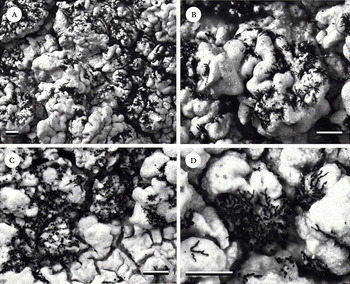
Lichenostigma rupicolae (holotype). A, heavily infected thallus of Pertusaria rupicola; B, detail showing the radiate disposition of the hyphal strands; C, group of isolated ascomata; D, group of ascomata with few surrounding hyphal strands. Scales. A–D = 0·5 mm.

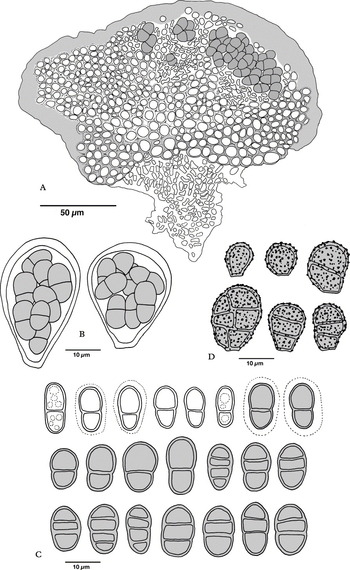
Lichenostigma rupicolae. A, section of an ascoma packed with spores; B, young asci with 8 spores; C, ascospore outlines showing the different stages of maturation, and the variation in septation; D, macroconidia in different developmental stages. Scales. A = 50 μm; B–D = 10 μm.

Vegetative hyphal strands superficial, forming black groups scattered over the host thallus and apothecial discs, loosely adpressed, simple or with few ramifications, about 150–350(–400) μm long and 15–42·5(–49) μm thick, consisting of 4–6 rows of isodiametric cells 5–7 μm diam. Young single infections forming dense groups of strands arranged radially, with swellings that gradually mature to become fertile stromata. In the final stage, the hyphal strands frequently lose their radial arrangement, and the ascomatic stromata remain isolated in a central position.
Ascomata stromatic, black, superficial, irregularly rounded or slightly elongate, (45–)55–90(–120) μm long and 35–55(–60) μm thick, densely aggregated or scattered. Internal structure formed by paraplectenchymatous tissue; outer layer strongly pigmented dark brown, with lateral densely compacted cells and basal subglobose cells 6–8·5 μm; inner tissue hyaline to pale brown, composed of spherical hyphal cells 5–7(–9) μm diam. The cells surrounding the asci differ by their irregularly elongated shape, 3·5–6·5 × 1·5–2·5 μm, forming an incipient hamathecium. Ascomatal tissue K/I− and I−, except for the irregularly-shaped cells around the asci that are I+ blue. Asci arising in locules, subglobose, bitunicate, 8-spored, K/I− and I−, evanescent; young asci 28–35 × 20–24 μm; after wall disintegration, the spores remain packed in groups of eight. Ascospores obovoid to broadly ellipsoidal, with rounded apices, constricted at the central septum, (11–)11·5–13–14·5(–16) × (5·5–)6·5–7–8·5(–9·5) μm, with length/breadth ratio of (1·5–)1·6–1·9–2·1(–2·5) (n = 136), 1–2(–3) transverse septa, rarely with a longitudinal septum, present in one or two cells, pale brown and with a perispore hyaline when young; at maturity, they turn dark brown, with a reduced perisporal sheath and a superficial fine granular ornamentation.
Macroconidia globose to ellipsoidal 9·5–17(–18·5) × (7·5–)8·5–13(–14·5) μm, produced directly on the surface of the hyphal strands and the ascomata, erect, multicellular.
Etymology. The epithet refers to the host species, Pertusaria rupicola.
Distribution and habitat. Lichenostigma rupicolae is currently known only from the localities in France, Spain and Turkey listed in this study. It grows on the thallus and apothecial discs of Pertusaria rupicola and does not seem to cause any major damage to the host, as its development is mainly superficial.
Pertusaria rupicola is a saxicolous lichen that grows on north-exposed acidic rock surfaces. It is one of the species that characterizes the association Pertusarietum rupicolae (Wirth & Llimona Reference Wirth and Llimona1975), in which other species of the genus Pertusaria are associated with P. rupicola, namely, P. excludens Nyl., P. leucosora Nyl., P. monogona Nyl., and P. pseudocorallina (Lilj.) Arnold. Based on our observations, we have found that L. rupicolae is highly selective of its host. It does not appear on any of the species mentioned above, even when their thalli are growing adjacent to the thalli of P. rupicola. In the type locality, L. rupicolae is quite abundant, and is widespread over the host thalli. Upon examination of the P. rupicola specimens in the BCN herbarium, L. rupicolae was also discovered on specimens from France and Turkey, as well as on collections from different localities within Catalonia (NE Spain). Based on our field observations, we can conclude that, although L. rupicolae is fairly abundant, it has been previously overlooked.
Remarks. Only one other species of Lichenostigma is known on Pertusaria: L. epirupestris Pérez-Ortega & Calat. (Reference Pérez-Ortega and Calatayud2009). This species grows on Pertusaria pertusa var. rupestris (DC.) Dalla Torre & Sarnth., and it differs from L. rupicolae by the absence of vegetative strands and by its larger cushion-like ascomata (up to 270 μm diam.).
Three other species of Lichenostigma on hosts other than Pertusaria form similar markedly radiating vegetative strands. These species are L. ampla Calat., Nav.-Ros. & Hafellner, L. gracilis Calat., Nav.-Ros. & Hafellner, and L. subradians Hafellner, Calat. & Nav.-Ros.. Lichenostigma ampla is characterized by having mainly submuriform ascospores, growing on Buellia species (Calatayud et al. Reference Calatayud, Hafellner, Navarro-Rosinés, Nash, Ryan, Gries and Bungartz2004). Lichenostigma gracilis and L. subradians share 1-septate ascospores, smaller than the ascospores of L. rupicolae. Furthermore, L. gracilis has paler golden brown hyphal strands, and grows on Acarospora fuscata (Nyl.) Arnold (Calatayud et al. Reference Calatayud, Navarro-Rosinés and Hafellner2002). Lichenostigma subradians is characterized by its hyphal strands with few ramifications, more or less perpendicular to the central strand and by growing on yellow Acarospora species (Calatayud et al. Reference Calatayud, Navarro-Rosinés and Hafellner2002).
The ascospores of Lichenostigma rupicolae are similar in size to those of L. svandae Vondrák & Šoun, with 1–2 septate ascospores, (11–)11·5–12·5–13·5(–15) × (6–)6·5–7·5–8·5(–10) μm. However, L. svandae has non-radiating hyphal strands, and forms root-like hyphae growing out and downwards, penetrating the cortical layer of the host, and occurs on thalli and apothecia of Acarospora cervina (Ach.) A. Massal. (Vondrák & Šoun Reference Vondrák and Šoun2007).
Lichenostigma rupicolae produces macroconidia, similar to those characteristic of the genus Lichenothelia D. Hawksw. (Henssen Reference Henssen1987). These peculiar propagules are also present in other species of Lichenostigma, such as L. supertegentis Ihlen & R. Sant. (Ihlen Reference Ihlen2004). On account of its habitat (parasitic on lichens), and the combination of the morphological characters (paraplectenchymatous ascomata and pale brown to dark brown septate spores with a thick perispore when young), L. rupicolae must be placed within the genus Lichenostigma. As it has been suggested by previous authors, molecular studies are needed to clarify the circumscription of Lichenostigma and its relationship to Lichenothelia (Ihlen Reference Ihlen2004; Pérez-Ortega & Calatayud Reference Pérez-Ortega and Calatayud2009).
Additional specimens examined (all on Pertusaria rupicola). France: Var, Six-Fours-les-Plages, Cap Sicié, Notre Dame de Mai, 350 m, 16 v 1964, on schists, Y. Rondon (BCN-lich 23).—Spain: Barcelona: Dosrius, Turó de Séllecs, UTM 31TDG4400, 530 m, on granitic rocks, 23 i 2009, X. Llimona & S. Fernández-Brime (BCN-lich. 16974). Girona: Cadaqués, Mas de Rabassers de Baix, near water reservoir, 110 m, UTM 31TEG2385, on acidic schists, 22 i 1995, X. Llimona (BCN-lich. 16973); el Port de la Selva, Camí dels Masos, path over Cala Tamariua, 20 m, UTM 31TEG1788, on acidic schists, 15 vi 1985, X. Llimona (BCN-lich. 16972); ibid., 24 v 2007, X. Llimona & S. Fernández-Brime (BCN-lich. 16971); el Port de la Selva, Serra Carbonera, 15 v 1988, X. Llimona (BCN-lich. 16970); el Port de la Selva, Serra de Verdera, 550 m, UTM 31TEG1286, on granitic rocks, 19 ix 2006, X. Llimona & S. Fernández-Brime (BCN-lich. 16969); Palau-Saverdera, Les Torroelles, 0–100m, UTM 31TEG1082, on granitic vertical wall, 10 x 1986, N. L. Hladun & A. Gómez-Bolea (BCN-lich. 8605); ibid., 20 iv 2007, X. Llimona & S. Fernández-Brime (BCN-lich. 16968); Vilajuïga, Castell de Quermançó, 100 m, UTM 31TEG0787, 07 iii 1992, P. Navarro-Rosinés, Cl. Roux, X. Llimona, A. Gómez-Bolea & I. Pereira (BCN-lich. 16967). Tarragona: Vimbodí, Serra de Prades, Ermita de l'Abellera, 1020 m, UTM 31TCF3374, 13 vii 1997, on red sandstone, M. Boqueras (BCN-lich. 16938); Vimbodí, Vall de Castellfollit, under Roca de l'Àliga, 880 m, UTM 31TCF3978, on granitic rocks, 19 ix 2006, X. Llimona & S. Fernández-Brime (BCN-lich. 16966).—Turkey: Muğla: Beşparmakdağ, near the pass between Narhisar and Cukurköy, 800 m, 37°28′N 27°42′E, on siliceous rocks of gneis, 17 iv 1992, V. John (V. John: Lichenes Anatolici Exsiccati 101).
Additional comparative material examined. Lichenostigma epirupestris. Spain: Tarragona, Arnes, Serra dels Ports, Barranc del Grevolar, 800–900 m, UTM 31TBF7125, on Pertusaria pertusa, on Juniperus phoenicea, 20 x 1990, M. Boqueras, A. Farnós & A. Gómez-Bolea (BCN, Herb. M. Boqueras d172).
Key to the species of Lichenostigma subgen. Lichenogramma
Based on the key in Calatayud et al. (Reference Calatayud, Navarro-Rosinés and Hafellner2002), updated with the addition of new species described since the publication of this work (Calatayud et al. Reference Calatayud, Hafellner, Navarro-Rosinés, Nash, Ryan, Gries and Bungartz2004; van den Boom & Etayo Reference van den Boom and Etayo2006; Vondrák & Šoun Reference Vondrák and Šoun2007). For the remaining Lichenostigma subgen. Lichenostigma, a newly revised key is currently available (Pérez-Ortega & Calatayud Reference Pérez-Ortega and Calatayud2009).
1 Vegetative strands mostly formed by a single row of cells; ascomata usually subglobose or scarcely elongated ... 2
Vegetative strands plurihyphal (stromatic); ascomata irregularly rounded or elongated ... 5
2(1) Mature ascospores brown ... 3
Mature ascospores mostly hyaline ... 4
3(2) Macroconidia over the hyphal strands, black, submural, 10–20(–26) × 7–10(–15) μm; ascomata rare; ascospores 9–10 × 4·5–5 μm; on Lecanora sulphurella ... ... L. episulphurella Etayo & van den Boom
Macroconidia absent; ascomata frequent; ascospores 10–12(–13) × 5·5–7(–8) μm; on Diplotomma hedinii (hedinianum) (= D. epipolium auct.) ... ... L. epipolina Nav.-Ros., Calat. & Hafellner
4(2) Vegetative hyphae sunken in fissures of the host thallus, ascospores 7–9(–10) × 4–5 μm; centrum I– or slightly reddish; on species of the Buellia epigaea group ... ... L. semiimmersa Hafellner
Vegetative hyphae developed on smooth thallus surface, prominent; ascospores 8–10(–11) × 3–4(–5) μm; centrum usually I+ orange-red; on Xanthoparmelia spp. ... L. cosmopolites Hafellner & Calat.
5(1) Strands of vegetative hyphae, at least in young infections, markedly radiating ... 6
Strands of vegetative hyphae not markedly radiating ... 10
6(5) Ascospores 1-septate, on Acarospora species ... 7
Ascospores with more than 1 septum, not on Acarospora species ... 8
7(6) Strands of vegetative hyphae loosely adpressed and distinctly prominent over the thallus surface; each strand formed by a main axis with few short lateral rectangular ramifications; ascospores (8–)9–10(–11) × (4–)5–6(–7) μm; mostly on yellow Acarospora species ... L. subradians Hafellner, Calat. & Nav.-Ros.
Strands of vegetative hyphae tightly adpressed and hardly prominent over the thallus surface; each strand with several lateral ramifications deviating at an acute angle; ascospores (8–)9–12(–13) × (4–)5–6(–7)μm; on Acarospora fuscata ... ... L. gracilis Calat., Nav.-Ros. & Hafellner
8(6) Mature ascospores 1–2(–3) septa; with abundant macroconidia; ascospores 11–14·5(–16) × (5·5–)6·5–8·5(–8·5) μm; on Pertusaria rupicola ... ... L. rupicolae Fdez.-Brime & Nav.-Ros.
Mature ascospores submuriform, 2–7 celled; no macroconidia observed ... 9
9(8) Vegetative strands about (50–)100–250(–400) μm long and about (9–)10–16(–20) μm wide, formed by (1–)2–5 rows of cells; ascospores (9–)10–13(–15) × 6–9(–10) μm; on Diploicia subcanescens ... L. diploiciae Calat., Nav.-Ros. & Hafellner
Vegetative strands about 60–90 μm long and about 25–55 μm wide, formed by 8–30 rows of cells; ascospores 11–16 × 7–10 μm; on Buellia species ... ... L. ampla Calat., Nav.-Ros. & Hafellner
10(5) Hyphal strands either plurihyphal or 1-cell wide; ascospores 8–9·5 × 5–6 μm; on Caloplaca bolacina ... L. bolacinae Nav.-Ros., Calat. & Hafellner
Hyphal strands all plurihyphal; ascospores larger ... 11
11(10) Ascospores 1-septate, (9–)10–13 × 6–8·5 μm; on Aspicilia and Lobothallia species ... L. elongata Nav.-Ros. & Hafellner
Ascospores with 1 or more septa ... 12
12(11) Hyphal strands 9·5–19·5(–25) μm thick and up to 500 μm long; 1–2 ascomata per strand; ascospores 1–2-septate, (11–)12·5–13·5(–15) × (6–)6·5–8·5(–10) μm; on Acarospora cervina ... L. svandae Vondrák & Šoun
Hyphal strands 8–13(–16) μm thick and up to 1000(–1500) μm long; 2–3 ascomata per strand; ascospores 1–3-septate, 10–13·5(–15·5) × 5·5–7(–8) μm; on Squamarina species ... L. rouxii Nav.-Ros., Calat. & Hafellner
The authors thank Dr. E. Gaya for her valuable comments on the manuscript, the curators of the Herbarium of BCN for providing material used in this work, Néstor Hladun for the help obtaining digital photographs, and Molly McMullen for the English revision. This work was carried out within the projects: CGL2007-66734-C03-02 (CICYT, Ministerio de Educación y Ciencia, Spain) and 2005SGR01047 (Departament d'Universitats, Recerca i Societat de la Informació, Generalitat de Catalunya, Spain). We gratefully acknowledge support from a PhD scholarship (FPU-Formación del Profesorado Universitario,Ministerio de Educación).