Introduction
In populations of dioecious parasitic nematodes, reproductive success depends on the type of mating system, the abundance and distribution of males and females in the host and their sex ratio (Haukisalmi et al., Reference Haukisalmi, Henttonen and Vikman1996). Female mating probability is higher in polygamous than monogamous systems (May & Woolhouse, Reference May and Woolhouse1993), and in polygamous systems, female biased sex ratios occur more commonly than male-biased ratios (Poulin, Reference Poulin and Poulin2007). Teladorsagia circumcincta is an example of a polygamous nematode with female-biased population structure and is often used in experimental studies (Stear et al., Reference Stear, Baiden, Bishop, Buitkamp, Duncan, Gettinby, McKellar, Park, Parkins, Reid, Strain and Murray1997). Waller & Thomas (Reference Waller and Thomas1978) found that, in this nematode, temporal change in sex ratio is mainly due to the fact that females survive longer than males inside the host. However, there is some evidence from other species that sex ratio is also density dependent. Poulin (Reference Poulin1997) conducted a meta-analysis of data from experimental infections using polygamous nematodes, which showed that high-intensity burdens were more male biased, although a comparative analysis from natural infections provided no support for this result.
Male nematode mating strategy is also potentially important to reproductive success. Males locate females of the same species by chemotaxis (Huettel, Reference Huettel, Gaugler and Bilgrami2004) and have been observed to engage in characteristic behaviour using the copulatory structures of the tail region to orientate and secure the female (Lee & Atkinson, Reference Lee, Atkinson, Lee and Atkinson1976). In some trichostrongylid nematodes, these copulatory structures show morphological polymorphism where the males of one species have two or more morphotypes (Lancaster et al., Reference Lancaster, Hong, Michel, Stone, Platt and Khalil1983; Lichtenfels & Hoberg, Reference Lichtenfels and Hoberg1993). In T. circumcincta, two genetically similar minor male morphotypes, Teladorsagia davtiani and Teladorsagia trifurcata, co-occur with the classic form (Andrews & Beveridge, Reference Andrews and Beveridge1990; Stevenson et al., Reference Stevenson, Gasser and Chilton1996; Leignel et al., Reference Leignel, Cabaret and Humbert2002; Grillo et al., Reference Grillo, Craig, Wimmer and Gilleard2008), but whether the male morphotypes adopt alternative mating strategies, as observed in some other trimorphic invertebrates (Rowland & Emlen, Reference Rowland and Emlen2009), is not known. Observations from experimental infections have shown that the minor morphs are generally less efficient at infecting the host than the T. circumcincta morph (Cabaret, Reference Cabaret1984; Richard & Cabaret, Reference Richard and Cabaret1993; Suarez et al., Reference Suarez, Cabaret and Gruner1995), and the infective minor morph larvae show lower survivorship at cold temperatures (Suarez et al., Reference Suarez, Cabaret and Gruner1995). Also, Suarez et al. (Reference Suarez, Cabaret and Gruner1995) and Leignel & Cabaret (Reference Leignel and Cabaret2001a) found that a higher proportion of the minor morphs was found in more susceptible sheep with high-intensity infections.
Experimental T. circumcincta infections have therefore shown that sex ratio and the proportion of minor male morphs observed are influenced by both host and nematode-related factors. However, artificially high infections may not simulate the rate of establishment (Gaba et al., Reference Gaba, Gruner and Cabaret2006) or adult sex ratio (Poulin, Reference Poulin1997) in nematodes observed in natural infections. Also, extrinsic factors have been shown to influence morphotype ratio. The prolonged cold storage of infective larvae in the laboratory is known to affect survival of the minor male morphs (Suarez et al., Reference Suarez, Cabaret and Gruner1995), and infections from livestock systems have shown that anthelmintic control has an indirect effect on the proportions of the minor morphs in the adult population (Leignel & Cabaret, Reference Leignel and Cabaret2001a, Reference Leignel and Cabaretb). As there are no comprehensive studies on the dynamics of sex ratio and morphological polymorphism in T. circumcincta in the wild, this study analysed both phenomena in the Soay sheep population on St Kilda, an undisturbed host–parasite system with ten endemic species of gastrointestinal nematode (Wilson et al., Reference Wilson, Grenfell, Pilkington, Boyd, Gulland, Clutton-Brock and Pemberton2004; Craig et al., Reference Craig, Pilkington and Pemberton2006). The study aimed to explore to what extent Teladorsagia sex ratio (proportion male) and the presence and intensity of each minor male morphotype are explained by the variables year of sampling, host age and sex and intensity of con-specific nematodes.
Materials and methods
Study area and host population
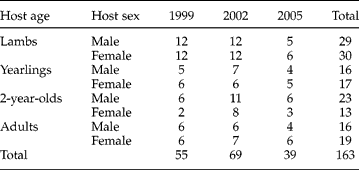
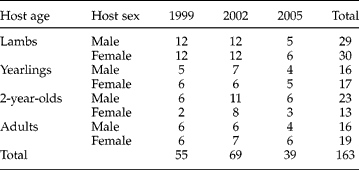
The focus of the study is the Village Bay area of Hirta (638 ha), the largest island of the St Kilda archipelago (57°49′N, 08°34′W) off the coast of Scotland. This remote site is the stronghold of the Soay sheep population that has survived unmanaged for hundreds of years and which has been studied continuously since 1985 (Clutton-Brock & Pemberton, Reference Clutton-Brock and Pemberton2004). The population is subject to extreme fluctuations with population crashes occurring when sheep numbers exceed food supply. This study used post-mortem worm count data from sheep that died in the crashes of 1999, 2002 and 2005 when the population decreased by 53, 52 and 32%, respectively, from the previous to the following August, based on island counts. At the time of sampling in the winter/spring months, lambs, yearlings, 2-year olds and adults were around 10, 22, 34 and >34 months old, respectively (table 1).
Sample sizes of Soay sheep from which Teladorsagia counts were obtained.
Collection and identification of nematodes
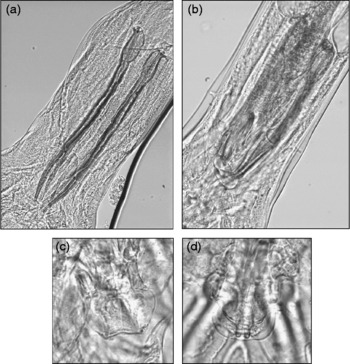
Nematodes were recovered from dead sheep and quantified as outlined by Craig et al. (Reference Craig, Pilkington and Pemberton2006). Two species of nematode occur in the abomasum, Teladorsagia and Trichostrongylus axei. Female Teladorsagia were differentiated from female T. axei by size and the presence of papillae on the neck region (T. axei females have a notch), and Teladorsagia males were differentiated from T. axei and into morphotypes T. circumcincta (synonym Ostertagia circumcincta), T. davtiani and T. trifurcata (synonym Ostertagia trifurcata) based on spicule and tail morphology. Teladorsagia circumcincta spicules are long and slender (fig. 1a). The minor morphs T. trifurcata and T. davtiani share similar short, stout spicules that have a thick median spine (fig. 1b). Further differentiation between the minor morphs was based on features of the dorsal part of the genital cone in accordance with Rose (Reference Rose1962) and Becklund & Walker (Reference Becklund and Walker1971); T. trifurcata has a prominent accessory bursal membrane supported by two rays (fig. 1c), whereas T. davtiani lacks an obvious membrane but exhibits two terminal protuberances on the cone (fig. 1d). Grillo et al. (Reference Grillo, Craig, Wimmer and Gilleard2008) have previously provided population genetic evidence that the three Teladorsagia male types in this population are morphological variants of the same species.
Morphological variation in Teladorsagia. (a) Adult male spicules of Teladorsagia circumcincta; (b) adult male spicules of Teladorsagia trifurcata and Teladorsagia davtiani. Posterior end of minor male morphs; (c) T. trifurcata, showing accessory bursal membrane supported by two rays; (d) T. davtiani, showing tuberosity on genital cone.

Statistical analyses
All statistical analyses were conducted on S-Plus version 6.2.1 (Insightful Corp., Seattle, Washington, USA) and GenStat Release 11.1 (VSN international Ltd, Hemel Hempstead, UK). For each model, the error structure (normality and constant variance) was evaluated graphically using the appropriate diagnostic plots (Crawley, Reference Crawley2003).
Total intensity of Teladorsagia
In order to test whether there was a significant difference in total Teladorsagia burden between crash years, a generalized linear model (GLM) with log link function and negative binomial error structure was fitted with count as the response variable and age, age2 (fitted as a quadratic to account for the fact that intensity increases until the age of 2 years before decreasing, see Craig et al., Reference Craig, Pilkington and Pemberton2006), host sex and crash year (as a factor) as explanatory variables.
Sex ratio (proportion male) of Teladorsagia
Sex ratio of Teladorsagia in each host was calculated as the proportion of males (males/(males+females)). Analysis of sex ratio was performed according to the method of Wilson & Hardy (Reference Wilson, Hardy and Hardy2002). A GLM (weighted regression using individual totals of male plus female nematodes as weights) with binomial error structure and logit link function was fitted with age, host sex, year (as a factor) and intensity of infection and all possible interactions as the response variables. The model was simplified by step-wise removal of non-significant terms using F-tests to account for overdispersion, as described by Wilson & Hardy (Reference Wilson, Hardy and Hardy2002).
Relative proportions of each male Teladorsagia morphotype
For illustration, the relative proportions of each male morphotype were calculated for each age class of sheep and for all sheep across all years by dividing the sum of each morph found by the sum of all male Teladorsagia, regardless of morphotype, within the particular age class, multiplied by 100 to give a percentage. Standard error for each proportion was calculated according to Fowler & Cohen (Reference Fowler and Cohen1990).
Prevalence and intensity of each minor male Teladorsagia morphotype
Prevalences of T. davtiani and T. trifurcata were analysed using a GLM with logit link function and binomial error structure with the presence or absence of each morph as a binary response (zero vs. non-zero counts), and tested for associations with host age, host age2, host sex, year (as a factor) plus intensities of the T. circumcincta male morph and Teladorsagia females as explanatory variables (excluding interactions).
Count data for T. davtiani and T. trifurcata were highly aggregated and best modelled using a linear model on log-transformed count data (excluding the zero counts) as the response variable and host age, host age2, host sex, year (as a factor) plus intensities of T. circumcincta male morph and Teladorsagia females as explanatory variables (excluding the interactions).
Results
Total intensity of Teladorsagia
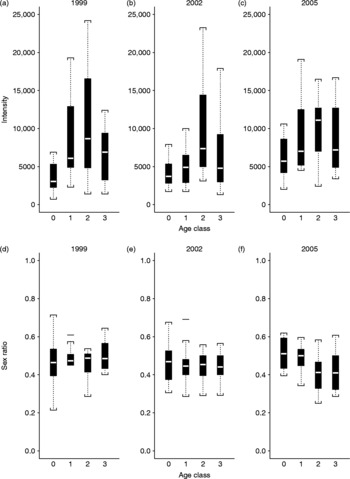
Teladorsagia intensity increased with age until the age of 2 years and then decreased (χ12 = 22.36, P < 0.0001). There was also an association with year; intensity was higher in 2005 than in the two previous crash years of 2002 and 1999 (χ22 = 8.18, P = 0.017; the final model explained 25.46% of the deviance; fig. 2). There was no significant association with host sex.
Teladorsagia intensity (a–c) and sex ratio (d–f; proportion male) by age class for each year (0, lambs; 1, yearlings; 2, 2-year-olds; 3, older than 2 years).

Sex ratio (proportion male) of Teladorsagia
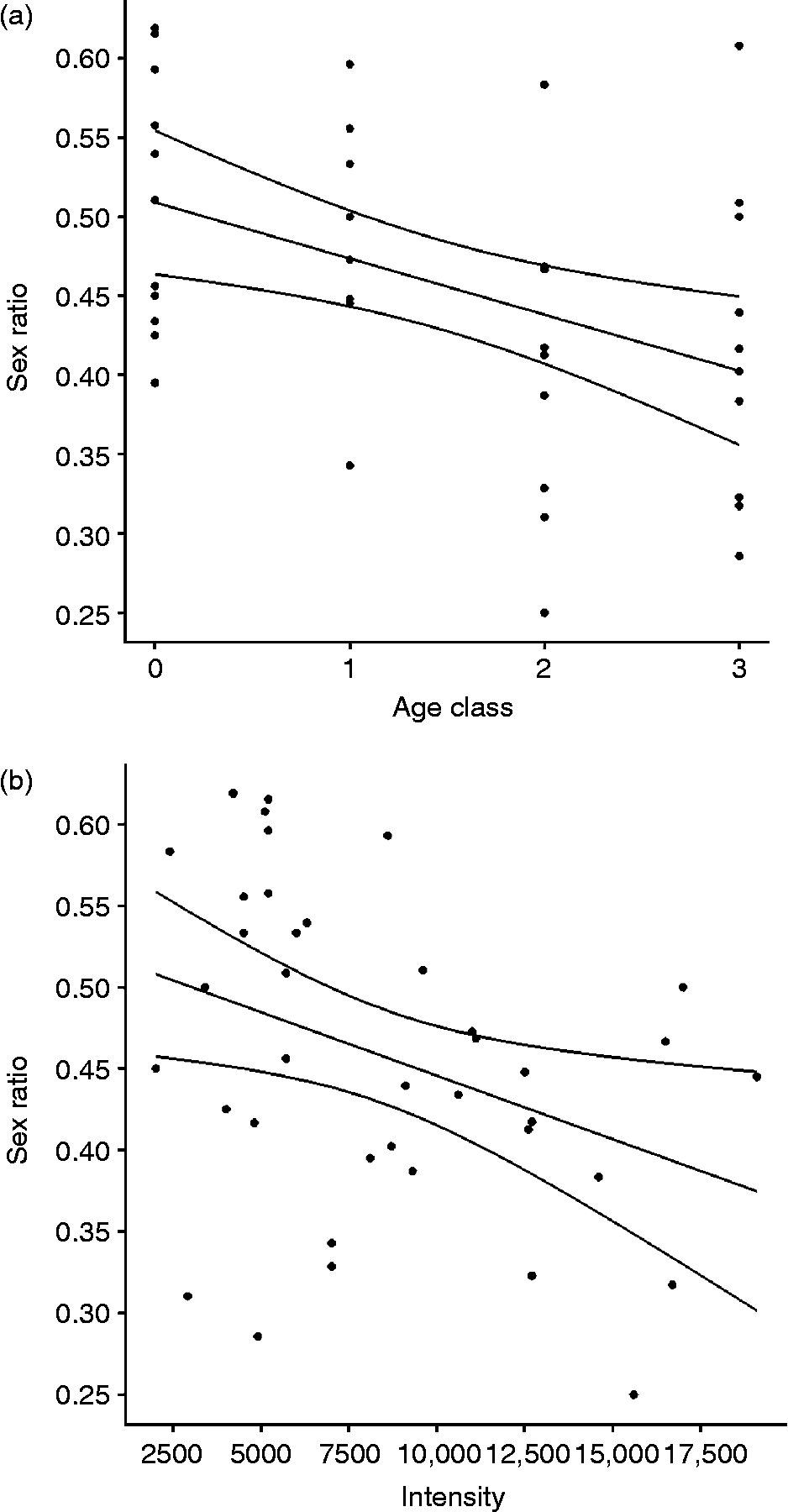
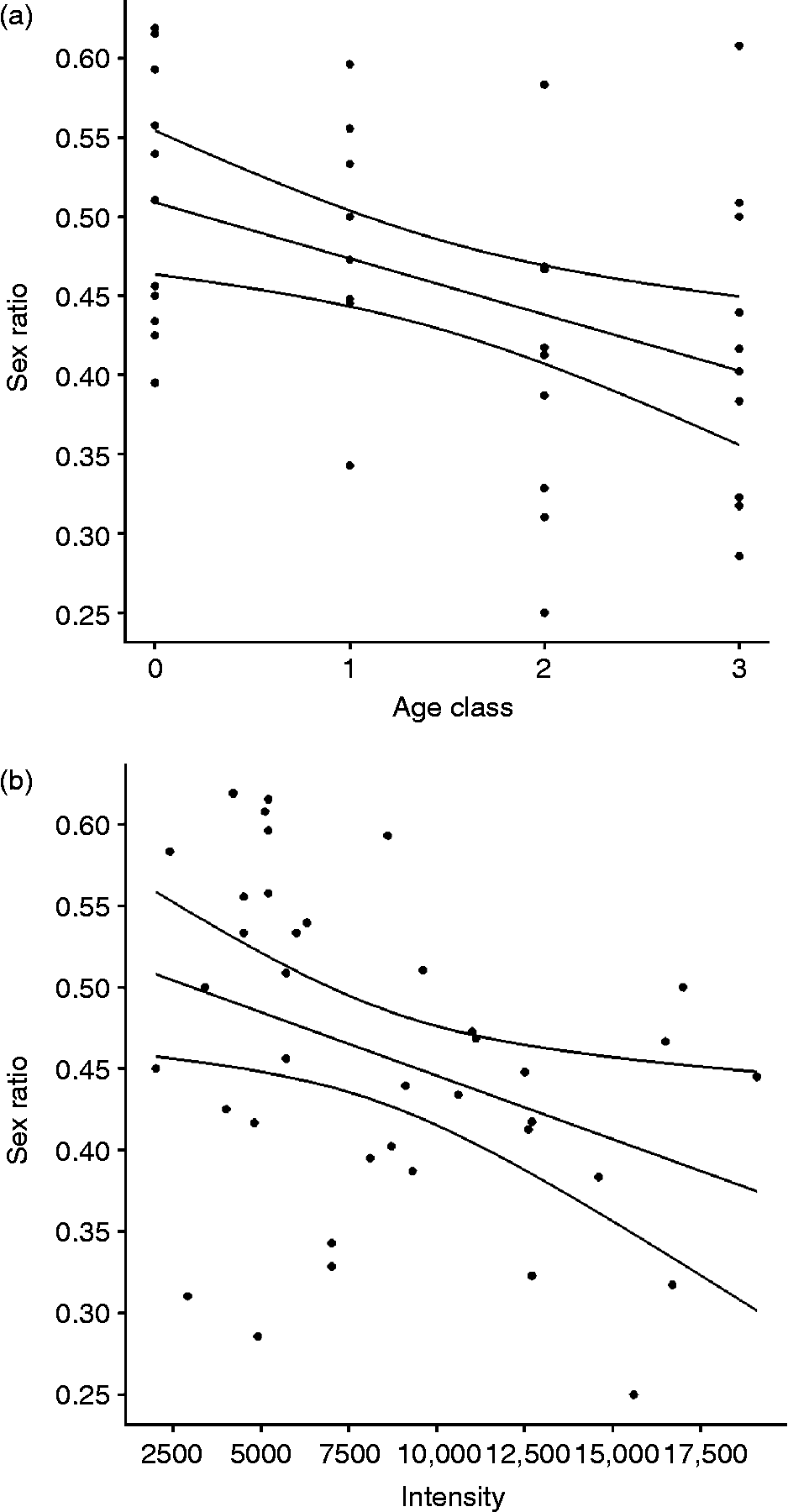
There was a significant interaction between host age and year on sex ratio (proportion male) (F 2,160 = 8.63, P = 0.0003; final model explained 15.63% of the variance). Due to the effect of year, sex ratio was also analysed within year and, in 2005, a negative association with host age (F 1,37 = 10.35, P = 0.002) and a marginally significant negative association with Teladorsagia intensity (F 1,37, P = 0.056; final model explained 32.77% of the variance) were found. In 1999 and 2002, no such associations were found and sex ratio was not associated with host sex in any year (table 2 and figs 2 and 3).
Summary of significant results from generalized linear model, with binomial error structure, testing for association between sex ratio (proportion male) and host age, sex and year and all possible interactions (F statistics were used to account for overdispersion).

Association between Teladorsagia sex ratio (proportion male) and (a) host age and (b) nematode intensity within all sheep sampled in 2005 (n = 39; line fitted with 95% confidence limits).
The relative proportions of each male Teladorsagia morphotype
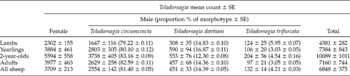
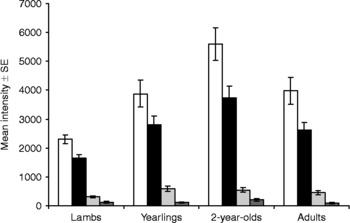
The proportions of each Teladorsagia male morph were calculated for each age class and across all hosts. Across all hosts in the study, the morphs always occurred in similar relative proportions; T. circumcincta made up 81.4% of all males, followed by T. davtiani at 14.39% and T. trifurcata at 4.21% (table 3 and fig. 4).
Mean intensity (±SE) of Teladorsagia nematodes recovered from sheep of both sexes and different age classes across all years (see table 1). Male nematodes are separated according to morphotype with relative proportions given in parentheses.

Mean intensity ( ± SE) of Teladorsagia nematodes by sex and male morphotype recovered from sheep of both sexes and different age classes across all years (see tables 1 and 3). □, Teladorsagia female; ■, Teladorsagia circumcincta male;  , Teladorsagia davtiani male;
 , Teladorsagia trifurcata male.

Prevalence and intensity of each minor male Teladorsagia morphotype
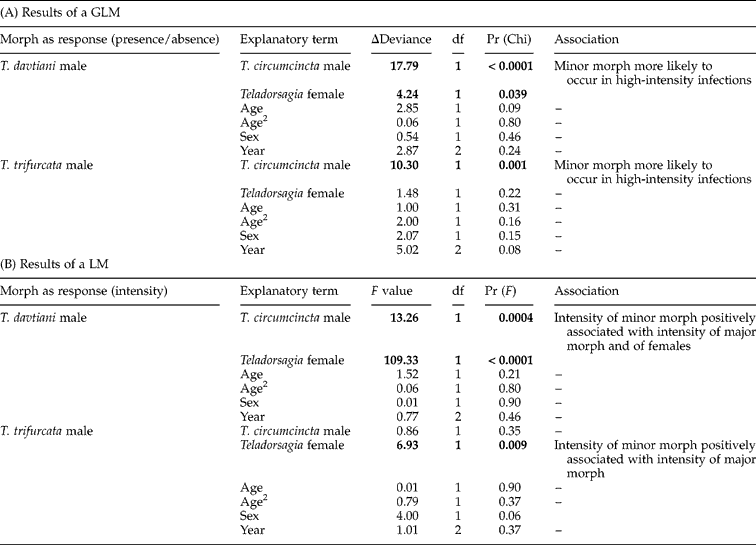
Across all hosts (n = 163), prevalence of the T. circumcincta male morph was 100%, T. davtiani was 91.41% and T. trifurcata was 61.35%. Presence of T. davtiani was associated with intensity of T. circumcincta males (χ12 = 17.79, P < 0.0001; final model explained 23% of the deviance) and Teladorsagia females (χ12 = 4.24, P = 0.04; final model explained 23% of the deviance). Similarly, the presence of T. trifurcata was associated with intensity of T. circumcincta males (χ12 = 10.30, P = 0.001; final model explained 4.7% of the deviance). None of the other explanatory variables, namely host sex, age (also fitted as a quadratic) or year, was associated with the presence of either minor male morph (table 4).
(A) Results of a generalized linear model (GLM), with binomial error structure, testing for an association between host age (also as quadratic), sex, year, intensity of Teladorsagia circumcincta males, Teladorsagia females and presence/absence of either Teladorsagia davtiani or Teladorsagia trifurcata males. (B) Results of linear model (LM), with normal error structure, testing for an association between the same explanatory variables as above and intensity (log transformed counts >0) of each minor morph.
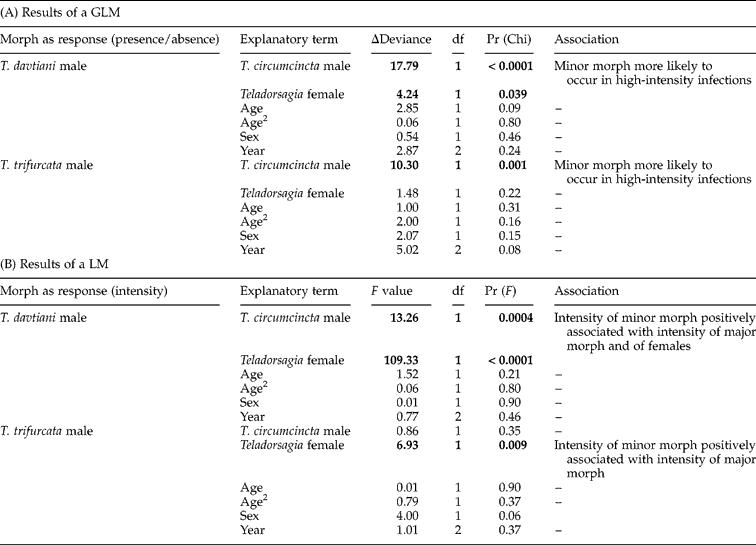
Significant results are highlighted in bold. Dashes denote non-significance.
Intensity of T. davtiani was explained by intensity of T. circumcincta males (F 1,146 = 13.26, P < 0.0005) and by intensity of Teladorsagia females (F 1,146 = 109.33, P < 0.0001; final model explained 45.64% of the variance). Intensity of T. trifurcata was explained by intensity of Teladorsagia females (F 1,97 = 6.93, P = 0.009; final model explained 11.08% of the variance). Neither host sex, age (also fitted as a quadratic) nor year was associated with intensity of T. davtiani or T. trifurcata (table 4).
Discussion
The notoriety of T. circumcincta as a pathogenic parasite of sheep (Stear et al., Reference Stear, Fitton, Innocent, Murphy, Rennie and Matthews2007) has prompted much research into the species at the population level (Stear et al., Reference Stear, Baiden, Bishop, Buitkamp, Duncan, Gettinby, McKellar, Park, Parkins, Reid, Strain and Murray1997). Sex ratio and frequency of male morphological polymorphism are dynamic aspects of the population structure and potentially important to the fitness of the parasite. Experimental infections have shown that both host and nematode-related factors can influence these characteristics; however, there have been no comprehensive studies from the wild. To address this, both sex ratio and morphological polymorphism in an endemic population of T. circumcincta infecting the wild Soay sheep of St Kilda were analysed for association with host age and sex and nematode infra-population size.
In a previous study using post-mortem nematode count data from the host population crashes of 1999 and 2002, T. circumcincta intensity was found to increase in hosts until the age of 2 years before decreasing, with no difference between the sexes or between years (Craig et al., Reference Craig, Pilkington and Pemberton2006). The addition of data from 2005 has confirmed this pattern in the host, but shown that the parasite was generally more abundant in 2005 than it was in 1999 and 2002 (fig. 2). In 2005 only, sex ratio (proportion male) was negatively associated with host age and tended to be negatively associated with nematode intensity (table 2 and figs 2 and 3). The fact that this was not found in 1999 or 2002, when general abundance was lower, may either suggest that this result is a statistical artefact or that a threshold level of intensity is required to detect an association. If real, the decrease in male nematode proportion with host age could be explained by differential mortality between the sexes. Waller & Thomas (Reference Waller and Thomas1978) found a reduction in the proportion of T. circumcincta male nematodes over time in domestic lambs and considered this to be due to greater susceptibility of male worms to the effects of the host immune system. The weak negative association of sex ratio (proportion male) and nematode intensity found in this study contradicts the findings of Poulin (Reference Poulin1997), whose meta-analysis of data from experimental infections gave the opposite result. However, the comparative analyses in natural infections did show a similar trend to the findings reported in this study (Poulin, Reference Poulin1997). To our knowledge, this is the first time that host age as well as nematode intensity have been associated with sex ratio in a natural T. circumcincta infection.
Within the male nematode population, three morphotypes exist; the predominant T. circumcincta morph and the minor morphs T. davtiani and T. trifurcata. This study examined the frequency of the minor male morphs and their association with the host and nematode infra-population, which is more detailed than most surveys that tend not to differentiate between the minor morphs (Becklund, Reference Becklund1962; Lichtenfels & Hoberg, Reference Lichtenfels and Hoberg1993; Drozdz, Reference Drozdz1995). Considering the fact that intensity of Teladorsagia varies with host age, it is interesting to note that the three morphotypes always occurred in more or less fixed proportions. This was first shown in a previous study using data from the 1999 and 2002 population crashes (Craig et al., Reference Craig, Pilkington and Pemberton2006). With the addition of data from 2005, this study showed that, within the male population, T. circumcincta predominated constituting 81.4%, T. davtiani was the second most frequent morph with 14.36%, followed by the comparatively rarer T. trifurcata, which only constituted 4.21% in all hosts examined (table 3 and fig. 4).
Neither host age nor sex affected the prevalence or intensity of the minor morphs. The presence of the minor morphs was mainly associated with intensity of the male T. circumcincta morph and, in hosts where all morphs occurred, intensity of the minor morphs was more associated with intensity of females (table 4). In experimental infections, Suarez et al. (Reference Suarez, Cabaret and Gruner1995) and Leignel & Cabaret (Reference Leignel and Cabaret2001a) found that a higher proportion of the minor morphs were found in more susceptible sheep, and that intensity of infection was the most important factor in explaining frequency of occurrence of the minor morphs.
It is not known whether the male morphotypes of T. circumcincta adopt alternative mating strategies in the host. Artificial selection of the minor morphs (not differentiated) has been achieved by mating them with virgin females, from the previously selected progeny, resulting in an orderly increase in incidence of the minor morph and an orderly decrease in incidence when selection ceased (Lancaster et al., Reference Lancaster, Hong, Michel, Stone, Platt and Khalil1983). If the morphs adopt alternative mating strategies, it could partly explain why they occur in characteristic proportions. If the morphological traits (fig. 1) are inherited and there is an underlying cost to being a minor morph, it is possible that natural selection shapes the relative proportions of the morphs observed in the field. Although it was not possible to examine the effects of season on the frequency of morphological polymorphism in T. circumcincta in the Soay sheep population, evidence from field surveys in France indicated a seasonal influence, where a higher proportion of the minor morphs were recorded in autumn than in spring, suggesting lower overwinter survivorship (Cabaret et al., Reference Cabaret, Morales and Gruner1984; Suarez et al., Reference Suarez, Cabaret and Gruner1995).
Taken together, these results show that, in a year of generally higher Teladorsagia abundance, nematode sex ratio (proportion male) was associated with host age and nematode intensity. The Teladorsagia population became more female biased with increasing host age and to some extent increasing nematode intensity. If this was due to higher mortality of males than females, all male morphotypes were apparently equally susceptible, as the relative proportions were not affected by host age. The frequency of occurrence of the minor morphs was most associated with intensity of nematodes. Further research is required to ascertain whether the different morphotypes have alternative mating strategies and whether their mating probability is influenced by sex ratio.
Acknowledgements
We thank A. Donald, H. Lloyd, A. Mayo, T. Innocent, L. Daniells and many other volunteers for their help with sample collection, Dr K. Wilson for insightful comments on the manuscript and W. Luo for statistical advice. Professors T. Clutton-Brock, B. Grenfell, M. Crawley, T. Coulson, Dr L. Kruuk and NERC are acknowledged for long-term management and funding of the Soay sheep project. The National Trust for Scotland and Scottish Natural Heritage gave permission to work on St Kilda. Logistical support was given by MOD, QinetiQ and Eurest staff on St Kilda and Benbecula. This project was funded by a Wellcome Trust Biodiversity Studentship.