Introduction
College English refers to a type of English course offered to non-English majors at tertiary level in mainland China. In recent years, however, College English has been criticised as ‘deaf and dumb English’ (Wu, Reference Wu2004; Zhang, Reference Zhang2002) because of Chinese students’ perceived weaknesses in listening and speaking. As Zhang (Reference Zhang2002), Director of the Department of Higher Education in the Chinese Ministry of Education (MOE), explains, ‘Chinese university students can neither speak English nor understand it when they hear the language spoken’ (p. 4). To improve the situation, Zhang urges that ‘[w]hile reading has to be reduced properly, listening and speaking should be increased in College English textbooks’ (ibid.: 5). In other words, it is listening and speaking rather than reading that should be emphasised.
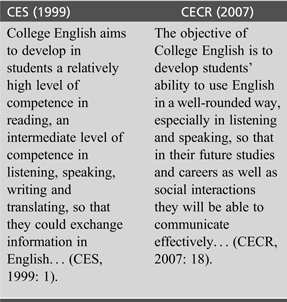
Consequently, 2002 saw the launching of a major reform of College English teaching. One of the most striking features of the reform is the replacement of the College English Syllabus (CES) (MOE, 1999), which guided the teaching of College English from the 1980s to 2004, by the College English Curriculum Requirements (CECR) (MOE, 2007), which has been the guidance of College English teaching since 2004. The teaching goal has been shifted from prioritising reading in the CES to listening and speaking in the CECR, as indicated in Table 1.
Policy shift in the primary goal of CE teaching

To effect the change, the MOE released a succession of reform documents, for example:
• 15 December 2003: Announcement on the launching of the reform of College English teaching at universities as trial sites (MOE, December 2003);
• 30 January 2004: Announcement on the publication and distribution of the College English Curriculum Requirements (for trial implementation) (MOE, January 2004);
• 18 February 2004: Announcement on the implementing of the reform of College English teaching at universities as first trial sites (MOE, February 2004);
• 9 June 2005: Announcement on the application for the extension program of the reform of College English teaching at universities as second trial sites (MOE, June 2005).
The number of documents released within such a short period seems to indicate that policymakers have a strong desire to make a breakthrough in College English teaching.
To place the focus of foreign/second language (L2) education on the oral form is not unusual. As Cook (Reference Cook, Cummins and Davison2007) has observed, language teaching methodology is dominated by an external goal with its target being actual language use outside the classroom evaluated against the achievement of linguistic competence of a native speaker, rather than an internal goal evaluated against progress towards achieving the educational aims of the language curriculum itself.
The external goal of making L2 learners become native speakers is controversial, particularly in countries like China where English is a foreign language and it is hard for people to have access to natural English speaking environments.
After illustrating the context of College English, this article explores some of the problems with oral English as a focus for the education of future professionals in the East Asian context. It does this first by considering the mismatches between the Chinese culture of teaching and learning and the communicative language teaching (CLT) methodology that the new teaching goal entails, and then moves on to reflecting on classroom realities, on the reduction of a productive vocabulary size in the CECR, and on learners’ future needs in their international communities.
The context
There are about 50,000 teachers teaching College English to 19,000,000 students (Wu, Reference Wu2004) in 2,148 universities in mainland China (Gaolu, Reference Gaolu2012). College English comprises two types of class: (1) Intensive Reading Class (IRC), and (2) Listening Class (LC) (also called listening and speaking class). While IRC focuses on learning a language through its written form, LC focuses on familiarising learners with the spoken form of the target language.
College English teaching has been under the guidance of official documents of the MOE, for example, the CES and the CECR as mentioned earlier. National tests - College English Test Band 4 (CET4) and Band 6 (CET6) - have an impact on teaching. Now students take part in these tests held in June and December every year (Baike, Reference Baike2015) to see whether they have met certain requirements stipulated in the CECR. Passing the CET4 indicates that a student has met the ‘Basic Requirements’, and passing the CET6 suggests that he/she has met the ‘Intermediate High Requirements’ - their English is at a higher level. Both students and teachers pay much attention to these tests because the results of the CET4 and CET6 are usually valued by employers.
College English teaching is textbook-based. New Horizon College English (Reading and Writing) (Zheng, Reference Zheng2008) is one of the textbooks used most widely in IRC. The series is made up of four books, with Book I as the primary level and Book IV as the advanced level. In each book, there are 10 units. Each unit consists of two texts: Text A and Text B.
The contents of the texts range across topics such as people, life, love, cultural differences, education, philosophy, language learning, sports, environment protection, commerce, history, science fiction, arts, social custom, and so on. The texts themselves are simple reading passages chosen from a range of sources including books, novels, magazines and newspapers in English. In terms of genre, while most texts are narration and argumentation, some are exposition and description. In general, Text A is the focus of teaching, while Text B is largely ignored in practice because of instructional time limits.
Text A is compiled as a main text with about 30 new words and 14 exercises on reading comprehension, vocabulary use, cloze (e.g. a passage with 10 blanks each of which needs to be filled in with the best item from among four given choices), translation (e.g. from Chinese into English and vice versa), and text structure analysis; while Text B is compiled as complementary. In contrast, although Text B has a similar amount of vocabulary to that in Text A, there are only four exercises attached to it: two are on reading comprehension, and two are on vocabulary.
The length of texts varies with different books. The books provide a word count of the length of Text A and Text B. Based on the statistics at the end of each book, the average length of a text in Book I is 688 words, in Book II 766 words, in Book III 880 words, and in Book IV 891 words.
While IRC is totally textbook-based, LC is relatively flexible. Teachers could use listening materials from different textbooks - for example, New Horizon College English (Viewing, Listening and Speaking) (Wang, Reference Wang2005), College English (Focus Listening and Speaking) (Yu & Li, Reference Yu and Li2006) - or from other sources, such as the CET4, the Voice of America (VOA) or the British Broadcasting Corporation (BBC). Textbooks for LC are different from those for IRC in that each unit in a textbook contains a vocabulary of about ten new words, short dialogues or passages about daily life, work, study, or hot topics. News reports from VOA or BBC are usually selected as complementary to a textbook because they are ‘new’ and, phonologically, the voices are viewed as representing standard American English or British English. When teachers select materials from the CET4, for example, short dialogues or passages previously used as test items, the selection is test-oriented.
In classroom teaching, teachers are encouraged to use English as much as possible. But how much English is actually used inevitably varies with the teacher. Code-switching between English and Chinese is common in classrooms. Usually a teacher with a high level of English proficiency speaks more in English than in Chinese.
The above situation shapes College English teaching as well as the implementation of the policy. To further analyse the situation, this study finds that it is hard to put into operation the new teaching goal largely because of hindrances to the policy, as will be discussed below.
Hindrances to the new teaching goal
1) The new policy entails CLT, which conflicts with the Chinese culture of teaching and learning
The new teaching goal prioritising oral English entails the use of CLT. From our perspective as teachers who have taught English as a foreign language for over 20 years in different universities in China, we are aware of the very real difficulties with CLT-inspired approaches faced by teachers in our own contexts.
Hu (Reference Hu2002) documents how CLT is resisted in classrooms where Englis is taught, as the result of its conflict with Chinese culture, particularly in terms of the nature of teaching and learning and roles and responsibilities of teachers and students. Hanyu, a Chinese philosopher who lived 768–824, defined a teacher as ‘one who transmits wisdom, imparts knowledge, and resolves doubts’ (Cheng, Reference Cheng1984: 22). This definition continues to shape teachers and their teaching today, and helps to explain why teaching in Chinese classrooms is usually teacher-centered.
In China, learning is generally viewed as equivalent to reading. This is reflected in the following well-known Chinese sayings: ‘It is when you are using what you have learnt from books that you wish you had read more’, ‘To fly high, a bird flaps its wings first; To make progress, you read books first’, ‘To position yourself in a society, you have to learn; To learn, you have to read’.
Additionally, both teachers and students view passing the CET4 and CET6 as a matter of meeting the ‘Basic Requirements’ and the ‘Intermediate High Requirements’ in the CECR, which, in this sense, makes College English teaching and learning test-oriented. The new teaching goal prioritising oral English, unfortunately, offers little help for this orientation.
The resistance from deeply-held Chinese cultural values helps us understand why ‘[a]lthough many teachers claim to be followers of CLT, this is often a matter of paying lip-service’ (Hu, Reference Hu2002: 94). A variety of research on teaching English as a foreign language has shown that CLT simply does not work in non-English speaking countries (Rao, Reference Rao2013). More disappointingly, there is little evidence that CLT works more effectively than the traditional approach of presentation, practice and production (P-P-P) (Richards, Reference Richards2006). The CLT approach may well be the wrong policy target in countries like China where English is not spoken as a first language.
2) Classroom realities hindering the implementation of the policy
In China, implementing a policy that entails the use of CLT can also be problematic when we consider the realities of English teaching situations which lack the ‘necessary resources’ required by the approach. For example, ‘big class size, limited instructional time, teachers’ lack of language proficiency and sociolinguistic competence, examination pressure…’ (Hu, Reference Hu2002: 94) have all been observed to hinder CLT in China. Along with other constraints, some of these problems were pointed out again by Wu, the Vice-Minister of the MOE, based on a recent investigation of 340 Chinese universities:
large class sizes (over 40–80), heavy teaching workload (16–20 class periods/week), low academic qualifications (72% of teachers holding bachelor's degree), teachers’ low language proficiency, lack of in-service training, and classrooms where teacher talk dominated and students seldom had opportunities to speak (Wu, Reference Wu2004).
This situation in China means it is disappointingly hard to meet the conditions to make CLT work. The approach is blind to its context because of ‘its standardized native speaker norms’ (Alptekin, Reference Alptekin2002: 57), which ‘means L2 learning can only lead to different degrees of failure, not degrees of success’ (Cook, Reference Cook, Cummins and Davison2007: 240). This is reflected in the criticism of College English as providing ‘deaf and dumb English’, as mentioned at the beginning of this article. The policy of prioritising oral English is in contrast with Saville-Troike's (Reference Saville-Troike2006: 135–137) argument that in teaching a foreign language it is more important to develop students’ academic competence focusing on reading than interpersonal competence focusing on speaking.
3) Reducing productive vocabulary means weakening the basis of oral English
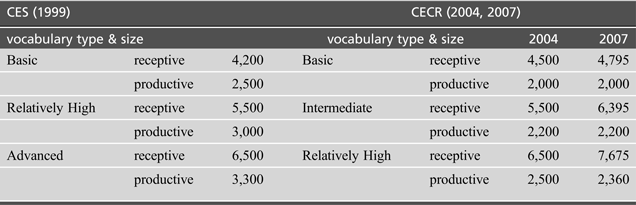
Four years after the launch of the College English teaching reform, the CES, which took reading as its teaching goal, was replaced by the CECR, which prioritises oral English. Table 2 compares these two official documents in terms of their vocabulary requirements.
Comparison of CES and CECR Vocabulary Requirements by Size
Sources: CES 1999; CECR 2004; CECR 2007
The table echoes Read's (Reference Read2000) observation that for both first and second language users the number of words they can recognise and understand is rather larger than the number they use in their own speech and writing. The distinction could be explained by the fact that acquiring productive knowledge of a word is more complex than acquiring receptive knowledge of it (Laufer, Reference Laufer1998; Nation, Reference Nation2001), and that consequently ‘[d]evelopment of receptive ability must normally precede productive ability in any language’ (Saville-Troike, Reference Saville-Troike2006: 137). According to Celce-Murcia and Olshtain (Reference Celce-Murcia and Olshtain2000), listening and reading require receptive vocabulary, while speaking and writing are based on productive vocabulary. However, in terms of foreign language learning, it would be an oversimplification to say that listening is totally a receptive skill.
Reflecting on our own experiences in learning Chinese as our first language and English as a foreign language, we see the biggest difference as follows: we acquired the spoken form of Chinese before learning its written form, while in our English learning, there was no acquisition but only learning; we had to learn both written and spoken English in school, and the former is the basis of the latter.
To understand an English word spoken to us, we must be at least familiar with the pronunciation and meaning(s) of that word among the written words we could recognise visually. Yet it does not necessarily follow that words which are visually recognisable can also be recognised when they are heard. Given the fact that our knowledge of oral English is based on our written knowledge, the size of our audibly recognisable stock of words is smaller than that of those that can be visually recognised. It would be safe to say that a productive vocabulary is the precondition for not only speaking and writing, but also listening.
However, a productive vocabulary in the CECR (MOE, 2004, 2007), which focuses on oral English as a teaching goal, is smaller at all levels of requirements than that in the CES (1999), which took reading as the priority. Specifically, the productive vocabulary required at three different levels is reduced from 2,500, 3,000, and 3,300 in the CES (1999) to 2,000, 2,200, 2,500 in the CECR (MOE, 2004). What is more, at the relatively higher requirements in the revised CECR (MOE, 2007) it is further reduced to 2,360.
Language is ‘the substance of what is being learnt’ (Halliday, Reference Halliday2007: 270). The very basic thing of this substance is vocabulary. Instead of strengthening the basis of oral English, the reduction of a productive vocabulary may actually weaken the basis of it.
4) Failing to understand learners’ future needs
For the vast majority of students who are learning English in China or other Asian countries, the ultimate goal is not to become members of local communities in English speaking countries ‘usually mediated through the spoken language’, but to qualify as members of international communities, for which they have to go ‘through the secondary socialisation of education and training, involving a heavy investment in the written language’ (Widdowson, Reference Widdowson1997: 143).
In contrast to local communities defined as the first or primary, international communities are referred to as the secondary and are mediated through written language. A policy entailing the use of CLT may not suit the tertiary education of future professionals from non-English speaking countries or regions where the goal of language teaching is not to reproduce native speakers but to produce L2 users (Cook, Reference Cook, Cummins and Davison2007), who, as Widdowson (Reference Widdowson1997) points out, are capable of communicating ‘with like-minded people’ all over the world by using ‘professional and academic registers’ which ‘tend to retain a written mode even when spoken’ (p. 143).
This is the reality of English as an international language for professionals worldwide. ‘Even in this modern age of multimedia and high-tech environments’, the majority of us still ‘rely on our reading ability in order to gain information or expand our knowledge’ (Celce-Murcia & Olshtain, Reference Celce-Murcia and Olshtain2000: 118), in particular, when our reliance on the Internet is, first of all, characterised by written language.
Conclusion
The new teaching goal of prioritising listening and speaking entails the implementation of CLT and classroom interaction, which conflict with the Chinese culture of teaching and learning. Among other classroom realities, it is hard for learners to have enough opportunities to speak in large classes. This perhaps explains why although policy-makers ‘promote communicative and learner-centred approaches, in reality, the roles of teachers and learners remain much as they always were’ (Zhang & Head, Reference Zhang and Head2010: 3). Additionally, the policy-makers’ reduction of a productive vocabulary seems to make their policy linguistically groundless.
There is nothing inherently wrong with emphasising oral English. However, when we take it as the top priority all the efforts would prove as futile as drawing water with a bamboo basket because in Chinese settings the oral form of English would become a stream losing its source and a tree losing its roots (Dong, Reference Dong2003). The policy treats the symptoms but not the disease, for it ignores the fact that the spoken form of English is not acquired but learned, and develops from its written form in the Chinese context. We can improve oral English on the basis of written proficiency, not vice versa.
The goal of language teaching is not to reproduce native speakers in local communities in which people are mediated basically by the spoken language, but to produce register users who are able to communicate with their counterparts largely mediated by the written language in international communities. To become such register users is also the ultimate goal of English learning for Chinese university students.
When all of the above are taken into consideration, we may see that the policy is not only hard to implement but also unlikely to guide teaching in the right direction. The goal of College English needs to be redefined by taking reading as the priority, fitting not only the English learning reality of the written form of English as the source of its spoken form in China, but also Chinese culture and Chinese university students’ future needs in utilising English as an international language in their specialised fields.
HUI DU is Professor in Applied Linguistics at Hohai University in Nanjing, China, and holds a PhD from the University of South Australia (UniSA) where his study (2007–2010) was supported by scholarships of an IPRS (International Postgraduate Research Scholarship) and a USAPA (UniSA Postgraduate Award). He has taught English in Chinese universities since 1985. His research interests include applied linguistics, teacher talk, classroom discourse analysis, sociocultural theory, (interactional) sociolinguistics, and teaching methodology. Email: duhuig@126.com
HONGDI GUAN is Associate Professor in Applied Linguistics at China Pharmaceutical University in Nanjing, China. She has taught English at a tertiary level in China for over 30 years. Her research interests include TESOL, teaching methodology, and English as an international language. Email: huihongdu@126.com