
1. Introduction
The existence of a sequence of eddies near a corner in Stokes flow was established theoretically by Moffatt (Reference Moffatt1964). The eddies, which decrease in intensity as the corner is approached, are now customarily referred to as Moffatt vortices. Moffatt vortices were subsequently observed in V-notch experiments by Taneda (Reference Taneda1979) and in corners and channels by the rotation of a cylinder close to a rigid boundary (Davis & O'Neill Reference Davis and O'Neill1977). Moffatt vortices appear in corners bounded by two solid surfaces or one solid and one free surface (Moffatt Reference Moffatt1964) and also in rectangular cavities (Pan & Acrivos Reference Pan and Acrivos1967). More recently, the presence of neighbouring Moffatt vortices adjacent to an interface between two liquids near a wall was established theoretically by Shtern (Reference Shtern2012, Reference Shtern2014) and experimentally by Naumov et al. (Reference Naumov, Sharifullin, Kravtsova and Shtern2020). A comprehensive review of cellular patterns that include the aforementioned theoretical results has recently appeared (Shtern Reference Shtern2018a). The conditions under which the sequence of eddies discovered by Moffatt (Reference Moffatt1964) can be finite or infinite were discussed by Kalita, Biswas & Panda (Reference Kalita, Biswas and Panda2018) and Shtern (Reference Shtern2018b).
Moffatt-vortex-like behaviour was recently observed in the viscous regime of electron fluids (Nazaryan & Levitov Reference Nazaryan and Levitov2021). In particular, current entering and leaving a strip from two oppositely located slits generates regions where adjacent vortices rotate with an opposite sense of circulation. These Moffatt vortices drive an electric current against the applied field resulting in a negative non-local voltage. This behaviour is important because it is reminiscent of the zero electrical resistance observed in superconducting metals (Levitov & Falkovich Reference Levitov and Falkovich2016).
Avron, Seiler & Zograf (Reference Avron, Seiler and Zograf1995) and Avron (Reference Avron1998) pointed out that the hydrodynamic equations are endowed with a second viscosity coefficient, termed odd or Hall viscosity, when time-reversal symmetry is broken either spontaneously or due to an external magnetic field or rotation. The Cauchy stress tensor acquires terms of a non-dissipative nature, in addition to its usual rate-of-strain part. Odd viscosity was recently observed to persist and was experimentally measured in a colloidal liquid consisting of spinning magnets (Soni et al. Reference Soni, Bililign, Magkiriadou, Sacanna, Bartolo, Shelley and Irvine2019). This anomalous stress also manifests itself as a divergence of intervortex interactions in the treatment of a dense system of vortices (Wiegmann & Abanov Reference Wiegmann and Abanov2014).
In this article we show that odd viscosity decreases the size and intensity of Moffatt vortices in a corner formed by a solid substrate and a free interface in Stokes flow. The effect is present because odd viscosity mediates to create a normal-stress-induced shear stress at the liquid–gas interface. The new shear stress is out of phase and oppositely directed with respect to the interfacial liquid velocity. It squeezes the vortices and damps their rotation. Thus, Moffatt vortices lying in a corner, or in a layer between a solid substrate and a free surface, will decrease in size and intensity. Odd-viscosity-mediated generation of such a stress is mentioned in the literature of chiral active matter (Soni et al. Reference Soni, Bililign, Magkiriadou, Sacanna, Bartolo, Shelley and Irvine2019), damping of gravity waves (Abanov, Can & Ganeshan Reference Abanov, Can and Ganeshan2018), bubble dynamics (Ganeshan & Abanov Reference Ganeshan and Abanov2017) and the thermocapillary effect (Kirkinis & Andreev Reference Kirkinis and Andreev2019). As a consequence, we expect that Moffatt vortices can now be observed with greater facility in an experiment. Odd viscosity also increases the range of corner angles over which Moffatt vortices can be observed, and, in general, shows a tendency to moderate singular behaviour.
This article is organized as follows. In § 2 we discuss the properties of the stress tensor associated with odd viscosity and tabulate its elements in two coordinate systems. In § 3 we consider the nature of Stokes flow in a corner, bounded by a solid boundary and a free surface and driven at large distances. Odd viscosity passivates Moffatt vortices, decreasing their size and reducing their intensity. This behaviour could better facilitate the observation of these vortices in a corner. In § 4 we demonstrate how the occurrence of Moffatt vortices in a liquid layer between a horizontal flat free surface and a horizontal substrate, predicted by Moffatt (Reference Moffatt1964), is modified. This situation corresponds to the limiting case of zero corner angle, and as observed in its finite-angle-corner counterpart, their size and intensity drop off on increasing the odd viscosity coefficient. Both size and intensity reach a plateau where the eddy behaviour is independent of the value of odd or even viscosity (as long as their ratio exceeds a certain value).
Odd viscosity shows a tendency to moderate singular flow behaviour. Thus, in § 5 we show analytically how odd viscosity reverses singular behaviour for a liquid in a corner with one free surface, the flow now being driven by an external tangential stress of ‘shear wind’ type (Davis, Gratton & Davis Reference Davis, Gratton and Davis2010). In § 6 we comment on open questions related to odd viscosity and emphasize the industrial and biomedical relevance of the work developed in the present article.
2. Definition of the stress tensor associated with odd viscosity
In an incompressible liquid with broken time-reversal symmetry, the Cauchy stress tensor  ${\boldsymbol {\sigma }}$ reads (Avron Reference Avron1998)
 \begin{equation} {\boldsymbol{\sigma}} ={-}p{\boldsymbol{I}}+ {\boldsymbol{\sigma}}^{e} + {\boldsymbol{\sigma}}^{o}. \end{equation}
In two dimensions
 \begin{equation} \sigma^{e}_{ik} = \eta_e \left( \frac{\partial u_i}{\partial x_k} + \frac{\partial u_k}{\partial x_i} \right) , \quad i=1,2, \ k=1,2, \end{equation}
is the standard (even) deviatoric part of the Cauchy stress tensor with standard (even) viscosity  $\eta _e$, while
 ${\boldsymbol {\sigma }}^{o}$ is the odd part of the Cauchy stress tensor which arises in the presence of time-reversal symmetry breaking due, for instance, to a magnetic field. A general form for the Cauchy stress tensor (Lifshitz & Pitaevskii Reference Lifshitz and Pitaevskii1981, § 13) contains the odd (or anomalous) stress tensor as a special case and depends on the orientation of the magnetic field. We tacitly assume the presence of a magnetic field perpendicular to a flow in the
 $x$–
 $y$ plane. In this case, the odd part of the Cauchy stress tensor is characterized by a single odd viscosity coefficient and its components read (Avron Reference Avron1998; Lapa & Hughes Reference Lapa and Hughes2014)
 \begin{equation} \sigma^{o}_{ik} ={-} \eta_o (\delta_{i1}\delta_{k1} - \delta_{i2}\delta_{k2} ) \left( \frac{\partial u_1}{\partial x_2} +\frac{\partial u_2}{\partial x_1} \right) + \eta_o \left( \delta_{i1}\delta_{k2} + \delta_{i2} \delta_{k1} \right) \left( \frac{\partial u_1}{\partial x_1} - \frac{\partial u_2}{\partial x_2}\right), \end{equation}
for  $i=1,2$ and
 $k=1,2$, where
 $\eta _o$ is the odd viscosity coefficient and
 $\delta _{ij}$ (with
 $i=1,2$ and
 $j=1,2$) is the Kronecker delta.
It is far more illuminating to collect (2.2) and (2.3) in a single compact formula in terms of the rate-of-strain tensor. Thus, the total stress (2.1) becomes
 \begin{align} {\sigma}_{ij} ={-}p\delta_{ij}+ {\eta}_{ik} \left(\frac{\partial u_k}{\partial x_j} + \frac{\partial u_j}{\partial x_k}\right), \quad i = 1,2,\ j = 1,2, \quad \text{where} \ {\eta}_{ik} = \left( \begin{array}{@{}cc@{}} \eta_e & -\eta_o \\ \eta_o & \eta_e \end{array} \right). \end{align}
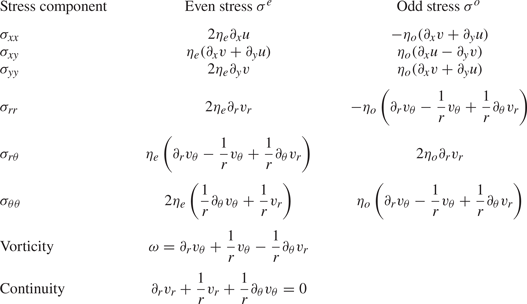
We emphasize that the Cauchy stress tensor  ${\boldsymbol {\sigma }}$ remains symmetric in the presence of odd viscosity. The components of the even and odd parts of the stress, in two coordinate systems, are collected in table 1.
Explicit formulas for even and odd stress defined in (2.2) and (2.3), respectively, in Cartesian coordinates with velocity  $\boldsymbol {u}=(u,v)$ and in plane polar coordinates with velocity
 $\boldsymbol {u}=v_r\boldsymbol {\hat r}+v_\theta \boldsymbol {\hat {\theta }}$. The vorticity and continuity equations in the latter system are also included.

Because
 \begin{equation} \partial_j \sigma_{ij}^{o} = \eta_o \partial_i \omega, \end{equation}
odd viscosity appears in the Navier–Stokes equations as the coefficient of the gradient of vorticity (for an incompressible liquid) which can therefore be incorporated into a modified pressure  $\tilde {p} = p + \eta _o \omega.$ With this notation, in the low-Reynolds-number regime we obtain the Stokes equations
 \begin{equation} -\boldsymbol{\nabla} \tilde{p} + \nabla^{2} \boldsymbol{u} = 0, \quad \boldsymbol{\nabla}{\,\boldsymbol{\cdot}\,}\boldsymbol{u}=0. \end{equation}
It can be shown (Anderson & Davis Reference Anderson and Davis1993) that the streamfunction satisfies the biharmonic equation and the pressure  $\tilde {p}$ is determined from the first relation of equation (2.6).
3. Moffatt vortices between a rigid boundary and a free surface
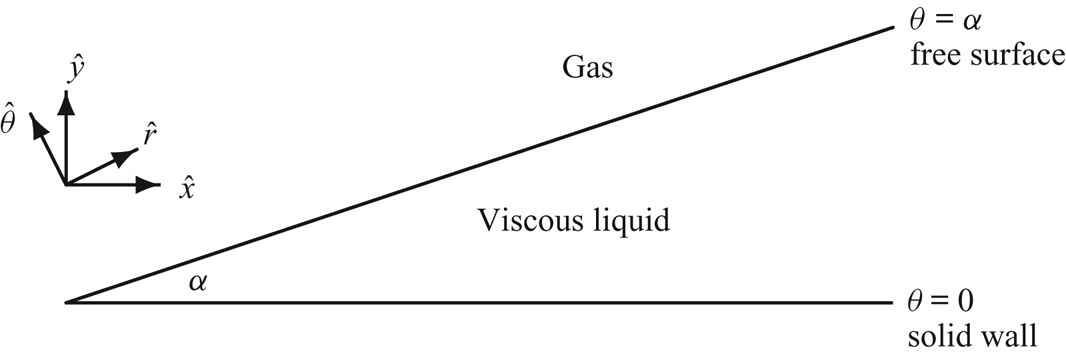
Consider a two-dimensional, slow, viscous flow in the corner region  $0 \le \theta \le \alpha$, using plane polar coordinates
 $(r,\theta )$ with the origin at the corner and a velocity field
 $\boldsymbol {u}=v_r\boldsymbol {\hat r}+v_\theta \boldsymbol {\hat {\theta }}$. Here
 $\theta =0$ is a solid stationary boundary, while
 $\theta =\alpha$ is the liquid–gas interface (see figure 1). The flow is driven by a disturbance at a large distance. The boundary conditions for this flow are
 \begin{equation} v_r=v_\theta = 0, \quad \text{at} \ \theta=0, \quad \text{and} \quad v_\theta=0, \quad \sigma_{r\theta}=0,\quad \text{on} \ \theta = \alpha, \end{equation}
implied by the no-slip and no-penetration conditions at  $\theta =0$, and by the zero normal velocity and zero shear stress at the liquid–gas interface
 $\theta = \alpha$. Solution of the Stokes equations leads to the following form for the streamfunction:
 \begin{equation} \psi = r^{n+1} \left[ A\cos (n+1)\theta + B\sin (n+1)\theta + C\cos (n-1)\theta + D \sin (n-1)\theta \right], \end{equation}
where  $v_r=({1}/{r})({\partial \psi }/{\partial \theta })$ and
 $v_\theta =-({\partial \psi }/{\partial r})$. Here
 $A,B,C$ and
 $D$ are constants and
 $n$ is a real or complex number that has a real part
 $> 0$, so that the flow velocity vanishes at the corner. The exponent
 $n$ is determined by solving a transcendental equation that appears below (see (3.6)). While formally (3.2) is one term in an infinite series of terms whose index
 $n$ runs over all possible roots of the transcendental equation (3.6), we are only interested in how hydrodynamic fields behave close to the origin (
 $r\ll 1$). Thus, the dominant term out of the infinite sum of streamfunctions (3.2) over
 $n$ is the one with the smallest possible real part of
 $n$.
Viscous flow of a liquid bounded by solid wall and a free surface. It is assumed that the flow is driven due to a disturbance at a large distance from the corner.

The pressure  $p$ is given by
 $p = \tilde {p} - \eta _o \omega$, where (Anderson & Davis Reference Anderson and Davis1993)
 \begin{equation} \tilde{p} = 4\eta_e n r^{n-1}\left[ D\cos (n-1)\theta - C \sin (n-1)\theta \right] \end{equation}
and
 \begin{equation} \omega ={-} 4 n r^{n-1}\left[ C\cos (n-1)\theta + D \sin (n-1)\theta \right]. \end{equation}
The effect studied in this article is crucially dependent on the zero shear stress boundary condition at the free surface (last of (3.1)) which can be written in the form
 \begin{equation} \sigma_{r\theta}^{e} ={-} 2\eta_o \partial_r v_r \equiv \tau^{o} \quad \text{at} \ \theta = \alpha, \end{equation}
where  $\sigma _{r\theta }^{e}$ is the standard shear stress of a Newtonian liquid (cf. table 1). This means that at the liquid–gas interface there is an extra stress
 $\tau ^{o}$ which will drive the flow. It can be understood as a normal stress-induced shear stress. This behaviour is not new. The odd-viscosity-induced shear stress has been observed in experiments and simulations to be out of phase with respect to interface undulations, acting at their inflection points and leading to unidirectional wave propagation (Soni et al. Reference Soni, Bililign, Magkiriadou, Sacanna, Bartolo, Shelley and Irvine2019, figure S22). A more comprehensive observation of the same effect was made during the expansion of a bubble in viscous flow (Ganeshan & Abanov Reference Ganeshan and Abanov2017). The odd-viscosity-mediated pressure-induced shear stress gave rise to new fluid flow behaviour, and, in particular, to an azimuthal velocity field transverse to the existing radial one.
This type of problem admits only specific solutions that relate  $n$ with the admissible angle
 $\alpha$. The solution process proceeds as follows. The first two boundary conditions in (3.1) determine two of the arbitrary constants
 $A$ to
 $D$ in (3.2). The last two boundary conditions in (3.1) lead to a system of equations for the remaining two arbitrary constants in (3.2). This system has a non-trivial solution only if the determinant of the coefficient matrix vanishes. When odd viscosity is included, the vanishing of the determinant of the coefficient matrix leads to the condition
 \begin{equation} \left[\left({-}1+\cos \left(2 \alpha \right)\right) n^{2}-\cos \left(2 \alpha n \right)+1\right] \eta_o +\left[-\sin \left(2 \alpha \right) n +\sin \left(2 \alpha n \right)\right] {\eta_e} =0 \end{equation}
that determines the parameter  $n$ for all admissible corner angles
 $\alpha$. In the absence of odd viscosity (
 $\eta _o\equiv 0$) the model is the same as that studied by Moffatt (Reference Moffatt1964) and Anderson & Davis (Reference Anderson and Davis1993), and relation (3.6) reduces to their conditions (3.20) and (2.27), respectively. In this case, as shown by Moffatt (Reference Moffatt1964), real solutions
 $n$ exist for angles
 $\alpha \gtrsim 78^{\circ }$.
For smaller angles, complex roots exist and the streamfunction represents eddies that are known as Moffatt vortices. We are interested in the effects of odd viscosity on these vortices. We therefore proceed by adapting the analysis of Moffatt (Reference Moffatt1964) to the case  $\eta _o \ne 0$.
We seek complex solutions of (3.6) in the form  $n=p + {\rm i}q$, where
 $p$ and
 $q$ are real numbers. Without loss of generality, we consider the roots with
 $q>0$ below. Setting
 $\xi = 2\alpha p$,
 $\zeta = 2\alpha q$,
 $k= {\sin 2\alpha }/{2\alpha }$ and the viscosity ratio
 \begin{equation} \eta = \frac{\eta_o}{\eta_e}, \end{equation}
and taking the real and imaginary parts of (3.6), we obtain two relations that may be written in the form
 \begin{align} \left( \begin{array}{@{}cc@{}} \cosh \zeta & -\eta\cosh \zeta \\ \eta\sinh \zeta & \sinh \zeta \end{array} \right) \left( \begin{array}{@{}c@{}} \sin \xi\\ \cos \xi \end{array} \right) = k \left( \begin{array}{@{}c@{}} \xi\\ \zeta \end{array} \right) + \eta \left( \begin{array}{@{}c@{}} \dfrac{\xi^{2}-\zeta^{2}}{2} \left(\dfrac{\sin\alpha}{\alpha}\right)^{2} -1\\ \xi\zeta\left(\dfrac{\sin\alpha}{\alpha}\right)^{2} \end{array} \right) . \end{align}
In the absence of odd viscosity (setting  $\eta _o=0$), (3.8) reduces to the corresponding condition of Moffatt (Reference Moffatt1964, § 3.2). For a given angle
 $\alpha$ and viscosity ratio
 $\eta$ these equations are solved to give
 $\xi (\alpha,\eta )$ and
 $\zeta (\alpha,\eta )$.
Consider the ratio  $\rho$ of distance from the corner between successive vortices and their relative intensity (or damping factor)
 $\varpi$:
 \begin{equation} \rho = \frac{r_m}{r_{m+1}} = {\rm e}^{{2\alpha{\rm \pi}}/{\zeta}} \quad\text{and}\quad \varpi = \frac{v_{m+{1}/{2}}}{v_{m+{3}/{2}}} = {\rm e}^{{{\rm \pi}\xi}/{\zeta}}, \end{equation}
as defined and developed by Moffatt (Reference Moffatt1964), but where now  $\xi$ and
 $\zeta$ may depend on odd viscosity. Here
 $r_m$ (
 $m=0,1,2,\ldots$) is the distance of the
 $m$th eddy from the corner and
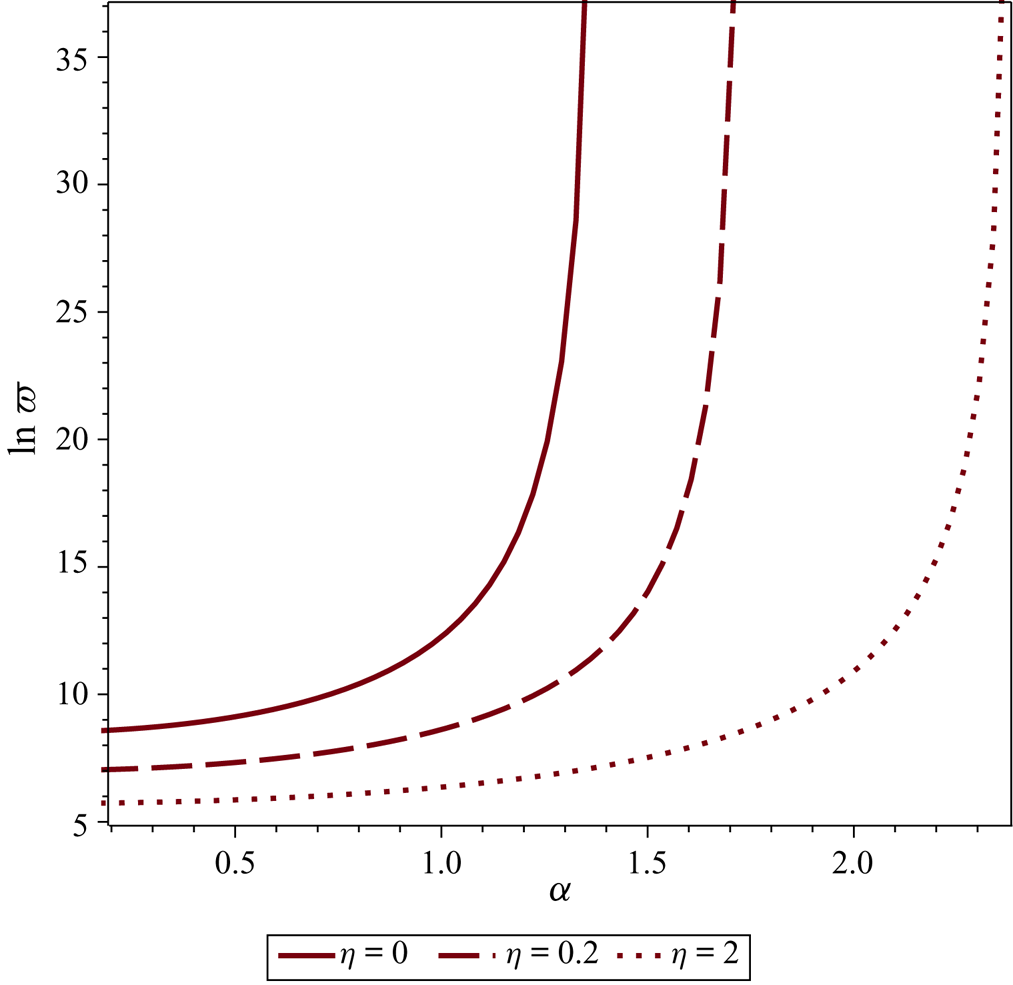
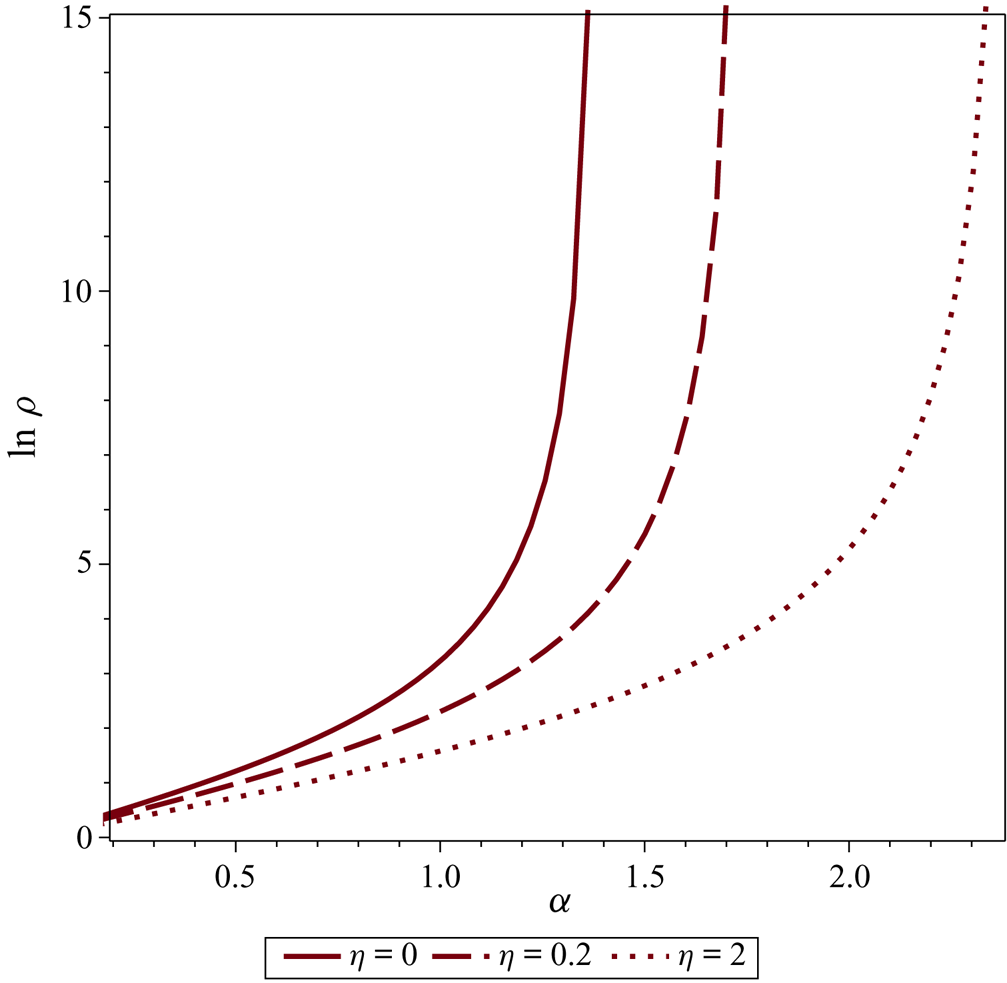
 $v_{m+1/2}$ is its maximum velocity. In figures 2 and 3 we plot the logarithm of the strength and the distance of Moffatt vortices by increasing the value of odd viscosity through the viscosity ratio
 $\eta$.
The logarithm of the relative strength  $\varpi$ between two adjacent Moffatt vortices as a function of the corner angle
 $\alpha$ in radians (cf. (3.9a,b)). The leftmost (solid) curve corresponds to the results of Moffatt (Reference Moffatt1964, figure 5) where odd viscosity is absent. The dashed and dotted curves depict the logarithm of the vortex strength when the viscosity ratio
 $\eta = {\eta _o}/{\eta _e}$ assumes the values
 $0.2$ and
 $2$, respectively. Two effects of odd viscosity can be seen. First, for a given angle
 $\alpha$, odd viscosity has decreased the intensity of vortices and thus they can now be observed with greater facility. For example, at
 $\alpha = {\rm \pi}/4$,
 $\varpi (\eta =0) \sim 30\,288$ while
 $\varpi (\eta =2) \sim 442$. Second, it is apparent that odd viscosity has extended the range of corner angles
 $\alpha$ over which these vortices can be observed.

The logarithm of the ratio of distances  $\rho$ in (3.9a,b) between two adjacent Moffatt vortices as a function of corner angle
 $\alpha$ in radians. The leftmost (solid) curve corresponds to the results of Moffatt (Reference Moffatt1964, figure 5), where odd viscosity is absent. The dashed and dotted curves depict the logarithm of the distance ratio when the viscosity ratio
 $\eta = {\eta _o}/{\eta _e}$ assumes the values
 $0.2$ and
 $2$, respectively. Odd viscosity has mediated to reduce the size of Moffatt vortices and has extended the range of corner angles
 $\alpha$ over which these vortices can be observed.

In figure 2 two effects of odd viscosity can be seen. First, for a given corner angle  $\alpha$, odd viscosity has decreased the intensity of vortices. For example, for
 $\alpha = {\rm \pi}/4$ the reduction is by almost two orders of magnitude (from
 $\varpi (\eta =0) \sim 30\,288$ to
 $\varpi (\eta =2) \sim 442$) and thus they can now be observed with greater facility. Second, it is apparent that odd viscosity has extended the range over which Moffatt vortices are present. When
 $\eta =0$ Moffatt vortices can be observed in corners with angle
 $\alpha$ up to
 $78^{\circ }$. When
 $\eta =2$ the angles can be up to
 $136^{\circ }$.
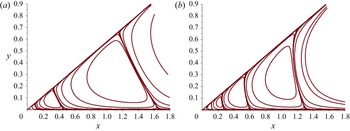
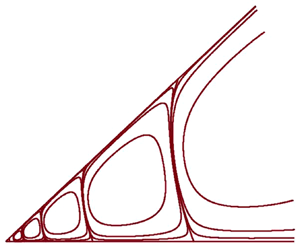
In figure 3 two effects of odd viscosity can be seen: odd viscosity has mediated to reduce the size of Moffatt vortices and has extended the range of corner angles  $\alpha$ over which these vortices can be observed. Figures 4(a) and 4(b) display Moffatt vortices in the absence and presence of odd viscosity, respectively. Odd viscosity has decreased the size of the Moffatt vortices.
Moffatt vortices in a corner of angle  $\alpha = {\rm \pi}/6$. (a) In the absence of odd viscosity (
 $\eta =0$). (b) Moffatt vortices for viscosity ratio
 $\eta \equiv \eta _o/\eta _e= 2$. Odd viscosity has squeezed and decreased the size of the vortices.

Why does the intensity of vortices and their size decrease in the presence of odd viscosity? To answer this question we calculate the radial velocity  $v_r$ at the liquid–gas interface
 $\theta = \alpha$:
 \begin{equation} v_r = \mathrm{Re} \left\{ r^{n} f'(\theta)\right\}, \end{equation}
where  $f(\theta )$ is the angle-dependent factor of the streamfunction
 $\psi$ in (3.2). Letting
 $n = p + {\rm i} q$ and
 $f = f_R + {\rm i}f_I$ we calculate that
 \begin{equation} v_r = {\rm e}^{p\ln r} \left[ f_R' \cos(q\ln r) - f_I' \sin(q\ln r) \right] \sim r^{p}\sin (q \ln r + \epsilon_1(\theta)) \end{equation}
for an angle-dependent phase  $\epsilon _1(\theta )$. Evaluating
 $v_r$ at the liquid–gas interface,
 $\theta = \alpha$
 \begin{equation} v_r(r,\alpha) \sim r^{p} \sin ( q \ln r + \epsilon_1 (\alpha)), \end{equation}
we see that when  $r$ satisfies
 \begin{equation} q \ln r + \epsilon_1 ={-}m{\rm \pi}, \quad m = 0,1,2,\ldots \end{equation}
the velocity changes sign an infinite number of times as one approaches the point  $r=0$.
As discussed above, the zero shear stress condition  $\sigma _{r\theta } = 0$ at
 $\theta = \alpha$ implies that an extra shear stress
 $\tau ^{o}$, due to odd viscosity, is active at the liquid–gas interface. It reads
 \begin{equation} \tau^{o} ={-} 2\eta_o \frac{\partial v_r}{\partial r}. \end{equation}
Thus, differentiating (3.11) with respect to  $r$ and evaluating at
 $\theta =\alpha$ we obtain the following expression for the extra shear stress:
 \begin{equation} \tau^{o}\sim{-}\eta_o r^{p-1}\sin(q \ln r + \epsilon_1(\alpha) + \epsilon_2(\alpha)). \end{equation}
This means that the extra shear stress  $\tau ^{o}$ acts on the liquid–gas interface with the same periodicity as the radial velocity but with an opposite sign and is out of phase by an angle
 \begin{equation} \epsilon_2 = \tan^{{-}1}\frac{q}{p}. \end{equation}
For a corner of angle  $\alpha = {\rm \pi}/6$ and viscosity ratio
 $\eta = 2$, we calculate the ratio
 $q/p \sim 0.535$ and thus
 $\epsilon _2 \sim 0.491$ rad or approximately
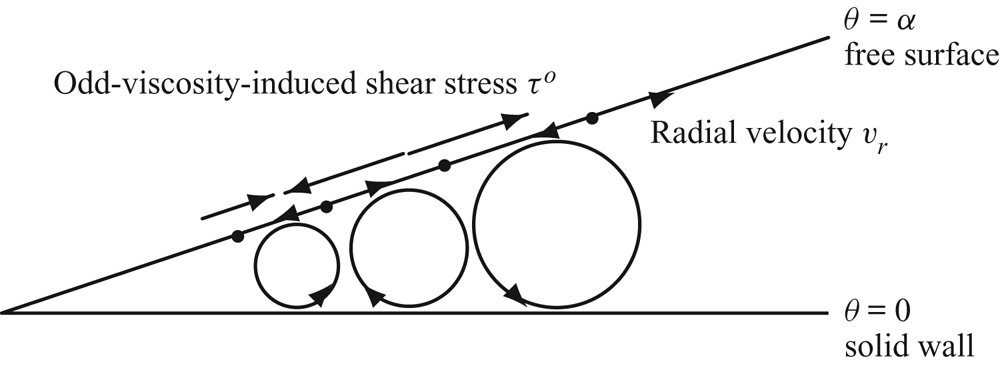
 $28^{\circ }$. In figure 5 we display the main features of the foregoing analysis.
Odd viscosity gives rise to the ‘extra’ shear stress  $\tau ^{o} =- 2\eta _o({\partial v_r}/{\partial r})$ at the liquid–gas interface (cf. (3.14)). Filled circles denote the locations at the liquid–gas interface where the radial velocity
 $v_r$ is zero, while the arrows on the liquid–gas interface denote the direction of the radial velocity
 $v_r$. The odd shear stress
 $\tau ^{o}$ in (3.14) is out of phase with respect to the radial velocity by approximately
 $28^{\circ }$ (3.16) and has an opposite sign. Thus, the shear stress is predominantly directed opposite to the radial interfacial velocity. This squeezes the vortices and damps their rotation.

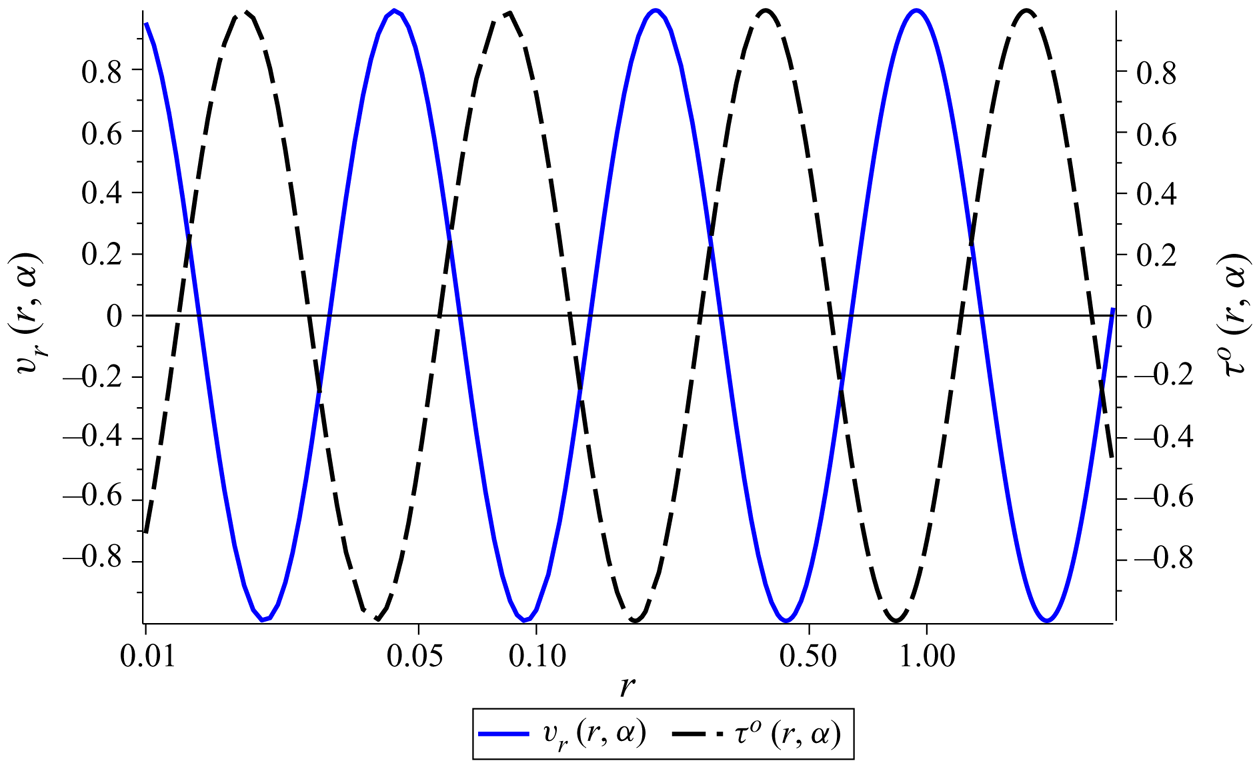
Figure 6 displays the normalized interfacial radial velocity and extra stress calculated from the full solution of the boundary-value problem. Both agree well with the trend depicted in figure 5 and discussed in the previous paragraph. Both curves in figure 6 have the same periodicity determined by  $q \ln r$ as in expression (3.12). Using the locations of two adjacent zeros of these curves (located at
 $r \sim 1.38$ and
 $r\sim 1.22$ for
 $v_r$ and
 $\tau ^{o}$, respectively) we can calculate the phase difference
 $180 q \ln (1.38/1.22)/ {\rm \pi}$, which reproduces the value of
 $28^{\circ }$ found from (3.16).
Normalized radial velocity  $v_r(r, \alpha )$ (equation (3.12)) and extra shear stress
 $\tau ^{o}(r, \alpha )$ (equation (3.14)) evaluated at the liquid–gas interface
 $\theta = \alpha ={\rm \pi} /6$ with
 $\eta = {\eta _o}/{\eta _e} = 2$ versus radial distance
 $r$ from the origin. The horizontal axis is displayed in logarithmic scale. The radial velocity and stress follow the trend displayed in figure 5: the odd shear stress
 $\tau ^{o}$ in (3.14) is out of phase with respect to the radial velocity by approximately
 $28^{\circ }$ (equation (3.16)) and has an opposite sign.

4. Moffatt vortices in a flat liquid layer
A liquid lying on a horizontal substrate at  $y=0$ with a flat free surface at
 $y=h$ can be considered as a special case of the previous discussion when the corner angle
 $\alpha \rightarrow 0$. Moffatt vortices form in this case and their wavelength is given by the expression
 \begin{equation} \lim_{\alpha\rightarrow 0} \frac{2{\rm \pi} h}{\zeta (\eta)} , \end{equation}
where  $\zeta$ is the solution of (3.8) when
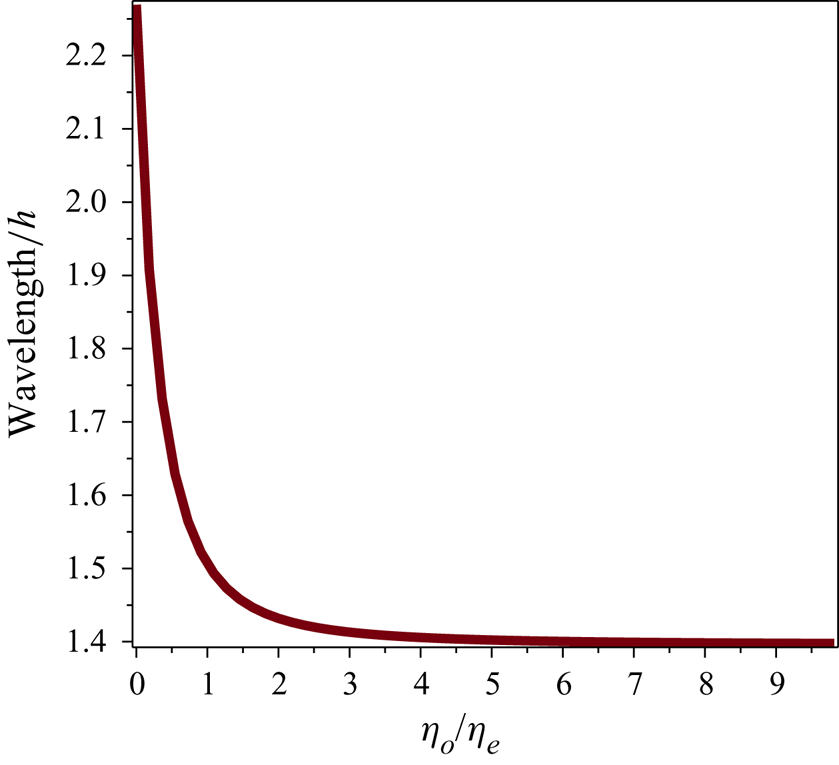
 $\alpha \rightarrow 0$. In figure 7 we display the dependence of the dimensionless size of eddies versus the viscosity ratio
 $\eta = {\eta _o}/{\eta _e}$. At
 $\eta \sim 1$, odd viscosity has significantly reduced the size of the eddies.
Vortex size in a flat liquid layer of thickness  $h$ on a solid substrate and surrounded by an ambient gas phase (4.1) versus the viscosity ratio
 $\eta = {\eta _o}/{\eta _e}$. Odd viscosity reduces the size of vortices.

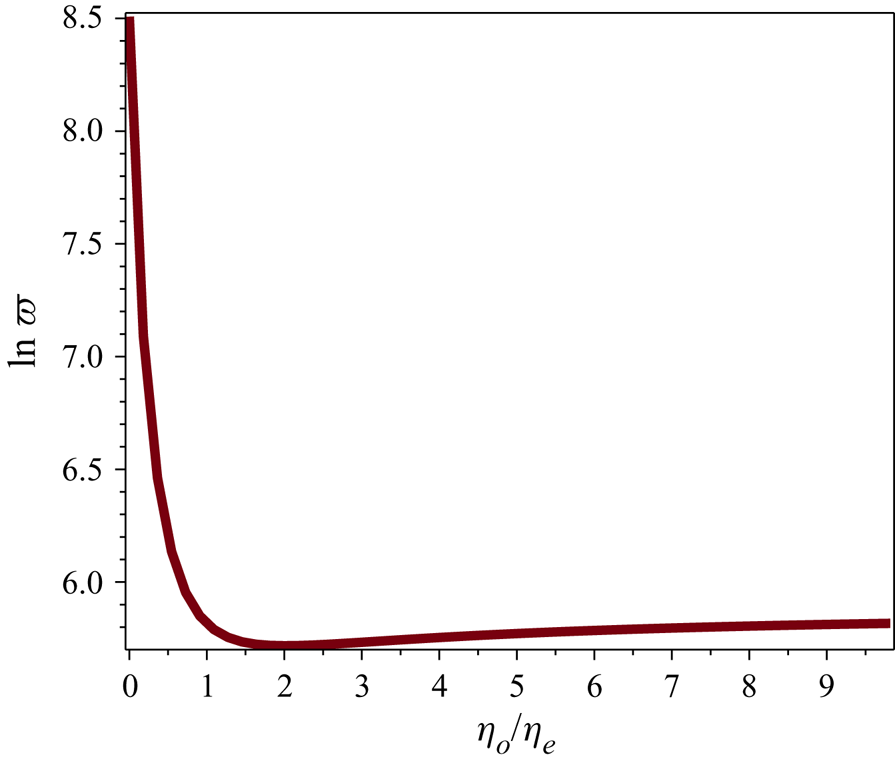
In figure 8 we display the damping factor  $\varpi$ as described in (3.9a,b) versus the viscosity ratio
 $\eta \equiv {\eta _o}/{\eta _e}$. In the absence of odd viscosity one obtains the result of Moffatt (Reference Moffatt1964), where the damping factor is
 ${\rm e}^{8.53}\sim 5000.$ On the other hand, at a viscosity ratio equal to one, the damping factor is
 ${\rm e}^{5.8}\sim 330.$ This means that odd viscosity equips us with a greater facility to observe Moffatt vortices in an experiment.
The logarithm of the relative strength  $\varpi$ between two adjacent Moffatt vortices versus the viscosity ratio
 $\eta = {\eta _o}/{\eta _e}$ (cf. (3.9a,b)) for a flat liquid layer of thickness
 $h$ on top of a solid substrate, surrounded by an ambient gas phase. The vortex relative strength in the absence of odd viscosity is
 $\varpi \sim 5000$. It reduces to
 $\varpi \sim 330$ even for a small viscosity ratio,
 $\eta \equiv {\eta _o}/{\eta _e}=1$. Thus odd viscosity increases the possibility of observation of Moffatt vortices in active matter.

The plateau reached in figures 7 and 8 can be understood from the bifurcation condition (3.8). As odd viscosity increases, the factors multiplying  $\eta$ (
 $= \eta _o/\eta _e$) in (3.8) become dominant. Explicitly, they read
 $\cos \xi \cosh \zeta + ({\xi ^{2} -\zeta ^{2}})/{2} =1$ and
 $\sin \xi \sinh \zeta = \xi \zeta$. These relations determine
 $\xi$ and
 $\zeta$ for a large viscosity ratio
 $\eta = \eta _o/\eta _e$ but are essentially independent of viscosity.
5. The tendency of odd viscosity to moderate singular behaviour
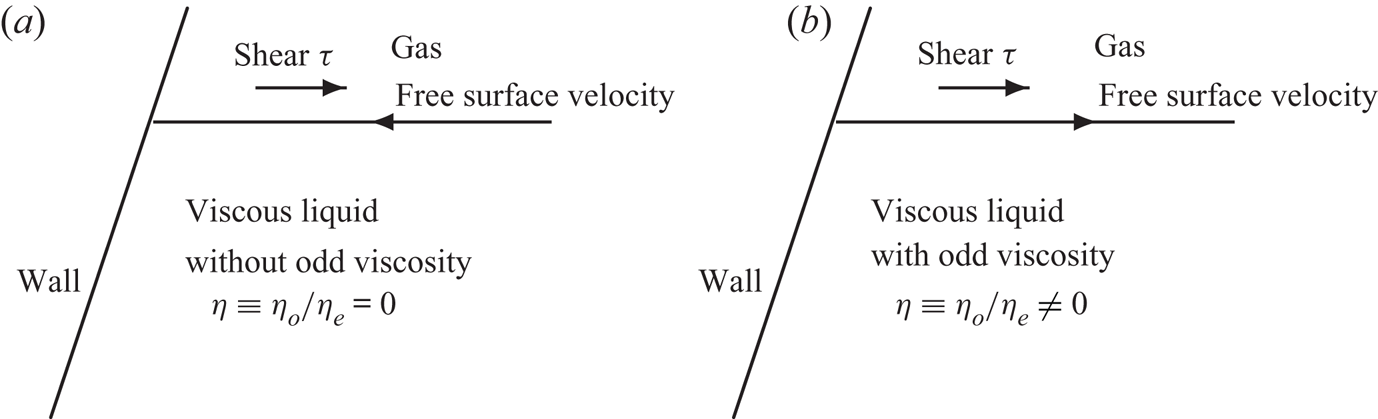
A certain regularization is observed in flow endowed with odd viscosity. For instance, Soni et al. (Reference Soni, Bililign, Magkiriadou, Sacanna, Bartolo, Shelley and Irvine2019) observed experimentally the levelling off of liquid surface undulations due to odd viscosity. Here we show analytically that odd viscosity mediates to moderate unphysical behaviour (cf. figure 9).
(a) Unphysical liquid flow behaviour when the corner is of angle  $\alpha >128^{\circ }$ as depicted in figure 10 by considering the streamfunction (5.3) and radial velocity (5.4) at the liquid–gas interface
 $\theta =\alpha$ (cf. Moffatt Reference Moffatt1964, figure 2b). (b) Odd viscosity regularizes the flow and restores its physical behaviour at the liquid–gas interface. (a) Unphysical behaviour. (b) Physically realistic.

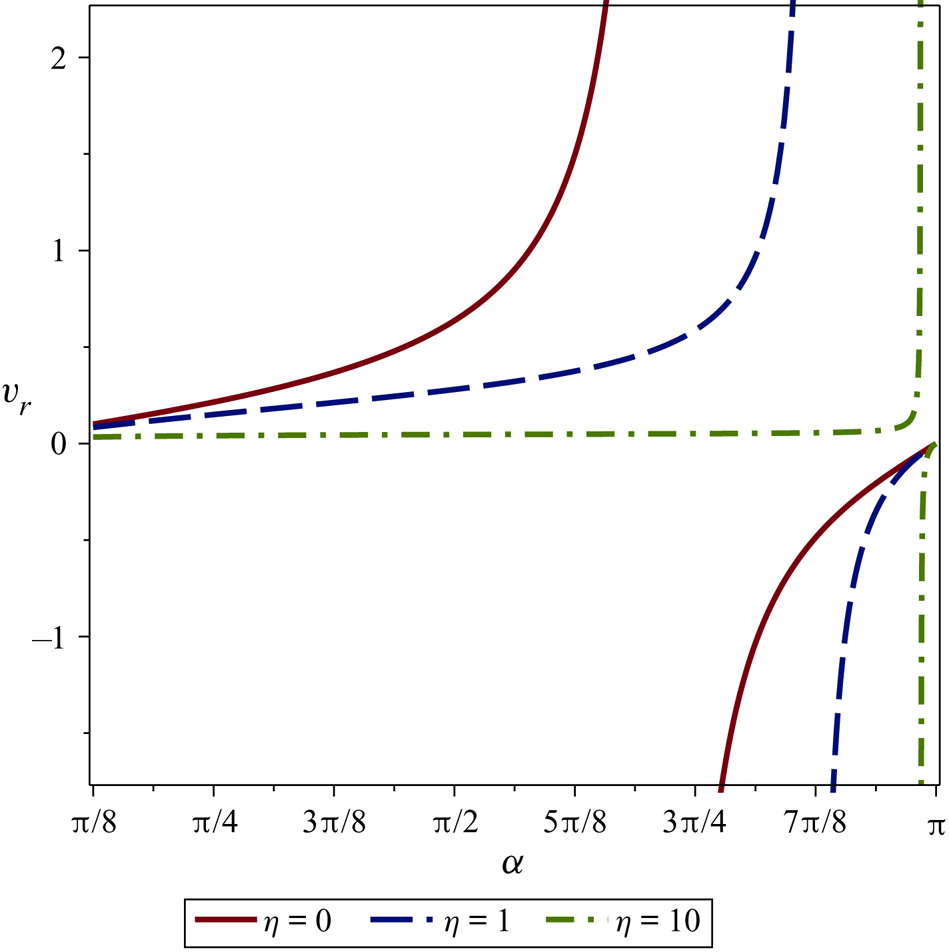
Variation of interface velocity  $v_r$ at
 $\theta =\alpha$ (see figure 9) versus angle
 $\alpha$ of the liquid wedge (at radius
 $r=1$ and shear strength
 $\tau =1$). In the absence of odd viscosity (solid curve,
 $\eta \equiv \eta _o/\eta _e =0$) the flow is singular at
 $\alpha \sim 128^{\circ }$. Odd viscosity mediates to moderate the singular behaviour by moving it towards the
 $\alpha = {\rm \pi}$ axis (dashed and dash-dotted curves for
 $\eta =1$ and
 $\eta =10$, respectively).

Consider the flow between a wall and a free surface under shear  $\tau$, like a shear ‘wind’ (Davis et al. Reference Davis, Gratton and Davis2010). The boundary conditions for this flow are (Moffatt Reference Moffatt1964, figure 2b)
 \begin{equation} v_r=v_\theta = 0, \quad \text{at} \ \theta=0, \quad \text{and} \quad v_\theta=0, \quad \sigma_{r\theta}=\tau\quad \text{on} \ \theta = \alpha, \end{equation}
implying no slip and no penetration at  $\theta =0$ and zero normal velocity and a surface shear wind
 $\tau$ at the liquid–gas interface
 $\theta = \alpha$. These conditions are applied on the streamfunction
 $\psi = \tau r^{2} [ A\cos 2\theta +B \sin 2\theta + C\theta +D ]$. This is identical to the problem considered by Moffatt (Reference Moffatt1964), but here the shear stress condition also accounts for odd viscosity:
 \begin{equation} \sigma_{r\theta} \equiv \sigma_{r\theta}^{e}+2\eta_o \partial_r v_r = \tau \quad \text{on}\ \theta=\alpha, \end{equation}
where  $\sigma _{r\theta }^{e}$ is the standard (even) shear stress (see table 1). As is the case in § 3, here we also have an extra stress
 $\tau ^{o} =-2\eta _o \partial _r v_r$ which will drive the flow. The same interpretation, that of a normal stress-induced shear stress, can also be applied here.
We can thus determine the streamfunction, which now depends on  $\eta _o$:
 \begin{equation} \psi ={-}\frac{r^{2} \tau \left({-}2 \alpha +2 \theta -\sin \left(2 \alpha -2 \theta \right)-2 \theta \cos \left(2 \alpha \right)+\sin \! \left(2 \alpha \right)+2 \cos \left(2 \theta \right) \alpha -\sin \left(2 \theta \right)\right)}{4 \left(\left(2 \sin \left(2 \alpha \right) \alpha +2 \cos \left(2 \alpha \right)-2\right) \eta_o +\left(2 \cos \left(2 \alpha \right) \alpha -\sin \left(2 \alpha \right)\right) \mathit{\eta_e} \right)}. \end{equation}
To check how realistic this result is, one can consider the velocity of the free interface at  $\theta = \alpha$:
 \begin{equation} v_r(\alpha) = \frac{r \tau \left(\sin \left(2 \alpha \right) \alpha +\cos \left(2 \alpha \right)-1\right)}{\left(2 \sin \left(2 \alpha \right) \alpha +2 \cos \left(2 \alpha \right)-2\right) \eta_o +\left(2 \cos \left(2 \alpha \right) \alpha -\sin \left(2 \alpha \right)\right) {\eta_e}}. \end{equation}
In the absence of odd viscosity the radial flow at the interface has a singularity when  $\tan (2\alpha )=2\alpha$, i.e. for the critical angle
 $\alpha \approx 2.24$ rad (approximately
 $128^{\circ }$). This is shown by the solid curve in figure 10. Clearly the infinite velocity at this singularity is unrealistic and the assumption of low-Reynolds-number flow also breaks down here. For larger angles the velocity at the free surface acquires a sign that is opposite to the applied shear, which is also unphysical. However, incorporating the odd viscosity contribution moves the singularity towards
 $\alpha = {\rm \pi}$. As shown in figure 10, when
 $\eta =1$ the singularity appears at
 $\alpha \approx 2.73$ rad (approximately
 $156^{\circ }$) and when
 $\eta = 10$ the singularity has been pushed to
 $\alpha \approx 3.08$ rad (approximately
 $176^{\circ }$).
The reason for the removal of the unphysical behaviour again lies in the odd viscosity. Assume a corner angle  $\alpha >128^{\circ }$ (which, in the absence of odd viscosity, leads to the unphysical behaviour depicted in figure 9a). Condition (5.2) can be written as
 \begin{equation} \sigma_{r\theta}^{e} = \tau - \frac{2\eta_o}{r}v_r(\alpha; \eta_o) \sim \tau - \frac{2\eta_o}{r}v_r(\alpha; 0) + \,\cdots\, , \end{equation}
where the function  $v_r(\alpha ;\eta _o)$ was expanded in a Taylor series about
 $\eta _o=0$. Since by assumption we lie in the unphysical region
 $\alpha >128^{\circ }$ (when odd viscosity is absent; cf. figure 9a), this implies that
 $v_r(\alpha ;0)<0$ thus making the last term in (5.5) positive. Thus, at least with respect to the accuracy provided by the leading-order term of the expansion, odd viscosity superposes an extra positive shear stress to the existing shear wind
 $\tau$. The effect of this process is to reverse the sign of the interfacial velocity, which is depicted in figure 9(b) and by the dashed and dash-dotted curves in figure 10.
6. Discussion and concluding remarks
Odd viscosity is known to have a number of striking consequences for fluid dynamical behaviour, especially when the liquid is bounded by a free surface (Ganeshan & Abanov Reference Ganeshan and Abanov2017; Soni et al. Reference Soni, Bililign, Magkiriadou, Sacanna, Bartolo, Shelley and Irvine2019). In this article we have considered the effects of odd viscosity on the formation of Moffatt vortices in low-Reynolds-number free-surface flow. We have shown that odd viscosity reduces the relative intensity of consecutive vortices, which should make a sequence of eddies easier to observe experimentally. It also extends the range of corner angles over which the vortices appear. In the case of an applied shear at the liquid–gas interface we have found that odd viscosity acts to alleviate singular behaviour at the interface. It leads to the formation of finite radial velocities over a larger range of corner angles  $\alpha$.
For industrial applications one would like to know how odd viscosity modifies the flow when the contact line of a liquid droplet is moving, and, in particular, to determine whether the slip law governing contact line motion modifies the flow behaviour (Kirkinis & Davis Reference Kirkinis and Davis2013, Reference Kirkinis and Davis2014).
One would also like to know the effect of odd viscosity on suspensions of ferromagnetic nanoparticles with a free surface. Odd viscosity might lead to the theoretical explanation of a number of experimental observations, for instance, interface patterns propagating in a direction opposite to the bulk liquid (Rinaldi & Zahn Reference Rinaldi and Zahn2002; Chaves, Zahn & Rinaldi Reference Chaves, Zahn and Rinaldi2008). Since these suspensions are currently employed in a number of biomedical applications (Rinaldi Reference Rinaldi2002; Torres-Díaz & Rinaldi Reference Torres-Díaz and Rinaldi2014), the effect of odd viscosity on their behaviour may prove to be critical in the design of experiments and their commercial adaptation. Finally, it is of fundamental interest to study the role of odd viscosity in turbulent flows where a collection of vortices is also present.
Funding
This work was supported by the Center for Bio-Inspired Energy Science (CBES), an Energy Frontier Research Center funded by the US Department of Energy (DOE) Office of Basic Energy Sciences (DE-SC0000989). Funding was also obtained from the Fairchild Foundation through the Center for Computation & Theory of Soft Materials at Robert R. McCormick School of Engineering and Applied Science, Northwestern University.
Declaration of interests
The authors report no conflict of interest.