INTRODUCTION
Assumptions regarding the emergence of the pottery wheel have, in the last 20 years, been subjected to increasingly intensive scrutiny, most significantly through the work of Valentine Roux and her colleagues (e.g. Roux Reference Roux, Binder and Courtin1994; Pierret Reference Pierret1994; Courty and Roux Reference Courty and Roux1995; Pierret and Moran Reference Pierret and Moran1996; Pierret, Moran and Bresson Reference Pierret and Moran1996; Gelbert Reference Gelbert1997; Roux and Courty Reference Roux and Courty1997; Reference Roux and Courty1998; Roux and Miroschedji Reference Roux and Miroschedji2009; Gandon et al. Reference Gandon, Casanova, Sainton, Coyle, Roux, Bril and Bootsma2011). Over the course of this time, the idea that a transition of techniques passed from hand-building to wheel-throwing pottery without the use of intermediate or combination potting strategies has been examined and challenged by using ethnographic, experimental and archaeological data, in a range of archaeological contexts. Although this approach has been applied in a few cases to Minoan contexts (Knappett Reference Knappett1999; Reference Knappett, Cadogan, Hatzaki and Vasilakes2004; Berg Reference Berg2009; Knappett and Jeffra in press), the archaeological material of Crete has not previously been the subject of comprehensive experimental study from this perspective.
The incorporation of such an approach into the fabric of Minoan ceramic analysis holds important ramifications. Historically, Minoan archaeologists have assumed a direct technological change from the almost exclusive use of hand-building prior to Middle Minoan IB, at which point potters gradually applied the wheel-throwing technique to more shapes and sizes of vessels through successive chronological periods (for a fuller discussion, see Knappett Reference Knappett1999). Based upon this assumption, detailed presentations of archaeological data, specifically excavation reports, may uncritically note the presence or absence of wheel-thrown ceramics. The continued maintenance of this established theory of the wheel transition has become problematic in light of new research, however. Thus far, no other contemporary context which has been comprehensively examined exhibits solid evidence for a hand-building to wheel-throwing technique transition (Roux and Courty Reference Roux and Courty1997; Spencer Reference Spencer2007; Roux Reference Roux, O'Brien and Shennan2009; Dupont-Delaleuf Reference Dupont-Delaleuf2011; Jeffra Reference Jeffra2011; Choleva Reference Choleva2012). If Crete did indeed undergo this type of transition, as some continue to suggest (Berg Reference Berg2009), then it was indeed unique. It should be evident, therefore, that it is essential to evaluate which technique (wheel-throwing or wheel-coiling) Minoan potters were using during the earliest appearance of the pottery wheel, and which specific methods were employed within those techniques (for further discussion of the terms ‘technique’ and ‘method’, see Tixier Reference Tixier, Clark and Bishop1967).
An understanding of the details of potting techniques, and the methods which characterise them, is necessary in order to interpret the organisation of craftspeople, and how craftspeople related to society more generally. If the incorporation of the pottery wheel in Crete was the result of the advocacy of a small, closed group of specialists familiar with the technology, a specific pattern may be expected (for a discussion of closed/open potting systems, see Roux Reference Roux, O'Brien and Shennan2009). First, one might anticipate an observable preference for potting techniques using rotation (or rotative kinetic energy, henceforth RKE, a term coined by and explored in detail by Courty and Roux Reference Courty and Roux1995) in a particular locality, identifiable as the technology's ‘homeland’ within Crete (for discussion of innovative behaviours, see Barnett Reference Barnett1953, 378–401; Rogers Reference Rogers1962, 169–171). A second trend would perhaps be a chronologically visible delay in the appearance of RKE evidence at different sites in terms of the appearance of wheel use, the result of contact with the RKE technique ‘homeland’, from which further developments emanate. Subsequent uptake may result in an array of methods (where new adopters are not members of the closed group of innovators and have indirect contact with the technology) or in the spread of a single method (where new adopters are members of the closed group of innovators and have direct contact with both the technology and specialist teaching). The subsequent spread of the wheel would probably appear archaeologically as a cultural lag on the part of later adopters at the other nearby sites, which may be a sign of poor information sharing on the part of innovators, or perhaps an indication of how receptive individuals and groups were to innovation generally (see, for example, Spratt Reference Spratt1982; Reference Spratt, van der Leeuw and Torrence1989; Leeuw Reference van der Leeuw, van der Leeuw and Torrence1989; Layton Reference Layton, van der Leeuw and Torrence1989; Leeuw and Papousek Reference van der Leeuw, Papousek and Audouze1992; Shortland Reference Shortland, Bourriau and Phillips2004; Arthur Reference Arthur2009).
Previous work
Previous work on understanding the first Minoan use of the potter's wheel through examining ceramic vessels is largely limited to the work of Carl Knappett (Reference Knappett1999; Reference Knappett and Hamilakis2002; Reference Knappett, Cadogan, Hatzaki and Vasilakes2004; Reference Knappett, Bradfer-Burdet, Detournay and Laffineur2005; Poursat and Knappett Reference Poursat and Knappett2005; Crewe and Knappett Reference Crewe, Knappett, Cadogan, Iacovou, Kopaka and Whitley2012; Knappett and Jeffra in press) and Ina Berg (Reference Berg and Kazazes2006; Reference Berg2009; Reference Berg and Scarcella2011a; Reference Berg2011b). This is not the only research in this context which addresses the potter's wheel as a topic, but other work has tended to address issues of reconstructing wheel devices (e.g. Evely Reference Evely1988; Morrison and Park Reference Morrison and Park2007; Morrison Reference Evely, Morrison, Matthiae, Pinnock, Nigro and Marchetti2010; Evely and Morrison Reference Evely, Morrison, Matthiae, Pinnock, Nigro and Marchetti2010; and the conference presentation Evely et al. Reference Evely, Politakis, Morrison and Park2008). Knappett and Berg each advocate different methodological approaches to the problem of identifying techniques of vessel forming.
Macroscopic assessment
The work that Knappett has undertaken has largely focused on fleshing out the understanding of forming techniques from a diachronic perspective, based on the macroscopic assessment of a range of contexts. Methodologically, he relies upon ‘detailed visual examination of macroscopic surface traces that relate to the forming processes used by the potter’ (Knappett Reference Knappett1999, 113). In his earliest work on the subject (Knappett Reference Knappett1999) he suggests that, during the first use of the wheel, when exclusively small vessels were being formed, potters were using the wheel-throwing technique. He goes on to suggest that the wheel-coiling technique was later developed in order to incorporate larger vessels into the wheel-forming repertoire. In a later contribution, he alters his position on the matter, stating that ‘recent research leads me to believe that the technological development in MM potting may not have involved the technique of wheel-throwing’, but instead the technique of wheel-coiling (Knappett Reference Knappett, Cadogan, Hatzaki and Vasilakes2004, 258).
The strength of Knappett's work lies in its wide base: by drawing on collections of material from a number of sites over several chronological periods, he is able generally to discuss change through time as well as across the island of Crete. However, a drawback of this wide perspective is its lack of detail. By talking about general technique changes through time, Knappett leaves specifics aside for later research; indeed, he acknowledges the need for detailed and tailored experimentation in order to fully understand the traces on vessels and which forming methods they indicate.
X-radiography
Berg's contributions tend to be methodologically focused, and are therefore rich in information regarding the positive aspects of X-radiography. Conceptually, X-rays are able to create images which illustrate both the overall changes in wall thicknesses and the orientation of inclusions, exposing manufacturing evidence which may be invisible to the naked eye. Berg's use of X-ray is limited to vessels which present a single profile, which does raise difficulties in examining closed forms, however (although this has been overcome by Bouzakis et al. Reference Bouzakis, Pantermalis, Efstathiou, Varitis, Paradisiadis and Mavroudis2011).
Methodologically, X-ray images have been found to show that inclusions and voids within vessel walls have an oblique to diagonal orientation when wheel-throwing or wheel-coiling combination techniques were used (Pierret and Moran Reference Pierret and Moran1996; Berg Reference Berg2009), although Berg (Reference Berg2009) suggests that this is more frequently the case for wheel-thrown vessels. Because of this similarity between X-ray images for wheel-thrown vessels and wheel-coiled vessels (when coil seams are not apparent in the X-ray image), Berg (Reference Berg2009, 145) identifies wheel-coiling by a ‘mismatch between the X-ray image and macroscopic observations’. So, although the focus of her work is based upon X-rays, her approach is still reliant upon an understanding of macroscopic traces (arguably a stronger methodology; for other approaches which strengthen the accuracy of X-radiography results through other means, see Pierret and Moran Reference Pierret and Moran1996; Pierret, Moran and Bresson Reference Pierret and Moran1996). The lack of systematic data on macroscopic traces is not, however, addressed in Berg's work despite the inherent dependency on an understanding of those traces. Furthermore, contrary to the suggestion of Knappett (Reference Knappett, Cadogan, Hatzaki and Vasilakes2004), Berg (Reference Berg2009) found evidence that a significant proportion of her data set was wheel-thrown. Thus, the macroscopic data on which X-radiography interpretation relies must be treated systematically in order to clarify this issue. This work therefore presents new experimental evidence to conclusively identify relevant macroscopic traces on vessels and relate them to potting techniques, answering the need highlighted by Knappett while challenging some of the results produced by Berg.
METHODOLOGY
The analytical approach undertaken in this work focused upon assessing macroscopic traces left on fired vessels in order to understand the potting strategy employed. To this end, an experimental type set of vessels was constructed, incorporating two significant variables: approximating the size and shape of Minoan-specific vessels representative of the chronological periods Middle Minoan IB–Late Minoan IA; and using a range of combination forming methods to produce relevant macroscopic traces. Following the creation of the experimental type set, 733 vessels from three Minoan sites, representing Middle Minoan IB through Late Minoan IA, were examined for evidence relating to their forming.
The experimental type set
Approximating Minoan vessel shapes and sizes
Minoan vessels are divisible into several size categories (as discussed by Knappett Reference Knappett1999), which correlate with Roux and Corbetta's (Reference Roux and Corbetta1989) observed apprenticeship stages. Each size category is composed of typical forms: small vessels are overwhelmingly represented by cups, medium vessels appear primarily as jugs, jars and cooking pots, and medium-large vessels generally consist of amphorae and storage jars (Knappett Reference Knappett1999, 119). In order to represent the range of variability within these typical forms, it was necessary to create a basis for generalisation. In the present approach, this was achieved by first finding the extremities of variation, and then establishing fixed points across the range which exists between those extremes.
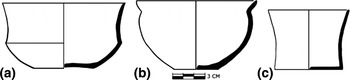
In the case of small vessels, represented in the experimental type set by cups, the extremes of shape are represented by three variations: carinated (Fig. 1 a), rounded (Fig. 1 b), and straight profiles (Fig. 1 c). However, the complexity of the Minoan repertoire, summarised for Knossos by MacGillivray (Reference MacGillivray1998), extends beyond the three variations. Straight profiles were the least complicated category of experimental cup profile: they represent straight-sided cups, conical cups, and crude wares which presented profiles, of varying wall angles, which are predominantly straight from base to rim. Carinated cups may be short-rimmed or tall-rimmed in a variety of overall heights, with a convex or S-shaped body below the carination. Similarly, what is described as rounded encompasses the categories of goblets and ogival and hemispherical cups, to name a selection, but the inclusion of a general representation of the shapes present allows for a wider reach to this experiment, which may inform later experiments of greater detail.
Basic Minoan cup variations: (a) carinated, (b) rounded and (c) straight sided.

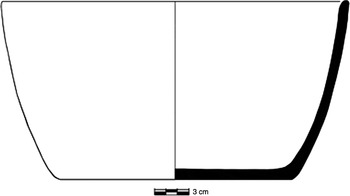
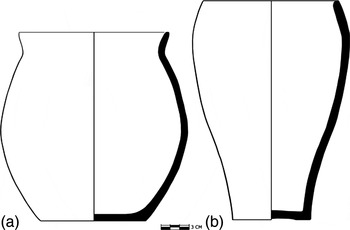
As noted above, jugs, jars and cooking pots are the most representative types within the medium-sized vessel group, and were therefore the focus of experimental representation. Cooking pots – specifically those which are open in form, often featuring tripod legs (Fig. 2) – stand apart from the other medium to medium-large vessel types. Remaining from the medium size category then, are jugs and jars. There is an observed alteration in the shape of both jugs and jars through time: in the early stages of application of the wheel, medium-sized vessels of this sort exhibited notable baggy globularity in shape, linked specifically with the earlier hand-building tradition. Vessels with globular lower body profiles (Fig. 3 a) were over time supplanted by vessels with conical lower body profiles (Fig. 3 b).
Minoan cooking pot (not showing tripod legs).

Basic Minoan medium jar/jug: (a) globular lower body, (b) conical lower body.

Representing the spectrum of wheel-coiling methods
The construction of the experimental type set followed the example of Roux and Courty (Reference Roux and Courty1998). In this previous study of the divisions between hand-building and wheel use, four discrete methods were isolated and described, which were employed to construct the experimental vessels. Roux and Courty's work is still a benchmark publication, on which current projects build. Through the use of this established experimental methodology, the results from this research have been designed to facilitate cross-regional comparison, contributing to wider dialogues of wheel trajectories throughout the Aegean and beyond during its earliest uses.
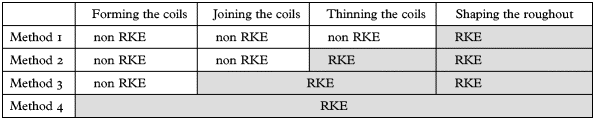
Key to the methodology is the demarcation of four specific methods within the wheel-coiling technique, which successively incorporate greater proportions of RKE through the process (see Table 1) (Roux and Courty Reference Roux and Courty1998, 748–750, fig. 1 and table 1).
-
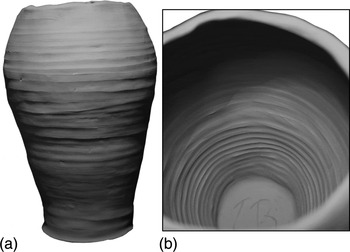
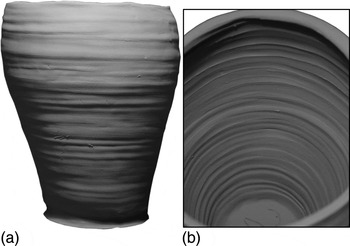
• Method 1 involves minimal use of RKE; the separate actions of forming the coils, joining the coils, and thinning the coils are each completed with the use of discontinuous pressures (i.e. without RKE, after Courty and Roux Reference Courty and Roux1995, 22). During the final stage of shaping, the coil-built roughout is then subjected to continuous pressures through the use of RKE. This late-stage application of RKE, according to Roux and Courty (Reference Roux and Courty1998, 751), leads to slight modification of vessel wall surfaces, as the walls would have already been subjected to discontinuous pressures (see Fig. 4).
-
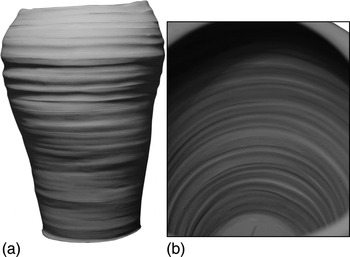
• Method 2 incorporates the use of RKE earlier in the forming process. Forming and joining the coils are, as above, accomplished with the use of discontinuous pressures, while both thinning the coils and shaping the roughout would be done through the use of RKE. The earlier use of RKE in this method should strongly modify wall surfaces through the erasure of joins and wall thinning (Roux and Courty Reference Roux and Courty1998, 751) (see Fig. 5).
-
• Method 3 involves discontinuous pressures for forming of coils only, a stage which is followed by joining and thinning of coils as a combined step with the use of RKE, before shaping of the roughout with RKE. The continuous pressures from RKE in this method strongly deform coils as well as wall surfaces, which should ultimately obscure patterns of coil joining (Roux and Courty Reference Roux and Courty1998, 751) (see Fig. 6).
-
• Method 4 utilises RKE at every stage of forming, where forming, joining and thinning of coils is completed as one step. Each coil is fully joined and thinned prior to the forming of subsequent coils. This final method is similar to method 3 in its deformation of coils and wall surfaces in order to erase join patterns, but the difference lies in the way in which coils are attached (Roux and Courty Reference Roux and Courty1998, 751).
Experimental vessel formed using method 1 showing (a) vessel exterior and (b) vessel interior.

Experimental vessel formed using method 2 showing (a) vessel exterior and (b) vessel interior.

Experimental vessel formed using method 3 showing (a) vessel exterior and (b) vessel interior.

Explanation of four methods of RKE and coil combination (after Roux and Courty Reference Roux and Courty1998, 750, table 1).

Although four separate methods were described by Roux and Courty, only methods 1–3 were represented in the experimental type set (Figs. 4–6). Method 4 was not utilised in this study for a number of reasons. First, method 4 is in use in Crete at Thrapsano (as described by Xanthoudides Reference Xanthoudides and Casson1927, 124–6), which provides an ample representation of the ways in which macroscopic traces are manifested. Second, method 4 is particularly well suited to very large vessels (such as pithoi), a vessel size which was not within the scope of this study. Finally, in small vessels, the division between method 3 and method 4 is unclear; with small vessels, a single coil may easily provide enough clay to produce the entire height of a vessel's wall.
It is important to note that when the experimental type set vessels were formed, the surfaces of those vessels were left entirely unaltered. The tools used included only a pottery wheel, the potter's hands, a sponge for applying water (applied directly to the vessel surfaces only at the rim), and a twisted wire to trim rims and cut vessels from the wheel surface. In this way, vessel surfaces should not include unrepresentative macroscopic traces from tools not verified archaeologically. The lack of surface modification after primary forming allows vessels to present the full range of possible macroscopic traces, thereby increasing the probability that such traces are recognised archaeologically irrespective of finishing and decoration operations known to exist in the archaeological material.
Comparative study of experimental material
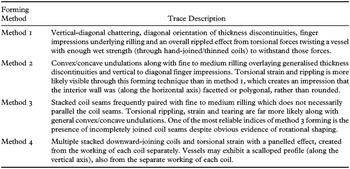
Through the examination of the experimental type set produced, a number of trends were observed as representative of specific methods of vessel forming. Although a description of the traces observed macroscopically is useful in terms of general identification, the specific character of these traces, which tended to cluster based upon the forming method employed in vessel production, has been described elsewhere (Jeffra Reference Jeffra2011, summarised in Table 2). It is important to highlight that the identification of forming methods in archaeological material is based upon similarities and overlap with the experimentally observed clustering of macroscopic traces.
Macroscopic traces observed in experimental type set, as observed by forming methods.

Although the experimental material produced facilitated the identification of macroscopic trace combinations as indicative of specific forming methods, the archaeological material directly illustrates the necessity for multiple types of analytical approach. In a number of cases, vessels were not clearly attributable to a single forming method based on the macroscopic trace evidence alone. In these cases, it should be noted that adding binocular microscopy to the present methodology would have led to a fuller understanding of the forming of specific vessels. The use of a single methodology for identifying forming methods produced meaningful results but, as with other approaches, the addition of a further analytical dimension can both increase certainty and clarify details in ambiguous cases. So, although a number of vessels are attributed to ‘in-between’ categories such as method 1/2, 2/3 or 3/4, these categories reflect more upon the methodology employed in this research than the reality of the methods used to construct the ceramics.
As a final methodological note, it is useful to consider the identification categories in a graded manner: vessels identified with method 1 and 2 were subjected to relatively low proportions of RKE during manufacture. Meanwhile, vessels identified with method 3 and 4 were subjected to high proportions of RKE. While the material has been evaluated with this in mind, the relative proportions of RKE used in the methods remain conceptually important.
THE ARCHAEOLOGICAL MATERIAL
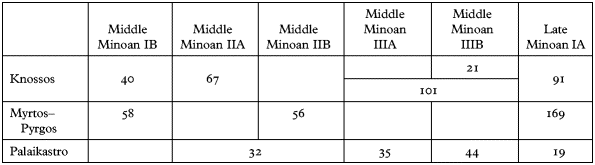
In order to understand the evidence both geographically and diachronically, it is necessary to discuss the ceramics studied first in terms of the sites, and then in terms of phenomena observed during specific periods. In several cases, deposits are identified chronologically with differing levels of precision. Some excavators have been able to state phase differentiation within the Middle Minoan II and III periods. Table 3 summarises the chronological and geographical distribution of vessels studied for macroscopic trace evidence.
Summary of quantities of vessels examined by site and chronological period.

The Sites
Knossos
Material from four excavations around the area of Knossos was studied for evidence of RKE fashioning methods (see Evans Reference Evans1900–1; Reference Evans1901–2; Reference Evans1903–4; Knappett, Macdonald and Mathioudaki in prep. for the Palace at Knossos; Popham Reference Popham1984 for the Minoan Unexplored Mansion; Macdonald Reference Macdonald, Evely, Lemos and Sherratt1996; Driessen and Macdonald Reference Driessen and Macdonald1997; Macdonald Reference Macdonald and Huxley2000; Macdonald Reference Macdonald, Driessen, Schoep and Laffineur2002 and Hatzaki Reference Hatzaki2013 for KS 178; Macdonald and Knappett Reference Macdonald and Knappett2007 for the Area of the South-West Houses and Early Magazine A). These deposits provide evidence for the trends during Middle Minoan IB and Middle Minoan IIA (Early Magazine A and the South-West Houses), undifferentiated Middle Minoan III (Room of the Knobbed Pithos and North Entrance of the Palace), Middle Minoan IIIB (KS 178), and Late Minoan IA (Minoan Unexplored Mansion).
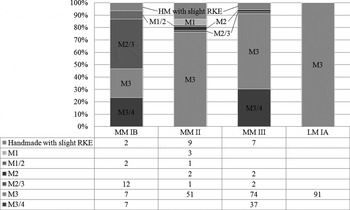
At Knossos, based on the studied material (see Fig. 7), potters tended to use forming methods which required relatively high proportions of RKE (methods 2/3, 3 and 3/4). In fact, during each period studied, lower proportion RKE methods (methods 1, 1/2 and 2) were observed in no more than 25% of vessels. Even more interesting is the pattern observed diachronically. During Middle Minoan IB, individual manufacture methods observed were relatively evenly split, albeit with a preference towards higher proportion RKE techniques. The pattern observed during the following period, Middle Minoan II, shows a more solid dominance of method 3 in particular yet at the same time an increased proportion of lower RKE methods. Later, in Middle Minoan III and Late Minoan IA, these lower proportion RKE methods diminish in observed frequency. This pattern may indicate that during Middle Minoan II, when potters were attempting to apply their skills to larger vessels more often, those skills appropriate for small vessels proved underdeveloped for constructing larger vessels. In lieu of those skills, potters opted for lower proportion RKE methods, a pattern which is similar to that proposed by Knappett (Reference Knappett, Cadogan, Hatzaki and Vasilakes2004, 263).
Knossos forming methods by period.

Palaikastro
Palaikastro is represented here by several components of the Block M excavations: EP 87, Area 6 and Building 6 (Knappett and Cunningham Reference Knappett and Cunningham2003; Reference Knappett and Cunningham2012). Specific contexts and deposits from these excavation zones each produced material dating to Middle Minoan II, Middle Minoan IIIA, Middle Minoan IIIB and Late Minoan IA: for detailed discussion of the contexts, see Knappett and Cunningham Reference Knappett and Cunningham2012.
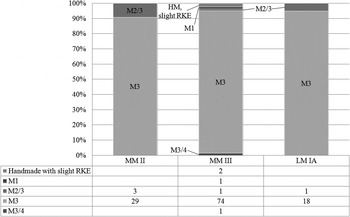
The pattern seen at Palaikastro (Fig. 8) for all studied periods is one of method 3 dominance. No less than 90% of vessels examined was correlated with method 3 manufacture for any chronological period. Interestingly, the only period during which evidence was observed for lower proportion RKE forming was Middle Minoan III, but this is the period in which there is the greatest proportional representation of method 3 manufacture.
Palaikastro forming methods by period.

Myrtos –Pyrgos
The Myrtos–Pyrgos excavations are being prepared for publication (interim reports include Cadogan Reference Cadogan1977; Reference Cadogan1980; Hankey Reference Hankey1985; Cadogan Reference Cadogan, Myers, Myers and Cadogan1992; Knappett Reference Knappett, Laffineur and Betancourt1997; Reference Knappett, Karetsou, Detorakis and Kalokairinos2000; Cadogan Reference Cadogan, Karetsou, Detorakis and Kalokairinos2000; Reference Cadogan and Murphy2011a; Reference Cadogan, Glowacki and Vogeikoff-Brogan2011b). The pottery included in this study comes from Middle Minoan IA to (probably) IIA and Middle Minoan IIB tumble deposits on the West Slope (Pyrgos II and III, respectively), and Late Minoan IA (Pyrgos IV) domestic contexts in the east of the site and from the use of the Tomb. This is the only material from a Minoan mortuary context included in this study.
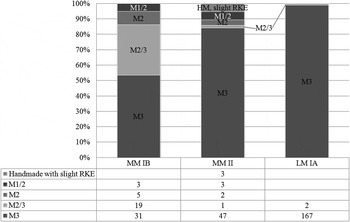
The Myrtos–Pyrgos material (Fig. 9) presents an apparently linear pattern of increasing use of method 3 forming over the periods studied. During Middle Minoan IB, higher proportion RKE forming accounted for 85% of vessels examined. In Middle Minoan II, although the relationship between higher and lower proportion RKE use remains the same, method 3 forming increases in frequency while method 2/3 decreases, which perhaps indicates a coalescence around a preferred method. By Late Minoan IA, all studied vessels corresponded with higher proportion RKE methods, the overwhelming majority of which were formed through the use of method 3.
Myrtos–Pyrgos forming methods by period.

The Chronological Periods
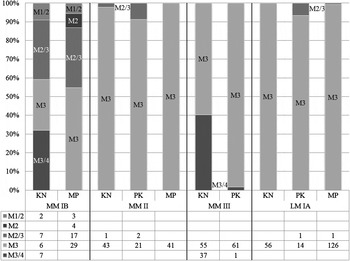
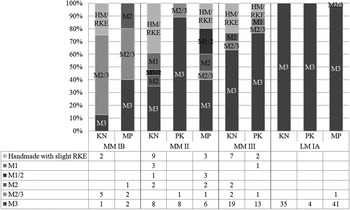
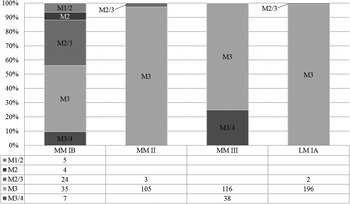
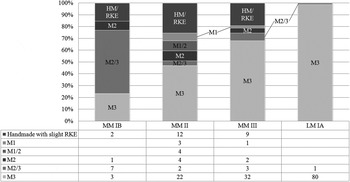
Though the assessment of the RKE ceramic data on a site-by-site basis is of benefit, consolidated chronological analysis illustrates the use of the pottery wheel across the three sites studied. The observed patterns of forming methods may then be compared against hypotheses of information sharing and the process of learning, particularly in light of the apparent dominance of a particular type of manufacture, method 3. Furthermore, changing forming methods may reveal an interesting relationship through time between dominant methods of manufacture and the incorporation of subsequently larger vessels into RKE forming methods (see Fig. 10, Fig. 11, Fig. 12 and Fig. 13).
Site-specific small vessel Minoan forming methods, by period.

Site-specific medium to medium-large vessel Minoan forming methods, by period.

Consolidated RKE forming methods in small Minoan vessels, by period.

Consolidated RKE forming methods in medium to medium-large Minoan vessels, by period.

Middle Minoan IB
During Middle Minoan IB, it can be seen through the data at Knossos and Myrtos–Pyrgos (see Figs. 10–11) that wheel methods were neither fixed nor standardised. Indeed, although the majority of examined vessels were created by using methods which required higher proportion RKE forming, this period demonstrates that the transition to the pottery wheel cannot be categorised as a binary switch.
The methods used for small vessels at Knossos and Myrtos–Pyrgos during this period show a similar distribution (Fig. 10). A primary difference between the two is the presence of method 2 at Myrtos–Pyrgos and method 3/4 at Knossos. Despite this, method 2/3 appears with similar frequency at each site, and the ratio between lower and higher proportion RKE forming is nearly identical. Turning to the medium and medium-large vessels studied (Fig. 11), the strong similarities remain. Although a number of medium to medium-large vessels were given cursory examination, only those with credible RKE forming traces were included in the data set discussed, which accounts for their low number at both Knossos and Myrtos–Pyrgos. A small data set notwithstanding, in each case lower proportion RKE methods account for similarly small numbers of vessels.
Middle Minoan II
After the relative diversity of Middle Minoan IB, it seems that RKE methods for the production of small vessels did reach a level of consistency (Fig. 10). The vast majority of vessels studied from all sites were made using method 3, and all vessels were formed using higher proportion RKE methods. Medium and medium-large vessels, on the other hand, show a marked increase in diversity of methods (Fig. 11). Unlike in Middle Minoan IB, potters were using a number of different rotative methods, and, at least for Knossos and Myrtos–Pyrgos, they were using lower proportion RKE methods more often. At Palaikastro, however, all of the studied vessels were constructed using higher proportion RKE methods (either method 2/3 or 3). The implications for this difference are unclear. Palaikastro has the smallest data set of medium and medium-large vessels for this period, but it is also a site at the eastern end of the island, and much further removed from Knossos and Myrtos–Pyrgos than those sites are from each other, as the crow flies. It may be argued that Palaikastro was on the sea route of northern towns to the Eastern Mediterranean, however, and that close contact could be expected between it and these. If one includes Malia, a northern coastal site which has been linked with Myrtos–Pyrgos (see Knappett Reference Knappett, Laffineur and Betancourt1997), the argument for distance alone as an explanation for differences becomes questionable.
Middle Minoan III
During Middle Minoan III, an interesting pattern is visible through the examination of small vessels from Knossos and Palaikastro (Fig. 10). At both sites, the standards for forming small vessels were either method 3 or 3/4 during this period. At Knossos, method 3/4 is used to produce 40% of all vessels examined. So, although at both sites potters were employing higher proportion RKE methods exclusively, the Knossos material is markedly different. One source of this differentiation is perhaps the inclusion of so-called ‘crude wares’ (see MacGillivray Reference MacGillivray and Momigliano2007) within the data set, all of which present very distinctive and clear macroscopic traces corresponding with method 3/4 forming. That this type of vessel does not appear at Palaikastro may perhaps explain the technological differentiation observed.
The comparison of medium and medium-large vessels at Knossos and Palaikastro presents closer similarities than were observed in the small vessel category for this period. Comparable frequencies of lower and higher proportion RKE methods are visible (Fig. 11), and there remains a certain level of diversity in the specific methods observed. From this perspective, then, it seems more likely that the relatively high proportion of method 3 vessels observed at Palaikastro during Middle Minoan II is due to the small sample size rather than a cultural phenomenon.
Late Minoan IA
To judge from the three sites, by Late Minoan IA all the vessels studied were made using higher proportion RKE methods, the majority of them with method 3 (see Fig. 10). Most interestingly, the pattern seen in the small vessel group is nearly identical to what was observed for Middle Minoan II. Similarly, medium to medium-large vessels from this period were almost exclusively made using method 3 (see Fig. 11). Within this larger size category, however, this observed pattern fits neatly into the changes through time from Middle Minoan IB.
Discussion
Above, a hypothesis was presented which suggested that, if the incorporation of the pottery wheel in Crete was the result of the advocacy of a small, closed group of specialists, then archaeologically one might expect to see localised preference for RKE use. This might then be followed chronologically by a diversification of methods as other potting groups learned through trial and error. This detailed examination of the RKE forming method trends from Knossos, Myrtos–Pyrgos and Palaikastro does not match the conditions set forth by this hypothesis, instead demonstrating that the potter's wheel was incorporated in Crete in a surprisingly linear manner. This is not just in terms of the forming of increasingly larger vessels using this technology through time, but also the incremental coalescence around a particular RKE forming method: method 3. When taking into consideration the inherent overlap of method 3 with method 3/4, the overall picture of small and medium to medium-large vessels through time is one of increasing RKE use at the expense of hand-building techniques (Figs. 10–11).
All of the evidence gathered indicates that there was a chronological progression, starting with an array of RKE-based methods (in which there was no clear preference) and concluding with a fairly homogenous field of method 3 use for vessels of all sizes studied. Contrary to the results reported by Berg (Reference Berg2009), no evidence for wheel-throwing was observed in any of the studied material at Knossos, Myrtos–Pyrgos or Palaikastro. The data from these separate regions of Crete suggest that the development of RKE forming methods was relatively consistent across potting groups, especially in light of the fact that method 3 grew to be the most prevalent forming method employed. Also striking is the fact that medium and medium-large vessels were formed using a greater diversity of methods (at all sites) than their small counterparts, a pattern alluded to by Knappett (Reference Knappett, Cadogan, Hatzaki and Vasilakes2004). Method 3 forming was dominant in all studied groups of any size, but the less frequently used methods demonstrate the presence of some other phenomena occurring within the Minoan potting community at the time. Indeed, this may be the result of potters experimenting with RKE forming methods for medium to medium-large shapes, but choosing, most of the time, to apply methods which were applied to smaller vessels. Though Middle Minoan IB as a chronological period shows the greatest degree of parity in terms of RKE manufacture proportions, the greatest diversity of RKE manufacture methods appears during Middle Minoan II. Furthermore, there is a progression in terms of vessel shapes within the Minoan repertoire over time, which may reflect a synergy of sorts between these shapes and the use of the wheel; the changing methods most likely altered the replication of particular forms, necessitating shifts in wall angles, thicknesses, and overall dimensions (a topic which is covered in much more detail in Gandon et al. Reference Gandon, Casanova, Sainton, Coyle, Roux, Bril and Bootsma2011).
It is also important to consider the implications of a wholesale technique change in primary forming. Gosselain, through his ethnographic work in sub-Saharan Africa, has proposed a model for the salience of aspects of the chaîne opératoire of pottery manufacture (Gosselain Reference Gosselain2000; Reference Gosselain2002; Reference Gosselain, Stark, Bowser and Horne2008; Reference Gosselain2010). Most relevantly to the case of Crete, he states that primary forming techniques – particularly those requiring mastery of a device like the wheel – are most resistant to change within a potting system, specifically because these relate to ‘those most rooted and enduring aspects of social identity, such as kinship, language, gender, and class subdivisions’, as they are characterised by ‘an intimate connection with the primary learning process and great stability through time and space … involving deep and formal relationships with a limited set of people, usually close relatives’ (Gosselain Reference Gosselain2000, 193). So, the presence of this technological change in Minoan potting is significant, but the manner in which it occurred exposes a deep level of social cohesion among Minoan potters.
CULTURAL IMPLICATIONS
There seems to be no shortage of acknowledged factors which may have precipitated the integration of RKE potting and the use of the wheel itself within Minoan potting workshops. The precursors of non-steady stateFootnote 1 wheel devices predate the first comprehensive application of rotation to potting in Crete, which supports the theory that this was an internal innovation. Nearby in Egypt, artefactual and documentary evidence indicates the presence of rotative devices from at least the Fifth Dynasty (2323–2150 bc) (Arnold and Bourriau Reference Arnold and Bourriau1993; Powell Reference Powell and Kemp1995). As the Protopalatial period was in part characterised by a rise in long-distance exchange, it is not difficult to suppose that the possibilities of rotative devices gestating in potters' workshops could have been accelerated through awareness of different regional potting practices (as highlighted in Knappett Reference Knappett1999). Indeed, a factor which potentially favours successful adoption of an innovation is the widening of communication and culture contact (Rogers Reference Rogers1962; Layton Reference Layton and Renfrew1973; Spratt Reference Spratt, van der Leeuw and Torrence1989; Arthur Reference Arthur2009), something which was clearly taking place prior to the use of the wheel.
From an a posteriori perspective, the changes in Minoan potting techniques take on a semblance of directionality, coalescence towards a standard practice (see Figs. 12 and 13). This directionality could perhaps be taken to indicate elite sponsorship in Minoan Crete although, if this is the case, the level of direct intervention is unclear. Furthermore, the nature of this technological innovation at a non-palatial site like Myrtos–Pyrgos can be seen as diminishing the validity of an argument for direct elite sponsorship. Perhaps the spread of RKE methods emerged through a more indirect kind of pressure. During the earliest comprehensive use of the wheel on Crete, an increase in administrative documentation and centralised storage, as well as a continuation of the accumulation of eastern exotic materials, objects and ideas, has been taken to indicate an increase in complexity and social stratification (Warren Reference Warren1980; Cadogan Reference Cadogan1983; Day, Wilson and Kiriatzi Reference Day, Wilson, Kiriatzi, Laffineur and Betancourt1997; Knappett Reference Knappett1999; Watrous Reference Watrous and Cullen2001; Rehak and Younger Reference Rehak, Younger and Cullen2001). A pre-existing tradition of conspicuous consumption practices was bolstered through this increase in complexity and social stratification, through which elites legitimised power and prestige (see Day and Wilson Reference Day, Wilson and Hamilakis2002 for discussion). The crux of this is the prominent position given during such practices to cups, which were the first vessels successfully and consistently produced with the wheel. If the application of wheel production to cups was encouraged by elites, it would not be surprising if these conspicuous, value-laden (through elite association) vessels had been prioritised for production in a specific manner. It would be in this context that the impact of recursionFootnote 2 may be visible, as was demonstrated by Roux (Reference Roux2003) elsewhere.
It has been suggested by Driessen and Macdonald (Reference Driessen and Macdonald1997, 74) that the evident uniformity of architecture and pottery in Minoan Crete could be the result of either a single state or peer polity interaction and imitation. In either case, the evidence of strong group cohesion among potters on the island indicates that contact went well beyond simple imitation. The concept of direct competition between closed, discrete potting groups does not immediately account for the evidence, either. Instead, the evidence from the potting communities corresponds best with open, cooperative effort, prioritising group cohesion (perhaps extending beyond the boundaries of individual archaeological sites) during the period of technological change. The outset of the innovation process for small vessels would have commenced sometime during Middle Minoan IA to IB and, as methods for those small vessels quickly became homogenised, concluding, perhaps, during Middle Minoan III. Pithoi, the largest of vessels produced, did not show evidence of RKE manipulation until the Middle Minoan III or Late Minoan I period, so the innovation process, as it relates to these very large vessels, started much later.
Driessen (Reference Driessen and Pullen2010, 35–6) has characterised Minoan society as a ‘middle-range society, a community somewhere on the continuum between egalitarian and highly-stratified’, noting that, at Palaikastro particularly, the various blocks evident in the town plan perhaps may be viewed as focal points for ‘corporate groups’ (Driessen Reference Driessen and Pullen2010, 54). These corporate groups may have extended beyond the House concept to include the possibility of the ‘existence of multilocal House groups, dispersed over a series of even nonadjacent communities, and thus contributing to a social and symbolic landscape that exists within and through the identifiable settlement network’ (Driessen Reference Driessen and Pullen2010, 55). In light of what appears to be close coordination between potting groups at distant geographical production points, as well as highly regularised establishment and acquisition of skills, it seems most likely that Minoan potters were cohesively organised prior to the first use of the wheel. Moreover, it is clear, particularly in light of the work done by Schoep (Reference Schoep2002; Reference Schoep2006) and Knappett (Reference Knappett, Bradfer-Burdet, Detournay and Laffineur2005), that potters' workshops were spatially not exclusively affiliated with the commonly viewed seats of power, the palatial structures/court buildings.
The frequent association of potters' workshops with other types of workshops and their location within settlements and towns (Michaelidis Reference Michaelidis1993, 36) encourage identification with some level of regionally cooperative production practices. In light of the associations between multiple types of workshops, Gillespie's assertion that ‘the house is an institution that used multiple strategies to recruit members whose everyday practices integrated kinship, economics, religion and politics’ (Gillespie Reference Gillespie, Joyce and Gillespie2000, 15) takes on an interesting dimension. The relationship between the corporate group (or groups) of elites and these potters is not as simple as terms such as ‘attached specialists’ might suggest. If several spatially related workshops (representing a range of crafts) could be conceived of as indicating the presence of a House or corporate group component, how might the technological interconnections between sites (which do not demonstrate a strong case for identification as Houses) be explained? It may be that potters changed their behaviours and techniques through indirect pressures (such as recursion), but, given that methods within the specific technique of wheel-coiling displayed such similarity at each site, it seems necessary to construct a framework for communication between geographically disparate Houses. This perspective would certainly benefit from other studies of a technological nature which may confirm or deny the presence of simultaneous technique acquisition between sites.
Obviously, the data from three sites do not provide a definitive conclusion as to the full spectrum of techniques used by potters during early comprehensive wheel use. Similarly, more assemblages need to be examined in order to test the accuracy of the geographical and chronological trends observed above. From a methodological perspective, it is important to rely on multiple types of analytical approaches when attempting to clarify the chaîne opératoire of objects, for every approach has its own particular areas of weakness. What is significant, however, is that this detailed macroscopic work has not only demonstrated the presence of wheel-coiling instead of wheel-throwing techniques in all contexts assessed, it has also allowed regional potting groups to be seen as close-fitting components of a larger, apparently cooperative network of potters across the island of Crete.
ACKNOWLEDGEMENTS
I would like to express my gratitude to the British School at Athens for permission to study collections held at the Stratigraphical Museum, and to Gerald Cadogan for access to unpublished material, as well as to Carl Knappett and Colin Macdonald for access to their material. My particular thanks go to Carl Knappett, Valentine Roux, Gerald Cadogan and Colin Macdonald for reading earlier drafts and for providing excellent insights and invaluable support. I would also like to thank Flora Michelaki for her translation assistance. This research was undertaken over the course of my doctoral studies at the University of Exeter and the publication of this research was supported by a Fyssen Foundation post-doctoral study fellowship.