Implications
Soaking a non-heat-treated diet composed of wheat, barley, maize and soybean meal provides a considerable potential for increasing apparent total tract digestibility of phosphorus (P), and thus reducing the use of mineral phosphate, resulting in a reduction in P excretion. However, this potential is absent when 1250 FTU/kg is supplemented and soaking is limited to 24 h at 20°C. Therefore, level of phytase and soaking conditions should be considered when evaluating the potential of soaking compared with dry feeding in non-heat-treated diets. The potential of soaking may however be different for heat-treated diets due to loss of plant phytase.
Introduction
Phytate, the mixed salt of phytic acid (myoinositol hexaphosphate), is the major storage form of phosphorus (P) in plant feedstuffs and is poorly digested by pigs unless phytase is present (Eeckhout and De Paepe, Reference Eeckhout and De Paepe1994; Viveros et al., Reference Viveros, Centeno, Brenes, Canales and Lozano2000). The most widespread and accepted practice in pig production is to provide dry feeds to the animals, either as meal or pellets. The effect of microbial phytase has been extensively studied in dry-fed diets and shows that microbial phytase increases the digestibility of plant P to a maximum level of 60% to 65% (e.g. Poulsen et al., Reference Poulsen, Blaabjerg and Feuerstein2007; Kim et al., Reference Kim, Sands, Mullan and Pluske2008; Blaabjerg et al., Reference Blaabjerg, Nørgaard and Poulsen2012a). In many cases, this means that the feed must be supplemented with some mineral phosphate to meet the pigs’ requirement of digestible P. However, this leaves a potential for further improvements of the digestibility of plant P, which will be valuable for decreasing (1) the excretion of P in favor of the environment and (2) the use of mineral phosphates that are a limited global resource. The bottleneck for increasing the P digestibility above 60% to 65% is the shortage of time for phytate degradation in the stomach of the pig (Blaabjerg et al., Reference Blaabjerg, Jørgensen, Tauson and Poulsen2011). Phytase is dormant in dry conditions but is activated to degrade phytate in wet conditions. Thus, use of liquid feeding seems to be a promising strategy to further enhance the P digestibility compared with dry feeding due to the initiation of the phytate degradation in the tank before feeding (Liu et al., Reference Liu, Bollinger, Ledoux, Ellersieck and Veum1997; Lyberg et al., Reference Lyberg, Lundh, Pedersen and Lindberg2006; Blaabjerg et al., Reference Blaabjerg, Jørgensen, Tauson and Poulsen2010b). However, more knowledge about the potential of liquid feeding without and with microbial phytase is needed. The hypothesis of this study is that soaking of a diet containing plant phytase increases the P digestibility and that the digestibility is further increased when the diet is soaked with microbial phytase resulting in a P digestibility above 65%. Therefore, the objective of this experiment was to evaluate the effect of soaking of a non-heat-treated diet based on wheat, barley, maize and soybean meal without and with microbial phytase on apparent total tract digestibility (ATTD) of P.
Material and methods
The experimental protocol was approved by the Danish Animal Experiments Inspectorate, the Danish Ministry of Justice, Copenhagen, Denmark.
Animals
The experiment comprised 24 female pigs (Landrace×Yorkshire×Duroc) from six litters weighing 65±3 kg. From each litter, the pigs were randomly assigned to four diets. Pigs were housed in stainless steel metabolism crates (70×135 cm). Each pig was fed 1 kg of one of the two dry diets or 3 kg of one of the two soaked diets (feed and water ratio: 1 : 2 (w/w)) twice a day (0800 and 1400 h) corresponding to 90% of ad libitum feeding. Daily feed refusals were recorded. The diets were fed for 12 days; 5 days for adaptation and 7 days for total collection of urine and feces. On day 5, the pigs were fitted with urine bladder catheters for separate collection of urine and feces. Urine was collected daily in containers, to which 40 ml 30% H2SO4 was added to avoid nitrogen (N) loss.
Preparation of feedstuffs and diets
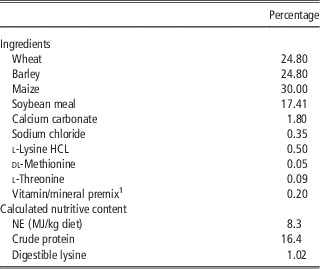
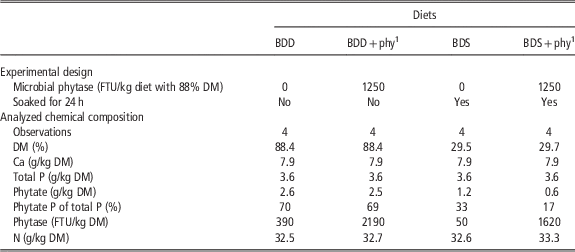
The basal diet was optimized according to the Danish recommendations for pigs between 45 and 105 kg for all nutrients except P (Pig Research Centre, 2013). No mineral phosphate was added and calcium (Ca) was adjusted to 7.0 g/kg diet leading to a total Ca : total P ratio of 2 : 1. One batch of the basal diet was prepared (Table 1). The diet was ground by a roller mill (3 mm between the rolls) and divided in two portions that were supplemented with microbial phytase (powder, Aspergillus niger, Natuphos 5000 G, BASF Animal Nutrition, Ludwigshafen, Germany) at 0 or 1250 FTU/kg diet with 88% DM. Following, the diets were either fed dry or soaked by mixing feed and water (20°C) in a ratio of 1 : 2 (w/w) in a closed tank kept at a room temperature of about 20°C for 24 h before feeding (2×2 factorial design; Table 2).
Ingredient composition and calculated energy and nutrient composition of the basal diet (as-fed basis)

NE=net energy.
1 Provided per kilogram of diet: 50 mg of Fe from FeSO4; 80 mg of Zn from ZnO; 27.7 mg of Mn from MnO; 20 mg of Cu from CuSO4; 0.2 mg of I from KI; 0.3 mg of Se from Na2SeO3; 60 mg of α-tocopherol; 2.2 mg of vitamin K3; 2.2 mg of thiamine; 4 mg of riboflavin; 3.3 mg of pyridoxine; 11 mg of d-pantothenic acid; 22 mg of niacin; 0.06 mg of biotin; 0.02 mg of vitamin B12; 4400 IU of vitamin A; and 1000 IU of vitamin D3.
Experimental treatments and mean chemical composition of the dry or soaked diets supplemented without or with microbial phytase
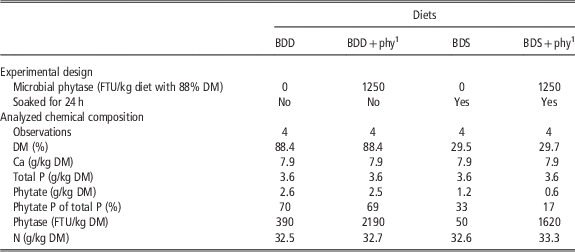
BDD=basal diet fed dry; BDD+phy=BDD with microbial phytase (1250 FTU (Aspergillus niger, Natuphos 5000 G, BASF Animal Nutrition, Germany)/kg diet with 88% DM); BDS=basal diet soaked for 24 h at 20°C; BDS+phy=BDS with microbial phytase (1250 FTU (A. niger, Natuphos 5000 G, BASF Animal Nutrition, Germany)/kg diet with 88% DM); FTU=phytase activity expressed in units; DM=dry matter.
1 Analyzed chemical composition of BDS or BDS+phy after 24 h of soaking at 20°C.
Chemical analyses
To maintain the phytase activity of the feed, dry matter (DM) of the diets was determined by freeze drying with the following parameters: cold trap: −85°C; time: 72 h; final product temperature: 30°C; and pressure: 0.05 mbar. DM in feces was determined by oven drying at 103°C for 20 h. Diets were analyzed for phytate P by the method of Haug and Lantzsch (Reference Haug and Lantzsch1983) and phytase activity by the procedure of Engelen et al. (Reference Engelen, Vanderheeft, Randsdorp and Smit Ed1994) where 1 FTU is the amount of enzyme that liberates 1 µmol inorganic orthophosphate per minute from 0.0051 mol/l sodium phytate at pH 5.5 and 37°C. Diets, feces and urine were analyzed for P by the colorimetric vanadomolybdate procedure (Stuffins, Reference Stuffins1967) and Ca according to the procedure of the Association of Official Analytical Chemist (AOAC, 2000a) with the following modifications: dry ashing was performed at 450°C for 3 h in step 1 and for 1 h in step 2. N in diets, feces and urine were analyzed by a modified Kjeldahl method (AOAC, 2000b). Each sample was analyzed in duplicate.
Statistical analyses
The results were analyzed by use of the MIXED procedure of SAS. The results are presented as least squares means and standard error of mean. Statistical significance was accepted at P<0.05 and tendencies were declared at 0.05⩽P⩽0.10. Treatment differences were separated by the PDIFF option of SAS. The model included the fixed effect of microbial phytase addition and soaking and their interactions. Litter was considered as a random factor.
Results
The analyzed chemical composition of the diets is shown in Table 2. The analyzed phytase activity of basal dry-fed diet (BDD)+phy was 21% higher than planned. Soaking for 24 h decreased the phytase activity with 340 FTU/kg DM (87%) in basal diet soaked for 24 h at 20°C (BDS) and with 570 FTU/kg DM (26%) in BDS+phy. Moreover, 54% and 76% of the phytate content in BDS and BDS+phy, respectively, was reduced by soaking. The crude protein (CP) content (N×6.25) was not affected by soaking.
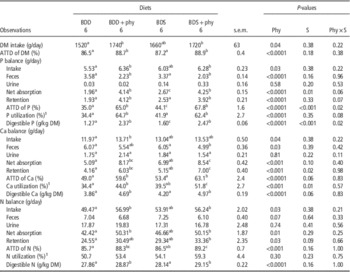
The P, Ca and N intake were highest for the microbial phytase-supplemented diets (P<0.05; Table 3) because of the slightly higher DM intake (P=0.04). Microbial phytase addition enhanced the ATTD of DM by 2 percentage units (P<0.0001). Of the results in Table 3, only the ATTD of P and the amount of digestible P were affected by the interaction between microbial phytase and soaking (P=0.02). These interactions were caused by a greater increase in the ATTD of P by microbial phytase in the dry (30 percentage units; BDD v. BDD+phy) compared with the soaked diet (24 percentage units; BDS v. BDS+phy) resulting in an increase in the amount of digestible P of 1.1 and 0.87 g/kg DM, respectively. Soaking of the diet without microbial phytase increased the ATTD of P by 9 percentage units (BDD v. BDS), whereas soaking of the diet with microbial phytase increased the ATTD of P (BDD+phy v. BDS+phy) by 3 percentage units.
Effects of microbial phytase and soaking (24 h) on intake and ATTD of DM, P, Ca and N and on excretion, retention and overall utilization of P, Ca and N (LS means±s.e.m.)

LS means=least square means; BDD=basal diet fed dry; BDD+phy=BDD with microbial phytase (1250 FTU (Aspergillus niger, Natuphos 5000 G, BASF Animal Nutrition, Germany)/kg diet with 88% DM); BDS=basal diet soaked for 24 h at 20°C; BDS+phy=BDS with microbial phytase (1250 FTU (A. niger, Natuphos 5000 G, BASF Animal Nutrition, Germany)/kg diet with 88% DM); s.e.m.=standard error of mean; Phy=microbial phytase; S=soaking; DM=dry matter; ATTD=apparent total tract digestibility; ns=non significant.
1 Utilization (%)=(retention/intake)×100.
a,b,cValues within a row with different superscripts differ significantly at P<0.05.
Microbial phytase addition increased the ATTD of Ca by 10 percentage units (P<0.0001), the Ca retention with 1.86 g/day (P<0.001), the Ca utilization by 11 percentage units (P<0.001) and the amount of digestible Ca with 0.80 g/kg DM (P<0.0001). Soaking increased the Ca retention with 0.98 g/day (P=0.02) and the Ca utilization with 6 percentage units (P=0.01) and tended to increase the ATTD of Ca by 4 percentage units (P=0.06).
Microbial phytase addition enhanced the ATTD of N by 3 percentage units (P<0.001) and the amount of digestible N with 1.01 g/kg DM (P<0.0001). Microbial phytase also increased the N retention with 4.98 g/day (P=0.03), whereas soaking tended to increase the N retention with 3.83 g/day (P=0.09).
Discussion
Addition of microbial phytase to the basal diet resulted in a higher phytase activity than planned. This may be due to analytical uncertainties or, most likely, because the phytase activity of the phytase product was higher than declared. Carlson and Poulsen (Reference Carlson and Poulsen2003) showed that the activity of plant phytases decreased during soaking at 20°C, whereas the activity of microbial phytase was stable. This agrees with the fact that almost no phytase activity was present in BDS after soaking. Thus, decrease of phytase activity in BDS+phy may primarily be due to inactivation of plant phytases.
Pigs fed diets without microbial phytase had a lower feed intake because of feed refusals compared with pigs fed diets with microbial phytase. This might have enhanced ATTD of P for BDD+phy and BDS+phy as Steiner et al. (Reference Steiner, Mosenthin, Fundis and Jakob2006) observed that increased feed intake improved the efficacy of microbial phytase. In line with previous studies (e.g. Poulsen et al., Reference Poulsen, Blaabjerg and Feuerstein2007; Kim et al., Reference Kim, Sands, Mullan and Pluske2008; Blaabjerg et al., Reference Blaabjerg, Jørgensen, Tauson and Poulsen2010b and Reference Blaabjerg, Nørgaard and Poulsen2012a), this study showed that addition of microbial phytase to dry-fed diets enhanced ATTD of plant P to a maximum of about 65%. Phosphate is primarily absorbed in the proximal part of the small intestine (Moore and Tyler, Reference Moore and Tyler1955; Partridge, Reference Partridge1978). Thus, to be available for absorption, phosphate must be released from the phytate complex before feeding or in the stomach of the pig. In BDS, the phytate content was halved before feeding because of degradation of phytate by phytases originating from wheat and barley in the diet. This increased ATTD of P for BDS by 9 percentage units compared with BDD. Similarly, soaking (1 h, 10°C) or fermentation (23.5 h, 50% residue in the tank) of feed based on wheat, barley, soybean meal and rapeseed meal increased ATTD of P by 7 and 10 percentage units, respectively (Lyberg et al., Reference Lyberg, Lundh, Pedersen and Lindberg2006). Common for these diets were that they, as BDS, contained plant phytases (due to inclusion of wheat and barley) initiating phytate degradation during soaking or fermentation before feeding. Accordingly, no effect of soaking or fermenting feed based on maize and soybean meal was observed on ATTD of P as these feedstuffs contain no or only negligible plant phytase to degrade phytate before feeding (Liu et al., Reference Liu, Bollinger, Ledoux, Ellersieck and Veum1997; Pedersen and Stein, Reference Pedersen and Stein2010).
A study by Liu et al. (Reference Liu, Bollinger, Ledoux, Ellersieck and Veum1997) showed that the net effect of soaking (2 h, 30°C) a maize–soybean meal-based diet on ATTD of P was less when 500 compared with 250 FTU/kg diet was supplemented (14 and 5 percentage units, respectively). Similarly, the present net effect of soaking on ATTD of P was less when microbial phytase was added (3 percentage units; BDS+phy) compared with the diet containing solely plant phytase (9 percentage units; BDS). Moreover, Liu et al. (Reference Liu, Bollinger, Ledoux, Ellersieck and Veum1997) found that only 250 and not 500 FTU/kg diet significantly increased ATTD of P in soaked compared with dry-fed diets (29% v. 43% and 38% to 43%, respectively). Likewise, the present ATTD of P was only significantly higher for BDS compared with BDD and not for BDS+phy compared with BDD+phy. Therefore, the present results and results by Liu et al. (Reference Liu, Bollinger, Ledoux, Ellersieck and Veum1997) indicate that soaking only increase ATTD of P compared with dry feeding when the activity of phytase (from any origin) is low. In contrast to BDS+phy, no residual phytate was detected after 17.5 h of fermentation (20°C, 50% residue in the tank) of a wheat–barley-based diet supplemented with 750 FTU/kg diet, which resulted in an ATTD of P of 72% compared with 61% in the dry feed (Blaabjerg et al., Reference Blaabjerg, Jørgensen, Tauson and Poulsen2010b). This suggests that soaking of the diet with 500 FTU/kg diet in the study by Liu et al. (Reference Liu, Bollinger, Ledoux, Ellersieck and Veum1997) and 1250 FTU/kg diet in the present study did not increase ATTD of P significantly compared with dry feeding most likely because phytate was degraded to the same extent before the P absorption site in the small intestine. On the other hand, soaking of the diets containing lower levels of phytase such as 250 FTU/kg diet (Liu et al., Reference Liu, Bollinger, Ledoux, Ellersieck and Veum1997) or solely plant phytase (present study) significantly increased ATTD of P compared with dry feeding as more phytate was degraded before the P absorption site when the feed was soaked before feeding. This implies that if soaking of diets containing high levels of phytase should increase ATTD of P compared with dry feeding, soaking conditions need to be optimized (e.g. time, temperature, residual amount in the tank, etc.) to degrade all phytate before feeding.
It is known that the time required to degrade phytate completely is very feedstuff dependent (Blaabjerg et al., Reference Blaabjerg, Carlsson, Hansen-Møller and Poulsen2010a and Reference Blaabjerg, Strathe and Poulsen2012b). Individual soaking (20°C) of barley, wheat, rapeseed cake or soybean meal (all supplemented with 1000 FTU/kg diet) showed a rapid initial degradation of phytate within the first 2 h after which the degradation rate declined despite a high phytase activity (Blaabjerg et al., Reference Blaabjerg, Carlsson, Hansen-Møller and Poulsen2010a and Reference Blaabjerg, Strathe and Poulsen2012b). It was found that about 60%, 45%, 34% and 8% of the phytate in the barley, wheat, rapeseed cake and soybean meal, respectively, remained intact after 24 h of soaking (Blaabjerg et al., Reference Blaabjerg, Carlsson, Hansen-Møller and Poulsen2010a and Reference Blaabjerg, Strathe and Poulsen2012b). Another study showed that 16% compared with 24% of phytate remained intact in maize and soybean meal, respectively, when soaked for 2 h at 38°C with microbial phytase (Ton Nu et al., Reference Ton Nu, Blaabjerg and Poulsen2014). These findings show that a part of the phytate pool in feedstuffs is rapidly degraded, whereas it takes longer time for phytase to get access to the remaining part especially in barley and wheat. Therefore, most likely, the 24% of the phytate that remained intact in the present diet soaked with microbial phytase originated from barley and wheat. Differences in accessibility to phytate between feedstuffs may be due to differences in storage sites of phytate. In wheat and barley, the major part of phytate is situated in the aleurone layer (O'Dell et al., Reference O'Dell, de Boland and Koirtyohann1972; Raboy, Reference Raboy1997, Reference Raboy2003), whereas phytate is deposited in the cotyledon of soybean seeds (Lott and Buttrose, Reference Lott and Buttrose1977; Prattley and Stanley, Reference Prattley and Stanley1982) and in the radicle and cotyledon of rapeseeds (Yiu et al., Reference Yiu, Altosaar and Fulcher1983). In maize, phytate is mainly stored in the germ (O'Dell et al., Reference O'Dell, de Boland and Koirtyohann1972). Moreover, structural changes caused by processing of soybeans and rapeseeds during removal of the oil may increase the access to phytate.
The homeostasis of Ca and P is tightly regulated. Under normal dietary conditions, Ca homeostasis is solely regulated in the intestine while P homeostasis primarily is regulated in the kidneys (Fernandez, Reference Fernandez1995). In the present study, only negligible amounts of P were excreted with the urine as none of the diets provided digestible P at or above the recommended level of 2.9 g digestible P/kg DM (Pig Research Centre, 2013). Stein et al. (Reference Stein, Kadzere, Kim and Miller2008) showed that ATTD of P was unaffected by the level of digestible P in the diet even when digestible P was provided at or above the recommended level by NRC (1998). This proves that although the amount of digestible P in BDS+phy was close to fulfill the requirement of digestible P, this did not affect the ATTD of P for BDS+phy negatively. The present ATTD of Ca almost mirrored ATTD of P. This is an effect of Ca demand for mineralization as the Ca absorption increased along with the increase in digestible P caused by the dietary treatments.
The ATTD of DM increased 2 percentage units in diets supplemented with microbial phytase, which most likely contributed to the observed increase of 3 percentage units in ATTD of CP (N×6.25). Reviews by Adeola and Sands (Reference Adeola and Sands2003) and Selle and Ravindran (Reference Selle and Ravindran2008) show that results from studies on the effect of microbial phytase on ATTD of CP in pigs are inconsistent. Liao et al. (Reference Liao, Sauer, Kies, Zhang, Cervantes and He2005b) found no effect of microbial phytase on ATTD of CP when added to a feed based on maize–soybean meal or barley–peas–canola. However, when added to a feed based on wheat–soybean meal or wheat–soybean meal–canola meal, ATTD of CP increased (2.3 and 1.3 percentage units, respectively) suggesting that the effect of microbial phytase depends on the diet composition (Liao et al., Reference Liao, Sauer, Kies, Zhang, Cervantes and He2005b). On the other hand, other studies found no effects of microbial phytase on ATTD of CP (Liao et al., Reference Liao, Kies, Sauer, Zhang, Cervantes and He2005a; Lyberg et al., Reference Lyberg, Andersson, Sands and Lindberg2008; Varley et al., Reference Varley, Callan and O’Doherty2011). No effect of soaking on the present ATTD of N was observed. Hong et al. (Reference Hong, Thuy, Passoth and Lindberg2009) did not detect any effect of fermenting (feed based on rice bran, maize and soybean meal; 72 h fermentation at 30°C to 35°C and with 20% residue in the tank) on apparent ileal digestibility (AID) and ATTD of CP, while Pedersen and Stein (Reference Pedersen and Stein2010) observed a reduction of up to 5.6 percentage units in AID of CP by fermentation of a maize–soybean meal-based diet (24 h fermentation at 20°C, 10% or 50% residue in the tank). In contrast, Lyberg et al. (Reference Lyberg, Lundh, Pedersen and Lindberg2006) showed an increase of 6 percentage units in AID of N by fermenting a wheat–barley-based diet (23.5 h fermentation, 50% residue in the tank) but no effect of soaking (1 h, 10°C). The above findings show that the effect of soaking or fermentation on ATTD of N is inconsistent probably because of differences in diet composition and soaking/fermentation conditions.
Conclusion
In conclusion, addition of microbial phytase (1250 FTU/kg diet) increased ATTD of P from 35 to 65% in the dry-fed diet. The effect of soaking of the diet without or with microbial phytase increased ATTD of P from 35% to 44% or from 65% to 68%, respectively. Consequently, soaking of a non-heat-treated wheat–barley–maize diet containing solely plant phytase provides a great potential for increasing ATTD of P. In contrast, soaking of a non-heat-treated wheat–barley–maize diet supplemented with 1250 FTU/kg diet for 24 h at 20°C does not increase ATTD of P significantly above the level obtained when the diet is fed dry. This is most likely because soaking with microbial phytase for 24 h at 20°C did not result in complete degradation of phytate before feeding, probably due to poor access of phytase to phytate in barley and wheat. This shows that soaking of non-heat-treated wheat–barley–maize diets with microbial phytase only will increase ATTD of P further, if soaking conditions (e.g. time, temperature, residual amount in the tank, etc.) are optimized so phytate is fully degraded before feeding.
Acknowledgment
The project was granted by The Danish Food Industry Agency, The Ministry of Food, Agriculture and Fisheries and Aarhus University.