Introduction
Molecular studies have helped to develop a new generic-level classification in the Parmeliaceae, in which the delimitation of genera has been vigorously debated (Hale Reference Hale1984; Hawksworth Reference Hawksworth1994; Nimis Reference Nimis1998; DePriest Reference DePriest1999; Rambold & Triebel Reference Rambold and Triebel1999; Crespo et al. Reference Crespo, Kauff, Divakar, del Prado, Pérez-Ortega, Amo de Paz, Ferencova, Blanco, Roca-Valiente and Núñez-Zapata2010; Thell et al. Reference Thell, Crespo, Divakar, Kärnefelt, Leavitt, Lumbsch and Seaward2012). The current generic delimitations were recently reviewed (Crespo et al. Reference Crespo, Divakar and Hawksworth2011; Thell et al. Reference Thell, Crespo, Divakar, Kärnefelt, Leavitt, Lumbsch and Seaward2012). Presently, the c. 2800 recognized species are classified into over 80 genera, the bulk of them belonging to the parmelioid lichens. Despite progress in understanding phylogenetic relationships among parmelioid lichens, the relationships of several groups remain uncertain, including the delimitation of a number of the mostly tropical genera in the Parmelia and Parmelina clades (Crespo et al. Reference Crespo, Kauff, Divakar, del Prado, Pérez-Ortega, Amo de Paz, Ferencova, Blanco, Roca-Valiente and Núñez-Zapata2010). Additionally, a few genera of parmelioid lichens have not yet been studied using molecular markers, including Bulborrhizina Kurok., Parmotremopsis Elix & Hale, and Pseudoparmelia Lynge. Recently, we were able to obtain fresh specimens of the last genus and generated sequences of five loci (mtSSU, nuLSU, ITS, Mcm7, RPB1) for three species, including the type species, in order to elucidate the phylogenetic placement of Pseudoparmelia.
Pseudoparmelia was initially erected based on the presence of pseudocyphellae on the lower surface (Lynge Reference Lynge1914), a character that was subsequently shown to be an artefact caused by tearing of rhizines (Santesson Reference Santesson1942). The genus was not generally accepted until it was resurrected in a redefined circumscription for parmelioid lichens with a pored epicortex and narrow, eciliate lobes (Hale Reference Hale1974b , Reference Hale1976b ). However, the genus was subsequently recognized as a heterogeneous assemblage and the majority of species were placed in other genera (Elix et al. Reference Elix, Johnston and Verdon1986; Hale Reference Hale1986), with only a few species remaining in a strict circumscription of Pseudoparmelia. Subsequently, a number of additional Pseudoparmelia species were described, and currently 16 species are accepted in the genus. In this narrower circumscription, Pseudoparmelia is characterized by having small ellipsoid to subspherical ascospores, bifusiform conidia, a yellow-pigmented upper cortex and medulla due to the presence of secalonic acids, a pale lower surface with simple rhizines, isolichenan in the fungal cell walls, β-orcinol depsidones in the medulla, and traces of atranorin in the cortex (Elix Reference Elix1993; Elix & Nash Reference Elix and Nash1997). The centres of distribution of the genus are in the Neotropics and southern Africa.
The tropical genus Relicina has sublinear, more or less dichotomously branched lobes with bulbate cilia, a pored epicortex, isolichenan in the cell walls, bifusiform conidia, and usnic acid as cortical substance. The centre of species diversity is in eastern Asia and Australasia, and over 50 species are currently accepted. Originally this genus was thought to be closely related to Bulbothrix, since both genera share the presence of bulbate cilia (Hale Reference Hale1974a , Reference Hale1975, Reference Hale1976a ; Elix Reference Elix1993). However, molecular data show that the two genera are only distantly related, with Bulbothrix belonging to the Parmelina clade, whereas Relicina belongs to the Parmelia clade (Crespo et al. Reference Crespo, Kauff, Divakar, del Prado, Pérez-Ortega, Amo de Paz, Ferencova, Blanco, Roca-Valiente and Núñez-Zapata2010). Another tropical genus in the Parmelia clade, the genus Relicinopsis, is similar to Relicina and shares key traits with that genus, but differs by lacking bulbate cilia and having fusiform conidia. Relicinopsis is a small genus of five species, most diverse in southern Asia and Australasia. Crespo et al. (Reference Crespo, Kauff, Divakar, del Prado, Pérez-Ortega, Amo de Paz, Ferencova, Blanco, Roca-Valiente and Núñez-Zapata2010) questioned the distinction of Relicina and Relicinopsis, since Relicinopsis was nested within Relicina in their 1GENE analysis; however, the two genera have been recovered as separate monophyletic clades in other analyses including more loci but smaller sample sizes.
Our study aims to elucidate whether Pseudoparmelia in a strict sense is a distinct lineage and to clarify its phylogenetic relationship within Parmeliaceae. We also attempt to elucidate the phylogenetic relationships among tropical genera in the Parmelia clade with an extended taxon sampling.
Materials and Methods
Taxon sampling
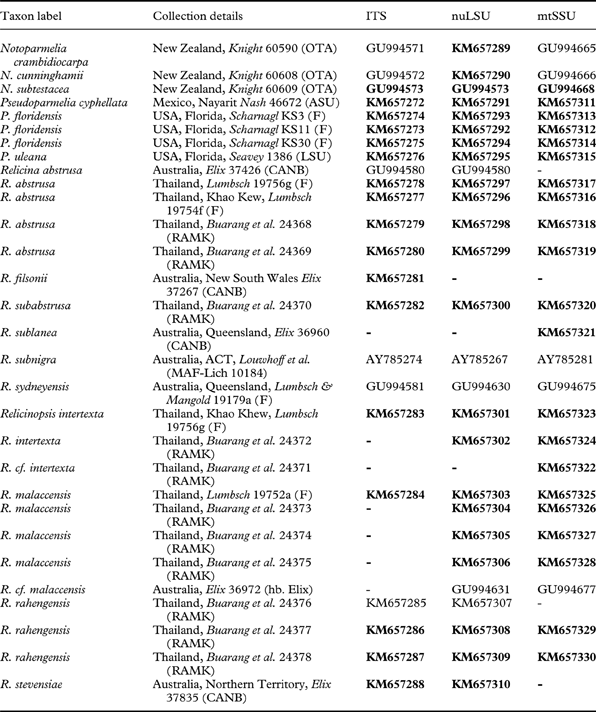
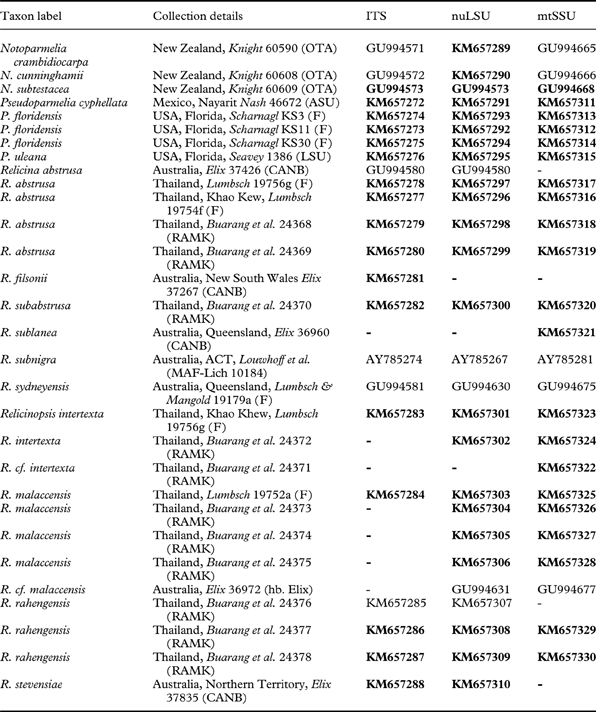
We prepared two datasets: 1) DNA sequences of nuclear ribosomal internal transcribed spacer (ITS), nuclear ribosomal large subunit (nuLSU), mitochondrial small subunit rDNA (mtSSU) and fragments of the protein-coding markers RPB1 and Mcm7 were assembled for five specimens of Pseudoparmelia representing three species, P. cyphellata (type species), P. floridensis, and P. uleana. These sequences were added to the 5-Gene dataset obtained (P. Divakar, unpublished data); 2) we assembled a three locus dataset including additional samples representing the genera Relicina and Relicinopsis in order to better understand the phylogenetic relations of these three target genera in this study. For this second dataset, DNA sequences of ITS, nuLSU and mtSSU were assembled for five samples representing three species including the type species of Pseudoparmelia, nine samples representing five species of Relicina, and 11 samples representing four species, including the type, of the genus Relicinopsis. Three species of Notoparmelia were used as outgroup because this genus has previously been shown to be closely related to this clade (Crespo et al. Reference Crespo, Kauff, Divakar, del Prado, Pérez-Ortega, Amo de Paz, Ferencova, Blanco, Roca-Valiente and Núñez-Zapata2010). Details of the specimens used in this second dataset, including GenBank accession numbers, are shown in Table 1.
Specimens used in the study, with location, reference collection detail and GenBank accession numbers. Newly obtained sequences for this study are in bold.
DNA extraction and PCR amplification
Small samples (2 mm2) prepared from freshly collected and frozen specimens were ground with sterile plastic pestles. Total genomic DNA was extracted using the DNeasy Plant Mini Kit (Qiagen, Hilden) according to the manufacturer's instructions but with slight modifications (Crespo et al. 2001). Genomic DNA (5–25 ng) was used for PCR amplifications of the ITS, nuLSU and mtSSU rDNA regions, and protein-coding markers RPB1 and Mcm7. Primers, PCR, and cycle sequencing conditions were the same as those described previously (Crespo et al. Reference Crespo, Kauff, Divakar, del Prado, Pérez-Ortega, Amo de Paz, Ferencova, Blanco, Roca-Valiente and Núñez-Zapata2010; Leavitt et al. Reference Leavitt, Esslinger, Spribille, Divakar and Lumbsch2013). Sequence fragments obtained were assembled with the program SeqMan 4.03 (DNAStar) and manually adjusted.
Sequence editing and alignment
Sequence and species identity was confirmed using the ‘megaBLAST’ search function in GenBank (Sayers et al. Reference Sayers, Barrett, Benson, Bolton, Bryant, Canese, Chetvernin, Church, DiCuccio and Federhen2011). ITS, nuLSU, RPB1 and Mcm7 sequences were aligned using the program MAFFT ver. 6 (Katoh & Toh Reference Katoh and Toh2008) using the G-INS-I alignment algorithm, ‘200PAM/K=2’ scoring matrix, and offset value= 0·0, and the remaining parameters set to default values. The mtSSU sequences were aligned with the E-INS-I alignment algorithm, ‘200PAM/K=2’ scoring matrix, and offset value=0·0 because long gaps in alignments of this marker are common in Parmeliaceae (Crespo et al. Reference Crespo, Kauff, Divakar, del Prado, Pérez-Ortega, Amo de Paz, Ferencova, Blanco, Roca-Valiente and Núñez-Zapata2010). The program Gblocks v0.91b (Talavera & Castresana Reference Talavera and Castresana2007) was used to remove regions of alignment uncertainty, using options for a “less stringent” selection on the Gblocks web server (http://molevol.cmima.csic.es/castresana/Gblocks_server.html).
Phylogenetic analyses
The alignments were analyzed using Maximum Likelihood (ML) and a Bayesian approach. ML analyses were performed using the program RAxML v7.2.7, as implemented on the CIPRES Web Portal, with the GTRGAMMA model (Stamatakis Reference Stamatakis2006; Stamatakis et al. Reference Stamatakis, Hoover and Rougemont2008) for the single locus and both partitioned combined datasets (1 and 2). Nodal support was assessed using the ‘rapid bootstrapping’ option with 1000 replicates.
Bayesian analyses were carried out using the program MrBayes 3.2.1 (Huelsenbeck & Ronquist Reference Huelsenbeck and Ronquist2001) for the second dataset. Models of DNA sequence evolution for each locus were selected with the program jModeltest v2.1.5 (Posada Reference Posada2008), using the Akaike Information Criterion (AICc) (Akaike Reference Akaike1974). The concatenated three-locus dataset was partitioned as ITS, nuLSU and mtSSU, specifying the best-fitting model, allowing unlinked parameter estimation and independent rate variation. No molecular clock was assumed. Two parallel runs were made with 10 000 000 generations, starting with a random tree and employing four simultaneous chains each. Every 1000th tree was saved into a file. The first 25% of trees were deleted as the burn-in of the chains.
We used AWTY (Nylander et al. Reference Nylander, Wilgenbusch, Warren and Swofford2007) to compare split frequencies in the different runs and to plot cumulative split frequencies to ensure that stationarity was reached. A majority-rule consensus tree with average branch lengths was calculated using the sumt option of MrBayes.
ML approach was used to examine the heterogeneity in phylogenetic signal among the three data partitions (Lutzoni et al. Reference Lutzoni, Kauff, Cox, McLaughlin, Celio, Dentinger, Padamsee, Hibbett, James and Baloch2004; Divakar et al. Reference Divakar, Ferencova, Del Prado, Lumbsch and Crespo2010). For the three loci and the concatenated analyses, the set of topologies reaching ≥70% bootstrap under likelihood was estimated (Hillis & Bull Reference Hillis and Bull1993). The combined dataset topology was then compared for conflict with ≥70% bootstrap intervals of the single gene analyses. If no conflict was evident, it was assumed that the two datasets were congruent and could be combined.
Only clades that received bootstrap support ≥70% in ML analysis or posterior probabilities ≥0·95 in MrBayes analysis were considered as well supported. Phylogenetic trees were drawn using FigTree v1.3.1 (Rambaut Reference Rambaut2009).
Results and Discussion
We generated 20 new mtSSU, 22 nuLSU, and 17 ITS sequences for this study (Table 1). The matrix of the combined dataset included 3031 unambiguously aligned nucleotide position characters (724 mtSSU, 791 nuLSU, 343 ITS, 512 Mcm7, and 661 RPB1). In the combined dataset, 2300 positions were constant. ITS PCR products obtained ranged between 600–800 bp. The differences in size were due to the presence or absence of insertions of c. 200 bp identified as group I introns (Gutierrez et al. Reference Gutierrez, Blanco, Divakar, Lumbsch and Crespo2007) at the 3′ end of the SSU rDNA. Group I introns were excluded from the analyses.
The phylogeny of parmelioid lichens will be discussed in detail elsewhere (P. Divakar, unpublished data) and is not treated here, except for the phylogenetic position of Pseudoparmelia. In the analysis of a broad sampling of Parmeliaceae (analysis of dataset 1, see Supplementary Materials , available on-line), the three sampled Pseudoparmelia species formed a well-supported monophyletic group. This clade was recovered with strong support as the sister group to a clade including species of Relicina and Relicinopsis, each forming well-supported monophyletic groups. The clade consisting of Pseudoparmelia, Relicina + Relicinopsis was recovered as a sister group to a clade including Notoparmelia and Parmelia, but this relationship lacked support (Supplementary Materials , available online).
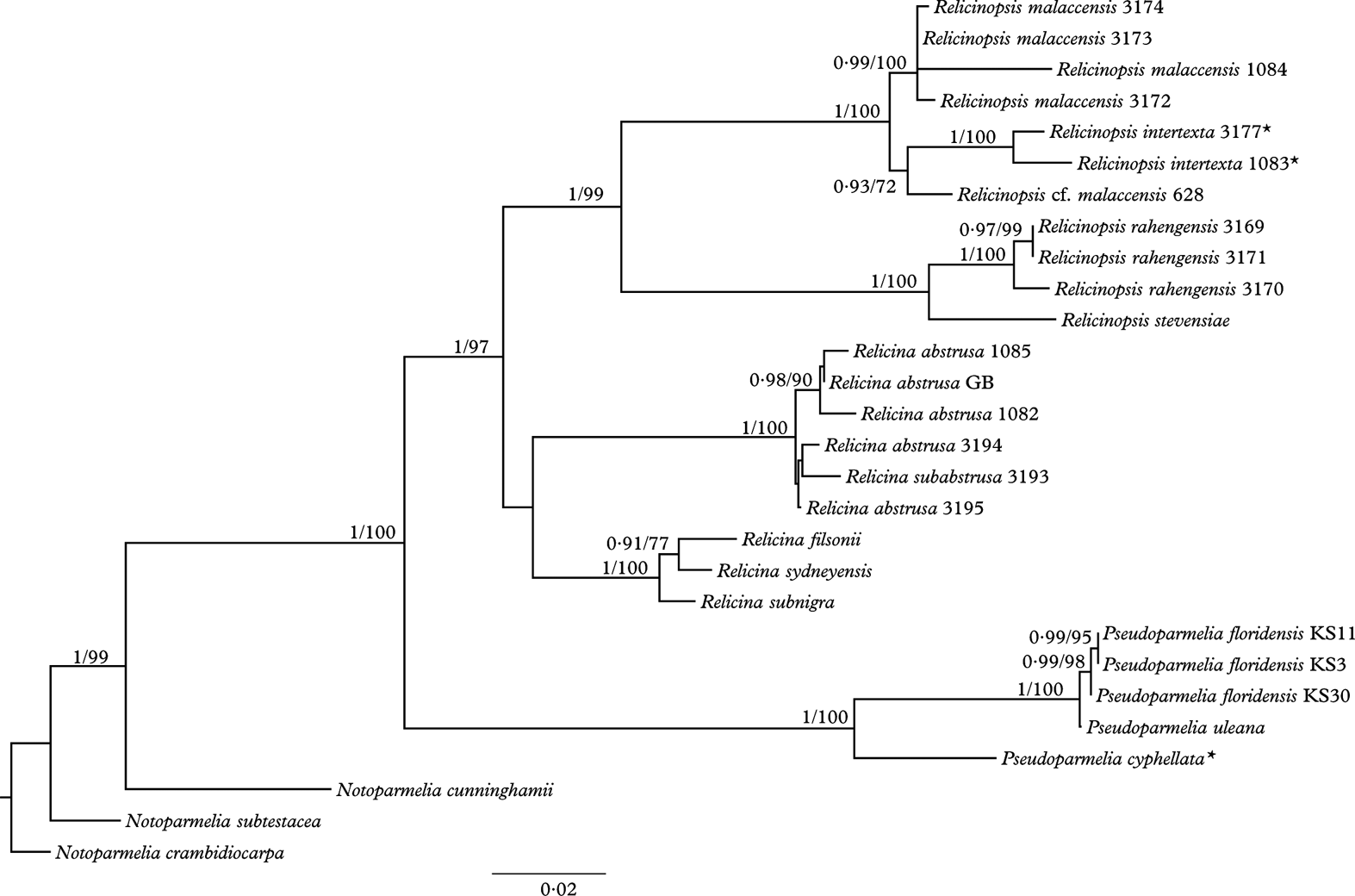
In order to better understand the phylogenetic relationships of the three genera Pseudoparmelia, Relicina and Relicinopsis, we assembled a second dataset including more species represented by three genetic markers (dataset 2, Table 1). In the phylogenetic tree (Fig. 1) resulting from this analysis, the sister group relationship of Relicina and Relicinopsis was strongly supported, as was the monophyly of Relicinopsis. However, the sister group relationship of the two clades found in Relicina lacked support in the three-gene phylogeny, and Relicina was recovered as paraphyletic, with Relicinopsis nested within, in the mtSSU single locus phylogeny (see Supplementary Materials , available on-line).
Phylogenetic relationships of the genera Pseudoparmelia, Relicina, and Relicinopsis samples based on maximum-likelihood and Bayesian analyses using three loci (mtSSU, nuLSU, ITS). Most likely tree obtained with RAxML shown here. ML-bootstrap support ≥70% and posterior probability values ≥0·95 are indicated at branches.
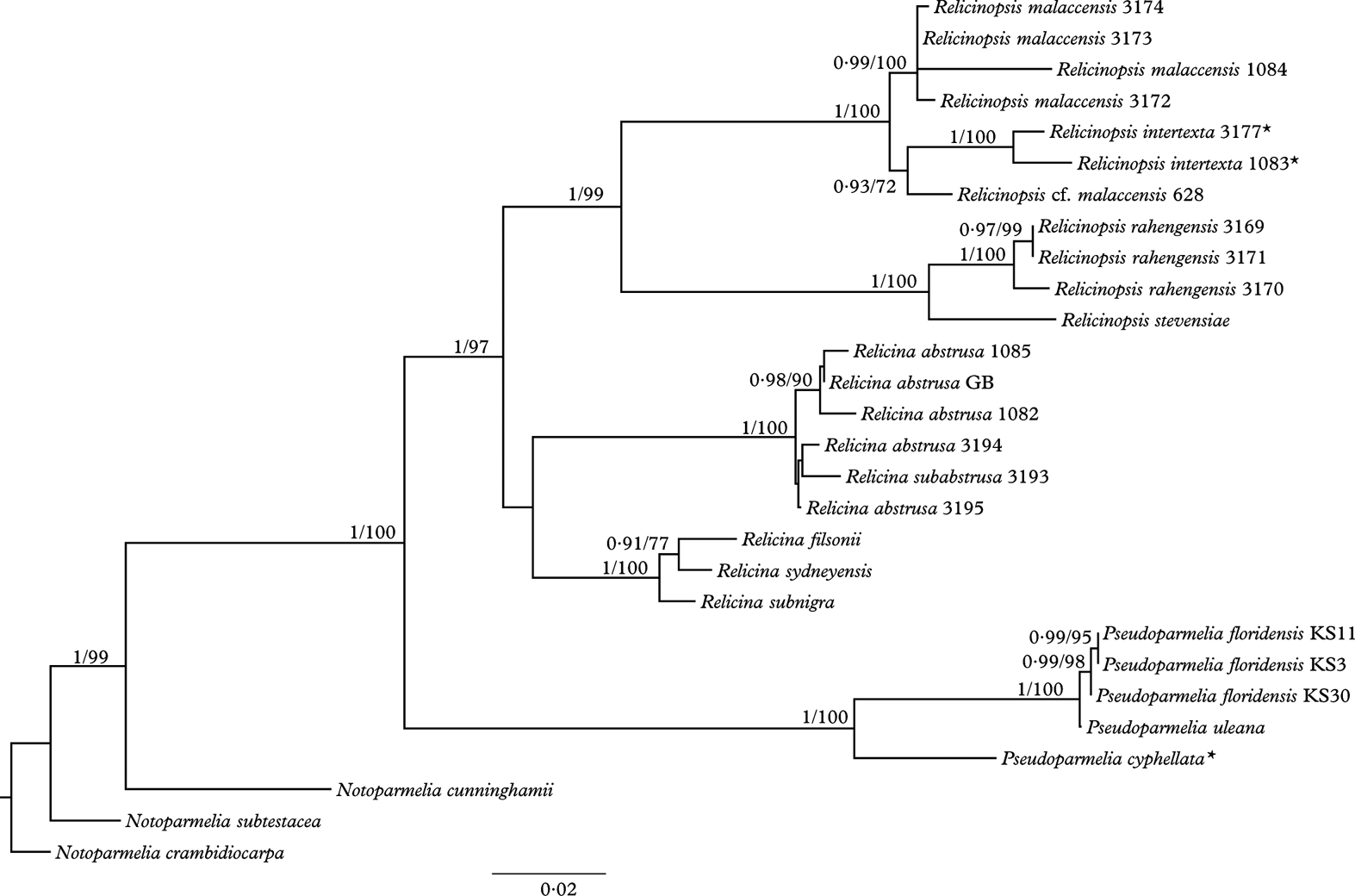
The genera Pseudoparmelia, Relicina, and Relicinopsis have a thallus covered by a pored epicortex, isolichenan as cell wall polysaccharide, and relatively small ascospores in common. In fact, the three genera are morphologically similar and species currently placed in Relicina and Relicinopsis have been included in the wider circumscription of Pseudoparmelia (Reference HaleHale 1976b ). Interestingly, a unique group of secondary metabolites, the butlerin derivatives, which are terphenyls, have been found in Pseudoparmelia (Elix & Nash Reference Elix and Nash1997) and Relicina spp. (Elix et al. Reference Elix, Gaul, Hockless and Wardlaw1995). Terphenyls are uncommon in lichenized fungi (also occurring in Parmotrema), but more common in non-lichenized Basidiomycota. A few Pseudoparmelia spp., especially P. relicinoides Elix & Nash, resemble the genus Relicina in overall growth habit and in having narrow lobes with blackened margins. Characters that distinguish Pseudoparmelia from the other genera (Table 2) include the presence of secalonic acids and absence of usnic acid. In addition, Relicina differs in having bulbate cilia and Relicinopsis in having fusiform-cylindrical conidia. We propose here to accept Pseudoparmelia in its strict sense (Elix Reference Elix1993; Elix & Nash Reference Elix and Nash1997) as a distinct genus within the Parmelia clade (Crespo et al. Reference Crespo, Kauff, Divakar, del Prado, Pérez-Ortega, Amo de Paz, Ferencova, Blanco, Roca-Valiente and Núñez-Zapata2010). The distinction of the genera Relicina and Relicinopsis requires further study with a broader sampling of Relicina spp., including the type species of the genus, R. relicinula. Furthermore, R. malaccensis was paraphyletic with R. intertexta nested within, suggesting that additional species may be hidden under the current concept of R. malaccensis.
Diagnostic characters to distinguish Pseudoparmelia from the closely related genera Relicina and Relicinopsis.

Newly obtained DNA sequences were generated in the Pritzker Laboratory for Molecular Systematics and Evolution at the Field Museum, and SYSTEMOL Laboratory at the Faculty of Pharmacy, Complutense University of Madrid. We thank Lynika Strozier for making invaluable contributions in the laboratory. This study was supported by the Spanish Ministerio de Ciencia e Innovación (CGL 2010-21646/BOS, CGL2013-42498-P), the Universidad Complutense-Banco Santander (GR 35/10A), Comunidad Autónoma de Madrid (REMEDINAL S-2009/AMB-1783), the Thai Research Fund through the Royal Golden Jubilee Ph.D. program, and the Negaunee Foundation.
Supplementary Material
For supplementary material accompanying this paper visit http://dx.doi.org/10.1017/S0024282914000577