I INTRODUCTION
Consular diptychs are a subset of what might more comprehensively be called presentation diptychs: decorated ivory panels made in multiple copies for distribution to a wide circle of friends and connections. Libanius, a professor of rhetoric in far off Antioch, was flattered and delighted to receive one from Tatianus, eastern consul in 391.Footnote 1 We know from literary sources of diptychs issued to commemorate praetorships and even quaestorships, and we have a handful of diptychs issued by other officials.Footnote 2 Thanks to the rediscovery of Mabillon's engraving of the Fauvel panel, we now know that perhaps the most famous surviving late antique diptych, NICOMACHORVM / SYMMACHORVM (55 V),Footnote 3 was produced in multiple copies to commemorate some occasion shared by the two families.Footnote 4 But those issued by ordinary consuls are by far the most numerous and best documented group.
Since ordinary consuls are securely dated by their year of office, and the presentation of their diptychs is datable to 1 January in that year, they are uniquely valuable for the precise chronological framework they provide for the art of the age, not to mention social history, the history of public entertainments and the iconography of public office. Surviving diptychs are distributed very unevenly both geographically and chronologically. Most western diptychs date from the fifth century, though the latest (541) is also western; all those so far identified as eastern date from the sixth century, ranging from 506 to 540. It is worth pointing out that the reason we can make the distinction with such certainty is because from 421 on eastern and western consular fasti list their own consul first.Footnote 5 Thus the otherwise wholly undocumented Anastasius cos. 517 is known to have been eastern consul in his year less from the style of his five surviving diptychs (as art historians tend to assume) than because his name is given first in eastern and second in western consular lists. Style alone is a very uncertain guide.
Earlier art historians devoted much effort to distinguishing schools and workshops on the basis of style, assigning the ‘best’ work to Alexandria and ‘inferior’ specimens to ‘provincial’ schools. More recently Olovsdotter simply assumed that Rome was the major centre of production in the West on the grounds that ‘the major magistracies were held there’, and that ‘provincial’ work, such as the diptych of Astyrius (449), was commissioned by consuls who held office ‘outside of Rome’.Footnote 6 Diptychs issued by western praetors and quaestors were no doubt normally made in Rome, where a substantial ivory and bone workshop still active in the sixth century has recently been identified.Footnote 7 But until the late fifth century consular inaugurations almost never took place in Rome but at the imperial court.Footnote 8 In this context ‘western’ in effect means made for distribution (depending on where the emperor happened to be at the time) in Milan, Ravenna, Trier or even Sirmium; ‘eastern’ normally made in Constantinople. We happen to know from the eyewitness description of Sidonius that Astyrius celebrated his inauguration at Arles. Yet while Gaul may seem provincial compared to Rome, by the fifth century Arles was the ‘little Rome of Gaul’, seat of the praetorian prefect of Gaul, an occasional imperial residence with palace and circus, where every luxury in the world was said to be available.Footnote 9
Wherever ivory-workers learned their trade, given the difficulty of winter travel (impossibility if it involved the sea) and the importance of the deadline (1 January), it is unlikely that consular diptychs were ever made far from the nearest imperial court (which at once rules out Alexandria). Inevitably, craftsmen set up (perhaps temporary) shop wherever there was a market for their wares; if the market moved (and fourth-century emperors travelled extensively), they moved their shop. It is natural to look for differences between diptychs made in eastern and western workshops, but the implication of the epithets that eastern and western consuls were appointed and lived in different cultural and artistic worlds should be resisted.
II EASTERN AND WESTERN DIPTYCHS
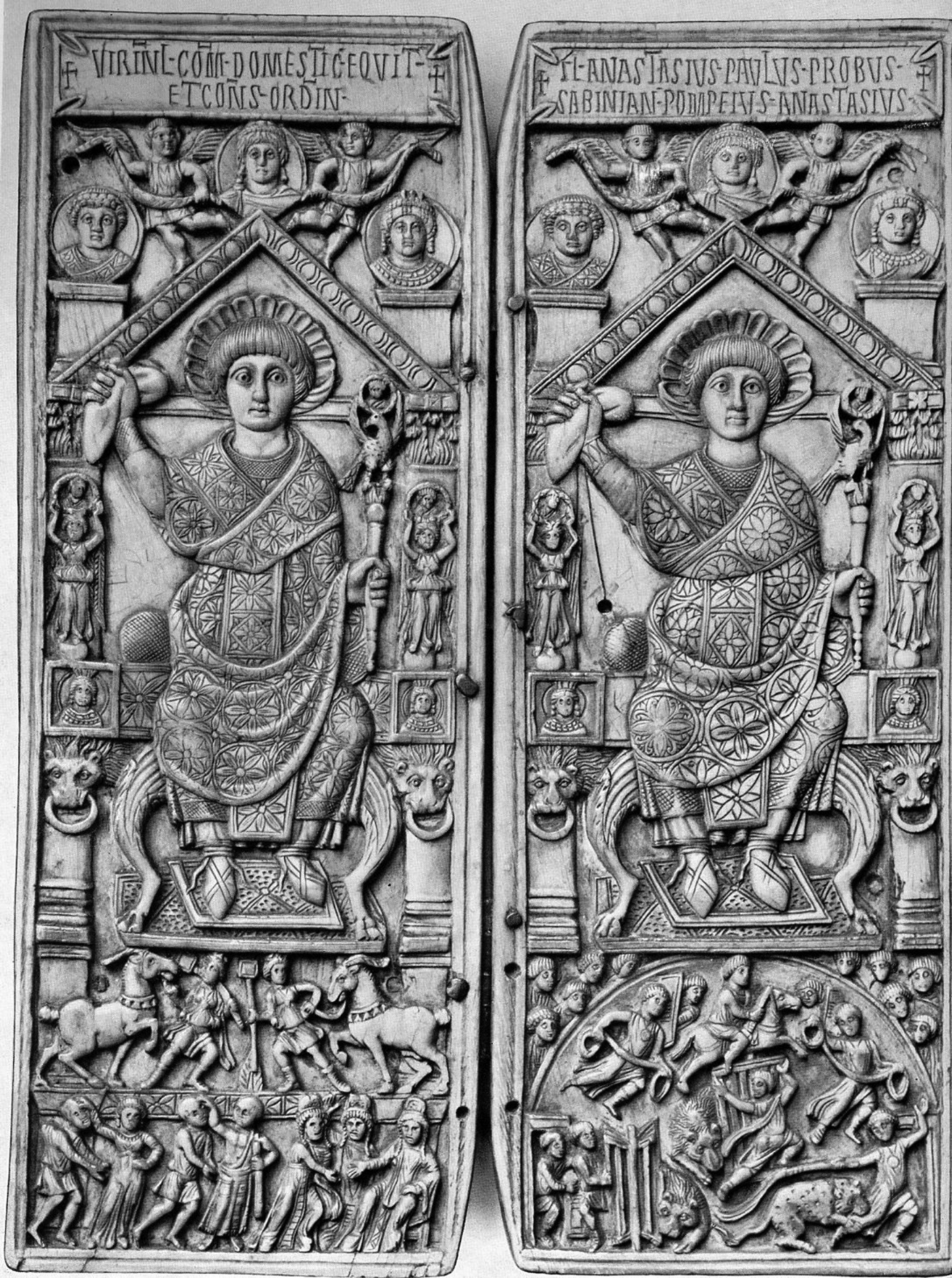
Richard Delbrueck, author of the still standard study,Footnote 10 identified two features that (he believed) differentiated eastern from western diptychs. First, on surviving western consular diptychs the honorific inscription begins on the left-hand panel when the diptych is open, facing the viewer (Fig. 1); while on eastern diptychs it begins on the right-hand panel (Fig. 2). Second, on eastern diptychs, the two panels are (except for the inscription) substantially identical, while the two leaves of western diptychs sometimes differ widely from each other.
Boethius diptych (West, 487). Left panel: NAR[ius] MANL[ius] BOETHIVS V[ir] C[larissimus] ET INL[ustris]; right panel: EX P[raefecto] P[raetorio] P[raefectus] V[rbis] SEC[undo] CONS[ul] ORD[inarius] ET PATRIC[ius]. (Photo: Giovanni dell'Orto)

Diptych of Anastasius (East, 513). Left panel: VIR INL[ustris] COM[es] DOMESTIC[orum] EQVIT[um] ET CONS[ul] ORDIN[arius]; right panel: FL[avius] ANASTASIVS PROBVS SABINIAN[us] POMPEIVS ANASTASIVS.
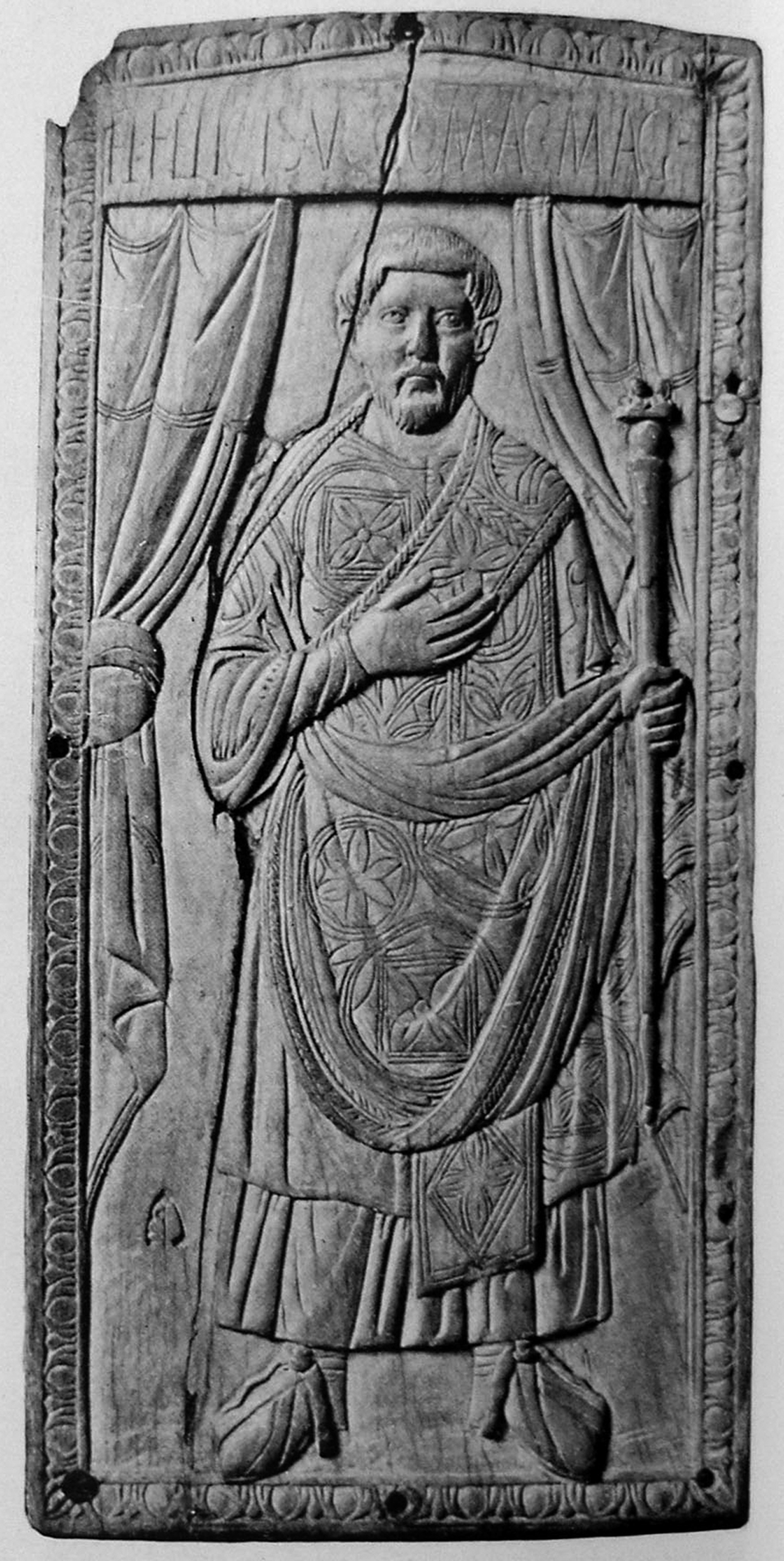
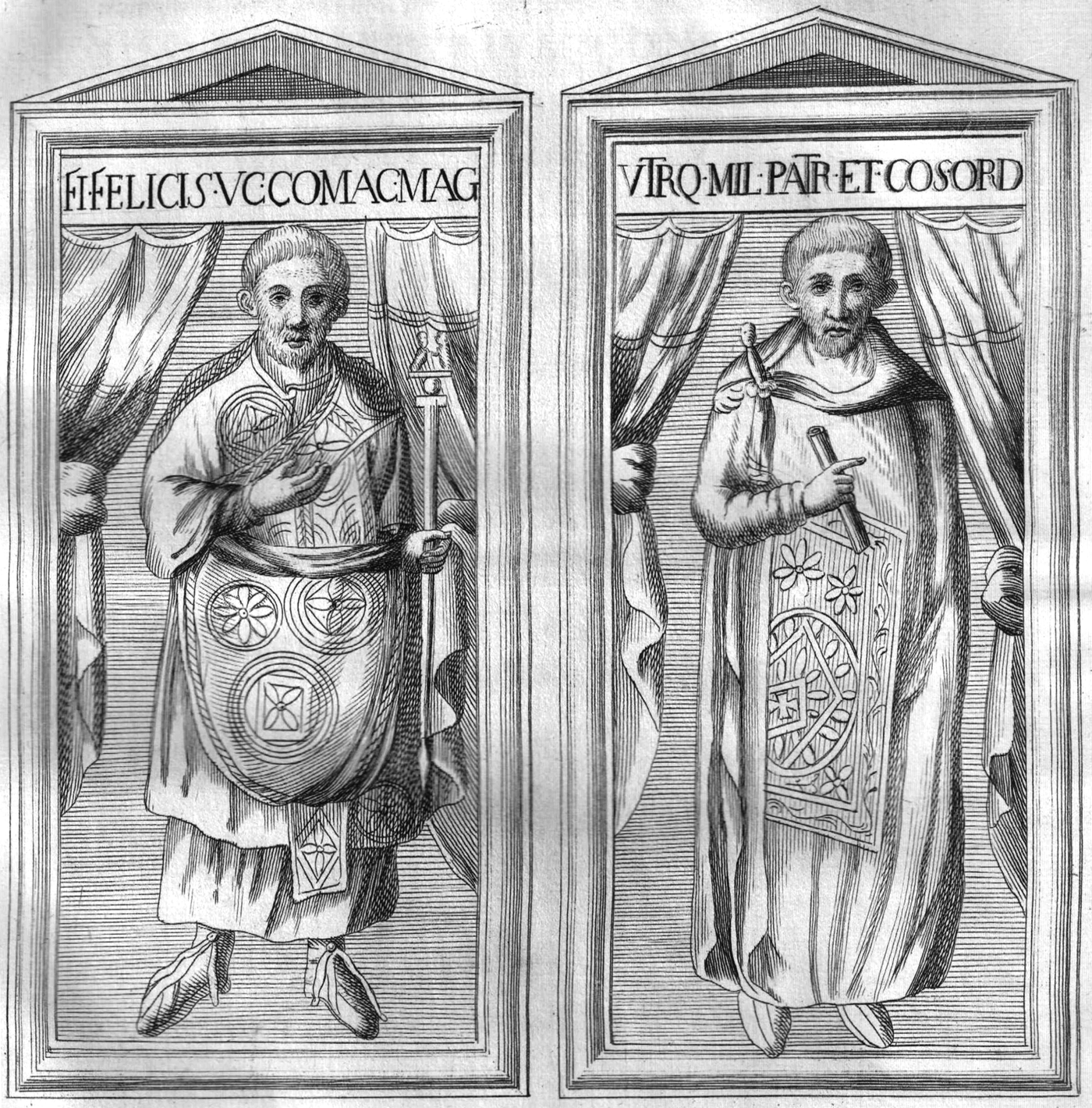
Delbrueck styled the panel on which the inscription begins the ‘Hauptseite’, the principal face, a distinction held to be supported by the differing representations of the consul on the two leaves of western diptychs. For example, the left-hand panel of the diptych of the magister utriusque militiae Felix (cos. 428) shows the consul in his trabea holding the sceptre of office (Fig. 3), while the right-hand panel (now only known from a watercolour by Mabillon)Footnote 11 shows him in a chlamys holding a scroll (Fig. 4). Only the left-hand panel of the Basilius diptych (541) shows the consul at all; the other panel has a winged Victory and an eagle. It was on this basis that Delbrueck identified the Halberstadt diptych as western.Footnote 12
Felix (West, 428). Left panel: FL[avii] FELICIS V[iri] C[larissimi] COM[itis] AC MAG[istri. (Photo: Wikimedia Commons)
Felix, watercolour by Mabillon. Right panel: VTR[ius]Q[ue] MIL[itiae] PATR[icius] ET CO[n]S[ul] ORD[inarius].
Though still widely accepted, do these distinctions really stand up? Delbrueck portentously explained the first as a ‘difference between the chancery styles of the two halves of the empire’ and the second as due to the ‘marked tendency of eastern art to more complete symmetry’.Footnote 13 But why should ‘chancery style’ have dictated a distinction between left and right? In most respects the content of consular iconography remains remarkably constant and entirely traditional from the fourth-century West to the sixth-century East.Footnote 14 Furthermore, the appeal to ‘chancery style’ implies that consular diptychs had some official function. Yet while following the conventions of official art, they were in fact entirely unofficial mementos intended for private distribution, quite distinct from the official codicils of office presented to the new consul, which would bear the emperor's portrait, not the consul's, and would exist in only a single copy.Footnote 15
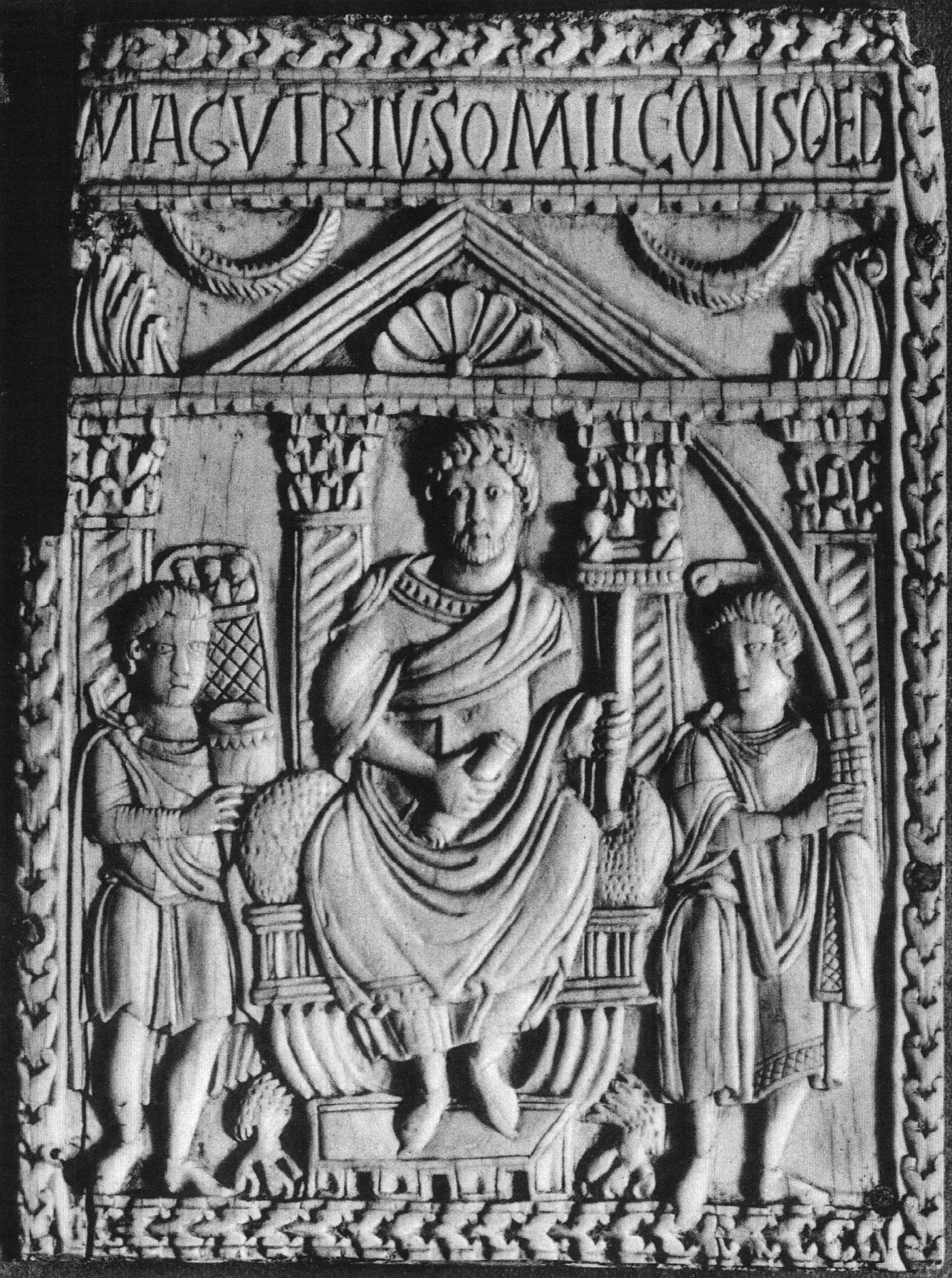
With twenty-five surviving diptychs of eastern consuls, most of them inscribed, there is ample material to support the eastern side of what have come to be known as Delbrueck's rules. But none is earlier than 506. How early are these distinctions supposed to have developed? As early as (say) 450? How many western diptychs survive from the period before 450? Excluding Halberstadt, we have one or both leaves of four inscribed consular diptychs, only two of which offer figural representations of the consul: those of Felix (428) and Astyrius (449). Felix fits both Delbrueck's rules, Astyrius (Fig. 5) neither. Hardly a ringing endorsement. The inscription begins on the right-hand panel, and the consul is shown in the same dress and pose on both panels (only one actually survives; the other is known from a sixteenth-century watercolour of both) (Fig. 6).Footnote 16
Astyrius (West, 449); left panel: MAG[istro] VTRIVSQ[ue] MIL[itiae] CONS[ul] OED[inarius]. (Photo: Delbrueck)
Sixteenth-century watercolour of both Astyrius panels; right panel: FL[avius] ASTYRIVS V[ir] C[clarissimus] ET INL[ustris] COM[es] EX.
It is tempting to explain these inconsistencies in terms of geography (Arles, and so provincial), but while the Astyrius diptych itself is firmly dated to 449, its craftsman made a suggestive error. The consul is shown holding a sceptre capped by two imperial busts, implying two reigning emperors, correct for 449 (Theodosius II and Valentinian III). But the stand (theca)Footnote 17 held by the figure on his right is capped by three busts, incorrectly implying three emperors. The watercolour copy accurately reproduces this discrepancy but in its copy of the now lost leaf shows both sceptre and stand capped by two busts. Compared with other representations of sceptres capped with two busts, the gap between the two busts on the surviving leaf is so wide that (as Delbrueck saw) it looks as if the craftsman originally carved three and then removed the middle one when he realized his error. The obvious explanation is that he was copying a model dating from a time when there were three emperors. The last period when this was true was 402–8 (Arcadius, Honorius and Theodosius II).Footnote 18 If so, then his model was more than forty years old. Of course, it need not follow that its inscription began on the right-hand leaf, but if he was copying it so slavishly, it is perhaps unlikely that the consul was shown in different pose and dress on the two leaves. And while the craftsman may have been ‘provincial’ (or at least incompetent; he also made blunders in the inscription), there are no grounds for assuming that his forty-year-old model was also ‘provincial’.
As for the symmetry Delbrueck saw as an eastern hallmark, an important paper by Josef Engemann has pointed out that a more wide-ranging symmetry is actually a feature of western diptychs.Footnote 19 The clearest illustration is NICOMACHORVM / SYMMACHORVM.Footnote 20 For all the differences in detail between the two panels, the pose of the two priestesses, the position of the altar and the shape and placement of the tree correspond exactly. Engemann drew attention to a number of similar, if less striking, correspondences between the two leaves of other diptychs generally thought to be fourth- or early fifth-century western: the Asclepius/Hygieia diptych (57 V), the Poet and Muse (68 V), Selene and Helios (61 V), Pairs of Lovers (66 V).
But the fact that this symmetrical composition is mainly restricted to classicizing diptychs with mythological themes suggests that it is less a western phenomenon than a feature of the subject matter. Engemann's claim to detect such symmetry in western consular diptychs was less successful. While the two images of Boethius (Fig. 1) are perceptibly, if only slightly, oriented towards the central hinge, it is less obvious that the surviving image of Felix is. When making his watercolour of the two leaves, Mabillon evidently saw Felix looking straight ahead on both (Fig. 4). Engemann himself conceded that there are ‘keine Richtungsdetails’ in the more generally classicizing Probianus diptych (62 V), and could only make LAMPADIORVM (54 V) fit by egregious special pleading (p. 119). The consul is certainly looking slightly to the left, but two hinge-holes on the right show that this is the left-hand panel, in which case he is looking the wrong way! To save his thesis Engemann suggested that the holes are medieval, but we have a description of the diptych before the right-hand panel was lost in an inventory of Novara cathedral dated to 1175: ‘tabule eburnee in quibus est scriptum Lampadiorum Rufiorum’.Footnote 21 We are bound to assume that the writer copied the inscription from left to right.
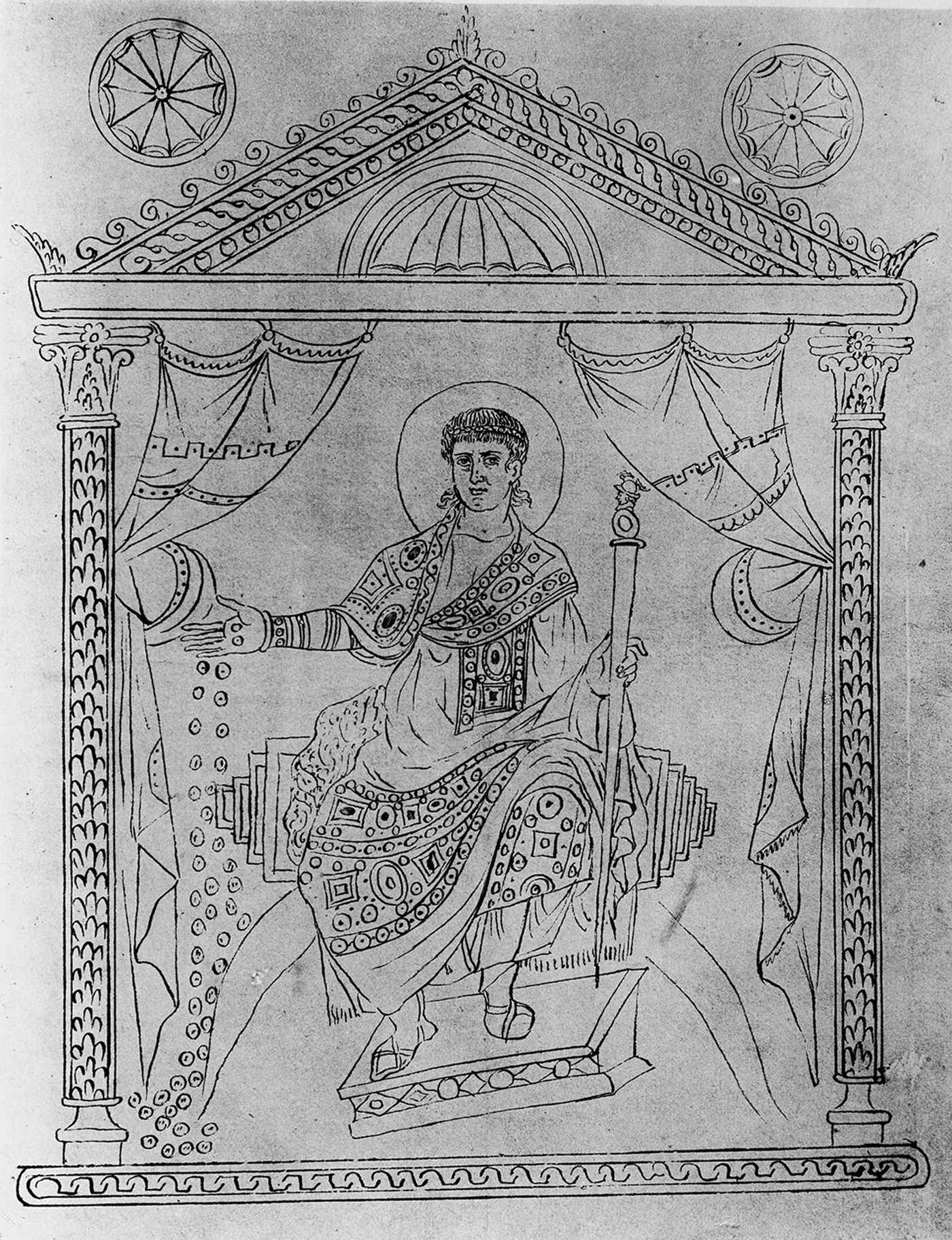
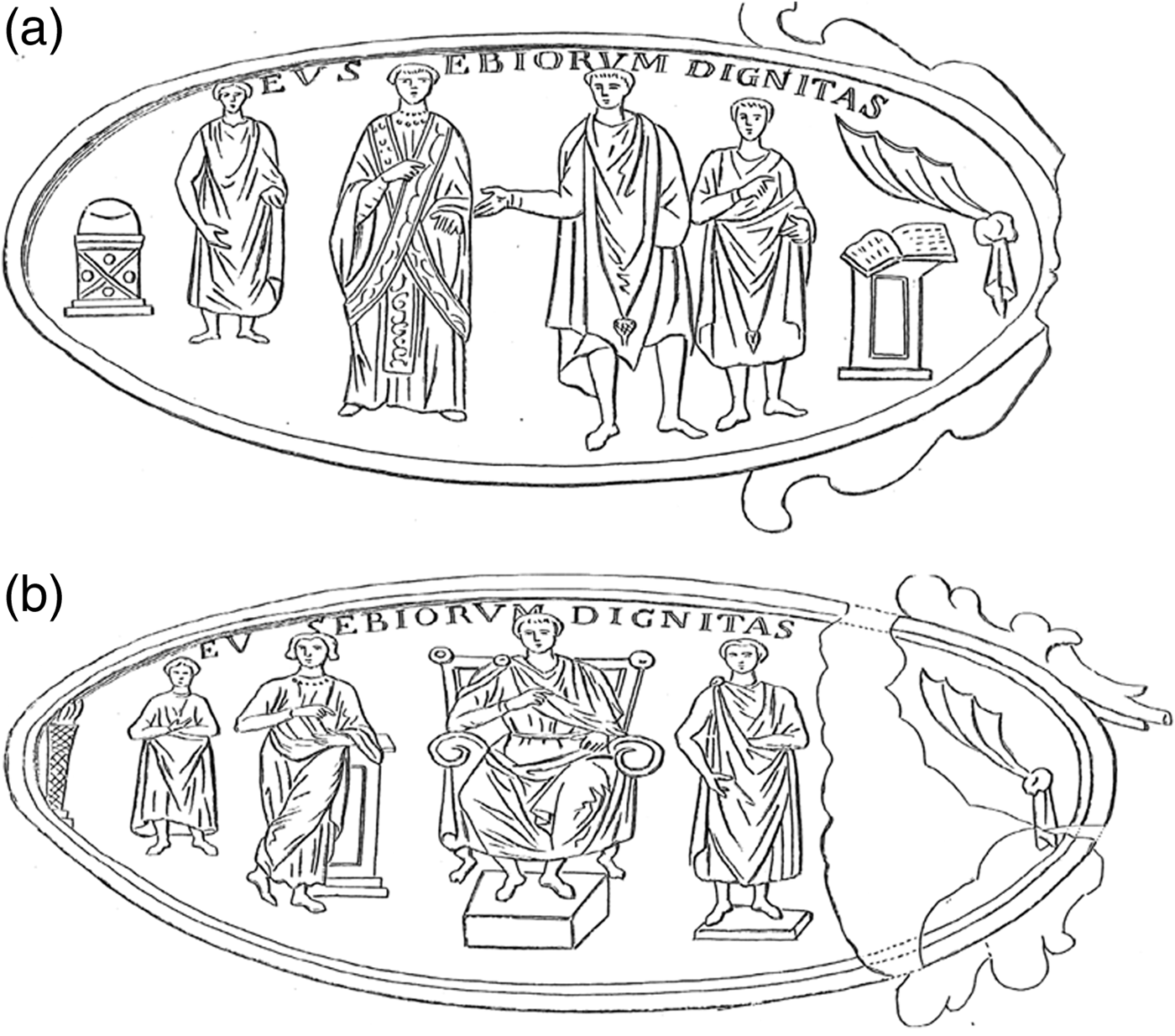
I would draw a somewhat different conclusion from Engemann's material. When asked to decorate a diptych for a cultivated customer, ideally the artist would create some classicizing design that united the two leaves, so that the eye could follow details or correspondences from one panel to the other. But when he was asked to celebrate a patron's consulship, it was much harder to come up with a unifying design. The architectural frame complete with pediments, curtains and sella curulis that we see as early as the image of Constantius II in the Calendar of 354 (Fig. 7) or the Aquileia silver spoons (Fig. 8) of about the same date pretty much excluded landscape, flowing draperies, movement, interaction with other characters, indeed action of any sort. These stock features more or less dictated frontal presentation.
Constantius II as consul in the Calendar of 354 (Photo: Art Resource)
Silver consular spoons from Aquileia. (After R. Garrucci)
The two representations of Felix are already close to indistinguishable, as are those of Honorius on the Probus diptych of 406 (1 V). While Felix's dress and attributes differ, Honorius is dressed the same on both leaves. But at a certain point all attempt at variety was dropped and the same design began to be repeated on both panels, with the earliest surviving example the Astyrius diptych. Despite this clear western exception, it has hitherto been assumed that identical representation on both leaves was simply ‘eastern’ practice, requiring no further explanation. But it is perhaps a natural consequence, in East and West alike, of the concentration on the pomp and regalia of office expected on specifically consular diptychs. No less important, it also reflects a simplification in production.
A later and more radical simplification has been identified in the production of eastern diptychs by Tony Cutler. While the diptychs of Areobindus (506), Clementinus (513), Anthemius (515), Anastasius (517) and Magnus (518) all carry ornate images of the consul, often presiding at elaborately represented spectacles, those of Justinian (521), Philoxenus (525), Apion (539) and Justinus (540) are much simpler, consisting of medallions, rosettes and inscriptions.Footnote 22 Remarkably enough, the three surviving diptychs of no less a person than Justinian carry no portrait at all, not even, as with the Philoxenus, Apion and Justinus diptychs, a bust framed by a medallion. This development was presumably intended to simplify and facilitate production. Since the majority of surviving diptychs date from the sixth century (seven of Areobindus alone), it is natural to link the increase in numbers with the simplification of production. This simpler design was not original with Justinian. It is already found on two of the seven surviving diptychs of Areobindus (V 12 and 14), but from the 520s it seems to have become standard. Nor is it an exclusively eastern development. In the West we find an example as early as Sividius cos. 488 (V 7) and the Ganay panel (V 41) from (probably) the 520s,Footnote 23 both very similar in design to the three eastern examples.
There is neither literary nor artistic evidence for what recipients did with their diptychs, but since they were splendid gifts from Very Important People, in the short term at least they were surely displayed somehow. It has sometimes been assumed that the rectangular objects adorned with portrait busts on the tables of imperial officials illustrated in the Notitia Dignitatum were diptychs, displayed closed. Since these rectangles are not ‘rendered with an indication of thickness’ like the undoubted diptychs illustrated elsewhere in the Notitia,Footnote 24 they are more probably imperial portraits.Footnote 25 But even if they are diptychs, they would be codicils of office, not the elaborately decorated presentation diptychs under discussion.
A diptych like NICOMACHORVM / SYMMACHORVM would be best appreciated displayed open, or perhaps half-open like a modern Christmas card. Artistic effect aside, both leaves were equally important in themselves, and the correspondences between them symbolized a close relationship between the two families. The correspondences between the two leaves of (say) the Felix diptych are minimal, but if it had been displayed closed, with the hinge to the left like a regular codex,Footnote 26 Delbrueck's ‘Hauptseite’, including the consul's name, would have been invisible. Why should the side on which he was shown with trabea and sceptre be considered more important than the side on which he was shown as a military man in the chlamys holding his codicils of office? Following Delbrueck, most identify the chlamys as the official dress of the patrician on the evidence of John the Lydian, but John's interest lies less in the chlamys itself than in the decoration of the patrician's chlamys with a purple stripe down the middle.Footnote 27 The chlamys was essentially a military garment, also worn by a variety of imperial officials, since their service was officially styled militia.Footnote 28 Felix was supreme military commander of the Western Empire.Footnote 29 One panel reflects the purely honorary distinction of the consulship, the other his very real power as generalissimo. The concept of a ‘Hauptseite’ is unhelpful and should be dropped.
Once the same design began to be carved on both panels, there was no point in looking for correspondences and connections between them, and so less point in displaying the diptych open. Assuming again that a closed diptych would be displayed with the hinge to the left, it now made more sense that the one visible side should include the consul's name. This may be why the custom of beginning the inscription on the right-hand panel began; and why the earliest surviving example occurs not on an eastern but a western diptych (that of Astyrius). What was to become standard practice in the East actually began in the West. So the supposedly key difference between eastern and western diptychs may have a chronological rather than a geographical origin. With the exception of the Astyrius diptych, the original form of inscribing names and titles lasted longer in the more conservative West, where the practice of varying the subject matter of the two panels lingered longer, in fact till the very last consular diptych, that of Basilius in 541.
III THE HALBERSTADT DIPTYCH
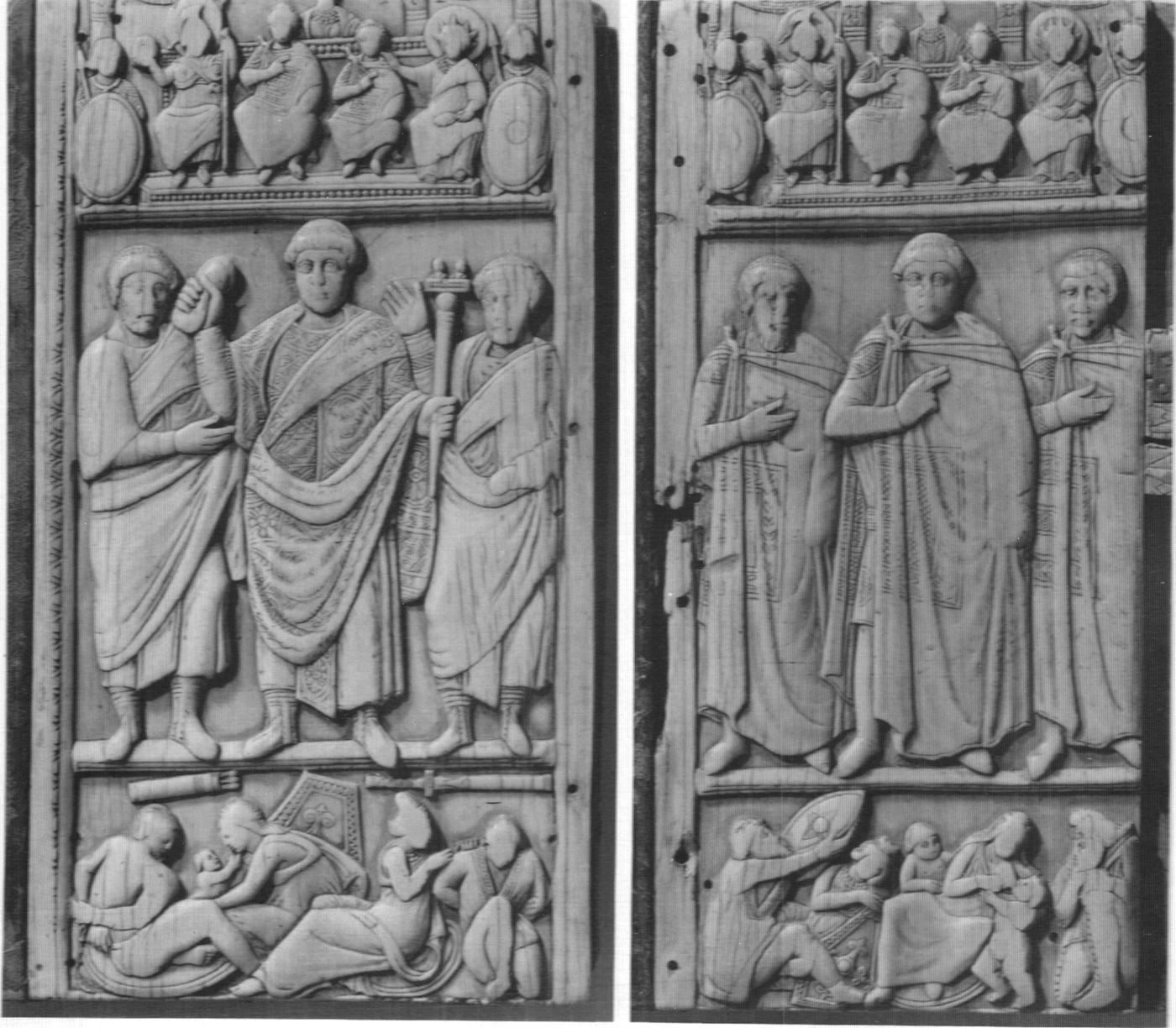
The Halberstadt ivory (Fig. 9) is the prime example of an uninscribed diptych assigned to a western consul on the basis of Delbrueck's rules and (as I shall argue) a mistaken understanding of the rôle played in such artifacts by city personifications. The top register of both panels is a virtually identical tableau: in the centre, the emperors Honorius and Theodosius II and flanking them Roma and Constantinopolis, all seated, with a standing guard carrying spear and shield framing the tableau on each side. The bottom register contains different scenes of captive barbarians (see below). The middle register shows the new consul, flanked by dignitaries.
Diptych in Halberstadt cathedral. (Photo: K. Beyer)
On the left-hand panel the consul is shown in trabea with sceptre and mappa, the dignitaries are togati; on the right-hand panel he is in the chlamys, appropriate for a military man, and the dignitaries are also chlamydati. Frustratingly the inscription, together with the rest of the top register of both panels, was cut off to make them fit the cover of the hymnal in which they were inserted in the twelfth or thirteenth century.Footnote 30 Until recently everyone was content to classify Halberstadt as western on the basis of the different dress and pose of the consul and flanking dignitaries. The scenes of captive barbarians in the bottom registers also differ from each other — but then so do the amphitheatre and theatre scenes in the bottom registers of one diptych of Areobindus, eastern consul in 506 (V 8), and one of Anastasius, eastern consul in 517 (V 21).
But the top registers of Halberstadt are identical, and if we apply the Engemann symmetry test, on each leaf the two emperors and the consul look straight ahead. As for the personifications, on both panels Roma's head is turned towards Honorius on her right and Constantinopolis is embracing Theodosius on her left (more on this below). The heads of the dignitaries on each side of the consul are turned towards him, just as the lictors that flank Astyrius are both looking at their consul. That is to say, each panel is constructed around a central axis, without even a nod towards the other panel. On this basis alone it might be argued that the diptych is eastern rather than western.
Until 1998, when I identified the honorand as Constans, eastern consul in 414,Footnote 31 the standard view was that Halberstadt celebrated the second consulship of the western magister militum Constantius in 417. Engemann and Gudrun BühlFootnote 32 at once claimed to have refuted my arguments and re-established the traditional date and identification. Given how differently the development of art in the eastern capital would be viewed if we could identify an eastern diptych almost a century earlier than the fairly homogeneous series datable to 506–539, it seems worth re-examining the case with new arguments.
Whether in East or West, 417 is impossible for two reasons, both deriving from the portrayal of the two emperors on the top register of both panels. First, Honorius is shown appreciably taller than Theodosius II, reflecting age rather than seniority, much less actual height.Footnote 33 It is only child-emperors who are shown smaller, and (to judge from the many dated monuments) never beyond the age of fifteen or sixteen, after which they are shown the same size as adult co-emperors. The clearest illustration is a 387 solidus of the (by four years) senior emperor Valentinian II (375–92) shown smaller (at age fifteen) than his junior but adult co-emperor Theodosius I (379–95).Footnote 34 In January 417 Theodosius II would have been fifteen years and nine months old. Gratian was married at fifteen, Honorius at fourteen. The argument falls short of proof, but 414 would be a better fit: Honorius at thirty-one and Theodosius II at twelve. This argument Engemann accepted, but met for a western consul by opting for Constantius' first consulship in 414.
Second and decisive in itself, both emperors are shown in the chlamys. But in 417 Honorius was consul, and so should have been shown in the trabea.Footnote 35 This was not the sort of detail any experienced craftsman would overlook. The Halberstadt consul must have held office in a year when neither emperor was consul. So later than 402–8 (when there were three emperors) and earlier than 417, which leaves 410, 413 and 414.Footnote 36 410 may be excluded, not just because of the chaos caused by the sack of Rome, but also because Alaric proclaimed Priscus Attalus as a (short-lived) third emperor late in 409.Footnote 37 413 may also be excluded: Heraclianus entered his consulship in Africa as a rebel, was executed by March and his consulship annulled. And if the chlamys is indeed meant to identify the honorand as patrician, Constantius did not win that title till 415.Footnote 38 That leaves 414.
Then there is the consul's mappa. According to Bühl,Footnote 39 I was mistaken to claim that the mappa ‘was not in use’ for ordinary consuls in the fourth- and fifth-century West, a claim easily refuted (she assumed) by citing coins showing emperors in consular robes holding the mappa. But emperors are irrelevant to the argument. Emperors had always been the principal providers of games, though even so they are not shown with the mappa before about 300.Footnote 40 Engemann raised a somewhat different objection,Footnote 41 that by the early fifth century the mappa was a ‘selbständiges consulares Amstattribut’ not necessarily implying games, an assertion for which he cited no evidence. The point is that citizen ordinary consuls in the fourth- and early fifth-century West did not routinely give elaborate consular games at their inauguration, as their eastern colleagues did. The suffect consul on the Lampadiorum panel is not a valid counter-example: the sole function of suffect consuls was to provide games.Footnote 42 While the mappa is not an argument for any particular date, it fits an eastern better than a western context.
Finally, the captive barbarians in the bottom register of both panels. All other such bottom registers on consular diptychs illustrate the consul's games or liberality (palm leaves, silver dishes, sacks of coin: see Figs 1 and 2). Halberstadt alone features the spoils of a military victory. A partial parallel is the exergue of the Aspar missorium (Fig. 15), where three categories of objects are displayed: palm leaves (symbols of victory in the games), silver largitio dishes, and (on the right) shields, unspecific military spoils.Footnote 43
If the year were 417, the Halberstadt barbarians ought to be the Goths Constantius forced into submission after a long campaign in Gaul and Spain in 414–16. But no military victory was involved, and (as we shall see) they do not really look like Goths. If (as Engemann now argues) Halberstadt celebrates Constantius' first consulship in 414, it should refer to his victory over the usurper Constantine III in 411. But Constantine commanded the Roman armies of Gaul and Britain, and while many of his troops were no doubt of barbarian birth, so were those of Constantius. Hardly an occasion for crowing over exotic barbarian captives.
To my claim that the dress and weapons of the captives look eastern rather than western, Engemann and Bühl both raised the same objection. In Bühl's words, ‘late-antique representations with symbols of victory are never limited only to a local significance’.Footnote 44 Both cite as though a decisive refutation of my argument Johannes Kollwitz's assessment of the ‘Barbaren-Huldigungsbilder’ on the base of the column of Arcadius:Footnote 45
Persians appear no less than Germans … It is not history in the strict sense we find depicted here. The representation is a monumental expression of the political pretensions of the Roman empire.
But this is to take Kollwitz's conclusion out of the context of a wide-ranging chapter.Footnote 46 While ‘Huldigung’, the paying of homage or tribute, is an appropriate term for the sort of scenes discussed by Kollwitz, it is not appropriate for the Halberstadt scenes. Kollwitz's concern was the monopolization of victory by emperors, a theme subsequently developed in a longer and even wider perspective by Michael McCormick.Footnote 47 Almost all late antique representations of the emperor emphasize his rôle as victor; among his standing titles was the formula victor ac triumphator semper Augustus.Footnote 48 Poets and panegyrists regularly represent any and all barbarians cowering before imperial might.Footnote 49
Kollwitz was particularly interested in cases where the victories were purely symbolic. For example, the north-west face of the obelisk of Theodosius, set up in 390. On the lower register barbarians offer the emperor baskets full of tribute on their knees, those on the left in Phrygian caps and Persian tunics, those on the right in fur coats and pants: Persians and Germans. But Theodosius won no victories over either Goths or Persians. The most he could claim were treaties: with the Goths in 382 and Persia in 387.Footnote 50 That is why these barbarians are not shown as captives; rather they are envoys from barbarian kings, (supposedly) bringing tribute and acknowledging the supremacy of the Roman emperor. Another famous illustration is the Barberini ivory (48 V), depicting the emperor victorious on horseback, with Germans and Persians or Indians offering tribute below. Once again, its purpose is to illustrate the universality of imperial victory, in effect the emperor's qualification to rule. Nor is it the case that even imperial monuments never commemorate specific victories over specific enemies.Footnote 51 Take the Arcadius column to which Engemann and Bühl both appeal. While the sides of the column base do indeed represent general scenes of imperial victory, not specific historical events, the spiral frieze on the column itself depicts very specifically the defeat of the Gothic rebellion of 400; the only barbarians shown are Goths, in their characteristic sheepskin jackets. Just so the reliefs on Trajan's column depict not generalized barbarians but very specifically the Dacians Trajan defeated in his two Dacian campaigns of 101/2 and 105/6; and the arch of Galerius in Thessalonica the Persians Galerius defeated in 298.
Let us take a closer look at the Halberstadt barbarians. To start with, they are clearly captives, not envoys (two of the men have their hands bound behind their backs). Two men are shown with Phrygian caps, two women with tall tiaras, and two men with ‘trousers with pearl-bordered front seams’.Footnote 52 More significant is the conspicuous and deliberate placing of quiver and sword on the left-hand panel, implying that these warriors were known for their skill with bow and sword. Sasanian kings are prominently represented with both sword and bow or quiver, carefully rendered on both large rock reliefs and silver plate; the two-handled hilt of the sword, long wide blade and rectangular scabbard point to an eastern enemy.Footnote 53
The Halberstadt diptych honours not an emperor but a private individual. Its consul is clearly represented as a military man, and the captives bound in chains together with their women and babies ought to be barbarians the general himself has conquered in a specific campaign, the victory that earned him his consulship. While emperors always took the credit for victories won by their generals, under no circumstances could a private citizen claim his emperor's victories, real or imaginary. In earlier times Roman generals had been awarded the honour of a public triumph, and dedicated monuments from their booty.Footnote 54 Such self-promotion was curtailed as early as the reign of Augustus.Footnote 55 If the consul had been Constantius, whether in 414 or 417, his victories were won in Gaul. To have included a symbolic victory over eastern barbarians would have been to encroach on imperial prerogative.
Another difference between the Halberstadt barbarians and those represented on the imperial monuments discussed by Kollwitz is that imperial monuments regularly illustrate the defeat or submission of eastern and western barbarians alike, to underline the universality of imperial victory. There is no such East/West contrast on Halberstadt: the consul is shown as the conqueror of eastern barbarians on both panels. He must have been an eastern general.
IV ROMA AND CONSTANTINOPOLIS: THE NUMISMATIC EVIDENCE
I turn now to the assumption that the Halberstadt honorand must have been a western consul because Roma, not Constantinopolis, is shown as the ‘dominant’ personification in the top register of each panel. Bühl's indispensable monograph, Roma und Constantinopolis (Reference Bühl1995), collects and illustrates all known representations of the two personifications and analyses them with skill and learning. But more remains to be said about tableaux where both appear together. In 1998 I stated that the very presence of Constantinopolis proved Halberstadt eastern. BühlFootnote 56 objected that personifications of the two cities shown together are found in both East and West. This is true, but she was able to cite only two very disparate examples, one fairly trivial,Footnote 57 the other nothing less than the imperial coinage.
Knowledge of the coins and medallions struck in commemoration of the foundation of Constantinople in 330 has been transformed by the recent work of Lars Ramskold and Noel Lenski.Footnote 58 Best known is the silver medallion bearing on its reverse a full-length Tyche figure, facing right, draped, veiled, with mural crown, seated on a high-backed throne, with right leg thrust forward and right foot on a galley; right hand bears a branch and left a cornucopia (Fig. 10).Footnote 59 As Ramskold and Lenski point out, in its unusual thickness, high relief, two-line vertical legend and several technical features, this medallion resembles hellenistic tetradrachms more than recent Roman coins or medallions. Specifically they cite Seleucid tetradrachms, notably those struck for Demetrius I Soter, with a remarkably similar seated Tyche, facing right, with mural crown, cornucopia, right leg thrust forward, and (above all) the unusual two-line vertical legend (Fig. 11).
Silver medallion of Constantine and the Tyche of Constantinople, 330. (Courtesy Lars Ramskold)
Tetradrachm of Demetrius Soter, 162–150 b.c. (Courtesy Lars Ramskold)
It has often been assumed that the Tyche of Constantinople was a Constantinian invention.Footnote 60 This is only half true. Literally hundreds of Greek cities, especially in Asia Minor, had boasted a Tyche on their coinage for centuries. While cities with ancient mythical traditions like Smyrna and Ephesus would place an ancestral Amazon or Artemis on their coins, ‘City Tyches were an admirable solution to the lack of particular, locally-based city gods in the many new foundations in Asia’.Footnote 61 For the Antonine period alone (138–92), Roman Provincial Coinage Online records and illustrates no fewer than 769 different types of Tyche (standing, seated, reclining on a couch, eleven with one foot on a ship's prow,Footnote 62 almost all with a cornucopia) from 150 different cities, among them two other future eastern imperial capitals, Nicomedia and Antioch.Footnote 63 Indeed there are several examples from late third-century, pre-Constantinian Byzantium itself.Footnote 64 Whether or not the cult goes back to the legendary Byzas,Footnote 65 there was certainly a pre-Constantinian Tyche of the city.
The most important discovery of Ramskold and Lenski is that the silver Tyche medallion was paired with a hitherto unknown exactly parallel Roma medallion, both struck in the new Constantinopolitan mint: Roma facing right, wearing a plumed helmet, seated on a high-backed throne, right leg thrust forward, holding orb and spear, with two-line vertical legend (Fig. 12). This is the most decisive, if ultimately unsurprising, proof yet found that Constantine intended from the very beginning that his newly refounded capital should enjoy some sort of parity with Rome.Footnote 66 The bronze commemorative coinage likewise pairs busts of Roma and Constantinopolis, both helmeted.Footnote 67
Silver medallion of Constantine and Roma, 330. (Courtesy Lars Ramskold)
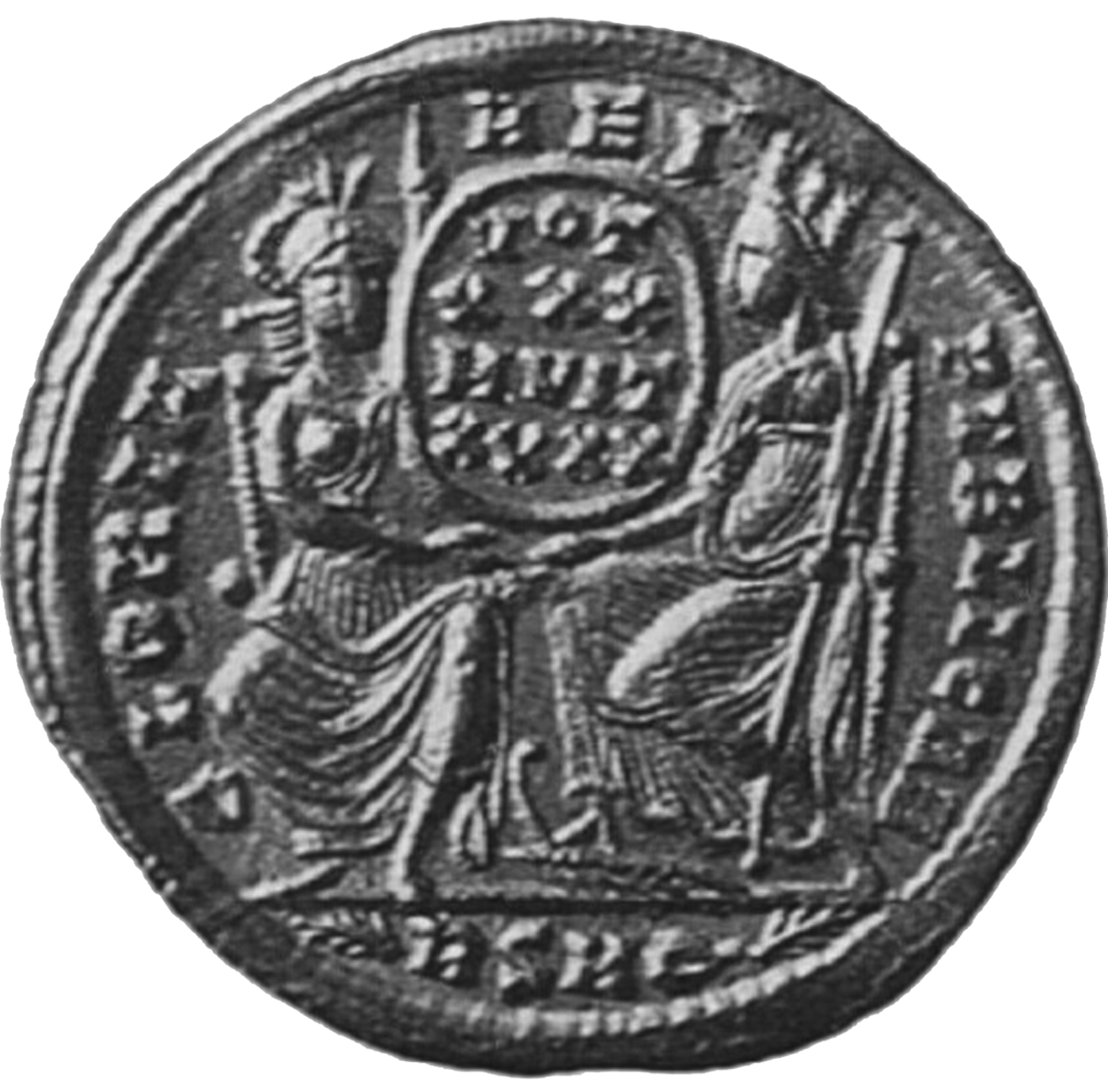
For the numismatic part of her refutation, Bühl relied on the series of ‘twin-cities’ issues. The first in the series was struck by the eastern emperor Constantius II in 343,Footnote 68 exclusively in eastern mints, Constantinople and Nicomedia. It is regularly assumed as self-evident that Roma and Constantinopolis represent West and East respectively.Footnote 69 Sometimes, as we shall see, but not here, at least not straightforwardly. It would make little sense for Roma to represent the West on a coin struck by Constantius, emperor of the East. Roma simply represents his authority as Roman emperor, while Constantinopolis serves to localize that authority in the East. It was not till 353, three years after Constantius became sole (legitimate) Augustus on the death of his brother, the western emperor Constans, in January 350, that he began to strike twin cities in western mints as wellFootnote 70 (Fig. 13). Was this meant as a claim that he now ruled both East and West? Surely not, because in 415 and again in 420 the eastern emperor Theodosius II struck essentially the same type, Roma and Constantinopolis enthroned with a vota shield between them; and then in 422 the western emperor Honorius struck a very similar type at Ravenna.Footnote 71 Theodosius did not claim to rule the West, nor Honorius the East.
Twin cities solidus of Constantius II, Rome, 353–57. (Photo: British Museum)
Here too the provincial coinage can help. One of the most historically interesting types of the second and third centuries of the empire is so-called ‘alliance’ coins. On present evidence, we know of at least eighty-seven cities in Thrace and Asia Minor that issued such coins, in almost 2,400 different types.Footnote 72 The standard form is Tyches of two different cities shown together clasping hands, over the legend ὁμόνοια. For example, turreted standing Tyches of Laodicea and Pergamum, holding long sceptres and clasping hands, over the legend ‘Alliance of the people of Laodicea and Pergamum’ (Fig. 14a).Footnote 73 Compare a bronze medallion struck at Rome in 353, Roma holding a spear, Constantinopolis a cornucopia, both standing, between them a shield with a vota legend for Constantius' tricennalia (Fig. 14b).Footnote 74
Alliance of the people of Laodicea and Pergamum, RPCO 2106 (a.d. 169–75). (Photo: British Museum).
Roma and Constantinopolis, bronze medallion, Rome, 353. (Photo: British Museum)
More than just a common motif is involved, more too than the commercial and touristic ‘twinning’ of cities in different countries today. Such alliances have to be seen against the background of the intense rivalry between (usually) neighbouring cities about precedence and a variety of other issues.Footnote 75 The ubiquitous twin Tyches motif of the provincial coinage surely exercised some influence on the design of Constantius' twin Tyches.Footnote 76 Indeed we have one such alliance coin from Byzantium itself, proclaiming ὁμόνοια with Nicaea in the mid-third century.Footnote 77
Why did Constantius pick 343 for his twin cities and then reissue them in 353? In the first place, 343 was the year of his vicennalia, 353 of his tricennalia, and in 343 the Nicomedian mint also struck this type for the decennalia of Constans. In 373 Valentinian and Valens struck twin cities types for their decennalia, in both eastern and western mints; in 415 Theodosius II celebrated his quindecennalia, in 420 his vicennalia,Footnote 78 and in 422 Honorius his tricennalia.Footnote 79 In the second place, in 373 Valentinian and Valens held joint consulships, and in 415, 420 and 422 Honorius and Theodosius II held joint consulships. It is hard to believe that all these coincidences are mere coincidences. If Constantius' aim in 353 had been to proclaim his rule over both East and West, why not issue twin cities in 350, when Constans died, rather than three years later? The explanation is surely the fact that in 353 he shared the consulship with his Caesar Gallus.
Twin cities coins were struck in years when there were two or more emperors, one eastern and one western. But they do not distinguish East from West or identify one as senior to the other. The double coincidence of regnal anniversaries and shared consulships suggests deliberate imitation of the alliance coins they so closely resemble. Westerners had been familiar since the joint reign of Marcus and Verus with coins and dedications proclaiming Concordia Augustorum and images of the figure of Concordia (often shown with a cornucopia) standing behind two emperors clasping hands.Footnote 80 Interestingly enough, a series of Theodosian gold solidi struck in Constantinople between 379 and 388 features just the Tyche of Constantinople on the reverse, but accompanied by the legend CONCORDIA AVGGG (i.e. Gratian, Valentinian II and Theodosius) or AVGGGG (adding Arcadius between his accession on 19 January and Gratian's death later in the year).Footnote 81 Officials at the mints must have had access to a wide range of earlier coins, illustrated by the imitation of hellenistic tetradrachms on Constantine's Tyche medallions. In any case, the alliance motif was surely displayed in other, more permanent media as well as on the coinage. Many easterners would have recognized Constantius' twin city Tyches as proclaiming concord and solidarity between the emperors.
Perhaps the most discussed feature of Halberstadt is the female figure shown behind and between the two emperors in the top register, on the traditional western attribution often identified as Honorius' half-sister Galla Placidia.Footnote 82 I once suggested Theodosius II's sister Pulcheria. But it is surely inconceivable that any human figure would be shown in a position of such prominence. Against the background of the coinage and in view of her placing between the Augusti, contemporaries would inevitably have identified Concordia.Footnote 83
V ROMA AND CONSTANTINOPOLIS: THE LITERARY EVIDENCE
Moderns who write on diptychs usually style Roma and Constantinopolis city goddesses.Footnote 84 Contemporaries would have styled both of them Tyches.Footnote 85 But Roma at any rate, though occasionally shown with the mural crown of a Tyche on early imperial Greek coinsFootnote 86 and reliefs of the Julio-Claudian Sebasteion at Aphrodisias,Footnote 87 was always far more than a city Tyche. It is a well-known paradox that dea Roma originated not in Rome but in the Greek world. She first appears in the hellenistic East in the second century b.c., an aspect of hellenistic ruler cult as the Greeks came to terms with the power of Rome.Footnote 88 For the Greek world, Roma represented less a city than an empire. One obvious difference between Roma and the Tyches is that Tyches were local deities, who are shown on the local coinage and receive cult in the cities they personify, whereas Roma was a distant suzerain worshipped from afar. Most Greeks had never even seen the city of Rome, but knew all too well the reach of its power. Another is that Roma was regularly honoured by festivals (Ῥωμαῖα) while Tyches seldom were.Footnote 89
For all the many virtues of her 1995 monograph, like her predecessor Jocelyn Toynbee, Bühl largely ignored literary texts, thus robbing herself of vital clues to the interpretation of the visual evidence. To start with her title, to the best of my knowledge no surviving text identifies any representation of Constantinopolis by that name.Footnote 90 Take the Neoplatonist Proclus, born in Constantinople, who claims that its ‘tutelary goddess’Footnote 91 was responsible for his existence, looked out for him in his early years, and once appeared to him in a dream. Even so he does not identify her any more precisely than ἡ τοῦ Βυζαντίου πολιοῦχος.Footnote 92 She is sometimes styled quite generally ‘Tyche of the city’ (ἡ Τύχη τῆς πόλεως),Footnote 93 sometimes by the rather puzzling name Anthusa (on which more below); otherwise Rome, New Rome, the royal city (ἡ βασιλὶς or βασιλεύουσα πόλις) or some other periphrasis, especially once she began to be shown with a helmet rather than mural crown. (Intriguingly enough, the switch from mural crown to helmet can be dated fairly precisely. On only the first of six issues of Theodosian solidi struck at the Constantinopolitan mint between 379 and 388 does Tyche wear a crown. On all the rest a helmet).Footnote 94
Roma personified is ubiquitous in literature of the Roman age, Greek as well as Latin, sometimes no more than the personification of the city of Rome, but more often the embodiment of Roman power and tradition. She makes only brief appearances in the Augustan poets,Footnote 95 but is frequently shown interacting with mortals (especially emperors) in imperial relief sculpture, first in the Flavian period.Footnote 96 The earliest known verbal interaction between Roma and a mortal occurs in Lucan (Phars. 1.185–203), when, described as having white hair and a mural crown, she challenges Caesar as he is about to cross the Rubicon.
The panegyrics and epics of Claudian (395–404) provide the most detailed and vivid literary descriptions we have of Roma, evoking every detail in her standard representation. Whether it was Claudian who introduced Roma into consular panegyrics cannot be known for certain, but since he virtually invented the consular panegyric in verse (at any rate in Latin), it is likely. His instant and lasting success surely played a part in the incorporation of Roma into the iconography of consular diptychs.
Nor is it just in the representation of Roma herself that Claudian's Roma corresponds to the diptychs.Footnote 97 Take the fasces. On the Bourges (V 36) and Astyrius diptychs, it is lictors who hold them. On the Aspar missorium and later eastern diptychs it is Roma and Constantinopolis. According to Bühl, by taking over the fasces, ‘treten die Personifikationen gewissermaßen formal und inhaltlich an die Stelle der Lictoren — und damit in dem Dienst des Consuls’.Footnote 98 This surely gets the emphasis wrong. Lictors were low-level officials who simply accompanied the consul and carried his fasces (a bundle of rods and an axe) as a symbol of his traditional power to flog and put to death.Footnote 99 But such grandiose personifications as Roma and Constantinopolis are over-qualified to take over so modest a rôle. They cannot be seen as mere servants, illustrated by the fact that on sixth-century diptychs, unlike the earlier diminutive lictors, they are shown taller than the consul. Claudian's Roma confers the fasces on the new consul (donet fasces, Stil. 3.90). Inevitably, the transformation of humble lictor into Roma herself elevates the function she performs.
No fewer than six of Claudian's major poems are consular panegyrics, and Roma plays a significant rôle in most of them, often in extended dialogue with Theodosius, Stilicho, Honorius, and a variety of gods, rivers and provinces. In Panegyricus dictus Probino et Olybrio consulibus of 395, in the guise of Minerva, wearing helmet and sword, one breast bare, Roma flies in her chariot to the Alps where Theodosius is recovering from his efforts after the battle of the Frigidus. She reminds him of the services of Petronius Probus cos. 371 and begs him to appoint Probus' sons, Anicius Olybrius and Anicius Probinus, consuls for the coming year. In De consulatu Stilichonis 2.218–68 of 400 a group of personified provinces urge Roma to persuade the (allegedly reluctant) Stilicho to accept the consulship. Roma agrees, dons her arms, and flies to the court in Milan, and (in anticipation of the diptychs) presents him with the insignia of office, the ivory sceptre and an elaborately described consular robe (2.339–66). At Cons. Stil. 3.87–90 we are told again that she gave him his trabea, curule chair and fasces. Prudentius, whether influenced by Claudian or other contemporary panegyrists or artists, envisages a celestial Roma who invests the martyred St Lawrence with the jewelled robes of a perpetual consulship in heaven:Footnote 100
Claudian wrote at a time when East and West were growing ever further apart, he wrote in Latin, and Olybrius, Probinus, Stilicho and Honorius were all western consuls. Even so, it would be a mistake to see his Roma, traditional accoutrements notwithstanding, as simply representing the western as distinct from the eastern empire. At Pan. Prob. 80 we are told that Roma is attended by the same attendants as when she battles against Parthia or India. And while his famous panegyric of Rome (Cons. Stil. 3.130–66) begins with the seven hills, we soon hear how, springing from humble confines, she now stretches from pole to pole, drawing together different races, so that her subjects can drink both Rhine and Orontes (3.158). At Pan. Prob. 160–3 Roma envisages Scythia and the Rhine, Persia and the Ganges as her boundaries. Though occasionally representing the city, notably in the long speech urging Honorius to celebrate his sixth consulship in Rome (VI cons. Hon. 361–425), Claudian's Roma is always more than the city on the Tiber. She embodies the power and above all the long history of Rome and the extent of its empire.
A recurring theme of Claudian's political poetry is rivalry between the eastern and western courts. Given this running polemic with the East and Claudian's predilection for chatty personifications, we might have expected an elaborately described personification of Constantinople to interact with all his other personifications. And yet we never quite find it. His Roma is closely based on contemporary representations, and by the time he was writing (395–404) the basic iconography of the Tyche of Constantinople was well established. Yet all Claudian produces is a vaguely evoked ‘Orient’ in the form of Aurora.Footnote 101 Indeed, as Kelly acutely noticed, Claudian is curiously reluctant even to name the eastern capital, several times hinting at but never quite coming out with Nova Roma.Footnote 102 The Tyche-figure of the monuments represents just the city of Constantinople, while Claudian's Aurora represents the eastern empire as a whole (‘geminas … partes’, In Eutr. 2.540; ‘Antiochi muros’, 570). Though she rails against the feasting and dancing of the palace (584–85), her main emphasis is on the suffering of the East in general, laid waste by rebellious barbarians and depopulation (‘expulsis Oriens squalescit aratris’, 566).
Intriguingly enough, we find the same reluctance to conjure up a fully-fledged personification of Constantinople in Sidonius, writing nearly seventy years later in 468. First he apostrophizes Constantinople without identifying her by name as ‘regina Orientis, orbis Roma tui … imperii sedes’, now to be considered ‘imperii genetrix’ because she has sent an easterner (Anthemius) to be ruler of the West (Pan. Anthem. 31–4). But later in the poem Roma visits the palace of Aurora (ibid. 418–38), where the goddess sits on her throne, with saffron hair, her eyes sending forth bright rays of light that lack heat. In her right hand she holds not a sceptre but a lamp (‘sceptri vice dextram / lampadis hasta replet’, 432–3). This lamp represents what Dawn brings to the world every morning, light. Indeed the poets regularly use the same word lampas specifically for the light of the sun, daylight or even just day (e.g. ‘postera Phoebea lustrabat lampade terras / … Aurora’, Verg., Aen. 4.6).Footnote 103 The identification with the Aurora of myth is made even more explicit by the presence nearby of Night with her feet already turning to flee, and at line 516 she is actually styled wife of Tithonus (Tithonia coniunx).
Not only does Sidonius not depict his Aurora wearing a mural crown. In his panegyric on Majorian he depicts Roma with a mural crown (turrita), showing off his knowledge of earlier poets (Lucan 1.186–8; Silius 4.408–9; Rutilius Namatianus 1.117), all surely influenced by Vergil's famous comparison of Roma to Cybele, ‘qualis Berecyntia mater / invehitur curru Phrygias turrita per urbes’ (Aen. 6.781–7). The Augustan poets liked to exploit the Trojan connection of the Magna Mater.Footnote 104
According to Kelly, ‘the reason that Claudian does not call Aurora Constantinopolis is simple: he was famously hostile to the city and its pretensions to the status of Rome’. This may be true of Claudian, but hostility cannot explain Sidonius' evasiveness. The ruler he was panegyrizing had come from Constantinople, elevated to the throne of the West by the emperor of the East. The true explanation, I suspect, is twofold. First, while Roma had always done double duty for both city and empire, neither art nor literature suggests that Constantinople ever ‘stood for’ the empire it ruled, either as a whole or its eastern part. That empire remained Rome, and the personification that represented it remained Roma. The Tyche with mural crown and cornucopia did not reflect that empire, and when she began to be shown with helmet and spear, she had in effect become Roma.
That it should be Roma who invests the new consul with his sceptre and fasces was a natural enough concept, especially after Claudian. But it is less obvious why she came to need a colleague. Roma alone was surely entitled to invest eastern and western consuls alike. On the other hand, it is clear that the Tyche of Constantinople did need a colleague to perform this function. Unlike Roma, she never appears by herself on a consular diptych,Footnote 105 nor can there be much doubt why. Despite representing an imperial capital, the Tyche of a city that did not exist before a.d. 330 could not by herself be thought of as embodying the thousand-year history of Rome. Only Roma had the authority to confer so ancient an office as the consulship. But once the two consuls began to be appointed separately, Constantinopolis was added to Roma for the increasingly elaborate iconography of consular inauguration in the new eastern Rome, on the analogy of the twin capitals of the coinage.
If we set on one side coins, medallions, diptychs and the (rather few) other objects where Roma and Constantinopolis appear together (the pairing itself detracts from her independence), the Tyche of Constantinople mainly appears as one among others in larger groupings of barely distinguishable city Tyches, sometimes actually labelled for clarity. For example, the Calendar of 354 (Rome, Alexandria, Trier and Constantinople); the Esquiline Treasure (Rome, Alexandria, Antioch and Constantinople); the Peutinger Table (Roma, Constantinople and Antioch); a silver cup in the Metropolitan Museum (Rome, Alexandria, Cyprus and Constantinople); and a bronze band round a casket in Budapest (Rome, Carthage, Nicomedia, Siscia and Constantinople).Footnote 106 More puzzling is the trio of Rome (surely New Rome), Madaba and Gregoria on a sixth-century mosaic pavement in Madaba.Footnote 107 According to a recent study of such groupings, ‘For many centuries Roma was the dominant city goddess in the Mediterranean world, but this superiority changed definitively with the creation of Constantinopolis’.Footnote 108 Yet for all its prominence in the limited media of the coinage and consular diptychs, disproportionately illustrated in modern books, the Tyche of Constantinople enjoyed a shadowy, unstable, short-lived existence. Except in the fourth-century coinage (where she takes many forms), she virtually never appears alone.Footnote 109 After 518 she disappears from consular diptychs, and after the sixth century never appears at all. Her swan song is on the reverse of a solidus of Justin II (565–78),Footnote 110 a helmeted figure with short tunic, sceptre and globe, Constantinopolis according to Bühl, but perhaps best left ambiguous. Some contemporaries apparently identified her indignantly as Aphrodite!Footnote 111 The lack of familiarity implied by such ignorance helps to explain some of the nonsense about Tyches we find in later Byzantine texts.Footnote 112
We have seen that the Tyche of Constantinople is conspicuous by her absence in fourth- and fifth-century Latin poetry. What about Claudian's Greek counterparts at the eastern court?Footnote 113 Unfortunately, the only such eastern poems we have complete, paradoxically enough, are both in Latin, Priscian's panegyric on Anastasius and Corippus' on Justin II. The most revealing single text is the long introduction to Paul the Silentiary's Description of Hagia Sophia, written to celebrate the rebuilding of the dome after its collapse in 558 and rededication in 562. At line 145 Paul invokes ‘fruitful Rome’ (ὄμπνια Ῥώμη), where ὄμπνια, ‘of or relating to corn’, is a standing epithet of Demeter.Footnote 114 Clearly he is referring to the city of Constantinople, because he says that Justinian has made her ‘more brilliant than your mother on the Tiber who bore you (σε τεκούσης)’ by rebuilding Hagia Sophia, which he then claims to outclass the ‘famed Roman Capitol’ (151–2). Yet this same ‘fruitful’ Rome ‘has extended the immeasurable spaces of your throne beyond the outermost boundaries, over against the shores of Ocean’ (148–9).
At line 156 he addresses her as ‘gold-robed Anthusa’ (χρυσοχίτων Ἀνθοῦσα), surely less a proper name than (in origin at least) a description, the present participle (as the accent shows) of the verb ἀνθέω, ἀνθοῦσα (sc. πόλις), the flourishing (city), the Greek version of a formula found in Latin as early as a law issued at Constantinople in 381 or 382, urbs florentissima.Footnote 115 Then at line 164 he bids ‘you too, first-born Latin (πρεσβυγένεθλε Λατινιάς) Rome’ sing in harmony with ‘fresh-budding (νεοθηλέϊ)’ Rome, ‘rejoicing that you see your child surpassing her mother’ (164–7). Paul is clearly distinguishing two Romes, and up to this point his descriptions fit their traditional identifications as Old and New Rome. The conceit that New Rome was the daughter of Old Rome (‘neither the mother city nor the daughter’) goes back at least to Libanius,Footnote 116 in general hostile to the pretensions of the new eastern capital.Footnote 117
But seventy lines later, when the dome collapses, ‘shield-brandishing’ (σακέσπολος) Roma (219) comes to Justinian and urges him to rebuild it.Footnote 118 While ‘fruitful’ Roma (145) implies the Tyche with a cornucopia, ‘shield-brandishing’ Roma fits to perfection the traditional representation of old warrior Roma, regularly shown with helmet, spear and shield. Indeed this Roma goes on to claim that she has ‘made all things subject to [Justinian's] trophy-bearing triumphs’ (227), specifying his victories over Mede, Celt and Carthage, i.e. Persians, Goths and Vandals (228–30). Yet the Rome that conquered Persians, Goths and Vandals, while certainly the warrior Rome of Claudian, must here represent, not the (now defunct) western but the eastern empire, the lands ruled and armies commanded by Justinian. There is no suggestion that ‘shield-brandishing’ Roma has just arrived from the West to help her ailing daughter. Indeed she goes on, in a striking metaphor, to describe the collapse of the dome as ‘a gaping ulcer welling up in my breast’ (223)Footnote 119 and to celebrate the merchant-ships that bring affluent prosperity to my children (ἐμοῖς τεκέεσσιν, 234), and then describes Justinian as having ‘built the whole city for me’ (πᾶσαν ἔδειμας ἐμοὶ πόλιν, 241), telling him that he will never find ‘a more brilliant symbol of your throne’ (247). In context, the ‘symbol’ she is urging him to rebuild is Hagia Sophia, so this must be the city of Constantinople. In response, Justinian stretched out his hand to ‘his familiar Rome’ (ἠθάδι Ῥώμῃ). Surely Constantinople (he had never been to Old Rome), though again perhaps best left ambiguous.
The closest parallel to this passage is Corippus' slightly later (565) account of the representation of Justinian's Vandalic victory on his funerary pall (Laus Iust. 1.285–90). The emperor tramples the Vandal king underfoot, to the applause of Africa, who holds out grain and a laurel branch; antiqua Roma stretches forth her arms with one breast bare, clearly dea Roma in traditional guise. Fifty lines later chariot racing in the hippodrome of Constantinople is described as ‘iucunda novae circensia gaudia Romae’ (1.344). Yet, like Paul's ‘shield-brandishing’ Rome, Corippus' Old Rome cannot be western Rome, nor is any contrast intended. As we have seen, the Rome that defeated the Vandals was the eastern army of Justinian. That ‘Old’ Rome is not here either the (by 565 sadly impoverished) city on the Tiber or the (now non-existent) western empire is proved by the fact that she is characterized in purely abstract terms, ‘nurse of empire and mother of liberty’. In context Old Rome is simply the moral and military might of Rome over the centuries.
A recent commentator on Paul's poem claims that, while personification of Rome ‘was new in neither literature nor art … What is innovatory (and provocative) is Paul's personification of Rome to denote Constantinople’.Footnote 120 Far from it. The name New Rome was no poetic fancy. From the moment of its foundation Constantinople regularly bore the title New Rome.Footnote 121 We have seen that the Constantinopolitan mint issued paired commemorative medallions of Roma and Constantinopolis in 330, and Optatianus Porphyrius' reference to altera Roma in a poem written in 324 (4.6) suggests that Constantine intended his new capital to be a ‘second Rome’ from the beginning.Footnote 122 In many contexts by at any rate 500 New Rome was regularly abbreviated to Rome tout court, in the poets well before then (Constantinopolis is not easy to fit into a hexameter line).Footnote 123 A fourth-century lament for the death of a Berytus professor on a visit to Constantinople describes how ‘Rome that never wept before wept then’,Footnote 124 and though he never quite uses it, Claudian was clearly familiar with the style New Rome (see n. 102). Musellius, grand chamberlain at Constantinople in 414, built a Museion for ‘Rome’, commemorated in an inscribed epigram (Μουσεῖον Ῥώμῃ δὲ χαρίσσατο).Footnote 125
By the second half of the sixth century, if not earlier, the prefect of Constantinople was styled simply ἔπαρχος Ῥώμης, even on such mundane objects as glass weight standards.Footnote 126 At one time it was thought that the prefects so designated were prefects of old, western Rome, but none of the scores of weights look earlier than the sixth century and most have been found in Asia Minor and Egypt. A novel of Justinian dated to 539 refers to the ‘most splendid prefects of each Rome’ (τῶν τε ἐνδοξοτάτων ἐπάρχων ἑκατέρας Ῥώμης). The Chronicon Paschale styles the first city prefect of Constantinople ἔπαρχος Ῥώμης,Footnote 127 and while this is probably anachronistic for 359, it was certainly the official title by the author's day.
Three faces of the new monument of the early sixth-century charioteer Porphyrius show city Tyches wearing mural crowns and carrying cornucopias. Two are identified by inscriptions as Berytus and Nicomedia, evidently sites of Porphyrius' earlier triumphs, and although the third, on the front face, has lost its inscription, it must represent Constantinople, where he has just won a statue in the hippodrome. Bühl understandably identified this Tyche as Constantinopolis,Footnote 128 but the only term we find in the epigrams on the seven Porphyrius monuments is Ῥώμη.Footnote 129 More important, even on a monument standing conspicuously in the hippodrome of sixth-century Constantinople, she is visually indistinguishable from the Tyches of Nicomedia and Berytus.Footnote 130 In this context, despite the sixth-century date, she appears as a regular Tyche because her function is simply to represent the city where Porphyrius has won his latest triumphs.
Paul seems to be making a clear distinction between two Romas: the ‘first-born Latin’, ‘shield-brandishing’ city on the Tiber and her daughter, the ‘fruitful’, ‘gold-robed Anthusa’ on the Bosporus. Yet a careful reading of the passage reveals that, epithets notwithstanding, the distinction is anything but clear. Daughters grow up. Already by the fifth century, not to mention the age of Justinian, Constantinople/New Rome had superseded Rome as the capital and centre of what remained of the Roman Empire, and the dropping of the ‘New’ in ‘New Rome’ had consequences that have not always been fully appreciated. Depending on context, at Byzantium the bare name ‘Rome’ can stand for or suggest many things: the city of Rome, the city of Constantinople, Roman power, Roman civilization, what moderns (though not contemporaries) call Byzantine power or Byzantine civilization. But New Rome stands for only one thing: the city of Constantinople. The empire ruled from New Rome was still the Roman Empire, not the New Roman Empire. Contemporaries would instinctively know from the context which sense the speaker/writer had in mind. Since the greater part of Paul's two poems is devoted to the church of Hagia Sophia, inevitably most of his references to Rome designate Constantinople, often in a very concrete sense. In the rest of his ecphrasis and in his separate ecphrasis of the Ambo of the great Church, he uses the bare name Roma six more times (326, 346, 677, 966, 984; Ambo 303), in every case undoubtedly referring to the city (in one case, 346, the actual streets) of Constantinople. But when he turns to Justinian's conquests, the two Romas turn out to be one and the same Roma wearing, so to speak, different hats.
We find the same duality in the early seventh-century panegyrical poetry of George of Pisidia. For example, when, after evoking the blessings conferred by St Paul on ‘the City and the whole world’, he calls upon Constantine the Great to appear once more to Rome (ϕανήθι, Κωνσταντῖνε, τῇ Ῥώμῃ πάλιν), it must be New Rome he has in mind. And when he begs God to grant the sons of Heraclius permanent rule over the ‘fertile fields of Rome’ (κρατεῖν τὰ Ῥώμης εἰς τέλος γεώργια), this must be what moderns call the eastern empire. But when he calls upon Rome to decide (Ῥώμη, δίκαζε …) to which of her many generals Heraclius might be compared, it is surely the entire thousand-year history of Rome he has in mind, including such names of the remote past as Camillus and the Scipios.Footnote 131
VI THE ORESTES DIPTYCH
Excluding Halberstadt, we have two diptychs where both Roma and Constantinopolis attend the new consul, those of Clementinus and Magnus, eastern consuls in 513 and 518; and one where Roma alone performs this office, for Basilius, western consul in 541 (Fig. 18).Footnote 132 That is to say, on western diptychs we find only Roma; on eastern diptychs Roma and Constantinopolis. There are two apparent exceptions to this principle: the diptych of Orestes, who is attended by both Roma and Constantinopolis despite being western consul in 530; and the silver missorium of Aspar, western consul in 434 (Section VII).
The first apparent exception was convincingly removed by Nancy Netzer on entirely independent grounds, by showing that the Orestes diptych is in fact a minimally recarved copy of the more or less identical eastern diptych of Clementinus. Olovsdotter and Williamson have tried to cast doubt on Netzer's thesis, but without carrying conviction.Footnote 133 In the top register we see medallions enclosing a male and female figure who, given the date, must be identified as the child king of Italy Athalaric and his mother the regent Amalasuintha. As Netzer pointed out, there are signs that these figures and their insignia have been recarved, and the obvious inference is that they represented Anastasius and his empress Ariadne in the original state of the diptych commemorating Clementinus' consulship in 513. The natural explanation for this recycling of an old diptych is, as Netzer saw, the ‘limited availability of ivory or of skilled carvers, or both, in the West during this period’. There is also another factor: in 530 both consuls were western, doubling the demand for both ivory and craftsmen at a stroke.
Remarkably enough, perhaps the strongest argument for identifying the Orestes diptych as a recarved Clementinus was not recognized even by Netzer: the inappropriateness of the presence of Constantinopolis on a western diptych. The Tyche of New Rome has no legitimate rôle in the investiture of a western consul — especially at a time when Italy was a barbarian kingdom, no longer even a part of the Roman Empire. It is clear from the recarving of the medallions that the artist took pains to present Orestes as a subject of the Gothic royal family. But why, only five years after Theodoric executed Boethius and Symmachus on the charge of treasonous dealings with the eastern empire, would a western artist go out of his way to include so obvious a symbol of the East as the Tyche of Constantinople? The only plausible explanation for the presence of Constantinopolis on what ended up as a western diptych in 530 is that there was no way of removing her. Busts of a Roman emperor and empress could without too much difficulty be turned into acceptable Gothic royals by reshaping a few details, but an entire full-length female figure could not be either eliminated or turned into something quite different.
The personifications on the Orestes, Clementinus (513) and Magnus (518) diptychs have by now become virtually identical. Each has taken on features of the other: Constantinopolis wears a helmet, and Roma no longer bares a breast. In all three cases Delbrueck identified the figure on the right, wearing a single-crested helmet, as Constantinopolis. But, as Toynbee saw, on the Paris and Milan Magnus panels (V 23 and 24) she rests her hand on a large oval shield, and ‘it is hard to believe that Constantinopolis would have been shown with this attribute, and the essentially warrior Roma without it, in the same design’.Footnote 134 Though lacking a shield, the figure with a single-crested helmet on the right of both Clementinus and Orestes panels is surely also Roma, in which case the figure with triple-crested helmet on the left is Constantinopolis. Perhaps more important than the arguments for distinguishing them is the fact that they have become to all intents and purposes indistinguishable. The (re-)carver of the Orestes diptych may have hoped that the nearly identical personifications would be read as duplications of Roma in the interest of symmetry.Footnote 135
VII THE MISSORIUM OF ASPAR
The other exception is the missorium of Aspar, western consul in 434 (Fig. 15), the only surviving example of a silver plate commemorating a consulship, probably distributed together with rather than instead of a diptych. Libanius received a silver bowl as well as diptych from Tatianus in 391.Footnote 136 The basic design is very similar to that of consular diptychs. In fact, as already noted, the motif of personifications carrying fasces marks a transition between fifth- and sixth-century diptychs. Aspar's plate is inscribed with his names and offices in full and was found in Italy. On the face of it there should be no doubt about its date and place of manufacture. In fact both are controversial, once again not least because of the problem of identifying the personifications.
Missorium of Aspar, consul 434 (East). (Photo: Archaeological Museum Florence)
For a long time critics took it for granted that the personifications that flank Aspar and hold his fasces are, as on the Clementinus and Magnus diptychs, Roma and Constantinopolis.Footnote 137 But there are difficulties with this assumption that need to be faced, difficulties that have led some to favour an alternative identification. First, despite being a prominent eastern general for forty years (431–71), Aspar was indisputably western consul in 434.Footnote 138 In 431/32 he led an expedition to North Africa to block the Vandal invasion, losing the first engagement and leaving many captives in Vandal hands (notably the future emperor Marcian, then Aspar's domesticus). According to Procopius, he immediately fled ‘home’,Footnote 139 implying Constantinople. But since Marcian survived to become emperor, Aspar must have remained long enough to ransom Roman prisoners, and (as we shall see) his presence is attested in Carthage at some point. We should also bear in mind that Procopius is elsewhere distinctly hostile to Aspar (BV 6.4 and 16), accusing him of treasonable dealings in connection with a later expedition against the Vandals in 468. In February 435 Gaiseric concluded a treaty with the western government, implying that the Romans had been able to check the Vandal advance somewhat since the defeat of 431, and the reward of a consulship in 434 points to Aspar as the commander responsible.Footnote 140
Quodvultdeus, a mid-fifth-century bishop of Carthage, dates an anecdote to ‘nostris quoque temporibus Aspare u.c. consule Karthagine constituto’.Footnote 141 If Aspar was appointed consul in Carthage, that might be held to support the identification of the personifications as Rome and Carthage. It is true that constituo can be used of designating or appointing an official (OLD s.v. 8), but in Late Antiquity the perfect participle passive of this verb is widely used as a substitute for the missing present participle of the verb esse. Countless examples might be cited,Footnote 142 but the most compelling comes three pages later in Quodvultdeus himself: ‘in Italia quoque, nobis apud Campaniam constitutis’,Footnote 143 where the italicized ablative absolute must mean, literally, ‘us being in Campania’, that is to say ‘when I was in Campania’. Similarly, ‘Aspare u.c. cons. Karthagine constituto’ means no more than ‘when the consul Aspar was in Carthage’, without necessarily implying even that the anecdote related took place during his consular year.Footnote 144 Aspar could not in any case have been appointed consul in Carthage. Consuls were designated months in advance at court, though he might have entered office (suscipere, inire consulatum) in Carthage if he had chanced to be there on 1 January.
The second problem is that, while the personification on Aspar's left, with triple-crested helmet, short slipped tunic, one breast bare, globe in left and fasces in right hand, is undoubtedly Roma, the one on the right wears, not Constantinopolis's customary mural crown or helmet, but a floral crown and what appear to be ears of grain, and holds a (laurel?) branch in her left hand. Stern drew attention to similarities between the figure on the right and the personification of Carthage, known from tetrarchic and Vandal coins and the Byrsa mosaic from Carthage, a female figure wearing some sort of crown holding sheaves of grain in both hands.Footnote 145 But these similarities are not by themselves close enough to support identifying her as Carthage, nor are the Aspar figure's arms outstretched as on all Carthage representations.Footnote 146 As for the branch she holds in her left hand, the Tyche of Constantinople is sometimes shown with a laurel branch, as on the 330 medallion and (probably) the Halberstadt diptych.Footnote 147
Both the Aspar personifications are holding the fasces, which should mean that both, not just Roma, were thought of as playing a rôle in the conferral of his consulship. The Aspar missorium is in fact the first surviving artifact on which personifications are shown with the fasces. But this is not a rôle that any city personification could play. If a consul designate chanced to be in Carthage on 1 January, the personification of Carthage could not have been shown holding his fasces. Constantinopolis can do so because she is Rome, New Rome. Carthage has no such double identity and therefore no such authority.
Appeal is often made in this connection to Agnellus' description of a mosaic in the palace of Theodoric in Ravenna, depictingFootnote 148
an image of Theodoric, wonderfully executed in mosaic, holding a lance in his right hand, a shield in his left, wearing a breastplate. Facing (?) the shield (contra clipeum) stood Roma, executed in mosaic with spear and helmet; whence (unde), holding a spear, was Ravenna, figured in mosaic, with right foot on the sea, left on land hastening toward the king.
It is often said that Theodoric was shown flanked by Roma and Ravenna,Footnote 149 but it is not clear what either contra clipeum or unde imply about the relative position of the three figures, or even whether all three were shown in the same mosaic.Footnote 150 In any case, there is no consular context here. Rome and Ravenna were simply the two most important cities in the Ostrogothic kingdom.
No less significant, representations and descriptions of Constantinople regularly emphasize her fertility. The Tyche figure is almost always shown carrying a cornucopia, and Paul the Silentiary describes her as fruitful. The closest parallel is in fact the Constantinopolis of the Halberstadt diptych, wearing what is usually identified as a floral crown ‘surmounted by rays (?), or long, spiky leaves’.Footnote 151 The spiky projections are too large to be leaves, and, given the parallel of the Aspar personification, the most likely solution is ears of grain. The Tyche of Constantinople is shown in a variety of headdresses,Footnote 152 and there can be no objection on iconographic grounds to identifying the Aspar personifications as Roma and Constantinopolis.
Even though the services that won Aspar his consulship were performed in the West, it remains odd that he should have been formally appointed western consul. The explanation might lie in his rivalry with the eastern consul of the same year 434, a member of the other great barbarian military dynasty of the age, Areobindus, father of Dagalaiphus cos. 461, and grandfather of Areobindus Dagalaiphus Areobindus cos. 506.Footnote 153 We have one or both leaves of no fewer than seven consular diptychs of the younger Areobindus; on five leaves two male figures dressed in the chlamys are shown behind the consul. On all five the facial features of both figures closely resemble the consul's, the one on the right more closely than the other.Footnote 154 Perhaps, as on Aspar's missorium (see below), his consular forebears. Aspar was an Alan, son of Ardabur cos. 427 and father of Ardabur junior cos. 447.Footnote 155 Aspar and the first Areobindus were ambitious military men of much the same age, inevitably rivals. If Theodosius had appointed both consuls in the East, whether in the same or successive years, he could not have avoided making one of them senior to the other. Perhaps he took advantage of Aspar's absence in the West by asking the western government to nominate him, so that neither could claim seniority.Footnote 156 Up till 421, the two ordinary consuls were always nominated together. Thereafter each court normally nominated its own without waiting for the other, in the formula ‘X consule et qui nuntiatus fuerit’, ‘X and whoever shall have been proclaimed’, a nice example of the periphrastic future perfect passive.Footnote 157 But in no fewer than twenty-two years between 421 and the proclamation of the last consul in 541 both consuls are either eastern or western, listed in the same sequence in both eastern and western lists.Footnote 158 Clearly East and West regularly consulted and occasionally ceded their slot to the other court. Even if we assume that the initiative came from the western court, they would in any case have needed the consent of the (senior) eastern emperor before offering the consulship to an eastern general.
The mappa on the missorium implies the traditional January games with all the accompanying pomp and extravagance, yet while in command of the Roman troops in Africa, Aspar would hardly have risked crossing from Carthage to Rome or Ravenna by sea in late December, at the height of the mare clausum.Footnote 159 And why would he choose to dissipate his fortune in a distant city to which, as far as we know, he never returned and which none of his three ambitious sons ever visited? It is even less likely that he gave games in Carthage. It would be without parallel for a consul to give his consular games while campaigning abroad.Footnote 160
According to Zaccagnino and Bevan, Aspar's influence ‘straddled both East and West’,Footnote 161 but apart from the expedition to North Africa and an expedition to Italy in 424–25, his entire forty-year career was spent in the East. His father (cos. 427), father-in-law (cos. 419) and three sons all held consulships in the East (in 447, 459 and 465). The fact that the missorium was found in Italy proves no more than that Aspar sent a copy to an Italian connection (Clementinus must have sent some Italian grandee the copy of his diptych that was re-used for Orestes seventeen years later). There is a story that Aspar was once offered the throne by ‘the senate’ and declined.Footnote 162 If there is any truth in this, it must have been an occasion when one of the two thrones was vacant. Hagith Sivan has suggested the death of the western usurper Ioannes in 425.Footnote 163 But Aspar would have been barely thirty then; the throne was surely that of Theodosius II or Marcian, and the senate the eastern senate. In both cases the new eastern emperor (Marcian in 450, Leo in 457) was a protégé of Aspar.
A peculiarity of the missorium that has yet to receive satisfactory explanation is the presence of Aspar's eldest son Ardabur junior standing to his left, explicitly labelled pr(a)etor, holding up a mappa like his father. No other consular artifact honours another person in addition to the consul. It has often been assumed that Ardabur just happened to be praetor in the year of his father's consulship (which conflicts with the assumption that Aspar himself was in North Africa at the time).Footnote 164 There is a better solution. This is not after all a consular missorium. Rather it commemorates the praetorian games of Aspar's son, presumably a year or two after his own consular year.
So far it has always been taken for granted that the missorium was manufactured in the West, whether at Rome, Ravenna or (least probably) CarthageFootnote 165 in 434. According to Jutta Meischner, stylistic parallels suggest that it was produced in the same Werkstattbereich as the Calendar of 354, despite the eighty years that separate the two artifacts.Footnote 166 On the contrary, a variety of details have always seemed to me to suggest an eastern artifact. For example, the use of Fl(avius) with the consul's full nomenclature, normally restricted to eastern dedications; and the style v(ir) ill(ustris) rather than the archaizing v(ir) c(larissimus) et inl(ustris), as regularly on western dedications.Footnote 167
More important, Aspar's two consular forebears, his father, Ardabur senior cos. 427, and Plinta cos. 419, both eastern generals, are shown on inset medallions, with identifying inscriptions. Why flaunt two eastern kinsmen on a missorium aimed at a western audience? Ardabur and Aspar were Alans and Plinta a Goth, so Plinta cannot have been blood kin. If the usual assumption, given the date of his consulship, that he was Aspar's father-in-law is correct, then he is surely featured on the missorium because of his blood kinship to Ardabur junior. As at Rome, the praetorship, often held in the teens, was a young noble's introduction to public life. Given the youth of the praetor, inevitably his father paid for and superintended his lavish praetorian games, as made clear by Symmachus' almost fifty letters dealing with preparations for his son's games and by a well-known passage of Olympiodorus:Footnote 168
When Probus the son of Alypius celebrated his praetorship during the reign of the usurper John, he spent 1,200 pounds of gold. Before the capture of Rome, Symmachus the orator, a senator of middling wealth, spent 2,000 pounds when his son, Symmachus, celebrated his praetorship. Maximus, one of the wealthy men, spent 4,000 pounds on his son's praetorship.
A western parallel is provided by two statues found in excavations on the Esquiline Hill in Rome, apparently a father and son, both in ceremonial dress and holding a mappa aloft.Footnote 169 For a slightly different parallel, there is what has always been known as the Stilicho diptych, although in fact its primary subject is the promotion of his young son Eucherius to the office of tribune and notary. To launch the boy on his all too brief career, Stilicho issued a diptych illustrating his glorious heritage on both sides. The boy, holding his codicils of office, is flanked by his father, supreme commander of the western armies, and his mother Serena, niece and adopted daughter of the emperor Theodosius I.
But the perfect parallel to the missorium has recently been found in Rome, a fragment of a glass plate (probably a copy of a silver missorium) decorated with gold leaf inscribed at the top SYMMACHVS CONSVL O[rdinarius], with a hand holding a mappa and, just below it, the word IV[N]IOR and the head of a boy (Fig. 16).Footnote 170 The obvious inference is that this plate commemorated the games of Symmachus' son, paid for and orchestrated by his father. Since Symmachus was consul in 391, and Memmius' praetorian games did not take place until 402, the probability is that the games in question were his quaestorian games, held in 393 when young Memmius was only ten, the approximate age of Ardabur junior on the missorium.
Fragment of glass plate (inscription in reverse). (Photo: Soprintendenza Speciale per i Beni Archeologici di Roma)
It was natural that a father would take the opportunity of his son's entry into public life to draw attention to the distinction of his forebears. Ardabur junior could boast a consular father and two consular grandfathers. Since father and son are both shown holding mappas, the missorium must commemorate games given by both, and even if Aspar held games in Rome, it is impossible to believe that he gave games in the name of Ardabur junior there as well. The purpose of praetorian games was to introduce a young man to public life, and why spend a fortune to introduce him to a public he would never see again. We are bound to conclude that Ardabur junior's games at any rate were held in Constantinople. Whence the overwhelming emphasis on his eastern ancestry.
The presence of Ardabur junior explains the presence of Constantinopolis. The primary purpose of the missorium was to celebrate Ardabur's praetorship, though naturally it was also intended to remind people of his glorious heritage. The Symmachan glass plate, proclaiming Symmachus consul two years after his consular year, provides an exact parallel. Since Ardabur junior's praetorian games must have been held in Constantinople, that is the most likely place for the manufacture of the missorium. Presumably the original design of Aspar's consular missorium was adapted to include Ardabur's praetorship: the originally central figure of Aspar himself seated on his sella curulis was moved to the left to make room for Ardabur. But the flanking personifications holding fasces only make sense in a consular tableau. They would not have been added for Ardabur, in which case they must have been an integral part of the original design. Even though formally western consul, Aspar's most important connections were in the East, and it makes sense that he should have distributed mementos aimed at an eastern audience at home.
VIII HALBERSTADT AGAIN
We are now in a position to offer a more comprehensive analysis of the more complex tableau in the top register of the Halberstadt diptych. Here the personifications flank not the consuls but the two emperors, Roma on the right of Honorius, Constantinopolis on the left of Theodosius II. The context in which the personifications appear is nonetheless the source of the consul's authority. There are various ways this authority is represented visually. Most simply, the imperial bust or busts on his sceptre (as on most consular diptychs) or on the theca (as on the Astyrius diptych). Whether appointed by western or eastern emperor, the consul's authority was conceived as deriving from the imperial college as a whole, whence two or even three busts if there happened to be two or three emperors at the time. More elaborately, the personification of Roma beside the consul, holding the fasces, the symbol of the consulship, as on the Basilius diptych of 541. More elaborately still, Roma and Constantinopolis flanking the consul, as first on the Aspar missorium and later the Magnus and Clementinus diptychs. Most elaborately of all, on Halberstadt we have, not imperial busts, but full length representations of both Augusti, seated on their thrones, flanked by Roma and Constantinopolis. Here another stage has been introduced. The consul derives his authority from the emperors, who derive theirs in turn from Roma and Constantinopolis.
On both panels Constantinopolis places her hand on Theodosius' shoulder, while Roma does not do the same for Honorius. Bühl argued nonetheless that ‘only Roma is shown with the distinctive attributes of imperial and cosmic power, orb and spear, while Constantinopolis remains an unspecific and vague figure without any evident expression of power’. Why, she asks, ‘would an eastern artist working for an eastern patron at the eastern court single out the western Roma as having all the attributes of power rather than his own personification of Constantinopolis?’ So too Olovsdotter: ‘Could this smaller, vague and courtified figure be interpreted as the primary city goddess in an eastern diptych?’Footnote 171
These are obviously intended as rhetorical questions, yet in fact admit of simple and entirely satisfactory answers. Roma is not here either ‘the western Roma’ or the ‘primary city goddess’, but the personification of the power and history of Rome, not just the city of Rome or even the western empire, but the entire Roman world, including the eastern provinces. So too, when we see Roma and Constantinopolis standing on each side of the eastern consuls Clementinus and Magnus, consuls at a time when the western empire no longer existed, quite obviously Roma cannot represent the West. Why then should she do so on Halberstadt?
I would agree that it is Roma who, with her orb and spear, is conferring his office on the consul. But this has nothing to do with whether he holds that office in East or West. If the consul's authority derives from both emperors, it is also conferred by both personifications. But that hand on Theodosius' shoulder reveals a difference in their rôles. We cannot treat so conspicuous and powerful a gestureFootnote 172 as iconographically insignificant. The most revealing parallel is the early seventh-century mosaic of St Demetrius in the church of St Demetrius in Thessalonica (Fig. 17).Footnote 173 The saint, standing between the bishop of the city and the eparch, described in the dedication as ‘the donors of the glorious house’, places one hand on one shoulder of each. Clearly he is acknowledging local benefactors. The fact that the eparch holds a sceptre in his left hand and mappa in his rightFootnote 174 suggests that the artist has christianized a tableau such as we find on the Halberstadt and Basilius diptychs. As I put it in 1998, ‘the patron saint has stepped into the role of the city Tyche’.
Mosaic of St Demetrius in Thessalonica, early seventh century. (Photo: Lykides)
The Halberstadt Constantinopolis is likewise acknowledging a local protégé, locating rather than conferring office. The closest parallel is the Basilius diptych (Fig. 18), where the combination of Roma's hand on the consul's shoulder and the absence of Constantinopolis inescapably identify a western consul, in 541, the first since 534, thanks to the Gothic wars. If the Halberstadt consul were a westerner, why would the artist show Constantinopolis embracing the eastern emperor but not Roma embracing the senior, western emperor?
Diptych panel of Basilius (541, West). (Photo: ARTstor)
IX CONCLUSION
If the Halberstadt consul was an eastern general, there is only one possible candidate, Constans, eastern consul in 414, magister militum per Thracias in 412.Footnote 175 It is regrettable that we know nothing else about either the man or his career,Footnote 176 but Constans alone fits the five criteria here established: military man; eastern consul in the second decade of the fifth century; a year with two emperors, one of them a minor, neither a consul. The diptych must commemorate some campaign of his otherwise lost to history, a campaign that won him his consulship.
But more important than the identification of the Halberstadt consul is the fact that we now have an eastern diptych almost a century earlier than the very different figural diptychs of the sixth-century East: Areobindus (506), Clementinus (513), Anthemius (515), Anastasius (517), and Magnus (518). The differences between Halberstadt and the sixth-century eastern diptychs can now be seen as chronological, the culmination of a long development largely lost to us, rather than somehow intrinsically ‘eastern’. And if both Halberstadt and the missorium of Aspar were made in eastern workshops, that problematizes the criteria for distinguishing western from eastern art in the fifth century. It means that other artifacts hitherto assumed western on very general stylistic grounds might in fact be eastern.